EP0431387B1 - Polysaccharides basiques - Google Patents
Polysaccharides basiques Download PDFInfo
- Publication number
- EP0431387B1 EP0431387B1 EP90122136A EP90122136A EP0431387B1 EP 0431387 B1 EP0431387 B1 EP 0431387B1 EP 90122136 A EP90122136 A EP 90122136A EP 90122136 A EP90122136 A EP 90122136A EP 0431387 B1 EP0431387 B1 EP 0431387B1
- Authority
- EP
- European Patent Office
- Prior art keywords
- cellulose
- polysaccharides
- meaning
- alkyl
- atom
- Prior art date
- Legal status (The legal status is an assumption and is not a legal conclusion. Google has not performed a legal analysis and makes no representation as to the accuracy of the status listed.)
- Expired - Lifetime
Links
- 0 CC*(C)(C*C)N(C)* Chemical compound CC*(C)(C*C)N(C)* 0.000 description 3
- VQMPTVQCADWACQ-UHFFFAOYSA-N CCC(C)(CC)N Chemical compound CCC(C)(CC)N VQMPTVQCADWACQ-UHFFFAOYSA-N 0.000 description 1
Classifications
-
- C—CHEMISTRY; METALLURGY
- C02—TREATMENT OF WATER, WASTE WATER, SEWAGE, OR SLUDGE
- C02F—TREATMENT OF WATER, WASTE WATER, SEWAGE, OR SLUDGE
- C02F1/00—Treatment of water, waste water, or sewage
- C02F1/52—Treatment of water, waste water, or sewage by flocculation or precipitation of suspended impurities
- C02F1/5263—Treatment of water, waste water, or sewage by flocculation or precipitation of suspended impurities using natural chemical compounds
-
- C—CHEMISTRY; METALLURGY
- C08—ORGANIC MACROMOLECULAR COMPOUNDS; THEIR PREPARATION OR CHEMICAL WORKING-UP; COMPOSITIONS BASED THEREON
- C08B—POLYSACCHARIDES; DERIVATIVES THEREOF
- C08B11/00—Preparation of cellulose ethers
- C08B11/02—Alkyl or cycloalkyl ethers
- C08B11/04—Alkyl or cycloalkyl ethers with substituted hydrocarbon radicals
- C08B11/14—Alkyl or cycloalkyl ethers with substituted hydrocarbon radicals with nitrogen-containing groups
- C08B11/15—Alkyl or cycloalkyl ethers with substituted hydrocarbon radicals with nitrogen-containing groups with carbamoyl groups, i.e. -CO-NH2
-
- C—CHEMISTRY; METALLURGY
- C08—ORGANIC MACROMOLECULAR COMPOUNDS; THEIR PREPARATION OR CHEMICAL WORKING-UP; COMPOSITIONS BASED THEREON
- C08B—POLYSACCHARIDES; DERIVATIVES THEREOF
- C08B11/00—Preparation of cellulose ethers
- C08B11/193—Mixed ethers, i.e. ethers with two or more different etherifying groups
Definitions
- the present invention relates to new polysaccharides, a process for their preparation and their use.
- Basic and cationic polysaccharides are in demand as auxiliaries for paper manufacture, starting products for the production of highly active filter materials that are used in the medical and food industries, and also as additives to hygienic and cosmetic cleaning and care products. As a rule, the more basic and / or cationic groups they contain, the greater their effectiveness.
- Basic polysaccharides serve, inter alia, as ion exchangers (USA-A 4 199 485) for the production of acid-soluble polysaccharides (US-A 2 623 041) and as starting products for the synthesis of cationic polysaccharides (cf. US-A 2 768 162).
- a cationization of cotton to improve the dyeability with basic dyes is described in GB-PS 1 082 880 and US-A 4 178 438.
- N-methylol-chloroacetamide (GB-PS) or N-methylol- ⁇ -aminopropionamide (US-PS) are used, which are reacted with the fiber and then with tertiary amines (GB-PS) or alkylating agents (US-PS) can be cationized.
- the degree of substitution is low.
- the maximum content of basic, that is quaternizable, N is about 1.3% by weight in both cases.
- cationic cellulose ethers are obtained by alkylating cellulose hydroxyethyl ether with 3-chloro-2-hydroxypropyl-trimethyl-ammonium chloride or with the 2,3-epoxypropyl-trimethyl-ammonium chloride resulting therefrom in the presence of alkali metal hydroxide.
- the alkylating agent is often used in large excess, the degree of substitution does not exceed 0.4.
- EP-A-233 336 proposes the same alkylating agent for the cationization of starch with particular ones more advantageous process conditions.
- the DS remains below 0.2.
- dimeric to oligomeric quaternary ammonium compounds are obtained, which bind selectively to the cellulose and can simulate a consistently high degree of substitution, or they are only aggregated with the cellulose and are difficult to remove by cleaning operations.
- FR-A-1 150 351 basic cellulose derivatives are obtained by reacting carboxylic ester groups with ammonia or amines. A further chemical reaction to cationic derivatives is not possible.
- Cationic starch derivatives are obtained according to FR-A-1 493 421 by reaction with chloroethylmorpholine hydrochloride.
- a disadvantage of the process is that the reaction products can only be purified with great difficulty from the etherification reagent and from the reaction by-products. From an economic point of view, a technical implementation of the process is hardly feasible due to the relatively high price of the alkylating agent.
- the object of the invention was to produce basic and cationic polysaccharides with a clear, flexibly adjustable substitution and the highest possible degree of substitution after clearly running reactions with inexpensive reagents.
- the formation of the polysaccharide derivatives according to the invention takes place with the exit of the radical R8 OH, optionally in the presence of H+ or OH ⁇ ions.
- Another particularly preferred embodiment is characterized in that the polysaccharide is present as salt II and that B corresponds to the following formula wherein n, R1, R2, R3, R4, R5 and X ⁇ have the meaning given in claim 1.
- esters of carboxylmethyl cellulose have already been reacted with amine. Both the esterification of the carboxymethyl cellulose and the aminolysis of the ester were carried out in solution in a very complex and laborious manner. A product with the structural element was obtained in the aminolysis with 2-diethylamino-p-aminobenzoate.
- Suitable polysaccharide esters for the preparation of the polysaccharides according to the invention are those of structure II as described, for example, in DE-PS 957 938, EP 104 567, J. App. Polym. Sci. 32 (6) 5657-9 (1986) but especially those which are produced according to DE 38 42 947.
- esters are polysaccharides such as polyglucosans such as cellulose, the various cellulose derivatives such as methyl cellulose or mixed cellulose ethers such as methyl hydroxyethyl celluloses, carboxymethyl cellulose, their various salts with sodium, potassium, calcium or ammonium, especially quaternary ammonium ions; Cellulose sulfate with various counterions, such as sodium, potassium, calcium, ammonium or quaternary ammonium groups; Polygalactosans; also mixed polysaccharides such as hemicelluloses.
- polyglucosans such as cellulose
- the various cellulose derivatives such as methyl cellulose or mixed cellulose ethers such as methyl hydroxyethyl celluloses, carboxymethyl cellulose, their various salts with sodium, potassium, calcium or ammonium, especially quaternary ammonium ions
- Cellulose sulfate with various counterions such as sodium, potassium, calcium, ammonium or quaternary ammonium groups
- Preferred starting products are cellulose and its derivatives, starch and dextrins; cellulose, methyl cellulose, ethyl cellulose, hydroxyethyl cellulose, hydroxypropyl cellulose, carboxymethyl cellulose and their salts and galactosans are particularly preferred.
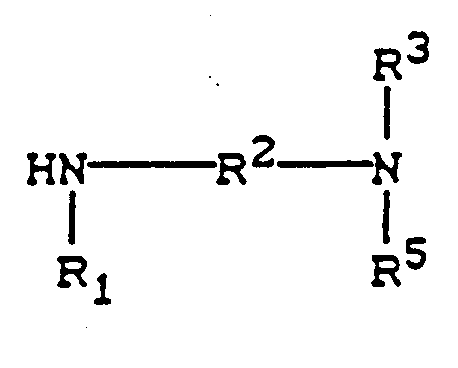
- Suitable amines for the preparation of the polysaccharide derivatives according to the invention are those of the general structure V.
- solubility of the amino or ammonium polysaccharides according to the invention in alcohols or water depends both on the starting material, on the amine (see above), on the degree of substitution, on the alkylating agent and on the degree of quaternization and can be adjusted as required. For example, one obtains insoluble products crosslinked with bisprimary diamines, soluble products with primary / tertiary diamines, while bifunctional alkylating agents in turn produce insoluble polysaccharide derivatives.
- quaternized derivatives which also contain carboxyl end groups, can form insoluble products, particularly after prolonged drying, presumably as a result of a type of "internal" salt formation. However, they can easily be brought back into solution by small amounts of base.
- methyl chloride chloroethanol, dimethyl sulfate, methyl mesylate, methyl tosylate, (meth) allyl chloride, benzyl chloride, 1,6-dibromohexane, epichlorohydrin, 1,4-dichlorobutene-2 are preferred.
- the reaction can be carried out in an excess of the amine used as the reactant or in a suspending agent.
- Suitable suspending agents are hydrocarbons, halogenated hydrocarbons, ethers, alcohol and carboxamides.
- Examples include cyclohexane, heptane, isooctane, benzene, toluene, xylene, chlorobenzene, dichlorobenzene, methylene chloride, chloroform, diethyl ether, diisopropyl ether, dibutyl ether, dioxane, benzodioxane, anisole, dimethoxybenzene, ethylene glycol dimethyl ether, isopropanol, tert-butanol, isopropanol, tert-butanol.
- the polysaccharides contain a few percentages of water, so that additional use of water is not always necessary.
- water content is low or not known, it is advisable to add water to the reaction mixture. It can be between 4 and 120% by weight, based on the polysaccharide used.
- the addition of water in itself is not very critical. However, it should not exceed such an amount that causes an unnecessarily strong swelling or even dissolution of the polysaccharide so that the reaction and workup are not made more difficult.
- the reaction is carried out at temperatures between 20 to 110 °.
- Acids or alkalis can optionally be added as catalysts in amounts of 0.01 to 5% by weight with respect to the cellulose derivative. Suitable are, for example, HCl, H2SO4, H3PO3, NaOH, KOH, LiOH, Ca (OH) 2, Mg (OH) 2.
- the molar ratio of the polysaccharide esters to the amines V or the compounds VI is between 1: 0.5 to 1:10. Of course, molar ratios beyond 1:10 can also be used without danger.
- the reaction time is generally between 3 and 20 hours.
- the water-soluble cationic polysaccharides according to the invention are suitable as additives for hygienic and cosmetic cleaning and care products, as auxiliaries for paper manufacture and for the treatment of textile fibers to improve the handle.
- the water-soluble cationic polysaccharides are also used as aggregating agents. This means flocculation, coagulation and precipitation. Flocculants are process aids for the rational design of solid-liquid separation processes. With their help, the sedimentation rate of water-suspended solids, which are often in colloidal form, can be significantly increased. Effective flocculants almost completely flocculate the suspended particles, so that the residual solids content in the liquid phase is largely minimized. Furthermore, the use of flocculants increases the solids content of the solid phase, which means that mechanical dewatering of the sludge which has settled can be made technically and economically favorable.
- Primary flocculants are chemical compounds that form poorly soluble precipitates in water. These include the Fe, Al and Ca salts used on a large scale in practice. Their addition initially results in charge neutralization, which usually results in suspension particles stabilized by negative surface charges, which destroys the electrical double layer of the particles and causes rapid coagulation.With the progressive hydrolysis of the inorganic compounds, water-soaked voluminous flakes are formed, which trap and contain water constituents. Disadvantages of blocking with the inexpensive inorganic metal salts are the temperature dependence of the flocculation, the binding to a narrow pH range, the relatively low sedimentation speed of the flakes and the formation of large volumes of sludge.
- Flocculants are cationic, anionic or neutral water-soluble polymers of high molecular weight, which do not have these disadvantages. Due to the ion and dipole interactions of the polymers with the suspended particles, the colloidal particles are also initially coagulated here. With a sufficiently high molar mass, the macromolecules are able to combine several of the destabilized particles into fast-depositing, shear-stable macro flakes. Flocculants are widely used in water and wastewater treatment in the petroleum, paper, coal and ore industries and in some branches of the chemical industry.
- the cationic polysaccharides produced according to the invention can be used advantageously. Depending on the degree of cationization and molar masses, they can be tailored to any application.
- Test filters in which a part of the raw material cellulose was replaced by the cationic polysaccharides according to the invention, showed an increased effectiveness in the filtration of germs compared to pyrogenic and endotoxin germs as fiber filters or aluminum oxide filled filter layers.
- Example 1 30 g from Example 1 and 21 g of 3-N, N-dimethylamino-propylamine are stirred in 100 ml of toluene at 100 ° C. for 5 h. After decanting off the solution, washing out several times with isopropanol and drying at 50 ° in vacuo, 22 g of water-soluble aminocellulose with an N content of 6.7 are obtained. This corresponds to a conversion of the ester into aminoamide of approx. 90% and a DS with respect to the amino function of 0.7 and with respect to the carboxylate of 0.2 to 0.3.
- the IR spectrum has a broad, strong carbonamide band at 1670 cm ⁇ 1.
- esterified carboxymethyl cellulose from Example 5 80 g are suspended in 200 ml of toluene and 106 g of 3-N, N-dimethylaminopropylamine and stirred at 60 ° for 9 h. Thereafter, about 90% of the ester aminolysis and after 6 hours at 95 ° C completely. After suction, repeated washing with toluene and drying at 50 ° in vacuo, 86 g of powdery, water-soluble aminocellulose with an N content of 8.1% and a DS of about 0.8 in terms of amino function are obtained.
- Example 6 100 g from Example 6 are suspended in 300 ml of toluene and 100 g of dimethyl sulfate and stirred at 50 ° for 12 h. After suction, washing with toluene and drying at 50 ° in vacuo, 110 g of water-soluble cationic cellulose derivative with an N content of 5.5% and an S content of 6.2% are obtained.
- the DS with respect to the ammonium group is approximately 0.8.
- Carboxymethyl celluloses with a total DS of DSg and an ester DS of DS est , in which the non-esterified part is present as Na salt, is suspended in isopropanol or toluene, mixed with the amine selected for the reaction and 10 hours at 90 to 95 ° stirred, suction filtered, by washing with toluene or isopropanol from excess amine is freed, dried at 50 ° in vacuo and the N content of the amino-amido-celluloses obtained is determined by elemental analysis. In any case, the IR analysis shows more or less pronounced amide, ester and carboxylate bands according to the DS.
- Table 2 lists the results of experiments 17 to 23. High degrees of substitution are calculated from the N and Cl contents, as prescribed by the starting products, the esterified carboxymethyl celluloses.
- Table 4 shows that the derivatized cellulose derivatives according to the invention bring about significantly faster sedimentation of the china clay than the commercially available polymer IR 125 product. Even if the content of active substance (Example 19, DS 0.25) is lower than that of the comparison substance already the superiority of the new cellulose derivatives. If the DS rises to 0.6, the improved effect is pronounced. Surprisingly, the basic, non-quaternized product from Example 9 can also be used as an excellent flocculant.
Landscapes
- Chemical & Material Sciences (AREA)
- Organic Chemistry (AREA)
- Chemical Kinetics & Catalysis (AREA)
- Life Sciences & Earth Sciences (AREA)
- Engineering & Computer Science (AREA)
- Polymers & Plastics (AREA)
- Health & Medical Sciences (AREA)
- Medicinal Chemistry (AREA)
- Materials Engineering (AREA)
- Biochemistry (AREA)
- General Chemical & Material Sciences (AREA)
- Hydrology & Water Resources (AREA)
- Environmental & Geological Engineering (AREA)
- Water Supply & Treatment (AREA)
- Polysaccharides And Polysaccharide Derivatives (AREA)
Claims (7)
- Polysaccharides contenant des motifs récurrents I ou un sel II de ces derniers
 S représente un motif de glucose, de pentose ou de galactose ou encore un motif de glucose de la cellulose, ayant subi une dérivationp représente une valeur de 0 à 2,9m représente une valeur de 0,05 à 2,9m + p représente une valeur de 0,05 à 3,0R représente un groupe alkyle en C₁-C₁₂, un groupe cycloalkyle en C₅-C₆, un groupe aryle en C₆-C₁₂, un groupe aralkyle en C₇-C₁₂, un groupe β-hydroxyalkyle et/ou 1/Z Me, où Me représente un cation et Z représente la valeur du cation,R¹ représente H, un groupe alkyle en C₁-C₄,R² représente un radical alkylène qui peut être interrompu par au moins un atome O ou un atome N, ou encore par une double liaison oléfinique,R³ représente H, un radical alkyle éventuellement substitué par un groupe OH ou par un groupement oléfinique, qui peut être interrompu par au moins un hétéroatome, un radical aralkyle ou encore le radical d'un polysaccharide répondant à la formule Ia dans laquelle les indices et les substituants ont la signification indiquée ci-dessus
 R⁴ est identique ou différent de R³ et est lié avec le même atome N que celui de R³, et il ne peut représenter simultanément avec R³ un groupe alkylène en C₂-C₈ ou Ia,R⁵ représente H, un radical alkyle, un radical aralkyle ou un radical aralkyle,et/ouR³ et R⁵, conjointement avec l'atome N commun, représentent un noyau contenant éventuellement un hétéro-atome supplémentaire,et/ouR¹ et R⁵, conjointement avec R² représentent un noyau,n représente un entier de 1 à 6,X⊖ représente un anion.
- Polysaccharides selon la revendication 1, caractérisés en ce que R² représente un radical III
-[R⁶-Y-]qR⁷- (III)
dans laquelleR⁶ et R⁷, de manière identique ou différente, représentent un radical alkylène éventuellement interrompu par un atome O, contenant de 2 à 6 atomes de carbone,Y représente O ou le groupement q représente un entier de 1 à 5X⊖ représente un anion.
- Polysaccharides selon l'une quelconque des revendications précédentes 1 ou 2, caractérisés en ce queR représente H, Na, CH₃,R¹ représente un atome d'hydrogène,R² représente -(CH₂-)₃-,R³, R⁴ et R⁵ représentent CH₃, CH₂CH₂OH, H,R³ représente en outre Ia,X⊖ représente un chlorure, CH₃SO₄⁻, un bromure,n représente 1,p représente de 0,1 à 1,9,m représente de 0,2 à 2,0,s représente un motif de glucose ou de pentose.
- Polysaccharides selon au moins une des revendications 1-3, caractérisés en ce que les motifs de monosaccharides S sont liés à un motif de cellulose.
- Polysaccharides selon la revendication 1, caractérisés en ce qu'ils sont présents sous la forme du sel II et contiennent le motif répondant à la formule ci-après

n, R¹, R², R³, R⁴, R⁵ et X⊖, p et m ont la signification indiquée dans la revendication 1, et en ce que1) la teneur en eau dans le mélange réactionnel s'élève à au moins 4-120% en poids rapportés à l'ester de structure IV,2) le rapport molaire de l'ester de polysaccharide IV à l'amine V s'élève de préférence de 1:0,5 à 1:10,3) le temps réactionnel s'élève de préférence entre 3 et 20 heures,4) la température réactionnelle s'élève de préférence entre 20 et 110°C,5) on ajoute des acides ou des alcalis comme catalyseurs dans des quantités de 0,01 à 5% en poids, rapportées au dérivé ester IV. - Procédé pour la préparation de polysaccharides selon l'une quelconque des revendications 1 à 5, par la mise en réaction d'esters de structure IV

 r représente une valeur de 0 à 2,5,s représente une valeur de 2,9 à 0,05,r + s représente une valeur de 0,05 à 3,0,R⁸ représente un groupe alkyle en C₁-C₁₂, un groupe cycloalkyle en C₅-C₆, un groupe aryle en C₆-C₁₂, un groupe aralkyle en C₇-C₁₂, un groupe β-hydroxyalkyle,et dans laquelle, les autres substituants ont la signification indiquée à la revendication 1.
- Utilisation des dérivés de polysaccharides selon au moins une des revendications précédentes 1 - 5 comme adjuvant de floculation.
Applications Claiming Priority (2)
| Application Number | Priority Date | Filing Date | Title |
|---|---|---|---|
| DE3939951 | 1989-12-02 | ||
| DE3939951A DE3939951A1 (de) | 1989-12-02 | 1989-12-02 | Basische polysaccharide |
Publications (2)
| Publication Number | Publication Date |
|---|---|
| EP0431387A1 EP0431387A1 (fr) | 1991-06-12 |
| EP0431387B1 true EP0431387B1 (fr) | 1995-09-06 |
Family
ID=6394710
Family Applications (1)
| Application Number | Title | Priority Date | Filing Date |
|---|---|---|---|
| EP90122136A Expired - Lifetime EP0431387B1 (fr) | 1989-12-02 | 1990-11-20 | Polysaccharides basiques |
Country Status (4)
| Country | Link |
|---|---|
| EP (1) | EP0431387B1 (fr) |
| CA (1) | CA2031329A1 (fr) |
| DE (2) | DE3939951A1 (fr) |
| FI (1) | FI905889A7 (fr) |
Families Citing this family (1)
| Publication number | Priority date | Publication date | Assignee | Title |
|---|---|---|---|---|
| US11566167B2 (en) | 2019-12-18 | 2023-01-31 | King Fahd University Of Petroleum And Minerals | Gemini surfactants containing an unsaturated linker for clay swelling inhibition |
Family Cites Families (4)
| Publication number | Priority date | Publication date | Assignee | Title |
|---|---|---|---|---|
| FR1150351A (fr) * | 1955-08-18 | 1958-01-10 | Henkel & Cie Gmbh | Procédé de préparation des amides des acides carboxyliques des éthers cellulosiques |
| FR1493421A (fr) * | 1965-08-03 | 1967-09-01 | Scholten Chemische Fab | Dérivés d'ammonium quaternaire de polysaccharides, et leur emploi |
| DE3302456A1 (de) * | 1983-01-26 | 1984-07-26 | Henkel KGaA, 4000 Düsseldorf | Kationische gellulosederivate, deren herstellung und verwendung in kosmetischen mitteln |
| DE3820031A1 (de) * | 1988-06-13 | 1989-12-14 | Goldschmidt Ag Th | Stickstoff enthaltende derivate der carboxymethylcellulose, deren herstellung und deren verwendung in kosmetischen zubereitungen |
-
1989
- 1989-12-02 DE DE3939951A patent/DE3939951A1/de not_active Withdrawn
-
1990
- 1990-11-20 EP EP90122136A patent/EP0431387B1/fr not_active Expired - Lifetime
- 1990-11-20 DE DE59009626T patent/DE59009626D1/de not_active Expired - Fee Related
- 1990-11-29 FI FI905889A patent/FI905889A7/fi not_active Application Discontinuation
- 1990-12-03 CA CA002031329A patent/CA2031329A1/fr not_active Abandoned
Also Published As
| Publication number | Publication date |
|---|---|
| DE3939951A1 (de) | 1991-06-06 |
| EP0431387A1 (fr) | 1991-06-12 |
| CA2031329A1 (fr) | 1991-06-03 |
| FI905889A7 (fi) | 1991-06-03 |
| DE59009626D1 (de) | 1995-10-12 |
| FI905889A0 (fi) | 1990-11-29 |
Similar Documents
| Publication | Publication Date | Title |
|---|---|---|
| DE1593657C2 (de) | Quaternäre Stickstoff enthaltende Celluloseether und Verfahren zu deren Herstellung | |
| DE2616220C2 (de) | Kationische wasserlösliche Amin- Epichlorhydrin-Polykondensate, Verfahren zu deren Herstellung und deren Verwendung | |
| EP0472075B1 (fr) | Procédé de préparation de polysaccharides | |
| DE69220664T2 (de) | Kationische polysaccharide | |
| DE1418604A1 (de) | Gelbildende hochmolekulare Substanzen und Verfahren zu ihrer Herstellung | |
| DE1468016A1 (de) | Verfahren zur Herstellung von Hydroxypropyl-Cellulose | |
| EP0161607A2 (fr) | Procédé pour la préparation d'éthers mixtes de cellulose, solubles dans l'eau | |
| DE3008413A1 (de) | Verfahren zur herstellung von aethylcarboxymethylcellulose | |
| EP1384727A1 (fr) | Dérivés de cellulose ayant des propriétés rhéologiques de type gel et procédé de leur préparation | |
| DE2636935A1 (de) | Verfahren zur herstellung von polysaccharidaethern | |
| DE2244513A1 (de) | Amin-modifizierte polyalkylenoxide | |
| EP0273335A2 (fr) | Floculants et aides de filtration et leur application | |
| EP0147369B1 (fr) | Produit cellulosique modifié ioniquement, sa préparation et application | |
| EP0621286A1 (fr) | Procédé de silylation d'hydrates de carbone et utilisation des hydrates de carbone silylatés | |
| DE2651802A1 (de) | Verfahren zur herstellung von zelluloseaethern | |
| DE2813921C2 (de) | Verfahren zur Herstellung von ionischen Pullulangelen sowie deren Verwendung als Molekularsiebe zur Trennung und Reinigung | |
| DE3820031C2 (fr) | ||
| EP0367003B1 (fr) | Polysaccharides, procédé pour leur préparation et application | |
| EP0825199B1 (fr) | Procédé pour la préparation d'éthers de la cellulose solubles dans l'eau avec récupération d'hydroxyde de sodium | |
| EP0117490A2 (fr) | Procédé pour la préparation d'éthers de la cellulose en présence d'un agent dispersant contenant aussi du diméthoxyéthane | |
| EP0431387A1 (fr) | Polysaccharides basiques | |
| DE102004035869A1 (de) | Verfahren zur Herstellung von aminogruppenhaltigen Cellulosederivaten sowie deren Verwendung in kosmetischen Zubereitungen der Wasseraufbereitung und der Papierherstellung | |
| DE1946722A1 (de) | Verfahren zur Herstellung von Diaminoalkylgruppen enthaltenden Cellulosederivaten | |
| DE2406367A1 (de) | Verfahren zur herstellung von ionenbindungen aufweisenden polyaethern | |
| DE3039963A1 (de) | Wasserloesliche cellulosemischether mit einem phosphonomethylsubstituenten und ein verfahren zu ihrer herstellung |
Legal Events
| Date | Code | Title | Description |
|---|---|---|---|
| PUAI | Public reference made under article 153(3) epc to a published international application that has entered the european phase |
Free format text: ORIGINAL CODE: 0009012 |
|
| 17P | Request for examination filed |
Effective date: 19901120 |
|
| AK | Designated contracting states |
Kind code of ref document: A1 Designated state(s): BE DE FR GB IT NL SE |
|
| 17Q | First examination report despatched |
Effective date: 19930914 |
|
| GRAA | (expected) grant |
Free format text: ORIGINAL CODE: 0009210 |
|
| AK | Designated contracting states |
Kind code of ref document: B1 Designated state(s): BE DE FR GB IT NL SE |
|
| PGFP | Annual fee paid to national office [announced via postgrant information from national office to epo] |
Ref country code: DE Payment date: 19951012 Year of fee payment: 6 |
|
| REF | Corresponds to: |
Ref document number: 59009626 Country of ref document: DE Date of ref document: 19951012 |
|
| ET | Fr: translation filed | ||
| PGFP | Annual fee paid to national office [announced via postgrant information from national office to epo] |
Ref country code: SE Payment date: 19951018 Year of fee payment: 6 |
|
| PGFP | Annual fee paid to national office [announced via postgrant information from national office to epo] |
Ref country code: FR Payment date: 19951030 Year of fee payment: 6 |
|
| PGFP | Annual fee paid to national office [announced via postgrant information from national office to epo] |
Ref country code: GB Payment date: 19951113 Year of fee payment: 6 |
|
| ITF | It: translation for a ep patent filed | ||
| PGFP | Annual fee paid to national office [announced via postgrant information from national office to epo] |
Ref country code: BE Payment date: 19951122 Year of fee payment: 6 |
|
| PGFP | Annual fee paid to national office [announced via postgrant information from national office to epo] |
Ref country code: NL Payment date: 19951130 Year of fee payment: 6 |
|
| GBT | Gb: translation of ep patent filed (gb section 77(6)(a)/1977) |
Effective date: 19951102 |
|
| PLBE | No opposition filed within time limit |
Free format text: ORIGINAL CODE: 0009261 |
|
| STAA | Information on the status of an ep patent application or granted ep patent |
Free format text: STATUS: NO OPPOSITION FILED WITHIN TIME LIMIT |
|
| 26N | No opposition filed | ||
| PG25 | Lapsed in a contracting state [announced via postgrant information from national office to epo] |
Ref country code: GB Effective date: 19961120 |
|
| PG25 | Lapsed in a contracting state [announced via postgrant information from national office to epo] |
Ref country code: SE Effective date: 19961121 |
|
| PG25 | Lapsed in a contracting state [announced via postgrant information from national office to epo] |
Ref country code: BE Effective date: 19961130 |
|
| BERE | Be: lapsed |
Owner name: WOLFF WALSRODE A.G. Effective date: 19961130 |
|
| PG25 | Lapsed in a contracting state [announced via postgrant information from national office to epo] |
Ref country code: NL Effective date: 19970601 |
|
| GBPC | Gb: european patent ceased through non-payment of renewal fee |
Effective date: 19961120 |
|
| PG25 | Lapsed in a contracting state [announced via postgrant information from national office to epo] |
Ref country code: FR Effective date: 19970731 |
|
| NLV4 | Nl: lapsed or anulled due to non-payment of the annual fee |
Effective date: 19970601 |
|
| PG25 | Lapsed in a contracting state [announced via postgrant information from national office to epo] |
Ref country code: DE Effective date: 19970801 |
|
| EUG | Se: european patent has lapsed |
Ref document number: 90122136.6 |
|
| REG | Reference to a national code |
Ref country code: FR Ref legal event code: ST |
|
| PG25 | Lapsed in a contracting state [announced via postgrant information from national office to epo] |
Ref country code: IT Free format text: LAPSE BECAUSE OF NON-PAYMENT OF DUE FEES;WARNING: LAPSES OF ITALIAN PATENTS WITH EFFECTIVE DATE BEFORE 2007 MAY HAVE OCCURRED AT ANY TIME BEFORE 2007. THE CORRECT EFFECTIVE DATE MAY BE DIFFERENT FROM THE ONE RECORDED. Effective date: 20051120 |