EP0431743B1 - Cathéter endoluminal pour l'excision de tissu - Google Patents
Cathéter endoluminal pour l'excision de tissu Download PDFInfo
- Publication number
- EP0431743B1 EP0431743B1 EP90311775A EP90311775A EP0431743B1 EP 0431743 B1 EP0431743 B1 EP 0431743B1 EP 90311775 A EP90311775 A EP 90311775A EP 90311775 A EP90311775 A EP 90311775A EP 0431743 B1 EP0431743 B1 EP 0431743B1
- Authority
- EP
- European Patent Office
- Prior art keywords
- catheter
- excision
- tissue
- cutting head
- distal end
- Prior art date
- Legal status (The legal status is an assumption and is not a legal conclusion. Google has not performed a legal analysis and makes no representation as to the accuracy of the status listed.)
- Expired - Lifetime
Links
Images

Classifications
-
- A—HUMAN NECESSITIES
- A61—MEDICAL OR VETERINARY SCIENCE; HYGIENE
- A61B—DIAGNOSIS; SURGERY; IDENTIFICATION
- A61B17/00—Surgical instruments, devices or methods
- A61B17/32—Surgical cutting instruments
- A61B17/3205—Excision instruments
- A61B17/3207—Atherectomy devices working by cutting or abrading; Similar devices specially adapted for non-vascular obstructions
- A61B17/32075—Pullback cutting; combined forward and pullback cutting, e.g. with cutters at both sides of the plaque
Definitions
- This invention relates to an Endoluminal Tissue Excision Catheter (ETEC) for the excision of tissue within the lumen of a vessel in a human or animal.
- ETEC Endoluminal Tissue Excision Catheter
- an excision catheter having a rearwardly directed cutting edge in surrounding relationship to an excised tissue collection chamber.
- the sheathing catheter carries at its distal end a cap which is engageable into the rearwardly open end of the tissue collection chamber. That end cap has a plain cylindrical surface.
- an excision catheter for excising tissue from within the lumen of a tubular vessel within the human or animal body, the catheter comprising a first tubular catheter member advanceable into the tubular vessel over a guide wire preinserted therein, said first catheter member carrying at its distal end a rearwardly open, hollow, rigid cylindrical cutting head advanceable into the tubular vessel to a location situated beyond the tissue to be excised, said cutting head having a rearwardly directed circular cutting edge at its proximal end and rearwardly open inner chamber for the collection of tissue excised from the lumen of the tubular vessel as the catheter is retracted back through the vessel in the opposite direction to the direction of insertion, a tubular, sheathing catheter member coaxially sheathing the first catheter and carrying at its distal end a plug member which is engageable in the proximal end of the tissue collection chamber so as to close the tissue collection chamber in the cutting head prior to the withdrawal of the catheter and cutting head from the tubular vessel, but after the said retraction of
- the Endoluminal Tissue Excision Catheter system (abbreviated herein to ETEC), thus comprises a pull-back catheter of the type described in US-A-4765332, but in which the collection chamber for the excised tissue can be positively sealed by retraction against a tapered plug carried by the distal end of the closing or outer sheathing catheter prior to withdrawal of the ETEC from the body, that tapered plug serving to space that cutting edge a small distance from the internal wall of the lumen, and thus preventing accidental damage to the lumen during insertion and withdrawal of the catheter.
- ETEC Endoluminal Tissue Excision Catheter system
- the plug on the distal end of the sheathing catheter has a cylindrical proximal portion, the diameter of which is approximately equal to the diameter of the cutting head and a tapering distal end or nose portion which engages into and seals the open end of the tissue collection chamber with the cutting edge engaging the tapering surface of that distal end portion throughout a full 360° arc.
- the ETEC has a flexible plastic tip which facilitates entry over a guide wire into the lumen of a vessel such as an artery. While it is being pushed forward through an arterial stenosis (or any obstructive tissue) the ETEC would be closed, i.e. the single cutting edge of the cut/collect catheter portion of the ETEC system would be in contact with the distal end of a closing catheter that surrounds most of the length of the cut/collect catheter. After ETEC's distal end is passed beyond the tissue to be excised, the closing catheter would then be pulled back so as to expose the single cutting blade.
- the cutting blade would then be pulled back (typically while rotating) and the excised tissue would collect into a tissue collection chamber until the blade was in contact again with the tapering surface of the end plug carried by the distal end of the closing catheter. Thus the cut tissue is completely contained and the cutting edge is protected.
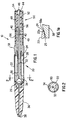
- Figure 1 is a longitudinal cross-sectional view of the distal end of the ETEC system 10 which consists of a cut/collect catheter 20 and a closing catheter 50.
- the cut/collect catheter 20 has a cutting cylinder 22 with a cutting edge 24 at its proximal end and which cylinder 22 encloses a tissue collection chamber 28 where the cut tissue is collected.
- a cylinder support 30 Inside the chamber 28 is a cylinder support 30 that (as also seen in FIG. 2 which is the section at 2-2 of FIG. 1) has two passagways 34 that allow fluid communication between the interior lumen 32 of the support 30 and the collection chamber 28.
- the support 30 would typically be spot welded at one or more points to the cylinder 22.
- the cutting cylinder's distal end 26 is formed with indentations to securely hold onto a flexible plastic tip 36 which has a lumen 38 that is in fluid communication with the lumen 32.
- the proximal end of the cylinder support 30 is welded to the distal end of a metal cannula 40 which has an interior lumen 42 as shown in FIG. 1.
- the proximal end of the cannula 40 is attached to the distal end of a plastic torqueing cylinder 44 which has a central lumen 46 which is in fluid communication with the other interior lumens of the ETEC 10.
- a machined cut-out 48 in the cannula 40 provides a secure mechanical attachment of the torqueing cylinder 44 to the cannula 40.
- a separate non-spinning washer cylinder 49 surrounds the metal cannula. Its function is to remain stationary relative to the tissue being excised while the cutting cylinder 22 is being rotated.
- the distal end of the closing catheter 50 is also shown in FIG. 1.
- the closing catheter cylinder 52 surrounds the torqueing cylinder 44 of the cut/collect catheter.
- a passageway 54 is formed between the outer surface of the torqueing cylinder 44 and the inner surface of the closing catheter cylinder 52. Solutions such as contrast media or medication can be injected at the proximal end of the closing catheter 50 (see FIG. 3) and that liquid will then enter an artery or other body vessel through one or more vent holes 56 at the distal end of the closing catheter 50.
- a metal tip or plug 58 Connected to the distal end of the cylinder 52 is a metal tip or plug 58.
- This plug has a cylindrical proximal end portion connected to the distal end of the cylindrical catheter 52 and a tapering distal end or nose portion that engages into and seals the open end of the tissue collection chamber 28, and when so engaged the tapering nose of the plug makes contact with the cutting end of the cutting cylinder 22 around a full circle 25, shown in Figure 1a.
- the outer surface of the cylindrical proximal end portion of the plug has a diameter that is approximately equal to the external diameter of the cylindrical cutting head 22, so that when the catheter system is inserted into or withdrawn from the lumen of the artery A (see Figure 5) before and after the excision of the stenotic plaque P, respectively, that cylindrical surface of the plug engages the wall of the artery and serves to space the cutting edge 24 of the cutting cylinder 22 a small distance from the interior wall of the lumen, thus to further prevent the cutting edge damaging the wall of the lumen during the insertion and withdrawal of the cutting head.
- the tapered distal end portion of the metal tip 58 provides a tapered conical surface 58a which has a smaller apex angle as compared to the apex angle of the cone 22a on the inner surface at the proximal end of the cutting cylinder 22.
- This construction prevents the edge 24 from coming in contact with the metal tip 58.
- the edge 24 is not made dull by contacting the metal tip 58.
- An alternative design would be to have a plastic end for the cylinder 52 into which the edge 24 could be imbedded without becoming dull.
- FIG. 2 a transverse cross section at position 2-2 of Figure 1, shows the detail of the two fluid passageways 34, the lumen 32 and the connection of the support 30 to the cutting cylinder 22.
- FIG 3 is a partial cross section of the proximal end of the ETEC system 10.
- a cross section of the torquing catheter 44 having an interior lumen 46 and the closing catheter cylinder 52.
- a plastic Luer fitting 51 is moulded onto the proximal end of the catheter 52.
- the two finger wings 53 are available to prevent rotation of the fitting 51 when the nut 55 is tightened.
- the nut 55 and sealing gland 57 are part of a Touhy-Borst fitting 58 which is used to seal off the proximal end of the passageway 54.
- a side-port 63 in the Touhy-Borst fitting 58 allows a syringe (not shown) to be connected for distally injecting contrast media through the distal vent hole(s) 56.
- Either a check valve or a single-port or a multiple-port stop cock can be connected at the side-port 63 to seal off the back flow of blood when the distal end of the ETEC 10 is placed in an artery.
- the sealing gland 57 in the Touhy-Borst fitting 58 seals against the outer surface of the torqueing cylinder 44.
- a Luer fitting 60 with two finger wings 62 is molded onto the proximal end of the torqueing cylinder 44.
- a guide wire can be inserted through the proximal end of the fitting 60 and then can be advanced until the distal end of the guide wire passes through the flexible tip 36 (see FIG. 1).
- a guide wire (as shown partially in FIG. 5) can first be advanced within the lumen of a human (or animal) vessel and the entire ETEC system 10 can then be advanced over the guide wire to that site in the vessel where tissue is to be excised.
- the proximal end of the ETEC 10 is designed so that there is a gap G between the proximal surface 59 of the Touhy-Borst fitting 58 and the distal surface 61 of the Luer fitting 60.
- This gap G determines the maximum distance that the cutting edge 24 of the cut/collect catheter 20 (see FIG. 5) can be separated from the metal tip 58 of the closing catheter 50.
- This gap G would typically be between 1 and 30 mm long.
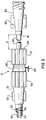
- FIG. 4 shows a rotator 70 which has a case 71 which encloses a battery 72 and a d-c motor-gear reducer assembly 73.
- the battery is electrically connected to the motor assembly 73 which causes rotation of the motor shaft onto which is mounted the small spur gear 74 which in turn rotates the large spur gear 75 which is mechanically joined to the rotating tube 76.
- the rotating tube 76 is attached at its distal end to a Luer fitting 79 which can be securely connected to the Luer fitting 60 ( Figure 3) located at the proximal end of the cut/collect catheter 20. When connected, these fittings provide a mechanical connection which is also a fluid seal.
- rotating tube 76 nests into a rear cylinder 77 which does not rotate.
- the proximal end of the cylinder 77 has a sealing gland 78 that seals against the guide wire 80 to prevent the distal top of the guide wire 80 from whipping around in the vessel when the cut/collect catheter 20 is being rotated.
- the guide wire passes through the entire length of the rotator 70 as well as extending through the entire length of the ETEC 10.
- the torque vs rotational speed curve of the rotator is such that at essentially zero torque, the rotating cylinder 76 (and therefore the cut/collect catheter 20) would rotate at approximately a resistive torque, as would be experienced when it cuts through highly calcified plaque or when the edge 24 engages the metal tip 58, the rotation rate slows considerably.
- the slower rotation rate is detected by the ETEC operator as a decreased audible tone which indicates that the cut is completed or that there is more resistive torque being experienced by the cutting edge 24. This feature of a detectable audible tone which depends upon the resistive torque provides valuable information to the operator when performing tissue excision from a vessel.
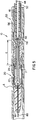
- Figure 5 shows the excision catheter system of Figure 1 in the open position and with the distal end of the cut/collect catheter 20 advanced over a guide wire 80 beyond a stenotic plaque P within a human artery A.
- Figure 5 shows the cutting edge 24 of the cylinder 22 being pulled back into the plaque P.
- the cutting cylinder 22 could typically be rotated at approximately 2000 RPM while the closing catheter is not rotated.
- the metal cannula 40 is somewhat longer than the gap G as shown in FIG. 5.
- this vessel straightening effect will tend to reduce the probability of perforating the vessel wall during the excision procedure.
- the cutting cylinder 22 is typically made from a hardened stainless cutlery steel such as Type 455.
- the remaining metal parts of ETEC 10 are typically made from a stainless steel such as Type 304 or 316.
- the plastic parts of the ETEC 10 are typically Nylon, or polyurethane or polyethylene, or other materials having similar properties.
- the method for performing the tissue excision is as follows:
- the entire ETEC 10 can be pulled back while maintaining a fixed gap G between the cutting edge 24 and the metal tip 58. Once the desired length has been transversed by ETEC 10, then the metal tip 58 can be held fixed relative to the vessel while the cutting edge 24 is pulled back to it. This final closure provides containment of the cut tissue within the collection chamber 28.
- the design of the ETEC system is such that it is well suited to excise tissue from a variety of vessels from within a living body, for example for the purpose of biopsy.
- the ETEC system could be advanced over a guide wire into a bile duct and there it could be used to obtain a tissue sample for biopsy.
- excision of tissue from the urethra, ureter, fallopian tubes or other vessels of a living body could be readily accomplished with the ETEC system.
- Still further ETEC could be used to simultaneously remove thrombus and plaque in an early stage of myocardial infarction thus opening a clogged coronary artery for the free flow of blood.
- An anti-thrombogenic agent such as tPA could simultaneously be injected into the artery through the vent holes at the distal end of the closing catheter in order to efficiently dissolve any residual thrombus.
- the ETEC system could also be used to remove plaque that has been dissected off the wall of an artery subsequent to balloon angioplasty. Such action could readily be used to open a clogged artery and preclude the necessity for vascular surgery.
Landscapes
- Health & Medical Sciences (AREA)
- Surgery (AREA)
- Life Sciences & Earth Sciences (AREA)
- Medical Informatics (AREA)
- Animal Behavior & Ethology (AREA)
- Engineering & Computer Science (AREA)
- Biomedical Technology (AREA)
- Heart & Thoracic Surgery (AREA)
- Vascular Medicine (AREA)
- Molecular Biology (AREA)
- Nuclear Medicine, Radiotherapy & Molecular Imaging (AREA)
- General Health & Medical Sciences (AREA)
- Public Health (AREA)
- Veterinary Medicine (AREA)
- Surgical Instruments (AREA)
- Materials For Medical Uses (AREA)
- Media Introduction/Drainage Providing Device (AREA)
Claims (14)
- Cathéter d'excision pour exciser du tissu dans la lumière d'un vaisseau tubulaire dans le corps humain ou animal, le cathéter comprenant un premier organe de cathéter tubulaire (20) pouvant être avancé dans le vaisseau tubulaire sur un fil de guidage (80) inséré au préalable en son sein, ledit premier organe de cathéter supportant à son extrémité distale un cylindre ou tête de coupe cylindrique, rigide, creux, ouvert vers l'arrière (22) pouvant être avancé dans le vaisseau tubulaire jusqu'à un emplacement situé au-delà du tissu à exciser, ledit cylindre de coupe (22) comportant un bord de coupe circulaire (24), dirigé vers l'arrière, à son extrémité proximale et une chambre interne ouverte vers l'arrière (28) pour collecter le tissu excisé de la lumière du vaisseau tubulaire tandis que le cathéter est rétracté vers l'arrière dans le vaisseau dans la direction opposée à la direction d'insertion, un organe de cathéter de fermeture, tubulaire (52), gainant co-axialement le premier cathéter (20) et supportant à son extrémité distale un obturateur (58) qui peut être engagé dans l'extrémité proximale de la chambre de collecte de tissu (28) afin de fermer la chambre de collecte de tissu (28) dans le cylindre de coupe (22) avant le retrait du cathéter et du cylindre de coupe (22) du vaisseau tubulaire, mais après ladite rétraction dudit cylindre de coupe (22) dans ledit tissu, et donc enfermer hermétiquement le tissu excisé dans la chambre de collecte (28), caractérisé en ce que l'obturateur (58) sur l'extrémité distale de l'organe de cathéter de fermeture (52) comporte une portion proximale cylindrique reliée à l'extrémité distale du cathéter de fermeture et une portion de bec ou d'extrémité distale conique qui se rétrécit jusqu'à un diamètre minimal à l'extrémité distale de l'obturateur, ce diamètre minimal étant inférieur au diamètre du bord de coupe (24) et le diamètre du bord de coupe étant inférieur à celui de la portion proximale cylindrique de l'obturateur de manière que l'extrémité distale de l'obturateur puisse être engagée dans l'extrémité ouverte vers l'arrière de la chambre de collecte de tissu (28) et, lorsqu'elle est ainsi engagée, la surface conique de l'obturateur engage l'extrémité proximale du cylindre de coupe (22) sur toute sa circonférence avec ladite portion proximale cylindrique de l'obturateur servant à espacer le bord de coupe de la paroi interne de la lumière.
- Cathéter d'excision selon la revendication 1, dans lequel l'extrémité ouverte du cylindre de coupe (22) est chanfreinée (22a) pour former un bord de coupe vers l'arrière annulaire (24) entourant l'extrémité ouverte du cylindre.
- Cathéter d'excision selon la revendication 2, dans lequel ledit obturateur (58) est une pointe de métal montée sur l'extrémité distale de l'organe de cathéter de fermeture (57) et dans lequel l'angle de cône de la portion de bec de l'obturateur (58) diffère de l'angle de chanfrein du bord de coupe (24) afin d'empêcher un engagement du bord de coupe (24) avec l'obturateur de métal (58) et donc un épointage du bord de coupe.
- Cathéter d'excision selon la revendication 1, dans lequel ledit obturateur (58) sur l'extrémité distale de l'organe de cathéter de fermeture (52) est en plastique dans lequel le bord de coupe (24) du cylindre de coupe (22) peut être enfoncé sans épointage du bord de coupe.
- Cathéter d'excision selon l'une quelconque des revendications 1 à 4, dans lequel un ou plusieurs passages (34) sont formés entre l'intérieur de ladite chambre de collecte (28) et la lumière (32) du premier organe de cathéter (20) pour permettre d'évacuer le tissu collecté de la chambre de collecte (28) après le retrait du cathéter du corps.
- Cathéter d'excision selon l'une quelconque des revendications 1 à 5, dans lequel le cylindre de coupe (22) supporte une pointe flexible creuse allongée (36) pour garantir un meilleur cheminement du cathéter sur le fil de guidage (80) durant l'insertion dans le corps.
- Cathéter d'excision selon l'une quelconque des revendications 1 à 6, dans lequel le premier organe de cathéter (20) et l'organe de cathéter de fermeture (52) sont espacés l'un de l'autre pour former un passage annulaire (54) pour faire passer un fluide de contraste ou un autre fluide dans le vaisseau tubulaire va des orifices de sortie (56) formés dans l'extrémité distale du cathéter de fermeture.
- Cathéter d'excision selon la revendication 7, comprenant une soupape d'arrêt ou vanne de non-retour à l'extrémité proximale de l'organe de cathéter de fermeture (52) pour empêcher un reflux de sang ou d'autres fluides du corps dans ledit passage annulaire (54).
- Cathéter d'excision selon l'une quelconque des revendications 1 à 8, comprenant un moyen de commande d'espace qui limite la distance sur laquelle l'organe de cathéter de fermeture (52) peut être rétracté par rapport au premier organe de cathéter (20) afin d'exposer le bord de coupe (24) du cylindre de coupe (22).
- Cathéter d'excision selon l'une quelconque des revendications 1 à 9, dans lequel le cylindre de coupe (22) est monté sans rotation sur le premier organe de cathéter (20) qui est un cathéter de transmission de couple monté à rotation dans l'organe de cathéter de fermeture (52), et un moyen d'entraînement rotatif (70) est adapté à être relié à l'extrémité proximale du cathéter de transmission de couple (20) pour faire tourner le cylindre de coupe (22) durant l'excision dudit tissu.
- Cathéter d'excision selon la revendication 10, dans lequel le moyen d'entraînement rotatif (70) émet une tonalité audible qui varie avec la vitesse de rotation du cylindre de coupe.
- Cathéter d'excision selon la revendication 11, dans lequel ladite tonalité audible perd de sa hauteur de son lorsque diminue la vitesse de rotation du cylindre de coupe.
- Cathéter d'excision selon la revendication 10, 11 ou 12, dans lequel le moyen d'entraînement rotatif (70) pouvant être relié à l'extrémité proximale du cathéter de transmission de couple (20) comporte un passage le traversant qui permet au moyen d'entraînement rotatif (70) d'être enfilé sur l'extrémité proximale du fil de guidage (80) pour relier le moyen d'entraînement rotatif au cathéter de transmission de couple.
- Cathéter d'excision selon la revendication 13, dans lequel le moyen d'entraînement rotatif (70) comprend un moyen (78) pour serrer le fil de guidage (80) lorsqu'il est enfilé sur lui afin d'empêcher le fil (80) de tourner lorsque le moyen d'entraînement rotatif est actionné.
Applications Claiming Priority (2)
| Application Number | Priority Date | Filing Date | Title |
|---|---|---|---|
| US447187 | 1989-12-07 | ||
| US07/447,187 US5011490A (en) | 1989-12-07 | 1989-12-07 | Endoluminal tissue excision catheter system and method |
Publications (2)
| Publication Number | Publication Date |
|---|---|
| EP0431743A1 EP0431743A1 (fr) | 1991-06-12 |
| EP0431743B1 true EP0431743B1 (fr) | 1996-08-28 |
Family
ID=23775341
Family Applications (1)
| Application Number | Title | Priority Date | Filing Date |
|---|---|---|---|
| EP90311775A Expired - Lifetime EP0431743B1 (fr) | 1989-12-07 | 1990-10-26 | Cathéter endoluminal pour l'excision de tissu |
Country Status (7)
| Country | Link |
|---|---|
| US (1) | US5011490A (fr) |
| EP (1) | EP0431743B1 (fr) |
| JP (1) | JPH03186256A (fr) |
| AT (1) | ATE141771T1 (fr) |
| AU (1) | AU623575B2 (fr) |
| CA (1) | CA2027489C (fr) |
| DE (1) | DE69028283T2 (fr) |
Families Citing this family (95)
| Publication number | Priority date | Publication date | Assignee | Title |
|---|---|---|---|---|
| US5366463A (en) * | 1990-05-02 | 1994-11-22 | Ryan William J | Atherectomy catheter for the removal of atherosclerosis from within blood vessels |
| US5127902A (en) * | 1990-09-05 | 1992-07-07 | Medical Innovative Technologies R&D Limited Partnership | Apparatus and method for precisely controlling the excision of obstructive tissue in a human blood vessel |
| US5192268A (en) * | 1991-06-27 | 1993-03-09 | Samuel Shiber | Flexible thrombectomy system |
| DE69230829T2 (de) * | 1991-09-04 | 2000-11-09 | David S. Zimmon | Biopsievorrichtung |
| US5197485A (en) * | 1991-10-15 | 1993-03-30 | Pilling Co. | Method and apparatus for sampling aortic plaque |
| US5224949A (en) * | 1992-01-13 | 1993-07-06 | Interventional Technologies, Inc. | Camming device |
| WO1993019679A1 (fr) * | 1992-04-07 | 1993-10-14 | The Johns Hopkins University | Systeme de catheter de fragmentation mecanique intradermique |
| US5287857A (en) * | 1992-06-22 | 1994-02-22 | David Mann | Apparatus and method for obtaining an arterial biopsy |
| US5571122A (en) * | 1992-11-09 | 1996-11-05 | Endovascular Instruments, Inc. | Unitary removal of plaque |
| US5628719A (en) * | 1992-11-25 | 1997-05-13 | Scimed Life Systems, Inc. | In vivo mechanical energy source and perfusion pump |
| DE4307642C1 (de) * | 1993-03-11 | 1994-06-09 | Redha Falah | Medizinisches Instrument zur Beseitigung von Ablagerungen |
| CH685738A5 (fr) * | 1993-03-25 | 1995-09-29 | Ferromec Sa | Instrument médical pour l'élimination de dépôts formés sur les parois intérieures des artères ou des veines. |
| US5520635A (en) * | 1994-12-16 | 1996-05-28 | Gelbfish; Gary A. | Method and associated device for removing clot |
| US5928218A (en) * | 1994-12-16 | 1999-07-27 | Gelbfish; Gary A. | Medical material removal method and associated instrumentation |
| US7384423B1 (en) | 1995-07-13 | 2008-06-10 | Origin Medsystems, Inc. | Tissue dissection method |
| US5882329A (en) * | 1997-02-12 | 1999-03-16 | Prolifix Medical, Inc. | Apparatus and method for removing stenotic material from stents |
| EP1007139A4 (fr) | 1997-02-12 | 2000-06-14 | Prolifix Medical Inc | Appareil d'extraction de matiere de protheses endovasculaires |
| US7037316B2 (en) * | 1997-07-24 | 2006-05-02 | Mcguckin Jr James F | Rotational thrombectomy device |
| US6090118A (en) * | 1998-07-23 | 2000-07-18 | Mcguckin, Jr.; James F. | Rotational thrombectomy apparatus and method with standing wave |
| US6142955A (en) * | 1997-09-19 | 2000-11-07 | United States Surgical Corporation | Biopsy apparatus and method |
| US6561998B1 (en) | 1998-04-07 | 2003-05-13 | Transvascular, Inc. | Transluminal devices, systems and methods for enlarging interstitial penetration tracts |
| US6001112A (en) | 1998-04-10 | 1999-12-14 | Endicor Medical, Inc. | Rotational atherectomy device |
| US6830546B1 (en) | 1998-06-22 | 2004-12-14 | Origin Medsystems, Inc. | Device and method for remote vessel ligation |
| US7326178B1 (en) | 1998-06-22 | 2008-02-05 | Origin Medsystems, Inc. | Vessel retraction device and method |
| US6976957B1 (en) | 1998-06-22 | 2005-12-20 | Origin Medsystems, Inc. | Cannula-based surgical instrument and method |
| EP0979635A2 (fr) | 1998-08-12 | 2000-02-16 | Origin Medsystems, Inc. | Dissecteur de tissu |
| US6758851B2 (en) | 1999-02-02 | 2004-07-06 | Samuel Shiber | Vessel cleaner |
| US6818002B2 (en) * | 1999-02-02 | 2004-11-16 | Samuel Shiber | Vessel cleaner and barrier |
| US6149663A (en) * | 1999-08-17 | 2000-11-21 | Scimed Life Systems, Inc. | Guide wire brake for ablation assembly |
| US7708749B2 (en) | 2000-12-20 | 2010-05-04 | Fox Hollow Technologies, Inc. | Debulking catheters and methods |
| US6299622B1 (en) | 1999-08-19 | 2001-10-09 | Fox Hollow Technologies, Inc. | Atherectomy catheter with aligned imager |
| US7713279B2 (en) | 2000-12-20 | 2010-05-11 | Fox Hollow Technologies, Inc. | Method and devices for cutting tissue |
| US8328829B2 (en) | 1999-08-19 | 2012-12-11 | Covidien Lp | High capacity debulking catheter with razor edge cutting window |
| AU2614901A (en) | 1999-10-22 | 2001-04-30 | Boston Scientific Corporation | Double balloon thrombectomy catheter |
| US8414543B2 (en) | 1999-10-22 | 2013-04-09 | Rex Medical, L.P. | Rotational thrombectomy wire with blocking device |
| US6503227B1 (en) | 2000-07-24 | 2003-01-07 | Scimed Life Systems, Inc. | Guide wire brake |
| US6712773B1 (en) | 2000-09-11 | 2004-03-30 | Tyco Healthcare Group Lp | Biopsy system |
| US6527732B1 (en) | 2000-10-17 | 2003-03-04 | Micro Therapeutics, Inc. | Torsionally compensated guidewire |
| US6558313B1 (en) | 2000-11-17 | 2003-05-06 | Embro Corporation | Vein harvesting system and method |
| AU2002229070B2 (en) * | 2000-11-27 | 2005-06-16 | Covidien Lp | Tissue sampling and removal apparatus and method |
| US6788266B2 (en) * | 2001-04-27 | 2004-09-07 | Tyco Electronics Logistics Ag | Diversity slot antenna |
| US8246640B2 (en) | 2003-04-22 | 2012-08-21 | Tyco Healthcare Group Lp | Methods and devices for cutting tissue at a vascular location |
| US7988705B2 (en) * | 2004-03-06 | 2011-08-02 | Lumen Biomedical, Inc. | Steerable device having a corewire within a tube and combination with a functional medical component |
| US8092483B2 (en) | 2004-03-06 | 2012-01-10 | Medtronic, Inc. | Steerable device having a corewire within a tube and combination with a functional medical component |
| US8409237B2 (en) * | 2004-05-27 | 2013-04-02 | Medtronic, Inc. | Emboli filter export system |
| US7976516B2 (en) * | 2004-06-25 | 2011-07-12 | Lumen Biomedical, Inc. | Medical device having mechanically interlocked segments |
| US20060047301A1 (en) * | 2004-09-02 | 2006-03-02 | Ogle Matthew F | Emboli removal system with oxygenated flow |
| US20080172066A9 (en) * | 2005-07-29 | 2008-07-17 | Galdonik Jason A | Embolectomy procedures with a device comprising a polymer and devices with polymer matrices and supports |
| US7938820B2 (en) * | 2005-08-18 | 2011-05-10 | Lumen Biomedical, Inc. | Thrombectomy catheter |
| US8021351B2 (en) * | 2005-08-18 | 2011-09-20 | Medtronic Vascular, Inc. | Tracking aspiration catheter |
| GB2434101A (en) * | 2005-12-21 | 2007-07-18 | Northwick Park Biomedical Serv | A fistula cutting device |
| US20070276419A1 (en) | 2006-05-26 | 2007-11-29 | Fox Hollow Technologies, Inc. | Methods and devices for rotating an active element and an energy emitter on a catheter |
| US9770230B2 (en) | 2006-06-01 | 2017-09-26 | Maquet Cardiovascular Llc | Endoscopic vessel harvesting system components |
| US8784440B2 (en) | 2008-02-25 | 2014-07-22 | Covidien Lp | Methods and devices for cutting tissue |
| US8070694B2 (en) | 2008-07-14 | 2011-12-06 | Medtronic Vascular, Inc. | Fiber based medical devices and aspiration catheters |
| JP5555242B2 (ja) | 2008-10-13 | 2014-07-23 | コヴィディエン リミテッド パートナーシップ | カテーテルシャフトを操作するデバイスおよび方法 |
| AU2010241801B2 (en) | 2009-04-29 | 2013-04-11 | Covidien Lp | Methods and devices for cutting and abrading tissue |
| BRPI1010595A2 (pt) | 2009-05-14 | 2017-05-16 | Tyco Healthcare | cateteres de aterectomia facilmente limpaveis e metodos para uso |
| WO2011068932A1 (fr) | 2009-12-02 | 2011-06-09 | Fox Hollow Technologies, Inc. | Procédés et dispositifs de coupe de tissu |
| RU2520801C2 (ru) | 2009-12-11 | 2014-06-27 | ТАЙКО ХЕЛСКЕА ГРУП эЛПи | Устройство для съема материала с улучшенной эффективностью захвата и способы применения |
| WO2011130256A2 (fr) | 2010-04-13 | 2011-10-20 | Lumen Biomedical, Inc. | Dispositifs d'embolectomie et procédés de traitement d'accident ischémique aigu |
| US8663259B2 (en) | 2010-05-13 | 2014-03-04 | Rex Medical L.P. | Rotational thrombectomy wire |
| US9023070B2 (en) | 2010-05-13 | 2015-05-05 | Rex Medical, L.P. | Rotational thrombectomy wire coupler |
| US9795406B2 (en) | 2010-05-13 | 2017-10-24 | Rex Medical, L.P. | Rotational thrombectomy wire |
| US8764779B2 (en) | 2010-05-13 | 2014-07-01 | Rex Medical, L.P. | Rotational thrombectomy wire |
| CN102946815B (zh) | 2010-06-14 | 2015-07-15 | 科维蒂恩有限合伙公司 | 材料移除装置 |
| RU2539720C2 (ru) | 2010-10-28 | 2015-01-27 | Ковидиен Лп | Устройство для удаления материала и способ применения |
| WO2012097292A1 (fr) * | 2011-01-14 | 2012-07-19 | Lemaitre Vascular, Inc. | Systèmes et méthodes pour l'endartériectomie à distance |
| US10779855B2 (en) | 2011-08-05 | 2020-09-22 | Route 92 Medical, Inc. | Methods and systems for treatment of acute ischemic stroke |
| JP2014521462A (ja) | 2011-08-05 | 2014-08-28 | シルク・ロード・メディカル・インコーポレイテッド | 急性虚血性脳卒中を治療するための方法及びシステム |
| US8992717B2 (en) | 2011-09-01 | 2015-03-31 | Covidien Lp | Catheter with helical drive shaft and methods of manufacture |
| US9532844B2 (en) | 2012-09-13 | 2017-01-03 | Covidien Lp | Cleaning device for medical instrument and method of use |
| WO2014074764A1 (fr) | 2012-11-08 | 2014-05-15 | Covidien Lp | Cathéter de retrait de tissu comprenant un mécanisme de commande fonctionnelle |
| US9943329B2 (en) | 2012-11-08 | 2018-04-17 | Covidien Lp | Tissue-removing catheter with rotatable cutter |
| US9265512B2 (en) | 2013-12-23 | 2016-02-23 | Silk Road Medical, Inc. | Transcarotid neurovascular catheter |
| US9526519B2 (en) | 2014-02-03 | 2016-12-27 | Covidien Lp | Tissue-removing catheter with improved angular tissue-removing positioning within body lumen |
| US9456843B2 (en) | 2014-02-03 | 2016-10-04 | Covidien Lp | Tissue-removing catheter including angular displacement sensor |
| US9820761B2 (en) | 2014-03-21 | 2017-11-21 | Route 92 Medical, Inc. | Rapid aspiration thrombectomy system and method |
| WO2015200702A1 (fr) | 2014-06-27 | 2015-12-30 | Covidien Lp | Dispositif de nettoyage pour cathéter, et cathéter le comprenant |
| US10426497B2 (en) | 2015-07-24 | 2019-10-01 | Route 92 Medical, Inc. | Anchoring delivery system and methods |
| EP4674460A3 (fr) | 2015-02-04 | 2026-03-25 | Route 92 Medical, Inc. | Système de thrombectomie par aspiration rapide |
| US11065019B1 (en) | 2015-02-04 | 2021-07-20 | Route 92 Medical, Inc. | Aspiration catheter systems and methods of use |
| US10314667B2 (en) | 2015-03-25 | 2019-06-11 | Covidien Lp | Cleaning device for cleaning medical instrument |
| US10292721B2 (en) | 2015-07-20 | 2019-05-21 | Covidien Lp | Tissue-removing catheter including movable distal tip |
| US10463386B2 (en) | 2015-09-01 | 2019-11-05 | Mivi Neuroscience, Inc. | Thrombectomy devices and treatment of acute ischemic stroke with thrombus engagement |
| US10314664B2 (en) | 2015-10-07 | 2019-06-11 | Covidien Lp | Tissue-removing catheter and tissue-removing element with depth stop |
| US10716915B2 (en) | 2015-11-23 | 2020-07-21 | Mivi Neuroscience, Inc. | Catheter systems for applying effective suction in remote vessels and thrombectomy procedures facilitated by catheter systems |
| US11229445B2 (en) | 2016-10-06 | 2022-01-25 | Mivi Neuroscience, Inc. | Hydraulic displacement and removal of thrombus clots, and catheters for performing hydraulic displacement |
| AU2018208460B2 (en) | 2017-01-10 | 2023-03-16 | Route 92 Medical, Inc. | Aspiration catheter systems and methods of use |
| CN114916978B (zh) | 2017-01-20 | 2025-02-25 | 92号医疗公司 | 单操作者颅内医疗装置输送系统和使用方法 |
| US10478535B2 (en) | 2017-05-24 | 2019-11-19 | Mivi Neuroscience, Inc. | Suction catheter systems for applying effective aspiration in remote vessels, especially cerebral arteries |
| US11234723B2 (en) | 2017-12-20 | 2022-02-01 | Mivi Neuroscience, Inc. | Suction catheter systems for applying effective aspiration in remote vessels, especially cerebral arteries |
| CN112423824B (zh) | 2018-05-17 | 2023-02-21 | 92号医疗公司 | 抽吸导管系统和使用方法 |
| US11617865B2 (en) | 2020-01-24 | 2023-04-04 | Mivi Neuroscience, Inc. | Suction catheter systems with designs allowing rapid clearing of clots |
| EP4225167A4 (fr) | 2020-10-09 | 2024-10-09 | Route 92 Medical, Inc. | Systèmes de cathéter d'aspiration et méthodes d'utilisation |
Family Cites Families (16)
| Publication number | Priority date | Publication date | Assignee | Title |
|---|---|---|---|---|
| US1167014A (en) * | 1915-06-25 | 1916-01-04 | William R O'brien | Veterinary surgical instrument. |
| US2505358A (en) * | 1949-04-20 | 1950-04-25 | Sklar Mfg Co Inc J | Double-cutting biopsy bistoury |
| FR2082045A5 (fr) * | 1970-03-02 | 1971-12-10 | Arouete J | |
| GB2044103A (en) * | 1979-03-21 | 1980-10-15 | Ross D N | Device for removing material from stenoses |
| US4596563A (en) * | 1983-06-09 | 1986-06-24 | Cordis Corporation | Thin-walled multi-layered catheter having a fuseless tip |
| IL69962A0 (en) * | 1983-10-13 | 1984-01-31 | Wertheimer Ltd | Abdominal wall aperturing device |
| US4732154A (en) * | 1984-05-14 | 1988-03-22 | Surgical Systems & Instruments, Inc. | Rotary catheter system |
| US5041082A (en) * | 1986-06-16 | 1991-08-20 | Samuel Shiber | Mechanical atherectomy system and method |
| US4696667A (en) * | 1986-03-20 | 1987-09-29 | Helmut Masch | Intravascular catheter and method |
| US4765332A (en) * | 1986-07-14 | 1988-08-23 | Medinnovations, Inc. | Pullback atherectomy catheter system |
| US4867156A (en) * | 1987-06-25 | 1989-09-19 | Stack Richard S | Percutaneous axial atheroectomy catheter assembly and method of using the same |
| US4898575A (en) * | 1987-08-31 | 1990-02-06 | Medinnovations, Inc. | Guide wire following tunneling catheter system and method for transluminal arterial atherectomy |
| DE3801318A1 (de) * | 1988-01-19 | 1989-07-27 | Stocksmeier Uwe | Medizinischer katheter mit schneidvorrichtung |
| AU618331B2 (en) * | 1988-02-09 | 1991-12-19 | Robert E. Fischell | Expandable pullback atherectomy catheter system |
| US4886061A (en) * | 1988-02-09 | 1989-12-12 | Medinnovations, Inc. | Expandable pullback atherectomy catheter system |
| DE8813144U1 (de) * | 1988-10-19 | 1988-12-15 | Günther, Rolf W., Prof. Dr., 5100 Aachen | Vorrichtung zur perkutanen Entfernung von Thromben und Emboli |
-
1989
- 1989-12-07 US US07/447,187 patent/US5011490A/en not_active Expired - Lifetime
-
1990
- 1990-10-09 AU AU63956/90A patent/AU623575B2/en not_active Ceased
- 1990-10-12 CA CA002027489A patent/CA2027489C/fr not_active Expired - Fee Related
- 1990-10-26 DE DE69028283T patent/DE69028283T2/de not_active Expired - Fee Related
- 1990-10-26 AT AT90311775T patent/ATE141771T1/de not_active IP Right Cessation
- 1990-10-26 EP EP90311775A patent/EP0431743B1/fr not_active Expired - Lifetime
- 1990-11-22 JP JP2315685A patent/JPH03186256A/ja active Pending
Also Published As
| Publication number | Publication date |
|---|---|
| ATE141771T1 (de) | 1996-09-15 |
| US5011490A (en) | 1991-04-30 |
| EP0431743A1 (fr) | 1991-06-12 |
| DE69028283D1 (de) | 1996-10-02 |
| DE69028283T2 (de) | 1997-01-02 |
| AU6395690A (en) | 1991-06-13 |
| CA2027489C (fr) | 2000-08-29 |
| AU623575B2 (en) | 1992-05-14 |
| JPH03186256A (ja) | 1991-08-14 |
| CA2027489A1 (fr) | 1991-06-08 |
Similar Documents
| Publication | Publication Date | Title |
|---|---|---|
| EP0431743B1 (fr) | Cathéter endoluminal pour l'excision de tissu | |
| US6824551B2 (en) | Percutaneous mechanical fragmentation catheter system | |
| US4732154A (en) | Rotary catheter system | |
| US5263959A (en) | Dottering auger catheter system and method | |
| US4846192A (en) | Rearwardly acting surgical catheter | |
| US4936845A (en) | Catheter system having distal tip for opening obstructions | |
| EP0657140A1 (fr) | Système de cathéter pour former un passage à travers une obstruction arterielle avant atherectomie ou angioplastie | |
| US5112345A (en) | Atherectomy cutter with arcuate blades | |
| US5116350A (en) | Catheter system having distal tip for opening obstructions | |
| US5749858A (en) | Method of using an aspiration catheter | |
| US7833240B2 (en) | Atherectomy catheter | |
| US4867156A (en) | Percutaneous axial atheroectomy catheter assembly and method of using the same | |
| US5409454A (en) | Apparatus for atherectomy | |
| EP0373927A2 (fr) | Appareil médical | |
| US4038985A (en) | Device for repairing arteries | |
| US5250060A (en) | Angioplasty apparatus | |
| CA2157697C (fr) | Inciseur/dilatateur vasculaire | |
| US6602264B1 (en) | Rotational thrombectomy apparatus and method with standing wave | |
| US6113614A (en) | Medical device for dissolution of tissue within the human body | |
| US20090093829A1 (en) | Chronic total occlusion (CTO) removal device | |
| JPH01131653A (ja) | 回転式カテ−テル | |
| EP0609239A1 (fr) | Dispositif de biopsie lateral | |
| CA2206370C (fr) | Instrumentation chirurgicale d'excision | |
| WO2025113622A1 (fr) | Dispositif de tunnellisation à sens réglable servant à ouvrir une occlusion artérielle | |
| WO1999060934A1 (fr) | Dispositif medical permettant le transport et la dissolution de fluide et de matiere dans le corps humain |
Legal Events
| Date | Code | Title | Description |
|---|---|---|---|
| PUAI | Public reference made under article 153(3) epc to a published international application that has entered the european phase |
Free format text: ORIGINAL CODE: 0009012 |
|
| AK | Designated contracting states |
Kind code of ref document: A1 Designated state(s): AT BE CH DE DK ES FR GB GR IT LI LU NL SE |
|
| 17P | Request for examination filed |
Effective date: 19911122 |
|
| 17Q | First examination report despatched |
Effective date: 19931110 |
|
| GRAH | Despatch of communication of intention to grant a patent |
Free format text: ORIGINAL CODE: EPIDOS IGRA |
|
| GRAH | Despatch of communication of intention to grant a patent |
Free format text: ORIGINAL CODE: EPIDOS IGRA |
|
| GRAA | (expected) grant |
Free format text: ORIGINAL CODE: 0009210 |
|
| AK | Designated contracting states |
Kind code of ref document: B1 Designated state(s): AT BE CH DE DK ES FR GB GR IT LI LU NL SE |
|
| PG25 | Lapsed in a contracting state [announced via postgrant information from national office to epo] |
Ref country code: BE Effective date: 19960828 Ref country code: DK Effective date: 19960828 Ref country code: GR Free format text: LAPSE BECAUSE OF FAILURE TO SUBMIT A TRANSLATION OF THE DESCRIPTION OR TO PAY THE FEE WITHIN THE PRESCRIBED TIME-LIMIT Effective date: 19960828 Ref country code: NL Free format text: LAPSE BECAUSE OF FAILURE TO SUBMIT A TRANSLATION OF THE DESCRIPTION OR TO PAY THE FEE WITHIN THE PRESCRIBED TIME-LIMIT Effective date: 19960828 Ref country code: ES Free format text: THE PATENT HAS BEEN ANNULLED BY A DECISION OF A NATIONAL AUTHORITY Effective date: 19960828 |
|
| REF | Corresponds to: |
Ref document number: 141771 Country of ref document: AT Date of ref document: 19960915 Kind code of ref document: T |
|
| REG | Reference to a national code |
Ref country code: CH Ref legal event code: NV Representative=s name: MICHELI & CIE INGENIEURS-CONSEILS |
|
| REF | Corresponds to: |
Ref document number: 69028283 Country of ref document: DE Date of ref document: 19961002 |
|
| ET | Fr: translation filed | ||
| PG25 | Lapsed in a contracting state [announced via postgrant information from national office to epo] |
Ref country code: LU Free format text: LAPSE BECAUSE OF NON-PAYMENT OF DUE FEES Effective date: 19961031 |
|
| ITF | It: translation for a ep patent filed | ||
| PG25 | Lapsed in a contracting state [announced via postgrant information from national office to epo] |
Ref country code: SE Effective date: 19961128 |
|
| NLV1 | Nl: lapsed or annulled due to failure to fulfill the requirements of art. 29p and 29m of the patents act | ||
| PLBE | No opposition filed within time limit |
Free format text: ORIGINAL CODE: 0009261 |
|
| STAA | Information on the status of an ep patent application or granted ep patent |
Free format text: STATUS: NO OPPOSITION FILED WITHIN TIME LIMIT |
|
| 26N | No opposition filed | ||
| REG | Reference to a national code |
Ref country code: GB Ref legal event code: IF02 |
|
| PGFP | Annual fee paid to national office [announced via postgrant information from national office to epo] |
Ref country code: AT Payment date: 20050914 Year of fee payment: 16 Ref country code: GB Payment date: 20050914 Year of fee payment: 16 |
|
| PGFP | Annual fee paid to national office [announced via postgrant information from national office to epo] |
Ref country code: FR Payment date: 20051006 Year of fee payment: 16 |
|
| PGFP | Annual fee paid to national office [announced via postgrant information from national office to epo] |
Ref country code: DE Payment date: 20051031 Year of fee payment: 16 |
|
| PGFP | Annual fee paid to national office [announced via postgrant information from national office to epo] |
Ref country code: CH Payment date: 20051216 Year of fee payment: 16 |
|
| PG25 | Lapsed in a contracting state [announced via postgrant information from national office to epo] |
Ref country code: AT Free format text: LAPSE BECAUSE OF NON-PAYMENT OF DUE FEES Effective date: 20061026 |
|
| PG25 | Lapsed in a contracting state [announced via postgrant information from national office to epo] |
Ref country code: CH Free format text: LAPSE BECAUSE OF NON-PAYMENT OF DUE FEES Effective date: 20061031 Ref country code: LI Free format text: LAPSE BECAUSE OF NON-PAYMENT OF DUE FEES Effective date: 20061031 |
|
| PGFP | Annual fee paid to national office [announced via postgrant information from national office to epo] |
Ref country code: IT Payment date: 20061031 Year of fee payment: 17 |
|
| PG25 | Lapsed in a contracting state [announced via postgrant information from national office to epo] |
Ref country code: DE Free format text: LAPSE BECAUSE OF NON-PAYMENT OF DUE FEES Effective date: 20070501 |
|
| REG | Reference to a national code |
Ref country code: CH Ref legal event code: PL |
|
| GBPC | Gb: european patent ceased through non-payment of renewal fee |
Effective date: 20061026 |
|
| REG | Reference to a national code |
Ref country code: FR Ref legal event code: ST Effective date: 20070629 |
|
| PG25 | Lapsed in a contracting state [announced via postgrant information from national office to epo] |
Ref country code: GB Free format text: LAPSE BECAUSE OF NON-PAYMENT OF DUE FEES Effective date: 20061026 |
|
| PG25 | Lapsed in a contracting state [announced via postgrant information from national office to epo] |
Ref country code: FR Free format text: LAPSE BECAUSE OF NON-PAYMENT OF DUE FEES Effective date: 20061031 |
|
| PG25 | Lapsed in a contracting state [announced via postgrant information from national office to epo] |
Ref country code: IT Free format text: LAPSE BECAUSE OF NON-PAYMENT OF DUE FEES Effective date: 20071026 |