EP0432335A1 - Préparation de coke à teneur en soufre plus basse et à teneur en soufre plus haute - Google Patents
Préparation de coke à teneur en soufre plus basse et à teneur en soufre plus haute Download PDFInfo
- Publication number
- EP0432335A1 EP0432335A1 EP89313134A EP89313134A EP0432335A1 EP 0432335 A1 EP0432335 A1 EP 0432335A1 EP 89313134 A EP89313134 A EP 89313134A EP 89313134 A EP89313134 A EP 89313134A EP 0432335 A1 EP0432335 A1 EP 0432335A1
- Authority
- EP
- European Patent Office
- Prior art keywords
- fraction
- coke
- sulfur
- weight percent
- heavy
- Prior art date
- Legal status (The legal status is an assumption and is not a legal conclusion. Google has not performed a legal analysis and makes no representation as to the accuracy of the status listed.)
- Granted
Links
- 239000000571 coke Substances 0.000 title claims abstract description 67
- NINIDFKCEFEMDL-UHFFFAOYSA-N Sulfur Chemical compound [S] NINIDFKCEFEMDL-UHFFFAOYSA-N 0.000 title claims abstract description 51
- 239000011593 sulfur Substances 0.000 title claims abstract description 51
- 229910052717 sulfur Inorganic materials 0.000 title claims abstract description 51
- 238000002360 preparation method Methods 0.000 title description 2
- 239000000295 fuel oil Substances 0.000 claims abstract description 8
- 239000003921 oil Substances 0.000 claims description 36
- 238000004939 coking Methods 0.000 claims description 19
- 238000009835 boiling Methods 0.000 claims description 18
- 238000000034 method Methods 0.000 claims description 17
- 239000011329 calcined coke Substances 0.000 claims description 10
- 230000003111 delayed effect Effects 0.000 claims description 8
- 238000001354 calcination Methods 0.000 claims description 7
- UFHFLCQGNIYNRP-UHFFFAOYSA-N Hydrogen Chemical compound [H][H] UFHFLCQGNIYNRP-UHFFFAOYSA-N 0.000 claims description 5
- 229910052739 hydrogen Inorganic materials 0.000 claims description 5
- 239000001257 hydrogen Substances 0.000 claims description 5
- 230000003197 catalytic effect Effects 0.000 claims description 4
- 239000002010 green coke Substances 0.000 claims description 3
- 210000003918 fraction a Anatomy 0.000 claims 4
- 238000004519 manufacturing process Methods 0.000 abstract description 15
- OKTJSMMVPCPJKN-UHFFFAOYSA-N Carbon Chemical compound [C] OKTJSMMVPCPJKN-UHFFFAOYSA-N 0.000 abstract description 13
- 229910000831 Steel Inorganic materials 0.000 abstract description 9
- 239000010959 steel Substances 0.000 abstract description 9
- 229910002804 graphite Inorganic materials 0.000 abstract description 8
- 239000010439 graphite Substances 0.000 abstract description 8
- 229910052782 aluminium Inorganic materials 0.000 abstract description 5
- XAGFODPZIPBFFR-UHFFFAOYSA-N aluminium Chemical compound [Al] XAGFODPZIPBFFR-UHFFFAOYSA-N 0.000 abstract description 5
- IJGRMHOSHXDMSA-UHFFFAOYSA-N Atomic nitrogen Chemical compound N#N IJGRMHOSHXDMSA-UHFFFAOYSA-N 0.000 description 16
- 239000000463 material Substances 0.000 description 15
- 229910052757 nitrogen Inorganic materials 0.000 description 8
- 239000003054 catalyst Substances 0.000 description 7
- 239000008186 active pharmaceutical agent Substances 0.000 description 5
- PNEYBMLMFCGWSK-UHFFFAOYSA-N aluminium oxide Inorganic materials [O-2].[O-2].[O-2].[Al+3].[Al+3] PNEYBMLMFCGWSK-UHFFFAOYSA-N 0.000 description 5
- 239000011294 coal tar pitch Substances 0.000 description 5
- 230000005484 gravity Effects 0.000 description 5
- 239000000203 mixture Substances 0.000 description 5
- VYPSYNLAJGMNEJ-UHFFFAOYSA-N Silicium dioxide Chemical compound O=[Si]=O VYPSYNLAJGMNEJ-UHFFFAOYSA-N 0.000 description 4
- 238000010891 electric arc Methods 0.000 description 4
- 239000007789 gas Substances 0.000 description 4
- 238000005984 hydrogenation reaction Methods 0.000 description 4
- -1 that is Substances 0.000 description 4
- 238000001644 13C nuclear magnetic resonance spectroscopy Methods 0.000 description 3
- 229910052799 carbon Inorganic materials 0.000 description 3
- 238000005336 cracking Methods 0.000 description 3
- 239000010779 crude oil Substances 0.000 description 3
- 238000005194 fractionation Methods 0.000 description 3
- 239000000446 fuel Substances 0.000 description 3
- 239000007788 liquid Substances 0.000 description 3
- 229910052751 metal Inorganic materials 0.000 description 3
- 239000002184 metal Substances 0.000 description 3
- DDTIGTPWGISMKL-UHFFFAOYSA-N molybdenum nickel Chemical compound [Ni].[Mo] DDTIGTPWGISMKL-UHFFFAOYSA-N 0.000 description 3
- 239000011269 tar Substances 0.000 description 3
- XEEYBQQBJWHFJM-UHFFFAOYSA-N Iron Chemical compound [Fe] XEEYBQQBJWHFJM-UHFFFAOYSA-N 0.000 description 2
- PXHVJJICTQNCMI-UHFFFAOYSA-N Nickel Chemical compound [Ni] PXHVJJICTQNCMI-UHFFFAOYSA-N 0.000 description 2
- KDLHZDBZIXYQEI-UHFFFAOYSA-N Palladium Chemical compound [Pd] KDLHZDBZIXYQEI-UHFFFAOYSA-N 0.000 description 2
- GWEVSGVZZGPLCZ-UHFFFAOYSA-N Titan oxide Chemical compound O=[Ti]=O GWEVSGVZZGPLCZ-UHFFFAOYSA-N 0.000 description 2
- 125000003118 aryl group Chemical group 0.000 description 2
- 239000000969 carrier Substances 0.000 description 2
- 239000011280 coal tar Substances 0.000 description 2
- 238000006477 desulfuration reaction Methods 0.000 description 2
- 230000023556 desulfurization Effects 0.000 description 2
- 239000003502 gasoline Substances 0.000 description 2
- 229930195733 hydrocarbon Natural products 0.000 description 2
- 150000002430 hydrocarbons Chemical class 0.000 description 2
- 150000002739 metals Chemical class 0.000 description 2
- BASFCYQUMIYNBI-UHFFFAOYSA-N platinum Chemical compound [Pt] BASFCYQUMIYNBI-UHFFFAOYSA-N 0.000 description 2
- 150000003839 salts Chemical class 0.000 description 2
- 239000000377 silicon dioxide Substances 0.000 description 2
- OKTJSMMVPCPJKN-OUBTZVSYSA-N Carbon-13 Chemical compound [13C] OKTJSMMVPCPJKN-OUBTZVSYSA-N 0.000 description 1
- VYZAMTAEIAYCRO-UHFFFAOYSA-N Chromium Chemical compound [Cr] VYZAMTAEIAYCRO-UHFFFAOYSA-N 0.000 description 1
- RWSOTUBLDIXVET-UHFFFAOYSA-N Dihydrogen sulfide Chemical compound S RWSOTUBLDIXVET-UHFFFAOYSA-N 0.000 description 1
- ZOKXTWBITQBERF-UHFFFAOYSA-N Molybdenum Chemical compound [Mo] ZOKXTWBITQBERF-UHFFFAOYSA-N 0.000 description 1
- KJTLSVCANCCWHF-UHFFFAOYSA-N Ruthenium Chemical compound [Ru] KJTLSVCANCCWHF-UHFFFAOYSA-N 0.000 description 1
- 125000004432 carbon atom Chemical group C* 0.000 description 1
- 238000006243 chemical reaction Methods 0.000 description 1
- 229910052804 chromium Inorganic materials 0.000 description 1
- 239000011651 chromium Substances 0.000 description 1
- 229910017052 cobalt Inorganic materials 0.000 description 1
- 239000010941 cobalt Substances 0.000 description 1
- GUTLYIVDDKVIGB-UHFFFAOYSA-N cobalt atom Chemical compound [Co] GUTLYIVDDKVIGB-UHFFFAOYSA-N 0.000 description 1
- 235000009508 confectionery Nutrition 0.000 description 1
- 239000000356 contaminant Substances 0.000 description 1
- 238000005235 decoking Methods 0.000 description 1
- 238000010586 diagram Methods 0.000 description 1
- 230000000694 effects Effects 0.000 description 1
- 235000013312 flour Nutrition 0.000 description 1
- 238000009472 formulation Methods 0.000 description 1
- 239000007770 graphite material Substances 0.000 description 1
- 238000005087 graphitization Methods 0.000 description 1
- 229910000037 hydrogen sulfide Inorganic materials 0.000 description 1
- 229910052741 iridium Inorganic materials 0.000 description 1
- GKOZUEZYRPOHIO-UHFFFAOYSA-N iridium atom Chemical compound [Ir] GKOZUEZYRPOHIO-UHFFFAOYSA-N 0.000 description 1
- 229910052742 iron Inorganic materials 0.000 description 1
- 229910044991 metal oxide Inorganic materials 0.000 description 1
- 150000004706 metal oxides Chemical class 0.000 description 1
- 230000004048 modification Effects 0.000 description 1
- 238000012986 modification Methods 0.000 description 1
- 229910052750 molybdenum Inorganic materials 0.000 description 1
- 239000011733 molybdenum Substances 0.000 description 1
- 229910052759 nickel Inorganic materials 0.000 description 1
- 229910052762 osmium Inorganic materials 0.000 description 1
- SYQBFIAQOQZEGI-UHFFFAOYSA-N osmium atom Chemical compound [Os] SYQBFIAQOQZEGI-UHFFFAOYSA-N 0.000 description 1
- 229910052763 palladium Inorganic materials 0.000 description 1
- 230000000737 periodic effect Effects 0.000 description 1
- 239000003208 petroleum Substances 0.000 description 1
- 239000011295 pitch Substances 0.000 description 1
- 229910052697 platinum Inorganic materials 0.000 description 1
- 238000000197 pyrolysis Methods 0.000 description 1
- 238000004064 recycling Methods 0.000 description 1
- 229910052703 rhodium Inorganic materials 0.000 description 1
- 239000010948 rhodium Substances 0.000 description 1
- MHOVAHRLVXNVSD-UHFFFAOYSA-N rhodium atom Chemical compound [Rh] MHOVAHRLVXNVSD-UHFFFAOYSA-N 0.000 description 1
- 229910052707 ruthenium Inorganic materials 0.000 description 1
- 238000000926 separation method Methods 0.000 description 1
- 238000003860 storage Methods 0.000 description 1
- 150000003568 thioethers Chemical class 0.000 description 1
- ZCUFMDLYAMJYST-UHFFFAOYSA-N thorium dioxide Chemical compound O=[Th]=O ZCUFMDLYAMJYST-UHFFFAOYSA-N 0.000 description 1
- WFKWXMTUELFFGS-UHFFFAOYSA-N tungsten Chemical compound [W] WFKWXMTUELFFGS-UHFFFAOYSA-N 0.000 description 1
- 229910052721 tungsten Inorganic materials 0.000 description 1
- 239000010937 tungsten Substances 0.000 description 1
- 238000005292 vacuum distillation Methods 0.000 description 1
Images
Classifications
-
- C—CHEMISTRY; METALLURGY
- C10—PETROLEUM, GAS OR COKE INDUSTRIES; TECHNICAL GASES CONTAINING CARBON MONOXIDE; FUELS; LUBRICANTS; PEAT
- C10G—CRACKING HYDROCARBON OILS; PRODUCTION OF LIQUID HYDROCARBON MIXTURES, e.g. BY DESTRUCTIVE HYDROGENATION, OLIGOMERISATION, POLYMERISATION; RECOVERY OF HYDROCARBON OILS FROM OIL-SHALE, OIL-SAND, OR GASES; REFINING MIXTURES MAINLY CONSISTING OF HYDROCARBONS; REFORMING OF NAPHTHA; MINERAL WAXES
- C10G69/00—Treatment of hydrocarbon oils by at least one hydrotreatment process and at least one other conversion process
-
- C—CHEMISTRY; METALLURGY
- C10—PETROLEUM, GAS OR COKE INDUSTRIES; TECHNICAL GASES CONTAINING CARBON MONOXIDE; FUELS; LUBRICANTS; PEAT
- C10B—DESTRUCTIVE DISTILLATION OF CARBONACEOUS MATERIALS FOR PRODUCTION OF GAS, COKE, TAR, OR SIMILAR MATERIALS
- C10B55/00—Coking mineral oils, bitumen, tar, and the like or mixtures thereof with solid carbonaceous material
Definitions
- Low sulfur recarburizer coke is a type of coke used in the production of high quality steels. Its purpose is to increase the carbon content of the steel without introducing any extraneous contaminants, especially sulfur and nitrogen.
- steel producers and recarburizer marketers have used crushed scrap graphite (graphitized premium coke) as the major source of recarburizer coke. However, this source has steadily declined as scrap rates in the graphite electrode production, and electric arc furnaces have been reduced.
- Premium coke is a type of coke used for the manufacture of large graphite electrodes for use in electric arc furnaces employed in the steel industry.
- the quality of premium coke used in graphite electrodes is usually measured by its coefficient of thermal expansion (CTE) which may vary from as low as 0 to as high as 8 centimeters per centimeter per degree centigrade x 10 ⁇ 7.
- CTE coefficient of thermal expansion
- coke which is manufactured in substantial quantities is so called aluminum grade coke, that is, coke which is used in manufacturing electrodes for use in the production of aluminum.
- This coke contains substantial amounts of sulfur and nitrogen which make it unsuitable for use as recarburizer coke. Also its CTE is substantially higher than that required for premium coke.
- Each of the above types of cokes are obtained by subjecting heavy oils, usually petroleum oils, to delayed coking.
- heavy oils usually petroleum oils
- the feedstocks used and the processing conditions used differ for each type of coke, thus they are usually manufactured in separate operations and from separate feedstocks.
- a virgin heavy oil is catalytically hydrotreated to substantially reduce its sulfur and nitrogen content; the hydrotreated product is separated into a light fraction and a heavy fraction, each of which is separately subjected to delayed coking; and the delayed coke is calcined to provide two products: a recarburizer or premium grade coke product containing not more than 0.1 weight percent sulfur; and a coke with higher levels of sulfur, which is suitable for use in the manufacture of electrodes used in the production of aluminum.
- the CTE of the recarburizer coke product is sufficiently low that this material after graphitization is suitable for use as premium coke.
- U.S. Patent No. 4,446,004 shows a process for upgrading residual oils by hydrotreating the residual oils, fractionating the hydrotreated residual oils and coking the 850°F+ fraction.
- U.S. Patent No. 3,684,688 discloses hydrotreating residual oil, fractionating the hydrotreated material, subjecting the 1000°F+ fraction to coking and using the 1000°F- fraction to produce liquid fuel.
- U.S. Patent No. 3,627,671 increases the yield of gasoline and jet fuel by hydrotreating a high boiling feedstock, fractionating the product into two fractions, utilizing the lower boiling fraction for liquid fuels and coking the higher boiling fraction.
- U.S. Patent No. 4,125,455 discloses conversion of sulfur containing oil by admixing the oil with a metal salt, then reacting the mixture with hydrogen to produce a low sulfur lighter oil fraction and a tar fraction containing higher sulfur.
- U.S. Patent No. 3,891,538 discloses hydrodesulfurization of a resid, catalytically cracking the fraction of the desulfurized material boiling from about 650°F to about 1000°F, combining decant oil from the cracking step with 1000°F+ material from the desulfurization step and coking same and recycling cycle oil from the cracking step and coker gas oil to the hydrodesulfurization step.
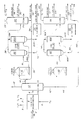
- the drawing is a schematic diagram of a process unit which illustrates the invention.
- the heavy oils used in the process of the invention comprises virgin oils, which may be crude oils or fractions of crude oils.
- the heavy oils are the residual fractions obtained by the vacuum distillation of crude oils to remove lighter materials.
- the residual oils which are used are those having an API gravity ranging from about -5 to about 25 and an initial boiling point of about 550°F to about 1000°F.
- These oils usually contain from about 0.2 to about 6 weight percent sulfur. They characteristically have an aromatic content of less than about 35 weight percent (based on the percentage of carbon atoms in the aromatic form as measured by carbon-13 NNR).
- the catalyst used in hydrotreater 4 comprises a hydrogenation component deposited on a suitable inert carrier.
- the various hydrogenation components include the metals, salts, oxides, or sulfides of the metals of periodic groups VIII and VIIIB, for example, chromium, molybdenum, tungsten, iron, cobalt, nickel, ruthenium, rhodium, palladium, osmium, iridium, and platinum.
- the particular catalyst employed is not critical to the invention and any of the conventional catalysts used for hydrotreating can be used.
- catalysts are typically distended on a suitable inert support of carbon, for example, activated carbon or a dried and calcined gel of an amphoteric metal oxide, for example, alumina, titania, thoria, silica, or mixtures thereof.
- an amphoteric metal oxide for example, alumina, titania, thoria, silica, or mixtures thereof.
- the most commonly employed carriers are the silica and alumina-containing carriers or mixtures thereof.
- hydrotreating Process conditions employed may be summarized as follows: Hydrotreating Conditions Broad Range Preferred Range Temperature - °F about 500 - 800 about 600 - 750 Pressure - psig about 800 - 2600 about 1000 - 2200 H2/Oil - SCFB about 500 - 6000 about 1000 - 5000 LHSV 0.1 - 6 0.5 - 2
- hydrotreating requirements are simply that the overall conditions should be selected to effect sufficient desulfurization of the feed to provide an ultimate recarburizer coke product containing not more than 0.1 weight percent sulfur and preferably not more than 0.05 weight percent sulfur. It is preferred to use hydrotreating conditions which provide a hydrotreated product containing not more than about 0.75 weight percent sulfur and preferably not more than about 0.30 weight percent sulfur.
- the sulfur which is removed from the residual oil feed in the hydrotreating step is taken overhead from the catalytic hydrotreater through line 5.
- the sulfur is removed from the hydrotreater as hydrogen sulfide.
- light gases C1 to C3 are removed from the hydrotreater through line 7.
- the remaining liquid effluent from the hydrotreater is transferred via line 8 to fractionator 10 where this material is separated into a light fraction and a heavier fraction.
- the light fraction usually has a maximum boiling point ranging from about 850°F to about 1150°F and preferably between about 900°F and about 1100°F.
- the entire light fraction may be further processed; however, since low boiling hydrocarbons do not form coke under normal coking conditions, these materials may be removed to provide a light fraction having an initial boiling point ranging from about 550°F to about 750°F.
- the light fraction which comprises from about 15 to about 85 weight percent of the hydrotreated material entering fractionator 10, is withdrawn from fractionator 10 through line 14 and introduced to coker furnace 16 wherein it is heated to temperatures in the range of about 875 to 975°F at pressures from about atmospheric to about 250 psig and is then passed via lines 18 and 18A to coke drums 20 and 20A.
- the coke drums operate on alternate coking and decoking cycles of about 16 to about 100 hours; while one drum is being filled with coke the other is being decoked. During the coking cycle, each drum operates at a temperature between about 850 and about 950°F and a pressure from about 15 to about 200 psig.
- the overhead vapor from the coke drums is passed via line 28 or 28A to fractionator 30 while coke is removed from the bottom of coke drums through outlet 22 or 22A.
- the material entering fractionator 30 is separated into several fractions, a gaseous material which is removed through line 32, a gasoline fraction removed through line 34 and a light gas oil which is removed via line 36.
- Heavy coker gas oil is taken from the bottom of fractionator 30 and is sent to storage through line 40. If desired, a portion or all of this material may instead be recycled through line 38 to a coker furnace 16.
- the green coke which is removed from the coke drums through outlets 22 and 22A is introduced to calciner 24 where it is subjected to elevated temperatures to remove volatile materials and to increase the carbon to a hydrogen ratio of the coke. Calcination may be carried out at temperatures in the range of between about 2000 and about 3000°F and preferably between about 2400 and about 2600°F.
- the coke is maintained under calcining conditions for between about 1/2 hour and about 10 hours and preferably between about 1 and about 3 hours.
- the calcined coke which contains less than 0.1 weight percent sulfur and preferably less than 0.05 percent sulfur is withdrawn from the calciner through outlet 26 and is suitable for use as recarburizer coke.
- this calcined coke product has a low CTE, varying from about 0 to about 3 x 10 ⁇ 7/°C (measured between 30 and 98°C on a 3/4" electrode produced from a standard flour formulation), it is also suitable for further processing and use in large graphite electrodes employed in electric arc furnaces for manufacturing steel.
- low boiling hydrocarbons may be separated from the hydrotreater effluent and removed from the fractionator via line 12.
- the heavy portion of the hydrotreater effluent, after separation of the light fraction which was removed through line 14, is transferred via line 42 to coker furnace 44 where it is heated, then transferred to coke drums 48 and 48A.
- Overhead vapors from the coke drums are passed to fractionator 58 and coke is removed from the drums and sent to calciner 52.
- the operations which are carried out in coker furnace 44, coke drums 48 and 48A, fractionator 58 and calciner 52 and the temperatures, pressures and other process variables employed therein are the same as or similar to those employed in processing the light fraction recovered in fractionator 10.
- the calcined coke obtained from calciner 52 contains more than 0.1 weight percent sulfur, usually from about 0.2 to about 1.5 weight percent. Also, the CTE of this product is sufficiently high that it may be less desirable for use in the manufacture of large graphite electrodes used in steel electric arc furnaces than coke produced in drums 20 and 20A. It does, however, have properties which make it useful in the preparation of smaller electrodes for the production of steel and in electrodes for the production of aluminum.
- the hydrotreated product was separated into two fractions, one boiling between 550 and 900°F and the other boiling above 900°F. Each fraction was subjected to delayed coking for 32 hours at 875°F and 140 psig. The results of the fractionation and coking are presented in Table 3.
- TABLE 3 Feed 550-900°F Fraction 900°F+ Fraction Weight Percent of the Hydrotreated Vacuum Resid 18.0 76.8 Sulfur - Weight Percent 0.02 0.19 Product Coke Yield - Weight Percent 4.6 21.3 CTE*, 10 ⁇ 7/°C 0.43 3.91 Sulfur, Weight Percent 0.014 0.47 *After calcining at 2400°F for 3 hours at atm pressure.
- the CTE measured between 30 and 98°C on a standard 3/4" electrode is estimated from the height of the 002 x-ray peak of calcined coke. It is well known that a strong correlation exists between coke CTE and x-ray properties of calcined coke.
- the coke obtained from the 550°F-900°F fraction has a sulfur content which makes it suitable for use as recarburizer coke.
- the sulfur content of the 900°F+ fraction coke is about 34 times as large as the sulfur in the coke from the lower boiling fraction.
- the 550-900°F fraction provides a calcined coke which yields an electrode having a CTE roughly 9 times lower than the electrode obtained from the heavier fraction.
- the lower CTE coke would be extremely desirable for use in production of large graphite electrodes for the steel industry. This CTE, in fact, is lower than the CTE of coke obtained from any commercial coking processes.
- a sweet virgin resid was hydrotreated in the presence of a nickel-molybdenum on alumina catalyst. Hydrotreating conditions, feedstock properties and hydrotreated product properties are shown in Table 4. TABLE 4 Run Conditions Reactor Temperature - °F 750 Reactor Pressure - psig 1500 LHSV - 1/Hr 0.90 H2 to Oil Ratio - SCFB 3000 Properties Resid Hydrotreated Resid API Gravity 22.8 27.7 Sulfur - Weight Percent 0.58 0.03 Nitrogen - Weight Percent 0.1 ⁇ 0.1 Percent Aromaticity by C-13 NMR 17.5 10.9
- a decant oil from a FCC unit and a coal tar pitch were subjected to hydrotreating in the presence of a nickel-molybdenum on alumina catalyst. Hydrotreating conditions, feedstock properties and hydrotreated product properties are shown in Table 6. TABLE 6 Run Conditions Decant Oil Coal Tar Pitch Reactor Temperature - °F 700 725 Reactor Pressure - psig 800 1500 LHSV - 1/Hr 1.00 1.00 Hydrogen to Oil Ratio - SCFB 3500 3000 DECANT OIL COAL TAR PITCH Properties Not Hydrotreated Hydrotreated Not Hydrotreated Hydrotreated Hydrotreated Gravity - API - - -13.6 -5.4 Sulfur - Weight Percent 1.12 0.37 0.74 0.15 Nitrogen - Weight Percent 0.10 0.10 1.00 0.60 C 13 NMR, Percent Aromatic Carbon Atoms 63.9 51.5 93.5 74.2
- the hydrotreated decant oil was separated into two fractions, a 550°F to 900°F fraction and a 900°F+ fraction.
- the hydrotreated coal tar pitch was also separated into two fractions, a 850 to 950°F fraction and a 950°F+ fraction. Each of these fractions was subjected to delayed coking for 32 hours at a temperature of 875°F and a pressure of 140 psig. The results of the fractionation and coking are shown in Table 7.
Landscapes
- Chemical & Material Sciences (AREA)
- Oil, Petroleum & Natural Gas (AREA)
- Engineering & Computer Science (AREA)
- Chemical Kinetics & Catalysis (AREA)
- General Chemical & Material Sciences (AREA)
- Organic Chemistry (AREA)
- Materials Engineering (AREA)
- Production Of Liquid Hydrocarbon Mixture For Refining Petroleum (AREA)
- Coke Industry (AREA)
- Carbon And Carbon Compounds (AREA)
Priority Applications (1)
| Application Number | Priority Date | Filing Date | Title |
|---|---|---|---|
| DE1989611147 DE68911147T2 (de) | 1989-12-15 | 1989-12-15 | Herstellung von schwefelärmerem und schwefelreicherem Koks. |
Applications Claiming Priority (1)
| Application Number | Priority Date | Filing Date | Title |
|---|---|---|---|
| US07/275,295 US4894144A (en) | 1988-11-23 | 1988-11-23 | Preparation of lower sulfur and higher sulfur cokes |
Publications (2)
| Publication Number | Publication Date |
|---|---|
| EP0432335A1 true EP0432335A1 (fr) | 1991-06-19 |
| EP0432335B1 EP0432335B1 (fr) | 1993-12-01 |
Family
ID=23051682
Family Applications (1)
| Application Number | Title | Priority Date | Filing Date |
|---|---|---|---|
| EP89313134A Expired - Lifetime EP0432335B1 (fr) | 1988-11-23 | 1989-12-15 | Préparation de coke à teneur en soufre plus basse et à teneur en soufre plus haute |
Country Status (4)
| Country | Link |
|---|---|
| US (1) | US4894144A (fr) |
| EP (1) | EP0432335B1 (fr) |
| JP (1) | JP2825570B2 (fr) |
| ES (1) | ES2047688T3 (fr) |
Families Citing this family (19)
| Publication number | Priority date | Publication date | Assignee | Title |
|---|---|---|---|---|
| US5158668A (en) * | 1988-10-13 | 1992-10-27 | Conoco Inc. | Preparation of recarburizer coke |
| US4894144A (en) * | 1988-11-23 | 1990-01-16 | Conoco Inc. | Preparation of lower sulfur and higher sulfur cokes |
| US5059301A (en) * | 1988-11-29 | 1991-10-22 | Conoco | Process for the preparation of recarburizer coke |
| US5045177A (en) * | 1990-08-15 | 1991-09-03 | Texaco Inc. | Desulfurizing in a delayed coking process |
| US5824194A (en) * | 1997-01-07 | 1998-10-20 | Bechtel Corporation | Fractionator system for delayed coking process |
| US7046905B1 (en) * | 1999-10-08 | 2006-05-16 | 3M Innovative Properties Company | Blacklight with structured surfaces |
| EP2234710A2 (fr) * | 2007-11-28 | 2010-10-06 | Saudi Arabian Oil Company | Processus d'hydrotraitement catalytique des pétroles bruts sulfureux |
| US8007659B2 (en) | 2008-06-03 | 2011-08-30 | Graftech International Holdings Inc. | Reduced puffing needle coke from coal tar distillate |
| WO2010009082A1 (fr) * | 2008-07-14 | 2010-01-21 | Saudi Arabian Oil Company | Procédé de pré-raffinage pour l'hydrodésulfuration de pétroles bruts sulfureux lourds en vue de produire des bruts plus légers moins sulfureux à l'aide d'un système catalytique mobile |
| US8372267B2 (en) * | 2008-07-14 | 2013-02-12 | Saudi Arabian Oil Company | Process for the sequential hydroconversion and hydrodesulfurization of whole crude oil |
| US9260671B2 (en) * | 2008-07-14 | 2016-02-16 | Saudi Arabian Oil Company | Process for the treatment of heavy oils using light hydrocarbon components as a diluent |
| US20100176029A1 (en) * | 2009-01-09 | 2010-07-15 | Conocophillips Company | Upgrading Slurry Oil Using Chromatographic Reactor Systems |
| US9375656B2 (en) | 2009-01-09 | 2016-06-28 | Phillips 66 Company | Slurry oil upgrading while preserving aromatic content |
| US8491779B2 (en) * | 2009-06-22 | 2013-07-23 | Saudi Arabian Oil Company | Alternative process for treatment of heavy crudes in a coking refinery |
| US9452955B2 (en) * | 2013-03-14 | 2016-09-27 | Lummus Technology Inc. | Process for producing distillate fuels and anode grade coke from vacuum resid |
| WO2015098754A1 (fr) * | 2013-12-24 | 2015-07-02 | Jx日鉱日石エネルギー株式会社 | Coke de pétrole et procédé de production correspondant |
| US10316253B2 (en) * | 2015-07-14 | 2019-06-11 | Kellog Brown & Root Llc | Co-production of anode and fuel grade petroleum coke in a delayed coker unit |
| CN109777478B (zh) * | 2017-11-14 | 2021-05-04 | 中国石油化工股份有限公司 | 一种生产针状焦的工艺方法 |
| WO2019096143A1 (fr) | 2017-11-14 | 2019-05-23 | 中国石油化工股份有限公司 | Système de cokéfaction et procédé de cokéfaction |
Citations (5)
| Publication number | Priority date | Publication date | Assignee | Title |
|---|---|---|---|---|
| US2913395A (en) * | 1957-03-04 | 1959-11-17 | Union Oil Co | Coking process |
| DE2025071A1 (de) * | 1969-05-26 | 1970-12-03 | The Lummus Company, Bloomfield, N.J. (V.St.A.) | Verfahren zur Herstellung von Nadelkoks |
| US3891538A (en) * | 1973-06-21 | 1975-06-24 | Chevron Res | Integrated hydrocarbon conversion process |
| US4125455A (en) * | 1973-09-26 | 1978-11-14 | Texaco Inc. | Hydrotreating heavy residual oils |
| US4894144A (en) * | 1988-11-23 | 1990-01-16 | Conoco Inc. | Preparation of lower sulfur and higher sulfur cokes |
Family Cites Families (11)
| Publication number | Priority date | Publication date | Assignee | Title |
|---|---|---|---|---|
| US2076855A (en) * | 1934-07-02 | 1937-04-13 | Universal Oil Prod Co | Heating of fluids |
| DE1671304B2 (de) * | 1967-03-28 | 1976-05-13 | Verzoegertes verkokungsverfahren zur gleichzeitigen herstellung zweier verschiedener guetegrade von petrolkoks | |
| BE757343A (fr) * | 1969-10-09 | 1971-03-16 | Chevron Res | Procede combine de reforming catalytique et d'extraction |
| US3684688A (en) * | 1971-01-21 | 1972-08-15 | Chevron Res | Heavy oil conversion |
| US4075084A (en) * | 1977-02-17 | 1978-02-21 | Union Oil Company Of California | Manufacture of low-sulfur needle coke |
| US4518486A (en) * | 1980-12-24 | 1985-05-21 | The Standard Oil Company | Concurrent production of two grades of coke using a single fractionator |
| US4351702A (en) * | 1981-09-08 | 1982-09-28 | Conoco Inc. | Processing of heavy high-sulfur feedstocks |
| US4446004A (en) * | 1982-12-23 | 1984-05-01 | Mobil Oil Corporation | Process for upgrading vacuum resids to premium liquid products |
| US4501654A (en) * | 1983-11-17 | 1985-02-26 | Exxon Research & Engineering Co. | Delayed coking process with split fresh feed and top feeding |
| US4676886A (en) * | 1985-05-20 | 1987-06-30 | Intevep, S.A. | Process for producing anode grade coke employing heavy crudes characterized by high metal and sulfur levels |
| US4795545A (en) * | 1987-09-17 | 1989-01-03 | Uop Inc. | Process for pretreatment of light hydrocarbons to remove sulfur, water, and oxygen-containing compounds |
-
1988
- 1988-11-23 US US07/275,295 patent/US4894144A/en not_active Expired - Lifetime
-
1989
- 1989-12-15 ES ES89313134T patent/ES2047688T3/es not_active Expired - Lifetime
- 1989-12-15 EP EP89313134A patent/EP0432335B1/fr not_active Expired - Lifetime
- 1989-12-20 JP JP1328531A patent/JP2825570B2/ja not_active Expired - Fee Related
Patent Citations (5)
| Publication number | Priority date | Publication date | Assignee | Title |
|---|---|---|---|---|
| US2913395A (en) * | 1957-03-04 | 1959-11-17 | Union Oil Co | Coking process |
| DE2025071A1 (de) * | 1969-05-26 | 1970-12-03 | The Lummus Company, Bloomfield, N.J. (V.St.A.) | Verfahren zur Herstellung von Nadelkoks |
| US3891538A (en) * | 1973-06-21 | 1975-06-24 | Chevron Res | Integrated hydrocarbon conversion process |
| US4125455A (en) * | 1973-09-26 | 1978-11-14 | Texaco Inc. | Hydrotreating heavy residual oils |
| US4894144A (en) * | 1988-11-23 | 1990-01-16 | Conoco Inc. | Preparation of lower sulfur and higher sulfur cokes |
Also Published As
| Publication number | Publication date |
|---|---|
| US4894144A (en) | 1990-01-16 |
| JP2825570B2 (ja) | 1998-11-18 |
| EP0432335B1 (fr) | 1993-12-01 |
| ES2047688T3 (es) | 1994-03-01 |
| JPH03199290A (ja) | 1991-08-30 |
Similar Documents
| Publication | Publication Date | Title |
|---|---|---|
| US4075084A (en) | Manufacture of low-sulfur needle coke | |
| EP0432335B1 (fr) | Préparation de coke à teneur en soufre plus basse et à teneur en soufre plus haute | |
| US5059301A (en) | Process for the preparation of recarburizer coke | |
| US5158668A (en) | Preparation of recarburizer coke | |
| US4178229A (en) | Process for producing premium coke from vacuum residuum | |
| EP0008493A1 (fr) | Procédé de cokéfaction retardée d'une charge comprenant un courant de recyclage hydrogéné et produits graphitisés obtenus à partir de coke produit par un tel procédé | |
| US3817853A (en) | Coking of pyrolysis tars | |
| US4443325A (en) | Conversion of residua to premium products via thermal treatment and coking | |
| EP0378326B1 (fr) | Brai liant et méthode de sa préparation | |
| US4235703A (en) | Method for producing premium coke from residual oil | |
| US4466883A (en) | Needle coke process and product | |
| US4822479A (en) | Method for improving the properties of premium coke | |
| EP0266988B1 (fr) | Procédé pour la fabrication de coke | |
| US4130475A (en) | Process for making premium coke | |
| EP0285261B1 (fr) | Procédé pour la fabrication de coke de qualité supérieure | |
| US3326796A (en) | Production of electrode grade petroleum coke | |
| US4762608A (en) | Upgrading of pyrolysis tar | |
| US4176046A (en) | Process for utilizing petroleum residuum | |
| US4492625A (en) | Delayed coking process with split fresh feed | |
| US4713168A (en) | Premium coking process | |
| GB1575279A (en) | Process for making premium coke | |
| US5034116A (en) | Process for reducing the coarse-grain CTE of premium coke | |
| EP0083143B1 (fr) | Procédé de fabrication de coke de qualité supérieure | |
| EP0041588B1 (fr) | Procédé de production de coke supérieur à partir d'huile résiduaire | |
| US4740291A (en) | Upgrading of pyrolysis tar using acidic catalysts |
Legal Events
| Date | Code | Title | Description |
|---|---|---|---|
| PUAI | Public reference made under article 153(3) epc to a published international application that has entered the european phase |
Free format text: ORIGINAL CODE: 0009012 |
|
| 17P | Request for examination filed |
Effective date: 19901211 |
|
| AK | Designated contracting states |
Kind code of ref document: A1 Designated state(s): DE ES FR GB IT NL |
|
| 17Q | First examination report despatched |
Effective date: 19920821 |
|
| GRAA | (expected) grant |
Free format text: ORIGINAL CODE: 0009210 |
|
| AK | Designated contracting states |
Kind code of ref document: B1 Designated state(s): DE ES FR GB IT NL |
|
| REF | Corresponds to: |
Ref document number: 68911147 Country of ref document: DE Date of ref document: 19940113 |
|
| ET | Fr: translation filed | ||
| ITF | It: translation for a ep patent filed | ||
| REG | Reference to a national code |
Ref country code: ES Ref legal event code: FG2A Ref document number: 2047688 Country of ref document: ES Kind code of ref document: T3 |
|
| PLBE | No opposition filed within time limit |
Free format text: ORIGINAL CODE: 0009261 |
|
| STAA | Information on the status of an ep patent application or granted ep patent |
Free format text: STATUS: NO OPPOSITION FILED WITHIN TIME LIMIT |
|
| 26N | No opposition filed | ||
| REG | Reference to a national code |
Ref country code: GB Ref legal event code: IF02 |
|
| PGFP | Annual fee paid to national office [announced via postgrant information from national office to epo] |
Ref country code: GB Payment date: 20021104 Year of fee payment: 14 |
|
| PGFP | Annual fee paid to national office [announced via postgrant information from national office to epo] |
Ref country code: NL Payment date: 20021112 Year of fee payment: 14 |
|
| PGFP | Annual fee paid to national office [announced via postgrant information from national office to epo] |
Ref country code: FR Payment date: 20021202 Year of fee payment: 14 |
|
| PGFP | Annual fee paid to national office [announced via postgrant information from national office to epo] |
Ref country code: ES Payment date: 20021218 Year of fee payment: 14 |
|
| PGFP | Annual fee paid to national office [announced via postgrant information from national office to epo] |
Ref country code: DE Payment date: 20021230 Year of fee payment: 14 |
|
| PG25 | Lapsed in a contracting state [announced via postgrant information from national office to epo] |
Ref country code: GB Free format text: LAPSE BECAUSE OF NON-PAYMENT OF DUE FEES Effective date: 20031215 |
|
| PG25 | Lapsed in a contracting state [announced via postgrant information from national office to epo] |
Ref country code: ES Free format text: LAPSE BECAUSE OF NON-PAYMENT OF DUE FEES Effective date: 20031216 |
|
| PG25 | Lapsed in a contracting state [announced via postgrant information from national office to epo] |
Ref country code: NL Free format text: LAPSE BECAUSE OF NON-PAYMENT OF DUE FEES Effective date: 20040701 Ref country code: DE Free format text: LAPSE BECAUSE OF NON-PAYMENT OF DUE FEES Effective date: 20040701 |
|
| GBPC | Gb: european patent ceased through non-payment of renewal fee |
Effective date: 20031215 |
|
| PG25 | Lapsed in a contracting state [announced via postgrant information from national office to epo] |
Ref country code: FR Free format text: LAPSE BECAUSE OF NON-PAYMENT OF DUE FEES Effective date: 20040831 |
|
| NLV4 | Nl: lapsed or anulled due to non-payment of the annual fee |
Effective date: 20040701 |
|
| REG | Reference to a national code |
Ref country code: FR Ref legal event code: ST |
|
| REG | Reference to a national code |
Ref country code: ES Ref legal event code: FD2A Effective date: 20031216 |
|
| PG25 | Lapsed in a contracting state [announced via postgrant information from national office to epo] |
Ref country code: IT Free format text: LAPSE BECAUSE OF NON-PAYMENT OF DUE FEES Effective date: 20051215 |