EP0432472A2 - Integrierte CMOS-Ausgangsschaltung mit bipolaren Transistoren in der Ausgangsstufe - Google Patents
Integrierte CMOS-Ausgangsschaltung mit bipolaren Transistoren in der Ausgangsstufe Download PDFInfo
- Publication number
- EP0432472A2 EP0432472A2 EP90121615A EP90121615A EP0432472A2 EP 0432472 A2 EP0432472 A2 EP 0432472A2 EP 90121615 A EP90121615 A EP 90121615A EP 90121615 A EP90121615 A EP 90121615A EP 0432472 A2 EP0432472 A2 EP 0432472A2
- Authority
- EP
- European Patent Office
- Prior art keywords
- bipolar transistor
- terminal
- output
- base
- node
- Prior art date
- Legal status (The legal status is an assumption and is not a legal conclusion. Google has not performed a legal analysis and makes no representation as to the accuracy of the status listed.)
- Granted
Links
Images


Classifications
-
- H—ELECTRICITY
- H03—ELECTRONIC CIRCUITRY
- H03K—PULSE TECHNIQUE
- H03K17/00—Electronic switching or gating, i.e. not by contact-making and –breaking
-
- H—ELECTRICITY
- H03—ELECTRONIC CIRCUITRY
- H03K—PULSE TECHNIQUE
- H03K19/00—Logic circuits, i.e. having at least two inputs acting on one output; Inverting circuits
- H03K19/02—Logic circuits, i.e. having at least two inputs acting on one output; Inverting circuits using specified components
- H03K19/08—Logic circuits, i.e. having at least two inputs acting on one output; Inverting circuits using specified components using semiconductor devices
- H03K19/094—Logic circuits, i.e. having at least two inputs acting on one output; Inverting circuits using specified components using semiconductor devices using field-effect transistors
- H03K19/0944—Logic circuits, i.e. having at least two inputs acting on one output; Inverting circuits using specified components using semiconductor devices using field-effect transistors using MOSFET or insulated gate field-effect transistors, i.e. IGFET
- H03K19/09448—Logic circuits, i.e. having at least two inputs acting on one output; Inverting circuits using specified components using semiconductor devices using field-effect transistors using MOSFET or insulated gate field-effect transistors, i.e. IGFET in combination with bipolar transistors [BIMOS]
-
- H—ELECTRICITY
- H03—ELECTRONIC CIRCUITRY
- H03K—PULSE TECHNIQUE
- H03K19/00—Logic circuits, i.e. having at least two inputs acting on one output; Inverting circuits
- H03K19/01—Modifications for accelerating switching
- H03K19/013—Modifications for accelerating switching in bipolar transistor circuits
- H03K19/0136—Modifications for accelerating switching in bipolar transistor circuits by means of a pull-up or down element
-
- H—ELECTRICITY
- H03—ELECTRONIC CIRCUITRY
- H03K—PULSE TECHNIQUE
- H03K19/00—Logic circuits, i.e. having at least two inputs acting on one output; Inverting circuits
- H03K19/02—Logic circuits, i.e. having at least two inputs acting on one output; Inverting circuits using specified components
- H03K19/08—Logic circuits, i.e. having at least two inputs acting on one output; Inverting circuits using specified components using semiconductor devices
- H03K19/094—Logic circuits, i.e. having at least two inputs acting on one output; Inverting circuits using specified components using semiconductor devices using field-effect transistors
Definitions
- the present invention relates to a signal output circuit arranged in a CMOS digital semiconductor integrated circuit and, more particularly, to a signal output circuit having a bipolar transistor in an output stage.
- Bi-CMOS bipolar-complimentary MOS
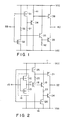
- Fig. 1 shows an example of a conventional Bi-CMOS signal output circuit.
- reference numerals 31 and 32 denote p- or n-channel MOS transistors, the gates of which are commonly connected to an input terminal 33, and which perform switching operations in response to a signal from the input terminal 33; 34 and 35, pnp or npn bipolar transistors; 36 and 37, resistors for setting a base current; 38 and 39, pnp or npn output bipolar transistors, the collectors of which are commonly connected to an output terminal 40; and 41 and 42, resistors for absorbing excess base charges of the bipolar transistors 38 and 39.
- a predetermined value of the base current is flowed into the npn bipolar transistor 39 through the resistor 36 and the bipolar transistor 35, so that the transistor 39 is turned on, and the output terminal 40 is discharged to a low-potential power supply voltage VSS.
- a resistance R of the resistor 36 is determined by the following equation, assuming that a current amplification factor hfe(Q39) of the bipolar transistor 39 is, e.g; 5 (since the transistor 39 is operated in a saturation region when it is in an ON state, the current amplification factor at this time is decreased as compared with the operation in a non-suturation region), and a current amplification hfe(Q35) of the bipolar transistor 35 is, e.g; 100 wherein Vf in the following equation is a base-emitter voltage of the npn or pnp bipolar transistor.
- the resistance of the resistor 36 becomes extremely large.
- the resistance of the resistor 37 becomes extremely large.
- the resistors 41 and 42 for absorbing base charges are normally set in values from 5 k ⁇ to 10 k ⁇ .
- the resistances of the resistors 36 and 37 are extremely large, so that charge and discharge rates of parasitic capacitors of the bases of the transistors 34 and 35 are low. As a result, switching speeds of the output bipolar transistors 38 and 39 are decreased, so the output switching speed is decreased.
- the base charges of the output transistors 38 and 39 are absorbed by the resistors 41 and 42.
- the output transistors 38 and 39 are turned on, wasteful currents not used as base currents are flowed into the resistors 41 and 42. Therefore, the base currents of the output transistors 38 and 39 are decreased by the wasteful currents, so that the turn-on speed of the output transistors is decreased, thereby further decreasing the output switching speed.
- a signal output circuit comprising at least one input terminal, an output terminal, first and second nodes for respectively receiving power supply voltages having different values, a CMOS logic gate for generating an output corresponding to the input, a first bipolar transistor of a first polarity having the base for receiving the output from the logic gate, a second bipolar transistor of a second polarity having the base for receiving the output from the logic gate, a first resistor having one terminal connected to the emitter of the first bipolar transistor, a second resistor having one terminal connected to the emitter of the second bipolar transistor, a third bipolar transistor of the first polarity having the emitter connected to the first node, the collector connected to the output terminal, and the base connected to the other terminal of the first resistor, and a fourth bipolar transistor of the second polarity having the emitter connected to the second node, the collector connected to the output terminal, and the base connected to the other terminal of the second resistor.
- Fig. 2 shows an arrangement of the first embodiment of a signal output circuit according to the present invention.
- the source of a p-channel MOS transistor 12 is connected to a node 11 for receiving a power supply voltage VCC of 5 V.
- the drain of an n-channel MOS transistor 13 is connected to the drain of the MOS transistor 12.
- the source of the MOS transistor 13 is connected to a node 14 for receiving a power supply voltage VSS of 0 V.
- the gates of the MOS transistors 12 and 13 are commonly connected to an input terminal 15, and the MOS transistors 12 and 13 constitute a CMOS inverter 16.
- the bases of a pnp bipolar transistor 18 and an npn bipolar transistor 19 are connected to an output node 17 which is a common connection point of the drains of the MOS transistors 12 and 13 in the inverter 16.
- the collector of one bipolar transistor 18 is connected to the node 14, and one terminal of a resistor 20 for setting a base current is connected to the emitter of the transistor 18.
- the base of an output pnp bipolar transistor 21 is connected to the other terminal of the resistor 20.
- the emitter of the bipolar transistor 21 is connected to the node 11, and the collector of the transistor 21 is connected to an output terminal 22.
- the collector of the other bipolar transistor 19 is connected to the node 11, and one terminal of a resistor 23 for setting a base current is connected to the emitter of the transistor 19.
- the base of an output npn bipolar transistor 24 is connected to the other terminal of the resistor 23.
- the collector and emitter of the bipolar transistor 24 are respectively connected to the output terminal 22 and the node 14.
- the source of a p-channel MOS transistor 25 for absorbing a base charge of the bipolar transistor 21 is connected to the node 11 of the power supply voltage VCC.
- the drain and gate of the MOS transistor 25 are respectively connected to the base of the bipolar transistor 21 and the input terminal 15.
- the source of an n-channel MOS transistor 26 for absorbing a base charge of the bipolar transistor 24 is connected to the node 14 of the power supply voltage VSS.
- the drain and gate of the MOS transistor 26 are respectively connected to the base of the bipolar transistor 24 and the input terminal 15.
- the n-channel MOS transistor 13 in the inverter 16 is in an ON state, and the output node 17 of the transistor 13 is "L” level.
- the pnp bipolar transistor 18 is in an ON state, and the base current is flowed into the output pnp bipolar transistor 21 through the resistor 20 and the transistor 18.
- the bipolar transistor 21 is turned on and the output terminal 22 is charged with the power supply voltage VCC to be "H" level.
- the input signal changes from "H" level to "L” level, and the p-channel MOS transistor 25 is in an ON state.
- the base current is stopped, and the charge accumulated at the base of the bipolar transistor 21 to be turned off is absorbed by the node 11 of the power supply voltage VCC through the MOS transistor 25. Therefore, the bipolar transistor 21 is abruptly turned off.
- the bipolar transistor 19 is turned off and supply of the base current to the transistor 24 is stopped, the charge accumulated at the base of the bipolar transistor 24 to be turned off is absorbed by the node 14 of the power supply voltage VSS through the n-channel MOS transistor 26 in an ON state. As a result, the bipolar transistor 24 is abruptly turned off.
- a resistance R of the resistors 20 and 23 is determined by the following equation, assuming that current amplification factors hfe (Q21) and hfe (Q24) of the bipolar transistors 21 and 24 are respectively 5, wherein Vf in the following equation is a base-emitter voltage of the npn or pnp bipolar transistor.
- the resistance of the resistors 20 and 23 becomes as low as 1/100 that in the conventional circuit, so that charge and discharge operations of parasitic capacitors of the bases of the bipolar transistors 21 and 24 can be performed at a higher speed than that in the conventional circuit.
- switching speeds of the output bipolar transistors 21 and 24 are increased, resulting in an increase in output switching speed.
- the excess base charges of the output transistors 21 and 24 are absorbed by the MOS transistors 25 and 26.
- one of the base charge absorbing MOS transistors 25 and 26 in an ON state is turned off, so that a wasteful current is not flowed upon turn-on operation of the output transistor, unlike in the conventional circuit.
- the base current can be larger than that in the conventional circuit. Therefore, the turn-on speed of the output transistor is increased, thereby increasing the output switching speed.
- a two-input NAND gate 27 constituted by two p-channel MOS transistors 12A and 12B and two n-channel MOS transistors 13A and 13B is arranged in place of the CMOS inverter 16 in the first embodiment shown in Fig. 2. More specifically, the sources of the p-channel MOS transistors 12A and 12B are commonly connected to a node 11 of a power supply voltage VCC, and the drains of the p-channel transistors 12A and 12B are commonly connected to an output node 28 of the NAND gate 27.
- the source-drain paths of the n-channel MOS transistors 13A and 13B are connected in series between a node 14 of a power supply voltage VSS and the output node 28.
- the gates of one p-channel MOS transistor 12A and one n-channel MOS transistor 13A are connected to one input terminal 15A, and the gates of the other p-channel MOS transistor 12B and the other n-channel MOS transistor 13B are connected to the other input terminal 15B.
- the source-drain paths of two p-channel MOS transistors 25A and 25B are connected in parallel between the node 11 of the power supply voltage VCC and the base of a pnp bipolar transistor 21, and the source-drain paths of two n-channel MOS transistors 26A and 26B are connected in series between the node 14 of the power supply voltage VSS and the base of an npn bipolar transistor 24.
- the gates of the MOS transistors 25A and 26A are commonly connected to one input terminal 15A, and the gates of the MOS transistors 25B and 26B are commonly connected to the other input terminal 15B.
- a signal of a level corresponding to signals supplied to the input terminals 15A and 15B is obtained from an output terminal 22. More specifically, when two input signals are “H” level, the output node 28 of the NAND gate 27 becomes “L” level, bipolar transistors 18 and 21 are respectively turned on, and an "H” level signal is output from the output terminal 22. When one of the two input signals is “L” level, the output node 28 of the NAND gate 27 becomes “H” level, bipolar transistors 19 and 24 are turned on, and a signal of "L” level is output from the output terminal 22.
- the resistances of resistors 20 and 23 can be greatly decreased as compared with the conventional circuit, resulting in an increase in output switching speed.
- This circuit has two input terminals 15A and 15B as in the second embodiment, and a two-input NOR gate 29 constituted by two p-channel MOS transistors 12A and 12B and two n-channel MOS transistors 13A and 13B is arranged in place of the CMOS inverter 16 shown in Fig. 2.
- the source-drain paths of the p-channel MOS transistors 12A and 12B are connected in series between a node 11 of a power supply voltage VCC and an output node 30 of the NOR gate 29.
- the sources of the n-channel MOS transistors 13A and 13B are commonly connected to a node 14 of a power supply voltage VSS, and the drains of the n-channel MOS transistors 13A and 13B are commonly connected to the output node 30.
- the gates of one p-channel MOS transistor 12A and one n-channel MOS transistor 13A are connected to one input terminal 15A.
- the gates of the other p-channel MOS transistor 12B and the other n-channel MOS transistor 13B are connected to the other input terminal 15B.
- the source-drain paths of two p-channel MOS transistors 25A and 25B are connected in series between the node 11 of the power supply voltage VCC and the base of a pnp bipolar transistor 21.
- the source-drain paths of two n-channel MOS transistors 26A and 26B are connected in parallel between the node 14 of the power supply voltage VSS and an npn bipolar transistor 24.
- the gates of the MOS transistors 25A and 26A are commonly connected to one input terminal 15A and the gates of the MOS transistors 25B and 26B are commonly connected to the other input terminal 15B.
- a signal of a level corresponding to signals supplied to the input terminals 15A and 15B is obtained from an output terminal 22. More specifically, when the two input signals are “L” level, the signal at the output node 30 in the NOR gate 29 becomes “H” level, bipolar transistors 19 and 24 are turned on, and a signal of "L” level is output from the output terminal 22. When one of the two input signals is “H” level, a signal of the output node 30 of the NOR gate 29 becomes “L” level, bipolar transistors 18 and 21 are turned on, and a signal of "H” level is output from the output terminal 22.
- the bipolar transistors 18 and 19 the resistances of resistors 20 and 23 can be greatly decreased as compared with the conventional circuit, and the output switching speed can be increased.
- a resistance of a resistor for setting a base current of an output transistor can be greatly decreased as compared with the conventional circuit, so that the parasitic capacitor can be charged upon switching at a relatively high speed.
- the excess base charge of the output transistor is absorbed by a MOS transistor, so that a higher switching speed upon turn-off operation of the output transistor can be obtained. Therefore, according to a signal output circuit of the present invention, high input/output transfer characteristics can be obtained.
Landscapes
- Engineering & Computer Science (AREA)
- Physics & Mathematics (AREA)
- Computer Hardware Design (AREA)
- Computing Systems (AREA)
- General Engineering & Computer Science (AREA)
- Mathematical Physics (AREA)
- Power Engineering (AREA)
- Logic Circuits (AREA)
- Electronic Switches (AREA)
- Bipolar Transistors (AREA)
- Metal-Oxide And Bipolar Metal-Oxide Semiconductor Integrated Circuits (AREA)
Applications Claiming Priority (2)
| Application Number | Priority Date | Filing Date | Title |
|---|---|---|---|
| JP1296567A JPH03156967A (ja) | 1989-11-15 | 1989-11-15 | 出力回路 |
| JP296567/89 | 1989-11-15 |
Publications (3)
| Publication Number | Publication Date |
|---|---|
| EP0432472A2 true EP0432472A2 (de) | 1991-06-19 |
| EP0432472A3 EP0432472A3 (en) | 1991-08-21 |
| EP0432472B1 EP0432472B1 (de) | 1996-02-28 |
Family
ID=17835217
Family Applications (1)
| Application Number | Title | Priority Date | Filing Date |
|---|---|---|---|
| EP90121615A Expired - Lifetime EP0432472B1 (de) | 1989-11-15 | 1990-11-12 | Integrierte CMOS-Ausgangsschaltung mit bipolaren Transistoren in der Ausgangsstufe |
Country Status (5)
| Country | Link |
|---|---|
| US (1) | US5066874A (de) |
| EP (1) | EP0432472B1 (de) |
| JP (1) | JPH03156967A (de) |
| KR (1) | KR940007978B1 (de) |
| DE (1) | DE69025567T2 (de) |
Cited By (2)
| Publication number | Priority date | Publication date | Assignee | Title |
|---|---|---|---|---|
| GB2264832A (en) * | 1992-03-06 | 1993-09-08 | Samsung Electronics Co Ltd | Bicmos driving circuit |
| WO2015008067A1 (en) * | 2013-07-17 | 2015-01-22 | Pragmatic Printing Ltd | Electronic circuits |
Families Citing this family (4)
| Publication number | Priority date | Publication date | Assignee | Title |
|---|---|---|---|---|
| US5438270A (en) * | 1994-06-24 | 1995-08-01 | National Semiconductor Corporation | Low battery tester comparing load and no-load battery voltage |
| RU2451224C2 (ru) * | 2007-12-17 | 2012-05-20 | Оилс Корпорэйшн | Сферический кольцевой уплотнительный элемент и способ его изготовления |
| EP3015827B1 (de) * | 2014-10-29 | 2018-03-28 | Delphi International Operations Luxembourg S.à r.l. | Sensorsystem |
| EP3713086A1 (de) * | 2019-03-18 | 2020-09-23 | Siemens Aktiengesellschaft | Schutzschaltung für einen halbleiterschalter |
Family Cites Families (9)
| Publication number | Priority date | Publication date | Assignee | Title |
|---|---|---|---|---|
| US4489246A (en) * | 1980-12-24 | 1984-12-18 | Fujitsu Limited | Field effect transistor logic circuit having high operating speed and low power consumption |
| EP0058958B1 (de) * | 1981-02-25 | 1986-10-29 | Kabushiki Kaisha Toshiba | Komplementäre MOSFET-Logikschaltung |
| JPS581330A (ja) * | 1981-06-26 | 1983-01-06 | Fujitsu Ltd | Ttl論理回路 |
| KR900000830B1 (ko) * | 1984-06-25 | 1990-02-17 | 후지쑤 가부시끼가이샤 | 상보형(相補型) Bi-MIS 게이트 회로 |
| JPS62154917A (ja) * | 1985-12-27 | 1987-07-09 | Hitachi Ltd | デジタル回路 |
| US4678940A (en) * | 1986-01-08 | 1987-07-07 | Advanced Micro Devices, Inc. | TTL compatible merged bipolar/CMOS output buffer circuits |
| US4810903A (en) * | 1987-12-14 | 1989-03-07 | Motorola, Inc. | BICMOS driver circuit including submicron on chip voltage source |
| JPH06103839B2 (ja) * | 1988-12-28 | 1994-12-14 | 株式会社東芝 | 半導体論理回路 |
| US4999523A (en) * | 1989-12-05 | 1991-03-12 | Hewlett-Packard Company | BICMOS logic gate with higher pull-up voltage |
-
1989
- 1989-11-15 JP JP1296567A patent/JPH03156967A/ja active Pending
-
1990
- 1990-11-12 EP EP90121615A patent/EP0432472B1/de not_active Expired - Lifetime
- 1990-11-12 DE DE69025567T patent/DE69025567T2/de not_active Expired - Fee Related
- 1990-11-14 KR KR1019900018388A patent/KR940007978B1/ko not_active Expired - Fee Related
- 1990-11-14 US US07/612,458 patent/US5066874A/en not_active Expired - Lifetime
Cited By (5)
| Publication number | Priority date | Publication date | Assignee | Title |
|---|---|---|---|---|
| GB2264832A (en) * | 1992-03-06 | 1993-09-08 | Samsung Electronics Co Ltd | Bicmos driving circuit |
| GB2264832B (en) * | 1992-03-06 | 1995-10-18 | Samsung Electronics Co Ltd | Bicmos driving circuit |
| WO2015008067A1 (en) * | 2013-07-17 | 2015-01-22 | Pragmatic Printing Ltd | Electronic circuits |
| US9768782B2 (en) | 2013-07-17 | 2017-09-19 | Pragmatic Printing Limited | Electronic circuits |
| EP3716485A1 (de) * | 2013-07-17 | 2020-09-30 | Pragmatic Printing Ltd | Elektronische schaltungen |
Also Published As
| Publication number | Publication date |
|---|---|
| US5066874A (en) | 1991-11-19 |
| JPH03156967A (ja) | 1991-07-04 |
| KR910010860A (ko) | 1991-06-29 |
| DE69025567T2 (de) | 1996-09-05 |
| EP0432472A3 (en) | 1991-08-21 |
| KR940007978B1 (ko) | 1994-08-31 |
| DE69025567D1 (de) | 1996-04-04 |
| EP0432472B1 (de) | 1996-02-28 |
Similar Documents
| Publication | Publication Date | Title |
|---|---|---|
| EP0279332A1 (de) | In Standard-IC's mit CMOS-Logikpegel verwendete Logikschaltung | |
| US5559451A (en) | Bicmos push-pull type logic apparatus with voltage clamp circuit and clamp releasing circuit | |
| US4783604A (en) | Buffer circuit for outputting signals of different polarities | |
| EP0270029B1 (de) | Logikschaltung | |
| EP0230306A2 (de) | Schmitt-Triggerschaltung | |
| KR900000487B1 (ko) | 논리 게이트 회로 | |
| EP0361841B1 (de) | Logische Bicmos-Schaltung | |
| US4880998A (en) | Bipolar transistor and CMOS transistor logic circuit having improved discharge capabilities | |
| KR930001439B1 (ko) | BiCMOS용 출력회로 | |
| US4948990A (en) | BiCMOS inverter circuit | |
| US5254885A (en) | Bi-CMOS logic circuit with feedback | |
| US4806797A (en) | bi-CMOS buffer cascaded to CMOS driver having PMOS pull-up transistor with threshold voltage greater than VBE of bi-CMOS bipolar pull-up transistor | |
| US5066874A (en) | Signal output circuit having bipolar transistor in output stage and arranged in cmos semiconductor integrated circuit | |
| EP0046498B1 (de) | Bootstrap-Treiberschaltung | |
| US5331225A (en) | BiCMOS logic circuit with bipolar transistor and MOS transistor formed on the same semiconductor substrate | |
| US7148724B2 (en) | Signal output circuit | |
| EP0473409B1 (de) | BiCMOS logische Schaltung | |
| EP0427084B1 (de) | Cascodeschaltkreis mit maximalem Hub für eine bipolare Ladungspumpe | |
| JP2861300B2 (ja) | Mntl型半導体集積回路装置 | |
| US5162673A (en) | Bi-CMOS logic circuit | |
| EP0614280B1 (de) | Integrierte Halbleiterschaltung | |
| KR930007564B1 (ko) | Fet 풀다운 부하를 가지는 ecl 회로 | |
| JPH02280412A (ja) | バイ・mos半導体集積回路 | |
| JP2511044B2 (ja) | 論理回路 | |
| EP0225489A2 (de) | Logischer Schaltkreis |
Legal Events
| Date | Code | Title | Description |
|---|---|---|---|
| PUAI | Public reference made under article 153(3) epc to a published international application that has entered the european phase |
Free format text: ORIGINAL CODE: 0009012 |
|
| 17P | Request for examination filed |
Effective date: 19901112 |
|
| AK | Designated contracting states |
Kind code of ref document: A2 Designated state(s): DE FR GB |
|
| PUAL | Search report despatched |
Free format text: ORIGINAL CODE: 0009013 |
|
| AK | Designated contracting states |
Kind code of ref document: A3 Designated state(s): DE FR GB |
|
| 17Q | First examination report despatched |
Effective date: 19940525 |
|
| GRAA | (expected) grant |
Free format text: ORIGINAL CODE: 0009210 |
|
| AK | Designated contracting states |
Kind code of ref document: B1 Designated state(s): DE FR GB |
|
| REF | Corresponds to: |
Ref document number: 69025567 Country of ref document: DE Date of ref document: 19960404 |
|
| ET | Fr: translation filed | ||
| PLBE | No opposition filed within time limit |
Free format text: ORIGINAL CODE: 0009261 |
|
| STAA | Information on the status of an ep patent application or granted ep patent |
Free format text: STATUS: NO OPPOSITION FILED WITHIN TIME LIMIT |
|
| 26N | No opposition filed | ||
| PGFP | Annual fee paid to national office [announced via postgrant information from national office to epo] |
Ref country code: GB Payment date: 19971103 Year of fee payment: 8 |
|
| PGFP | Annual fee paid to national office [announced via postgrant information from national office to epo] |
Ref country code: DE Payment date: 19971121 Year of fee payment: 8 |
|
| PG25 | Lapsed in a contracting state [announced via postgrant information from national office to epo] |
Ref country code: GB Free format text: LAPSE BECAUSE OF NON-PAYMENT OF DUE FEES Effective date: 19981112 |
|
| GBPC | Gb: european patent ceased through non-payment of renewal fee |
Effective date: 19981112 |
|
| PG25 | Lapsed in a contracting state [announced via postgrant information from national office to epo] |
Ref country code: DE Free format text: LAPSE BECAUSE OF NON-PAYMENT OF DUE FEES Effective date: 19990901 |
|
| PGFP | Annual fee paid to national office [announced via postgrant information from national office to epo] |
Ref country code: FR Payment date: 20071108 Year of fee payment: 18 |
|
| REG | Reference to a national code |
Ref country code: FR Ref legal event code: ST Effective date: 20090731 |
|
| PG25 | Lapsed in a contracting state [announced via postgrant information from national office to epo] |
Ref country code: FR Free format text: LAPSE BECAUSE OF NON-PAYMENT OF DUE FEES Effective date: 20081130 |