EP0433887A2 - Polytetrahydrofuranderivate mit endständigen aromatischen Gruppen - Google Patents
Polytetrahydrofuranderivate mit endständigen aromatischen Gruppen Download PDFInfo
- Publication number
- EP0433887A2 EP0433887A2 EP90124066A EP90124066A EP0433887A2 EP 0433887 A2 EP0433887 A2 EP 0433887A2 EP 90124066 A EP90124066 A EP 90124066A EP 90124066 A EP90124066 A EP 90124066A EP 0433887 A2 EP0433887 A2 EP 0433887A2
- Authority
- EP
- European Patent Office
- Prior art keywords
- pthf
- compound
- nmr
- residue
- groups
- Prior art date
- Legal status (The legal status is an assumption and is not a legal conclusion. Google has not performed a legal analysis and makes no representation as to the accuracy of the status listed.)
- Granted
Links
Classifications
-
- C—CHEMISTRY; METALLURGY
- C08—ORGANIC MACROMOLECULAR COMPOUNDS; THEIR PREPARATION OR CHEMICAL WORKING-UP; COMPOSITIONS BASED THEREON
- C08G—MACROMOLECULAR COMPOUNDS OBTAINED OTHERWISE THAN BY REACTIONS ONLY INVOLVING UNSATURATED CARBON-TO-CARBON BONDS
- C08G65/00—Macromolecular compounds obtained by reactions forming an ether link in the main chain of the macromolecule
- C08G65/02—Macromolecular compounds obtained by reactions forming an ether link in the main chain of the macromolecule from cyclic ethers by opening of the heterocyclic ring
- C08G65/32—Polymers modified by chemical after-treatment
- C08G65/329—Polymers modified by chemical after-treatment with organic compounds
Definitions
- This invention relates to novel polytetrahydrofuran derivatives with terminal aromatic groups.
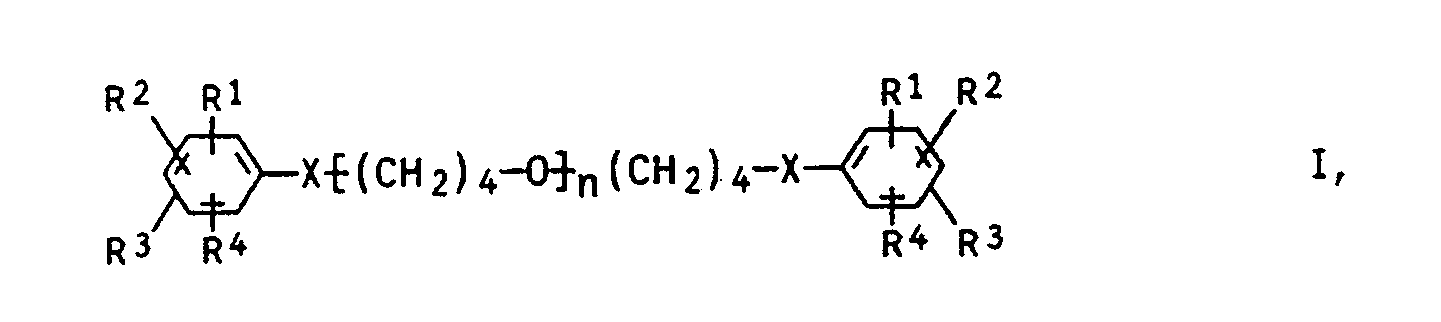
- the new polytetrahydrofuran derivatives have the general formula in which n is a number from 2 to 70, X is the bridge member -NH- or -O-,
- a hydrogen atom an alkyl radical having 1 to 20 C atoms, an H2N, O2N, OHC-NH, HO, OHC, NC, HOCH2-, H2NCH2-, ClH2C-, FH2C-, Cl3C-, F3C -, HO3S, ClOC, OCN, NCO radical or one of the radicals R5-NH-, R5R6N-, R5O-CO-, R5CO-, R5O-, R5CO-NH-, R5OOC-NH-, R5OOC-O -, in which R5 and R6 stand for alkyl radicals with 1 to 10 carbon atoms,
- PTHF Polytetrahydrofurans
- THF tetrahydrofuran
- the degree of polymerization m or the average molecular weight corresponding to this value (hereinafter referred to as MG referred to), by which the at Polymerization of THF available PTHF mixtures can be characterized, for. B. can be determined by osmometric or titrimetric analyzes.
- Each of these PTHF mixtures contains a broad spectrum of PTHF homologs, the number of which is approximately 10 to 20 in the low molecular weight range and increases to over 30 in the high molecular weight range.
- PTHF is used as an ⁇ , ⁇ -diol for the production of polymers. It is characterized by its valuable properties as a building block for elastomeric and thermoplastic polymers (P. Dreyfuss "Handbook of Elastomers, New Developments and Technology", 1988, p. 695).
- This invention relates to the new PTHF derivatives of the formula I. These new compounds are valuable intermediates for the production of polymeric esters, amides, urethanes, ureas, adhesives and binders.
- Suitable alkyl radicals for R1 are those with 1 to 20 C atoms, and for R2, R3, R5 and R6 those with 1 to 10 C atoms.
- the alkyl radicals can be straight-chain or branched.
- the following alkyl radicals may be mentioned, for example: methyl, ethyl, propyl, isopropyl, butyl, isobutyl, tert-butyl, pentyl, hexyl and nonyl.
- the preferred alkyl radicals R1 have 1 to 10 carbon atoms and the preferred alkyl radicals R2, R3, R5 and R6 have 1 to 6, in particular 1 to 4, carbon atoms.
- PTHF derivatives of the formula 1 are, for example, the following compounds in which the bridge member ⁇ (CH2) 4-O ⁇ n (CH2) 4- stands for:
- the new PTHF derivatives are prepared, for example, by reacting PTHF or PTHF derivatives of the general formula in which X and n have the meaning given above, with benzene derivatives of the general formula here, where Y is an electrofuge substituent, such as a halogen atom, preferably a chlorine or fluorine atom and R1, R2, R3, R4 have the abovementioned meaning.
- Y is an electrofuge substituent, such as a halogen atom, preferably a chlorine or fluorine atom
- R1, R2, R3, R4 have the abovementioned meaning.
- the new PTHF derivatives can also be prepared, for example, by using PTHF derivatives of the formula in which Z is an electrofuge residue, such as a halogen atom, preferably Cl or Br, or a sulfonic acid residue, such as a tosyl residue or a phenylsulfonic acid residue, preferably a mesyl residue, with a benzene derivative of the formula in which X, R1, R2, R3 and R4 have the meaning given above.
- Z is an electrofuge residue, such as a halogen atom, preferably Cl or Br
- a sulfonic acid residue such as a tosyl residue or a phenylsulfonic acid residue, preferably a mesyl residue
- X, R1, R2, R3 and R4 have the meaning given above.
- Benzene derivatives of the formula VI are, for example, phenol derivatives, such as alkylphenols, e.g. B. p-nonylphenol, hydroxymethylphenols, e.g. B. p-hydroxymethylphenol, halomethylphenols, e.g. B. o-trifluoromethylphenol or p-trichloromethylphenol, acylphenols, e.g. B. o- and p-formylphenol, o- and p-acetylphenol, alkoxycarbonylphenols, e.g. B. o- and p-methoxycarbonylphenol, cyanophenols, e.g. B.
- alkylphenols e.g. B. p-nonylphenol
- hydroxymethylphenols e.g. B. p-hydroxymethylphenol
- halomethylphenols e.g. B. o-trifluoromethylphenol or p-trichloro
- o- and p-cyanophenol aminophenols, e.g. B. p-aminophenol, N-acylaminophenols, e.g. B. pN-formylaminophenol, polyhydric phenols, e.g. B. catechol, resorcinol and hydroquinone, nitrophenols, e.g. B. o-, m- and p-nitrophenol, and 2,4-dinitrophenol, sulfo-substituted phenols, e.g. B. o- and p-hydroxibenzenesulfonic acid.
- Other compounds of formula VI are e.g. B.
- aniline and aniline derivatives such as alkylanilines, e.g. B. o-, m- and p-toluidine, 2,6-dimethylaniline and polyvalent aminobenzenes, e.g. B. o-, m- and p-phenylenediamine, 2,4-diethyl-6-methyl-1,3-phenylenediamine, hydroxyaminophenols, e.g. B. p-hydroxianiline.
- alkylanilines e.g. B. o-, m- and p-toluidine
- 2,6-dimethylaniline e.g. B. o-, m- and p-phenylenediamine, 2,4-diethyl-6-methyl-1,3-phenylenediamine, hydroxyaminophenols, e.g. B. p-hydroxianiline.
- PTHF derivatives of formula I e.g. also by hydrogenation of those PTHF derivatives of the formula I which contain reducible substituents on the benzene ring, such as acyl, ester, nitrile or in particular nitro groups, these groups being converted into hydroxyalkyl, hydroxymethyl, aminomethyl and amino groups.
- reducible substituents on the benzene ring such as acyl, ester, nitrile or in particular nitro groups, these groups being converted into hydroxyalkyl, hydroxymethyl, aminomethyl and amino groups.
- PTHF derivatives of the formula I with nitro groups are particularly suitable for this.
- Water-moist 2,4-dinitrophenol is first dried by azeotropic dewatering with toluene, then 150 ml of N-methylpyrrolidone are added to the suspension of 18.5 g of 2,4-dinitrophenol in about 100 ml of toluene, and the toluene is distilled off under normal pressure. After the addition of 7.6 g of anhydrous potassium carbonate and 28.9 g of PTHF 1000 dimesylate, the mixture is heated at 130 ° C. for 5 h with nitrogen and stirring, the solvent is stripped off at 5 mbar and 100 ° C.
Landscapes
- Chemical & Material Sciences (AREA)
- General Chemical & Material Sciences (AREA)
- Health & Medical Sciences (AREA)
- Chemical Kinetics & Catalysis (AREA)
- Medicinal Chemistry (AREA)
- Polymers & Plastics (AREA)
- Organic Chemistry (AREA)
- Organic Low-Molecular-Weight Compounds And Preparation Thereof (AREA)
- Polyethers (AREA)
- Cosmetics (AREA)
Abstract
in der n eine Zahl von 2 bis 70, X das Bindeglied -NH- oder -O- und die Reste R¹ bis R⁴ Wasserstoffatome oder verschiedene Reste bedeuten.
Description
- Diese Erfindung betrifft neue Polytetrahydrofuranderivate mit endständigen aromatischen Gruppen.
- Die neuen Polytetrahydrofuranderivate haben die allgemeine Formel

in der n eine Zahl von 2 bis 70, X das Brückenglied -NH- oder -O-, - ein Wasserstoffatom, einen Alkylrest mit 1 bis 20 C-Atomen, einen H₂N-, O₂N-, OHC-NH-, HO-, OHC-, NC-, HOCH₂-, H₂NCH₂-, ClH₂C-, FH₂C-, Cl₃C-, F₃C-, HO₃S-, ClOC-, OCN-, NCO-Rest oder einen der Reste R⁵-NH-, R⁵R⁶N-, R⁵O-CO-, R⁵CO-, R⁵O-, R⁵CO-NH-, R⁵OOC-NH-, R⁵OOC-O-, in denen R⁵ und R⁶ für Alkylreste mit 1 bis 10 C-Atomen stehen,
- jeweils ein Wasserstoffatom, einen Alkylrest mit 1 bis 10 C-Atomen, einen H₂N-, O₂N-, OHC-NH-, HO-, OHC-, NC-, HOCH₂-Rest oder einen der Reste R⁵-NH-, R⁵R⁶-N-, in denen R⁵ und R⁶ die obengenannte Beschreibung haben, und
- ein Wasserstoffatom, einen Alkylrest mit 1 bis 4 C-Atomen oder einen H₂N-, O₂N oder HO-Rest bedeuten.
- Polytetrahydrofurane (im folgenden PTHF genannt) haben die allgemeine Formel

in der m = n + 1 bedeutet. Sie werden z. B. durch kationische Polymerisation von Tetrahydrofuran (im folgenden THF genannt) hergestellt. In der Formel II gibt der Polymerisationsgrad m die Anzahl der vom THF abgeleiteten Oxi-butan-1,4-diyl-Einheiten pro Molekül an; er liegt üblicherweise bei m = 3 (entsprechend einem mittleren Molgewicht von MG = 234) bis m etwa 70 (entsprechend einem mittleren MG von etwa 5000). Der Polymerisationsgrad m bzw. das diesem Wert entsprechende mittlere Molgewicht (im folgenden alsMG bezeichnet), durch die die bei der Polymerisation von THF erhältlichen PTHF-Gemische charakterisiert werden, können z. B. durch osmometrische oder titrimetrische Analysen ermittelt werden. Von besonderem technischen Interesse sind z. B. die folgenden PTHF-Gemische: PTHF 250 (MG = ca. 250, m = ca. 3), PTHF 650 (MG = ca. 650, m = ca. 9), PTHF 1000 (MG = ca. 1000, m = ca. 14), PTHF 2000 (MG = ca. 2000, m = ca. 27), PTHF 2900 (MG = ca. 2900, m = ca. 40) und PTHF 4500 (MG = ca. 4500, m = ca. 62). - Jedes dieser PTHF-Gemische enthält ein breites Spektrum von PTHF-Homologen, deren Anzahl ca. 10 bis 20 im niedrigen Molmassenbereich beträgt und auf über 30 im hohen Molmassenbereich ansteigt.
- PTHF wird als α,ω-Diol für die Herstellung von Polymeren verwendet. Hierbei zeichnet es sich wegen seiner wertvollen Eigenschaften als Baustein für elastomere und thermoplastische Polymere aus (P. Dreyfuss "Handbook of Elastomers, New Developments and Technology", 1988, S. 695).
- Als α,ω-Diol ist die Reaktionsfähigkeit des PTHF allerdings auf die typischen Reaktionen von primären Alkoholen beschränkt. Es hat daher nicht an Versuchen gefehlt, dem PTHF durch Modifizieren der Endgruppen eine andere Reaktivität zu verleihen, um dadurch seine Verwendungsmöglichkeiten zu erweitern. So liefert z. B. die Umsetzung des PTHF mit Diisocyanaten im Molverhältnis 1:2 PTHF-Diurethane mit freien, endständigen Isocyanatgruppen, und durch Umesterung von (Meth-)Acrylsäureestern mit PTHF erhält man PTHF-bis(meth-)acrylate. Bei derartigen Umsetzungen mit Gemischen von PTHF-Homologen erhält man wiederum Gemische von homologen PTHF-Derivaten, die sich strukturell ebenfalls nur durch die unterschiedliche Zahl der wiederkehrenden Oxi-butan-1,4-diyl-Einheiten in der Polyetherkette unterscheiden.
- Gegenstand dieser Erfindung sind die neuen PTHF-Derivate der Formel I. Diese neuen Verbindungen sind wertvolle Zwischenprodukte für die Herstellung polymerer Ester, Amide, Urethane, Harnstoffe, Klebstoffe und Bindemittel.
- Als Alkylreste kommen für R¹ solche mit 1 bis 20 C-Atomen, und für R², R³, R⁵ und R⁶ solche mit 1 bis 10 C-Atomen in Betracht. Die Alkylreste können geradkettig oder verzweigt sein. Beispielsweise seien die folgenden Alkylreste genannt: Methyl, Ethyl, Propyl, iso-Propyl, Butyl, iso-Butyl, tert.-Butyl, Pentyl, Hexyl und Nonyl.
- Die bevorzugten Alkylreste R¹ haben 1 bis 10 C-Atome und die bevorzugten Alkylreste R², R³, R⁵ und R⁶ haben 1 bis 6, insbesondere 1 bis 4 C-Atome. PTHF-Derivate der Formel 1 sind z.B. die folgenden Verbindungen, in denen


- Man stellt die neuen PTHF-Derivate z.B. durch Umsetzung von PTHF oder PTHF-Derivaten der allgemeinen Formel

in der X und n die obengenannte Bedeutung haben, mit Benzolderivaten der allgemeinen Formel
her, wobei Y für einen elektrofugen Substituenten, wie ein Halogenatom, vorzugsweise ein Chlor- oder Fluoratom steht und R¹, R², R³, R⁴ die obengenannte Bedeutung haben. Für diese Umsetzung werden vorzugsweise solche Benzolderivate der Formel IV herangezogen, in denen die Reste R für elektronegative Substituenten, wie O₂N-, OHC-, NC-, R⁵O-CO-Reste stehen. - Man kann die neuen PTHF-Derivate z.B. auch dadurch herstellen, daß man PTHF-Derivate der Formel

in der Z einen elektrofugen Rest, wie ein Halogenatom, vorzugsweise Cl oder Br oder einen Sulfonsäurerest, wie einen Tosylrest oder einen Phenylsulfonsäurerest, vorzugsweise einen Mesylrest bedeutet, mit einem Benzolderivat der Formel
in der X, R¹, R², R³ und R⁴ die obengenannte Bedeutung haben, umsetzt. - Benzolderivate der Formel VI sind z.B. Phenolderivate, wie Alkylphenole, z. B. p-Nonylphenol, Hydroximethylphenole, z. B. p-Hydroximethylphenol, Halogenmethylphenole, z. B. o-Trifluormethylphenol oder p-Trichlormethylphenol, Acylphenole, z. B. o-und p-Formylphenol, o- und p-Acetylphenol, Alkoxicarbonylphenole, z. B. o- und p-Methoxicarbonylphenol, Cyanophenole, z. B. o- und p-Cyanophenol, Aminophenole, z. B. p-Aminophenol, N-Acylaminophenole, z. B. p-N-Formylaminophenol, mehrwertige Phenole, z. B. Brenzkatechin, Resorcin und Hydrochinon, Nitrophenole, z. B. o-, m- und p-Nitrophenol, sowie 2,4-Dinitrophenol, Sulfo-substituierte Phenole, z. B. o- und p-Hydroxibenzolsulfonsäure. Weitere Verbindungen der Formel VI sind z. B. Anilin und Anilinderivate, wie Alkylaniline, z. B. o-, m- und p-Toluidin, 2,6-Dimethylanilin und mehrwertige Aminobenzole, z. B. o-, m-und p-Phenylendiamin, 2,4-Diethyl-6-methyl-1,3-phenylendiamin, Hydroxiaminophenole, z. B. p-Hydroxianilin.
- Man kann PTHF-Derivate der Formel I z.B. auch durch Hydrierung solcher PTHF-Derivate der Formel I herstellen, die am Benzolring reduzierbare Substituenten, wie Acyl-, Ester-, Nitril- oder insbesondere Nitrogruppen enthalten, wobei diese Gruppen in Hydroxialkyl-, Hydroximethyl-, Aminomethyl- und Aminogruppen übergehen. Besonders geeignet sind hierfür PTHF-Derivate der Formel I mit Nitrogruppen.
- In den folgenden Beispielen wurden alle neuen Polytetrahydrofuranderivate NMR-spektroskopisch unter Verwendung von Tetramethylsilan als innerem Standard charakterisiert; die chemischen Verschiebungen sind in ppm angegeben. Die Abkürzungen bedeuten: s = Singulett, d = Dublett, t = Triplett, m = Multiplett. Die mittleren Molmassen
MG wurden aus den Intensitätsverhältnissen charakteristischer NMR-Banden abgeleitet oder osmometrisch bestimmt. - Herstellung von PTHF mit p-Nitrophenoxigruppen (Verbindung Nr. 5)
- Man erhitzt das Gemisch aus 16,3 g PTHF 650, 3,8 g feingepulvertem, trockenem Kaliumcarbonat, 10,6 g p-Nitrofluorbenzol und 0,2 g Tetramethylammoniumchlorid 24 h auf 180°C und destilliert anschließend das überschüssige p-Nitrofluorbenzol bei 0,5 mbar und 48°C ab. Nach Extrahieren des Rückstandes mit 100 ml Methyl-tert.-butylether filtriert man die Lösung, zieht das Lösungsmittel ab und trocknet den Rückstand im Ölpumpenvakuum. Man erhält 22,0 g der Verbindung Nr. 5 mit n = 8 als braunes, viskoses Öl.
NMR (CDCl₃):
δ = 1,4-2,0 (m); 3,2-3,5 (m); 4,1 (t); 6,95 und 8,2 (d, d)
MG (osmometrisch in Chloroform): 750 - Herstellung von PTHF mit 2,4-Dinitrophenoxigruppen (Verbindung Nr. 8)
- In Analogie zu Beispiel 1 setzt man 32,5 g PTHF 650 mit 7,6 g Kaliumcarbonat und 27,9 g 2,4-Dinitrofluorbenzol um. Nach der gleichen Aufarbeitung erhält man 41,7 g der Verbindung Nr. 8 mit n = 8 als braunes, viskoses Öl.
NMR (CDCl₃):
δ = 1,4-2,0 (m) 3,2-3,6 (m); 4,3 (t); 7,25 und 8,4 (d, d); 8,75 (s)
MG (osmometrisch in Aceton): 890 - Herstellung von PTHF mit p-Formylphenoxigruppen (Verbindung Nr. 38)
- Zum Gemisch aus 158 g ca. 87 %igem Natriumsalz des p-Hydroxibenzaldehyds und 2 l Dimethylformamid tropft man unter Rühren bei 60-67°C innerhalb von 3 h 156 g PTHF 250-Dimesylat. Man rührt das Reaktionsgemisch noch 8 h bei 60°C, versetzt es dann mit 3 l Wasser und extrahiert es zweimal mit je 1 l Methyl-tert.-butylether. Die vereinigten organischen Lösungen werden dreimal mit je 0,5 l Wasser gewaschen und eingedampft. Der Rückstand wird im Ölpumpenvakuum getrocknet. Man erhält 160 g der Verbindung Nr. 38 mit n = 2 als dickflüssiges Öl.
NMR (CDCl₃):
δ = 1,5-2,0 (m) ; 3,3-3,6 (m); 4,05 (t); 6,95 und 7,8 (d, d); 9,0 (s)
MG (NMR): 479 - Herstellung von PTHF mit p-Acetylphenoxigruppen (Verbindung Nr. 26)
- In Analogie zu Beispiel 3 setzt man 137 g eines 97 %igen Natriumsalzes des p-Acetylphenols in 2 l Dimethylformamid bei 65-70°C mit 366 g PTHF 1000-Dimesylat um. Nach der gleichen Aufarbeitung erhält man 370 g der Verbindung Nr. 26 mit n = 13 als dickflüssiges Öl.
NMR (CDCl₃):
δ = 1,5-2,0 (m); 2,55 (s); 3,3-3,6 (m); 4,0 (t); 7,0 und 8,0 (d, d)
MG (osmometrisch in Aceton): 1252 - Herstellung von PTHF mit p-Methoxicarbonylphenoxigruppen (Verbindung Nr. 28)
- Man löst 94,4 g p-Hydroxibenzoesäuremethylester in 600 ml Methanol, gibt 111,6 g 30 %ige methanolische Natriummethylatlösung und 564 g einer 48 %igen Lösung des PTHF-1000-Dimesylats in Toluol hinzu und rührt das Reaktionsgemisch 24 h bei ca. 60°C. Anschließend zieht man das Lösungsmittel ab, verteilt den Rückstand zwischen 300 ml Wasser und 800 ml Methyl-tert.-butylether, wäscht die organische Phase mit 500 ml Wasser, destilliert das Lösungsmittel ab und trocknet den Rückstand im Ölpumpenvakuum. Man erhält 279 g der Verbindung Nr. 28 mit n = 13.
NMR (CDCl₃):
δ = 1,5-1,95 (m); 3,3-3,55 (m); 3,85 (s); 4,0 (t); 6,9 und 8,0 (d, d)
MG (NMR): 1056 - Herstellung von PTHF mit p-Cyanophenoxigruppen (Verbindung Nr. 31)
- Man legt eine Lösung von 25 g p-Cyanophenol und 10,8 g Natriummethylat in 230 ml Methanol vor und tropft innerhalb von 4,5 h unter Rühren bei 60°C Reaktionstemperatur 262,8 g einer 44 %igen Lösung von PTHF 1000-Dimesylat in Toluol zu. Man rührt noch 6 h bei 60°C weiter, gibt 1 l Wasser zu, trennt die organische Phase ab, wäscht sie zweimal mit 250 ml 10 %iger wäßriger Natriumcarbonatlösung, zieht die Lösungsmittel ab und trocknet den Rückstand im Ölpumpenvakuum. Man erhält 107,2 g der Verbindung Nr. 31 mit n = 13.
NMR (CDCl₃):
δ = 1,45-1,95 (m); 3,2-3,5 (m); 4,05 (t); 6,9 und 7,6 (d, d)
MG (NMR): 1450 - Herstellung von PTHF mit p-Aminophenoxigruppen (Verbindung Nr. 3)
- Analog zu Beispiel 8 setzt man unter Stickstoff das Salz aus 3,4 g ca. 80 %igem Natriumhydrid mit 12 g p-Aminophenol in 150 ml N-Methylpyrrolidon mit der Lösung von 39 g PTHF 650-Dimesylat in 40 ml N-Methylpyrrolidon um. Nach der gleichen Aufarbeitung erhält man 36 g der Verbindung Nr. 3 mit n = 8 als dunkles, zähes Öl.
NMR (CDCl₃):
δ = 1,4-1,8 (m); 3,2-3,4 (m); 3,9 (t); 6,6 und 6,75 (d, d)
MG (osmometrisch in Chloroform): 840 - Herstellung von PTHF mit o-Nitrophenoxigruppen (Verbindung Nr. 7)
- Man legt unter Stickstoff 3,5 g 80 %iges Natriumhydrid in 70 ml N-Methylpyrrolidon vor, gibt bei 25-35°C innerhalb von ca. 45 min 15,3 g o-Nitrophenol zu, erhitzt anschließend auf 100°C und tropft in 1 h die Lösung von 57,8 g PTHF 1000-Dimesylat in 50 ml N-Methylpyrrolidon zu. Nach 4stündigem Rühren bei 100°C zieht man das Lösungsmittel bei 1 mbar und 100°C Badtemperatur ab, verteilt den Rückstand zwischen 400 ml 10 %iger wäßriger Natriumcarbonatlösung und 300 ml Methyl-tert.-butylether, wäscht die organische Lösung mit 200 ml 10 %iger wäßriger Natriumcarbonatlösung, destilliert das Lösungsmittel ab und trocknet den Rückstand im Ölpumpenvakuum. Man erhält 50 g der Verbindung Nr. 7 mit n = 13.
NMR (CDCl₃):
δ = 1,4-2,0 (m); 3,2-3,5 (m); 4,15 (t); 7,0; 7,05; 7,5 und 7,8 (m, m, m, m)
MG (NMR): 1100 - Herstellung von PTHF mit m-Nitrophenoxigruppen (Verbindung Nr. 6)
- In Analogie zu Beispiel 8 setzt man 15,3 g m-Nitrophenol anstelle von o-Nitrophenol um. Man erhält 48 g der Verbindung Nr. 6 mit n = 13.
NMR (CDCl₃):
δ = 1,4-2,0 (m); 3,2-3,5 (m); 4,05 (t); 7,2; 7,4 und 7,8 (m, m, m); 7,7 (s)
MG (NMR): 1170 - Herstellung von PTHF mit p-Nitrophenoxigruppen (Verbindung Nr. 5)
- Unter trockenem Stickstoff legt man 3,5 g 80 %iges Natriumhydrid in 70 ml N-Methylpyrrolidon vor und tropft in ca. 45 min unter Rühren bei 25-40°C die Lösung von 15,3 g p-Nitrophenol in 80 ml N-Methylpyrrolidon zu. Man erhitzt die Lösung auf 140°C, tropft in 1 h die Lösung von 57,8 g PTHF 1000-Dimesylat in 50 ml N-Methylpyrrolidon zu, rührt das Reaktionsgemisch weitere 4 h bei 140°C und zieht das Lösungsmittel bei 1 mbar und 100°C Badtemperatur ab. Man verteilt den Rückstand zwischen 400 ml einer 10 %igen wäßrigen Natriumcarbonat-Lösung und 300 ml Methyl-tert.-butylether, wäscht die organische Phase mit 200 ml 10 %iger wäßriger Natriumcarbonat-Lösung, zieht das Lösungsmittel ab und trocknet den Rückstand im Ölpumpenvakuum. Man erhält 51,3 g der Verbindung Nr. 5 mit n = 13 als gelbes, zähes Öl.
NMR (CDCl₃):
δ = 1,4-2,0 (m); 3,2-3,5 (m); 4,1 (t); 6,95 und 8,2 (d, d)
MG (osmometrisch in Aceton): 1160 - Herstellung von PTHF mit 2,4-Dinitrophenoxigruppen (Verbindung Nr. 8)
- Man trocknet zunächst wasserfeuchtes 2,4-Dinitrophenol durch Azeotropentwässerung mit Toluol, fügt dann zu der Suspension von 18,5 g 2,4-Dinitrophenol in ca. 100 ml Toluol 150 ml N-Methylpyrrolidon und destilliert das Toluol bei Normaldruck ab. Nach Zugabe von 7,6 g wasserfreiem Kaliumcarbonat und 28,9 g PTHF 1000-Dimesylat erwärmt man unter Stickstoff und Rühren 5 h auf 130°C Reaktionstemperatur, zieht das Lösungsmittel bei 5 mbar und 100°C Badtemperatur ab, verteilt den Rückstand zwischen 300 ml 10 %iger wäßriger Kaliumcarbonatlösung und 300 ml Methyl-tert.-butylether, wäscht die organische Phase mit 200 ml 10 %iger wäßriger Kaliumcarbonatlösung, zieht das Lösungsmittel ab und trocknet den Rückstand im Ölpumpenvakuum. Man erhält 20 g der Verbindung Nr. 8 (n = 13) als dunkles Öl.
NMR: wie bei Beispiel 2 beschrieben
MG (osmometrisch in Aceton): 1302 - Herstellung von PTHF mit p-Hydroxiphenoxigruppen (Verbindung Nr. 10)
- Analog zu Beispiel 8 setzt man unter Stickstoff das Salz aus 8,3 g ca. 80 %igem Natriumhydrid und 27,5 g Hydrochinon in 400 ml N-Methylpyrrolidon mit der Lösung von 28,9 g PTHF 1000-Dimesylat um. Nach dem Abkühlen versetzt man das Reaktionsgemisch mit 12 g Eisessig, zieht das Lösungsmittel bei 5 mbar und 100°C Badtemperatur ab, verteilt den Rückstand zwischen 500 ml 10 %iger wäßriger Natriumcarbonat-Lösung und 400 ml Methyl-tert.-butylether, extrahiert die wäßrige Phase zweimal mit je 100 ml Methyl-tert.-butylether, wäscht die vereinigten organischen Lösungen mit 150 ml 10 %iger wäßriger Natriumhydrogencarbonat-Lösung, zieht das Lösungsmittel ab und entfernt überschüssiges Hydrochinon durch Absublimieren bei 0,2 mbar und 140-155°C Badtemperatur. Man erhält 22,3 g der Verbindung Nr. 10 (n = 13) als dunkles, zähes Öl.
NMR (D₆-DMSO):
δ = 1,4-1,8 (m); 3,25 (s); 3,35 (m); 3,85 (t); 6,65 und 6,75 (d, d)
MG (osmometrisch in Aceton): 1306 - Herstellung von PTHF mit p-Sulfophenoxigruppen (Verbindung Nr. 44)
- Unter Stickstoff suspendiert man 143,8 g eines ca. 90 %igen Dinatriumsalzes der p-Hydroxiphenylsulfonsäure in 1 l N-Methylpyrrolidon, tropft unter Rühren bei 100°C Reaktionstemperatur 208,1 g PTHF 1000-Dimesylat zu, rührt das Reaktionsgemisch noch 4 h bei 100°C und eine weitere Stunde bei 120°C. Nach dem Abziehen des Lösungsmittels bei 5 mbar und 100°C Badtemperatur verteilt man den Rückstand zwischen 500 ml 2n Salzsäure und 500 ml Methylenchlorid, schüttelt die organische Phase einmal mit 300 ml 2n Salzsäure, zieht das Lösungsmittel ab und trocknet den Rückstand im Ölpumpenvakuum. Man erhält 179 g der Verbindung Nr. 44 mit n = 13.
NMR (D₆-DMSO):
δ = 1,4-1,8 (m); 3,2-3,5 (m); 4,0 (t); 6,85 und 7,5 (d, d); 8,1 (m)
MG (aus Säurezahl berechnet): 1403 - Herstellung von PTHF mit Phenylaminogruppen (Verbindung Nr. 52)
- Man legt 1058 g Anilin vor und tropft unter Rühren 231 g PTHF 250-Dimesylat innerhalb von 1 h bei 70°C zu. Man rührt weitere 4 h und destilliert das überschüssige Anilin bei 55°C/0,5 mbar ab. Der Rückstand wird zwischen 700 ml 2n. Natronlauge und 500 ml Methyl-tert.-butylether verteilt und die organische Phase getrocknet und eingeengt. Man erhält 189 g der Verbindung der Formel 52 (n = 2) als gelbes Öl.
NMR (CDCl₃):
δ = 1,4-1,8 (m); 3,15 (t); 3,3-3,5 (m); 3,65 (breites m) ; 6,5-6,8 (m); 7,1-7,3 (m)
MG (NMR): 420 - Herstellung von PTHF mit p-Aminophenylaminogruppen (Verbindung Nr. 58)
- Unter Stickstoff löst man 10,8 g p-Phenylendiamin in 200 ml Methanol bei 30-40°C, tropft unter Rühren 11,6 g PTHF 1000-Dimesylat innerhalb von ca. 30 min zu und rührt das Reaktionsgemisch weitere 3 h bei Raumtemperatur. Nach Abziehen des Lösungsmittels entfernt man das übeschüssige p-Phenylendiamin bei 180-220°C und 3 mbar in einer Kurzweg-Destillationsapparatur. Man suspendiert den Rückstand in 80 ml 2n Natronlauge und extrahiert dreimal mit je 100 ml Methyl-tert.-butylether. Nach Waschen der vereinigten organischen Lösungen mit 50 ml Wasser zieht man das Lösungsmittel ab und trocknet den Rückstand im Ölpumpenvakuum. Man erhält 10,3 g der Verbindung Nr. 58 mit n = 13.
NMR (CDCl₃):
δ = 1,4-1,8 (m); 3,1 (t); 3,2,-3,4 (m); 6,55 und 6,6 (d, d)
MG (osmometrisch in Chloroform): 1200 - Herstellung von PTHF mit 3-Amino-2,4-diethyl-6-methylphenylaminogruppen (Verbindung Nr. 54)
- Man legt 963 g 3,5-Diethyl-2,4-diaminotoluol vor und tropft unter Rühren 122 g PTHF 250-Dimesylat innerhalb von 1 h bei 70°C zu. Man rührt weitere 4 h und destilliert das überschüssige Amin bei 133°C/2 mbar ab. Der Rückstand wird zwischen 400 ml Toluol und 500 ml 2n Natronlauge verteilt. Die Toluolphase wird noch 1x mit 400 ml gesättigter Natriumchlorid-Lösung ausgeschüttelt, getrocknet und eingeengt. Man erhält 134,6 g der Verbindung Nr. 54 mit n = 2 als gelbes Öl.
NMR (CDCl₃):
δ = 1,1-1,3 (m); 1,5-1,7 (m); 2,0-2,3 (m); 2,4-2,8 (m) ; 2,9 (t); 3,2-3,6 (m); 6,75 (s)
MG (NMR): 570 - Herstellung von PTHF mit p-Hydroxiphenylaminogruppen (Verbindung Nr. 53)
- Man legt 21,8 g p-Aminophenol in 200 ml N-Methylpyrrolidon vor, tropft unter Rühren in 1 h bei 50°C 23,1 g PTHF 1000-Dimesylat zu und rührt das Reaktionsgemisch noch 3 h. Nach Abdestillieren des Lösungsmittels bei 5 mbar und 100°C Badtemperatur entfernt man den größten Teil des p-Aminophenol-Überschusses durch Absublimieren bei 2 mbar und 160°C Badtemperatur, verteilt den Rückstand zwischen 150 ml 10 %iger wäßriger Natriumhydrogencarbonatlösung und 150 ml Methylenchlorid, wäscht die organische Phase mit 100 ml 10 %iger wäßriger Natriumhydrogencarbonatlösung, zieht das Lösungsmittel ab und trocknet den Rückstand im Ölpumpenvakuum.
- Man erhält 15,5 g der Verbindung Nr. 53 mit n = 13 als dunkles, zähes Öl.
NMR (CDCl₃):
δ = 1,4-1,7 (m); 3,1 (t); 3,2-3,5 (m); 6,4 (breites m); 6,55 und 6,7 (d, d)
MG (osmometrisch in Chloroform): 1300 - Herstellung von PTHF mit p-Aminophenoxigruppen (Verbindung Nr. 3)
- In einem 300-ml-Autoklaven erhitzt man das Gemisch aus 62,1 g der Verbindung Nr. 5 (MG = 1200), 150 ml THF und 5 g Raney-Nickel unter Durchmischen unter 50 bar Wasserstoff-Druck 2 h auf 75°C und noch eine weitere h auf 100°C. Anschließend läßt man abkühlen, entspannt, filtriert und zieht die Niedersieder im Vakuum ab. Man erhält 56,0 g der Verbindung Nr. 3 mit n = 13 als viskoses, braunes Öl.
NMR: wie unter Beispiel 7 beschrieben
MG (osmometrisch in Chloroform): 1200 - Herstellung von PTHF mit 2,4-Diaminophenoxigruppe (Verbindung Nr. 4)
- In Analogie zu Beispiel 18 hydriert man 19,6 g der Verbindung Nr. 8 (
MG = 1300) in 100 ml THF an 2 g Raney-Nickel. Nach der gleichen Aufarbeitung erhält man 17,2 g der Verbindung Nr. 4 mit n = 13 als viskoses, braunes Öl.
NMR (CDCl₃):
δ = 1,4-2,0 (m); 3,2-3,6 (m); 3,9 (t); 6,0 und 6,6 (d, d); 6,1 (s)
MG (osmometrisch in Chloroform): 1300 - Herstellung von PTHF mit p-Aminomethylphenoxigruppen (Verbindung Nr. 16)
- In einem 300-l-Autoklaven erhitzt man das Gemisch aus 20 g der Verbindung Nr. 31 (
MG = 1450), 75 ml THF, 50 ml flüssigem Ammoniak und 5 g Raney-Kobalt unter Durchmischen 5 h unter 50 bar Wasserstoff-Druck auf 100°C. Anschließend läßt man abkühlen, entspannt, filtriert und zieht die Niedersieder im Vakuum ab. Man erhält 18,3 g der Verbindung Nr. 16 mit n = 13 als zähes, gelbes Öl.
NMR (CDCl₃):
δ = 1,4-2,0 (m); 3,2-3,6 (m); 3,9 (m); 4,0 (t); 6,9 und 7,2 (d, d)
MG (osmometrisch in Chloroform): 1450 - Herstellung von PTHF mit p-Formylaminophenoxigruppen (Verbindung Nr. 23)
- Das Gemisch aus 84 g der Verbindung Nr. 3, 13,5 g Formamid und 200 ml NMP wird so lange auf 120°C erhitzt, bis kein Ammoniak mehr entweicht (ca. 5 h). Anschließend destilliert man überschüssiges Formamid und Lösungsmittel im Vakuum ab. Man erhält 86 g der Verbindung Nr. 23 mit n = 9.
NMR (CDCl₃):
δ = 1,4-1,8 (m); 3,2-3,6 (m); 4,0 (t); 6,6 und 7,6 (d, d); 8,4 (s); 9,0 (breites s)
MG (osmometrisch in Chloroform): 902 - Herstellung von PTHF mit p-Isocyanatophenoxigruppen (Verbindung Nr. 40)
- Man legt die Lösung von 84 g der Verbindung Nr. 3 (650) in 200 ml o-Dichlorbenzol vor, leitet bei 0°C Chlorwasserstoff ein und setzt die erhaltene Suspension des Dihydrochlorids bei 120-130°C mit ca. 20 g Phosgen um. Nach 5 h Reaktionsdauer wird das fast klare Reaktionsgemisch filtriert, das Lösungsmittel abdestilliert und der Rückstand im Ölpumpen-Vakuum getrocknet. Man erhält 85 g der Verbindung Nr. 40 mit n = 9.
NMR (CDCl₃):
δ = 1,4-1,8 (m); 3,2-3,6 (m); 3,9 (t); 6,8 und 7,0 (d, d)
MG (osmometrisch in Chloroform): 895 - Herstellung von PTHF mit p-Nonylphenoxigruppen (Verbindung Nr. 42)
- In Analogie zu Beispiel 3 setzt man 26,4 g p-Nonylphenol und 6,5 g Natriummethylat in 20 ml Methanol mit 507 g einer 48 %igen PTHF 4500-Dimesylat-Lösung in Toluol um. Nach der gleichen Aufarbeitung erhält man 246 g der Verbindung Nr. 42 mit n = 61 als gelbliches, wachsartig erstarrendes Produkt.
NMR (CDCl₃):
δ = 0,9 (m) ; 1,2-2,1 (m); 2,5 (t); 3,3-3,6 (m) ; 3,9 (t); 6,7 und 7,0 (d,d)
MG (NMR): 4900
Claims (1)
- Polytetrahydrofuranderivate der allgemeinen Formel

R¹
ein Wasserstoffatom, einen Alkylrest mit 1 bis 20 C-Atomen, einen H₂N-, O₂N-, OHC-NH-, HO-, OHC-, NC-, HOCH₂-, H₂NCH₂-, ClH₂C-, FH₂C-, Cl ₃C-, F₃C-, HO₃S-, ClOC-, OCN-, NCO-Rest oder einen der Reste R⁵-NH-, R⁵R⁶N-, R⁵O-CO-, R⁵CO-, R⁵O-, R⁵CO-NH-, R⁵OOC-NH-, R⁵OOC-O-, in denen R⁵ und R⁶ für Alkylreste mit 1 bis 10 C-Atomen stehen,
R² und R³
jeweils ein Wasserstoffatom, einen Alkylrest mit 1 bis 10 C-Atomen,
einen H₂N-, O₂N-, OHC-NH-, HO-, OHC-, NC-, HOCH₂-Rest oder einen der Reste R⁵-NH-, R⁵R⁶-N-, in denen R⁵ und R⁶ die obengenannte Beschreibung haben, und
R⁴
ein Wasserstoffatom, einen Alkylrest mit 1 bis 4 C-Atomen oder einen H₂N-, O₂N- oder HO-Rest bedeuten.
Applications Claiming Priority (2)
| Application Number | Priority Date | Filing Date | Title |
|---|---|---|---|
| DE3942574A DE3942574A1 (de) | 1989-12-22 | 1989-12-22 | Polytetrahydrofuranderivate mit endstaendigen aromatischen gruppen |
| DE3942574 | 1989-12-22 |
Publications (3)
| Publication Number | Publication Date |
|---|---|
| EP0433887A2 true EP0433887A2 (de) | 1991-06-26 |
| EP0433887A3 EP0433887A3 (en) | 1991-12-18 |
| EP0433887B1 EP0433887B1 (de) | 1996-06-12 |
Family
ID=6396203
Family Applications (1)
| Application Number | Title | Priority Date | Filing Date |
|---|---|---|---|
| EP90124066A Expired - Lifetime EP0433887B1 (de) | 1989-12-22 | 1990-12-13 | Polytetrahydrofuranderivate mit endständigen aromatischen Gruppen |
Country Status (5)
| Country | Link |
|---|---|
| US (1) | US5130454A (de) |
| EP (1) | EP0433887B1 (de) |
| JP (1) | JPH04126717A (de) |
| DE (2) | DE3942574A1 (de) |
| ES (1) | ES2087883T3 (de) |
Cited By (3)
| Publication number | Priority date | Publication date | Assignee | Title |
|---|---|---|---|---|
| WO2003024917A1 (de) * | 2001-09-07 | 2003-03-27 | Henkel Kommanditgesellschaft Auf Aktien | Verbrückte p-phenylendiamine |
| WO2010076188A1 (en) | 2008-12-30 | 2010-07-08 | Total Petrochemicals Research Feluy | Synthesis of substituted tetrahydroindenyl complexes |
| WO2013043837A3 (en) * | 2011-09-21 | 2013-06-27 | Prc-Desoto International, Inc. | Flexible polyamines, flexible amine-terminated adducts, compositions thereof and methods of use |
Families Citing this family (4)
| Publication number | Priority date | Publication date | Assignee | Title |
|---|---|---|---|---|
| WO2005113487A2 (en) * | 2004-05-14 | 2005-12-01 | Sawyer Kenneth I | Polyurea compositions and compounds for the preparation thereof |
| US7375177B2 (en) * | 2005-11-29 | 2008-05-20 | General Electric Company | Polymers, polymer compositions and method of preparation |
| US7183431B1 (en) * | 2005-11-29 | 2007-02-27 | General Electric Company | Dihydroxy aromatic compounds and methods for preparation |
| JP2010241881A (ja) * | 2009-04-02 | 2010-10-28 | Nippon Shokubai Co Ltd | 重合体組成物およびその製造方法 |
Family Cites Families (4)
| Publication number | Priority date | Publication date | Assignee | Title |
|---|---|---|---|---|
| US4507498A (en) * | 1982-04-09 | 1985-03-26 | Hoffmann-La Roche Inc. | Phenoxycarboxylic acids |
| JPS6038412B2 (ja) * | 1982-09-21 | 1985-08-31 | 東洋ゴム工業株式会社 | ポリエ−テルポリオ−ル誘導体及びその製造法 |
| US4847416A (en) * | 1986-10-27 | 1989-07-11 | The Dow Chemical Company | Capping of polyols with aromatic amines |
| DE3713858A1 (de) * | 1987-04-25 | 1988-11-17 | Bayer Ag | Aromatische polyamine, ein verfahren zu ihrer herstellung und ihre verwendung zur herstellung von polyurethankunststoffen |
-
1989
- 1989-12-22 DE DE3942574A patent/DE3942574A1/de not_active Withdrawn
-
1990
- 1990-12-13 EP EP90124066A patent/EP0433887B1/de not_active Expired - Lifetime
- 1990-12-13 ES ES90124066T patent/ES2087883T3/es not_active Expired - Lifetime
- 1990-12-13 DE DE59010374T patent/DE59010374D1/de not_active Expired - Lifetime
- 1990-12-19 US US07/630,013 patent/US5130454A/en not_active Expired - Lifetime
- 1990-12-20 JP JP2404243A patent/JPH04126717A/ja not_active Withdrawn
Cited By (5)
| Publication number | Priority date | Publication date | Assignee | Title |
|---|---|---|---|---|
| WO2003024917A1 (de) * | 2001-09-07 | 2003-03-27 | Henkel Kommanditgesellschaft Auf Aktien | Verbrückte p-phenylendiamine |
| WO2010076188A1 (en) | 2008-12-30 | 2010-07-08 | Total Petrochemicals Research Feluy | Synthesis of substituted tetrahydroindenyl complexes |
| US9422467B2 (en) | 2011-03-18 | 2016-08-23 | Prc-Desoto International, Inc. | Flexible polyamines, flexible amine-terminated adducts, compositions thereof and methods of use |
| WO2013043837A3 (en) * | 2011-09-21 | 2013-06-27 | Prc-Desoto International, Inc. | Flexible polyamines, flexible amine-terminated adducts, compositions thereof and methods of use |
| US8816044B2 (en) | 2011-09-21 | 2014-08-26 | PRC DeSoto International, Inc | Flexible polyamines, flexible amine-terminated adducts, compositions thereof and methods of use |
Also Published As
| Publication number | Publication date |
|---|---|
| DE3942574A1 (de) | 1991-06-27 |
| ES2087883T3 (es) | 1996-08-01 |
| EP0433887A3 (en) | 1991-12-18 |
| DE59010374D1 (de) | 1996-07-18 |
| EP0433887B1 (de) | 1996-06-12 |
| US5130454A (en) | 1992-07-14 |
| JPH04126717A (ja) | 1992-04-27 |
Similar Documents
| Publication | Publication Date | Title |
|---|---|---|
| DE2141807C2 (de) | Selbstemulgierter wäßriger Polyurethanharnstoff- oder Polyharnstoff-Latex und dessen Verwendung zur Herstellung von Filmen | |
| DE3048076C2 (de) | ||
| EP0050275A1 (de) | Verfahren zur Herstellung von Polyaminen | |
| DE2648825C2 (de) | Endständige Aminogruppen aufweisende Polyäther, Verfahren zu ihrer Herstellung und ihre Verwendung | |
| WO1999006460A1 (de) | Latent vernetzende wässerige dispersionen enthaltend ein polyurethan | |
| EP0433887B1 (de) | Polytetrahydrofuranderivate mit endständigen aromatischen Gruppen | |
| DD236539A5 (de) | Verwendung und herstellung von substituierten p,p'-methylen-bis-anilinen | |
| DE1229288B (de) | Verfahren zur Herstellung von Polyurethan-elastomeren aus der Loesung | |
| DE3246297C2 (de) | ||
| DE3713858A1 (de) | Aromatische polyamine, ein verfahren zu ihrer herstellung und ihre verwendung zur herstellung von polyurethankunststoffen | |
| US3678013A (en) | Process of reacting carboxy-terminated polyalkylene polymer with an imine and resultant product | |
| DE1111389B (de) | Verfahren zur Herstellung von warmverformbaren, haertbaren Polyurethanen | |
| US4174455A (en) | Anthranilates of oxyalkylated carboxamides | |
| DE2916599A1 (de) | Bis-(anthranilsaeureester) von harnstoffderivaten | |
| DE2114744B2 (de) | Verfahren zur Herstellung von Polyurethan amiden | |
| DE2058502C3 (de) | Polyurethanelastomere | |
| US2761852A (en) | Basic polyureas | |
| US5260484A (en) | Polytetrahydrofuran derivatives having terminal aromatic groups | |
| EP0336184B1 (de) | Monoformylierte 3,3'-Diaminodipropylamine, ein Verfahren zu deren Herstellung und deren Verwendung | |
| DE2852746A1 (de) | Bis-(anthranilsaeureester), verfahren zu ihrer herstellung und deren verwendung | |
| DE3818391C2 (de) | ||
| US3940376A (en) | Permanently antistatic shaped structures of acrylonitrile polymers | |
| DE3437632A1 (de) | Verfahren zur herstellung hoehermolekularer aminoverbindungen mit vermindertem monomeramingehalt, sowie deren verwendung | |
| CH511814A (de) | Verfahren zur Herstellung neuer Harnstoffderivate | |
| DE2648766C3 (de) | Endständige Aminogruppen aufweisende Poly(thio)äther, Verfahren zu deren Herstellung und deren Verwendung |
Legal Events
| Date | Code | Title | Description |
|---|---|---|---|
| PUAI | Public reference made under article 153(3) epc to a published international application that has entered the european phase |
Free format text: ORIGINAL CODE: 0009012 |
|
| 17P | Request for examination filed |
Effective date: 19901213 |
|
| AK | Designated contracting states |
Kind code of ref document: A2 Designated state(s): BE DE ES FR GB IT NL |
|
| PUAL | Search report despatched |
Free format text: ORIGINAL CODE: 0009013 |
|
| AK | Designated contracting states |
Kind code of ref document: A3 Designated state(s): BE DE ES FR GB IT NL |
|
| 17Q | First examination report despatched |
Effective date: 19940517 |
|
| GRAH | Despatch of communication of intention to grant a patent |
Free format text: ORIGINAL CODE: EPIDOS IGRA |
|
| GRAH | Despatch of communication of intention to grant a patent |
Free format text: ORIGINAL CODE: EPIDOS IGRA |
|
| GRAA | (expected) grant |
Free format text: ORIGINAL CODE: 0009210 |
|
| AK | Designated contracting states |
Kind code of ref document: B1 Designated state(s): BE DE ES FR GB IT NL |
|
| REG | Reference to a national code |
Ref country code: ES Ref legal event code: BA2A Ref document number: 2087883 Country of ref document: ES Kind code of ref document: T3 |
|
| REF | Corresponds to: |
Ref document number: 59010374 Country of ref document: DE Date of ref document: 19960718 |
|
| REG | Reference to a national code |
Ref country code: ES Ref legal event code: FG2A Ref document number: 2087883 Country of ref document: ES Kind code of ref document: T3 |
|
| ITF | It: translation for a ep patent filed | ||
| GBT | Gb: translation of ep patent filed (gb section 77(6)(a)/1977) |
Effective date: 19960729 |
|
| ET | Fr: translation filed | ||
| PLBE | No opposition filed within time limit |
Free format text: ORIGINAL CODE: 0009261 |
|
| STAA | Information on the status of an ep patent application or granted ep patent |
Free format text: STATUS: NO OPPOSITION FILED WITHIN TIME LIMIT |
|
| 26N | No opposition filed | ||
| REG | Reference to a national code |
Ref country code: GB Ref legal event code: IF02 |
|
| PGFP | Annual fee paid to national office [announced via postgrant information from national office to epo] |
Ref country code: NL Payment date: 20041205 Year of fee payment: 15 |
|
| PGFP | Annual fee paid to national office [announced via postgrant information from national office to epo] |
Ref country code: GB Payment date: 20041208 Year of fee payment: 15 Ref country code: FR Payment date: 20041208 Year of fee payment: 15 |
|
| PGFP | Annual fee paid to national office [announced via postgrant information from national office to epo] |
Ref country code: DE Payment date: 20041209 Year of fee payment: 15 |
|
| PGFP | Annual fee paid to national office [announced via postgrant information from national office to epo] |
Ref country code: ES Payment date: 20041229 Year of fee payment: 15 |
|
| PGFP | Annual fee paid to national office [announced via postgrant information from national office to epo] |
Ref country code: BE Payment date: 20050701 Year of fee payment: 15 |
|
| PG25 | Lapsed in a contracting state [announced via postgrant information from national office to epo] |
Ref country code: IT Free format text: LAPSE BECAUSE OF NON-PAYMENT OF DUE FEES;WARNING: LAPSES OF ITALIAN PATENTS WITH EFFECTIVE DATE BEFORE 2007 MAY HAVE OCCURRED AT ANY TIME BEFORE 2007. THE CORRECT EFFECTIVE DATE MAY BE DIFFERENT FROM THE ONE RECORDED. Effective date: 20051213 Ref country code: GB Free format text: LAPSE BECAUSE OF NON-PAYMENT OF DUE FEES Effective date: 20051213 |
|
| PG25 | Lapsed in a contracting state [announced via postgrant information from national office to epo] |
Ref country code: ES Free format text: LAPSE BECAUSE OF NON-PAYMENT OF DUE FEES Effective date: 20051214 |
|
| PG25 | Lapsed in a contracting state [announced via postgrant information from national office to epo] |
Ref country code: BE Free format text: LAPSE BECAUSE OF NON-PAYMENT OF DUE FEES Effective date: 20051231 |
|
| PG25 | Lapsed in a contracting state [announced via postgrant information from national office to epo] |
Ref country code: DE Free format text: LAPSE BECAUSE OF THE APPLICANT RENOUNCES Effective date: 20060126 |
|
| PG25 | Lapsed in a contracting state [announced via postgrant information from national office to epo] |
Ref country code: NL Free format text: LAPSE BECAUSE OF NON-PAYMENT OF DUE FEES Effective date: 20060701 |
|
| GBPC | Gb: european patent ceased through non-payment of renewal fee |
Effective date: 20051213 |
|
| PG25 | Lapsed in a contracting state [announced via postgrant information from national office to epo] |
Ref country code: FR Free format text: LAPSE BECAUSE OF NON-PAYMENT OF DUE FEES Effective date: 20060831 |
|
| NLV4 | Nl: lapsed or anulled due to non-payment of the annual fee |
Effective date: 20060701 |
|
| REG | Reference to a national code |
Ref country code: FR Ref legal event code: ST Effective date: 20060831 |
|
| REG | Reference to a national code |
Ref country code: ES Ref legal event code: FD2A Effective date: 20051214 |
|
| BERE | Be: lapsed |
Owner name: *BASF A.G. Effective date: 20051231 |