EP0434246B1 - Verfahren und Apparat zur Herstellung bandförmiger Supraleiter - Google Patents
Verfahren und Apparat zur Herstellung bandförmiger Supraleiter Download PDFInfo
- Publication number
- EP0434246B1 EP0434246B1 EP90313037A EP90313037A EP0434246B1 EP 0434246 B1 EP0434246 B1 EP 0434246B1 EP 90313037 A EP90313037 A EP 90313037A EP 90313037 A EP90313037 A EP 90313037A EP 0434246 B1 EP0434246 B1 EP 0434246B1
- Authority
- EP
- European Patent Office
- Prior art keywords
- film
- wire
- substrate
- molten bead
- molten
- Prior art date
- Legal status (The legal status is an assumption and is not a legal conclusion. Google has not performed a legal analysis and makes no representation as to the accuracy of the status listed.)
- Expired - Lifetime
Links
- 239000002887 superconductor Substances 0.000 title claims description 81
- 238000000034 method Methods 0.000 title claims description 76
- 239000000758 substrate Substances 0.000 claims description 129
- 239000011324 bead Substances 0.000 claims description 82
- 150000001875 compounds Chemical class 0.000 claims description 40
- 239000000463 material Substances 0.000 claims description 38
- 230000008018 melting Effects 0.000 claims description 25
- 238000002844 melting Methods 0.000 claims description 25
- 238000009792 diffusion process Methods 0.000 claims description 21
- 239000012768 molten material Substances 0.000 claims description 20
- 238000001816 cooling Methods 0.000 claims description 13
- 238000012544 monitoring process Methods 0.000 claims description 13
- 238000010438 heat treatment Methods 0.000 claims description 12
- 239000000112 cooling gas Substances 0.000 claims description 11
- RYGMFSIKBFXOCR-UHFFFAOYSA-N Copper Chemical compound [Cu] RYGMFSIKBFXOCR-UHFFFAOYSA-N 0.000 claims description 5
- 229910052802 copper Inorganic materials 0.000 claims description 5
- 239000010949 copper Substances 0.000 claims description 5
- 238000010791 quenching Methods 0.000 claims description 5
- 230000000171 quenching effect Effects 0.000 claims description 2
- 239000010408 film Substances 0.000 description 53
- 239000010955 niobium Substances 0.000 description 9
- GUCVJGMIXFAOAE-UHFFFAOYSA-N niobium atom Chemical compound [Nb] GUCVJGMIXFAOAE-UHFFFAOYSA-N 0.000 description 9
- 229910052758 niobium Inorganic materials 0.000 description 8
- 229910052782 aluminium Inorganic materials 0.000 description 5
- 229910052718 tin Inorganic materials 0.000 description 5
- 238000003466 welding Methods 0.000 description 5
- 238000006243 chemical reaction Methods 0.000 description 4
- 229910000657 niobium-tin Inorganic materials 0.000 description 4
- ATJFFYVFTNAWJD-UHFFFAOYSA-N Tin Chemical compound [Sn] ATJFFYVFTNAWJD-UHFFFAOYSA-N 0.000 description 3
- 230000000694 effects Effects 0.000 description 3
- 229910052733 gallium Inorganic materials 0.000 description 3
- 229910052732 germanium Inorganic materials 0.000 description 3
- 238000011031 large-scale manufacturing process Methods 0.000 description 3
- 238000004519 manufacturing process Methods 0.000 description 3
- 239000000155 melt Substances 0.000 description 3
- 229910045601 alloy Inorganic materials 0.000 description 2
- 239000000956 alloy Substances 0.000 description 2
- 238000005229 chemical vapour deposition Methods 0.000 description 2
- 239000004020 conductor Substances 0.000 description 2
- 238000005137 deposition process Methods 0.000 description 2
- 238000002074 melt spinning Methods 0.000 description 2
- KJSMVPYGGLPWOE-UHFFFAOYSA-N niobium tin Chemical compound [Nb].[Sn] KJSMVPYGGLPWOE-UHFFFAOYSA-N 0.000 description 2
- 238000011282 treatment Methods 0.000 description 2
- 229910001275 Niobium-titanium Inorganic materials 0.000 description 1
- 239000002253 acid Substances 0.000 description 1
- XAGFODPZIPBFFR-UHFFFAOYSA-N aluminium Chemical compound [Al] XAGFODPZIPBFFR-UHFFFAOYSA-N 0.000 description 1
- 238000013459 approach Methods 0.000 description 1
- 230000015572 biosynthetic process Effects 0.000 description 1
- 238000007664 blowing Methods 0.000 description 1
- 238000004140 cleaning Methods 0.000 description 1
- 239000011248 coating agent Substances 0.000 description 1
- 238000000576 coating method Methods 0.000 description 1
- 238000010924 continuous production Methods 0.000 description 1
- 238000010894 electron beam technology Methods 0.000 description 1
- 239000011261 inert gas Substances 0.000 description 1
- 229910000765 intermetallic Inorganic materials 0.000 description 1
- 230000001678 irradiating effect Effects 0.000 description 1
- 238000004093 laser heating Methods 0.000 description 1
- 239000000203 mixture Substances 0.000 description 1
- NGRREJFFVWHKRV-UHFFFAOYSA-N niobium titanium Chemical compound [Ti][Ti][Nb] NGRREJFFVWHKRV-UHFFFAOYSA-N 0.000 description 1
- 238000004886 process control Methods 0.000 description 1
- 238000003908 quality control method Methods 0.000 description 1
- 238000005057 refrigeration Methods 0.000 description 1
- 238000007788 roughening Methods 0.000 description 1
- 238000007711 solidification Methods 0.000 description 1
- 230000008023 solidification Effects 0.000 description 1
- 238000009718 spray deposition Methods 0.000 description 1
- 239000007858 starting material Substances 0.000 description 1
- 239000010409 thin film Substances 0.000 description 1
Images


Classifications
-
- H—ELECTRICITY
- H10—SEMICONDUCTOR DEVICES; ELECTRIC SOLID-STATE DEVICES NOT OTHERWISE PROVIDED FOR
- H10N—ELECTRIC SOLID-STATE DEVICES NOT OTHERWISE PROVIDED FOR
- H10N60/00—Superconducting devices
- H10N60/01—Manufacture or treatment
- H10N60/0184—Manufacture or treatment of devices comprising intermetallic compounds of type A-15, e.g. Nb3Sn
Definitions
- the present invention relates to a method and apparatus for producing superconductors in the form of an elongated tape.
- A-15 type superconducting materials are plasma spray forming and the melt spinning.
- the former has the disadvantage that the conductors must be formed in relatively thick sections in order to ensure continuity of the superconductor material and of its superconductive properties.
- the melt spinning process has the disadvantage that there is a limitation on the amount of material which can be molten and ejected out under pressure to form a thin film on a substrate. The process is therefore not believed to be well suited for large scale production of superconductor products. Chemical vapor deposition (CVD) could be employed as well, but this process is slow and costly and also would not be well suited for large scale production.
- CVD chemical vapor deposition
- processes disclosed in the art include forming a bulk "tape" of the superconducting material and heating and melting a center part of the tape such that the melted and resolidified section forms a compound superconductor region on the tape.
- the process has at least one disadvantage in that a much larger amount of the base material is required than is actually converted to the superconductive material.
- a further process disclosed in the art calls for forming a substrate of one of the elements of the compound superconductor and applying to the substrate a coating of a second element of the compound, heat treating the coated substrate to produce intermetallic compounds, and subsequently irradiating the coated substrate with a high-energy density beam such as an electron beam or laser beam.
- the process has the disadvantage that numerous process steps are required before the superconducting material is produced.
- One aspect of the present invention provides a method involving continuously melting the end of a wire feedstock made of a compound superconductor material, thereby forming a molten bead of the material at the tip of the wire, and passing a cooled tape substrate or backing material into contact with the molten bead to wipe the molten material onto the substrate.
- the wire feedstock is continuously advanced as the end is melted and wiped onto the substrate, and a film of the molten superconductor compound material is formed and resolidifies on e tape substrate, thus forming a superconductive tape product.
- Laser heating of the wire feedstock is preferably employed to produce the molten bead at the end of the wire, although alternative approaches can be employed, such as generating an arc at the tip of a pair of wires in a manner similar to an arc welding process.
- a method of the present invention may also be performed as a two step process, wherein a first film of one of the elements of the compound superconductor is laid down on the substrate and the second element is laid down on top of the first film.
- the thickness and continuity of the deposited films can be monitored and controlled using a laser tracking system.
- the tape may then optionally be heated to induce a diffusion reaction between the films of the two elements to produce the superconductor, either "on-line” with a subsequent heating device, or "off-line” at a later point in time.
- Apparatus includes a means for melting a tip of the wire to produce a molten bead, a means for transporting a tape substrate of extended length in a predetermined direction with respect to the molten bead and into contact with the molten bead to wipe molten material from the bead onto the substrate to form a film of superconductor material, a means for continuously feeding the wire toward the substrate to me melted to replace molten material wiped from the bead, and a means for cooling the film to solidify the superconducting material.
- Embodiments of the invention disclosed herein seek to provide:- a simplified method for producing long lengths of superconductor tape; a method for producing a superconductive tape of an A-15 type compound superconductor suitable for use in superconductor magnets; a method for substantially continuous production of superconductive tape products of indeterminate length; a method for producing superconductor tape products which is especially well suited for on-line dimensional control and quality control of the tape product; and/or an apparatus for producing elongated tape superconductors at speeds suitable for large scale production.
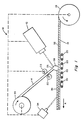
- a high powered laser heat source 12 of a type known generally in the art is positioned such that the laser beam is directed at the tip of a wire 14 which, in this embodiment, is made up of the superconductor compound material.
- the apparatus and method of the present invention are particularly well suited for use with A-15 type superconductors, e.g. Nb-Al, Nb-Ge, Nb-Ga and Nb-Sn, although other superconductor materials may be employed in producing tape superconductors.
- the method may be carried out without the necessity of employing a vacuum chamber or otherwise drawing a vacuum in any part of the process. It is expected that the method will preferably be carried out in a controlled air or inert gas environment, either of which provides relative simplicity of operation as compared to the use of a vacuum chamber which other of the known processes employ.
- a cooled substrate or backing material 16, such as copper, is disposed to pass in close proximity to the tip of the superconductor wire 14 when the substrate is moved horizontally and axially in a direction along a longitudinal axis of the apparatus, as indicated by arrow A, past the tip of the wire.
- the tape substrate may be supplied in any conventional manner, shown in FIG. 1 as being unwound from supply roll 18.
- the cooling of the substrate may be accomplished in a conventional manner, by passing the substrate through a refrigeration unit or chill rolls ahead of the point where the superconductor wire 14 is located, or may be cooled from underneath by coils 20, as depicted substantially schematically in FIG. 1.
- Substrate 16 is chilled in order to prevent the possibility that the substrate will melt when the film is deposited thereon, and also to effect a rapid quench and solidification of the film, and therefore the means for chilling the substrate is preferably designed to chill the substrate both immediately before the molten material is deposited, and immediately thereafter.
- the superconductor wire 14 is continuously fed in a direction toward substrate 16, passing between roller guides 22 at a location above the substrate and above the tip area of the wire irradiated by the laser beam, in order to support the wire and maintain the position of the wire tip at a substantially constant location.
- the wire feed system may be of a type used in consumable electrode arc welding processes, indicated substantially schematically by spool 24 from which the wire is fed. Roller guides 22 and/or spool 24 may be driven in order to feed the wire toward the substrate.
- the laser heat source 12 directs a laser beam with substantial power at the tip 26 of the superconductor wire 14, which melts the wire material to form a molten bead 28 of the superconducting material.
- a suitable laser source could be a commercially available CO2 laser with a power output capability which, depending upon several factors including the speed at which the process is carried out, would be about 50W minimum to about 1000W maximum.
- the substrate 16 is positioned to be in contact with this molten bead 28, and as the substrate is moved laterally with respect to the bead, molten material is wiped onto the substrate to form a superconductor film 30 on a top surface 32 of the substrate 16.
- the speed of travel of the substrate and of the wire feed are preferably coordinated such that the wire 14 is continuously fed toward the substrate and melted by the laser heat source to continuously replenish the molten bead, with the bead formed at the tip of the wire being wiped onto the substrate to produce a continuous film of a predetermined thickness.
- the thickness of the deposited film may preferably range from about 1.27 mm (1/2 mil) to about 5.08 (2 mils), although other thicknesses may prove to be suitable in various applications.
- the molten superconductor material is quickly quenched and solidified once the material exits the area heated by laser 12.
- the finished product, comprising the substrate and the superconductive film disposed thereon can be made in long, substantially continuous lengths, the length being theoretically limited only by the length of the tape substrate starter material and/or the upper limit of the length of a wire feedstock which can be continuously supplied by the wire feed system.
- the upper surface 32 of the tape substrate 16 may optionally be treated in order to improve the wettability of the substrate which will have the effect of improving the bonding of the superconductive film thereto.
- treatments would be an acid cleaning of the surface or other treatments to remove oxides therefrom, or a physical roughening of the surface.
- the method of the present invention lends itself well to on-line control, whether automatic or manual, in obtaining a tape having desired dimensions, especially a thickness dimension, and also having a desired level of deposit continuity and quality.
- a laser tracking system shown schematically at 34, similar in pertinent respect to arc bead laser tracking system previously developed for use in arc welding processes, is especially well suited for monitoring and controlling the thickness and deposit continuity (quality) of the superconductor material deposited on the tape. It will be readily recognized that both the wire feed rate and the speed of travel of the substrate could be varied, as well as the melting of the wire, in controlling the thickness of the deposited film.
- a preferred thickness for the deposited material may be selected in a range from about 1.27 to 5.08 mm (1/2 mil to 2 mils).
- the laser tracking system 34 will thus preferably contain process control hardware and/or software and will preferably be operatively coupled to the various components responsible for the substrate supply rate, the wire feed rate and the power output of the laser heat source, as indicated by broken lines in FIG. 1. Other monitoring and control means previously employed in the art may be used in performing these functions as well.
- FIG. 2 depicts an apparatus 100 which may be employed to perform the method described above, or, where desired, a variation of that method. Except where indicated to the contrary, the components depicted in FIG. 2 will preferably have the same operating characteristics as the analogous components depicted and described with respect to Claim 1.
- the apparatus in this embodiment comprises a first and a second laser heat source 102, 104, respectively, of a type known generally in the art.
- the laser heat sources 102, 104 are spaced apart from one another with respect to an axial direction of travel A of tape substrate 106.
- the first laser heat source is positioned to direct a laser beam at the tip 108 of a first wire 110 made up of a first element from which the compound superconductor is to be formed.
- the second laser heat source 104 is positioned "downstream" of first laser heat source 102, the downstream direction being determined by the direction of travel A of the substrate.
- the second laser heat source is positioned to direct a laser beam at the tip 112 of a second wire 114 made up of a second element from which the compound superconductor is to be formed.
- the tape substrate or backing material 106 is preferably cooled in a manner similar to the FIG. 1 embodiment, and is disposed to pass in close proximity to the tips 108, 112 of the first and second superconductor wires 110, 114, when the substrate is moved horizontally, as indicated by arrow A, past the tips of the wires.
- substrate 106 may be supplied from a supply roll 116, or other conventional means, and the cooling of the substrate can be accomplished through the use of cooling coils 118.
- the first wire 110 is continuously fed in a direction toward substrate 106, passing between roller guides 120 at a location above the substrate and above the tip area of the wire which is to be irradiated by the laser beam.
- the roller guides are provided in order to support the wire and maintain the position of the wire tip at a substantially constant location.
- the wire feed system represented by spool 122, may be of a type used in conventional arc welding processes as discussed above with respect to FIG. 1.
- the first laser heat source 102 directs a high energy laser beam at the tip 108 of the first wire 110, which heats and melts the wire material, thus forming first molten bead 124.
- substrate 106 is positioned to be in contact with the molten bead 124, and as the substrate is moved laterally with respect to me bead, molten material from the bead is continuously wiped from the wire onto substrate 106 to form a first film 126 on the upper surface 107 of the substrate, in a manner substantially identical to the method in FIG. 1.
- the second wire 114 is continuously fed toward substrate 106, passing between roller guides 128 at a location above the substrate 106 and first deposited film 126 and above the tip area of the wire which is to be irradiated by the second laser beam.
- the wire feed system which his preferably identical to that previously described, is represented by spool 130.
- the second laser heat source 104 directs a high energy laser beam at the tip of 112 of second wire 114, which heats and melts the wire material, thus forming second molten bead 132. Molten material from the second molten bead is continuously wiped from the wire onto the first film 126, which forms a second film layer 134 disposed on top of first film 126.
- the two wires 110, 114, and thus the two film layers 126, 134, in this embodiment preferably comprise the two elements from which the compound superconductor is formed.
- the first wire used to lay down the first film 126 may comprise niobium (Nb), and the second wire, forming second film 134, would comprise tin (Sn).
- Nb niobium
- Sn tin
- superconductive properties are attained in such a structure by diffusion of a sufficient quantity of the tin into the niobium such that an Nb3Sn (A-15 type) phase is formed.
- Nb3Sn A-15 type
- the materials in order to obtain adequate levels of diffusion with the materials of interest herein, the materials must be held at a minimum temperature at least one-half of the melting temperature of the material having the higher melting temperature.
- the diffusion In the tape superconductor described as an example above, i.e., a niobium-tin superconductor on a copper backing or substrate, the diffusion must take place at a temperature lower than one-half of the melting temperature of niobium (2700°C), as the copper would melt at that temperature.
- a sufficient amount of diffusion may be obtained by slowing the quench rate of the first film 126 deposited on the substrate, and by holding the temperature for a slightly longer time period.
- a further reaction between the films may be carried out "on-line” by a further heating device, such as a plasma arc torch 136, of a type known generally in the art.
- the torch 136 may preferably be designed to heat the tape to approximately 900°C, which is roughly 15% cooler than the melting temperature of the copper substrate.
- the temperature and duration of additional heating can be selected to ensure adequate diffusion of the tin into the niobium, as indicated schematically in FIG. 2 showing a single superconductor film 138 disposed on substrate 106 resulting from the heating and diffusion, even though in reality a complete diffusion of the element is not likely to be actually achieved.
- the further reaction where necessary or desirable, may optionally be conducted "off-line", as is done in other processes known in the art.
- the above method may be practiced with any of the other A-15 type compound superconductors or other compound superconductors in a similar manner.
- the order in which the films are deposited is not believed to be critical to the method, and therefore the secondary element (e.g., Ga, Ge, Al, Sn) may be deposited at the first film, with the niobium being deposited as the second film.
- the secondary element e.g., Ga, Ge, Al, Sn
- the thickness and continuity of the films deposited on the tape substrate 106 can be monitored and controlled using a laser tracking system operatively coupled with the tape substrate and wire feed speed controls.
- FIG. 3 depicts, in substantially schematic form, an alternative apparatus 200 for producing tape superconductors according to the method of the present invention.
- This apparatus 200 employs a different means for generating a molten bead of material than those depicted in FIGS. 1 and 2.
- an arc is created at the tips of a first and a second superconductor wire 202, 204, respectively, which are fed to a predetermined location immediately above the moving substrate 206.
- the direction of movement of the substrate is indicated by arrow A, and the substrate 206 may be supplied by any conventional means including a supply roll as depicted in either FIG. 1 or FIG. 2.
- the first and second wires 202, 204 are likewise continuously supplied in a conventional manner such as a wire spool like those depicted in FIGS. 1 and 2.
- a first and second pair of roller guides 208, 210 associated with the first and second wires 202, 204, act not only to feed and guide the wires to the desired location, but also preferably serve as electrodes to feed current through the wires in a manner similar to conventional DC arc welding process.
- a conventional DC arc power supply 212 is connected to each of these pairs of roller guides 208, 210, to provide a current running through each of the first and second wires.
- the first and second wires 202, 204 are both fed to the same predetermined location, and an arc is struck between the tips 214, 216 of the current-carrying wires, thereby forming a molten bead 218 comprising material melted from the tips of each of the two wires.
- the moving substrate 206 is positioned, as in FIG. 1 to come into contact with the molten bead 218, and to wipe molten material onto an upper surface 220 of the substrate to form a film 222 which is subsequently quenched to form an elongated superconductive film or tape on tape substrate 206.
- the moving substrate 206 is preferably cooled or chilled (cooling means not shown) in a manner similar to the substrates of FIGS. 1 and 2, in order to prevent possible melting of the substrate and to promote a rapid quench of the deposited film.
- the FIG. 3 apparatus further includes a means for delivering a cooling gas at the upper side of the molten bead 218 formed in the method described above.
- the cooling gas may be delivered through schematically depicted conventional tubing 224, in line with one or more valves 226 provided, as necessary, to control the flow rate of the cooling gas or to completely shut off the flow of cooling gas in instances where in is not desired.
- the flow of cooling gas may improve the process and the quality of the film deposits and tape superconductors produced in that the cooling gas will force the molten bead 218 downwardly toward the substrate, and in addition will assist in quenching the deposited film 222.
- the first and second wires 202, 204 are preferably each made of the desired superconductor compound material, whether of the A-15 type or other superconductor compositions.
- wire feedstock a first wire 202 comprising a first element of the compound superconductor and a second wire 204 comprising the second element of the compound superconductor.
- a niobium wire and an aluminum wire may be used in the process as first and second wires 202, 204, respectively, and the superconductive compound phase Nb3Al would have an opportunity form in solution in the molten bead and subsequently be deposited on the substrate 206.
- FIG 3 also depicts a plasma arc torch 228 located downstream of the area in which the molten bead is deposited on the substrate to form film 222.
- the plasma arc torch is employed, as in FIG. 2, to heat the deposited film to promote the diffusion of the elements comprising the compound superconductor. This further heating of the film may not be necessary in all instances as adequate diffusion of the elements may be achieved at the time the film is deposited and before the deposited film 222 has been quenched. Also, it would be possible, if further diffusion of the elements is desired, to carry out an "off-line" diffusion reaction process in lieu of the "on-line” process represented by plasma arc torch 228.
- FIG. 4 depicts, in substantially schematic form, a further alternative apparatus 300 for producing tape superconductors according to the method of the present invention.
- the apparatus in this Figure is used to perform a "two-step" film deposition process similar in many respects to the process described with respect to FIG. 2.
- the wire feed means and the substrate supply means may preferably be of the same type as those previously described.
- an arc is struck between a first pair of continuously fed first and second wires 302, 304, at the wire tips 303, 305, forming first molten bead 306, which is wiped onto an upper surface 308 of moving tape substrate 310.
- an arc is struck between a second pair of continuously fed first and second wires 314, 316, at the wire tips 315, 317, forming second molten bead 318, which is wiped onto an upper surface 320 of first film 312, thus forming second film 322.
- the means for striking the arcs in the FIG. 4 embodiment may preferably be similar to that described with respect to FIG. 3.
- a first and second pair of roller guides 324, 326 is provided to guide the first pair of first and second wires 302, 304, to the desired predetermined position above substrate 310, and the roller guides 324, 326 are coupled to a first DC arc power supply 328, and serve as electrodes for delivering current through the wire to create the arc.
- An additional or second pair of first and second roller guides 330, 332 is provided to guide the second pair of first and second wires 314, 316 to the desired predetermined position above first film 312, and the roller guides 330, 332 are coupled to a second DC arc power supply 334, and serve as electrodes for delivering current through the wire to create the arc.
- a cooling gas may preferably be delivered blowing downwardly on each of first and second molten beads 306, 318, in a manner identical to that described with respect to FIG. 3.
- the first pair of first and second wires 302, 304 may comprise niobium or a basic alloy containing niobium, and each of the second pair of first and second wires 314, 316 may preferably comprise the second element (Al, Ga, Ge, Sn) or an alloy of the second element and niobium.
- the film deposition process itself may, under appropriate circumstances, provide adequate diffusion of the elements in the first and second films in order to produce the compound superconductive material.
- an "on-line” or "off-line” heating of the tape and deposited films to produce further diffusion of the elements may be employed where desired or if required.
Landscapes
- Engineering & Computer Science (AREA)
- Manufacturing & Machinery (AREA)
- Superconductors And Manufacturing Methods Therefor (AREA)
- Laser Beam Processing (AREA)
Claims (36)
- Vorrichtung zum Herstellen eines bandförmigen Supraleiters aus einer Supraleiter-Verbindung, umfassend:
eine Einrichtung zum Schmelzen eines ersten Drahtes an einer Spitze davon, um einen ersten kugelförmigen Körper an dieser Spitze zu bilden;
eine Einrichtung zum Transportieren eines Bandsubstrates in einer vorbestimmten Richtung mit Bezug auf die Spitze des ersten Drahtes, wobei das Substrat in Kontakt mit und axial vorbei an dem ersten geschmolzenen kugelförmigen Körper, der an der Spitze des ersten Drates gebildet ist, transportiert wird, wodurch geschmolzenes Material von dem ersten geschmolzenen kugelförmigen Körper auf eine obere Oberfläche des Bandsubstrates gewischt wird, um einen esten Film darauf zu bilden;
eine Einrichtung, um im wesentlichen kontinuierlich den ersten Draht zuzuführen, während die Spitze des ersten Drahtes fortschreitend durch die Schmelzeinrichtung geschmolzen und auf das Substrat gewischt wird und eine Einrichtung zum Kühlen des Substrates, wenn das Substrat in Kontakt mit dem und vorbei an dem ersten geschmolzenen kugelförmigen Körper transportiert wird. - Vorrichtung nach Anspruch 1, worin der erste Draht aus einem Material hergestellt ist, der die Elemente enthält, die den Verbindungs-Supraleiter umfassen.
- Vorrichtung nach Anspruch 2, worin die Schmelzeinrichtung eine Laser-Wärmequelle umfaßt, die genügend Energieabgabe aufweist, um den ersten Draht zu schmelzen.
- Vorrichtung nach Anspruch 3, worin die Kühleinrichtung weiter eine Einrichtung zum raschen Abschrecken des auf dem Substrat gebildeten ersten Filmes umfaßt.
- Vorrichtung nach Anspruch 1, worin das Bandsubstrat, das durch die Transporteinrichtung transportiert wird, von unbestimmter Länge ist.
- Vorrichtung nach Anspruch 3, worin der erste auf dem Substrat gebildete Film eine vorbestimmte erwünschte Dicke, ausgewählt aus einem Bereich von 1,27 bis 5,08 mm (1/2 mil bis 2 mils) hat.
- Vorrichtung nach Anspruch 6, weiter umfassend eine Einrichtung zum Überwachen des auf dem Substrat abgeschiedenen ersten Filmes und eine Einrichtung zum Kontrollieren einer Dicke des abgeschiedenen Filmes, die mit der Überwachungseinrichtung und mindestens einer der Schmelzeinrichtung, Transporteinrichtung und Drahtzufuhreinrichtung gekoppelt ist.
- Vorrichtung nach Anspruch 7, worin die Überwachungseinrichtung eine Laser-Abtasteinrichtung umfaßt.
- Vorrichtung nach Anspruch 1, worin der erste Draht im wesentlichen aus einem ersten Element eines Supraleiters aus einer Verbindung aus zwei Elementen besteht und die Vorrichtung weiter umfaßt:
eine Einrichtung zum Schmelzen eines zweiten Drahtes an einer Spitze davon, um einen zweiten geschmolzenen kugelförmigen Körper an dieser Spitze zu bilden, wobei der zweite Draht im wesentlichen aus einem zweiten Element des Supraleiters aus einer Verbindung aus zwei oder mehr Elementen besteht, und worin die Transporteinrichtung so konstruiert und angeordnet ist, das Substrat und den ersten Film in Kontakt mit und axial vorbei an dem zweiten geschmolzenen kugelförmigen Körper zu transportieren, der an der Spitze des zweiten Drahtes gebildet ist, wobei geschmolzenes Material von dem zweiten geschmolzenen kugelförmigen Körper auf eine obere Oberfläche des ersten Filmes gewischt wird, um darauf einen zweiten Film zu bilden;
eine Einrichtung zum im wesentlichen kontinuierlichen Zuführen des zweiten Drahtes, während die Spitze des zweiten Drahtes fortschreitend durch die Schmelzeinrichtung geschmolzen und auf den ersten Film gewischt wird und eine Einrichtung zum Kühlen des Substrates, wenn das Substrat an dem zweiten geschmolzenen kugelförmigen Körper vorbeitransportiert wird. - Vorrichtung nach Anspruch 9, weiter umfassend eine Einrichtung zum Erhitzen des ersten und zweiten Films, die auf dem Substrat angeordnet sind, auf eine Temperatur und für eine Dauer, die zum Induzieren von Diffusion von Elementen zwischen dem ersten und zweiten Film genügt, während das Substrat transportiert wird.
- Vorrichtung nach Anspruch 1, worin die Schmelzeinrichtung weiter eine Einrichtung zum Erzeugen eines Lichtbogens zwischen der Spitze des ersten Drahtes und einer Spitze eines zweiten Drahtes umfaßt, wobei der erste und zweite Draht ein erstes Paar von Drähten bilden, um den ersten geschmolzenen kugelförmigen Körper an den Spitzen zu bilden und
eine Einrichtung zum im wesentlichen kontinuierlichen Zuführen des zweiten Drahtes des ersten Drahtpaares, während der erste geschmolzene kugelförmige Körper fortschreitend auf das Bandsubstrat gewischt wird. - Vorrichtung nach Anspruch 11, worin die Einrichtung zum Erzeugen des Lichtbogens eine Gleichstrom-Leistungsquelle umfaßt, die leitend mit dem ersten und zweiten Draht des ersten Drahtpaares gekoppelt ist.
- Vorrichtung nach Anspruch 12, weiter umfassend eine Einrichtung zum Erzeugen eines Lichtbogens zwischen einer Spitze eines ersten und zweiten Drahtes eines zweiten Drahtpaares zur Bildung eines zweiten geschmolzenen kugelförmigen Körpers an den Spitzen, worin die Transporteinrichtung so konstruiert und angeordnet ist, daß das Substrat und der erste Film in Kontakt mit und axial vorbei an dem zweiten geschmolzenen kugelförmigen Körper transportiert wird, der an den Spitzen des zweiten Drahtpaares gebildet ist, wobei geschmolzenes Material vom zweiten geschmolzenen kugelförmigen Körper auf eine obere Oberfläche des ersten Filmes gewischt wird, um einen zweiten Film darauf zu bilden;
eine Einrichtung zum im wesentlichen kontinuierlichen Zuführen des ersten und zweiten Drahtes des zweiten Drahtpaares, während der zweite geschmolzene kugelförmige Körper fortschreitend auf den ersten Film gewischt wird und eine Einrichtung zum Kühlen des Substrates, wenn das Substrat an dem zweiten geschmolzenen kugelförmigen Körper vorbeitransportiert wird. - Vorrichtung nach Anspruch 13, worin der erste und zweite Draht des ersten Drahtpaares ein erstes Element eines Supraleiters aus einer Verbindung aus zwei Elementen umfaßt und der erste und zweite Draht des zweiten Drahtpaares ein zweites Element des Supraleiters aus einer Verbindung aus zwei Elementen umfaßt.
- Vorrichtung nach Anspruch 12, weiter umfassend eine Einrichtung zum Zuführen eines Kühlgases zu einer oberen Seite des ersten geschmolzenen kugelförmigen Körpers.
- Vorrichtung nach Anspruch 13, weiter umfassend eine Einrichtung zum Zuführen eines Kühlgases zu einer Oberseite des ersten geschmolzenen kugelförmigen Körpers und zu einer Oberseite des zweiten geschmolzenen kugelförmigen Körpers.
- Verfahren zum Herstellen eines bandförmigen Supraleiters aus einem Supraleiter aus einer Verbindung, umfassend die Stufen:
Zuführen eines Drahtes, umfassend Elemente der supraleitenden Verbindung in einer im wesentlichen kontinuierlichen Weise und in einer Richtung zu einem Bandsubstrat; Schmelzen einer Spitze des Drahtes, um einen geschmolzenen kugelförmigen Körper an der Spitze zu bilden;
Wischen geschmolzenen Materials von dem geschmolzenen kugelförmigen Körper auf das Bandsubstrat, um einen Film darauf zu bilden, indem das Bandsubstrat axial an einer vorbestimmten Position vorbeitransportiert wird, in der das Substrat den geschmolzenen kugelförmigen Körper berührt, wobei das Bandsubstrat weiter in einer vorbestimmten axialen Richtung mit Bezug auf den geschmolzenen kugelförmigen Körper transportiert wird und
Kühlen des Filmes, um den Film zu einer supraleitenden Verbindung zu verfestigen. - Verfahren zum Herstellen eines bandförmigen Supraleiters aus einem Supraleiter aus einer Verbindung, umfassend die Stufen:
Zuführen eines ersten Drahtes, umfassend mindestens ein erstes Element des Supraleiters in einer im wesentlichen kontinuierlichen Weise und in einer Richtung auf ein Bandsubstrat zu;
Schmelzen einer Spitze des ersten Drahtes, um einen ersten geschmolzenen kugelförmigen Körper an der Spitze zu bilden;
Wischen geschmolzenen Materials von dem geschmolzenen kugelförmigen Körper auf das Bandsubstrat, um einen ersten Film darauf zu bilden, durch Transportieren des Bandsubstrates axial an einer vorbestimmten Position vorbei, bei der das Substrat den ersten geschmolzenen kugelförmigen Körper berührt, wobei das Bandsubstrat weiter in einer vorbestimmten axialen Richtung relativ zum ersten geschmolzenen kugelförmigen Körper transportiert wird;
Zuführen eines zweiten Drahtes, umfassend mindestens ein zweites Element des Verbindungs-Supraleiters in einer im wesentlichen kontinuierlichen Weise und in eine Richtung auf das Bandsubstrat und den ersten darauf abgeschiedenen Film zu;
Schmelzen einer Spitze des zweiten Drahtes, um einen zweiten geschmolzenen kugelförmigen Körper an der Spitze zu bilden;
Wischen geschmolzenen Materials von dem zweiten geschmolzenen kugelförmigen Körper auf den ersten Film, der vorher auf das Bandsubstrat gewischt worden war, um einen zweiten Film darauf zu bilden, indem man das Bandsubstrat axial an einer vorbestimmten Position vorbeitransportiert, in der der erste Film den zweiten geschmolzenen kugelförmigen Körper berührt, wobei das Bandsubstrat weiter in einer vorbestimmten axialen Richtung relativ zum zweiten geschmolzenen kugelförmigen Körper transportiert wird und
Kühlen des ersten und zweiten Films, um die Filme erstarren zu lassen. - Verfahren nach Anspruch 17, worin der geschmolzene kugelförmige Körper durch Laser-Schmelzen der Spitze gebildet wird.
- Verfahren nach Anspruch 18, worin der erste und zweite geschmolzene kugelförmige Körper durch Laser-Schmelzen der Spitze des ersten und zweiten Drahtes gebildet wird.
- Verfahren nach Anspruch 19, umfassend die weitere Stufe des Erhitzens des Films auf dem Bandsubstrat auf eine Temperatur und für eine Zeit, die genügen, um die Diffusion der Elemente in dem Film zu induzieren.
- Verfahren nach Anspruch 20, umfassend die weitere Stufe des Erhitzens des ersten und zweiten Films, die auf dem Bandsubstrat angeordnet sind, auf eine Temperatur und für eine Zeit, die genügen, um die Diffusion der Elemente zwischen dem ersten und zweiten Film zu induzieren.
- Verfahren nach Anspruch 21, umfassend die weitere Stufe des Überwachens einer Dicke und einer Kontinuität des auf das Bandsubstrat gewischten Filmes und selektives Kontrollieren, auf der Grundlage der Überwachung der Dicke und der Kontinuität des Films, von mindestens einem Verfahrensparameter, um die Dicke und Kontinuität innerhalb vorbestimmter Grenzen zu halten.
- Verfahren nach Anspruch 22, umfassend die weitere Stufe des Überwachens einer Dicke und Kontinuität des auf das Bandsubstrat gewischten Filmes und selektives Kontrollieren, auf der Grundlage der Überwachung der Dicke und Kontinuität des Filmes, mindestens eines Verfahrensparameters, um die Dicke und Kontinuität innerhalb vorbestimmter Grenzen zu halten.
- Verfahren zum Herstellen eines bandförmigen Supraleiters aus einem Supraleiter aus einer Verbindung, umfassend die Stufen:
Bilden eines ersten geschmolzenen kugelförmigen Körpers des supraleitenden Verbindungsmaterials von mindestens einem Draht an einer vorbestimmten Position;
Wischen geschmolzenen Materials von dem ersten geschmolzenen kugelförmigen Körper auf ein Bandsubstrat, um einen ersten Film darauf zu bilden, durch Transportieren des Bandsubstrates axial an der vorbestimmten Position vorbei und in Berührung mit dem ersten geschmolzenen kugelförmigen Körper, der an der vorbestimmten Position angeordnet ist;
Zuführen des mindestens einen Drahtes in einer im wesentlichen kontinuierlichen Weise zu der vorbestimmten Position und Schmelzen einer Spitze mindestens eines Drahtes mit im weasentlichen der gleichen Geschwindigkeit, in der geschmolzenes Material von dem ersten geschmolzenen kugelförmigen Körper durch das Bandsubstrat entfernt wird, um den ersten geschmolzenen kugelförmigen Körper bei einem im wesentlichen konstanten Volumen zu halten und Kühlen des ersten Filmes zur Bildung des Verbindungs-Supraleiters. - Verfahren nach Anspruch 25, umfassend die weiteren Stufen:
Zuführen in einer im wesentlichen kontinuierlichen Weise eines ersten Paares von Drähten, umfassend den mindestens einen Draht und einen zweiten Draht zu der vorbestimmten Stelle und
Zünden und Aufrechterhalten eines Lichtbogens zwischen einer Spitze des mindestns einen Drahtes und einer Spitze des zweiten Drahtes, um die Spitzen zu schmelzen und den ersten geschmolzenen kugelförmigen Körper zu bilden. - Verfahren zum Herstellen eines bandförmigen Supraleiters aus einem Supraleiter aus einer Verbindung, umfassend die Stufen:
Bilden eines ersten geschmolzenen kugelförmigen Körpers, umfassend mindestens ein Element des supraleitenden Verbindungsmaterials von einem Paar von Drähten in einer ersten vorbestimmten Position durch Zünden und Aufrechterhalten eines Lichtbogens zwischen einer Spitze jedes Drahtes des ersten Drahtpaares;
Wischen geschmolzenen Materials von dem ersten geschmolzenen kugelförmigen Körper auf ein Bandsubstrat zur Bildung eines ersten Filmes darauf durch Transportieren des Bandsubstrates axial an der vorbestimmten Position vorbei und in Kontakt mit dem ersten geschmolzenen kugelförmigen Körper, der sich in der ersten vorbestimmten Position befindet;
Zuführen des mindestens einen Drahtes in einer im wesentlichen kontinuierlichen Weise zu der ersten vorbestimmten Position und Schmelzen der Spitzen des ersten Drahtpaares mit im wesentlichen der gleichen Geschwindigkeit, in der geschmolzenes Material von dem ersten geschmolzenen kugelförmigen Körper durch das Bandsubstrat entfernt wird, um den ersten geschmolzenen kugelförmigen Körper bei einem im wesentlichen konstanten Volumen zu halten;
Bilden eines zweiten geschmolzenen kugelförmigen Körpers von einem zweiten Drahtpaar an einer zweiten vorbestimmten Position durch Zünden und Aufrechterhalten eines Lichtbogens zwischen einer Spitze jedes des zweiten Paares von Drähten, wobei der zweite geschmolzene kugelförmige Körper ein Element des supraleitenden Verbindungsmaterials umfaßt, das ein anderes ist als das erste Element;
Wischen geschmolzenen Materials von dem zweiten geschmolzenen kugelförmigen Körper auf den ersten Film, der auf dem Bandsubstrat ausgebildet ist, zur Bildung eines zweiten Filmes auf dem Bandsubstrat durch Transportieren des Bandsubstrates axial an der zweiten vorbestimmten Position vorbei und in Kontakt mit dem zweiten geschmolzenen kugelförmigen Körper;
Zuführen des zweiten Drahtpaares in einer im wesentlich kontinuierlichen Weise zu der zweiten vorbestimmten Position und Schmelzen der Spitzen des zweiten Drahtpaares mit im wesentlichen der gleichen Geschwindigkeit, in der geschmolzenes Material von dem zweiten geschmolzenen kugelförmigen Körper durch das Bandsubstrat entfernt wird, um den zweiten geschmolzenen kugelförmigen Körper bei einem im wesentlichen konstanten Volumen zu halten und Kühlen des ersten und zweiten Filmes, um die Filme erstarren zu lassen. - Verfahren nach Anspruch 26, umfassend die weitere Stufe des Erhitzens des ersten Filmes auf dem Bandsubstrat auf eine Temperatur und für eine Zeit, die genügen, um Diffusion innerhalb des supraleitenden Materials zu induzieren.
- Verfahren nach Anspruch 27, umfassend die weitere Stufe des Erhitzens des ersten Filmes und des zweiten Filmes auf dem Bandsubstrat auf eine Temperatur und für eine Zeit, die zum Induzieren der Diffusion zwischen dem ersten und dem zweiten Film genügen.
- Verfahren nach Anspruch 26, umfassend die weitere Stufe des Überwachens einer Dicke des ersten Filmes, der auf dem Bandsubstrat abgeschieden ist, unter Anwendung einer Laser-Abtastquelle und
Kontrollieren einer Dicke des ersten Filmes auf der Grundlage der Information, die aufgrund des Überwachens des ersten Filmes erhalten wurde. - Verfahren nach Anspruch 27, umfassend die weitere Stufe des Überwachens einer Dicke jedes des ersten und zweiten Filmes unter Anwendung einer Laser-Abtastquelle und
Kontrollieren einer Dicke jedes des ersten und zweiten Filmes auf der Grundlage der Information, die aus der Überwachung des ersten und zweiten Filmes erhalten wurde. - Verfahren nach Anspruch 25 oder 27, worin das Bandsubstrat eine unbestimmte Länge hat.
- Verfahren nach Anspruch 32, worin das Bandsubstrat aus Kupfer hergestellt ist.
- Verfahren nach Anspruch 25, umfassend die weitere Stufe der Schaffung eines nach unten gerichteten Kühlgases an einer Oberseite des ersten geschmolzenen kugelförmigen Körpers.
- Verfahren nach Anspruch 27, umfassend die weitere Stufe der Schaffung eines nach unten gerichteten Kühlgases an einer Oberseite jedes des ersten und zweiten geschmolzenen kugelförmigen Körpers.
- Verfahren nach Anspruch 25 oder 27, worin die Verbindung des Supraleiters vom A-25-Typ ist.
Applications Claiming Priority (2)
| Application Number | Priority Date | Filing Date | Title |
|---|---|---|---|
| US45165189A | 1989-12-18 | 1989-12-18 | |
| US451651 | 1989-12-18 |
Publications (3)
| Publication Number | Publication Date |
|---|---|
| EP0434246A2 EP0434246A2 (de) | 1991-06-26 |
| EP0434246A3 EP0434246A3 (en) | 1991-09-18 |
| EP0434246B1 true EP0434246B1 (de) | 1994-09-14 |
Family
ID=23793126
Family Applications (1)
| Application Number | Title | Priority Date | Filing Date |
|---|---|---|---|
| EP90313037A Expired - Lifetime EP0434246B1 (de) | 1989-12-18 | 1990-11-30 | Verfahren und Apparat zur Herstellung bandförmiger Supraleiter |
Country Status (5)
| Country | Link |
|---|---|
| EP (1) | EP0434246B1 (de) |
| JP (1) | JPH0719489B2 (de) |
| CA (1) | CA2025254A1 (de) |
| DE (1) | DE69012530D1 (de) |
| IL (1) | IL96544A (de) |
Cited By (1)
| Publication number | Priority date | Publication date | Assignee | Title |
|---|---|---|---|---|
| US10421142B2 (en) | 2011-03-31 | 2019-09-24 | Norsk Titanium As | Method and arrangement for building metallic objects by solid freeform fabrication using plasma transferred arc (PTA) torches |
Families Citing this family (6)
| Publication number | Priority date | Publication date | Assignee | Title |
|---|---|---|---|---|
| US5109593A (en) * | 1990-08-01 | 1992-05-05 | General Electric Company | Method of melt forming a superconducting joint between superconducting tapes |
| DE4102891A1 (de) * | 1991-01-31 | 1992-08-06 | Siemens Ag | Loetbare, supraleitende leitung und verwendung der leitung |
| US7851984B2 (en) * | 2006-08-08 | 2010-12-14 | Federal-Mogul World Wide, Inc. | Ignition device having a reflowed firing tip and method of construction |
| US12397363B2 (en) | 2011-03-31 | 2025-08-26 | Norsk Titanium As | Method and arrangement for building metallic objects by solid freeform fabrication |
| DE102023002042B3 (de) | 2023-05-19 | 2024-10-31 | Mercedes-Benz Group AG | Laserschweißvorrichtung |
| CN116598076B (zh) * | 2023-06-29 | 2023-11-14 | 正泰交联电缆有限公司 | 一种聚氯乙烯绝缘电缆均匀高效烘干装置 |
Family Cites Families (2)
| Publication number | Priority date | Publication date | Assignee | Title |
|---|---|---|---|---|
| DE2108635A1 (de) * | 1971-02-24 | 1972-08-31 | Kabel Metallwerke Ghh | Verfahren zur kontinuierlichen Herstellung eines langgestreckten Supraleiters |
| US4088512A (en) * | 1977-01-21 | 1978-05-09 | The United States Of America As Represented By The United States Department Of Energy | Quench-age method for the fabrication of niobium-aluminum superconductors |
-
1990
- 1990-09-13 CA CA002025254A patent/CA2025254A1/en not_active Abandoned
- 1990-11-30 DE DE69012530T patent/DE69012530D1/de not_active Expired - Lifetime
- 1990-11-30 EP EP90313037A patent/EP0434246B1/de not_active Expired - Lifetime
- 1990-12-05 IL IL9654490A patent/IL96544A/en not_active IP Right Cessation
- 1990-12-17 JP JP2411188A patent/JPH0719489B2/ja not_active Expired - Lifetime
Cited By (2)
| Publication number | Priority date | Publication date | Assignee | Title |
|---|---|---|---|---|
| US10421142B2 (en) | 2011-03-31 | 2019-09-24 | Norsk Titanium As | Method and arrangement for building metallic objects by solid freeform fabrication using plasma transferred arc (PTA) torches |
| US11213920B2 (en) | 2011-03-31 | 2022-01-04 | Norsk Titanium As | Method and arrangement for building metallic objects by solid freeform fabrication |
Also Published As
| Publication number | Publication date |
|---|---|
| EP0434246A3 (en) | 1991-09-18 |
| CA2025254A1 (en) | 1991-06-19 |
| JPH0719489B2 (ja) | 1995-03-06 |
| JPH0419921A (ja) | 1992-01-23 |
| DE69012530D1 (de) | 1994-10-20 |
| IL96544A0 (en) | 1991-09-16 |
| IL96544A (en) | 1994-06-24 |
| EP0434246A2 (de) | 1991-06-26 |
Similar Documents
| Publication | Publication Date | Title |
|---|---|---|
| US5127364A (en) | Apparatus for making A-15 type tape superconductors which includes means to melt a wire at its tip so a beam is formed and means for wiping the bead onto a continuous tape substrate | |
| US5206216A (en) | Method for fabricating oxide superconducting wires by laser ablation | |
| AU658016B2 (en) | A method of fabricating a superconductive flexible conductor, having a high critical temperature, and a conductor resulting therefrom | |
| EP0434246A2 (de) | Verfahren und Apparat zur Herstellung bandförmiger Supraleiter | |
| US4806721A (en) | Wire electrode for wire-cut electrical discharge machining | |
| EP0365229B1 (de) | Schweissen von beschichteten Metallen | |
| US5705228A (en) | Method for the continuous coating of a filiform steel substrate by immersion of the substrate in a bath of molten coating metal | |
| US5966975A (en) | Method and device for zinc plating a spark erosion wire, and wire obtained in this way | |
| JP2644911B2 (ja) | 放電加工用ワイヤ型電極及びその製造方法 | |
| US5624717A (en) | Process for coating or hardfacing a part by means of a plasma transferred arc | |
| US5149488A (en) | Apparatus and method for spill chilling rapidly solidified materials | |
| JP3092961B2 (ja) | 酸化物超電導線材の製造方法 | |
| US4664176A (en) | Casting in a thermally-induced low density atmosphere | |
| US4913220A (en) | Apparatus and method for spill chilling rapidly solidified material | |
| EP0124684B1 (de) | Giessen in eine thermisch induzierte Atmosphäre niederer Dichte | |
| JPH01246718A (ja) | 酸化物超電導材料テープの製造方法 | |
| JP2963901B1 (ja) | 超電導薄膜の製造方法 | |
| EP0124688B1 (de) | Giessen unter einer Atmosphäre geringer Dichte | |
| US11806820B2 (en) | Laminated molding and method of manufacturing laminated molding | |
| US4932463A (en) | Use of AC power in arc spray process | |
| JPS6117351A (ja) | 複合線材の製造方法 | |
| JPH0325275B2 (de) | ||
| JPH0483867A (ja) | 薄帯の電子ビームフラッシュ蒸着による薄膜製造法 | |
| JPS61199095A (ja) | 部分メツキ方法 | |
| JPS6319259B2 (de) |
Legal Events
| Date | Code | Title | Description |
|---|---|---|---|
| PUAI | Public reference made under article 153(3) epc to a published international application that has entered the european phase |
Free format text: ORIGINAL CODE: 0009012 |
|
| AK | Designated contracting states |
Kind code of ref document: A2 Designated state(s): DE FR GB NL |
|
| PUAL | Search report despatched |
Free format text: ORIGINAL CODE: 0009013 |
|
| AK | Designated contracting states |
Kind code of ref document: A3 Designated state(s): DE FR GB NL |
|
| 17P | Request for examination filed |
Effective date: 19911220 |
|
| 17Q | First examination report despatched |
Effective date: 19931213 |
|
| GRAA | (expected) grant |
Free format text: ORIGINAL CODE: 0009210 |
|
| AK | Designated contracting states |
Kind code of ref document: B1 Designated state(s): DE FR GB NL |
|
| PG25 | Lapsed in a contracting state [announced via postgrant information from national office to epo] |
Ref country code: NL Effective date: 19940914 Ref country code: FR Effective date: 19940914 |
|
| PGFP | Annual fee paid to national office [announced via postgrant information from national office to epo] |
Ref country code: GB Payment date: 19941018 Year of fee payment: 5 |
|
| REF | Corresponds to: |
Ref document number: 69012530 Country of ref document: DE Date of ref document: 19941020 |
|
| PG25 | Lapsed in a contracting state [announced via postgrant information from national office to epo] |
Ref country code: DE Effective date: 19941215 |
|
| EN | Fr: translation not filed | ||
| NLV1 | Nl: lapsed or annulled due to failure to fulfill the requirements of art. 29p and 29m of the patents act | ||
| PLBE | No opposition filed within time limit |
Free format text: ORIGINAL CODE: 0009261 |
|
| STAA | Information on the status of an ep patent application or granted ep patent |
Free format text: STATUS: NO OPPOSITION FILED WITHIN TIME LIMIT |
|
| 26N | No opposition filed | ||
| PG25 | Lapsed in a contracting state [announced via postgrant information from national office to epo] |
Ref country code: GB Effective date: 19951130 |
|
| GBPC | Gb: european patent ceased through non-payment of renewal fee |
Effective date: 19951130 |