EP0434409B1 - Mehrstufenverfahren zur Herstellung von Hexafluorpropylen - Google Patents
Mehrstufenverfahren zur Herstellung von Hexafluorpropylen Download PDFInfo
- Publication number
- EP0434409B1 EP0434409B1 EP90313951A EP90313951A EP0434409B1 EP 0434409 B1 EP0434409 B1 EP 0434409B1 EP 90313951 A EP90313951 A EP 90313951A EP 90313951 A EP90313951 A EP 90313951A EP 0434409 B1 EP0434409 B1 EP 0434409B1
- Authority
- EP
- European Patent Office
- Prior art keywords
- catalyst
- ccl2
- cfcl
- chlorofluorination
- temperature
- Prior art date
- Legal status (The legal status is an assumption and is not a legal conclusion. Google has not performed a legal analysis and makes no representation as to the accuracy of the status listed.)
- Expired - Lifetime
Links
- HCDGVLDPFQMKDK-UHFFFAOYSA-N hexafluoropropylene Chemical group FC(F)=C(F)C(F)(F)F HCDGVLDPFQMKDK-UHFFFAOYSA-N 0.000 title claims description 33
- 238000007040 multi-step synthesis reaction Methods 0.000 title description 2
- 239000003054 catalyst Substances 0.000 claims description 132
- QDOXWKRWXJOMAK-UHFFFAOYSA-N dichromium trioxide Chemical compound O=[Cr]O[Cr]=O QDOXWKRWXJOMAK-UHFFFAOYSA-N 0.000 claims description 69
- ATUOYWHBWRKTHZ-UHFFFAOYSA-N Propane Chemical compound CCC ATUOYWHBWRKTHZ-UHFFFAOYSA-N 0.000 claims description 55
- QQONPFPTGQHPMA-UHFFFAOYSA-N propylene Natural products CC=C QQONPFPTGQHPMA-UHFFFAOYSA-N 0.000 claims description 42
- 125000004805 propylene group Chemical group [H]C([H])([H])C([H])([*:1])C([H])([H])[*:2] 0.000 claims description 41
- 238000000034 method Methods 0.000 claims description 32
- 239000001294 propane Substances 0.000 claims description 27
- 239000000460 chlorine Substances 0.000 claims description 24
- 229930195733 hydrocarbon Natural products 0.000 claims description 23
- 229910052739 hydrogen Inorganic materials 0.000 claims description 22
- 239000001257 hydrogen Substances 0.000 claims description 21
- 229910052801 chlorine Inorganic materials 0.000 claims description 20
- ZAMOUSCENKQFHK-UHFFFAOYSA-N Chlorine atom Chemical compound [Cl] ZAMOUSCENKQFHK-UHFFFAOYSA-N 0.000 claims description 19
- 230000008569 process Effects 0.000 claims description 18
- UFHFLCQGNIYNRP-UHFFFAOYSA-N Hydrogen Chemical compound [H][H] UFHFLCQGNIYNRP-UHFFFAOYSA-N 0.000 claims description 15
- 238000002360 preparation method Methods 0.000 claims description 15
- WUKWITHWXAAZEY-UHFFFAOYSA-L calcium difluoride Chemical compound [F-].[F-].[Ca+2] WUKWITHWXAAZEY-UHFFFAOYSA-L 0.000 claims description 13
- 229910001634 calcium fluoride Inorganic materials 0.000 claims description 13
- 229910052751 metal Inorganic materials 0.000 claims description 12
- 239000002184 metal Substances 0.000 claims description 11
- 229910052700 potassium Inorganic materials 0.000 claims description 10
- 229920006395 saturated elastomer Polymers 0.000 claims description 10
- JKQOBWVOAYFWKG-UHFFFAOYSA-N molybdenum trioxide Chemical compound O=[Mo](=O)=O JKQOBWVOAYFWKG-UHFFFAOYSA-N 0.000 claims description 8
- 238000003682 fluorination reaction Methods 0.000 claims description 7
- -1 acyclic hydrocarbons Chemical class 0.000 claims description 6
- KRHYYFGTRYWZRS-UHFFFAOYSA-N Fluorane Chemical compound F KRHYYFGTRYWZRS-UHFFFAOYSA-N 0.000 claims description 4
- 229910000040 hydrogen fluoride Inorganic materials 0.000 claims description 4
- 239000012808 vapor phase Substances 0.000 claims description 4
- 229910052792 caesium Inorganic materials 0.000 claims description 2
- KYKAJFCTULSVSH-UHFFFAOYSA-N chloro(fluoro)methane Chemical compound F[C]Cl KYKAJFCTULSVSH-UHFFFAOYSA-N 0.000 claims description 2
- 229910052701 rubidium Inorganic materials 0.000 claims description 2
- 239000011949 solid catalyst Substances 0.000 claims description 2
- 238000006243 chemical reaction Methods 0.000 description 81
- 239000000047 product Substances 0.000 description 51
- 229910052799 carbon Inorganic materials 0.000 description 33
- 239000000203 mixture Substances 0.000 description 29
- 235000013849 propane Nutrition 0.000 description 26
- XLYOFNOQVPJJNP-UHFFFAOYSA-N water Substances O XLYOFNOQVPJJNP-UHFFFAOYSA-N 0.000 description 24
- 239000006227 byproduct Substances 0.000 description 23
- 239000000243 solution Substances 0.000 description 21
- 239000000543 intermediate Substances 0.000 description 20
- 239000000376 reactant Substances 0.000 description 17
- 238000005984 hydrogenation reaction Methods 0.000 description 16
- 239000004215 Carbon black (E152) Substances 0.000 description 15
- 150000001875 compounds Chemical class 0.000 description 14
- 239000007789 gas Substances 0.000 description 14
- IJGRMHOSHXDMSA-UHFFFAOYSA-N Atomic nitrogen Chemical compound N#N IJGRMHOSHXDMSA-UHFFFAOYSA-N 0.000 description 13
- 239000011651 chromium Substances 0.000 description 13
- OKTJSMMVPCPJKN-UHFFFAOYSA-N Carbon Chemical compound [C] OKTJSMMVPCPJKN-UHFFFAOYSA-N 0.000 description 12
- 229910001026 inconel Inorganic materials 0.000 description 12
- 239000008188 pellet Substances 0.000 description 12
- 239000007787 solid Substances 0.000 description 12
- 239000007858 starting material Substances 0.000 description 12
- 230000015572 biosynthetic process Effects 0.000 description 11
- 238000005695 dehalogenation reaction Methods 0.000 description 11
- PXHVJJICTQNCMI-UHFFFAOYSA-N nickel Substances [Ni] PXHVJJICTQNCMI-UHFFFAOYSA-N 0.000 description 11
- WGLPBDUCMAPZCE-UHFFFAOYSA-N chromium trioxide Inorganic materials O=[Cr](=O)=O WGLPBDUCMAPZCE-UHFFFAOYSA-N 0.000 description 10
- 229910052736 halogen Inorganic materials 0.000 description 10
- 150000002367 halogens Chemical class 0.000 description 10
- 238000003786 synthesis reaction Methods 0.000 description 10
- 238000002474 experimental method Methods 0.000 description 9
- 150000008282 halocarbons Chemical class 0.000 description 9
- QYSGYZVSCZSLHT-UHFFFAOYSA-N octafluoropropane Chemical compound FC(F)(F)C(F)(F)C(F)(F)F QYSGYZVSCZSLHT-UHFFFAOYSA-N 0.000 description 9
- 238000004064 recycling Methods 0.000 description 9
- 150000003839 salts Chemical class 0.000 description 9
- 238000004458 analytical method Methods 0.000 description 8
- 230000000694 effects Effects 0.000 description 8
- 238000010438 heat treatment Methods 0.000 description 8
- 229960005419 nitrogen Drugs 0.000 description 8
- 239000010949 copper Substances 0.000 description 7
- 239000000314 lubricant Substances 0.000 description 7
- 239000002002 slurry Substances 0.000 description 7
- VHUUQVKOLVNVRT-UHFFFAOYSA-N Ammonium hydroxide Chemical compound [NH4+].[OH-] VHUUQVKOLVNVRT-UHFFFAOYSA-N 0.000 description 6
- KZBUYRJDOAKODT-UHFFFAOYSA-N Chlorine Chemical compound ClCl KZBUYRJDOAKODT-UHFFFAOYSA-N 0.000 description 6
- 229910002651 NO3 Inorganic materials 0.000 description 6
- PNEYBMLMFCGWSK-UHFFFAOYSA-N aluminium oxide Inorganic materials [O-2].[O-2].[O-2].[Al+3].[Al+3] PNEYBMLMFCGWSK-UHFFFAOYSA-N 0.000 description 6
- 239000000908 ammonium hydroxide Substances 0.000 description 6
- 229910052804 chromium Inorganic materials 0.000 description 6
- PHFQLYPOURZARY-UHFFFAOYSA-N chromium trinitrate Chemical compound [Cr+3].[O-][N+]([O-])=O.[O-][N+]([O-])=O.[O-][N+]([O-])=O PHFQLYPOURZARY-UHFFFAOYSA-N 0.000 description 6
- 229910052802 copper Inorganic materials 0.000 description 6
- 150000002222 fluorine compounds Chemical class 0.000 description 6
- 229910052759 nickel Inorganic materials 0.000 description 6
- 238000005944 trans-halogenation reaction Methods 0.000 description 6
- ZLMJMSJWJFRBEC-UHFFFAOYSA-N Potassium Chemical compound [K] ZLMJMSJWJFRBEC-UHFFFAOYSA-N 0.000 description 5
- 229910000423 chromium oxide Inorganic materials 0.000 description 5
- 238000001035 drying Methods 0.000 description 5
- 238000001914 filtration Methods 0.000 description 5
- 239000000463 material Substances 0.000 description 5
- 229910052757 nitrogen Inorganic materials 0.000 description 5
- 239000011591 potassium Substances 0.000 description 5
- KLZUFWVZNOTSEM-UHFFFAOYSA-K Aluminium flouride Chemical compound F[Al](F)F KLZUFWVZNOTSEM-UHFFFAOYSA-K 0.000 description 4
- 229910021630 Antimony pentafluoride Inorganic materials 0.000 description 4
- LFQSCWFLJHTTHZ-UHFFFAOYSA-N Ethanol Chemical compound CCO LFQSCWFLJHTTHZ-UHFFFAOYSA-N 0.000 description 4
- VEXZGXHMUGYJMC-UHFFFAOYSA-N Hydrochloric acid Chemical compound Cl VEXZGXHMUGYJMC-UHFFFAOYSA-N 0.000 description 4
- 229910052779 Neodymium Inorganic materials 0.000 description 4
- VBVBHWZYQGJZLR-UHFFFAOYSA-I antimony pentafluoride Chemical compound F[Sb](F)(F)(F)F VBVBHWZYQGJZLR-UHFFFAOYSA-I 0.000 description 4
- 230000003247 decreasing effect Effects 0.000 description 4
- 238000007323 disproportionation reaction Methods 0.000 description 4
- 150000002431 hydrogen Chemical class 0.000 description 4
- 238000000197 pyrolysis Methods 0.000 description 4
- 238000003756 stirring Methods 0.000 description 4
- BFKJFAAPBSQJPD-UHFFFAOYSA-N tetrafluoroethene Chemical group FC(F)=C(F)F BFKJFAAPBSQJPD-UHFFFAOYSA-N 0.000 description 4
- RYGMFSIKBFXOCR-UHFFFAOYSA-N Copper Chemical class [Cu] RYGMFSIKBFXOCR-UHFFFAOYSA-N 0.000 description 3
- 229910021604 Rhodium(III) chloride Inorganic materials 0.000 description 3
- 229910052772 Samarium Inorganic materials 0.000 description 3
- 229910052783 alkali metal Inorganic materials 0.000 description 3
- QVGXLLKOCUKJST-UHFFFAOYSA-N atomic oxygen Chemical compound [O] QVGXLLKOCUKJST-UHFFFAOYSA-N 0.000 description 3
- 239000011230 binding agent Substances 0.000 description 3
- 230000003197 catalytic effect Effects 0.000 description 3
- 150000001805 chlorine compounds Chemical class 0.000 description 3
- JGDFBJMWFLXCLJ-UHFFFAOYSA-N copper chromite Chemical compound [Cu]=O.[Cu]=O.O=[Cr]O[Cr]=O JGDFBJMWFLXCLJ-UHFFFAOYSA-N 0.000 description 3
- 229910001873 dinitrogen Inorganic materials 0.000 description 3
- 239000012153 distilled water Substances 0.000 description 3
- 229910052731 fluorine Inorganic materials 0.000 description 3
- 150000002430 hydrocarbons Chemical class 0.000 description 3
- 238000002955 isolation Methods 0.000 description 3
- 229910052746 lanthanum Inorganic materials 0.000 description 3
- 150000002823 nitrates Chemical class 0.000 description 3
- 239000001301 oxygen Substances 0.000 description 3
- 229910052760 oxygen Inorganic materials 0.000 description 3
- DAFIBNSJXIGBQB-UHFFFAOYSA-N perfluoroisobutene Chemical group FC(F)=C(C(F)(F)F)C(F)(F)F DAFIBNSJXIGBQB-UHFFFAOYSA-N 0.000 description 3
- 239000002244 precipitate Substances 0.000 description 3
- 229910052703 rhodium Inorganic materials 0.000 description 3
- SONJTKJMTWTJCT-UHFFFAOYSA-K rhodium(iii) chloride Chemical compound [Cl-].[Cl-].[Cl-].[Rh+3] SONJTKJMTWTJCT-UHFFFAOYSA-K 0.000 description 3
- 238000012360 testing method Methods 0.000 description 3
- 229910052727 yttrium Inorganic materials 0.000 description 3
- OPLWDQVQIWKMSG-UHFFFAOYSA-N 1-chloro-1-fluoropropane Chemical class CCC(F)Cl OPLWDQVQIWKMSG-UHFFFAOYSA-N 0.000 description 2
- CSCPPACGZOOCGX-UHFFFAOYSA-N Acetone Chemical compound CC(C)=O CSCPPACGZOOCGX-UHFFFAOYSA-N 0.000 description 2
- 229910052684 Cerium Inorganic materials 0.000 description 2
- VYZAMTAEIAYCRO-UHFFFAOYSA-N Chromium Chemical class [Cr] VYZAMTAEIAYCRO-UHFFFAOYSA-N 0.000 description 2
- 229910021556 Chromium(III) chloride Inorganic materials 0.000 description 2
- 229910019923 CrOx Inorganic materials 0.000 description 2
- YCKRFDGAMUMZLT-UHFFFAOYSA-N Fluorine atom Chemical compound [F] YCKRFDGAMUMZLT-UHFFFAOYSA-N 0.000 description 2
- 229910020851 La(NO3)3.6H2O Inorganic materials 0.000 description 2
- 239000004743 Polypropylene Substances 0.000 description 2
- 229910052777 Praseodymium Inorganic materials 0.000 description 2
- GWEVSGVZZGPLCZ-UHFFFAOYSA-N Titan oxide Chemical compound O=[Ti]=O GWEVSGVZZGPLCZ-UHFFFAOYSA-N 0.000 description 2
- 125000002015 acyclic group Chemical group 0.000 description 2
- 239000003513 alkali Substances 0.000 description 2
- 150000001340 alkali metals Chemical class 0.000 description 2
- 229910052787 antimony Inorganic materials 0.000 description 2
- 238000009835 boiling Methods 0.000 description 2
- ZCCIPPOKBCJFDN-UHFFFAOYSA-N calcium nitrate Chemical compound [Ca+2].[O-][N+]([O-])=O.[O-][N+]([O-])=O ZCCIPPOKBCJFDN-UHFFFAOYSA-N 0.000 description 2
- OSGAYBCDTDRGGQ-UHFFFAOYSA-L calcium sulfate Chemical compound [Ca+2].[O-]S([O-])(=O)=O OSGAYBCDTDRGGQ-UHFFFAOYSA-L 0.000 description 2
- 125000001309 chloro group Chemical group Cl* 0.000 description 2
- 238000004587 chromatography analysis Methods 0.000 description 2
- QSWDMMVNRMROPK-UHFFFAOYSA-K chromium(3+) trichloride Chemical compound [Cl-].[Cl-].[Cl-].[Cr+3] QSWDMMVNRMROPK-UHFFFAOYSA-K 0.000 description 2
- AQACLAOEMJLOEC-UHFFFAOYSA-N chromium(3+);oxygen(2-);trihydrate Chemical compound O.O.O.[O-2].[O-2].[O-2].[Cr+3].[Cr+3] AQACLAOEMJLOEC-UHFFFAOYSA-N 0.000 description 2
- 239000011636 chromium(III) chloride Substances 0.000 description 2
- 235000007831 chromium(III) chloride Nutrition 0.000 description 2
- 229910052593 corundum Inorganic materials 0.000 description 2
- 230000018044 dehydration Effects 0.000 description 2
- 238000006297 dehydration reaction Methods 0.000 description 2
- 239000011737 fluorine Substances 0.000 description 2
- 238000011010 flushing procedure Methods 0.000 description 2
- 238000004817 gas chromatography Methods 0.000 description 2
- 229910002804 graphite Inorganic materials 0.000 description 2
- 239000010439 graphite Substances 0.000 description 2
- 238000000227 grinding Methods 0.000 description 2
- 125000005843 halogen group Chemical group 0.000 description 2
- 239000011261 inert gas Substances 0.000 description 2
- 229910052500 inorganic mineral Inorganic materials 0.000 description 2
- 229910052742 iron Inorganic materials 0.000 description 2
- 150000002739 metals Chemical class 0.000 description 2
- 239000011707 mineral Substances 0.000 description 2
- 235000010755 mineral Nutrition 0.000 description 2
- 238000002156 mixing Methods 0.000 description 2
- 239000007800 oxidant agent Substances 0.000 description 2
- 230000001590 oxidative effect Effects 0.000 description 2
- 239000002245 particle Substances 0.000 description 2
- 229920000642 polymer Polymers 0.000 description 2
- 229920001155 polypropylene Polymers 0.000 description 2
- 238000010926 purge Methods 0.000 description 2
- 239000004576 sand Substances 0.000 description 2
- 231100000331 toxic Toxicity 0.000 description 2
- 230000002588 toxic effect Effects 0.000 description 2
- 238000005406 washing Methods 0.000 description 2
- 229910001845 yogo sapphire Inorganic materials 0.000 description 2
- SFCFZNZZFJRHSD-UHFFFAOYSA-N 1,2,2-trichloro-1,1,3,3,3-pentafluoropropane Chemical compound FC(F)(F)C(Cl)(Cl)C(F)(F)Cl SFCFZNZZFJRHSD-UHFFFAOYSA-N 0.000 description 1
- KNKRKFALVUDBJE-UHFFFAOYSA-N 1,2-dichloropropane Chemical compound CC(Cl)CCl KNKRKFALVUDBJE-UHFFFAOYSA-N 0.000 description 1
- YTCHAEAIYHLXBK-UHFFFAOYSA-N 2-chloro-1,1,3,3,3-pentafluoroprop-1-ene Chemical compound FC(F)=C(Cl)C(F)(F)F YTCHAEAIYHLXBK-UHFFFAOYSA-N 0.000 description 1
- PRNZBCYBKGCOFI-UHFFFAOYSA-N 2-fluoropropane Chemical compound CC(C)F PRNZBCYBKGCOFI-UHFFFAOYSA-N 0.000 description 1
- 238000012935 Averaging Methods 0.000 description 1
- 101100065885 Caenorhabditis elegans sec-15 gene Proteins 0.000 description 1
- UXVMQQNJUSDDNG-UHFFFAOYSA-L Calcium chloride Chemical compound [Cl-].[Cl-].[Ca+2] UXVMQQNJUSDDNG-UHFFFAOYSA-L 0.000 description 1
- CURLTUGMZLYLDI-UHFFFAOYSA-N Carbon dioxide Chemical compound O=C=O CURLTUGMZLYLDI-UHFFFAOYSA-N 0.000 description 1
- 229910004631 Ce(NO3)3.6H2O Inorganic materials 0.000 description 1
- VOPWNXZWBYDODV-UHFFFAOYSA-N Chlorodifluoromethane Chemical compound FC(F)Cl VOPWNXZWBYDODV-UHFFFAOYSA-N 0.000 description 1
- 229910021580 Cobalt(II) chloride Inorganic materials 0.000 description 1
- KRHYYFGTRYWZRS-UHFFFAOYSA-M Fluoride anion Chemical compound [F-] KRHYYFGTRYWZRS-UHFFFAOYSA-M 0.000 description 1
- 229910018957 MClx Inorganic materials 0.000 description 1
- 229910021570 Manganese(II) fluoride Inorganic materials 0.000 description 1
- 239000002253 acid Chemical class 0.000 description 1
- 239000003570 air Substances 0.000 description 1
- GUNJVIDCYZYFGV-UHFFFAOYSA-K antimony trifluoride Chemical compound F[Sb](F)F GUNJVIDCYZYFGV-UHFFFAOYSA-K 0.000 description 1
- VMPVEPPRYRXYNP-UHFFFAOYSA-I antimony(5+);pentachloride Chemical compound Cl[Sb](Cl)(Cl)(Cl)Cl VMPVEPPRYRXYNP-UHFFFAOYSA-I 0.000 description 1
- 238000013459 approach Methods 0.000 description 1
- 239000012736 aqueous medium Substances 0.000 description 1
- 239000007864 aqueous solution Substances 0.000 description 1
- 239000012298 atmosphere Substances 0.000 description 1
- 229910052788 barium Inorganic materials 0.000 description 1
- 229910001632 barium fluoride Inorganic materials 0.000 description 1
- 239000002585 base Substances 0.000 description 1
- 238000001354 calcination Methods 0.000 description 1
- 239000011575 calcium Substances 0.000 description 1
- 239000001110 calcium chloride Substances 0.000 description 1
- 235000011148 calcium chloride Nutrition 0.000 description 1
- 229910001628 calcium chloride Inorganic materials 0.000 description 1
- 125000004432 carbon atom Chemical group C* 0.000 description 1
- 239000006229 carbon black Substances 0.000 description 1
- 235000011089 carbon dioxide Nutrition 0.000 description 1
- 238000006555 catalytic reaction Methods 0.000 description 1
- 150000001768 cations Chemical class 0.000 description 1
- CETPSERCERDGAM-UHFFFAOYSA-N ceric oxide Chemical compound O=[Ce]=O CETPSERCERDGAM-UHFFFAOYSA-N 0.000 description 1
- 229910000422 cerium(IV) oxide Inorganic materials 0.000 description 1
- 239000003153 chemical reaction reagent Substances 0.000 description 1
- 150000008280 chlorinated hydrocarbons Chemical class 0.000 description 1
- 238000005660 chlorination reaction Methods 0.000 description 1
- 150000001844 chromium Chemical class 0.000 description 1
- UFMZWBIQTDUYBN-UHFFFAOYSA-N cobalt dinitrate Chemical compound [Co+2].[O-][N+]([O-])=O.[O-][N+]([O-])=O UFMZWBIQTDUYBN-UHFFFAOYSA-N 0.000 description 1
- 229910001981 cobalt nitrate Inorganic materials 0.000 description 1
- 230000000052 comparative effect Effects 0.000 description 1
- 230000006835 compression Effects 0.000 description 1
- 238000007906 compression Methods 0.000 description 1
- 238000009833 condensation Methods 0.000 description 1
- 230000005494 condensation Effects 0.000 description 1
- 230000001143 conditioned effect Effects 0.000 description 1
- 238000007796 conventional method Methods 0.000 description 1
- 238000001816 cooling Methods 0.000 description 1
- 238000000151 deposition Methods 0.000 description 1
- CTNMMTCXUUFYAP-UHFFFAOYSA-L difluoromanganese Chemical compound F[Mn]F CTNMMTCXUUFYAP-UHFFFAOYSA-L 0.000 description 1
- 125000001028 difluoromethyl group Chemical group [H]C(F)(F)* 0.000 description 1
- 239000003085 diluting agent Substances 0.000 description 1
- 238000004821 distillation Methods 0.000 description 1
- 230000009977 dual effect Effects 0.000 description 1
- 239000002360 explosive Substances 0.000 description 1
- 239000012467 final product Substances 0.000 description 1
- 238000004508 fractional distillation Methods 0.000 description 1
- 239000012634 fragment Substances 0.000 description 1
- 150000004820 halides Chemical class 0.000 description 1
- 150000002366 halogen compounds Chemical class 0.000 description 1
- 229910000856 hastalloy Inorganic materials 0.000 description 1
- 239000001307 helium Substances 0.000 description 1
- 229910052734 helium Inorganic materials 0.000 description 1
- SWQJXJOGLNCZEY-UHFFFAOYSA-N helium atom Chemical compound [He] SWQJXJOGLNCZEY-UHFFFAOYSA-N 0.000 description 1
- UKACHOXRXFQJFN-UHFFFAOYSA-N heptafluoropropane Chemical compound FC(F)C(F)(F)C(F)(F)F UKACHOXRXFQJFN-UHFFFAOYSA-N 0.000 description 1
- 125000004435 hydrogen atom Chemical group [H]* 0.000 description 1
- 239000008172 hydrogenated vegetable oil Substances 0.000 description 1
- 239000004615 ingredient Substances 0.000 description 1
- 230000000977 initiatory effect Effects 0.000 description 1
- 238000002347 injection Methods 0.000 description 1
- 239000007924 injection Substances 0.000 description 1
- 230000002045 lasting effect Effects 0.000 description 1
- 239000007791 liquid phase Substances 0.000 description 1
- 230000007774 longterm Effects 0.000 description 1
- 229910001635 magnesium fluoride Inorganic materials 0.000 description 1
- 229910052748 manganese Inorganic materials 0.000 description 1
- 238000004519 manufacturing process Methods 0.000 description 1
- 239000002609 medium Substances 0.000 description 1
- 229910001510 metal chloride Inorganic materials 0.000 description 1
- 229910001512 metal fluoride Inorganic materials 0.000 description 1
- VNWKTOKETHGBQD-UHFFFAOYSA-N methane Chemical compound C VNWKTOKETHGBQD-UHFFFAOYSA-N 0.000 description 1
- 229910052750 molybdenum Inorganic materials 0.000 description 1
- KBJMLQFLOWQJNF-UHFFFAOYSA-N nickel(ii) nitrate Chemical compound [Ni+2].[O-][N+]([O-])=O.[O-][N+]([O-])=O KBJMLQFLOWQJNF-UHFFFAOYSA-N 0.000 description 1
- 239000012299 nitrogen atmosphere Substances 0.000 description 1
- 239000003921 oil Substances 0.000 description 1
- 235000019198 oils Nutrition 0.000 description 1
- 230000003647 oxidation Effects 0.000 description 1
- 238000007254 oxidation reaction Methods 0.000 description 1
- TWNQGVIAIRXVLR-UHFFFAOYSA-N oxo(oxoalumanyloxy)alumane Chemical compound O=[Al]O[Al]=O TWNQGVIAIRXVLR-UHFFFAOYSA-N 0.000 description 1
- 229910052763 palladium Inorganic materials 0.000 description 1
- 229960004065 perflutren Drugs 0.000 description 1
- 230000000737 periodic effect Effects 0.000 description 1
- 239000012071 phase Substances 0.000 description 1
- 229910052697 platinum Inorganic materials 0.000 description 1
- 238000001556 precipitation Methods 0.000 description 1
- 125000002577 pseudohalo group Chemical class 0.000 description 1
- 239000011541 reaction mixture Substances 0.000 description 1
- 230000007420 reactivation Effects 0.000 description 1
- 230000009257 reactivity Effects 0.000 description 1
- 238000011084 recovery Methods 0.000 description 1
- 230000009467 reduction Effects 0.000 description 1
- 239000011347 resin Substances 0.000 description 1
- 229920005989 resin Polymers 0.000 description 1
- 230000004044 response Effects 0.000 description 1
- 238000000926 separation method Methods 0.000 description 1
- 238000007493 shaping process Methods 0.000 description 1
- 229910052709 silver Inorganic materials 0.000 description 1
- 229910001220 stainless steel Inorganic materials 0.000 description 1
- 239000010935 stainless steel Substances 0.000 description 1
- 229910001637 strontium fluoride Inorganic materials 0.000 description 1
- FVRNDBHWWSPNOM-UHFFFAOYSA-L strontium fluoride Chemical compound [F-].[F-].[Sr+2] FVRNDBHWWSPNOM-UHFFFAOYSA-L 0.000 description 1
- 239000000126 substance Substances 0.000 description 1
- 238000006467 substitution reaction Methods 0.000 description 1
- 238000010189 synthetic method Methods 0.000 description 1
- 229910052718 tin Inorganic materials 0.000 description 1
- 238000012546 transfer Methods 0.000 description 1
- 229910052723 transition metal Inorganic materials 0.000 description 1
- 150000003624 transition metals Chemical class 0.000 description 1
- 229910052721 tungsten Inorganic materials 0.000 description 1
- 229910052720 vanadium Inorganic materials 0.000 description 1
- 239000003039 volatile agent Substances 0.000 description 1
- 229910009112 xH2O Inorganic materials 0.000 description 1
- 229910052725 zinc Inorganic materials 0.000 description 1
Images


Classifications
-
- C—CHEMISTRY; METALLURGY
- C07—ORGANIC CHEMISTRY
- C07C—ACYCLIC OR CARBOCYCLIC COMPOUNDS
- C07C21/00—Acyclic unsaturated compounds containing halogen atoms
- C07C21/02—Acyclic unsaturated compounds containing halogen atoms containing carbon-to-carbon double bonds
- C07C21/18—Acyclic unsaturated compounds containing halogen atoms containing carbon-to-carbon double bonds containing fluorine
-
- C—CHEMISTRY; METALLURGY
- C07—ORGANIC CHEMISTRY
- C07C—ACYCLIC OR CARBOCYCLIC COMPOUNDS
- C07C17/00—Preparation of halogenated hydrocarbons
- C07C17/013—Preparation of halogenated hydrocarbons by addition of halogens
- C07C17/06—Preparation of halogenated hydrocarbons by addition of halogens combined with replacement of hydrogen atoms by halogens
-
- C—CHEMISTRY; METALLURGY
- C07—ORGANIC CHEMISTRY
- C07C—ACYCLIC OR CARBOCYCLIC COMPOUNDS
- C07C17/00—Preparation of halogenated hydrocarbons
- C07C17/093—Preparation of halogenated hydrocarbons by replacement by halogens
- C07C17/10—Preparation of halogenated hydrocarbons by replacement by halogens of hydrogen atoms
-
- C—CHEMISTRY; METALLURGY
- C07—ORGANIC CHEMISTRY
- C07C—ACYCLIC OR CARBOCYCLIC COMPOUNDS
- C07C17/00—Preparation of halogenated hydrocarbons
- C07C17/093—Preparation of halogenated hydrocarbons by replacement by halogens
- C07C17/20—Preparation of halogenated hydrocarbons by replacement by halogens of halogen atoms by other halogen atoms
- C07C17/202—Preparation of halogenated hydrocarbons by replacement by halogens of halogen atoms by other halogen atoms two or more compounds being involved in the reaction
- C07C17/206—Preparation of halogenated hydrocarbons by replacement by halogens of halogen atoms by other halogen atoms two or more compounds being involved in the reaction the other compound being HX
-
- C—CHEMISTRY; METALLURGY
- C07—ORGANIC CHEMISTRY
- C07C—ACYCLIC OR CARBOCYCLIC COMPOUNDS
- C07C17/00—Preparation of halogenated hydrocarbons
- C07C17/23—Preparation of halogenated hydrocarbons by dehalogenation
Definitions
- the present invention relates to a multistep synthesis of hexafluoropropylene from acyclic three-carbon hydrocarbons or partially halogenated acyclic three-carbon hydrocarbons.
- Hexafluoropropylene has been prepared by the pyrolysis of tetrafluoroethylene. This process has several disadvantages. Tetrafluoroethylene, which is itself difficult to prepare and purify, is an explosive compound, which must be stored and handled with the greatest care. The pyrolysis of tetrafluoroethylene inevitably makes some perfluoroisobutylene as a by-product, and this compound is extremely toxic and is costly to remove and destroy.
- Another preparative method for hexafluoropropylene is to make it simultaneously with tetrafluoroethylene by pyrolysis of CHClF2.
- the product also contains the toxic by-product perfluoroisobutylene, and the process provides a particular mixture of the too products, which may be different from the ratio of products desired by the user.
- Both of the above synthetic methods are carried out at high temperatures, so it is necessary to make the equipment from rare and expensive metals. Patents describing these processes include U.S. 3,873,630, U.S. 2,970,176, U.S. 3,459,818, U.S. 2,758,138, and U.S. 3,306,940.
- Vapor phase chlorofluorination of two-carbon hydrocarbons to make saturated halocarbons is known, but two-carbon hydrocarbons have only primary carbon-hydrogen bonds, while three-carbon hydrocarbons also have secondary carbon-hydrogen bonds, which have sharply different reactivity in reactions with halogens and halogen compounds.
- U.S. 2,900,423 relates to the synthesis of hexafluoropropylene by hydrogenation of CF3-CFCl-CF3 over a catalyst.
- the patent gives no information about the washing step or the residual K in the catalyst. No information on catalyst life is presented, the longest run lasting only three hours.
- Fluorination i.e. the reaction of a chlorinated hydrocarbon with HF to substitute F for Cl
- Transhalogenation i.e., the exchange of one halogen atom in one compound for a halogen atom in another
- U.S. 3,651,156 and U.S. 4,814,522 are disclosed in U.S. 3,651,156 and U.S. 4,814,522.
- the invention provides a process for the preparation of hexafluoropropylene which comprises
- Selected catalysts are used to make the above saturated perhalocarbon intermediates. Catalysts and conditions can be selected to favour synthesis of any of the named perhalocarbons intermediates, with recycle of the underfluorinated intermediates.
- the synthesis of CF3-CCl2-CF3 in particularly high yield is desirable. Novel catalysts have been made for the hydrodehalogenation of CF3-CFCl-CF3, and they give improved catalyst life.
- the process of this invention synthesizes hexafluoropropylene without production of perfluorisobutylene.
- Catalyst means a solid metal-containing catalytic salt or oxide as charged to the reactor.
- the catalyst may undergo unknown changes in composition during pretreatment and reaction steps.
- Contact time means the volume of catalyst charged to the reactor in ml, divided by the sum of all gas flow rates, in ml/sec, as measured at standard temperature and pressure.
- Halogen means Cl and F.
- Chlorofluorination means reaction of a feed containing at least one of propane, propylene, and a partially halogenated three-carbon acyclic hydrocarbon with a mixture of Cl2 and HF.
- Transhalogenation means the exchange of one halogen in one organic reactant for another halogen in the same or a different organic reactant.
- Disproportionation is a special case in which transhalogenation occurs with only one reactant. In other words, it means the exchange of one halogen in the reactant for another halogen in another molecule of the same reactant.
- Chlorine, HF, and HCl are separated by conventional methods. Thereafter, the lowest boiling material (after the removal of C-1 and C-2 byproducts) is C3F8, which is a useful by-product; the next is hexafluoropropylene, which is the final product desired; the next lowest boiling among saturated perhalocarbon intermediates is CF3-CFCl-CF3, which is used in the last step of the process. Intermediates containing two or more chlorine atoms boil higher, and may be recycled with or without isolation.
- reaction sequences of the invention include:
- the catalysts which are effective for the chlorofluorination of a feed containing at least one of propane, propylene, and a partially halogenated three-carbon acyclic hydrocarbon include compounds of the metallic elements. In use they may be in the form of their fluorides, oxyfluorides, chlorides, oxychlorides or oxides, but as charged to the reactor they may be in the form of any compounds convertible to the above compounds under reaction conditions, such as pseudohalides and acid salts. They may be used either alone or in combination and in the presence or absence of a support such as, but not limited to, elemental carbon. Some minerals such as ceria and didymia contain mixtures of rare earths such as La, Sm, Nd, and Pr, and the salts of these minerals may be more practical to use than those of the pure elements.
- Preferred catalysts for the synthesis of C3F7Cl are Cr2O3, Cr2O3 on alumina, and mixed oxides of Cr and Mn.
- Preferred catalysts for the synthesis of C3F6Cl2 are supported salts of at least one of Co, Nd, Fe, Cr, Rh, Ce, Y, Ni, La; a compound of Al; and La 0.8 Ce 0.2 CrO3.
- Preferred catalysts for the synthesis of mixtures of C3F6Cl2, C3F5Cl3, C3F4Cl4, and C3F3Cl5 are supported catalysts containing at least one of Zn, Cu, Co, La, Pr, Cr, Y, Rh, Nd, Ce, Fe, Sm, and Sn. Acceptable results can be obtained with other metal-containing catalysts, provided the temperature, contact time, and other reaction conditions are suitably selected.
- a temperature may be employed of between 100°C and 550°C. However, the preferred temperature is 200°C to 500°C. The most preferred temperature is 300°C to 450°C. The temperature used depends on the contact time chosen, the catalyst used, and the time the catalyst has been on stream.
- the concentration of chlorine in relationship to propane/propylene may vary over a fairly broad range.
- mole ratios of chlorine to propane may be from 8 to 25, with the preferred range being 9 to 20 and the most preferred range being 10 to 14.
- Mole ratios of chlorine to propylene may be from 7 to 25, with a preferred range being 7 to 20 and the most preferred range being 8 to 16.
- the concentration of hydrogen fluoride in relationship to propane/propylene may vary over a fairly broad range.
- mole ratios of hydrogen fluoride to propane/propylene may be from 3 to 110, with a preferred range of 20 to 60, and most preferred range of 30 to 50.
- the ratio of HF to chlorine can be varied over the range of 1-7. It is preferable to use higher HF: chlorine ratios, such as 2-7, to make highly fluorinated products, such as CF3-CFCl-CF3.
- the reaction pressure is not critical. Preferably it may be between 1 and 40 atmospheres. about 20 atmospheres is preferred to allow easy separation of HCl from the halocarbons without requiring compression.
- the yield of desired products will be determined to a large extent by the temperature and contact time of the reactant materials with the catalyst. Contact times of the order of 300 seconds or less are suitable. Preferred contact times are 0.01 to 100 seconds. Most preferred contact times are 0.05 to 15 seconds.
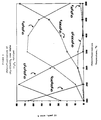
- Figure 1 illustrates schematically how the conversion to the various chlorofluoropropanes referred to in the previous paragraph changes with increasing severity of conditions when propylene is chlorofluorinated over CrO x on Cr2O3; the severity of conditions was varied by changing contact time or temperature.
- Figure 2 also illustrates this point, using a different catalyst, CrCl3 on carbon.
- the abscissa represents increased chlorofluorination severity, as achieved by varying the HF: propylene ratio from 17 to 30, varying the temperature from 400 to 440°C, and varying the contact time from 2 to 20 seconds.
- the reactor was an Inconel® tube with an outside diameter of 0.5 inch (1.27 cm), shaped like a squared U. It was charged with the desired amount of catalyst, usually 20 ml, and purged with nitrogen. The reactor temperature was increased via a heated fluidized sand bath to 450°C. The nitrogen flow was maintained through the reactor during the heating period. When a temperature of about 450°C was achieved, the HF flow was initiated and the nitrogen flow was discontinued. The temperature was then adjusted to the desired value. The HF flow was decreased to the desired value followed by initiating the chlorine and propane (or propylene) flow at the desired value. Alternatively, after heating the catalyst at 450°C, the temperature was lowered to 150°C. A N2/HF flow was started over the catalyst and the temperature slowly raised to the reaction temperature.
- Product analysis was achieved by gas chromatography using a 3m column from Supelco packed with 5% Krytox® fluorinated oil supported on Carbopack® B graphite carbon black. Sample injection was accomplished by an on-line sample valve. The analysis was done at 70°C for 8 minutes followed by temperature programming at 8 degrees per minute up to 200°C and held at 200°C for an additional 16 minutes. Product analyses are reported as relative area %.
- the desired amount of metal chloride was dissolved in 35 to 75 ml of water and the entire solution poured over 40 cc of commercial carbon granules (Girdler 411, 0.32 cm pellets). The resulting mixture was allowed to stand at room temperature for one hour and was then placed in a vacuum oven at 110°C for 16 to 24 hours to remove the water. The catalyst was then pretreated by heating in an atmosphere of nitrogen gas at 450°C followed by heating in HF at 450°C prior to its use as a chlorofluorination catalyst.
- the catalyst was mixed with 1-5 weight % "Sterotex” powdered lubricant (registered trademark of Capital City Products Co, Columbus, Ohio, division of Stokely-Van Camp, for its edible hydrogenated vegetable oil) to give 1/8" diameter x 3/16" long cylindrical pellets from a Stokes tablet machine.
- “Sterotex” powdered lubricant registered trademark of Capital City Products Co, Columbus, Ohio, division of Stokely-Van Camp, for its edible hydrogenated vegetable oil
- La(NO3)3.6H2O, 346.4 g, 86.8 g of Ce(NO3)3.6H2O and 400.15 g of Cr(NO3)3.9H2O were dissolved in 1000 cc H2O.
- the pH of the solution was adjusted to 9 with concentrated ammonium hydroxide.
- the crude solid was collected by filtration, washed with water and dried in the vacuum oven.
- the catalyst was fired at 600°C for four days with daily grinding and mixing.
- the catalyst was mixed with 1-5 weight % "Sterotex" powdered lubricant to give 1/8" diameter x 3/16" long cylindrical pellets from a Stokes tablet machine.
- La(NO3)3.6H2O, 303.1 g, 400.2 g of Cr(NO3)3.9H2O was dissolved in 1000 cc of H2O.
- the pH of the solution was adjusted to 9 with concentrated ammonium hydroxide.
- SrF2, 37.7 g, was added and the slurry was stirred for 30 minutes.
- the crude solid was collected by filtration, washed with 500 cc of H2O and dried in a vacuum oven.
- the catalyst was fired 4 days at 600°C with daily grinding and mixing.
- the catalyst was mixed with 1-5 weight % "Sterotex" powdered lubricant to give 1/8" diameter x 3/16" long cylindrical pellets from a Stokes tablet machine.
- hydrous chromium oxide When hydrous chromium oxide is used in making a catalyst, that catalyst is preferably heated to 450°C. for about one hour with a flow of a gaseous diluent such as nitrogen, to dehydrate the hydrous chromium oxide before the catalyst is used.
- a gaseous diluent such as nitrogen
- Yield as reported in the examples, is calculated from peak areas obtained in gas chromatographic analysis. This is a common technique in product identification, even though various compounds have somewhat different response factors.
- Temperature in a tubular reactor of less than about 1 cm in diameter is measured with a thermocouple in the heat transfer medium outside the tube. Temperature in a tubular reactor of more than about 1 cm diameter is measured with a thermocouple in an internal well. In large scale reactors, there are several thermocouples in the well so that the temperature profile can be observed.
- Example 1 The conditions and results of propylene chlorofluorination experiments directed toward saturated halocarbons are recorded in Table I (Examples 1 to 22), in which Ct means contact time in seconds, and other abbreviations are defined. Examples which are preferred for making CF3-CCl2-CF2Cl are 6 and 21. Examples which are preferred for making CF3-CCl2-CF3 as the major product are Examples 1 to 6. Example 9 makes a mixture of CF3-CCl2-CF3 and CF3-CFCl-CF2Cl.
- the metal salt or oxide catalysts employed in the preferred process of this invention are considerably more active than carbon pellets alone. This is illustrated in Table II summarising the results of Examples 5 to 7 and 10 to 13 in which the temperatures, contact times, and ratios of reactants are similar. Note that considerably larger quantities of saturated perhalocarbons are made when the promoted catalysts are used. Table II also illustrates the results obtained when using carbon pellets as catalyst rather than a metal-containing catalyst (Comparative Example 23).
- Examples of the chlorofluorination of propane are summarised by Examples 24 to 28 in Table III, showing that CF3CCl2CF3 was made in conversions of up to 81%, with yields to this product plus recyclable intermediates of 85-88%.
- Dehalogenation of CF3-CFCl-CF3 to hexafluoropropylene is accomplished by reaction with hydrogen in the presence of a catalyst.
- Catalysts which are preferred include, as charged to the reactor, common hydrogenation catalysts such as Cu, Ni, Cr, or combinations thereof, optionally promoted with compounds of Mo, V, W, Ag, Fe, K, Ba, or combinations thereof. It is not critical whether the catalysts are supported or not, but some of the better catalysts include unsupported copper chromite. However, supports which are unreactive to halocarbons, HF, and oxygen at hydrogenation temperatures and up to 100° higher such as metal fluorides, alumina, and titania, may be used. Particularly useful are supports of fluorides of metals of Group II of the Mendeleeff periodic table, particularly Ca. A preferred catalyst is made of equimolar quantities of Cu, Ni, and Cr2O3 on CaF2.
- An especially preferred catalyst contains 1.0 mole CuO, 0.2-1 mole Nio, 1-1.2 moles Cr2O3 and 1.3-2.7 moles of CaF2, promoted with 1-20 weight %, based on the total catalyst, of an alkali metal selected from K, Cs, and Rb, preferably K.
- K is the promoter
- the preferred amount is 2-15 weight % of the total catalyst, but the method of adding the K is not critical. For example, it may be added as a salt or base.
- the catalyst is prepared by coprecipitating, from an aqueous medium, salts of copper, nickel and chromium with and preferably on calcium fluoride; washing, heating, filtering and drying the precipitate; depositing an alkali metal salt on the precipitate; and calcining the precipitate to convert the copper, nickel and chromium to the respective oxides.
- Copper, nickel and chromium salts suitable for use herein include the chlorides, fluorides and nitrates, with the nitrates being especially preferred.
- the catalyst may be granulated, pressed into pellets, or shaped into other desirable forms.
- the catalyst may contain a binder to help ensure the physical integrity of the catalyst during granulating or shaping the catalyst into the desired form. Suitable binders include carbon and graphite, with carbon being preferred. When a binder is added to the catalyst, it normally comprises about 0.1 to 5 weight percent of the weight of the catalyst.
- Another group of catalysts which showed good lifetime in the hydrodehalogenation of CF3-CFCl-CF3, CF2Cl-CF2Cl, or CFCl2-CF2Cl is 1.0 CuO/0.2-1 NiO/1-2 Cr2O3/0.4-1 MoO3/0.8-4 CaF2, optionally promoted with at least one compound from the group consisting of MgF2, MnF2, and BaF2 or with a trace of Pd or WO3. Two of these hydrodehalogenation runs were shut down after 153 and 361 hours, respectively, while still giving good results.
- the hydrogenation catalyst is reduced with hydrogen at or somewhat above the desired reaction temperature before the chlorofluorocarbon feed is started.
- the activity of the catalyst may decrease.
- the catalyst activity can be regenerated by stopping the flow of halocarbon, flushing the bed with a gas such as hydrogen, air, or oxygen, at a temperature near or up to 100° higher than the hydrogenation temperature for at least several minutes. (A temperature higher than the hydrogenation temperature is normally used, but a lower temperature can be used with hydrogen.)
- the reactor temperature is readjusted to the hydrogenation temperature before resuming the hydrogenation reaction. While the inventors do not wish to be bound by any hypothesis, it is believed possible that catalyst activity deteriorates when the halocarbon feed deposits a small amount of polymer on the catalyst. Heating to a higher temperature in the presence of a flowing gas may pyrolyze the polymer to volatile fragments, which are swept away by the gas.
- the nature of the gas is not critical, but hydrogen is preferred.
- a suitable temperature for the hydrogenation step is 250-550°C, preferably 350-475°, and most preferably 400-450°.
- a suitable contact time is 0.1-120 seconds.
- a preferred contact time is 0.3-60 seconds, and the most preferred contact time is 0.5-15 seconds.
- Suitable pressure in step (c) is 0-100 atmospheres gauge. Preferred is 0-50 atmospheres, and most preferred is 2-30 atmospheres.
- the catalyst charged was chromium oxide trihydrate, and dehydration of the catalyst was conducted at 400°C with a flow of HF.
- Example 29 Feed rates in mols/hour were 44 HF, 22 Cl2, and 1 propylene. Operation was at 420°C. at 115 pounds/square inch absolute (790 kPa). The conversions to various products were:
- Example 30 The conditions were the same as in the previous example except the temperature was 390°C. The conversions to various products were: In these examples all products are recyclable except C3F8 and C2F5Cl.
- Example 31 This example was carried out in a two-inch by five-foot (5 cm x 1.5 m) tubular Inconel® reactor, giving CF3CFClCF3 as the chief product. Feed rates in moles/hour were 90 for HF, 35 for Cl2, and 1.5 for propylene. The temperature was 440°C and the pressure was 115 pounds per square inch (790 kPa). Conversions to various products were:
- Examples 32-33 The reactor was a 1 inch (2.54cm) Inconel® tube packed with 50 inches (1.27 m) of catalyst bed.
- the catalyst was chromium oxide trihydrate from Shepherd Chemical Company. In this flow system, HF and propylene were mixed and chlorine was added, and the mixture was passed into the reactor. Table IV shows the results obtained, with very good yields to CF3-CFCl-CF3 and recyclables.
- Examples 34-41 Several pressure chlorofluorinations were carried out to show that underfluorinated byproducts can be recycled, with or without added propylene.
- the reactor was an Inconel® tube 2" x 5 ft (5.1 cm diameter x 1.52 m), and the catalyst was the same as in Example 29. The pressure was 690 kPa.
- the "recycle organic" feed was the product of the chlorofluorination of propylene from which the C3F8 and CF3-CFCl-CF3 had been largely removed by distillation, and this feed composition is shown in the first column of Table V. From these experiments it was demonstrated that the byproducts in the chlorofluorination can be recycled to make C3F8 and CF3-CFCl-CF3.
- Example 42 A 1:1 molar mixture of hydrogen and CF3-CFCl-CF3 was passed over a BaCrO4-modified copper chromite catalyst at 400°C and atmospheric pressure at a contact time of 15-20 seconds.
- the once-through conversion to hexafluoropropylene was 60-70%, with C3F7H the major by-product. This could be recycled to step (a) for further chlorination, so the overall yield was excellent.
- Examples 43-45 For these examples, an Inconel® 600 U-tube reactor was made from 24 inches (61 cm) of 0.5 inch (1.3 cm) tubing. Each arm of the U-tube was 8 inches (20.3 cm) long, as was the bottom.
- the inlet and outlet to the reactor were 1/4 inch (0.64 cm) tubing, and tees allowed 1/8 inch (0.32 cm) thermowells to be placed in each end of the tube.
- the reactor tube was totally filled with catalyst so that as the cool feed gases were heated, they were in contact with the catalyst.
- the inlet thermowell indicated that the gases were at reaction temperature within the first 4 inches (10.2 cm) of the reactor length. Because of the preheat length and the length of tubing above the level of the alundum, the actual heated length of the reactor was assumed to be 12 inches (30.5 cm).
- a separate thermocouple was kept in the fluidized bath to verify the batch temperature.
- the cooled product from the reactor was passed into a small polypropylene trap, then into a 20% KOH scrubber made of polypropylene.
- the heat of reaction of HF and HCl with the alkali was never great enough to heat the solution above 50°C.
- the product then went through a water scrubber, a small bed of Drierite R , and then to a cold trap in dry ice/acetone where the products and unconverted reactants were collected.
- the main analysis tool used for this work was a temperature programmable Hewlett-Packard 5880A gas chromatograph with a thermal conductivity detector.
- This dual column unit was equipped with a pair of 8-foot x 1/8 inch (2.43 m x 0.32 cm) stainless steel columns packed with 1% SP-1000 on 60/80 mesh Carbopack B purchased from Supelco, Inc (catalog no. 1-2548). These columns were run with helium flows of 30 cc/minute. The column was started at 50°C for three minutes, then heated to 150°C at a rate of 20°C/minute, and held there for another 15 minutes if necessary.
- the catalyst for Example 43 was CuO/Cr2O3/NiO/0.9 MoO3/2.1 CaF2, made by method B.
- Example 44 used a CuO/NiO/Cr2O3/2.7CaF2 catalyst, prepared by method B*, which performed for over 130 hours of intermittent hydrogenation, and was still active as the experiment was voluntarily terminated.
- Example 45 used as catalyst CuO/1.2 Cr2O3/0.9 NiO/1.7 CaF2/K+, prepared by method A.
- Example 45A used pellets of a CuO/NiO/Cr2O3/2.7CaF2 catalyst which had been soaked in KOH until they contained, after drying, 7.9 weight percent K.
- the yield to HFP at 400°C or at 420°C after extended operation was quite superior to that obtained with similar catalysts containing 0.08% or 0.1.2% K, and was slightly superior to that obtained with similar catalysts containing 4.6, 8.9, 9.6, and 15.1% K.
- step (a) Any by-products made in the hydrogenation step are recycled to step (a), so they do not represent a yield loss.
- Example 46A This hydrogenation was also carried out at elevated pressure, as shown in this Example.
- a reactor was made of Inconel® tubing with inside diameter 0.19 inches (0.48 cm). The reactor was charged with 1.0 g of CuO/NiO/Cr2O3/2.7CaF2 , which was conditioned with hydrogen at atmospheric pressure at 550°C for one hour. Then the reactor was pressurized with nitrogen and fed 95% pure CF3-CFCl-CF3 and hydrogen at 150-200 psig (1034-1379 kPa) continuously at 420°C for 46 hours. The conversion of CF3-CFCl-CF3 was 20%, and the yield of hexafluoropropylene from converted CF3-CFCl-CF3 was 98-100%.
- Example 46 This example describes the preparation and testing of CuO/NiO/Cr2O3/2.7 CaF2 containing various amounts of added K.
- Aqueous calcium nitrate (2.7 moles) was mixed with 5.4 moles of aqueous KF, heated and stirred briefly at 100°C to form a slurry of CaF2.
- To this slurry were added 1 mole of chromium nitrate, and 1 mole of chromium nitrate as solids.
- the slurry was stirred at 70-80°C until the salts (other than CaF2) dissolved.
- 0.1 mole of aqueous KOH was added over a period of 1 hour and the mixture was boiled briefly.
- the slurry was cooled to 40-50°C and filtered.
- the solid was washed exhaustively to reduce the K content to an undetectable level.
- KOH was added as a solution in quantities sufficient to provide the K contents shown in Table 8.
- the catalyst was calcined at 600°C for 8-16 hours, then granulated and screened to 1-2 mm particles.
- the catalyst was subjected to a reactivation sequence which comprised a 15 minute nitrogen-gas purge at atmospheric pressure and 420°C, followed by oxidation for one hour in 30 cc/min air at a catalyst-bed inlet temperature of 420°C, a 15 minute nitrogen-gas purge, then reduction using hydrogen at 520°C for 65 minutes, and cooling the catalyst to 400°C in a nitrogen atmosphere over a 20 minute period.
- a reactivation sequence which comprised a 15 minute nitrogen-gas purge at atmospheric pressure and 420°C, followed by oxidation for one hour in 30 cc/min air at a catalyst-bed inlet temperature of 420°C, a 15 minute nitrogen-gas purge, then reduction using hydrogen at 520°C for 65 minutes, and cooling the catalyst to 400°C in a nitrogen atmosphere over a 20 minute period.
- Cycles 3 and 4 are reported in Table VIII; the selectivity pattern in the last two cycles of the experiment is a useful predictor of long-term catalyst performance.
- Selectivity in Table VIII is defined as mols of HFP produced per mol of CF3CFClCF3 consumed based upon gas chromatography analysis of reaction off-gas.
- Table VIII shows that the average selectivity of all catalysts with a potassium content of 4.6% or higher was higher in the fourth test cycle than in the third. Catalysts with a potassium content of 1.2% or less show a fall-off in selectivity in the last two cycles.
- the catalyst with a potassium content of 7.9 weight percent was tested for 1070 hours and found to be active and selective in the synthesis of hexafluoropropylene from CF3CFClCF3 at the end of the test.
- Example 9 makes a useful mixture of CF3-CCl2-CF3 and CF3-CFCl-CF2Cl.
- Example 47 Propylene was chlorofluorinated over CrF3.3.5H2O at 440°C and 115 psia (793 kPa) using a feed of 1.0 mole/hr propylene, 30 moles/hr chlorine, and 30 moles/hr HF.
- % CrCl3 on Harshaw #3945 Al2O3, a low alkali aluminum oxide support It was pretreated with 450 cc/minute HF and 1000 cc/minute dry air at 250-410°C for 20 hours. The treated catalyst had an apparent density of 0.984 g/cc.
- CF3-CCl2-CF3 was then fed at 18 cc/minute, along with 50 cc/minute HF at 450°C. for a contact time of 22.2 seconds. After 40 hours, the conversion to CF3-CFCl-CF3 was 33% and recovered reactant was 63%, for a yield of 90%. Examples 50-56 .
- CF3-CFCl-CF2Cl was reacted with HF over the same chromium oxide catalyst at 450-470°C. in a 3/4 inch (1.9 cm) Inconel® 600 reactor that was 26 inches (66cm) long, of which 20 inches (51 cm) was at temperature.
- CF3-CCl2-CF3 (12 cc/min) and HF (48 cc/min) were passed over Cr2O3 at 465°C and a contact time of 7.6 seconds.
- the yield from converted starting material was 87%.
- Example 59 Similar results were obtained in shorter runs at 100-200 psig (690-1380 kPa) over the same kind of catalyst.
- step (b) The contact time was 24 seconds.
- the results are presented below: Temp, °C Conversion to CF3-CFCl-CF3 Yield (assuming other products were starting material) 400 5.5% 89% 412 10 83 425 20 88 437 32 86
- the halogen exchange reaction of step (b) was also carried out under completely different conditions, using SbF5 reactant.
- replacement of Cl with F can be carried out with Sb fluorides in the (III) or (V) valence state, or a mixture of these.
- Sb chlorides plus HF can also be used.
- the temperature range can be 25-250°C, and the time can be 15 minutes to 15 hours.
- the temperature is 150-200°
- the reagent is SbF5
- the time is long enough to provide a reasonable conversion of starting material. Higher temperature, longer time, and higher Sb valence tend to higher conversion.
- the presence of F on a carbon adjacent to a C-Cl bond deactivates the Cl toward replacement using Sb halide.
- the group -CCl3 is easier to fluorinate than the group -CCl2-. Carbon-fluorine bonds activated by an adjacent double bond react more readily with Sb fluorides.
- Example 61
Landscapes
- Chemical & Material Sciences (AREA)
- Organic Chemistry (AREA)
- Chemical Kinetics & Catalysis (AREA)
- Organic Low-Molecular-Weight Compounds And Preparation Thereof (AREA)
- Low-Molecular Organic Synthesis Reactions Using Catalysts (AREA)
- Catalysts (AREA)
Claims (7)
- Verfahren zur Herstellung von Hexafluorpropylen, welches umfaßt(a) Chlorfluorierung von wenigstens einem von Propan, Propylen und teilweise halogenierten acyclischen C₃-Kohlenwasserstoffen mit Fluorwasserstoff und Chlor in Gegenwart eines metallhaltigen festen Katalysators, um gesättigte perhalogenierte C₃-Chlorfluorkohlenstoffe herzustellen,(b) Fluorierung der Chlorfluorkohlenstoffe aus Stufe (a), die nicht CF₃CFClCF₃ sind, um CF₃CFClCF₃ herzustellen, und(c) Hydrodehalogenierung von jeglichem CF₃CFClCF₃ aus der genannten Chlorfluorierung und von CF₃CFClCF₃ aus der genannten Fluorierung zu Hexafluorpropylen in Gegenwart von Wasserstoff und einem Katalysator.
- Verfahren nach Anspruch 1, bei dem der gesättigte perhalogenierte C₃-Chlorfluorkohlenstoff wenigstens eines von C₃F₄Cl₄, C₃F₅Cl₃, CF₃CFClCF₂Cl, CF₃CCl₂CF₃ und CF₃CCl₂CCl₃ ist.
- Verfahren nach Anspruch 1 oder 2, bei dem Stufe (a) in der Dampfphase durchgeführt wird.
- Verfahren nach Anspruch 1, 2 oder 3, bei dem die Hydrodehalogenierung (c) in Gegenwart von Wasserstoff und einem K-haltigen Katalysator durchgeführt wird.
- Verfahren nach Anspruch 1, 2 oder 3, bei dem der in Stufe (c) verwendete Katalysator etwa 1,0 mol CuO/0,2 bis 1 mol NiO/1 bis 3 mol Cr₂O₃/4 bis 21 mol CaF₂ umfaßt und außerdem 1-20 Gew.-% von wenigstens einem von K, Cs und Rb enthält.
- Verfahren nach Anspruch 1, 2 oder 3, bei dem der in Stufe (c) verwendete Katalysator etwa 1,0 mol CuO/0,2 bis 1 mol NiO/1 bis 2 mol Cr₂O₃/0,4 bis 1 mol MoO₃/0,8 bis 4 mol CaF₂ umfaßt und außerdem 1-20 Gew.-% von wenigstens einem von K, CS und Rb enthält.
- Verfahren nach Anspruch 5 oder 6, bei dem der Katalysator K in einer Menge von 2-15 Gew.-% enthält.
Applications Claiming Priority (2)
| Application Number | Priority Date | Filing Date | Title |
|---|---|---|---|
| US07/452,402 US5057634A (en) | 1989-12-19 | 1989-12-19 | Multistep synthesis of hexafluoropropylene |
| US452402 | 1989-12-19 |
Publications (2)
| Publication Number | Publication Date |
|---|---|
| EP0434409A1 EP0434409A1 (de) | 1991-06-26 |
| EP0434409B1 true EP0434409B1 (de) | 1994-10-12 |
Family
ID=23796311
Family Applications (1)
| Application Number | Title | Priority Date | Filing Date |
|---|---|---|---|
| EP90313951A Expired - Lifetime EP0434409B1 (de) | 1989-12-19 | 1990-12-19 | Mehrstufenverfahren zur Herstellung von Hexafluorpropylen |
Country Status (5)
| Country | Link |
|---|---|
| US (1) | US5057634A (de) |
| EP (1) | EP0434409B1 (de) |
| JP (1) | JP2613683B2 (de) |
| CA (1) | CA2032273C (de) |
| DE (1) | DE69013313T2 (de) |
Families Citing this family (60)
| Publication number | Priority date | Publication date | Assignee | Title |
|---|---|---|---|---|
| US5177273A (en) * | 1991-02-01 | 1993-01-05 | E. I. Du Pont De Nemours And Company | Process for the manufacture of halogen-substituted propanes containing hydrogen and at least five fluorine substituents |
| US5258561A (en) * | 1992-11-06 | 1993-11-02 | E. I. Du Pont De Nemours And Company | Catalytic chlorofluorination process for producing CF3 CHClF and CF3 CHF2 |
| US5395999A (en) * | 1992-11-06 | 1995-03-07 | E. I. Du Pont De Nemours And Company | Catalytic chlorofluorination process for producing CHClFCF3 and CHF2 CF3 |
| US5714655A (en) * | 1993-06-10 | 1998-02-03 | Daikin Industries, Ltd. | Process of manufacturing 1,1,1,3,3-pentafluoropropane, process of manufacturing 2,2,3-trichloro 1,1,1,3,3-pentafluoropropane and process of manufacturing 2,3,3-trichloro-1,1,1-trifluoropropene |
| US5847242A (en) * | 1995-05-19 | 1998-12-08 | E. I. Du Pont De Nemours And Company | Catalysts for halogenated hydrocarbon processing, their precursors and their preparation and use |
| US5841007A (en) * | 1996-04-12 | 1998-11-24 | Korea Institute Of Science And Technology | Process for manufacturing 1,1,1,2-tetrafluoroethane |
| IT1282961B1 (it) * | 1996-05-06 | 1998-04-02 | Ausimont Spa | Processo per la rigenerazione di un catalizzatore a base di composti di cromo trivalente |
| US5892135A (en) * | 1996-08-23 | 1999-04-06 | E. I. Du Pont De Nemours And Company | Process for the production of trifluoroethylene |
| US6376727B1 (en) | 1997-06-16 | 2002-04-23 | E. I. Du Pont De Nemours And Company | Processes for the manufacture of 1,1,1,3,3-pentafluoropropene, 2-chloro-pentafluoropropene and compositions comprising saturated derivatives thereof |
| ES2224359T3 (es) | 1997-02-19 | 2005-03-01 | E. I. Du Pont De Nemours And Company | Procesos para producir 1,1,1,3,3,-pentafluoropropano, 2-cloro-pentafluoropropano.sp. |
| EP1068170A2 (de) * | 1998-04-03 | 2001-01-17 | E.I. Du Pont De Nemours And Company | Verfahren zur reinigung und verwendung von 2,2-dichlor-1,1,1,3,3,3-hexafluorpropan und deren azeotropen mit hf |
| US6281395B1 (en) | 1998-04-03 | 2001-08-28 | E. I. Du Pont De Nemours And Company | 1,1,1,2,3,3,3-heptafluoropropane manufacturing process |
| US6018083A (en) * | 1998-04-03 | 2000-01-25 | E. I. Du Pont De Nemours And Company | Process for the production of fluorocarbons |
| JP2002510664A (ja) * | 1998-04-03 | 2002-04-09 | イー・アイ・デュポン・ドウ・ヌムール・アンド・カンパニー | 2−クロロ−1,1,1,2,3,3,3−ヘプタフルオロプロパンと、そのhfとの共沸混合物を精製および使用する方法 |
| EP1084093B1 (de) * | 1998-06-02 | 2004-08-18 | E.I. Dupont De Nemours And Company | Verfahren zur herstellung von hexafluorpropen und gegebenenfalls weiteren halogenierten fluor enthaltenden kohlenwasserstoffen |
| EP1683778A3 (de) | 1998-06-02 | 2008-03-19 | E.I.Du pont de nemours and company | azeotrope von cclf2cclfcf3 mit hf und deren verwendungen |
| DE69930512T2 (de) | 1998-06-02 | 2006-10-05 | E.I. Dupont De Nemours And Co., Wilmington | Verfahren zur herstellung von hexafluorpropen aus cc1f2cc1fcf3 und azeotrope von cc1f2cc1fcf3 mit hf |
| US6583328B1 (en) | 1999-04-05 | 2003-06-24 | Pcbu Services, Inc. | Method for the preparation of 1,1,1,3,3-pentafluoropropene and 1,1,1,3,3-pentafluoropropane |
| JP4333894B2 (ja) * | 2001-02-13 | 2009-09-16 | 日本ゼオン株式会社 | パーハロゲン化5員環化合物の製造方法 |
| US7329786B2 (en) | 2001-09-28 | 2008-02-12 | Great Lakes Chemical Corporation | Processes for producing CF3CFHCF3 |
| CN100464840C (zh) * | 2002-08-22 | 2009-03-04 | 纳幕尔杜邦公司 | 钴取代的氧化铬组合物,它们的制备以及它们作为催化剂和催化剂前体的用途 |
| WO2004018397A1 (en) * | 2002-08-22 | 2004-03-04 | E.I. Du Pont De Nemours And Company | Processes for the preparation of 2-chloro-1,1,1,2,3,3,3-heptafluoropropane, hexafluoropropene and 1,1,1,2,3,3,3-heptafluoropropane |
| DE10252272A1 (de) * | 2002-11-11 | 2004-05-27 | Bayer Ag | Verfahren zur Herstellung von Polyhalogenalkanen |
| US7250539B2 (en) * | 2002-12-30 | 2007-07-31 | Great Lakes Chemical Corp. | Materials and methods for the conversion of hydrofluorocarbons |
| US7223351B2 (en) * | 2003-04-17 | 2007-05-29 | Great Lakes Chemical Corporation | Fire extinguishing mixtures, methods and systems |
| US20050020863A1 (en) * | 2003-07-25 | 2005-01-27 | Honeywell International Inc. | Method of making fluorinated propanes |
| US20050038302A1 (en) | 2003-08-13 | 2005-02-17 | Hedrick Vicki E. | Systems and methods for producing fluorocarbons |
| JP2007508376A (ja) | 2003-10-14 | 2007-04-05 | イー・アイ・デュポン・ドウ・ヌムール・アンド・カンパニー | 1,1,1,3,3−ペンタフルオロプロパンおよび1,1,1,2,3−ペンタフルオロプロパンの調製法 |
| WO2005037742A1 (en) * | 2003-10-14 | 2005-04-28 | E.I. Dupont De Nemours And Company | Process for the preparation of 1,1,1,3,3,3-hexafluoropropane and at least one of 1,1,1,2,3,3-hexafluoropropane and 1,1,1,2,3,3,3-heptafluoropropane |
| TW200844075A (en) | 2006-10-31 | 2008-11-16 | Du Pont | Processes for the production of fluoropropanes and halopropenes |
| WO2008054781A1 (en) * | 2006-10-31 | 2008-05-08 | E. I. Du Pont De Nemours And Company | Processes for the production of fluoropropanes and halopropenes and azeotropic compositions of 2-chloro-3,3,3-trifluoro-1-propene with hf and of 1,1,1,2,2-pentafluoropropane with hf |
| US7473810B1 (en) * | 2007-10-12 | 2009-01-06 | Honeywell International Inc. | Method of dechlorinating organic compounds comprising vicinal chlorides |
| GB0721991D0 (en) * | 2007-11-09 | 2007-12-19 | Ineos Fluor Holdings Ltd | Preparation method |
| BRPI0914033A2 (pt) * | 2008-10-13 | 2015-11-03 | Dow Global Technologies Inc | processo de uma etapa para a produção de de propenos clorados e fluorados e processo para preparar 2,3,3,3- tetrafluorprop-1 eno( 1,3,3,3- tetrafluorprop-1 eno (hfo-123ze) |
| US8399721B2 (en) * | 2008-12-22 | 2013-03-19 | E I Du Pont De Nemours And Company | Method of hydrodechlorination to produce dihydrofluorinated olefins |
| JP5782038B2 (ja) * | 2009-10-09 | 2015-09-24 | ダウ グローバル テクノロジーズ エルエルシー | 等温多管式反応器及び該反応器を組み込んだプロセス |
| KR20120093202A (ko) | 2009-10-09 | 2012-08-22 | 다우 글로벌 테크놀로지스 엘엘씨 | 단열식 플러그 흐름 반응기 및 염화 및/또는 불화 프로펜 및 고급 알켄의 제조 방법 |
| KR20120093857A (ko) * | 2009-10-09 | 2012-08-23 | 다우 글로벌 테크놀로지스 엘엘씨 | 염화 및/또는 불화 프로펜의 제조 방법 |
| EP2485997B1 (de) | 2009-10-09 | 2015-09-09 | Dow Global Technologies LLC | Verfahren zur herstellung von chlorierten und/oder fluorierten probenen und höheren alkenen |
| CA2837292C (en) | 2011-05-31 | 2020-01-28 | Blue Cube Ip Llc | Process for the production of chlorinated propenes |
| CA2836493A1 (en) | 2011-05-31 | 2012-12-06 | Max Markus Tirtowidjojo | Process for the production of chlorinated propenes |
| ES2721451T3 (es) | 2011-06-08 | 2019-07-31 | Dow Agrosciences Llc | Procedimiento para la producción de propenos clorados y/o fluorados |
| EP2739595B1 (de) | 2011-08-07 | 2018-12-12 | Blue Cube IP LLC | Verfahren zur herstellung von chlorierten propenen |
| CN103717559A (zh) | 2011-08-07 | 2014-04-09 | 陶氏环球技术有限责任公司 | 生产氯化的丙烯的方法 |
| CA2856271A1 (en) | 2011-11-21 | 2013-05-30 | Dow Global Technologies Llc | Process for the production of chlorinated alkanes |
| IN2014CN04029A (de) | 2011-12-02 | 2015-10-23 | Dow Global Technologies Llc | |
| JP6059246B2 (ja) | 2011-12-02 | 2017-01-11 | ブルー キューブ アイピー エルエルシー | 塩素化アルカンの製造方法 |
| US8754273B2 (en) * | 2011-12-07 | 2014-06-17 | Honeywell International Inc. | Process for preparing 1,1,2-Trichloro-3,3,3-trifluoropropane |
| JP6170068B2 (ja) | 2011-12-13 | 2017-07-26 | ブルー キューブ アイピー エルエルシー | 塩素化プロパン及びプロペンの製造方法 |
| EP2794528B1 (de) | 2011-12-22 | 2020-02-26 | Blue Cube IP LLC | Verfahren zur herstellung von tetrachlormethan |
| BR112014015123A2 (pt) | 2011-12-23 | 2017-06-13 | Dow Global Technologies Llc | processo para a produção de um ou mais alcenos ou compostos aromáticos |
| US9321707B2 (en) | 2012-09-20 | 2016-04-26 | Blue Cube Ip Llc | Process for the production of chlorinated propenes |
| JP2015529247A (ja) | 2012-09-20 | 2015-10-05 | ダウ グローバル テクノロジーズ エルエルシー | 塩素化プロペンの生成のためのプロセス |
| WO2014052945A2 (en) | 2012-09-30 | 2014-04-03 | Dow Global Technologies, Llc | Weir quench and processes incorporating the same |
| JP6363610B2 (ja) | 2012-10-26 | 2018-07-25 | ブルー キューブ アイピー エルエルシー | 混合器およびそれを組み込んだプロセス |
| WO2014100066A1 (en) | 2012-12-18 | 2014-06-26 | Dow Global Technologies, Llc | Process for the production of chlorinated propenes |
| US9475740B2 (en) | 2012-12-19 | 2016-10-25 | Blue Cube Ip Llc | Process for the production of chlorinated propenes |
| EP2961722A2 (de) | 2013-02-27 | 2016-01-06 | Blue Cube IP LLC | Verfahren zur herstellung von chlorierten propenen |
| CN105026348A (zh) | 2013-03-09 | 2015-11-04 | 蓝立方知识产权有限责任公司 | 用于生产氯化烷烃的方法 |
| JP7287391B2 (ja) * | 2018-05-28 | 2023-06-06 | Agc株式会社 | 含フッ素プロペンの製造方法 |
Family Cites Families (18)
| Publication number | Priority date | Publication date | Assignee | Title |
|---|---|---|---|---|
| US2558703A (en) * | 1948-01-06 | 1951-06-26 | Hooker Electrochemical Co | Preparation of trifluorotrichloropropene |
| US2758138A (en) * | 1954-05-06 | 1956-08-07 | Du Pont | Pyrolysis process for making perfluoropropene from tetrafluoroethylene |
| US2970176A (en) * | 1957-10-31 | 1961-01-31 | Du Pont | Pyrolysis of fluorocarbons to hexafluoropropylene |
| US2900423A (en) * | 1957-12-13 | 1959-08-18 | Allied Chem | Manufacture of perfluoropropene |
| US3258500A (en) * | 1959-08-17 | 1966-06-28 | Du Pont | Process for fluorinating halohydro-carbons |
| NL269647A (de) * | 1960-09-28 | |||
| NL301934A (de) * | 1962-12-28 | 1900-01-01 | ||
| DE1250420B (de) * | 1963-11-05 | 1967-09-21 | Laporte Chemicals Limited, Luton, Bedfordshire (Großbritannien) | Verfahren zur Herstellung von halogenierten Kohlenwasser stoffen durch Chlorfluorierung bzw Bromfluorierung |
| US3459818A (en) * | 1966-05-28 | 1969-08-05 | Asahi Glass Co Ltd | Process of producing tetrafluoroethylene and hexafluoropropylene |
| DE1568617C3 (de) * | 1966-11-12 | 1973-10-31 | Farbwerke Hoechst Ag, Vormals Meister Lucius & Bruening, 6000 Frankfurt | Verfahren zur Herstellung von fluorierten aliphatischen Kohlenwasser Stoffverbindungen durch Disproportionierung |
| NL136586C (de) * | 1967-01-11 | |||
| DE1910529C3 (de) * | 1969-03-01 | 1978-09-28 | Dynamit Nobel Ag, 5210 Troisdorf | Verfahren zur katalytischen Hydrofluorierung von bestimmten gesattigten und ungesättigten halogenierten Kohlenwasserstoffen |
| US3873630A (en) * | 1972-06-12 | 1975-03-25 | Du Pont | Process for pyrolyzing tetrafluoroethylene to hexafluoropropylene |
| US3865885A (en) * | 1973-08-10 | 1975-02-11 | Du Pont | Catalytic chlorofluorination of isopropyl fluoride to 1,1,2-trichlorotrifluoropropene-1 |
| US4110406A (en) * | 1976-12-21 | 1978-08-29 | Allied Chemical Corporation | Preparation of 1-chloro-2-trifluoromethyl-3,3,3-trifluoropropene from isobutylene |
| DE3017154A1 (de) * | 1980-05-05 | 1981-11-12 | Hoechst Ag, 6000 Frankfurt | Verfahren zur herstellung von 2-chlor-1,1,1,2,3,3,3,-heptafluor-propan |
| JPS6226239A (ja) * | 1985-05-28 | 1987-02-04 | イ−・アイ・デユポン・デ・ニモアス・アンド・カンパニ− | フルオロオレフインの接触ハロゲン交換法 |
| DE58904105D1 (de) * | 1988-03-14 | 1993-05-27 | Hoechst Ag | Verfahren zur herstellung von hexafluorpropen. |
-
1989
- 1989-12-19 US US07/452,402 patent/US5057634A/en not_active Expired - Lifetime
-
1990
- 1990-12-14 CA CA002032273A patent/CA2032273C/en not_active Expired - Lifetime
- 1990-12-19 DE DE69013313T patent/DE69013313T2/de not_active Expired - Fee Related
- 1990-12-19 EP EP90313951A patent/EP0434409B1/de not_active Expired - Lifetime
- 1990-12-19 JP JP2411690A patent/JP2613683B2/ja not_active Expired - Fee Related
Also Published As
| Publication number | Publication date |
|---|---|
| JP2613683B2 (ja) | 1997-05-28 |
| CA2032273A1 (en) | 1991-06-20 |
| DE69013313T2 (de) | 1995-03-30 |
| CA2032273C (en) | 2002-01-22 |
| JPH04145033A (ja) | 1992-05-19 |
| EP0434409A1 (de) | 1991-06-26 |
| US5057634A (en) | 1991-10-15 |
| DE69013313D1 (de) | 1994-11-17 |
Similar Documents
| Publication | Publication Date | Title |
|---|---|---|
| US5057634A (en) | Multistep synthesis of hexafluoropropylene | |
| US5068472A (en) | Multistep synthesis of hexafluoropropylene | |
| EP0434407B1 (de) | Mehrstufenverfahren zur Herstellung von Hexafluoropropylen | |
| US6111150A (en) | Method for producing 1,1,1,3,3,-pentafluoropropane | |
| JP4077032B2 (ja) | 末端炭素原子に結合したフッ素を含有するハロゲン化プロパンの製法 | |
| EP0964845B1 (de) | Verfahren für die herstellung von 1,1,1,3,3-pentafluorpropen und 2-chlor-pentafluorpropen | |
| AU630807B2 (en) | Process for the manufacture of 1,1,1,2-tetra-fluorochloroethane and/or pentafluoroethane | |
| CN102164881A (zh) | 1,3,3,3-四氟丙烯的制造方法 | |
| US6376727B1 (en) | Processes for the manufacture of 1,1,1,3,3-pentafluoropropene, 2-chloro-pentafluoropropene and compositions comprising saturated derivatives thereof | |
| JP2005536539A (ja) | 1,1,1,2,2−ペンタフルオロエタンを製造するための方法 | |
| JP3369604B2 (ja) | 1,1,1,2,3,3−ヘキサフルオロプロパンの製造方法及びテトラフルオロクロロプロペンの製造方法 | |
| EP0703208B1 (de) | Verfahren zur Herstellung von 1,1,1,3,3-Pentafluorpropan | |
| US7151197B2 (en) | Processes for purifying chlorofluorinated compounds and processes for purifying CF3CFHCF3 | |
| US5892135A (en) | Process for the production of trifluoroethylene | |
| EP0714874B1 (de) | Verfahren zur Herstellung von 1,1,1-Trifluorethan | |
| CA2298099C (en) | Multistep synthesis of hexafluoropropylene | |
| US5220083A (en) | Synthesis of perfluoropropane | |
| KR100477292B1 (ko) | 말단탄소에치환된불소를함유하는할로겐화프로판의제조방법 | |
| EP1428811B1 (de) | Azeotropische Zusammensetzungen enthaltend 1,1,1,2,3,3,3-Heptafluorpropan und Verfahren, die diese Zusammensetzungen verwenden | |
| JP2003176243A (ja) | 1,1,1,3,3−ペンタフルオロプロパン及び/又は1,1,3,3,3−ペンタフルオロプロペンの製造方法 |
Legal Events
| Date | Code | Title | Description |
|---|---|---|---|
| PUAI | Public reference made under article 153(3) epc to a published international application that has entered the european phase |
Free format text: ORIGINAL CODE: 0009012 |
|
| AK | Designated contracting states |
Kind code of ref document: A1 Designated state(s): DE FR GB IT |
|
| 17P | Request for examination filed |
Effective date: 19910712 |
|
| 17Q | First examination report despatched |
Effective date: 19920820 |
|
| GRAA | (expected) grant |
Free format text: ORIGINAL CODE: 0009210 |
|
| AK | Designated contracting states |
Kind code of ref document: B1 Designated state(s): DE FR GB IT |
|
| PG25 | Lapsed in a contracting state [announced via postgrant information from national office to epo] |
Ref country code: FR Effective date: 19941012 |
|
| REF | Corresponds to: |
Ref document number: 69013313 Country of ref document: DE Date of ref document: 19941117 |
|
| ITF | It: translation for a ep patent filed | ||
| EN | Fr: translation not filed | ||
| PLBE | No opposition filed within time limit |
Free format text: ORIGINAL CODE: 0009261 |
|
| STAA | Information on the status of an ep patent application or granted ep patent |
Free format text: STATUS: NO OPPOSITION FILED WITHIN TIME LIMIT |
|
| 26N | No opposition filed | ||
| REG | Reference to a national code |
Ref country code: GB Ref legal event code: IF02 |
|
| PGFP | Annual fee paid to national office [announced via postgrant information from national office to epo] |
Ref country code: GB Payment date: 20061213 Year of fee payment: 17 |
|
| PGFP | Annual fee paid to national office [announced via postgrant information from national office to epo] |
Ref country code: DE Payment date: 20061214 Year of fee payment: 17 |
|
| PGFP | Annual fee paid to national office [announced via postgrant information from national office to epo] |
Ref country code: IT Payment date: 20061231 Year of fee payment: 17 |
|
| GBPC | Gb: european patent ceased through non-payment of renewal fee |
Effective date: 20071219 |
|
| PG25 | Lapsed in a contracting state [announced via postgrant information from national office to epo] |
Ref country code: DE Free format text: LAPSE BECAUSE OF NON-PAYMENT OF DUE FEES Effective date: 20080701 |
|
| PG25 | Lapsed in a contracting state [announced via postgrant information from national office to epo] |
Ref country code: GB Free format text: LAPSE BECAUSE OF NON-PAYMENT OF DUE FEES Effective date: 20071219 |
|
| PG25 | Lapsed in a contracting state [announced via postgrant information from national office to epo] |
Ref country code: IT Free format text: LAPSE BECAUSE OF NON-PAYMENT OF DUE FEES Effective date: 20071219 |