EP0434619A2 - Verfahren zum Einbau von O-Hydroxyphenyl-S-triazinen in organische Polymere - Google Patents
Verfahren zum Einbau von O-Hydroxyphenyl-S-triazinen in organische Polymere Download PDFInfo
- Publication number
- EP0434619A2 EP0434619A2 EP90810978A EP90810978A EP0434619A2 EP 0434619 A2 EP0434619 A2 EP 0434619A2 EP 90810978 A EP90810978 A EP 90810978A EP 90810978 A EP90810978 A EP 90810978A EP 0434619 A2 EP0434619 A2 EP 0434619A2
- Authority
- EP
- European Patent Office
- Prior art keywords
- alkyl
- formula
- substituted
- ch2ch
- hydrogen
- Prior art date
- Legal status (The legal status is an assumption and is not a legal conclusion. Google has not performed a legal analysis and makes no representation as to the accuracy of the status listed.)
- Granted
Links
Classifications
-
- C—CHEMISTRY; METALLURGY
- C07—ORGANIC CHEMISTRY
- C07D—HETEROCYCLIC COMPOUNDS
- C07D251/00—Heterocyclic compounds containing 1,3,5-triazine rings
- C07D251/02—Heterocyclic compounds containing 1,3,5-triazine rings not condensed with other rings
- C07D251/12—Heterocyclic compounds containing 1,3,5-triazine rings not condensed with other rings having three double bonds between ring members or between ring members and non-ring members
- C07D251/14—Heterocyclic compounds containing 1,3,5-triazine rings not condensed with other rings having three double bonds between ring members or between ring members and non-ring members with hydrogen or carbon atoms directly attached to at least one ring carbon atom
- C07D251/24—Heterocyclic compounds containing 1,3,5-triazine rings not condensed with other rings having three double bonds between ring members or between ring members and non-ring members with hydrogen or carbon atoms directly attached to at least one ring carbon atom to three ring carbon atoms
-
- C—CHEMISTRY; METALLURGY
- C08—ORGANIC MACROMOLECULAR COMPOUNDS; THEIR PREPARATION OR CHEMICAL WORKING-UP; COMPOSITIONS BASED THEREON
- C08F—MACROMOLECULAR COMPOUNDS OBTAINED BY REACTIONS ONLY INVOLVING CARBON-TO-CARBON UNSATURATED BONDS
- C08F246/00—Copolymers in which the nature of only the monomers in minority is defined
-
- C—CHEMISTRY; METALLURGY
- C08—ORGANIC MACROMOLECULAR COMPOUNDS; THEIR PREPARATION OR CHEMICAL WORKING-UP; COMPOSITIONS BASED THEREON
- C08F—MACROMOLECULAR COMPOUNDS OBTAINED BY REACTIONS ONLY INVOLVING CARBON-TO-CARBON UNSATURATED BONDS
- C08F8/00—Chemical modification by after-treatment
- C08F8/30—Introducing nitrogen atoms or nitrogen-containing groups
Definitions
- the present invention relates to a process for the incorporation of o-hydroxyphenyl-s-triazines into organic polymers and to the modified polymers obtainable by this process.
- o-hydroxyphenyl-s-triazines absorb UV light and, because of this property, can be used as light stabilizers for organic materials, in particular for organic polymers.
- compounds are used for this purpose which contain a p-alkoxy group in addition to the o-hydroxy group, the alkoxy group also being able to be substituted, as is e.g. in US-A-3 118 887 or in US-A-3 244 708.
- A1, A2, A3, A4 and R3 as C1-C12 alkyl can be straight or branched alkyl, e.g. Methyl, ethyl, iso-propyl, n-butyl, sec-butyl, tert-butyl, pentyl, hexyl, heptyl, octyl, 2-ethylhexyl, ditert-octyl, decyl or dodecyl.
- R1 and R4 as C2-C6 alkenyl can e.g. Vinyl, 1-propenyl, allyl, methallyl, 2-butenyl or 2-hexenyl.
- R2 and R3 as C3-C5 alkenyl are especially allyl or methallyl.
- R2 as C1-C4 alkyl is especially methyl or ethyl.
- R4 as C2-C6-hydroxyalkyl is in particular 2-hydroxyethyl or 2-hydroxypropyl.
- R5, R7 and R9 as C2-C10 alkylene can e.g. 1,2-ethylene, trimethylene, tetramethylene, hexamethylene, octamethylene or 1,3,3-trimethyltetramethylene.
- R6 as C2-C14 alkylene is preferably 1,2-alkylene such as e.g. 1,2-ethylene, 1,2-propylene, 1,2-octylene or 1,2-dodecylene.
- R1 as a substituted C1-C18 alkyl is preferably substituted C1-C4 alkyl. It can contain one or more of the substituents OH, ⁇ COOH, ⁇ COOR2, ⁇ NHR3, ⁇ CONHR4 and ⁇ O-CO-R4.
- Examples include 2-hydroxyethyl, 2-hydroxypropyl, 2-hydroxybutyl, carboxymethyl, 2-carboxyethyl, 2-carboxypropyl, methoxycarbonylmethyl, methoxycarbonylethyl, ethoxycarbonylethyl, glycidyloxycarbonylethyl, allyloxycarbonylmethyl, allyloxycarbonylethyl, 2-aminoethyl, methyl-2-hydroxypropyl 2-hydroxy-3-butylaminopropyl, 2-hydroxy-3-allylaminopropyl, 2- (allylaminocarbonyl) ethyl, 2-hydroxyethylaminocarbonylmethyl, 2-acryloyloxyethyl, methacryloyloxymethyl, 2-hydroxy-3-acryloyloxypropyl, 2-hydroxy-3-methacryloyloxypropyl 2-hydroxy-3-maleimido-propyl or 2,3-dihydroxypropyl.
- R1 is a C2-C4-alkyl substituted by OH and C1-C12-alkoxy or phenoxy, this is in particular propyl substituted in this way, e.g. 2-hydroxy-2-butoxypropyl, 2-hydroxy-3-hexyloxypropyl, 2-hydroxy-3-octyloxypropyl, 2-hydroxy-3-dodecyloxypropyl or 2-hydroxy-3-phenoxypropyl.
- R1 is an OH or ⁇ OCOR4 substituted cyclohexyl
- the group OH or ⁇ OCOR4 is preferably in the ortho position (2 position).
- a compound of the formula I in which n is 1 or 2, A1, A2, A3 and A4 are preferably hydrogen, C1-C4-alkyl or chlorine is used for the incorporation, R1, when n is 1, hydrogen, C1-C4-alkyl substituted by OH, ⁇ COOH, ⁇ COOR2, ⁇ NHR3, ⁇ CONHR4 or / and ⁇ O-CO-R4, C OH substituted by OH and interrupted by one or more O's -C20-alkyl, propyl substituted by OH and C1-C12 alkoxy or phenoxy, cyclohexyl, allyl, glycidyl or one of the substituted by OH or ⁇ OCOR4 and when n is 2, one of the groups ⁇ CH2CH (OH) CH2 ⁇ , ⁇ CH2CH (OH) CH2O-R5-OCH2CH (OH) CH2 ⁇ or ⁇ CH2CH (R8) O-CO-CH CH-CO-OCH (R8) CH
- R2 is C1-C4-alkyl or allyl
- R4 C2-C4 alkenyl means and
- the incorporation can be carried out by copolymerization, copolycondensation or copolyaddition or by reaction with a polymer which bears suitable functional groups.
- n 1 or 2
- R1 is allyl, C1-C4-alkyl substituted by ⁇ COOR2 or ⁇ O-CO-R4 or cyclohexyl substituted by ⁇ O-CO-R4 are particularly suitable, R2 is allyl and R4 is C2-C4- Alkenyl means.
- the polymer can be composed of one or more such monomers.
- the unsaturated compound of the formula I is added during the polymerization, so that a copolymerization takes place.
- the polymerization can be initiated by radical, anionic or cationic initiators. It is preferred to use free radical initiators which decompose into free radicals on heating, e.g. organic peroxides or hydroperoxides, azo compounds or redox catalysts.
- the polymerization can also be initiated by high-energy radiation, e.g. also for radiation-curable paints (UV-curable or ESR-curable).
- UV-curable or ESR-curable radiation-curable paints
- the copolymerizable hydroxyphenyl-s-triazine is incorporated into the coating matrix during film formation.
- the group transfer polymerization process is particularly suitable for such copolymerizations.
- a "living" polymer is formed by using certain initiators.
- suitable initiators are 1-trimethylsiloxy-1-alkoxy-2-methylpropene.
- the method of group transfer polymerization has been known for several years and is described, for example, in US Pat. Nos. 4,695,607 and 4,414,372.
- the polymerization can be carried out in solution, emulsion, dispersion or in bulk. These methods are known to the person skilled in the art. In the examples which follow, such copolymerizations are described in detail.
- n 1 or 2
- R1 if n is 1, C1-C18 alkyl or a group substituted by OH and ⁇ COOH, ⁇ COOR2 or ⁇ NHR3 when n is 2, a group ⁇ CH2CH (OH) CH2O-R5-OCH2CH (OH) CH2 ⁇
- R2 is C1-C4-alkyl
- R3 is hydrogen, C1-C12-alkyl, allyl or cyclohexyl
- R5 is C2-C10 -Alkylene, phenylene or a group
- Such mono- or difunctional compounds of formula I can e.g. in polyester, polyether esters, polyamides, polyurethanes, polycarbonates, epoxy resins, phenolic resins, melamine resins or alkyd resins. Installation is carried out by adding during the production of the condensation or addition polymers according to the methods known to those skilled in the art.
- Unsaturated compounds of the formula I can be added to unsaturated polyester resins and their mixtures with other vinyl compounds and then cured with the addition of free radical initiators.
- oligomeric epoxy resins can be reacted with functional compounds of form 1 and then cured with an epoxy hardener.
- OH-functional compounds of the formula I can be reacted with melamine resins and the resulting compounds can then be cured with the addition of acrylate resins.
- phenolic resins or alkyd resins can also be done with a precursor before the resin is finally cured.
- the resin can also be cured under acidic or basic catalysis without interfering with the triazine compounds.
- a further possibility of incorporation consists in the reaction of a compound of formula I with a polymer which contains suitable functional groups.
- This can e.g. Polymers with hydroxyl, carboxyl, anhydride, amino, epoxy or isocyanate groups. Examples of these are copolymers of acrylic and methacrylic acid, of hydroxyalkyl (meth) acrylates, of glycidyl (meth) acrylates, partially hydrolyzed polyvinyl acetate or ethylene-vinyl acetate copolymer, partially esterified cellulose, partially hydrolyzed polyalkyl (meth) acrylates, polyesters or polyurethanes reactive end groups, epoxy resins or copolymers of maleic acid, of maleic anhydride or of maleic acid semiesters or half amides.
- Compounds of the formula I which contain a functional group which contains the functional groups of the polymer are suitable for the reaction can react. These can be, for example, hydroxyl, carboxyl, ester, amino, epoxy or isocyanate groups. If, for example, a polymer which contains OH groups is to be modified with a compound of the formula I, it is possible, for example, to use a compound of the formula I which contains at least one isocyanate, epoxide, carboxyl or ester group. A polymer which contains epoxy groups can, for example, be reacted with a compound of the formula I which contains at least one hydroxyl, carboxyl or amino group. A copolymer of maleic anhydride can, for example, be reacted with a compound of the formula I which contains a hydroxyl, amino or epoxide group.
- reaction is preferably carried out in solution. All or some of the functional groups of the polymer can be reacted. This is determined by the amount of the compound of the formula I used for the reaction. Details for such reactions are described in the examples which follow.
- a special method for incorporation into polymers is the grafting of ethylenically unsaturated derivatives of the formula I onto hydrocarbon polymers.
- the compounds of the formula I which contain ethylenically unsaturated groups have already been defined in more detail above.
- Hydrocarbon polymers can be saturated or unsaturated.
- the former include the polyolefins, e.g. Polyethylene, polypropylene, polybutene or polyisobutene.
- the latter include the diene polymers and their copolymers with olefins, e.g. Polybutadiene, polyisoprene, propylene-butadiene or ethylene-propylene-butadiene. Grafting on polyolefins, in particular on polyethylene, is preferred.
- the grafting reaction can be carried out in solution or in bulk.
- Free radical formers such as are also used for the homo- or copolymerization of unsaturated compounds, are used as catalysts.
- All of these processes for incorporating compounds of the formula I into polymers can be carried out using a relatively small amount of the triazine, for example 0.05 to 5% by weight, based on the modified polymer. These amounts give the polymers resistance to damage by light, oxygen and heat, this stabilization not being lost through migration or elution of the stabilizer can. For this purpose, 0.1 to 3% by weight of a compound of the formula I are preferably incorporated.
- polymeric stabilizers can be added to organic materials, especially organic polymers.
- the polymeric stabilizers can, however, also be applied as a thin protective layer on molded plastic parts, for example in dissolved form or by coextrusion, as it is e.g. in US-A-4,676,870.
- EP-A-226 538 describes the incorporation of light stabilizers by copolymerization or copolycondensation into those microparticles which can be used as a disperse phase in coatings.
- 0.1 to 30% by weight of a compound of the formula I preferably 0.5 to 10% by weight, based on the modified polymer, is incorporated into the microparticles.
- the method of group transfer polymerization can advantageously be used for incorporation into microparticles, as is e.g. is described in EP-A-293 871.
- the invention also relates to the modified polymers produced by the process described, which contain a compound of the formula I in the stated amounts by weight in a chemically bound form and are thereby stabilized against damage by light, oxygen and heat.
- the polymers modified in this way can be mixed with various additives, as is customary in the technology of the polymers.
- additives can be stabilizers or processing aids or pigments or other additives. Examples of this are the following additions.
- Alkylated monophenols for example 2,6-di-tert-butyl-4-methylphenol, 2-tert-butyl-4,6-dimethylphenol, 2,6-di-tert-butyl-4-ethylphenol, 2,6-di-tert-butyl-4-n-butylphenol, 2,6-di-tert-butyl-4-i-butylphenol, 2,6- Di-cyclopentyl-4-methylphenol, 2- ( ⁇ -methylcyclohexyl) -4,6-dimethylphenol, 2,6-di-octadecyl-4-methylphenol, 2,4,6-tri-cyclohexylphenol, 2,6-di- tert-butyl-4-methoxymethylphenol, 2,6-di-nonyl-4-methylphenol.
- 2,6-di-tert-butyl-4-methylphenol for example 2,6-di-tert-butyl-4-methylphenol, 2-tert-butyl
- Alkylated hydroquinones for example 2,6-di-tert-butyl-4-methoxyphenol, 2,5-di-tert-butylhydroquinone, 2,5-di-tert-amyl-hydroquinone, 2,6-diphenyl-4-octadecyloxyphenol.
- Hydroxylated thiodiphenyl ethers for example 2,2'-thio-bis- (6-tert-butyl-4-methylphenol), 2,2'-thio-bis- (4-octylphenol), 4,4'-thio-bis- (6-tert.butyl-3-methylphenol), 4,4'-thio-bis- (6-tert.butyl-2-methylphenol).
- Alkylidene bisphenols for example 2,2'-methylene-bis- (6-tert.butyl-4-methylphenol), 2,2'-methylene-bis- (6-tert.butyl-4-ethylphenol), 2.2 '-Methylene-bis- [4-methyl-6- ( ⁇ -methylcyclohexyl) phenol], 2,2'-methylene-bis- (4-methyl-6-cyclohexylphenol), 2,2'-methylene-bis- (6-nonyl-4-methylphenol), 2,2'-methylene-bis- (4,6-di-tert.butylphenol), 2,2'-ethylidene-bis- (4,6-di-tert.butylphenol) ), 2,2′-ethylidene-bis- (6-tert.butyl-4-isobutylphenol), 2,2′-methylene-bis- [6- ( ⁇ -methylbenzyl) -4-nonylphenol], 2,2 ′ -Methylene-bis- [
- benzyl compounds for example 1,3,5-tris (3,5-di-tert-butyl-4-hydroxy-benzyl) -2,4,6-trimethylbenzene, bis- (3,5-di-tert-butyl -4-hydroxybenzyl) sulfide, isooctyl 3,5-di-tert-butyl-4-hydroxy-benzyl-mercaptoacetic acid, bis (4-tert-butyl-3-hydroxy-2,6-dimethylbenzyl) dithiol terephthalate , 1,3,5-tris (3,5-di-tert-butyl-4-hydroxybenzyl) isocyanurate, 1,3,5-tris (4-tert-butyl-3-hydroxy-2,6- dimethylbenzyl) isocyanurate, 3,5-di-tert-butyl-4-hydroxybenzyl-phosphonic acid dioctadecyl ester, Ca salt of 3,5-di-tert-butyl
- Acylaminophenols for example 4-hydroxy-lauric anilide, 4-hydroxystearic anilide, 2,4-bis- (octylmercapto) -6- (3,5-di-tert-butyl-4-hydroxyanilino) -s-triazine, N- (3,5-di-tert-butyl-4-hydroxyphenyl) - carbamic acid octyl ester.
- esters of ⁇ - (3,5-di-tert-butyl-4-hydroxyphenyl) propionic acid with mono- or polyhydric alcohols such as with methanol, octa-decanol, 1,6-hexanediol, neopentyl glycol, thiodiethylene glycol, diethylene glycol, triethylene glycol , Pentaerythritol, tris (hydroxyethyl) isocyanurate, N, N'-bis (hydroxyethyl) oxalic acid diamide.
- esters of ⁇ - (5-tert-butyl-4-hydroxy-3-methylphenyl) propionic acid with mono- or polyhydric alcohols such as with methanol, octadecanol, 1,6-hexanediol, neopentyl glycol, thiodiethylene glycol, diethylene glycol, triethylene glycol, pentaerythritol , Tris (hydroxy) ethyl isocyanurate, N, N'-bis (hydroxyethyl) oxalic acid diamide.
- Esters of ⁇ - (3,5-dicyclohexyl-4-hydroxyphenyl) propionic acid with mono- or polyhydric alcohols such as with methanol, octadecanol, 1,6-hexanediol, neopentyl glycol, thiodiethylene glycol, diethylene glycol, triethylene glycol, pentaerythritol, tris ( hydroxy) ethyl isocyanurate, N, N'-bis (hydroxyethyl) oxalic acid diamide.
- Amides of ⁇ - (3,5-di-tert-butyl-4-hydroxyphenyl) propionic acid such as N, N'-bis (3,5-di-tert-butyl-4-hydroxyphenylpropionyl) hexamethylene diamine, N , N'-bis (3,5-di-tert-butyl-4-hydroxyphenylpropionyl) trimethylene diamine, N, N'-bis (3,5-di-tert-butyl-4-hydroxyphenylpropionyl) hydrazine.
- 2.2.2-hydroxybenzophenones such as 4-hydroxy, 4-methoxy, 4-octoxy, 4-decyloxy, 4-dodecyloxy, 4-benzyloxy, 4,2 ', 4'-trihydroxy, 2'-hydroxy-4,4'-dimethoxy derivative.
- Esters of optionally substituted benzoic acids such as, for example, 4-tert-butylphenyl salicylate, phenyl salicylate, octylphenyl salicylate, dibenzoylresorcinol, bis (4-tert.butylbenzoyl) resorcinol, Benzoyl resorcinol, 3,5-di-tert-butyl-4-hydroxybenzoic acid, 2,4-di-tert-butylphenyl ester, 3,5-di-tert-butyl-4-hydroxybenzoic acid, hexadecyl ester.
- Acrylates such as, for example, ⁇ -cyano- ⁇ , ⁇ -diphenylacrylic acid ethyl or isooctyl ester, ⁇ -carbomethoxy-cinnamic acid methyl ester, ⁇ -cyano- ⁇ -methyl-p-methoxy-cinnamic acid methyl ester or -butyl ester, ⁇ -carbomethoxy-p- methoxy cinnamic acid methyl ester, N- ( ⁇ -carbomethoxy- ⁇ -cyanovinyl) -2-methyl-indoline.
- Nickel compounds such as nickel complexes of 2,2 ' -Thio-bis- [4- (1,1,3,3-tetramethylbutyl) phenol], such as the 1: 1 or the 1: 2 complex, optionally with additional Ligands, such as n-butylamine, triethanolamine or N-cyclohexyl-diethanolamine, nickel dibutyldithiocarbamate, nickel salts of 4-hydroxy-3,5-di-tert-butylbenzylphosphonic acid monoalkyl esters, such as of methyl or ethyl ester, nickel complexes of ketoximes, such as of 2- Hydroxy-4-methyl-phenyl-undecylketoxime, nickel complexes of 1-phenyl-4-lauroyl-5-hydroxy-pyrazole, optionally with additional ligands.
- additional Ligands such as n-butylamine, triethanolamine or N-cyclohexyl-diethanolamine, nickel dibutyld
- Sterically hindered amines such as bis (2,2,6,6-tetramethyl-piperidyl) sebacate, bis (1,2,2,6,6-pentamethylpiperidyl) sebacate, n-butyl-3,5- di-tert.butyl-4-hydroxybenzylmalonic acid bis (1,2,2,6,6-pentamethylpiperidyl) ester, condensation product from 1-hydroxyethyl-2,2,6,6-tetramethyl-4-hydroxypiperidine and succinic acid, condensation product from N, N′-bis (2,2,6,6-tetramethyl-4-piperidyl) hexamethylenediamine and 4-tert-octylamino-2,6-dichloro-1,3,5-s-triazine, tetrakis (2,2,6,6-tetramethyl-4-piperidyl) -1,2,3,4-butanetetraoate, 1,1 ′ - (1,2-ethanediy
- Oxalic acid diamides such as 4,4′-di-octyloxy-oxanilide, 2,2′-di-octyloxy-5,5′-di-tert.butyl-oxanilide, 2,2′-di-dodecyloxy-5,5 ′ -di-tert.butyl-oxanilide, 2-ethoxy-2'-ethyl-oxanilide, N, N'-bis (3-dimethylaminopropyl) oxalamide, 2-ethoxy-5-tert.butyl-2'-ethyloxanilide and its mixture with 2-ethoxy-2'-ethyl-5,4'-di-tert.butyl-oxanilide, mixtures of o- and p-methoxy and of o- and p-ethoxy-di-substituted oxanilides.
- Metal deactivators such as N, N'-diphenyloxalic acid diamide, N-salicylal-N'-salicyloylhydrazine, N, N'-bis (salicyloyl) hydrazine, N, N'-bis (3,5-di-tert .butyl-4-hydroxyphenylpropionyl) hydrazine, 3-salicyloylamino-1,2,4-triazole, bis (benzylidene) oxalic acid dihydrazide.
- phosphites and phosphonites such as triphenyl phosphite, diphenylalkyl phosphites , phenyl dialkyl phosphites , tris (nonylphenyl) phosphite, trilauryl phosphite, trioctadecyl phosphite, distearyl pentaerythritol diphosphite, tris (2,4-di-tert.butylphenyl) ditophosphite, ditphitophosphite Bis (2,4-di-tert.butylphenyl) pentaerythritol diphosphite, tristearyl sorbitol triphosphite, tetrakis (2,4-di-tert.butylphenyl) -4,4'-biphenylene diphosphonite, 3,9-bis - (2,4-di-tert.butyl)
- Peroxide-destroying compounds such as esters of ⁇ -thio-dipropionic acid, for example the lauryl, stearyl, myristyl or tridecyl ester, mercaptobenzimidazole, the zinc salt of 2-mercaptobenzimidazole, zinc dibutyl dithiocarbamate, dioctadecyl disulfide, penta ⁇ -dodecylmercapto) propionate.
- esters of ⁇ -thio-dipropionic acid for example the lauryl, stearyl, myristyl or tridecyl ester, mercaptobenzimidazole, the zinc salt of 2-mercaptobenzimidazole, zinc dibutyl dithiocarbamate, dioctadecyl disulfide, penta ⁇ -dodecylmercapto) propionate.
- Polyamide stabilizers such as copper salts in combination with iodides and / or phosphorus compounds and salts of divalent manganese.
- Basic co-stabilizers such as melamine, polyvinylpyrrolidone, dicyandiamide, triallyl cyanurate, urea derivatives, hydrazine derivatives, amines, polyamides, polyurethanes, alkali and alkaline earth metal salts of higher fatty acids, for example Ca stearate, Zn stearate, Mg stearate , Na ricinoleate, K-palmitate, antimony catecholate or tin catecholate.
- Basic co-stabilizers such as melamine, polyvinylpyrrolidone, dicyandiamide, triallyl cyanurate, urea derivatives, hydrazine derivatives, amines, polyamides, polyurethanes, alkali and alkaline earth metal salts of higher fatty acids, for example Ca stearate, Zn stearate, Mg stearate , Na ricinoleate, K-palmitate, anti
- Nucleating agents such as 4-tert-butylbenzoic acid, adipic acid, diphenylacetic acid.
- Fillers and reinforcing agents such as calcium carbonate, silicates, glass fibers, asbestos, talc, kaolin, mica, barium sulfate, metal oxides and hydroxides, carbon black, graphite.
- additives such as plasticizers, lubricants, emulsifiers, pigments, optical brighteners, flame retardants, antistatic agents, blowing agents.
- additives are stabilizers, they are preferably added in a total amount of 0.05 to 5% by weight.
- a further embodiment of the invention is that, in addition to a compound of the formula I, a further stabilizer is built into the polymer.
- a further stabilizer is built into the polymer.
- the additional incorporation of a sterically hindered amine can take place by copolymerization or copolycondensation or copolyaddition or by reaction with a polymer which contains suitable functional groups.
- Sterically hindered amines which contain ethylenically unsaturated groups and are suitable for copolymerization according to the invention are e.g. the acrylic and methacrylic acid derivatives of 2,2,6,6-tetramethylpiperidine and their N-alkyl and N-alkoxy derivatives described in US Pat. No. 3,705,166. Further copolymerizable derivatives of tetramethylpiperidine are described in US Pat. No. 4,210,612 and in EP-A-389,420.
- Sterically hindered amines that can react with functional polymers include those that contain hydroxyl groups, such as 2,2,6,6, tetramethylpiperidinol-4, 1,2,2,6,6-pentamethylpiperidinol-4, 1-hydroxyethyl-2,2,6,6-tetramethylpiperidinol-4, or A-4 087 404 and compounds described in EP-A 389,419; or those containing amino groups, e.g. the 4-amino-2,2,6,6-tetramethylpiperidine or the 4-aminopiperidines described in US Pat. No. 3,904,581.
- Such sterically hindered amines can be incorporated simultaneously with the incorporation of the triazines of the formula I or before or after.
- the procedures used for this are the same as for the incorporation of the triazines. Further details can be found in the examples below.
- a sterically hindered amine is also added to the If polymers are incorporated, the latter is preferably used in an amount which corresponds to 0.1 to 15% by weight of the modified polymer.
- the polymers modified according to the invention can be used for the customary forms of use of polymers, such as e.g. as molded parts, pipes, plates, foils, fibers, casting resins, adhesives or coatings. They are preferably used as binders for paints, both for pigmented and unpigmented paints.
- parts mean parts by weight and% by weight, M n number average molecular weight and M w weight average molecular weight.
- Solution I is added dropwise within 3 h, solution II within 3.5 h. The mixture is then heated to reflux for a further 1 h. A viscous, approximately 50% polymer solution is obtained which is clear and colorless. The solution contains 4.33 moles of epoxy groups.
- the solution of the modified acrylate resin thus obtained is mixed in a solids ratio of 65:35 with a melamine resin (Cymel® 327, Cyanamid Corp.). 2.5% (based on solids) of a leveling agent (Baysilon® A, Bayer AG) (1% solution in xylene) are added.
- This clearcoat formulation is diluted with xylene / butanol / butylglycol acetate 13: 6: 1 for sprayability, applied to an aluminum sheet coated with a silver metallic basecoat and baked at 130 ° C. for 30 minutes. The result is a film thickness of 40-45 ⁇ m.
- the clear lacquer described under a), which contains no triazine derivative, serves as a comparison.
- the weather resistance of the samples is checked in a UVCON® weathering device UVB-313 with a cycle of 4 h UV radiation at 60 ° C and 4 h condensation at 50 ° C.
- the 20 ° gloss is measured according to DIN 67530 before weathering and after 400 h of weathering.
- the copolymer contains 3.3% of the above triazine compound and has a molecular weight M n 3248 and M w 8135.
- This clearcoat formulation is diluted with xylene for sprayability and applied to an aluminum sheet coated with a silver metallic basecoat. After baking (30 minutes at 120 ° C) a film thickness of 40-45 ⁇ m results.
- a clear lacquer which contains no triazine derivative and was obtained by polymerizing solution III and mixing it with melamine resin, serves as a comparison. The samples are tested for weather resistance in the UVCON® device.
- Example 2A The procedure is as in Example 2A), but 5.1 g of 4-acryloyloxy-1,2,2,6,6-pentamethylpiperidine are added to solution IV. A light yellow viscous solution of the copolymer is obtained.
- the copolymer contains 3.3% of the triazine derivative and 1.6% of the piperidine derivative and has a molecular weight M n 3063 and M w 9283.
- All three resin solutions are diluted with xylene for sprayability and applied to an aluminum sheet primed with a silver metallic basecoat.
- the samples are baked at 140 ° C for 20 min.
- the resulting film thickness is 45-50 ⁇ m.
- the weather resistance of the samples is tested in UVCON® 313 with a cycle of 8 h UV radiation at 70 ° C and 4 h condensation at 50 ° C and the 20 ° gloss measured according to DIN 67530.
- a UV-curable system is being prepared 66 parts of a urethane acrylate (Genomer® T 1600, Gurder), 32 parts of 1,6-hexanediol diacrylate (Sartomer® SR 238) and 2 parts of 1-benzoylcyclohexanol (as initiator).
- a portion is mixed with 1.5% of the unsaturated triazine derivative described in Example 2.
- a second part is mixed with 1.5% of this triazine derivative and 0.5% 4-acryloyloxy-1-octyloxy-2,2,6,6-tetramethylpiperidine (HALS).
- HALS 4-acryloyloxy-1-octyloxy-2,2,6,6-tetramethylpiperidine
- a third part is hardened without the addition of stabilizers.
- the formulations are applied to an aluminum sheet primed with a silver metallic paint and cured in a UV processor from PPG with 2 lamps of 80 W / cm in two passes at a speed of 10 m / min.
- the result is a film thickness of approx. 40 ⁇ m.
- sample sheets are weathered in a UVCON® 313 with a cycle of 4 h UV radiation at 60 ° C and 4 h condensation at 50 ° C and the 20 ° gloss measured according to DIN 67530.
- a radiation-curable clearcoat is prepared on 70 parts of an aliphatic urethane acrylate (Ebecryl® 284, UCB) and 30 parts of 1,6-hexanediol diacrylate. A part of it is mixed with 2% of the unsaturated triazine derivative described in Example 2 (dissolved in xylene).
- the paint samples are applied to a white-primed aluminum sheet and irradiated in an electron beam device with a dose of 1 Mrad.
- the resulting film thickness is approximately 40 ⁇ m.
- part of the sample sheet is extracted with toluene for 2 h and the extract is analyzed analytically.
- the concentration of triazine extracted is less than 0.1%. This proves the quantitative incorporation of triazine in the paint.
- the samples are weathered in UVCON® 313 as in Example 4 and the 20 ° gloss measured.
Landscapes
- Chemical & Material Sciences (AREA)
- Organic Chemistry (AREA)
- Health & Medical Sciences (AREA)
- Chemical Kinetics & Catalysis (AREA)
- Medicinal Chemistry (AREA)
- Polymers & Plastics (AREA)
- General Chemical & Material Sciences (AREA)
- Compositions Of Macromolecular Compounds (AREA)
- Addition Polymer Or Copolymer, Post-Treatments, Or Chemical Modifications (AREA)
- Paints Or Removers (AREA)
- Graft Or Block Polymers (AREA)
- Polyesters Or Polycarbonates (AREA)
- Other Resins Obtained By Reactions Not Involving Carbon-To-Carbon Unsaturated Bonds (AREA)
- Polyurethanes Or Polyureas (AREA)
- Epoxy Resins (AREA)
- Macromolecular Compounds Obtained By Forming Nitrogen-Containing Linkages In General (AREA)
Abstract
Description
- Die vorliegende Erfindung betrifft ein Verfahren zum Einbau von o-Hydroxyphenyl-s-triazinen in organische Polymere und die nach diesem Verfahren erhältlichen modifizierten Polymeren.
- Es ist bekannt, dass o-Hydroxyphenyl-s-triazine UV-Licht absorbieren und auf Grund dieser Eigenschaft als Lichtschutzmittel für organische Materialien, insbesondere für organische Polymere verwendet werden können. Insbesondere werden dazu solche Verbindungen verwendet, die ausser der o-Hydroxygruppe noch eine p-Alkoxygruppe enthalten, wobei die Alkoxygruppe auch substituiert sein kann, wie dies z.B. im US-A-3 118 887 oder im US-A-3 244 708 beschrieben ist.
- Um ein Auswandern und Ausblühen dieser Stabilisatoren zu verhindern, hat man auch bereits vorgeschlagen, p-Acryloyloxyderivate von o-Hydroxyphenyl-s-triazinen in die zu schützenden Polymeren durch Copolymerisation oder durch Pfropfung einzubauen, wie dies im US-A-3 423 360 beschrieben ist. Diese p-Acryloyloxyderivate neigen jedoch zu einer Vergilbung unter dem Einfluss von UV-Licht.
- Auf der Suche nach chemisch einbaubaren o-Hydroxyphenyl-s-triazin-Derivaten wurde eine grössere Anzahl von Derivaten gefunden, die sich durch Copolymerisation, Copolykondensation, Copolyaddition oder polymeranaloge Umsetzung in verschiedene Typen von organischen Polymeren einbauen lassen und die im eingebauten Zustand weniger zu Verfärbungen neigen als die vorhin erwähnten bekannten Derivate.
- Die Erfindung betrifft daher ein Verfahren zum Einbau von o-Hydroxyphenyl-s-triazinen in organische Polymere, dadurch gekennzeichnet, dass man eine Verbindung der Formel I,
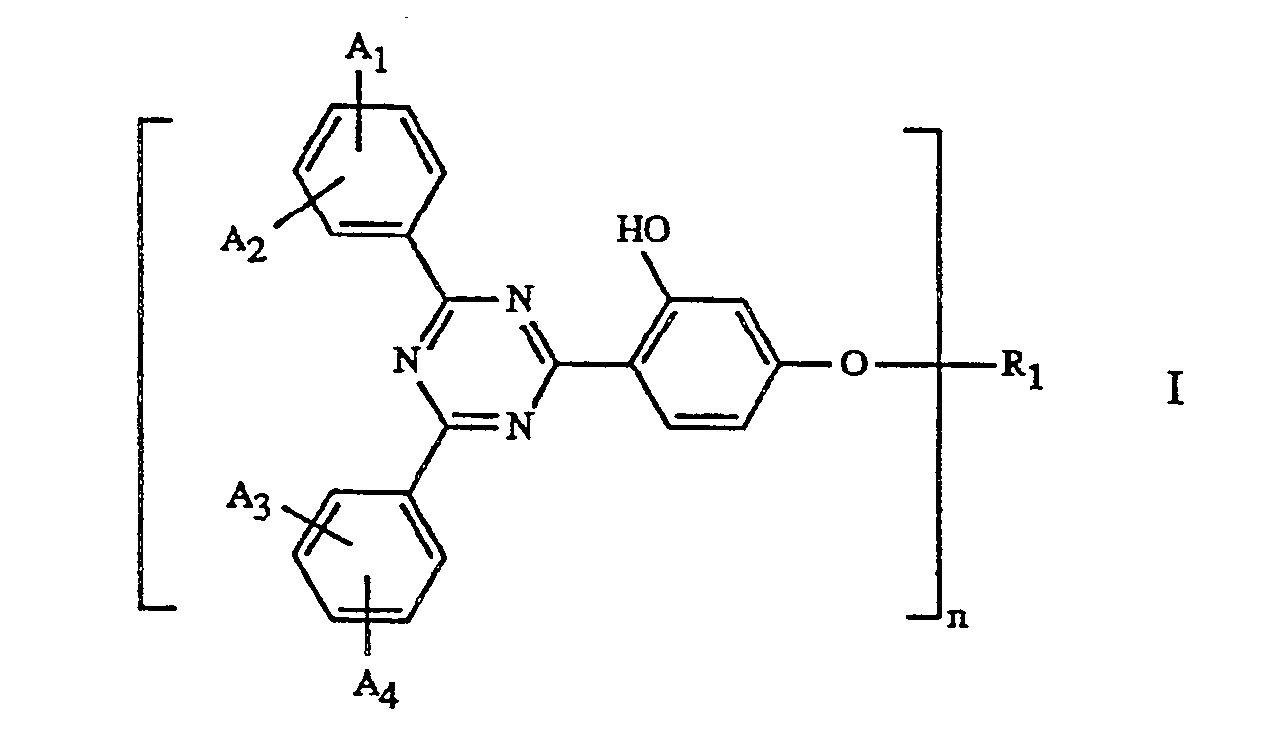
worin n 1 oder 2 ist,
A₁, A₂, A₃ und A₄ unabhängig voneinander Wasserstoff, C₁-C₁₂-Alkyl, Cyclohexyl oder Halogen bedeuten,
R₁, wenn n 1 ist, Wasserstoff, duch OH, ―COOH, ―COOR₂, ―NHR₃, ―CONHR₄,

und wenn n 2 ist, eine der Gruppen ―CH₂CH(OH)CH₂―, ―CO-CH = CH-CO―,
―CH₂CH(OH)CH₂O-R₅-OCH₂CH(OH)CH₂― oder
―CH₂CH(R₈)O-CO-CH = CH-CO-OCH(R₈)CH₂― bedeutet,
R₂ C₁-C₄-Alkyl, Glycidyl oder C₃-C₅-Alkenyl bedeutet,
R₃ Wasserstoff, C₁-C₁₂-Alkyl, C₃-C₅-Alkenyl oder Cyclohexyl bedeutet,
R₄ C₂-C₆-Alkenyl oder C₂-C₆-Hydroxyalkyl bedeutet,
R₅ C₂-C₁₀-Alkylen, Phenylen oder eine Gruppe
bedeutet, worin X ―O―, ―S―, ―SO₂, ―CH₂― oder ―C(CH₃)₂― ist, oder R₅ eine Gruppe
―CO-R₉-CO― bedeutet,
R₆ C₂-C₁₄-Alkylen, ―CH = CH― oder o-Phenylen bedeutet,
R₇ C₂-C₁₀-Alkylen, Phenylen, Tolylen oder eine Gruppe der Formel
bedeutet,
R₈ Wasserstoff oder Methyl bedeutet und
R₉ C₂-C₁₀-Alkylen, ―CH = CH― oder Phenylen bedeutet,
entweder bei der Herstellung des Polymeren durch Copolymerisation, Copolykondensation oder Copolyaddition einbaut oder mit einem Polymeren, das geeignete funktionelle Gruppen enthält, reagieren lässt. - A₁, A₂, A₃, A₄ und R₃ als C₁-C₁₂-Alkyl können unverzweigtes oder verzweigtes Alkyl sein, wie z.B. Methyl, Ethyl, iso-Propyl, n-Butyl, sec-Butyl, tert-Butyl, Pentyl, Hexyl, Heptyl, Octyl, 2-Ethylhexyl, ditert-Octyl, Decyl oder Dodecyl.
- R₁ und R₄ als C₂-C₆-Alkenyl kann z.B. Vinyl, 1-Propenyl, Allyl, Methallyl, 2-Butenyl oder 2-Hexenyl sein. R₂ und R₃ als C₃-C₅-Alkenyl sind insbesondere Allyl oder Methallyl. R₂ als C₁-C₄-Alkyl ist insbesondere Methyl oder Ethyl.
- R₄ als C₂-C₆-Hydroxyalkyl ist insbesondere 2-Hydroxyethyl oder 2-Hydroxypropyl.
- R₅, R₇ und R₉ als C₂-C₁₀-Alkylen kann z.B. 1,2-Ethylen, Trimethylen, Tetramethylen, Hexamethylen, Octamethylen oder 1,3,3-Trimethyltetramethylen sein. R₆ als C₂-C₁₄ Alkylen ist vorzugsweise 1,2-Alkylen wie z.B. 1,2-Ethylen, 1,2-Propylen, 1,2-Octylen oder 1,2-Dodecylen.
- R₁ als substituiertes C₁-C₁₈-Alkyl ist vorzugsweise substituiertes C₁-C₄-Alkyl. Es kann einen oder mehrere der Substituenten OH, ―COOH, ―COOR₂, ―NHR₃, ―CONHR₄ und ―O-CO-R₄ enthalten. Beispiele hierfür sind 2-Hydroxyethyl, 2-Hydroxypropyl, 2-Hydroxybutyl, Carboxymethyl, 2-Carboxyethyl, 2-Carboxypropyl, Methoxycarbonylmethyl, Methoxycarbonylethyl, Ethoxycarbonylethyl, Glycidyloxycarbonylethyl, Allyloxycarbonylmethyl, Allyloxycarbonylethyl, 2-Aminoethyl, 2-Hydroxy-3-methylaminopropyl, 2-Hydroxy-3-butylaminopropyl, 2-Hydroxy-3-allylaminopropyl, 2-(Allylaminocarbonyl)-ethyl, 2-Hydroxyethylaminocarbonylmethyl, 2-Acryloyloxyethyl, Methacryloyloxymethyl, 2-Hydroxy-3-acryloyloxypropyl, 2-Hydroxy-3-methacryloyloxypropyl, 2-Hydroxy-3-maleinimido-propyl oder 2,3-Dihydroxypropyl.
- Wenn R₁ ein durch OH substituiertes und durch ein oder mehrere O unterbrochenes C₄-C₂₀-Alkyl ist, so kann dies z.B. eine Gruppe (̵CH₂CH₂OH mit m = 2-10 oder


- Wenn R₁ ein durch OH und C₁-C₁₂-Alkoxy oder Phenoxy substituiertes C₂-C₄-Alkyl ist, so ist dies insbesondere solcherart substituiertes Propyl, wie z.B. 2-Hydroxy-2-butoxypropyl, 2-Hydroxy-3-hexyloxypropyl, 2-Hydroxy-3-octyloxypropyl, 2-Hydroxy-3-dodecyloxypropyl oder 2-Hydroxy-3-phenoxypropyl.
- Wenn R₁ ein durch OH oder ―OCOR₄ substituiertes Cyclohexyl ist, so steht die Gruppe OH oder ―OCOR₄ bevorzugt in ortho-Stellung (2-Stellung).
- Bevorzugt verwendet man zum Einbau eine Verbindung der Formel I, worin n 1 oder 2 ist, A₁, A₂, A₃ und A₄ Wasserstoff, C₁-C₄-Alkyl oder Chlor bedeuten,
R₁, wenn n 1 ist, Wasserstoff, durch OH, ―COOH, ―COOR₂, ―NHR₃, ―CONHR₄ oder/und ―O-CO-R₄ substituiertes C₁-C₄-Alkyl, durch OH substituiertes und durch ein oder mehrere O unterbrochenes C₄-C₂₀-Alkyl, durch OH und C₁-C₁₂-Alkoxy oder Phenoxy substituertes Propyl, durch OH oder ―OCOR₄ substituiertes Cyclohexyl, Allyl, Glycidyl oder eine der
―CH₂CH(OH)CH₂O-R₅-OCH₂CH(OH)CH₂― oder
―CH₂CH(R₈)O-CO-CH = CH-CO-OCH(R₈)CH₂― bedeutet,
R₂ C₁ -C₄-Alkyl, Glycidyl oder Allyl bedeutet,
R₃ C₁-C₁₂-Alkyl bedeutet,
R₄ C₂-C₆-Alkenyl bedeutet,
R₅ C₂-C₁₀-Alkylen, Phenylen oder eine Gruppe
R₇ C₂-C₁₀-Alkylen, Phenylen, Tolylen oder eine Gruppe der Formel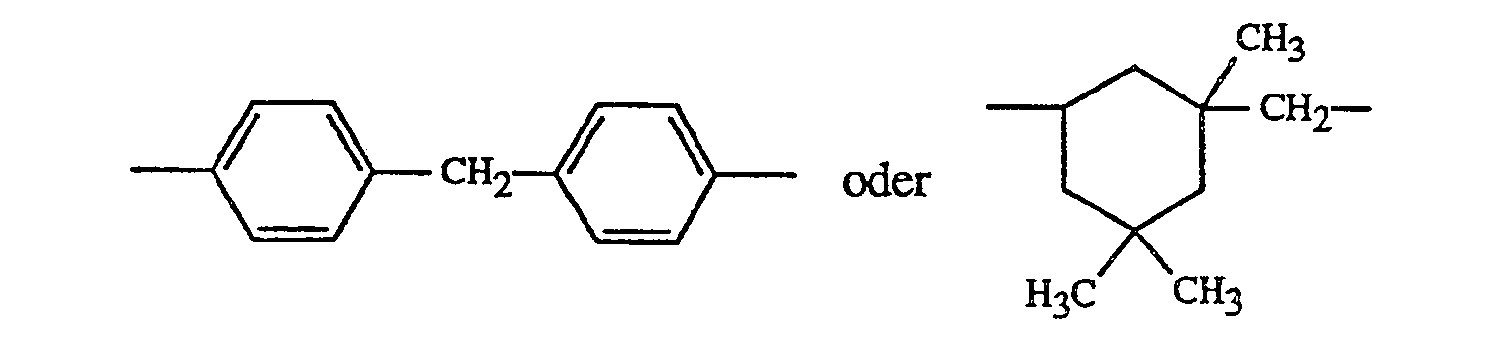
bedeutet,
R₈ Wasserstoff oder Methyl bedeutet und
R₉ C₂-C₁₀-Alkylen, ―CH = CH― oder Phenylen bedeutet. - Besonders bevorzugt verwendet man zum Einbau eine Verbindung der Formel I, worin n 1 oder 2 ist,
A₁ und A₃ Wasserstoff, Methyl oder Chlor bedeuten,
A₂ und A₄ Wasserstoff oder Methyl bedeuten,
R₁, wenn n 1 ist, Wasserstoff, durch OH, ―COOH, ―COOR₂ oder/und ―O-CO-R₄ substituiertes C₁-C₄-Alkyl, durch OH substituiertes und durch ein oder mehrere O unterbrochenes C₄-C₂₀-Alkyl, durch OH und C₄-C₁₂-Alkoxy substituiertes Propyl,
- wenn n 2 ist, eine der Gruppen ―CH₂CH(OH)CH₂― oder
―CH₂CH(OH)CH₂O-R₅-OCH₂CH(OH)CH₂― bedeutet,
R₂ C₁-C₄-Alkyl oder Allyl bedeutet,
R₄ C₂-C₄-Alkenyl bedeutet und

- Der Einbau kann durch Copolymerisation, Copolykondensation oder Copolyaddition erfolgen oder durch Reaktion mit einem Polymeren, das geeignete funktionelle Gruppen trägt.
- Der Einbau durch Copolymerisation kommt vor allem für solche Verbindungen der Formel I in Frage, die ethylenisch ungesättigte Gruppen enthalten. Dies sind die Verbindungen der Formel I, worin n 1 oder 2 ist, R₁, wenn n 1 ist, C₂-C₆-Alkenyl, durch ―COOR₂, ―NH-R₃, ―CONHR₄ oder ―O-CO-R₄ substituiertes C₁-C₁₈-Alkyl, durch ―O-CO-R₄ substituiertes Cyclohexyl oder eine Gruppe ―CO-CH = CH-COOH bedeutet, und wenn n = 2 ist, eine Gruppe ―CO-CH = CH-CO―,
―CH₂CH(R₈)O-CO-CH = CH-CO-OCH(R₈)CH₂― oder
―CH₂CH(OH)CH₂O-CO-CH = CH-CO-OCH₂CH(CH)CH₂― bedeutet, R₂ C₃-C₅-Alkenyl ist, R₃ Allyl ist, R₄ C₂-C₆-Alkenyl ist und R₈ Wasserstoff oder Methyl ist. - Besonders geeignet sind hierzu Verbindungen der Formel I, worin R₁ Allyl, durch ―COOR₂ oder ―O-CO-R₄ substituiertes C₁-C₄-Alkyl oder durch ―O-CO-R₄ substituiertes Cyclohexyl bedeutet, R₂ Allyl ist und R₄ C₂-C₄-Alkenyl bedeutet.
- Der Einbau durch Copolymerisation kann in solche Polymere erfolgen, die durch Polymerisation ethylenisch ungesättigter Monomere hergestellt werden. Dazu zählen beispielsweise folgende Monomere:
- Acrylsäure, Methacrylsäure, Ester der Acryl- und Methacrylsäure, Amide der Acryl- und Methacrylsäure, Acrylnitril, Styrol, α-Methylstyrol, Butadien, Isopren, Maleinsäureanhydrid, Ester, Amide und Imide der Maleinsäure, Vinylchlorid, Vinylidenchlorid, Vinylacetat, Vinylbutyral, Vinylalkylether oder N-Vinylpyrrolidon. Bevorzugt ist der Einbau in solche Polymere, die aus Acrylsäure, Methacrylsäure, Estern oder Amiden der Acryl- oder Methacrylsäure, Styrol oder Acrylnitril aufgebaut sind. Das Polymer kann aus einem oder mehreren solcher Monomeren aufgebaut sein. Die Zugabe der ungesättigten Verbindung der Formel I erfolgt während der Polymerisation, sodass eine Copolymerisation stattfindet.
- Die Polymerisation kann durch radikalische, anionische oder kationische Initiatoren initiert werden. Vorzugsweise verwendet man radikalische Initiatoren, die beim Erwärmen in Radikale zerfallen, wie z.B. organische Peroxide oder Hydroperoxide, Azoverbindungen oder Redox-Katalysatoren. Die Polymerisation kann auch durch energiereiche Strahlung initiert werden, so z.B. auch bei strahlenhärtbaren Lacken (UV-härtbar oder ESR-härtbar). Dabei wird das copolymerisierbare Hydroxyphenyl-s-triazin während der Filmbildung in die Lackmatrix eingebaut.
- Besonders geeignet für solche Copolymerisationen ist das Verfahren der Gruppentransferpolymerisation. Hierbei wird durch Verwendung bestimmter Initiatoren ein "lebendes" Polymer gebildet. Beispiele für hierfür geeignete Initiatoren sind 1-Trimethylsiloxy-1-alkoxy-2-methylpropene. Das Verfahren der Gruppentransferpolymerisation ist seit einigen Jahren bekannt und beispielsweise in US-A-4 695 607 und US-A-4 414 372 beschrieben.
- Die Polymerisation kann in Lösung, Emulsion, Dispersion oder in Masse ausgeführt werden. Dem Fachmann sind diese Verfahren bekannt. In den später folgenden Beispielen werden solche Copolymerisationen im Detail beschrieben.
- Für den Einbau durch Copolykondensation oder Copolyaddition kommen vor allem solche Verbindungen der Formel I in Frage, die zwei funktionelle Gruppen enthalten. Dies sind z.B. die Verbindungen der Formel I, worin n 1 oder 2 ist, R₁, wenn n 1 ist, durch OH und ―COOH, ―COOR₂ oder ―NHR₃ substituiertes C₁-C₁₈-Alkyl oder eine Gruppe


- worin X ―O―, ―S―, ―SO₂―, ―CH₂― oder ―CH(CH₃)₂― ist. Sollen nur kleine Mengen einer Verbindung der Formel I durch Polykondensation oder Polyaddition eingebaut werden, so kommen auch solche Verbindungen der Formel I in Frage, die nur eine funktionelle

- Dies sind insbesondere solche Verbindungen der Formel I, worin n 1 ist,
R₁ Wasserstoff, durch OH, ―COOH, ―COOR₂, ―NHR₃, ―CONHR₄ oder ―O-CO-R₄ substituiertes C₁-C₁₈-Alkyl, durch OH substituiertes und durch ein oder mehrere O unterbrochenes C₄-C₂₀-Alkyl, durch OH und C₁-C₁₂-Alkoxy oder Phenoxy substituiertes C₂-C₄-Alkyl, durch OH substituiertes Cyclohexyl, Glycidyl oder eine der Gruppen ―CO-R₆-COOH oder ―CO-NH-R₇-NCO bedeutet,
R₂ C₁-C₄-Alkyl oder Glycidyl bedeutet, R₃ Wasserstoff, C₁-C₁₂-Alkyl oder Cyclohexyl bedeutet, R₄ C₂-C₆-Hydroxyalkyl bedeutet, R₆ C₂-C₁₄-Alkylen, ―CH = CH― oder o-Phenylen bedeutet und R₇ die in Anspruch 1 gegebenen Bedeutungen hat. - Solche mono- oder difunktionelle Verbindungen der Formel I können z.B. in Polyester, Polyetherester, Polyamide, Polyurethane, Polycarbonate, Epoxidharze, Phenolharze, Melaminharze oder Alkydharze eingebaut werden. Der Einbau erfolgt durch Zugabe bei der Herstellung der Kondensations- oder Additionspolymeren nach den hierfür dem Fachmann bekannten Methoden.
- Der Einbau kann auch in oligomere oder polymere Zwischenprodukte stattfinden. Z.B. können ungesättigte Verbindungen der Formel I zu ungesättigten Polyesterharzen und deren Gemischen mit anderen Vinylverbindungen zugesetzt werden und dann unter Zugabe radikalischer Initiatoren ausgehärtet werden. Oder oligomere Epoxidharze können mit funktionellen Verbindungen der Forme 1 umgesetzt werden und anschliessend mit einem Epoxid-Härter ausgehärtet werden. Oder OH-funktionelle Verbindungen der Formel I können mit Melaminharzen umgesetzt werden und die dabei entstandenen Verbindungen anschliessend unter Zugabe von Acrylatharzen ausgehärtet werden.
- Auch der Einbau in Polyurethane, Phenolharze oder Alkydharze kann mit einer Vorstufe (precursor) geschehen, vor der endgültigen Aushärtung des Harzes. Die Aushärtung des Harzes kann auch unter saurer oder basischer Katalyse geschehen ohne dass dabei die Triazinverbindungen stören.
- Eine weitere Möglichkeit des Einbaus besteht in der Reaktion einer Verbindung der Formel I mit einem Polymeren, das geeignete funktionelle Gruppen enthält. Dies können z.B. Polymere mit Hydroxyl-, Carboxyl-, Anhydrid-, Amino-, Epoxid- oder Isocyanatgruppen sein. Beispiele hierfür sind Copolymerisate von Acryl- und Methacrylsäue, von Hydroxyalkyl(meth)acrylaten, von Glycidyl(meth)acrylaten, partiell hydrolysiertes Polyvinylacetat oder Ethylen-vinylacetat-Copolymer, partiell veresterte Cellulose, partiell hydrolysierte Polyalkyl(meth)acrylate, Polyester oder Polyurethane mit reaktiven Endgruppen, Epoxidharze oder Copolymere der Maleinsäure, des Maleinsäureanhydrides oder von Maleinsäurehalbestern oder -halbamiden.
- Für die Umsetzung kommen solche Verbindungen der Formel I in Frage, die eine funktionelle Gruppe enthalten, die mit den funktionellen Gruppen des Polymeren reagieren kann. Dies können z.B. Hydroxyl-, Carboxyl-, Ester-, Amino-, Epoxid- oder Isocyanatgruppen sein. Wenn man z.B. ein Polymeres, das OH-Gruppen enthält, mit einer Verbindung der Formel I modifizieren will, so kann man beispielsweise eine Verbindung der Formel I verwenden, die mindestens eine Isocyanat-, Epoxid-, Carboxyl- oder Estergruppe enthält. Ein Polymer, das Epoxidgruppen enthält, kann z.B. mit einer Verbindung der Formel I umgesetzt werden, die mindestens eine Hydroxyl-, Carboxyl- oder Aminogruppe enthält. Ein Copolymer des Maleinsäureanhydrides kann z.B. mit einer Verbindung der Formel I umgesetzt werden, die eine Hydroxyl-, Amino- oder Epoxidgruppe enthält.
- Diese Reaktionen werden nach den allgemein üblichen Methoden für polymerhomologe Umsetzungen ausgeführt. Vorzugsweise wird die Reaktion in Lösung ausgeführt. Man kann dabei alle funktionellen Gruppen des Polymeren oder nur einen Teil davon umsetzen. Danach richtet sich die Menge der zu Umsetzung verwendeten Verbindung der Formel I. In den später folgenden Beispielen werden Details für solche Umsetzungen beschrieben.
- Eine spezielle Methode zum Einbau in Polymere ist die Pfropfung von ethylenisch ungesättigten Derivaten der Formel I auf Kohlenwasserstoff-Polymeren. Die Verbindungen der Formel I, die ethylenisch ungesättigte Gruppen enthalten, wurden vorhin bereits näher definiert. Kohlenwasserstoff-Polymere können gesättigt oder ungesättigt sein. Zu ersteren gehören die Polyolefine, wie z.B. Polyethylen, Polypropylen, Polybuten oder Polyisobuten. Zu letzteren gehören die Dien-Polymeren und deren Copolymerisate mit Olefinen, wie z.B. Polybutadien, Polyisopren, Propylen-Butadien oder Ethylen-Propylen-Butadien. Bevorzugt ist die Pfropfung auf Polyolefine, insbesondere auf Polyethylen.
- Die Pfropfreaktion kann in Lösung oder in Masse duchgeführt werden. Als Katalysatoren verwendet man Radikalbildner, wie sie auch für die Homo- oder Copolymerisation ungesättigter Verbindung verwendet werden.
- Alle diese Verfahren zum Einbau von Verbindungen der Formel I in Polymere können mit einer relativ kleinen Menge des Triazines durchgeführt werden, beispielsweise mit 0,05 bis 5 Gew.-%, bezogen auf das modifizierte Polymere. Diese Mengen verleihen den Polymeren Beständigkeit gegen Schädigung durch Licht, Sauerstoff und Wärme, wobei diese Stabilisierung nicht durch Auswandern oder Eluieren des Stabilisators verlorengehen kann. Bevorzugt werden für diesen Zweck 0,1 bis 3 Gew.-% einer Verbindung der Formel I eingebaut.
- Man kann nach diesen Verfahren aber auch grössere Mengen des Triazins einbauen, beispielsweise 5 bis 50 Gew.-%, bezogen auf das modifizierte Polymere. Dies ist dann sinnvoll, wenn man die so modifizierten Polymeren als polymere Stabilisatoren verwenden will. Diese polymeren Stabilisatoren können organischen Materialien, insbesondere organischen Polymeren, zugesetzt werden. Die polymeren Stabilisatoren können aber auch als dünne Schutzschicht auf Kunststoff-Formteile aufgebracht werden, beispielsweise in gelöster Form oder durch Coextrusion, wie es z.B. im US-A-4 676 870 beschrieben ist.
- Eine weitere Anwendung dieser Verfahren ist der Einbau von Verbindungen der Formel I in Polymermikropartikel. In EP-A-226 538 ist der Einbau von Lichtschutzmitteln durch Copolymerisation oder Copolykondensation in solche Mikropartikel beschrieben, die als disperse Phase in Ueberzügen verwendet werden können. In diesem Falle baut man in die Mikropartikel 0,1 bis 30 Gew.-% einer Verbindung der Formel I ein, bevorzugt 0,5 bis 10 Gew.-%, bezogen auf das modifizierte Polymere.
- Für den Einbau in Mikropartikel kann vorteilhafterweise das Verfahren der Gruppentransferpolymerisation verwendet werden, wie dies z.B. in der EP-A-293 871 beschrieben ist.
- Die Erfindung betrifft auch die durch das geschilderte Verfahren hergestellten modifizierten Polymeren, die eine Verbindung der Formel I in den genannten Gewichtsmengen in chemisch gebundener Form enthalten und dadurch gegen Schädigung durch Licht, Sauerstoff und Wärme stabilisiert sind.
- Die so modifizierten Polymeren können mit verschiedenen Zusätzen versetzt werden, wie dies in der Technologie der Polymeren üblich ist. Diese Zusätze können Stabilisatoren sein oder Verarbeitungshilfsmittel oder Pigmente oder sonstige Zusätze. Beispiele hierfür sind die folgenden Zusätze.
- 1.1. Alkylierte Monophenole, z.B. 2,6-Di-tert.butyl-4-methylphenol, 2-Tert.butyl-4,6-dimethylphenol, 2,6-Di-tert.butyl-4-ethylphenol, 2,6-Di-tert.butyl-4-n-butylphenol, 2,6-Di-tert.butyl-4-i-butylphenol, 2,6-Di-cyclopentyl-4-methylphenol, 2-(α-Methylcyclohexyl)-4,6-dimethylphenol, 2,6-Di-octadecyl-4-methylphenol, 2,4,6-Tri-cyclohexylphenol, 2,6-Di-tert.butyl-4-methoxymethylphenol, 2,6-Di-nonyl-4-methylphenol.
- 1.2. Alkylierte Hydrochinone, z.B. 2,6-Di-tert.butyl-4-methoxyphenol, 2,5-Di-tert.butylhydrochinon, 2,5-Di-tert.amyl-hydrochinon, 2,6-Diphenyl-4-octadecyloxyphenol.
- 1.3. Hydroxylierte Thiodiphenylether, z.B. 2,2′-Thio-bis-(6-tert.-butyl-4-methylphenol), 2,2′-Thio-bis-(4-octylphenol), 4,4′-Thio-bis-(6-tert.butyl-3-methylphenol), 4,4′-Thio-bis-(6-tert.butyl-2-methylphenol).
- 1.4. Alkyliden-Bisphenole, z.B. 2,2′-Methylen-bis-(6-tert.butyl-4-methylphenol), 2,2′-Methylen-bis-(6-tert.butyl-4-ethylphenol), 2,2′-Methylen-bis-[4-methyl-6-(α-methylcyclohexyl)-phenol], 2,2′-Methylen-bis-(4-methyl-6-cyclohexylphenol), 2,2′-Methylen-bis-(6-nonyl-4-methylphenol), 2,2′-Methylen-bis-(4,6-di-tert.butylphenol), 2,2′-Ethyliden-bis-(4,6-di-tert.butylphenol), 2,2′-Ethyliden-bis-(6-tert.butyl-4-isobutylphenol), 2,2′-Methylen-bis-[6-(α-methylbenzyl)-4-nonylphenol], 2,2′-Methylen-bis-[6-(α,α-dimethylbenzyl)-4-nonylphenol], 4,4′-Methylen-bis-(2,6-di-tert.-butylphenol), 4,4′-Methylen-bis-(6-tert.butyl-2-methylphenol), 1,1-Bis-(5-tert.butyl-4-hydroxy-2-methylphenyl)-butan, 2,6-Bis-(3-tert.butyl-5-methyl-2-hydroxybenzyl)-4-methylphenol, 1,1,3-Tris-(5-tert.butyl-4-hydroxy-2-methylphenyl)-butan, 1, 1 -Bis-(5-tert.butyl-4-hydroxy-2-methyl-phenyl)-3-n-dodecylmercaptobutan, Ethylenglycol-bis-[3,3-bis-(3′-tert.-butyl-4′-hydroxyphenyl)-butyrat], Bis-(3-tert.butyl-4-hydroxy-5-methyl-phenyl)-dicyclopentadien, Bis-[2-(3′-tert.butyl-2′-hydroxy-5′-methyl-benzyl)-6-tert.butyl-4-methyl-phenyl]-terephthalat.
- 1.5 Benzylverbindungen, z.B. 1,3,5-Tris-(3,5-di-tert.butyl-4-hydroxy-benzyl)-2,4,6-trimethylbenzol, Bis-(3,5-di-tert.butyl-4-hydroxybenzyl)-sulfid, 3,5-Di-tert.butyl-4-hydroxy-benzyl-mercaptoessigsäure-isooctylester, Bis-(4-tert.butyl-3-hydroxy-2,6-dimethylbenzyl)dithiol-terephthalat, 1,3,5-Tris-(3,5-di-tert.butyl-4-hydroxybenzyl)-isocyanurat, 1,3,5-Tris-(4-tert.butyl-3-hydroxy-2,6-dimethylbenzyl)-isocyanurat, 3,5-Di-tert.butyl-4-hydroxybenzyl-phosphonsäure-dioctadecylester, Ca-Salz des 3,5-Di-tert.butyl-4-hydroxybenzyl-phosphonsäure-monoethylester,1,3,5-Tris-(3,5-dicyclohexyl-4-hydroxybenzyl)isocyanurat.
- 1.6. Acylaminophenole, z.B. 4-Hydroxy-laurinsäureanilid, 4-Hydroxystearinsäureanilid, 2,4-Bis-(octylmercapto)-6-(3,5-di-tert.butyl-4-hydroxyanilino)-s-triazin, N-(3,5-di-tert.butyl-4-hydroxyphenyl)-carbaminsäureoctylester.
- 1.7. Ester der β-(3,5-Di-tert.butyl-4-hydroxyphenyl)-propionsäure mit ein- oder mehrwertigen Alkoholen, wie z.B. mit Methanol, Octa-decanol, 1,6-Hexandiol, Neopentylglycol, Thiodiethylenglycol, Diethylenglycol, Triethylenglycol, Pentaerythrit, Tris-(hydroxyethyl)-isocyanurat, N,N′-Bis-(hydroxyethyl)-oxalsäurediamid.
- 1.8. Ester der β-(5-tert.Butyl-4-hydroxy-3-methylphenyl)-propionsäure mit ein- oder mehrwertigen Alkoholen, wie z.B. mit Methanol, Octadecanol, 1,6-Hexandiol, Neopentylglycol, Thiodiethylenglycol, Diethylenglycol, Triethylenglycol, Pentaerythrit, Tris-(hydroxy)ethyl-isocyanurat, N,N′-Bis-(hydroxyethyl)-oxalsäurediamid.
- 1.9. Ester der β-(3,5-Dicyclohexyl-4-hydroxyphenyl)-propionsäure mit ein- oder mehrwertigen Alkoholen, wie z.B. mit Methanol, Octadecanol, 1,6-Hexandiol, Neopentylglycol, Thiodiethylenglycol, Diethylenglycol, Triethylenglycol, Pentaerythrit, Tris-(hydroxy)ethyl-isocyanurat, N,N′-Bis-(hydroxyethyl)-oxalsäurediamid.
- 1.10. Amide der β-(3,5-Di-tert.butyl-4-hydroxyphenyl)-propionsäure, wie z.B. N,N′-Bis-(3,5-di-tert.butyl-4-hydroxyphenylpropionyl)-hexamethylendiamin, N,N′-Bis-(3,5-di-tert.butyl-4-hydroxyphenylpropionyl)-trimethylendiamin, N,N′-Bis-(3,5-di-tert.butyl-4-hydroxyphenylpropionyl)-hydrazin.
- 2.1.2-(2′-Hydroxyphenyl)-benztriazole, wie z.B. das 5′-Methyl-, 3′,5′-Di-tert.butyl-, 5′-tert.Butyl-, 5′-(1,1,3,3-Tetramethylbutyl)-, 5-Chlor-3′,5′-di-tert.butyl-, 5-Chlor-3′-tert.butyl-5′-methyl-, 3′-sec.Butyl-5′-tert.butyl, 4′-Octoxy-, 3′,5′-Di-tert.amyl-, 3′,5′-Bis-(α,α-dimethylbenzyl)-Derivat.
- 2.2.2-Hydroxybenzophenone, wie z.B. das 4-Hydroxy-, 4-Methoxy-, 4-Octoxy-, 4-Decyloxy-, 4-Dodecyloxy-, 4-Benzyloxy-, 4,2′,4′-Trihydroxy-, 2′-Hydroxy-4,4′-dimethoxy-Derivat.
- 2.3. Ester von gegebenenfalls substituierten Benzoesäuren, wie z.B. 4-tert.Butyl-phenylsalicylat, Phenylsalicylat, Octylphenyl-salicylat, Dibenzoylresorcin, Bis-(4-tert.butylbenzoyl)-resorcin, Benzoylresorcin,3,5-Di-tert.butyl-4-hydroxybenzoesäure-2,4-di-tert.butylphenylester, 3,5-Di-tert.butyl-4-hydroxybenzoesäurehexadecylester.
- 2.4. Acrylate, wie z.B. α-Cyan-β,β-diphenylacrylsäure-ethylester bzw. -isooctylester, α-Carbomethoxy-zimtsäuremethylester, α-Cyano-β-methyl-p-methoxy-zimtsäuremethylester bzw. -butylester, α-Carbomethoxy-p-methoxy-zimtsäure-methylester, N-(β-Carbomethoxy-β-cyanovinyl)-2-methyl-indolin.
- 2.5. Nickelverbindungen, wie z.B. Nickelkomplexe des 2,2′-Thio-bis-[4-(1,1,3,3-tetramethylbutyl)-phenols], wie der 1: 1- oder der 1: 2-Komplex, gegebenenfalls mit zusätzlichen Liganden, wie n-Butylamin, Triethanolamin oder N-Cyclohexyl-diethanolamin, Nickeldibutyldithiocarbamat, Nickelsalze von 4-Hydroxy-3,5-di-tert.butylbenzylphosphonsäure-monoalkylestern, wie vom Methyl- oder Ethylester, Nickelkomplexe von Ketoximen, wie von 2-Hydroxy-4-methyl-phenyl-undecylketoxim, Nickelkomplexe des 1-Phenyl-4-lauroyl-5-hydroxy-pyrazols, gegebenenfalls mit zusätzlichen Liganden.
- 2.6. Sterisch gehinderte Amine, wie z.B. Bis-(2,2,6,6-tetramethyl-piperidyl)-sebacat, Bis-(1,2,2,6,6-pentamethylpiperidyl)-sebacat, n-Butyl-3,5-di-tert.butyl-4-hydroxybenzylmalonsäure-bis(1,2,2,6,6-pentamethylpiperidyl)-ester, Kondensationsprodukt aus 1-Hydroxyethyl-2,2,6,6-tetramethyl-4-hydroxypiperidin und Bernsteinsäure, Kondensationsprodukt aus N,N′-Bis-(2,2,6,6-Tetramethyl-4-piperidyl)-hexamethylendiamin und 4-tert.Octylamino-2,6-dichlor-1,3,5-s-triazin, Tetrakis-(2,2,6,6-tetramethyl-4-piperidyl)-1,2,3,4-butantetraoat, 1,1′-(1,2-Ethandiyl)-bis-(3,3,5,5-tetramethyl-piperazinon), Bis-(2,2,6,6-tetramethylpiperidyl)-succinat, Bis-(1-octyloxy-2,2,6,6-tetramethylpiperidyl)-sebacat.
- 2.7. Oxalsäurediamide, wie z.B. 4,4′-Di-octyloxy-oxanilid, 2,2′-Di-octyloxy-5,5′-di-tert.butyl-oxanilid, 2,2′-Di-dodecyloxy-5,5′-di-tert.butyl-oxanilid, 2-Ethoxy-2′-ethyl-oxanilid, N,N′-Bis-(3-dimethylaminopropyl)-oxalamid, 2-Ethoxy-5-tert.butyl-2′-ethyloxanilid und dessen Gemisch mit 2-Ethoxy-2′-ethyl-5,4′-di-tert.butyl-oxanilid, Gemische von o- und p-Methoxy- sowie von o- und p-Ethoxy-di-substituierten Oxaniliden.
- 2.8. 2-(2-Hydroxyphenyl)-1,3,5-triazine, wie z.B. 2,4,6-Tris(2-hydroxy-4-octyloxyphenyl)-1,3,5-triazin, 2-(2-Hydroxy-4-octyloxyphenyl)-4,6-bis-(2,4-dimethylphenyl)-1,3,5-triazin,2-(2,4-Dihydroxyphenyl)-4,6-bis(2,4-dimethylphenyl)-1,3,5-triazin, 2,4-Bis(2-hydroxy-4-propyloxyphenyl)-6-(2,4-dimethylphenyl)-1,3,5-triazin, 2-(2-Hydroxy-4-octyloxyphenyl)-4,6-bis(4-methylphenyl)-1,3,5-triazin, 2-(2-Hydroxy-4-dodecyloxyphenyl)-4,6-bis(2,4-dimethylphenyl)-1,3,5-triazin.
- 4. Phosphite und Phosphonite, wie z.B. Triphenylphosphit, Diphenylalkylphosphite, Phenyldialkylphosphite, Tris-(nonylphenyl)-phosphit, Trilaurylphosphit, Trioctadecylphosphit, Distearyl-pentaerythritdiphosphit, Tris-(2,4-di-tert.butylphenyl)-phosphit, Diisodecylpentaerythrit-diphosphit, Bis-(2,4-di-tert.butylphenyl)-pentaerythritdiphosphit, Tristearyl-sorbit-triphosphit, Tetrakis-(2,4-di-tert.butylphenyl)-4,4′-biphenylen-diphosphonit, 3,9-Bis-(2,4-di-tert.butylphenoxy)-2,4,8,10-tetraoxa-3,9-diphosphaspiro[5.5]undecan.
- 5. Peroxidzerstörende Verbindungen, wie z.B. Ester der β-Thio-dipropionsäure, beispielsweise der Lauryl-, Stearyl-, Myristyl- oder Tridecylester, Mercaptobenzimidazol, das Zinksalz des 2-Mercaptobenzimidazols, Zink-dibutyl-dithiocarbamat, Dioctadecyldisulfid, Pentaerythrit-tetrakis-(β-dodecylmercapto)-propionat.
- 6. Polyamidstabilisatoren, wie z.B. Kupfersalze in Kombination mit Jodiden und/oder Phosphorverbindungen und Salze des zweiwertigen Mangans.
- 7. Basische Co-Stabilisatoren, wie z.B. Melamin, Polyvinylpyrrolidon, Dicyandiamid, Triallylcyanurat, Harnstoff-Derivate, Hydrazin-Derivate, Amine, Polyamide, Polyurethane, Alkali- und Erdalkalisalze höherer Fettsäuren, beispielsweise Ca-Stearat, Zn-Stearat, Mg-Stearat, Na-Ricinoleat, K-Palmitat, Antimonbrenzcatechinat oder Zinnbrenzcatechinat.
- 8. Nukleierungsmittel, wie z.B. 4-tert.Butylbenzoesäure, Adipinsäure, Diphenylessigsäure.
- 9. Füllstoffe und Verstärkungsmittel, wie z.B. Calciumcarbonat, Silikate, Glasfasern, Asbest, Talk, Kaolin, Glimmer, Bariumsulfat, Metalloxide und -hydroxide, Russ, Graphit.
- 10. Sonstige Zusätze, wie z.B. Weichmacher, Gleitmittel, Emulgatoren, Pigmente, Optische Aufheller, Flammschutzmittel, Antistatika, Treibmittel.
- Von besonderer Bedeutung ist der Zusatz von sterisch gehinderten Aminen (Abschnitt 2.6 der obigen Aufzählung), da diese mit den modifizierten Polymeren eine besonders wirksame Lichtstabilisierung ergeben.
- Sofern die Zusätze Stabilisatoren sind, werden diese vorzugsweise in einer Menge von insgesamt 0,05 bis 5 Gew.-% zugesetzt.
- Eine weitere Ausgestaltung der Erfindung ist, dass man zusätzlich zu einer Verbindung der Formel I einen weiteren Stabilisator in das Polymer einbaut. Von besonderem Interesse ist der zusätzliche Einbau eines sterisch gehinderten Amins. Je nachdem, ob man ein sterisch gehindertes Amin verwendet, das eine ethylenisch ungesättigte Gruppe oder eine andere funktionelle Gruppe enthält, kann der Einbau durch Copolymerisation oder Copolykondensation oder Copolyaddition oder durch Reaktion mit einem Polymeren, das geeignete funktionelle Gruppen enthält, geschehen.
- Sterisch gehinderte Amine, die ethylenisch ungesättigte Gruppen enthalten und erfindungsgemäss zur Copolymerisation geeignet sind, sind z.B. die im US-A-3 705 166 beschriebenen Acryl- und Methacrylsäurederivate des 2,2,6,6-Tetramethylpiperidins sowie dessen N-Alkyl und N-Alkoxyderivate. Weitere copolymerisierbare Derivate des Tetramethylpiperidins sind im US-A-4 210 612 und in der EP-A-389,420 beschrieben.
- Sterisch gehinderte Amine, die mit funktionellen Polymeren reagieren können, sind z.B solche, die Hydroxylgruppen enthalten, wie z.B. das 2,2,6,6,-Tetramethylpiperidinol-4, das 1,2,2,6,6-Pentamethylpiperidinol-4, das 1-Hydroxyethyl-2,2,6,6-tetramethylpiperidinol-4 oder die im US-A-4 087 404 und in der EP-A 389,419 beschriebenen Verbindungen; oder solche, die Aminogruppen enthalten, wie z.B. das 4-Amino-2,2,6,6-tetramethylpiperidin oder die im US-A-3 904 581 beschriebenen 4-Aminopiperidine.
- Der Einbau solcher sterisch gehinderter Amine kann gleichzeitig mit dem Einbau der Triazine der Formel I oder vorher oder nachher geschehen. Die hierfür benutzten Verfahren sind dieselben wie für den Einbau der Triazine. Nähere Details finden sich in den später folgenden Beispielen.
- Wird ausser der Triazinverbindung der Formel I auch ein sterisch gehindertes Amin in das Polymere eingebaut, so verwendet man letzteres vorzugsweise in einer Menge, die 0,1 bis 15 Gew.-% des modifizierten Polymeren entspricht.
- Die erfindungsgemäss modifizierten Polymeren können für die üblichen Verwendungsformen von Polymeren verwendet werden, wie z.B. als Formteile, Rohre, Platten, Folien, Fasern, Giessharze, Klebstoffe oder Beschichtungen. Bevorzugt verwendet man sie als Bindemittel für Lacke und zwar sowohl für pigmentierte wie unpigmentierte Lacke.
- Weiterhin können die modifizierten Polymeren als Stabilisatoren für organische Materialien, vorwiegend für Polymere, verwendet werden. Hierzu verwendet man vorzugsweise solche modifizierte Polymere, die mindestens 5% einer Verbindung der Formel I in eingebauter Form enthalten. Diese können zum Stabilisieren von organischen Materialien wie z.B. von Oelen, Fetten, Wachsen, Kosmetika oder photographischen Materialien verwendet werden, insbesondere aber zum Stabilisieren von organischen Polymeren. Beispiele für Polymere, die so stabilisiert werden können, sind die folgenden:
- 1. Polymere von Mono- und Diolefinen, beispielsweise Polypropylen, Polyisobutylen, Polybuten-1, Polymethylpenten-1, Polyisopren oder Polybutadien sowie Polymerisate von Cycloolefinen wie z.B. von Cyclopenten oder Norbornen; ferner Polyethylen (das gegebenenfalls vernetzt sein kann), z.B. Polyethylen hoher Dichte (HDPE), Polyethylen niederer Dichte (LDPE), lineares Polyethylen niederer Dichte (LLDPE).
- 2. Mischungen der unter 1) genannten Polymeren, z.B. Mischungen von Polypropylen mit Polyisobutylen, Polypropylen mit Polyethylen (z.B. PP/HDPE, PP/LDPE) und Mischungen verschiedener Polyethylentypen (z.B. LDPE/HDPE).
- 3. Copolymere von Mono- und Diolefinen untereinander oder mit anderen Vinylmonomeren, wie z.B. Ethylen-Propylen-Copolymere, lineares Polyethylen niederer Dichte (LLDPE) und Mischungen desselben mit Polyethylen niederer Dichte (LDPE), Propylen-Buten-1-Copolymere, Propylen-Isobutylen-Copolymere, Ethylen-Buten-1-Copolymere, Ethylen-Hexen-Copolymere, Ethylen-Methylpenten-Copolymere, EthylenHepten-Copolymere, Ethylen-Octen-Copolymere, Propylen-Butadien-Copolymere, Isobutylen-Isopren-Copolymere, Ethylen-Alkylacrylat-Copolymere, Ethylen-Alkylmethacrylat- Copolymere, Ethylen-Vinylacetat-Copolymere oder Ethylen-Acrylsäure-Copolymere und deren Salze (Ionomere), sowie Terpolymere von Ethylen mit Propylen und einem Dien, wie Hexadien, Dicyclopentadien oder Ethylidennorbornen; ferner Mischungen solcher Copolymere untereinander und mit unter 1) genannten Polymeren, z.B. Polypropylen/Ethylen-Propylen-Copolymere, LDPE/Ethylen-Vinylacetat-Copolymere, LDPE/Ethylen-Acrylsäure-Copolymere, LLDPE/Ethylen-Vinylacetat-Copolymere und LLDPE/Ethylen-Acrylsäure-Copolymere.
- 3a. Kohlenwasserstoffharze (z.B. C₅-C₉) inklusive hydrierte Modifikationen davon (z.B Klebrigmacherharze).
- 4. Polystyrol, Poly-(p-methylstyrol), Poly-(α-methylstyrol).
- 5. Copolymere von Styrol oder α-Methylstyrol mit Dienen oder Acrylderivaten, wie z.B. Styrol-Butadien, Styrol-Acrylnitril, Styrol-Alkylmethacrylat, Styrol-Butadien-Alkylacrylat, Styrol-Maleinsäureanhydrid, Styrol-Acrylnitril-Methylacrylat; Mischungen von hoher Schlagzähigkeit aus Styrol-Copolymeren und einem anderen Polymer, wie z.B. einem Polyacrylat, einem Dien-Polymeren oder einem Ethylen-Propylen-Dien-Terpolymeren; sowie Block-Copolymere des Styrols, wie z.B. Styrol-Butadien-Styrol, Styrol-Isopren-Styrol, Styrol-Ethylen/Butylen-Styrol oder Styrol-Ethylen/Propylen-Styrol.
- 6. Pfropfcopolymere von Styrol oder a-Methylstyrol, wie z.B. Styrol auf Polybutadien, Styrol auf Polybutadien-Styrol- oder Polybutadien-Acrylnitril-Copolymere, Styrol und Acrylnitril (bzw. Methacrylnitril) auf Polybutadien; Styrol, Acrylnitril und Methylmethacrylat auf Polybutadien; Styrol und Maleinsäureanhydrid auf Polybutadien; Styrol, Acrylnitril und Maleinsäureanhydrid oder Maleinsäureimid auf Polybutadien; Styrol und Maleinsäureimid auf Polybutadien, Styrol und Alkylacrylate bzw. Alkylmethacrylate auf Polybutadien, Styrol und Acrylnitril auf Ethylen-Propylen-Dien-Terpolymeren, Styrol und Acrylnitril auf Polyalkylacrylaten oder Polyalkylmethacrylaten, Styrol und Acrylnitril auf Acrylat-Butadien-Copolymeren, sowie deren Mischungen mit den unter 5) genannten Copolymeren, wie sie z.B. als sogenannte ABS-, MBS-, ASA- oder AES-Polymere bekannt sind.
- 7. Halogenhaltige Polymere, wie z.B. Polychloropren, Chlorkautschuk, chloriertes oder chlorsulfoniertes Polyethylen, Copolymere von Ethylen und chloriertem Ethylen, Epichlorhydrinhomo- und -copolymere, insbesondere Polymere aus halogenhaltigen Vinylverbindungen, wie z.B. Polyvinylchlorid, Polyvinylidenchlorid, Polyvinylfluorid, Polyvinylidenfluorid; sowie deren Copolymere, wie Vinylchlorid-Vinylidenchlorid, Vinylchlorid-Vinylacetat oder Vinylidenchlorid-Vinylacetat.
- 8. Polymere, die sich von α,β-ungesättigten Säuren und deren Derivaten ableiten, wie Polyacrylate und Polymethacrylate, Polyacrylamide und Polyacrylnitrile.
- 9. Copolymere der unter 8) genannten Monomeren untereinander oder mit anderen ungesättigten Monomeren, wie z.B. Acrylnitril-Butadien-Copolymere, Acrylnitril-Alkylacrylat-Copolymere, Acrylnitril-Alkoxyalkylacrylat-Copolymere, Acrylnitril-Vinylhalogenid-Copolymere oder Acrylnitril-Alkylmethacrylat-Butadien-Terpolymere.
- 10. Polymere, die sich von ungesättigten Alkoholen und Aminen bzw. deren Acylderivaten oder Acetalen ableiten, wie Polyvinylalkohol, Polyvinylacetat, -stearat, -benzoat, -maleat, Polyvinylbutyral, Polyallylphthalat, Polyallylmelamin; sowie deren Copolymere mit in Punkt 1 genannten Olefinen.
- 11. Homo- und Copolymere von cyclischen Ethern, wie Polyalkylenglykole, Polyethylenoxyd, Polypropylenoxyd oder deren Copolymere mit Bisglycidylethern.
- 12. Polyacetale, wie Polyoxymethylen, sowie solche Polyoxymethylene, die Comonomere, wie z.B. Ethylenoxid, enthalten; Polyacetale, die mit termoplastischen Polyurethanen, Acrylaten oder MBS modifiziert sind.
- 13. Polyphenylenoxide und -sulfide und deren Mischungen mit Styrolpolymeren oder Polyamiden.
- 14. Polyurethane, die sich von Polyesthern, Polyestern und Polybutadienen mit endständigen Hydroxylgruppen einerseits und aliphatischen oder aromatischen Polyisocyanaten andererseits ableiten, sowie deren Vorprodukte.
- 15. Polyamide und Copolyamide, die sich von Diaminen und Dicarbonsäuren und/oder von Aminocarbonsäuren oder den entsprechenden Lactamen ableiten, wie Polyamid 4, Polyamid 6, Polyamid 6/6, 6/10, 6/9, 6/12, 4/6, Polyamid 11, Polyamid 12, aromarische Polyamide ausgehend von m-Xylol, Diamin und Adipinsäure; Polyamide, hergestellt aus Hexamethylendiamin und Iso- und/oder Terephthalsäure und gegebenenfalls einem Elastomer als Modifikator, z.B. Poly-2,4,4-trimethylhexamethylenterephthalamid, Poly-m-phenylen-isophthalamid. Block-Copolymere der vorstehend genanntenPolyamide mit Polyolefinen, Olefin-Copolymeren, Ionomeren oder chemisch gebundenen oder gepfropften Elastomeren; oder mit Polyethern, wie z.B. mit Polyethylenglykol, Polypropylenglykol oder Polytetramethylenglykol. Ferner mit EPDM oder ABS modifizierte Polyamide oder Copolyamide; sowie während der Verarbeitung kondensierte Polyamide ("RIM-Polyamid-systeme").
- 16. Polyharnstoffe, Polyimide, Polyamid-imide und Polybenzimidazole.
- 17. Polyester, die sich von Dicarbonsäuren und Dialkoholen und/oder von Hydroxycarbonsäuren oder den entsprechenden Lactonen ableiten, wie Polyethylenterephthalat, Polybutylenterephthalat, Poly-1,4-dimethylolcyclohexanterephthalat, Polyhydroxybenzoate, sowie Block-Polyether-ester, die sich von Polyethern mit Hydroxylendgruppen ableiten; ferner mit Polycarbonaten oder MBS modifizierte Polyester.
- 18. Polycarbonate und Polyestercarbonate.
- 19. Polysulfone, Polyethersulfone und Polyetherketone.
- 20. Vernetzte Polymere, die sich von Aldehyden einerseits und Phenolen, Harnstoff oder Melamin andererseits ableiten, wie Phenol-Formaldehyd-, Harnstoff-Formaldehyd- und Melamin-Formaldehydharze.
- 21. Trocknende und nicht-trocknende Alkydharze.
- 22. Ungesättigte Polyesterharze, die sich von Copolyestern gesättigter und ungesättigter Dicarbonsäuren mit mehrwertigen Alkoholen, sowie Vinylverbindungen als Vernetzungsmittel ableiten, wie auch deren halogenhaltige, schwerbrennbare Modifikationen.
- 23. Vernetzbare Acrylharze, die sich von substituierten Acrylsäureestern ableiten, wie z.B. von Epoxyacrylaten, Urethan-acrylaten oder Polyester-acrylaten.
- 24. Alkydharze, Polyesterharze und Acrylatharze, die mit Melaminharzen, Harnstoffharzen, Polyisocyanaten oder Epoxidharzen vernetzt sind.
- 25. Vernetzte Epoxidharze, die sich von Polyepoxiden ableiten, z.B. von Bis-glycidylethern oder von cycloaliphatischen Diepoxiden.
- 26. Natürliche Polymere, wie Cellulose, Naturkautschuk, Gelatine, sowie deren polymerhomolog chemisch abgewandelte Derivate, wie Celluloseacetate, -propionate und -butyrate, bzw. die Celluloseether, wie Methylcellulose; sowie Kolophoniumharze und Derivate.
- 27. Mischungen (Polyblends) der vorgenannten Polymeren, wie z.B. PP/EPDM, Polyamid/EPDM oder ABS, PVC/EVA, PVC/ABS, PVC/MBS, PC/ABS, PBTP/ABS, PC/ASA, PC/PBT, PVC/CPE, PVC/Acrylate, POM/thermoplastisches PUR, PC/thermoplastisches PUR, POM/Acrylat, POM/MBS, PPO/HIPS, PPO/PA 6.6 und Copolymere, PA/HDPE, PA/PP, PA/PPO.
- Die meisten Verbindungen der Formel I sind bekannte Verbindungen, die z.B. im US-A-3118 887, US-A-3 244 708 oder in der US-Anmeldung No. 446 369 beschrieben sind.
- Die folgenden Beispiele erläutern die Erfindung näher. Darin bedeuten Teile Gewichtsteile und % Gewichts-%,
M n Zahlenmittel des Molekulargewichtes undM w Gewichtsmittel des Molekulargewichtes. - In einem 6 1-Glaskolben werden unter Stickstoff 2070 ml trockenes Toluol zum Rückfluss erwärmt. Unter Rühren lässt man dazu gleichzeitig die Lösungen I und II zutropfen.
- Lösung I
- : 606,8 g Methylmethacrylat
- 1212,3 g Butylmethacrylat
- 631,5 g Glycidylmethacrylat
- Lösung II
- : 60 g Azoisobuyronitril
- 750 ml Toluol
- Lösung I wird innerhalb 3 h zugetropft, Lösung II innerhalb 3,5 h. Anschliessend wird noch 1 h zum Rückfluss erwärmt. Man erhält eine viskose ca. 50%ige Polymerlösung, die klar und farblos ist. Die Lösung enthält 4,33 Mol Epoxidgruppen.
- In einem 750 ml Glaskolben werden 275 g der obigen Polymerlösung mit 4,5 g 2,4-Di-(2,4-dimethylphenyl)-6-(2,4-dihydroxyphenyl)-1,3,5-triazin gemischt und 48 h zum Rückfluss erwärmt (Innentemperatur ca. 110°C). Hierbei reagieren die Epoxidgruppen der Lösung I mit den Hydroxylgruppen der Lösung II. Man erhält eine hellgelbe klare Lösung des modifizierten Polymeren. Das Polymer enthält gemäss Elementaranalyse 3,2 % der Triazinverbindung. Gemäss Gelpermationschromatographie beträgt das Molekulargewicht
M n 4363 undM w 13308. - Die so erhaltene Lösung des modifizierten Acrylatharzes wird im Festkörper-Verhältnis 65: 35 mit einem Melaminharz (Cymel® 327, Cyanamid Corp.) gemischt. Dazu werden 2,5% (bezogen auf Festkörper) eines Verlaufsmittels (Baysilon® A, Bayer AG) (1%ige Lösung in Xylol) zugesetzt.
- Diese Klarlackformulierung wird mit Xylol/Butanol/Butylglykolacetat 13: 6: 1 auf Spritzfähigkeit verdünnt, auf ein mit einem Silbermetallic Basislack lackiertes Aluminiumblech aufgetragen und bei 130°C 30 Minuten eingebrannt. Es resultiert eine Filmdicke von 40-45 µm.
Als Vergleich dient der unter a) beschriebene Klarlack, der kein Triazinderivat enthält. Die Witterungsbeständigkeit der Proben wird in einem UVCON®-Bewitterungsgerät UVB-313 bei einem Cyklus von 4 h UV-Bestrahlung bei 60°C und 4 h Kondensation bei 50°C geprüft. Gemessen wird der 20°-Glanz nach DIN 67530 vor der Bewitterung und nach 400 h Bewitterung.
- A) In einem 750 ml-Glaskolben werden 200 ml trockenes Xylol auf 135°C erwärmt. Unter Rühren lässt man dazu gleichzeitig innerhalb 3 g die Lösungen III und IV zutropfen.
- Lösung III
- : 75 g Butylacrylat
- 81 g Butylmethacrylat
- 90 g Hydroxyethylacrylat
- 45 g Styrol
- 9 g Eisessig
- 18,6 g t-Amylperbenzoat
- Lösung IV
- : 40 ml Xylol
- 10,5 g 1-Methacryloyloxy-2-hydroxy-3-[4-(4,6-di[2,4-dimethyl
- phenyl]-3-triazin-2-yl)-3-hydroxyphenoxy]-propan der Formel
- Nach der Zugabe erwärmt man noch 1 h auf 135°C und erhält eine hellgelbe viskose Lösung des Copolymeren. Das Copolymer enthält gemäss Elementaranalyse 3,3% der obigen Triazinverbindung und hat ein Molekulargewicht
M n 3248 undM w 8135. - B) Die so erhaltene Harz-Lösung wird im Festkörperverhältnis 65: 35 mit einem Melaminharz (Cymel® 303, Cyanamid Corp.) gemischt. Dazu werden als Härtungskatalysator 0,5% (bezogen auf Festkörper) p-Toluolsulfonsäure gegeben.
- Diese Klarlackformulierung wird mit Xylol auf Spritzfähigkeit verdünnt und auf ein mit einem Silbermetallic-Basislack lackiertes Aluminiumblech aufgetragen. Nach dem Einbrennen (30 Minuten bei 120°C) resultiert eine Filmdicke von 40-45 µm. Als Vergleich dient ein Klarlack, der kein Triazinderivat enthält und durch Polymerisation der Lösung III und Abmischung mit Melaminharz erhalten wurde. Die Proben werden im UVCON®-Gerät auf ihre Witterungsbeständigkeit geprüft.

- Es wird wie in Beispiel 2A) gearbeitet, jedoch werden der Lösung IV noch 5,1 g 4-Acryloyloxy-1,2,2,6,6-pentamethylpiperidin zugegeben. Man erhält eine hellgelbe viskose Lösung des Copolymeren. Das Copolymere enthält 3,3% des Triazinderivates und 1,6% des Piperidinderivates und hat ein Molekulargewicht
M n 3063 undM w 9283. - 100 Teile der Harz-Lösung werden mit 0,14 Teilen Zinkoctoat, 30 Teilen eines trimerisierten Diisocyanates (Desmodur® 3390) und 1,6 Teilen eines Verlaufhilfsmittels (Byk® 300) vermischt.
- In derselben Weise werden 100 Teile der Harz-Lösung von Beispiel 2A mit Zinkoctoat, Desmodur® 3390 und Byk® 300 gemischt.
- Als Vergleich werden 100 Teile der aus Lösung III des Beispiels 2A erhaltenen Polymerlösung (die kein Triazin enthält) in derselben Weise mit Zinkoctoat, Desmodur® 3390 und Byk® 300 gemischt.
- Alle drei Harzlösungen werden mit Xylol auf Spritzfähigkeit verdünnt und auf ein mit einem Silbermetallic-Basislack grundiertes Aluminiumblech aufgetragen. Die Proben werden 20 min bei 140°C eingebrannt. Die resultierende Filmdicke ist 45-50 µm.
- Die Witterungsbeständigkeit der Proben wird im UVCON® 313 bei einem Cyklus von 8 h UV-Bestrahlung bei 70°C und 4 h Kondensation bei 50°C geprüft und der 20°-Glanz nach DIN 67530 gemessen.

- Ein UV-härtbares System wird bereitet aus
66 Teilen eines Urethanacrylates (Genomer® T 1600, Fa. Mäder),
32 Teilen 1,6-Hexandiol-diacrylat (Sartomer® SR 238) und
2 Teilen 1-Benzoylcyclohexanol (als Initiator). - Ein Teil wird mit 1,5% des in Beispiel 2 beschriebenen ungesättigten Triazinderivates versetzt. Ein zweiter Teil wird mit 1,5% dieses Triazinderivates und 0,5% 4-Acryloyloxy-1-octyloxy-2,2,6,6-tetramethylpiperidin (HALS) versetzt. Ein dritter Teil wird ohne Stabilisatorzusatz gehärtet.
- Die Formulierungen werden auf ein mit einem Silbermetallic-Lack grundiertes Aluminiumblech aufgebracht und in einem UV-Prozessor der Fa. PPG mit 2 Lampen à 80 W/cm in zwei Durchläufen bei 10 m/min Durchlaufgeschwindigkeit gehärtet. Es resultiert eine Filmdicke von ca. 40 µm.
- Die Probenbleche werden in einem UVCON® 313 bei einem Cyklus von 4 h UV-Bestrahlung bei 60°C und 4 h Kondensation bei 50°C bewittert und der 20°-Glanz nach DIN 67530 gemessen.

- Ein strahlenhärtbarer Klarlack wird bereitet auf 70 Teilen eines aliphatisches Urethanacrylates (Ebecryl® 284, Fa. UCB) und 30 Teilen 1,6-Hexandiol-diacrylat. Ein Teil davon wird mit 2% des in Beispiel 2 beschriebenen ungesättigten Triazinderivates (gelöst in Xylol) versetzt.
- Die Lackproben werden auf ein weiss-grundiertes Aluminiumblech aufgebracht und in einen Elektronenstrahlgerät mit einer Dosis von 1 Mrad bestrahlt. Die resultierende Filmdicke beträgt ca. 40 µm.
- Um den Einbau des Triazins zu kontrollieren wird ein Teil des Probenbleches 2 h mit Toluol extrahiert und das Extrakt analytisch untersucht. Die Konzentration an extrahiertem Triazin ist kleiner als 0,1%. Das beweist den quantitativen Einbau des Triazins in den Lack.
- Die Proben werden im UVCON® 313 wie in Beispiel 4 bewittert und der 20°-Glanz gemessen.


Claims (12)
- Verfahren zum Einbau von o-Hydroxyphenyl-s-triazinen in organische Polymere, dadurch gekennzeichnet, dass man eine Verbindung der Formel I,

A₁, A₂, A₃ und A₄ unabhängig voneinander Wasserstoff, C₁-C₁₂-Alkyl, Cyclohexyl oder Halogen bedeuten,
R₁, wenn n 1 ist, Wasserstoff, durch OH, ―COOH, ―COOR₂, ―NHR₃, ―CONHR₄,

und wenn n 2 ist, eine der Gruppen ―CH₂CH(OH)CH₂―, ―CO-CH = CH-CO―, ―CH₂CH(OH)CH₂O-R₅-OCH₂CH(OH)CH₂― oder ―CH₂CH(R₈)O-CO-CH = CH-CO-CH(R₈)CH₂― bedeutet,
R₂ C₁-C₄-Alkyl, Glycidyl oder C₃-C₅-Alkenyl bedeutet,
R₃ Wasserstoff, C₁-C₁₂-Alkyl, C₃-C₅-Alkenyl oder Cyclohexyl bedeutet,
R₄ C₂-C₆-Alkenyl oder C₂-C₆-Hydroxyalkyl bedeutet,
R₅ C₂-C₁₀-Alkylen, Phenylen oder eine Gruppe
R₆ C₂-C₁₄-Alkylen, ―CH = CH― oder o-Phenylen bedeutet,
R₇ C₂-C₁₀-Alkylen, Phenylen, Tolylen oder eine Gruppe der Formel
R₈ Wasserstoff oder Methyl bedeutet und
R₉ C₂-C₁₀-Alkylen, ―CH = CH― oder Phenylen bedeutet,
entweder bei der Herstellung des Polymeren durch Copolymerisation, Copolykondensation oder Copolyaddition einbaut oder mit einem Polymeren, das geeignete funktionelle Gruppen enthält, reagieren lässt. - Verfahren gemäss Anspruch 1, dadurch gekennzeichnet, dass man eine Verbindung der Formel I einbaut,
worin n 1 oder 2 ist,
A₁, A₂, A₃ und A₄ Wasserstoff, C₁-C₄-Alkyl oder Chlor bedeuten,
R₁, wenn n 1 ist, Wasserstoff, durch OH, ―COOH, ―COOR₂, ―NHR₃, ―CONHR₄ oder/und ―O-CO-R₄ substituiertes C₁-C₄-Alkyl, durch OH substituiertes und durch ein oder mehrere O unterbrochenes C₄-C₂₀-Alkyl, durch OH und C₁-C₁₂-Alkoxy oder Phenoxy substituertes Propyl, durch OH oder ―OCOR₄ substituiertes Cyclohexyl, Allyl, Glycidyl oder eine der
―CH₂CH(OH)CH₂O-R₅-OCH₂CH(OH)CH₂― oder
―CH₂CH(R₈)O-CO-CH = CH-CO-OCH(R₈)CH₂― bedeutet,
R₂ C₁-C₄-Alkyl, Glycidyl oder Allyl bedeutet,
R₃ C₁-C₁₂-Alkyl bedeutet,
R₄ C₂-C₆-Alkenyl bedeutet,
R₅ C₂-C₁₀-Alkylen, Phenylen oder eine Gruppe
R₇ C₂-C₁₀-Alkylen, Phenylen, Tolylen oder eine Gruppe der Formel
R₈ Wasserstoff oder Methyl bedeutet und
R₉ C₂-C₁₀-Alkylen, ―CH = CH― oder Phenylen bedeutet. - Verfahren gemäss Anspruch 1, dadurch gekennzeichnet, dass man eine Verbindung der Formel I einbaut, worin n 1 oder 2 ist,
A₁ und A₃ Wasserstoff, Methyl oder Chlor bedeuten,
A₂ und A₄ Wasserstoff oder Methyl bedeuten,
R₁, wenn n 1 ist, Wasserstoff, durch OH, ―COOH, ―COOR₂ oder/und ―O-CO-R₄ substituiertes C₁-C₄-Alkyl, durch OH substituiertes und durch ein oder mehrere O, unterbrochenes C₄-C₂₀-Alkyl, durch OH und C₄-C₁₂-Alkoxy substituiertes Propyl,
―CH₂CH(OH)CH₂O-R₅-OCH₂CH(OH)CH₂― bedeutet,
R₂ C₁-C₄-Alkyl oder Allyl bedeutet,
R₄ C₂-C₄-Alkenyl bedeutet und
- Verfahren gemäss Anspruch 1, dadurch gekennzeichnet, dass man eine Verbindung der Formel I, worin n 1 oder 2 ist, R₁, wenn n 1 ist, C₂-C₆-Alkenyl, durch ―COOR₂, ―NHR₃, ―CONHR₄ oder ―O-CO-R₄ substituiertes C₁-C₁₈-Alkyl, durch ―O-CO-R₄ substituiertes Cyclohexyl oder eine Gruppe ―CO-CH = CH-COOH bedeutet, und wenn n 2 ist, eine Gruppe ―CO-CH = CH-CO―, ―CH₂CH(R₈)O-CO-CH = CH-CO-OCH(R₈)CH₂― oder ―CH₂CH(OH)CH₂O-CO-CH = CH-CO-OCH₂CH(OH)CH₂― bedeutet, R₂ C₃-C₅-Alkenyl ist, R₃ Allyl ist, R₄ C₂-C₆-Alkenyl ist und R₈ Wasserstoff oder Methyl ist, mit einem oder mehreren ethylenisch ungesättigten Monomeren copolymerisiert.
- Verfahren gemäss Anspruch 4, dadurch gekennzeichnet, dass man als Monomere Acrylsäure, Methacrylsäure, Ester oder Amide der Acryl- oder Methacrylsäure, Styrol oder Acrylnitril verwendet.
- Verfahren gemäss Anspruch 1, dadurch gekennzeichnet, dass man eine Verbindung der Formel I, worin n 1 oder 2 ist, R₁, wenn n 1 ist, durch OH und ―COOH, ―COOR₂ oder ―NHR₃ substituiertes C₁-C₁₈-Alkyl oder eine Gruppe ―CH₂CH(OH)CH₂OH oder


durch Copolykondensation oder Copolyaddition in einen Polyester oder Polyetherester, ein Polyamid, Polyurethan, Polycarbonat, Epoxidharz, Phenolharz, Melaminharz oder Alkydharz einbaut. - Verfahren gemäss Anspruch 1, dadurch gekennzeichnet, dass man ein Polymer, das Hydroxyl-, Carboxyl-, Anhydrid-, Amino-, Epoxid- oder Isocyanatgruppen enthält, mit einer Verbindung der Formel I umsetzt, die solche funktionelle Gruppen enthält, die mit den funktionellen Gruppen des Polymeren reagieren können.
- Verfahren gemäss Anspruch 1, dadurch gekennzeichnet, dass man eine ethylenisch ungesättigte Verbindung der Formel I, wie sie in Anspruch 4 definiert ist, auf ein Kohlenwasserstoffpolymer aufpfropft.
- Ein nach dem Verfahren des Anspruches 1 modifiziertes Polymer, enthaltend 0,05 bis 50 Gew.-% einer Triazinverbindung der Formel I chemisch gebunden an das Polymer.
- Modifiziertes Polymer gemäss Anspruch 9, enthaltend als physikalischen Zusatz mindestens einen Stabilisator, ein Verarbeitungshilfsmittel, ein Pigment oder einen sonstigen Zusatz.
- Modifiziertes Polymer gemäss Anspruch 9, enthaltend ein sterisch gehindertes Amin in das Polymer eingebaut.
- Verwendung eines modifizierten Polymeren gemäss Anspruch 9 als Bindemittel für Lacke.
Applications Claiming Priority (2)
| Application Number | Priority Date | Filing Date | Title |
|---|---|---|---|
| CH458189 | 1989-12-21 | ||
| CH4581/89 | 1989-12-21 |
Publications (3)
| Publication Number | Publication Date |
|---|---|
| EP0434619A2 true EP0434619A2 (de) | 1991-06-26 |
| EP0434619A3 EP0434619A3 (en) | 1991-11-27 |
| EP0434619B1 EP0434619B1 (de) | 1995-09-06 |
Family
ID=4278772
Family Applications (1)
| Application Number | Title | Priority Date | Filing Date |
|---|---|---|---|
| EP19900810978 Expired - Lifetime EP0434619B1 (de) | 1989-12-21 | 1990-12-12 | Verfahren zum Einbau von O-Hydroxyphenyl-S-triazinen in organische Polymere |
Country Status (6)
| Country | Link |
|---|---|
| EP (1) | EP0434619B1 (de) |
| JP (1) | JP3016161B2 (de) |
| KR (1) | KR0162249B1 (de) |
| CA (1) | CA2032669C (de) |
| DE (1) | DE59009628D1 (de) |
| ES (1) | ES2077052T3 (de) |
Cited By (9)
| Publication number | Priority date | Publication date | Assignee | Title |
|---|---|---|---|---|
| WO1994009042A1 (en) * | 1992-10-13 | 1994-04-28 | Allergan, Inc. | Methods for benefitting polymers |
| US5466768A (en) * | 1991-04-25 | 1995-11-14 | Allergan, Inc. | Ultraviolet light absorbing compounds, silicone compositions and methods for making same |
| EP0693483A1 (de) * | 1994-07-23 | 1996-01-24 | Ciba-Geigy Ag | Verbindungen mit UV absorbierenden Eigenschaften |
| FR2725204A1 (fr) * | 1994-10-04 | 1996-04-05 | Ciba Geigy Ag | 2-hydroxyphenyltriazines comme agents photostabilisants |
| WO1999067227A1 (en) * | 1998-06-22 | 1999-12-29 | Ciba Specialty Chemicals Holding Inc. | Poly-trisaryl-1,3,5-triazine carbamate ultraviolet light absorbers |
| WO1999067226A1 (en) * | 1998-06-22 | 1999-12-29 | Cytec Technology Corp. | Non-yellowing para-tertiary-alkyl phenyl substituted triazine and pyrimidine ultraviolet light absorbers |
| AT406161B (de) * | 1994-10-10 | 2000-03-27 | Ciba Sc Holding Ag | Bis-resorcinyltriazine |
| NL1005651C2 (nl) * | 1996-03-26 | 2000-06-19 | Ciba Sc Holding Ag | Hydroxyfenyltriazinen. |
| WO2010081625A2 (en) | 2009-01-19 | 2010-07-22 | Basf Se | Organic black pigments and their preparation |
Families Citing this family (5)
| Publication number | Priority date | Publication date | Assignee | Title |
|---|---|---|---|---|
| JPH0952916A (ja) * | 1995-08-11 | 1997-02-25 | Asahi Denka Kogyo Kk | 紫外線吸収性組成物 |
| ES2216610T3 (es) * | 1998-12-23 | 2004-10-16 | Ciba Specialty Chemicals Holding Inc. | Estabilizadores polimeros que tienen baja polidispersidad. |
| EP1094094A4 (de) | 1999-04-12 | 2002-07-24 | Asahi Denka Kogyo Kk | Zusammensetzung aus polymermaterial |
| JP5863317B2 (ja) * | 2010-09-29 | 2016-02-16 | 株式会社トクヤマ | フォトクロミック組成物 |
| JP6647023B2 (ja) * | 2014-12-11 | 2020-02-14 | 株式会社Adeka | 新規トリアジン化合物及びこれを用いてなる合成樹脂組成物 |
Family Cites Families (6)
| Publication number | Priority date | Publication date | Assignee | Title |
|---|---|---|---|---|
| US3118887A (en) | 1961-03-06 | 1964-01-21 | American Cyanamid Co | O-hydroxy substituted tris aryl-s-triazines |
| CH485484A (de) * | 1964-12-04 | 1970-02-15 | Ciba Geigy | Verwendung von neuen Hydroxyphenyl-1,3,5-triazinen als Schutzmittel gegen Ultraviollettstrahlung für organische Materialien ausserhalb der Textilindustrie |
| CH481954A (de) * | 1965-11-09 | 1969-11-30 | Ciba Geigy | Verfahren zur Herstellung von gegen die Einwirkung ultravioletter Strahlen geschützten Polymeren |
| EP0000496B1 (de) * | 1977-07-19 | 1982-05-19 | Ciba-Geigy Ag | Seitenständige N-heterocyclische Ringe tragende Acrylatpolymere und deren Verwendung als Lichtschutzmittel |
| US4356287A (en) * | 1981-07-20 | 1982-10-26 | American Cyanamid Company | Novel polymeric light stabilizers for polymers |
| JP5912703B2 (ja) | 2012-03-16 | 2016-04-27 | ローム株式会社 | Ledランプ |
-
1990
- 1990-12-12 ES ES90810978T patent/ES2077052T3/es not_active Expired - Lifetime
- 1990-12-12 EP EP19900810978 patent/EP0434619B1/de not_active Expired - Lifetime
- 1990-12-12 DE DE59009628T patent/DE59009628D1/de not_active Expired - Fee Related
- 1990-12-19 CA CA 2032669 patent/CA2032669C/en not_active Expired - Fee Related
- 1990-12-20 KR KR1019900021537A patent/KR0162249B1/ko not_active Expired - Fee Related
- 1990-12-21 JP JP2413413A patent/JP3016161B2/ja not_active Expired - Fee Related
Cited By (17)
| Publication number | Priority date | Publication date | Assignee | Title |
|---|---|---|---|---|
| US5376737A (en) * | 1991-04-25 | 1994-12-27 | Allergan, Inc. | Methods for benefitting polymers |
| US5466768A (en) * | 1991-04-25 | 1995-11-14 | Allergan, Inc. | Ultraviolet light absorbing compounds, silicone compositions and methods for making same |
| WO1994009042A1 (en) * | 1992-10-13 | 1994-04-28 | Allergan, Inc. | Methods for benefitting polymers |
| EP0693483A1 (de) * | 1994-07-23 | 1996-01-24 | Ciba-Geigy Ag | Verbindungen mit UV absorbierenden Eigenschaften |
| ES2106684A1 (es) * | 1994-10-04 | 1997-11-01 | Ciba Geigy Ag | 2-hidroxifeniltriazinas. |
| NL1001338C2 (nl) * | 1994-10-04 | 1996-04-12 | Ciba Geigy Ag | 2-Hydroxyfenyltriazinen, werkwijze ter bereiding daarvan alsmede de toepassing van UV-absorbeermiddelen. |
| BE1008871A5 (fr) * | 1994-10-04 | 1996-08-06 | Ciba Geigy Ag | 2-hydroxyphenyltriazines comme agents photostabilisants. |
| US5672704A (en) * | 1994-10-04 | 1997-09-30 | Ciba-Geigy Corporation | 2-Hydroxyphenyl-s-Triazines substituted with ethylenically unsaturated moieties |
| FR2725204A1 (fr) * | 1994-10-04 | 1996-04-05 | Ciba Geigy Ag | 2-hydroxyphenyltriazines comme agents photostabilisants |
| US5869588A (en) * | 1994-10-04 | 1999-02-09 | Ciba Specialty Chemicals Corporation | Polymeric compounds derived from 2-hydroxy-phenyl-s-triazines substituted with ethylenically unsaturated moieties |
| AT405515B (de) * | 1994-10-04 | 1999-09-27 | Ciba Sc Holding Ag | 2-hydroxyphenyltriazine |
| AT406161B (de) * | 1994-10-10 | 2000-03-27 | Ciba Sc Holding Ag | Bis-resorcinyltriazine |
| NL1005651C2 (nl) * | 1996-03-26 | 2000-06-19 | Ciba Sc Holding Ag | Hydroxyfenyltriazinen. |
| WO1999067227A1 (en) * | 1998-06-22 | 1999-12-29 | Ciba Specialty Chemicals Holding Inc. | Poly-trisaryl-1,3,5-triazine carbamate ultraviolet light absorbers |
| WO1999067226A1 (en) * | 1998-06-22 | 1999-12-29 | Cytec Technology Corp. | Non-yellowing para-tertiary-alkyl phenyl substituted triazine and pyrimidine ultraviolet light absorbers |
| US6306939B1 (en) | 1998-06-22 | 2001-10-23 | Ciba Specialty Chemicals Corporation | Poly-trisaryl-1,3,5-Triazine carbamate ultraviolet light absorbers |
| WO2010081625A2 (en) | 2009-01-19 | 2010-07-22 | Basf Se | Organic black pigments and their preparation |
Also Published As
| Publication number | Publication date |
|---|---|
| CA2032669A1 (en) | 1991-06-22 |
| KR910012091A (ko) | 1991-08-07 |
| KR0162249B1 (en) | 1999-01-15 |
| CA2032669C (en) | 2002-08-20 |
| DE59009628D1 (de) | 1995-10-12 |
| JP3016161B2 (ja) | 2000-03-06 |
| EP0434619B1 (de) | 1995-09-06 |
| EP0434619A3 (en) | 1991-11-27 |
| JPH04117410A (ja) | 1992-04-17 |
| ES2077052T3 (es) | 1995-11-16 |
Similar Documents
| Publication | Publication Date | Title |
|---|---|---|
| RU2083605C1 (ru) | Полимерная стабилизированная композиция | |
| DE69708028T2 (de) | 1,2-Bis-Addukte von Introxyden mit substituierten Äthylenen und stabilisierte Zusammensetzungen | |
| EP0415887B1 (de) | 3-Phenylbenzofuran-2-one | |
| EP0434619B1 (de) | Verfahren zum Einbau von O-Hydroxyphenyl-S-triazinen in organische Polymere | |
| DE19536730A1 (de) | 2-Hydroxyphenyltriazine | |
| EP0453405B1 (de) | Verbindungen aus o-Hydroxyphenyl-1,3,5-triazinen und sterisch gehinderten Aminen | |
| DE3811117A1 (de) | Lichtschutzmittelgemisch | |
| DE19712277A1 (de) | Hydroxyphenyltriazine | |
| DE69602902T2 (de) | S-Triazin-Lichtstabilisatorhybride, substituiert mit Benzotriazol- oder Benzophenon-Einheiten und damit stabilisierte Zusammensetzungen | |
| US4983737A (en) | Ethylenically unsaturated compounds containing 1-hydrocarbyloxy-2,2,6,6-tetramethylpiperidine moieties, and polymers, copolymers and stabilized compositions | |
| EP0638597A1 (de) | Polymere Addukte von gehinderten Amin-Epoxiden als Stabilisatoren | |
| DE19703047A1 (de) | Synergistisches Gemisch aus einem 2,4-Dimethyl-6-s-alkylphenol und einem sterisch gehinderten Phenol | |
| EP0344114B1 (de) | Ungesättigte Derivate von 2,2,6,6-Tetramethylpiperidin | |
| US5047489A (en) | Ethylenically unsaturated compounds containing 1-hydrocarbyloxy-2,2,6,6-tetramethylpiperidine moieties, and polymers, copolymers and stabilized compositions | |
| DE69012617T2 (de) | Azoverbindungen mit einer sterisch gehinderten Aminogruppe geringer Basizität. | |
| EP0421932A1 (de) | Stabilisiertes organisches Material | |
| DE69012619T2 (de) | Bis(1-Hydrocarbyloxy-2,2,6,6-tetramethylpiperidin-4-yl)-amin-derivate und stabilisierte Zusammensetzungen. | |
| EP0119961A1 (de) | Oligoester mit Polyalkylpiperidingruppen | |
| EP0434618B1 (de) | Uv-Absorber und diese enthaltendes lichtempfindliches organisches Material | |
| DE3809628A1 (de) | Sich von 2,2,6,6-tetramethylpiperidin ableitende triazin-verbindungen | |
| US5204422A (en) | Peroxide free radical initiators containing hindered amine moieties with low basicity | |
| US5077340A (en) | Ethylenically unsaturated compounds containing 1-hydrocarbyloxy-2,2,6,6-tetramethylpiperidine moieties, and polymers, copolymers and stabilized compositions | |
| DE69012618T2 (de) | Derivate des Triazins und des Hexahydrotriazins mit gehinderter Aminfunktion. | |
| DE69019855T2 (de) | Mercaptosäureester, Thioacetale, Sulfide und Disulfide von sterisch gehinderten Aminen mit 1-Hydrocarbyloxygruppe. | |
| EP0421928B1 (de) | Hydroxyphenylcarbonsäureester als Stabilisatoren |
Legal Events
| Date | Code | Title | Description |
|---|---|---|---|
| PUAI | Public reference made under article 153(3) epc to a published international application that has entered the european phase |
Free format text: ORIGINAL CODE: 0009012 |
|
| 17P | Request for examination filed |
Effective date: 19901215 |
|
| AK | Designated contracting states |
Kind code of ref document: A2 Designated state(s): BE DE ES FR GB IT NL |
|
| PUAL | Search report despatched |
Free format text: ORIGINAL CODE: 0009013 |
|
| AK | Designated contracting states |
Kind code of ref document: A3 Designated state(s): BE DE ES FR GB IT NL |
|
| 17Q | First examination report despatched |
Effective date: 19931123 |
|
| GRAA | (expected) grant |
Free format text: ORIGINAL CODE: 0009210 |
|
| ITF | It: translation for a ep patent filed | ||
| AK | Designated contracting states |
Kind code of ref document: B1 Designated state(s): BE DE ES FR GB IT NL |
|
| REF | Corresponds to: |
Ref document number: 59009628 Country of ref document: DE Date of ref document: 19951012 |
|
| REG | Reference to a national code |
Ref country code: ES Ref legal event code: FG2A Ref document number: 2077052 Country of ref document: ES Kind code of ref document: T3 |
|
| GBT | Gb: translation of ep patent filed (gb section 77(6)(a)/1977) |
Effective date: 19951024 |
|
| ET | Fr: translation filed | ||
| PLBQ | Unpublished change to opponent data |
Free format text: ORIGINAL CODE: EPIDOS OPPO |
|
| PLBI | Opposition filed |
Free format text: ORIGINAL CODE: 0009260 |
|
| PLBF | Reply of patent proprietor to notice(s) of opposition |
Free format text: ORIGINAL CODE: EPIDOS OBSO |
|
| 26 | Opposition filed |
Opponent name: CYTEC INDUSTRIES INC. Effective date: 19960607 |
|
| NLR1 | Nl: opposition has been filed with the epo |
Opponent name: CYTEC INDUSTRIES INC. |
|
| PLBF | Reply of patent proprietor to notice(s) of opposition |
Free format text: ORIGINAL CODE: EPIDOS OBSO |
|
| BECN | Be: change of holder's name |
Effective date: 19961129 |
|
| PLBF | Reply of patent proprietor to notice(s) of opposition |
Free format text: ORIGINAL CODE: EPIDOS OBSO |
|
| NLS | Nl: assignments of ep-patents |
Owner name: CIBA SC HOLDING AG |
|
| RAP2 | Party data changed (patent owner data changed or rights of a patent transferred) |
Owner name: CIBA SPECIALTY CHEMICALS HOLDING INC. |
|
| PLBF | Reply of patent proprietor to notice(s) of opposition |
Free format text: ORIGINAL CODE: EPIDOS OBSO |
|
| NLT2 | Nl: modifications (of names), taken from the european patent patent bulletin |
Owner name: CIBA SPECIALTY CHEMICALS HOLDING INC. |
|
| REG | Reference to a national code |
Ref country code: GB Ref legal event code: 732E |
|
| NLT1 | Nl: modifications of names registered in virtue of documents presented to the patent office pursuant to art. 16 a, paragraph 1 |
Owner name: CIBA SPECIALTY CHEMICALS HOLDING INC. |
|
| REG | Reference to a national code |
Ref country code: FR Ref legal event code: TP |
|
| REG | Reference to a national code |
Ref country code: ES Ref legal event code: PC2A |
|
| PLBQ | Unpublished change to opponent data |
Free format text: ORIGINAL CODE: EPIDOS OPPO |
|
| PLAB | Opposition data, opponent's data or that of the opponent's representative modified |
Free format text: ORIGINAL CODE: 0009299OPPO |
|
| R26 | Opposition filed (corrected) |
Opponent name: CYTEC INDUSTRIES INC. Effective date: 19960607 |
|
| NLR1 | Nl: opposition has been filed with the epo |
Opponent name: CYTEC INDUSTRIES INC. |
|
| PLBL | Opposition procedure terminated |
Free format text: ORIGINAL CODE: EPIDOS OPPC |
|
| PLBM | Termination of opposition procedure: date of legal effect published |
Free format text: ORIGINAL CODE: 0009276 |
|
| STAA | Information on the status of an ep patent application or granted ep patent |
Free format text: STATUS: OPPOSITION PROCEDURE CLOSED |
|
| 27C | Opposition proceedings terminated |
Effective date: 20000918 |
|
| NLR2 | Nl: decision of opposition | ||
| REG | Reference to a national code |
Ref country code: GB Ref legal event code: IF02 |
|
| GBPC | Gb: european patent ceased through non-payment of renewal fee |
Effective date: 20020107 |
|
| PGFP | Annual fee paid to national office [announced via postgrant information from national office to epo] |
Ref country code: GB Payment date: 20031204 Year of fee payment: 14 |
|
| PGFP | Annual fee paid to national office [announced via postgrant information from national office to epo] |
Ref country code: BE Payment date: 20040115 Year of fee payment: 14 |
|
| PG25 | Lapsed in a contracting state [announced via postgrant information from national office to epo] |
Ref country code: GB Free format text: LAPSE BECAUSE OF NON-PAYMENT OF DUE FEES Effective date: 20041212 |
|
| PG25 | Lapsed in a contracting state [announced via postgrant information from national office to epo] |
Ref country code: BE Free format text: LAPSE BECAUSE OF NON-PAYMENT OF DUE FEES Effective date: 20041231 |
|
| BERE | Be: lapsed |
Owner name: *CIBA SPECIALTY CHEMICALS HOLDING INC. Effective date: 20041231 |
|
| GBPC | Gb: european patent ceased through non-payment of renewal fee |
Effective date: 20041212 |
|
| PGFP | Annual fee paid to national office [announced via postgrant information from national office to epo] |
Ref country code: FR Payment date: 20051116 Year of fee payment: 16 |
|
| PGFP | Annual fee paid to national office [announced via postgrant information from national office to epo] |
Ref country code: NL Payment date: 20051118 Year of fee payment: 16 |
|
| PGFP | Annual fee paid to national office [announced via postgrant information from national office to epo] |
Ref country code: DE Payment date: 20051124 Year of fee payment: 16 |
|
| PGFP | Annual fee paid to national office [announced via postgrant information from national office to epo] |
Ref country code: ES Payment date: 20051213 Year of fee payment: 16 |
|
| PGFP | Annual fee paid to national office [announced via postgrant information from national office to epo] |
Ref country code: IT Payment date: 20061231 Year of fee payment: 17 |
|
| PG25 | Lapsed in a contracting state [announced via postgrant information from national office to epo] |
Ref country code: NL Free format text: LAPSE BECAUSE OF NON-PAYMENT OF DUE FEES Effective date: 20070701 |
|
| PG25 | Lapsed in a contracting state [announced via postgrant information from national office to epo] |
Ref country code: DE Free format text: LAPSE BECAUSE OF NON-PAYMENT OF DUE FEES Effective date: 20070703 |
|
| NLV4 | Nl: lapsed or anulled due to non-payment of the annual fee |
Effective date: 20070701 |
|
| REG | Reference to a national code |
Ref country code: FR Ref legal event code: ST Effective date: 20070831 |
|
| BERE | Be: lapsed |
Owner name: *CIBA SPECIALTY CHEMICALS HOLDING INC. Effective date: 20041231 |
|
| REG | Reference to a national code |
Ref country code: ES Ref legal event code: FD2A Effective date: 20061213 |
|
| PG25 | Lapsed in a contracting state [announced via postgrant information from national office to epo] |
Ref country code: FR Free format text: LAPSE BECAUSE OF NON-PAYMENT OF DUE FEES Effective date: 20070102 Ref country code: ES Free format text: LAPSE BECAUSE OF NON-PAYMENT OF DUE FEES Effective date: 20061213 |
|
| PG25 | Lapsed in a contracting state [announced via postgrant information from national office to epo] |
Ref country code: IT Free format text: LAPSE BECAUSE OF NON-PAYMENT OF DUE FEES Effective date: 20071212 |