EP0434890A1 - Autoclave suited to achieve a marked reduction of the amount of process fluids employed and energy savings - Google Patents
Autoclave suited to achieve a marked reduction of the amount of process fluids employed and energy savings Download PDFInfo
- Publication number
- EP0434890A1 EP0434890A1 EP90107240A EP90107240A EP0434890A1 EP 0434890 A1 EP0434890 A1 EP 0434890A1 EP 90107240 A EP90107240 A EP 90107240A EP 90107240 A EP90107240 A EP 90107240A EP 0434890 A1 EP0434890 A1 EP 0434890A1
- Authority
- EP
- European Patent Office
- Prior art keywords
- autoclave
- chamber
- walls
- closed chamber
- proof
- Prior art date
- Legal status (The legal status is an assumption and is not a legal conclusion. Google has not performed a legal analysis and makes no representation as to the accuracy of the status listed.)
- Withdrawn
Links
- 239000012530 fluid Substances 0.000 title claims abstract description 9
- 238000000034 method Methods 0.000 title claims abstract description 5
- 230000009467 reduction Effects 0.000 title abstract description 4
- 239000000463 material Substances 0.000 claims abstract description 35
- 230000006835 compression Effects 0.000 claims abstract description 11
- 238000007906 compression Methods 0.000 claims abstract description 11
- 229920005989 resin Polymers 0.000 claims abstract description 8
- 239000011347 resin Substances 0.000 claims abstract description 8
- 239000004927 clay Substances 0.000 claims abstract description 7
- 239000008187 granular material Substances 0.000 claims abstract description 7
- 229920003319 Araldite® Polymers 0.000 claims abstract description 3
- 239000011810 insulating material Substances 0.000 claims abstract description 3
- 239000007788 liquid Substances 0.000 claims description 10
- 239000000126 substance Substances 0.000 claims description 9
- 230000005484 gravity Effects 0.000 claims description 4
- 239000011148 porous material Substances 0.000 claims description 4
- 230000009257 reactivity Effects 0.000 claims description 3
- 238000012546 transfer Methods 0.000 claims description 2
- 239000002184 metal Substances 0.000 claims 2
- 238000005260 corrosion Methods 0.000 claims 1
- 230000007797 corrosion Effects 0.000 claims 1
- 239000000155 melt Substances 0.000 claims 1
- 238000004043 dyeing Methods 0.000 abstract description 8
- 239000011796 hollow space material Substances 0.000 abstract description 3
- 238000004061 bleaching Methods 0.000 abstract description 2
- 238000009413 insulation Methods 0.000 description 4
- 238000010276 construction Methods 0.000 description 3
- 230000008901 benefit Effects 0.000 description 2
- 238000005265 energy consumption Methods 0.000 description 2
- 230000001747 exhibiting effect Effects 0.000 description 2
- 230000006872 improvement Effects 0.000 description 2
- 239000000203 mixture Substances 0.000 description 2
- 238000005192 partition Methods 0.000 description 2
- 238000012545 processing Methods 0.000 description 2
- 239000004753 textile Substances 0.000 description 2
- 239000011800 void material Substances 0.000 description 2
- 230000009471 action Effects 0.000 description 1
- 239000007931 coated granule Substances 0.000 description 1
- 230000001627 detrimental effect Effects 0.000 description 1
- 230000000694 effects Effects 0.000 description 1
- 239000000835 fiber Substances 0.000 description 1
- 230000009969 flowable effect Effects 0.000 description 1
- 239000006260 foam Substances 0.000 description 1
- 230000002706 hydrostatic effect Effects 0.000 description 1
- 238000003780 insertion Methods 0.000 description 1
- 230000037431 insertion Effects 0.000 description 1
- 230000002093 peripheral effect Effects 0.000 description 1
- 230000002085 persistent effect Effects 0.000 description 1
- 238000011112 process operation Methods 0.000 description 1
- 229910001220 stainless steel Inorganic materials 0.000 description 1
- 239000010935 stainless steel Substances 0.000 description 1
- 238000012360 testing method Methods 0.000 description 1
- 238000010792 warming Methods 0.000 description 1
- 238000005406 washing Methods 0.000 description 1
- 239000002699 waste material Substances 0.000 description 1
Images

Classifications
-
- D—TEXTILES; PAPER
- D06—TREATMENT OF TEXTILES OR THE LIKE; LAUNDERING; FLEXIBLE MATERIALS NOT OTHERWISE PROVIDED FOR
- D06B—TREATING TEXTILE MATERIALS USING LIQUIDS, GASES OR VAPOURS
- D06B5/00—Forcing liquids, gases or vapours through textile materials to effect treatment, e.g. washing, dyeing, bleaching, sizing impregnating
- D06B5/12—Forcing liquids, gases or vapours through textile materials to effect treatment, e.g. washing, dyeing, bleaching, sizing impregnating through materials of definite length
- D06B5/16—Forcing liquids, gases or vapours through textile materials to effect treatment, e.g. washing, dyeing, bleaching, sizing impregnating through materials of definite length through yarns, threads or filaments
-
- B—PERFORMING OPERATIONS; TRANSPORTING
- B01—PHYSICAL OR CHEMICAL PROCESSES OR APPARATUS IN GENERAL
- B01J—CHEMICAL OR PHYSICAL PROCESSES, e.g. CATALYSIS OR COLLOID CHEMISTRY; THEIR RELEVANT APPARATUS
- B01J3/00—Processes of utilising sub-atmospheric or super-atmospheric pressure to effect chemical or physical change of matter; Apparatus therefor
- B01J3/04—Pressure vessels, e.g. autoclaves
Definitions
- the present invention relates to an autoclave that is suited to achieve a strong reduction of the amount of processing fluids employed and savings in energy consumptions.
- a first known way of reducing the bath ratio that is the ratio of the employed amount of treatment fluid to the volume of the yarn to be treated, is to keep the upper part of the autoclave under air pressure.
- a further improvement that has been proposed consists of providing two vertical partitions or walls laterally of the charge of material to be treated material, said partitions or walls defining within the autoclave an upwards-open tank so as to substantially reduce the surface area of the cross-section occupied by the liquid, comprising three circular segments, two lateral ones and an upper one.
- the invention there is created inside the autoclave a closed chamber of any shape in which the materials to be treated are tightly arranged so as not to waste room, the hollow spaces formed between said closed chamber and the body of the autoclave being filled with a thermally insulating material, said material being resistant to compression and porous, and suited to directly transfer to the structure of the autoclave body the strains from the walls of the closed chamber that is under hydraulic pressure.
- the treatment fluid is thereby constrained to the inner space of the chamber and, due to the intrinsic thermal insulation properties of the material contained in the hollow spaces, the heat loss is minimized, thereby providing a clear economical advantage in process operation.
- Another remarkable advantage attained by the invention is that the chemical treatment bath, circulating only inside the closed chamber, does not come into contact with the autoclave, which can therefore be built with several materials which are less expensive then the materials normally employed, while the use of more precious materials can be limited to the construction of the inside chamber only.
- the limitation of the bath volume to the strictly necessary minimum amounts permits in any case the circulation of the treatment fluid to be easily inverted even when the chamber is completely full of the treatment fluid.
- the closed chamber can be obtained by means of walls which are directly constrained on the external structures and form with them hollows to be permanently filled with said material that is resistant to compression, thermally insulating and porous, or by introducing, at least partly, removable, suitably shaped bodies, filled with the same material and inserted between the walls of the closed chamber and the inside wall of the autoclave.
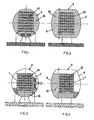
- figure 1 schematically shows a cross-section of a dyeing autoclave according to the prior art, containing a charge oof material to be treated;
- figure 2 schematically shows a longitudinal section of the autoclave shown in figure 1;
- figure 3 schematically shows a cross-section of a dyeing autoclave provided with a known arrangement to limit the volume of the treatment bath;
- figure 4 shows the longitudinal section of the autoclave shown in figure 3;
- figure 5 shows, in an enlarged scale, the cross-section of an autoclave according to the invention
- figure 6 shows the longitudinal section of the autoclave shown in figure 5;
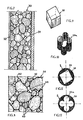
- figure 7 illustratively shows a cross-section of a part of a shaped body made of material which is thermally insulating and resistant to compression, to be inserted into the hollows between the closed treatment chamber and the wall of the autoclave;
- figure 8 schematically shows a cross-section of an enlarged detail of the thermally insulating, compression resistant, porous material, used to fill the hollows between the treatment chamber and the autoclave body;
- figure 9 shows a perspective view of a closed treatment chamber, of the most frequently used type, having the shape of a parallelepipedon;
- figure 10 shows a perspective view of a closed treatment chamber embodying one of the possible shape variants within the scope of the invention
- figure 11 schematically shows a top-plan view of a vertical autoclave enclosing the treatment chamber according to figure 9 and;
- figure 12 schematically shows a top-plan view of a autoclave enclosing the treatment chamber according to figure 10.
- Figures 1 and 2 show a transversal and longitudinal cross-section, respectively, of an autoclave of the conventional type, the body 2 of which has a cylindrical shape, said shape being, from a structural point of view, the most suited one to withstand the stress internally imposed by the pressure of the treatment liquid.
- the body 2 is provided with two terminal rounded end plates, 4 and 6. It can be noticed that the charge 10 of material to be treated takes a much smaller volume related to the total volume of the autoclave, whereby the autoclave is filled with a large amount of treatment bath 12, as indicated by the dashed area, said volume being absolutely excessive and expensive from the point of view of heat, chemicals and energy consumption for circulating it.
- Figures 3 and 4 show a known solution in which, by means of vertical walls 7, 7', 7" the volume of the treatment bath 12, dashed in a similar way as in figures 1 and 2, is limited to the front part and lower part, with a marked improvement in the bath ratio.
- the non-dashed area, in this case, are normally occupied by compressed air.
- FIGS 5 and 6 illustratively show, in a transversal and longitudinal cross-section respectively, an autoclave according to the invention.
- the autoclave generally indicated with 1, has a cylindrical body 2 with two rounded end plates 4 and 6.
- chamber 20 that in the embodiment shown has the shape of a parallelepipedon, said chamber being completely closed on the peripheral walls 21, 22, 23, 24 and on the back-wall 25 as well, while the front opening, that is necessary to load the material, is closed by a wall 26, said wall 26 being tied to bottom 4 and tightly coupled with said opening by means of suitable gaskets.
- chamber 20 is so chosen as to tightly contain the charge 10 of material to be treated, the outline of which is of known dimensions, said charge comprising stackable reel trays or conventional insertion structures, said chamber being connected in a known way, by means suitable pipes that cross the wall of the autoclave, with the necessary pump(s) for the circulation of the treatment liquid and with heat exchangers for warming up the treatment liquid (said connections are not shown in the figures).
- Chamber 20 is made up of flat, relatively thin walls that can be deformed by the internal pressure, a sheet of a material withstanding the corrosive action of the treatment bath being preferably used for said walls, for example stainless steel.
- the hollow spaces formed between the body 2 of the autoclave and the side walls 21 and 23, the upper and lower walls 22 and 24 and the rear wall, as well as the space formed by the rounded front plate 4, are directly filled or occupied by suitable pre-formed bodies, said bodies being in turn filled with a material 30 exhibiting the properties of:
- Said filling is shown schematically in figures 5 and 6 as having an honeycomb shape.
- a material that can be preferably, but, not exclusively, suited to said purpose, and exhibiting all the above-mentioned features is a conglomerate comprising expanded clay granules bonded with a two-component resin like ARALDITE (TM) marketed by CIBA.
- Said mixture that can be easily prepared inside a normal mixer, is easily flowable and is therefore suited to be poured into any mold provided therefore, within which it polymerizes, thereby forming a mass of surface-coated granules bonded to one another by said resin, said resin leaving however void spaces among the granules, said void spaces being inter-connected and giving rise to a very suitable porosity.
- FIG 7 is illustratively shown a segment of a shaped body comprising a thin wall 32 that is brought into contact with a wall, for example 25, of the closed chamber 20, the opposite wall 34 lying on the bottom 6 of the autoclave.
- Figure 8 showing a detail of conglomerate material 30 as obtained above, shows that the clay granules 40, having for example an average diameter of 4 mm, are inter-connected at their surface by resin 42, indicated in figure with a bold-face line, so that the polymerized block, the apparent crumbliness of the clay notwithstanding, exhibits altogether a compression resistance of about 17 kg/cm2, that is much higher then the internal operating pressure of treatment chamber 20, that is usually between 2 and 3 kg/cm2.
- the hydrostatic forces acting onto the walls of chamber 20 are thereby transferred, through said conglomerate, to the outer structure of the autoclave, while, due to the porosity of the mass, it is possible to internally ventilate the hollow space.
- the conglomerate 30 has a specific gravity of less then 0.5 kg/dm3, a high coefficient of thermal insulation, a negligible chemical reactivity and a low coefficient of dimensional shrinkage, and the resin exhibits a very good adhesion to the surface of the clay granules.
- the pourability of the mixtures allows filling bodies of any shape to be obtained, said shape being possibly different from that of the hollow spaces between a parallelepipedon-shaped chamber (see figures 9 and 11) and an autoclave body, however complex shapes, such as 20a in figures 10 and 12, being possibly obtained, the application of said bodies being possibly different from the above-mentioned, non limiting example of the dyeing autoclaves
- an autoclave made up as described besides achieving very high operation savings due to the reduced volume of the treatment bath, also as far as the employed chemicals are concerned, provides a minimization of the heat losses to the outside due to the insulation provided by the clay conglomerate and to the low total weight of the assembly.
- the direct contact of the treatment liquid with the walls of the autoclave being avoided, the external body of the autoclave can be built with less expensive and chemical corrosion-proof materials, the use of said materials being limited to the walls of the inner chamber.
Landscapes
- Chemical & Material Sciences (AREA)
- Engineering & Computer Science (AREA)
- Materials Engineering (AREA)
- Organic Chemistry (AREA)
- Chemical Kinetics & Catalysis (AREA)
- Textile Engineering (AREA)
- Treatment Of Fiber Materials (AREA)
- Organic Low-Molecular-Weight Compounds And Preparation Thereof (AREA)
Applications Claiming Priority (2)
| Application Number | Priority Date | Filing Date | Title |
|---|---|---|---|
| IT02253189A IT1237142B (it) | 1989-11-28 | 1989-11-28 | Autoclave atta a realizzare forti riduzioni dei quantitativi di fluidi di processo utilizzati ed economie sui consumi energetici |
| IT2253189 | 1989-11-28 |
Publications (1)
| Publication Number | Publication Date |
|---|---|
| EP0434890A1 true EP0434890A1 (en) | 1991-07-03 |
Family
ID=11197504
Family Applications (1)
| Application Number | Title | Priority Date | Filing Date |
|---|---|---|---|
| EP90107240A Withdrawn EP0434890A1 (en) | 1989-11-28 | 1990-04-17 | Autoclave suited to achieve a marked reduction of the amount of process fluids employed and energy savings |
Country Status (2)
| Country | Link |
|---|---|
| EP (1) | EP0434890A1 (it) |
| IT (1) | IT1237142B (it) |
Cited By (2)
| Publication number | Priority date | Publication date | Assignee | Title |
|---|---|---|---|---|
| US6821486B1 (en) | 1997-02-20 | 2004-11-23 | Sinvent As | Multiautoclave for combinatorial synthesis of zeolites and other materials |
| US7341872B1 (en) | 2004-04-29 | 2008-03-11 | Uop Llc | Multiautoclave with set of vessels for combinatorial synthesis of zeolites and other materials |
Citations (4)
| Publication number | Priority date | Publication date | Assignee | Title |
|---|---|---|---|---|
| FR2162253A1 (en) * | 1971-12-07 | 1973-07-20 | Terzariol Edgard | Resin bound building blocks - cast with expanded clay fillers to enhance compressive strength and insulating props |
| US4689358A (en) * | 1985-08-06 | 1987-08-25 | The Brooklyn Union Gas Company | Insulating polymer concrete |
| FR2609062A1 (fr) * | 1986-12-30 | 1988-07-01 | Barriquand | Autoclave perfectionne, notamment pour le traitement au mouille de matieres textiles |
| EP0286509A1 (fr) * | 1987-04-10 | 1988-10-12 | BARRIQUAND, Société dite: | Machine de traitement au mouille de matières textiles |
-
1989
- 1989-11-28 IT IT02253189A patent/IT1237142B/it active IP Right Grant
-
1990
- 1990-04-17 EP EP90107240A patent/EP0434890A1/en not_active Withdrawn
Patent Citations (4)
| Publication number | Priority date | Publication date | Assignee | Title |
|---|---|---|---|---|
| FR2162253A1 (en) * | 1971-12-07 | 1973-07-20 | Terzariol Edgard | Resin bound building blocks - cast with expanded clay fillers to enhance compressive strength and insulating props |
| US4689358A (en) * | 1985-08-06 | 1987-08-25 | The Brooklyn Union Gas Company | Insulating polymer concrete |
| FR2609062A1 (fr) * | 1986-12-30 | 1988-07-01 | Barriquand | Autoclave perfectionne, notamment pour le traitement au mouille de matieres textiles |
| EP0286509A1 (fr) * | 1987-04-10 | 1988-10-12 | BARRIQUAND, Société dite: | Machine de traitement au mouille de matières textiles |
Cited By (2)
| Publication number | Priority date | Publication date | Assignee | Title |
|---|---|---|---|---|
| US6821486B1 (en) | 1997-02-20 | 2004-11-23 | Sinvent As | Multiautoclave for combinatorial synthesis of zeolites and other materials |
| US7341872B1 (en) | 2004-04-29 | 2008-03-11 | Uop Llc | Multiautoclave with set of vessels for combinatorial synthesis of zeolites and other materials |
Also Published As
| Publication number | Publication date |
|---|---|
| IT1237142B (it) | 1993-05-24 |
| IT8922531A1 (it) | 1991-05-28 |
| IT8922531A0 (it) | 1989-11-28 |
Similar Documents
| Publication | Publication Date | Title |
|---|---|---|
| US4889177A (en) | Method and apparatus for sand moulding composite articles with a die made of light alloy and a fibrous insert | |
| DE2340105A1 (de) | Behaelter zur lagerung von substanzen bei tiefen temperaturen, insbesondere zur lagerung von verfluessigten gasen sowie verfahren zu seiner herstellung | |
| KR940007193B1 (ko) | 용융-결정화의 높은 잠정적 열을 갖는 에너지 저장매체 리시피언트(recipient) | |
| EP0434890A1 (en) | Autoclave suited to achieve a marked reduction of the amount of process fluids employed and energy savings | |
| US4269323A (en) | Heat insulated tank | |
| GB2058320A (en) | Double-walled tanks for low temperature liquids | |
| US3443631A (en) | High-pressure container | |
| GB1605214A (en) | Method of and apparatus for producing tubular filter element | |
| US3688938A (en) | Heat insulating wall structure for a low temperature liquefied gas tank of the membrane type | |
| US2404594A (en) | Reinforced buoyant rubber disk | |
| US3776257A (en) | False walled pressure vessel | |
| EP0388235A2 (en) | Method and apparatus for casting | |
| US3389823A (en) | Container for the storage and/or transportation of liquefied gases | |
| US3250061A (en) | Degasification tanks for metal melts | |
| WO2010119014A2 (en) | Self supporting isobaric structure for electrolyte aeration in cells for electrorefining or electrowinning non ferrous metals | |
| US3643903A (en) | Base for a spherical container | |
| CA2339558A1 (en) | Hydrostatic pressure retainment system | |
| CN217260590U (zh) | 水上漂浮平台及浮岛 | |
| CN217630567U (zh) | 一种抗渗防潮型pc预制构件 | |
| CN219150143U (zh) | 一种具有加热保温功能的浸渍釜 | |
| SU1105592A1 (ru) | Предварительно напр женна железобетонна емкость дл хранени и транспортировани сжатых жидкостей и газов | |
| CN114294420B (zh) | 一种真空绝热深冷压力容器内容器应变强化用装置 | |
| JPS5899104A (ja) | 金属水素化物反応容器 | |
| CN211642548U (zh) | 一种船坞抗压坞门 | |
| JPS56157792A (en) | Heat storing method and heat accumulator |
Legal Events
| Date | Code | Title | Description |
|---|---|---|---|
| PUAI | Public reference made under article 153(3) epc to a published international application that has entered the european phase |
Free format text: ORIGINAL CODE: 0009012 |
|
| AK | Designated contracting states |
Kind code of ref document: A1 Designated state(s): AT BE CH DE DK ES FR GB GR LI NL SE |
|
| STAA | Information on the status of an ep patent application or granted ep patent |
Free format text: STATUS: THE APPLICATION IS DEEMED TO BE WITHDRAWN |
|
| 18D | Application deemed to be withdrawn |
Effective date: 19920104 |