EP0435006A2 - Système de balayage à fibres optiques - Google Patents
Système de balayage à fibres optiques Download PDFInfo
- Publication number
- EP0435006A2 EP0435006A2 EP90122795A EP90122795A EP0435006A2 EP 0435006 A2 EP0435006 A2 EP 0435006A2 EP 90122795 A EP90122795 A EP 90122795A EP 90122795 A EP90122795 A EP 90122795A EP 0435006 A2 EP0435006 A2 EP 0435006A2
- Authority
- EP
- European Patent Office
- Prior art keywords
- rotating element
- light
- fiber
- glass fiber
- optic scanner
- Prior art date
- Legal status (The legal status is an assumption and is not a legal conclusion. Google has not performed a legal analysis and makes no representation as to the accuracy of the status listed.)
- Granted
Links
Images


Classifications
-
- G—PHYSICS
- G02—OPTICS
- G02B—OPTICAL ELEMENTS, SYSTEMS OR APPARATUS
- G02B26/00—Optical devices or arrangements for the control of light using movable or deformable optical elements
- G02B26/08—Optical devices or arrangements for the control of light using movable or deformable optical elements for controlling the direction of light
- G02B26/10—Scanning systems
- G02B26/103—Scanning systems having movable or deformable optical fibres, light guides or waveguides as scanning elements
-
- G—PHYSICS
- G02—OPTICS
- G02B—OPTICAL ELEMENTS, SYSTEMS OR APPARATUS
- G02B6/00—Light guides; Structural details of arrangements comprising light guides and other optical elements, e.g. couplings
- G02B6/24—Coupling light guides
- G02B6/26—Optical coupling means
- G02B6/35—Optical coupling means having switching means
- G02B6/3502—Optical coupling means having switching means involving direct waveguide displacement, e.g. cantilever type waveguide displacement involving waveguide bending, or displacing an interposed waveguide between stationary waveguides
- G02B6/3504—Rotating, tilting or pivoting the waveguides, or with the waveguides describing a curved path
-
- G—PHYSICS
- G02—OPTICS
- G02B—OPTICAL ELEMENTS, SYSTEMS OR APPARATUS
- G02B6/00—Light guides; Structural details of arrangements comprising light guides and other optical elements, e.g. couplings
- G02B6/24—Coupling light guides
- G02B6/26—Optical coupling means
- G02B6/35—Optical coupling means having switching means
- G02B6/351—Optical coupling means having switching means involving stationary waveguides with moving interposed optical elements
- G02B6/3512—Optical coupling means having switching means involving stationary waveguides with moving interposed optical elements the optical element being reflective, e.g. mirror
-
- G—PHYSICS
- G02—OPTICS
- G02B—OPTICAL ELEMENTS, SYSTEMS OR APPARATUS
- G02B6/00—Light guides; Structural details of arrangements comprising light guides and other optical elements, e.g. couplings
- G02B6/24—Coupling light guides
- G02B6/26—Optical coupling means
- G02B6/35—Optical coupling means having switching means
- G02B6/351—Optical coupling means having switching means involving stationary waveguides with moving interposed optical elements
- G02B6/3524—Optical coupling means having switching means involving stationary waveguides with moving interposed optical elements the optical element being refractive
-
- G—PHYSICS
- G02—OPTICS
- G02B—OPTICAL ELEMENTS, SYSTEMS OR APPARATUS
- G02B6/00—Light guides; Structural details of arrangements comprising light guides and other optical elements, e.g. couplings
- G02B6/24—Coupling light guides
- G02B6/26—Optical coupling means
- G02B6/35—Optical coupling means having switching means
- G02B6/354—Switching arrangements, i.e. number of input/output ports and interconnection types
- G02B6/3554—3D constellations, i.e. with switching elements and switched beams located in a volume
- G02B6/3558—1xN switch, i.e. one input and a selectable single output of N possible outputs
Definitions
- the invention relates to a fiber optic scanner according to the preamble of claim 1 or the preamble of claim 2.
- Fiber optic scanners are optomechanical devices that serve to deflect light beams. For example, the light information falling on a line can be converted into a sequence of light pulses in a glass fiber (fiber-optic line scanner).
- the object of the invention is to propose a fast, mechanically resilient fiber-optic scanner.
- a rotating element which directs the light from a point-shaped entrance to the circularly arranged beginnings of glass fibers of a glass fiber array.
- the ends of the glass fibers can be arranged as desired, preferably in a line or a straight line.
- Claim 2 describes the inverse component, in which light is received by a glass fiber array of any shape.
- the glass fibers are arranged so that their ends lie on a circle, from which the light is directed via a rotating element to a light-receiving location (exit).
- the size of the scanner according to the invention is compact and changes only linearly with the beam aperture D to be scanned. Beam apertures of almost any size can be scanned at almost any speed. Thanks to the modular structure, the scan geometries can be adapted by exchanging the glass fiber array and the lens.
- Light-emitting diodes or fiber-optic-coupled light-emitting diodes can be used.
- modulated CW laser diodes, or CW lasers can be used. With these or other continuously operating light sources, there is no synchronization, which can be used with pulsed light-emitting diodes or laser diodes.
- the glass fiber array is a cross-sectional converter with which a circular arrangement of the glass fibers is transformed into a line-shaped arrangement (focal plane transformation from a circle into a line). It consists, for example, of a number of quartz monofibers with a core diameter of 0.2 mm can have. Other multimode or monomode fibers can also be used. The number of fibers in the example shown below is 64. The number of fibers can be set as desired. The maximum number of fibers is only limited by the manufacturing process of the array. The type of socket allows a deviation from the position of the glass fibers and a deviation from the roundness of the glass fiber array of, for example, 0.005 mm.
- the flexibility of the glass fibers also has the advantage that they can be positioned so that aberrations of the lens, which is arranged at the input or output of the device, can be compensated.
- the glass fibers can be arranged as desired in the focal plane or in the imaging plane of this objective, so that any scan figures can be generated.
- the rule will be a linear arrangement next to each other. Arrangements in two or more lines or in any form are also possible.
- the light that is introduced into the optical scanner can e.g. through a glass fiber, e.g. ends on the axis of rotation.
- a tapper instead of the one glass fiber to bring several light sources together. As a result, both the scan frequency and the luminance can be increased.
- an optical system which lies in the beam path between the introduction of light and the rotating element and / or between the rotating element and the glass fiber ends arranged in a circle.
- This optic consists, for example, of two links, the distance between which can be varied, to change the overall focal length of the lens thus formed. This makes it possible to compensate for assembly and manufacturing tolerances, for example of the imaging element (mirror) and the glass fiber array mount.
- the rotating element can be a mirror (preferably a planar mirror) that is (slightly) tilted with respect to its axis of rotation.
- the mirror can also be designed as a dielectric selective filter; in this embodiment, an interference filter in the coupling-in beam path or in the coupling-out beam path can be dispensed with.
- the mirror can be mounted slightly tilted on a holder that rotates parallel to the optical axis. It is also possible that the axis of rotation of the mirror is not in the optical axis of the scanner. In this case, the light source is also not arranged in the optical axis. What is common in the explanations is the fact that the mirror is tilted with respect to its axis of rotation.
- a planar mirror a concave mirror or a manganese mirror can also be used, the lens or the optics can then be made in one piece.
- a wedge prism can also be used instead of the mirror.
- the light source is then on the opposite side of the circular glass fiber ends.
- the light emanating from the light source can be imaged onto the circularly arranged glass fiber inputs via a collimator lens and the wedge prism and possibly further optics.
- a lens or a collimator whose optical axes are eccentric to the axis of rotation can also be used as the rotating element. That the light coupling fiber is then in the drive axis.
- the optics can in turn be made in one piece.
- a perforated screen in which the translucent hole is arranged eccentrically to the axis of rotation.
- This device is particularly simple and suitable for strong light sources. It is also possible to deflect the light through a short piece of glass fiber that is arranged inside a carrier. Its input lies on the optical axis, which coincides with the axis of rotation, its output lies eccentrically to the distance from the optical axis in which the circularly arranged glass fiber ends of the glass fiber array lie.
- An electric motor is suitable as a drive for the rotating element, e.g. a high-frequency motor (DC or synchronous motor), whose bearings are e.g. has an impact error ⁇ 0.005 mm and has a balance quality of class 0.04.
- the number of strains is, for example, 15,000 revolutions per minute. However, it can also be increased to well over 100,000 revolutions per minute.
- a stepper motor can also be used so that the glass fibers can also be controlled individually.
- an optical mark detector can be provided for synchronizing the rotating element with a pulsed light source, which detects the position of the rotating element and can pass it on to the control of the light source.
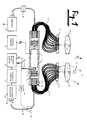
- Fig. 1 shows a fiber optic scanner, which is suitable for both light absorption and light emission. It is symmetrical and has a receiving part on the left and a transmitting part on the right.
- Laser diode 15 is used here as the light source. Its light is introduced into the glass fiber 10, which is arranged on the optical axis of the fiber optic scanner. The light beam that emerges from the glass fiber 10 is collimated by the lens 5. After the reflection, at the mirror 4 tilted to the axis of rotation, the light bundle is again focused by the same objective 5 and coupled into a glass fiber of the circular glass fiber array 9.
- the circular shape is achieved by the frame elements 6, 7 and 8.
- the light bundle of the glass fiber 10 is coupled into the individual glass fibers of the glass fiber array 9 one after the other.
- the glass fibers of the array 9 are arranged annularly and concentrically to the light-introducing glass fiber 10.
- the light bundle emerging from the glass fibers is collimated by an objective.
- the glass fiber array is arranged in a row in the focal plane of the objective 12.
- the glass fiber ends are oriented in the mount 11 so that the central axis of the light beam passes through the main point H 'of the lens.
- a pulsed laser diode is used as the light source 15, it is necessary to synchronize the angular position of the mirror 4, which is dependent on the direction of rotation, with the position of the glass fibers of the glass fiber array.
- the speed of the motor 1 in the housing 2 is regulated very constantly with the speed control 19 (control deviation e.g. 100 ppm).
- An optical mark detector 18 recognizes a mark on the mirror mount 3 via two glass fibers 13, 13 '.
- the mark detector 18 triggers 9 trigger pulses with constant frequency via the laser pulse trigger 17 in accordance with the number of glass fibers in the glass fiber array.
- the trigger pulses ignite the pulses of the laser diode 15 via the diode driver 16.
- the trigger pulses can be generated by illuminating the glass fiber array 9 with a light source 21. The light path is then reversed as previously described. The light from the light source 21 can be coupled out of the glass fiber 10 and directed to the brand detector 18 (coupling 22). The trigger pulses are generated directly via the mark detector 18. A separate speed control 19 and the laser pulse triggering 17 are then omitted. In this solution, the trigger is generated directly by the position of the optical fiber in question for the angular position of the mirror 4. The light for the brand detector 18 can be coupled out via a glass fiber Y-coupler or via a beam splitter. A spectral filter (IF 14 ') can be used to prevent crosstalk of the pulse laser diode on the mark detector 18.
- IF 14 ' spectral filter
- the system just described is arranged again symmetrically to the second end of the drive shaft.
- the left side can are used as a reception branch, that is to say the arrays 11 and 11 'are adjusted with respect to their objectives 12 and 12' in such a way that they aim at the same object points at a distance R.
- the light source on the left side is then only replaced by the receiver 20.
- the signal processing can be decisively improved with the aid of an interference filter 14.
- Fig. 2 shows schematically the beam path in the fiber optic scanner of Fig. 1 on the right side.
- Light passes from the light source 15 through the glass fiber 10, which is arranged on the optical axis. This light is directed by the optics 5 onto the mirror 4 tilted by the angle ⁇ with respect to the optical axis (not shown). The light deflected there passes through the optics 5 to a point on the circular fiber array arrangement 9.
- the mirror 4 is rotated about the optical axis, the light is guided successively onto each of the glass fibers arranged in the broken line.
- Fig. 3 shows a further embodiment in which the optical axis of the scanner and the axis of rotation of the mirror 4 'intersect.
- the light source 15 is also not located on the optical axis of the scanner here.
- the light coming from the light source 15 is directed by the optics 5 'onto the mirror 4'. This is tilted by an angle ⁇ not equal to 90 ° with respect to its axis of rotation.
- ⁇ not equal to 90 ° with respect to its axis of rotation.
- FIG. 4 shows a further embodiment in which a wedge prism 23 is used as the rotating element.
- the light of the light source 15 incident in the optical axis is directed onto the wedge prism 23 by the optics 5 ′. With that Rotation, the outgoing light is in turn directed to the circular arrangement (shown in broken lines) of the glass fiber ends 9.
- a second optical system 5 ' is shown.
- Fig. 5 shows an embodiment in which the rotating element is the lens 24 24, the optical axis of which is eccentric to the optical axis (not specified) of the scanner.
- the lens 24 rotates about the optical axis of the scanner, the light originating from the light source 15 is in turn directed onto the circular arrangement (shown in broken lines) of the ends of the glass fibers 9.
- An optical system 5 ' is also shown.
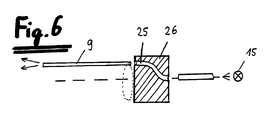
- Fig. 6 shows a further embodiment in which an optical fiber 25 is used which is cast in a carrier 26 which rotates about the optical axis.
- the glass fiber 25 is arranged in the carrier 26 in such a way that its beginning lies on the optical axis and its end lies at a distance from the optical axis in that the beginnings of the circularly arranged glass fibers 9 are located.
- a possible imaging optics is not shown here.
- the fiber-optic scanners according to the invention can be used in cameras for three-dimensional images (distance images) for robot control or for switching light pulses. It can also be used to record or transmit light-coded data streams.
Landscapes
- Physics & Mathematics (AREA)
- General Physics & Mathematics (AREA)
- Optics & Photonics (AREA)
- Optical Couplings Of Light Guides (AREA)
- Mechanical Optical Scanning Systems (AREA)
- Facsimile Scanning Arrangements (AREA)
- Electrochromic Elements, Electrophoresis, Or Variable Reflection Or Absorption Elements (AREA)
- Optical Fibers, Optical Fiber Cores, And Optical Fiber Bundles (AREA)
- Endoscopes (AREA)
- Road Signs Or Road Markings (AREA)
- Developing Agents For Electrophotography (AREA)
- Carbon And Carbon Compounds (AREA)
- Glass Compositions (AREA)
- Mechanical Light Control Or Optical Switches (AREA)
Applications Claiming Priority (2)
| Application Number | Priority Date | Filing Date | Title |
|---|---|---|---|
| DE3942771 | 1989-12-23 | ||
| DE3942771A DE3942771C1 (fr) | 1989-12-23 | 1989-12-23 |
Publications (3)
| Publication Number | Publication Date |
|---|---|
| EP0435006A2 true EP0435006A2 (fr) | 1991-07-03 |
| EP0435006A3 EP0435006A3 (en) | 1992-03-04 |
| EP0435006B1 EP0435006B1 (fr) | 1996-02-07 |
Family
ID=6396304
Family Applications (1)
| Application Number | Title | Priority Date | Filing Date |
|---|---|---|---|
| EP90122795A Expired - Lifetime EP0435006B1 (fr) | 1989-12-23 | 1990-11-29 | Système de balayage à fibres optiques |
Country Status (5)
| Country | Link |
|---|---|
| US (1) | US5109459A (fr) |
| EP (1) | EP0435006B1 (fr) |
| AT (1) | ATE134045T1 (fr) |
| DE (2) | DE3942771C1 (fr) |
| ES (1) | ES2085315T3 (fr) |
Families Citing this family (31)
| Publication number | Priority date | Publication date | Assignee | Title |
|---|---|---|---|---|
| US5247600A (en) * | 1990-01-03 | 1993-09-21 | Williams Charles M | Fiber optic data/graphic display screen |
| DK31791D0 (da) * | 1991-02-22 | 1991-02-22 | Purup Electronics A S | Belysningsenhed |
| US5288991A (en) * | 1992-12-04 | 1994-02-22 | International Business Machines Corporation | Optical system for rapid inspection of via location |
| DE4320485B4 (de) * | 1993-06-21 | 2007-04-19 | Eads Deutschland Gmbh | Verfahren zur Objektvermessung mittels intelligenter Entfernungsbildkamera |
| US5589351A (en) * | 1994-12-06 | 1996-12-31 | Nps Pharmaceuticals, Inc. | Fluorescence detection apparatus |
| US5650868A (en) * | 1995-06-07 | 1997-07-22 | Compaq Computer Corporation | Data transfer system |
| US5887102A (en) * | 1996-11-20 | 1999-03-23 | Fostec, Inc. | Fiber optic lightline device having randomized input and output for reducing sensitivity to input variations and method of making the same |
| US6246658B1 (en) | 1998-06-02 | 2001-06-12 | Science Applications International Corporation | Multiple channel scanning device using optoelectronic switching |
| US6166756A (en) * | 1998-06-02 | 2000-12-26 | Science Applications International Corporation | Multiple channel data writing device |
| US6584052B1 (en) | 1998-06-02 | 2003-06-24 | Science Applications International Corporation | Method and apparatus for controlling the focus of a read/write head for an optical scanner |
| US6341118B1 (en) | 1998-06-02 | 2002-01-22 | Science Applications International Corporation | Multiple channel scanning device using oversampling and image processing to increase throughput |
| US6091067A (en) * | 1998-06-02 | 2000-07-18 | Science Applications International Corporation | Scanning device using fiber optic bimorph |
| US6137105A (en) | 1998-06-02 | 2000-10-24 | Science Applications International Corporation | Multiple parallel source scanning device |
| US6356528B1 (en) * | 1999-04-15 | 2002-03-12 | Qualcomm Incorporated | Interleaver and deinterleaver for use in a diversity transmission communication system |
| US6449042B1 (en) * | 1999-05-04 | 2002-09-10 | Laser Sensor Technology, Inc. | Method and apparatus for particle assessment using multiple scanning beam reflectance |
| DE19928958A1 (de) * | 1999-05-22 | 2000-11-23 | Volkswagen Ag | Laserscanner |
| AT3845U1 (de) * | 1999-09-28 | 2000-08-25 | Avl List Gmbh | Optoelektronische messeinrichtung |
| US20040021101A1 (en) * | 2000-06-29 | 2004-02-05 | Essex Electro Engineers, Inc. | Method and apparatus for radiographic imaging |
| US6696698B2 (en) | 2000-06-29 | 2004-02-24 | Essex Electro Engineers, Inc. | Method and apparatus for radiographic imaging |
| US6647164B1 (en) | 2000-10-31 | 2003-11-11 | 3M Innovative Properties Company | Gimbaled micro-mirror positionable by thermal actuators |
| US6711318B2 (en) | 2001-01-29 | 2004-03-23 | 3M Innovative Properties Company | Optical switch based on rotating vertical micro-mirror |
| GB0123640D0 (en) * | 2001-09-19 | 2003-04-09 | Matra Bae Dynamics Uk Ltd | Multiple pulse generation |
| JP2006072058A (ja) * | 2004-09-03 | 2006-03-16 | Pentax Corp | レーザ走査装置 |
| DE102007010236B4 (de) * | 2007-03-02 | 2008-11-20 | Toposys Topographische Systemdaten Gmbh | Vorrichtung und Verfahren zur Entfernungsbestimmung mittels Lichtpulsen |
| DE102007010235A1 (de) | 2007-03-02 | 2008-09-04 | Toposys Topographische Systemdaten Gmbh | Faseroptischer Scanner |
| DE102007010237B4 (de) * | 2007-03-02 | 2017-10-12 | Toposys Topographische Systemdaten Gmbh | Faseroptischer Scanner |
| US20100008207A1 (en) * | 2008-07-08 | 2010-01-14 | Raytheon Company | Method and Apparatus for Optical Power Transfer Control |
| PL2309293T3 (pl) | 2009-10-10 | 2012-05-31 | Eads Deutschland Gmbh | Skaner światłowodowy |
| RU2612874C1 (ru) * | 2015-11-12 | 2017-03-13 | Федеральное государственное автономное научное учреждение "Центральный научно-исследовательский и опытно-конструкторский институт робототехники и технической кибернетики" (ЦНИИ РТК) | Система импульсной лазерной локации |
| KR102430667B1 (ko) * | 2017-03-24 | 2022-08-09 | 주식회사 히타치엘지 데이터 스토리지 코리아 | 거리 측정 장치 |
| WO2020155152A1 (fr) * | 2019-02-02 | 2020-08-06 | 深圳市大疆创新科技有限公司 | Module de balayage et dispositif de mesure de distance |
Family Cites Families (9)
| Publication number | Priority date | Publication date | Assignee | Title |
|---|---|---|---|---|
| US3401232A (en) * | 1963-02-07 | 1968-09-10 | Chicago Aerial Ind Inc | Fiber optic scanning apparatus |
| US4409477A (en) * | 1981-06-22 | 1983-10-11 | Sanders Associates, Inc. | Scanning optical system |
| DE3146872A1 (de) * | 1981-11-26 | 1983-06-01 | Philips Patentverwaltung Gmbh, 2000 Hamburg | Optischer drucker |
| GB2111716B (en) * | 1981-12-14 | 1985-08-21 | Elven Precision Limited | Improvements in or relating to optical scanning and optical image transmission |
| FR2539236A1 (fr) * | 1983-01-07 | 1984-07-13 | Cit Alcatel | Commutateur pour circuit a guide de lumiere |
| GB2144873A (en) * | 1983-08-12 | 1985-03-13 | Fairey Eng | Apparatus for scanning a laser beam |
| DE3332909A1 (de) * | 1983-09-13 | 1985-03-21 | Philips Patentverwaltung Gmbh, 2000 Hamburg | Anordnung zum beleuchten einer zeile eines informationstraegers |
| GB2200223B (en) * | 1986-01-31 | 1989-06-07 | Ferranti Plc | Apparatus for controlling the direction of a beam of optical radiation |
| US4856863A (en) * | 1988-06-22 | 1989-08-15 | Texas Instruments Incorporated | Optical fiber interconnection network including spatial light modulator |
-
1989
- 1989-12-23 DE DE3942771A patent/DE3942771C1/de not_active Expired - Lifetime
-
1990
- 1990-11-29 AT AT90122795T patent/ATE134045T1/de not_active IP Right Cessation
- 1990-11-29 EP EP90122795A patent/EP0435006B1/fr not_active Expired - Lifetime
- 1990-11-29 ES ES90122795T patent/ES2085315T3/es not_active Expired - Lifetime
- 1990-11-29 DE DE59010119T patent/DE59010119D1/de not_active Expired - Lifetime
- 1990-12-21 US US07/632,063 patent/US5109459A/en not_active Expired - Lifetime
Also Published As
| Publication number | Publication date |
|---|---|
| ATE134045T1 (de) | 1996-02-15 |
| EP0435006A3 (en) | 1992-03-04 |
| DE3942771C1 (fr) | 1991-07-04 |
| US5109459A (en) | 1992-04-28 |
| DE59010119D1 (de) | 1996-03-21 |
| ES2085315T3 (es) | 1996-06-01 |
| EP0435006B1 (fr) | 1996-02-07 |
Similar Documents
| Publication | Publication Date | Title |
|---|---|---|
| EP0435006B1 (fr) | Système de balayage à fibres optiques | |
| DE69112320T2 (de) | Verfahren und Vorrichtung zur optischen Abtastung. | |
| EP1058142B1 (fr) | Système de balayage laser comprenant une lentille boule | |
| EP0662273B1 (fr) | Systeme de projection video | |
| DE69026780T2 (de) | Rastermikroskop und Rastermechanismus dafür | |
| DE69618087T2 (de) | Mechanischer faseroptischer Schalter | |
| DE69521675T2 (de) | Optische Anordnung für passive Abtastwinkelverdopplung | |
| DE69629877T2 (de) | Konfokales Mikroskop | |
| DE69324622T2 (de) | Optisches Strahlabtastgerät | |
| DE69408740T2 (de) | Plotter mit innenaufzeichnender Trommel | |
| WO2006047896A1 (fr) | Systeme fibres-lentilles et reseau de lentilles d'un tel systeme fibres-lentilles | |
| DE3609669A1 (de) | Optischer leser | |
| DE69222598T2 (de) | Mehrstrahlige optische Abtastvorrichtung | |
| EP2309293B1 (fr) | Scanner à fibre optique | |
| EP0992823A2 (fr) | Procédé de réglage d'un élément électrooptique et un tel élément | |
| EP1055937A2 (fr) | Agencement de réception pour un dispositif de balayage à laser | |
| EP0644668A1 (fr) | Module d'émmission-réception pour transmission bidirectionnelle optique à plusieurs canaux | |
| DE3601442A1 (de) | Vorrichtung zum optischen abtasten von objekten | |
| EP0041660A1 (fr) | Dispositif de lecture et d'enregistrement comprenant un dispositif de balayage optique | |
| EP0115267B1 (fr) | Système d'image | |
| DE19703607A1 (de) | Strahlungsübertragungseinheit mit mindestens einem Lichtwellenleiter | |
| DE4103298A1 (de) | Vorrichtung zur abbildung eines objektes | |
| DE3853637T2 (de) | Achromatisches abtastsystem. | |
| EP0270062B1 (fr) | Dispositif de prise d'image | |
| EP0156124A2 (fr) | Dispositif pour la transmission des signaux de lumière entre deux composants |
Legal Events
| Date | Code | Title | Description |
|---|---|---|---|
| PUAI | Public reference made under article 153(3) epc to a published international application that has entered the european phase |
Free format text: ORIGINAL CODE: 0009012 |
|
| AK | Designated contracting states |
Kind code of ref document: A2 Designated state(s): AT BE CH DE DK ES FR GB GR IT LI LU NL SE |
|
| PUAL | Search report despatched |
Free format text: ORIGINAL CODE: 0009013 |
|
| AK | Designated contracting states |
Kind code of ref document: A3 Designated state(s): AT BE CH DE DK ES FR GB GR IT LI LU NL SE |
|
| 17P | Request for examination filed |
Effective date: 19920824 |
|
| 17Q | First examination report despatched |
Effective date: 19940419 |
|
| RAP1 | Party data changed (applicant data changed or rights of an application transferred) |
Owner name: DORNIER GMBH |
|
| GRAA | (expected) grant |
Free format text: ORIGINAL CODE: 0009210 |
|
| AK | Designated contracting states |
Kind code of ref document: B1 Designated state(s): AT BE CH DE DK ES FR GB GR IT LI LU NL SE |
|
| PG25 | Lapsed in a contracting state [announced via postgrant information from national office to epo] |
Ref country code: DK Effective date: 19960207 Ref country code: GR Free format text: LAPSE BECAUSE OF FAILURE TO SUBMIT A TRANSLATION OF THE DESCRIPTION OR TO PAY THE FEE WITHIN THE PRESCRIBED TIME-LIMIT Effective date: 19960207 |
|
| REF | Corresponds to: |
Ref document number: 134045 Country of ref document: AT Date of ref document: 19960215 Kind code of ref document: T |
|
| REF | Corresponds to: |
Ref document number: 59010119 Country of ref document: DE Date of ref document: 19960321 |
|
| GBT | Gb: translation of ep patent filed (gb section 77(6)(a)/1977) |
Effective date: 19960222 |
|
| REG | Reference to a national code |
Ref country code: CH Ref legal event code: NV Representative=s name: DIPL.-ING. ETH H. R. WERFFELI PATENTANWALT |
|
| ET | Fr: translation filed | ||
| ITF | It: translation for a ep patent filed | ||
| REG | Reference to a national code |
Ref country code: ES Ref legal event code: FG2A Ref document number: 2085315 Country of ref document: ES Kind code of ref document: T3 |
|
| PG25 | Lapsed in a contracting state [announced via postgrant information from national office to epo] |
Ref country code: LU Free format text: LAPSE BECAUSE OF NON-PAYMENT OF DUE FEES Effective date: 19961130 |
|
| PLBE | No opposition filed within time limit |
Free format text: ORIGINAL CODE: 0009261 |
|
| STAA | Information on the status of an ep patent application or granted ep patent |
Free format text: STATUS: NO OPPOSITION FILED WITHIN TIME LIMIT |
|
| 26N | No opposition filed | ||
| REG | Reference to a national code |
Ref country code: GB Ref legal event code: IF02 |
|
| REG | Reference to a national code |
Ref country code: GB Ref legal event code: 732E |
|
| REG | Reference to a national code |
Ref country code: CH Ref legal event code: PUE Owner name: EADS DEUTSCHLAND GMBH Free format text: DORNIER GMBH##D-88039 FRIEDRICHSHAFEN (DE) -TRANSFER TO- EADS DEUTSCHLAND GMBH#WILLY-MESSERSCHMITT-STRASSE#85521 OTTOBRUNN (DE) Ref country code: CH Ref legal event code: NV Representative=s name: R. A. EGLI & CO. PATENTANWAELTE |
|
| NLS | Nl: assignments of ep-patents |
Owner name: EADS DEUTSCHLAND GMBH |
|
| REG | Reference to a national code |
Ref country code: FR Ref legal event code: TP |
|
| REG | Reference to a national code |
Ref country code: ES Ref legal event code: PC2A |
|
| PGFP | Annual fee paid to national office [announced via postgrant information from national office to epo] |
Ref country code: DE Payment date: 20091120 Year of fee payment: 20 Ref country code: AT Payment date: 20091113 Year of fee payment: 20 Ref country code: CH Payment date: 20091124 Year of fee payment: 20 Ref country code: ES Payment date: 20091123 Year of fee payment: 20 Ref country code: SE Payment date: 20091112 Year of fee payment: 20 |
|
| PGFP | Annual fee paid to national office [announced via postgrant information from national office to epo] |
Ref country code: NL Payment date: 20091112 Year of fee payment: 20 |
|
| PGFP | Annual fee paid to national office [announced via postgrant information from national office to epo] |
Ref country code: FR Payment date: 20091201 Year of fee payment: 20 Ref country code: GB Payment date: 20091119 Year of fee payment: 20 Ref country code: IT Payment date: 20091126 Year of fee payment: 20 |
|
| PGFP | Annual fee paid to national office [announced via postgrant information from national office to epo] |
Ref country code: BE Payment date: 20091224 Year of fee payment: 20 |
|
| BE20 | Be: patent expired |
Owner name: *EADS DEUTSCHLAND G.M.B.H. Effective date: 20101129 |
|
| REG | Reference to a national code |
Ref country code: NL Ref legal event code: V4 Effective date: 20101129 |
|
| REG | Reference to a national code |
Ref country code: CH Ref legal event code: PL |
|
| REG | Reference to a national code |
Ref country code: GB Ref legal event code: PE20 Expiry date: 20101128 |
|
| PG25 | Lapsed in a contracting state [announced via postgrant information from national office to epo] |
Ref country code: NL Free format text: LAPSE BECAUSE OF EXPIRATION OF PROTECTION Effective date: 20101129 |
|
| EUG | Se: european patent has lapsed | ||
| PG25 | Lapsed in a contracting state [announced via postgrant information from national office to epo] |
Ref country code: GB Free format text: LAPSE BECAUSE OF EXPIRATION OF PROTECTION Effective date: 20101128 |
|
| PG25 | Lapsed in a contracting state [announced via postgrant information from national office to epo] |
Ref country code: DE Free format text: LAPSE BECAUSE OF EXPIRATION OF PROTECTION Effective date: 20101129 |
|
| REG | Reference to a national code |
Ref country code: ES Ref legal event code: FD2A Effective date: 20130718 |
|
| PG25 | Lapsed in a contracting state [announced via postgrant information from national office to epo] |
Ref country code: ES Free format text: LAPSE BECAUSE OF EXPIRATION OF PROTECTION Effective date: 20101130 |