EP0435714A2 - Procédé de préparation de chlorures d'acides carboxyliques chlorés - Google Patents
Procédé de préparation de chlorures d'acides carboxyliques chlorés Download PDFInfo
- Publication number
- EP0435714A2 EP0435714A2 EP90403429A EP90403429A EP0435714A2 EP 0435714 A2 EP0435714 A2 EP 0435714A2 EP 90403429 A EP90403429 A EP 90403429A EP 90403429 A EP90403429 A EP 90403429A EP 0435714 A2 EP0435714 A2 EP 0435714A2
- Authority
- EP
- European Patent Office
- Prior art keywords
- radical
- process according
- carbon atoms
- phosgene
- chlorinated
- Prior art date
- Legal status (The legal status is an assumption and is not a legal conclusion. Google has not performed a legal analysis and makes no representation as to the accuracy of the status listed.)
- Granted
Links
- 238000000034 method Methods 0.000 title claims abstract description 21
- 238000002360 preparation method Methods 0.000 title claims abstract description 7
- 150000001732 carboxylic acid derivatives Chemical class 0.000 title 1
- YGYAWVDWMABLBF-UHFFFAOYSA-N Phosgene Chemical compound ClC(Cl)=O YGYAWVDWMABLBF-UHFFFAOYSA-N 0.000 claims abstract description 24
- 150000002596 lactones Chemical class 0.000 claims abstract description 14
- -1 carboxylic acid chlorides Chemical class 0.000 claims abstract description 12
- 239000003054 catalyst Substances 0.000 claims abstract description 12
- 125000004432 carbon atom Chemical group C* 0.000 claims abstract description 11
- 125000004435 hydrogen atom Chemical group [H]* 0.000 claims abstract description 5
- 150000003568 thioethers Chemical class 0.000 claims abstract 2
- 238000006243 chemical reaction Methods 0.000 claims description 12
- YEJRWHAVMIAJKC-UHFFFAOYSA-N 4-Butyrolactone Chemical compound O=C1CCCO1 YEJRWHAVMIAJKC-UHFFFAOYSA-N 0.000 claims description 11
- 150000001875 compounds Chemical class 0.000 claims description 11
- 150000001805 chlorine compounds Chemical class 0.000 claims description 10
- FIQMHBFVRAXMOP-UHFFFAOYSA-N triphenylphosphane oxide Chemical compound C=1C=CC=CC=1P(C=1C=CC=CC=1)(=O)C1=CC=CC=C1 FIQMHBFVRAXMOP-UHFFFAOYSA-N 0.000 claims description 10
- 239000000203 mixture Substances 0.000 claims description 9
- 150000001735 carboxylic acids Chemical class 0.000 claims description 7
- CIUQDSCDWFSTQR-UHFFFAOYSA-N [C]1=CC=CC=C1 Chemical compound [C]1=CC=CC=C1 CIUQDSCDWFSTQR-UHFFFAOYSA-N 0.000 claims description 6
- OZJPLYNZGCXSJM-UHFFFAOYSA-N 5-valerolactone Chemical compound O=C1CCCCO1 OZJPLYNZGCXSJM-UHFFFAOYSA-N 0.000 claims description 5
- 239000002904 solvent Substances 0.000 claims description 5
- 125000000217 alkyl group Chemical group 0.000 claims description 4
- 239000007795 chemical reaction product Chemical class 0.000 claims description 4
- GAEKPEKOJKCEMS-UHFFFAOYSA-N gamma-valerolactone Chemical compound CC1CCC(=O)O1 GAEKPEKOJKCEMS-UHFFFAOYSA-N 0.000 claims description 4
- 150000003254 radicals Chemical group 0.000 claims description 4
- ZMBHCYHQLYEYDV-UHFFFAOYSA-N trioctylphosphine oxide Chemical compound CCCCCCCCP(=O)(CCCCCCCC)CCCCCCCC ZMBHCYHQLYEYDV-UHFFFAOYSA-N 0.000 claims description 4
- IRQJWIUKHLVISG-UHFFFAOYSA-N 3,3-diphenyloxolan-2-one Chemical compound O=C1OCCC1(C=1C=CC=CC=1)C1=CC=CC=C1 IRQJWIUKHLVISG-UHFFFAOYSA-N 0.000 claims description 3
- 239000012320 chlorinating reagent Substances 0.000 claims description 3
- JBFHTYHTHYHCDJ-UHFFFAOYSA-N gamma-caprolactone Chemical compound CCC1CCC(=O)O1 JBFHTYHTHYHCDJ-UHFFFAOYSA-N 0.000 claims description 3
- WCYWZMWISLQXQU-UHFFFAOYSA-N methyl Chemical group [CH3] WCYWZMWISLQXQU-UHFFFAOYSA-N 0.000 claims description 2
- 125000002496 methyl group Chemical group [H]C([H])([H])* 0.000 claims description 2
- MPQXHAGKBWFSNV-UHFFFAOYSA-N oxidophosphanium Chemical class [PH3]=O MPQXHAGKBWFSNV-UHFFFAOYSA-N 0.000 claims description 2
- 125000004430 oxygen atom Chemical group O* 0.000 claims description 2
- 229910052717 sulfur Inorganic materials 0.000 claims description 2
- 125000004434 sulfur atom Chemical class 0.000 claims description 2
- 150000004945 aromatic hydrocarbons Chemical class 0.000 claims 1
- 230000015572 biosynthetic process Effects 0.000 abstract description 3
- 239000000543 intermediate Substances 0.000 abstract description 3
- 238000003786 synthesis reaction Methods 0.000 abstract description 3
- 150000003003 phosphines Chemical class 0.000 abstract description 2
- 238000004821 distillation Methods 0.000 description 12
- 239000007789 gas Substances 0.000 description 12
- IJGRMHOSHXDMSA-UHFFFAOYSA-N Atomic nitrogen Chemical compound N#N IJGRMHOSHXDMSA-UHFFFAOYSA-N 0.000 description 10
- 238000009835 boiling Methods 0.000 description 9
- 239000012429 reaction media Substances 0.000 description 7
- 229910052757 nitrogen Inorganic materials 0.000 description 5
- VEXZGXHMUGYJMC-UHFFFAOYSA-N Hydrochloric acid Chemical compound Cl VEXZGXHMUGYJMC-UHFFFAOYSA-N 0.000 description 4
- 230000009466 transformation Effects 0.000 description 3
- MNZAKDODWSQONA-UHFFFAOYSA-N 1-dibutylphosphorylbutane Chemical compound CCCCP(=O)(CCCC)CCCC MNZAKDODWSQONA-UHFFFAOYSA-N 0.000 description 2
- NGNBDVOYPDDBFK-UHFFFAOYSA-N 2-[2,4-di(pentan-2-yl)phenoxy]acetyl chloride Chemical compound CCCC(C)C1=CC=C(OCC(Cl)=O)C(C(C)CCC)=C1 NGNBDVOYPDDBFK-UHFFFAOYSA-N 0.000 description 2
- WNZQDUSMALZDQF-UHFFFAOYSA-N 2-benzofuran-1(3H)-one Chemical compound C1=CC=C2C(=O)OCC2=C1 WNZQDUSMALZDQF-UHFFFAOYSA-N 0.000 description 2
- CDIIZULDSLKBKV-UHFFFAOYSA-N 4-chlorobutanoyl chloride Chemical compound ClCCCC(Cl)=O CDIIZULDSLKBKV-UHFFFAOYSA-N 0.000 description 2
- CURLTUGMZLYLDI-UHFFFAOYSA-N Carbon dioxide Chemical compound O=C=O CURLTUGMZLYLDI-UHFFFAOYSA-N 0.000 description 2
- VEXZGXHMUGYJMC-UHFFFAOYSA-M Chloride anion Chemical compound [Cl-] VEXZGXHMUGYJMC-UHFFFAOYSA-M 0.000 description 2
- JUJWROOIHBZHMG-UHFFFAOYSA-N Pyridine Chemical compound C1=CC=NC=C1 JUJWROOIHBZHMG-UHFFFAOYSA-N 0.000 description 2
- 125000003118 aryl group Chemical group 0.000 description 2
- 230000005587 bubbling Effects 0.000 description 2
- RWGFKTVRMDUZSP-UHFFFAOYSA-N cumene Chemical compound CC(C)C1=CC=CC=C1 RWGFKTVRMDUZSP-UHFFFAOYSA-N 0.000 description 2
- 238000007872 degassing Methods 0.000 description 2
- CTSLXHKWHWQRSH-UHFFFAOYSA-N oxalyl chloride Chemical compound ClC(=O)C(Cl)=O CTSLXHKWHWQRSH-UHFFFAOYSA-N 0.000 description 2
- 239000000047 product Substances 0.000 description 2
- 150000003242 quaternary ammonium salts Chemical class 0.000 description 2
- 230000035484 reaction time Effects 0.000 description 2
- FYSNRJHAOHDILO-UHFFFAOYSA-N thionyl chloride Chemical compound ClS(Cl)=O FYSNRJHAOHDILO-UHFFFAOYSA-N 0.000 description 2
- VYNGFCUGSYEOOZ-UHFFFAOYSA-N triphenylphosphine sulfide Chemical compound C=1C=CC=CC=1P(C=1C=CC=CC=1)(=S)C1=CC=CC=C1 VYNGFCUGSYEOOZ-UHFFFAOYSA-N 0.000 description 2
- OCJBOOLMMGQPQU-UHFFFAOYSA-N 1,4-dichlorobenzene Chemical compound ClC1=CC=C(Cl)C=C1 OCJBOOLMMGQPQU-UHFFFAOYSA-N 0.000 description 1
- SPKBYIYIZQARNX-UHFFFAOYSA-N 1-bis(4-methylphenyl)phosphoryl-4-methylbenzene Chemical compound C1=CC(C)=CC=C1P(=O)(C=1C=CC(C)=CC=1)C1=CC=C(C)C=C1 SPKBYIYIZQARNX-UHFFFAOYSA-N 0.000 description 1
- BRLCBJSJAACAFG-UHFFFAOYSA-N 1-didodecylphosphoryldodecane Chemical compound CCCCCCCCCCCCP(=O)(CCCCCCCCCCCC)CCCCCCCCCCCC BRLCBJSJAACAFG-UHFFFAOYSA-N 0.000 description 1
- STXFPTXIUCVATR-UHFFFAOYSA-N 4-chloro-2,2-diphenylbutanoyl chloride Chemical compound C=1C=CC=CC=1C(C(Cl)=O)(CCCl)C1=CC=CC=C1 STXFPTXIUCVATR-UHFFFAOYSA-N 0.000 description 1
- HCBIDLRKPXILPU-UHFFFAOYSA-N 4-chloropentanoyl chloride Chemical compound CC(Cl)CCC(Cl)=O HCBIDLRKPXILPU-UHFFFAOYSA-N 0.000 description 1
- 239000002841 Lewis acid Substances 0.000 description 1
- 238000013019 agitation Methods 0.000 description 1
- 150000007933 aliphatic carboxylic acids Chemical class 0.000 description 1
- 230000003266 anti-allergic effect Effects 0.000 description 1
- 230000001142 anti-diarrhea Effects 0.000 description 1
- 239000000043 antiallergic agent Substances 0.000 description 1
- 239000000935 antidepressant agent Substances 0.000 description 1
- 229940005513 antidepressants Drugs 0.000 description 1
- 229940125714 antidiarrheal agent Drugs 0.000 description 1
- 239000003793 antidiarrheal agent Substances 0.000 description 1
- 239000003849 aromatic solvent Substances 0.000 description 1
- 229930188620 butyrolactone Natural products 0.000 description 1
- 239000001569 carbon dioxide Substances 0.000 description 1
- 229910002092 carbon dioxide Inorganic materials 0.000 description 1
- 230000034303 cell budding Effects 0.000 description 1
- 239000003153 chemical reaction reagent Substances 0.000 description 1
- MVPPADPHJFYWMZ-UHFFFAOYSA-N chlorobenzene Chemical compound ClC1=CC=CC=C1 MVPPADPHJFYWMZ-UHFFFAOYSA-N 0.000 description 1
- 238000010668 complexation reaction Methods 0.000 description 1
- 238000002425 crystallisation Methods 0.000 description 1
- 230000008025 crystallization Effects 0.000 description 1
- 238000000354 decomposition reaction Methods 0.000 description 1
- ASWXNYNXAOQCCD-UHFFFAOYSA-N dichloro(triphenyl)-$l^{5}-phosphane Chemical compound C=1C=CC=CC=1P(Cl)(C=1C=CC=CC=1)(Cl)C1=CC=CC=C1 ASWXNYNXAOQCCD-UHFFFAOYSA-N 0.000 description 1
- 229940117389 dichlorobenzene Drugs 0.000 description 1
- 239000003814 drug Substances 0.000 description 1
- 230000000694 effects Effects 0.000 description 1
- 230000007062 hydrolysis Effects 0.000 description 1
- 238000006460 hydrolysis reaction Methods 0.000 description 1
- 239000012535 impurity Substances 0.000 description 1
- 239000002917 insecticide Substances 0.000 description 1
- 150000002576 ketones Chemical class 0.000 description 1
- 150000007517 lewis acids Chemical class 0.000 description 1
- 238000004519 manufacturing process Methods 0.000 description 1
- 238000002156 mixing Methods 0.000 description 1
- 230000003071 parasitic effect Effects 0.000 description 1
- 239000000825 pharmaceutical preparation Substances 0.000 description 1
- 229940127557 pharmaceutical product Drugs 0.000 description 1
- UHZYTMXLRWXGPK-UHFFFAOYSA-N phosphorus pentachloride Chemical compound ClP(Cl)(Cl)(Cl)Cl UHZYTMXLRWXGPK-UHFFFAOYSA-N 0.000 description 1
- UMJSCPRVCHMLSP-UHFFFAOYSA-N pyridine Natural products COC1=CC=CN=C1 UMJSCPRVCHMLSP-UHFFFAOYSA-N 0.000 description 1
- 239000002994 raw material Substances 0.000 description 1
- 238000003860 storage Methods 0.000 description 1
- 150000004763 sulfides Chemical class 0.000 description 1
- 239000008096 xylene Substances 0.000 description 1
- 150000003738 xylenes Chemical class 0.000 description 1
- PAPBSGBWRJIAAV-UHFFFAOYSA-N ε-Caprolactone Chemical compound O=C1CCCCCO1 PAPBSGBWRJIAAV-UHFFFAOYSA-N 0.000 description 1
Classifications
-
- C—CHEMISTRY; METALLURGY
- C07—ORGANIC CHEMISTRY
- C07C—ACYCLIC OR CARBOCYCLIC COMPOUNDS
- C07C51/00—Preparation of carboxylic acids or their salts, halides or anhydrides
- C07C51/58—Preparation of carboxylic acid halides
- C07C51/60—Preparation of carboxylic acid halides by conversion of carboxylic acids or their anhydrides or esters, lactones, salts into halides with the same carboxylic acid part
Definitions
- the invention relates to a process for the preparation of chlorides of chlorinated carboxylic acids. It relates more particularly to a process for the preparation of chlorides of chlorinated aliphatic carboxylic acids by phosgenation of aliphatic lactones.
- French Patent No. 1,080,261 describes the preparation of chlorides of chlorinated carboxylic acids by phosgenation of lactones, in particular 4-butyrolactone in the presence of pyridine as catalyst at a temperature of 120 ° C.
- pyridine as catalyst
- lactones such as butyrolactone, valerolactone or caprolactone
- phosgenation of lactones is carried out in the presence of a quaternary ammonium salt at high temperature and preferably also in the presence of hydrochloric acid.
- the quaternary ammonium salts used as catalysts have the disadvantage of being rather unstable at high temperature and therefore lose part of their activity.
- the hydrochloric acid used in large quantities is particularly corrosive at high temperatures and requires special facilities and precautions. There are parasitic reactions.
- the lactone polymerizes and the correct agitation of the medium is not easy. Other impurities are formed by decomposition. The implementation of this process is therefore difficult. Several successive operations are necessary to obtain good yields.
- Chlorides of chlorinated carboxylic acids have been particularly sought after for several years as synthesis intermediates for the manufacture of medicaments and phytosanitary products, there is therefore a need to obtain them in a simple and economical manner as well as with good yields. These chlorides must also have good light and storage stability.
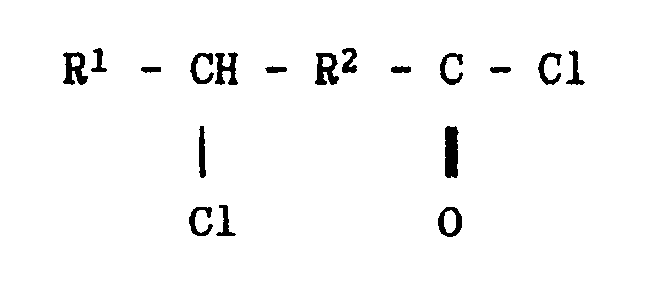
- chlorides of chlorinated carboxylic acids of the formula can be prepared.
- R2 represents the radical (CH2) n, n being an integer from 2 to 4, or the radical -CH2-C (C6H5) 2- and
- R1 represents a hydrogen atom or an alkyl radical having from 1 to 4 carbon atoms, by reaction of the lactones of formula in which R1 and R2 have the above meanings, with phosgene at a temperature between 90 ° and 180 ° C, using as oxides or sulfides of phosphines tri-substituted formula in which Y1, Y2 and Y3, which are identical or different, each represent a linear or branched alkyl radical having up to 18 carbon atoms or a phenyl radical which may carry one or more alkyl groups having up to 4 carbon atoms and X represents a oxygen atom or in which Y1, Y2 and Y3, identical or different, each represent a phenyl radical which may carry one or more alkyl groups having up to 4 carbon atoms and X represents a sulfur atom, or the reaction products of compounds of formula III with chlorinating agents, or mixtures of these compounds.
- lactones which can be transformed according to the process according to the invention are preferably the lactones of formula II in which R1 represents a hydrogen atom or a methyl radical.
- R1 represents a hydrogen atom or a methyl radical.
- 4-butyrolactone 4-valerolactone, 5-valerolactone, 6-caprolactone, 2,2-diphenyl-4-butyrolactone.
- Catalysts which are very suitable in the context of the present invention are the compounds of formula III in which Y1, Y2 and Y3, which are identical or different, represent a linear or branched alkyl radical having up to 12 carbon atoms or a phenyl radical which can carry one or more methyl groups.
- the compounds of formula III can also be replaced by their reaction products with known chlorinating agents such as oxalyl chloride, thionyl chloride, phosgene and phosphorus pentachloride, which are conventionally obtained by mixing the compounds .
- the preferred catalysts in the context of the present invention are trioctylphosphine oxide and triphenylphosphine oxide.
- catalysts described above are sufficient for the proper performance of the process. They are generally between 0.1 and 5% by mole relative to the starting lactone and preferably between 0.5 and 2.5%.
- the reaction temperature can be between 90 ° and 180 ° C. It is preferably between 120 ° and 160 ° C.
- the reaction is preferably carried out in the absence of solvent. It is however possible to add a solvent medium inert with respect to the compounds present in the medium, in particular phosgene.
- solvents mention may be made, for example, of chlorinated or non-chlorinated aromatic solvents having a sufficiently high boiling point such as monochlorobenzene, dichlorobenzene, isopropylbenzene and xylenes.
- Phosgene is generally added in stoichiometric quantity or in excess. This excess is preferably between 10 and 20%.
- the process according to the present invention can be carried out either batchwise or continuously at atmospheric pressure or at a pressure close to atmospheric pressure in known phosgenation devices.
- the lactone, the catalyst and optionally the solvent are first introduced into the reactor.
- the reaction medium is heated to the chosen temperature and then the gaseous phosgene is gradually passed through the medium.
- the carbon dioxide formed and the excess phosgene are cooled in a condenser.
- the medium is cooled, a stream of nitrogen is passed through.
- the chlorinated acid chloride formed can be isolated in the usual way, for example by distillation or by crystallization.
- the process according to the invention makes it possible, starting from raw materials available on the market, to obtain chlorides of high purity chlorinated carboxylic acids, with high yields, which moreover have excellent light and heat stability.
- the phosphine oxides used as catalysts are very stable under the conditions of the present reaction and can be used one or more times with the same efficiency. It is therefore possible to recycle them or to reuse the distillation residue for a new operation.
- the chlorides of chlorinated carboxylic acids obtained are particularly useful as synthesis intermediates for example for the preparation of chlorinated ketones or for forming pharmaceutical products such as neuroleptics, antiallergics, antidepressants and antidiarrheals, or phytosanitary products such as insecticides.
- phosgenation reactor comprising a thermometer, an agitator, a gas inlet and a condenser.
- the mixture is heated to 140 ° C. and the phosgene gas is bubbled through.
- 2,500 g (29 moles) of 4-butyrolactone are introduced into a 4 1 reactor of the same type as that of Example 2, 500 g of the base stock of the operation described in Example 2 containing 'equivalent of 80 g (0.285 mol) of triphenylphosphine oxide.
- the medium is heated to 140 ° C. and phosgene gas is introduced slowly.
- the transformation is complete after 13 h after having introduced 3400 g of phosgene (34.34 moles).
- Example 2 As in Example 1, 200 g (2 modes) of 4-valerolactone and 11.2 g (0.04 mole) of triphenylphosphine oxide are introduced into the reactor. The medium is heated to 150 ° C. and 268 g of phosgene gas are introduced over 9 h. The reaction medium is cooled and degassed. Chloro-4-methyl-butyroyl chloride is separated by distillation (boiling point: 68 ° C under 18 mm Hg). The yield is 70% relative to the reacted 4-valerolactone.
- phosgenation reactor comprising a thermometer, an agitator, a gas inlet and a condenser.
- the mixture is brought to 140 ° C. and the phosgene gas is bubbled.
- the reaction medium is cooled and degassed by bubbling with nitrogen. Distillation under reduced pressure makes it possible to recover 200 g of 4-chloro-butyroyl chloride (purity 99% by CPG analysis), ie a yield of 70%.
Landscapes
- Chemical & Material Sciences (AREA)
- Organic Chemistry (AREA)
- Engineering & Computer Science (AREA)
- Oil, Petroleum & Natural Gas (AREA)
- Organic Low-Molecular-Weight Compounds And Preparation Thereof (AREA)
- Low-Molecular Organic Synthesis Reactions Using Catalysts (AREA)
Abstract
dans
laquelle R² représente le radical (CH₂)n, n étant un nombre entier de 2 à 4, ou le radical -CH₂-C(C₆H₅)z- et R¹ représente un atome d'hydrogène ou un radical alkyle ayant de 1 à 4 atomes de carbone, qui consiste à faire réagir des lactones de formule
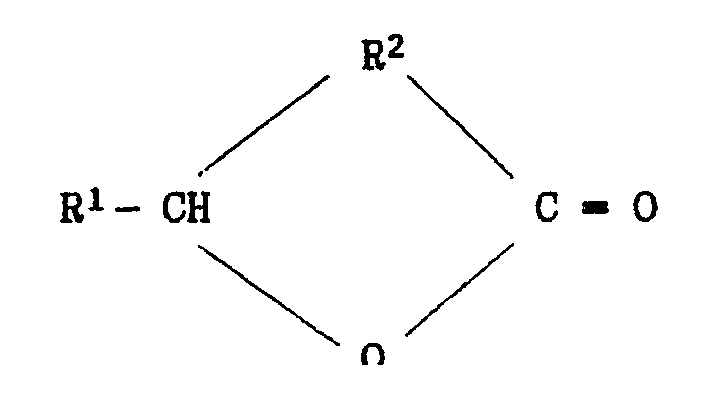
dans laquelle R¹ et R² ont les significa
tions précédentes, avec du phosgène, à une température de 90° à 180°C en utilisant comme catalyseurs des oxydes ou sulfures de phosphines trisubstitués.
Description
- L'invention concerne un procédé de préparation de chlorures d'acides carboxyliques chlorés. Elle concerne plus particulièrement un procédé de préparation de chlorures d'acides carboxyliques aliphatiques chlorés par phosgénation de lactones aliphatiques.
- Le brevet FR n° 1 080 261 décrit la préparation de chlorures d'acides carboxyliques chlorés par phosgénation de lactones en particulier de la 4-butyrolactone en présence de pyridine comme catalyseur à une température de 120°C. Mais il est difficile de reproduire les résultats mentionnés, en particulier ceux de l'exemple 2, comme il est indiqué dans la demande de brevet européen n° 253 214.
- Dans l'article de D.J. Burton et W.M. Koppes (J. Org. Chem., Vol 40, N° 21, 1975, pp. 3026 à 3031), le chlorure aromatique d'orthochlorométhylbenzoyle a été obtenu à partir de la lactone aromatique correspondante avec un dichlorotriphénylphosphorane en excès mais ce composé est un réactif de laboratoire très cher qui n'est pas stable et est particulièrement sensible à l'hydrolyse. De plus il réagit avec le chlorure d'acide formé et il est préférable de l'utiliser après sa complexation avec un acide de Lewis tel que BF₃, ce qui rend encore plus compliqué le procédé. A part la transformation du phtalide mentionné aucun autre essai n'a été réalisé à partir d'autres lactones.
- Selon la demande de brevet européen EP n° 253 214 récemment déposée on effectue la phosgénation de lactones telle que les butyrolactone, valérolactone ou caprolactone en présence d'un sel d'ammonium quaternaire à température élevée et de préférence en présence également d'acide chlorhydrique. Mais les sels d'ammonium quaternaires utilisés comme catalyseurs présentent l'inconvénient d'être plutôt instables à température élevée et perdent donc une partie de leur activité. L'acide chlorhydrique employé en quantité importante est particulièrement corrosif à haute température et nécessite des installations et des précautions particulières. Il se produit des réactions parasites. La lactone polymérise et l'agitation correcte du milieu n'est pas aisée. D'autres impuretés se forment par décomposition. La mise en oeuvre de ce procédé est par conséquent difficile. Plusieurs opérations successives sont nécessaires pour obtenir de bons rendements.
- Les chlorures d'acides carboxyliques chlorés sont particulièrement recherchés depuis plusieurs années comme intermédiaires de synthèse pour la fabrication de médicaments et de phytosanitaires, il existe donc un besoin de les obtenir de façon simple et économique ainsi qu'avec de bons rendements. Ces chlorures doivent de plus présenter une bonne stabilité à la lumière et au stockage.
- Il a maintenant été trouvé que l'on pouvait préparer des chlorures d'acides carboxyliques chlorés de formule

dans laquelle R² représente le radical (CH₂)n, n étant un nombre entier de 2 à 4, ou le radical -CH₂-C(C₆H₅)₂- et - R¹ représente un atome d'hydrogène ou un radical alkyle ayant de 1 à 4 atomes de carbone, par réaction des lactones de formule

dans laquelle R¹ et R² ont les significations précédentes, avec du phosgène à une température comprise entre 90° et 180°C, en utilisant comme catalyseurs des oxydes ou des sulfures de phosphines trisubstitués de formule
dans laquelle Y¹, Y² et Y³ identiques ou différents représentent chacun un radical alkyle linéaire ou ramifié ayant jusqu'à 18 atomes de carbone ou un radical phényle qui peut porter un ou plusieurs groupes alkyles ayant jusqu'à 4 atomes de carbone et X représente un atome d'oxygène ou dans laquelle Y¹, Y² et Y³ identiques ou différents représentent chacun un radical phényle qui peut porter un ou plusieurs groupes alkyles ayant jusqu'à 4 atomes de carbone et X représente un atome de soufre, ou les produits de réaction des composés de formule III avec des agents chlorurants, ou encore des mélanges de ces composés. - Les lactones qui peuvent être transformées selon le procédé selon l'invention sont de préférence les lactones de formule II dans laquelle R¹ représente un atome d'hydrogène ou un radical méthyle. A titre d'exemple on peut citer la 4-butyrolactone, la 4-valérolactone, la 5-valérolactone, la 6-caprolactone, la 2,2-diphényl-4-butyrolactone.
- Des catalyseurs qui conviennent bien dans le cadre de la présente invention sont les composés de formule III dans lesquels Y¹, Y² et Y³ identiques ou différents représentent un radical alkyle linéaire ou ramifié ayant jusqu' à 12 atomes de carbone ou un radical phényle qui peut porter un ou plusieurs groupes méthyles.
- On peut également remplacer les composés de formule III par leurs produits de réaction avec des agents chlorurants connus tels que le chlorure d'oxalyle, le chlorure de thionyle, le phosgène et le pentachlorure de phosphore, qui sont obtenus de façon classique par mélange des composés.
- On peut également employer un mélange des composés de formule III et de ces produits de réaction.
- Comme exemples de catalyseurs utilisables selon l'invention on peut citer l'oxyde de tributylphosphine, l'oxyde de trioctylphosphine, l'oxyde de tridodécylphosphine, l'oxyde de triphénylphosphine, le sulfure de triphénylphosphine, l'oxyde de tri-p-tolylphosphine.
- Les catalyseurs préférés dans le cadre de la présente invention sont l'oxyde de trioctylphosphine et l'oxyde de triphénylphosphine.
- Des quantités très faibles des catalyseurs précédemment décrits sont suffisantes pour la bonne réalisation du procédé. Elles sont généralement comprises entre 0,1 et 5% en mole par rapport à la lactone de départ et de préférence entre 0,5 et 2,5%.
- La température de réaction peut être comprise entre 90° et 180°C. Elle est de préférence comprise entre 120° et 160°C.
- La réaction est de préférence effectuée en absence de solvant. On peut cependant ajouter un milieu solvant inerte vis à vis des composés présents dans le milieu, en particulier du phosgène. Comme solvants on peut citer par exemple les solvants aromatiques chlorés ou non ayant un point d'ébullition suffisamment élevé tels que le monochlorobenzène, le dichlorobenzène, l'isopropylbenzène et les xylènes.
- Le phosgène est généralement ajouté en quantité stoechiométrique ou en excès. Cet excès est de préférence compris entre 10 et 20%.
- Le procédé selon la présente invention peut être mis en oeuvre soit en discontinu soit en continu à la pression atmosphérique ou à une pression voisine de la pression atmosphérique dans des dispositifs de phosgénation connus.
- Selon un mode opératoire approprié, la lactone, le catalyseur et éventuellement le solvant sont tout d'abord introduits dans le réacteur. Le milieu réactionnel est chauffé à la température choisie puis on fait passer progressivement le phosgène gazeux dans le milieu. Le dioxyde de carbone formé et le phosgène en excès sont refroidis dans un condenseur. A la fin de la réaction le milieu est refroidi, on fait passer un courant d'azote. Le chlorure d'acide chloré formé peut être isolé de façon habituelle, par exemple par distillation ou par cristallisation.
- Le procédé selon l'invention permet à partir de matières premières disponibles sur le marché d'obtenir avec des rendements élevés des chlorures d'acides carboxyliques chlorés de grande pureté qui présentent de plus une excellente stabilité à la lumière et à la chaleur.
- Les oxydes de phosphine utilisés comme catalyseurs sont très stables dans les conditions de la présente réaction et peuvent être utilisés une ou plusieurs fois avec la même efficacité. Il est donc possible de les recycler ou de réutiliser le résidu de distillation pour une nouvelle opération.
- Les chlorures d'acides carboxyliques chlorés obtenus sont particulièrement utiles comme intermédiaires de synthèse par exemple pour la préparation des cétones chlorés ou pour former des produits pharmaceutiques tels que des neuroleptiques, des antiallergiques, des antidépresseurs et des antidiarrhéiques, ou des produits phytosanitaires tels que des insecticides.
- Les exemples suivants illustrent l'invention :
- Dans un réacteur de phosgénation, comportant un thermomètre, un agitateur, une arrivée de gaz et un condenseur, on introduit 172 g (2 moles) de 4-butyrolactone et 5,6 g (0,02 mole) d'oxyde de triphénylphosphine. On chauffe de mélange à 140°C et on fait barboter le phosgène gazeux.
- Après avoir introduit 240 g de phosgène en 9 h de temps de réaction, de milieu réactionnel est refroidi et dégazé par bullage d'azote. Une distillation sous pression réduite permet de récupérer 233,5 g de chlorure de chloro-4-butyroyle, soit un rendement de 82% (point d'ébulltion 82°C sous 33 mm Hg). La pureté de ce chlorure déterminée par analyse CPG est de 99%.
- Dans un réacteur de 4 1, muni des mêmes dispositifs que précédemment, on introduit 2 500 g (29 moles) de 4-butyrolactone, 80 g (0,285 mode) d'oxyde de triphénylphosphine. Le milieu est chauffé à 140°C et de phosgène gazeux est introduit lentement. La transformation est complète au bout de 12h après avoir introduit 3 200 g de phosgène (32,3 moles).
- Après dégazage et distillation sous pression réduite, on obtient 3 560 g de chlorure de chloro-4-butyroyle dont la pureté déterminée par analyse CPG est de 99%, soit un rendement de 86% (point d'ébullition 70°C sous 20 mm Hg).
- Dans un réacteur de 4 1, du même type que celui de l'exemple 2, on introduit 2 500 g (29 moles) de 4-butyrolactone, 500 g du pied de cuve de l'opération décrite à l'exemple 2 contenant d'équivalent de 80 g (0,285 mole) d'oxyde de triphénylphosphine. Le milieu est chauffé à 140°C et de phosgène gazeux est introduit lentement. La transformation est complète au bout de 13 h après avoir introduit 3 400 g de phosgène (34,34 moles). Après dégazage et distillation sous pression réduite, on obtient 3 640 g de chlorure de chloro-4-butyroyle (25,8 moles) de pureté 98,9% (analyse CPG), soit un rendement de 88,9% (point d'ébullition : 70°C sous 20 mm Hg).
- Les résultats des tests de stabilité à la lumière et en enceinte climatique du chlorure obtenu sont des suivants :

- Comme à d'exemple 1, on introduit dans de réacteur 172 g (2 modes) de 4-butyrolactone et 7,7 g (0,02 mole) d'oxyde de trioctylphosphine. On chauffe le mélange à 150°C et on introduit 272 g de phosgène gazeux en 15 h. Le milieu réactionnel est refroidi et dégazé. Une distillation sous pression réduite permet de récupérer 218,6 g de chlorure de chloro-4-butyroyle, pur à 98% (analyse CPG), soit un rendement de 76% (point d'ébullition 60°C sous 14 mm Hg).
- Comme à l'exemple 1, on introduit dans de réacteur 200 g (2 modes) de 4-valérolactone et 11,2 g (0,04 mole) d'oxyde de triphénylphosphine. On chauffe le milieu à 150°C et on introduit 268 g de phosgène gazeux en 9 h. Le milieu réactionnel est refroidi et dégazé. Le chlorure de chloro-4-méthyl-butyroyle est séparé par distillation (point d'ébullition : 68°C sous 18 mm Hg). Le rendement est de 70% par rapport à la 4-valérolactone ayant réagit.
- Comme à l'exemple précédent, on introduit dans de réacteur 200 g (2 moles) de 5-valérolactone et 11,2 g (0,04 mole) d'oxyde de triphénylphosphine. On chauffe de mélange à 140°C. Après avoir introduit 236 g de phosgène gazeux en 5 h, le milieu réactionnel est refroidi et dégazé. Une distillation sous pression réduite permet de récupérer 217 g de chlorure de chloro-5-valéroyle, d'une pureté de 99% (analyse CPG) soit un rendement de 70% (point d'ébullition : 59°C sous 0,25 mm Hg).
- Comme précédemment, on introduit dans le réacteur 228,4 g (2 moles) de 6-caprolactone et 5,6 g (0,02 mole) d'oxyde de triphénylphosphine. On chauffe de mélange à 140°C et on introduit progressivement 265 g de phosgène gazeux. La conversion de la lactone est complète au bout de 6 h. Une distillation sous pression réduite permet de séparer 270 g de chlorure de chloro-6-caproyle, d'une pureté de 99%, soit un rendement de 79% (point d'ébullition : 67°C sous 0,3 mm Hg).
- Comme précédemment, on introduit dans le réacteur 100 g (0, 419 mole) de 2,2-diphényl-4-butyrolactone et 1,15 g (4 x 10⁻³ mode) d'oxyde de triphénylphosphine. On chauffe progressivement le milieu à 150°C et on introduit lentement 72 g de phosgène gazeux à cette température. Après 15 h de réaction l'avancement de la réaction est de 60%. Le milieu est alors refroidi, puis dégazé à l'azote. Par distillation on obtient le chlorure de 2,2-diphényl-4-chloro-butyroyle. Point d'ébullition 200°C sous 0,9 mm Hg.
- Dans un réacteur de phosgénation, comportant un thermomètre, un agitateur, une arrivée de gaz et un condenseur, on introduit 172 g (2 moles) de 4-butyrolactone et 5,9 g (0,02 mole) de sulfure de triphényl phosphine. Le mélange est porté à 140°C et on fait barboter le phosgène gazeux. Après avoir introduit 273 g de phosgène en 8 h de temps de réaction, de milieu réactionnel est refroidi et dégazé par bullage d'azote. Une distillation sous pression réduite permet de récupérer 200 g de chlorure de chloro-4 butyroyle (pureté 99% par analyse CPG), soit un rendement de 70%.
- De la même façon qu'à l'exemple précédent, on introduit dans le réacteur 172 g (2 moles) de 4-butyrolactone et 4,4 g (0,02 mode) d'oxyde de tributyl phosphine. On chauffe à 150°C et on fait barboter le phosgène gazeux. Après avoir introduit 280 g de phosgène en 15 heures de réaction, le milieu réactionnel est refroidi et dégazé par budlage d'azote. Après distillation sous pression réduire, on recueille 171 g de chlorure de chloro-4 butyroyle (pureté 99% par analyse CPG), soit un rendement de 60%.
Claims (9)
- Procédé de préparation des chlorures d'acides carboxyliques chlorés de formule

R¹ représente un atome d'hydrogène ou un radical alkyle ayant de 1 à 4 atomes de carbone,

- Procédé selon la revendication 1 caractérisé en ce que le catalyseur est ajouté en proportions comprises entre 0,1 et 5%, de préférence entre 0,5 et 2,5% en mode par rapport à la lactone.
- Procédé selon l'une quelconque des revendications précédentes caractérisé en ce que Y¹, Y² et Y³ identiques ou différents représentent chacun un radical alkyle linéaire ou ramifié ayant jusqu'à 12 atomes de carbone ou un radical phényle qui peut porter un ou plusieurs groupes méthyles.
- Procédé selon l'une quelconque des revendications précédentes caractérisé en ce que le phosgène est ajouté en quantité stoechiométrique ou en excès, de préférence compris entre 10 et 20% en mole par rapport à la lactone.
- Procédé selon l'une quelconque des revendications précédentes caractérisé en ce que le catalyseur utilisé est l'oxyde de trioctylphosphine ou l'oxyde de triphénylphosphine.
- Procédé selon l'une quelconque des revendications précédentes caractérisé en ce que la température est comprise entre 120° et 160°C.
- Procédé selon l'une quelconque des revendications précédentes caractérisé en ce que la réaction a lieu dans un milieu solvant inerte vis à vis des composés présents choisis parmi les hydrocarbures aromatiques chlorés ou non.
- Procédé selon l'une quelconque des revendications précédentes caractérisé en ce que R¹ représente un atome d'hydrogène ou un radical méthyle.
- Procédé selon l'une quelconque des revendications précédentes caractérisé en ce que la lactone est choisie parmi la 4-butyrolactone, la 4-valérolactone, la 5-valérolactone, la 6-caprolactone, la 2, 2-diphényl-4-butyrolactone.
Applications Claiming Priority (2)
| Application Number | Priority Date | Filing Date | Title |
|---|---|---|---|
| FR8916094 | 1989-12-06 | ||
| FR8916094A FR2655334B1 (fr) | 1989-12-06 | 1989-12-06 | Procede de preparation de chlorures d'acides carboxyliques chlores. |
Publications (4)
| Publication Number | Publication Date |
|---|---|
| EP0435714A2 true EP0435714A2 (fr) | 1991-07-03 |
| EP0435714A3 EP0435714A3 (en) | 1993-09-08 |
| EP0435714B1 EP0435714B1 (fr) | 1995-08-09 |
| EP0435714B2 EP0435714B2 (fr) | 1998-07-08 |
Family
ID=9388193
Family Applications (1)
| Application Number | Title | Priority Date | Filing Date |
|---|---|---|---|
| EP90403429A Expired - Lifetime EP0435714B2 (fr) | 1989-12-06 | 1990-12-03 | Procédé de préparation de chlorures d'acides carboxyliques chlorés |
Country Status (8)
| Country | Link |
|---|---|
| US (1) | US5130478A (fr) |
| EP (1) | EP0435714B2 (fr) |
| JP (1) | JP2919083B2 (fr) |
| AT (1) | ATE126201T1 (fr) |
| DE (1) | DE69021535T3 (fr) |
| ES (1) | ES2077659T5 (fr) |
| FR (1) | FR2655334B1 (fr) |
| IE (1) | IE67075B1 (fr) |
Cited By (1)
| Publication number | Priority date | Publication date | Assignee | Title |
|---|---|---|---|---|
| US6262300B1 (en) | 1997-12-04 | 2001-07-17 | Basf Aktiengesellschaft | Method for producing chlorocarboxylic acid chlorides |
Families Citing this family (4)
| Publication number | Priority date | Publication date | Assignee | Title |
|---|---|---|---|---|
| JP2918191B2 (ja) * | 1994-04-11 | 1999-07-12 | 同和鉱業株式会社 | 金属−セラミックス複合部材の製造方法 |
| AU2837201A (en) * | 1999-12-06 | 2001-06-18 | Basf Aktiengesellschaft | Method for producing o-chloromethyl benzenecarbonyl chlorides |
| MXPA02004965A (es) * | 1999-12-07 | 2002-09-18 | Basf Ag | Metodo para producir cloruros del acido o-clorometilbenzoico. |
| CN101624340B (zh) * | 2009-08-13 | 2011-11-30 | 浙江国邦药业有限公司 | 4-氯代丁酰氯的制备方法 |
Family Cites Families (6)
| Publication number | Priority date | Publication date | Assignee | Title |
|---|---|---|---|---|
| FR1080261A (fr) * | 1952-07-12 | 1954-12-08 | Basf Ag | Procédé pour la production de chlorures carboxyliques à côté de chlorures d'alcoyle et de chlorures omega-chlorocarboxyliques |
| US2778852A (en) * | 1952-07-12 | 1957-01-22 | Basf Ag | Production of chlorocarboxylic acid chlorides |
| NL175521C (nl) * | 1973-04-26 | 1984-11-16 | Hoechst Ag | Werkwijze voor het bereiden van carbonzuurchloriden. |
| DE3535984A1 (de) * | 1985-10-09 | 1987-04-09 | Bayer Ag | Verfahren zur herstellung von aromatischen carbonsaeurechloriden |
| DE3738039A1 (de) * | 1987-11-09 | 1989-05-18 | Thieme Werner Gmbh & Co | Siebdruckmaschine |
| JPH01171944A (ja) * | 1987-12-28 | 1989-07-06 | Kyocera Corp | スクリーン印刷機 |
-
1989
- 1989-12-06 FR FR8916094A patent/FR2655334B1/fr not_active Expired - Lifetime
-
1990
- 1990-11-20 IE IE419890A patent/IE67075B1/en not_active IP Right Cessation
- 1990-12-03 AT AT90403429T patent/ATE126201T1/de not_active IP Right Cessation
- 1990-12-03 EP EP90403429A patent/EP0435714B2/fr not_active Expired - Lifetime
- 1990-12-03 DE DE69021535T patent/DE69021535T3/de not_active Expired - Lifetime
- 1990-12-03 ES ES90403429T patent/ES2077659T5/es not_active Expired - Lifetime
- 1990-12-06 US US07/623,187 patent/US5130478A/en not_active Expired - Lifetime
- 1990-12-06 JP JP2406311A patent/JP2919083B2/ja not_active Expired - Fee Related
Cited By (1)
| Publication number | Priority date | Publication date | Assignee | Title |
|---|---|---|---|---|
| US6262300B1 (en) | 1997-12-04 | 2001-07-17 | Basf Aktiengesellschaft | Method for producing chlorocarboxylic acid chlorides |
Also Published As
| Publication number | Publication date |
|---|---|
| EP0435714B1 (fr) | 1995-08-09 |
| JPH06128188A (ja) | 1994-05-10 |
| FR2655334B1 (fr) | 1992-02-21 |
| US5130478A (en) | 1992-07-14 |
| ES2077659T3 (es) | 1995-12-01 |
| JP2919083B2 (ja) | 1999-07-12 |
| DE69021535D1 (de) | 1995-09-14 |
| EP0435714B2 (fr) | 1998-07-08 |
| IE904198A1 (en) | 1991-06-19 |
| DE69021535T2 (de) | 1996-02-15 |
| ES2077659T5 (es) | 1998-10-01 |
| ATE126201T1 (de) | 1995-08-15 |
| FR2655334A1 (fr) | 1991-06-07 |
| IE67075B1 (en) | 1996-02-21 |
| EP0435714A3 (en) | 1993-09-08 |
| DE69021535T3 (de) | 1999-03-04 |
Similar Documents
| Publication | Publication Date | Title |
|---|---|---|
| CH636848A5 (fr) | Procede de production de n,n-di(ethyl)-meta-toluamide. | |
| EP0435714B1 (fr) | Procédé de préparation de chlorures d'acides carboxyliques chlorés | |
| EP0298870B1 (fr) | Synthèse des bromures de perfluoroalkyle | |
| EP0021927B1 (fr) | Procédé de préparation d'éthers aryliques | |
| EP0648731A1 (fr) | Procédé d'hydroxycarbonylation du butadiène | |
| EP0030528B1 (fr) | Procédé pour la fixation de groupes alkyles, aralkyles ou cycloalkyles sur une chaîne carbonée portant un groupe fonctionnel | |
| EP0213976B1 (fr) | Nouveau procédé de préparation de chlorures d'acides par phosgénation des acides et catalyseurs pour ce procédé | |
| CH637102A5 (fr) | Procede de preparation de chlorure de chloracetyle. | |
| EP0049186B1 (fr) | Procédé de préparation de fluorobenzonitriles | |
| EP0233432A1 (fr) | Composés polyfluoroalkylthio-méthyliques, leurs procédés de préparation et leurs applications comme agents tensio-actifs ou précurseurs de ces derniers | |
| EP0710641B1 (fr) | Procédé de préparation de l'oxyde de 1,1-dichlorométhyle et de méthyle ou de l'oxyde de 1,1-dichlorométhyle et d'éthyle | |
| EP0110761B1 (fr) | Procédé de préparation de chlorures d'acides alpha-chlores | |
| FR2505327A1 (fr) | Procede d'halogenation en meta de n-(o,o'-dialkyl phenyl) alaninates et homologues | |
| EP0053981A1 (fr) | Procédé de fabrication de thiochloroformiates | |
| EP0334720A1 (fr) | Nouveau procédé de préparation d'isocyanates d'acyle | |
| EP0315517B1 (fr) | Procédé de préparation de chlorures d'acides carboxyliques | |
| EP0249556A1 (fr) | Procédé de préparation d'esters organiques alpha-halogénés de l'acide carbonique | |
| EP0199660B1 (fr) | Procédé de préparation de dérivés aromatiques 1,1 difluoro perhalogénoalcoxylés ou 1,1 difluoro perhalogénothioalkylés | |
| SU1214661A1 (ru) | Способ получени 2-метил-2-органотиолпропаналей | |
| FR2751963A1 (fr) | Procede de preparation de lactames n-substitues | |
| EP0378022A1 (fr) | Composés chlorofluorés fonctionnels et leur préparation | |
| EP0232666B1 (fr) | Procédé de préparation de chlorure de trifluoroacétyle | |
| FR2568250A1 (fr) | Nouveaux derives de pyridones | |
| EP0260472A2 (fr) | Procédé pour la préparation de cétones cycloaliphatiques | |
| FR2581061A1 (fr) | Procede de preparation des carbamates de chloro-1 alkyle ou aralkyle |
Legal Events
| Date | Code | Title | Description |
|---|---|---|---|
| PUAI | Public reference made under article 153(3) epc to a published international application that has entered the european phase |
Free format text: ORIGINAL CODE: 0009012 |
|
| AK | Designated contracting states |
Kind code of ref document: A2 Designated state(s): AT BE CH DE ES FR GB IT LI SE |
|
| PUAL | Search report despatched |
Free format text: ORIGINAL CODE: 0009013 |
|
| AK | Designated contracting states |
Kind code of ref document: A3 Designated state(s): AT BE CH DE ES FR GB IT LI SE |
|
| 17P | Request for examination filed |
Effective date: 19940122 |
|
| 17Q | First examination report despatched |
Effective date: 19941010 |
|
| GRAA | (expected) grant |
Free format text: ORIGINAL CODE: 0009210 |
|
| AK | Designated contracting states |
Kind code of ref document: B1 Designated state(s): AT BE CH DE ES FR GB IT LI SE |
|
| REF | Corresponds to: |
Ref document number: 126201 Country of ref document: AT Date of ref document: 19950815 Kind code of ref document: T |
|
| ITF | It: translation for a ep patent filed | ||
| GBT | Gb: translation of ep patent filed (gb section 77(6)(a)/1977) |
Effective date: 19950814 |
|
| REF | Corresponds to: |
Ref document number: 69021535 Country of ref document: DE Date of ref document: 19950914 |
|
| REG | Reference to a national code |
Ref country code: ES Ref legal event code: FG2A Ref document number: 2077659 Country of ref document: ES Kind code of ref document: T3 |
|
| PLBQ | Unpublished change to opponent data |
Free format text: ORIGINAL CODE: EPIDOS OPPO |
|
| PLBI | Opposition filed |
Free format text: ORIGINAL CODE: 0009260 |
|
| PLBF | Reply of patent proprietor to notice(s) of opposition |
Free format text: ORIGINAL CODE: EPIDOS OBSO |
|
| 26 | Opposition filed |
Opponent name: BASF AKTIENGESELLSCHAFT, LUDWIGSHAFEN Effective date: 19960509 |
|
| PLBF | Reply of patent proprietor to notice(s) of opposition |
Free format text: ORIGINAL CODE: EPIDOS OBSO |
|
| PLAW | Interlocutory decision in opposition |
Free format text: ORIGINAL CODE: EPIDOS IDOP |
|
| PLAW | Interlocutory decision in opposition |
Free format text: ORIGINAL CODE: EPIDOS IDOP |
|
| PUAH | Patent maintained in amended form |
Free format text: ORIGINAL CODE: 0009272 |
|
| STAA | Information on the status of an ep patent application or granted ep patent |
Free format text: STATUS: PATENT MAINTAINED AS AMENDED |
|
| PLBQ | Unpublished change to opponent data |
Free format text: ORIGINAL CODE: EPIDOS OPPO |
|
| PLAB | Opposition data, opponent's data or that of the opponent's representative modified |
Free format text: ORIGINAL CODE: 0009299OPPO |
|
| 27A | Patent maintained in amended form |
Effective date: 19980708 |
|
| AK | Designated contracting states |
Kind code of ref document: B2 Designated state(s): AT BE CH DE ES FR GB IT LI SE |
|
| R26 | Opposition filed (corrected) |
Opponent name: BASF AKTIENGESELLSCHAFT, LUDWIGSHAFEN Effective date: 19960509 |
|
| REG | Reference to a national code |
Ref country code: CH Ref legal event code: AEN Free format text: MAINTIEN DU BREVET DONT L'ETENDUE A ETE MODIFIEE |
|
| GBTA | Gb: translation of amended ep patent filed (gb section 77(6)(b)/1977) | ||
| REG | Reference to a national code |
Ref country code: ES Ref legal event code: DC2A Kind code of ref document: T5 Effective date: 19980902 |
|
| REG | Reference to a national code |
Ref country code: GB Ref legal event code: IF02 |
|
| REG | Reference to a national code |
Ref country code: FR Ref legal event code: CD |
|
| REG | Reference to a national code |
Ref country code: CH Ref legal event code: PFA Owner name: SNPE Free format text: SOCIETE NATIONALE DES POUDRES ET EXPLOSIFS#12, QUAI HENRI IV#PARIS 4E (FR) -TRANSFER TO- SNPE#12, QUAI HENRI IV#75181 PARIS CEDEX 04 (FR) |
|
| REG | Reference to a national code |
Ref country code: FR Ref legal event code: TP |
|
| REG | Reference to a national code |
Ref country code: GB Ref legal event code: 732E |
|
| REG | Reference to a national code |
Ref country code: CH Ref legal event code: PUE Owner name: ISOCHEM Free format text: SNPE#12, QUAI HENRI IV#75181 PARIS CEDEX 04 (FR) -TRANSFER TO- ISOCHEM#12, QUAI HENRI IV#75004 PARIS (FR) |
|
| REG | Reference to a national code |
Ref country code: ES Ref legal event code: PC2A |
|
| PGFP | Annual fee paid to national office [announced via postgrant information from national office to epo] |
Ref country code: SE Payment date: 20091120 Year of fee payment: 20 Ref country code: CH Payment date: 20091116 Year of fee payment: 20 Ref country code: AT Payment date: 20091203 Year of fee payment: 20 Ref country code: ES Payment date: 20091223 Year of fee payment: 20 |
|
| PGFP | Annual fee paid to national office [announced via postgrant information from national office to epo] |
Ref country code: GB Payment date: 20091209 Year of fee payment: 20 Ref country code: FR Payment date: 20100108 Year of fee payment: 20 Ref country code: IT Payment date: 20091222 Year of fee payment: 20 |
|
| PGFP | Annual fee paid to national office [announced via postgrant information from national office to epo] |
Ref country code: BE Payment date: 20091207 Year of fee payment: 20 Ref country code: DE Payment date: 20091231 Year of fee payment: 20 |
|
| REG | Reference to a national code |
Ref country code: CH Ref legal event code: PL |
|
| REG | Reference to a national code |
Ref country code: GB Ref legal event code: PE20 Expiry date: 20101202 |
|
| BE20 | Be: patent expired |
Owner name: *ISOCHEM Effective date: 20101203 |
|
| EUG | Se: european patent has lapsed | ||
| PG25 | Lapsed in a contracting state [announced via postgrant information from national office to epo] |
Ref country code: GB Free format text: LAPSE BECAUSE OF EXPIRATION OF PROTECTION Effective date: 20101202 |
|
| PG25 | Lapsed in a contracting state [announced via postgrant information from national office to epo] |
Ref country code: DE Free format text: LAPSE BECAUSE OF EXPIRATION OF PROTECTION Effective date: 20101203 |
|
| REG | Reference to a national code |
Ref country code: ES Ref legal event code: FD2A Effective date: 20140826 |
|
| PG25 | Lapsed in a contracting state [announced via postgrant information from national office to epo] |
Ref country code: ES Free format text: LAPSE BECAUSE OF EXPIRATION OF PROTECTION Effective date: 20101204 |