EP0435714B2 - Verfahren zur Herstellung von chlorierten Carbonsäurechloriden - Google Patents
Verfahren zur Herstellung von chlorierten Carbonsäurechloriden Download PDFInfo
- Publication number
- EP0435714B2 EP0435714B2 EP90403429A EP90403429A EP0435714B2 EP 0435714 B2 EP0435714 B2 EP 0435714B2 EP 90403429 A EP90403429 A EP 90403429A EP 90403429 A EP90403429 A EP 90403429A EP 0435714 B2 EP0435714 B2 EP 0435714B2
- Authority
- EP
- European Patent Office
- Prior art keywords
- radical
- formula
- process according
- compounds
- phosgene
- Prior art date
- Legal status (The legal status is an assumption and is not a legal conclusion. Google has not performed a legal analysis and makes no representation as to the accuracy of the status listed.)
- Expired - Lifetime
Links
- 238000000034 method Methods 0.000 title claims abstract description 29
- -1 carboxylic acid chlorides Chemical class 0.000 title claims abstract description 25
- 238000002360 preparation method Methods 0.000 title abstract description 10
- YGYAWVDWMABLBF-UHFFFAOYSA-N Phosgene Chemical compound ClC(Cl)=O YGYAWVDWMABLBF-UHFFFAOYSA-N 0.000 claims abstract description 43
- 150000002596 lactones Chemical class 0.000 claims abstract description 26
- 239000003054 catalyst Substances 0.000 claims abstract description 25
- 125000004432 carbon atom Chemical group C* 0.000 claims abstract description 14
- 125000004435 hydrogen atom Chemical group [H]* 0.000 claims abstract description 8
- 150000003003 phosphines Chemical class 0.000 claims abstract description 5
- 150000003568 thioethers Chemical class 0.000 claims abstract description 3
- 150000001875 compounds Chemical class 0.000 claims description 25
- 238000006243 chemical reaction Methods 0.000 claims description 24
- YEJRWHAVMIAJKC-UHFFFAOYSA-N 4-Butyrolactone Chemical compound O=C1CCCO1 YEJRWHAVMIAJKC-UHFFFAOYSA-N 0.000 claims description 19
- FIQMHBFVRAXMOP-UHFFFAOYSA-N triphenylphosphane oxide Chemical compound C=1C=CC=CC=1P(C=1C=CC=CC=1)(=O)C1=CC=CC=C1 FIQMHBFVRAXMOP-UHFFFAOYSA-N 0.000 claims description 19
- 239000000203 mixture Substances 0.000 claims description 15
- 150000003254 radicals Chemical class 0.000 claims description 15
- OZJPLYNZGCXSJM-UHFFFAOYSA-N 5-valerolactone Chemical compound O=C1CCCCO1 OZJPLYNZGCXSJM-UHFFFAOYSA-N 0.000 claims description 9
- 239000002904 solvent Substances 0.000 claims description 9
- CIUQDSCDWFSTQR-UHFFFAOYSA-N [C]1=CC=CC=C1 Chemical compound [C]1=CC=CC=C1 CIUQDSCDWFSTQR-UHFFFAOYSA-N 0.000 claims description 7
- 125000000217 alkyl group Chemical group 0.000 claims description 7
- GAEKPEKOJKCEMS-UHFFFAOYSA-N gamma-valerolactone Chemical compound CC1CCC(=O)O1 GAEKPEKOJKCEMS-UHFFFAOYSA-N 0.000 claims description 7
- 239000012320 chlorinating reagent Substances 0.000 claims description 6
- IRQJWIUKHLVISG-UHFFFAOYSA-N 3,3-diphenyloxolan-2-one Chemical compound O=C1OCCC1(C=1C=CC=CC=1)C1=CC=CC=C1 IRQJWIUKHLVISG-UHFFFAOYSA-N 0.000 claims description 5
- JBFHTYHTHYHCDJ-UHFFFAOYSA-N gamma-caprolactone Chemical compound CCC1CCC(=O)O1 JBFHTYHTHYHCDJ-UHFFFAOYSA-N 0.000 claims description 5
- 238000004519 manufacturing process Methods 0.000 claims description 4
- NINIDFKCEFEMDL-UHFFFAOYSA-N Sulfur Chemical group [S] NINIDFKCEFEMDL-UHFFFAOYSA-N 0.000 claims description 3
- WCYWZMWISLQXQU-UHFFFAOYSA-N methyl Chemical group [CH3] WCYWZMWISLQXQU-UHFFFAOYSA-N 0.000 claims description 3
- 125000002496 methyl group Chemical group [H]C([H])([H])* 0.000 claims description 3
- 125000004430 oxygen atom Chemical group O* 0.000 claims description 3
- 229910052760 oxygen Inorganic materials 0.000 claims description 2
- 239000001301 oxygen Substances 0.000 claims description 2
- 150000004945 aromatic hydrocarbons Chemical class 0.000 claims 1
- QVGXLLKOCUKJST-UHFFFAOYSA-N atomic oxygen Chemical compound [O] QVGXLLKOCUKJST-UHFFFAOYSA-N 0.000 claims 1
- 239000000543 intermediate Substances 0.000 abstract description 5
- 230000015572 biosynthetic process Effects 0.000 abstract description 3
- 238000003786 synthesis reaction Methods 0.000 abstract description 3
- 238000004821 distillation Methods 0.000 description 22
- IJGRMHOSHXDMSA-UHFFFAOYSA-N Atomic nitrogen Chemical compound N#N IJGRMHOSHXDMSA-UHFFFAOYSA-N 0.000 description 18
- 150000001805 chlorine compounds Chemical class 0.000 description 18
- 238000009835 boiling Methods 0.000 description 17
- 239000007789 gas Substances 0.000 description 16
- 150000001735 carboxylic acids Chemical class 0.000 description 12
- 239000012429 reaction media Substances 0.000 description 12
- 229910052757 nitrogen Inorganic materials 0.000 description 9
- VEXZGXHMUGYJMC-UHFFFAOYSA-N Hydrochloric acid Chemical compound Cl VEXZGXHMUGYJMC-UHFFFAOYSA-N 0.000 description 8
- 125000004429 atom Chemical group 0.000 description 7
- 239000007795 chemical reaction product Substances 0.000 description 6
- 230000009466 transformation Effects 0.000 description 6
- ZMBHCYHQLYEYDV-UHFFFAOYSA-N trioctylphosphine oxide Chemical compound CCCCCCCCP(=O)(CCCCCCCC)CCCCCCCC ZMBHCYHQLYEYDV-UHFFFAOYSA-N 0.000 description 5
- NGNBDVOYPDDBFK-UHFFFAOYSA-N 2-[2,4-di(pentan-2-yl)phenoxy]acetyl chloride Chemical compound CCCC(C)C1=CC=C(OCC(Cl)=O)C(C(C)CCC)=C1 NGNBDVOYPDDBFK-UHFFFAOYSA-N 0.000 description 4
- WNZQDUSMALZDQF-UHFFFAOYSA-N 2-benzofuran-1(3H)-one Chemical compound C1=CC=C2C(=O)OCC2=C1 WNZQDUSMALZDQF-UHFFFAOYSA-N 0.000 description 4
- 241001550224 Apha Species 0.000 description 4
- 0 C1CC*CC1 Chemical compound C1CC*CC1 0.000 description 4
- CURLTUGMZLYLDI-UHFFFAOYSA-N Carbon dioxide Chemical compound O=C=O CURLTUGMZLYLDI-UHFFFAOYSA-N 0.000 description 4
- VEXZGXHMUGYJMC-UHFFFAOYSA-M Chloride anion Chemical compound [Cl-] VEXZGXHMUGYJMC-UHFFFAOYSA-M 0.000 description 4
- XYFCBTPGUUZFHI-UHFFFAOYSA-N Phosphine Chemical compound P XYFCBTPGUUZFHI-UHFFFAOYSA-N 0.000 description 4
- JUJWROOIHBZHMG-UHFFFAOYSA-N Pyridine Chemical compound C1=CC=NC=C1 JUJWROOIHBZHMG-UHFFFAOYSA-N 0.000 description 4
- 125000003118 aryl group Chemical group 0.000 description 4
- 230000005587 bubbling Effects 0.000 description 4
- 238000004040 coloring Methods 0.000 description 4
- RWGFKTVRMDUZSP-UHFFFAOYSA-N cumene Chemical compound CC(C)C1=CC=CC=C1 RWGFKTVRMDUZSP-UHFFFAOYSA-N 0.000 description 4
- 238000007872 degassing Methods 0.000 description 4
- CTSLXHKWHWQRSH-UHFFFAOYSA-N oxalyl chloride Chemical compound ClC(=O)C(Cl)=O CTSLXHKWHWQRSH-UHFFFAOYSA-N 0.000 description 4
- 239000000047 product Substances 0.000 description 4
- 230000035484 reaction time Effects 0.000 description 4
- FYSNRJHAOHDILO-UHFFFAOYSA-N thionyl chloride Chemical compound ClS(Cl)=O FYSNRJHAOHDILO-UHFFFAOYSA-N 0.000 description 4
- RIOQSEWOXXDEQQ-UHFFFAOYSA-N triphenylphosphine Chemical compound C1=CC=CC=C1P(C=1C=CC=CC=1)C1=CC=CC=C1 RIOQSEWOXXDEQQ-UHFFFAOYSA-N 0.000 description 4
- MNZAKDODWSQONA-UHFFFAOYSA-N 1-dibutylphosphorylbutane Chemical compound CCCCP(=O)(CCCC)CCCC MNZAKDODWSQONA-UHFFFAOYSA-N 0.000 description 3
- CDIIZULDSLKBKV-UHFFFAOYSA-N 4-chlorobutanoyl chloride Chemical compound ClCCCC(Cl)=O CDIIZULDSLKBKV-UHFFFAOYSA-N 0.000 description 3
- 235000020004 porter Nutrition 0.000 description 3
- OCJBOOLMMGQPQU-UHFFFAOYSA-N 1,4-dichlorobenzene Chemical compound ClC1=CC=C(Cl)C=C1 OCJBOOLMMGQPQU-UHFFFAOYSA-N 0.000 description 2
- SPKBYIYIZQARNX-UHFFFAOYSA-N 1-bis(4-methylphenyl)phosphoryl-4-methylbenzene Chemical compound C1=CC(C)=CC=C1P(=O)(C=1C=CC(C)=CC=1)C1=CC=C(C)C=C1 SPKBYIYIZQARNX-UHFFFAOYSA-N 0.000 description 2
- BRLCBJSJAACAFG-UHFFFAOYSA-N 1-didodecylphosphoryldodecane Chemical compound CCCCCCCCCCCCP(=O)(CCCCCCCCCCCC)CCCCCCCCCCCC BRLCBJSJAACAFG-UHFFFAOYSA-N 0.000 description 2
- STXFPTXIUCVATR-UHFFFAOYSA-N 4-chloro-2,2-diphenylbutanoyl chloride Chemical compound C=1C=CC=CC=1C(C(Cl)=O)(CCCl)C1=CC=CC=C1 STXFPTXIUCVATR-UHFFFAOYSA-N 0.000 description 2
- HCBIDLRKPXILPU-UHFFFAOYSA-N 4-chloropentanoyl chloride Chemical compound CC(Cl)CCC(Cl)=O HCBIDLRKPXILPU-UHFFFAOYSA-N 0.000 description 2
- 239000002841 Lewis acid Substances 0.000 description 2
- UCKMPCXJQFINFW-UHFFFAOYSA-N Sulphide Chemical compound [S-2] UCKMPCXJQFINFW-UHFFFAOYSA-N 0.000 description 2
- 238000013019 agitation Methods 0.000 description 2
- 150000007933 aliphatic carboxylic acids Chemical class 0.000 description 2
- 150000003863 ammonium salts Chemical class 0.000 description 2
- 230000003266 anti-allergic effect Effects 0.000 description 2
- 230000001142 anti-diarrhea Effects 0.000 description 2
- 239000000043 antiallergic agent Substances 0.000 description 2
- 239000000935 antidepressant agent Substances 0.000 description 2
- 229940005513 antidepressants Drugs 0.000 description 2
- 229940125714 antidiarrheal agent Drugs 0.000 description 2
- 239000003793 antidiarrheal agent Substances 0.000 description 2
- 239000003849 aromatic solvent Substances 0.000 description 2
- 229930188620 butyrolactone Natural products 0.000 description 2
- 239000001569 carbon dioxide Substances 0.000 description 2
- 229910002092 carbon dioxide Inorganic materials 0.000 description 2
- 239000003153 chemical reaction reagent Substances 0.000 description 2
- MVPPADPHJFYWMZ-UHFFFAOYSA-N chlorobenzene Chemical compound ClC1=CC=CC=C1 MVPPADPHJFYWMZ-UHFFFAOYSA-N 0.000 description 2
- 238000010668 complexation reaction Methods 0.000 description 2
- 238000002425 crystallisation Methods 0.000 description 2
- 230000008025 crystallization Effects 0.000 description 2
- 238000000354 decomposition reaction Methods 0.000 description 2
- ASWXNYNXAOQCCD-UHFFFAOYSA-N dichloro(triphenyl)-$l^{5}-phosphane Chemical compound C=1C=CC=CC=1P(Cl)(C=1C=CC=CC=1)(Cl)C1=CC=CC=C1 ASWXNYNXAOQCCD-UHFFFAOYSA-N 0.000 description 2
- 229940117389 dichlorobenzene Drugs 0.000 description 2
- 229940079593 drug Drugs 0.000 description 2
- 239000003814 drug Substances 0.000 description 2
- 230000000694 effects Effects 0.000 description 2
- 229940082150 encore Drugs 0.000 description 2
- 230000007062 hydrolysis Effects 0.000 description 2
- 238000006460 hydrolysis reaction Methods 0.000 description 2
- 239000012535 impurity Substances 0.000 description 2
- 239000002917 insecticide Substances 0.000 description 2
- 238000009434 installation Methods 0.000 description 2
- 150000002576 ketones Chemical class 0.000 description 2
- 150000007517 lewis acids Chemical class 0.000 description 2
- 238000002156 mixing Methods 0.000 description 2
- MPQXHAGKBWFSNV-UHFFFAOYSA-N oxidophosphanium Chemical class [PH3]=O MPQXHAGKBWFSNV-UHFFFAOYSA-N 0.000 description 2
- 230000003071 parasitic effect Effects 0.000 description 2
- 239000000825 pharmaceutical preparation Substances 0.000 description 2
- 229940127557 pharmaceutical product Drugs 0.000 description 2
- 229910000073 phosphorus hydride Inorganic materials 0.000 description 2
- UHZYTMXLRWXGPK-UHFFFAOYSA-N phosphorus pentachloride Chemical compound ClP(Cl)(Cl)(Cl)Cl UHZYTMXLRWXGPK-UHFFFAOYSA-N 0.000 description 2
- UMJSCPRVCHMLSP-UHFFFAOYSA-N pyridine Natural products COC1=CC=CN=C1 UMJSCPRVCHMLSP-UHFFFAOYSA-N 0.000 description 2
- 150000003242 quaternary ammonium salts Chemical class 0.000 description 2
- 239000002994 raw material Substances 0.000 description 2
- 238000011084 recovery Methods 0.000 description 2
- 238000003860 storage Methods 0.000 description 2
- 229910052717 sulfur Inorganic materials 0.000 description 2
- 125000004434 sulfur atom Chemical group 0.000 description 2
- ZFEAYIKULRXTAR-UHFFFAOYSA-M triphenylsulfanium;chloride Chemical compound [Cl-].C1=CC=CC=C1[S+](C=1C=CC=CC=1)C1=CC=CC=C1 ZFEAYIKULRXTAR-UHFFFAOYSA-M 0.000 description 2
- 239000008096 xylene Substances 0.000 description 2
- 150000003738 xylenes Chemical class 0.000 description 2
- PAPBSGBWRJIAAV-UHFFFAOYSA-N ε-Caprolactone Chemical compound O=C1CCCCCO1 PAPBSGBWRJIAAV-UHFFFAOYSA-N 0.000 description 2
- MYMOFIZGZYHOMD-UHFFFAOYSA-N Dioxygen Chemical compound O=O MYMOFIZGZYHOMD-UHFFFAOYSA-N 0.000 description 1
- 230000034303 cell budding Effects 0.000 description 1
- 239000003795 chemical substances by application Substances 0.000 description 1
- 235000001508 sulfur Nutrition 0.000 description 1
Classifications
-
- C—CHEMISTRY; METALLURGY
- C07—ORGANIC CHEMISTRY
- C07C—ACYCLIC OR CARBOCYCLIC COMPOUNDS
- C07C51/00—Preparation of carboxylic acids or their salts, halides or anhydrides
- C07C51/58—Preparation of carboxylic acid halides
- C07C51/60—Preparation of carboxylic acid halides by conversion of carboxylic acids or their anhydrides or esters, lactones, salts into halides with the same carboxylic acid part
Definitions
- the invention relates to a process for the preparation of chlorides of chlorinated carboxylic acids. She relates more particularly to a process for the preparation of chlorides of aliphatic carboxylic acids chlorinated by phosgenation of aliphatic lactones.
- Patent No. 1,080,261 describes the preparation of chlorides of chlorinated carboxylic acids by phosgenation of lactones, in particular 4-butyrolactone in the presence of pyridine as a catalyst a temperature of 120 ° C. But it is difficult to reproduce the results mentioned, especially those of example 2, as indicated in European patent application No. 253,214.
- lactones such as butyrolactone, valerolactone or caprolactone in the presence of an ammonium salt quaternary at high temperature and preferably also in the presence of hydrochloric acid.
- the quaternary ammonium salts used as catalysts have the disadvantage of being rather unstable at high temperature and therefore lose part of their activity.
- the hydrochloric acid used in quantity important is particularly corrosive at high temperatures and requires installation and precautions particular. There are parasitic reactions. Lactone polymerizes and correct agitation of the middle is not easy. Other impurities are formed by decomposition. The implementation of this process is therefore difficult. Several successive operations are necessary to obtain good yields.
- Chlorides of chlorinated carboxylic acids have been particularly sought after for several years as synthesis intermediates for the manufacture of medicines and phytosanitary products, there are therefore a need to obtain them in a simple and economical manner as well as with good yields. These chlorides must also have good light and storage stability.
- lactones which can be transformed according to the process according to the invention are preferably the lactones of formula II in which R 1 represents a hydrogen atom or a methyl radical.
- R 1 represents a hydrogen atom or a methyl radical.
- 4-butyrolactone 4-valerolactone, 5-valerolactone, 6-caprolactone, 2,2-diphenyl-4-butyrolactone.
- Catalysts which are very suitable in the context of the present invention are the compounds of formula III in which Y 1 , Y 2 and Y 3, which are identical or different, represent a linear or branched alkyl radical having up to 12 carbon atoms or a phenyl radical which can carry one or more methyl groups.
- the compounds of formula III can also be replaced by their reaction products with known chlorinating agents such as oxalyl chloride, thionyl chloride, phosgene and phosphorus pentachloride, which are conventionally obtained by mixing the compounds.
- chlorinating agents such as oxalyl chloride, thionyl chloride, phosgene and phosphorus pentachloride, which are conventionally obtained by mixing the compounds.
- the preferred catalysts in the context of the present invention are trioctylphosphine oxide and triphenylphosphine oxide.
- catalysts described above are sufficient for the good carrying out the process. They are generally between 0.1 and 5 mol% relative to the lactone starting and preferably between 0.5 and 2.5%.
- the reaction temperature can be between 90 ° and 180 ° C. It is preferably understood between 120 ° and 160 ° C.
- the reaction is preferably carried out in the absence of solvent.
- a middle solvent inert with respect to the compounds present in the medium, in particular phosgene.
- solvents mention may be made, for example, of chlorinated or non-chlorinated aromatic solvents having a sufficiently boiling point. high such as monochlorobenzene, dichlorobenzene, isopropylbenzene and xylenes.
- Phosgene is generally added in stoichiometric quantity or in excess. This excess is preferably between 10 and 20%.
- the process according to the present invention can be carried out either batchwise or continuously at the atmospheric pressure or at a pressure close to atmospheric pressure in devices for known phosgenation.
- the lactone, the catalyst and optionally the solvent are all first introduced into the reactor.
- the reaction medium is heated to the chosen temperature and then gradually pass the gaseous phosgene into the medium. Carbon dioxide formed and phosgene in excess are cooled in a condenser. At the end of the reaction, the medium is cooled, a nitrogen flow.
- the chlorinated acid chloride formed can be isolated in the usual way, for example by distillation or by crystallization.
- the process according to the invention makes it possible, from raw materials available on the market, to obtain with high yields of chlorides of high purity chlorinated carboxylic acids which exhibit in addition excellent stability to light and heat.
- the phosphine oxides used as catalysts are very stable under the conditions of present reaction and can be used one or more times with the same effectiveness. It is therefore possible to recycle them or to reuse the distillation residue for a new operation.
- the chlorides of chlorinated carboxylic acids obtained are particularly useful as intermediates for example for the preparation of chlorinated ketones or to form pharmaceutical products such as neuroleptics, antiallergics, antidepressants and antidiarrheals, or phytosanitary products such as insecticides.
- a phosgenation reactor comprising a thermometer, an agitator, a gas inlet and a condenser, 172 g (2 moles) of 4-butyrolactone and 5.6 g (0.02 mole) of triphenylphosphine oxide are introduced.
- the mixture is heated to 140 ° C. and the phosgene gas is bubbled.
- 2,500 g (29 g) are introduced into a 4 l reactor, fitted with the same devices as above. moles) of 4-butyrolactone, 80 g (0.285 mode) of triphenylphosphine oxide. The medium is heated to 140 ° C and phosgene gas is introduced slowly. The transformation is complete after 12 hours after introducing 3,200 g of phosgene (32.3 moles).
- 2,500 g (29 moles) of 4-butyrolactone are introduced into a 4 l reactor, of the same type as that of Example 2 500 g of the base stock of the operation described in Example 2 containing the equivalent of 80 g (0.285 mole) of triphenylphosphine oxide.
- the medium is heated to 140 ° C and phosgene gas is introduced slowly.
- the transformation is complete after 13 h after having introduced 3400 g of phosgene (34.34 moles).
- Example 2 As in Example 1, 200 g (2 modes) of 4-valerolactone and 11.2 g (0.04) are introduced into the reactor. mole) of triphenylphosphine oxide. The medium is heated to 150 ° C. and 268 g of phosgene are introduced gaseous in 9 h. The reaction medium is cooled and degassed. Chloro-4-methyl-butyroyl chloride is separated by distillation [boiling point: 68 ° C at 24 mbar (18 mm Hg)]. The yield is 70% by compared to the reacted 4-valerolactone.
- phosgenation reactor comprising a thermometer, an agitator, a gas inlet and a condenser, 172 g (2 moles) of 4-butyrolactone and 5.9 g (0.02 mole) of triphenyl sulfide are introduced phosphine.
- the mixture is brought to 140 ° C. and the phosgene gas is bubbled.
- the reaction medium is cooled and degassed by bubbling nitrogen. Distillation under reduced pressure makes it possible to recover 200 g of 4-chloro-butyroyl chloride (purity 99% by CPG analysis), ie a yield of 70%.
- the invention relates to a process for the preparation of chlorides of chlorinated carboxylic acids. She relates more particularly to a process for the preparation of chlorides of aliphatic carboxylic acids chlorinated by phosgenation of aliphatic lactones.
- Patent No. 1,080,261 describes the preparation of chlorides of chlorinated carboxylic acids by phosgenation of lactones, in particular 4-butyrolactone in the presence of pyridine as a catalyst a temperature of 120 ° C. But it is difficult to reproduce the results mentioned, especially those of example 2, as indicated in European patent application No. 253,214.
- lactones such as butyrolactone, valerolactone or caprolactone in the presence of an ammonium salt quaternary at high temperature and preferably also in the presence of hydrochloric acid.
- the quaternary ammonium salts used as catalysts have the disadvantage of being rather unstable at high temperature and therefore lose part of their activity.
- the hydrochloric acid used in quantity important is particularly corrosive at high temperatures and requires installation and precautions particular. There are parasitic reactions. Lactone polymerizes and correct agitation of the middle is not easy. Other impurities are formed by decomposition. The implementation of this process is therefore difficult. Several successive operations are necessary to obtain good yields.
- Chlorides of chlorinated carboxylic acids have been particularly sought after for several years as synthesis intermediates for the manufacture of medicines and phytosanitary products, there are therefore a need to obtain them in a simple and economical manner as well as with good yields. These chlorides must also have good light and storage stability.
- lactones which can be transformed according to the process according to the invention are preferably the lactones of formula II in which R 1 represents a hydrogen atom or a methyl radical.
- R 1 represents a hydrogen atom or a methyl radical.
- 4-butyrolactone 4-valerolactone, 5-valerolactone, 6-caprolactone, 2,2-diphenyl-4-butyrolactone.
- Catalysts which are very suitable in the context of the present invention are the compounds of formula III in which Y 1 , Y 2 and Y 3, which are identical or different, represent a linear or branched alkyl radical having up to 12 carbon atoms or a phenyl radical which can carry one or more methyl groups.
- the compounds of formula III can also be replaced by their reaction products with known chlorinating agents such as oxalyl chloride, thionyl chloride, phosgene and phosphorus pentachloride, which are conventionally obtained by mixing the compounds.
- chlorinating agents such as oxalyl chloride, thionyl chloride, phosgene and phosphorus pentachloride, which are conventionally obtained by mixing the compounds.
- the preferred catalysts in the context of the present invention are trioctylphosphine oxide and triphenylphosphine oxide.
- catalysts described above are sufficient for the good carrying out the process. They are generally between 0.1 and 5 mol% relative to the lactone starting and preferably between 0.5 and 2.5%.
- the reaction temperature can be between 90 ° and 180 ° C. It is preferably understood between 120 ° and 160 ° C.
- the reaction is preferably carried out in the absence of solvent.
- a middle solvent inert with respect to the compounds present in the medium, in particular phosgene.
- solvents mention may be made, for example, of chlorinated or non-chlorinated aromatic solvents having a sufficiently boiling point. high such as monochlorobenzene, dichlorobenzene, isopropylbenzene and xylenes.
- Phosgene is generally added in stoichiometric quantity or in excess. This excess is preferably between 10 and 20%.
- the process according to the present invention can be carried out either batchwise or continuously at the atmospheric pressure or at a pressure close to atmospheric pressure in devices for known phosgenation.
- the lactone, the catalyst and optionally the solvent are all first introduced into the reactor.
- the reaction medium is heated to the chosen temperature and then gradually pass the gaseous phosgene into the medium. Carbon dioxide formed and phosgene in excess are cooled in a condenser. At the end of the reaction, the medium is cooled, a nitrogen flow.
- the chlorinated acid chloride formed can be isolated in the usual way, for example by distillation or by crystallization.
- the process according to the invention makes it possible, from raw materials available on the market, to obtain with high yields of chlorides of high purity chlorinated carboxylic acids which exhibit in addition excellent stability to light and heat.
- the phosphine oxides used as catalysts are very stable under the conditions of present reaction and can be used one or more times with the same effectiveness. It is therefore possible to recycle them or to reuse the distillation residue for a new operation.
- the chlorides of chlorinated carboxylic acids obtained are particularly useful as intermediates for example for the preparation of chlorinated ketones or to form pharmaceutical products such as neuroleptics, antiallergics, antidepressants and antidiarrheals, or phytosanitary products such as insecticides.
- a phosgenation reactor comprising a thermometer, an agitator, a gas inlet and a condenser, 172 g (2 moles) of 4-butyrolactone and 5.6 g (0.02 mole) of triphenylphosphine oxide are introduced.
- the mixture is heated to 140 ° C. and the phosgene gas is bubbled.
- 2,500 g (29 g) are introduced into a 4 l reactor, fitted with the same devices as above. moles) of 4-butyrolactone, 80 g (0.285 mode) of triphenylphosphine oxide. The medium is heated to 140 ° C and phosgene gas is introduced slowly. The transformation is complete after 12 hours after introducing 3,200 g of phosgene (32.3 moles).
- 2,500 g (29 moles) of 4-butyrolactone are introduced into a 4 l reactor, of the same type as that of Example 2 500 g of the base stock of the operation described in Example 2 containing the equivalent of 80 g (0.285 mole) of triphenylphosphine oxide.
- the medium is heated to 140 ° C and phosgene gas is introduced slowly.
- the transformation is complete after 13 h after having introduced 3400 g of phosgene (34.34 moles).
- Example 2 As in Example 1, 200 g (2 modes) of 4-valerolactone and 11.2 g (0.04) are introduced into the reactor. mole) of triphenylphosphine oxide. The medium is heated to 150 ° C. and 268 g of phosgene are introduced gaseous in 9 h. The reaction medium is cooled and degassed. Chloro-4-methyl-butyroyl chloride is separated by distillation [boiling point: 68 ° C at 24 mbar (18 mm Hg)]. The yield is 70% by compared to the reacted 4-valerolactone.
- phosgenation reactor comprising a thermometer, an agitator, a gas inlet and a condenser, 172 g (2 moles) of 4-butyrolactone and 5.9 g (0.02 mole) of triphenyl sulfide are introduced phosphine.
- the mixture is brought to 140 ° C. and the phosgene gas is bubbled.
- the reaction medium is cooled and degassed by bubbling nitrogen. Distillation under reduced pressure makes it possible to recover 200 g of 4-chloro-butyroyl chloride (purity 99% by CPG analysis), ie a yield of 70%.
Landscapes
- Chemical & Material Sciences (AREA)
- Organic Chemistry (AREA)
- Engineering & Computer Science (AREA)
- Oil, Petroleum & Natural Gas (AREA)
- Organic Low-Molecular-Weight Compounds And Preparation Thereof (AREA)
- Low-Molecular Organic Synthesis Reactions Using Catalysts (AREA)
Claims (10)
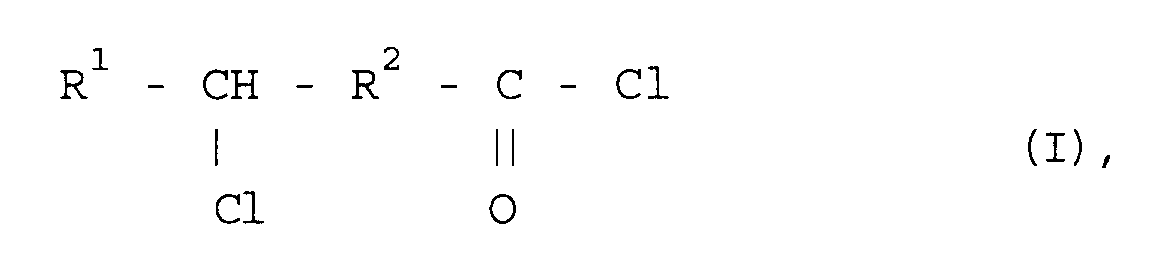
- Verfahren zur Herstellung von Chloriden chlorierter Carbonsäuren der Formelin der bedeuten:

- R1
- ein Wasserstoffatom oder C1-4-Alkyl
und - R2
- eine Gruppe (CH2)n, wobei n eine ganze Zahl von 2 bis 4 bedeutet, oder die Gruppe -CH2-C(C6H5)2-,
in der R1 und R2 die oben angegebenen Bedeutungen haben,
mit Phosgen in Gegenwart eines Katalysators,
dadurch gekennzeichnet, daß die Umsetzung bei einer Temperatur von 90 bis 180 °C durchgeführt wird, wobei als Katalysatoren verwendet werden:Oxide oder Sulfide von trisubstituierten Phosphinen der Formelworin bedeuten: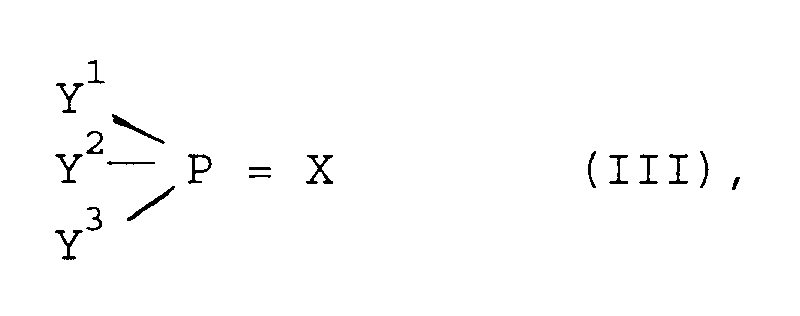
- Y1, Y2 und Y3,
- die gleich oder verschieden sind,
jeweils eine Phenylgruppe, die ggf. mit einer
oder mehreren C1-4-Alkylgruppen substituiert
ist,
und - X
- ein Sauerstoffatom oder ein Schwefelatom,
Reaktionsprodukte von Verbindungen der Formel III mit Chlorierungsmitteln
oderGemische dieser Verbindungen. - Verfahren zur Herstellung von Chloriden chlorierter Carbonsäuren der Formelin der bedeuten:
- R1
- ein Wasserstoffatom oder C1-4-Alkyl
und - R2
- die Gruppe -CH2-C(C6H5)2-,
in der R1 und R2 die oben angegebenen Bedeutungen haben,
mit Phosgen in Gegenwart eines Katalysators,
dadurch gekennzeichnet, daß die Umsetzung bei einer Temperatur von 90 bis 180 °C durchgeführt wird, wobei als Katalysatorenverwendet werden.Oxide von trisubstituierten Phosphinen der Formelworin bedeuten: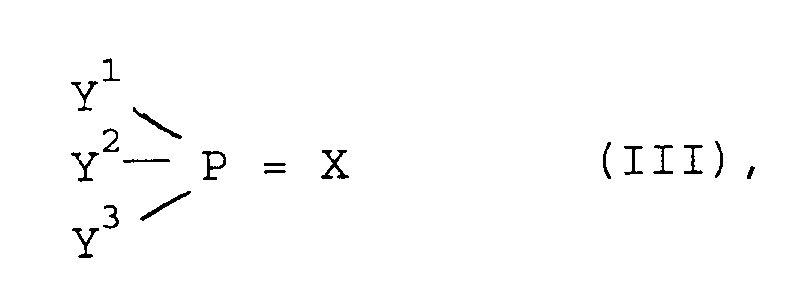
- Y1, Y2 und Y3,
- die gleich oder verschieden sind,
jeweils geradkettiges oder verzweigtes Alkyl
mit bis zu 18 C-Atomen
und - X
- ein Sauerstoffatom,
Reaktionsprodukte von Verbindungen der Formel III mit Chlorierungsmitteln
oderGemische dieser Verbindungen - Verfahren nach Anspruch 1, dadurch gekennzeichnet, daß Y1, Y2 und Y3, die gleich oder verschieden sind, jeweils eine Phenylgruppe bedeuten, die ggf. mit einer oder mehreren Methylgruppen substituiert ist.
- Verfahren nach einem der vorhergehenden Ansprüche, dadurch gekennzeichnet, daß der Katalysator in Mengenanteilen von 0,1 bis 5 Mol-% und vorzugsweise 0,5 bis 2,5 Mol-%, bezogen auf das Lacton, zugegeben wird.
- Verfahren nach einem der vorhergehenden Ansprüche, dadurch gekennzeichnet, daß das Phosgen in stöchiometrischer Menge oder im Überschuß, vorzugsweise in einem Überschuß von 10 bis 20 Mol-%, bezogen auf das Lacton, zugegeben wird.
- Verfahren nach einem der Ansprüche 1 und 3 bis 5, dadurch gekennzeichnet, daß als Katalysator Triphenylphosphinoxid verwendet wird.
- Verfahren nach einem der vorhergehenden Ansprüche, dadurch gekennzeichnet, daß die Temperatur im Bereich von 120 bis 160 °C liegt.
- Verfahren nach einem der vorhergehenden Ansprüche, dadurch gekennzeichnet, daß die Umsetzung in einem gegenüber den vorliegenden Verbindungen inerten Lösungsmittelmedium durchgeführt wird, wobei die Lösungsmittel unter aromatischen Kohlenwasserstoffen und chlorierten aromatischen Kohlenwasserstoffen ausgewählt sind.
- Verfahren nach einem der vorhergehenden Ansprüche, dadurch gekennzeichnet, daß R1 ein Wasserstoffatom oder Methyl bedeutet.
- Verfahren nach einem der vorhergehenden Ansprüche, dadurch gekennzeichnet, daß das Lacton unter 4-Butyrolacton, 4-Valerolacton, 5-Valerolacton, 6-Caprolacton und 2,2-Diphenyl-4-butyrolacton ausgewählt wird.
Applications Claiming Priority (2)
| Application Number | Priority Date | Filing Date | Title |
|---|---|---|---|
| FR8916094 | 1989-12-06 | ||
| FR8916094A FR2655334B1 (fr) | 1989-12-06 | 1989-12-06 | Procede de preparation de chlorures d'acides carboxyliques chlores. |
Publications (4)
| Publication Number | Publication Date |
|---|---|
| EP0435714A2 EP0435714A2 (de) | 1991-07-03 |
| EP0435714A3 EP0435714A3 (en) | 1993-09-08 |
| EP0435714B1 EP0435714B1 (de) | 1995-08-09 |
| EP0435714B2 true EP0435714B2 (de) | 1998-07-08 |
Family
ID=9388193
Family Applications (1)
| Application Number | Title | Priority Date | Filing Date |
|---|---|---|---|
| EP90403429A Expired - Lifetime EP0435714B2 (de) | 1989-12-06 | 1990-12-03 | Verfahren zur Herstellung von chlorierten Carbonsäurechloriden |
Country Status (8)
| Country | Link |
|---|---|
| US (1) | US5130478A (de) |
| EP (1) | EP0435714B2 (de) |
| JP (1) | JP2919083B2 (de) |
| AT (1) | ATE126201T1 (de) |
| DE (1) | DE69021535T3 (de) |
| ES (1) | ES2077659T5 (de) |
| FR (1) | FR2655334B1 (de) |
| IE (1) | IE67075B1 (de) |
Families Citing this family (5)
| Publication number | Priority date | Publication date | Assignee | Title |
|---|---|---|---|---|
| JP2918191B2 (ja) * | 1994-04-11 | 1999-07-12 | 同和鉱業株式会社 | 金属−セラミックス複合部材の製造方法 |
| DE19753773A1 (de) | 1997-12-04 | 1999-06-10 | Basf Ag | Verfahren zur Herstellung von Chlorcarbonsäurechloriden |
| AU2837201A (en) * | 1999-12-06 | 2001-06-18 | Basf Aktiengesellschaft | Method for producing o-chloromethyl benzenecarbonyl chlorides |
| MXPA02004965A (es) * | 1999-12-07 | 2002-09-18 | Basf Ag | Metodo para producir cloruros del acido o-clorometilbenzoico. |
| CN101624340B (zh) * | 2009-08-13 | 2011-11-30 | 浙江国邦药业有限公司 | 4-氯代丁酰氯的制备方法 |
Family Cites Families (6)
| Publication number | Priority date | Publication date | Assignee | Title |
|---|---|---|---|---|
| FR1080261A (fr) * | 1952-07-12 | 1954-12-08 | Basf Ag | Procédé pour la production de chlorures carboxyliques à côté de chlorures d'alcoyle et de chlorures omega-chlorocarboxyliques |
| US2778852A (en) * | 1952-07-12 | 1957-01-22 | Basf Ag | Production of chlorocarboxylic acid chlorides |
| NL175521C (nl) * | 1973-04-26 | 1984-11-16 | Hoechst Ag | Werkwijze voor het bereiden van carbonzuurchloriden. |
| DE3535984A1 (de) * | 1985-10-09 | 1987-04-09 | Bayer Ag | Verfahren zur herstellung von aromatischen carbonsaeurechloriden |
| DE3738039A1 (de) * | 1987-11-09 | 1989-05-18 | Thieme Werner Gmbh & Co | Siebdruckmaschine |
| JPH01171944A (ja) * | 1987-12-28 | 1989-07-06 | Kyocera Corp | スクリーン印刷機 |
-
1989
- 1989-12-06 FR FR8916094A patent/FR2655334B1/fr not_active Expired - Lifetime
-
1990
- 1990-11-20 IE IE419890A patent/IE67075B1/en not_active IP Right Cessation
- 1990-12-03 AT AT90403429T patent/ATE126201T1/de not_active IP Right Cessation
- 1990-12-03 EP EP90403429A patent/EP0435714B2/de not_active Expired - Lifetime
- 1990-12-03 DE DE69021535T patent/DE69021535T3/de not_active Expired - Lifetime
- 1990-12-03 ES ES90403429T patent/ES2077659T5/es not_active Expired - Lifetime
- 1990-12-06 US US07/623,187 patent/US5130478A/en not_active Expired - Lifetime
- 1990-12-06 JP JP2406311A patent/JP2919083B2/ja not_active Expired - Fee Related
Also Published As
| Publication number | Publication date |
|---|---|
| EP0435714B1 (de) | 1995-08-09 |
| JPH06128188A (ja) | 1994-05-10 |
| FR2655334B1 (fr) | 1992-02-21 |
| US5130478A (en) | 1992-07-14 |
| ES2077659T3 (es) | 1995-12-01 |
| JP2919083B2 (ja) | 1999-07-12 |
| DE69021535D1 (de) | 1995-09-14 |
| IE904198A1 (en) | 1991-06-19 |
| DE69021535T2 (de) | 1996-02-15 |
| ES2077659T5 (es) | 1998-10-01 |
| ATE126201T1 (de) | 1995-08-15 |
| FR2655334A1 (fr) | 1991-06-07 |
| IE67075B1 (en) | 1996-02-21 |
| EP0435714A3 (en) | 1993-09-08 |
| EP0435714A2 (de) | 1991-07-03 |
| DE69021535T3 (de) | 1999-03-04 |
Similar Documents
| Publication | Publication Date | Title |
|---|---|---|
| CH636848A5 (fr) | Procede de production de n,n-di(ethyl)-meta-toluamide. | |
| EP0435714B1 (de) | Verfahren zur Herstellung von chlorierten Carbonsäurechloriden | |
| EP0648731B1 (de) | Verfahren zur Hydroxycarbonylierung von Butadien | |
| EP0021927B1 (de) | Verfahren zur Herstellung von Aryl-Äthern | |
| EP0213976B1 (de) | Verfahren zur Herstellung von Carbonsäurechloriden durch Phosgenierung von Carbonsäuren und Katalysatoren für dieses Verfahren | |
| EP0433124A1 (de) | 2,4-Dichlor-5-fluorbenzonitril und Verfahren zu seiner Herstellung, seine Verwendung zur Herstellung von 2-Chlor-4,5-difluorbenzoesäure und neues Verfahren zur Herstellung dieser Säure | |
| EP0710641B1 (de) | Verfahren zur Herstellung von (1,1-Dichloromethyl)methylether und (1,1-Dichloromethyl)ethylether | |
| CH618984A5 (de) | ||
| EP0822184B1 (de) | Verfahren zur Herstellung von N-substituierten Laktamen | |
| FR2505327A1 (fr) | Procede d'halogenation en meta de n-(o,o'-dialkyl phenyl) alaninates et homologues | |
| EP0110761B1 (de) | Verfahren zur Herstellung von alpha-Chlorocarbonsäurechloriden | |
| EP0334720A1 (de) | Verfahren zur Herstellung von Acylisocyanaten | |
| EP0053981A1 (de) | Verfahren zur Herstellung von Thiochlorameisensäureestern | |
| FR2612186A1 (fr) | Carbonyl 2,2' bis (alkyl-4 oxadiazolidines-1,2,4-diones-3,5), leur procede de preparation et leur utilisation comme intermediaires de synthese dans la preparation de carbamates | |
| EP0199660B1 (de) | Verfahren zur Herstellung von aromatischen 1,1-Difluorperhaloalkoxy- oder 1,1-Difluorperhalothioalkylderivaten | |
| EP0378022A1 (de) | Funktionalisierte Chlorfluorverbindungen und ihre Herstellung | |
| EP0232666B1 (de) | Verfahren zur Herstellung von Trifluoracetylchlorid | |
| US4761494A (en) | Preparation of cyanomethyl esters | |
| EP0767166B1 (de) | Verfahren zur Herstellung von Acylisocyanaten | |
| EP0249556A1 (de) | Herstellungsverfahren von alpha-halogenierten organischen Carbonatestern | |
| FR2568250A1 (fr) | Nouveaux derives de pyridones | |
| FR2581061A1 (fr) | Procede de preparation des carbamates de chloro-1 alkyle ou aralkyle | |
| EP0176456A1 (de) | Verfahren zur Herstellung von O-Alkyl-S-(alpha-verzweigtes Alkyl)alkylphosphonothioate | |
| EP0172380A2 (de) | Herstellung von Cyanomethyl-Estern | |
| BE864106A (fr) | Procede de preparation de dichloracetamides secondaires |
Legal Events
| Date | Code | Title | Description |
|---|---|---|---|
| PUAI | Public reference made under article 153(3) epc to a published international application that has entered the european phase |
Free format text: ORIGINAL CODE: 0009012 |
|
| AK | Designated contracting states |
Kind code of ref document: A2 Designated state(s): AT BE CH DE ES FR GB IT LI SE |
|
| PUAL | Search report despatched |
Free format text: ORIGINAL CODE: 0009013 |
|
| AK | Designated contracting states |
Kind code of ref document: A3 Designated state(s): AT BE CH DE ES FR GB IT LI SE |
|
| 17P | Request for examination filed |
Effective date: 19940122 |
|
| 17Q | First examination report despatched |
Effective date: 19941010 |
|
| GRAA | (expected) grant |
Free format text: ORIGINAL CODE: 0009210 |
|
| AK | Designated contracting states |
Kind code of ref document: B1 Designated state(s): AT BE CH DE ES FR GB IT LI SE |
|
| REF | Corresponds to: |
Ref document number: 126201 Country of ref document: AT Date of ref document: 19950815 Kind code of ref document: T |
|
| ITF | It: translation for a ep patent filed | ||
| GBT | Gb: translation of ep patent filed (gb section 77(6)(a)/1977) |
Effective date: 19950814 |
|
| REF | Corresponds to: |
Ref document number: 69021535 Country of ref document: DE Date of ref document: 19950914 |
|
| REG | Reference to a national code |
Ref country code: ES Ref legal event code: FG2A Ref document number: 2077659 Country of ref document: ES Kind code of ref document: T3 |
|
| PLBQ | Unpublished change to opponent data |
Free format text: ORIGINAL CODE: EPIDOS OPPO |
|
| PLBI | Opposition filed |
Free format text: ORIGINAL CODE: 0009260 |
|
| PLBF | Reply of patent proprietor to notice(s) of opposition |
Free format text: ORIGINAL CODE: EPIDOS OBSO |
|
| 26 | Opposition filed |
Opponent name: BASF AKTIENGESELLSCHAFT, LUDWIGSHAFEN Effective date: 19960509 |
|
| PLBF | Reply of patent proprietor to notice(s) of opposition |
Free format text: ORIGINAL CODE: EPIDOS OBSO |
|
| PLAW | Interlocutory decision in opposition |
Free format text: ORIGINAL CODE: EPIDOS IDOP |
|
| PLAW | Interlocutory decision in opposition |
Free format text: ORIGINAL CODE: EPIDOS IDOP |
|
| PUAH | Patent maintained in amended form |
Free format text: ORIGINAL CODE: 0009272 |
|
| STAA | Information on the status of an ep patent application or granted ep patent |
Free format text: STATUS: PATENT MAINTAINED AS AMENDED |
|
| PLBQ | Unpublished change to opponent data |
Free format text: ORIGINAL CODE: EPIDOS OPPO |
|
| PLAB | Opposition data, opponent's data or that of the opponent's representative modified |
Free format text: ORIGINAL CODE: 0009299OPPO |
|
| 27A | Patent maintained in amended form |
Effective date: 19980708 |
|
| AK | Designated contracting states |
Kind code of ref document: B2 Designated state(s): AT BE CH DE ES FR GB IT LI SE |
|
| R26 | Opposition filed (corrected) |
Opponent name: BASF AKTIENGESELLSCHAFT, LUDWIGSHAFEN Effective date: 19960509 |
|
| REG | Reference to a national code |
Ref country code: CH Ref legal event code: AEN Free format text: MAINTIEN DU BREVET DONT L'ETENDUE A ETE MODIFIEE |
|
| GBTA | Gb: translation of amended ep patent filed (gb section 77(6)(b)/1977) | ||
| REG | Reference to a national code |
Ref country code: ES Ref legal event code: DC2A Kind code of ref document: T5 Effective date: 19980902 |
|
| REG | Reference to a national code |
Ref country code: GB Ref legal event code: IF02 |
|
| REG | Reference to a national code |
Ref country code: FR Ref legal event code: CD |
|
| REG | Reference to a national code |
Ref country code: CH Ref legal event code: PFA Owner name: SNPE Free format text: SOCIETE NATIONALE DES POUDRES ET EXPLOSIFS#12, QUAI HENRI IV#PARIS 4E (FR) -TRANSFER TO- SNPE#12, QUAI HENRI IV#75181 PARIS CEDEX 04 (FR) |
|
| REG | Reference to a national code |
Ref country code: FR Ref legal event code: TP |
|
| REG | Reference to a national code |
Ref country code: GB Ref legal event code: 732E |
|
| REG | Reference to a national code |
Ref country code: CH Ref legal event code: PUE Owner name: ISOCHEM Free format text: SNPE#12, QUAI HENRI IV#75181 PARIS CEDEX 04 (FR) -TRANSFER TO- ISOCHEM#12, QUAI HENRI IV#75004 PARIS (FR) |
|
| REG | Reference to a national code |
Ref country code: ES Ref legal event code: PC2A |
|
| PGFP | Annual fee paid to national office [announced via postgrant information from national office to epo] |
Ref country code: SE Payment date: 20091120 Year of fee payment: 20 Ref country code: CH Payment date: 20091116 Year of fee payment: 20 Ref country code: AT Payment date: 20091203 Year of fee payment: 20 Ref country code: ES Payment date: 20091223 Year of fee payment: 20 |
|
| PGFP | Annual fee paid to national office [announced via postgrant information from national office to epo] |
Ref country code: GB Payment date: 20091209 Year of fee payment: 20 Ref country code: FR Payment date: 20100108 Year of fee payment: 20 Ref country code: IT Payment date: 20091222 Year of fee payment: 20 |
|
| PGFP | Annual fee paid to national office [announced via postgrant information from national office to epo] |
Ref country code: BE Payment date: 20091207 Year of fee payment: 20 Ref country code: DE Payment date: 20091231 Year of fee payment: 20 |
|
| REG | Reference to a national code |
Ref country code: CH Ref legal event code: PL |
|
| REG | Reference to a national code |
Ref country code: GB Ref legal event code: PE20 Expiry date: 20101202 |
|
| BE20 | Be: patent expired |
Owner name: *ISOCHEM Effective date: 20101203 |
|
| EUG | Se: european patent has lapsed | ||
| PG25 | Lapsed in a contracting state [announced via postgrant information from national office to epo] |
Ref country code: GB Free format text: LAPSE BECAUSE OF EXPIRATION OF PROTECTION Effective date: 20101202 |
|
| PG25 | Lapsed in a contracting state [announced via postgrant information from national office to epo] |
Ref country code: DE Free format text: LAPSE BECAUSE OF EXPIRATION OF PROTECTION Effective date: 20101203 |
|
| REG | Reference to a national code |
Ref country code: ES Ref legal event code: FD2A Effective date: 20140826 |
|
| PG25 | Lapsed in a contracting state [announced via postgrant information from national office to epo] |
Ref country code: ES Free format text: LAPSE BECAUSE OF EXPIRATION OF PROTECTION Effective date: 20101204 |