EP0436687B1 - Procede et dispositif pour la separation d'un melange de substances et utilisation de ce dispositif - Google Patents
Procede et dispositif pour la separation d'un melange de substances et utilisation de ce dispositif Download PDFInfo
- Publication number
- EP0436687B1 EP0436687B1 EP19900910511 EP90910511A EP0436687B1 EP 0436687 B1 EP0436687 B1 EP 0436687B1 EP 19900910511 EP19900910511 EP 19900910511 EP 90910511 A EP90910511 A EP 90910511A EP 0436687 B1 EP0436687 B1 EP 0436687B1
- Authority
- EP
- European Patent Office
- Prior art keywords
- mixture
- roller
- materials
- sorting
- drum
- Prior art date
- Legal status (The legal status is an assumption and is not a legal conclusion. Google has not performed a legal analysis and makes no representation as to the accuracy of the status listed.)
- Expired - Lifetime
Links
- 239000000203 mixture Substances 0.000 title claims abstract description 39
- 239000000126 substance Substances 0.000 title claims abstract description 17
- 238000000034 method Methods 0.000 title claims abstract description 13
- 239000000463 material Substances 0.000 claims abstract description 32
- 238000000926 separation method Methods 0.000 claims abstract description 11
- 230000001133 acceleration Effects 0.000 claims description 6
- 230000002093 peripheral effect Effects 0.000 claims description 5
- 238000011144 upstream manufacturing Methods 0.000 claims description 3
- 229910052500 inorganic mineral Inorganic materials 0.000 claims description 2
- 229910052751 metal Inorganic materials 0.000 claims description 2
- 239000002184 metal Substances 0.000 claims description 2
- 239000011707 mineral Substances 0.000 claims description 2
- 239000006185 dispersion Substances 0.000 claims 2
- 239000010791 domestic waste Substances 0.000 abstract description 2
- 239000011521 glass Substances 0.000 description 10
- 229910052782 aluminium Inorganic materials 0.000 description 6
- XAGFODPZIPBFFR-UHFFFAOYSA-N aluminium Chemical compound [Al] XAGFODPZIPBFFR-UHFFFAOYSA-N 0.000 description 6
- 239000002994 raw material Substances 0.000 description 6
- 239000002699 waste material Substances 0.000 description 6
- 238000005516 engineering process Methods 0.000 description 4
- 238000012216 screening Methods 0.000 description 4
- 238000002474 experimental method Methods 0.000 description 3
- 238000013461 design Methods 0.000 description 2
- 230000000694 effects Effects 0.000 description 2
- 230000035515 penetration Effects 0.000 description 2
- 238000012545 processing Methods 0.000 description 2
- 238000012360 testing method Methods 0.000 description 2
- XEEYBQQBJWHFJM-UHFFFAOYSA-N Iron Chemical compound [Fe] XEEYBQQBJWHFJM-UHFFFAOYSA-N 0.000 description 1
- 239000004566 building material Substances 0.000 description 1
- 238000004140 cleaning Methods 0.000 description 1
- 238000010276 construction Methods 0.000 description 1
- 239000000428 dust Substances 0.000 description 1
- 230000008846 dynamic interplay Effects 0.000 description 1
- 239000006148 magnetic separator Substances 0.000 description 1
- 239000011368 organic material Substances 0.000 description 1
- 239000002245 particle Substances 0.000 description 1
- 238000004064 recycling Methods 0.000 description 1
- 238000007873 sieving Methods 0.000 description 1
- 230000002269 spontaneous effect Effects 0.000 description 1
- 238000005406 washing Methods 0.000 description 1
- 239000002023 wood Substances 0.000 description 1
Images
Classifications
-
- B—PERFORMING OPERATIONS; TRANSPORTING
- B07—SEPARATING SOLIDS FROM SOLIDS; SORTING
- B07B—SEPARATING SOLIDS FROM SOLIDS BY SIEVING, SCREENING, SIFTING OR BY USING GAS CURRENTS; SEPARATING BY OTHER DRY METHODS APPLICABLE TO BULK MATERIAL, e.g. LOOSE ARTICLES FIT TO BE HANDLED LIKE BULK MATERIAL
- B07B13/00—Grading or sorting solid materials by dry methods, not otherwise provided for; Sorting articles otherwise than by indirectly controlled devices
- B07B13/08—Grading or sorting solid materials by dry methods, not otherwise provided for; Sorting articles otherwise than by indirectly controlled devices according to weight
-
- B—PERFORMING OPERATIONS; TRANSPORTING
- B03—SEPARATION OF SOLID MATERIALS USING LIQUIDS OR USING PNEUMATIC TABLES OR JIGS; MAGNETIC OR ELECTROSTATIC SEPARATION OF SOLID MATERIALS FROM SOLID MATERIALS OR FLUIDS; SEPARATION BY HIGH-VOLTAGE ELECTRIC FIELDS
- B03B—SEPARATING SOLID MATERIALS USING LIQUIDS OR USING PNEUMATIC TABLES OR JIGS
- B03B9/00—General arrangement of separating plant, e.g. flow sheets
- B03B9/06—General arrangement of separating plant, e.g. flow sheets specially adapted for refuse
- B03B9/061—General arrangement of separating plant, e.g. flow sheets specially adapted for refuse the refuse being industrial
-
- B—PERFORMING OPERATIONS; TRANSPORTING
- B07—SEPARATING SOLIDS FROM SOLIDS; SORTING
- B07B—SEPARATING SOLIDS FROM SOLIDS BY SIEVING, SCREENING, SIFTING OR BY USING GAS CURRENTS; SEPARATING BY OTHER DRY METHODS APPLICABLE TO BULK MATERIAL, e.g. LOOSE ARTICLES FIT TO BE HANDLED LIKE BULK MATERIAL
- B07B13/00—Grading or sorting solid materials by dry methods, not otherwise provided for; Sorting articles otherwise than by indirectly controlled devices
- B07B13/003—Separation of articles by differences in their geometrical form or by difference in their physical properties, e.g. elasticity, compressibility, hardness
Definitions
- the invention relates to a method, a device and the use of the device for environmentally friendly separation of a mixture of substances, e.g. of a recyclable material, into individual material components of different properties, the material mixture being fed continuously to a rotating sorting drum which gives way to the inside.
- a mixture of substances e.g. of a recyclable material
- Trough material In individual cases it cannot be avoided that enormously different groupage, e.g. Trough material must be sorted into light, reusable, organic components and heavy, fractions intended for recyclables or landfills.
- the object of the invention was now to achieve a high separation effect for different substance mixtures with simple, inexpensive operating resources or the corresponding process technology. Furthermore, as little energy as possible should be used for the operation and the operability should be possible by little trained personnel.
- the process according to the invention is characterized in that the mixture of substances is fed in the same direction as the surface movement at a speed of 10-30% of the peripheral speed of the sorting drum and in its apex area, so that even the densest types are collected beyond the drum axis.
- the corresponding centrifugal force preventing the penetration by the rotation of the sorting drum, on the one hand, and the dynamic interplay between the bristles and the bodies to be sorted, on the other hand, are primarily responsible for the sorting success.
- the division of the mixture components should take place on the discharge side in the direction of centrifugal drum bristles because only in this way is the plurality of bristles really selectively forced into a release force game with each particle of the mixture.
- the actual separation takes place between light and heavy bodies that are specific to the surface pressure.
- the invention allows various particularly preferred embodiments.
- the sorting drum is very particularly preferably designed as a centrifugal drum brush and the flexibility or. Pressability of the sorting drum resp. the resulting surface pressure is determined by appropriate selection of the speed and / or the equipment of the sorting drum (with bristles). The largest possible body to be separated can be determined with the length of the bristles.
- the raw material is preferably fed continuously with a feed unit onto the cylindrical jacket of a sorting drum. It is proposed to feed in the raw material in the top area of the sorting drum, particularly preferably in the top area.
- the sorting quality is increased by the material to be separated being fed in with a more tangential component in relation to the sorting drum or with a more radial component.
- the raw material on the feed unit is to be pre-accelerated to about 10 to 30%, preferably 10 to 25%, of the peripheral speed of the sorting drum.
- the sorting drum generates a strong, orientable air flow. This can be used to separate another light fraction such as pieces of paper, threads, cords, etc. At the same time, the air flow very reliably prevents the sorting drum from being wrapped with cords and the like, so that very high operational reliability can be achieved.
- the invention further relates to a device for separating a mixture of substances into individual substance components as described above.
- the device according to the invention is characterized in claim 6. Further refinements provide a feeding device for the continuous feeding of the substance mixture into an upper sector, preferably corresponding to (viewed in cross section) 11:00 to 14:00, very particularly preferably between 12:00 and 13:00 o'clock in the direction of the surface movement of the sorting drum.
- a light part discharge is preferably arranged on the discharge side at approximately the level of the drum axis of rotation and a heavy part discharge is arranged in the quadrant adjoining below.
- the sorting drum is a centrifugal drum brush; e.g. if a washing brush is used for car washes, the drum effect only develops in the operating state. At a standstill, the bristles hang down.
- the centrifugal force generated during rotation and the choice of the number and quality of the bristles determine the resistance behavior for the penetration of bodies into the interior of the drum.
- the signpost of everyone rotating brush as well as the air flow result in the impulse for the rejection of the lighter parts that are specific to the surface pressure.
- the substance mixture feed is particularly preferably designed as a belt or acceleration belt, very particularly preferably with an upstream sieve or as a bar chain grate conveyor or as a stationary sieve, in particular as a rod sieve.
- the conveying speed of the feed device be 0.5 to 2 m / sec. preferably 1.2 to 1.5 m / sec and the peripheral speed of the drum is 5 to 15 m / sec, preferably 7 to 10 m / sec, with a diameter of 1 to 1.5 m.
- the invention further relates to the use of a centrifugal drum brush for sorting mixtures of substances, such as container waste, which are preferably pre-sorted via sieves, for example. mixed construction site waste, road demolition, residues of building materials and household-like groupage, the heavy fraction essentially containing mineral components and the light fraction essentially containing organic materials.
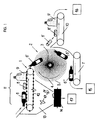
- the mixture of substances 11 is transferred directly to a sorting drum 2 via a feed device.
- the sorting drum 2 is driven by a shaft 3.
- bristles 4 are attached, which by the rotation of the shaft 3, respectively.
- the centrifugal force thereby acting is brought to a cylindrical shape 5.
- glass bottles 6 sink into the interior of the drum, as is shown with the bottle 6 'and 6' '.
- the bottle 6 ′′ is transferred below the sorting drum 1 to a discharge belt 7 for heavy goods 15 and is fed to a corresponding collector.
- the heavy goods 15 contain all bodies, which exert a large surface pressure on the sorting drum 2, such as glass bottles, full metal bodies or, for example. larger stones would also be excreted in the mixture of substances with the heavy fraction 15.
- the middle goods 16 contains all light hollow bodies such as aluminum cans and plastic bottles. Iron metal cans can be read out via magnetic separators, either before or after the sorting drum.
- a feeding device 1 designed as a bar chain grate conveyor 12 and fed to a collector for fines 17 via a funnel 13 and a belt conveyor 14.
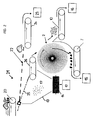
- FIG. 2 schematically shows a sorting device for container waste with components similar to household waste. Pre-classifying the raw material mixture is important for container waste.
- the raw material mixture is continuously transferred via a feed belt 20 to a screening system or a screening stage 21.
- An upper or preceding coarse screen 22 removes all parts, e.g. larger than river size or larger than 250 to 350 mm, e.g. large boulders, larger pieces of wood, etc.
- the overflow of the coarse screen 22 is discharged as coarse material 23 directly via a belt 24.
- Fine material 17 falls through the coarse sieve 22 as well as through a fine sieve 25 arranged underneath and is discharged via the funnel 13 and a belt conveyor 14.
- the middle fraction of the raw material mixture is transferred to an acceleration belt 26 as an overflow of the screening stage 21.
- an adjustable drive motor (not shown) so that the conveying speed of the mixture of substances in the region of the point of impact on the sorting drum 2 can be specifically selected.
- the acceleration belt 26, which can be operated independently of the pretreatment, in any case gives the possibility of a defined feeding of the mixture of substances to the sorting drum 2. It is also possible to attach additional alignment aids to the acceleration belt 26, so that at least the parts that are difficult to sort on in the optimal direction and position hit the sorting drum 2. Stones and the like as heavy goods 15 with a large surface pressure sink into the sorting drum 2 and are discharged downward via the discharge belt 7.
- Medium material 16 which mainly contains organic components, is discharged via the discharge belt 10.
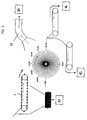
- FIG. 3 shows a further design idea.
- light goods 30, e.g. Pieces of paper, smallest pieces of plastic and the like are sucked off via an aspiration 31.
Landscapes
- Combined Means For Separation Of Solids (AREA)
- Processing Of Solid Wastes (AREA)
Abstract
Claims (13)
- Procédé pour la séparation écologique d'un mélange de matières (6, 8, 9), par ex. un mélange de matières recyclables, en composants individuels de différentes natures, le mélange de matières étant amené en continu vers un tambour (2) rotatif flexible vers l'intérieur par l'intermédiaire d'un dispositif d'alimentation (11) dans le même sens que le mouvement de surface du tambour (2),
caractérisé en ce que
le mélange de matières est alimenté de façon essentiellement tangentielle et dans la zone du sommet du tambour de tri (2) par l'intermédiaire du dispositif d'alimentation (11) à une vitesse égale à 10-30% de la vitesse périphérique du tambour de tri, de telle sorte que les composants du mélange de matières dont la densité est la plus élevée soient captés sélectivement de chaque côté de l'axe du tambour (3) par une dispersion dépendant de la densité. - Procédé suivant la revendication 1, caractérisé en ce que le tambour de tri (2) est configuré comme brosse à tambour centrifuge et que l'élasticité ou la pression superficielle résultante est déterminée par une sélection correspondante de la vitesse de rotation et/ou de l'équipement du tambour de tri (2) avec des poils de brosse (4), la brosse prenant une forme cylindrique en état de marche.
- Procédé suivant la revendication 1, caractérisé en ce qu'un système de criblage est placé en amont du tambour de tri (2).
- Procédé suivant l'une des revendications 1 à 3, caractérisé en ce qu'un courant d'air est produit par le tambour de tri (2) et utilisé pour séparer une fraction légère.
- Procédé suivant la revendication 1, caractérisé en ce que l'alimentation du mélange de matières dans une zone du sommet se fait entre les positions 11h00 et 14h00 du cadran d'une montre.
- Dispositif pour la séparation d'un mélange de matières (6, 8, 9) en différents composants de matières suivant le procédé conforme à l'une des revendications 1 à 5, avec un dispositif d'alimentation (11) pour l'alimentation continue du mélange de matières sur un tambour (2) rotatif flexible vers l'intérieur.
caractérisé en ce que
l'extrémité d'éjection du dispositif d'alimentation (11) est disposée sur la zone du sommet du tambour de tri (2) et que les moyens d'évacuation (7, 10) présentent respectivement des zones de réception pour les produits du tri, lesquels, vus depuis le dispositif d'alimentation, se trouvent de chaque côté de l'axe du tambour (3), de sorte que les éléments du mélange de matières qui présentent la densité la plus élevée puissent également être récupérés sélectivement de chaque côté de l'axe du tambour (3) par une dispersion dépendant de la densité. - Dispositif suivant la revendication 6, caractérisé en ce qu'une bande d'évacuation pour les produits légers (10) est disposée plus ou moins à hauteur de l'axe de rotation du tambour ou de l'arbre (3) et qu'une bande d'évacuation pour les produits lourds (7) est disposée dans le quadrant adjacent.
- Dispositif suivant la revendication 6, caractérisé en ce que le tambour de tri (2) est configuré comme brosse à tambour centrifuge et présente une forme cylindrique.
- Dispositif suivant l'une des revendications 7 ou 8, caractérisé en ce qu'un système de criblage est placé en amont du tambour de tri (2) pour séparer les tailles supérieures ou inférieures.
- Dispositif suivant l'une des revendications 6 à 9, caractérisé en ce que le dispositif d'alimentation (1) est configuré comme élément d'accélération du mélange de matières, de préférence avec une possibilité de libre sélection d'un sens d'alimentation et/ou d'une vitesse définis.
- Dispositif suivant l'une des revendications 6 à 10, caractérisé en ce que le dispositif d'alimentation (1) est configuré comme convoyeur à bande ou comme convoyeur à grilles à chaîne ou comme crible à barreaux fixe.
- Dispositif suivant l'une des revendications 6 à 11, caractérisé en ce que le dispositif d'alimentation (1) est configuré comme bande d'accélération (26) avec une vitesse de transport ou d'éjection de 0,5 à 2 m/sec, de préférence 1,2 à 1,5 m/sec, et une vitesse périphérique du tambour de tri (2) de 5 à 15 m/sec, de préférence 7 à 10 m/sec, pour un diamètre de 1 à 1,5 m.
- Utilisation d'une brosse à tambour centrifuge pour le tri de mélanges de matières prétriées de préférence par l'intermédiaire d'un tamis, comme par ex. les ordures de conteneurs et les produits rassemblés apparentés aux ordures ménagères, caractérisée en ce que la fraction lourde du mélange de matières contient essentiellement des éléments métalliques, minéraux et compacts, et la fraction légère du mélange de matières essentiellement des matières organiques et des matières légèrement métalliques.
Priority Applications (1)
| Application Number | Priority Date | Filing Date | Title |
|---|---|---|---|
| AT90910511T ATE100358T1 (de) | 1989-07-28 | 1990-07-26 | Verfahren und vorrichtung zum trennen eines stoffgemisches und verwendung der vorrichtung. |
Applications Claiming Priority (2)
| Application Number | Priority Date | Filing Date | Title |
|---|---|---|---|
| CH282389A CH677327A5 (fr) | 1989-07-28 | 1989-07-28 | |
| CH2823/89 | 1989-07-28 |
Publications (2)
| Publication Number | Publication Date |
|---|---|
| EP0436687A1 EP0436687A1 (fr) | 1991-07-17 |
| EP0436687B1 true EP0436687B1 (fr) | 1994-01-19 |
Family
ID=4242403
Family Applications (1)
| Application Number | Title | Priority Date | Filing Date |
|---|---|---|---|
| EP19900910511 Expired - Lifetime EP0436687B1 (fr) | 1989-07-28 | 1990-07-26 | Procede et dispositif pour la separation d'un melange de substances et utilisation de ce dispositif |
Country Status (7)
| Country | Link |
|---|---|
| EP (1) | EP0436687B1 (fr) |
| JP (1) | JPH04500776A (fr) |
| CA (1) | CA2027594A1 (fr) |
| CH (1) | CH677327A5 (fr) |
| DE (1) | DE59004338D1 (fr) |
| ES (1) | ES2049036T3 (fr) |
| WO (1) | WO1991001817A1 (fr) |
Families Citing this family (7)
| Publication number | Priority date | Publication date | Assignee | Title |
|---|---|---|---|---|
| US5116486A (en) * | 1991-02-01 | 1992-05-26 | Pederson Dennis A | Apparatus and method for separating recyclable waste |
| FR2737982B1 (fr) * | 1995-08-23 | 1998-12-31 | Boudet Daniel | Dispositif de tri de recipients, notamment de bouteilles, selon leur poids et leur dimension |
| CN106733671A (zh) * | 2017-03-20 | 2017-05-31 | 广西壮族自治区农业机械研究院 | 一种原料蔗除杂处理设备 |
| CN108816755A (zh) * | 2018-08-03 | 2018-11-16 | 北京宜城环保科技有限公司 | 一种用于处理垃圾的负压风选系统及负压风选方法 |
| DE102018122808A1 (de) * | 2018-09-18 | 2020-03-19 | Voith Patent Gmbh | Steuerverfahren einer Reinigungsvorrichtung mit Schwerteil-Abscheider |
| DE102019008916A1 (de) * | 2019-12-20 | 2021-06-24 | Ife Aufbereitungstechnik Gmbh | Vorrichtung und Verfahren zur Sichtung eines Materialien-Gemisches |
| WO2021121664A1 (fr) | 2019-12-20 | 2021-06-24 | Ife Aufbereitungstechnik Gmbh | Dispositif et procédé pour trier un mélange de matières |
Family Cites Families (3)
| Publication number | Priority date | Publication date | Assignee | Title |
|---|---|---|---|---|
| GB2010128B (en) * | 1977-09-27 | 1982-04-15 | Olesen R | Handling and treating of rootcrops |
| SE430761B (sv) * | 1980-04-30 | 1983-12-12 | Kmw Mekan Ab | Anordning for torr avskiljning av tyngre foremal i ett kontinuerligt flode av lett material |
| EP0174967B1 (fr) * | 1984-03-01 | 1989-11-15 | Maschinenfabrik Bezner GmbH & Co. KG | Installation de triage pour la recuperation de materiaux de valeur a partir d'ordures |
-
1989
- 1989-07-28 CH CH282389A patent/CH677327A5/de not_active IP Right Cessation
-
1990
- 1990-07-26 DE DE90910511T patent/DE59004338D1/de not_active Expired - Fee Related
- 1990-07-26 ES ES90910511T patent/ES2049036T3/es not_active Expired - Lifetime
- 1990-07-26 JP JP2509923A patent/JPH04500776A/ja active Pending
- 1990-07-26 EP EP19900910511 patent/EP0436687B1/fr not_active Expired - Lifetime
- 1990-07-26 WO PCT/CH1990/000181 patent/WO1991001817A1/fr not_active Ceased
- 1990-07-26 CA CA 2027594 patent/CA2027594A1/fr not_active Abandoned
Also Published As
| Publication number | Publication date |
|---|---|
| ES2049036T3 (es) | 1994-04-01 |
| JPH04500776A (ja) | 1992-02-13 |
| CH677327A5 (fr) | 1991-05-15 |
| CA2027594A1 (fr) | 1991-01-29 |
| EP0436687A1 (fr) | 1991-07-17 |
| DE59004338D1 (de) | 1994-03-03 |
| WO1991001817A1 (fr) | 1991-02-21 |
Similar Documents
| Publication | Publication Date | Title |
|---|---|---|
| DE69608152T2 (de) | Verfahren und System zur Wiederverwertung von Teppichen | |
| DE69308025T2 (de) | Vorrichtung und verfahren zum trennen von wiederverwertbarem material | |
| DE102014220330B4 (de) | Verfahren zur Aufbereitung von Kunststoffen und Vorrichtung | |
| DE3513696C2 (fr) | ||
| EP2411196B1 (fr) | Procédé de recyclage pour déchets électroniques destiné à récupérer des matières revalorisables en évitant de libérer des substances nocives | |
| EP0174967A1 (fr) | Installation de triage pour la recuperation de materiaux de valeur a partir d'ordures. | |
| DE2800283A1 (de) | Siebtrommel zum sortieren von wiederverwertbarem verpackungsmaterial | |
| DE69934183T2 (de) | Verfahren zur Herstellung von Glassand und System dafür | |
| EP0243819B1 (fr) | Procédé et dispositif pour fractionner un mélange hétérogène de matières solides | |
| DE69523331T2 (de) | Vorrichtung zum sieben von partikeln | |
| DE3919610C2 (fr) | ||
| EP0148375A2 (fr) | Dispositif pour successivement déchirer des sacs contenant des déchets et tamiser les déchets | |
| DE19510923B4 (de) | Verfahren und Einrichtung zum Trennen eines bei der Aufarbeitung von Verbundwerkstoffteilen anfallenden Partikelgemisches in mindestens zwei Partikelfraktionen | |
| EP0123825B1 (fr) | Installation de triage notamment pour extraire des produits de valeur des déchets ménagers, industriels, encombrants, secs et/ou des matières dangereuses et posant un problème | |
| WO1991001817A1 (fr) | Procede et dispositif pour la separation d'un melange de substances et utilisation de ce dispositif | |
| DE19545240A1 (de) | Verfahren und Vorrichtung zum Trennen von Materialgemischen nach der Sorte | |
| DE3238742C2 (fr) | ||
| EP1188491B1 (fr) | Procédé pour séparer un mélange de plastiques d'un mélange de déchets et dispositif de tri de déchets | |
| DE4310862C2 (de) | Verfahren zur Batteriesortierung | |
| DE19932480C1 (de) | Trennanlage und Verfahren zur Auftrennung einer NE-Metalle enthaltenden Fraktion aus einer Elektrikschrottaufbereitung | |
| DE3907445C2 (fr) | ||
| DE19629110C1 (de) | Verfahren und Vorrichtung zum Trennen von feinteiligen Stoffgemischen mittels eines magnetischen Feldes | |
| DE102007040225A1 (de) | Verfahren und Anlage zur Gewinnung von Metallteilen aus Rückständen von Müllverbrennungsprozessen | |
| DE9204985U1 (de) | Vorrichtung zum Sortieren der wiederverwendbaren Wertstoffe von Kunststoff- und Verbundabfällen im dualen Entsorgungssystem | |
| DE3804190A1 (de) | Vorrichtung zum klassieren eines stroms von partikeln und verwendung der vorrichtung |
Legal Events
| Date | Code | Title | Description |
|---|---|---|---|
| PUAI | Public reference made under article 153(3) epc to a published international application that has entered the european phase |
Free format text: ORIGINAL CODE: 0009012 |
|
| 17P | Request for examination filed |
Effective date: 19910111 |
|
| AK | Designated contracting states |
Kind code of ref document: A1 Designated state(s): AT BE CH DE ES FR GB IT LI NL SE |
|
| 17Q | First examination report despatched |
Effective date: 19920722 |
|
| ITF | It: translation for a ep patent filed | ||
| GRAA | (expected) grant |
Free format text: ORIGINAL CODE: 0009210 |
|
| AK | Designated contracting states |
Kind code of ref document: B1 Designated state(s): AT BE CH DE ES FR GB IT LI NL SE |
|
| REF | Corresponds to: |
Ref document number: 100358 Country of ref document: AT Date of ref document: 19940215 Kind code of ref document: T |
|
| REF | Corresponds to: |
Ref document number: 59004338 Country of ref document: DE Date of ref document: 19940303 |
|
| ET | Fr: translation filed | ||
| GBT | Gb: translation of ep patent filed (gb section 77(6)(a)/1977) |
Effective date: 19940224 |
|
| REG | Reference to a national code |
Ref country code: ES Ref legal event code: FG2A Ref document number: 2049036 Country of ref document: ES Kind code of ref document: T3 |
|
| PLBE | No opposition filed within time limit |
Free format text: ORIGINAL CODE: 0009261 |
|
| STAA | Information on the status of an ep patent application or granted ep patent |
Free format text: STATUS: NO OPPOSITION FILED WITHIN TIME LIMIT |
|
| 26N | No opposition filed | ||
| EAL | Se: european patent in force in sweden |
Ref document number: 90910511.6 |
|
| PGFP | Annual fee paid to national office [announced via postgrant information from national office to epo] |
Ref country code: CH Payment date: 19950609 Year of fee payment: 6 |
|
| PGFP | Annual fee paid to national office [announced via postgrant information from national office to epo] |
Ref country code: GB Payment date: 19950615 Year of fee payment: 6 Ref country code: BE Payment date: 19950615 Year of fee payment: 6 |
|
| PGFP | Annual fee paid to national office [announced via postgrant information from national office to epo] |
Ref country code: AT Payment date: 19950620 Year of fee payment: 6 |
|
| PGFP | Annual fee paid to national office [announced via postgrant information from national office to epo] |
Ref country code: FR Payment date: 19950621 Year of fee payment: 6 |
|
| PGFP | Annual fee paid to national office [announced via postgrant information from national office to epo] |
Ref country code: SE Payment date: 19950626 Year of fee payment: 6 |
|
| PGFP | Annual fee paid to national office [announced via postgrant information from national office to epo] |
Ref country code: NL Payment date: 19950629 Year of fee payment: 6 |
|
| PGFP | Annual fee paid to national office [announced via postgrant information from national office to epo] |
Ref country code: ES Payment date: 19950720 Year of fee payment: 6 |
|
| PGFP | Annual fee paid to national office [announced via postgrant information from national office to epo] |
Ref country code: DE Payment date: 19950728 Year of fee payment: 6 |
|
| REG | Reference to a national code |
Ref country code: FR Ref legal event code: CL |
|
| PG25 | Lapsed in a contracting state [announced via postgrant information from national office to epo] |
Ref country code: GB Effective date: 19960726 Ref country code: AT Effective date: 19960726 |
|
| PG25 | Lapsed in a contracting state [announced via postgrant information from national office to epo] |
Ref country code: SE Effective date: 19960727 Ref country code: ES Free format text: LAPSE BECAUSE OF THE APPLICANT RENOUNCES Effective date: 19960727 |
|
| PG25 | Lapsed in a contracting state [announced via postgrant information from national office to epo] |
Ref country code: LI Effective date: 19960731 Ref country code: CH Effective date: 19960731 Ref country code: BE Effective date: 19960731 |
|
| BERE | Be: lapsed |
Owner name: BUHLER A.G. Effective date: 19960731 |
|
| PG25 | Lapsed in a contracting state [announced via postgrant information from national office to epo] |
Ref country code: NL Effective date: 19970201 |
|
| REG | Reference to a national code |
Ref country code: CH Ref legal event code: PL |
|
| GBPC | Gb: european patent ceased through non-payment of renewal fee |
Effective date: 19960726 |
|
| PG25 | Lapsed in a contracting state [announced via postgrant information from national office to epo] |
Ref country code: FR Effective date: 19970328 |
|
| NLV4 | Nl: lapsed or anulled due to non-payment of the annual fee |
Effective date: 19970201 |
|
| PG25 | Lapsed in a contracting state [announced via postgrant information from national office to epo] |
Ref country code: DE Effective date: 19970402 |
|
| EUG | Se: european patent has lapsed |
Ref document number: 90910511.6 |
|
| REG | Reference to a national code |
Ref country code: FR Ref legal event code: ST |
|
| REG | Reference to a national code |
Ref country code: ES Ref legal event code: FD2A Effective date: 19991007 |
|
| PG25 | Lapsed in a contracting state [announced via postgrant information from national office to epo] |
Ref country code: IT Free format text: LAPSE BECAUSE OF NON-PAYMENT OF DUE FEES;WARNING: LAPSES OF ITALIAN PATENTS WITH EFFECTIVE DATE BEFORE 2007 MAY HAVE OCCURRED AT ANY TIME BEFORE 2007. THE CORRECT EFFECTIVE DATE MAY BE DIFFERENT FROM THE ONE RECORDED. Effective date: 20050726 |