EP0437072A1 - Punkt-zu-Mehrpunkt-TDM/TDMA-Kommunikationssystem mit paketbasierter Rahmenstruktur - Google Patents
Punkt-zu-Mehrpunkt-TDM/TDMA-Kommunikationssystem mit paketbasierter Rahmenstruktur Download PDFInfo
- Publication number
- EP0437072A1 EP0437072A1 EP90313942A EP90313942A EP0437072A1 EP 0437072 A1 EP0437072 A1 EP 0437072A1 EP 90313942 A EP90313942 A EP 90313942A EP 90313942 A EP90313942 A EP 90313942A EP 0437072 A1 EP0437072 A1 EP 0437072A1
- Authority
- EP
- European Patent Office
- Prior art keywords
- packet
- field
- basestation
- outstation
- communication channel
- Prior art date
- Legal status (The legal status is an assumption and is not a legal conclusion. Google has not performed a legal analysis and makes no representation as to the accuracy of the status listed.)
- Withdrawn
Links
- 230000006854 communication Effects 0.000 title claims abstract description 26
- 238000004891 communication Methods 0.000 title claims abstract description 26
- 230000007175 bidirectional communication Effects 0.000 claims abstract description 4
- 230000005540 biological transmission Effects 0.000 claims description 15
- 230000004044 response Effects 0.000 claims description 6
- 239000013307 optical fiber Substances 0.000 claims description 3
- 125000004122 cyclic group Chemical group 0.000 claims description 2
- 238000012544 monitoring process Methods 0.000 claims description 2
- 230000001934 delay Effects 0.000 abstract description 3
- 238000011144 upstream manufacturing Methods 0.000 description 8
- 230000003287 optical effect Effects 0.000 description 4
- 238000010586 diagram Methods 0.000 description 3
- 230000006870 function Effects 0.000 description 2
- 230000008859 change Effects 0.000 description 1
- 230000009977 dual effect Effects 0.000 description 1
- 230000000694 effects Effects 0.000 description 1
- 239000000835 fiber Substances 0.000 description 1
- 230000003993 interaction Effects 0.000 description 1
- 230000000873 masking effect Effects 0.000 description 1
- 230000007246 mechanism Effects 0.000 description 1
- 238000000034 method Methods 0.000 description 1
- 238000011084 recovery Methods 0.000 description 1
- 230000011664 signaling Effects 0.000 description 1
- 238000004513 sizing Methods 0.000 description 1
- 230000001360 synchronised effect Effects 0.000 description 1
Images


Classifications
-
- H—ELECTRICITY
- H04—ELECTRIC COMMUNICATION TECHNIQUE
- H04B—TRANSMISSION
- H04B10/00—Transmission systems employing electromagnetic waves other than radio-waves, e.g. infrared, visible or ultraviolet light, or employing corpuscular radiation, e.g. quantum communication
- H04B10/27—Arrangements for networking
- H04B10/272—Star-type networks or tree-type networks
-
- H—ELECTRICITY
- H04—ELECTRIC COMMUNICATION TECHNIQUE
- H04J—MULTIPLEX COMMUNICATION
- H04J3/00—Time-division multiplex systems
- H04J3/16—Time-division multiplex systems in which the time allocation to individual channels within a transmission cycle is variable, e.g. to accommodate varying complexity of signals, to vary number of channels transmitted
- H04J3/1694—Allocation of channels in TDM/TDMA networks, e.g. distributed multiplexers
-
- H—ELECTRICITY
- H04—ELECTRIC COMMUNICATION TECHNIQUE
- H04L—TRANSMISSION OF DIGITAL INFORMATION, e.g. TELEGRAPHIC COMMUNICATION
- H04L12/00—Data switching networks
- H04L12/28—Data switching networks characterised by path configuration, e.g. LAN [Local Area Networks] or WAN [Wide Area Networks]
Definitions
- This invention relates to telecommunications systems and in particular to a packet-based frame structure for use therein, especially in a TDM/TDMA network.
- TDM time-division multiplexing
- TDMA time-division multiple access
- TDM time-division multiplexing
- TDMA time-division multiple access
- One example of such a network is referred to as TPON (Telephony over a Passive Optical Network).
- TPON Telephony over a Passive Optical Network
- the number of subscribers which can be served by a passive distribution network is typically 128.
- the present invention aims to provide a frame structure which allows higher numbers, typically 400, of subscribers to be served in a street or business TPON environment than hitherto.
- each frame including a plurality of spaced apart packets capable of carrying traffic data, and wherein each said packet includes a communication channel field which is employed for conveying messages at least for system configuration purposes.
- a packet-based frame structure for use in communications systems including a base station and a plurality of outstations connected by a point-to-multipoint network and for transmission in both directions between the base station and the outstations, each frame comprising a plurality of spaced apart packets capable of carrying traffic data, and wherein each said packet includes a communication channel field which is employed for conveying messages between the base station and each outstation independently, and vice versa, at least for network configuration purposes.
- a point-to-multipoint TDM/TDMA communications network including a base station and a plurality of outstations and employing a packet-based frame structure, for transmission in both directions therebetween, wherein the frame structure is formatted at the base station, each frame comprising a plurality of spaced apart packets capable of carrying traffic data, wherein each said packet includes a communications channel (COM) field, which fields together provide a fixed capacity, bidirectional communication channel between the base station and each outstation independently at least for network configuration purposes, and wherein each outstation includes intelligence means for interpreting and responding to messages received over the communication channel.
- COM communications channel
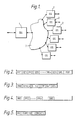
- a network node also referred to as a base station (BS) and a plurality (n) of customer nodes 2, also referred to as outstations (OS) coupled together by a point-to-multipoint network 3, such as a passive fibre optic network.
- BS base station
- OS outstations
- a TDM/TDMA network is assumed for this description, i.e. transmission in the direction from the base station BS 1 to the outstation 2 employs TDM, whereas transmission in the direction from the outstations 2 to the base station 1 employs TDMA.
- Two related frame structures are required; one from BS to OS (downstream) and one from OS to BS (upstream).
- Each downstream (broadcast) frame may be constructed as shown in Fig 2.
- the frame consists of n packets of data (PK1 to PKn), which packets are separated by a short guard space GDS.
- a skeleton packet (SKL) is appended after the final data packet-guard space sequence.
- the skeleton packet is used for system configuration.
- the remainder of the frame is filled with "frame fill" characters (FRF).
- FFF "frame fill" characters
- Each packet can be constructed as in Fig 3 and thus includes a preamble field (PRE), a synchronisation word field (SYN), an address field (ADD), a size of data field (SIZ), a communication channel field (COM), a user data field (DAT) and an end of packet delimiter field (EDL).
- the SIZ field determines the size of the packet and hence the capacity allocated to the receiving node. If an SIZ field is not included then the packet size can be deduced at the outstation by detecting the end delimiter EDL. In order that single or burst errors do not corrupt either the addressing or packet size information, error correcting codes are used.
- Fuzzy matching techniques can be used to enable recognition of the start of a packet even when there is a high error rate over the transmission medium.
- fuzzy matching sequences within a certain Hamming distance of a given code are deemed to be the start of packets.
- the data field is checked by a CRC (cyclic redundancy check) which allows channel performance monitoring, i.e. by including a CRC field in the frame structure.
- CRC cyclic redundancy check
- the COM field is the key to the system flexibility. This field provides a fixed-capacity, bidirectional communication channel between the base station BS and each outstation OS independently.
- a messaging protocol such as HDLC (high level data link control) is used to convey messages between the base station BS 1 and OS 2. It is these messages that contain information such as OS packet size requirements, settings for OS programmable delays, security measures (such as PIN numbers) and configuration messages.
- a marshalling protocol is employed. This provides compensation for varying propagation delays between the outstations and the base station and has the effect of ensuring that there is a minimum gap between upstream packets despite the outstations being at various distances from the base station.
- the mechanism for implementing this is to provide a programmable delay function at each outstation, which is programmed via the COM channel to equalise the total round-trip delay of each outstation as seen at the base station.
- the skeleton packet structure is illustrated in Fig 5. It includes a preamble field (PRE), a synchronisation word field (SYN), a skeleton identification (SID), a communications channel field (COM) and an end delimiter field (EDL).
- PRE preamble field
- SYN synchronisation word field
- SID skeleton identification
- COM communications channel field
- EDL end delimiter field
- each outstation 2 seeks to set up packet traffic by seizing the skeleton packet.
- the position of the outstation response to the skeleton packet i.e. the position of SRE, is measured at the base station 1 and the delay set appropriately by sending a message to the outstation via the COM channel.
- the base station may detect a collision, in which case the competing outstations are instructed to try again after a respective random time. If the base station fails to detect a collision, the response from one outstation masking the response from others, a dialogue will commence between the base station and the successful outstation. This dialogue is also received by the outstations which failed to make contact. The unsuccessful outstations then have to wait for a respective random time before trying again.
- the downstream frame structure is defined by the base station. Because the outstations simply respond when addressed, this also dictates the format of the upstream traffic.
- the only intelligence required at an outstation, which is thus of a simple design, is that which is needed to interpret the COM channel messages and set a programmable delay.
- the bulk of the system complexity is concentrated at the base station. This means that the cost per outstation is minimised.
- the network controller (base station) can reallocate capacity on a frame-by-frame basis. This allows time-of-day switching, network reconfiguration to be performed with ease together with matching network capacity allocation to customer requirements. Thus flexibility of operation is provided.
- each packet data payload can be individually encoded using PIN numbers that correspond to each outstation.
- PIN numbers that correspond to each outstation.
- broadcast services could be transmitted in the GDS and FRF areas to further utilise the downstream transmission bandwidth. Any interaction with these services could be handled through the COM channel.
- Figs 6 and 7 indicate, respectively, functional block diagrams of a base station and an outstation.
- the base station which comprises a control block 20, a network interface 21, a channel assignment table 22, a dual port memory 23, an outstation PIN number store 24, a data encryption block 25, an HDLC interface 26, a packet assembler 27, a packet dis-assembler 28, a transmission performance monitor 29, and an electro-optics interface 30.
- An optical fibre 31 couples the basestation to a passive optical network including passive optical coupler (POC) 32 and thence to the outstations.
- POC passive optical coupler
- an electro-optics interface 34 includes an electro-optics interface 34, a packet dis-assembler 35, packet assembler 36, transmission performance monitor 37, a controller (microcontroller) 38, an HDLC interface 39, data decipher block 40, channel assignment table 41, line card interface 42 and subscribers 43 connected thereto.
- the number of functional blocks at an outstation which are specifically for the proposed frame structure are relatively small.
- the microcontroller 38 and the HDLC interface 39 are present whatever the structure, as are elements like the transmission performance monitor 37, the packet assembler 36 and packet dis-assembler 35 and the interfaces 34 and 42. This leaves a few relatively straightforward blocks of logic to perform the other functions, namely data decipher and channel assignment.
- Each outstation basically only has to know its own deciphering system.
- the complexity is at the basestation, which is shared amongst the outstations.
- the formatting of the frames is performed at the basestation.
- the complexity is at the control block 20 which interacts with the packet assembler 27.
- the packet assembler 27 of the basestation works together with the packet dis-assembler of the outstations such as 35, across the passive optical network, as do the assemblers 36 and the dis-assembler 28.
- the way in which the packets are assembled is under the control of the control block 20.
- Data is encrypted at 25 in accordance with the appropriate outstation PIN provided by store 24, switching to a different encryption scheme for each outstation; store 24 instructing data encryption block 25 to switch to different encryption schemes for different outstations.
- the PIN numbers can be changed, if required, at the outstation, for example a sequence of PIN numbers may be required in order to maintain security.
- control block 20 supplies signalling and network management information to the network interface 21 and controls the channel assignment via table 22.
- the frame structure described above could be applied over point-to-point links, when applied to TDM/TDMA networks (point-to-multipoint links) advantages are obtained which conventional frame structures have not been able to provide.
- the proposed frame structure allows a simple network configuration with minimal complexity required at the customer nodes (outstations), allows secure communication in the broadcast network to be simply implemented and allows flexible allocation of capacity (transmission bandwidth) in the network. It is not necessary for each frame to include a skeleton packet. In fact increased efficiency results if skeleton packets are present in only some of the frames.
- the frame structure is suitable for being line coded i.e. 4B/5B similar to FDDI.
- the transmission bit rate is set at 40.96MBit/s and the frame period at 500 us.
- the packet structure described above allows trade offs between total network channel capacity, number of active outstations, and variability in outstation distance.
- the following table gives examples of system configuration options:
Landscapes
- Engineering & Computer Science (AREA)
- Computer Networks & Wireless Communication (AREA)
- Signal Processing (AREA)
- Computing Systems (AREA)
- Physics & Mathematics (AREA)
- Electromagnetism (AREA)
- Data Exchanges In Wide-Area Networks (AREA)
- Time-Division Multiplex Systems (AREA)
Applications Claiming Priority (2)
| Application Number | Priority Date | Filing Date | Title |
|---|---|---|---|
| GB9000605A GB2240011B (en) | 1990-01-11 | 1990-01-11 | Telecommunications systems |
| GB9000605 | 1990-01-11 |
Publications (1)
| Publication Number | Publication Date |
|---|---|
| EP0437072A1 true EP0437072A1 (de) | 1991-07-17 |
Family
ID=10669122
Family Applications (1)
| Application Number | Title | Priority Date | Filing Date |
|---|---|---|---|
| EP90313942A Withdrawn EP0437072A1 (de) | 1990-01-11 | 1990-12-19 | Punkt-zu-Mehrpunkt-TDM/TDMA-Kommunikationssystem mit paketbasierter Rahmenstruktur |
Country Status (3)
| Country | Link |
|---|---|
| EP (1) | EP0437072A1 (de) |
| GB (1) | GB2240011B (de) |
| IE (2) | IE904659A1 (de) |
Cited By (13)
| Publication number | Priority date | Publication date | Assignee | Title |
|---|---|---|---|---|
| EP0544975A1 (de) * | 1991-12-05 | 1993-06-09 | ALCATEL BELL Naamloze Vennootschap | Verwaltungssystem von Zeitschlitzen |
| GB2291299A (en) * | 1994-07-07 | 1996-01-17 | Plessey Telecomm | Telecommunications network |
| WO1996022641A3 (en) * | 1995-01-19 | 1997-01-16 | Starburst Communications Corp | Network multicasting method using arq techniques for preventing unnecessary retransmissions |
| US5872645A (en) * | 1994-07-07 | 1999-02-16 | Gpt Limited | Telecommunications network |
| EP0903954A1 (de) * | 1993-04-23 | 1999-03-24 | KE KOMMUNIKATIONS-ELEKTRONIK GMBH & CO | Anordnung zur leitungsgebundenen digitalen Nachrichtenübertragung |
| GB2316252B (en) * | 1996-08-03 | 2001-05-16 | Gpt Ltd | Telecommunications network |
| US6289012B1 (en) | 1998-08-03 | 2001-09-11 | Instanton Corporation | High concurrency data download apparatus and method |
| US6453438B1 (en) | 1995-01-19 | 2002-09-17 | The Fantastic Corporation | System and method for automatically rescheduling a data transmission to members of a group |
| US6625652B1 (en) | 1995-01-19 | 2003-09-23 | The Fantastic Corporation | System and method for host list pruning |
| US6873627B1 (en) | 1995-01-19 | 2005-03-29 | The Fantastic Corporation | System and method for sending packets over a computer network |
| EP1860804A1 (de) * | 2006-05-23 | 2007-11-28 | Alcatel Lucent | Vorbehandelungsverfahren zur Gewinnregelung eines Verstärkers, optisches Zugangsnetz, Zentralstation und Endstation |
| CN109561396A (zh) * | 2018-12-13 | 2019-04-02 | 浙江天则通信技术有限公司 | 一种用于机器人的数据传输系统 |
| US11962515B2 (en) | 2022-02-28 | 2024-04-16 | Nokia Solutions And Networks Oy | Deterministic communications via packet-switched networks |
Citations (3)
| Publication number | Priority date | Publication date | Assignee | Title |
|---|---|---|---|---|
| EP0100662A2 (de) * | 1982-08-02 | 1984-02-15 | Ashraf M. Dahod | Digitales Übertragungssystem |
| WO1988005233A1 (en) * | 1987-01-05 | 1988-07-14 | British Telecommunications Public Limited Company | Optical communications network |
| EP0337619A1 (de) * | 1988-03-24 | 1989-10-18 | BRITISH TELECOMMUNICATIONS public limited company | Kommunikationssystem |
-
1990
- 1990-01-11 GB GB9000605A patent/GB2240011B/en not_active Expired - Fee Related
- 1990-12-19 EP EP90313942A patent/EP0437072A1/de not_active Withdrawn
- 1990-12-21 IE IE465990A patent/IE904659A1/en unknown
-
1991
- 1991-01-08 IE IE005591A patent/IE910055A1/en unknown
Patent Citations (3)
| Publication number | Priority date | Publication date | Assignee | Title |
|---|---|---|---|---|
| EP0100662A2 (de) * | 1982-08-02 | 1984-02-15 | Ashraf M. Dahod | Digitales Übertragungssystem |
| WO1988005233A1 (en) * | 1987-01-05 | 1988-07-14 | British Telecommunications Public Limited Company | Optical communications network |
| EP0337619A1 (de) * | 1988-03-24 | 1989-10-18 | BRITISH TELECOMMUNICATIONS public limited company | Kommunikationssystem |
Non-Patent Citations (2)
| Title |
|---|
| INTERNATIONAL CONFERENCE ON COMMUNICATIONS '84 May 1984, IEEE New York(US) pages 959 - 964; M.T.HEWITT et al.: "A COST EFFECTIVE 19GHz DIGITAL MULTIPOINT RADIO SYSTEM FOR LOCAL DISTRIBUTION APPLICATIONS" * |
| INTERNATIONAL CONFERENCE ON COMMUNICATIONS '86 June 1986, IEEE New York(US) pages 1748 - 1752; T.LE-NGOC: "SR500 - A POINT-TO-MULTIPOINT DIGITAL RADIO SYSTEM" * |
Cited By (23)
| Publication number | Priority date | Publication date | Assignee | Title |
|---|---|---|---|---|
| US5353285A (en) * | 1991-12-05 | 1994-10-04 | Alcatel N.V. | Time slot management system |
| EP0544975A1 (de) * | 1991-12-05 | 1993-06-09 | ALCATEL BELL Naamloze Vennootschap | Verwaltungssystem von Zeitschlitzen |
| EP0903954A1 (de) * | 1993-04-23 | 1999-03-24 | KE KOMMUNIKATIONS-ELEKTRONIK GMBH & CO | Anordnung zur leitungsgebundenen digitalen Nachrichtenübertragung |
| US5872645A (en) * | 1994-07-07 | 1999-02-16 | Gpt Limited | Telecommunications network |
| GB2291299A (en) * | 1994-07-07 | 1996-01-17 | Plessey Telecomm | Telecommunications network |
| GB2291299B (en) * | 1994-07-07 | 1998-09-16 | Plessey Telecomm | Telecommunications network |
| US6151696A (en) * | 1995-01-19 | 2000-11-21 | Starburst Communications Corporation | Data transmission |
| US5727002A (en) * | 1995-01-19 | 1998-03-10 | Starburst Communications Corporation | Methods for transmitting data |
| US7710961B2 (en) | 1995-01-19 | 2010-05-04 | Miller C Kenneth | System and method for sending packets over a computer network |
| WO1996022641A3 (en) * | 1995-01-19 | 1997-01-16 | Starburst Communications Corp | Network multicasting method using arq techniques for preventing unnecessary retransmissions |
| EP1128591A3 (de) * | 1995-01-19 | 2002-03-06 | The Fantastic Corporation | Methode zur Mehrfachaussendung in Netzwerken mit ARQ zur Vermeidung unnötiger Wiederholungsübertragungen |
| US6453438B1 (en) | 1995-01-19 | 2002-09-17 | The Fantastic Corporation | System and method for automatically rescheduling a data transmission to members of a group |
| US6625652B1 (en) | 1995-01-19 | 2003-09-23 | The Fantastic Corporation | System and method for host list pruning |
| US6873627B1 (en) | 1995-01-19 | 2005-03-29 | The Fantastic Corporation | System and method for sending packets over a computer network |
| US8081629B2 (en) | 1995-01-19 | 2011-12-20 | Darby & Mohaine, L.L.C. | System and method for sending packets over a computer network |
| GB2316252B (en) * | 1996-08-03 | 2001-05-16 | Gpt Ltd | Telecommunications network |
| US6289012B1 (en) | 1998-08-03 | 2001-09-11 | Instanton Corporation | High concurrency data download apparatus and method |
| WO2007135150A1 (en) * | 2006-05-23 | 2007-11-29 | Alcatel Lucent | Pre-conditioning method for an amplifier gain control and corresponding optical access network, central station and terminal |
| EP1860804A1 (de) * | 2006-05-23 | 2007-11-28 | Alcatel Lucent | Vorbehandelungsverfahren zur Gewinnregelung eines Verstärkers, optisches Zugangsnetz, Zentralstation und Endstation |
| US8213796B2 (en) | 2006-05-23 | 2012-07-03 | Alcatel Lucent | Method as a pre-condition for a gain control, optical access network, central station and terminal |
| CN109561396A (zh) * | 2018-12-13 | 2019-04-02 | 浙江天则通信技术有限公司 | 一种用于机器人的数据传输系统 |
| CN109561396B (zh) * | 2018-12-13 | 2021-03-02 | 浙江天则通信技术有限公司 | 一种用于机器人的数据传输系统 |
| US11962515B2 (en) | 2022-02-28 | 2024-04-16 | Nokia Solutions And Networks Oy | Deterministic communications via packet-switched networks |
Also Published As
| Publication number | Publication date |
|---|---|
| GB9000605D0 (en) | 1990-03-14 |
| GB2240011B (en) | 1994-01-19 |
| IE904659A1 (en) | 1991-07-17 |
| IE910055A1 (en) | 1991-07-17 |
| GB2240011A (en) | 1991-07-17 |
Similar Documents
| Publication | Publication Date | Title |
|---|---|---|
| US6697374B1 (en) | Optical network communication system | |
| AU709237B2 (en) | Network protocol for wireless broadband ISDN using ATM | |
| EP0281334B1 (de) | Drahtloses Netzwerk für Innenraum-Breitbandkommunikation | |
| US6498667B1 (en) | Method and system for packet transmission over passive optical network | |
| US6151312A (en) | Network protocol for wireless broadband-ISDN using ATM | |
| US7457298B2 (en) | Local area network with a bridge terminal for transmitting data between a plurality of sub-networks | |
| CN1086899C (zh) | 用于语音和数据传输的蜂窝式移动无线电网络中按包数据业务的数据包传输方法 | |
| EP0781495B1 (de) | Steuernachrichtenübertragung in digitaler telefonie | |
| JPH08331092A (ja) | Tdma管理方法、およびこの方法を実行するための中央ステーション、端末ステーション、およびネットワークシステム | |
| PL177435B1 (pl) | Sposób pakietowego przesyłania danych w ruchomej sieci radiokomunikacyjnej | |
| IE904659A1 (en) | Telecommunications systems | |
| JP2004528784A (ja) | 可変長パケット及び可変長上り方向の時間スロットを利用するポイントツーマルチポイント受動光ネットワーク | |
| US6351469B1 (en) | Sound/data sharing communications system | |
| JP3621428B2 (ja) | パケット送信方法、パケット送信装置、無線フレーム伝送方法、移動体通信方法、移動体通信システム、および交換局 | |
| US6411629B1 (en) | Data interleaving method | |
| JPWO1999014905A1 (ja) | パケット送信方法、パケット送信装置、無線フレーム伝送方法、移動体通信方法、移動体通信システム、および交換局 | |
| EP0691760A2 (de) | Multiplexing in einem passiven optischen Netzwerk | |
| EP1107620B1 (de) | Mehrfach-Abfragesystem für GPRS | |
| US9854338B2 (en) | Timeslot management method, a related network terminator, a related line terminator and an upstream signal frame structure for a time division multiple access system | |
| JP2001016179A (ja) | 運ばれる様々な種類のトラフィックの要件を考慮した伝送システムと、対応する送信機および受信機 | |
| US20050220149A1 (en) | Method to divide upstream timeslots in a time division multiple access system, related line terminator and related network terminator | |
| CN113765615B (zh) | Cpri接口的时分通信系统 | |
| JPH07118674B2 (ja) | 通信方式 | |
| CN122073656A (zh) | 无源光网络的设备共存方法及无源光网络系统 | |
| KR20010062250A (ko) | 데이터 송신 시스템, 기지국 및 위성국 |
Legal Events
| Date | Code | Title | Description |
|---|---|---|---|
| PUAI | Public reference made under article 153(3) epc to a published international application that has entered the european phase |
Free format text: ORIGINAL CODE: 0009012 |
|
| AK | Designated contracting states |
Kind code of ref document: A1 Designated state(s): DE ES FR IT |
|
| 17P | Request for examination filed |
Effective date: 19910815 |
|
| 17Q | First examination report despatched |
Effective date: 19930908 |
|
| STAA | Information on the status of an ep patent application or granted ep patent |
Free format text: STATUS: THE APPLICATION IS DEEMED TO BE WITHDRAWN |
|
| 18D | Application deemed to be withdrawn |
Effective date: 19940119 |