EP0437256A2 - Système de blocage d'identification automatique de numéro d'appel - Google Patents
Système de blocage d'identification automatique de numéro d'appel Download PDFInfo
- Publication number
- EP0437256A2 EP0437256A2 EP91100250A EP91100250A EP0437256A2 EP 0437256 A2 EP0437256 A2 EP 0437256A2 EP 91100250 A EP91100250 A EP 91100250A EP 91100250 A EP91100250 A EP 91100250A EP 0437256 A2 EP0437256 A2 EP 0437256A2
- Authority
- EP
- European Patent Office
- Prior art keywords
- calling party
- called party
- line interface
- network line
- call
- Prior art date
- Legal status (The legal status is an assumption and is not a legal conclusion. Google has not performed a legal analysis and makes no representation as to the accuracy of the status listed.)
- Ceased
Links
Images

Classifications
-
- H—ELECTRICITY
- H04—ELECTRIC COMMUNICATION TECHNIQUE
- H04M—TELEPHONIC COMMUNICATION
- H04M3/00—Automatic or semi-automatic exchanges
- H04M3/42—Systems providing special services or facilities to subscribers
-
- H—ELECTRICITY
- H04—ELECTRIC COMMUNICATION TECHNIQUE
- H04M—TELEPHONIC COMMUNICATION
- H04M1/00—Substation equipment, e.g. for use by subscribers
- H04M1/66—Substation equipment, e.g. for use by subscribers with means for preventing unauthorised or fraudulent calling
-
- H—ELECTRICITY
- H04—ELECTRIC COMMUNICATION TECHNIQUE
- H04Q—SELECTING
- H04Q3/00—Selecting arrangements
- H04Q3/72—Finding out and indicating number of calling subscriber
-
- B—PERFORMING OPERATIONS; TRANSPORTING
- B65—CONVEYING; PACKING; STORING; HANDLING THIN OR FILAMENTARY MATERIAL
- B65D—CONTAINERS FOR STORAGE OR TRANSPORT OF ARTICLES OR MATERIALS, e.g. BAGS, BARRELS, BOTTLES, BOXES, CANS, CARTONS, CRATES, DRUMS, JARS, TANKS, HOPPERS, FORWARDING CONTAINERS; ACCESSORIES, CLOSURES, OR FITTINGS THEREFOR; PACKAGING ELEMENTS; PACKAGES
- B65D2571/00—Bundles of articles held together by packaging elements for convenience of storage or transport, e.g. portable segregating carrier for plural receptacles such as beer cans, pop bottles; Bales of material
- B65D2571/00006—Palletisable loads, i.e. loads intended to be transported by means of a fork-lift truck
- B65D2571/00012—Bundles surrounded by a film
- B65D2571/00018—Bundles surrounded by a film under tension
- B65D2571/0003—Mechanical characteristics of the stretch film
-
- H—ELECTRICITY
- H04—ELECTRIC COMMUNICATION TECHNIQUE
- H04M—TELEPHONIC COMMUNICATION
- H04M1/00—Substation equipment, e.g. for use by subscribers
- H04M1/57—Arrangements for indicating or recording the number of the calling subscriber at the called subscriber's set
- H04M1/571—Blocking transmission of caller identification to called party
Definitions
- the present invention pertains to an automated telephone communications system for use in telephone communications environments and, in particular, for use in telephone communications environments wherein origination information, for example, calling party identification in the form of automatic number identification (ANI), is signalled; the automated telephone communications system being particularly adapted for use in blocking transmission of the origination information to a called party.
- origination information for example, calling party identification in the form of automatic number identification (ANI)
- ANI automatic number identification
- a telephone communications environment such as, for example, a network signalling environment or a customer premises equipment (CPE) environment, often interacts with signals in which origination information, for example, calling party identification in the form of automatic number identification (ANI), is signalled.
- origination information for example, calling party identification in the form of automatic number identification (ANI)
- ANI automatic number identification
- the Bell Telephone Company of Pennsylvania has a CallerID service wherein calling-number-identification is presented to a device at the called party's premises, letting the called party view the number before answering the call.
- a controversy has arisen in that allegations have been made that the CallerID service violates the privacy rights of callers and possibly endangered the lives of individuals who want to preserve their anonymity. For example, it has been stated by the Pennsylvania Office of Consumer Advocate that, "If you call an automobile dealership or insurance company [that has a device that records as well as displays callers' numbers] you have a friend for life.”
- an automated telephone communications system which logically interfaces between a calling party and a called party in a telephone network which provides calling party identification and which provides a calling party identification blocking service.
- a telephone network which provides a calling party identification blocking service there is a need for an automated telephone communications system which automatically: (1) accepts a call from the calling party; (2) places a call to the called party; and (3) connects the called party with the calling party.
- Embodiments of the present invention advantageously satisfy the above-identified need in the art and permit calling parties to make calls within a telephone network which provides a calling party identification service such as, for example, CallerID service without having their telephone numbers disclosed to called parties.
- a calling party identification service such as, for example, CallerID service
- a first set of embodiments of the present invention comprises an ANI Blocking System (ABS) which logically interfaces between a calling party and a called party in a telephone network which provides calling party identification blocking.
- ABS automatically: (1) accepts a call from the calling party; (2) places a call to the called party; and (3) connects the called party with the calling party.
- the ABS interfaces with a telephone network, for example, with a local exchange, as customer premises equipment (CPE) of a CallerID blocking service provider and, in another such embodiment of the present invention, an ABS is interfaced into the telephone network at a tandem access point.
- CPE customer premises equipment
- the ABS automatically: (1) accepts a call from the calling party; (2) obtains called party identification from the calling party; (3) places a call to the called party; and (4) connects the called party with the calling party.
- the first set of embodiments of the ABS are used in a telephone network which offers a CallerID blocking service to which a calling party subscribes.
- the telephone network when a subscribing calling party makes a telephone call, the telephone network causes the call to be intercepted and routed to the ABS.
- the network When the call is transmitted to the ABS, the network also transmits the telephone number of the calling and the called party to the ABS.
- the ABS uses the transmitted called party telephone number to initiate a separate call to the called party.
- the telephone network transmits the CallerID of the ABS to the called party instead of the telephone number or origination ID of the calling party.
- the ABS then connects the calling party to the called party and the calling party proceeds as if the call had been placed to the called party directly.
- the ABS monitors both ends of the call to detect whether the calling party or the called party hangs up to determine whether the call has ended. At that point the ABS will terminate the call, i.e., go on-hook towards, the calling party and the called party, thereby tearing down the call.
- the ABS comprises: (a) means for receiving a call from a calling party; (b) means for obtaining called party identification; (c) means for placing a call to the called party; (d) means for connecting the calling party and the called party; (e) means for detecting whether the calling party or the called party has terminated the call; and (f) means for terminating the call in the network when either the calling party or the called party has terminated the call.
- the second set of embodiments of the ABS are used in a telephone network which does not offer a CallerID blocking service or, if such a blocking service is offered, a calling party does not subscribe thereto.
- a calling party may still wish to have CallerID blocked or replaced on a call-by-call basis and the calling party first calls the ABS by dialing an access number.
- the ABS prompts the calling party to enter the telephone number of the called party, for example, by using dual tone multi-frequency (DTMF) or voice input.
- DTMF dual tone multi-frequency
- the ABS uses the called party telephone number to initiate a separate call to the called party.
- the telephone network transmits the CallerID of the ABS to the called party instead of the telephone number or origination ID of the calling party.
- the ABS then connects the calling party to the called party and the calling party proceeds as if the call had been placed to the called party directly.
- the ABS monitors both ends of the call to detect whether the calling party or the called party hangs up to determine whether the call has ended. At that point the ABS will terminate the call, i.e., go on-hook towards, the calling party and the called party, thereby tearing down the call.
- the ABS comprises: (a) means for receiving a call from a calling party; (b) means for prompting the calling party to transmit a called party identification and means for receiving and identifying such information; (c) means for placing a call to the called party; (d) means for connecting the calling party and the called party; (e) means for detecting whether the calling party or the called party has terminated the call; and (f) means for terminating the call in the network when either party has terminated the call.
- the ABS receives the calling party or origination identification information and places it in a database for use as, for example, in billing the calling party for service such as, for example, for the CallerId Blocking service, for providing information to governmental authorities in response to criminal investigations, and so forth.
- FIG. 1 shows the logical placement of ANI Blocking System 100 (ABS 100) in a telephone network.
- calling party 500 and called party 540 are connected to local exchanges 510 and 530, respectively.
- Local exchanges 510 and 530 are interconnected through a network of inter-exchange carriers and inter-exchange switches which are collectively represented by inter-exchange network 520.
- Local exchange 510 to which calling party 500 is connected knows the telephone number of calling party 500.
- local exchange 510 passes the telephone number of calling party 500 through inter-exchange network 520 to local exchange 530.
- Local exchange 530 passes the telephone number of calling party 500 to called party 540 and to customer premises device 550 at the premises of called party 540.
- customer premises equipment 550 can display and/or store the telephone number of calling party 500.
- ABS 100 can be placed into the telephone network by interconnecting it at local exchange 510 or, as shown in FIG. 1, it may be interconnected at a tandem access point such as, for example, at inter-exchange network 520.
- ABS 100 can operate in either of two modes. In its first mode of operation, ABS 100 is utilized in a telephone network which offers a CallerID blocking service to which a calling party subscribes. In such a telephone network, when calling party subscriber 500 makes a telephone call, the telephone network causes the call to be intercepted and routed to ABS 100. When the call is received by ABS 100, the network also sends the telephone number of calling party 500 and the telephone number of called party 540. ABS 100 uses the telephone number of called party 540 to initiate a separate call to called party 540.
- ABS 100 In such an environment, just as the telephone network transmitted the telephone number of calling party 500 to ABS 100, now, the telephone network transmits the CallerID of ABS 100 to called party 540 instead of the telephone number or origination ID of calling party 500. Then, ABS 100 connects calling party 500 to called party 540 and calling party 500 proceeds as if the call had been placed to called party 540 directly. ABS 100 monitors both ends of the call to detect whether calling party 500 or called party 540 hangs up to determine whether the call has ended. At that point ABS 100 will terminate the call, i.e., go on-hook towards, calling party 500 and called party 540, thereby tearing down the calls.
- ABS 100 In its second mode of operation, ABS 100 is utilized in a telephone network which does not offer a CallerID blocking service or, if such a blocking service is offered, calling party 500 does not subscribe thereto. In this case calling party 500 may still wish to have CallerID blocked on a call-by-call basis and calling party 500 first calls ABS 100 by dialing an access number. When the call is received by ABS 100, ABS 100 prompts calling party 500 to enter the telephone number of called party 540, for example, by using dual tone multi-frequency (DTMF) or voice input. ABS 100 then uses the telephone number of called party 540 to initiate a separate call to called party 540.
- DTMF dual tone multi-frequency
- ABS 100 performs the same tasks for the remainder of the call as have been outlined above for the first mode of operation.
- FIG. 2 shows a block diagram of ABS 100 fabricated in accordance with the present invention.
- ABS 100 is connected by lines 20 to the public switched telephone network (PSTN) and by lines 30 to the PSTN.
- PSTN public switched telephone network
- ABS 100 receives a telephone call signal which is comprised of in-band network routing and/or origination information, for example, automatic numbering identification (ANI) and the telephone number of called party 540.
- ANI automatic numbering identification
- ABS 100 is comprised of network line interface 40 (NLI 40).
- NLI 40 provides access over lines 20 from the PSTN to ABS 100.
- NLI 40 appears to the PSTN to be physically identical to a CPE (customer premise equipment) such as, for example, a PBX or an ACD or to a telephone.
- CPE customer premise equipment
- NLI 40 may operate on an analog or digital basis, it must be capable of performing the following functions. It must: (1) recognize an incoming request for service from a calling party using the PSTN over lines 20 and be able to report same to controller 80 of ABS 100 over lines 85 and (2) acknowledge a request for service from the PSTN over lines 20 in response to commands transmitted thereto over lines 85 from controller 80.
- lines 20 may service a single party and/or others of lines 20 may service a multiplicity of parties by means of a multiplex scheme such as that used on a T1 digital carrier.
- Embodiments of NLI 40 are commercially available in the art. For example, in a preferred embodiment, one may utilize digital telephony interface DTI/124, DIALOG/41B, and MF/40, all of which are available from Dialogic Corporation, 300 Littleton Road, Parsippany, New Jersey 07054.
- ABS 100 is further comprised of network line interface 60 (NLI 60).
- NLI 60 provides access over lines 30 from the PSTN to ABS 100.
- NLI 60 appears to the PSTN to be physically identical to a CPE such as, for example, a PBX or an ACD or to a telephone.
- CPE such as, for example, a PBX or an ACD or to a telephone.
- NLI 60 may operate on an analog or digital basis, it must be capable of performing the following functions. It must: (1) make a request for service to the PSTN over lines 30 in response to commands transmitted thereto over lines 75 from controller 80; and (2) transmit a telephone number of a called party into the PSTN over lines 30 in response to commands transmitted thereto over lines 75 from controller 80.
- lines 30 may service a single party and/or others of lines 30 may service a multiplicity of parties by means of a multiplex scheme such as that used on a T1 digital carrier.
- Embodiments of NLI 60 are commercially available in the art. For example, in a preferred embodiment, one may utilize digital telephony interface DTI/124, DIALOG/41B, and MF/40, all of which are available from Dialogic Corporation, 300 Littleton Road, Parsippany, New Jersey 07054.
- ABS 100 is further comprised of voice and data processing means 70 (VDPM 70).
- VDPM 70 provides the following functions. It: (1) generates digitized or synthesized progress tone output signals for transmission to: (a) NLI 40 over lines 65 for ultimate transmission to the PSTN over lines 20 in response to commands from controller 80 over lines 95 and (b) NLI 60 over lines 55 for ultimate transmission to the PSTN over lines 30 in response to commands from controller 80 over lines 95; (2) detects and decodes addressing such as, for example, telephone numbers, call progress signals, network routing and/or origination information, and/or other identification signals, including dual tone multi-frequency signals (DTMF) and multi-frequency tones (MF), which were received from the PSTN over lines 20 and transmitted to VDPM 70 over lines 65 or which were were received from the PSTN over lines 30 and transmitted to VDPM 70 over lines 55 and transmits same to controller 80 over lines 95; (3) codes and transmits addressing such as, for example, telephone numbers, network routing and/or origination information, and/or other identification
- Embodiments of VDPM 70 are commercially available in the art.
- ABS 100 is further comprised of connection and switching means 50 (CSM 50).
- CSM 50 provides: (a) the function of connecting and switching, on an analog or digital basis, individual circuits in NLI 40 to individual voice and data processing circuits within VDPM 70 or to individual circuits within NLI 60 and (b) the function of connecting and switching, on an analog or digital basis, individual circuits in NLI 60 to individual voice and data processing circuits within VDPM 70, all in response to commands transmitted thereto over lines 45 from controller 80.
- Embodiments of CSM 50 are commercially available in the art. For example, in a preferred embodiment, one may utilize a portion of the DTI/124 referred to above to switch by means of time-division multiplex (TDM) switching.
- TDM time-division multiplex
- the DTI/124 permits switching between a T-1 digital telephony interface input which carries 24 telephone conversations and either an expansion bus which connects, in turn, to NLI 60 or to any of the voice processing circuits of VDPM 70.
- ABS 100 further comprises controller 80.
- Controller 80 manages and coordinates the activity of the components of ABS 100.
- Controller 80 comprises the following parts: a central processing unit 81 (CPU 81), memory 82, and I/O interfaces 83.
- controller 80 may optionally further comprise a local data base (not shown) and/or communications interface 90 for communication with an external computer which itself may have a data base.
- the local data base may be accessed on the basis of network routing and/or origination information such as, for example, ANI information and/or DNIS information, for storing information pertaining to the received network routing and/or origination information.
- Communications interface 90 provides communication of various information to an external host computer (not shown) which itself may have a data base.
- the information transmitted over communications interface 90 may include the ANI and/or the DNIS information in a predetermined format.
- controller 80 is an IBM compatible personal computer (PC) or similar unit which is commercially available from many sources.
- an embodiment of communications interface 90 may be obtained commercially from many sources such as from DCA of Alpharetta, Georgia, AST of Irvine, California and so forth.
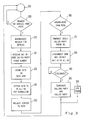
- ABS 100 operates in handling a telephone call from calling party 500 to called party 540 with reference to FIG 3.
- ABS 100 is waiting for a request for service from a calling party over the PSTN.
- requests are typically made in the form of the application of a ringing signal in an analog interface to the PSTN or in the form of a signalling bit transition in a digital interface to the PSTN.
- requests are received, detected and decoded by NLI 40, see decision box 205.
- NLI 40 may detect an incoming telephone call from a calling party customer by detecting loop current in a telephone line accessed by the calling party customer and by transmitting a message regarding the detection event to controller 80.
- NLI 40 transmits a message that a request for service has been detected to controller 80 over lines 85.
- controller 80 sends a command to CSM 50 over lines 45 to connect a voice and data processing circuit in VDPM 70 to the circuit in NLI 40 which has the request pending.
- controller 80 sends a command to NLI 40 over lines 85 to cause it to acknowledge the request for service.
- acknowledgement generally takes the form of an "off hook" signal presented to the PSTN in an analog interface or such acknowledgement, as is well known in the art, generally takes the form of a momentary application of a signalling bit toward the PSTN in a digital interface.
- VDPM 70 receives and decodes network routing and/or origination information signals that are sent from the PSTN.
- network routing and/or origination information signals can take the form of dial pulse digits, dual tone multi-frequency (DTMF) digits, multi-frequency (MF) digits or common channel signalling.
- DTMF dual tone multi-frequency
- MF multi-frequency
- Such network routing and/or origination information signals will typically be present in DID (Direct-Inward-Dial), DNIS (Dialed-Number-Identification-Service), ANI (Automatic-Number-Identification) or ISDN (Integrated Services Digital Network) networks and are used, as is well known to those of ordinary skill in the art, to automatically identify the destination path for the call, the intended purpose for the call, and/or addressing information concerning the calling party.
- DID Direct-Inward-Dial
- DNIS Dialed-Number-Identification-Service
- ANI Automatic-Number-Identification
- ISDN Integrated Services Digital Network
- VDPM 70 can be commanded by controller 80, in a manner well known to those of ordinary skill in the art, to output a voice message --prepared by the ABS provider in accordance with methods well known in the art-- to prompt the calling party.
- the calling party in response to the automated prompt, will manually enter a DTMF signal using, for example, the dialing pad on his telephone, to identify the called party.
- the DTMF will then be received and decoded by VDPM 70 and a message will then be transmitted to controller 80 over lines 95.
- ABS 100 is not restricted to customers that can only transmit DTMF.
- ABS 100 may include within VDPM 70 speech recognition (SR) equipments which are well known to those of ordinary skill in the art for receiving spoken user responses and for converting such spoken responses into commands or input data which is in a form that is compatible for computer use.
- SR speech recognition
- the dialogue between the calling party and ABS 100 is accomplished by a dialogue wherein ABS 100 transmits voice prompts to the calling party and the calling party responds in normal speech.
- a system for carrying out dialogues by means of DTMF and/or SR has been disclosed in a patent application which is commonly assigned with this application, is entitled “Interactive Voice Processing With Speech Recognition,” was filed February 26, 1988, and has Serial No. 160,820.
- controller 80 in conjunction with VDPM 70, has collected the called party's telephone number. If controller 80 is comprised of a local data base, it will store a predetermined set of data in the local data base using at least a portion of the ANI information as a retrieval key. If, however, controller 80 is not comprised of a local data base, controller 80 may communicate with a remote data base in a host computer (not shown) via communications interface 90 and transmit at least a portion of the ANI information thereto.
- controller 80 commands CSM 50 to connect an available voice and data processing circuit from VDPM 70 to an available channel in NLI 60 --in this embodiment this advantageously permits VDPM 70 to perform the signalling.
- controller 80 sends a command to NLI 60 over lines 75 to make a request for service to the PSTN.
- a request for service may comprise, for example, a contact closure or a signalling bit state transition.
- NLI 60 waits to receive acknowledgement of its request for service from the PSTN by, for example, dial tone or a signalling bit transition.
- controller 80 commands VDPM 70 to transmit the called party's telephone number over the path selected by CSM 50 towards NLI 60.
- controller 80 commands CSM 50 to disconnect any circuits in VDPM 70 which are connected to either the NLI 40 circuit or the NLI 60 circuit and to connect the calling party interfaced with NLI 40 to the PSTN interfaced with NLI 60. This provides a full connection or communications path between the calling party and the called party.
- this communications path remains intact until NLI 40 detects a disconnect signal from the PSTN indicating that the calling party has hung up or until NLI 60 detects a disconnect signal from the PSTN indicating that the called party has hung up.
- controller 80 commands CSM 50 to remove the connection between NLI 40 and NLI 60 and commands NLI 40 and NLI 60 to signal appropriate disconnects with the PSTN by, for example, presenting "on hook" signals thereto.
- the transaction is logged at point 310 and the operation continues at point 200.
- logging may include updating a local data base or updating a remote data base by transmitting transaction information thereto over communications interface 90.
- transaction information may include, without limitation, network routing and/or origination information, a predetermined set of the initially retrieved data, called party information, call duration and so forth.
- the embodiment of the inventive ABS disclosed above takes advantage of a time-division-multiplex which is contained in the DTI/124 commercially available apparatus which may be used to embody CSM 50.
- the inventive ABS may also be implemented when one uses an equal number of NLI circuits and VDPM circuits. In such embodiments there may be no need for a switching means because the various resources can be connected together on a one-to-one basis.
- a TDM switching capability of the DTI/124 need not be used, and circuits in NLI 40 are connected to circuits in NLI 60 via an expansion bus in the DTI/124.
- inventive ABS can be used with any application that requires an interface with a multiplicity of users and is not restricted to analog or digital interfaces over telephone lines.
Landscapes
- Engineering & Computer Science (AREA)
- Signal Processing (AREA)
- Computer Networks & Wireless Communication (AREA)
- Computer Security & Cryptography (AREA)
- Telephonic Communication Services (AREA)
Applications Claiming Priority (2)
| Application Number | Priority Date | Filing Date | Title |
|---|---|---|---|
| US463298 | 1990-01-10 | ||
| US07/463,298 US5161181A (en) | 1990-01-10 | 1990-01-10 | Automatic number identification blocking system |
Publications (2)
| Publication Number | Publication Date |
|---|---|
| EP0437256A2 true EP0437256A2 (fr) | 1991-07-17 |
| EP0437256A3 EP0437256A3 (en) | 1993-03-03 |
Family
ID=23839621
Family Applications (1)
| Application Number | Title | Priority Date | Filing Date |
|---|---|---|---|
| EP19910100250 Ceased EP0437256A3 (en) | 1990-01-10 | 1991-01-09 | Automatic number identification blocking system |
Country Status (2)
| Country | Link |
|---|---|
| US (1) | US5161181A (fr) |
| EP (1) | EP0437256A3 (fr) |
Cited By (5)
| Publication number | Priority date | Publication date | Assignee | Title |
|---|---|---|---|---|
| GB2251157A (en) * | 1990-09-21 | 1992-06-24 | Hashimoto Corp | Telephone caller I.D. blocking system |
| WO1993012620A1 (fr) * | 1991-12-19 | 1993-06-24 | Siemens Aktiengesellschaft | Poste telephonique supplementaire programmable |
| EP0768785A3 (fr) * | 1995-10-10 | 1997-06-25 | Boon Chen Lim | Appareil téléphonique avec des moyens de programmation pour composer un code d'identification de l'appelant et pour recevoir un signal d'identification d'un appel en attente |
| GB2314482A (en) * | 1996-06-17 | 1997-12-24 | Casio Phonemate Inc | A telephone answering device with calling party identification |
| WO1998036584A3 (fr) * | 1997-02-18 | 1998-11-26 | Ericsson Ge Mobile Inc | Dispositif permettant de passer outre un filtrage anonyme |
Families Citing this family (80)
| Publication number | Priority date | Publication date | Assignee | Title |
|---|---|---|---|---|
| US6545589B1 (en) | 1984-09-14 | 2003-04-08 | Aspect Communications Corporation | Method and apparatus for managing telecommunications |
| US5375161A (en) | 1984-09-14 | 1994-12-20 | Accessline Technologies, Inc. | Telephone control system with branch routing |
| US6201950B1 (en) | 1984-09-14 | 2001-03-13 | Aspect Telecommunications Corporation | Computer-controlled paging and telephone communication system and method |
| US5588037A (en) | 1984-09-14 | 1996-12-24 | Accessline Technologies, Inc. | Remote access telephone control system |
| US5341414A (en) * | 1992-02-05 | 1994-08-23 | Fred Popke | Calling number verification service |
| US5309508A (en) * | 1992-09-23 | 1994-05-03 | Howard Rosen | Apparatus and method for automatically blocking the transmission of identifying information concerning a telephone calling party |
| US5502756A (en) * | 1992-10-28 | 1996-03-26 | At&T Corp. | Remote test call unit and service |
| US5588049A (en) * | 1993-01-25 | 1996-12-24 | Detering; Greig R. | Method for the automatic insertion of removal of a calling number identification (CNID) blocking prefix from within a telephone number in a personal computer based telephone management system |
| JP2905358B2 (ja) * | 1993-05-18 | 1999-06-14 | 富士通株式会社 | 通信サービス方式及び通信サービスを実施するための交換システム |
| US6427064B1 (en) | 1994-01-05 | 2002-07-30 | Daniel A. Henderson | Method and apparatus for maintaining a database in a portable communication device |
| US7426264B1 (en) | 1994-01-05 | 2008-09-16 | Henderson Daniel A | Method and apparatus for improved personal communication devices and systems |
| US6278862B1 (en) | 1994-01-05 | 2001-08-21 | Daniel A. Henderson | Method and apparatus for enhancing the efficient communication of information in an alphanumeric paging network |
| US7266186B1 (en) | 1994-01-05 | 2007-09-04 | Intellect Wireless Inc. | Method and apparatus for improved paging receiver and system |
| US7142846B1 (en) | 1994-01-05 | 2006-11-28 | Henderson Daniel A | Method and apparatus for improved paging receiver and system |
| US5467388A (en) * | 1994-01-31 | 1995-11-14 | Bell Atlantic Network Services, Inc. | Method and apparatus for selectively blocking incoming telephone calls |
| US6026156A (en) | 1994-03-18 | 2000-02-15 | Aspect Telecommunications Corporation | Enhanced call waiting |
| US5497414A (en) * | 1994-05-04 | 1996-03-05 | Bell Atlantic Network Services, Inc. | Telephone system processing of designated caller ID private calls |
| US5533106A (en) * | 1994-06-27 | 1996-07-02 | Us West Technologies, Inc. | Method and system for processing calls wherein the display of calling party ID information has been inhibited |
| US5590184A (en) * | 1995-03-03 | 1996-12-31 | Lucent Technologies Inc. | Communications privacy protection system by replacing calling party number with non-assigned number |
| US5642414A (en) * | 1995-05-17 | 1997-06-24 | Kazemzadeh; Fardad | Method and apparatus for automatic generation of telephone call blocking signals |
| US6411682B1 (en) | 1995-09-21 | 2002-06-25 | Aspect Telecommunications Corporation | Computer controlled paging and telephone communication system and method |
| US5864612A (en) * | 1996-10-01 | 1999-01-26 | Bell Atlantic Network Services, Inc. | Caller selective identification for telephone calls |
| US6343120B1 (en) | 1996-10-08 | 2002-01-29 | At&T Wireless Services, Inc. | Method and apparatus for providing a caller ID alias |
| US5930346A (en) * | 1996-10-17 | 1999-07-27 | Chen; Abraham Y. | Extended public switched telephone network architecture with enhanced subscriber control on call setup |
| US6101251A (en) * | 1996-12-16 | 2000-08-08 | Ericsson Inc | Method and apparatus for routing an anonymous call |
| US5953399A (en) * | 1997-03-13 | 1999-09-14 | Bell Atlantic Network Services, Inc. | PBX selective caller identification authentication |
| WO1998041042A1 (fr) * | 1997-03-13 | 1998-09-17 | Kabushiki Kaisha Toshiba | Autocommutateur prive |
| US7388951B2 (en) * | 2003-01-21 | 2008-06-17 | Sbc Properties, L.P. | Access code enhancement for caller preview service |
| US6704563B1 (en) | 1998-08-11 | 2004-03-09 | Boston Communications Group, Inc. | Systems and methods for prerating costs for a communication event |
| US7187928B1 (en) | 1998-11-24 | 2007-03-06 | Boston Communications Group, Inc. | Call delivery systems for roaming prepaid subscribers |
| US6700957B2 (en) | 1998-12-07 | 2004-03-02 | Curio, Ltd. | Caller ID system with retransmitted caller ID information |
| US6298122B1 (en) * | 1998-12-07 | 2001-10-02 | Gregory L. Horne | Caller ID system |
| US6424702B1 (en) * | 1999-01-28 | 2002-07-23 | Ameritech Corporation | Method and system for termination blocking of message delivery service |
| US6584178B2 (en) | 1999-01-28 | 2003-06-24 | Sbc Properties, L.P. | Method and system for termination blocking of message delivery service in a switch-based telecommunication system |
| US6330317B1 (en) | 1999-11-09 | 2001-12-11 | Dean Garfinkel | Call blocking system |
| US7283969B1 (en) * | 2000-11-22 | 2007-10-16 | Tekelec | Methods and systems for automatically registering complaints against calling parties |
| US7388949B2 (en) | 2000-12-28 | 2008-06-17 | At&T Delaware Intellectual Property, Inc. | System and method for audio caller identification service |
| US7254226B1 (en) | 2001-05-08 | 2007-08-07 | At&T Intellectual Property, Inc. | Call waiting priority alert |
| US7012999B2 (en) | 2001-06-25 | 2006-03-14 | Bellsouth Intellectual Property Corporation | Audio caller identification |
| US7085358B2 (en) | 2001-06-25 | 2006-08-01 | Bellsouth Intellectual Property Corporation | Visual caller identification |
| US7110525B1 (en) | 2001-06-25 | 2006-09-19 | Toby Heller | Agent training sensitive call routing system |
| US7403768B2 (en) | 2001-08-14 | 2008-07-22 | At&T Delaware Intellectual Property, Inc. | Method for using AIN to deliver caller ID to text/alpha-numeric pagers as well as other wireless devices, for calls delivered to wireless network |
| US7315614B2 (en) | 2001-08-14 | 2008-01-01 | At&T Delaware Intellectual Property, Inc. | Remote notification of communications |
| US7269249B2 (en) | 2001-09-28 | 2007-09-11 | At&T Bls Intellectual Property, Inc. | Systems and methods for providing user profile information in conjunction with an enhanced caller information system |
| US7079837B1 (en) | 2001-11-06 | 2006-07-18 | Bellsouth Intellectual Property Corporation | Caller identification queue for wireless telephones |
| US7315618B1 (en) | 2001-12-27 | 2008-01-01 | At&T Bls Intellectual Property, Inc. | Voice caller ID |
| US7023979B1 (en) | 2002-03-07 | 2006-04-04 | Wai Wu | Telephony control system with intelligent call routing |
| US7372952B1 (en) | 2002-03-07 | 2008-05-13 | Wai Wu | Telephony control system with intelligent call routing |
| US7586898B1 (en) | 2002-05-13 | 2009-09-08 | At&T Intellectual Property, I, L.P. | Third party content for internet caller-ID messages |
| US7385992B1 (en) | 2002-05-13 | 2008-06-10 | At&T Delaware Intellectual Property, Inc. | Internet caller-ID integration |
| US7623645B1 (en) | 2002-07-23 | 2009-11-24 | At&T Intellectual Property, I, L.P. | System and method for gathering information related to a geographical location of a caller in a public switched telephone network |
| US7139374B1 (en) | 2002-07-23 | 2006-11-21 | Bellsouth Intellectual Property Corp. | System and method for gathering information related to a geographical location of a callee in a public switched telephone network |
| US9818136B1 (en) | 2003-02-05 | 2017-11-14 | Steven M. Hoffberg | System and method for determining contingent relevance |
| US7676034B1 (en) | 2003-03-07 | 2010-03-09 | Wai Wu | Method and system for matching entities in an auction |
| US8287340B2 (en) * | 2003-04-17 | 2012-10-16 | Par Technology Corporation | System and method for employee incentive game |
| US7443964B2 (en) | 2003-04-18 | 2008-10-28 | At&T Intellectual Property, I,L.P. | Caller ID messaging |
| US7978833B2 (en) | 2003-04-18 | 2011-07-12 | At&T Intellectual Property I, L.P. | Private caller ID messaging |
| US7283625B2 (en) | 2003-04-18 | 2007-10-16 | At&T Bls Intellectual Property, Inc. | Caller ID messaging telecommunications services |
| US7280646B2 (en) | 2003-04-18 | 2007-10-09 | At&T Bls Intellectual Property, Inc. | Dynamic Caller ID messaging |
| US7463727B2 (en) | 2003-04-18 | 2008-12-09 | At&T International Property, I, L.P. | Caller ID messaging device |
| US20080019487A1 (en) * | 2003-04-24 | 2008-01-24 | At&T Knowledge Ventures, L.P. | Method and system for termination blocking of message delivery service in a swtich-based telecommunication system |
| US7269412B2 (en) | 2003-05-29 | 2007-09-11 | At&T Bls Intellectual Property, Inc. | Caller identification device and method of operation thereof |
| US7113586B2 (en) * | 2003-06-30 | 2006-09-26 | Edward Michael Silver | Caller controlled network-based timed ring suppression |
| US7239693B2 (en) * | 2003-06-30 | 2007-07-03 | Bellsouth Intellectual Property Corporation | Network-based timed ring suppression |
| US7529564B2 (en) * | 2003-06-30 | 2009-05-05 | At&T Intellectual Property I, L.P. | Timed ring suppressor |
| US7352854B1 (en) | 2003-09-29 | 2008-04-01 | At&T Delaware Intellectual Property, Inc. | Call waiting suppression |
| US7443967B1 (en) | 2003-09-29 | 2008-10-28 | At&T Intellectual Property I, L.P. | Second communication during ring suppression |
| US7418091B1 (en) | 2003-10-24 | 2008-08-26 | Nortel Networks Limited | Selective call waiting caller ID |
| US7609832B2 (en) | 2003-11-06 | 2009-10-27 | At&T Intellectual Property, I,L.P. | Real-time client survey systems and methods |
| US7623849B2 (en) | 2003-11-13 | 2009-11-24 | At&T Intellectual Property, I, L.P. | Method, system, and storage medium for providing comprehensive originator identification services |
| US7672444B2 (en) * | 2003-12-24 | 2010-03-02 | At&T Intellectual Property, I, L.P. | Client survey systems and methods using caller identification information |
| US8195136B2 (en) | 2004-07-15 | 2012-06-05 | At&T Intellectual Property I, L.P. | Methods of providing caller identification information and related registries and radiotelephone networks |
| US7702089B2 (en) * | 2004-10-22 | 2010-04-20 | Broadcom Corporation | Selective unblocking of caller ID based on security level |
| US20070036316A1 (en) * | 2005-07-29 | 2007-02-15 | Marian Croak | Method and apparatus for protecting calling party identification |
| US8874477B2 (en) | 2005-10-04 | 2014-10-28 | Steven Mark Hoffberg | Multifactorial optimization system and method |
| US8300798B1 (en) | 2006-04-03 | 2012-10-30 | Wai Wu | Intelligent communication routing system and method |
| US8243909B2 (en) | 2007-08-22 | 2012-08-14 | At&T Intellectual Property I, L.P. | Programmable caller ID |
| US8160226B2 (en) | 2007-08-22 | 2012-04-17 | At&T Intellectual Property I, L.P. | Key word programmable caller ID |
| US8363799B2 (en) * | 2008-10-03 | 2013-01-29 | At&T Intellectual Property I, L.P. | Party information for data-capable communication device |
| CA2966507A1 (fr) | 2014-11-03 | 2016-05-12 | Genentech, Inc. | Procede et biomarqueurs permettant de predire l'efficacite et d'evaluer un traitement par l'agoniste ox40 |
Family Cites Families (20)
| Publication number | Priority date | Publication date | Assignee | Title |
|---|---|---|---|---|
| US3111561A (en) * | 1959-11-23 | 1963-11-19 | American Telephone & Telegraph | Intercept equipment |
| US4054756A (en) * | 1976-09-29 | 1977-10-18 | Bell Telephone Laboratories, Incorporated | Method and apparatus for automating special service call handling |
| JPS5754492A (ja) * | 1980-09-19 | 1982-03-31 | Nec Corp | Konaikokankiniokeruchakushinkokaihoshiki |
| US4747124A (en) * | 1982-09-28 | 1988-05-24 | Opcom | PBX telephone call control system |
| JPS5986357A (ja) * | 1982-11-10 | 1984-05-18 | Nippon Telegr & Teleph Corp <Ntt> | 自動交換電話装置 |
| US4696028A (en) * | 1984-03-26 | 1987-09-22 | Dytel Corporation | PBX Intercept and caller interactive attendant bypass system |
| US4955047A (en) * | 1984-03-26 | 1990-09-04 | Dytel Corporation | Automated attendant with direct inward system access |
| US4782508A (en) * | 1986-03-03 | 1988-11-01 | American Telephone And Telegraph Company, At&T Bell Laboratories | Method of discouraging the completion of wrong-number calls |
| US4922519A (en) * | 1986-05-07 | 1990-05-01 | American Telephone And Telegraph Company | Automated operator assistance calls with voice processing |
| US4797910A (en) * | 1986-05-07 | 1989-01-10 | American Telphone And Telegraph Company, At&T Bell Laboratories | Automated operator assistance calls with voice processing |
| US4827500A (en) * | 1987-01-30 | 1989-05-02 | American Telephone And Telegraph Company, At&T Bell Laboratories | Automatic speech recognition to select among call destinations |
| US4797911A (en) * | 1987-06-16 | 1989-01-10 | Inventions, Inc. | Customer account online servicing system |
| US4850007A (en) * | 1987-06-25 | 1989-07-18 | American Telephone And Telegraph Company | Telephone toll service with advertising |
| US4979206A (en) * | 1987-07-10 | 1990-12-18 | At&T Bell Laboratories | Directory assistance systems |
| US4847890A (en) * | 1987-08-10 | 1989-07-11 | The Telephone Connection | Anonymous interactive telephone system |
| US4942598A (en) * | 1988-03-04 | 1990-07-17 | Motorola, Inc. | Telephone answering machine in paging systems with automatic number identification based message operations |
| US4935956A (en) * | 1988-05-02 | 1990-06-19 | Telequip Ventures, Inc. | Automated public phone control for charge and collect billing |
| DE3815908A1 (de) * | 1988-05-10 | 1989-11-23 | Telefonbau & Normalzeit Gmbh | Verfahren zur wahrung der anonymitaet eines anrufenden teilnehmers in kommunikationsvermittlungsanlagen |
| US4852149A (en) * | 1988-06-29 | 1989-07-25 | Dialogic Corporation | Automated call filter |
| US5058152A (en) * | 1989-12-12 | 1991-10-15 | The Telephone Connection | Anonymous interactive telephone system having direct connect feature |
-
1990
- 1990-01-10 US US07/463,298 patent/US5161181A/en not_active Expired - Lifetime
-
1991
- 1991-01-09 EP EP19910100250 patent/EP0437256A3/en not_active Ceased
Cited By (11)
| Publication number | Priority date | Publication date | Assignee | Title |
|---|---|---|---|---|
| GB2251157A (en) * | 1990-09-21 | 1992-06-24 | Hashimoto Corp | Telephone caller I.D. blocking system |
| US5341411A (en) * | 1990-09-21 | 1994-08-23 | Hashimoto Corporation | Caller ID blocking method and processing system (block caller ID information) |
| GB2251157B (en) * | 1990-09-21 | 1995-05-17 | Hashimoto Corp | Caller ID blocking method and device in calling party telephone number displaying system |
| WO1993012620A1 (fr) * | 1991-12-19 | 1993-06-24 | Siemens Aktiengesellschaft | Poste telephonique supplementaire programmable |
| EP0768785A3 (fr) * | 1995-10-10 | 1997-06-25 | Boon Chen Lim | Appareil téléphonique avec des moyens de programmation pour composer un code d'identification de l'appelant et pour recevoir un signal d'identification d'un appel en attente |
| US5796810A (en) * | 1995-10-10 | 1998-08-18 | Lim; Boon Chen | Apparatus for dialing of caller ID block code and receiving call waiting caller-ID-signal |
| GB2314482A (en) * | 1996-06-17 | 1997-12-24 | Casio Phonemate Inc | A telephone answering device with calling party identification |
| US5781613A (en) * | 1996-06-17 | 1998-07-14 | Casio Phonemate, Inc. | Telephone answering device and method for screening incoming telephone calls with blocked calling party identification information |
| GB2314482B (en) * | 1996-06-17 | 2000-04-05 | Casio Phonemate Inc | Telephone answering device and corrosponding method |
| WO1998036584A3 (fr) * | 1997-02-18 | 1998-11-26 | Ericsson Ge Mobile Inc | Dispositif permettant de passer outre un filtrage anonyme |
| US5937052A (en) * | 1997-02-18 | 1999-08-10 | Ericsson Inc. | Anonymous call rejection override |
Also Published As
| Publication number | Publication date |
|---|---|
| EP0437256A3 (en) | 1993-03-03 |
| US5161181A (en) | 1992-11-03 |
Similar Documents
| Publication | Publication Date | Title |
|---|---|---|
| US5161181A (en) | Automatic number identification blocking system | |
| US5046088A (en) | Converter for in-band routing and/or origination information | |
| US6041114A (en) | Telecommute server | |
| US4852149A (en) | Automated call filter | |
| US5668852A (en) | Automatic caller-associated information provision system, improvement and method for paging system | |
| US5608788A (en) | Information display provided to calling party | |
| EP1168791B1 (fr) | rappel à un centre d'appel | |
| CN1076570C (zh) | 个人移动通信系统 | |
| US4783796A (en) | PBX telephone call control system | |
| US5953399A (en) | PBX selective caller identification authentication | |
| US5659605A (en) | Method and apparatus for providing soft dial tone using office equipment designators | |
| KR19980702059A (ko) | 재택근무 방법 및 통화 제어 장치 | |
| CA2090165A1 (fr) | Gestion des appels vers l'exterieur dans un reseau | |
| US5572577A (en) | Information system for a PABX | |
| KR100600904B1 (ko) | 착신전화응답지연방법 | |
| GB2308270A (en) | Telephone system with remote call pick-up capability | |
| US5315647A (en) | Private branch exchange adapted for telemarketing | |
| EP0793374B1 (fr) | Système de commutation vidéo, système de communication vidéo et méthode pour établir automatiquement des communications vidéo utilisant un commutateur téléphonique | |
| US5898757A (en) | Method and system for processing emergency service calls | |
| WO2000039990A1 (fr) | Intervention sur une messagerie vocale | |
| US5063592A (en) | Control of non-locally switched telecommunication services | |
| US5844974A (en) | Emergency telephone communications system | |
| EP0766445A2 (fr) | Interface de communication audio, méthode et système de communication pour connecter un opérateur éloigné à un commutateur téléphonique | |
| EP1269769B1 (fr) | Couplage telephonie-informatique | |
| EP0786891A2 (fr) | Méthode et système de connection automatique pour connecter des appels sortants à des opérateurs |
Legal Events
| Date | Code | Title | Description |
|---|---|---|---|
| PUAI | Public reference made under article 153(3) epc to a published international application that has entered the european phase |
Free format text: ORIGINAL CODE: 0009012 |
|
| AK | Designated contracting states |
Kind code of ref document: A2 Designated state(s): DE FR GB |
|
| PUAL | Search report despatched |
Free format text: ORIGINAL CODE: 0009013 |
|
| AK | Designated contracting states |
Kind code of ref document: A3 Designated state(s): DE FR GB |
|
| 17P | Request for examination filed |
Effective date: 19930420 |
|
| 17Q | First examination report despatched |
Effective date: 19950323 |
|
| GRAG | Despatch of communication of intention to grant |
Free format text: ORIGINAL CODE: EPIDOS AGRA |
|
| STAA | Information on the status of an ep patent application or granted ep patent |
Free format text: STATUS: THE APPLICATION HAS BEEN REFUSED |
|
| 18R | Application refused |
Effective date: 19961230 |