EP0437280A2 - Verfahren zum Verarbeiten von Röntgenbilddaten zur Ermittlung von Schweissfehlern - Google Patents
Verfahren zum Verarbeiten von Röntgenbilddaten zur Ermittlung von Schweissfehlern Download PDFInfo
- Publication number
- EP0437280A2 EP0437280A2 EP91100359A EP91100359A EP0437280A2 EP 0437280 A2 EP0437280 A2 EP 0437280A2 EP 91100359 A EP91100359 A EP 91100359A EP 91100359 A EP91100359 A EP 91100359A EP 0437280 A2 EP0437280 A2 EP 0437280A2
- Authority
- EP
- European Patent Office
- Prior art keywords
- defect
- image
- type
- weld
- welding line
- Prior art date
- Legal status (The legal status is an assumption and is not a legal conclusion. Google has not performed a legal analysis and makes no representation as to the accuracy of the status listed.)
- Granted
Links
Images


Classifications
-
- B—PERFORMING OPERATIONS; TRANSPORTING
- B23—MACHINE TOOLS; METAL-WORKING NOT OTHERWISE PROVIDED FOR
- B23K—SOLDERING OR UNSOLDERING; WELDING; CLADDING OR PLATING BY SOLDERING OR WELDING; CUTTING BY APPLYING HEAT LOCALLY, e.g. FLAME CUTTING; WORKING BY LASER BEAM
- B23K31/00—Processes relevant to this subclass, specially adapted for particular articles or purposes, but not covered by any single one of main groups B23K1/00 - B23K28/00
- B23K31/12—Processes relevant to this subclass, specially adapted for particular articles or purposes, but not covered by any single one of main groups B23K1/00 - B23K28/00 relating to investigating the properties, e.g. the weldability, of materials
-
- G—PHYSICS
- G01—MEASURING; TESTING
- G01N—INVESTIGATING OR ANALYSING MATERIALS BY DETERMINING THEIR CHEMICAL OR PHYSICAL PROPERTIES
- G01N23/00—Investigating or analysing materials by the use of wave or particle radiation, e.g. X-rays or neutrons, not covered by groups G01N3/00 – G01N17/00, G01N21/00 or G01N22/00
- G01N23/02—Investigating or analysing materials by the use of wave or particle radiation, e.g. X-rays or neutrons, not covered by groups G01N3/00 – G01N17/00, G01N21/00 or G01N22/00 by transmitting the radiation through the material
- G01N23/06—Investigating or analysing materials by the use of wave or particle radiation, e.g. X-rays or neutrons, not covered by groups G01N3/00 – G01N17/00, G01N21/00 or G01N22/00 by transmitting the radiation through the material and measuring the absorption
- G01N23/083—Investigating or analysing materials by the use of wave or particle radiation, e.g. X-rays or neutrons, not covered by groups G01N3/00 – G01N17/00, G01N21/00 or G01N22/00 by transmitting the radiation through the material and measuring the absorption the radiation being X-rays
-
- G—PHYSICS
- G01—MEASURING; TESTING
- G01N—INVESTIGATING OR ANALYSING MATERIALS BY DETERMINING THEIR CHEMICAL OR PHYSICAL PROPERTIES
- G01N23/00—Investigating or analysing materials by the use of wave or particle radiation, e.g. X-rays or neutrons, not covered by groups G01N3/00 – G01N17/00, G01N21/00 or G01N22/00
- G01N23/02—Investigating or analysing materials by the use of wave or particle radiation, e.g. X-rays or neutrons, not covered by groups G01N3/00 – G01N17/00, G01N21/00 or G01N22/00 by transmitting the radiation through the material
- G01N23/06—Investigating or analysing materials by the use of wave or particle radiation, e.g. X-rays or neutrons, not covered by groups G01N3/00 – G01N17/00, G01N21/00 or G01N22/00 by transmitting the radiation through the material and measuring the absorption
- G01N23/18—Investigating the presence of flaws defects or foreign matter
-
- G—PHYSICS
- G06—COMPUTING OR CALCULATING; COUNTING
- G06T—IMAGE DATA PROCESSING OR GENERATION, IN GENERAL
- G06T7/00—Image analysis
- G06T7/0002—Inspection of images, e.g. flaw detection
- G06T7/0004—Industrial image inspection
-
- G—PHYSICS
- G06—COMPUTING OR CALCULATING; COUNTING
- G06T—IMAGE DATA PROCESSING OR GENERATION, IN GENERAL
- G06T2207/00—Indexing scheme for image analysis or image enhancement
- G06T2207/30—Subject of image; Context of image processing
- G06T2207/30108—Industrial image inspection
- G06T2207/30136—Metal
-
- Y—GENERAL TAGGING OF NEW TECHNOLOGICAL DEVELOPMENTS; GENERAL TAGGING OF CROSS-SECTIONAL TECHNOLOGIES SPANNING OVER SEVERAL SECTIONS OF THE IPC; TECHNICAL SUBJECTS COVERED BY FORMER USPC CROSS-REFERENCE ART COLLECTIONS [XRACs] AND DIGESTS
- Y10—TECHNICAL SUBJECTS COVERED BY FORMER USPC
- Y10S—TECHNICAL SUBJECTS COVERED BY FORMER USPC CROSS-REFERENCE ART COLLECTIONS [XRACs] AND DIGESTS
- Y10S706/00—Data processing: artificial intelligence
- Y10S706/902—Application using ai with detail of the ai system
- Y10S706/911—Nonmedical diagnostics
- Y10S706/912—Manufacturing or machine, e.g. agricultural machinery, machine tool
Definitions
- This invention relates to a method of processing image data of welding, and particularly to a method of processing image data of welding in detecting a defect of welding at a welding portion of a pipe or the like in a power plant facility.
- Welding portions are crucial not only for the retention of the inherent function of the machine, plant facility, etc., but also for the security of the machine and facility and of the peripheral environment. Accordingly, these joint portions are very crucial points of construction and also at the maintenance activity during the operation.
- the visual inspection and judgement by a skilled inspector rely on the threshold of judgement which can differ depending on each person and can also vary due to the tiredness of vision and psychological pressure, resulting in the difficulty of stable and objective judgement.
- An example of defect extraction method is to categorize defects through the emphasis of a defect image by selective application of computational operations, the binary conversion of the emphasized image using a certain threshold, and the determination based on the density of image. This method will be called “the first method” hereinafter.
- Another method publicized is based on the spacial frequency of the density distribution normal to the welding line, in which spectral components of radiographic image is fed through a band-pass filter thereby to extract the discontinuity at a defective portion and the filter output is subjected to the binary conversion based on a certain threshold thereby to make a judgement of weld defect.
- This method will be called “the second method” hereinafter.
- a further method deals with a signal which is produced by scanning the joint in the direction normal to the welding line and the difference between the signal and its quadratic approximation is subjected to a high-frequency filtering process thereby to emphasize the radiographic image to be subjected to the maximumizing process.
- This method will be called “the third method” hereinafter.
- a further method developed and publicized makes a quadratic curve approximation of the brightness distribution of the radiographic image taken in the direction normal to the welding line and the approximated curve is subtracted from the original curve thereby to produce an emphasized differential image, and the image is rendered the binary conversion based on the threshold value derived from the density difference, with the image being modified to clarify the boundary of binary image regions.
- This method will be called “the fourth method” hereinafter.
- a method for deterministicly classifying the type of the weld defect by specifying the existing range of feature values for each defect type, on the basis of feature values of the shape of the defect image obtained by the image processing of the radiography. Also, a method for inferring the type of the weld defect from the statistic distribution of the feature values by using probability. These methods will be called “the fifth method” hereinafter. Examples of this inspection system based on the Bayes' law are described in the proceeding of the fourth industrial image sensing technology symposium, pp.
- the first method involves the difficulty in selecting the operation, i.e. the selection of an operation is not possible unless the image of defect is known in advance. Since the value of pixel of the emphasized image does not have a direct physical meaning, it unfavorably necessitates the threshold setting based on try-and-error. The method suffers from high possibility of distortion of an emphasized defect image used for the judgement of defect. Despite the fact that the extracted defect image can possibly include an irrelevant indication signal, the method lacks in the processing scheme for eliminating that signal, resulting possibly in the over sensitivity of defect detection.
- the second method is capable of extracting such a volumetric weld defect as a blow hole, but it suffers from extracting a defect image with a small density difference such as that of lack of fusion. Since the image of defect is discriminated based solely on the extracted density difference, the result of detection is not consistent with that of an experienced inspector having high sensitivity of detection. Therefore, it lacks in the practicability as an extraction method, and has a drawback of difficult determination of the threshold value.
- the third method is deficient in that the image of defect cannot be emphasized due to a small density difference for a planar weld defect such as a lack of fusion, as in the previous method. Although the method renders the sharpness of image, it cannot eliminate the density variation at the residual weld portion, and it suffers in the inability of defect image extraction with a single threshold value.
- the third method by itself is not intended for the automatic extraction of a defect image.
- the fourth method is incapable of extracting a defect image with a small density difference such as that of a lack of fusion. Due to its defect image extraction based solely on the density difference among pixels of emphasized image, the sensitivity of detection can differ from that of an experienced inspector. Consequently, it suffers from poor reliability and from a determination of the defect shape being inconsistent with the result provided by the inspector because its modification process is based solely on the binary-converted image.
- the fifth method of the inspection judgement systems offered by Koshimizu et al and Inoue et al involves the following problems.
- the inspection system offered by Koshimizu et al is a determinative method based on the logical sequence, and this method categorized to be an algorithm process scheme suffers from the addition of a new judgement rule and logical treatment.
- this method is advantageous in the logical processing and metrical data processing by using graphical data of the weld defect portion and positions of density around the defective portion, the knowledge of an experienced inspector cannot be introduced or added to the expert system.
- the system offered by Inoue et al uses the Bayes' law, and it requires complete data collection. For example, the system needs nine feature values of defect, and it does not allow the merging with the expert system.
- a first object of this invention is to provide a processing method and apparatus for automatically extracting a defect of welding promptly and accurately from the film image of radiography of a welded portion.
- a second object of this invention is to provide a processing method and apparatus for automatically inferring the type of weld defect promptly and accurately from the film image of radiography of a welded portion.
- the first object of this invention is achieved through the following elaboration.
- a radiographic test is conducted for a welded portion of a pipe in a power plant or the like thereby to produce an image of welded portion on a radiographic film or introduce the transmitted radiation rays directly through an image intensifier.
- a frame of picture including an image of weld defect is introduced to a computer, in which noises are removed, an inspection area is trimmed, and the welding line portion is extracted for preprocessing. Volumetric defects of type 1 and planar defects of type 2 are rendered specific emphasizing processes. After the statistic process, the extraction process is conducted thereby to discriminate a type 1 defect or type 2 defect.
- Modification is conducted based on the statistic value for the pixel value at the end and peripheral portions of the welding line in the defect-emphasized image of the welding line so that the value is adjusted to be correspondent to the sensitivity of detection implemented by the inspector, thereby making the result of extraction of the defective portion consistent with that of an experienced inspector.
- Pixel values of the modified, emphasized image are assumed to be in the normal distribution, so that the level of an abnormal image including a defect image can be defined in terms of the standard deviation and the threshold value for the extraction of defective portion can be set easily.
- the knowledge of an experienced inspector for detecting an irrelevant indication is prepared as a database, and the feature value of defect related to the density and shape measured from the extracted defect candidate is compared with the database so as to remove irrelevant indication images thereby to avoid over-sensitive detection of defect images. Consequently, the ultimate result of judgement of defect is consistent with that of an experienced inspector.
- the second objective of this invention is to make a database of feature value based on the image on the radiographic film or image intensifier, make a knowledge base of the inspector's experience, make a rule of defect judgement based on both databases, collect the degree of certainty of judgement through the collation of images of welded objects with the rule, and finally infer the type of defect of welding.
- a radiographic test using the X rays or the like is conducted for a certain welded portion of a pipe joint or the like in a power plant facility thereby to form an original image 1 of the welded portion on a radiographic film.
- the original image on the film is picked up with an ITV camera and introduced to a certain computer, by which noises in the video signal are eliminated.
- the reason for the removal of noises is the possible degradation of the picture quality due to noises at the introduction of the film image into the computer through the ITV camera.
- One of noise removal means known as "median filter”, is used. This method is to arrange small “window" areas around each point of the image and replace the point with the median of brightness of these windows.
- the film image covers, in addition to the welded portion, the base metal and its exterior with the provision of a transmission meter and tone meter thereby to ensure the picture quality.
- the image includes a mark of literal or numeric character for the identification of the film, and this image can impose a significant influence on the statistic value of brightness distribution of the image, resulting possibly in the failure of emphasis of the defective portion.
- this embodiment uses means of sampling an object area by defining the area up to such images as the above-mentioned meters and marks in the vertical direction of the welding line. In this manner, the object area of judgement on the image is sampled (3) and the welding line portion is extracted (4).
- An image is divided horizontally into divisions with a proper width, and a binary threshold value is determined automatically based on the least square reference for each divided width.
- the coordinates of the central point in each column of binary image is evaluated thereby to determine the center line of the welding line region by application of the method of least squares.
- emphasized extraction for a defect image of type 1 i.e., such a volumetric defect image having a relatively strong contrast and having a thickness in the direction of irradiation of the radiation rays, such as the X rays, as a blow hole and slag inclusion
- a procedure based on the emphasized extraction for a defect image of type 2 i.e., such a planar (linear on the film image) defect image having a relatively weak contrast along the welding line as a lack of fusion are conducted at the same time.
- the emphasized extraction for a defect image of type 1 is to have a quadratic curve approximation in the direction normal to the welding line thereby to approximate the influence of the brightness of the welding residual portion.
- the differential process 5 for subtracting the original image from the image with the approximated brightness of the residual portion is conducted.
- the modification of pixel value of the differential image is conducted (process 6 in Fig. 1).
- the reason is that the central portion and peripheral portion of the welding line are different in brightness even for the same defect and thus an inspector has different sensitivities for brightness.
- a psychological adjustment of sensitivity is predicated to take place so that the central portion and peripheral portion of the welding line are sensed in the same brightness.
- a statistic value of the brightness of the differential image is taken thereby to implement the process equivalent to the inspector's behavior so that the central portion and peripheral portion have equal sensitivity of brightness in terms of the degree of variance, and the same result as of the inspector's inspection is realized.
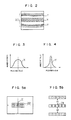
- the range of object for evaluating the statistic value of the overall image is confined to the interior of the welding line 20 as shown in Fig. 2, so that the statistic value which is unrelated to the sampling area can be evaluated without the influence of the base metal.
- Two regions X and Y of Fig. 2 are set so that the statistic value in the range is made controllable as a parameter of image processing.
- a certain logarithmic conversion for the brightness is conducted with the intention of conversion of the pixel value to the value which is proportional to the magnitude of human's visual sensitivity.
- the modified pixel value of defect image is predicated to have been converted to a value which corresponds to the sensitivity of psychological sense of the inspector. Based on this fact, for the modified image, the mean value and standard deviation are evaluated for the statistic value of the brightness distribution of the overall image thereby to determine the threshold value by calculating the mean value of brightness subtracted by the standard deviation multiplied by a (where a is a parameter), and pixels having brightness smaller than or equal to the threshold value are extracted as candidates of defect (process 9 in Fig. 1).
- a region extracted based on this threshold value can only be an extremely dark portion of the image in some case, and the region is further shaped by expanding the region so that pixels with value of brightness smaller than or equal to the threshold value plus standard deviation divided by b (where b is a parameter) in the peripheral portion of the extraction region are included.
- the result of extraction in this manner is virtually identical to the result of extraction implemented by the inspector.
- the quadratic approximation for the change of brightness in the residual portion is implemented not only in the direction normal to the welding line, but also in the direction of welding line, as shown in process 7 in Fig. 1.
- the quadratic approximation for the change of brightness in the residual portion is implemented not only in the direction normal to the welding line, but also in the direction of welding line, as shown in process 7 in Fig. 1.
- Images extracted automatically in this manner include an irrelevant indication, which is not an inherent defect image or a defect other than a candidate defect, but is an irrelevant indication caused by a dark shadow or noise in contrast to a portion of sharp variation in brightness, and an irrelevant indication caused by the influence of a special image processing, and these irrelevant indications need to be removed.
- the feature value of defect on the film image is measured, and the result is compared with the irrelevant indication removal rule in the irrelevant indication database which has been collected in advance by the inspector, thereby eliminating the irrelevant indication.
- the emphasizing and extraction of a defect image which is elongated in the lateral direction along the planar welding line, such as a lack of fusion of type 2 are conducted.
- the emphasizing process for the brightness change in the direction of welding line is carried out as shown by the process 10 in Fig. 1. Because of a weak contrast of the image on the film as compared with a blow hole or the like of the type-1 defect, the use of the same method as for type 1 is inconvenient in that emphasizing is not possible due to the overwhelming brightness distribution of the background.
- a rectangular window 22 is formed for a pixel 21 in attention at the center, the mean value of brightness in the window 22 is evaluated, and the brightness of the pixel 21 in attention is replaced with the mean value thereby to improve the contrast of defect image which is elongated in the lateral direction.
- a weighting factor -1 is multiplied to pixels that are distant by id pixels above and below the pixel 21 in attention and a weighting factor of 2 is multiplied to the central section, and these terms are totaled.
- emphasizing modification of the pixel value is conducted in the same manner as for a defect of type 1.
- the emphasizing modification for the image at the end of the residual portion is carried out as shown by the process 12 in Fig. 1.
- the process 12 implements the modification based on the logarithmic conversion so that the standard deviation ⁇ of the residual end section (low brightness portion is equal to the standard deviation ⁇ ' of the welding center section (high brightness portion).
- the binary conversion of candidate defect image, shaping and irrelevant indication removal processes shown by the process 14 in Fig. 1 are carried out concurrently in the same manner as for the candidate defect image of type 1 described previously.
- the extraction result 15 for the candidate defect image of type 2 is obtained.
- the process of candidate defect image of the case where the extraction regions do not overlap is to retain all extracted regions of defect images of type 1 and to retain defect images of type 2 with the extraction region having a vertical to horizontal ratio of three or more or a length to width ratio in the inertial main axis direction of region of three or more, and to remove the remainder.
- the process for a candidate defect image of the case where the extraction regions overlap is the selection based on the vertical to horizontal ratio of the extraction region, the selection based on the area, or the selection based on the distribution of brightness in the extraction region of the original image.
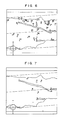
- a candidate defect image before the application of the irrelevant indication removal rule shown in Table 1 to the result of extraction of a defect image which has been rendered the emphasized extraction process is shown in Fig. 6, and a candidate defect image after the application of the rule is shown in Fig. 7.
- Images which undergo the image processing are not only images formed on the radiographic film, but images which are introduced directly through the image intensifier can also be applicable, as mentioned previously.
- the radiographic test using the X rays or the like for such a weld defect as a blow hole and lack of fusion emerging in the welded portion or the like of a pipe or the like of a power plant facility it is possible to extract a defective portion automatically and measure the shape and size of the defect automatically thereby to speed up the inspection and enhance the stability of the judgement result.
- the result of extraction is consistent with the result of the inspector. Setting of the threshold value of extraction is easy, and over sensitivity detection of defect images caused by the irrelevant indication removal process can be prevented.
- the level of a candidate defect image including a defect image in the image can be defined in terms of the deviation value, whereby setting of the threshold value at the extraction of defect image is made easy.
- an emphasized image converted into binary through the calculation of statistic value of pixel values of modified, emphasized image and subtraction of the threshold value multiplied by a certain parameter of the standard deviation from the mean value so that part of the candidate defect image can be extracted is conceivable to have a virtual normal distribution, and therefore the above-mentioned value of multiple of the standard deviation can be set easily by adjustment in the manner of probability.
- pixels having lower values than their periphery are merged and thereafter the border line is smoothed, whereby it is possible to extract the shape of defect image which is consistent with the result of recognition of the image which has been inferred conventionally by the human inference, i.e., the inference by the inspector or the like having abundant experience.
- the method of inferring the type of weld defect based on the second embodiment of this invention is as follows. Measured data for a welded portion obtained from the image on the radiographic film, the degree of certainty of rules A, B and C of the knowledge base based on the feature value of weld defect derived from the data, and the rule of user input information D and E which can be obtained by experience by only one of the welding worker and inspector are subjected to collation thereby to obtain the total degree of certainty. Using the degree of certainty, it will become possible to determine a weld defect to be a lack of fusion, or to infer the certainty of such a defect as a slag inclusion, for example.
- the welding condition which can be known only by the welding worker e.g., the welding attitude such as up-face welding or down-face welding, the magnitude of welding current, the slag of welding bead, the state of scale, the type of tip-open welding, etc. are added with the degree of certainty based on the experience of the welding worker thereby to make a certain rule in advance.
- the welding condition which can be known only by the welding worker, e.g., the welding attitude such as up-face welding or down-face welding, the magnitude of welding current, the slag of welding bead, the state of scale, the type of tip-open welding, etc.
- the degree of certainty of the feature value of defect based on the measurement of image of a weld defect portion (F) and the above-mentioned user input information (G) are collated in a total sense, which is used together with the total degree of certainty based on the parallel comparison with each rule, and the inferrence of the type of weld defect is made.
- the feature value of welding is obtained through the complicated procedure, and a specific procedure of rule generation is as follows.
- a resulting image film 34 is developed through a certain treatment.
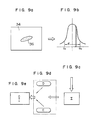
- Fig. 8a at the site 31 of a piping facility or the like in a power plant, an inspector 32 takes a radiographic film picture of a weld defect in a welded portion of the pipe or the like by means of a radiographic inspection device 33 using the X rays or the like.
- a resulting image film 34 is developed through a certain treatment.
- Data of the average density of item 6 through the nonlinearity of item 10 are features in this invention.
- the welding center line 38, defect image 36, angle ⁇ and the like for the bead 35 between the base metals 37 on the image film 34 are schematically shown in Figs. 8c and 8d.
- data of feature value of weld defect based on the measured data is prepared in advance as shown by the Table 2 in a memory unit 40 shown in Fig. 8e.
- Fig. 8e shows the feature value of weld defect of the data in Table 2.
- an identification rule of a sort of knowledge base is created.
- the data relation meet the conditions: 1/3 LLT -0.2 ⁇ FLT ⁇ 1/8 LLT + 0.3, and LLT ⁇ 12, then inference is made that the weld defect is a lack of fusion or it is a slag inclusion at a degree of certainty of 0.95 based on the identification rule.
- the probability for the number of all data may be used.
- the foregoing embodiment is an example of the identification rule as a knowledge base of the feature value of weld defect for the weld defect portion 36, and for a certain relation of other feature value of weld defect, a respective identification rule of knowledge base is available, and a certain number of these rules are set in parallel.
- the identification rule F obtained as a knowledge base and the feature value 39 of weld defect, and the user input information G and user input information D and E are collated for each rule in a general manner, as shown in Fig. 8g.
- the type of defect and the cause of defect of a certain weld defect portion are inferred with the estimation of predetermined certainty based on the adopted degree of certainty. Otherwise, a total degree of certainty is evaluated based on a certain calculation method for the degree of certainty, and the certainty of the type and cause of the weld defect portion is presented as a composite degree of certainty.
- Fig. 9a There is rule generation based on data processing as shown in Fig. 9a to Fig. 9c.
- the feature values of defect as shown in Table 2 are evaluated in advance for the defective portion 36 of the film image 34.
- the database of histogram for each feature value is provided in advance as shown in Fig. 9b, and the feature value is collated with the database to determine the range of standard deviations 1 ⁇ , 2 ⁇ or 3 ⁇ . For example, in the case of a blow hole, as shown in Fig.
- weighting factors of 1.0, 0.6 and 0.1 are given to the deviations ⁇ , 2 ⁇ and 3 ⁇ of a feature value, respectively, and the weighting factors are selected to be 1.0, 0.6 and 0.1 as the degree of certainties for the flatness, density and weld defect length, respectively, as shown in the following Table 3. (Accordingly, the weighting factors and degrees of certainty differ depending on the experience of inspectors and the like, and therefore it is desirable to have the estimation of weighting factors and degrees of certainty provided by an inspector who has abundant skillness.)
- the type and cause of a weld defect is expressed in such a rule system of "if ... then ..., and the degree of certainty is ", thereby estimating the inference of certainty in a sense of fuzzy theory by avoiding the assertion of the type and cause in a sense of determinative theory.
- a final, total degree of certainty is estimated based on a certain calculation method of the degree of certainty.
- Embodiments of this invention are not limited to the radiography of the image of a welded portion on the film, but, needless to say, the image may be introduced as a direct digital image through the image intensifier, or displayed on the CRT.
- the certainty which is not obtained by the conventional method is inferred and the error made by the determinative method can be avoided, whereby the degree of certainty which is closed to the inference of the type and cause of a practical defective portion implemented by an extremely expertized inspector can be estimated.
- it is very easy to add a new rule or alter a rule complete supplement for the collected data is not needed, and inference based on data which can be collected is made possible.
Landscapes
- Engineering & Computer Science (AREA)
- General Physics & Mathematics (AREA)
- Physics & Mathematics (AREA)
- Health & Medical Sciences (AREA)
- General Health & Medical Sciences (AREA)
- Chemical & Material Sciences (AREA)
- Analytical Chemistry (AREA)
- Biochemistry (AREA)
- Life Sciences & Earth Sciences (AREA)
- Immunology (AREA)
- Pathology (AREA)
- Mechanical Engineering (AREA)
- Quality & Reliability (AREA)
- Computer Vision & Pattern Recognition (AREA)
- Theoretical Computer Science (AREA)
- Toxicology (AREA)
- Analysing Materials By The Use Of Radiation (AREA)
Priority Applications (1)
| Application Number | Priority Date | Filing Date | Title |
|---|---|---|---|
| EP96112286A EP0742433A3 (de) | 1990-01-12 | 1991-01-14 | Verfahren zum Verarbeiten von Röntgenbilddaten zur Ermittlung von Schweissfehlern |
Applications Claiming Priority (4)
| Application Number | Priority Date | Filing Date | Title |
|---|---|---|---|
| JP350990A JPH07119713B2 (ja) | 1990-01-12 | 1990-01-12 | 放射線試験での溶接欠陥像の自動抽出処理方法 |
| JP3508/90 | 1990-01-12 | ||
| JP2003508A JPH07119714B2 (ja) | 1990-01-12 | 1990-01-12 | 溶接欠陥の種類推定方法 |
| JP3509/90 | 1990-01-12 |
Related Child Applications (1)
| Application Number | Title | Priority Date | Filing Date |
|---|---|---|---|
| EP96112286A Division EP0742433A3 (de) | 1990-01-12 | 1991-01-14 | Verfahren zum Verarbeiten von Röntgenbilddaten zur Ermittlung von Schweissfehlern |
Publications (3)
| Publication Number | Publication Date |
|---|---|
| EP0437280A2 true EP0437280A2 (de) | 1991-07-17 |
| EP0437280A3 EP0437280A3 (en) | 1993-07-07 |
| EP0437280B1 EP0437280B1 (de) | 1998-04-22 |
Family
ID=26337100
Family Applications (2)
| Application Number | Title | Priority Date | Filing Date |
|---|---|---|---|
| EP91100359A Expired - Lifetime EP0437280B1 (de) | 1990-01-12 | 1991-01-14 | Verfahren zum Verarbeiten von Röntgenbilddaten zur Ermittlung von Schweissfehlern |
| EP96112286A Withdrawn EP0742433A3 (de) | 1990-01-12 | 1991-01-14 | Verfahren zum Verarbeiten von Röntgenbilddaten zur Ermittlung von Schweissfehlern |
Family Applications After (1)
| Application Number | Title | Priority Date | Filing Date |
|---|---|---|---|
| EP96112286A Withdrawn EP0742433A3 (de) | 1990-01-12 | 1991-01-14 | Verfahren zum Verarbeiten von Röntgenbilddaten zur Ermittlung von Schweissfehlern |
Country Status (4)
| Country | Link |
|---|---|
| US (1) | US5182775A (de) |
| EP (2) | EP0437280B1 (de) |
| DE (1) | DE69129275T2 (de) |
| DK (1) | DK0437280T3 (de) |
Cited By (5)
| Publication number | Priority date | Publication date | Assignee | Title |
|---|---|---|---|---|
| WO1998053303A1 (fr) * | 1997-05-22 | 1998-11-26 | Commissariat A L'energie Atomique | Procede et dispositif de traitement de radiogrammes de soudure pour la detection de defauts de soudure |
| EP1710571A1 (de) * | 2005-04-06 | 2006-10-11 | The General Electric Company | Wirbelstromprüfverfahren und Vorrichtung |
| CN114663365A (zh) * | 2022-03-04 | 2022-06-24 | 重庆中科云从科技有限公司 | 缺陷检测方法、装置及计算机存储介质 |
| CN115063422A (zh) * | 2022-08-18 | 2022-09-16 | 建首(山东)钢材加工有限公司 | 一种用于集装箱焊接质量智能检测方法 |
| US11585765B1 (en) | 2021-09-16 | 2023-02-21 | Wrightbrothers Co., Ltd | Apparatus, method, computer-readable storage medium for non-destructive inspection of bicycle based on analyzing amount of scale value change |
Families Citing this family (43)
| Publication number | Priority date | Publication date | Assignee | Title |
|---|---|---|---|---|
| JP3123146B2 (ja) * | 1991-09-11 | 2001-01-09 | トヨタ自動車株式会社 | 溶接ビードの品質検査装置 |
| US5345514A (en) * | 1991-09-16 | 1994-09-06 | General Electric Company | Method for inspecting components having complex geometric shapes |
| US5991435A (en) * | 1992-06-30 | 1999-11-23 | Matsushita Electric Industrial Co., Ltd. | Inspecting apparatus of mounting state of component or printing state of cream solder in mounting line of electronic component |
| US5555316A (en) * | 1992-06-30 | 1996-09-10 | Matsushita Electric Industrial Co., Ltd. | Inspecting apparatus of mounting state of component or printing state of cream solder in mounting line of electronic component |
| CN1133633A (zh) * | 1993-10-26 | 1996-10-16 | 旭化成工业株式会社 | 光泽不均匀、印刷不均匀的测定方法及装置 |
| JP3363735B2 (ja) * | 1996-06-26 | 2003-01-08 | 松下電器産業株式会社 | X線画像装置 |
| EP1105717A4 (de) * | 1998-08-18 | 2006-08-16 | Lockheed Corp | Digitales röntqeuenitersuchungsvorrichtung zur prüfen von schweissstellen |
| EP1126729A1 (de) * | 2000-02-18 | 2001-08-22 | STMicroelectronics S.r.l. | Verfahren zur Schätzung des Rauschpegels in Bildsequenzen und Vorrichtung dafür |
| AU2001286261A1 (en) * | 2000-09-18 | 2002-03-26 | Olympus Optical Co., Ltd. | System and method for managing image data file |
| WO2003062809A1 (en) * | 2002-01-23 | 2003-07-31 | Marena Systems Corporation | Infrared thermography for defect detection and analysis |
| FR2862803B1 (fr) * | 2003-11-24 | 2007-12-07 | Franco Belge Combustibles | Procede de controle non destructif d'un element pour reacteur nucleaire |
| JP3972941B2 (ja) * | 2004-06-30 | 2007-09-05 | オムロン株式会社 | 部品実装基板用のはんだ印刷検査方法およびはんだ印刷検査用の検査機 |
| US7436992B2 (en) * | 2004-07-30 | 2008-10-14 | General Electric Company | Methods and apparatus for testing a component |
| US8013599B2 (en) * | 2004-11-19 | 2011-09-06 | General Electric Company | Methods and apparatus for testing a component |
| US7873237B2 (en) * | 2006-02-17 | 2011-01-18 | Dassault Systèmes | Degrading 3D information |
| US20080088621A1 (en) * | 2006-10-11 | 2008-04-17 | Jean-Jacques Grimaud | Follower method for three dimensional images |
| US7529336B2 (en) | 2007-05-31 | 2009-05-05 | Test Research, Inc. | System and method for laminography inspection |
| US10352902B2 (en) | 2012-09-27 | 2019-07-16 | Kinder Morgan, Inc. | System, method and computer medium having computer program to determine presence of stress corrosion cracking in pipelines with pattern recognition |
| CA2643219C (en) * | 2007-12-21 | 2017-08-22 | Knight, Inc. | System, method and program product to screen for longitudinal-seam anomalies |
| US10546372B2 (en) | 2007-12-21 | 2020-01-28 | Kinder Morgan, Inc. | Method, machine, and computer medium having computer program to detect and evaluate structural anomalies in circumferentially welded pipelines |
| WO2010077240A1 (en) | 2008-12-30 | 2010-07-08 | Sikorsky Aircraft Corporation | Non-destructive inspection method with objective evaluation |
| US20100169053A1 (en) * | 2008-12-30 | 2010-07-01 | Caterpillar Inc. | Method for creating weldment inspection documents |
| CN102175700B (zh) * | 2011-01-20 | 2012-07-25 | 山东大学 | 数字x射线图像焊缝分割和缺陷检测方法 |
| JP6031339B2 (ja) * | 2012-11-21 | 2016-11-24 | 富士フイルム株式会社 | 透視画像濃度補正方法、非破壊検査方法、及び画像処理装置 |
| US9180552B2 (en) * | 2013-05-27 | 2015-11-10 | ThinkSmart IT Solutions Private Limited | System and method for identifying defects in welds by processing X-ray images |
| CN104749184B (zh) * | 2013-12-31 | 2018-08-21 | 研祥智能科技股份有限公司 | 自动光学检测方法和系统 |
| CN104897701A (zh) * | 2015-06-19 | 2015-09-09 | 国核电站运行服务技术有限公司 | 阀门阀体局部减薄的射线检测方法 |
| JP2017054337A (ja) * | 2015-09-10 | 2017-03-16 | ソニー株式会社 | 画像処理装置および方法 |
| CN105486702B (zh) * | 2015-12-07 | 2018-06-26 | 苏州科耐视智能科技有限公司 | 一种基于x射线的目标缺陷检测系统 |
| KR102018330B1 (ko) * | 2017-04-11 | 2019-09-05 | 한국전자통신연구원 | 다중 메타학습을 이용한 플랜트 배관 이상 감지 장치 및 방법 |
| CN108956617A (zh) * | 2018-06-04 | 2018-12-07 | 温州大学 | 一种基于微形变智能分类器的电子器件焊点热循环失效的检测方法 |
| US11448604B2 (en) * | 2019-07-08 | 2022-09-20 | Worldwide Nondestructive Testing, Inc. | System and method for inspecting fused plastic pipes |
| US12203873B2 (en) * | 2019-07-08 | 2025-01-21 | Worldwide Nondestructive Testing, Inc. | System and method for inspecting fused plastic pipes |
| FR3111703B1 (fr) * | 2020-06-18 | 2022-05-20 | Skf Svenska Kullagerfab Ab | Procédé de détection d’un défaut critique pour élément roulant en matériau céramique |
| US11668660B2 (en) * | 2020-09-29 | 2023-06-06 | Varex Imaging Corporation | Radiographic inspection system for pipes and other structures and material loss estimation |
| CN113808094A (zh) * | 2021-09-10 | 2021-12-17 | 武汉联开检测科技有限公司 | 一种射线检测焊接缺陷图像评级系统及方法 |
| CN113763294B (zh) * | 2021-09-26 | 2023-08-08 | 上海航天精密机械研究所 | 基于动态clahe的焊缝图像快速预处理方法及系统 |
| CN114593871A (zh) * | 2022-02-28 | 2022-06-07 | 陕西省天然气股份有限公司 | 基于数字射线的管道阀门内漏检测装置及检测方法 |
| CN116433669B (zh) * | 2023-06-14 | 2023-08-18 | 山东兴华钢结构有限公司 | 基于机器视觉的抗震结构钢架焊缝质量检测方法 |
| CN117086465B (zh) * | 2023-09-27 | 2024-10-11 | 盐城工学院 | 一种基于ai技术的搅拌摩擦焊接机器人控制方法及系统 |
| CN118096753B (zh) * | 2024-04-26 | 2024-08-06 | 陕西正鑫工程材料股份有限公司 | 基于图像处理的梯护笼成型组装缺陷识别方法 |
| CN118357814B (zh) * | 2024-06-19 | 2024-09-10 | 风凯换热器制造(常州)有限公司 | 一种焊缝打磨平整度检测方法及系统 |
| CN120318605B (zh) * | 2025-06-16 | 2025-09-09 | 深圳市信润富联数字科技有限公司 | 焊接参数的调整方法及装置、存储介质、电子装置 |
Family Cites Families (9)
| Publication number | Priority date | Publication date | Assignee | Title |
|---|---|---|---|---|
| JPS4939477A (de) * | 1972-08-12 | 1974-04-12 | ||
| JPS5981544A (ja) * | 1982-11-01 | 1984-05-11 | Nireko:Kk | 内部欠陥の検出方法 |
| HU190197B (en) * | 1983-12-05 | 1986-08-28 | Kohaszati Gyarepitoe Vallalat,Hu | Method and device for testing quality of the welds by videoradiography |
| DE3533913A1 (de) * | 1985-09-23 | 1987-04-02 | Muenchener Apparatebau Fuer El | Anordnung zur zerstoerungsfreien pruefung von schweissnaehten |
| US4809308A (en) * | 1986-02-20 | 1989-02-28 | Irt Corporation | Method and apparatus for performing automated circuit board solder quality inspections |
| US4926452A (en) * | 1987-10-30 | 1990-05-15 | Four Pi Systems Corporation | Automated laminography system for inspection of electronics |
| US4896278A (en) * | 1988-07-11 | 1990-01-23 | Northrop Corporation | Automated defect recognition system |
| JPH02148180A (ja) * | 1988-11-29 | 1990-06-07 | Nippon Seiko Kk | パターン検査方法及び装置 |
| US5058178A (en) * | 1989-12-21 | 1991-10-15 | At&T Bell Laboratories | Method and apparatus for inspection of specular, three-dimensional features |
-
1991
- 1991-01-11 US US07/639,872 patent/US5182775A/en not_active Expired - Lifetime
- 1991-01-14 EP EP91100359A patent/EP0437280B1/de not_active Expired - Lifetime
- 1991-01-14 EP EP96112286A patent/EP0742433A3/de not_active Withdrawn
- 1991-01-14 DE DE69129275T patent/DE69129275T2/de not_active Expired - Fee Related
- 1991-01-14 DK DK91100359T patent/DK0437280T3/da active
Cited By (9)
| Publication number | Priority date | Publication date | Assignee | Title |
|---|---|---|---|---|
| WO1998053303A1 (fr) * | 1997-05-22 | 1998-11-26 | Commissariat A L'energie Atomique | Procede et dispositif de traitement de radiogrammes de soudure pour la detection de defauts de soudure |
| EP1710571A1 (de) * | 2005-04-06 | 2006-10-11 | The General Electric Company | Wirbelstromprüfverfahren und Vorrichtung |
| US7233867B2 (en) | 2005-04-06 | 2007-06-19 | General Electric Company | Eddy current inspection method and system |
| US11585765B1 (en) | 2021-09-16 | 2023-02-21 | Wrightbrothers Co., Ltd | Apparatus, method, computer-readable storage medium for non-destructive inspection of bicycle based on analyzing amount of scale value change |
| EP4152249A1 (de) * | 2021-09-16 | 2023-03-22 | Wrightbrothers Co., Ltd. | Vorrichtung, verfahren, computerlesbares speichermedium zur zerstörungsfreien prüfung von fahrrädern auf basis der analyse der menge an skalenwertänderungen |
| US11846591B2 (en) | 2021-09-16 | 2023-12-19 | Wrightbrothers Co., Ltd | Apparatus, method, computer-readable storage medium for non-destructive inspection of bicycle based on analyzing amount of scale value change |
| CN114663365A (zh) * | 2022-03-04 | 2022-06-24 | 重庆中科云从科技有限公司 | 缺陷检测方法、装置及计算机存储介质 |
| CN115063422A (zh) * | 2022-08-18 | 2022-09-16 | 建首(山东)钢材加工有限公司 | 一种用于集装箱焊接质量智能检测方法 |
| CN115063422B (zh) * | 2022-08-18 | 2022-11-08 | 建首(山东)钢材加工有限公司 | 一种用于集装箱焊接质量智能检测方法 |
Also Published As
| Publication number | Publication date |
|---|---|
| EP0742433A2 (de) | 1996-11-13 |
| US5182775A (en) | 1993-01-26 |
| DE69129275T2 (de) | 1998-10-08 |
| EP0437280A3 (en) | 1993-07-07 |
| DK0437280T3 (da) | 1998-10-05 |
| EP0437280B1 (de) | 1998-04-22 |
| EP0742433A3 (de) | 1997-09-17 |
| DE69129275D1 (de) | 1998-05-28 |
Similar Documents
| Publication | Publication Date | Title |
|---|---|---|
| EP0437280A2 (de) | Verfahren zum Verarbeiten von Röntgenbilddaten zur Ermittlung von Schweissfehlern | |
| Gang et al. | Detection and measurement of retinal vessels in fundus images using amplitude modified second-order Gaussian filter | |
| JP3400008B2 (ja) | ディジタル胸部レントゲン写真において関心領域の選択と中隔線の検出を行なう自動化方法およびそのシステム | |
| CA2130340C (en) | Method for identifying objects using data processing techniques | |
| CN120912602B (zh) | 基于计算机视觉的变压器铁芯检测方法 | |
| Carrasco et al. | Segmentation of welding defects using a robust algorithm | |
| JPH0896136A (ja) | 溶接欠陥の評価システム | |
| CN118537339B (zh) | 一种基于磨砂机的零部件表面质量的评估方法及系统 | |
| CN117237747B (zh) | 基于人工智能的五金件缺陷分类识别方法 | |
| Mery et al. | Image processing for fault detection in aluminum castings | |
| CN121033057A (zh) | 一种基于神经网络的导光板缺陷检测方法及系统 | |
| CN118097141A (zh) | 一种基于产科影像的图像分割方法及系统 | |
| CN116563289A (zh) | 一种基于机器视觉的贴标品质检测方法和系统 | |
| Palakal et al. | Intelligent computational methods for corrosion damage assessment | |
| CN120656060A (zh) | 一种基于计算机视觉的葡萄叶ai分级处理方法及系统 | |
| CN120807471A (zh) | 基于图像处理技术的公路防腐效果检测评估方法 | |
| JPH06116914A (ja) | 塗膜劣化診断方法及び装置 | |
| JPH03209583A (ja) | 放射線試験での溶接欠陥像の自動抽出処理方法 | |
| JPH0376402B2 (de) | ||
| Rale et al. | Comparison of different ANN techniques for automatic defect detection in X-Ray images | |
| Fadel et al. | Non destructive testing for detection abnormal object in the x-ray images | |
| CN120064300B (zh) | 一种基于机器视觉的织带瑕疵检测方法及系统 | |
| JPH06233013A (ja) | 画質評価方法 | |
| CN120782779B (zh) | 一种用于矿用锚杆安全生产的可视化监控方法及系统 | |
| KR100234732B1 (ko) | 광선 무늬를 이용한 물체변형 해석장치 및 방법 |
Legal Events
| Date | Code | Title | Description |
|---|---|---|---|
| PUAI | Public reference made under article 153(3) epc to a published international application that has entered the european phase |
Free format text: ORIGINAL CODE: 0009012 |
|
| AK | Designated contracting states |
Kind code of ref document: A2 Designated state(s): DE DK FR GB NL |
|
| PUAL | Search report despatched |
Free format text: ORIGINAL CODE: 0009013 |
|
| AK | Designated contracting states |
Kind code of ref document: A3 Designated state(s): DE DK FR GB NL |
|
| 17P | Request for examination filed |
Effective date: 19930729 |
|
| 17Q | First examination report despatched |
Effective date: 19950523 |
|
| GRAG | Despatch of communication of intention to grant |
Free format text: ORIGINAL CODE: EPIDOS AGRA |
|
| GRAG | Despatch of communication of intention to grant |
Free format text: ORIGINAL CODE: EPIDOS AGRA |
|
| GRAH | Despatch of communication of intention to grant a patent |
Free format text: ORIGINAL CODE: EPIDOS IGRA |
|
| GRAH | Despatch of communication of intention to grant a patent |
Free format text: ORIGINAL CODE: EPIDOS IGRA |
|
| GRAA | (expected) grant |
Free format text: ORIGINAL CODE: 0009210 |
|
| AK | Designated contracting states |
Kind code of ref document: B1 Designated state(s): DE DK FR GB NL |
|
| XX | Miscellaneous (additional remarks) |
Free format text: TEILANMELDUNG 96112286.8 EINGEREICHT AM 30/07/96. |
|
| REF | Corresponds to: |
Ref document number: 69129275 Country of ref document: DE Date of ref document: 19980528 |
|
| ET | Fr: translation filed | ||
| REG | Reference to a national code |
Ref country code: DK Ref legal event code: T3 |
|
| PLBE | No opposition filed within time limit |
Free format text: ORIGINAL CODE: 0009261 |
|
| STAA | Information on the status of an ep patent application or granted ep patent |
Free format text: STATUS: NO OPPOSITION FILED WITHIN TIME LIMIT |
|
| 26N | No opposition filed | ||
| REG | Reference to a national code |
Ref country code: GB Ref legal event code: IF02 |
|
| PGFP | Annual fee paid to national office [announced via postgrant information from national office to epo] |
Ref country code: DK Payment date: 20020104 Year of fee payment: 12 |
|
| PGFP | Annual fee paid to national office [announced via postgrant information from national office to epo] |
Ref country code: GB Payment date: 20020116 Year of fee payment: 12 |
|
| PGFP | Annual fee paid to national office [announced via postgrant information from national office to epo] |
Ref country code: FR Payment date: 20020129 Year of fee payment: 12 |
|
| PGFP | Annual fee paid to national office [announced via postgrant information from national office to epo] |
Ref country code: NL Payment date: 20020131 Year of fee payment: 12 |
|
| PGFP | Annual fee paid to national office [announced via postgrant information from national office to epo] |
Ref country code: DE Payment date: 20020328 Year of fee payment: 12 |
|
| PG25 | Lapsed in a contracting state [announced via postgrant information from national office to epo] |
Ref country code: GB Free format text: LAPSE BECAUSE OF NON-PAYMENT OF DUE FEES Effective date: 20030114 |
|
| PG25 | Lapsed in a contracting state [announced via postgrant information from national office to epo] |
Ref country code: DK Free format text: LAPSE BECAUSE OF NON-PAYMENT OF DUE FEES Effective date: 20030131 |
|
| PG25 | Lapsed in a contracting state [announced via postgrant information from national office to epo] |
Ref country code: NL Free format text: LAPSE BECAUSE OF NON-PAYMENT OF DUE FEES Effective date: 20030801 Ref country code: DE Free format text: LAPSE BECAUSE OF NON-PAYMENT OF DUE FEES Effective date: 20030801 |
|
| GBPC | Gb: european patent ceased through non-payment of renewal fee | ||
| REG | Reference to a national code |
Ref country code: DK Ref legal event code: EBP |
|
| PG25 | Lapsed in a contracting state [announced via postgrant information from national office to epo] |
Ref country code: FR Free format text: LAPSE BECAUSE OF NON-PAYMENT OF DUE FEES Effective date: 20030930 |
|
| NLV4 | Nl: lapsed or anulled due to non-payment of the annual fee |
Effective date: 20030801 |
|
| REG | Reference to a national code |
Ref country code: FR Ref legal event code: ST |