EP0437699B1 - Phenylazo- oder Naphthylazobenzole mit mehreren reaktiven Gruppen sowie deren Zwischenprodukte - Google Patents
Phenylazo- oder Naphthylazobenzole mit mehreren reaktiven Gruppen sowie deren Zwischenprodukte Download PDFInfo
- Publication number
- EP0437699B1 EP0437699B1 EP90121853A EP90121853A EP0437699B1 EP 0437699 B1 EP0437699 B1 EP 0437699B1 EP 90121853 A EP90121853 A EP 90121853A EP 90121853 A EP90121853 A EP 90121853A EP 0437699 B1 EP0437699 B1 EP 0437699B1
- Authority
- EP
- European Patent Office
- Prior art keywords
- formula
- phenyl
- alkyl
- radical
- amino
- Prior art date
- Legal status (The legal status is an assumption and is not a legal conclusion. Google has not performed a legal analysis and makes no representation as to the accuracy of the status listed.)
- Expired - Lifetime
Links
- 239000013067 intermediate product Substances 0.000 title description 2
- -1 C1-C4-alkoxycarbonyl Chemical group 0.000 claims description 66
- 125000001997 phenyl group Chemical group [H]C1=C([H])C([H])=C(*)C([H])=C1[H] 0.000 claims description 20
- 125000004178 (C1-C4) alkyl group Chemical group 0.000 claims description 18
- 239000000985 reactive dye Substances 0.000 claims description 14
- 238000006243 chemical reaction Methods 0.000 claims description 10
- 229910052739 hydrogen Inorganic materials 0.000 claims description 9
- 239000001257 hydrogen Substances 0.000 claims description 9
- 125000002887 hydroxy group Chemical group [H]O* 0.000 claims description 9
- 125000000020 sulfo group Chemical group O=S(=O)([*])O[H] 0.000 claims description 9
- 229910052736 halogen Inorganic materials 0.000 claims description 8
- 150000002367 halogens Chemical class 0.000 claims description 8
- 125000002924 primary amino group Chemical group [H]N([H])* 0.000 claims description 8
- 125000000229 (C1-C4)alkoxy group Chemical group 0.000 claims description 7
- ZAMOUSCENKQFHK-UHFFFAOYSA-N Chlorine atom Chemical compound [Cl] ZAMOUSCENKQFHK-UHFFFAOYSA-N 0.000 claims description 6
- PXGOKWXKJXAPGV-UHFFFAOYSA-N Fluorine Chemical compound FF PXGOKWXKJXAPGV-UHFFFAOYSA-N 0.000 claims description 6
- 125000001624 naphthyl group Chemical group 0.000 claims description 6
- 125000004430 oxygen atom Chemical group O* 0.000 claims description 6
- 239000000460 chlorine Substances 0.000 claims description 5
- 229910052801 chlorine Inorganic materials 0.000 claims description 5
- 238000004043 dyeing Methods 0.000 claims description 4
- 229910052731 fluorine Inorganic materials 0.000 claims description 4
- 239000011737 fluorine Substances 0.000 claims description 4
- 125000001841 imino group Chemical group [H]N=* 0.000 claims description 4
- 125000000449 nitro group Chemical group [O-][N+](*)=O 0.000 claims description 4
- 125000000391 vinyl group Chemical group [H]C([*])=C([H])[H] 0.000 claims description 4
- 229920002554 vinyl polymer Polymers 0.000 claims description 4
- 125000004769 (C1-C4) alkylsulfonyl group Chemical group 0.000 claims description 3
- GEYOCULIXLDCMW-UHFFFAOYSA-N 1,2-phenylenediamine Chemical compound NC1=CC=CC=C1N GEYOCULIXLDCMW-UHFFFAOYSA-N 0.000 claims description 3
- 125000003178 carboxy group Chemical group [H]OC(*)=O 0.000 claims description 3
- 125000004093 cyano group Chemical group *C#N 0.000 claims description 3
- 125000000951 phenoxy group Chemical group [H]C1=C([H])C([H])=C(O*)C([H])=C1[H] 0.000 claims description 3
- 125000003170 phenylsulfonyl group Chemical group C1(=CC=CC=C1)S(=O)(=O)* 0.000 claims description 3
- 239000000758 substrate Substances 0.000 claims description 3
- WKBOTKDWSSQWDR-UHFFFAOYSA-N Bromine atom Chemical compound [Br] WKBOTKDWSSQWDR-UHFFFAOYSA-N 0.000 claims description 2
- GDTBXPJZTBHREO-UHFFFAOYSA-N bromine Substances BrBr GDTBXPJZTBHREO-UHFFFAOYSA-N 0.000 claims description 2
- 229910052794 bromium Inorganic materials 0.000 claims description 2
- 125000005842 heteroatom Chemical group 0.000 claims description 2
- 229910052757 nitrogen Inorganic materials 0.000 claims description 2
- 125000004433 nitrogen atom Chemical group N* 0.000 claims description 2
- 125000004435 hydrogen atom Chemical class [H]* 0.000 claims 4
- 239000000975 dye Substances 0.000 description 20
- 150000001875 compounds Chemical class 0.000 description 11
- 150000003254 radicals Chemical class 0.000 description 9
- OJGMBLNIHDZDGS-UHFFFAOYSA-N N-Ethylaniline Chemical compound CCNC1=CC=CC=C1 OJGMBLNIHDZDGS-UHFFFAOYSA-N 0.000 description 8
- XLYOFNOQVPJJNP-UHFFFAOYSA-N water Substances O XLYOFNOQVPJJNP-UHFFFAOYSA-N 0.000 description 7
- ZMXDDKWLCZADIW-UHFFFAOYSA-N N,N-Dimethylformamide Chemical compound CN(C)C=O ZMXDDKWLCZADIW-UHFFFAOYSA-N 0.000 description 6
- WCUXLLCKKVVCTQ-UHFFFAOYSA-M Potassium chloride Chemical compound [Cl-].[K+] WCUXLLCKKVVCTQ-UHFFFAOYSA-M 0.000 description 6
- YXFVVABEGXRONW-UHFFFAOYSA-N Toluene Chemical compound CC1=CC=CC=C1 YXFVVABEGXRONW-UHFFFAOYSA-N 0.000 description 6
- 239000000047 product Substances 0.000 description 6
- FYSNRJHAOHDILO-UHFFFAOYSA-N thionyl chloride Chemical compound ClS(Cl)=O FYSNRJHAOHDILO-UHFFFAOYSA-N 0.000 description 6
- UFHFLCQGNIYNRP-UHFFFAOYSA-N Hydrogen Chemical compound [H][H] UFHFLCQGNIYNRP-UHFFFAOYSA-N 0.000 description 5
- 239000002904 solvent Substances 0.000 description 5
- FFRBMBIXVSCUFS-UHFFFAOYSA-N 2,4-dinitro-1-naphthol Chemical compound C1=CC=C2C(O)=C([N+]([O-])=O)C=C([N+]([O-])=O)C2=C1 FFRBMBIXVSCUFS-UHFFFAOYSA-N 0.000 description 4
- IMUUNYPYNWXUBO-UHFFFAOYSA-N 4-aminobenzene-1,3-disulfonic acid Chemical compound NC1=CC=C(S(O)(=O)=O)C=C1S(O)(=O)=O IMUUNYPYNWXUBO-UHFFFAOYSA-N 0.000 description 4
- QTBSBXVTEAMEQO-UHFFFAOYSA-N Acetic acid Chemical compound CC(O)=O QTBSBXVTEAMEQO-UHFFFAOYSA-N 0.000 description 4
- CSCPPACGZOOCGX-UHFFFAOYSA-N Acetone Chemical compound CC(C)=O CSCPPACGZOOCGX-UHFFFAOYSA-N 0.000 description 4
- 229920000742 Cotton Polymers 0.000 description 4
- VEXZGXHMUGYJMC-UHFFFAOYSA-N Hydrochloric acid Chemical compound Cl VEXZGXHMUGYJMC-UHFFFAOYSA-N 0.000 description 4
- 150000002431 hydrogen Chemical class 0.000 description 4
- 150000004986 phenylenediamines Chemical class 0.000 description 4
- 239000011541 reaction mixture Substances 0.000 description 4
- 150000003839 salts Chemical class 0.000 description 4
- 239000000725 suspension Substances 0.000 description 4
- HEMHJVSKTPXQMS-UHFFFAOYSA-M Sodium hydroxide Chemical compound [OH-].[Na+] HEMHJVSKTPXQMS-UHFFFAOYSA-M 0.000 description 3
- 239000002253 acid Substances 0.000 description 3
- 125000003277 amino group Chemical group 0.000 description 3
- MGNCLNQXLYJVJD-UHFFFAOYSA-N cyanuric chloride Chemical compound ClC1=NC(Cl)=NC(Cl)=N1 MGNCLNQXLYJVJD-UHFFFAOYSA-N 0.000 description 3
- 239000005457 ice water Substances 0.000 description 3
- 238000002844 melting Methods 0.000 description 3
- 230000008018 melting Effects 0.000 description 3
- FWFGVMYFCODZRD-UHFFFAOYSA-N oxidanium;hydrogen sulfate Chemical compound O.OS(O)(=O)=O FWFGVMYFCODZRD-UHFFFAOYSA-N 0.000 description 3
- 239000001103 potassium chloride Substances 0.000 description 3
- 235000011164 potassium chloride Nutrition 0.000 description 3
- 0 *[C@](C(C12)C34)C13C24N Chemical compound *[C@](C(C12)C34)C13C24N 0.000 description 2
- AZUYLZMQTIKGSC-UHFFFAOYSA-N 1-[6-[4-(5-chloro-6-methyl-1H-indazol-4-yl)-5-methyl-3-(1-methylindazol-5-yl)pyrazol-1-yl]-2-azaspiro[3.3]heptan-2-yl]prop-2-en-1-one Chemical compound ClC=1C(=C2C=NNC2=CC=1C)C=1C(=NN(C=1C)C1CC2(CN(C2)C(C=C)=O)C1)C=1C=C2C=NN(C2=CC=1)C AZUYLZMQTIKGSC-UHFFFAOYSA-N 0.000 description 2
- GFFGYTMCNVMFAJ-UHFFFAOYSA-N 1-isocyanato-3-nitrobenzene Chemical compound [O-][N+](=O)C1=CC=CC(N=C=O)=C1 GFFGYTMCNVMFAJ-UHFFFAOYSA-N 0.000 description 2
- 125000004199 4-trifluoromethylphenyl group Chemical group [H]C1=C([H])C(=C([H])C([H])=C1*)C(F)(F)F 0.000 description 2
- KDLHZDBZIXYQEI-UHFFFAOYSA-N Palladium Chemical compound [Pd] KDLHZDBZIXYQEI-UHFFFAOYSA-N 0.000 description 2
- UIIMBOGNXHQVGW-UHFFFAOYSA-M Sodium bicarbonate Chemical compound [Na+].OC([O-])=O UIIMBOGNXHQVGW-UHFFFAOYSA-M 0.000 description 2
- QAOWNCQODCNURD-UHFFFAOYSA-N Sulfuric acid Chemical compound OS(O)(=O)=O QAOWNCQODCNURD-UHFFFAOYSA-N 0.000 description 2
- 229960000583 acetic acid Drugs 0.000 description 2
- 125000002947 alkylene group Chemical group 0.000 description 2
- 150000001412 amines Chemical class 0.000 description 2
- 150000001450 anions Chemical class 0.000 description 2
- 239000000987 azo dye Substances 0.000 description 2
- 125000001951 carbamoylamino group Chemical group C(N)(=O)N* 0.000 description 2
- 230000008878 coupling Effects 0.000 description 2
- 238000010168 coupling process Methods 0.000 description 2
- 238000005859 coupling reaction Methods 0.000 description 2
- 239000012954 diazonium Substances 0.000 description 2
- 150000001989 diazonium salts Chemical class 0.000 description 2
- 239000012362 glacial acetic acid Substances 0.000 description 2
- 239000000543 intermediate Substances 0.000 description 2
- 125000001037 p-tolyl group Chemical group [H]C1=C([H])C(=C([H])C([H])=C1*)C([H])([H])[H] 0.000 description 2
- 239000000843 powder Substances 0.000 description 2
- 238000005185 salting out Methods 0.000 description 2
- 125000004765 (C1-C4) haloalkyl group Chemical group 0.000 description 1
- UOCLXMDMGBRAIB-UHFFFAOYSA-N 1,1,1-trichloroethane Chemical compound CC(Cl)(Cl)Cl UOCLXMDMGBRAIB-UHFFFAOYSA-N 0.000 description 1
- PNHUHPSIWGBXDF-UHFFFAOYSA-N 1,3,5-trichloro-2,4-dihydrotriazine Chemical compound ClN1CC(Cl)=CN(Cl)N1 PNHUHPSIWGBXDF-UHFFFAOYSA-N 0.000 description 1
- CPELXLSAUQHCOX-UHFFFAOYSA-M Bromide Chemical compound [Br-] CPELXLSAUQHCOX-UHFFFAOYSA-M 0.000 description 1
- QMLIZEKEXGTWHY-UHFFFAOYSA-N CNC(Nc(cc(cc1)N)c1N)=O Chemical compound CNC(Nc(cc(cc1)N)c1N)=O QMLIZEKEXGTWHY-UHFFFAOYSA-N 0.000 description 1
- 229920003043 Cellulose fiber Polymers 0.000 description 1
- VEXZGXHMUGYJMC-UHFFFAOYSA-M Chloride anion Chemical compound [Cl-] VEXZGXHMUGYJMC-UHFFFAOYSA-M 0.000 description 1
- KRHYYFGTRYWZRS-UHFFFAOYSA-M Fluoride anion Chemical compound [F-] KRHYYFGTRYWZRS-UHFFFAOYSA-M 0.000 description 1
- MHAJPDPJQMAIIY-UHFFFAOYSA-N Hydrogen peroxide Chemical compound OO MHAJPDPJQMAIIY-UHFFFAOYSA-N 0.000 description 1
- AFVFQIVMOAPDHO-UHFFFAOYSA-M Methanesulfonate Chemical compound CS([O-])(=O)=O AFVFQIVMOAPDHO-UHFFFAOYSA-M 0.000 description 1
- PHSPJQZRQAJPPF-UHFFFAOYSA-N N-alpha-Methylhistamine Chemical compound CNCCC1=CN=CN1 PHSPJQZRQAJPPF-UHFFFAOYSA-N 0.000 description 1
- LJQFYBCLMVVNAQ-UHFFFAOYSA-N NCCc1cccc(N)c1 Chemical compound NCCc1cccc(N)c1 LJQFYBCLMVVNAQ-UHFFFAOYSA-N 0.000 description 1
- 229910004727 OSO3H Inorganic materials 0.000 description 1
- 239000004952 Polyamide Substances 0.000 description 1
- 239000007868 Raney catalyst Substances 0.000 description 1
- NPXOKRUENSOPAO-UHFFFAOYSA-N Raney nickel Chemical compound [Al].[Ni] NPXOKRUENSOPAO-UHFFFAOYSA-N 0.000 description 1
- 229910000564 Raney nickel Inorganic materials 0.000 description 1
- PMZURENOXWZQFD-UHFFFAOYSA-L Sodium Sulfate Chemical compound [Na+].[Na+].[O-]S([O-])(=O)=O PMZURENOXWZQFD-UHFFFAOYSA-L 0.000 description 1
- DWAQJAXMDSEUJJ-UHFFFAOYSA-M Sodium bisulfite Chemical compound [Na+].OS([O-])=O DWAQJAXMDSEUJJ-UHFFFAOYSA-M 0.000 description 1
- NINIDFKCEFEMDL-UHFFFAOYSA-N Sulfur Chemical compound [S] NINIDFKCEFEMDL-UHFFFAOYSA-N 0.000 description 1
- UCKMPCXJQFINFW-UHFFFAOYSA-N Sulphide Chemical compound [S-2] UCKMPCXJQFINFW-UHFFFAOYSA-N 0.000 description 1
- 125000000217 alkyl group Chemical group 0.000 description 1
- SRSXLGNVWSONIS-UHFFFAOYSA-M benzenesulfonate Chemical compound [O-]S(=O)(=O)C1=CC=CC=C1 SRSXLGNVWSONIS-UHFFFAOYSA-M 0.000 description 1
- 125000001797 benzyl group Chemical group [H]C1=C([H])C([H])=C(C([H])=C1[H])C([H])([H])* 0.000 description 1
- 238000009835 boiling Methods 0.000 description 1
- CODNYICXDISAEA-UHFFFAOYSA-N bromine monochloride Chemical compound BrCl CODNYICXDISAEA-UHFFFAOYSA-N 0.000 description 1
- 125000000484 butyl group Chemical group [H]C([*])([H])C([H])([H])C([H])([H])C([H])([H])[H] 0.000 description 1
- 239000003054 catalyst Substances 0.000 description 1
- 239000003795 chemical substances by application Substances 0.000 description 1
- 238000009833 condensation Methods 0.000 description 1
- 230000005494 condensation Effects 0.000 description 1
- 238000006482 condensation reaction Methods 0.000 description 1
- 125000004663 dialkyl amino group Chemical group 0.000 description 1
- 125000004915 dibutylamino group Chemical group C(CCC)N(CCCC)* 0.000 description 1
- 125000001664 diethylamino group Chemical group [H]C([H])([H])C([H])([H])N(*)C([H])([H])C([H])([H])[H] 0.000 description 1
- 125000002147 dimethylamino group Chemical group [H]C([H])([H])N(*)C([H])([H])[H] 0.000 description 1
- 125000004914 dipropylamino group Chemical group C(CC)N(CCC)* 0.000 description 1
- 239000003792 electrolyte Substances 0.000 description 1
- 230000032050 esterification Effects 0.000 description 1
- 238000005886 esterification reaction Methods 0.000 description 1
- 238000005530 etching Methods 0.000 description 1
- 125000001495 ethyl group Chemical group [H]C([H])([H])C([H])([H])* 0.000 description 1
- 125000006125 ethylsulfonyl group Chemical group 0.000 description 1
- 230000002349 favourable effect Effects 0.000 description 1
- 239000000835 fiber Substances 0.000 description 1
- 239000002657 fibrous material Substances 0.000 description 1
- 239000012065 filter cake Substances 0.000 description 1
- 239000007789 gas Substances 0.000 description 1
- 125000005843 halogen group Chemical group 0.000 description 1
- 230000002140 halogenating effect Effects 0.000 description 1
- XMBWDFGMSWQBCA-UHFFFAOYSA-N hydrogen iodide Chemical compound I XMBWDFGMSWQBCA-UHFFFAOYSA-N 0.000 description 1
- 125000000959 isobutyl group Chemical group [H]C([H])([H])C([H])(C([H])([H])[H])C([H])([H])* 0.000 description 1
- 125000001449 isopropyl group Chemical group [H]C([H])([H])C([H])(*)C([H])([H])[H] 0.000 description 1
- 239000010985 leather Substances 0.000 description 1
- 239000000463 material Substances 0.000 description 1
- 238000000034 method Methods 0.000 description 1
- 125000002496 methyl group Chemical group [H]C([H])([H])* 0.000 description 1
- 125000004170 methylsulfonyl group Chemical group [H]C([H])([H])S(*)(=O)=O 0.000 description 1
- 239000000203 mixture Substances 0.000 description 1
- 125000003261 o-tolyl group Chemical group [H]C1=C([H])C(*)=C(C([H])=C1[H])C([H])([H])[H] 0.000 description 1
- FAIAAWCVCHQXDN-UHFFFAOYSA-N phosphorus trichloride Chemical compound ClP(Cl)Cl FAIAAWCVCHQXDN-UHFFFAOYSA-N 0.000 description 1
- 229920002647 polyamide Polymers 0.000 description 1
- 239000002244 precipitate Substances 0.000 description 1
- 238000002360 preparation method Methods 0.000 description 1
- 125000001436 propyl group Chemical group [H]C([*])([H])C([H])([H])C([H])([H])[H] 0.000 description 1
- 239000004627 regenerated cellulose Substances 0.000 description 1
- 125000002914 sec-butyl group Chemical group [H]C([H])([H])C([H])([H])C([H])(*)C([H])([H])[H] 0.000 description 1
- 235000017557 sodium bicarbonate Nutrition 0.000 description 1
- 229910000030 sodium bicarbonate Inorganic materials 0.000 description 1
- 235000010267 sodium hydrogen sulphite Nutrition 0.000 description 1
- 229910052938 sodium sulfate Inorganic materials 0.000 description 1
- 235000011152 sodium sulphate Nutrition 0.000 description 1
- XMVONEAAOPAGAO-UHFFFAOYSA-N sodium tungstate Chemical compound [Na+].[Na+].[O-][W]([O-])(=O)=O XMVONEAAOPAGAO-UHFFFAOYSA-N 0.000 description 1
- 125000001424 substituent group Chemical group 0.000 description 1
- 125000001174 sulfone group Chemical group 0.000 description 1
- 229910052717 sulfur Inorganic materials 0.000 description 1
- 239000011593 sulfur Substances 0.000 description 1
- 239000004753 textile Substances 0.000 description 1
- 125000004149 thio group Chemical group *S* 0.000 description 1
- JOXIMZWYDAKGHI-UHFFFAOYSA-N toluene-4-sulfonic acid Chemical compound CC1=CC=C(S(O)(=O)=O)C=C1 JOXIMZWYDAKGHI-UHFFFAOYSA-N 0.000 description 1
- 229940066528 trichloroacetate Drugs 0.000 description 1
- YNJBWRMUSHSURL-UHFFFAOYSA-N trichloroacetic acid Chemical compound OC(=O)C(Cl)(Cl)Cl YNJBWRMUSHSURL-UHFFFAOYSA-N 0.000 description 1
- 238000010626 work up procedure Methods 0.000 description 1
Classifications
-
- C—CHEMISTRY; METALLURGY
- C09—DYES; PAINTS; POLISHES; NATURAL RESINS; ADHESIVES; COMPOSITIONS NOT OTHERWISE PROVIDED FOR; APPLICATIONS OF MATERIALS NOT OTHERWISE PROVIDED FOR
- C09B—ORGANIC DYES OR CLOSELY-RELATED COMPOUNDS FOR PRODUCING DYES, e.g. PIGMENTS; MORDANTS; LAKES
- C09B62/00—Reactive dyes, i.e. dyes which form covalent bonds with the substrates or which polymerise with themselves
- C09B62/44—Reactive dyes, i.e. dyes which form covalent bonds with the substrates or which polymerise with themselves with the reactive group not directly attached to a heterocyclic ring
- C09B62/4401—Reactive dyes, i.e. dyes which form covalent bonds with the substrates or which polymerise with themselves with the reactive group not directly attached to a heterocyclic ring with two or more reactive groups at least one of them being directly attached to a heterocyclic system and at least one of them being directly attached to a non-heterocyclic system
- C09B62/4403—Reactive dyes, i.e. dyes which form covalent bonds with the substrates or which polymerise with themselves with the reactive group not directly attached to a heterocyclic ring with two or more reactive groups at least one of them being directly attached to a heterocyclic system and at least one of them being directly attached to a non-heterocyclic system the heterocyclic system being a triazine ring
- C09B62/4411—Azo dyes
- C09B62/4413—Non-metallized monoazo dyes
-
- C—CHEMISTRY; METALLURGY
- C07—ORGANIC CHEMISTRY
- C07C—ACYCLIC OR CARBOCYCLIC COMPOUNDS
- C07C317/00—Sulfones; Sulfoxides
- C07C317/26—Sulfones; Sulfoxides having sulfone or sulfoxide groups and nitrogen atoms, not being part of nitro or nitroso groups, bound to the same carbon skeleton
- C07C317/28—Sulfones; Sulfoxides having sulfone or sulfoxide groups and nitrogen atoms, not being part of nitro or nitroso groups, bound to the same carbon skeleton with sulfone or sulfoxide groups bound to acyclic carbon atoms of the carbon skeleton
Definitions
- substituted phenyl radicals occur in the above formula I, unless otherwise noted, e.g. C1-C4-alkyl, C1-C4-haloalkyl, C1-C4-alkoxy, amino, C1-C4-mono- or dialkylamino, nitro, formyl, cyano, carboxyl or hydroxysulfonyl come into consideration as substituents.
- R1, R2 and R3 are e.g. Methyl, ethyl, propyl, isopropyl, butyl, isobutyl or sec-butyl.
- R4 radicals are, for example, methoxy, ethoxy, propoxy, isopropoxy, butoxy, isobutoxy, sec-butoxy, mono- or dimethylamino, mono- or diethylamino, mono- or dipropylamino, mono- or diisopropylamino, mono- or dibutylamino, N-methyl-N -ethylamino, N- (2-hydroxyethyl) amino, N- (2-hydroxysulfonylethyl) amino, N- (2-sulfatoethyl) amino, mono- or diphenylamino, N-methyl-N-phenylamino, N-ethyl-N-phenylamino , N-propyl-N-phenylamino, N-isopropyl-N-phenylamino, N-butyl-N-phenylamino, 2- or 4-methylphenylamino, N-methyl-N- (2- or 4-methylphenyl
- R5 are e.g. Methylsulfonyl, ethylsulfonyl, propylsulfonyl, isopropylsulfonyl or butylsulfonyl.
- Residues A are e.g. - (CH2) 2-, - (CH2) 3-, - (CH2) 4-, - (CH2) 5-, - (CH2) 6-, - (CH2) 7-, - (CH2) 8-, - CH (CH3) -CH2-, -CH (CH3) -CH (CH3) -, - (CH2) 2-O- (CH2) 2-, - (CH2) 2-NH- (CH2) 2-, - ( CH2) 2-N (CH3) - (CH2) 2-, - (CH2) 2-O- (CH2) 2-O- (CH2) 2- or - (CH2) 2-O- (CH2) 2-O- (CH2) 2-O- (CH2) 2-O- (CH2) 2-.
- Y in formula I represents, inter alia, a group which can be split off under alkaline reaction conditions.
- groups are, for example, chlorine, OSO3H, SSO3H, OP (O) (OH) 2, C1-C4-alkylsulfonyloxy, optionally substituted phenylsulfonyloxy, C1-C4-alkanoyloxy, C1-C4-dialkylamino, wherein Q1, Q2 and Q3 are the same or different and each independently of the other is C1-C4-alkyl or benzyl and An ⁇ each is an anion.
- Suitable anions are, for example, fluoride, chloride, bromide, iodide, mono-, di- or trichloroacetate, methyl sulfonate, phenyl sulfonate or 2- or 4-methylphenyl sulfonate.
- Residues D are e.g. 2,4-dihydroxysulfonylphenyl, 2,5-dihydroxysulfonylphenyl, 2,5-dihydroxysulfonyl-4-methylphenyl, 2,5-dihydroxysulfonyl-6-chlorophenyl, 3,6,8-trihydroxysulfonylnaphth-2-yl, 4,6,8- Trihydroxysulfonylnaphth-2-yl, 1,5-dihydroxysulfonylnaphth-2-yl or 1,6-dihydroxysulfonylnaphth-2-yl.
- the new reactive dyes of the formula I are obtained in an advantageous manner if, for example, an amine of the formula III is used in a manner known per se D-NH2 (III), in which D has the abovementioned meaning, diazotized and with a phenylenediamine of the formula II in which R1, R2, R3 and A each have the abovementioned meaning and X is hydroxy or halogen, couples.
- the new reactive dyes of the formula I are advantageously suitable for dyeing or printing hydroxyl groups or organic substrates having amino groups.
- substrates are, for example, leather or fiber material which predominantly contains natural or synthetic polyamides or natural or regenerated cellulose.
- the new dyes are preferably suitable for dyeing and printing textile material based on cotton.
- the reactive dyes according to the invention can also be used for etching printing, since they are alkaline etchable.
- the new phenylenediamines of the formula II can be obtained by methods known per se. For example, by using 3-nitrophenyl isocyanate of the formula VI with a sulfur-containing amine of formula VII in which R3 and A each have the abovementioned meaning, implemented and in the resulting thio compound of the formula VIII in which R3 and A each have the abovementioned meaning, first oxidize the thio group to the sulfone group in a manner known per se and then reduce the nitro group to the amino group. The halogen group can then be replaced by halogen using conventional halogenating agents (eg thionyl chloride, phosphorus trichloride or phosphorus tribromide).
- conventional halogenating agents eg thionyl chloride, phosphorus trichloride or phosphorus tribromide.
- the phenylenediamine derivatives of the formula II according to the invention are valuable intermediates for the preparation of the new reactive dyes of the formula I.
- reaction mixture was mixed with 12.5 g (0.1 mol) of N-ethylaniline dissolved in hydrochloric acid, the pH was kept between 6 and 7 and heated to 30 to 35 ° C. until the condensation was complete. The solvent was then evaporated and a dye of the formula insulated.
- reaction mixture was then mixed with 12.5 g (0.1 mol) of hydrochloric acid-dissolved N-ethylaniline and the pH was maintained at 6 and 20 to 30 ° C. until the end of the reaction.
- potassium chloride a salt-containing dye was isolated, in the form of the free acid of the formula corresponds. It dyes cellulose fibers in a golden yellow tone with very good light fastness and good wet fastness.
- This vinyl compound can also be prepared in a corresponding manner from the dye described in Example 26.
Landscapes
- Chemical & Material Sciences (AREA)
- Organic Chemistry (AREA)
- Coloring (AREA)
Description
- Die vorliegende Erfindung betrifft neue Reaktivfarbstoffe der Formel I

in der - R¹, R² und R³
- gleich oder verschieden sind und unabhängig voneinander jeweils Wasserstoff, C₁-C₄-Alkyl oder Phenyl,
- R⁴
- C₁-C₄-Alkoxy, Phenoxy oder einen Rest der Formel NL¹L², wobei L¹ und L² gleich oder verschieden sind und unabhängig voneinander jeweils für C₁-C₄-Alkyl, das gegebenenfalls durch Hydroxy, Hydroxysulfonyl oder Sulfato substituiert ist, oder gegebenenfalls substituiertes Phenyl oder L¹ und L² zusammen mit dem sie verbindenden Stickstoffatom für einen 5- oder 6-gliedrigen gesättigten heterocyclischen Rest, der gegebenenfalls noch weitere Heteroatome aufweisen kann, oder L¹ auch für Wasserstoff stehen,
- R⁵
- Fluor, Chlor, Brom, C₁-C₄-Alkylsulfonyl, Phenylsulfonyl oder einen Rest der Formel

- A
- C₂-C₈-Alkylen, das gegebenenfalls durch 1 bis 3 Sauerstoffatome, Iminogruppen oder C₁-C₄-Alkyliminogruppen unterbrochen ist,
- Y
- Vinyl oder einen Rest der Formel -CH₂-CH₂-Q, wobei Q für eine unter alkalischen Reaktionsbedingungen abspaltbare Gruppe steht, und
- D
- Phenyl oder Naphthyl, wobei diese Reste ein- oder mehrfach durch Hydroxysulfonyl, Carboxyl, C₁-C₄-Alkoxycarbonyl, Cyano, C₁-C₄-Alkyl, C₁-C₄-Alkoxy, Halogen, Nitro oder Vinylsulfonyl substituiert sein können, bedeuten,
- Aus der EP-A-174 909 sind Reaktivfarbstoffe bekannt, die als reaktive Gruppe den Vinylsulfonylrest aufweisen, wobei dieser über eine Ureidogruppe an den Farbstoffrest geknüpft ist.
- Aufgabe der vorliegenden Erfindung war es, neue Reaktivfarbstoffe bereitzustellen, die ebenfalls eine Vinylsulfonylgruppe aufweisen, welche über eine Ureidogruppe an den Chromophor gebunden ist, wobei die neuen Farbstoffe günstige anwendungstechnische Eigenschaften aufweisen sollten.
- Demgemäß wurden die eingangs näher bezeichneten Reaktivfarbstoffe der Formel I gefunden.
- Alle in der obengenannten Formel I auftretenden Alkyl- und Alkylengruppen können sowohl geradkettig als auch verzweigt sein.
- Wenn in der obengenannten Formel I substituierte Phenylreste auftreten, so können dabei, sofern nicht anders vermerkt, z.B. C₁-C₄-Alkyl, C₁-C₄-Halogenalkyl, C₁-C₄-Alkoxy, Amino, C₁-C₄-Mono- oder Dialkylamino, Nitro, Formyl, Cyano, Carboxyl oder Hydroxysulfonyl als Substituenten in Betracht kommen.
- Reste R¹, R² und R³ sind z.B. Methyl, Ethyl, Propyl, Isopropyl, Butyl, Isobutyl oder sec-Butyl.
- Reste R⁴ sind z.B. Methoxy, Ethoxy, Propoxy, Isopropoxy, Butoxy, Isobutoxy, sec-Butoxy, Mono- oder Dimethylamino, Mono- oder Diethylamino, Mono- oder Dipropylamino, Mono- oder Diisopropylamino, Mono- oder Dibutylamino, N-Methyl-N-ethylamino, N-(2-Hydroxyethyl)amino, N-(2-Hydroxysulfonylethyl)amino, N-(2-Sulfatoethyl)amino, Mono- oder Diphenylamino, N-Methyl-N-phenylamino, N-Ethyl-N-phenylamino, N-Propyl-N-phenylamino, N-Isopropyl-N-phenylamino, N-Butyl-N-phenylamino, 2- oder 4-Methylphenylamino, N-Methyl-N-(2- oder 4-methylphenyl)amino, N-Ethyl-N-(2- oder 4-methylphenyl)amino, 2- oder 4-Chlormethylphenylamino, N-Methyl-N-(2-oder 4-chlormethylphenyl)amino, N-Ethyl-N-(2- oder 4-chlormethylphenyl)amino, 2- oder 4-Trifluormethylphenylamino, N-Methyl-N-(2- oder 4-trifluormethylphenyl)amino, N-Ethyl-N-(2- oder 4-trifluormethylphenyl)amino, 2-Methoxyphenylamino, N-Methyl-N-(2-methoxyphenyl)amino, N-Ethyl-N-(2-methoxyphenyl)amino, 2-Aminophenylamino, N-Methyl-N-(2-aminophenyl)amino, N-Ethyl-N-(2-aminophenyl)amino, 2-Methylaminophenylamino, N-Methyl-N-(2-methylaminophenyl)amino, N-Ethyl-N-(2-methylaminophenyl)amino, 2-Dimethylaminophenylamino, N-Methyl-N-(2-dimethylaminophenyl)amino, N-Ethyl-N-(2-dimethylaminophenyl)amino, 3-Nitrophenylamino, N-Methyl-N-(3-nitrophenyl)amino, N-Ethyl-N-(3-nitrophenyl)amino, 3-Cyanophenylamino, N-Methyl-N-(3-cyanophenyl)amino, N-Ethyl-N-(3-cyanophenylamino), 3-Formylphenylamino, N-Methyl-N-(3-formylphenyl)amino, N-Ethyl-N-(3-formylphenyl)amino, 3-Carboxylphenylamino, N-Methyl-N-(3-carboxylphenyl)amino, N-Ethyl-N-(3-carboxylphenyl)amino, 3-Hydroxysulfonylphenylamino, N-Methyl-N-(3-hydroxysulfonylphenyl)amino, N-Ethyl-N-(3-hydroxysulfonylphenyl)amino, Pyrrolidino, Piperidino, Morpholino, Piperazino oder N-(C₁-C₄-Alkyl)piperazino.
- Reste R⁵ sind z.B. Methylsulfonyl, Ethylsulfonyl, Propylsulfonyl, Isopropylsulfonyl oder Butylsulfonyl.
- Reste A sind z.B. -(CH₂)₂-, -(CH₂)₃-, -(CH₂)₄-, -(CH₂)₅-, -(CH₂)₆-, -(CH₂)₇-, -(CH₂)₈-, -CH(CH₃)-CH₂-, -CH(CH₃)-CH(CH₃)-, -(CH₂)₂-O-(CH₂)₂-, -(CH₂)₂-NH-(CH₂)₂-, -(CH₂)₂-N(CH₃)-(CH₂)₂-, -(CH₂)₂-O-(CH₂)₂-O-(CH₂)₂- oder -(CH₂)₂-O-(CH₂)₂-O-(CH₂)₂-O-(CH₂)₂-.
- Y in Formel I steht u.a. für eine unter alkalischen Reaktionsbedingungen abspaltbare Gruppe. Solche Gruppen sind z.B. Chlor, OSO₃H, SSO₃H, OP(O)(OH)₂, C₁-C₄-Alkylsulfonyloxy, gegebenenfalls substituiertes Phenylsulfonyloxy, C₁-C₄-Alkanoyloxy, C₁-C₄-Dialkylamino,

wobei Q¹, Q² und Q³ gleich oder verschieden sind und unabhängig voneinander jeweils die Bedeutung von C₁-C₄-Alkyl oder Benzyl und An⊖ jeweils die Bedeutung eines Anions besitzen. (Geeignete Anionen sind z.B. Fluorid, Chlorid, Bromid, Iodid, Mono-, Di- oder Trichloracetat, Methylsulfonat, Phenylsulfonat oder 2- oder 4-Methylphenylsulfonat.) - Reste D sind z.B. 2,4-Dihydroxysulfonylphenyl, 2,5-Dihydroxysulfonylphenyl, 2,5-Dihydroxysulfonyl-4-methylphenyl, 2,5-Dihydroxysulfonyl-6-chlorphenyl, 3,6,8-Trihydroxysulfonylnaphth-2-yl, 4,6,8-Trihydroxysulfonylnaphth-2-yl, 1,5-Dihydroxysulfonylnaphth-2-yl oder 1,6-Dihydroxysulfonylnaphth-2-yl.
- Bevorzugt sind Reaktivfarbstoffe der Formel I, in der
- R¹, R² und R³
- jeweils Wasserstoff,
- R⁴
- einen Rest der Formel NL¹L², wobei L¹ für C₁-C₄-Alkyl und L² für gegebenenfalls substituierter Phenyl stehen,
- R⁵
- Fluor oder Chlor,
- A
- C₂-C₄-Alkylen, das gegebenenfalls durch ein Sauerstoffatom unterbrochen ist, und
- D
- Phenyl oder Naphthyl, wobei diese Reste durch Hydroxysulfonyl ein- bis dreifach substituiert sind, bedeuten und
- Y
- die obengenannte Bedeutung besitzt.
- Insbesondere bevorzugt sind Reaktivfarbstoffe der Formel I, in der
- R⁴
- einen Rest der Formel NL¹L², wobei L¹ für C₁-C₄-Alkyl und L² für Phenyl stehen, und
- D
- Dihydroxysulfonylphenyl oder Trihydroxysulfonylnaphthyl bedeuten.
- Die neuen Reaktivfarbstoffe der Formel I werden in vorteilhafter Weise erhalten, wenn man auf an sich bekanntem Weg z.B. ein Amin der Formel III
D-NH₂ (III),
in der D die obengenannte Bedeutung besitzt, diazotiert und mit einem Phenylendiamin der Formel II
in der R¹, R², R³ und A jeweils die obengenannte Bedeutung besitzen und X Hydroxy oder Halogen bedeutet, kuppelt. - Der resultierende Azofarbstoff der Formel IV

in der D, R¹, R², R³, A und X jeweils die obengenannte Bedeutung besitzen, kann dann in bekannter Weise mit Trihalogentriazin und anschließend mit einer Verbindung der Formel V
R⁴-H (V),
in der R⁴ die obengenannte Bedeutung besitzt, umgesetzt werden. - Für den Fall, daß X Hydroxy bedeutet, wird schließlich, ebenfalls auf an sich bekanntem Wege, z.B. durch Veresterung mit Schwefelsäure, die Gruppierung -CH₂CH₂-X in den Rest Y (Bedeutung siehe oben) übergeführt.
- Die neuen Reaktivfarbstoffe der Formel I eignen sich in vorteilhafter Weise zum Färben oder Bedrucken von Hydroxylgruppen oder Aminogruppen aufweisenden organischen Substraten. Solche Substrate sind beispielsweise Leder oder Fasermaterial, das überwiegend natürliche oder synthetische Polyamide oder natürliche oder regenerierte Cellulose enthält. Vorzugsweise eignen sich die neuen Farbstoffe zum Färben und Bedrucken von Textilmaterial auf der Basis von Baumwolle. Die erfindungsgemäßen Reaktivfarbstoffe können auch für den Ätzdruck verwendet werden, da sie alkalisch ätzbar sind.
- Ein weiterer Gegenstand der vorliegenden Erfindung sind Phenylendiamine der Formel II

in der - R¹, R² und R³
- gleich oder verschieden sind und unabhängig voneinander jeweils Wasserstoff, C₁-C₄-Alkyl oder Phenyl,
- A
- C₂-C₈-Alkylen, das gegebenenfalls durch 1 bis 3 Sauerstoffatome, Iminogruppen oder C₁-C₄-Alkyliminogruppen unterbrochen ist, und
- X
- Hydroxy oder Halogen bedeuten.
- Was die beispielhafte Erläuterung der genannten Reste betrifft, sei auf die voranstehend vorgenommenen Ausführungen verwiesen.
- Die neuen Phenylendiamine der Formel II können nach an sich bekannten Methoden erhalten werden. Beispielsweise indem man 3-Nitrophenylisocyanat der Formel VI

mit einem schwefelhaltigen Amin der Formel VII
in der R³ und A jeweils die obengenannte Bedeutung besitzen, umsetzt und in der resultierenden Thioverbindung der Formel VIII
in der R³ und A jeweils die obengenannte Bedeutung besitzen, auf an sich bekanntem Wege zunächst die Thiogruppierung zur Sulfongruppe oxidiert und anschließend die Nitrogruppe zur Aminogruppe reduziert. Mit an sich üblichen Halogenierungsmitteln (z.B. Thionylchlorid, Phosphortrichlorid oder Phosphortribromid) kann dann die Hydroxygruppe durch Halogen ausgetauscht werden. - Die erfindungsgemäßen Phenylendiaminderivate der Formel II sind wertvolle Zwischenprodukte für die Herstellung der neuen Reaktivfarbstoffe der Formel I.
- Die folgenden Beispiele sollen die Erfindung näher erläutern.
-
- a) 82 g (0,5 mol) 3-Nitrophenylisocyanat in 500 ml Toluol wurden zu einer Lösung aus 60,5 g (0,5 mol) 2-Amino-2'-hydroxydiethylsulfid und 200 ml Toluol bei einer Temperatur von 30 bis 40°C getropft. Nach beendeter Reaktion wurde das Lösungsmittel abgezogen, der Rückstand mit 500 ml Wasser und 1,5 g Natriumwolframat x 2 H₂O versetzt und bei ca. 70°C mit 325 g 30 gew.-%iger Wasserstoffperoxidlösung oxidiert. Das Reaktionsgemisch wurde noch 1,5 Stunden bei dieser Temperatur nachgerührt, anschließend auf ca. 5°C abgekühlt und vom Niederschlag abfiltriert. Der Filterkuchen wurde mit Natriumbisulfitlösung und Wasser gewaschen. Es resultierten 125 g der Verbindung der Formel

- b) 110 g (0,35 mol) der in Beispiel 1a) beschriebenen Verbindung wurden in 350 ml N,N-Dimethylformamid gelöst, mit 3,5 g Palladium auf Kohle (10 gew.-%ig) versetzt, auf 60 °C erwärmt und mit 23,3 l Wasserstoff hydriert. Anschließend wurde vom Katalysator abgetrennt, das Lösungsmittel abgezogen und der ölige Rückstand mit 100 ml Aceton zur Kristallisation gebracht. Es verblieben 80 g der Verbindung der Formel

- Analog Beispiel 1 werden die in der folgenden Tabelle 1 aufgeführten Verbindungen erhalten.

-
- a) 79,3 g (0,25 mol) des in Beispiel 1a beschriebenen Produktes wurden in 300 ml 1,1,1-Trichlorethan gelöst, mit 29,8 g (0,25 mol) Thionylchlorid bei 30 bis 40°C versetzt und bis zur Beendigung der Gasentwicklung zum Sieden erhitzt. Anschließend wurde das Lösungsmittel und überschüssiges Thionylchlorid unter vermindertem Druck abdestilliert und der verbleibende Rückstand gegebenenfalls aus Eisessig umkristallisiert. Es verblieben 44,2 g der Verbindung der Formel

- b) 67 g des in Beispiel 5a) beschriebenen Produktes wurden in 170 ml N,N-Dimethylformamid gelöst und mit Raney-Nickel bei 60 °C hydriert. Nach üblicher Aufarbeitung wurden 47 g einer Verbindung isoliert, die der Formel

- Die in der folgenden Tabelle 2 aufgeführten Verbindungen werden analog Beispiel 5 erhalten.

- 22,1 g (0,1 mol) Anilin-2,4-disulfonsäure wurden in 200 ml Wasser salzsauer diazotiert und die Diazoniumsalzsuspension zu einer Lösung von 28,7 g (0,1 mol) des Produkts aus Beispiel 1b) in 200 ml Wasser, wobei der pH-Wert der Lösung 3 betrug, bei 5 bis 10°C gegeben. Nach beendeter Kupplung (bei pH = 5 bis 6) wurde die Farbstofflösung bei 0 bis 5°C mit einer Suspension aus 18,4 g (0,1 mol) Cyanurchlorid und 200 ml Eiswasser versetzt und innerhalb von 1,5 Stunden bei pH = 5 bis 6 auf Raumtemperatur gebracht. Nach beendeter Umsetzung wurde das Reaktionsgemisch mit 12,5 g (0,1 mol) salzsauer gelöstem N-Ethylanilin vermischt, der pH-Wert zwischen 6 und 7 gehalten und bis zur vollständigen Kondensation auf 30 bis 35 °C erwärmt. Anschließend wurde das Lösungsmittel verdampft und ein Farbstoff der Formel

zwischenisoliert. - 75 g dieses Farbstoffes wurden bei 20 bis 30 °C portionsweise in 300 g Schwefelsäure-Monohydrat eingetragen. Es wurde 1,5 Stunden bei 40°C nachgerührt und anschließend auf 1 kg Eis gefällt. Der resultierende Reaktivfarbstoff entspricht der Formel

und färbt Baumwolle in goldgelbem Ton mit sehr guten Licht- und Naßechtheiten. - In analoger Weise werden die in Tabelle 3 aufgeführten Farbstoffe der Formel

erhalten.

- 22,1 g (0,1 mol) Anilin-2,4-disulfonsäure wurden in 200 ml Wasser salzsauer diazotiert und die Diazoniumsalzsuspension zu einer Lösung von 28,7 g (0,1 mol) des Produktes aus Beispiel 1b in 250 ml Wasser, wobei der pH-Wert der Lösung 3 betrug, bei 5 bis 10°C gegeben. Nach beendeter Kupplung bei pH = 5 bis 6 wurde das Lösungsmittel eingedampft und 108,5 g elektrolythaltiges Pulver, das den Farbstoff der Formel

enthielt, isoliert. - 108 g dieses Pulvers wurden in 400 g Schwefelsäure-Monohydrat portionsweise bis zu einer Innentemperatur von 40 °C eingetragen und ca. 8 Stunden bei Raumtemperatur gerührt. Nach vollständiger Umsetzung wurde die Reaktionslösung auf 1000 g Eis gefällt, mit Natriumhydrogencarbonat auf einen pH-Wert von 4 bis 5 gestellt, vom ausgeschiedenen Natriumsulfat abgetrennt und mit einer Suspension aus 18,4 g (0,1 mol) 1,3,5-Trichlortriazin in 200 ml Eiswasser bei 0 bis 5 °C versetzt. Die Kondensationsreaktion wurde bei einem pH-Wert von 5 bis 6 und 5 bis 10°C durchgeführt. Anschließend versetzte man das Reaktionsgemisch mit 12,5 g (0,1 mol) salzsauer gelöstem N-Ethylanilin und hielt einen pH-Wert von 6 und 20 bis 30°C bis zum Reaktionsende ein. Durch Zugabe von Kaliumchlorid wurde ein salzhaltiger Farbstoff isoliert, der in Form der freien Säure der Formel

entspricht. Er färbt Cellulosefasern in goldgelbem Ton mit sehr guten Lichtechtheiten und guten Naßechtheiten. - (Die in der obigen Tabelle 3 aufgeführten Verbindungen können auch analog Beispiel 25 hergestellt werden.)
- 22,1 g (0,1 mol) salzsauer diazotierte Anilin-2,4-disulfonsäure wurden mit 30,6 g (0,1 mol) des Produkts aus Beispiel 5b) bei einem pH-Wert von 4 bis 5 gekuppelt und anschließend bei 5 bis 10 °C mit 18,4 g (0,1 mol) Cyanurchlorid bei einem pH-Wert von 5 bis 6 kondensiert. Danach wurde das Reaktionsgemisch bei 20 bis 30 °C mit 12,5 g (0,1 mol) salzsauer gelöstem N-Ethylanilin versetzt und bis zur vollständigen Umsetzung bei einem pH-Wert von 5 bis 6 gehalten. Durch Aussalzen mittels Kaliumchlorid wurde ein salzhaltiger Farbstoff isoliert, der in Form der freien Säure der Formel

entspricht. Er färbt Baumwolle in goldgelbem Ton mit guten Echtheiten. - Analog Beispiel 26 werden die in Tabelle 4 angeführten Farbstoffe der Formel

erhalten.

-
- a) 108 g salzhaltiger Farbstoff der Formel


- b) 31,6 g (0,05 mol) des in a) beschriebenen Azofarbstoffs wurden mit 300 ml Wasser angerührt und mit jeweils der äquivalenten Menge an Cyanurchlorid und N-Ethylanilin analog Beispiel 25 kondensiert.
- c) Zur Überführung in die Vinylsulfonverbindung wurde die in Beispiel 42b erhaltene Lösung bei ca. 30°C mit 2 n Natronlauge bis zur vollständigen Eliminierung auf pH = 9 bis 10 gestellt und danach neutralisiert. Durch Aussalzen mit Kaliumchlorid wurde ein salzhaltiger Farbstoff isoliert, der in Form der freien Säure der Formel

- Diese Vinylverbindung ist in entsprechender Weise auch aus dem in Beispiel 26 beschriebenen Farbstoff darstellbar.
- (In analoger Weise können auch die in den Tabellen 3 und 4 aufgeführten Beispiele als Vinylverbindungen erhalten werden.)
Claims (4)
- Reaktivfarbstoffe der Formel I
 R¹, R² und R³ gleich oder verschieden sind und unabhängig voneinander jeweils Wasserstoff, C₁-C₄-Alkyl oder Phenyl,R⁴ C₁-C₄-Alkoxy, Phenoxy oder einen Rest der Formel NL¹L², wobei L¹ und L² gleich oder verschieden sind und unabhängig voneinander jeweils für C₁-C₄-Alkyl, das gegebenenfalls durch Hydroxy, Hydroxysulfonyl oder Sulfato substituiert ist, oder gegebenenfalls substituiertes Phenyl oder L¹ und L² zusammen mit dem sie verbindenden Stickstoffatom für einen 5- oder 6-gliedrigen gesättigten heterocyclischen Rest, der gegebenenfalls noch weitere Heteroatome aufweisen kann, oder L¹ auch für Wasserstoff stehen,R⁵ Fluor, Chlor, Brom, C₁-C₄-Alkylsulfonyl, Phenylsulfonyl oder einen Rest der Formel
 A C₂-C₈-Alkylen, das gegebenenfalls durch 1 bis 3 Sauerstoffatome, Iminogrupppen oder C₁-C₄-Alkyliminogruppen unterbrochen ist,Y Vinyl oder einen Rest der Formel -CH₂-CH₂-Q, wobei Q für eine unter alkalischen Reaktionsbedingungen abspaltbare Gruppe steht, undD Phenyl oder Naphthyl, wobei diese Reste ein- oder mehrfach durch Hydroxysulfonyl, Carboxyl, C₁-C₄-Alkoxycarbonyl, Cyano, C₁-C₄-Alkyl, C₁-C₄-Alkoxy, Halogen, Nitro oder vinylsulfonyl substituiert sein können, bedeuten.
 - Reaktivfarbstoffe nach Anspruch 1, dadurch gekennzeichnet, daßR¹, R² und R³ jeweils Wasserstoff,R⁴ einen Rest der Formel NL¹L², wobei L¹ für C₁-C₄-Alkyl und L² für gegebenenfalls substituiertes Phenyl stehen,R⁵ Fluor oder Chlor,A C₂-C₄-Alkylen, das gegebenenfalls durch ein Sauerstoffatom unterbrochen ist, undD Phenyl oder Naphthyl, wobei diese Reste durch Hydroxysulfonyl ein- bis dreifach substituiert sind, bedeuten undY die in Anspruch 1 genannte Bedeutung besitzt.
- Phenylendiamine der Formel II
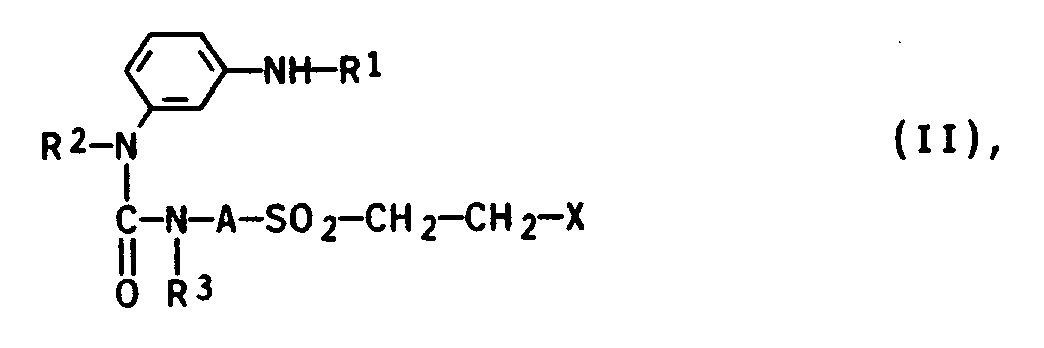 R¹, R² und R³ gleich oder verschieden sind und unabhängig voneinander jeweils Wasserstoff, C₁-C₄-Alkyl oder Phenyl,A C₂-C₈-Alkylen, das gegebenenfalls durch 1 bis 3 Sauerstoffatome, Iminogruppen oder C₁-C₄-Alkyliminogruppen unterbrochen ist, undX Hydroxy oder Halogen bedeuten.
 - Verwendung der Reaktivfarbstoffe gemäß Anspruch 1 zum Färben oder Bedrucken von Hydroxyl- oder Aminogruppen aufweisenden organischen Substraten.
Applications Claiming Priority (2)
| Application Number | Priority Date | Filing Date | Title |
|---|---|---|---|
| DE3939286 | 1989-11-28 | ||
| DE3939286A DE3939286A1 (de) | 1989-11-28 | 1989-11-28 | Phenylazo- oder naphthylazobenzole mit mehreren reaktiven gruppen sowie deren zwischenprodukte |
Publications (2)
| Publication Number | Publication Date |
|---|---|
| EP0437699A1 EP0437699A1 (de) | 1991-07-24 |
| EP0437699B1 true EP0437699B1 (de) | 1994-06-22 |
Family
ID=6394335
Family Applications (1)
| Application Number | Title | Priority Date | Filing Date |
|---|---|---|---|
| EP90121853A Expired - Lifetime EP0437699B1 (de) | 1989-11-28 | 1990-11-15 | Phenylazo- oder Naphthylazobenzole mit mehreren reaktiven Gruppen sowie deren Zwischenprodukte |
Country Status (4)
| Country | Link |
|---|---|
| US (1) | US5091516A (de) |
| EP (1) | EP0437699B1 (de) |
| JP (1) | JPH03172355A (de) |
| DE (2) | DE3939286A1 (de) |
Families Citing this family (5)
| Publication number | Priority date | Publication date | Assignee | Title |
|---|---|---|---|---|
| DE4107692A1 (de) * | 1991-03-09 | 1992-09-17 | Basf Ag | Verdoppelte phenylazo- oder naphthylazobenzole mit mehreren reaktiven gruppen sowie deren zwischenprodukte |
| DE4116785A1 (de) * | 1991-05-23 | 1992-11-26 | Basf Ag | Phenylazo- oder naphthylazobenzole mit mehreren reaktiven ankern |
| DE4201699A1 (de) * | 1992-01-23 | 1993-07-29 | Basf Ag | Gemischte oxalsaeurediamide |
| DE4320661A1 (de) * | 1993-06-22 | 1995-01-05 | Basf Ag | Phenylazo- oder Naphthylazobenzole mit Thioethergruppen |
| US20080305512A1 (en) * | 2006-10-26 | 2008-12-11 | Mattingly Phillip G | Assay for cardiac troponin autoantibodies |
Family Cites Families (1)
| Publication number | Priority date | Publication date | Assignee | Title |
|---|---|---|---|---|
| DE3584410D1 (de) * | 1984-08-30 | 1991-11-21 | Ciba Geigy Ag | Reaktivfarbstoffe, deren herstellung und verwendung. |
-
1989
- 1989-11-28 DE DE3939286A patent/DE3939286A1/de not_active Withdrawn
-
1990
- 1990-11-05 US US07/608,842 patent/US5091516A/en not_active Expired - Fee Related
- 1990-11-05 JP JP2297364A patent/JPH03172355A/ja active Pending
- 1990-11-15 EP EP90121853A patent/EP0437699B1/de not_active Expired - Lifetime
- 1990-11-15 DE DE59006227T patent/DE59006227D1/de not_active Expired - Lifetime
Also Published As
| Publication number | Publication date |
|---|---|
| JPH03172355A (ja) | 1991-07-25 |
| DE3939286A1 (de) | 1991-05-29 |
| US5091516A (en) | 1992-02-25 |
| DE59006227D1 (de) | 1994-07-28 |
| EP0437699A1 (de) | 1991-07-24 |
Similar Documents
| Publication | Publication Date | Title |
|---|---|---|
| EP0073481B1 (de) | Wasserlösliche Azoverbindungen, Verfahren zu ihrer Herstellung und ihre Verwendung als Farbstoffe | |
| DE19600765A1 (de) | Reaktive Azofarbstoffe mit einer Kupplungskomponente aus der Reihe der Aminonaphthalinsulfonsäuren sowie deren Zwischenprodukte | |
| EP0772653B1 (de) | Reaktive azofarbstoffe mit einer kupplungskomponente aus der aminonaphthalinreihe | |
| EP0051808B1 (de) | Wasserlösliche Monoazoverbindungen, Verfahren zu ihrer Herstellung und ihre Verwendung als Farbstoffe | |
| EP0515844B1 (de) | Phenylazo- oder Naphthylazobenzole mit mehreren reaktiven Ankern | |
| EP0051807B1 (de) | Wasserlösliche Disazoverbindungen, Verfahren zu ihrer Herstellung und ihre Verwendung als Farbstoffe | |
| EP0437699A1 (de) | Phenylazo- oder Naphthylazobenzole mit mehreren reaktiven Gruppen sowie deren Zwischenprodukte | |
| EP0503385B1 (de) | Verdoppelte Phenylazo- oder Naphthylazobenzole mit mehreren reaktiven Gruppen sowie deren Zwischenprodukte | |
| EP0587030B1 (de) | Reaktivfarbstoffe auf Formazanbasis sowie Hydrazone | |
| EP0283900B1 (de) | Wasserlösliche Azoverbindungen, Verfahren zu ihrer Herstellung und ihre Verwendung als Farbstoffe | |
| EP0603116B1 (de) | Azoreaktivfarbstoffe | |
| DE3819752A1 (de) | Reaktivfarbstoffe | |
| DE19619239A1 (de) | Azoreaktivfarbstoffe mit einer reaktivankertragenden Diazokomponente aus der Reihe des m-Phenylendiamins | |
| EP0592980A2 (de) | Reaktivfarbstoffe auf Formazanbasis, die mindestens zwei reaktive Gruppen aufweisen, sowie Aminophenole | |
| EP0489360B1 (de) | Wasserlösliche Azoverbindungen, Verfahren zu ihrer Herstellung und ihre Verwendung als Farbstoffe | |
| US5214207A (en) | Phenyl- or naphthylazobenzenes with multiple reactive groups and intermediates therefor | |
| EP0630947A1 (de) | Phenylazo- oder Naphthylazobenzole mit Thioethergruppen | |
| EP0735108B1 (de) | Reaktive Azofarbstoffe mit einer Kupplungskomponente aus der Reihe der Aminonaphtalinsulfonsäuren | |
| EP0513657A2 (de) | Wasserlösliche Azoverbindungen, Verfahren zu ihrer Herstellung und ihre Verwendung als Farbstoffe | |
| EP0381133B1 (de) | Wasserlösliche Azoverbindungen, Verfahren zu ihrer Herstellung und ihre Verwendung als Farbstoffe | |
| EP0433764A1 (de) | Reaktivfarbstoffe mit Triazin- und Chlorbutinylanker | |
| EP0255020A2 (de) | Wasserlösliche Triphendioxazin-Verbindungen, Verfahren zu ihrer Herstellung und ihre Verwendung als Farbstoffe | |
| EP0399411B1 (de) | Wasserlösliche Azoverbindungen, Verfahren zu ihrer Herstellung und ihre Verwendung als Farbstoffe | |
| EP0754733A1 (de) | Azofarbstoffe, Verfahren zu deren Herstellung und deren Verwendung | |
| DE2161553B2 (de) | Wasserlösliche, faserreaktive Azofarbstoffe, Verfahren zu ihrer Herstellung und ihre Verwendung zum Färben oder Bedrucken von Leder, Wolle, Seide und Materialien aus Polyamid- oder Polyurethanfasern oder nativen oder regenerierten Cellulosefasern |
Legal Events
| Date | Code | Title | Description |
|---|---|---|---|
| PUAI | Public reference made under article 153(3) epc to a published international application that has entered the european phase |
Free format text: ORIGINAL CODE: 0009012 |
|
| 17P | Request for examination filed |
Effective date: 19901227 |
|
| AK | Designated contracting states |
Kind code of ref document: A1 Designated state(s): CH DE FR GB IT LI |
|
| 17Q | First examination report despatched |
Effective date: 19930415 |
|
| GRAA | (expected) grant |
Free format text: ORIGINAL CODE: 0009210 |
|
| AK | Designated contracting states |
Kind code of ref document: B1 Designated state(s): CH DE FR GB IT LI |
|
| REF | Corresponds to: |
Ref document number: 59006227 Country of ref document: DE Date of ref document: 19940728 |
|
| ITF | It: translation for a ep patent filed | ||
| GBT | Gb: translation of ep patent filed (gb section 77(6)(a)/1977) |
Effective date: 19940712 |
|
| ET | Fr: translation filed | ||
| PLBE | No opposition filed within time limit |
Free format text: ORIGINAL CODE: 0009261 |
|
| STAA | Information on the status of an ep patent application or granted ep patent |
Free format text: STATUS: NO OPPOSITION FILED WITHIN TIME LIMIT |
|
| 26N | No opposition filed | ||
| PGFP | Annual fee paid to national office [announced via postgrant information from national office to epo] |
Ref country code: FR Payment date: 19971027 Year of fee payment: 8 |
|
| PGFP | Annual fee paid to national office [announced via postgrant information from national office to epo] |
Ref country code: GB Payment date: 19971103 Year of fee payment: 8 |
|
| PGFP | Annual fee paid to national office [announced via postgrant information from national office to epo] |
Ref country code: CH Payment date: 19971105 Year of fee payment: 8 |
|
| PGFP | Annual fee paid to national office [announced via postgrant information from national office to epo] |
Ref country code: DE Payment date: 19971128 Year of fee payment: 8 |
|
| PG25 | Lapsed in a contracting state [announced via postgrant information from national office to epo] |
Ref country code: GB Free format text: LAPSE BECAUSE OF NON-PAYMENT OF DUE FEES Effective date: 19981115 |
|
| PG25 | Lapsed in a contracting state [announced via postgrant information from national office to epo] |
Ref country code: LI Free format text: LAPSE BECAUSE OF NON-PAYMENT OF DUE FEES Effective date: 19981130 Ref country code: CH Free format text: LAPSE BECAUSE OF NON-PAYMENT OF DUE FEES Effective date: 19981130 |
|
| PG25 | Lapsed in a contracting state [announced via postgrant information from national office to epo] |
Ref country code: DE Free format text: LAPSE BECAUSE OF THE APPLICANT RENOUNCES Effective date: 19981204 |
|
| GBPC | Gb: european patent ceased through non-payment of renewal fee |
Effective date: 19981115 |
|
| REG | Reference to a national code |
Ref country code: CH Ref legal event code: PL |
|
| PG25 | Lapsed in a contracting state [announced via postgrant information from national office to epo] |
Ref country code: FR Free format text: LAPSE BECAUSE OF NON-PAYMENT OF DUE FEES Effective date: 19990730 |
|
| REG | Reference to a national code |
Ref country code: FR Ref legal event code: ST |
|
| PG25 | Lapsed in a contracting state [announced via postgrant information from national office to epo] |
Ref country code: IT Free format text: LAPSE BECAUSE OF NON-PAYMENT OF DUE FEES;WARNING: LAPSES OF ITALIAN PATENTS WITH EFFECTIVE DATE BEFORE 2007 MAY HAVE OCCURRED AT ANY TIME BEFORE 2007. THE CORRECT EFFECTIVE DATE MAY BE DIFFERENT FROM THE ONE RECORDED. Effective date: 20051115 |