EP0437905A1 - Composition cÀ©ramique pour le coulage en barbotine et de feuilles minces et procédé pour la production de corps céramiques - Google Patents
Composition cÀ©ramique pour le coulage en barbotine et de feuilles minces et procédé pour la production de corps céramiques Download PDFInfo
- Publication number
- EP0437905A1 EP0437905A1 EP90300480A EP90300480A EP0437905A1 EP 0437905 A1 EP0437905 A1 EP 0437905A1 EP 90300480 A EP90300480 A EP 90300480A EP 90300480 A EP90300480 A EP 90300480A EP 0437905 A1 EP0437905 A1 EP 0437905A1
- Authority
- EP
- European Patent Office
- Prior art keywords
- composition
- particulate material
- casting
- present
- group
- Prior art date
- Legal status (The legal status is an assumption and is not a legal conclusion. Google has not performed a legal analysis and makes no representation as to the accuracy of the status listed.)
- Withdrawn
Links
- 239000000203 mixture Substances 0.000 title claims abstract description 77
- 239000000919 ceramic Substances 0.000 title claims description 25
- 238000000034 method Methods 0.000 title claims description 22
- 230000008569 process Effects 0.000 title claims description 14
- 238000010345 tape casting Methods 0.000 title description 6
- 238000007569 slipcasting Methods 0.000 title description 3
- 239000002270 dispersing agent Substances 0.000 claims abstract description 46
- 239000003960 organic solvent Substances 0.000 claims abstract description 19
- 239000011236 particulate material Substances 0.000 claims abstract description 19
- 125000004432 carbon atom Chemical group C* 0.000 claims abstract description 5
- 125000000217 alkyl group Chemical group 0.000 claims abstract description 4
- 125000001183 hydrocarbyl group Chemical group 0.000 claims abstract 3
- YXFVVABEGXRONW-UHFFFAOYSA-N Toluene Chemical compound CC1=CC=CC=C1 YXFVVABEGXRONW-UHFFFAOYSA-N 0.000 claims description 36
- LFQSCWFLJHTTHZ-UHFFFAOYSA-N Ethanol Chemical compound CCO LFQSCWFLJHTTHZ-UHFFFAOYSA-N 0.000 claims description 8
- 238000001035 drying Methods 0.000 claims description 7
- 239000010408 film Substances 0.000 claims description 7
- 239000000758 substrate Substances 0.000 claims description 6
- 125000002877 alkyl aryl group Chemical group 0.000 claims description 3
- 238000010304 firing Methods 0.000 claims description 3
- 238000004519 manufacturing process Methods 0.000 claims description 3
- 239000010409 thin film Substances 0.000 claims description 2
- OKKJLVBELUTLKV-UHFFFAOYSA-N Methanol Chemical compound OC OKKJLVBELUTLKV-UHFFFAOYSA-N 0.000 claims 3
- 238000005266 casting Methods 0.000 abstract description 60
- 238000000465 moulding Methods 0.000 abstract description 4
- 238000004062 sedimentation Methods 0.000 description 15
- 239000002245 particle Substances 0.000 description 12
- HBMJWWWQQXIZIP-UHFFFAOYSA-N silicon carbide Chemical compound [Si+]#[C-] HBMJWWWQQXIZIP-UHFFFAOYSA-N 0.000 description 11
- 229910010271 silicon carbide Inorganic materials 0.000 description 11
- 239000002002 slurry Substances 0.000 description 10
- 239000013049 sediment Substances 0.000 description 9
- XLYOFNOQVPJJNP-UHFFFAOYSA-N water Substances O XLYOFNOQVPJJNP-UHFFFAOYSA-N 0.000 description 9
- PMHQVHHXPFUNSP-UHFFFAOYSA-M copper(1+);methylsulfanylmethane;bromide Chemical compound Br[Cu].CSC PMHQVHHXPFUNSP-UHFFFAOYSA-M 0.000 description 8
- 239000000463 material Substances 0.000 description 8
- 239000007787 solid Substances 0.000 description 8
- 235000021323 fish oil Nutrition 0.000 description 5
- 239000007788 liquid Substances 0.000 description 5
- 239000006185 dispersion Substances 0.000 description 4
- 238000002474 experimental method Methods 0.000 description 4
- 239000010954 inorganic particle Substances 0.000 description 4
- 239000000523 sample Substances 0.000 description 4
- CSCPPACGZOOCGX-UHFFFAOYSA-N Acetone Chemical compound CC(C)=O CSCPPACGZOOCGX-UHFFFAOYSA-N 0.000 description 3
- UHOVQNZJYSORNB-UHFFFAOYSA-N Benzene Chemical compound C1=CC=CC=C1 UHOVQNZJYSORNB-UHFFFAOYSA-N 0.000 description 3
- 230000008901 benefit Effects 0.000 description 3
- 239000011230 binding agent Substances 0.000 description 3
- 238000005056 compaction Methods 0.000 description 3
- 239000002285 corn oil Substances 0.000 description 3
- 235000005687 corn oil Nutrition 0.000 description 3
- 230000000694 effects Effects 0.000 description 3
- 235000019441 ethanol Nutrition 0.000 description 3
- 150000002430 hydrocarbons Chemical group 0.000 description 3
- 239000012535 impurity Substances 0.000 description 3
- 229910010272 inorganic material Inorganic materials 0.000 description 3
- 239000011147 inorganic material Substances 0.000 description 3
- 239000000843 powder Substances 0.000 description 3
- 239000003981 vehicle Substances 0.000 description 3
- KFZMGEQAYNKOFK-UHFFFAOYSA-N Isopropanol Chemical compound CC(C)O KFZMGEQAYNKOFK-UHFFFAOYSA-N 0.000 description 2
- LRHPLDYGYMQRHN-UHFFFAOYSA-N N-Butanol Chemical compound CCCCO LRHPLDYGYMQRHN-UHFFFAOYSA-N 0.000 description 2
- 238000007792 addition Methods 0.000 description 2
- 239000002518 antifoaming agent Substances 0.000 description 2
- 230000015572 biosynthetic process Effects 0.000 description 2
- 229910010293 ceramic material Inorganic materials 0.000 description 2
- 230000008859 change Effects 0.000 description 2
- 239000000084 colloidal system Substances 0.000 description 2
- 239000013068 control sample Substances 0.000 description 2
- 230000007547 defect Effects 0.000 description 2
- 238000001704 evaporation Methods 0.000 description 2
- 230000008020 evaporation Effects 0.000 description 2
- 238000005189 flocculation Methods 0.000 description 2
- 230000016615 flocculation Effects 0.000 description 2
- 230000006872 improvement Effects 0.000 description 2
- 238000002156 mixing Methods 0.000 description 2
- 229920000642 polymer Polymers 0.000 description 2
- 239000002904 solvent Substances 0.000 description 2
- KZNICNPSHKQLFF-UHFFFAOYSA-N succinimide Chemical compound O=C1CCC(=O)N1 KZNICNPSHKQLFF-UHFFFAOYSA-N 0.000 description 2
- WFKWXMTUELFFGS-UHFFFAOYSA-N tungsten Chemical compound [W] WFKWXMTUELFFGS-UHFFFAOYSA-N 0.000 description 2
- 229910052721 tungsten Inorganic materials 0.000 description 2
- 239000010937 tungsten Substances 0.000 description 2
- KBPLFHHGFOOTCA-UHFFFAOYSA-N 1-Octanol Chemical compound CCCCCCCCO KBPLFHHGFOOTCA-UHFFFAOYSA-N 0.000 description 1
- 239000004215 Carbon black (E152) Substances 0.000 description 1
- 229920000298 Cellophane Polymers 0.000 description 1
- NTIZESTWPVYFNL-UHFFFAOYSA-N Methyl isobutyl ketone Chemical compound CC(C)CC(C)=O NTIZESTWPVYFNL-UHFFFAOYSA-N 0.000 description 1
- UIHCLUNTQKBZGK-UHFFFAOYSA-N Methyl isobutyl ketone Natural products CCC(C)C(C)=O UIHCLUNTQKBZGK-UHFFFAOYSA-N 0.000 description 1
- -1 Milar Polymers 0.000 description 1
- ZOKXTWBITQBERF-UHFFFAOYSA-N Molybdenum Chemical compound [Mo] ZOKXTWBITQBERF-UHFFFAOYSA-N 0.000 description 1
- CTQNGGLPUBDAKN-UHFFFAOYSA-N O-Xylene Chemical compound CC1=CC=CC=C1C CTQNGGLPUBDAKN-UHFFFAOYSA-N 0.000 description 1
- 239000004372 Polyvinyl alcohol Substances 0.000 description 1
- 239000004809 Teflon Substances 0.000 description 1
- 229920006362 Teflon® Polymers 0.000 description 1
- BOTDANWDWHJENH-UHFFFAOYSA-N Tetraethyl orthosilicate Chemical compound CCO[Si](OCC)(OCC)OCC BOTDANWDWHJENH-UHFFFAOYSA-N 0.000 description 1
- NRTOMJZYCJJWKI-UHFFFAOYSA-N Titanium nitride Chemical compound [Ti]#N NRTOMJZYCJJWKI-UHFFFAOYSA-N 0.000 description 1
- XSTXAVWGXDQKEL-UHFFFAOYSA-N Trichloroethylene Chemical group ClC=C(Cl)Cl XSTXAVWGXDQKEL-UHFFFAOYSA-N 0.000 description 1
- 229920001807 Urea-formaldehyde Polymers 0.000 description 1
- 229910026551 ZrC Inorganic materials 0.000 description 1
- OTCHGXYCWNXDOA-UHFFFAOYSA-N [C].[Zr] Chemical compound [C].[Zr] OTCHGXYCWNXDOA-UHFFFAOYSA-N 0.000 description 1
- 230000002411 adverse Effects 0.000 description 1
- 150000001298 alcohols Chemical class 0.000 description 1
- WUKWITHWXAAZEY-UHFFFAOYSA-L calcium difluoride Chemical compound [F-].[F-].[Ca+2] WUKWITHWXAAZEY-UHFFFAOYSA-L 0.000 description 1
- 229910001634 calcium fluoride Inorganic materials 0.000 description 1
- BRPQOXSCLDDYGP-UHFFFAOYSA-N calcium oxide Chemical compound [O-2].[Ca+2] BRPQOXSCLDDYGP-UHFFFAOYSA-N 0.000 description 1
- 239000000292 calcium oxide Substances 0.000 description 1
- ODINCKMPIJJUCX-UHFFFAOYSA-N calcium oxide Inorganic materials [Ca]=O ODINCKMPIJJUCX-UHFFFAOYSA-N 0.000 description 1
- 239000003990 capacitor Substances 0.000 description 1
- 239000003054 catalyst Substances 0.000 description 1
- 229920002301 cellulose acetate Polymers 0.000 description 1
- 238000005524 ceramic coating Methods 0.000 description 1
- 239000003153 chemical reaction reagent Substances 0.000 description 1
- 238000006757 chemical reactions by type Methods 0.000 description 1
- 239000010941 cobalt Substances 0.000 description 1
- 229910017052 cobalt Inorganic materials 0.000 description 1
- 239000002131 composite material Substances 0.000 description 1
- 150000001875 compounds Chemical class 0.000 description 1
- 229920001577 copolymer Polymers 0.000 description 1
- 230000001419 dependent effect Effects 0.000 description 1
- 239000003599 detergent Substances 0.000 description 1
- 235000014113 dietary fatty acids Nutrition 0.000 description 1
- 239000000194 fatty acid Substances 0.000 description 1
- 229930195729 fatty acid Natural products 0.000 description 1
- 150000004665 fatty acids Chemical class 0.000 description 1
- 239000010419 fine particle Substances 0.000 description 1
- 150000002222 fluorine compounds Chemical class 0.000 description 1
- 239000006260 foam Substances 0.000 description 1
- 238000005187 foaming Methods 0.000 description 1
- 230000006870 function Effects 0.000 description 1
- 239000011521 glass Substances 0.000 description 1
- 229930195733 hydrocarbon Natural products 0.000 description 1
- 230000003993 interaction Effects 0.000 description 1
- 229910000765 intermetallic Inorganic materials 0.000 description 1
- 239000000395 magnesium oxide Substances 0.000 description 1
- CPLXHLVBOLITMK-UHFFFAOYSA-N magnesium oxide Inorganic materials [Mg]=O CPLXHLVBOLITMK-UHFFFAOYSA-N 0.000 description 1
- AXZKOIWUVFPNLO-UHFFFAOYSA-N magnesium;oxygen(2-) Chemical compound [O-2].[Mg+2] AXZKOIWUVFPNLO-UHFFFAOYSA-N 0.000 description 1
- 230000015654 memory Effects 0.000 description 1
- 229910044991 metal oxide Inorganic materials 0.000 description 1
- 150000004706 metal oxides Chemical class 0.000 description 1
- 229940043265 methyl isobutyl ketone Drugs 0.000 description 1
- 238000012986 modification Methods 0.000 description 1
- 230000004048 modification Effects 0.000 description 1
- 229910052750 molybdenum Inorganic materials 0.000 description 1
- 239000011733 molybdenum Substances 0.000 description 1
- 239000000178 monomer Substances 0.000 description 1
- TWNQGVIAIRXVLR-UHFFFAOYSA-N oxo(oxoalumanyloxy)alumane Chemical compound O=[Al]O[Al]=O TWNQGVIAIRXVLR-UHFFFAOYSA-N 0.000 description 1
- RVTZCBVAJQQJTK-UHFFFAOYSA-N oxygen(2-);zirconium(4+) Chemical compound [O-2].[O-2].[Zr+4] RVTZCBVAJQQJTK-UHFFFAOYSA-N 0.000 description 1
- 239000004014 plasticizer Substances 0.000 description 1
- ODGAOXROABLFNM-UHFFFAOYSA-N polynoxylin Chemical compound O=C.NC(N)=O ODGAOXROABLFNM-UHFFFAOYSA-N 0.000 description 1
- 229920002451 polyvinyl alcohol Polymers 0.000 description 1
- 239000012254 powdered material Substances 0.000 description 1
- 238000001556 precipitation Methods 0.000 description 1
- 238000002360 preparation method Methods 0.000 description 1
- 238000012545 processing Methods 0.000 description 1
- 238000004080 punching Methods 0.000 description 1
- 238000000518 rheometry Methods 0.000 description 1
- 230000035945 sensitivity Effects 0.000 description 1
- 238000007493 shaping process Methods 0.000 description 1
- 239000007790 solid phase Substances 0.000 description 1
- 239000007858 starting material Substances 0.000 description 1
- 229960002317 succinimide Drugs 0.000 description 1
- 229920002994 synthetic fiber Polymers 0.000 description 1
- 238000012360 testing method Methods 0.000 description 1
- UBOXGVDOUJQMTN-UHFFFAOYSA-N trichloroethylene Natural products ClCC(Cl)Cl UBOXGVDOUJQMTN-UHFFFAOYSA-N 0.000 description 1
- UFTFJSFQGQCHQW-UHFFFAOYSA-N triformin Chemical compound O=COCC(OC=O)COC=O UFTFJSFQGQCHQW-UHFFFAOYSA-N 0.000 description 1
- MTPVUVINMAGMJL-UHFFFAOYSA-N trimethyl(1,1,2,2,2-pentafluoroethyl)silane Chemical compound C[Si](C)(C)C(F)(F)C(F)(F)F MTPVUVINMAGMJL-UHFFFAOYSA-N 0.000 description 1
- 238000009966 trimming Methods 0.000 description 1
- 235000021122 unsaturated fatty acids Nutrition 0.000 description 1
- 238000004017 vitrification Methods 0.000 description 1
- 239000008096 xylene Substances 0.000 description 1
- 229910001928 zirconium oxide Inorganic materials 0.000 description 1
- 229910000859 α-Fe Inorganic materials 0.000 description 1
Images



Classifications
-
- C—CHEMISTRY; METALLURGY
- C04—CEMENTS; CONCRETE; ARTIFICIAL STONE; CERAMICS; REFRACTORIES
- C04B—LIME, MAGNESIA; SLAG; CEMENTS; COMPOSITIONS THEREOF, e.g. MORTARS, CONCRETE OR LIKE BUILDING MATERIALS; ARTIFICIAL STONE; CERAMICS; REFRACTORIES; TREATMENT OF NATURAL STONE
- C04B35/00—Shaped ceramic products characterised by their composition; Ceramics compositions; Processing powders of inorganic compounds preparatory to the manufacturing of ceramic products
- C04B35/622—Forming processes; Processing powders of inorganic compounds preparatory to the manufacturing of ceramic products
- C04B35/626—Preparing or treating the powders individually or as batches ; preparing or treating macroscopic reinforcing agents for ceramic products, e.g. fibres; mechanical aspects section B
- C04B35/62605—Treating the starting powders individually or as mixtures
- C04B35/62625—Wet mixtures
- C04B35/6264—Mixing media, e.g. organic solvents
-
- C—CHEMISTRY; METALLURGY
- C04—CEMENTS; CONCRETE; ARTIFICIAL STONE; CERAMICS; REFRACTORIES
- C04B—LIME, MAGNESIA; SLAG; CEMENTS; COMPOSITIONS THEREOF, e.g. MORTARS, CONCRETE OR LIKE BUILDING MATERIALS; ARTIFICIAL STONE; CERAMICS; REFRACTORIES; TREATMENT OF NATURAL STONE
- C04B33/00—Clay-wares
- C04B33/28—Slip casting
-
- C—CHEMISTRY; METALLURGY
- C04—CEMENTS; CONCRETE; ARTIFICIAL STONE; CERAMICS; REFRACTORIES
- C04B—LIME, MAGNESIA; SLAG; CEMENTS; COMPOSITIONS THEREOF, e.g. MORTARS, CONCRETE OR LIKE BUILDING MATERIALS; ARTIFICIAL STONE; CERAMICS; REFRACTORIES; TREATMENT OF NATURAL STONE
- C04B35/00—Shaped ceramic products characterised by their composition; Ceramics compositions; Processing powders of inorganic compounds preparatory to the manufacturing of ceramic products
- C04B35/515—Shaped ceramic products characterised by their composition; Ceramics compositions; Processing powders of inorganic compounds preparatory to the manufacturing of ceramic products based on non-oxide ceramics
- C04B35/56—Shaped ceramic products characterised by their composition; Ceramics compositions; Processing powders of inorganic compounds preparatory to the manufacturing of ceramic products based on non-oxide ceramics based on carbides or oxycarbides
- C04B35/565—Shaped ceramic products characterised by their composition; Ceramics compositions; Processing powders of inorganic compounds preparatory to the manufacturing of ceramic products based on non-oxide ceramics based on carbides or oxycarbides based on silicon carbide
-
- C—CHEMISTRY; METALLURGY
- C04—CEMENTS; CONCRETE; ARTIFICIAL STONE; CERAMICS; REFRACTORIES
- C04B—LIME, MAGNESIA; SLAG; CEMENTS; COMPOSITIONS THEREOF, e.g. MORTARS, CONCRETE OR LIKE BUILDING MATERIALS; ARTIFICIAL STONE; CERAMICS; REFRACTORIES; TREATMENT OF NATURAL STONE
- C04B35/00—Shaped ceramic products characterised by their composition; Ceramics compositions; Processing powders of inorganic compounds preparatory to the manufacturing of ceramic products
- C04B35/515—Shaped ceramic products characterised by their composition; Ceramics compositions; Processing powders of inorganic compounds preparatory to the manufacturing of ceramic products based on non-oxide ceramics
- C04B35/58—Shaped ceramic products characterised by their composition; Ceramics compositions; Processing powders of inorganic compounds preparatory to the manufacturing of ceramic products based on non-oxide ceramics based on borides, nitrides, i.e. nitrides, oxynitrides, carbonitrides or oxycarbonitrides or silicides
- C04B35/581—Shaped ceramic products characterised by their composition; Ceramics compositions; Processing powders of inorganic compounds preparatory to the manufacturing of ceramic products based on non-oxide ceramics based on borides, nitrides, i.e. nitrides, oxynitrides, carbonitrides or oxycarbonitrides or silicides based on aluminium nitride
-
- C—CHEMISTRY; METALLURGY
- C04—CEMENTS; CONCRETE; ARTIFICIAL STONE; CERAMICS; REFRACTORIES
- C04B—LIME, MAGNESIA; SLAG; CEMENTS; COMPOSITIONS THEREOF, e.g. MORTARS, CONCRETE OR LIKE BUILDING MATERIALS; ARTIFICIAL STONE; CERAMICS; REFRACTORIES; TREATMENT OF NATURAL STONE
- C04B2235/00—Aspects relating to ceramic starting mixtures or sintered ceramic products
- C04B2235/60—Aspects relating to the preparation, properties or mechanical treatment of green bodies or pre-forms
- C04B2235/602—Making the green bodies or pre-forms by moulding
- C04B2235/6025—Tape casting, e.g. with a doctor blade
-
- C—CHEMISTRY; METALLURGY
- C04—CEMENTS; CONCRETE; ARTIFICIAL STONE; CERAMICS; REFRACTORIES
- C04B—LIME, MAGNESIA; SLAG; CEMENTS; COMPOSITIONS THEREOF, e.g. MORTARS, CONCRETE OR LIKE BUILDING MATERIALS; ARTIFICIAL STONE; CERAMICS; REFRACTORIES; TREATMENT OF NATURAL STONE
- C04B2235/00—Aspects relating to ceramic starting mixtures or sintered ceramic products
- C04B2235/60—Aspects relating to the preparation, properties or mechanical treatment of green bodies or pre-forms
- C04B2235/602—Making the green bodies or pre-forms by moulding
- C04B2235/6027—Slip casting
Definitions
- the present invention is related to an improvement in ceramic slip and tape casting compositions.
- the present invention is directed to ceramic casting compositions which utilize organic solvents. More particularly, the present invention is directed to the use of a particular class of dispersing agents for the inorganic casting compositions.
- the characteristics of a good casting composition are: (1) the slip must pour easily and fill all the details of the mold and should not exhibit significant yield point or pronounced dilatency or thixotropy; (2) the particles in the casting composition should not settle too quickly to the bottom otherwise the casting composition or casted product will have tapered walls and thick bottoms and the final fired ceramic part will have an excessive number of flaws or defects; (3) the casting composition must release from the mold fairly easy and should not shrink to excessive amounts during drying; (4) the strength of the cast object prior to firing must be sufficient to allow handling, trimming or further shaping of the cast article; (5) the rate of casting when utilizing the composition should be such as to be consistent with reasonable production rates and good properties; (6) the casting composition should not produce an excessive amount of foam which would result in the entrapment of air bubbles in the pre-fired cast object; and (7) the solvent used for the casting composition should have a relatively low evaporation rate so that a dry film does not form on the exposed surface of the cast composition.
- prior casting compositions containing organic solvents have used polymers and copolymers of natural or synthetic materials as the dispersing agents.
- these types of materials include fish oil, a cross-linked fatty acid triglyceride, corn oil, an unsaturated fatty acid glyceride and LB 2155 (a polyisobutenyl succinimide) produced by Lubrizol Corp.. While all these materials produce adequate organic casting compositions, there is substantial room for improvement. It is the object of the present invention to provide improved casting or slip composition utilizing a unique dispersing agent.
- the casting composition of the present invention comprises a mixture of a powdered inorganic material, an organic solvent or vehicle and a dispersing agent having the structure characterized by the formula set forth below: where R 1 R 2 R 3 are linear or branched hydrocarbon chains and alkylaryl, and not more than one of the R Groups is CH 3 and the remaining R groups are each at least 6 to 30 carbon atoms long;
- the process of the present invention comprises forming a ceramic article by mixing an inorganic powdered material with an organic solvent in the presence of a dispersing agent having the formula described above to form a casting composition, applying the casting composition to a suitable substrate, drying the casting composition for a time sufficient to remove the organic solvent and firing the dried composition to produce the finished ceramic product.
- the casting composition and process of the present invention provides a ceramic article which has increased density and compaction when compared to prior art ceramic articles.
- the casting composition of the present invention is substantially insensitive to water at least within the operating ranges normally associated with processes utilizing casting compositions. That is, the casting composition provides good dispersions of the inorganic particulate material even if water is present in the composition or starting material.
- typical organic casting composition could not tolerate any significant amount of water because it would lead immediately to flocculation and/or precipitation of the dispersed inorganic particles and loss of favored rheology (i.e. flow properties).
- the dispersant of the present invention while not being highly water soluble provides that the organic dispersed casting composition can tolerate relatively high water content.
- casting compositions prepared with the dispersing agent of the present invention were able to tolerate up to 20 wt. % water without any adverse effects on the composition. This means that the casting composition of the present invention can tolerate water as an impurity and that no special handling is necessary during the casting operation.
- the inorganic particulate material suitable for use in the casting composition of the present invention may comprise any conventional ceramic or inorganic material.
- suitable inorganic particulate materials useful in ceramic applications are metal oxides such as aluminum oxide, magnesium oxide, calcium oxide, zirconium oxide, etc.; intermetallic compounds such as silicon carbide, titanium carbide, titanium nitride, aluminum nitride, zirconium carbide, etc.; cermets such as tungsten carbide-cobalt, etc.; metallics such as tungsten and molybdenum and slip-casting fluorides such as calcium fluoride.
- the inorganic particulate material should be compatible with the organic solvent utilized to form the casting composition.
- the weight percent of the inorganic particulate material is between about 5 to 80, preferably 5 to 50, especially preferred being 5 to 40.
- these ranges are illustrative only and it is envisioned that particulate material outside these ranges, in particular, lower amounts would be suitable in the practice of the present invention.
- the size of the particles constituting the solid phase may vary over a wide range depending on the density of the inorganic material and the desired characteristics of the fired article. However, the particles should be in the colloidal size range. High density materials require sub-micron particles to avoid settling. Experience has shown that oxide bodies to be fired to vitrification should consist of particles smaller than 20 micrometers in diameter with at least half the particles being between 1 and 5 micrometers. Extremely fine particles such as those smaller than 1 micrometer may cause problems because they require large amounts of liquids to provide a usable slip for casting compositions. In the practice of the present invention, the preferred particle size for the inorganic particles is between 0.01 and 20 microns, most preferably, 0.5 to 10 microns.
- the organic solvent used to suspend the inorganic particles in the casting composition should have a relatively low vapor pressure, be compatible with the suspended particulate material, be cheap, of low viscosity and have an ability to dissolve the dispersing agent.
- Typical organic solvents for the casting composition of the present invention comprise acetone, ethyl alcohol, benzene,. butanol, ethanol, isopropanol, methylisobutylketone, toluene, trichloroethylene and xylene.
- the organic solvent utilized is toluene.
- the dispersing agent of the present invention is generally classified as a zwitterion and must have the formula as set forth above.
- This zwitterionic dispersing agent has been shown to provide casting compositions which result in a green unfired ceramic composition which is tightly packed and has a high density. Another advantage is that the dispersing agents control settling time for the casting solution.
- the zwitterionic dispersing agent of the present invention provides the casting composition with a high tolerance to impurities such as water.
- the dispersing agents of the present invention are low molecular weight monomers consisting of a polar head group that contains at least one positive and one negative charge in a branched hydrocarbon tail.
- Suitable dispersants for the present invention include: The weight percent of dispersant with respect to solids may range from .5 to 10, preferably 1 to 8. Most preferably the range is 2 to 5. Of course, it should be understood that the particular preferred wt. percent of dispersant in the casting composition will be dependent on the final utility of the resulting cast product and can be determined by routine experimentation by one having ordinary skill in the art.
- binders and anti-foaming agents may be added to the casting composition of the present invention.
- these types of binders include polyvinyl alcohol, ureaformaldehyde, carboxymethylcellusose, ethylsilicate, etc.
- Typical anti-foaming agents include small amounts of octyl alcohol.
- the casting composition of the present invention is suitable in any conventional molding or casting operation. It is envisioned that it shall find significant utility in the Doctor Blade process of forming ceramic materials.
- the Doctor Blade process comprises suspending a finely divided inorganic powders in a non-aqueous liquid system comprising an organic solvent, binder and dispersing agent to form a slurry that is cast onto a moving carrier surface.
- the slurry passes beneath a knife edge or blade that levels or "doctors” the slurry into a layer of controlled thickness and width as the carrier surface advances along a supporting table.
- the solvent evaporates, the fine, solid particles coalesce into a relatively dense, flexible sheet that can be stored on take-up reels or stripped from the carrier in a continuous sequence.
- the terms “tape process”, “knife coating”, “tape casting” and “sheet casting” have been used synonymously with the doctor blading in referring to the process of forming thin, relatively large area sheets of ceramic compositions.
- This particular process has been established as a useful method for manufacturing of a variety of electronic ceramics. Typical applications include the preparation of capacitors, peizioelectric devices, ferrite memories, electrically insulating substrates for thick and thin film circuitry and substrates for catalysts. It is generally advantageous for preparing relatively large area, thin sheets but uniform in high unfired densities. The usual range and the fired thickness of the parts made by this process are from .001 to .045 inches. Complex shapes with intricate hole patterns can be formed directly by punching or stamping the parts from the as-cast sheet.
- the average particle size of the inorganic powder in the casting composition is approximately .4 micrometers.
- the particle range is between .1 to 3 micrometers.
- Typical organic solvents used are alcohols and toluene.
- the process comprises casting the slip onto a carrier films which may be selected from the common materials such as Teflon, Milar, cellophane and cellulose acetate. Carrier films are selected to provide a clean, smooth, impervious, insoluble surface. The dried slip should not adhere too strongly to the carrier because this would cause difficulties in stripping the tape (i.e. dried slip) from the carrier.
- the slurry should have sufficient adherence or interaction with the carrier during drying to effectively control shrinkage during drying causing it to occur essentially in the thickness direction perpendicular to the tape carrier. It has been suggested that to prevent excessive sticking of the slurry to the tape that plasticizers be added to the slurry composition. However, these materials do not form a part of this invention and are readily selected by anyone having ordinary skill in the art.
- a casting composition/slip comprising the inorganic particulate material, an organic solvent and a dispersant having the formula described above is mixed in a vessel.
- the slurry is then transferred from the vessel to a carrier sheet which passes under a doctor blade.
- the doctor blade levels the casting composition on the sheet as it passes thereby.
- the organic solvent in the slurry is evaporated leaving a pre-fired green ceramic coating on the carrier sheet.
- the resulting dried pre-fired ceramic can then be fired at a high temperature (i.e. greater than 500 C) to produce the finished ceramic product.
- the casting or slip composition to be tested was prepared as follows.
- the fully prepared dispersant was dissolved in 7cc of toluene in the cleaned cylinder.
- the cylinder was previously acid-cleaned to remove any traces of organics and detergents that could interfere with the dispersion tests.
- Exactly 0.5000 ⁇ 0.0005gm of colloid inorganic powder is dropped in the solution, with rapid small additions.
- the cylinder is stoppered, and total volume of solids and liquids recorded. The initial volume of solids is also recorded, if visible.
- the cylinder is vigorously shaken for 2 minutes by hand, and then allowed to settle at room temperature undisturbed.
- the rate of sedimentation is recorded by measuring the level of the solid/liquid interface as a function of time. In poorly dispersed systems this rate is very rapid and difficult to measure in the first minutes as a result of adhesion of solids to the glass walls. In well dispersed systems the sedimentation rate is slower and often characterized by descent of a smooth column of non- adhering solids.
- the final sediment volume is the measure of the solid-liquid interface after it achieves a stable level. In poorly dispersed systems this stable level is achieved within 2-3 hours, with minimal change from 2-12 hours. In highly dispersed systems this level is observed to continue compacting for up to 12 hours.
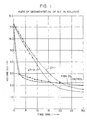
- FIG. 1 is a graph plotting the rate of sedimentation of SiC over time. As shown in this figure, the "ZT" dispersants form more highly dispersed slurries in a very short time (2 min. shaking), as evidenced by the slower sedimentation rate. After 30 min., the trend is for a more compact ceramic from the "ZT" dispersants.
- ZT-1TM was tested at three dosage levels on a wt. % basis to SiC solid.
- the samples were prepared by substantially the same general procedure described above.
- Each sedimentation curve shown graphically in Figure 3 shows a smooth descent with little scatter. The observed trend is towards slightly improved performance as dosage increases.
- a control sample was prepared by mixing 0.5g SiC in 7cc toluene with no dispersing agent.
- a second sample was prepared similarly to the control except that 2 wt. % LB-2155 was added.
- a third sample was prepared similarly to the control using a dispersing agent having the formula and designated ZT-1TM.
- To each of the previously dispersed samples 2 ⁇ l aliquot portions of H 2 0 were added and the dispersion shaken for about 2 minutes. The sedimentation rate and final sediment volume was recorded. The procedure was repeated with increasing addition of H 2 0 up to 100 ⁇ l.
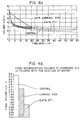
- Figure 4 (a) and (b) depicts the results of this experiment graphically.
- Figure 4 (a) plots change in volume for each sample vs. time. The results shows that flocculation caused fast sedimentation rates with the control sample and the LB-2155 sample compared with the casting composition of the present invention.
- Figure 4 (b) illustrates by the bar graph that the final sedimentation volume of the inorganic particles dispersed in the casting composition of the present invention is approximately 1cc compared to over 2 or 3cc for known commercial products leading to poor low density compacts.
- This experiment was directed to a comparison of the sedimentation rate and compaction volume of casting composition of the present invention versus a blank control where a mixture of inorganic particulate materials are utilized.
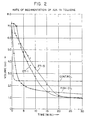
- the casting compositions are prepared according to the general procedure outlined previously except that .25gm SIC and .25gm AIN were utilized. The results obtained are illustrated in the graphs set forth in Figures 5 and 6. The graph dramatically demonstrated the effect that the dispersing agent ZT-1TM has on sedimentation time (i.e. higher dispersed slurry resulting in a slow sedimentation time) and final compact volume (more compact ceramic) for the casting composition.
Landscapes
- Chemical & Material Sciences (AREA)
- Engineering & Computer Science (AREA)
- Ceramic Engineering (AREA)
- Manufacturing & Machinery (AREA)
- Materials Engineering (AREA)
- Structural Engineering (AREA)
- Organic Chemistry (AREA)
- Inorganic Chemistry (AREA)
- Mechanical Engineering (AREA)
- Dispersion Chemistry (AREA)
- Emulsifying, Dispersing, Foam-Producing Or Wetting Agents (AREA)
- Compositions Of Oxide Ceramics (AREA)
Applications Claiming Priority (1)
| Application Number | Priority Date | Filing Date | Title |
|---|---|---|---|
| US07/155,659 US4917842A (en) | 1988-02-12 | 1988-02-12 | Process of making ceramics |
Publications (1)
| Publication Number | Publication Date |
|---|---|
| EP0437905A1 true EP0437905A1 (fr) | 1991-07-24 |
Family
ID=22556268
Family Applications (1)
| Application Number | Title | Priority Date | Filing Date |
|---|---|---|---|
| EP90300480A Withdrawn EP0437905A1 (fr) | 1988-02-12 | 1990-01-17 | Composition cÀ©ramique pour le coulage en barbotine et de feuilles minces et procédé pour la production de corps céramiques |
Country Status (3)
| Country | Link |
|---|---|
| US (1) | US4917842A (fr) |
| EP (1) | EP0437905A1 (fr) |
| JP (1) | JPH03242367A (fr) |
Families Citing this family (6)
| Publication number | Priority date | Publication date | Assignee | Title |
|---|---|---|---|---|
| US5346660A (en) * | 1990-09-07 | 1994-09-13 | Toto Ltd. | Method of manufacturing powder molding |
| US5342563A (en) * | 1991-11-22 | 1994-08-30 | The Lubrizol Corporation | Methods of preparing sintered shapes and green bodies used therein |
| US5594931A (en) * | 1995-05-09 | 1997-01-14 | Newcomer Products, Inc. | Layered composite carbide product and method of manufacture |
| US20090162556A1 (en) * | 2007-12-20 | 2009-06-25 | Brett Allen Boutwell | Methods for making tape cast barrier coatings, components comprising the same and tapes made according to the same |
| CN104479068B (zh) * | 2014-12-26 | 2016-10-05 | 中科院广州化学有限公司 | 一种聚羧酸型陶瓷分散剂及其制备方法与应用 |
| US11858850B2 (en) * | 2020-07-14 | 2024-01-02 | Leatec Fine Ceramics Co., Ltd. | High-strength zirconia-alumina composite ceramic substrate applied to semiconductor device and manufacturing method thereof |
Citations (5)
| Publication number | Priority date | Publication date | Assignee | Title |
|---|---|---|---|---|
| EP0231863A2 (fr) * | 1986-01-28 | 1987-08-12 | Elektroschmelzwerk Kempten GmbH | Barbotine stable de coulage à base de poudres à grains fins contenant du nitrure d'aluminium |
| EP0240160A2 (fr) * | 1986-03-26 | 1987-10-07 | Imperial Chemical Industries Plc | Composition contenant de fines particules de céramique et un dispersant organique |
| WO1988007505A1 (fr) * | 1987-04-01 | 1988-10-06 | Ceramics Process Systems | Solution liante polymerisable pour des coulis de particules hautement charges, a faible viscosite et procedes de fabrication derivee d'articles |
| EP0291590A1 (fr) * | 1985-11-19 | 1988-11-23 | Nippon Shokubai Co., Ltd. | Dispersant pour ciment |
| EP0296941A1 (fr) * | 1987-06-25 | 1988-12-28 | Guy Dion Biro | Agent émulseur contenant un alcool gras en C14, procédé de pépration de l'agent émulseur, utilisation de l'agent émulseur en mélange avec un liant hydraulique, procédé de préparation d'un élément de construction expansé ou cellulaire et élément de construction expansé ou cellulaire obtenu |
Family Cites Families (35)
| Publication number | Priority date | Publication date | Assignee | Title |
|---|---|---|---|---|
| US457672A (en) * | 1891-08-11 | Car-coupling | ||
| US3367871A (en) * | 1966-07-25 | 1968-02-06 | Carey Philip Mfg Co | Molded precision-dimensioned high temperature insulation material |
| US3505243A (en) * | 1967-12-05 | 1970-04-07 | Itt Rayonier Inc | Dispersants from spent sulfite liquor |
| US3738938A (en) * | 1968-02-29 | 1973-06-12 | Chem Prod Corp | Carbonate composition and process |
| US3615811A (en) * | 1968-02-29 | 1971-10-26 | Chemical Products Corp | Carbonate compositions and process |
| US3594144A (en) * | 1968-10-10 | 1971-07-20 | Sprague Electric Co | Dispersing vehicle used in glass bonding |
| US3849348A (en) * | 1969-04-14 | 1974-11-19 | Colgate Palmolive Co | Detergent compositions |
| US3663284A (en) * | 1970-01-09 | 1972-05-16 | Marine Colloids Inc | Titanium dioxide suspensions |
| US3717487A (en) * | 1970-06-17 | 1973-02-20 | Sprague Electric Co | Ceramic slip composition |
| GB1366705A (en) * | 1971-07-09 | 1974-09-11 | Foseco Int | Hardening of refractory/sodium silicate |
| US3736165A (en) * | 1971-07-21 | 1973-05-29 | Minerals & Chemicals Corp | Method for processing kaolin clay |
| JPS519012B2 (fr) * | 1971-11-02 | 1976-03-23 | ||
| JPS5010439B2 (fr) * | 1971-11-15 | 1975-04-21 | ||
| US4046732A (en) * | 1975-01-09 | 1977-09-06 | Infante Samuel J | Dispersant for the application of dental ceramic |
| US4143180A (en) * | 1975-08-04 | 1979-03-06 | Owens-Illinois, Inc. | Article marking method |
| US4166048A (en) * | 1975-09-22 | 1979-08-28 | Kao Soap Co., Ltd. | High foaming detergent composition having low skin irritation properties |
| US4301020A (en) * | 1978-08-01 | 1981-11-17 | Bell Telephone Laboratories, Incorporated | Process of slurrying and spray drying ceramic oxides with polyethyleneimine dispersants |
| US4267065A (en) * | 1978-08-01 | 1981-05-12 | Bell Telephone Laboratories, Incorporated | Dispersants for a ceramic slurry |
| US4264640A (en) * | 1978-08-30 | 1981-04-28 | Infante Samuel J | Method for preparing a dental prosthesis |
| US4226843A (en) * | 1979-03-30 | 1980-10-07 | Dowa Mining Co., Ltd. | Process and apparatus for production of spherical grain ferrite powder |
| US4318995A (en) * | 1980-04-25 | 1982-03-09 | Bell Telephone Laboratories, Incorporated | Method of preparing lightly doped ceramic materials |
| US4370169A (en) * | 1980-12-31 | 1983-01-25 | Ppg Industries, Inc. | Aqueous dispersion of glass fibers and method and composition for producing same |
| US4554098A (en) * | 1982-02-19 | 1985-11-19 | Colgate-Palmolive Company | Mild liquid detergent compositions |
| US4414337A (en) * | 1982-05-19 | 1983-11-08 | Westinghouse Electric Corp. | Shaped ceramics |
| US4485182A (en) * | 1982-07-28 | 1984-11-27 | Ibiden Kabushiki Kaisha | Powder composition for producing sintered ceramic |
| FR2533209B1 (fr) * | 1982-09-22 | 1985-11-08 | Centre Nat Rech Scient | Lipopeptides, leur obtention et leur application comme emulsifiants |
| US4638029A (en) * | 1983-02-22 | 1987-01-20 | Union Carbide Corporation | Ceramic composition and process for use thereof |
| US4486328A (en) * | 1983-05-03 | 1984-12-04 | Colgate-Palmolive Company | Betaine-soap shampoo composition |
| US4587068A (en) * | 1983-06-24 | 1986-05-06 | Materials Research Corporation | Method of making ceramic tapes |
| US4541855A (en) * | 1983-08-18 | 1985-09-17 | Corning Glass Works | Method of forming a glass or ceramic product |
| US4569920A (en) * | 1983-09-06 | 1986-02-11 | Blasch Precision Ceramics, Inc. | Preparation of inorganic particle slurries |
| US4552680A (en) * | 1983-11-04 | 1985-11-12 | The Procter & Gamble Company | Hypochlorite bleach containing surfactant and organic antifoamant |
| JPS60108356A (ja) * | 1983-11-16 | 1985-06-13 | ニチアス株式会社 | 溶融アルミ用複合繊維組成物 |
| US4555360A (en) * | 1984-06-22 | 1985-11-26 | The Procter & Gamble Company | Mild detergent compositions |
| US4548733A (en) * | 1984-10-05 | 1985-10-22 | Dow Corning Corporation | Anionic siliconates of silylorganocarboxylates, sulfonates and phosphonates to reduce viscosities of particulate slurries |
-
1988
- 1988-02-12 US US07/155,659 patent/US4917842A/en not_active Expired - Fee Related
-
1990
- 1990-01-17 EP EP90300480A patent/EP0437905A1/fr not_active Withdrawn
- 1990-02-09 JP JP2031284A patent/JPH03242367A/ja active Pending
Patent Citations (5)
| Publication number | Priority date | Publication date | Assignee | Title |
|---|---|---|---|---|
| EP0291590A1 (fr) * | 1985-11-19 | 1988-11-23 | Nippon Shokubai Co., Ltd. | Dispersant pour ciment |
| EP0231863A2 (fr) * | 1986-01-28 | 1987-08-12 | Elektroschmelzwerk Kempten GmbH | Barbotine stable de coulage à base de poudres à grains fins contenant du nitrure d'aluminium |
| EP0240160A2 (fr) * | 1986-03-26 | 1987-10-07 | Imperial Chemical Industries Plc | Composition contenant de fines particules de céramique et un dispersant organique |
| WO1988007505A1 (fr) * | 1987-04-01 | 1988-10-06 | Ceramics Process Systems | Solution liante polymerisable pour des coulis de particules hautement charges, a faible viscosite et procedes de fabrication derivee d'articles |
| EP0296941A1 (fr) * | 1987-06-25 | 1988-12-28 | Guy Dion Biro | Agent émulseur contenant un alcool gras en C14, procédé de pépration de l'agent émulseur, utilisation de l'agent émulseur en mélange avec un liant hydraulique, procédé de préparation d'un élément de construction expansé ou cellulaire et élément de construction expansé ou cellulaire obtenu |
Also Published As
| Publication number | Publication date |
|---|---|
| US4917842A (en) | 1990-04-17 |
| JPH03242367A (ja) | 1991-10-29 |
Similar Documents
| Publication | Publication Date | Title |
|---|---|---|
| Hotza et al. | Aqueous tape casting of ceramic powders | |
| Bergstrm et al. | Colloidal processing of a very fine BaTiO3 powder—effect of particle interactions on the suspension properties, consolidation, and sintering behavior | |
| US4904411A (en) | Highly loaded, pourable suspensions of particulate materials | |
| EP0116300B1 (fr) | Liant pour la fabrication de corps céramiques moulés | |
| Doreau et al. | Processing of aqueous tape-casting of alumina with acrylic emulsion binders | |
| KR930011269B1 (ko) | 세라믹 그린 시이트 | |
| US4641221A (en) | Thin tape for dielectric materials | |
| Albano et al. | Aqueous tape casting of yttria stabilized zirconia | |
| US20030148873A1 (en) | Ceramic slip composition and method for making the same | |
| WO1987006495A1 (fr) | Liquefaction de suspensions particulaires fortement chargees | |
| Ushifusa et al. | Aqueous processing of mullite‐containing green sheets | |
| Albano et al. | Influence of the slip composition on the properties of tape-cast alumina substrates | |
| US4917842A (en) | Process of making ceramics | |
| US5473008A (en) | Casting composition for producing green ceramic sheets containing polyvinyl alcohol/fatty acid ester as dispersant | |
| Shih et al. | Boehmite coating as a consolidation and forming aid in aqueous silicon nitride processing | |
| US4814302A (en) | Stable slip-casting compositions having a base of powders containing finely divided aluminum nitride | |
| JPH0664963A (ja) | 焼結形状品の調製方法およびそれらに用いられる組成物 | |
| JP2866137B2 (ja) | セラミックグリーンシートの製造方法 | |
| Szafran et al. | Effect of Acrylic‐Styrene Copolymer Chemical Structure on the Properties of Ceramic Tapes Obtained by Tape Casting | |
| CA2007904A1 (fr) | Melange de fonderie et procede de fabrication de ceramique | |
| US5643996A (en) | Inorganic powder composition containing polymeric auxiliaries and use thereof | |
| CN1189426C (zh) | 乳胶体系水基流延法制备陶瓷薄片材料的方法 | |
| JP3761915B2 (ja) | セラミック成形用組成物 | |
| CA2012040A1 (fr) | Modification des taux de frittage de poudres a electrodes de palladium-argent | |
| CN1805912B (zh) | 金属元素氧化物层的制备方法 |
Legal Events
| Date | Code | Title | Description |
|---|---|---|---|
| PUAI | Public reference made under article 153(3) epc to a published international application that has entered the european phase |
Free format text: ORIGINAL CODE: 0009012 |
|
| AK | Designated contracting states |
Kind code of ref document: A1 Designated state(s): DE FR GB IT |
|
| STAA | Information on the status of an ep patent application or granted ep patent |
Free format text: STATUS: THE APPLICATION IS DEEMED TO BE WITHDRAWN |
|
| 18D | Application deemed to be withdrawn |
Effective date: 19920125 |