EP0438096B1 - Stabilisants pour compositions de copolymère éthlène/chlorotrifluoroéthylène - Google Patents
Stabilisants pour compositions de copolymère éthlène/chlorotrifluoroéthylène Download PDFInfo
- Publication number
- EP0438096B1 EP0438096B1 EP91100355A EP91100355A EP0438096B1 EP 0438096 B1 EP0438096 B1 EP 0438096B1 EP 91100355 A EP91100355 A EP 91100355A EP 91100355 A EP91100355 A EP 91100355A EP 0438096 B1 EP0438096 B1 EP 0438096B1
- Authority
- EP
- European Patent Office
- Prior art keywords
- composition
- ethylene
- amount
- chlorotrifluoroethylene copolymer
- present
- Prior art date
- Legal status (The legal status is an assumption and is not a legal conclusion. Google has not performed a legal analysis and makes no representation as to the accuracy of the status listed.)
- Expired - Lifetime
Links
- SGVUHPSBDNVHKL-UHFFFAOYSA-N CC1CC(C)CCC1 Chemical compound CC1CC(C)CCC1 SGVUHPSBDNVHKL-UHFFFAOYSA-N 0.000 description 1
Classifications
-
- C—CHEMISTRY; METALLURGY
- C08—ORGANIC MACROMOLECULAR COMPOUNDS; THEIR PREPARATION OR CHEMICAL WORKING-UP; COMPOSITIONS BASED THEREON
- C08K—Use of inorganic or non-macromolecular organic substances as compounding ingredients
- C08K5/00—Use of organic ingredients
- C08K5/16—Nitrogen-containing compounds
- C08K5/34—Heterocyclic compounds having nitrogen in the ring
- C08K5/3467—Heterocyclic compounds having nitrogen in the ring having more than two nitrogen atoms in the ring
- C08K5/3477—Six-membered rings
Definitions
- This invention relates to improved stabilized ethylene/chlorotrifluoroethylene copolymers having improved color, melt stability, and less weight loss during processing at high temperatures.
- Ethylene/chlorotrifluoroethylene copolymers exhibit outstanding mechanical, electrical and chemical properties at high temperatures.
- ethylene/chlorotrifluoroethylene copolymers resist attack of most organic solvents at ambient as well as elevated temperatures, being only slightly soluble at 100-150°C in a 2,5 dichlorobenzotrifluoride/benzonitrile or o-dichlorobenzene mixtures of 10:90 to 50:50 volume ratio. They are insoluble in bases and acids, including fuming nitric acid.
- copolymers also possess high tensile strength and have melting points above about 200°C and as high as about 260°C, which melting points are higher than those of the homopolymers of either ethylene (as high as 130°C) or chlorotrifluoroethylene (as high as 215°C).
- Equimolar ethylene/chlorotrifluoroethylene copolymers also have outstanding electrical properties. For all of these advantageous properties, they are suitable for making useful articles, such as valves, gaskets, pipes, wire insulation, sheets or films for use in applications where their excellent mechanical, electrical and chemical properties can be used to advantage.
- Ethylene/chlorotrifluoroethylene copolymers due to their high melting points in excess about 220°C, require melt fabrication temperatures of above about 250°C, usually within the range of between about 260°C to 310°C. At these high temperatures, an initial bubble formation and degradation of the polymer occurs, resulting in loss of chemical, mechanical and electrical properties. In particular, loss of these properties occurs during extrusion wire coating causing high scrap rates for the process.
- U.S. Patent Nos. 3,745,145; 3,773,698 and 4,539,354 disclose various ethylene/chlorotrifluoroethylene copolymer compositions which are stabilized against thermal degradation.
- thermal stabilizing systems for these copolymers comprise a phosphite of an organic polyhydric phenol; a salt of a carboxylic acid and a metal of Group II of the periodic table; and a thiodipropionic acid ester or alkali metal salt. This stabilizing system is satisfactory for most melt fabricating techniques used to process ethylene/chlorotrifluoroethylene copolymer compositions.
- melt fabricating processes such as high speed extrusion coating of conductors for telephone wire, where the temperature, residence time and shearing of the material in the process are more severe than encountered in most melt fabricating techniques.
- a particular problem in such a process is the formation of bubbles in the molten polymer. Each bubble is believed to cause spark failures, cone breaks, reduced mechanical properties and other processing and quality problems. Therefore, it is desirable to have an improved stabilization system for ethylene/chlorotrifluoroethylene compositions to protect against bubble formation during high speed extrusion.
- composition comprising a halopolymer and an effective stabilizing amount of (a) a phenolic complex of the formula: wherein at least one of R1 through R5 is -OH, and the remaining R1 through R5 is hydrogen or an aliphatic hydrocarbon, and wherein each of R1 through R5 may be the same or different provided that at least one of R1 through R5 is -OH.
- Each of R6 and R7 is an alkylene group having from 1 to 10 carbon atoms, and each of R6 and R7 may be the same or different; and (b) a phosphite of the formula P-(OR)3, wherein R is hydrogen, or an alkyl, cycloalkyl, aralkyl, aryl, or a hydroxy-substituted alkyl group having from 1 to 18 carbon atoms.
- the aliphatic hydrocarbon is a saturated hydrocarbon, and preferably having from 1 to 5 carbon atoms. More preferably, at least one of the remaining R1 through R5 is a tert-butyl group. Still more preferably, each of R6 and R7 is an alkylene group having from 1 to 5 carbon atoms.
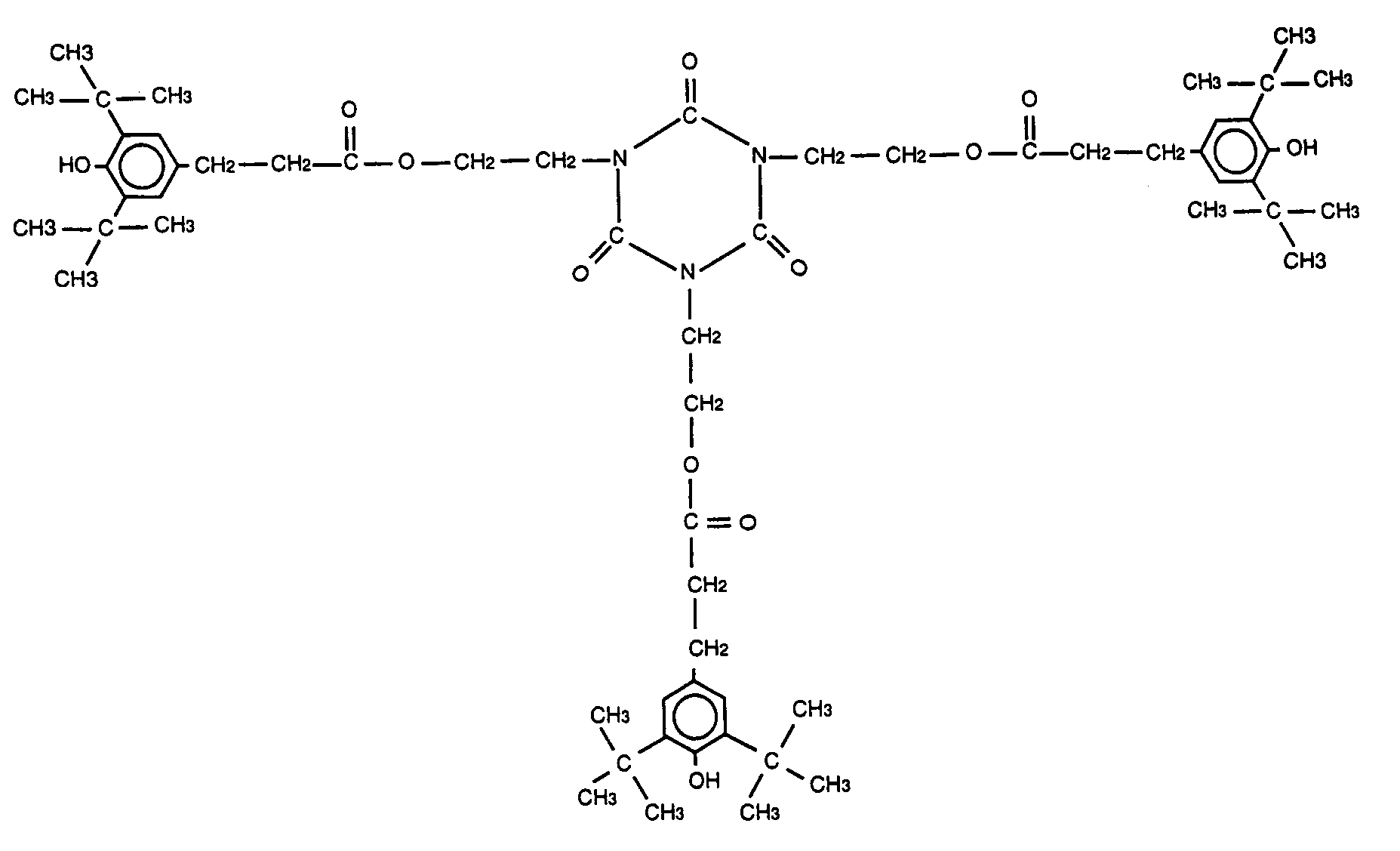
- the phenolic complex is of the formula:
- This compound is known as 3,5,di-t-butyl-4-hydroxy hydrocinnamic acid triester of 1,3,5-tris (2-hydroxy ethyl)-s-triazine 2,4,5-(1H, 3H, 5H)-trione.
- An example of this phenolic complex is sold by the R.T. Vanderbilt Company as Vanox SKT.
- This compound has a molecular weight of 1,042, and is in the form of a white crystalline powder, and has a density of 0.92Mg/m3 ⁇ .03 and has a melting range of 123-131°C.
- the phosphite is of the formula P-(OR)3, wherein R is of the formula: wherein n is from 1 to 9.
- the phosphite is tris (2,4-di-tert-butyl-phenyl) phosphite, which is of the following structure: Tris (2,4-di-tert-butyl-phenyl) phosphite has a molecular weight of 647 and a melting point of 185°C, and is normally in the form of a white powder.
- the phenolic complex may be present in an amount of from 0.02 to 5 parts per one hundred parts of the halopolymer in the composition, preferably from 0.15 to 0.6 parts per hundred, and most preferably from 0.3 to 0.6 parts per hundred.
- the phosphite when present, may be present in an amount of from 0.02 to 5.0 parts per one hundred parts of halopolymer in the composition, preferably from 0.15 to 0.6 parts per hundred, and most preferably from 0.3 to 0.6 parts per hundred.
- the composition may further comprise, in addition to the halopolymer, phenolic complex, and phosphite, an effective stabilizing amount of a thioester.
- the thioester may be of the formula: R1OOCCH2CH2-S-CH2CH2COOR2, wherein R1 and R2 may be the same or different, and are selected from the group consisting of alkali metals, straight chain or branched alkyl radicals having from 1 to 36 carbon atoms, alkenyl radicals having from 6 to 36 carbon atoms, aryl radicals and alkylaryl radicals, with the proviso that not more than one of R1 and R2 may be hydrogen.
- the thioester is distearylthiodipropionate.
- the thioester when present, may be present in an amount of from 0.01 to 5.0 parts per one hundred parts of halopolymer in said composition, preferably from 0.15 to 0.3 parts per hundred.
- the composition may further include, in addition to the halopolymer, phenolic complex, and the phosphite, an effective stabilizing amount of a sulfide selected from the group consisting of: wherein R1 is an alkyl group having from 8 to 20 carbon atoms, R2 is H or an alkyl group having from 1 to 4 carbon atoms, R' is an alkyl or alkenyl group having up to 12 carbon atoms, and n is 0 or 1.
- the sulfide is of the formula wherein R' is an alkyl or alkenyl group having up to 12 carbon atoms, and n is 0 or 1.
- a most preferred example of such a sulfite composition is 1-[B-(n-octadecylthio) ethyl]-3-(n-octadecylthio) cyclohexane, which is in the form of a white powder and has a melting point of from 56°-66°C.
- the sulfide when present, may be present in an amount of from 0.01 to 5.0 parts per one hundred parts of said halopolymer in said composition, preferably from 0.15 to 0.3 parts per hundred.
- the composition may comprise a halopolymer, and effective stabilizing amounts of the phenolic complex and of the thioester hereinabove described.
- the composition may comprise a halopolymer, and effective stabilizing amounts of the phenolic complex and the sulfide compound hereinabove described.
- the halopolymer which is stabilized in accordance with the present invention is preferably a fluoropolymer, and, most preferably an ethylene/chlorotrifluorethylene copolymer.
- the ethylene/chlorotrifluoroethylene copolymer may contain from 40 mole% to 60 mole% ethylene, and from 40 mole% to 60 mole% chlorotrifluoroethylene.
- the ethylene/chlorotrifluoroethylene copolymer contains from 45 mole% to 55 mole% ethylene, and from 45 mole% to 55 mole% chlorotrifluoroethylene, most preferably 50 mole% ethylene and 50 mole% chlorotrifluoroethylene.
- Such ethylene/chlorotrifluoroethylene copolymers may be prepared by processes known to those skilled in the art, as described, for example in Hanford U.S. Pat. No. 2,392,378, which shows copolymerization of ethylene with chlorotrifluoroethylene in a stirred aqueous medium at superatmospheric pressure using benzoyl peroxide as catalyst; in NUCLEONICS, September, 1964, pp. 72-74, disclosing formation of a high melting (237°C) 1:1 alternating copolymer of ethylene and chlorotrifluoroethylene prepared using radiation of 0°C; or British Patent No.
- About equimolar ethylene/chlorotrifluoroethylene copolymers having a melting point above 200°C can also be prepared by batchwise bulk copolymerization of the monomers at temperatures of from -20 to +20°C, at superatmospheric pressure in an agitator-equipped pressure vessel by charging the vessel with liquid chlorotrifluoroethylene monomer and bubbling gaseous ethylene into this monomer, using organic peroxide-type initiators, such as trichloracetyl peroxide and, if desired, adding small amounts of chain transfer agents, such as chloroform or heptane.
- the desired copolymer product is obtained as a dispersion in the monomer.
- the copolymer can contain nominal amounts of comonomers other than ethylene and chlorotrifluoroethylene, including propylene, isobutylene, vinyl fluoride, hexafluoropropylene, tetrafluoroethylene, vinylidene fluoride, perfluoro-vinyl ether, acrylic acid and alkyl ester, methacrylic acid and alkyl ester, perfluoroalkyl ethylene.
- comonomers other than ethylene and chlorotrifluoroethylene including propylene, isobutylene, vinyl fluoride, hexafluoropropylene, tetrafluoroethylene, vinylidene fluoride, perfluoro-vinyl ether, acrylic acid and alkyl ester, methacrylic acid and alkyl ester, perfluoroalkyl ethylene.
- the stabilized halopolymers of the present invention exhibit improved melt stability at elevated extrusion temperatures. Such extrusion temperatures may reach higher than 300°C. Such improved melt stability is evidenced by, for example, the absence of or the reduction in the formation of bubbles in the polymer melt, reduced change in melt index with time, and less change in color as the composition is heated. The reduced change in color indicates a decrease in or the absence of degradation of polymer chains and/or the possibility of side reactions. The reduced change in melt index indicates less breakdown and/or cross-linking of ethylene/chlorotrifluoroethylene copolymer chains.
- HALAR 5041 1,85 kg (5 lbs) of ethylene/chlorotrifluoroethylene copolymer, having 50 mole% ⁇ 1 mole percent ethylene and 50 mole% ⁇ 1 mole% chlorotrifluoroethylene, sold by Ausimont, U.S.A., Inc. as HALAR 5041, was dry mixed in a powder mixer with various amounts of stabilizers 1, 2, 3, or 4. A control was also prepared to which no stabilizer was added to HALAR 5041. Amounts of stabilizer are measured in parts per one hundred parts of ethylene/chlorotrifluoroethylene copolymer.
- Stabilizer 1 is a 3,5-di-tert-butyl-4-hydroxy-hydrocinnamic acid triester of 1,3,5-tris(2-hydroxyethyl)-s-triazine-2,4,6-(1H, 3H, 5H)-trione sold by R.T. Vanderbilt Co. as VANOX SKT.
- Stabilizer 2 is tris-(2,4-di-tert-butyl-phenyl) phosphite.
- Stabilizer 3 is 1-[ -(n-octadecylthio) ethyl]-3-(n-octadecylthio) cyclohexane.
- Stabilizer 4 is distearylthiodipropionate.
- the stabilizers were mixed with the copolymer in a Henschel powder mixer Model FMIOC/Purnell, Inc., Houston, Texas, for 5 minutes at room temperature to form a homogenous powder mixture.
- Each stabilizer and polymer mixture was then pelletized at 250-300°C using an extruder.
- Each mixture was fed to a 38,1 mm (1 1/2 ") single screw extruder with zones 1, 2, 3, and 4 set at 244°C, 264°C, 263°C, and 252°C, respectively.
- the resulting strands from a 3,175 mm (1/8") round die were cooled in a water trough, air dried, and pelletized using a pelletizer.
- the samples were then tested for color rating (as evidenced by Black Spot Test Ranking), change in melt stability, weight loss.
- the black spot ranking test is a subjective test wherein each sample tested is observed for discoloration. Optimally, the extruded sample should be of a white, or a cream color. Discoloration in most cases is in the form of various shades of brown, or black. The tested samples are ranked subjectively as to the amount of discoloration through visual observation. The sample which receives a black spot ranking of 1 shows the least discoloration, and the sample with the highest number (in these examples, 7) shows the most discoloration.
- the weight loss test is performed by weighing out 5 grams of each sample in the form of a powder. Each powder sample is then heated at a temperature of 305°C in an air circulated oven for 30 minutes. Each sample is then weighed after heating. Percent weight loss is calculated as follows: The results are given in Table I below.
- Example Stabilizer Black Spot Ranking Melt Stability, % Weight Loss, % 1 2 3 4 1 0.3 0.3 0.15 ⁇ 1 6.7 0.28 2 0.6 0.6 ⁇ 0.3 2 5.4 0.43 3 0.3 0.3 ⁇ 0.15 3 N/A 0.25 4 0.6 0.6 0.3 ⁇ 4 3.6 0.48 5 0.15 0.15 0.075 ⁇ 5 36.4 0.40 6 0.15 0.15 ⁇ 0.075 6 75.0 0.40 7 (control) ⁇ ⁇ ⁇ ⁇ 7 46.1 2.10
- Stabilized ethylene/chlorotrifluoroethylene copolymer compositions were prepared as disclosed in Examples 1-7, wherein Stabilizer 1 with Stabilizer 2 was added to the ethylene/chlorotrifluoroethylene copolymer. The composition was then tested for melt stability. The result is given in Table II below. TABLE II Example Stabilizer (pph) Melt Stability, % 1 2 8 0.3 0.3 10.5
- Example 1 The composition of Example 1 was scaled up for wire coating extrusion using larger sized equipment.
- the composition of Example 1 was mixed in a Henschel mixer at 2,59 kg (7 lbs) per mixing and then was pelletized using a 38,1 mm (1 1/2") single screw extruder, equipped with an underwater pelletizer, and pelletized.
- the pelletized material was then evaluated on a wire line.
- the 38,1 mm (1 1/2") extrusion line was capable of coating wire at speeds of 335,3 m/min (1,100 ft./min.).
- Extrusion conditions were as follows: Zone 1 temperature 240,6°C (465°F) Zone 2 temperature 260 °C(500°F) Zone 3 temperature 254,4°C (490°F) Flange temperature 265,6°C (510°F) Crosshead temperature 265,6°C (510°F) Dieholder temperature 268,3°C (515°F) Die temperature 288,3°C (551°F) Screw Speed (RPM) 16 Torque (AMP) 20 Melt temperature 285,6°C (546°F) Diameter (in.) 0,7112 mm (0.028) Line Speed (ft./min.) 0,3288 m/min (1.079)
- the extruded wire coating composition had 1 spark failure per 6096 m (20,000 feet), and had resisted tendency to form cone breaks through the run. The melt also did not emit any noticeable fumes.
- Example 10 corresponds to the composition of Example 1
- Example 11 corresponds to the composition of Example 4
- Example 12 corresponds to the composition of Example 5.
- the cone clarity evaluation is a subjective evaluation of the extruded sample for clarity of the sample. Each sample is evaluated for cone clarity on a scale of 1 to 5, with 1 indicating poor clarity and 5 indicating excellent clarity. Clarity is an indication of the evenness of the dispersion of stabilizer in the sample. Samples with excellent clarity have an even dispersion of stabilizer throughout the extruded sample.
- the purge whiteness evaluation is a subjective evaluation of the degree of discoloration of material purged from the extruder. Samples are evaluated on a scale of 1 to 5, with 1 being indicative of a high degree of discoloration and 5 being indicative of little or no discoloration. Samples showing little or no discoloration are samples in which little or no degradation of the polymer has occurred.
- the color change evaluation is similar to the purge whitenss evaluation.
- the extruded samples are evaluated on a scale of 1 to 5, with 1 indicating much color change in the extruded product as compared with the sample before extrusion, while 5 indicates little or no color change. Those samples showing little or no color change have experienced little or no polymer degradation.
- the amount of fumes and smoke is also evaluated subjectively on a scale of 1 to 5, with 1 indicating a high amount of fumes and smoke emitted as a result of melt extrusion of the polymer, while 5 is indicative of little or no fumes or smoke being emitted.
- Advantages of the present invention include the formation of improved stabilized halopolymer compositions which may be extruded at high temperatures (eg., 300°C and above), which exhibit low volatility and little change in melt stability. Such compositions also exhibit low weight loss after extrusion and have good color ratings. In addition, such compositions give off less fumes upon extrusion and have a minimal number of spark failures and cone breaks.
Landscapes
- Chemical & Material Sciences (AREA)
- Health & Medical Sciences (AREA)
- Chemical Kinetics & Catalysis (AREA)
- Medicinal Chemistry (AREA)
- Polymers & Plastics (AREA)
- Organic Chemistry (AREA)
- Compositions Of Macromolecular Compounds (AREA)
- Addition Polymer Or Copolymer, Post-Treatments, Or Chemical Modifications (AREA)
- Organic Insulating Materials (AREA)
Claims (28)
- Composition comprenant un copolymère d'éthylène/chlorotrifluoroéthylène et une quantité effectivement stabilisatrice de(a) un complexe phénolique de formule :

et(b) un phosphite de formule P-(OR)₃ dans laquelle R représente l'hydrogène ou un groupe alkyle, cycloalkyle, aralkyle, aryle ou alkyle hydroxy-substitué ayant de 1 à 18 atomes de carbone. - Composition selon la revendication 1, dans laquelle ledit hydrocarbure aliphatique est un hydrocarbure saturé.
- Composition selon la revendication 2, dans laquelle ledit hydrocarbure saturé a de 1 à 5 atomes de carbone.
- Composition selon la revendication 3, dans laquelle au moins un des substituants R₁ à R₅ restants est un groupe t-butyle.
- Composition selon la revendication 4, dans laquelle chacun des substituants R₆ et R₇ est un groupe alkylène ayant de 1 à 5 atomes de carbone.
- Composition selon la revendication 5, dans laquelle ledit complexe phénolique a la formule :
- Composition selon la revendication 1, dans laquelle ledit phosphite a la formule P-(OR)₃ dans laquelle R a la formule :

- Composition selon la revendication 7, dans laquelle ledit phosphite est le phosphite de tris (2,4-di-t-butyl-phényle).
- Composition selon la revendication 1, dans laquelle ledit complexe phénolique est présent à raison de 0,02 à 5,0 parties pour 100 parties de copolymère éthylène/chlorotrifluoroéthylène dans ladite composition.
- Composition selon la revendication 9, dans laquelle ledit complexe phénolique est présent à raison de 0,15 à 0,6 parties pour 100 parties dudit copolymère éthylène/chlorotrifluoroéthylène dans ladite composition.
- Composition selon la revendication 10, dans laquelle ledit complexe phénolique est présent à raison de 0,3 à 0,6 parties pour 100 parties du copolymère éthylène/chlorotrifluoroéthylène dans ladite composition.
- Composition selon la revendication 1, dans laquelle ledit phosphite est présent à raison de 0,02 à 5,0 parties pour 100 parties du copolymère éthylène/chlorotrifluoroéthylène dans ladite composition.
- Composition selon la revendication 12, dans laquelle ledit phosphite est présent à raison de 0,15 à 0,6 parties pour 100 parties du copolymère éthylène/chlorotrifluoroéthylène dans ladite composition.
- Composition selon la revendication 13, dans laquelle ledit phosphite est présent à raison de 0,3 à 0,6 parties pour 100 parties du copolymère éthylène/chlorotrifluoroéthylène dans ladite composition.
- Composition selon la revendication 1 comprenant au surplus une quantité effectivement stabilisante d'un thioester.
- Composition selon la revendication 15, dans laquelle ledit thioester a la formule R₁OOCCH₂CH₂-S-CH₂CH₂COOR₂, dans laquelle les substituants R₁ et R₂ peuvent être identiques ou différents et sont choisis entre l'hydrogène, les métaux alcalins, les radicaux alkyle à chaîne droite ou à chaîne ramifiée ayant de 1 à 36 atomes de carbone, les radicaux alkènyle ayant de 6 à 36 atomes de carbone, les radicaux aryle et les radicaux alkylaryle, à condition que pas plus d'un des substituants R₁ et R₂ représente l'hydrogène.
- Composition selon la revendication 16, dans laquelle ledit thioester est le thiodipropionate de distéaryle.
- Composition selon la revendication 15, dans laquelle ledit thioester est présent à raison de 0,01 à 5,0 parties pour 100 parties du copolymère d'éthylène/chlorotrifluoroéthylène dans la composition.
- Composition selon la revendication 18, dans laquelle ledit thioester est présent à raison de 0,15 à 0,3 parties pour 100 parties du copolymère éthylène/chlorotrifluoroéthylène dans la composition.
- Composition selon la revendication 1, comprenant au surplus une quantité effectivement stabilisatrice d'un sulfure choisi entre :

- Composition selon la revendication 20, dans laquelle ledit sulfure a la formule :

- Composition selon la revendication 20, dans laquelle ledit sulfure est présent à raison de 0,01 à 5,0 parties pour 100 parties du copolymère d'éthylène/chlorotrifluoroéthylène dans la composition.
- Composition selon la revendication 22, dans laquelle ledit sulfure est présent à raison de 0,15 à 0,3 parties pour 100 parties du copolymère d'éthylène/chlorotrifluoroéthylène dans ladite composition.
- Composition selon la revendication 1, comprenant au surplus une quantité effectivement stabilisatrice d'un thioester.
- Composition selon la revendication 1, comprenant au surplus une quantité effectivement stabilisatrice d'un sulfure choisi entre :

- Composition selon la revendication 25, dans laquelle l'éthylène est présent à raison de 40 à 60 moles % du copolymère d'éthylène/chlorotrifluoroéthylène et le chlorotrifluoroéthylène est présent à raison de 40 à 60 moles % du copolymère d'éthylène/chlorotrifluoroéthylène.
- Composition selon la revendication 26, dans laquelle l'éthylène est présent à raison de 45 à 55 moles % du copolymère d'éthylène/chlorotrifluoroéthylène et le chlorotrifluoroéthylène est présent à raison de 45 à 55 moles % du copolymère d'éthylène/chlorotrifluoroéthylène.
- Composition selon la revendication 27, dans laquelle l'éthylène est présent à raison de 50 moles % du copolymère d'éthylène/chlorotrifluoroéthylène et le chlorotrifluoroéthylène est présent à raison de 50 moles % de copolymère d'éthylène/chlorotrifluoroéthylène.
Applications Claiming Priority (2)
| Application Number | Priority Date | Filing Date | Title |
|---|---|---|---|
| US46497390A | 1990-01-16 | 1990-01-16 | |
| US464973 | 1990-01-16 |
Publications (2)
| Publication Number | Publication Date |
|---|---|
| EP0438096A1 EP0438096A1 (fr) | 1991-07-24 |
| EP0438096B1 true EP0438096B1 (fr) | 1995-08-23 |
Family
ID=23846030
Family Applications (1)
| Application Number | Title | Priority Date | Filing Date |
|---|---|---|---|
| EP91100355A Expired - Lifetime EP0438096B1 (fr) | 1990-01-16 | 1991-01-12 | Stabilisants pour compositions de copolymère éthlène/chlorotrifluoroéthylène |
Country Status (7)
| Country | Link |
|---|---|
| EP (1) | EP0438096B1 (fr) |
| AT (1) | ATE126813T1 (fr) |
| CA (1) | CA2033610A1 (fr) |
| DE (1) | DE69112231T2 (fr) |
| DK (1) | DK0438096T3 (fr) |
| ES (1) | ES2077693T3 (fr) |
| GR (1) | GR3018108T3 (fr) |
Families Citing this family (1)
| Publication number | Priority date | Publication date | Assignee | Title |
|---|---|---|---|---|
| US5216061A (en) * | 1991-01-11 | 1993-06-01 | Phillips Petroleum Company | Process to graft stereoregular polymers of branched, higher alpha-olefins and compositions thereof |
Family Cites Families (2)
| Publication number | Priority date | Publication date | Assignee | Title |
|---|---|---|---|---|
| US3707542A (en) * | 1971-02-25 | 1972-12-26 | Ciba Geigy Corp | Dialkyl-4-hydroxyphenylcarboxylates of tris(hydroxy-alkyl) isocyanurate |
| IT1215943B (it) * | 1988-02-24 | 1990-02-22 | Enichem Sintesi | Composizione stabilizzante per polimeri organici. |
-
1991
- 1991-01-04 CA CA002033610A patent/CA2033610A1/fr not_active Abandoned
- 1991-01-12 DE DE69112231T patent/DE69112231T2/de not_active Expired - Fee Related
- 1991-01-12 EP EP91100355A patent/EP0438096B1/fr not_active Expired - Lifetime
- 1991-01-12 DK DK91100355.6T patent/DK0438096T3/da active
- 1991-01-12 ES ES91100355T patent/ES2077693T3/es not_active Expired - Lifetime
- 1991-01-12 AT AT91100355T patent/ATE126813T1/de not_active IP Right Cessation
-
1995
- 1995-11-16 GR GR950403224T patent/GR3018108T3/el unknown
Also Published As
| Publication number | Publication date |
|---|---|
| DK0438096T3 (da) | 1996-01-02 |
| ATE126813T1 (de) | 1995-09-15 |
| CA2033610A1 (fr) | 1991-07-17 |
| DE69112231D1 (de) | 1995-09-28 |
| GR3018108T3 (en) | 1996-02-29 |
| EP0438096A1 (fr) | 1991-07-24 |
| ES2077693T3 (es) | 1995-12-01 |
| DE69112231T2 (de) | 1996-02-01 |
Similar Documents
| Publication | Publication Date | Title |
|---|---|---|
| DE60116121T2 (de) | Imidate enthaltende fluorpolymerzusammensetzungen | |
| US6465576B1 (en) | Fluoroelastomer compositions and articles made therefrom | |
| US5401787A (en) | Flame retardant insulation compositions | |
| US3745145A (en) | Stabilized melt-processable ethylene/chlorotrifluoroethylene copolymer compositions | |
| JPH08261389A (ja) | 改善された硬化特性を有する難燃性断熱組成物 | |
| EP0708084B1 (fr) | Agent de vulcanisation pour des élastomères fluorés contenant bisamidrazones | |
| US20020058736A1 (en) | Thermoplastic compositions of fluoropolymers | |
| US3998715A (en) | Radiation crosslinked polyvinyl chloride and process therefor | |
| EP0093806A1 (fr) | Compositions à base de copolymères d'alkylène et d'acrylates d'alcoyle modifiés par des silanes et durcissables sous l'effet de l'eau | |
| DE60133019T2 (de) | Metallaminkomplex enthaltende fluorpolymer- zusammensetzungen | |
| EP0104479B1 (fr) | Composition d'une résine acrylique résistant à la flamme et son procédé de préparation | |
| EP0438096B1 (fr) | Stabilisants pour compositions de copolymère éthlène/chlorotrifluoroéthylène | |
| JPH0414123B2 (fr) | ||
| NZ206811A (en) | Olefin polymer containing filler and processing aid | |
| US4496677A (en) | Stabilized fluoropolymer composition | |
| US5200503A (en) | Stabilizers for halopolymer compositions | |
| EP0344699A2 (fr) | Procédé pour la polymérisation de l'ester pentabromobenzyl monoacrylate | |
| SU831081A3 (ru) | Плам задерживающа композици | |
| US3382209A (en) | Flame-retardant systems | |
| EP0360102A1 (fr) | Compositions stabilisées à base de halopolymères | |
| US3835091A (en) | Flame resistant reinforced polyolefin mixture | |
| US3812066A (en) | Smoke suppressants for copolymers of ethylene and chlorotrifluoroethylene | |
| US3332889A (en) | Resinous polymeric reaction products of phosphorus and a polyamine | |
| EP0683204A2 (fr) | Compositions à base de copolymères éthylène/chlorotrifluoroéthylène, stables à la chaleur | |
| US3459833A (en) | Composition comprising a thermoplastic polymer and the reaction product of phosphorus and a polyamine |
Legal Events
| Date | Code | Title | Description |
|---|---|---|---|
| PUAI | Public reference made under article 153(3) epc to a published international application that has entered the european phase |
Free format text: ORIGINAL CODE: 0009012 |
|
| AK | Designated contracting states |
Kind code of ref document: A1 Designated state(s): AT BE CH DE DK ES FR GB GR IT LI LU NL SE |
|
| 17P | Request for examination filed |
Effective date: 19920122 |
|
| 17Q | First examination report despatched |
Effective date: 19930929 |
|
| GRAA | (expected) grant |
Free format text: ORIGINAL CODE: 0009210 |
|
| AK | Designated contracting states |
Kind code of ref document: B1 Designated state(s): AT BE CH DE DK ES FR GB GR IT LI LU NL SE |
|
| REF | Corresponds to: |
Ref document number: 126813 Country of ref document: AT Date of ref document: 19950915 Kind code of ref document: T |
|
| ITF | It: translation for a ep patent filed | ||
| REF | Corresponds to: |
Ref document number: 69112231 Country of ref document: DE Date of ref document: 19950928 |
|
| ET | Fr: translation filed | ||
| REG | Reference to a national code |
Ref country code: ES Ref legal event code: FG2A Ref document number: 2077693 Country of ref document: ES Kind code of ref document: T3 |
|
| PGFP | Annual fee paid to national office [announced via postgrant information from national office to epo] |
Ref country code: LU Payment date: 19960101 Year of fee payment: 6 |
|
| REG | Reference to a national code |
Ref country code: DK Ref legal event code: T3 |
|
| PGFP | Annual fee paid to national office [announced via postgrant information from national office to epo] |
Ref country code: ES Payment date: 19960130 Year of fee payment: 6 Ref country code: DK Payment date: 19960130 Year of fee payment: 6 |
|
| PGFP | Annual fee paid to national office [announced via postgrant information from national office to epo] |
Ref country code: GR Payment date: 19960131 Year of fee payment: 6 Ref country code: AT Payment date: 19960131 Year of fee payment: 6 |
|
| REG | Reference to a national code |
Ref country code: GR Ref legal event code: FG4A Free format text: 3018108 |
|
| PGFP | Annual fee paid to national office [announced via postgrant information from national office to epo] |
Ref country code: CH Payment date: 19960201 Year of fee payment: 6 |
|
| PGFP | Annual fee paid to national office [announced via postgrant information from national office to epo] |
Ref country code: BE Payment date: 19960209 Year of fee payment: 6 |
|
| PLBE | No opposition filed within time limit |
Free format text: ORIGINAL CODE: 0009261 |
|
| STAA | Information on the status of an ep patent application or granted ep patent |
Free format text: STATUS: NO OPPOSITION FILED WITHIN TIME LIMIT |
|
| 26N | No opposition filed | ||
| PG25 | Lapsed in a contracting state [announced via postgrant information from national office to epo] |
Ref country code: LU Free format text: LAPSE BECAUSE OF NON-PAYMENT OF DUE FEES Effective date: 19970112 Ref country code: DK Effective date: 19970112 Ref country code: AT Effective date: 19970112 |
|
| REG | Reference to a national code |
Ref country code: DK Ref legal event code: EBP |
|
| PG25 | Lapsed in a contracting state [announced via postgrant information from national office to epo] |
Ref country code: ES Free format text: LAPSE BECAUSE OF NON-PAYMENT OF DUE FEES Effective date: 19970113 |
|
| PG25 | Lapsed in a contracting state [announced via postgrant information from national office to epo] |
Ref country code: LI Effective date: 19970131 Ref country code: CH Effective date: 19970131 Ref country code: BE Effective date: 19970131 |
|
| BERE | Be: lapsed |
Owner name: AUSIMONT USA INC. Effective date: 19970131 |
|
| PG25 | Lapsed in a contracting state [announced via postgrant information from national office to epo] |
Ref country code: GR Free format text: THE PATENT HAS BEEN ANNULLED BY A DECISION OF A NATIONAL AUTHORITY Effective date: 19970731 |
|
| REG | Reference to a national code |
Ref country code: GR Ref legal event code: MM2A Free format text: 3018108 |
|
| REG | Reference to a national code |
Ref country code: CH Ref legal event code: PL |
|
| REG | Reference to a national code |
Ref country code: ES Ref legal event code: FD2A Effective date: 19990201 |
|
| REG | Reference to a national code |
Ref country code: GB Ref legal event code: IF02 |
|
| PGFP | Annual fee paid to national office [announced via postgrant information from national office to epo] |
Ref country code: GB Payment date: 20021209 Year of fee payment: 13 |
|
| PGFP | Annual fee paid to national office [announced via postgrant information from national office to epo] |
Ref country code: FR Payment date: 20021218 Year of fee payment: 13 Ref country code: DE Payment date: 20021218 Year of fee payment: 13 |
|
| PGFP | Annual fee paid to national office [announced via postgrant information from national office to epo] |
Ref country code: NL Payment date: 20021223 Year of fee payment: 13 |
|
| PGFP | Annual fee paid to national office [announced via postgrant information from national office to epo] |
Ref country code: SE Payment date: 20030102 Year of fee payment: 13 |
|
| PG25 | Lapsed in a contracting state [announced via postgrant information from national office to epo] |
Ref country code: GB Free format text: LAPSE BECAUSE OF NON-PAYMENT OF DUE FEES Effective date: 20040112 |
|
| PG25 | Lapsed in a contracting state [announced via postgrant information from national office to epo] |
Ref country code: SE Free format text: LAPSE BECAUSE OF NON-PAYMENT OF DUE FEES Effective date: 20040113 |
|
| PG25 | Lapsed in a contracting state [announced via postgrant information from national office to epo] |
Ref country code: NL Free format text: LAPSE BECAUSE OF NON-PAYMENT OF DUE FEES Effective date: 20040801 |
|
| PG25 | Lapsed in a contracting state [announced via postgrant information from national office to epo] |
Ref country code: DE Free format text: LAPSE BECAUSE OF NON-PAYMENT OF DUE FEES Effective date: 20040803 |
|
| EUG | Se: european patent has lapsed | ||
| GBPC | Gb: european patent ceased through non-payment of renewal fee |
Effective date: 20040112 |
|
| PG25 | Lapsed in a contracting state [announced via postgrant information from national office to epo] |
Ref country code: FR Free format text: LAPSE BECAUSE OF NON-PAYMENT OF DUE FEES Effective date: 20040930 |
|
| NLV4 | Nl: lapsed or anulled due to non-payment of the annual fee |
Effective date: 20040801 |
|
| REG | Reference to a national code |
Ref country code: FR Ref legal event code: ST |
|
| PG25 | Lapsed in a contracting state [announced via postgrant information from national office to epo] |
Ref country code: IT Free format text: LAPSE BECAUSE OF NON-PAYMENT OF DUE FEES;WARNING: LAPSES OF ITALIAN PATENTS WITH EFFECTIVE DATE BEFORE 2007 MAY HAVE OCCURRED AT ANY TIME BEFORE 2007. THE CORRECT EFFECTIVE DATE MAY BE DIFFERENT FROM THE ONE RECORDED. Effective date: 20050112 |