EP0438532B1 - Procede de production de revetements de sols ou de murs et produits obtenus - Google Patents
Procede de production de revetements de sols ou de murs et produits obtenus Download PDFInfo
- Publication number
- EP0438532B1 EP0438532B1 EP89913087A EP89913087A EP0438532B1 EP 0438532 B1 EP0438532 B1 EP 0438532B1 EP 89913087 A EP89913087 A EP 89913087A EP 89913087 A EP89913087 A EP 89913087A EP 0438532 B1 EP0438532 B1 EP 0438532B1
- Authority
- EP
- European Patent Office
- Prior art keywords
- sheet
- floor
- process according
- optionally
- decoration
- Prior art date
- Legal status (The legal status is an assumption and is not a legal conclusion. Google has not performed a legal analysis and makes no representation as to the accuracy of the status listed.)
- Expired - Lifetime
Links
- 238000004519 manufacturing process Methods 0.000 title description 7
- 238000000034 method Methods 0.000 claims abstract description 38
- 239000000463 material Substances 0.000 claims abstract description 16
- 229920001155 polypropylene Polymers 0.000 claims abstract description 13
- 238000005034 decoration Methods 0.000 claims abstract description 12
- 229920001577 copolymer Polymers 0.000 claims description 10
- 239000000203 mixture Substances 0.000 claims description 10
- 239000002671 adjuvant Substances 0.000 claims description 9
- 238000003490 calendering Methods 0.000 claims description 9
- 239000003063 flame retardant Substances 0.000 claims description 8
- QQONPFPTGQHPMA-UHFFFAOYSA-N propylene Natural products CC=C QQONPFPTGQHPMA-UHFFFAOYSA-N 0.000 claims description 8
- 239000000470 constituent Substances 0.000 claims description 7
- 229920000642 polymer Polymers 0.000 claims description 7
- VTYYLEPIZMXCLO-UHFFFAOYSA-L Calcium carbonate Chemical compound [Ca+2].[O-]C([O-])=O VTYYLEPIZMXCLO-UHFFFAOYSA-L 0.000 claims description 6
- 239000004743 Polypropylene Substances 0.000 claims description 6
- 239000000945 filler Substances 0.000 claims description 6
- -1 polypropylene Polymers 0.000 claims description 6
- 238000004049 embossing Methods 0.000 claims description 5
- 125000004805 propylene group Chemical group [H]C([H])([H])C([H])([*:1])C([H])([H])[*:2] 0.000 claims description 5
- 239000002966 varnish Substances 0.000 claims description 5
- RNFJDJUURJAICM-UHFFFAOYSA-N 2,2,4,4,6,6-hexaphenoxy-1,3,5-triaza-2$l^{5},4$l^{5},6$l^{5}-triphosphacyclohexa-1,3,5-triene Chemical compound N=1P(OC=2C=CC=CC=2)(OC=2C=CC=CC=2)=NP(OC=2C=CC=CC=2)(OC=2C=CC=CC=2)=NP=1(OC=1C=CC=CC=1)OC1=CC=CC=C1 RNFJDJUURJAICM-UHFFFAOYSA-N 0.000 claims description 4
- 229920002943 EPDM rubber Polymers 0.000 claims description 4
- 150000001875 compounds Chemical class 0.000 claims description 4
- 229910000019 calcium carbonate Inorganic materials 0.000 claims description 3
- 239000003795 chemical substances by application Substances 0.000 claims description 3
- 238000001125 extrusion Methods 0.000 claims description 3
- 239000000843 powder Substances 0.000 claims description 3
- 239000007787 solid Substances 0.000 claims description 3
- 230000000295 complement effect Effects 0.000 claims description 2
- 230000008021 deposition Effects 0.000 claims 3
- 239000012757 flame retardant agent Substances 0.000 claims 2
- 239000012760 heat stabilizer Substances 0.000 claims 2
- 239000004611 light stabiliser Substances 0.000 claims 2
- 239000000126 substance Substances 0.000 claims 2
- 239000010410 layer Substances 0.000 description 32
- 238000002485 combustion reaction Methods 0.000 description 7
- 238000009434 installation Methods 0.000 description 5
- 239000011248 coating agent Substances 0.000 description 3
- 238000000576 coating method Methods 0.000 description 3
- 230000002747 voluntary effect Effects 0.000 description 3
- 229920000181 Ethylene propylene rubber Polymers 0.000 description 2
- 238000001816 cooling Methods 0.000 description 2
- 230000000694 effects Effects 0.000 description 2
- 239000007789 gas Substances 0.000 description 2
- 239000003365 glass fiber Substances 0.000 description 2
- QJGQUHMNIGDVPM-UHFFFAOYSA-N nitrogen group Chemical group [N] QJGQUHMNIGDVPM-UHFFFAOYSA-N 0.000 description 2
- 230000000704 physical effect Effects 0.000 description 2
- 239000000049 pigment Substances 0.000 description 2
- 231100000331 toxic Toxicity 0.000 description 2
- 230000002588 toxic effect Effects 0.000 description 2
- 239000002699 waste material Substances 0.000 description 2
- IJGRMHOSHXDMSA-UHFFFAOYSA-N Atomic nitrogen Chemical compound N#N IJGRMHOSHXDMSA-UHFFFAOYSA-N 0.000 description 1
- ZAMOUSCENKQFHK-UHFFFAOYSA-N Chlorine atom Chemical compound [Cl] ZAMOUSCENKQFHK-UHFFFAOYSA-N 0.000 description 1
- 229920001944 Plastisol Polymers 0.000 description 1
- 239000004952 Polyamide Substances 0.000 description 1
- BZHJMEDXRYGGRV-UHFFFAOYSA-N Vinyl chloride Chemical compound ClC=C BZHJMEDXRYGGRV-UHFFFAOYSA-N 0.000 description 1
- 239000000654 additive Substances 0.000 description 1
- 239000012790 adhesive layer Substances 0.000 description 1
- 229910052787 antimony Inorganic materials 0.000 description 1
- WATWJIUSRGPENY-UHFFFAOYSA-N antimony atom Chemical compound [Sb] WATWJIUSRGPENY-UHFFFAOYSA-N 0.000 description 1
- 239000000460 chlorine Substances 0.000 description 1
- 229910052801 chlorine Inorganic materials 0.000 description 1
- 239000002131 composite material Substances 0.000 description 1
- 238000007796 conventional method Methods 0.000 description 1
- 238000013016 damping Methods 0.000 description 1
- 230000034994 death Effects 0.000 description 1
- 231100000517 death Toxicity 0.000 description 1
- 238000000151 deposition Methods 0.000 description 1
- 230000002542 deteriorative effect Effects 0.000 description 1
- 229910001873 dinitrogen Inorganic materials 0.000 description 1
- 239000005038 ethylene vinyl acetate Substances 0.000 description 1
- 239000003517 fume Substances 0.000 description 1
- 239000004615 ingredient Substances 0.000 description 1
- 229910052500 inorganic mineral Inorganic materials 0.000 description 1
- 238000011068 loading method Methods 0.000 description 1
- 238000005259 measurement Methods 0.000 description 1
- 239000011707 mineral Substances 0.000 description 1
- 239000012768 molten material Substances 0.000 description 1
- 230000003287 optical effect Effects 0.000 description 1
- 238000004806 packaging method and process Methods 0.000 description 1
- 239000004014 plasticizer Substances 0.000 description 1
- 239000004999 plastisol Substances 0.000 description 1
- 229920002647 polyamide Polymers 0.000 description 1
- 229920002635 polyurethane Polymers 0.000 description 1
- 239000004814 polyurethane Substances 0.000 description 1
- 230000000135 prohibitive effect Effects 0.000 description 1
- 230000001681 protective effect Effects 0.000 description 1
- 229920005604 random copolymer Polymers 0.000 description 1
- 230000006641 stabilisation Effects 0.000 description 1
- 238000011105 stabilization Methods 0.000 description 1
- 239000007858 starting material Substances 0.000 description 1
- 239000004753 textile Substances 0.000 description 1
- 231100000167 toxic agent Toxicity 0.000 description 1
- 239000003440 toxic substance Substances 0.000 description 1
- 238000004804 winding Methods 0.000 description 1
Images
Classifications
-
- B—PERFORMING OPERATIONS; TRANSPORTING
- B29—WORKING OF PLASTICS; WORKING OF SUBSTANCES IN A PLASTIC STATE IN GENERAL
- B29C—SHAPING OR JOINING OF PLASTICS; SHAPING OF MATERIAL IN A PLASTIC STATE, NOT OTHERWISE PROVIDED FOR; AFTER-TREATMENT OF THE SHAPED PRODUCTS, e.g. REPAIRING
- B29C43/00—Compression moulding, i.e. applying external pressure to flow the moulding material; Apparatus therefor
- B29C43/22—Compression moulding, i.e. applying external pressure to flow the moulding material; Apparatus therefor of articles of indefinite length
- B29C43/30—Making multilayered or multicoloured articles
-
- B—PERFORMING OPERATIONS; TRANSPORTING
- B32—LAYERED PRODUCTS
- B32B—LAYERED PRODUCTS, i.e. PRODUCTS BUILT-UP OF STRATA OF FLAT OR NON-FLAT, e.g. CELLULAR OR HONEYCOMB, FORM
- B32B27/00—Layered products comprising a layer of synthetic resin
- B32B27/06—Layered products comprising a layer of synthetic resin as the main or only constituent of a layer, which is next to another layer of the same or of a different material
- B32B27/08—Layered products comprising a layer of synthetic resin as the main or only constituent of a layer, which is next to another layer of the same or of a different material of synthetic resin
-
- B—PERFORMING OPERATIONS; TRANSPORTING
- B32—LAYERED PRODUCTS
- B32B—LAYERED PRODUCTS, i.e. PRODUCTS BUILT-UP OF STRATA OF FLAT OR NON-FLAT, e.g. CELLULAR OR HONEYCOMB, FORM
- B32B27/00—Layered products comprising a layer of synthetic resin
- B32B27/18—Layered products comprising a layer of synthetic resin characterised by the use of special additives
-
- B—PERFORMING OPERATIONS; TRANSPORTING
- B32—LAYERED PRODUCTS
- B32B—LAYERED PRODUCTS, i.e. PRODUCTS BUILT-UP OF STRATA OF FLAT OR NON-FLAT, e.g. CELLULAR OR HONEYCOMB, FORM
- B32B27/00—Layered products comprising a layer of synthetic resin
- B32B27/32—Layered products comprising a layer of synthetic resin comprising polyolefins
-
- B—PERFORMING OPERATIONS; TRANSPORTING
- B32—LAYERED PRODUCTS
- B32B—LAYERED PRODUCTS, i.e. PRODUCTS BUILT-UP OF STRATA OF FLAT OR NON-FLAT, e.g. CELLULAR OR HONEYCOMB, FORM
- B32B37/00—Methods or apparatus for laminating, e.g. by curing or by ultrasonic bonding
- B32B37/14—Methods or apparatus for laminating, e.g. by curing or by ultrasonic bonding characterised by the properties of the layers
- B32B37/15—Methods or apparatus for laminating, e.g. by curing or by ultrasonic bonding characterised by the properties of the layers with at least one layer being manufactured and immediately laminated before reaching its stable state, e.g. in which a layer is extruded and laminated while in semi-molten state
- B32B37/153—Methods or apparatus for laminating, e.g. by curing or by ultrasonic bonding characterised by the properties of the layers with at least one layer being manufactured and immediately laminated before reaching its stable state, e.g. in which a layer is extruded and laminated while in semi-molten state at least one layer is extruded and immediately laminated while in semi-molten state
-
- B—PERFORMING OPERATIONS; TRANSPORTING
- B32—LAYERED PRODUCTS
- B32B—LAYERED PRODUCTS, i.e. PRODUCTS BUILT-UP OF STRATA OF FLAT OR NON-FLAT, e.g. CELLULAR OR HONEYCOMB, FORM
- B32B37/00—Methods or apparatus for laminating, e.g. by curing or by ultrasonic bonding
- B32B37/14—Methods or apparatus for laminating, e.g. by curing or by ultrasonic bonding characterised by the properties of the layers
- B32B37/16—Methods or apparatus for laminating, e.g. by curing or by ultrasonic bonding characterised by the properties of the layers with all layers existing as coherent layers before laminating
- B32B37/20—Methods or apparatus for laminating, e.g. by curing or by ultrasonic bonding characterised by the properties of the layers with all layers existing as coherent layers before laminating involving the assembly of continuous webs only
- B32B37/203—One or more of the layers being plastic
- B32B37/206—Laminating a continuous layer between two continuous plastic layers
-
- B—PERFORMING OPERATIONS; TRANSPORTING
- B32—LAYERED PRODUCTS
- B32B—LAYERED PRODUCTS, i.e. PRODUCTS BUILT-UP OF STRATA OF FLAT OR NON-FLAT, e.g. CELLULAR OR HONEYCOMB, FORM
- B32B38/00—Ancillary operations in connection with laminating processes
- B32B38/06—Embossing
-
- B—PERFORMING OPERATIONS; TRANSPORTING
- B32—LAYERED PRODUCTS
- B32B—LAYERED PRODUCTS, i.e. PRODUCTS BUILT-UP OF STRATA OF FLAT OR NON-FLAT, e.g. CELLULAR OR HONEYCOMB, FORM
- B32B38/00—Ancillary operations in connection with laminating processes
- B32B38/14—Printing or colouring
- B32B38/145—Printing
-
- D—TEXTILES; PAPER
- D06—TREATMENT OF TEXTILES OR THE LIKE; LAUNDERING; FLEXIBLE MATERIALS NOT OTHERWISE PROVIDED FOR
- D06N—WALL, FLOOR, OR LIKE COVERING MATERIALS, e.g. LINOLEUM, OILCLOTH, ARTIFICIAL LEATHER, ROOFING FELT, CONSISTING OF A FIBROUS WEB COATED WITH A LAYER OF MACROMOLECULAR MATERIAL; FLEXIBLE SHEET MATERIAL NOT OTHERWISE PROVIDED FOR
- D06N3/00—Artificial leather, oilcloth or other material obtained by covering fibrous webs with macromolecular material, e.g. resins, rubber or derivatives thereof
- D06N3/04—Artificial leather, oilcloth or other material obtained by covering fibrous webs with macromolecular material, e.g. resins, rubber or derivatives thereof with macromolecular compounds obtained by reactions only involving carbon-to-carbon unsaturated bonds
- D06N3/045—Artificial leather, oilcloth or other material obtained by covering fibrous webs with macromolecular material, e.g. resins, rubber or derivatives thereof with macromolecular compounds obtained by reactions only involving carbon-to-carbon unsaturated bonds with polyolefin or polystyrene (co-)polymers
-
- B—PERFORMING OPERATIONS; TRANSPORTING
- B32—LAYERED PRODUCTS
- B32B—LAYERED PRODUCTS, i.e. PRODUCTS BUILT-UP OF STRATA OF FLAT OR NON-FLAT, e.g. CELLULAR OR HONEYCOMB, FORM
- B32B2307/00—Properties of the layers or laminate
- B32B2307/50—Properties of the layers or laminate having particular mechanical properties
- B32B2307/51—Elastic
-
- B—PERFORMING OPERATIONS; TRANSPORTING
- B32—LAYERED PRODUCTS
- B32B—LAYERED PRODUCTS, i.e. PRODUCTS BUILT-UP OF STRATA OF FLAT OR NON-FLAT, e.g. CELLULAR OR HONEYCOMB, FORM
- B32B2323/00—Polyalkenes
- B32B2323/10—Polypropylene
-
- B—PERFORMING OPERATIONS; TRANSPORTING
- B32—LAYERED PRODUCTS
- B32B—LAYERED PRODUCTS, i.e. PRODUCTS BUILT-UP OF STRATA OF FLAT OR NON-FLAT, e.g. CELLULAR OR HONEYCOMB, FORM
- B32B2471/00—Floor coverings
-
- B—PERFORMING OPERATIONS; TRANSPORTING
- B32—LAYERED PRODUCTS
- B32B—LAYERED PRODUCTS, i.e. PRODUCTS BUILT-UP OF STRATA OF FLAT OR NON-FLAT, e.g. CELLULAR OR HONEYCOMB, FORM
- B32B2607/00—Walls, panels
- B32B2607/02—Wall papers, wall coverings
-
- Y—GENERAL TAGGING OF NEW TECHNOLOGICAL DEVELOPMENTS; GENERAL TAGGING OF CROSS-SECTIONAL TECHNOLOGIES SPANNING OVER SEVERAL SECTIONS OF THE IPC; TECHNICAL SUBJECTS COVERED BY FORMER USPC CROSS-REFERENCE ART COLLECTIONS [XRACs] AND DIGESTS
- Y10—TECHNICAL SUBJECTS COVERED BY FORMER USPC
- Y10T—TECHNICAL SUBJECTS COVERED BY FORMER US CLASSIFICATION
- Y10T156/00—Adhesive bonding and miscellaneous chemical manufacture
- Y10T156/10—Methods of surface bonding and/or assembly therefor
- Y10T156/1002—Methods of surface bonding and/or assembly therefor with permanent bending or reshaping or surface deformation of self sustaining lamina
-
- Y—GENERAL TAGGING OF NEW TECHNOLOGICAL DEVELOPMENTS; GENERAL TAGGING OF CROSS-SECTIONAL TECHNOLOGIES SPANNING OVER SEVERAL SECTIONS OF THE IPC; TECHNICAL SUBJECTS COVERED BY FORMER USPC CROSS-REFERENCE ART COLLECTIONS [XRACs] AND DIGESTS
- Y10—TECHNICAL SUBJECTS COVERED BY FORMER USPC
- Y10T—TECHNICAL SUBJECTS COVERED BY FORMER US CLASSIFICATION
- Y10T428/00—Stock material or miscellaneous articles
- Y10T428/24—Structurally defined web or sheet [e.g., overall dimension, etc.]
- Y10T428/24355—Continuous and nonuniform or irregular surface on layer or component [e.g., roofing, etc.]
- Y10T428/24364—Continuous and nonuniform or irregular surface on layer or component [e.g., roofing, etc.] with transparent or protective coating
-
- Y—GENERAL TAGGING OF NEW TECHNOLOGICAL DEVELOPMENTS; GENERAL TAGGING OF CROSS-SECTIONAL TECHNOLOGIES SPANNING OVER SEVERAL SECTIONS OF THE IPC; TECHNICAL SUBJECTS COVERED BY FORMER USPC CROSS-REFERENCE ART COLLECTIONS [XRACs] AND DIGESTS
- Y10—TECHNICAL SUBJECTS COVERED BY FORMER USPC
- Y10T—TECHNICAL SUBJECTS COVERED BY FORMER US CLASSIFICATION
- Y10T428/00—Stock material or miscellaneous articles
- Y10T428/24—Structurally defined web or sheet [e.g., overall dimension, etc.]
- Y10T428/24479—Structurally defined web or sheet [e.g., overall dimension, etc.] including variation in thickness
- Y10T428/24612—Composite web or sheet
-
- Y—GENERAL TAGGING OF NEW TECHNOLOGICAL DEVELOPMENTS; GENERAL TAGGING OF CROSS-SECTIONAL TECHNOLOGIES SPANNING OVER SEVERAL SECTIONS OF THE IPC; TECHNICAL SUBJECTS COVERED BY FORMER USPC CROSS-REFERENCE ART COLLECTIONS [XRACs] AND DIGESTS
- Y10—TECHNICAL SUBJECTS COVERED BY FORMER USPC
- Y10T—TECHNICAL SUBJECTS COVERED BY FORMER US CLASSIFICATION
- Y10T428/00—Stock material or miscellaneous articles
- Y10T428/24—Structurally defined web or sheet [e.g., overall dimension, etc.]
- Y10T428/24802—Discontinuous or differential coating, impregnation or bond [e.g., artwork, printing, retouched photograph, etc.]
-
- Y—GENERAL TAGGING OF NEW TECHNOLOGICAL DEVELOPMENTS; GENERAL TAGGING OF CROSS-SECTIONAL TECHNOLOGIES SPANNING OVER SEVERAL SECTIONS OF THE IPC; TECHNICAL SUBJECTS COVERED BY FORMER USPC CROSS-REFERENCE ART COLLECTIONS [XRACs] AND DIGESTS
- Y10—TECHNICAL SUBJECTS COVERED BY FORMER USPC
- Y10T—TECHNICAL SUBJECTS COVERED BY FORMER US CLASSIFICATION
- Y10T428/00—Stock material or miscellaneous articles
- Y10T428/24—Structurally defined web or sheet [e.g., overall dimension, etc.]
- Y10T428/24802—Discontinuous or differential coating, impregnation or bond [e.g., artwork, printing, retouched photograph, etc.]
- Y10T428/24851—Intermediate layer is discontinuous or differential
-
- Y—GENERAL TAGGING OF NEW TECHNOLOGICAL DEVELOPMENTS; GENERAL TAGGING OF CROSS-SECTIONAL TECHNOLOGIES SPANNING OVER SEVERAL SECTIONS OF THE IPC; TECHNICAL SUBJECTS COVERED BY FORMER USPC CROSS-REFERENCE ART COLLECTIONS [XRACs] AND DIGESTS
- Y10—TECHNICAL SUBJECTS COVERED BY FORMER USPC
- Y10T—TECHNICAL SUBJECTS COVERED BY FORMER US CLASSIFICATION
- Y10T428/00—Stock material or miscellaneous articles
- Y10T428/24—Structurally defined web or sheet [e.g., overall dimension, etc.]
- Y10T428/24802—Discontinuous or differential coating, impregnation or bond [e.g., artwork, printing, retouched photograph, etc.]
- Y10T428/24851—Intermediate layer is discontinuous or differential
- Y10T428/24868—Translucent outer layer
-
- Y—GENERAL TAGGING OF NEW TECHNOLOGICAL DEVELOPMENTS; GENERAL TAGGING OF CROSS-SECTIONAL TECHNOLOGIES SPANNING OVER SEVERAL SECTIONS OF THE IPC; TECHNICAL SUBJECTS COVERED BY FORMER USPC CROSS-REFERENCE ART COLLECTIONS [XRACs] AND DIGESTS
- Y10—TECHNICAL SUBJECTS COVERED BY FORMER USPC
- Y10T—TECHNICAL SUBJECTS COVERED BY FORMER US CLASSIFICATION
- Y10T428/00—Stock material or miscellaneous articles
- Y10T428/24—Structurally defined web or sheet [e.g., overall dimension, etc.]
- Y10T428/24802—Discontinuous or differential coating, impregnation or bond [e.g., artwork, printing, retouched photograph, etc.]
- Y10T428/24851—Intermediate layer is discontinuous or differential
- Y10T428/24868—Translucent outer layer
- Y10T428/24876—Intermediate layer contains particulate material [e.g., pigment, etc.]
-
- Y—GENERAL TAGGING OF NEW TECHNOLOGICAL DEVELOPMENTS; GENERAL TAGGING OF CROSS-SECTIONAL TECHNOLOGIES SPANNING OVER SEVERAL SECTIONS OF THE IPC; TECHNICAL SUBJECTS COVERED BY FORMER USPC CROSS-REFERENCE ART COLLECTIONS [XRACs] AND DIGESTS
- Y10—TECHNICAL SUBJECTS COVERED BY FORMER USPC
- Y10T—TECHNICAL SUBJECTS COVERED BY FORMER US CLASSIFICATION
- Y10T428/00—Stock material or miscellaneous articles
- Y10T428/24—Structurally defined web or sheet [e.g., overall dimension, etc.]
- Y10T428/24802—Discontinuous or differential coating, impregnation or bond [e.g., artwork, printing, retouched photograph, etc.]
- Y10T428/24893—Discontinuous or differential coating, impregnation or bond [e.g., artwork, printing, retouched photograph, etc.] including particulate material
- Y10T428/24901—Discontinuous or differential coating, impregnation or bond [e.g., artwork, printing, retouched photograph, etc.] including particulate material including coloring matter
-
- Y—GENERAL TAGGING OF NEW TECHNOLOGICAL DEVELOPMENTS; GENERAL TAGGING OF CROSS-SECTIONAL TECHNOLOGIES SPANNING OVER SEVERAL SECTIONS OF THE IPC; TECHNICAL SUBJECTS COVERED BY FORMER USPC CROSS-REFERENCE ART COLLECTIONS [XRACs] AND DIGESTS
- Y10—TECHNICAL SUBJECTS COVERED BY FORMER USPC
- Y10T—TECHNICAL SUBJECTS COVERED BY FORMER US CLASSIFICATION
- Y10T428/00—Stock material or miscellaneous articles
- Y10T428/31504—Composite [nonstructural laminate]
- Y10T428/31855—Of addition polymer from unsaturated monomers
- Y10T428/31909—Next to second addition polymer from unsaturated monomers
- Y10T428/31913—Monoolefin polymer
-
- Y—GENERAL TAGGING OF NEW TECHNOLOGICAL DEVELOPMENTS; GENERAL TAGGING OF CROSS-SECTIONAL TECHNOLOGIES SPANNING OVER SEVERAL SECTIONS OF THE IPC; TECHNICAL SUBJECTS COVERED BY FORMER USPC CROSS-REFERENCE ART COLLECTIONS [XRACs] AND DIGESTS
- Y10—TECHNICAL SUBJECTS COVERED BY FORMER USPC
- Y10T—TECHNICAL SUBJECTS COVERED BY FORMER US CLASSIFICATION
- Y10T428/00—Stock material or miscellaneous articles
- Y10T428/31504—Composite [nonstructural laminate]
- Y10T428/31855—Of addition polymer from unsaturated monomers
- Y10T428/31909—Next to second addition polymer from unsaturated monomers
- Y10T428/31913—Monoolefin polymer
- Y10T428/31917—Next to polyene polymer
-
- Y—GENERAL TAGGING OF NEW TECHNOLOGICAL DEVELOPMENTS; GENERAL TAGGING OF CROSS-SECTIONAL TECHNOLOGIES SPANNING OVER SEVERAL SECTIONS OF THE IPC; TECHNICAL SUBJECTS COVERED BY FORMER USPC CROSS-REFERENCE ART COLLECTIONS [XRACs] AND DIGESTS
- Y10—TECHNICAL SUBJECTS COVERED BY FORMER USPC
- Y10T—TECHNICAL SUBJECTS COVERED BY FORMER US CLASSIFICATION
- Y10T428/00—Stock material or miscellaneous articles
- Y10T428/31504—Composite [nonstructural laminate]
- Y10T428/31855—Of addition polymer from unsaturated monomers
- Y10T428/31909—Next to second addition polymer from unsaturated monomers
- Y10T428/31924—Including polyene monomers
-
- Y—GENERAL TAGGING OF NEW TECHNOLOGICAL DEVELOPMENTS; GENERAL TAGGING OF CROSS-SECTIONAL TECHNOLOGIES SPANNING OVER SEVERAL SECTIONS OF THE IPC; TECHNICAL SUBJECTS COVERED BY FORMER USPC CROSS-REFERENCE ART COLLECTIONS [XRACs] AND DIGESTS
- Y10—TECHNICAL SUBJECTS COVERED BY FORMER USPC
- Y10T—TECHNICAL SUBJECTS COVERED BY FORMER US CLASSIFICATION
- Y10T428/00—Stock material or miscellaneous articles
- Y10T428/31504—Composite [nonstructural laminate]
- Y10T428/31855—Of addition polymer from unsaturated monomers
- Y10T428/31931—Polyene monomer-containing
Definitions
- the present invention relates to floor and wall coverings having improved properties, in particular with regard to their fire behavior and the risks they present of giving off toxic fumes during their combustion as well as during a accidental fire only during their voluntary incineration.
- the present invention aims to obtain a product for covering floors or walls of a new type which differs from products obtained by essentially technical processes in the broad sense such as woven or tufted carpets or made of so-called non-woven materials and which avoids the use of polymers capable of giving off chlorinated or nitrogenous compounds.
- GB-A-1 199 050 describes materials for covering floors provided with a layer which may be based on polypropylene, containing fillers, plasticizer and pigments and applied by coating in order to provide this floor covering with improved properties of adhesion and of sound and / or thermal damping.
- Patent GB-A-1 268 823 describes a synthetic paper made up of two layers based on polypropylene and intended for typing, printing, packaging and as decorative material. In order to give it an appearance and feel similar to that of ordinary paper, the outer film receives a charge and "micro-voids".
- Patent FR-A-2 322 737 suggests covering a paper support with a protective film (which may in particular be polypropylene), by means of an adhesive layer. Before the layering process, the film is provided with a printed image.
- a protective film which may in particular be polypropylene
- the technique used must therefore also make it possible to obtain the desired decorative effect by printing while ensuring proper behavior for use.
- essentially consisting of a material derived from a propylene polymer is meant a material whose quantity of propylene constituents in the mixture of polymers and / or in the copolymer is greater than 50%.
- the invention covers any application of decoration derived from similar techniques used for floor and / or wall coverings, essentially consisting of PVC.
- the lower and upper layers and possibly the intermediate layer or layers are advantageously obtained by calendering or by extrusion.
- the application of the upper sheet and optionally of the intermediate sheet is advantageously carried out by the doubling or coextrusion techniques. If, however, the upper layer consisted of a finishing varnish (wear layer) covering a decoration for example, this top coat can be applied by other techniques, including coating.
- the fillers and flexibilizers added to the starting material to obtain the different layers are of course chosen so as not to be in themselves the cause of significant chlorine or nitrogen gas evolution in the event of combustion.
- random copolymers of propylene are particularly advantageous. These of course include the usual thermal and light stabilization adjuvants as well as processability agents.
- any suitable pattern can be applied to the back of the upper layer by conventional printing techniques in force in the technique of producing floor and wall coverings. Particularly suitable for rotogravure or four-color printing. It is found that such an impression does not influence the subsequent dubbing.
- the upper sheet is of course chosen so as to be at least translucent and preferably transparent so that the decorative pattern is visible.
- a top sheet of the type described, namely based on propylene polymers and very particularly on a random propylene copolymer exhibits excellent behavior in use. Its wear resistance and its sliding properties are satisfactory. The stain resistance characteristics are excellent. The use of compounds which make it possible to further optimize these properties naturally falls within the scope of the invention, if necessary.
- the polymers used for the production of the "upper” layer are however not suitable as such for the so-called “lower” layer as a result of unsatisfactory behavior during winding and laying. It appeared, according to an important subsidiary characteristic of the invention, that flexibilizing additives should be added to the material intended for the production of this lower sheet in order to reduce its rigidity.
- Said lower sheet also has a high load of non-polymeric inert materials, preferably calcium carbonate. This charge greatly contributes to giving the finished product advantageous characteristics of fire behavior.
- flame retardants in particular of the type of antimony or other derivatives, is of course particularly desirable.
- a suitable choice and dosage allow in particular to meet the severe standards of fire behavior not only for the release of toxic products but also for the flammability or flame resistance properties.
- the total inert fillers and flame retardant adjuvants expressed as a percentage by weight relative to the total polymeric constituents of the lower layer can be of the order of 50 to 100%.
- the technique combines in a finished product, produced by calendering, the properties of a noble layer (upper sheet) with those of a sufficiently flexible and inert underlay to allow the roll-up and reduce the dangers of pollution in the event of combustion.
- a suitable product which greatly reduces the risks in the event of combustion.
- the interposition between the upper sheet and the lower sheet of an intermediate pigment pigmented in the mass is particularly advantageous in order to achieve a colored background for the decorative pattern printed on the back of the top sheet, for example.
- the thickness of the upper layer and that of the intermediate layer are much smaller than that of the lower layer.
- These first two layers essentially contribute to the decorative appearance and to the surface resistance to wear and stain without affecting the other physical properties which are essentially assumed by the lower layer.
- the first (upper) layer may for example consist of a film of 0.20 mm, the intermediate layer also by a film of 0.20 mm and the lower loaded flexible layer may have a thickness of the order of 1.8 mm for example.
- Both the top layer and the middle layer may have flame retardants, if desired.
- the flammable polymeric mass (despite the high loading rate) is essentially constituted by the lower layer which is considerably thicker than the superposed layer or layers, it is generally sufficient to limit the presence of flame retardants to said lower layer, in the extent to which it has been properly addressed.
- the product of the invention allows the use of different conventional complementary techniques, in particular of finishing. This is how the outer surface of the upper sheet can be grained or coated with a surface varnish improving the wear properties or resistance to light, etc.
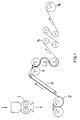
- An installation of the type described in FIG. 1 may be suitable for obtaining three different sheets then used in the installation described in FIG. 2.
- An internal mixer 1 of the type shown in FIG. 1, may be suitable for producing both a pigmented film intended for the upper sheet, a pigmented film intended for producing the intermediate sheet or a charged and flexible film serving to obtain the lower sheet .
- work is carried out to produce the transparent film and the intermediate film in the internal mixer at a temperature of 155 ° C. while a lower temperature is maintained, of the order of 140 ° C. for the loaded and flexibilized sheet.
- the material is transferred to an external mixer 2 working at 170 ° C for the transparent sheet and the intermediate sheet and at around 150 ° C for the loaded and softened sheet.
- a conveyor 3 then takes the material to a calendering installation 4 which makes it possible to produce a calendered sheet, at a temperature of 190 ° C. for the transparent sheet and the intermediate sheet and at a temperature of 180 ° C for the softened loaded sheet.
- Cooling coils 5 are interposed as shown and the material is then wound up and stored at 6.
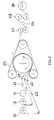
- a reel 11 provides a transparent sheet 21, the reel 12 provides the intermediate sheet 22 and the reel 13 provides the loaded and flexible sheet 23, the three sheets being brought to a combiner 24 working at a temperature of 160 to 170 ° C in view to produce the calendered product of the invention.
- a composite sheet 25 can be brought to an embossing installation 27 and then the sheet 25 circulates towards cooling rolls 28 to finally be wound on a reel 30.
- compositions can be used:
- compositions A and B of the loaded flexibilized sheet were also measured.
- the measurements carried out with the METRAVIB viscoanalyzer gave the following results: A: 2.108 N / m2 B: 5.107 N / m2.
- Part of the charges up to 50% can be replaced by a flame retardant.
Landscapes
- Engineering & Computer Science (AREA)
- Mechanical Engineering (AREA)
- Chemical & Material Sciences (AREA)
- Chemical Kinetics & Catalysis (AREA)
- Textile Engineering (AREA)
- Laminated Bodies (AREA)
- Synthetic Leather, Interior Materials Or Flexible Sheet Materials (AREA)
- Application Of Or Painting With Fluid Materials (AREA)
- Floor Finish (AREA)
Abstract
Description
- La présente invention concerne des revêtements de sols et de murs présentant des propriétés améliorées, en particulier pour ce qui se rapporte à leur comportement au feu et les risques qu'ils présentent de dégager des fumées toxiques lors de leur combustion aussi bien lors d'un incendie accidentel que lors de leur incinération volontaire.
- Elle a également pour objet le procédé de production de tels produits.
- Les produits de revêtements de sols ou de murs font largement appel à des compositions polymériques dérivées de chlorure de vinyle ou de composés contenant de l'azote tels que les polyuréthanes, les polyamides etc.
- La combustion accidentelle de tels produits au cours d'un incendie provoque d'importants dégagements gazeux, notamment chlorés (essentiellement constitués de HCl). Ceux-ci sont la cause primaire de nombreux décès lors d'incendies ou d'atteintes invalidantes aussi bien pour les victimes que pour le personnel d'intervention.
- Le traitement des déchets par incinération volontaire entraîne également une pollution non négligeable, en dépit des précautions qui peuvent être prises telles que le tri préalable.
- L'utilisation de filtres ou d'autres dispositifs entraîne de toute façon un accroissement prohibitif des coûts de traitement des immondices, sans résoudre tous les problèmes de pollution.
- Les combustions volontaires ou accidentelles de dépôts d'immondices entraînent un dégagement d'agents toxiques gazeux, en général plus important que celui d'un traitement de ces mêmes déchets par incinération à cause du caractère incontrôlé de la combustion qui de plus est généralement incomplète.
- Il existe donc un besoin urgent de disposer d'une technique de réalisation de produits de revêtement de sols ou de murs présentant moins d'inconvénients que ceux existants.
- Dans la demande de brevet EP-A2-0 274 115, on décrit l'impact sur l'environnement de produits de revêtement de sols et de murs. La solution proposée repose sur l'utilisation d'une matière fondue comportant des matières minérales, homogène ou déposée sur une sous-couche de non-tissé de fibre de verre. Après impression, ce produit peut recevoir un vernis de finition.
- Les possibilités décoratives sont bien entendu forcément limitées et le comportement physique des produits, en particulier leur résistance mécanique n'est pas nécessairement assuré dans tous les cas.
- La présente invention vise à obtenir un produit de revêtement de sols ou de murs de type nouveau qui se distingue des produits obtenus par des procédés essentiellement techniques au sens large tels que les tapis tissés ou tuftés ou en matériaux dits non-tissés et qui évite le recours à des polymères susceptibles de dégager des composés chlorés ou azotés.
- Elle vise à apporter également des perfectionnements aux propriétés des produits obtenus et à leurs conditions de production.
- Jusqu'à présent, la technique de production de revêtement de sols ou de murs par voie non textile a largement fait appel au PVC, par suite des larges facilités de mise en oeuvre de ce produit par diverses techniques, en particulier par enduction d'un plastisol sur une sous-couche de fibres de verre ou autre.
- Le brevet GB-A-1 199 050 décrit des matériaux pour revêtement de sols munis d'une couche pouvant être à base de polypropylène, contenant des charges, un plastifiant et des pigments et appliqués par enduction afin de fournir à ce revêtement de sol des propriétés améliorées d'adhérence et d'amortissement phonique et/ou thermique.
- Dans le brevet GB-A-1 268 823, on a décrit un papier synthétique constitué de deux couches à base de polypropylène et destiné pour la frappe à la machine à écrire, pour l'impression, pour l'emballage et comme matériau décoratif. En vue de lui conférer un aspect et un toucher similaire à celui du papier ordinaire, le film extérieur reçoit une charge et des "micro-vides".
- Le brevet FR-A-2 322 737 suggère de recouvrir un support de papier, d'un film protecteur (pouvant être notamment de polypropylène), au moyen d'une couche adhésive. Avant le processus de superposition, le film est muni d'une image imprimée.
- Il convient de garder à l'esprit à cet égard que les utilisateurs se montrent particulièrement exigeants aussi bien pour ce qui concerne les propriétés physiques d'usage des produits (résistance à l'usure et résistance aux taches) qu'à l'aspect décoratif du produit (reproduction des motifs naturels ou non, brillance, relief ou structure, etc.).
- La technique utilisée doit donc permettre d'obtenir également par impression l'effet décoratif souhaité tout en assurant un comportement convenable à l'usage.
- Il est apparu que ces exigences peuvent être satisfaites par une technique comportant l'application au moins d'une feuille supérieure sur une feuille inférieure chargée et flexibilisée, un décor étant interposé entre lesdites couches et l'ensemble étant constitué essentiellement d'une matière dérivée d'un polymère de propylène.
- Par "essentiellement constituée d'une matière dérivée d'un polymère de propylène", on entend une matière dont la quantité de constituants propyléniques dans le mélange de polymères et/ou dans le copolymère est supérieure à 50%.
- Pour obtenir les effets décoratifs optiques souhaités, il est avantageux et généralement prévu selon l'invention d'intercaler entre les deux feuilles précitées au moins une couche intermédiaire éventuellement pigmentée dans la masse et/ou éventuellement pourvue d'un décor, essentiellement dérivée également d'un polymère de propylène.
- La référence à une couche supérieure et inférieure et le cas échéant à une couche intermédiaire se rapporte bien entendu au produit tel qu'il est prévu lors de la pose sur le sol ou sur le mur.
- Selon l'invention, le décor peut être obtenu selon l'un au moins des procédés choisis parmi:
- le grainage et/ou le gaufrage mécanique;
- l'impression, de préférence l'impression sur la face interne de la feuille supérieure et/ou sur la face interne de la feuille inférieure et/ou éventuellement sur la feuille intermédiaire;
- l'inclusion de matières solides;
- le dépôt de poudres;
- l'utilisation au moins localisée de matières moussables colorées ou non;
- et d'autres procédés classiques connus en soi dans la technique de réalisation de revêtements de sols ou de murs.
- De manière générale, l'invention couvre toute application de décor dérivée des techniques analogues utilisées pour les revêtements de sols et/ou de murs, constitués essentiellement de PVC.
- Les couches inférieures et supérieures et éventuellement la ou les couches intermédiaires sont avantageusement obtenues par calandrage ou par extrusion. En outre, l'application de la feuille supérieure et éventuellement de la feuille intermédiaire s'effectue avantageusement par les techniques de doublage ou de coextrusion. Si toutefois, la couche supérieure était constituée d'un vernis de finition (couche d'usure) recouvrant un décor par exemple, cette couche supérieure peut être appliquée par d'autres techniques, notamment par enduction.
- Les agents de charge et de flexibilisation ajoutés dans la matière de départ pour obtenir les différentes couches sont bien entendu choisies de manière à ne pas être par eux-mêmes la cause de dégagements gazeux chlorés ou azotés importants en cas de combustion.
- Pour les diverses couches, l'utilisation de copolymères statistiques du propylène est particulièrement avantageuse. Ceux-ci comportent bien entendu les adjuvants habituels de stabilisation thermique et à la lumière ainsi que les agents de processabilité.
- Préalablement au calandrage par exemple, on peut appliquer sur le verso de la couche supérieure tout motif approprié par des techniques classiques d'impression en vigueur dans la technique de réalisation de revêtements de sols et de murs. Conviennent tout particulièrement l'héliogravure ou la quadrichromie. On constate qu'une telle impression n'influence pas le doublage ultérieur. La feuille supérieure est bien entendu choisie de manière à être au moins translucide et de préférence transparente de manière que le motif décoratif soit visible. Une feuille supérieure du type décrit, à savoir à base de polymères du propylène et tout particulièrement d'un copolymère statistique du propylène présente un excellent comportement à l'usage. Sa résistance à l'usure et ses propriétés de glissance sont satisfaisantes. Les caractéristiques de résistance aux taches sont excellentes. L'emploi de composés permettant d'encore optimaliser ces propriétés relève bien entendu de l'invention à titre complémentaire éventuel.
- Les polymères mis en oeuvre pour la réalisation de la couche "supérieure" ne conviennent cependant pas tels quels pour la couche dite "inférieure" par suite d'un comportement non satisfaisant lors de l'enroulage et de la pose. Il est apparu, selon une caractéristique subsidiaire importante de l'invention, qu'il convient d'ajouter à la matière destinée à la réalisation de cette feuille inférieure, des adjuvants flexibilisants afin d'en réduire la rigidité.
- A titre d'illustration d'adjuvants flexibilisants relevant de l'invention, on peut citer des copolymères du type du type éthylène-acétate de vinyle (EVA), éthylènepropylène-monomère diène (EPDM), caoutchouc éthylène-propylène (EPR) mais également du polypropylène atactique. Des mélanges de ces divers composés entre eux peuvent également convenir.
- Alors qu'un module d'élasticité compris dans une plage de 2.10¹⁰ N/m² à 2.10¹¹ N/m² convient pour la feuille supérieure, il est apparu qu'il convient de réduire ce module à une valeur dans une plage de l'ordre de 5.10⁷ N/m² à 2.10⁸ N/m² pour la feuille inférieure.
- Ladite feuille inférieure comporte également une forte charge de matières inertes non polymériques, de préférence du carbonate de calcium. Cette charge contribue fortement à conférer au produit fini des caractéristiques avantageuses de comportement au feu.
- L'adjonction d'agents ignifugeants bien connus notamment du type des dérivés d'antimoine ou autres est bien entendu particulièrement souhaitable. Un choix et un dosage convenables permettent notamment de répondre aux normes sévères de comportement au feu non seulement pour le dégagement de produits toxiques mais aussi pour les propriétés d'inflammabilité ou de résistance à la flamme.
- La totalité des charges inertes et des adjuvants ignifugeants exprimée en pourcentage en poids par rapport aux constituants polymériques totaux de la couche inférieure peut être de l'ordre de 50 à 100%.
- Les valeurs du module d'élasticité précitées se rapportent bien entendu à la feuille finie incluant les matières de charge et les matières ignifugeantes et éventuellement d'autres ingrédients avantageux.
- Il est surprenant qu'il soit possible de "charger" d'une telle manière une feuille à base de polymères de propylène flexibilisée sans détériorer ses propriétés intrinsèques et sans porter atteinte aux caractéristiques du produit calandré final. En fait, la technique combine dans un produit fini, réalisé par calandrage, les propriétés d'une couche noble (feuille supérieure) avec celles d'une sous-couche suffisamment souple et inerte pour permettre l'enroulabilité et réduire les dangers de pollution en cas de combustion. Par la technique de l'invention, il est possible d'offrir au marché un produit adapté qui réduit fortement les risques en cas de combustion.
- Ainsi qu'il a été indiqué ci-dessus, l'interposition entre la feuille supérieure et la feuille inférieure d'une couche intermédiaire pigmentée dans la masse est particulièrement intéressante afin de réaliser un fond coloré pour le motif décoratif imprimé sur le verso de la feuille supérieure, par exemple.
- En principe, l'épaisseur de la couche supérieure et celle de la couche intermédiaire sont nettement plus réduites que celle de la couche inférieure. Ces deux premières couches contribuent essentiellement à l'aspect décoratif et à la résistance superficielle à l'usure et à la tache sans intervenir sur les autres propriétés physiques qui sont essentiellement assumées par la couche inférieure. La première couche (supérieure) peut par exemple être constituée par un film de 0,20 mm, la couche intermédiaire également par un film de 0,20 mm et la couche flexibilisée chargée inférieure peut avoir une épaisseur de l'ordre de 1,8 mm par exemple.
- Aussi bien la couche supérieure que la couche intermédiaire peuvent comporter des agents ignifugeants, si on le souhaite. Du fait cependant que la masse polymérique inflammable (en dépit du taux de chargement élevé) est essentiellement constituée par la couche inférieure nettement plus épaisse que la ou les couches superposées, il suffit généralement de limiter la présence des agents ignifugeants à ladite couche inférieure, dans la mesure où celle-ci a été convenablement traitée.
- Le produit de l'invention permet le recours à différentes techniques complémentaires classiques, notamment de finition. C'est ainsi que la surface externe de la feuille supérieure peut subir un grainage ou être revêtue d'un vernis de surface améliorant les propriétés d'usure ou de résistance à la lumière, etc.
- L'invention sera décrite plus en détail ci-après en référence à une installation de production donnée à titre d'illustration.
-
- La figure 1 représente schématiquement la technique de production préalable des feuilles individuelles destinées à former le produit selon l'invention;
- La figure 2 représente schématiquement l'opération de doublage appliquée à des feuilles individuelles produites selon la figure 1.
- Dans la figure 1, on a représenté la réalisation des feuilles individuelles mises en oeuvre dans la technique de l'invention.
- Une installation du type décrit à la figure 1 peut convenir pour l'obtention de trois feuilles différentes utilisées ensuite dans l'installation décrite dans la figure 2.
- Un mélangeur interne 1 du type de celui représenté à la figure 1, peut convenir pour réaliser aussi bien un film pigmenté destiné à la feuille supérieure, un film pigmenté destiné à réaliser la feuille intermédiaire ou un film chargé et flexibilisé servant à obtenir la feuille inférieure.
- On travaille avantageusement pour réaliser le film transparent et le film intermédiaire dans le mélangeur interne à une température de 155 °C tandis qu'une température plus basse est maintenue, de l'ordre de 140 °C pour la feuille chargée et flexibilisée.
- Ensuite, la matière est transférée vers un mélangeur externe 2 travaillant à 170 °C pour la feuille transparente et la feuille intermédiaire et à environ 150 °C pour la feuille chargée et assouplie.
- Un transporteur 3 emmène ensuite la matière vers une installation de calandrage 4 qui permet de réaliser une feuille calandrée, à une température de 190 °C pour la feuille transparente et la feuille intermédiaire et à une température de 180 °C pour la feuille chargée assouplie. Des bobines de refroidissement 5 sont intercalées comme représenté et la matière est ensuite enroulée et stockée en 6.
- Une bobine 11 fournit une feuille transparente 21, la bobine 12 fournit la feuille intermédiaire 22 et la bobine 13 fournit la feuille chargée et flexibilisée 23, les trois feuilles étant amenées à une combinante 24 travaillant à une température de 160 à 170 °C en vue de réaliser le produit calandré de l'invention. A la sortie de la combinante, une feuille composite 25 peut être amenée vers une installation de grainage 27 et ensuite la feuille 25 circule vers des cylindres de refroidissement 28 pour finalement être enroulée sur une bobine 30.
- A titre d'exemple, on peut utiliser les compositions suivantes:

- On a également mesuré les modules d'élasticité des compositions A et B de la feuille chargée flexibilisée. Les mesures effectuées au viscoanalyseur METRAVIB ont donné les résultats suivants:
A: 2.10⁸ N/m²
B: 5.10⁷ N/m². - Une partie des charges allant jusqu'à 50% peut être remplacée par un agent ignifugeant.
Claims (17)
- Procédé d'obtention de revêtements de sols ou de murs caractérisé en ce qu'il comporte l'application d'au moins une feuille supérieure translucide ou transparente (21) sur une feuille inférieure (23) chargée et flexibilisée, un décor étant interposé entre lesdites feuilles et l'ensemble étant constitué d'une matière dans laquelle la quantité de constituants propyléniques présente dans le mélange de polymères et/ou dans le copolymère est supérieure à 50%.
- Procédé selon la revendication 1 caractérisé en ce qu'on intercale entre la feuille supérieure (21) et inférieure (23) au moins une feuille intermédiaire (22) éventuellement pigmentée dans la masse et/ou pourvue d'un décor, dans laquelle la quantité de constituants propyléniques présente dans le mélange de polymères et/ou dans le copolymère est supérieure à 50%.
- Procédé selon l'une quelconque des revendications précédentes caractérisée en ce que le décor est obtenu selon l'un au moins des procédés choisis parmi:- le grainage et/ou le gaufrage mécanique;- l'impression, de préférence l'impression sur la face interne de la feuille supérieure (21) et/ou sur la face interne de la feuille inférieure (23) et/ou éventuellement sur la feuille intermédiaire (22);- l'inclusion de matières solides;- le dépôt de poudres;- l'utilisation au moins localisée de matières moussables colorées ou non;- et d'autres procédés classiques connus en soi dans la technique de réalisation de revêtements de sols ou de murs.
- Procédé selon l'une quelconque des revendications précédentes caractérisé en ce que les feuilles inférieure (23), intermédiaire (22) et supérieure (21) sont obtenues par calandrage ou par extrusion.
- Procédé selon l'une quelconque des revendications précédentes caractérisé en ce que l'application de la feuille supérieure et éventuellement de la feuille intermédiaire s'effectue par les techniques de doublage ou de coextrusion.
- Procédé selon l'une quelconque des revendications précédentes caractérisé en ce que les feuilles sont constituées de copolymères statistiques du propylène comportant des adjuvants habituels de stabilisation thermique et à la lumière ainsi que des agents de processabilité et éventuellement des agents ignifugeants.
- Procédé selon l'une quelconque des revendications précédentes caractérisé en ce qu'on utilise comme adjuvants flexibilisants pour la feuille inférieure des copolymères du type éthylène-acétate de vinyle (EVA), éthylène-propylène-monomère diène (EPDM), caoutchouc éthylène-propylène (EPR) ou du polypropylène atactique ou encore des mélanges de ces composés entre eux.
- Procédé selon la revendication 7 caractérisé en ce que la feuille inférieure présente un module d'élasticité compris dans une plage de 5.10⁷ N/m² à 2.10⁸ N/m².
- Procédé selon l'une quelconque des revendications précédentes caractérisé en ce que la feuille inférieure comporte une forte charge de matières inertes non polymériques, de préférence du carbonate de calcium, de sorte que la totalité des charges inertes et des adjuvants ignifugeants, exprimée en pourcentage en poids par rapport aux constituants polymériques totaux de la couche inférieure peut être de l'ordre de 50 à 100%.
- Procédé selon l'une quelconque des revendications précédentes caractérisé en ce que le produit subit un traitement complémentaire de finition, notamment un grainage au moins localisé de la surface externe de la feuille supérieure ou le dépôt au moins localisé d'un vernis de surface améliorant les propriétés d'usure ou de résistance à la lumière.
- Revêtement de sols ou de murs comportant au moins une feuille supérieure translucide ou transparente (21), une feuille inférieure (23) chargée et flexibilisée et un décor interposé entre lesdites feuilles, l'ensemble étant constitué essentiellement d'une matière dans laquelle la quantité de constituants propyléniques présente dans le mélange de polymères et/ou dans le copolymère est supérieure à 50%.
- Revêtement de sols ou de murs selon la revendication 11 caractérisé en ce qu'il comporte encore, entre les feuilles supérieure (21) et inférieure (23) une feuille intermédiaire (22) éventuellement pigmentée dans la masse et/ou éventuellement pourvue d'un décor, essentiellement dérivée également d'un polymère de propylène.
- Revêtement de sols ou de murs selon la revendication 11 ou 12 caractérisé en ce que le décor est choisi parmi:- le grainage et/ou le gaufrage mécanique;- l'impression, de préférence l'impression sur la face interne de la feuille supérieure (21) et/ou sur la face interne de la feuille inférieure (23) et/ou éventuellement sur la feuille intermédiaire (22);- l'inclusion de matières solides appelées "cailloux";- le dépôt de poudres;- l'utilisation au moins localisée de matières moussables colorées ou non;- et autres procédés classiques connus en soi dans la technique de réalisation de revêtements de sols ou de murs.
- Revêtement de sols ou de murs selon l'une quelconque des revendications 12 ou 13 caractérisé en ce que les feuilles sont constituées de copolymères statistiques de propylène comportant des adjuvants habituels de stabilisation thermique et à la lumière ainsi que des agents de processabilité et éventuellement des agents ignifugeants, obtenues par calandrage ou extrusion.
- Revêtement de sols ou de murs selon l'une quelconque des revendications 12 à 14 caractérisé en ce que la feuille inférieure (23) contient à titre d'adjuvants flexibilisants des copolymères du type éthylène-acétate de vinyle (EVA), éthylène-propylène-monomère diène (EPDM), caoutchouc éthylène-propylène (EPR) ou du polypropylène atactique ou encore des mélanges de ces composés entre eux, et en ce qu'elle présente un module d'élasticité compris entre 5.10⁷ N/m² à 2.10⁸ N/m².
- Revêtement de sols ou de murs selon l'une quelconque des revendications 12 à 15 caractérisé en ce que la feuille inférieure comporte une forte charge de matières inertes non polymériques, de préférence du carbonate de calcium et en ce que la totalité des charges inertes et des adjuvants ignifugeants, exprimée en pourcentage en poids par rapport aux constituants polymériques totaux de la couche inférieure peut être de l'ordre de 50 à 100%.
- Revêtement de sols ou de murs selon l'une quelconque des revendications 11 à 16 caractérisé en ce qu'il présente une surface externe supérieure grainée au moins localement ou revêtue au moins localement d'un vernis de surface améliorant les propriétés d'usure ou de résistance à la lumière.
Priority Applications (1)
| Application Number | Priority Date | Filing Date | Title |
|---|---|---|---|
| AT89913087T ATE86922T1 (de) | 1988-12-06 | 1989-12-04 | Verfahren zur herstellung von wand- und fussbodenbelaegen und produkte. |
Applications Claiming Priority (2)
| Application Number | Priority Date | Filing Date | Title |
|---|---|---|---|
| LU87402A LU87402A1 (fr) | 1988-12-06 | 1988-12-06 | Procede de production de revetements de sols ou de murs et produits obtenus |
| LU87402 | 1988-12-06 |
Publications (2)
| Publication Number | Publication Date |
|---|---|
| EP0438532A1 EP0438532A1 (fr) | 1991-07-31 |
| EP0438532B1 true EP0438532B1 (fr) | 1993-03-17 |
Family
ID=19731122
Family Applications (1)
| Application Number | Title | Priority Date | Filing Date |
|---|---|---|---|
| EP89913087A Expired - Lifetime EP0438532B1 (fr) | 1988-12-06 | 1989-12-04 | Procede de production de revetements de sols ou de murs et produits obtenus |
Country Status (9)
| Country | Link |
|---|---|
| US (1) | US5316861A (fr) |
| EP (1) | EP0438532B1 (fr) |
| JP (1) | JP3022596B2 (fr) |
| AU (1) | AU4631889A (fr) |
| CA (1) | CA2004765C (fr) |
| DK (1) | DK130391A (fr) |
| ES (1) | ES2040506T3 (fr) |
| LU (1) | LU87402A1 (fr) |
| WO (1) | WO1990006233A1 (fr) |
Cited By (2)
| Publication number | Priority date | Publication date | Assignee | Title |
|---|---|---|---|---|
| DE4313037C1 (de) * | 1993-04-21 | 1994-08-25 | Pegulan Tarkett Ag | Mehrlagig aufgebauter thermoplastischer Fußbodenbelag auf Polyolefinbasis sowie Verfahren zu dessen Herstellung |
| US8007902B2 (en) | 2008-05-05 | 2011-08-30 | A. Schulman, Inc. | Multilayer clear over color polyolefin sheets and layered backing structure |
Families Citing this family (11)
| Publication number | Priority date | Publication date | Assignee | Title |
|---|---|---|---|---|
| DE4127107C1 (fr) * | 1991-08-16 | 1992-12-24 | Tarkett Pegulan Ag, 6710 Frankenthal, De | |
| JP3720354B2 (ja) * | 1993-09-20 | 2005-11-24 | ザ アムティコ カンパニー リミティド | 床仕上材 |
| US5569551A (en) * | 1995-04-24 | 1996-10-29 | Aer Energy Resources Inc. | Dual air elecrtrode cell |
| GB9523780D0 (en) * | 1995-11-21 | 1996-01-24 | Amtico Co | Floor coverings |
| GB9523781D0 (en) * | 1995-11-21 | 1996-01-24 | Amtico Co | Floor coverings and films for use therein |
| WO1997030848A1 (fr) * | 1996-02-22 | 1997-08-28 | Idemitsu Petrochemical Co., Ltd. | Pellicule ou plaque decorative, materiau decoratif et materiau de construction fait a partir de ce materiau decoratif |
| DE19708160A1 (de) * | 1997-02-27 | 1998-09-03 | Lauterburg & Cie Ag | Nicht brennbarer wettergerechter Markisenstoff |
| US6299966B1 (en) | 1999-09-24 | 2001-10-09 | Reynolds Metals Company | Embossed cling wrap |
| JP4806482B2 (ja) * | 2000-02-28 | 2011-11-02 | ロンシール工業株式会社 | 建築物用難燃シート |
| US9018310B2 (en) * | 2009-04-06 | 2015-04-28 | Polyone Designed Structures And Solutions Llc | Polymer blend composition for automotive flooring applications |
| US8950147B2 (en) * | 2011-08-22 | 2015-02-10 | Awi Licensing Company | Floor panel and floating floor system incorporating the same |
Family Cites Families (8)
| Publication number | Priority date | Publication date | Assignee | Title |
|---|---|---|---|---|
| BE626904A (fr) * | 1962-01-09 | |||
| DE1560722A1 (de) * | 1966-11-17 | 1970-09-17 | Gundernhausen Chemie | Verfahren zur Herstellung von Fussbodenbelag mit rutschfester Belagsrueckseite |
| JPS4640794B1 (fr) * | 1968-03-26 | 1971-12-02 | ||
| GB1384556A (en) * | 1971-12-22 | 1975-02-19 | Mitsubishi Petrochemical Co | Synthetic papers and method of making the same |
| FR2322737A1 (fr) * | 1975-09-04 | 1977-04-01 | Ora Fabrikker As | Procede de production des papiers de tenture |
| US4759968A (en) * | 1986-04-01 | 1988-07-26 | Minnesota Mining And Manufacturing Company | Transfer graphic article |
| EP0248750A1 (fr) * | 1986-04-10 | 1987-12-09 | S.A. PAPETERIES R. &P. BLANQUART | Complexe coloré |
| JP2682636B2 (ja) * | 1988-04-19 | 1997-11-26 | 住友金属鉱山株式会社 | 自熔製錬炉の操業方法 |
-
1988
- 1988-12-06 LU LU87402A patent/LU87402A1/fr unknown
-
1989
- 1989-04-12 US US07/688,608 patent/US5316861A/en not_active Expired - Lifetime
- 1989-12-04 AU AU46318/89A patent/AU4631889A/en not_active Abandoned
- 1989-12-04 ES ES198989913087T patent/ES2040506T3/es not_active Expired - Lifetime
- 1989-12-04 WO PCT/BE1989/000050 patent/WO1990006233A1/fr not_active Ceased
- 1989-12-04 EP EP89913087A patent/EP0438532B1/fr not_active Expired - Lifetime
- 1989-12-04 JP JP2500012A patent/JP3022596B2/ja not_active Expired - Lifetime
- 1989-12-06 CA CA002004765A patent/CA2004765C/fr not_active Expired - Lifetime
-
1991
- 1991-07-04 DK DK130391A patent/DK130391A/da not_active Application Discontinuation
Cited By (3)
| Publication number | Priority date | Publication date | Assignee | Title |
|---|---|---|---|---|
| DE4313037C1 (de) * | 1993-04-21 | 1994-08-25 | Pegulan Tarkett Ag | Mehrlagig aufgebauter thermoplastischer Fußbodenbelag auf Polyolefinbasis sowie Verfahren zu dessen Herstellung |
| US8007902B2 (en) | 2008-05-05 | 2011-08-30 | A. Schulman, Inc. | Multilayer clear over color polyolefin sheets and layered backing structure |
| US8182906B2 (en) | 2008-05-05 | 2012-05-22 | A. Schulman, Inc. | Multilayer clear over color polyolefin sheets and layered backing structure |
Also Published As
| Publication number | Publication date |
|---|---|
| EP0438532A1 (fr) | 1991-07-31 |
| DK130391D0 (da) | 1991-07-04 |
| US5316861A (en) | 1994-05-31 |
| WO1990006233A1 (fr) | 1990-06-14 |
| CA2004765A1 (fr) | 1990-06-08 |
| JPH04504384A (ja) | 1992-08-06 |
| LU87402A1 (fr) | 1990-07-10 |
| CA2004765C (fr) | 2003-11-11 |
| AU4631889A (en) | 1990-06-26 |
| DK130391A (da) | 1991-07-04 |
| JP3022596B2 (ja) | 2000-03-21 |
| ES2040506T3 (es) | 1993-10-16 |
Similar Documents
| Publication | Publication Date | Title |
|---|---|---|
| RU2143506C1 (ru) | Покрытие для полов | |
| CA2004765C (fr) | Procede de production de revetements de sols ou de murs et produits obtenus | |
| US20120258303A1 (en) | Multi-Layer Sheet Material and Method for the Production thereof | |
| EP0595706B1 (fr) | Stratifiés à base de mélanges compatibilisés de polyamides/polyoléfines et de liants de coextrusion et objets obtenus à partir de ceux-ci | |
| EP4143022B1 (fr) | Revetêment de sol à couche d'usure ignifugée | |
| FR3052176A1 (fr) | Revetement de sol comprenant un decor imprime par jet d'encre | |
| AU5521294A (en) | A multilayer, stretched heat-sealable polypropylene film combining good surface slip with improved barrier properties | |
| CN113453889A (zh) | 修饰膜 | |
| JP3226681B2 (ja) | 写真用の層状支持体 | |
| JP5141467B2 (ja) | 化粧シート | |
| JP2006088349A (ja) | 化粧シート | |
| EP0865351A1 (fr) | Revetements de sol et pellicules integrees a ceux-ci | |
| JP3802265B2 (ja) | 化粧材 | |
| BE1007454A3 (fr) | Produits de revetement de sols ou de murs et procede pour leur fabrication. | |
| US12350911B2 (en) | Stainable decorative sheet and method of staining decorative sheet | |
| EP0595701A1 (fr) | Film composite thermorétractable, procédé de fabrication et utilisation dudit film pour le suremballage d'articles | |
| JP4108185B2 (ja) | 化粧シート | |
| JPH11152343A (ja) | 化粧シート用フィルム | |
| JP2004276358A (ja) | 化粧シート及びそれを用いた金属化粧板 | |
| WO2003100161A1 (fr) | Revetement de sols avec envers textile | |
| JP2000263720A (ja) | 化粧材 | |
| JP3722322B2 (ja) | 化粧シート及びその製造方法 | |
| DE68905485T2 (de) | Verfahren zur herstellung von wand- und fussbodenbelaegen und produkte. | |
| JP4394772B2 (ja) | 表面保護フィルム | |
| EP1116814A1 (fr) | Textile enduit imprimé à base d'un composant polyoléfinique |
Legal Events
| Date | Code | Title | Description |
|---|---|---|---|
| PUAI | Public reference made under article 153(3) epc to a published international application that has entered the european phase |
Free format text: ORIGINAL CODE: 0009012 |
|
| 17P | Request for examination filed |
Effective date: 19910523 |
|
| AK | Designated contracting states |
Kind code of ref document: A1 Designated state(s): AT BE CH DE ES FR GB IT LI LU NL SE |
|
| 17Q | First examination report despatched |
Effective date: 19920527 |
|
| GRAA | (expected) grant |
Free format text: ORIGINAL CODE: 0009210 |
|
| AK | Designated contracting states |
Kind code of ref document: B1 Designated state(s): AT BE CH DE ES FR GB IT LI LU NL SE |
|
| REF | Corresponds to: |
Ref document number: 86922 Country of ref document: AT Date of ref document: 19930415 Kind code of ref document: T |
|
| REF | Corresponds to: |
Ref document number: 68905485 Country of ref document: DE Date of ref document: 19930422 |
|
| ITF | It: translation for a ep patent filed | ||
| GBT | Gb: translation of ep patent filed (gb section 77(6)(a)/1977) |
Effective date: 19930616 |
|
| REG | Reference to a national code |
Ref country code: ES Ref legal event code: FG2A Ref document number: 2040506 Country of ref document: ES Kind code of ref document: T3 |
|
| PLBI | Opposition filed |
Free format text: ORIGINAL CODE: 0009260 |
|
| RAP2 | Party data changed (patent owner data changed or rights of a patent transferred) |
Owner name: SOMMER S.A. |
|
| EPTA | Lu: last paid annual fee | ||
| 26 | Opposition filed |
Opponent name: FORBO-FORSHAGA AB Effective date: 19931215 |
|
| NLT2 | Nl: modifications (of names), taken from the european patent patent bulletin |
Owner name: SOMMER S.A. TE WILTZ, LUXEMBURG. |
|
| NLR1 | Nl: opposition has been filed with the epo |
Opponent name: FORBO-FORSHAGA AB |
|
| EAL | Se: european patent in force in sweden |
Ref document number: 89913087.6 |
|
| PLBO | Opposition rejected |
Free format text: ORIGINAL CODE: EPIDOS REJO |
|
| PLBN | Opposition rejected |
Free format text: ORIGINAL CODE: 0009273 |
|
| STAA | Information on the status of an ep patent application or granted ep patent |
Free format text: STATUS: OPPOSITION REJECTED |
|
| 27O | Opposition rejected |
Effective date: 19960106 |
|
| NLR2 | Nl: decision of opposition | ||
| PGFP | Annual fee paid to national office [announced via postgrant information from national office to epo] |
Ref country code: CH Payment date: 20001120 Year of fee payment: 12 |
|
| PGFP | Annual fee paid to national office [announced via postgrant information from national office to epo] |
Ref country code: AT Payment date: 20001121 Year of fee payment: 12 |
|
| PG25 | Lapsed in a contracting state [announced via postgrant information from national office to epo] |
Ref country code: AT Free format text: LAPSE BECAUSE OF NON-PAYMENT OF DUE FEES Effective date: 20011204 |
|
| PG25 | Lapsed in a contracting state [announced via postgrant information from national office to epo] |
Ref country code: LI Free format text: LAPSE BECAUSE OF NON-PAYMENT OF DUE FEES Effective date: 20011231 Ref country code: CH Free format text: LAPSE BECAUSE OF NON-PAYMENT OF DUE FEES Effective date: 20011231 |
|
| REG | Reference to a national code |
Ref country code: GB Ref legal event code: IF02 |
|
| REG | Reference to a national code |
Ref country code: CH Ref legal event code: PL |
|
| PGFP | Annual fee paid to national office [announced via postgrant information from national office to epo] |
Ref country code: IT Payment date: 20061231 Year of fee payment: 18 |
|
| PGFP | Annual fee paid to national office [announced via postgrant information from national office to epo] |
Ref country code: ES Payment date: 20071226 Year of fee payment: 19 Ref country code: NL Payment date: 20071223 Year of fee payment: 19 |
|
| PGFP | Annual fee paid to national office [announced via postgrant information from national office to epo] |
Ref country code: GB Payment date: 20071227 Year of fee payment: 19 |
|
| PGFP | Annual fee paid to national office [announced via postgrant information from national office to epo] |
Ref country code: LU Payment date: 20080107 Year of fee payment: 19 Ref country code: SE Payment date: 20071227 Year of fee payment: 19 Ref country code: DE Payment date: 20080131 Year of fee payment: 19 |
|
| PGFP | Annual fee paid to national office [announced via postgrant information from national office to epo] |
Ref country code: FR Payment date: 20071217 Year of fee payment: 19 |
|
| PGFP | Annual fee paid to national office [announced via postgrant information from national office to epo] |
Ref country code: BE Payment date: 20071231 Year of fee payment: 19 |
|
| BERE | Be: lapsed |
Owner name: S.A. *EUROFLOOR Effective date: 20081231 |
|
| EUG | Se: european patent has lapsed | ||
| GBPC | Gb: european patent ceased through non-payment of renewal fee |
Effective date: 20081204 |
|
| PG25 | Lapsed in a contracting state [announced via postgrant information from national office to epo] |
Ref country code: IT Free format text: LAPSE BECAUSE OF NON-PAYMENT OF DUE FEES Effective date: 20071204 |
|
| NLV4 | Nl: lapsed or anulled due to non-payment of the annual fee |
Effective date: 20090701 |
|
| PG25 | Lapsed in a contracting state [announced via postgrant information from national office to epo] |
Ref country code: BE Free format text: LAPSE BECAUSE OF NON-PAYMENT OF DUE FEES Effective date: 20081231 |
|
| REG | Reference to a national code |
Ref country code: FR Ref legal event code: ST Effective date: 20090831 |
|
| PG25 | Lapsed in a contracting state [announced via postgrant information from national office to epo] |
Ref country code: DE Free format text: LAPSE BECAUSE OF NON-PAYMENT OF DUE FEES Effective date: 20090701 |
|
| PG25 | Lapsed in a contracting state [announced via postgrant information from national office to epo] |
Ref country code: GB Free format text: LAPSE BECAUSE OF NON-PAYMENT OF DUE FEES Effective date: 20081204 Ref country code: NL Free format text: LAPSE BECAUSE OF NON-PAYMENT OF DUE FEES Effective date: 20090701 |
|
| REG | Reference to a national code |
Ref country code: ES Ref legal event code: FD2A Effective date: 20081205 |
|
| PG25 | Lapsed in a contracting state [announced via postgrant information from national office to epo] |
Ref country code: FR Free format text: LAPSE BECAUSE OF NON-PAYMENT OF DUE FEES Effective date: 20081231 Ref country code: ES Free format text: LAPSE BECAUSE OF NON-PAYMENT OF DUE FEES Effective date: 20081205 |
|
| PG25 | Lapsed in a contracting state [announced via postgrant information from national office to epo] |
Ref country code: LU Free format text: LAPSE BECAUSE OF NON-PAYMENT OF DUE FEES Effective date: 20081204 |
|
| PG25 | Lapsed in a contracting state [announced via postgrant information from national office to epo] |
Ref country code: SE Free format text: LAPSE BECAUSE OF NON-PAYMENT OF DUE FEES Effective date: 20081205 |