EP0440574A2 - Modelauswahlvorrichtung an einer Strickmaschine - Google Patents
Modelauswahlvorrichtung an einer Strickmaschine Download PDFInfo
- Publication number
- EP0440574A2 EP0440574A2 EP91500009A EP91500009A EP0440574A2 EP 0440574 A2 EP0440574 A2 EP 0440574A2 EP 91500009 A EP91500009 A EP 91500009A EP 91500009 A EP91500009 A EP 91500009A EP 0440574 A2 EP0440574 A2 EP 0440574A2
- Authority
- EP
- European Patent Office
- Prior art keywords
- jack
- slide member
- selector
- cancellation
- butt
- Prior art date
- Legal status (The legal status is an assumption and is not a legal conclusion. Google has not performed a legal analysis and makes no representation as to the accuracy of the status listed.)
- Withdrawn
Links
Images




Classifications
-
- D—TEXTILES; PAPER
- D04—BRAIDING; LACE-MAKING; KNITTING; TRIMMINGS; NON-WOVEN FABRICS
- D04B—KNITTING
- D04B15/00—Details of, or auxiliary devices incorporated in, weft knitting machines, restricted to machines of this kind
- D04B15/66—Devices for determining or controlling patterns ; Program-control arrangements
- D04B15/68—Devices for determining or controlling patterns ; Program-control arrangements characterised by the knitting instruments used
- D04B15/78—Electrical devices
Definitions
- This invention relates to a needle selection system in a knitting machine which comprises: a needle bed provided with tricks for receiving needles; selector devices; a plurality of association members to associate the needles with the selector devices; cams adapted to engage said association members and said needles and provided with movement relative to said association members and needles; and electronic control means.
- This invention improves the last named aspect on providing an individual selection system for each needle. Furthermore, unlike other embodiments, the present arrangement allows a longer time to be made available for the selection operations, both for actuating the electromagnets retaining the selectors and for the movement of the latter, since they are prepared for selection thereof within the period in which the needle is knitting.
- the present invention affords great advantages, since with the selection being individual for each needle, it allows the source of any fault to be easily located and with the availability of compact sets grouping the selection electromagnets and the selectors corresponding to a group of needles together, it allows for ready replacement with a new set, reducing the downtimes, as stated above.
- selector system of the type first mentioned above and wherein there is a selector device for each needle, each selector device being fixed relative to said association members and needles and comprising: selector slide member moveable between a first position and a second position; a spring urging said slide member to said first position; an electromagnet in which there is a coil, a fixed armature and a moving armature moveable between a position close to said fixed armature when the coil is energised and a normal spaced apart position, said moving armature forming a retaining member which in one of said positions retains said selector slide member and in the other of said positions releases said selector slide member; and electrical connection means for said coil, associated with said electronic control means; there being furthermore external actuating means for moving said selector slide member cyclically from said first position to said second position.
- each selector slide member is vertically moveable and is provided with a projection directed towards said needle bed and a vertical portion in which there is a first portion having a thickness different from the thickness of the immediately adjacent portions and a second portion defining a support surface orientated transversally to the vertical direction; said retaining member interlocks with said first portion to retain the selector slide member; and said spring engages said support surface, urging said selector slide member to the first position thereof.
- said first portion is a recess in which said retaining member enters to retain the selector slide member or it is a projection, one of the flanks of which is engaged by said retaining member to retain the selector slide member.
- said support surface is a surface of a shoulder forming said second portion or it is a recess forming said second portion.
- the association members for associating the needles with the selector devices comprise a cancellation jack and a pulling jack, said cancellation jack being adapted to undergo a first vertical movement between a high position and a low position and having an upper portion and a lower portion, both being adapted to rock resiliently and independently between a first position of approach to the needle bed and a second position spaced apart therefrom, while said pulling jack is adapted to undergo a vertical translation movement between an upper position and a lower position and rocks simultaneously with said upper portion of the cancellation jack between a first position of approach to the needle bed and a second position spaced apart therefrom.
- the lower portion of the cancellation jack is provided with a rocking butt and a raising butt and the upper portion is provided with a thrust butt, such that:
- Figure 1 is a cross section view of a selector device on an axial plane.
- Figure 2 is a cross section view on the line II-II of Figure 1.
- Figure 3 is partial schematic view of the selector slide member and of the retaining member in the retained position.
- Figure 4 is a view similar to the previous one in the released position.
- Figure 5 is a cross section view on the line V-V of Figure 2.
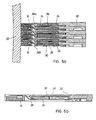
- Figure 5a is a similar view to the previous one with the fixed armatures, being independent parts of the bodies.
- Figure 5b is a detail on a larger scale of part of one of said bodies housing a fixed armature having a central orifice.
- Figure 6 is a schematic perspective view of needles with the corresponding association members and cams.
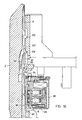
- Figure 7 is a cross section view on an axial plane comprising the upper portion of the needle bed, a selector device, a needle and the association members between the needle and the device, corresponding to a preferred embodiment, all with the selector slide member in the second position, the cancellation jack in the low position thereof and the lower portion of the same jack in the first position thereof close to the needle bed.
- Figure 8 is a cross section view similar to that of Figure 7, with the selector slide member in the first position, the cancellation jack still in the low position and the lower portion in the second position thereof.
- Figure 9 is a cross section view similar to the previous two, with the selector slide member in the second position again and the cancellation jack in the high position, both portions in the jack being in the second position thereof.
- Figure 10 is a cross section view similar to the previous ones, with the selector slide member in the second position, the cancellation jack in the high position and the upper portion of the jack in the first position thereof close to the needle bed.
- the needle selection system of the invention relates to both circular and to flat bed knitting machines, although the examples described and illustrated herein correspond to circular machines.
- the machines comprise a needle bed 2 (particularly, a needle cylinder in circular machines) having tricks 4 for receiving needles 6 and a selector device 8 for each needle.
- association members are cancellation jacks 10, pulling jacks 12 and others to which reference will be made hereinafter.
- Each selector device 8 comprises a selector slide member 14 which preferably comprises a projecting portion 16, directed towards the needle bed 2, fixedly attached to a vertical portion 18 in which there is a first portion 20 ( Figures 3 and 4) having a thickness different from the thickness of the immediately adjacent portions.
- Portion 20 is shown in the Figures to be thinner, whereby it forms a recess 22, although the invention also contemplates that the portion 20 be thicker, whereby it would form a shoulder.
- the slide member 14 is provided, further, with a second portion 24 (preferably formed by a shoulder, as shown) defining a support surface 26, although this second portion may also be formed by a recess also defining a support surface. Further reference will be made to said portions 20 and 24 hereinafter.
- the selector slide member 14 is adapted to move between a first position, such as shown in Figure 8, and a second position such as shown in Figures 1, 7, 9 and 10. There is a spring 28 urging the slide member to the first position. Furthermore, there is an electromagnet 30 for each slide member 14. It should be noted that two electromegnets 30 have been shown in Figures 1 and 7 to 10, since two slide members 14 are partially superimposed in said figures.
- the electromagnets are housed in bodies 32 and comprise a coil 34, a fixed armature 36 and a moving armature 38 which is moveable between a position close to the fixed armature and a normal position spaced apart therefrom.
- the moving armature is in the close position when the coil 34 is energised.
- the normal spaced apart position is shown by the moving armature 38a and the close up position (which may even be contact) is shown with the moving armature 38b.
- the bodies 32 are preferably formed of non-magnetic material and in each of them there is housed at least one electromagnet 30.
- the fixed armature 36 of each electromagnet is an independent part housed in the body 32. Thus there is avoided the appearance of possible magnetic influences between the electromagnets which are mounted in one same body 32 or those which are mounted in contiguous bodies.
- the existence of a central orifice 37 in the fixed armature 36 is contemplated.
- the first portion 20 (and, as the case may be, the recess 22) are facing the moving armature 38 and, preferably, an extension 40 thereof.
- the electromagnet 30 is not energised, the moving armature 38 and the extension 40 thereof move apart from the fixed armature 36, whereby the extension 40 is inserted in the recess 22 and thus becomes a retaining member for the slide member in said second position.
- the electromagnet is energised, the moving armature 38 will cease to act as retaining member and, urged by the spring, the slide member 14 passes to the first position thereof.
- FIG. 2 there are to be seen six packages 42, each of which comprises a pair of selector devices housed in a body 32 prepared for the selection of each pair of consecutive needles 6.
- the coils 34 of the electromagnets 30 may be supplied directly by conductor leads 44 in the machines where an electronic control having no relative movement with the packages 42 of selector devices 8 may be provided. This may occur in machines having a fixed needle bed and fixed controller.
- an electrical conducting system by way of brushes 46 and slip rings 48, in communication with distributor rings 50 to which the plug pins 52 of each package 42 of selectors 8 are connected may be provided
- the electricity received through said pins 52 is fed at the right time to the coils 34 following a trigger signal sent from the machine′s electronic control (not shown) through optical signal transmission means.
- the signal received through said means is processed by electronic components 58 so that the required electrical signal is allowed to reach the coils 34 to energise the electromagnets 30, thereby acting on the selector devices 8 according to a preset programme.
- the packages 42 are seen to be easily removeable, since they are fixed in flanges 60 of a ring 62, which is fixedly attached to the needle bed 2 by a locking system 64.
- the packages 42 are attached to the ring 62 by conventional fastening means 66.
- the packages are protected by the screen 68 whereby the interior thereof is practically unaccessible to dust, yarn and/or fabric fly and other impurities.
- each cancellation jack 10 is resilient and is provided with a bulge 70 forming a lower portion 72 and an upper portion 74 of the cancellation jack, each of which may rock resiliently from the bulge 70 independently of the other portion.
- the lower portion 72 is provided with a rocking butt 76 and a raising butt 78.
- the selector slide member 14 When the selector slide member 14 is in the second position thereof, the projection 16 thereof is engaged with the rocking butt 76, whereby the lower portion 72 of the cancellation jack rocks to a first position close to the needle bed 2, as shown in Figure 1.
- the raising butt 78 is disengaged from a raising cam 80, whereby, while the projection 16 is engaged with the butt 76, the cancellation jack 10 is not moved vertically. See Figures 1 and 7 and cancellation jacks 10a and 10c in Figure 6.
- the moving armature 38 approaches the fixed armature 36, whereby said moving armature 38 is spaced apart from the recess 22 of the selector slide member 14 and releases it. In this way the force of spring 28 urges the selector slide member 14 to move to the first position, with disengagement of the projection 16 from the rocking butt 76.
- the lower portion 72 of the rocking jack moves to the second position removed from the needle bed (see Figure 8 and cancellation jacks 10b in Figure 6) and consequently the raising butt 78 engages the raising cam 80.
- the cancellation jack engages a protuberance 82 of the cam 80, the jack is raised vertically from the low position thereof (jack 10b) to the high position thereof (jack 10d).
- the upper portion 74 of the cancellation jack 10 is provided with a thrust butt 84.
- the thrust butt is withdrawn from engagement with the thrust cam 86.
- the upper portion 74 of the jack moves to the first position thereof close to the needle bed.
- the cam has a second cam surface 89 which is also adapted to cause the cancellation jack to rock, in turn, to the first close-up position thereof.
- the pulling jack 12 is in constant engagement with the upper portion 74 of the corresponding cancellation jack 10, whereby it accompanies this upper portion in the rocking movement thereof to the close-up position to the needle bed.
- a spring 90 urges the pulling jack to the position removed from the needle bed.
- the pulling jack is provided also with a lifting butt 92, so that in the close-up position to the needle bed, butt 92 is disengaged from the lifting cam 94 and, on the other hand, in the removed position the lifting butt 92 engages said cam 94, so that when the butt 92 engages a first slope 96, the jack 12 is lifted.
- the pulling jack 12 may be lifted for a second time by engagement with the second slope 98, although, for this purpose, it is necessary for the corresponding cancellation jack (jack 10e in Figure 6) to be in the low position thereof, since otherwise, the thrust jack 84e would have engaged the second cam surface 89 and the pulling jack 12e would have rocked towards the needle bed, whereby the lifting jack 92e would have become disengaged from said second slope 98.
- the selector slide member 14 is seen in Figure 6 to be in the first position, whereby it has allowed the lower portion 72 of the cancellation jack 10b to rock to the second position thereof.
- This jack will duly be pushed upwards by the protuberance 82, whereby it will occupy the position corresponding to jack 10d which, in the upward movement thereof, has pulled the selector slide member 14d which, in turn, is immobilised in this position by the aforesaid action of the electromegnet 30 and its moving armature 38. Consequently, when the cancellation jack (jack 10f) has been drawn down by the drawdown cam 91, the projection 16 reengages the rocking jack 76. Therefore, the cancellation jack 10 is an external means to the selector device 8 which cyclically moves the selector slide member 14 from the first position to the second position.
- Figure 6 also shows needles 6 having a lower butt 100 and an intermediate butt 102, as well as a first cam track 104 and a second cam track 106.
- the first cam track 104 is traversed by the upper jack 108 of the pulling jack 12, provided that the lifting butt 92 of the same jack 12 has previously traversed the first and second slopes 96 and 98.
- This cam track defines a depressing cam for moving the pulling jack from the upper position to the lower position.
- the second cam track 106 is traversed in turn by the intermediate butt 102 of each needle 6 and the needle will be lifted if the corresponding pulling jack 12 has been previously been lifted.
- the needles may be moved alternatively to the welting track 110, the tucking track 112 or to the knitting level 114.
Landscapes
- Engineering & Computer Science (AREA)
- Textile Engineering (AREA)
- Knitting Machines (AREA)
Applications Claiming Priority (4)
| Application Number | Priority Date | Filing Date | Title |
|---|---|---|---|
| ES9000229 | 1990-01-26 | ||
| ES9000229A ES2020833A6 (es) | 1990-01-26 | 1990-01-26 | Sistema de seleccion de agujas en una maquina de genero de punto. |
| ES9001150 | 1990-04-24 | ||
| ES9001150A ES2024199A6 (es) | 1990-04-24 | 1990-04-24 | Perfeccionamientos en el objeto de la patente de invencion n{ 9000229 por sistema de seleccion de agujas en una maquina de genero de punto. |
Publications (2)
| Publication Number | Publication Date |
|---|---|
| EP0440574A2 true EP0440574A2 (de) | 1991-08-07 |
| EP0440574A3 EP0440574A3 (en) | 1992-04-01 |
Family
ID=26154453
Family Applications (1)
| Application Number | Title | Priority Date | Filing Date |
|---|---|---|---|
| EP19910500009 Withdrawn EP0440574A3 (en) | 1990-01-26 | 1991-01-25 | Needle selection system in a knitting machine |
Country Status (1)
| Country | Link |
|---|---|
| EP (1) | EP0440574A3 (de) |
Family Cites Families (7)
| Publication number | Priority date | Publication date | Assignee | Title |
|---|---|---|---|---|
| DE1635963B1 (de) * | 1963-02-15 | 1972-05-04 | Schieber Universal Maschf | Strickmaschine, insbesondere Flachstrickmaschine, zum Herstellen von gemusterter Maschenware |
| CH479738A (fr) * | 1967-09-15 | 1969-10-15 | Dubied & Cie Sa E | Dispositif de sélection des aiguilles d'une machine à tricoter |
| DE2445291A1 (de) * | 1974-09-21 | 1976-04-01 | Mayer & Cie Maschinenfabrik | Mehrsystemige rundstrickmaschine mit elektromagnetisch betaetigter mustereinrichtung |
| FR2325756A1 (fr) * | 1975-09-26 | 1977-04-22 | Vyzk Vyvojovy Ustav Zavodu | Dispositif pour la selection individuelle des organes fonctionnels des machines a tricoter |
| US4196599A (en) * | 1978-03-04 | 1980-04-08 | Jumberca, S. A. | Needle selection mechanism for knitting machines |
| CS223457B1 (en) * | 1981-04-15 | 1983-10-28 | Milan Havranek | Design device of the circular knitting machine |
| CH659673A5 (it) * | 1986-02-18 | 1987-02-13 | Massimo Mozer | Meccanismo di selezione totale degli aghi nelle macchine tessili per tessuti a maglia circolari o lineari, a programmazione. |
-
1991
- 1991-01-25 EP EP19910500009 patent/EP0440574A3/en not_active Withdrawn
Also Published As
| Publication number | Publication date |
|---|---|
| EP0440574A3 (en) | 1992-04-01 |
Similar Documents
| Publication | Publication Date | Title |
|---|---|---|
| EP1026299B1 (de) | Nadelauswahlvorrichtung für eine Flachstrickmaschine | |
| EP0591987B1 (de) | Interlock-Strickmaschine zum Jacquard Stricken | |
| US6988385B2 (en) | Yarn feeder of weft knitting machine and method of feeding yarn for weft knitting machine | |
| US4294085A (en) | Flat bed knitting machines | |
| KR0122597B1 (ko) | 환편기에서의 전자선침장치 | |
| JPH01239143A (ja) | 丸編機における積極型の糸送り装置 | |
| EP0440574A2 (de) | Modelauswahlvorrichtung an einer Strickmaschine | |
| US4793159A (en) | Needle selection device for circular knitting machines | |
| US5375436A (en) | Needle selecting device of a knitting machine | |
| US4860557A (en) | Needle selection system for a circular knitting machine | |
| US4414806A (en) | Needle selection device for a knitting machine | |
| GB2110252A (en) | Knitting machine: electromagnetic needle selection | |
| US4972686A (en) | Electromagnetic needle selector for circular knitting machines | |
| GB2024267A (en) | Pattern providing apparatus for a knitting machine | |
| EP0718427B1 (de) | Flachstrickmaschine | |
| US4660391A (en) | Needle selection device for a flat knitting machine | |
| US5046334A (en) | Electromagnetic needle selector for circular knitting machines | |
| EP0569065A1 (de) | Rundstrickmaschine mit elastischen Nadeln und einer Schieberauswahlvorrichtung | |
| US10612169B2 (en) | Knitting mechanism for circular knitting machine and the circular knitting machine | |
| JPH04289249A (ja) | 丸編機における針の選択の方法および装置 | |
| GB2203172A (en) | Device for yarn change selection on knitting machines | |
| US5291756A (en) | Knitting machine with needle selecting device | |
| EP4726089A1 (de) | Rundstrickmaschine zum stricken von doppelseitigen gestricken mit farbigen garnen | |
| US3818726A (en) | Needle selecting mechanism for flat knitting machines | |
| KR810002144Y1 (ko) | "환편기에 있어서 칼라파일 무늬사의 공급 절환장치" |
Legal Events
| Date | Code | Title | Description |
|---|---|---|---|
| PUAI | Public reference made under article 153(3) epc to a published international application that has entered the european phase |
Free format text: ORIGINAL CODE: 0009012 |
|
| AK | Designated contracting states |
Kind code of ref document: A2 Designated state(s): DE ES IT |
|
| PUAL | Search report despatched |
Free format text: ORIGINAL CODE: 0009013 |
|
| AK | Designated contracting states |
Kind code of ref document: A3 Designated state(s): DE ES IT |
|
| REG | Reference to a national code |
Ref country code: ES Ref legal event code: RD2A Effective date: 19921230 |
|
| STAA | Information on the status of an ep patent application or granted ep patent |
Free format text: STATUS: THE APPLICATION IS DEEMED TO BE WITHDRAWN |
|
| 18D | Application deemed to be withdrawn |
Effective date: 19921002 |