EP0440595A2 - Dispositif pour relacher sélectivement des fils d'une frange - Google Patents
Dispositif pour relacher sélectivement des fils d'une frange Download PDFInfo
- Publication number
- EP0440595A2 EP0440595A2 EP91870019A EP91870019A EP0440595A2 EP 0440595 A2 EP0440595 A2 EP 0440595A2 EP 91870019 A EP91870019 A EP 91870019A EP 91870019 A EP91870019 A EP 91870019A EP 0440595 A2 EP0440595 A2 EP 0440595A2
- Authority
- EP
- European Patent Office
- Prior art keywords
- yarns
- tying
- yarn
- fringe
- tied
- Prior art date
- Legal status (The legal status is an assumption and is not a legal conclusion. Google has not performed a legal analysis and makes no representation as to the accuracy of the status listed.)
- Granted
Links
Images



Classifications
-
- D—TEXTILES; PAPER
- D21—PAPER-MAKING; PRODUCTION OF CELLULOSE
- D21F—PAPER-MAKING MACHINES; METHODS OF PRODUCING PAPER THEREON
- D21F1/00—Wet end of machines for making continuous webs of paper
- D21F1/0027—Screen-cloths
- D21F1/0054—Seams thereof
-
- D—TEXTILES; PAPER
- D03—WEAVING
- D03D—WOVEN FABRICS; METHODS OF WEAVING; LOOMS
- D03D3/00—Woven fabrics characterised by their shape
- D03D3/04—Endless fabrics
Definitions
- the present invention relates to an apparatus for use in production of a woven seam in fabric belts. More particularly, the present invention relates to an apparatus for automatically forming a woven seam in industrial fabrics of the type employed in the papermaking industry. The present invention is especially useful in automated seaming of papermakers fabrics used in the Fourdrinier or forming section of a paper machine.
- the art has sought solutions to the problems of selecting the yarn, separating the yarn and presenting the yarn for interweaving.
- the present invention meets all three of these objectives.
- the present invention provides an apparatus for selectively releasing tied yarns from a fringe strip.
- the fringe strip is comprised of a plurality of tying and tied yarns which are interwoven in a given repeat pattern.
- the apparatus utilizes a shed formation means to define a shedding pattern for the fringe strip tying yarns.
- a shed formation means to define a shedding pattern for the fringe strip tying yarns.
- the manipulation of the tying yarns is accomplished through a plurality of individual control means.
- the weaving process may be a hand weaving process or one of the automated weaving process as described in the 4,410,015 or 4,581,794 patent.
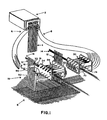
- Figure 1 is a perspective view of an apparatus in accordance with the present invention.
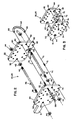
- Figure 2 is an exploded view of a yarn shedding means in accordance with the present invention.
- Figure 3 is an assembled view of the yarn shedding means depicted in Figure 2.
- Figure 4 illustrates the yarn threading arrangement from the left hand side of the apparatus.
- Figure 5 illustrates the yarn threading arrangement from the right side of the apparatus.
- Figure 6 illustrates the shedding of the fringe and the release of a tied yarn.
- Figure 7 illustrates a preferred means for capturing a yarn prior to interweaving.
- Figure 8 illustrates a preferred capture device.
- Figure 9 is a side elevation taken in the direction of 9-9 on Figure 8.
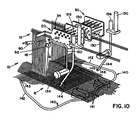
- Figure 10 illustrates the present invention in an automated seaming apparatus.
- Figure 11 illustrates the interweaving of a yarn after it has been released from the separator to the automated weaving apparatus.
- Figure 12 illustrates the interweaving of the released yarn.
- FIG. 1 With reference to Figure 1, there is shown a Jacquard machine 2 and a fabric 8 which is to be seamed.
- a plurality of harness cords extend from the Jacquard machine 2.
- the central group of harness cords 4 extend downwardly from the Jacquard machine 2 to the fabric 8 which is being seamed.
- the harness cords 4 will control the shedding of yarns 10 in the base fabric 8 as the selected fringe yarn 16 is interwoven as part of the seam.
- the side cords 6 extend from the Jacquard machine 2 to the respective fringe control apparatus 30 and will control the shedding of the ribbon of tying fring yarns 14 during selective release of the tied fringe yarns 16. In their interwoven state, the tying yarns 14 and the tied yarns 16 form a fringe area 12. Since the left and right hand fringe control apparatus 20 and 30 are essentially mirror images of each other, the description thereof will be limited to one fringe control apparatus. To the extent that there are distinctions between the left and right hand sides, they will be clearly identified and described hereinafter.
- Each fringe control apparatus 20 is comprised of opposed mounting plates 32 and 34 which are spaced apart and oriented in parallel vertical planes. The distance between the mounting plates 32 and 34 is maintained by the spacing shafts 36.
- Each shaft 36 has an unthreaded central portion and threaded end portions 38 and 40.
- a nut 42 is secured to each shaft at the threaded portions 38 and 40. The nut is threaded toward the central portion and the threaded portion is then passed through the respective plate 32 or 34 at the apertures 50 and a second nut 44 secured thereto.
- the preferred embodiment has been shown with two spacers 36, it will be understood by those skilled in the art that additional spacers may be used and the final number will depend upon the structural rigidity desired for the fringe control apparatus 20.
- Mounting plates 32 and 34 have a series of apertures formed across their upper and lower portions. With reference to mounting plate 34, the upper series of apertures 52 is dimensioned to securely receive the brass sleeve 56. Within brass sleeve 56 is a spring element 54. Each spring element 54 is retained within a respective sleeve 56 and aperture 52 by a ring 58.
- the opposed plate 32 has a plurality of apertures 60 which generally correspond to the apertures 52.
- Each aperture in the second series of apertures 62 in plate 32 is generally in vertical alignment with a corresponding aperture 60 and is substantially the same size.
- the apertures 60 and 62 are slightly tapered or chamfered, in the manner of a recess, as they extend through the plate 32 toward the plate 34.
- a semi-circular sleeve 64 is fitted vertically between the respectively paired apertures 60 and 62.
- Sleeve 64 provides a raceway and turnaround for the control cord 70 as it extends between spring 54 and the mail or eyelet 72.
- Control cord 74 extends from the left side of eyelet 72 through the aperture 76 to the associated harness cord of side cords 6 on the left side of the Jacquard machine 2.
- the aperture 76 is dimensioned to accomodate cord 74.
- each aperture 76 is provided with an eyelet to reduce abrasion on the cord 74.
- Figure 3 shows the elements of Figure 2 assembled.
- the fringe control mechanism is adaptable in size and, therefore, can be varied to accomodate varied shed counts.
- plate 34 is provided with an extending arm member 31.
- the extending arm 31 is secured to a horizontal mounting member 33 which is securely mounted and positioned so as to locate the fringe control apparatus 20 adjacent to the fringe.
- the mount 33 is connected directly to the base of the automatic seamin apparatus. It will be understood by those skilled in the art that the variety of seaming devices presently used in the art will result in differential mounting techniques in order to avoid interference with movement of the fabric or seaming.
- the carding arrangement for the Jacquard machine 2 may possess the same repeat pattern for controlling the harnesses 4 and 6.
- the repeats for the fringe harnesses 6 are the same as each other but different than that of harness 4.
- the cards for harnesses 6 have the same repeat pattern without regard to whether or not harnesses 4 or 6 are being controlled by same card arrangement.
- the tying yarns 14 are inverted as they are led into the fringe control apparatus in the respective right and left hand positions. This is explained in more detail below.
- Figure 4 will be representative of the right side apparatus 30 and Figure 5 will be representative of the left side apparatus 20.
- the ribbon of tying yarns 14 would preferably be comprised of two repeats or sixteen yarns. Accordingly, the tying yarns 14 are represented as 14-1 through 14-16.
- the yarns of the left side are sequenced opposite to those of the right side.
- the first tying yarn 14-1 will be controlled by the mail 72 occupying the number 1 position in the lower right hand corner of plate 32. After yarn 14-1 has passed beyond the controlled apparatus 30, it is strung through an end ribbon control bracket 80.
- the sequence of holes in end ribbon control bracket 80 is the same as that in the associated bracket 32.
- each yarn 14, after it proceeds through the bracket 80 is weighted to maintain the proper tension in accordance with accepted Jacquard techniques.
- the ribbon is manipulated or shedded in the mirror image of itself.
- the proper tied yarn 16 is sequentially released from the tying yarns of the ribbon 14 and is made available for interweaving.
- the preferred embodiment includes a pulsed air or pressure source 90 and a yarn catcher 92 to assist in liberation and capture of the tied yarn 16.
- a controlled burst of air be released from the pressure source 90 to direct the yarn into the yarn catcher 92.
- the catcher 92 momentarily stabilizes the yarn and assists in determining a fixed position for pick up of the yarn 16 as part of the interweaving process to complete the seam construction.
- the pressure source 90 is preferably positioned to the inside of the yarn fringe at about the point where separation will take place.
- the pressure source 90 will direct the air outwardly so that the air is expelled away from the fringe yarns and the seam area.
- the yarn catcher 92 is secured to the guide-mount 124.
- the guide 124 will assist in securing and positioning the free end of the fringe 12.
- principle control over the fringe 12 will be established through the ribbon 14, guide 124 has been found to be useful. Since guide 124 is positioned adjacent the seam area, it makes an ideal mount for the yarn catcher 92. As a tied yarn 16 is released, it will fall into the side opening 106 and will be blown into the slot 108. This operation can be clearly understood by reference to Figure 8.
- the yarn catcher 92 has a tubular body 100 which is approximately 50.8 mm in length.
- Tubular body 100 is closed at one end by the nipple 102 ; the other end 104 is open. Opening 106 in the side of tubular body 100 is approximately 9.5 mm long and communicates with slot 108 which is approximately 19.0 mm long.
- the open side 106 is bordered by guides 110 and 114. As can be seen by reference to Figure 7, the guides 110 and 114 will extend about tied yarns 16 of fringe area 12.
- an additional guide 116 is provided.
- Guide 116 extends parallel to the open side 106 and the slot 108 and is positioned off of the body 100 by approximately 3.2 mm.
- Guide 116 is about 47.6 mm long and serves a bearing for a tied yarn 16 as it is released from the fringe area 12.
- the released yarn will be of such a length that a portion of the free end of the yarn may extend past the body 100.
- guide 116 will assure that the yarn does not become abraded in the side opening or slot.
- Yarn catcher 92 also has a mounting arm or stem 118 which is used to secure catcher 92 to guide-mount 124.
- guide 110 is secured to the body 100 by weldment 112.
- the guides 114 and 116 and the mounting arm 118 are formed from a single piece of stock which is secured to the body 100 by the weldment 120.
- Figures 10, 11 and 12 illustrate the present invention in an interweaving apparatus as disclosed in U.S. Patent 4,581,794.
- the separation means of the present invention has been described herein above and reference should be made to U.S. Patent 4,581,794 for a full description of the interweaving apparatus.
- the following description generally describes the interweaving of a separated yarn.
- the selected fringe yarn 16 will first come under the influence of a transfer arm 130.
- a pair of transfer arms 130 are positioned on either side of the seam.
- Each transfer arm is supported for pivotal movement about a horizontal axis parallel to the fabric 8.
- the free end 132 of each transfer arm 130 includes a means for gripping the selected fringe yarn 16 following the separation.
- the free end 132 of the transfer arm 130 is positionable so that it can grip the selected fringe yarn 16 and then move the yarn to the position shown in Figure 11.
- the selected fringe yarn 16 is moved generally forward and downward so that the free end of the yarn is moved into the shed plane of the fabric 8. At this time, the yarn will come under the influence of an interlacing arm 140.
- interlacing arms 140 There are a pair of interlacing arms 140 which are disposed on either side of the fabric seam. The interlacing arms 140 are disposed so as to rotate over the seam area and through the shed formed by the shedding of yarns 10 in the base fabric.
- the selected fringe yarn 16 will be transferred from the free end 132 of a transfer arm to the free end 142 of the interlacing arm.
- the free end 142 of interlacing arm 140 includes means for gripping the thread in the yarn receiving notch 143 when it is transferred from end 132.
- Each of the interlacing arms 140 is generally L-shaped and is supported at the end 141 for pivotal movement about a vertical axis. In this manner, the interlacing arms 140 will generally move in a horizontal plane from one side of the fabric seam through the shed opening to an opposite side of the fabric seam. In this manner, the selected yarn 16 is pulled across the shed and is interwoven in the repeat pattern. Compare Figures 11 and 12. With reference again to Figures 10, 11 and 12 the interwoven yarn is then transferred from the interlacing arm to an extractor arm 144. Once again, there are a pair of extractor arms which are positioned on either side of the seam. Each extractor arm is provided with means for causing selected vertical movement of the lower end 146 of extractor arm 144.
- the means for selected vertical movement comprises a pair of pneumatically controlled pistons which are contained within piston housings 150 and 156.
- the extractor arm 144 As the selected yarn 16 is brought across the fabric seam face, as shown in Figure 12, it will come under the influence of the extractor arm 144.
- the extractor arm is provided with means within yarn receiving notch 148 for gripping the yarn as it is released from the interlacing arm 140. Having thus gained control over the yarn, the yarn is pulled against the face of the seam by rearward retraction of the extractor 144, see Figure 12.
- the above described device may be useful in hand, semi-automated or automated seam formation techniques.
- the present invention finds particular application in an automated seaming apparatus as described in U.S. Patent 4,581,794 which has been modified to incorporate the above described apparatus for selectively releasing yarns from a fringe.
Landscapes
- Engineering & Computer Science (AREA)
- Textile Engineering (AREA)
- Yarns And Mechanical Finishing Of Yarns Or Ropes (AREA)
- Looms (AREA)
- Treatment Of Fiber Materials (AREA)
- Woven Fabrics (AREA)
- Spinning Or Twisting Of Yarns (AREA)
- Paper (AREA)
- Ropes Or Cables (AREA)
Applications Claiming Priority (2)
| Application Number | Priority Date | Filing Date | Title |
|---|---|---|---|
| US07/472,734 US5027483A (en) | 1990-01-31 | 1990-01-31 | Apparatus for selectively releasing yarns from a fringe |
| US472734 | 1990-01-31 |
Publications (3)
| Publication Number | Publication Date |
|---|---|
| EP0440595A2 true EP0440595A2 (fr) | 1991-08-07 |
| EP0440595A3 EP0440595A3 (en) | 1992-01-02 |
| EP0440595B1 EP0440595B1 (fr) | 1995-12-27 |
Family
ID=23876730
Family Applications (1)
| Application Number | Title | Priority Date | Filing Date |
|---|---|---|---|
| EP91870019A Expired - Lifetime EP0440595B1 (fr) | 1990-01-31 | 1991-01-30 | Dispositif pour relacher sélectivement des fils d'une frange |
Country Status (10)
| Country | Link |
|---|---|
| US (1) | US5027483A (fr) |
| EP (1) | EP0440595B1 (fr) |
| JP (1) | JP2815241B2 (fr) |
| AT (1) | ATE132217T1 (fr) |
| AU (1) | AU634625B2 (fr) |
| CA (3) | CA2034793C (fr) |
| DE (1) | DE69115723T2 (fr) |
| FI (1) | FI93474C (fr) |
| NO (1) | NO177319C (fr) |
| NZ (1) | NZ236913A (fr) |
Cited By (5)
| Publication number | Priority date | Publication date | Assignee | Title |
|---|---|---|---|---|
| WO1993016220A1 (fr) * | 1992-02-07 | 1993-08-19 | Asten Group, Inc. | Appareil destine a former le pas |
| DE19505280A1 (de) * | 1995-02-16 | 1996-08-22 | Staeubli Gmbh | Verfahren und Vorrichtung zur maschinellen Herstellung einer Naht zum Endlosmachen einer Gewebebahn |
| WO1998006894A1 (fr) * | 1996-08-13 | 1998-02-19 | Asten, Inc. | Appareil permettant de realiser une jonction cousue dans un tissu comprenant plusieurs fils sens machine |
| EP0909846A1 (fr) * | 1997-10-17 | 1999-04-21 | WIS Engineering GmbH & Co.KG | Procédé et dispositif pour la présentation des bouts de fils de chaíne d'une bande de tissu |
| DE4215971C2 (de) * | 1992-05-14 | 2000-08-17 | Wis Engineering Gmbh Timelkam | Verfahren zum Herstellen einer Naht zum Endlosmachen eines Gewebebandes, insbesondere eines Papiermaschinensiebes |
Families Citing this family (8)
| Publication number | Priority date | Publication date | Assignee | Title |
|---|---|---|---|---|
| DE9215498U1 (de) * | 1992-11-13 | 1994-03-17 | Novatech GmbH Siebe und Technologie für Papier, 72760 Reutlingen | Durchziehgreifer zum Eintragen eines Hilfsschußfadens in das Nahtwebfach bei einer Nahtwebmaschine |
| DE9301722U1 (de) * | 1993-02-08 | 1994-06-09 | Novatech GmbH Siebe und Technologie für Papier, 72760 Reutlingen | Nahtwebmaschine mit Fransenfänger |
| US5390708A (en) * | 1993-09-21 | 1995-02-21 | Asten Group, Inc. | Apparatus for translating yarns in the proper position and orientation for forming a woven join |
| US6014797A (en) * | 1997-06-16 | 2000-01-18 | Jwi Ltd. | Method and apparatus for unravelling threads |
| US6016851A (en) * | 1998-10-16 | 2000-01-25 | Wis Seaming Equipment, Inc. | Method and apparatus for providing the warp thread end of a fabric ribbon |
| US6554029B1 (en) * | 2000-05-26 | 2003-04-29 | Wagner Finckh Gmbh | Method for mounting a new harness on a seam weaving machine, apparatus for making a flat woven fabric endless and harness carriage |
| US6634068B1 (en) * | 2002-04-24 | 2003-10-21 | Astenjohnson, Inc. | Apparatus for preparing a fabric for seaming |
| DE202005018856U1 (de) * | 2005-12-01 | 2007-04-12 | Wangner Gmbh & Co Kg | Halterung für das Webblatt einer Nahtwebmaschine, um den Nahtschussfaden wahlweise mittels Schrägstellung der Riete oder verfahrbarer Rolle einzuwälzen |
Family Cites Families (6)
| Publication number | Priority date | Publication date | Assignee | Title |
|---|---|---|---|---|
| DE3025909C2 (de) * | 1980-07-09 | 1983-07-14 | Hermann Wangner Gmbh & Co Kg, 7410 Reutlingen | Verfahren und Vorrichtung zum Herstellen einer Webnaht zwischen zwei Gewebeenden |
| FI843698A0 (fi) * | 1982-08-20 | 1984-09-20 | Scapa Porritt Ltd | Automatisk hopfogningsmaskin. |
| US4581794A (en) * | 1984-03-07 | 1986-04-15 | Asten Group Inc. | Automatic seaming machine for fabric belts |
| JPS62299561A (ja) * | 1986-02-20 | 1987-12-26 | ウイスコンシン・ワイアズ・インコ−ポレ−テツド | 織布ベルトの自動継目形成装置 |
| DE8713074U1 (de) * | 1987-07-27 | 1988-11-24 | Hermann Wangner Gmbh & Co Kg, 7410 Reutlingen | Separator zum Vereinzeln von in einer Aufreihung gehaltenen Fäden |
| DE3823715A1 (de) * | 1988-07-13 | 1990-01-18 | Oberdorfer Fa F | Verfahren zur herstellung einer stecknaht zum endlosmachen eines gewebebandes und nahtungsmaschine |
-
1990
- 1990-01-31 US US07/472,734 patent/US5027483A/en not_active Expired - Fee Related
-
1991
- 1991-01-23 CA CA002034793A patent/CA2034793C/fr not_active Expired - Fee Related
- 1991-01-23 CA CA002206577A patent/CA2206577A1/fr not_active Abandoned
- 1991-01-23 CA CA002206731A patent/CA2206731A1/fr not_active Abandoned
- 1991-01-28 NZ NZ236913A patent/NZ236913A/en unknown
- 1991-01-29 NO NO910339A patent/NO177319C/no unknown
- 1991-01-30 AU AU70080/91A patent/AU634625B2/en not_active Ceased
- 1991-01-30 EP EP91870019A patent/EP0440595B1/fr not_active Expired - Lifetime
- 1991-01-30 DE DE69115723T patent/DE69115723T2/de not_active Expired - Fee Related
- 1991-01-30 FI FI910454A patent/FI93474C/fi active
- 1991-01-30 AT AT91870019T patent/ATE132217T1/de not_active IP Right Cessation
- 1991-01-31 JP JP3031589A patent/JP2815241B2/ja not_active Expired - Lifetime
Cited By (8)
| Publication number | Priority date | Publication date | Assignee | Title |
|---|---|---|---|---|
| WO1993016220A1 (fr) * | 1992-02-07 | 1993-08-19 | Asten Group, Inc. | Appareil destine a former le pas |
| US5355911A (en) * | 1992-02-07 | 1994-10-18 | Asten Group, Inc. | Weave shed formation apparatus with individual heddle selector control |
| DE4215971C2 (de) * | 1992-05-14 | 2000-08-17 | Wis Engineering Gmbh Timelkam | Verfahren zum Herstellen einer Naht zum Endlosmachen eines Gewebebandes, insbesondere eines Papiermaschinensiebes |
| DE19505280A1 (de) * | 1995-02-16 | 1996-08-22 | Staeubli Gmbh | Verfahren und Vorrichtung zur maschinellen Herstellung einer Naht zum Endlosmachen einer Gewebebahn |
| US5720323A (en) * | 1995-02-16 | 1998-02-24 | Staeubli Gmbh | Method and apparatus for mechanically producing a woven fabric endless seam |
| DE19505280C2 (de) * | 1995-02-16 | 1998-08-06 | Staeubli Gmbh | Verfahren und Vorrichtung zur maschinellen Herstellung einer Naht zum Endlosmachen einer Gewebebahn |
| WO1998006894A1 (fr) * | 1996-08-13 | 1998-02-19 | Asten, Inc. | Appareil permettant de realiser une jonction cousue dans un tissu comprenant plusieurs fils sens machine |
| EP0909846A1 (fr) * | 1997-10-17 | 1999-04-21 | WIS Engineering GmbH & Co.KG | Procédé et dispositif pour la présentation des bouts de fils de chaíne d'une bande de tissu |
Also Published As
| Publication number | Publication date |
|---|---|
| ATE132217T1 (de) | 1996-01-15 |
| EP0440595A3 (en) | 1992-01-02 |
| AU634625B2 (en) | 1993-02-25 |
| CA2034793C (fr) | 1998-05-19 |
| DE69115723D1 (de) | 1996-02-08 |
| FI93474B (fi) | 1994-12-30 |
| NZ236913A (en) | 1994-11-25 |
| NO910339L (no) | 1991-08-01 |
| US5027483A (en) | 1991-07-02 |
| JPH05148790A (ja) | 1993-06-15 |
| NO177319C (no) | 1995-08-23 |
| NO910339D0 (no) | 1991-01-29 |
| AU7008091A (en) | 1991-08-01 |
| CA2206731A1 (fr) | 1991-08-01 |
| NO177319B (no) | 1995-05-15 |
| CA2206577A1 (fr) | 1991-08-01 |
| FI93474C (fi) | 1995-04-10 |
| EP0440595B1 (fr) | 1995-12-27 |
| DE69115723T2 (de) | 1996-09-19 |
| JP2815241B2 (ja) | 1998-10-27 |
| FI910454A0 (fi) | 1991-01-30 |
| FI910454L (fi) | 1991-08-01 |
| CA2034793A1 (fr) | 1991-08-01 |
Similar Documents
| Publication | Publication Date | Title |
|---|---|---|
| US5027483A (en) | Apparatus for selectively releasing yarns from a fringe | |
| US4985970A (en) | Seaming machine to manufacture an insertion-type seam for making a cloth belt endless | |
| JP5819097B2 (ja) | 3次元製織のための織機およびその製織方法 | |
| US5492153A (en) | Clamp type arrangement for presenting weft threads to a gripper | |
| EP0236601B1 (fr) | Machine automatique pour la jonction de deux extrémités de bande | |
| US3952778A (en) | Selvage forming device | |
| US5615712A (en) | Technique for separating and tensioning warp threads in a face-to-face weaving machine | |
| EP0259915A1 (fr) | Procédé pour réparer un fil de chaîne cassé dans les métiers à tisser, et mécanisme de réenfilage utilisé | |
| GB2113725A (en) | Circular looms | |
| US5411063A (en) | Seam-weaving machine with fringe catcher | |
| US5699836A (en) | Method and apparatus for manufacturing slotted webbing on a needle loom | |
| US5212858A (en) | Apparatus for capturing and stabilizing a yarn | |
| US5390708A (en) | Apparatus for translating yarns in the proper position and orientation for forming a woven join | |
| US4078586A (en) | Method and apparatus for producing a selvage | |
| US4974300A (en) | Thread separator for seaming machines | |
| NZ247920A (en) | Tubular-yarn capturing apparatus for seaming machine | |
| GB2129449A (en) | A shuttleless weaving loom having apparatus for forming a selvage | |
| CN101454491A (zh) | 用于在剑杆织机上形成织物边的方法和装置 | |
| CA1318830C (fr) | Methode de confection de joint integre de toile sans fin et machine correspondante | |
| US3171443A (en) | Selvage forming mechanism | |
| CN86101305B (zh) | 生产筒形织物的方法及其圆机 | |
| NO178439B (no) | Pneumatisk garninnfangningsapparat for innfangning og stabilisering av garn för sammenvevning | |
| US4259998A (en) | Loom with stationary weft supply | |
| GB1566033A (en) | Weft insertion device | |
| EP0939155A3 (fr) | Dispositif d'insertion de la trame et ruban d'insertion pour métiers à tisser à griffes |
Legal Events
| Date | Code | Title | Description |
|---|---|---|---|
| PUAI | Public reference made under article 153(3) epc to a published international application that has entered the european phase |
Free format text: ORIGINAL CODE: 0009012 |
|
| AK | Designated contracting states |
Kind code of ref document: A2 Designated state(s): AT BE CH DE DK ES FR GB GR IT LI LU NL SE |
|
| PUAL | Search report despatched |
Free format text: ORIGINAL CODE: 0009013 |
|
| AK | Designated contracting states |
Kind code of ref document: A3 Designated state(s): AT BE CH DE DK ES FR GB GR IT LI LU NL SE |
|
| 17P | Request for examination filed |
Effective date: 19920624 |
|
| 17Q | First examination report despatched |
Effective date: 19940705 |
|
| RAP1 | Party data changed (applicant data changed or rights of an application transferred) |
Owner name: ASTEN, INC. |
|
| GRAA | (expected) grant |
Free format text: ORIGINAL CODE: 0009210 |
|
| AK | Designated contracting states |
Kind code of ref document: B1 Designated state(s): AT BE CH DE DK ES FR GB GR IT LI LU NL SE |
|
| PG25 | Lapsed in a contracting state [announced via postgrant information from national office to epo] |
Ref country code: GR Free format text: LAPSE BECAUSE OF FAILURE TO SUBMIT A TRANSLATION OF THE DESCRIPTION OR TO PAY THE FEE WITHIN THE PRESCRIBED TIME-LIMIT Effective date: 19951227 Ref country code: ES Free format text: THE PATENT HAS BEEN ANNULLED BY A DECISION OF A NATIONAL AUTHORITY Effective date: 19951227 Ref country code: DK Effective date: 19951227 |
|
| REF | Corresponds to: |
Ref document number: 132217 Country of ref document: AT Date of ref document: 19960115 Kind code of ref document: T |
|
| ITF | It: translation for a ep patent filed | ||
| PG25 | Lapsed in a contracting state [announced via postgrant information from national office to epo] |
Ref country code: LU Free format text: LAPSE BECAUSE OF NON-PAYMENT OF DUE FEES Effective date: 19960131 |
|
| REF | Corresponds to: |
Ref document number: 69115723 Country of ref document: DE Date of ref document: 19960208 |
|
| ET | Fr: translation filed | ||
| PLBE | No opposition filed within time limit |
Free format text: ORIGINAL CODE: 0009261 |
|
| STAA | Information on the status of an ep patent application or granted ep patent |
Free format text: STATUS: NO OPPOSITION FILED WITHIN TIME LIMIT |
|
| 26N | No opposition filed | ||
| PGFP | Annual fee paid to national office [announced via postgrant information from national office to epo] |
Ref country code: FR Payment date: 19990111 Year of fee payment: 9 |
|
| PGFP | Annual fee paid to national office [announced via postgrant information from national office to epo] |
Ref country code: AT Payment date: 19990113 Year of fee payment: 9 |
|
| PGFP | Annual fee paid to national office [announced via postgrant information from national office to epo] |
Ref country code: SE Payment date: 19990126 Year of fee payment: 9 |
|
| PGFP | Annual fee paid to national office [announced via postgrant information from national office to epo] |
Ref country code: NL Payment date: 19990131 Year of fee payment: 9 |
|
| PGFP | Annual fee paid to national office [announced via postgrant information from national office to epo] |
Ref country code: GB Payment date: 19990204 Year of fee payment: 9 |
|
| PGFP | Annual fee paid to national office [announced via postgrant information from national office to epo] |
Ref country code: DE Payment date: 19990205 Year of fee payment: 9 |
|
| PGFP | Annual fee paid to national office [announced via postgrant information from national office to epo] |
Ref country code: CH Payment date: 19990210 Year of fee payment: 9 |
|
| PGFP | Annual fee paid to national office [announced via postgrant information from national office to epo] |
Ref country code: BE Payment date: 19990324 Year of fee payment: 9 |
|
| PG25 | Lapsed in a contracting state [announced via postgrant information from national office to epo] |
Ref country code: GB Free format text: LAPSE BECAUSE OF NON-PAYMENT OF DUE FEES Effective date: 20000130 Ref country code: AT Free format text: LAPSE BECAUSE OF NON-PAYMENT OF DUE FEES Effective date: 20000130 |
|
| PG25 | Lapsed in a contracting state [announced via postgrant information from national office to epo] |
Ref country code: SE Free format text: LAPSE BECAUSE OF NON-PAYMENT OF DUE FEES Effective date: 20000131 Ref country code: LI Free format text: LAPSE BECAUSE OF NON-PAYMENT OF DUE FEES Effective date: 20000131 Ref country code: CH Free format text: LAPSE BECAUSE OF NON-PAYMENT OF DUE FEES Effective date: 20000131 Ref country code: BE Free format text: LAPSE BECAUSE OF NON-PAYMENT OF DUE FEES Effective date: 20000131 |
|
| BERE | Be: lapsed |
Owner name: ASTEN INC. Effective date: 20000131 |
|
| PG25 | Lapsed in a contracting state [announced via postgrant information from national office to epo] |
Ref country code: NL Free format text: LAPSE BECAUSE OF NON-PAYMENT OF DUE FEES Effective date: 20000801 |
|
| EUG | Se: european patent has lapsed |
Ref document number: 91870019.6 |
|
| GBPC | Gb: european patent ceased through non-payment of renewal fee |
Effective date: 20000130 |
|
| PG25 | Lapsed in a contracting state [announced via postgrant information from national office to epo] |
Ref country code: FR Free format text: LAPSE BECAUSE OF NON-PAYMENT OF DUE FEES Effective date: 20000929 |
|
| NLV4 | Nl: lapsed or anulled due to non-payment of the annual fee |
Effective date: 20000801 |
|
| PG25 | Lapsed in a contracting state [announced via postgrant information from national office to epo] |
Ref country code: DE Free format text: LAPSE BECAUSE OF NON-PAYMENT OF DUE FEES Effective date: 20001101 |
|
| REG | Reference to a national code |
Ref country code: FR Ref legal event code: ST |
|
| PG25 | Lapsed in a contracting state [announced via postgrant information from national office to epo] |
Ref country code: IT Free format text: LAPSE BECAUSE OF NON-PAYMENT OF DUE FEES;WARNING: LAPSES OF ITALIAN PATENTS WITH EFFECTIVE DATE BEFORE 2007 MAY HAVE OCCURRED AT ANY TIME BEFORE 2007. THE CORRECT EFFECTIVE DATE MAY BE DIFFERENT FROM THE ONE RECORDED. Effective date: 20050130 |
|
| REG | Reference to a national code |
Ref country code: CH Ref legal event code: NV Representative=s name: BOVARD AG PATENTANWAELTE |