EP0440686B1 - Peptides representant des sites epitopiques sur r-ifn-beta, leurs anticorps et leur utilisation - Google Patents
Peptides representant des sites epitopiques sur r-ifn-beta, leurs anticorps et leur utilisation Download PDFInfo
- Publication number
- EP0440686B1 EP0440686B1 EP89911467A EP89911467A EP0440686B1 EP 0440686 B1 EP0440686 B1 EP 0440686B1 EP 89911467 A EP89911467 A EP 89911467A EP 89911467 A EP89911467 A EP 89911467A EP 0440686 B1 EP0440686 B1 EP 0440686B1
- Authority
- EP
- European Patent Office
- Prior art keywords
- leu
- asp
- gln
- lys
- phe
- Prior art date
- Legal status (The legal status is an assumption and is not a legal conclusion. Google has not performed a legal analysis and makes no representation as to the accuracy of the status listed.)
- Expired - Lifetime
Links
Images


Classifications
-
- C—CHEMISTRY; METALLURGY
- C07—ORGANIC CHEMISTRY
- C07K—PEPTIDES
- C07K16/00—Immunoglobulins [IG], e.g. monoclonal or polyclonal antibodies
- C07K16/18—Immunoglobulins [IG], e.g. monoclonal or polyclonal antibodies against material from animals or humans
- C07K16/24—Immunoglobulins [IG], e.g. monoclonal or polyclonal antibodies against material from animals or humans against cytokines, lymphokines or interferons
- C07K16/249—Interferons
-
- A—HUMAN NECESSITIES
- A61—MEDICAL OR VETERINARY SCIENCE; HYGIENE
- A61P—SPECIFIC THERAPEUTIC ACTIVITY OF CHEMICAL COMPOUNDS OR MEDICINAL PREPARATIONS
- A61P37/00—Drugs for immunological or allergic disorders
-
- A—HUMAN NECESSITIES
- A61—MEDICAL OR VETERINARY SCIENCE; HYGIENE
- A61P—SPECIFIC THERAPEUTIC ACTIVITY OF CHEMICAL COMPOUNDS OR MEDICINAL PREPARATIONS
- A61P43/00—Drugs for specific purposes, not provided for in groups A61P1/00-A61P41/00
-
- C—CHEMISTRY; METALLURGY
- C07—ORGANIC CHEMISTRY
- C07K—PEPTIDES
- C07K14/00—Peptides having more than 20 amino acids; Gastrins; Somatostatins; Melanotropins; Derivatives thereof
- C07K14/435—Peptides having more than 20 amino acids; Gastrins; Somatostatins; Melanotropins; Derivatives thereof from animals; from humans
- C07K14/52—Cytokines; Lymphokines; Interferons
- C07K14/555—Interferons [IFN]
- C07K14/565—IFN-beta
-
- A—HUMAN NECESSITIES
- A61—MEDICAL OR VETERINARY SCIENCE; HYGIENE
- A61K—PREPARATIONS FOR MEDICAL, DENTAL OR TOILETRY PURPOSES
- A61K38/00—Medicinal preparations containing peptides
-
- C—CHEMISTRY; METALLURGY
- C07—ORGANIC CHEMISTRY
- C07K—PEPTIDES
- C07K2317/00—Immunoglobulins specific features
- C07K2317/30—Immunoglobulins specific features characterized by aspects of specificity or valency
- C07K2317/34—Identification of a linear epitope shorter than 20 amino acid residues or of a conformational epitope defined by amino acid residues
Definitions
- IFN's Human interferons
- cytokines Several antigenically distinct types of interferons are known: ⁇ (leukocyte), ⁇ (fibroblast) and (immune). They all bind to high affinity cell surface receptors; IFN ⁇ and IFN- ⁇ share a receptor that is distinct from the one bound by IFN . The events responsible for biological activity beyond receptor binding are poorly understood. Recent studies, however, showing IFN'a efficacy in treating certain viral diseases and cancer have been encouraging. These clinical observations have stimulated interest in further understanding the molecular basis of activity.
- IFN- ⁇ ser an altered form of fibroblast interferon, rIFN- ⁇ ser . It is a recombinant molecule the sequence of which is based on human fibroblast interferon. In this protein, a cysteine residue at position 17 was replaced with serine by sitedirected mutagenesis. The resulting molecule is fully active having the same biologic activities as natural IFN- ⁇ and it is now a clinically useful protein therapeutic.
- IFN- ⁇ will be used to denote both natural and recombinant forms of IFN- ⁇ . In clinical usage it has been found that some patients produce antibodies to IFN- ⁇ which neutralize its biologic activity.
- these antibodies have the ability to inhibit all or some of the beneficial activities of IFN- ⁇ .
- the present invention is concerned with the discovery of peptides that represent the sites to which neutralizing antibodies bind to IFN- ⁇ . These peptides may be the same epitopes responsible for the biologic activity of IFN- ⁇ .
- the peptides of this invention may be useful in inhibiting the neutralizing effect of neutralizing antibodies to IFN- ⁇ . They also have diagnostic applications for the detection of neutralizing antibodies.
- Antibodies raised to and having specific binding affinity for the peptides mentioned above are also a part of this invention as they can be used to detect and monitor levels of IFN- ⁇ in patients during the course of treatment.
- the present invention discloses synthetic peptides which represent epitopic sites on both natural and recombinant HuIFN- ⁇ .
- the epitopic peptides represent the site(s) where neutralizing antibodies bind to IFN- ⁇ thereby reducing or eliminating its activity.
- Another aspect of this invention provides a diagnostic or prognostic assay whereby a patient receiving IFN- ⁇ therapy can be assessed for production of IFN- ⁇ neutralizing antibodies.
- a third aspect of this invention provides a method for treating a patient to reduce or eliminate the effect of neutralizing antibodies during IFN- ⁇ therapy.
- a fourth aspect of this invention provides a method for detecting IFN- ⁇ levels in a sample.
- the peptides of this invention may also represent the epitopes responsible for IFN- ⁇ 's biological activity.
- Figure 1 is a plot of the absorbance obtained in an antibody-binding ELISA when a neutralizing mAb, Al in this example, is allowed to react with the set of sequentially overlapping synthetic octapeptides that span the sequence of rIFN- ⁇ , i.e. peptide 1 contains residues 1-8, peptide 2 residues 2-9, etc. to peptide 157 containing residues 157-164.
- Figures 2, 3, 4 and 5 illustrate binding of neutralizing and non-neutralizing mAb's to peptides IB, IC, IE and a control peptide respectively.
- Figure 6 represents inhibition of mAb binding to IFN- ⁇ in the presence of peptides IB, IC and a control peptide.
- Figure 7 illustrates binding to IFN- ⁇ of rabbit polyclonal antibodies raised against synthetic peptides IB and IB to IFN- ⁇ .
- the present invention discloses peptides which have the ability to interfere with mAb's that neutralize the activity of IFN- ⁇ . These antibodies have been produced against rIFN- ⁇ and were screened for their ability to neutralize biologic functions commonly associated with this cytokine.
- the present invention identifies the specific epitope or epitopes to which mAb's that neutralizing IFN- ⁇ activity bind.
- the peptides synthesized were then reacted with the neutralizing mAb's to determine binding between them. A typical result is shown in figure 1.
- the first class of peptides of this invention are selected from the following sequence. where X is NH2 or an amino acid sequence up to 10 amino acids long, selected in sequence from the following sequence: Y is COOH or an amino acid sequence up to 13 amino acids long, selected in sequence from the following sequence:
- the peptides of this invention are one of the following sequences: where X and Y are defined the same as for formula I above. Most preferably the peptides are one of the following sequences:
- the peptides of this invention are those found between residues 30-60 of rIFN- ⁇ and having at least the sequence of any of formulas I-IE above.
- Another aspect of this invention is the antibodies raised to and having binding affinity for the peptides of formulas I-ID above.
- the peptides of the present invention can be prepared by conventional processes for synthesizing peptides; more specifically, using processes as described in Schroder and Lubke, The Peptides , Vol. 1, published by Academic Press, New York (1966), or Izumiya, et al., Synthesis of Peptides , published by Maruzen Publishing Co., Ltd., (1975), both of which are herein incorporated by reference.
- an azide process for example, an acid chloride process, a symmetric anhydride process, a mixed anhydride process, a DCC process, an active ester process (for example: p-nitrophenyl ester, N-hydroxysuccinimide ester, or cyanomethyl ester), a carbodiimidazole process, an oxidative-reductive process, or a DCC/additive process can be used.
- Solid phase and solution phase syntheses are both applicable to the foregoing processes.
- peptides of the present invention are suitably prepared in accordance with the above processes as typically employed in peptide synthesis, generally either by a so-called stepwise process which comprises condensing an amino acid to the terminal amino acid, one by one in sequence, or by coupling peptide fragments to the terminal amino acid. (Amino groups that are not being used in the coupling reaction must be protected to prevent coupling at an incorrect location.)
- the C-terminal amino acid is bound to an insoluble carrier or support through its carboxyl group.
- the insoluble carrier is not particularly limited as long as it has a binding capability to a reactive carboxyl group.
- examples of such insoluble carriers include halomethyl resins of polystyrene, such as chloromethyl resin or bromomethyl resin; hydroxymethyl resins, phenol resins, tert-alkyloxycarbonyl-hydrazidated resins, and the like.
- protective groups of imidazole moiety include: benzyloxycarbonyl, Boc, tert-amyloxycarbonyl, isobornyloxycarbonyl, p-methoxybenzyloxycarbonyl, Cl-Z, adamantyloxycarbonyl, trifluoracetyl, phthalyl, formyl, o-nitrophenylsulfenyl, diphenylphosphinothioyl, and the like.
- protective groups for the imino group of histidine include: Tos, Bzl, DNP, trityl, and the like.
- protective groups for the hydroxy group of tyrosine include: Bzl, Cl2-Bzl, BrZ, benzyloxycarbonyl, acetyl, Tos, and the like.
- protective groups for the amino group of lysine include: benzyloxycarbonyl, Cl-Z, Cl2-Bzl, Boc, Tos, and the like.
- Protection for the carboxyl groups of glutamic acid and aspartic acid includes: esterification of the carboxylic acids with benzyl alcohol, methanol, ethanol, tert-butanol, and the like.
- protective groups for the hydroxy of serine include: 0-benzyl, o-tert-butyl, and the like.
- protective groups for threonine include: 0-benzyl, 0-tert-butyl, and the like.
- protective groups for cysteine include: paramethoxybenzyl, acetamideomethyl, S-trityl, S-butyl, and the like.
- activated carboxyl groups include: the corresponding acid chlorides, symmetric anhydrides, mixed anhydrides, azides, and active esters (esters with pentachlorophenol, p-nitrophenol, N-hydroxysuccinimide, N-hydroxybenzotriazole, N-hydroxy-5-norbornene-2,3-dicarboxydiimide, and the like).
- the peptides of this invention can also be prepared through DNA techniques.
- the amino acid sequence of the desired peptide is used to deduce the codon sequence for the single-stranded DNA, synthesized using conventional synthetic techniques (including multiple gene copy techniques), then the double-stranded DNA is prepared and inserted at a suitable site in a cloning vehicle, vector, or plasmid.
- An appropriate organism such as bacteria cells, yeast cells, or mammalian cells, is transformed to obtain expression of the desired peptide.
- the prepared peptides of the present invention can be isolated and purified from the reaction mixture by means of peptide separation, for example, by extraction, counter-current distribution, column chromatography, high performance liquid chromatography, and the like.
- the peptides of this invention form salts with a variety of inorganic or organic bases.
- the non-toxic, pharmaceutically-acceptable salts are preferred, although other salts are also useful in isolating or purifying the product.
- Such pharmaceutically-acceptable salts include metal salts, such as sodium, potassium, or lithium, alkaline earth metal salts, such as calcium or magnesium, and salts derived from amino acids, such as arginine or lysine.
- the salts are obtained by reacting the acid form of the peptide with a molar equivalent of the base supplying the desired ion in a medium in which the sale precipitates or in aqueous medium and then lyophilizing.
- the peptides form salts with a variety of inorganic and organic acids.
- the non-toxic, pharmaceutically-acceptable salts are preferred, although other salts are also useful in isolating or purifying the product.
- Such pharmaceutically-acceptable salts include those formed with hydrochloric acid, methanesulfonic acid, sulfuric acid, maleic acid, acetic acid, palmitic acid, and the like.
- the salts are obtained by reacting the product with a molar equivalent amount of the acid in a medium in which the salt precipitates.
- antibodies raised against the peptides of the invention are also an important aspect of this invention.
- antibodies or antibody fragments, e.g., F(ab')2 or Fab fragments, against the peptides of formulas I - ID may be useful in immunoassays to detect levels of rIFN- ⁇ in bodily fluids of patients receiving the protein therapeutically.
- the peptides of the invention are preferably treated or prepared in a fashion which optimizes their antigenicity.
- Antigenic peptides can be prepared by using the peptides or fragments of the peptides of the present invention as haptens and reacting the peptides or fragments with a suitable carrier in the present of a hapten-carrier binding agent.
- a suitable carrier in the present of a hapten-carrier binding agent.
- natural and synthetic proteins having a high molecular weight which are conventionally employed in the preparation of antigens, can be employed as carriers to be bound to the haptens.
- Such carriers include: albumins of animal sera, globulins of animal sera, thyroglobulins of animals, hemoglobulins of animals, hemocyanins of animals, such as Keyhole limpet hemocyanin (KLH), proteins extracted from ascaris, polylysine, polyglutamic acid, lysine-glutamic acid copolymers, and copolymers containing lysine or ornithine.
- KLH Keyhole limpet hemocyanin
- hapten-carrier binding agents those conventionally employed in the preparation of antigens can be employed.
- these agents include: diazonium compounds for cross linking aromatic residues, aliphatic dialdehydes for cross linking an amino group with an amino group, dimaleimide compounds for cross linking a thiol group with a thiol group, maleimido-N-hydroxysuccinimide esters for cross linking an amino group with a thiol group, and agents used in conventional peptide bond forming reactions in which amide bonds are formed from an amino group and a carboxyl group.
- hapten-carrier binding agent it is also possible to use diazonium aryl carboxylic acids, such as p-diazonium phenylacetic acid, in combination with conventional peptide bond-forming agents, such as the dehydrating and condensing agents described above.
- the coupling reaction for preparing the antigenic forms of the peptides of the present invention is suitably carried out in an aqueous solution or a conventional buffer solution having a pH of 7 to 10, preferably in a buffer solution having a pH of 7.5 to 9, at temperatures ranging from about 0° to 40°C, preferably around room temperature.
- the coupling reaction is generally completed within about 1 to about 24 hours, preferably 3 to 5 hours.
- Representative examples of buffer solutions which can be used in the above process include:
- Proportions of the hapten, hapten-carrier binding agent, and carrier can be appropriately determined, but it is preferred that the molar ratio of hapten to carrier be about 20 to about 1 and the molar ratio of binding agent to hapten be about 10 to about 1.
- the hapten is bound to the carrier via the hapten-carrier binding agent to obtain a desired antigen composed a peptide-carrier complex.
- the antigen can be isolated and purified by means of dialysis, gel filtration, fractional precipitation, and the like.
- the antibody or antibodies of the present invention which are raised to a peptide or peptides of this invention can be monoclonal or polyclonal, but monoclonal is preferred.
- antibodies may be obtained by injecting the desired immunogen or antigen into a wide variety of vertebrates in accordance with conventional techniques. Suitable vertebrates include mice, rats, rabbits, sheep, and goats, with mice being preferred. Usually, the animals are bled periodically with the successive bleeds having improved titer and specificity.
- the antigens may be injected intramuscularly, intraperitoneally, subcutaneously, or the like. Chimeric antibodies (mouse human hybrids) made by genetic engineering are also contemplated by this invention.
- Polyclonal antibodies are prepared by hyperimmunization of the animal with antigen. Then the blood of the animal is collected shortly after the repeated immunizations and the gamma globulin is isolated. Suitable methods of preparing polyclonal antibodies are described in the Handbook of Experimental Immunology, 3d edition, (ed. Weir, 1978), which is herein incorporated by reference.
- spleen cells from the immunized vertebrate demonstrating the desired antibody response are immortalized.
- the manner of immortalization is not critical, but the most common method is fusion with a myeloma fusion partner.
- Other techniques of immortalization include EBV transformation, transformation with bare DNA, such as oncogenes or retroviruses, or any other method which provides for stable maintenance of the cell line and production of monoclonal antibodies.
- the general process for obtaining monoclonal antibodies is described by Kohler and Milstein, in Nature, 256, 495-497 (1975), which is herein incorporated by reference.
- Human monoclonal antibodies may be obtained by fusion of the spleen cells with an appropriate human fusion partner, such as WI-L2, described in European Application No. 82.301103.6, the relevant portions of which are herein incorporated by reference.
- WI-L2 human fusion partner
- a detailed technique for producing mouse x mouse monoclonal antibodies is taught by Oi and Herzenberg, in Selected Methods in Cellular Immunology , 351-372 (eds. Mishel and Shiigi, 1980), which also is herein incorporated by reference.
- the resulting hybridomas are screened to isolate individual clones, each of which secretes a single antibody species capable of recognizing the antigen.
- the peptides and/or antibodies may be used without modification or may be modified in a variety of ways, for example, by labeling.
- Labeling is intended to mean joining, either covalently or non-covalently, a moiety which directly or indirectly provides for a means of detection.
- a wide variety of labels are known and include: radionuclides, enzymes, substrates, cofactors, inhibitors, fluorescers, chemiluminescers, magnetic particles, and the like.
- the peptides and antibodies of this invention may be used in the preparation of diagnostic tests, such as immunoassays.
- diagnostic techniques include, for example, enzyme immune assay (EIA), enzyme multiplied immunoassay technique (EMIT), enzyme-linked immunosorbent assay (ELISA), radioimmune assay (RIA), fluorescence immune assay, either single or double antibody techniques, and other techniques where either the peptides or antibodies of this invention are labeled with some detectable tag.
- EIA enzyme immune assay
- EMIT enzyme multiplied immunoassay technique
- ELISA enzyme-linked immunosorbent assay
- RIA radioimmune assay
- fluorescence immune assay either single or double antibody techniques, and other techniques where either the peptides or antibodies of this invention are labeled with some detectable tag.
- EIA enzyme immune assay
- EMIT enzyme multiplied immunoassay technique
- ELISA enzyme-linked immunosorbent assay
- RIA radioimmune assay
- the peptides of this invention can be used as therapeutic agents against antibody mediated neutralization of IFN- ⁇ activity.
- the peptides of this invention can be used alone in straight chain or cyclic ring form, as a polymer wherein adjacent polypeptide repeating units are bonded together by oxidized cysteine residues, or as a conjugate linked to a carrier.
- Therapeutic formulations of the novel peptides or fragments or derivatives may be administered in any conventional dosage formulation. While it is possible for the active ingredient to be administered alone, it is preferable to present it as a pharmaceutical formulation.
- Formulations comprise at least one active ingredient as defined above together with one or more acceptable carriers thereof and optionally other therapeutic agents. Each carrier must be "acceptable” in the sense of being compatible with the other ingredients and not injurious to the patient.
- Formulations include those suitable for oral, rectal, nasal, or parenteral (including subcutaneous, intramuscular, intravenous and intradermal) administration.
- the formulations may conveniently be presented in unit dosage form and may be prepared by any methods well known in the art of pharmacy.
- Reagents used in peptide synthesis were purchased from the indicated vendors: Boc amino acids, Peninsula Laboratories, Belmont, CA; diisopropylcarbodiimide and 1-hydroxybenzotriazole, Aldrich, Milwaukee, WI; carbon-14 labelled amino acids, Amersham.
- Boc group was removed by treating the protecting peptide resin for 20 min with 45% trifluoroacetic acid in dichloromethane (v/v), followed by two 5 min neutralizations with 5% diisopropylethylamine in dichloromethan (v/v). The resin was washed before and after each deprotection, neutralization and coupling step with appropriate solvents. Boc group removal and completeness of coupling was monitored qualitatively by a ninhydrin color test (Kaiser et al., 1970) Anal. Biochem. 34 , pp 595). Carbon-14 containing amino acids, e.g., glycine, were coupled initially through a diisopropylcarbodiimide mediated reaction and secondly by utilizing a preformed 1-hydroxybenzotriazole ester.
- 157 octapeptides were synthesized in duplicate on polyethylene rods or "pins".
- Each peptide represents an 8-mer made by moving one amino acid at a time through the sequence of rIFN- ⁇ .
- a solution of 175 ⁇ l of each neutralizing mAb at an appropriate dilution was mixed with each of the peptide-pins overnight at 4°C.
- Each peptide-pin was mixed with goat anti-mouse IgG/horseradish peroxidase (HRP) conjugate and developed with 1mM 2,2'-Azinobis(3-ethylbenthiazoline-6-sulfonic acid) (ABTS) substrate.
- Results are shown as vertical lines corresponding to the absorbance obtained in the antibody-binding ELISA, plotted above the number of the N-terminal amino acid of each 8-mer peptide within the sequence rIFN-ß. This plot shows a peak of binding to amino acids at approximately 40 to 47. (See figure 1).
- ELISA enzyme-linked immunosorbent assays
- the plate was placed in a vacuum desiccator overnight to dry the peptide to the well. Standard ELISA procedures were followed after the overnight coupling, i.e. common blocking steps, washes, incubation conditions and color development of the appropriate goat anti-mouse/horseradish peroxidase conjugate with ABTS substrate.
- MAb A1 reacted well with peptides IB and IC to a lesser extent with IE.
- MAb A5 reacted weakly with peptides tested.
- A7 reacted well with peptides IB and IC but virtually no activity was seen with peptide IE.
- the non neutralizing mAb B2b reacted with peptides IB and IC but not with IE.
- the mAb's irrespective of neutralizing or non-neutralizing activity reacted poorly with a control peptide of comparable size and composition but unrelated to IFN- ⁇ . While all mAb's tested bound the synthetic peptides, the neutralizing mAb's showed preferential binding, especially A1 to peptide IB and IC and A5 to peptide IE.
- Figure 6 shows the result of an ELISA wherein the binding of neutralizing mAb's A1, A5 and A7 to IFN- ⁇ is significantly inhibited by preincubation with synthetic peptides IB and IC.
- the neutralizing mAb's were incubated overnight at 4°C in PBS/tween with a 104 molar excess of peptide.
- non-neutralizing mAb B2b was treated in an identical manner.
- Each mAb was used at the same concentration, i.e. 1/5000 dilution from a 0.1 mg/ml stock solution. After overnight incubation with peptide, the mAb/peptide solution was run in an ELISA against IFN- ⁇ at a concentration of 50ng/well.
- Antibodies to peptides IB and IC were raised in rabbits immunized with KLH/peptide conjugates. After an appropriate period of time, bleeds were taken and antiserum containing Ab's to each peptide was obtained. Further purification of each antibody population was obtained by ammonium sulfate fractionation of each antiserum sample. The ammonium sulfate cuts were tested by ELISA for reactivity to IFN- ⁇ .
- Figure 7 shows that the polyclonal Ab population raised against each peptide recognized their respective immunogen, the other related peptide and IFN- ⁇ .
- Peptide IB seems to be more immunogenic than IC, but Ab's raised against the latter react more strongly with IFN- ⁇ . While both recognize IFN- ⁇ well, anti-IC could have grater diagnostic utility for measuring IFN- ⁇ levels.
Landscapes
- Health & Medical Sciences (AREA)
- Chemical & Material Sciences (AREA)
- Organic Chemistry (AREA)
- Life Sciences & Earth Sciences (AREA)
- General Health & Medical Sciences (AREA)
- Medicinal Chemistry (AREA)
- Proteomics, Peptides & Aminoacids (AREA)
- Molecular Biology (AREA)
- Genetics & Genomics (AREA)
- Biophysics (AREA)
- Biochemistry (AREA)
- Immunology (AREA)
- Public Health (AREA)
- Bioinformatics & Cheminformatics (AREA)
- Pharmacology & Pharmacy (AREA)
- Veterinary Medicine (AREA)
- Nuclear Medicine, Radiotherapy & Molecular Imaging (AREA)
- General Chemical & Material Sciences (AREA)
- Chemical Kinetics & Catalysis (AREA)
- Animal Behavior & Ethology (AREA)
- Engineering & Computer Science (AREA)
- Toxicology (AREA)
- Zoology (AREA)
- Gastroenterology & Hepatology (AREA)
- Peptides Or Proteins (AREA)
- Medicines Containing Antibodies Or Antigens For Use As Internal Diagnostic Agents (AREA)
- Preparation Of Compounds By Using Micro-Organisms (AREA)
- Medicines That Contain Protein Lipid Enzymes And Other Medicines (AREA)
Claims (30)
- Peptides ayant une affinité spécifique aux anticorps neutralisant l'IFN-β ayant la séquence d'acides mainés suivante :où X reprédsente NH₂ ou une séquence d'acides aminés d'une longueur jusqu'à 10 acides aminés, choisis en séquence dans la séquence suivante :
 Y représente COOH ou une séquence d'acides aminés d'une longueur jusqu'à 13 acides aminés, choisie en séquence dans la séquence d'acides aminés suivante :

- Peptides de la revendication 1, oùAA₁ est Ile, Phe, ou Leu ;AA₂ est Ile, Leu, ou Arg ;AA₃ est Lys, Ile, ou Leu ;AA₄ est Leu, Phe, ou Tyr ;
- Peptides de la revendication 1, où :AA₁ est Ile ;AA₂ est Ile ;AA₃ est Lys ; etAA₄ est Leu.
- Peptides de la revendication 3, où :X est NH₂ etY est Gln-Gln-Phe-Gln-Lys-Glu-Asp-Ala-Ala.
- Peptides de la revendication 3, où :X est Leu-Lys-Asp-Arg-Met-Asn-Phe-Asp etY est COOH.
- Peptides de la revendication 3, où :X est Leu-Lys-Asp-Arg-Met-Asn-Phe-Asp etY est Gln-Gln-Phe-Gln-Lys-Gly-Asp-Ala-Ala.
- Anticorps formés pour et ayant une affinité de liaison aux peptides de la séquence d'acides aminés suivante :où X est NH₂ ou une séquence d'acides aminés d'une longueur jusqu'à 10 acides aminés, choisie en séquence de la séquence suivante :
 Y est COOH ou une séquence d'acides aminés d'une longueur jusqu'à 10 acides aminés, choisie en séquence de la séquence suivante :
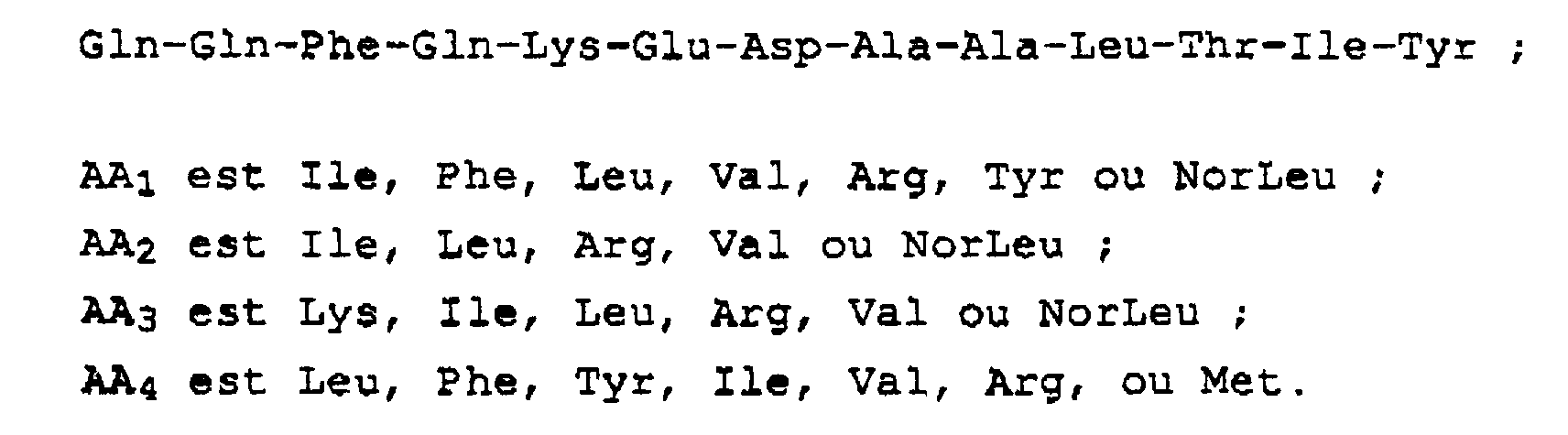
- Anticorps de la revendication 7, où :AA₁ est Ile, Phe, ou Leu ;AA₂ est Ile, Leu, ou Arg ;AA₃ est Lys, Ile, ou Leu ;AA₄ est Leu, Phe, ou Tyr ;
- Anticorps de la revendication 7, où :AA₁ est Ile ;AA₂ est Ile ;AA₃ est Lys ; etAA₄ est Leu.
- Anticorps de la revendication 7, où :X est NH₂ etY est Gln-Gln-Phe-Gln-Lys-Glu-Asp-Ala-Ala.
- Anticorps de la revendication 9, où :X est Leu-Lys-Asp-Arg-Met-Asn-Phe-Asp etY est COOH.
- Anticorps de la revendication 9, où :X est Leu-Lys-Asp-Arg-Met-Asn-Phe-Asp etY est Gln-Gln-Phe-Gln-Lys-Glu-Asp-Ala-Ala.
- Méthode pour détecter la présence d'anticorps neutralisant l'IFN-β comprenant :A) mise en contact d'un échantillon de fluide corporel du hôte supposé d'être porteur desdits anticorps neutralisants avec un peptide de formule :où X est NH₂ ou une séquence d'acides aminés d'une longueur jusqu'à 10 acides aminés, choisie en séquence de la séquence suivante :
 Y est COOH ou une séquence d'acides aminés d'une longueur jusqu'à 13 acides aminés, choisie en séquence de la séquence suivante :
 B) la détermination du niveau de liaison dudit peptide auxdits anticorps neutralisants contenus dans ledit fluid corporel étant un diagnostic de la présence des anticorps neutralisants de l'IFN-β dans ledit hôte.
 - Méthode selon la revendication 13, oùAA₁ est Ile ;AA₂ est Ile ;AA₃ est Lys ; etAA₄ est Leu.
- Méthode selon la revendication 14, où :X est NH₂ etY est Gln-Gln-Phe-Gln-Lys-Glu-Asp-Ala-Ala.
- Méthode selon la revendication 14, où ;X est Leu-Lys-Asp-Arg-Met-Asn-Phe-Asp etY est COOH.
- Méthode de la revendication 14, où :X est Leu-Lys-Asp-Arg-Met-Asn-Phe-Asp etY est Gln-Gln-Phe-Gln-Lys-Glu-Asp-Ala-Ala.
- Méthode pour la détection de l'IFN-β comprenant :A) mise en contact d'un échantillon de fluide corporel du hôte avec les anticorps induits pour et ayant une affinité pour les peptides ayant la séquence d'acides aminés suivante :où X est NH₂ ou une séquence d'acides aminés d'une longueur jusqu'à 10 acides aminés, choisie en séquence de la séquence suivante :
 Y est COOH ou une séquence d'acides aminés d'une longueur jusqu'à 13 acides aminés, choisie en séquence de la séquence suivante :
 B) la détermination du niveau de liaison desdits anticorps de l'IFN-β comme diagnostic de la présence de l'IFN-β.
 - Méthode selon la revendication 18, oùAA₁ est Ile ;AA₂ est Ile ;AA₃ est Lys ; etAA₄ est Leu.
- Méthode selon la revendication 19, oùX est NH₂ etY est Gln-Gln-Phe-Gln-Lys-Glu-Asp-Ala-Ala.
- Méthode selon la revendication 19, où :X est Leu-Lys-Asp-Arg-Met-Asn-Phe-Asp etY est COOH.
- Méthode selon la revendication 19, où :X est Leu-Lys-Asp-Arg-Met-Asn-Phe-Asp etY est Gln-Gln-Phe-Gln-Lys-Glu-Asp-Ala-Ala.
- Quantité efficace d'un peptide de la revendication 1, pour l'utilisation visant à empêcher la neutralisation de l'activité de l'IFN-β dans l'hôte.
- Quantité efficace d'un peptide de la revendication 3, pour l'utilisation visant à empêcher la neutralisation de l'activité de l'IFN-β dans l'hôte.
- Quantité thérapeutiquement efficace d'un peptide de la revendication 1, pour l'utilisation dans le traitement d'une personne ayant des niveaux réduits d'IFN-β actif dus à une réponse immunitaire à celui-ci.
- Quantité thérapeutiquement efficace d'un peptide de la revendication 3, pour l'utilisation dans le traitement d'une personne ayant des niveaux réduits d'IFN-β actif dus à une réponse immunitaire à celui-ci.
- Quantité thérapeutiquement efficace d'un peptide de la revendication 4, pour l'utilisation dans le traitement d'une personne ayant des niveaux réduits d'IFN-β actif dus à une réponse immunitaire à celui-ci.
- Quantité thérapeutiquement efficace d'un peptide de la revendication 5, pour l'utilisation dans le traitement d'une personne ayant des niveaux réduits d'IFN-β actif dus à une réponse immunitaire à celui-ci.
- Quantité thérapeutiquement efficace d'un peptide de la revendication 1, pour l'utilisation dans le traitement d'une personne ayant des niveaux réduits d'IFN-β actif dus à une réponse immunitaire à celui-ci.
- Trousse diagnostique comprenant :A) un peptide ayant une affinité de liaison spécifique aux anticorps neutralisants l'IFN-β et ayant la séquence d'acides aminés suivante :où X est NH₂ ou une séquence d'acides aminés d'une longueur jusqu'à 10 acides aminés, choisie en séquence de la séquence suivante :
 Y est COOH ou une séquence d'acides aminés d'une longueur jusqu'à 13 acides aminés, choisie en séquence de la séquence suivante :
 B) un réactif de détection par réaction immunitaire.
Applications Claiming Priority (3)
| Application Number | Priority Date | Filing Date | Title |
|---|---|---|---|
| US25765188A | 1988-10-14 | 1988-10-14 | |
| US257651 | 1988-10-14 | ||
| PCT/US1989/004334 WO1990003982A1 (fr) | 1988-10-14 | 1989-10-04 | Peptides representant des sites epitopiques sur r-ifn-beta, leurs anticorps et leur utilisation |
Publications (2)
| Publication Number | Publication Date |
|---|---|
| EP0440686A1 EP0440686A1 (fr) | 1991-08-14 |
| EP0440686B1 true EP0440686B1 (fr) | 1996-01-03 |
Family
ID=22977172
Family Applications (1)
| Application Number | Title | Priority Date | Filing Date |
|---|---|---|---|
| EP89911467A Expired - Lifetime EP0440686B1 (fr) | 1988-10-14 | 1989-10-04 | Peptides representant des sites epitopiques sur r-ifn-beta, leurs anticorps et leur utilisation |
Country Status (7)
| Country | Link |
|---|---|
| US (1) | US5869603A (fr) |
| EP (1) | EP0440686B1 (fr) |
| JP (1) | JP2717319B2 (fr) |
| AT (1) | ATE132502T1 (fr) |
| CA (1) | CA2000420C (fr) |
| DE (1) | DE68925365T2 (fr) |
| WO (1) | WO1990003982A1 (fr) |
Families Citing this family (5)
| Publication number | Priority date | Publication date | Assignee | Title |
|---|---|---|---|---|
| US6514729B1 (en) | 1999-05-12 | 2003-02-04 | Xencor, Inc. | Recombinant interferon-beta muteins |
| US7272636B2 (en) * | 2001-04-24 | 2007-09-18 | Sun Microsystems, Inc. | Peer group name server |
| JP2005029471A (ja) * | 2001-06-26 | 2005-02-03 | Toray Ind Inc | ペプチドの立体構造モチーフおよび3次元構造座標ならびにそれらの使用 |
| US20040086874A1 (en) * | 2002-10-31 | 2004-05-06 | Parker Russell A. | Devices and methods for holding a biopolymeric array |
| CA2965652A1 (fr) * | 2016-04-29 | 2017-10-29 | Pfizer Inc. | Anticorps d'interferon beta |
Family Cites Families (2)
| Publication number | Priority date | Publication date | Assignee | Title |
|---|---|---|---|---|
| US4311639A (en) * | 1980-07-25 | 1982-01-19 | E. I. Du Pont De Nemours And Company | Immunogenic interferon peptides |
| GB8412564D0 (en) * | 1984-05-17 | 1984-06-20 | Searle & Co | Structure and properties |
-
1989
- 1989-10-04 JP JP1510708A patent/JP2717319B2/ja not_active Expired - Fee Related
- 1989-10-04 EP EP89911467A patent/EP0440686B1/fr not_active Expired - Lifetime
- 1989-10-04 WO PCT/US1989/004334 patent/WO1990003982A1/fr not_active Ceased
- 1989-10-04 AT AT89911467T patent/ATE132502T1/de not_active IP Right Cessation
- 1989-10-04 DE DE68925365T patent/DE68925365T2/de not_active Expired - Fee Related
- 1989-10-11 CA CA002000420A patent/CA2000420C/fr not_active Expired - Fee Related
-
1991
- 1991-12-12 US US07/807,030 patent/US5869603A/en not_active Expired - Fee Related
Also Published As
| Publication number | Publication date |
|---|---|
| WO1990003982A1 (fr) | 1990-04-19 |
| ATE132502T1 (de) | 1996-01-15 |
| CA2000420C (fr) | 2000-12-19 |
| JPH07508494A (ja) | 1995-09-21 |
| US5869603A (en) | 1999-02-09 |
| JP2717319B2 (ja) | 1998-02-18 |
| DE68925365T2 (de) | 1996-09-12 |
| CA2000420A1 (fr) | 1990-04-14 |
| EP0440686A1 (fr) | 1991-08-14 |
| DE68925365D1 (de) | 1996-02-15 |
Similar Documents
| Publication | Publication Date | Title |
|---|---|---|
| US4493795A (en) | Synthetic peptide sequences useful in biological and pharmaceutical applications and methods of manufacture | |
| Yi-An et al. | Chemically unambiguous peptide immunogen: preparation, orientation and antigenicity of purified peptide conjugated to the multiple antigen peptide system | |
| US4983387A (en) | HIV related peptides, immunogenic antigens, and use therefor as subunit vaccine for AIDS virus | |
| US4772684A (en) | Peptides affecting blood pressure regulation | |
| EP0313651B1 (fr) | Peptides synthetiques pour le diagnostic et la prevention d'infections par le virus influenza, et leur utilisation | |
| US5712100A (en) | Antibodies to peptides having NGF-like activity, and use thereof | |
| EP0152477B1 (fr) | Anticorps monoclonaux d'oncoproteines induits par des polypeptides | |
| AU7176291A (en) | Antibody antagonists of human interleukin-4 | |
| US4859765A (en) | Synthetic peptide sequences useful in biological and pharmaceutical applications and methods of manufacture | |
| EP0231914A2 (fr) | Peptides d'enveloppe de HTLV-III | |
| EP0410303A1 (fr) | Anticorps monoclonal contre l'endothéline-3 ou un de ses précurseurs et son utilisation | |
| Bidart et al. | Antigenic determinants on human choriogonadotropin alpha-subunit. I. Characterization of topographic sites recognized by monoclonal antibodies. | |
| EP0246829B1 (fr) | Peptides relatifs au virus HTLV-III(LAV), anticorps contre les peptides, vaccins, immunisation passive et active contre le virus de SIDA, et test diagnostique pour la détection sérologique du virus de SIDA | |
| CA2024063C (fr) | Anticorps diriges contre peptides de type facteur de croissance nerveuse | |
| US6010864A (en) | Peptides representing epitopic sites on r-IFN-β,antibodies thereto, and uses thereof | |
| EP0440686B1 (fr) | Peptides representant des sites epitopiques sur r-ifn-beta, leurs anticorps et leur utilisation | |
| Troalen et al. | Antigenic determinants on human choriogonadotropin alpha-subunit. II. Immunochemical mapping by a monoclonal antipeptide antibody. | |
| US5003043A (en) | Peptides representing epitopic sites for the major HTLV-I envelope protein, antibodies thereto, and uses thereof | |
| EP0175613B1 (fr) | Peptides HAV immunogéniques | |
| Barasoain et al. | Antibodies against a peptide representative of a conserved region of human IFN-alpha. Differential effects on the antiviral and antiproliferative effects of IFN. | |
| AU595597B2 (en) | Peptides affecting blood pressure regulation | |
| WO1987005029A1 (fr) | Peptides affectant la regulation de la tension arterielle | |
| JPH04352797A (ja) | ヒトプレプローtrh関連ペプチド | |
| CA2021779A1 (fr) | Anticorps monoclonal contre l'endotheline-3 ou son precurseur et utilisation |
Legal Events
| Date | Code | Title | Description |
|---|---|---|---|
| PUAI | Public reference made under article 153(3) epc to a published international application that has entered the european phase |
Free format text: ORIGINAL CODE: 0009012 |
|
| 17P | Request for examination filed |
Effective date: 19910412 |
|
| AK | Designated contracting states |
Kind code of ref document: A1 Designated state(s): AT BE CH DE FR GB IT LI LU NL SE |
|
| RAP1 | Party data changed (applicant data changed or rights of an application transferred) |
Owner name: BERLEX LABORATORIES, INC. |
|
| 17Q | First examination report despatched |
Effective date: 19940117 |
|
| GRAA | (expected) grant |
Free format text: ORIGINAL CODE: 0009210 |
|
| AK | Designated contracting states |
Kind code of ref document: B1 Designated state(s): AT BE CH DE FR GB IT LI LU NL SE |
|
| REF | Corresponds to: |
Ref document number: 132502 Country of ref document: AT Date of ref document: 19960115 Kind code of ref document: T |
|
| REF | Corresponds to: |
Ref document number: 68925365 Country of ref document: DE Date of ref document: 19960215 |
|
| ITF | It: translation for a ep patent filed | ||
| ET | Fr: translation filed | ||
| PLBE | No opposition filed within time limit |
Free format text: ORIGINAL CODE: 0009261 |
|
| STAA | Information on the status of an ep patent application or granted ep patent |
Free format text: STATUS: NO OPPOSITION FILED WITHIN TIME LIMIT |
|
| 26N | No opposition filed | ||
| REG | Reference to a national code |
Ref country code: GB Ref legal event code: IF02 |
|
| PGFP | Annual fee paid to national office [announced via postgrant information from national office to epo] |
Ref country code: AT Payment date: 20030909 Year of fee payment: 15 |
|
| PGFP | Annual fee paid to national office [announced via postgrant information from national office to epo] |
Ref country code: FR Payment date: 20030911 Year of fee payment: 15 |
|
| PGFP | Annual fee paid to national office [announced via postgrant information from national office to epo] |
Ref country code: GB Payment date: 20030916 Year of fee payment: 15 |
|
| PGFP | Annual fee paid to national office [announced via postgrant information from national office to epo] |
Ref country code: NL Payment date: 20030917 Year of fee payment: 15 |
|
| PGFP | Annual fee paid to national office [announced via postgrant information from national office to epo] |
Ref country code: CH Payment date: 20030918 Year of fee payment: 15 |
|
| PGFP | Annual fee paid to national office [announced via postgrant information from national office to epo] |
Ref country code: SE Payment date: 20030922 Year of fee payment: 15 |
|
| PGFP | Annual fee paid to national office [announced via postgrant information from national office to epo] |
Ref country code: DE Payment date: 20030924 Year of fee payment: 15 |
|
| PGFP | Annual fee paid to national office [announced via postgrant information from national office to epo] |
Ref country code: LU Payment date: 20031003 Year of fee payment: 15 |
|
| PGFP | Annual fee paid to national office [announced via postgrant information from national office to epo] |
Ref country code: BE Payment date: 20031009 Year of fee payment: 15 |
|
| PG25 | Lapsed in a contracting state [announced via postgrant information from national office to epo] |
Ref country code: LU Free format text: LAPSE BECAUSE OF NON-PAYMENT OF DUE FEES Effective date: 20041004 Ref country code: GB Free format text: LAPSE BECAUSE OF NON-PAYMENT OF DUE FEES Effective date: 20041004 Ref country code: AT Free format text: LAPSE BECAUSE OF NON-PAYMENT OF DUE FEES Effective date: 20041004 |
|
| PG25 | Lapsed in a contracting state [announced via postgrant information from national office to epo] |
Ref country code: SE Free format text: LAPSE BECAUSE OF NON-PAYMENT OF DUE FEES Effective date: 20041005 |
|
| PG25 | Lapsed in a contracting state [announced via postgrant information from national office to epo] |
Ref country code: LI Free format text: LAPSE BECAUSE OF NON-PAYMENT OF DUE FEES Effective date: 20041031 Ref country code: CH Free format text: LAPSE BECAUSE OF NON-PAYMENT OF DUE FEES Effective date: 20041031 Ref country code: BE Free format text: LAPSE BECAUSE OF NON-PAYMENT OF DUE FEES Effective date: 20041031 |
|
| BERE | Be: lapsed |
Owner name: *BERLEX LABORATORIES INC. Effective date: 20041031 |
|
| PG25 | Lapsed in a contracting state [announced via postgrant information from national office to epo] |
Ref country code: NL Free format text: LAPSE BECAUSE OF NON-PAYMENT OF DUE FEES Effective date: 20050501 |
|
| PG25 | Lapsed in a contracting state [announced via postgrant information from national office to epo] |
Ref country code: DE Free format text: LAPSE BECAUSE OF NON-PAYMENT OF DUE FEES Effective date: 20050503 |
|
| GBPC | Gb: european patent ceased through non-payment of renewal fee |
Effective date: 20041004 |
|
| EUG | Se: european patent has lapsed | ||
| PG25 | Lapsed in a contracting state [announced via postgrant information from national office to epo] |
Ref country code: FR Free format text: LAPSE BECAUSE OF NON-PAYMENT OF DUE FEES Effective date: 20050630 |
|
| NLV4 | Nl: lapsed or anulled due to non-payment of the annual fee |
Effective date: 20050501 |
|
| REG | Reference to a national code |
Ref country code: FR Ref legal event code: ST |
|
| PG25 | Lapsed in a contracting state [announced via postgrant information from national office to epo] |
Ref country code: IT Free format text: LAPSE BECAUSE OF NON-PAYMENT OF DUE FEES;WARNING: LAPSES OF ITALIAN PATENTS WITH EFFECTIVE DATE BEFORE 2007 MAY HAVE OCCURRED AT ANY TIME BEFORE 2007. THE CORRECT EFFECTIVE DATE MAY BE DIFFERENT FROM THE ONE RECORDED. Effective date: 20051004 |
|
| BERE | Be: lapsed |
Owner name: *BERLEX LABORATORIES INC. Effective date: 20041031 |