EP0440792A1 - Geschlossener behälter zum kochen im mikrowellenofen - Google Patents
Geschlossener behälter zum kochen im mikrowellenofen Download PDFInfo
- Publication number
- EP0440792A1 EP0440792A1 EP88908383A EP88908383A EP0440792A1 EP 0440792 A1 EP0440792 A1 EP 0440792A1 EP 88908383 A EP88908383 A EP 88908383A EP 88908383 A EP88908383 A EP 88908383A EP 0440792 A1 EP0440792 A1 EP 0440792A1
- Authority
- EP
- European Patent Office
- Prior art keywords
- lid
- antenna
- layer
- sealed container
- microwave oven
- Prior art date
- Legal status (The legal status is an assumption and is not a legal conclusion. Google has not performed a legal analysis and makes no representation as to the accuracy of the status listed.)
- Granted
Links
- 238000010411 cooking Methods 0.000 title description 3
- 239000010410 layer Substances 0.000 claims description 151
- 238000003475 lamination Methods 0.000 claims description 51
- 239000000463 material Substances 0.000 claims description 33
- 239000000126 substance Substances 0.000 claims description 28
- 239000004020 conductor Substances 0.000 claims description 20
- 239000012790 adhesive layer Substances 0.000 claims description 15
- 230000008602 contraction Effects 0.000 claims description 3
- 239000004831 Hot glue Substances 0.000 claims 1
- 238000010276 construction Methods 0.000 abstract description 6
- 239000010408 film Substances 0.000 description 13
- 229920005989 resin Polymers 0.000 description 13
- 239000011347 resin Substances 0.000 description 13
- 230000005684 electric field Effects 0.000 description 11
- 235000013305 food Nutrition 0.000 description 11
- 239000011248 coating agent Substances 0.000 description 9
- 238000010438 heat treatment Methods 0.000 description 9
- 238000000034 method Methods 0.000 description 9
- 238000000576 coating method Methods 0.000 description 8
- -1 epoxy resin Chemical class 0.000 description 8
- 239000007767 bonding agent Substances 0.000 description 6
- 239000003822 epoxy resin Substances 0.000 description 6
- 239000002985 plastic film Substances 0.000 description 6
- 229920000647 polyepoxide Polymers 0.000 description 6
- 239000004743 Polypropylene Substances 0.000 description 5
- 230000005291 magnetic effect Effects 0.000 description 5
- 230000010355 oscillation Effects 0.000 description 5
- 229920003023 plastic Polymers 0.000 description 5
- 239000004033 plastic Substances 0.000 description 5
- 229920001155 polypropylene Polymers 0.000 description 5
- XEEYBQQBJWHFJM-UHFFFAOYSA-N Iron Chemical compound [Fe] XEEYBQQBJWHFJM-UHFFFAOYSA-N 0.000 description 4
- PXHVJJICTQNCMI-UHFFFAOYSA-N Nickel Chemical compound [Ni] PXHVJJICTQNCMI-UHFFFAOYSA-N 0.000 description 4
- 239000004677 Nylon Substances 0.000 description 4
- 239000011230 binding agent Substances 0.000 description 4
- 229920001778 nylon Polymers 0.000 description 4
- 229920000728 polyester Polymers 0.000 description 4
- 238000007738 vacuum evaporation Methods 0.000 description 4
- 229910000859 α-Fe Inorganic materials 0.000 description 4
- 239000004698 Polyethylene Substances 0.000 description 3
- JRPBQTZRNDNNOP-UHFFFAOYSA-N barium titanate Chemical compound [Ba+2].[Ba+2].[O-][Ti]([O-])([O-])[O-] JRPBQTZRNDNNOP-UHFFFAOYSA-N 0.000 description 3
- 229910002113 barium titanate Inorganic materials 0.000 description 3
- 239000012141 concentrate Substances 0.000 description 3
- 239000000843 powder Substances 0.000 description 3
- 229920001187 thermosetting polymer Polymers 0.000 description 3
- 240000007594 Oryza sativa Species 0.000 description 2
- 235000007164 Oryza sativa Nutrition 0.000 description 2
- 230000001070 adhesive effect Effects 0.000 description 2
- 229910045601 alloy Inorganic materials 0.000 description 2
- 239000000956 alloy Substances 0.000 description 2
- XAGFODPZIPBFFR-UHFFFAOYSA-N aluminium Chemical compound [Al] XAGFODPZIPBFFR-UHFFFAOYSA-N 0.000 description 2
- 238000009792 diffusion process Methods 0.000 description 2
- 238000001704 evaporation Methods 0.000 description 2
- 230000008020 evaporation Effects 0.000 description 2
- 239000011888 foil Substances 0.000 description 2
- 229910052742 iron Inorganic materials 0.000 description 2
- 239000000696 magnetic material Substances 0.000 description 2
- 230000005389 magnetism Effects 0.000 description 2
- 238000012986 modification Methods 0.000 description 2
- 230000004048 modification Effects 0.000 description 2
- 229910052759 nickel Inorganic materials 0.000 description 2
- 229920000573 polyethylene Polymers 0.000 description 2
- 229920000139 polyethylene terephthalate Polymers 0.000 description 2
- 239000005020 polyethylene terephthalate Substances 0.000 description 2
- 235000013324 preserved food Nutrition 0.000 description 2
- 235000009566 rice Nutrition 0.000 description 2
- 229920001169 thermoplastic Polymers 0.000 description 2
- 239000004416 thermosoftening plastic Substances 0.000 description 2
- 239000010409 thin film Substances 0.000 description 2
- DHKHKXVYLBGOIT-UHFFFAOYSA-N 1,1-Diethoxyethane Chemical compound CCOC(C)OCC DHKHKXVYLBGOIT-UHFFFAOYSA-N 0.000 description 1
- 229920000178 Acrylic resin Polymers 0.000 description 1
- 239000004925 Acrylic resin Substances 0.000 description 1
- 229920001342 Bakelite® Polymers 0.000 description 1
- OKTJSMMVPCPJKN-UHFFFAOYSA-N Carbon Chemical compound [C] OKTJSMMVPCPJKN-UHFFFAOYSA-N 0.000 description 1
- VEXZGXHMUGYJMC-UHFFFAOYSA-M Chloride anion Chemical compound [Cl-] VEXZGXHMUGYJMC-UHFFFAOYSA-M 0.000 description 1
- KRHYYFGTRYWZRS-UHFFFAOYSA-M Fluoride anion Chemical compound [F-] KRHYYFGTRYWZRS-UHFFFAOYSA-M 0.000 description 1
- 239000004640 Melamine resin Substances 0.000 description 1
- 229920000877 Melamine resin Polymers 0.000 description 1
- ISWSIDIOOBJBQZ-UHFFFAOYSA-N Phenol Chemical compound OC1=CC=CC=C1 ISWSIDIOOBJBQZ-UHFFFAOYSA-N 0.000 description 1
- BQCADISMDOOEFD-UHFFFAOYSA-N Silver Chemical compound [Ag] BQCADISMDOOEFD-UHFFFAOYSA-N 0.000 description 1
- 229920001807 Urea-formaldehyde Polymers 0.000 description 1
- 240000001417 Vigna umbellata Species 0.000 description 1
- 235000011453 Vigna umbellata Nutrition 0.000 description 1
- 229920002433 Vinyl chloride-vinyl acetate copolymer Polymers 0.000 description 1
- 239000011358 absorbing material Substances 0.000 description 1
- 239000011354 acetal resin Substances 0.000 description 1
- NIXOWILDQLNWCW-UHFFFAOYSA-N acrylic acid group Chemical group C(C=C)(=O)O NIXOWILDQLNWCW-UHFFFAOYSA-N 0.000 description 1
- 229920000122 acrylonitrile butadiene styrene Polymers 0.000 description 1
- 239000000853 adhesive Substances 0.000 description 1
- 229910052782 aluminium Inorganic materials 0.000 description 1
- 239000004637 bakelite Substances 0.000 description 1
- 229910052788 barium Inorganic materials 0.000 description 1
- DSAJWYNOEDNPEQ-UHFFFAOYSA-N barium atom Chemical compound [Ba] DSAJWYNOEDNPEQ-UHFFFAOYSA-N 0.000 description 1
- 229910052799 carbon Inorganic materials 0.000 description 1
- 229910017052 cobalt Inorganic materials 0.000 description 1
- 239000010941 cobalt Substances 0.000 description 1
- GUTLYIVDDKVIGB-UHFFFAOYSA-N cobalt atom Chemical compound [Co] GUTLYIVDDKVIGB-UHFFFAOYSA-N 0.000 description 1
- 150000001875 compounds Chemical class 0.000 description 1
- 238000007796 conventional method Methods 0.000 description 1
- 229920001577 copolymer Polymers 0.000 description 1
- 235000021438 curry Nutrition 0.000 description 1
- 238000000354 decomposition reaction Methods 0.000 description 1
- 239000003989 dielectric material Substances 0.000 description 1
- 238000007599 discharging Methods 0.000 description 1
- 238000009826 distribution Methods 0.000 description 1
- 230000005294 ferromagnetic effect Effects 0.000 description 1
- OIAUFEASXQPCFE-UHFFFAOYSA-N formaldehyde;1,3-xylene Chemical compound O=C.CC1=CC=CC(C)=C1 OIAUFEASXQPCFE-UHFFFAOYSA-N 0.000 description 1
- 230000020169 heat generation Effects 0.000 description 1
- PYGSKMBEVAICCR-UHFFFAOYSA-N hexa-1,5-diene Chemical group C=CCCC=C PYGSKMBEVAICCR-UHFFFAOYSA-N 0.000 description 1
- 229920000554 ionomer Polymers 0.000 description 1
- 238000010030 laminating Methods 0.000 description 1
- 238000004519 manufacturing process Methods 0.000 description 1
- 229910052751 metal Inorganic materials 0.000 description 1
- 239000002184 metal Substances 0.000 description 1
- 239000007769 metal material Substances 0.000 description 1
- 150000001455 metallic ions Chemical class 0.000 description 1
- 239000002245 particle Substances 0.000 description 1
- 239000000088 plastic resin Substances 0.000 description 1
- 238000007747 plating Methods 0.000 description 1
- 229920006122 polyamide resin Polymers 0.000 description 1
- 229920001721 polyimide Polymers 0.000 description 1
- 239000009719 polyimide resin Substances 0.000 description 1
- 229920000098 polyolefin Polymers 0.000 description 1
- 229920006324 polyoxymethylene Polymers 0.000 description 1
- 239000004800 polyvinyl chloride Substances 0.000 description 1
- 229920000915 polyvinyl chloride Polymers 0.000 description 1
- 229920000131 polyvinylidene Polymers 0.000 description 1
- 238000007639 printing Methods 0.000 description 1
- 238000007650 screen-printing Methods 0.000 description 1
- 239000004065 semiconductor Substances 0.000 description 1
- 238000000926 separation method Methods 0.000 description 1
- 229910052710 silicon Inorganic materials 0.000 description 1
- 239000010703 silicon Substances 0.000 description 1
- 239000002904 solvent Substances 0.000 description 1
- 238000006467 substitution reaction Methods 0.000 description 1
- 229920002803 thermoplastic polyurethane Polymers 0.000 description 1
- 229920005992 thermoplastic resin Polymers 0.000 description 1
Images





Classifications
-
- B—PERFORMING OPERATIONS; TRANSPORTING
- B65—CONVEYING; PACKING; STORING; HANDLING THIN OR FILAMENTARY MATERIAL
- B65D—CONTAINERS FOR STORAGE OR TRANSPORT OF ARTICLES OR MATERIALS, e.g. BAGS, BARRELS, BOTTLES, BOXES, CANS, CARTONS, CRATES, DRUMS, JARS, TANKS, HOPPERS, FORWARDING CONTAINERS; ACCESSORIES, CLOSURES, OR FITTINGS THEREFOR; PACKAGING ELEMENTS; PACKAGES
- B65D81/00—Containers, packaging elements, or packages, for contents presenting particular transport or storage problems, or adapted to be used for non-packaging purposes after removal of contents
- B65D81/34—Containers, packaging elements, or packages, for contents presenting particular transport or storage problems, or adapted to be used for non-packaging purposes after removal of contents for packaging foodstuffs or other articles intended to be cooked or heated within the package
- B65D81/3446—Containers, packaging elements, or packages, for contents presenting particular transport or storage problems, or adapted to be used for non-packaging purposes after removal of contents for packaging foodstuffs or other articles intended to be cooked or heated within the package specially adapted to be heated by microwaves
- B65D81/3453—Rigid containers, e.g. trays, bottles, boxes, cups
-
- B—PERFORMING OPERATIONS; TRANSPORTING
- B65—CONVEYING; PACKING; STORING; HANDLING THIN OR FILAMENTARY MATERIAL
- B65D—CONTAINERS FOR STORAGE OR TRANSPORT OF ARTICLES OR MATERIALS, e.g. BAGS, BARRELS, BOTTLES, BOXES, CANS, CARTONS, CRATES, DRUMS, JARS, TANKS, HOPPERS, FORWARDING CONTAINERS; ACCESSORIES, CLOSURES, OR FITTINGS THEREFOR; PACKAGING ELEMENTS; PACKAGES
- B65D2581/00—Containers, packaging elements, or packages, for contents presenting particular transport or storage problems, or adapted to be used for non-packaging purposes after removal of contents
- B65D2581/34—Containers, packaging elements, or packages, for contents presenting particular transport or storage problems, or adapted to be used for non-packaging purposes after removal of contents for packaging foodstuffs or other articles intended to be cooked or heated within
- B65D2581/3437—Containers, packaging elements, or packages, for contents presenting particular transport or storage problems, or adapted to be used for non-packaging purposes after removal of contents for packaging foodstuffs or other articles intended to be cooked or heated within specially adapted to be heated by microwaves
- B65D2581/3439—Means for affecting the heating or cooking properties
- B65D2581/344—Geometry or shape factors influencing the microwave heating properties
-
- B—PERFORMING OPERATIONS; TRANSPORTING
- B65—CONVEYING; PACKING; STORING; HANDLING THIN OR FILAMENTARY MATERIAL
- B65D—CONTAINERS FOR STORAGE OR TRANSPORT OF ARTICLES OR MATERIALS, e.g. BAGS, BARRELS, BOTTLES, BOXES, CANS, CARTONS, CRATES, DRUMS, JARS, TANKS, HOPPERS, FORWARDING CONTAINERS; ACCESSORIES, CLOSURES, OR FITTINGS THEREFOR; PACKAGING ELEMENTS; PACKAGES
- B65D2581/00—Containers, packaging elements, or packages, for contents presenting particular transport or storage problems, or adapted to be used for non-packaging purposes after removal of contents
- B65D2581/34—Containers, packaging elements, or packages, for contents presenting particular transport or storage problems, or adapted to be used for non-packaging purposes after removal of contents for packaging foodstuffs or other articles intended to be cooked or heated within
- B65D2581/3437—Containers, packaging elements, or packages, for contents presenting particular transport or storage problems, or adapted to be used for non-packaging purposes after removal of contents for packaging foodstuffs or other articles intended to be cooked or heated within specially adapted to be heated by microwaves
- B65D2581/3439—Means for affecting the heating or cooking properties
- B65D2581/3445—Microwave reactive adhesives, e.g. also used in valves or lids
-
- B—PERFORMING OPERATIONS; TRANSPORTING
- B65—CONVEYING; PACKING; STORING; HANDLING THIN OR FILAMENTARY MATERIAL
- B65D—CONTAINERS FOR STORAGE OR TRANSPORT OF ARTICLES OR MATERIALS, e.g. BAGS, BARRELS, BOTTLES, BOXES, CANS, CARTONS, CRATES, DRUMS, JARS, TANKS, HOPPERS, FORWARDING CONTAINERS; ACCESSORIES, CLOSURES, OR FITTINGS THEREFOR; PACKAGING ELEMENTS; PACKAGES
- B65D2581/00—Containers, packaging elements, or packages, for contents presenting particular transport or storage problems, or adapted to be used for non-packaging purposes after removal of contents
- B65D2581/34—Containers, packaging elements, or packages, for contents presenting particular transport or storage problems, or adapted to be used for non-packaging purposes after removal of contents for packaging foodstuffs or other articles intended to be cooked or heated within
- B65D2581/3437—Containers, packaging elements, or packages, for contents presenting particular transport or storage problems, or adapted to be used for non-packaging purposes after removal of contents for packaging foodstuffs or other articles intended to be cooked or heated within specially adapted to be heated by microwaves
- B65D2581/3471—Microwave reactive substances present in the packaging material
- B65D2581/3477—Iron or compounds thereof
-
- B—PERFORMING OPERATIONS; TRANSPORTING
- B65—CONVEYING; PACKING; STORING; HANDLING THIN OR FILAMENTARY MATERIAL
- B65D—CONTAINERS FOR STORAGE OR TRANSPORT OF ARTICLES OR MATERIALS, e.g. BAGS, BARRELS, BOTTLES, BOXES, CANS, CARTONS, CRATES, DRUMS, JARS, TANKS, HOPPERS, FORWARDING CONTAINERS; ACCESSORIES, CLOSURES, OR FITTINGS THEREFOR; PACKAGING ELEMENTS; PACKAGES
- B65D2581/00—Containers, packaging elements, or packages, for contents presenting particular transport or storage problems, or adapted to be used for non-packaging purposes after removal of contents
- B65D2581/34—Containers, packaging elements, or packages, for contents presenting particular transport or storage problems, or adapted to be used for non-packaging purposes after removal of contents for packaging foodstuffs or other articles intended to be cooked or heated within
- B65D2581/3437—Containers, packaging elements, or packages, for contents presenting particular transport or storage problems, or adapted to be used for non-packaging purposes after removal of contents for packaging foodstuffs or other articles intended to be cooked or heated within specially adapted to be heated by microwaves
- B65D2581/3471—Microwave reactive substances present in the packaging material
- B65D2581/3479—Other metallic compounds, e.g. silver, gold, copper, nickel
-
- B—PERFORMING OPERATIONS; TRANSPORTING
- B65—CONVEYING; PACKING; STORING; HANDLING THIN OR FILAMENTARY MATERIAL
- B65D—CONTAINERS FOR STORAGE OR TRANSPORT OF ARTICLES OR MATERIALS, e.g. BAGS, BARRELS, BOTTLES, BOXES, CANS, CARTONS, CRATES, DRUMS, JARS, TANKS, HOPPERS, FORWARDING CONTAINERS; ACCESSORIES, CLOSURES, OR FITTINGS THEREFOR; PACKAGING ELEMENTS; PACKAGES
- B65D2581/00—Containers, packaging elements, or packages, for contents presenting particular transport or storage problems, or adapted to be used for non-packaging purposes after removal of contents
- B65D2581/34—Containers, packaging elements, or packages, for contents presenting particular transport or storage problems, or adapted to be used for non-packaging purposes after removal of contents for packaging foodstuffs or other articles intended to be cooked or heated within
- B65D2581/3437—Containers, packaging elements, or packages, for contents presenting particular transport or storage problems, or adapted to be used for non-packaging purposes after removal of contents for packaging foodstuffs or other articles intended to be cooked or heated within specially adapted to be heated by microwaves
- B65D2581/3471—Microwave reactive substances present in the packaging material
- B65D2581/3483—Carbon, carbon black, or graphite
-
- B—PERFORMING OPERATIONS; TRANSPORTING
- B65—CONVEYING; PACKING; STORING; HANDLING THIN OR FILAMENTARY MATERIAL
- B65D—CONTAINERS FOR STORAGE OR TRANSPORT OF ARTICLES OR MATERIALS, e.g. BAGS, BARRELS, BOTTLES, BOXES, CANS, CARTONS, CRATES, DRUMS, JARS, TANKS, HOPPERS, FORWARDING CONTAINERS; ACCESSORIES, CLOSURES, OR FITTINGS THEREFOR; PACKAGING ELEMENTS; PACKAGES
- B65D2581/00—Containers, packaging elements, or packages, for contents presenting particular transport or storage problems, or adapted to be used for non-packaging purposes after removal of contents
- B65D2581/34—Containers, packaging elements, or packages, for contents presenting particular transport or storage problems, or adapted to be used for non-packaging purposes after removal of contents for packaging foodstuffs or other articles intended to be cooked or heated within
- B65D2581/3437—Containers, packaging elements, or packages, for contents presenting particular transport or storage problems, or adapted to be used for non-packaging purposes after removal of contents for packaging foodstuffs or other articles intended to be cooked or heated within specially adapted to be heated by microwaves
- B65D2581/3486—Dielectric characteristics of microwave reactive packaging
- B65D2581/3494—Microwave susceptor
-
- Y—GENERAL TAGGING OF NEW TECHNOLOGICAL DEVELOPMENTS; GENERAL TAGGING OF CROSS-SECTIONAL TECHNOLOGIES SPANNING OVER SEVERAL SECTIONS OF THE IPC; TECHNICAL SUBJECTS COVERED BY FORMER USPC CROSS-REFERENCE ART COLLECTIONS [XRACs] AND DIGESTS
- Y10—TECHNICAL SUBJECTS COVERED BY FORMER USPC
- Y10S—TECHNICAL SUBJECTS COVERED BY FORMER USPC CROSS-REFERENCE ART COLLECTIONS [XRACs] AND DIGESTS
- Y10S99/00—Foods and beverages: apparatus
- Y10S99/14—Induction heating
Definitions
- This invention relates to a sealed container for accommodating food therein and, more particularly, to a sealed container to be cooked in a microwave oven in which an opening is automatically opened in a lid of a sealed container for discharging vapor generated at a time when the container filled with the food is heated to be cooked in the microwave oven.
- a sticking layer made of non-metallic type microwave absorbing particles is applied on the lid of the container.
- an electrically conductive material is applied on the lid of the container and the dimensional shape of the conductive material is designed so as to absorb the microwave. According to these methods, the lid is heated and fused to be opened by the provision of the microwave absorbing material.
- the heat generating material having a large size is utilized to open the container lid in the low strength region of the microwave, if the heat generating material is positioned in the high strength region of the microwave, the widened opening is formed in the lid of the container, through which a large amount of the vapor is dispersed and the food will be denatured.
- an object of this invention is to provide a sealed container to be cooked in a microwave oven in which when a container sealed with a lid made of an insulative flexible sheet material is exposed to the microwaves in the electronic oven, the lid is rapidly heated in a short time to provide a fused opening having a precisely controlled size.
- Another object of this invention is to provide a sealed container to be cooked in a microwave oven in which a lid of the container is rapidly heated in a short time to provide a fused opening having a precisely controlled size even in a case where there exist regions in the interior of the oven at which the oscillation directions of the microwaves are different from each other.
- a further object of this invention is to provide a sealed container to be cooked in a microwave oven in which when a container sealed with a lid made of an insulative flexible sheet material or a container in form of a bag made of an insulative flexible material is exposed to the microwaves in the microwave oven, the lid of the container or the container bag or pouch can be surely opened after a predetermined time has elapsed, and also provide the same with reduced cost.
- a sealed container to be cooked in a microwave oven characterized in that an antenna made of an electrically conductive material is laminated on a lid of a container body to be sealed by the lid made of an insulative flexible material, an energy caused by microwaves is concentrated near the opposing front portions of the antenna when the container body is exposed to the microwaves in the microwave oven, and the energy is converted into a heat energy by which the lid is opened.
- the heat generating operation is further increased by arranging the heat generating material to a region at which the microwave energy is concentrated.
- the microwave energy is converted into the heat energy by arranging the heat generating material at the corner portion of the antenna instead of arranging the same at the opposing front portions thereof, whereby the lid is opened by the heat energy.
- an alternating current passes the antenna made of a good electrically conductive material when the microwaves are generated, and high electric field and high magnetic field of high frequency are caused at a portion at which antennas are opposed or at a corner portion of the antenna.
- a resistance as a heat generating element is arranged at the portion where the high electric field and high magnetic field are created, a heat is generated due to the Joule heat caused by the current passing the heat generating element, and where a dielectric element as a heat generating element is arranged at the portion of the high electric field region, a heat is generated by the dielectric heating of the dielectric element.
- a heat is generated by the hysterisis phenomenon of the magnetism.
- the antenna does not substantially generate the heat, so that the heat diffusion from the antenna is reduced even if a large-sized antenna is utilized, and since a large amount of the energy concentrated by the antenna having a large size is converted into the heat energy by the heat generating element having a small size, the lid of the container can be rapidly heated to a high temperature, whereby the lid of the sealed container can be surely opened when the container is heated and cooked in the microwave oven.
- a sealed container to be cooked in a microwave oven characterized in that an antenna made of an electrically conductive material is disposed to a lid of a container body sealed by the lid made of an insulative flexible sheet material, the antenna being provided with a portion inclined by an inclination more than about 3° with respect to the horizontal plane so as to concentrate microwaves to a specified portion of the antenna and when the container is exposed to the microwaves in the electronic oven, energy concentrated by the antenna due to the microwaves is converted into heat energy, the lid is opened by the thus converted heat.
- Various kinds of antennas can be utilized.
- the microwave energy is concentrated to the front portion thereof, when a C-shaped antenna is utilized, the energy is concentrated to the opposing ends thereof, and when a plurality of antennas are utilized in combination, the energy is concentrated at a portion at which end portions of the antennas are arranged in close to each other.
- the thus concentrated energy due to the microwaves is converted into heat energy by the heat generating element laminated on the lid, and the microwave energy may be also converted into the heat energy by the dielectric loss of the lid.
- standing waves are caused in the interior of the microwave oven and the microwaves in the microwave oven are reflected with the vertical and horizontal oscillation components on the vertical and horizontal walls thereof because of the rectangular configuration of the microwave oven.
- the vertical and horizontal oscillation components are sometime different from each other in their strengths.
- the antenna for receiving the microwaves of this invention since the antenna is provided with vertically and horizontally directed portions, the microwave energy can be effectively concentrated even if the vertical and horizontal oscillation components of the microwaves are different in their strengths. The thus concentrated microwave energy is converted into the heat energy by the heat generating element or the lid of the container to thereby fuse the opening of the lid.
- the lid of the sealed container can be rapidly heated and fused in a short time, thus surely forming an opening having a proper size.
- a sealed container to be cooked in a microwave oven characterized in that an electrically conductive layer in shape of a linear belt for concentrating microwaves and a heat generating layer for converting the microwave energy into a heat energy are aranged at a distance of 0 to 3.5 mm, these layers being contained in a label and the label is sticked on a lid, made of an insulative flexible material, of a sealed container or on a bag or pouch made of a flexible material having an insulative property.
- the liner conductive layer has a length more than 20mm and a surface resistivity less than 1 ⁇ / ⁇ .
- the conductive layer since the conductive layer has an adequate length, the conductive layer can stably concentrate the microwave energy to the heat generating layer even in a location in the standing wave region of the microwaves.
- the heat generating element is preferrably made of a material suitable for converting the microwave energy into the heat energy such as a conductive material, having a high resistivity, dielectric material or magnetic material, or combination of these materials.
- the microwave energy is converted into the heat energy by the resistance loss, dielectric loss, or magnetism loss and the lid of the container body of a part or a lavel of the bag is fused by the thus converted heat to thereby form an opening.
- the base layer is arranged so as to provide a proper rigidity to the label to easily release the label from a releasing layer or to stick the label to the lid, thus improving the manufacturing cost.
- the adhesive layer serves to stick the label to the lid or the pouch.
- the conductive layer serving as an antenna has a long length of about 20mm, so that the microwave energy is effectively concentrated and the lid or bag can be stably opened regardless of the location of the container or bag in the microwave oven.
- Figs. 1 and 2 represent the first embodiment according to this invention.
- reference numeral 1 designates a lid made of a plastic sheet having a thermoplasticity and adapted to heat seal a flanged portion 2a of a container body 2 which is made of a material having plasticity and into which a preserved food 3 is accommodated.
- a C-shaped antenna 4 made of an electrically conductive material and a heat generating element or material 5 made of a high resisting material are laminated on the surface of the lid 1.
- the heat generating element 5 is arranged at an upper portion of the heat seal portion of the lid 1 and the antenna 4 is positioned so that the heat generating element 4 is arranged between both the ends of the C-shaped antenna 4.
- the antenna 4 is prepared by the coating with a conductive coating agent containing conductive powders, a vacuum evaporation, a spattering method, a flame coating of a conductive material, a chemical plating method, or a bonding of a metallic foil, and the heat generating element 5 is formed by the coating with a binder including high resistance powders or the bonding of a conductive plastic sheet.
- antenna 4 and the heat generating element 5 may be directly laminated on the lid 1 or once laminated on a plastic sheet to form a label, which is then bonded on the lid 1.
- the heat generating element 5 is formed by the coating with the binder including the high resistance powders, the binder is fused when the heat generating element 5 is heated to a temperature more than a predetermined value, and when the binder is fused, the heat generation of the heat generating element stops, so that the lid 1 cannot be abnormally heated thereby to prevent the lid from being subjected to the heat decomposition.
- a foamable material is disposed on the flange 2a of the container body 2 at a portion corresponding to the location of the heat generating element 5 arranged on the lid 1.
- the current passing the antenna 4 creates a high electric field for the heat generating element 5 to pass the current through the heat generating element 5, whereby the heat generating element 5 generates a heat and the sealed portion heated by the heat generating element 5 is fused and opened.
- the lid 1 can be easily separated from the container body 2 by pulling the opened seal portion. The location of the foamable material at the seal portion can further facilitate the easy separation of the lid 1 from the container body 2.
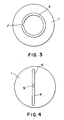
- Fig. 3 is a plan view of a lid of a sealed container according to the second embodiment of this invention.
- reference numeral 4 designates a C-shaped antenna 4 made of an electrically conductive material and the antenna 4 is laminated on the lid 1 as described with reference to the first embodiment.
- the lid 1 is heat sealed by the manner substantially the same as that described in the first emboeiment.
- a high electric field is created between the opposing ends of the C-shaped antenna 4 through which a current passes caused by the microwaves, whereby a portion 1′ near the front ends of the antenna 4 is fused and opened by the dielectric heating.
- Fig. 4 is a plan view of the lid used for the sealed container of the third embodiment of this invention.
- reference numerals 4 and 4 designate antennas in form of linear belts made of an electrically conductive material, which are to be laminated on the lid 1 by substantially the same manner as that described with reference to the first embodiment.
- a heat generating element 5 is also laminated on the lid 1 so as to connect the opposing ends of the antennas 4 and 4.
- the heat generating element 5 may be formed of the same material as that of the antenna 4 or of a material different from that of the antenna, but it is necessary for the heat generating element 5 to have a resistance larger than that of the antenna 4 with respect to the unit length.
- the heat generating element 5 In a case where the heat generating element 5 is made of the same material as that of the antenna 4, the heat generating element 5 should be designed to have a width or thickness smaller than that of the antenna 4. In the illustrated embodiment, the heat generating element 5 is connected to the antennas 4 and 4, but the heat generating element 5 may be disposed in close to the end portions of the antennas 4 and 4. When the lid 1 of the construction described above is utilized in the manner described with reference to the first embodiment, the high electric field is created between the antennas 4 and 4 thereby to pass the current through the heat generating element 5, whereby the heat generating element 5 generates heat.
- Fig. 5 is a plan view of the lid used for a sealed container according to the fourth embodiment of this invention.
- reference numeral 4 designates an antenna made of an electrically conductive material and formed substantially in shape of a belt, which is to be laminated on the lid 1 as described with reference to the first embodiment.
- a heat generating element 5 made of a high resistance material is laminated on the lid 1 in the manner such that the heat generating element 5 contacts the front end of the antenna 4. In the illustrated embodiment, the heat generating element 5 contacts the front end of the antenna 4, but the heat generating element 5 may be disposed in close to the antenna 4.
- the lid 1 of the construction described above is utilized in the manner described with reference to the first embodiment, the high electric field created by the antenna 4 is applied to the heat generating element 5 so as to heat the heat generating element 5, whereby the lid 1 is fused and opened.
- Fig. 6 is a plan view of a lid used for a sealed container according to the fifth embodiment of this invention.
- reference numerals 4 and 4 designate antennas made of an electrically conductive material and laminated on the lid 1 as described with respect to the first embodiment in the manner such that the front end portions of the antennas 4 and 4 are closely opposed.
- the lid 1 of the construction described above is utilized in the manner described with reference to the first embodiment, the high electric field is created between the antennas 4 and 4, whereby the portion 1′ of the lid 1 in close to the antennas 4 and 4 are fused and opened by the dielectric heating.
- Fig. 7 is a plan view of a lid used for a sealed container according to the sixth embodiment of this invention.
- reference numerals 4 and 4 designate antennas made of an electrically conductive material and formed in arcuate shapes, and an arcuate heat generating element 5 made of a ferrite SF-547 manufactured by TODA KOGYO and an epoxy resin is laminated on the lid 1 in close to and along the arcuate longitudinal sides of the antennas 4 and 4 as described with reference to the first embodiment.
- the heat generating element made of the ferrite and the epoxy resin generates the heat, whereby the lid 1 is opened in a linear shape.
- Fig. 8 is a plan view of a lid used for a sealed container according to the seventh embodiment of this invention.
- reference numerals 4 and 4 designate antennas made of an electrically conductive material and the antennas 4 and 4 are laminated on the lid 1 in the state that a heat generating element 5 made of a metallic aluminum evaporation film is laminated on the lid 1 as described with reference to the first embodiment in close to and between the opposing ends of the antennas 4 and 4.
- the heat generating element made of the evaporation film is heated by the electric field caused between the antennas 4 and 4 and the lid 1 is thereby opened.
- Fig. 9 is a plan view of a lid of a sealed container according to the eigthth embodiment of this invention.
- reference numeral 4 designates a C-shaped antenna made of an electrically conductive material
- reference numeral 5 designates a heat generating element made of a barium titanate and an epoxy resin and laminated on the lid 1 as described with reference to the first embodiment in close to the antenna 4.
- the heat generating element 5 made of the barium titanate-epoxy resin is dielectrically heated by the high electric field caused between the end portions of the antenna 4, whereby the lid 1 is opened.
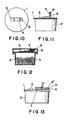
- Figs. 10 to 12 represent the ninth embodiment according to this invention.
- reference numeral 1 designates a lid made of a flexible sheet having an insulative property, and the lid 1 is heat sealed to a flanged portion of a container body 2 made of a plastic material into which a preserved food 3 is accommodated.
- a lamination layer composed of an antenna 4 made of an electrically conductive material and formed in shape of a linear belt and a flexible sheet 6 having an insulative property is bonded to the lid 1.
- a heat generating element 5 is bonded to the lid 1 in close to the antenna 4.
- the flexible sheet 6 is composed of two sheet elements which have portions bonded to each other and the remaining portions, not bonded to each other, are bonded to the lid 1 so as to extend in directions reverse to each other.
- the portions laminated due to the elasticities thereof extend vertically upwardly.
- the flexible sheet 6 is bent substantially horizontally by temporarily applying a lid 8 as shown in Fig. 12 when the sealed container is prepared, but when the sealed container is entered into the electronic oven, the lid 8 is removed and the flexible sheet 6 then returns the standing position as shown in Fig. 11. In the state shown in Fig.
- the antenna 4 extends in the vertical and horizontal directions substantially in an L shape, so that the antenna 4 can effectively concentrate the microwave energy to the heat generating element 5 even in a case where either one of vertical or horizontal component of the microwaves is strong, whereby the the heat generating element 5 generates the heat adequate to fuse and open the lid 1.
- Fig. 13 is a side view of a sealed container according to the tenth embodiment of this invention.
- reference numeral 4 designates an antenna made of an electrically conductive material which is laminated with flexible sheets 6 and 6′ having an insulative property in a sandwitched manner.
- the coefficient of thermal contraction of the flexible sheet 6′ in the longitudinal direction thereof is larger than that of the flexible sheet 6.
- a part of the thus formed lamination layer is bonded to the lid 1 made of an insulative flexible sheet through a layer 7 of a bonding agent.
- a heat generating element 5 is bonded to the lid 1 at a portion in close to one end of the antenna 4.
- Fig. 14 is a side view of a sealed container according to the eleventh embodiment of this invention.
- a lid 1 made of a flexible sheet having an insulative property is heat sealed to a flanged portion of a container body 2 so as to have an inclination ⁇ with respect to the bottom surface of the container body 2. It is desired that the inclination ⁇ is a value more than about 3° .
- the lamination layer composed of the antenna 4 and the flexible sheet 6 is bonded to the lid 1 so that the lamination layer inclines at the largest magnitude in the longitudinal direction of the lid 1.
- the heat generating element 5 is bonded to the lid 1 at a portion in close to the end of the antenna 4. Accordingly, in this embodiment, the antenna 4 has the vertical and horizontal components in the longitudinal direction thereof.
- Fig. 15 is a side view of a sealed container according to the twelfth embodiment of this invention.
- a lid 1 made of a flexible sheet having an insulative property is heat sealed to a flanged portion of a container body 2.
- a lamination layer composed of the conductive antenna 4 and the insulative flexible sheet is bonded to the lid and the side of the container body 2.
- a heat generating element 5 is bonded to the lid 1 at a portion in close to the end of the antenna 4.
- the antenna 4 also has the vertical and horizontal components in the longitudinal directions thereof.
- Figs. 16 and 17 represent the thirteenth embodiment according to this invention, in which a lamination layer 14a and 14b each composed of a belt-shape antenna and an insulative flexible sheet are utilized.
- the lamination layer 14b is entirely bonded to the lid 1, but the lamination layer 14a is bonded to the lid 1 at one portion and the remaining portion not bonded extends vertically by the elastic property itself.
- the microwave energy is concentrated between the lamination layers 14a and 14b where the energy is converted into the heat energy due to the dielectric loss of the lid 1 thereby to fuse and open the lid 1.
- Figs. 18 and 19 represent the fourteenth embodiment according to this invention, in which a lamination layer composed of an antenna 14a and an insulative flexible sheet 14b are disposed on the lid 1 in form of a belt.
- the lamination 14b is entirely bonded to the lid 1 and the lamination 14a is bonded to the lid 1 and the side of the container body 2.
- the microwave energy is concentrated to a portion between the lamination layers 14a and 14b, where the energy is then converted into the heat energy by the dielectric loss of the lid 1 thereby to fuse and open the lid 1.
- a C-shaped lamination layer 14a composed of an antenna and an insulative flexible sheet is utilized, and a part of the lamination layer 14a is bonded to the lid 1 and the remaining part extends substantially vertically as viewed by the self-elasticity of the lamination layer 14a.
- the microwave energy is concentrated to a portion between the opposing ends of the C-shaped lamination layer 14a and this energy is converted into the heat energy by the dielectric loss of the lid thereby to fuse and open the lid 1.
- a C-shaped lamination layer 14a of an antenna and an insulative flexible sheet is utilized, and the lamination layer 14a is bonded both to the lid 1 and to side surface of the container body 2.
- the microwave energy is concentrated to a portion between the opposing ends of the C-shaped lamination layer 14a and this energy is converted into the heat energy by the dielectric loss of the lid thereby to fuse and open the lid 1.
- two types of lamination layers 14a and 14b constituting the antennas and the insulative flexible sheets are utilized.
- the lamination layers 14b and 14b are entirely bonded to the lid 1, but the lamination layer 14a is partially bonded thereto.
- the remaining portion of the lamination layer 14a extends substantially vertically as viewed by the self-elasticity of the lamination layer 14a.
- the microwave energy is concentrated to a portion betwwen the lamination layers 14b and the lamination layer 14a, where the microwave energy is converted into the heat energy by the dielectric loss of the lid thereby to fuse and open the lid 1.
- two types of lamination layers 14a and 14b constituting the antennas and the insulative flexible sheets are utilized.
- the lamination layers 14b and 14b are entirely bonded on the lid 1, but the lamination layer 14a is bonded both to the lid 1 and to the side surface of the container body 2.
- the microwave energy is concentrated to a portion between the lamination layers 14b and the lamination layer 14a, where the microwave energy is converted into the heat energy by the dielectric loss of the lid thereby to fuse and open the lid 1.
- a C-shaped lamination layer 14b composed of an antenna and an insulative flexible sheet and a belt-shaped lamination 14a composed of an antenna and an insulative flexible sheet are utilized.
- the lamination layer 14b is entirely bonded to the lid 1, but the lamination layer 14a is partially bonded to the lid 1 and the remaining part extends substantially apart from the lid 1 as viewed by the self-elasticity of the lamination layer 14a.
- Microwave energy is concentrated to a portion between the lamination layer 14a and the opposing ends of the C-shaped lamination layer 14b, where this energy is converted into the heat energy by the dielectric loss of the lid thereby to fuse and open the lid 1.
- a C-shaped lamination layer 14b composed of an antenna and an insulative flexible sheet and a belt-shaped lamination layer 14a composed of an antenna and an insulative flexible sheet are utilized.
- the lamination layer 14b is entirely bonded to the lid 1, but the lamination layer 14a is bonded both to the lid 1 and to the side surface of the container body 2.
- the microwave energy is concentrated to a portion between the lamination layer 14a and the opposing ends of the C-shaped lamination layer 14b, where this energy is converted into the heat energy by the dielectric loss of the lid thereby to fuse and open the lid 1.
- Sealed containers according to the ninth to twentieth embodiments of this invention and sealed containers having structures substantially the same as those of the described embodiment except that the longitudinal sides of the antennas extend horizontally were prepared (in which the lids 1 were made of lamination of polyester/nylon/polypropylene layers).
- a rice boiled together with red beans (SEKIHAN) having a volume of 200g was filled and sealed in the respective containers, which were then set in the central portion of the microwave oven (National Electronic Oven NE-M200, Output: 500W, Lower Stirrer-type) and heated for two minutes.
- the containers prepared according to the described embodiments were all opened in 10 to 30 seconds, but some of the containers provided with the horizontally extending antennas ware not completely opened in this heating time.
- the antennas of the thirteenth to twentieth embodiments may be utilized in the combined manner and such antennas may be entirely bonded to the lid of the eleventh embodiment and the heat generating element may be positioned at a portion between the antennas between which the microwave energy can be concentrated.
- the heat generating elements utilizes not only the high resistance substance but also the other substances which generate heat by absorbing the microwave energy, that is, the substances which generate heat due to the magentic loss, dielectric loss or discharge in substitution for the resistance loss.
- ferromagnetic alloy made of, for example, ferrite, iron, cobalt, nickel, which are represented by MOFe2O3 (where M is a divalent metallic ion) and the combination of some of these substances.
- MOFe2O3 where M is a divalent metallic ion
- a high molecular compound such as epoxy resin, neoplene, bakelite or nylon will be utilized for the heat generating element which generates heat due to the dielectric loss, and a substance having a large dielectric loss such as a barium titanate will be also utilized for the heat generating element.
- a vacuum evaporation film of metallic material such as aluminum, iron or nickel, vacuum evaporation film of semiconductor material such as silicon, or fiberic substance made of these substances.
- Embodiments of the container sealed with lids or containers in form of pouches or bags to which labels are bonded according to this invention will be described hereunder.
- a label of the twenty-first embodiment according to to this invention is shown in Fig. 26, in which an electrically conductive layer 12 and a heat generating layer 13 is laminated on a base layer 11 and a protection layer 14 is further laminated so as to enclose the conductive layer 12 and the heat generating layer 13.
- a layer 15 of a bonding agent or adhesives is also laminated below the base layer 11 and a releasing layer 16 is temporarily bonded to the adhesive layer 15.
- the base layer 11 is composed of single lamination layer of a thermoplastic sheet, thermosetting plastic sheet or paper material having a thickness suitable for applying a proper rigidity to the label.
- the conductive layer 12 is prepared by a substance which may form a thin film having a surface resistivity below 1 ⁇ / ⁇ such as metallic foil, flame coating film or conductive coating film. If the conductive layer 12 is composed of a substance having a surface resistivity more than 1 ⁇ / ⁇ , the substance itself absorbs the microwave energy and generates the heat and, hence, it is not proper to use the substance as an antenna for concentrating the microwave energy. It is necessary for the conductive layer 12 to have a length more than 20mm, and if the length is below 20mm, the conductive layer is affected by the electric field distribution in the electronic oven and the heat is not generated stably. The end shape of the conductive layer may be made in linear line, curved line or polygonal line, or combination of these lines.
- the heat generating layer 13 is prepared by a substance which absorbs the microwave energy and generates heat and, for example, a ferrite or a ferromagentic alloy having a large magnetic loss, barium titanate having a large dielectric loss, or conductive coating film, conductive plastic or vacuum evaporation film having a large resistance loss may be utilized for a substance of the heat generating layer 13.
- a substance having a large resistance loss it is desired for the substance to have a surface resistivity more than 11 ⁇ / ⁇ , and If the substance having the surface resistivity less than 11 ⁇ / ⁇ , the substance not only absorbs the microwave energy but also reflects the same, thus reducing the heat generating function.
- the heat generating layer 13 may be formed in circular shape or polygonal shape, or combination of these shapes. It is necessary that the distance C between the conductive layer 12 and the heat generating layer 13 is of 0 to 3.5 mm, and if the distance is beyond the value of 3.5 mm, it is impossible to apply an adequate heating amount to a portion to be opened.
- the protection layer 14 serves to protect the conductive layer 12 and the heat generating layer 13 and is prepared by an insulative plastic sheet or a coat film which is bonded, fused or coated to the conductive layer 12, the heat generating layer 13 and the base layer 11.
- the adhesive layer 15 is prepared by an acrylic bonding agent of another bonding agent utilized for the bonding of a usual label.
- the releasing layer 16 serves to protect the adhesive layer 15 and is prepared by a film essentially consisting of a plastic material and having a low adhesive property, a releasing layer essentially consisting of a surface treated film or paper, or a substance prepared by coating a paper with a plastic material.
- the label having the structure described above is provided with a cut line 17 in the base layer 11 around the conductive layer 12 and the heat generating layer 13 as shown in Fig. 27, and the upper portion of the releasing layer 16 is pealed off along the cut line 17.
- the label is thus bonded to the lid of the sealed container or the bag through the adhesive layer 15. It is desired to display an object of the usage of this label for a user, and for this purpose, a printing may be directly made to the conductive layer 12 or protection layer 14.
- the base layer 11 is endowed with a function of the protection layer, and the conductive layer 12 and the heat generating layer 13 are laminated between the base layer 11 and the adhesive layer 15.
- the other structures and functions of the embodiment shown in Fig. 28 are substantially the same as those described with reference to Fig. 27.
- the adhesive layer 15 is composed of a hot metal type bonding agent.
- the adhesive layer 15 is disposed on the surface of the lid or bag of the container and heat pressed by a heating matter from the base layer 11, whereby the adhesive layer 15 is softened and bonded to the lid of the container or the bag with the releasing layer 16, the conductive layer 12 and the heat generating layer 13 removed from the base layer 11.
- a polyethylene terephthalate film, having a thickness of 25 ⁇ m, prepared by a biaxial orientation method was utilized as the base layer 11, and an electrically conductive silver paste, having a length of 45mm and a thickness of 5 ⁇ m, prepared as the conductive layer 12 was coated on the base layer 11.
- the surface resistivity of the thus prepared conductive layer was of 0.2 ⁇ / ⁇ .
- An electrically conductive thin film of carbon paste (thickness: 3 ⁇ m; surface resistivity: 400 ⁇ / ⁇ ) was applied on the base 11 as the heat generating layer 13 by the screen printing method.
- An acrylic solvent type substance was utilized as the adhesive layer 15 and a polyethylene laminate glassing paper was utilized as the releasing layer 16.
- a lamination of polyester/nylon/polypropylene layers was utilized for prepareing a container in form of a pouch or bag, with the polypropylene layer inwardly, having outer dimension of 170 x 130mm, and the rice of 200g weight was filled in the container, which was then sealed.
- a lavel having substantially the same structure as that of the Example 1 was bonded to the container.
- the thus prepared sealed container was entered into a microwave oven (output power: 500 W; National Electronic Oven NE-M 200), in which the container was exposed to the mocrowaves to examine the lid opening test.
- the results of the several containers indicated that the lids were opened in about 10 to 30 seconds and steam was jetted through the opening without breaking the bag container even when the locations of the containers were changed in the microwave oven.
- the heat generating layer and the conductive layer may be laminated separately on the front and rear surfaces of the base layer without laminating on the same side of the base layer.
- thermoplastic sheet there will be provided linear polyester such as polyethylene terephthalate, polyolefine resin such as ionomer, polyethylene, polypropylene, ethylene-propylene copolymer, acrylic resin, polystyrane resin, AS resin, ABS resin, polyamide resin, polyimide resin, polyimine resin, polyvinyl chloride resin, polyvinyliden chloride resin, vinyl chloride-vinyl acetate copolymer, vinyliden copolymer, acetal resin, diallyl phethalate resin, fluoride resin, or resin prepared by the combination of some of these resins.
- linear polyester such as polyethylene terephthalate
- polyolefine resin such as ionomer, polyethylene, polypropylene, ethylene-propylene copolymer, acrylic resin, polystyrane resin, AS resin, ABS resin, polyamide resin, polyimide resin, polyimine resin, polyvinyl chloride resin, polyvinyliden chloride resin, vinyl chlor
- thermosetting plastic resin there will be provided a urea resin, phenole resin, epoxy resin, melamine resin, urethane resin, xylene-formaldehyde resin, or a resin prepared by the combination of some of these resins.
- the sealed container according to this invention are suitable to be heated in an electronic, particularly microwave, oven or a microwave generating box to cook the food accommodated in the container with the sealed condition.
Landscapes
- Engineering & Computer Science (AREA)
- Life Sciences & Earth Sciences (AREA)
- Food Science & Technology (AREA)
- Mechanical Engineering (AREA)
- Package Specialized In Special Use (AREA)
- Cookers (AREA)
Applications Claiming Priority (6)
| Application Number | Priority Date | Filing Date | Title |
|---|---|---|---|
| JP250026/87 | 1987-10-05 | ||
| JP62250026A JPH0667341B2 (ja) | 1987-10-05 | 1987-10-05 | 電子レンジ調理用密封容器 |
| JP24941/88 | 1988-02-06 | ||
| JP63024941A JP2512980B2 (ja) | 1988-02-06 | 1988-02-06 | 電子レンジ調理用密封容器貼着用ラベル |
| JP63100237A JPH0811591B2 (ja) | 1988-04-25 | 1988-04-25 | 電子レンジ調理用密封容器 |
| JP100237/88 | 1988-04-25 |
Publications (3)
| Publication Number | Publication Date |
|---|---|
| EP0440792A4 EP0440792A4 (de) | 1990-02-06 |
| EP0440792A1 true EP0440792A1 (de) | 1991-08-14 |
| EP0440792B1 EP0440792B1 (de) | 1993-09-15 |
Family
ID=27284841
Family Applications (1)
| Application Number | Title | Priority Date | Filing Date |
|---|---|---|---|
| EP88908383A Expired - Lifetime EP0440792B1 (de) | 1987-10-05 | 1988-09-30 | Geschlossener behälter zum kochen im mikrowellenofen |
Country Status (4)
| Country | Link |
|---|---|
| US (1) | US4992636A (de) |
| EP (1) | EP0440792B1 (de) |
| AU (1) | AU2523088A (de) |
| WO (1) | WO1989002715A1 (de) |
Cited By (4)
| Publication number | Priority date | Publication date | Assignee | Title |
|---|---|---|---|---|
| WO2001021506A1 (en) * | 1999-09-24 | 2001-03-29 | Brown Bruce W | Dual compartment food package for microwave cooking |
| GB2369341A (en) * | 2000-11-22 | 2002-05-29 | Mccain Foods | A heat responsive food product container |
| EP1398278A1 (de) * | 2002-09-11 | 2004-03-17 | Northern Foods PLC | Nahrungsmittelbehälter mit leicht zu öffnendem Verschluss |
| EP1714908A3 (de) * | 2005-04-21 | 2006-11-08 | Mondi Packaging AG | Mikrowellengeeignete Verpackung |
Families Citing this family (35)
| Publication number | Priority date | Publication date | Assignee | Title |
|---|---|---|---|---|
| US4925684A (en) * | 1988-08-19 | 1990-05-15 | Campbell Soup Company | Food package with a microwave releasable sealed closure |
| US4911938A (en) * | 1988-08-22 | 1990-03-27 | E. I. Du Pont De Nemours And Company | Conformable wrap susceptor with releasable seal for microwave cooking |
| USD336592S (en) | 1989-08-15 | 1993-06-22 | Aladdin Synergetics, Inc. | Tray top for a food service tray |
| US5241150A (en) * | 1989-10-02 | 1993-08-31 | Minnesota Mining And Manufacturing Company | Microwave food package |
| USD335796S (en) | 1990-01-29 | 1993-05-25 | Aladdin Synergetics, Inc. | Food serving tray |
| US5191181A (en) * | 1990-08-01 | 1993-03-02 | Geo. A. Hormel & Co. | Sealing thermoplastic member devoid of conductive material |
| WO1992005090A1 (en) * | 1990-09-21 | 1992-04-02 | Cambridge Consultants Limited | Microwave heat responsive container |
| US5876811A (en) * | 1990-11-27 | 1999-03-02 | Blackwell; Tommie R. | Microwavable single-serving meal container |
| GB9114068D0 (en) * | 1991-06-28 | 1991-08-14 | Beckett Ind Inc | Microwave heating device |
| US5322984A (en) * | 1992-04-03 | 1994-06-21 | James River Corporation Of Virginia | Antenna for microwave enhanced cooking |
| USD335797S (en) | 1992-07-08 | 1993-05-25 | Aladdin Synergetics, Inc. | Tray |
| USD334513S (en) | 1992-08-04 | 1993-04-06 | Aladdin Synergetics, Inc. | Cover |
| FR2706472B1 (fr) * | 1993-06-10 | 1995-09-01 | Breger Guy | Procédé de fabrication d'un produit en un polymère thermofusible ou thermodurcissable comportant des zones sensibles à un rayonnement électromagnétique du domaine des micro-ondes et produit obtenu. |
| US5582854A (en) * | 1993-07-05 | 1996-12-10 | Ajinomoto Co., Inc. | Cooking with the use of microwave |
| US5530231A (en) * | 1994-01-25 | 1996-06-25 | Advanced Deposition Technologies, Inc. | Multilayer fused microwave conductive structure |
| US5412187A (en) * | 1994-01-25 | 1995-05-02 | Advanced Deposition Technologies, Inc. | Fused microwave conductive structure |
| EP0744348B1 (de) * | 1995-05-24 | 2002-01-30 | Eastman Kodak Company | Produktbehälter mit einem magnetischen Identifikator |
| US5698127A (en) * | 1995-09-18 | 1997-12-16 | Lai; Lawrence | Microwavable container with heating element having energy collecting loops |
| JPH09214227A (ja) * | 1996-02-07 | 1997-08-15 | Murata Mfg Co Ltd | チップアンテナ |
| US5935477A (en) * | 1996-07-22 | 1999-08-10 | Kontract Product Supply Inc. | Continuous microwave cooking grill having a plurality of spaced segments |
| US6229131B1 (en) | 1996-07-22 | 2001-05-08 | Kontract Product Supply, Inc. | Microwave cooking grill and steamer |
| US5977531A (en) * | 1997-07-15 | 1999-11-02 | Pfister; Dennis M. | Microwave induced thermal inversion packaging |
| US6053474A (en) * | 1998-09-16 | 2000-04-25 | Corning Consumer Products Company | Vent valve |
| US6960748B2 (en) * | 2003-10-09 | 2005-11-01 | Smurfit-Stone Container Enterprises, Inc. | Collapsible microwave popcorn box |
| JP4958897B2 (ja) * | 2005-04-28 | 2012-06-20 | イノベイティブ デザイン オブ スカンジナビア エービー | 食べ物を移すための食べ物パッケージと移送方法 |
| US20080157442A1 (en) * | 2006-12-28 | 2008-07-03 | Kimberly-Clark Worldwide, Inc. | Process For Cutting Textile Webs With Improved Microwave Absorbing Compositions |
| US20080156157A1 (en) * | 2006-12-28 | 2008-07-03 | Kimberly-Clark Worldwide, Inc. | Process For Cutting Textile Webs With Improved Microwave Absorbing Compositions |
| US8182552B2 (en) | 2006-12-28 | 2012-05-22 | Kimberly-Clark Worldwide, Inc. | Process for dyeing a textile web |
| US7568251B2 (en) | 2006-12-28 | 2009-08-04 | Kimberly-Clark Worldwide, Inc. | Process for dyeing a textile web |
| US7674300B2 (en) | 2006-12-28 | 2010-03-09 | Kimberly-Clark Worldwide, Inc. | Process for dyeing a textile web |
| US20080156428A1 (en) * | 2006-12-28 | 2008-07-03 | Kimberly-Clark Worldwide, Inc. | Process For Bonding Substrates With Improved Microwave Absorbing Compositions |
| US7740666B2 (en) | 2006-12-28 | 2010-06-22 | Kimberly-Clark Worldwide, Inc. | Process for dyeing a textile web |
| US8632613B2 (en) | 2007-12-27 | 2014-01-21 | Kimberly-Clark Worldwide, Inc. | Process for applying one or more treatment agents to a textile web |
| US20090257687A1 (en) * | 2008-04-11 | 2009-10-15 | Birds Eye Foods, Inc. | Package fof cooking foodstuffs having high-moisture content |
| WO2012160181A1 (en) * | 2011-05-26 | 2012-11-29 | Amcor Flexibles Transpac B.V.B.A | A hermetically closed package to be heated in a microwave oven |
Family Cites Families (5)
| Publication number | Priority date | Publication date | Assignee | Title |
|---|---|---|---|---|
| US4141487A (en) * | 1977-03-29 | 1979-02-27 | Union Carbide Corporation | Disposable food package |
| US4210674A (en) * | 1978-12-20 | 1980-07-01 | American Can Company | Automatically ventable sealed food package for use in microwave ovens |
| US4320274A (en) * | 1980-01-14 | 1982-03-16 | Rte Corporation | Cooking utensil for uniform heating in microwave oven |
| US4640838A (en) * | 1984-09-06 | 1987-02-03 | Minnesota Mining And Manufacturing Company | Self-venting vapor-tight microwave oven package |
| CA1283384C (en) * | 1985-09-26 | 1991-04-23 | Curtis L. Larson | Microwave food package |
-
1988
- 1988-09-30 AU AU25230/88A patent/AU2523088A/en not_active Abandoned
- 1988-09-30 WO PCT/JP1988/000996 patent/WO1989002715A1/ja not_active Ceased
- 1988-09-30 EP EP88908383A patent/EP0440792B1/de not_active Expired - Lifetime
- 1988-09-30 US US07/368,383 patent/US4992636A/en not_active Expired - Fee Related
Non-Patent Citations (1)
| Title |
|---|
| See references of WO8902715A1 * |
Cited By (5)
| Publication number | Priority date | Publication date | Assignee | Title |
|---|---|---|---|---|
| WO2001021506A1 (en) * | 1999-09-24 | 2001-03-29 | Brown Bruce W | Dual compartment food package for microwave cooking |
| GB2369341A (en) * | 2000-11-22 | 2002-05-29 | Mccain Foods | A heat responsive food product container |
| EP1398278A1 (de) * | 2002-09-11 | 2004-03-17 | Northern Foods PLC | Nahrungsmittelbehälter mit leicht zu öffnendem Verschluss |
| GB2393091A (en) * | 2002-09-11 | 2004-03-17 | Northern Foods Ltd | Food container with heat sensitive seal released by microwave susceptor |
| EP1714908A3 (de) * | 2005-04-21 | 2006-11-08 | Mondi Packaging AG | Mikrowellengeeignete Verpackung |
Also Published As
| Publication number | Publication date |
|---|---|
| US4992636A (en) | 1991-02-12 |
| AU2523088A (en) | 1989-04-18 |
| EP0440792A4 (de) | 1990-02-06 |
| WO1989002715A1 (fr) | 1989-04-06 |
| EP0440792B1 (de) | 1993-09-15 |
Similar Documents
| Publication | Publication Date | Title |
|---|---|---|
| EP0440792B1 (de) | Geschlossener behälter zum kochen im mikrowellenofen | |
| US4210674A (en) | Automatically ventable sealed food package for use in microwave ovens | |
| US6541744B2 (en) | Packaging having self-contained heater | |
| US5217768A (en) | Adhesiveless susceptor films and packaging structures | |
| CA1241701A (en) | Self-venting vapor-tight microwave oven package | |
| US4848931A (en) | Packaging sheet and containers and pouches using the sheet | |
| US4756917A (en) | Packaging sheet and containers and pouches using the sheet | |
| US5256846A (en) | Microwaveable barrier films | |
| JPH01141044A (ja) | マイクロ波吸収複合材 | |
| CA2421207C (en) | Microwave-heating container | |
| JP4467683B2 (ja) | 電子レンジ加熱用包装容器 | |
| JPH0667341B2 (ja) | 電子レンジ調理用密封容器 | |
| JP2512980B2 (ja) | 電子レンジ調理用密封容器貼着用ラベル | |
| JPH0811591B2 (ja) | 電子レンジ調理用密封容器 | |
| EP0470771A2 (de) | Mikrowellenverpackung mit leicht zu öffendem Verschluss | |
| JP2773138B2 (ja) | 電子レンジ調理用密封容器 | |
| JP4501242B2 (ja) | 電子レンジ加熱時に自動的に開封するパウチ | |
| CA1221338A (en) | Container for use in microwave ovens | |
| JP4505390B2 (ja) | レンジ加熱用容器入り食品及び容器 | |
| JP2012056594A (ja) | 電子レンジ加熱調理用容器 | |
| JPS6333273A (ja) | 密封容器 | |
| JP6746380B2 (ja) | 電子レンジ用容器 | |
| JPS6344472A (ja) | 容器 | |
| JPH0735174B2 (ja) | 包装用容器 | |
| JPH10194354A (ja) | 電子レンジ加熱品の包装体 |
Legal Events
| Date | Code | Title | Description |
|---|---|---|---|
| PUAI | Public reference made under article 153(3) epc to a published international application that has entered the european phase |
Free format text: ORIGINAL CODE: 0009012 |
|
| 17P | Request for examination filed |
Effective date: 19890604 |
|
| AK | Designated contracting states |
Kind code of ref document: A1 Designated state(s): GB |
|
| 17Q | First examination report despatched |
Effective date: 19920624 |
|
| GRAA | (expected) grant |
Free format text: ORIGINAL CODE: 0009210 |
|
| AK | Designated contracting states |
Kind code of ref document: B1 Designated state(s): GB |
|
| PLBE | No opposition filed within time limit |
Free format text: ORIGINAL CODE: 0009261 |
|
| STAA | Information on the status of an ep patent application or granted ep patent |
Free format text: STATUS: NO OPPOSITION FILED WITHIN TIME LIMIT |
|
| 26N | No opposition filed | ||
| PGFP | Annual fee paid to national office [announced via postgrant information from national office to epo] |
Ref country code: GB Payment date: 20000927 Year of fee payment: 13 |
|
| PG25 | Lapsed in a contracting state [announced via postgrant information from national office to epo] |
Ref country code: GB Free format text: LAPSE BECAUSE OF NON-PAYMENT OF DUE FEES Effective date: 20010930 |
|
| REG | Reference to a national code |
Ref country code: GB Ref legal event code: IF02 |
|
| GBPC | Gb: european patent ceased through non-payment of renewal fee |
Effective date: 20010930 |