EP0441231B1 - Halbleiterspeicheranordnung - Google Patents
Halbleiterspeicheranordnung Download PDFInfo
- Publication number
- EP0441231B1 EP0441231B1 EP91101164A EP91101164A EP0441231B1 EP 0441231 B1 EP0441231 B1 EP 0441231B1 EP 91101164 A EP91101164 A EP 91101164A EP 91101164 A EP91101164 A EP 91101164A EP 0441231 B1 EP0441231 B1 EP 0441231B1
- Authority
- EP
- European Patent Office
- Prior art keywords
- pair
- lines
- bit lines
- data bus
- transistors
- Prior art date
- Legal status (The legal status is an assumption and is not a legal conclusion. Google has not performed a legal analysis and makes no representation as to the accuracy of the status listed.)
- Expired - Lifetime
Links
Images



Classifications
-
- G—PHYSICS
- G11—INFORMATION STORAGE
- G11C—STATIC STORES
- G11C11/00—Digital stores characterised by the use of particular electric or magnetic storage elements; Storage elements therefor
- G11C11/21—Digital stores characterised by the use of particular electric or magnetic storage elements; Storage elements therefor using electric elements
- G11C11/34—Digital stores characterised by the use of particular electric or magnetic storage elements; Storage elements therefor using electric elements using semiconductor devices
-
- G—PHYSICS
- G11—INFORMATION STORAGE
- G11C—STATIC STORES
- G11C7/00—Arrangements for writing information into, or reading information out from, a digital store
- G11C7/10—Input/output [I/O] data interface arrangements, e.g. I/O data control circuits, I/O data buffers
-
- G—PHYSICS
- G11—INFORMATION STORAGE
- G11C—STATIC STORES
- G11C7/00—Arrangements for writing information into, or reading information out from, a digital store
- G11C7/10—Input/output [I/O] data interface arrangements, e.g. I/O data control circuits, I/O data buffers
- G11C7/1006—Data managing, e.g. manipulating data before writing or reading out, data bus switches or control circuits therefor
Definitions
- This invention relates to a semiconductor memory device, more specifically to the arrangement of its bit lines and their connections to the data bus.
- a semiconductor memory device has a memory cell array from which bit lines carry data to sense amplifiers, which place amplified data on an internal data bus.
- the bit lines and data bus lines are actually complementary pairs of lines, one carrying the data value and the other the inverse of that value.
- Modern semiconductor memory devices are frequently subdivided into two or more memory cell arrays, each with separate bit lines and sense amplifiers which may be shared by adjacent memory cell arrays, and have two or more pairs of data bus lines. Interconnections between the bit lines and data bus lines are controlled by switching elements, called transfer means, that operate in response to column signals.
- transfer means switching elements, called transfer means, that operate in response to column signals.
- each column signal selects two pairs of bit lines, connecting one bit line pair to one data bus pair, and the other bit line pair to the other data bus pair.
- bit line pairs are laid out in an order that alternates between one data bus line and the other.
- This scheme permits the two bit line pairs selected by the same column signal to be disposed side by side, but has the disadvantage that each bit line must be connected to the data bus at a separate node. This imposes a limitation to the reduction in the bit line pitch, and hence to the increase in the degree of integration.
- the article "A 46-ns- 1-Mbit CMOS SRAM" by Shimada et al in IEEE Journal of Solid-State Circuits, p. 53 to 58 discloses a semiconductor memory device according the pre-characterizing part of claim 1.
- This semiconductor memory device achieves a small standby power of 25 ⁇ W, an active power of 80 mW at 1-MHz write operation and a short access time of 46 ns by employing a PMOS bit-line dc load to reduce power dissipation in the write cycle and by using four-block access mode to reduce the testing time.
- the bit line pitch is reletively large as is usual in the state of the art.
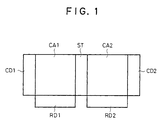
- Figure 1 is a schematic diagram showing a memory device comprising two memory cell arrays with a block of sense amplifiers and transfer transistors interposed between the two memory cell arrays.
- Figure 2 is a circuit diagram illustrating the pertinent portion of the memory device of Figure 1.
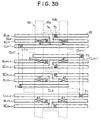
- Figure 3A, Figure 3B and Figure 3C are layout diagrams illustrating respective layers of the pertinent portion of the memory device of Figure 1.
- a semiconductor memory device with a novel arrangement of bit lines, their connections with data bus lines, and other elements will be described with reference first to circuit diagrams in Figure 1 and Figure 2, then to an actual layout diagrams in Figure 3A to Figure 3C.
- the semiconductor memory device shown will be a dynamic random access memory (RAM).
- RAM dynamic random access memory
- Figure 1 shows a memory device which comprises a pair of memory cell arrays CA1 and CA2 each consisting of memory cells arranged in row and columns to form a matrix, a block ST of sense amplifiers and transfer transistors, first and second row decoders RD1 and RD2, and first and second column decoders CD1 and CD2.
- the sense amplifiers are shared by the two memory cell arrays CA1 and CA2.
- Figure 2 is a circuit diagram showing electrical connection of sense amplifiers, transfer transistors, and related components.
- Figure 2 shows four sense amplifiers 30 m , 30 m+1 , 30 m+2 , and 30 m+3 and their associated circuit lines.
- a complementary bit line BL ⁇ x is connected to the drain of the second NMOS transistor 31 ⁇ x , and the gate of the first NMOS transistor 31 x .
- the sources of the NMOS transistors 31 x and 31 ⁇ x are connected to a common sense clock ( ⁇ ⁇ S ) line.
- the function of the sense clock line ⁇ ⁇ S is to activate the sense amplifier 30 x .
- the clock line ⁇ ⁇ S is driven active, the small potential difference between the BL and BL ⁇ lines is amplified so that one of these bit lines is pulled up to the logic 1 level while the other is pulled down to the logic 0 level.
- the sense amplifiers 30 m , ... 30 m+3 are connected to pairs of bit lines (BL m , BL ⁇ m ), ... (BL m+3 , BL ⁇ m+3 ) having matching subscripts.
- bit line pairs are arranged in the order (BL m , BL ⁇ m ), (BL m+2 , BL ⁇ m+2 ), (BL m+1 , BL ⁇ m+1 ), (BL m+3 , BL ⁇ m+3 ).
- the effect of the invention depends on the order of the pairs, but not on the order of the two bit lines within each pair.
- Each pair of bit lines (BL x , BL ⁇ x ) is connected to a column of memory cells in a memory cell array.
- a word line (not shown as such) and a row decoder RD1 and RD2
- the data value stored in the selected memory cell appears as a slight potential difference between the bit lines BL x and BL ⁇ x .
- This potential difference is amplified by the sense amplifier 30 x as described above.
- a column line CL n is disposed between the bit line pairs (BL m , BL ⁇ m ) and (BL m+2 , BL ⁇ m+2 ).
- Another column line CL n+1 is disposed between the bit line pairs (BL m+1 , BL ⁇ m+1 ) and (BL m+3 , BL ⁇ m+3 ).
- An auxiliary line CL n ' connected by bridging line CL n " is disposed between the bit line pairs (BL m+1 , BL ⁇ m+1 ) and (BL m+3 , BL ⁇ m+3 ).
- Another auxiliary line CL n+1 ' connected to a bridging line CL n+1 " is disposed between the bit line pairs (BL m , BL ⁇ m ) and (BL m+2 , BL ⁇ m+2 ).
- the device in Figure 2 has transfer transistors comprising NMOS transistors 40 m , 40 ⁇ m , ..., 40 m+3 , 40 ⁇ m+3 .
- the purpose of the transfer means is to connect the bit lines BL m , BL ⁇ m , ..., BL m+3 , BL ⁇ m+3 and sense amplifiers 30 m , ..., 30 m+3 to pairs of complementary data bus lines (DB0, DB ⁇ 0) and (DB1, DB ⁇ 1), disposed perpendicular to the bit lines.
- the transfer means are controlled by the column lines, together with the auxiliary lines, so that only one pair of bit lines is connected to a given pair of data bus lines at a time. Accordingly, transfer means that connect different bit lines to the same data bus line are controlled by different column lines.
- the transfer transistor 40 m is connected at its source to the bit line BL m and the sense amplifier 30 m .
- the sources of the transfer transistors 40 ⁇ m , ..., 40 m+3 , 40 ⁇ m+3 are connected to bit lines BL ⁇ m , ..., BL m+3 , BL ⁇ m+3 and sense amplifiers 30 m , ..., 30 m+3 with matching subscripts.
- the gate electrodes of the transfer transistors 40 m and 40 ⁇ m are connected directly to the column line CL n .
- the gate electrodes of the transfer transistors 40 m+1 and 40 ⁇ m+1 are connected to the column line CL n via auxiliary line CL n '.
- the gate electrodes of the transfer transistors 40 m+2 and 40 ⁇ m+2 are connected to the column line CL n+1 via auxiliary line CL n+1 '.
- the gate electrodes of the transfer transistors 40 m+3 and 40 ⁇ m+3 are connected directly to the column line CL n+1 .
- the drains of the transfer transistors 40 m and 40 m+2 are connected to the data bus line DB0 at the common node P m/m+2 .
- the transfer transistors 40 m and 40 m+2 therefore connect the data bus line DB0 to the bit line BL m when the column line CL n is driven active, and to the bit line BL m+2 when the column line CL n+1 is driven active.
- the transfer transistors 40 ⁇ m and 40 ⁇ m+2 connect the data bus line DB ⁇ 0 to the bit line BL ⁇ m or BL ⁇ m+2 at the common node P ⁇ m/m+2
- the transfer transistors 40 m+1 and 40 m+3 connect the data bus line DB1 to the bit line BL m+1 or BL m+3 at the common node P m+1/m+3
- the transfer transistors 40 ⁇ m+1 and 40 ⁇ m+3 connect the data bus line DB ⁇ 1 to the bit line BL ⁇ m+1 or BL ⁇ m+3 at the common node P ⁇ m+1/m+3 .
- data are transferred from the data bus pairs (DB0, DB ⁇ 0) and (DB1, DB ⁇ 1) via the common nodes P m/m+2 , P ⁇ m/m+2 , P m+1/m+3 , and P ⁇ m+1/m+3 and the transfer transistors 40 m , 40 ⁇ m , 40 m+3 , and 40 ⁇ m+3 to the sense amplifiers 30 m and 30 m+3 , respectively.
- the transferred data are written via the bit line pairs (BL m , BL ⁇ m ) and (BL m+3 , BL ⁇ m+3 ) to memory cells selected by a row decoder RD1 and RD2.
- a semiconductor memory device normally has many more bit lines and column lines than shown in the drawing.
- the other lines can be arranged in a fashion analogous to Figure 2, with two bit lines connected to each data bus line at a common node.
- adjacent pairs of transfer transistors 40 m and 40 ⁇ m ; and 40 m+2 , 40 ⁇ m+2 are connected through common nodes to the data bus line pair DB0 and DB ⁇ 0.
- adjacent pairs of transfer transistors 40 m+1 and 40 ⁇ m+1 ; and 40 m+3 , 40 ⁇ m+3 are connected through common nodes to the data bus line pair DB1 and DB ⁇ 1.
- each data bus line needs only to be connected via a contact hole to the transfer transistor at every four pairs of bit lines. This is in contrast to the prior art scheme in which each data bus line needs to be connected via a contact hole to the transfer transistor at every two pairs of bit lines.
- the reduction in the number of contact holes for connection with the data bus lines with the transfer transistors enables reduction in the bit line pitch, and hence increase in the degree of integration.
- Figure 3A shows, in solid lines, active regions 50 formed in the semiconductor substrate, and is comprised of doped semiconductor regions, and shows, in broken lines, polysilicon layers, and part of metal layers, in phantom lines.
- Figure 3B shows, in solid lines, polysilicon layers forming the bit lines BL m , BL ⁇ m , BL m+2 , BL ⁇ m+2 , BL m+1 , BL ⁇ m+1 , BL m+3 , BL ⁇ m+3 , column lines CL n , and CL n+1 , and auxiliary lines CL n ' and CL n+1 '.
- Figure 3B also shows, in dotted lines, the active regions 50, and part of the metal layers in phantom lines.
- Figure 3C shows, in solid lines, metal layers forming data bus lines DB0, DB ⁇ 0, DB1, and DB ⁇ 1, clock line ⁇ ⁇ S 64, bridging lines CL n “ and CL n+1 " for connecting the auxiliary lines CL n ' and CL n+1 ' to the column lines CL n and CL n+1 , and bridging lines 74 for connecting pieces 65 of bit lines BL m , BL m+1 , BL m+2 , and BL m+3 at portions where the bit lines pairs are "twisted", or where the bit lines of each pair are positionally exchanged for forming a flip-flop type sense amplifier.
- Figure 3C also shows, in broken lines, the polysilicon layers, and the active regions in dotted lines.
- bit lines are connected to the junction regions of the active regions 50 by means of junction-polysilicon ohmic contacts 61, which extend through the contact holes.
- the clock line 64 is connected to the junction regions 50 by means of junction-metal contacts 62 extending through contact holes.
- the metal bridging lines 74 shown in solid lines in Figure 3C and in broken lines in Figure 3B, are connected to the polysilicon bit lines BL x by metal-polysilicon contacts 75 extending through contact holes.
- the bridging lines CL n " and CL n+1 " are connected to the polysilicon column lines CL n and CL n+1 and the polysilicon auxiliary lines CL n ' and CL n+1 ', by means of polysilicon-metal contacts 71 extending through contact holes.
- the active regions 50 includes first and second main parts 50a and 50b extending in parallel with the data bus lines, and parts lateral projections 50e, 50f, 50g and 50h which extend laterally, i.e., in the direction of bit lines, from the first and second main parts 50a and 50b of the active region 50 at locations adjacent the drains of the transfer transistors, to form the data bus line interconnections DB0', DB ⁇ 0', DB1' and DB ⁇ 1' ( Figure 2) which are connected to the data bus lines DB0, DB ⁇ 0, DB1 and DB ⁇ 1 by means of contacts 70e, 70f, 70g, 70h extending through contact holes, thereby to form the common nodes P m/m+2 , P ⁇ m/m+2 , P m+1/m+3 and P ⁇ m+1/m+3 .
- Transistors 31 m , ..., 31 m+3 forming the transfer means are formed where the bit lines BL ⁇ x cross the first main part 50a of the active region.
- Transistors 31 ⁇ m , ..., 31 ⁇ m+3 forming the transfer means are formed where the bit lines BLx cross the second main part 50b of the active region.
- Transfer transistors 40 m , ..., 40 m+3 are formed where the column lines CL n and CL n+1 cross the first main part 50a of the active region 50.
- Transfer transistors 40 ⁇ m , ..., 40 ⁇ m+3 are formed where the column lines CL n and CL n+1 cross the second main part 50b of the active region 50.
- the lateral projections 50e to 50h are disposed at points intermediate between these transfer transistors.
- the sense amplifiers 30 m to 30 m+3 may have circuit configurations differeing from Figure 2; the transfer means may comprise transistors other than the transfer transistors 40 m , 40 ⁇ m, ..., 40 ⁇ m+3 ; the transfer means may be connected directly to the sense amplifier nodes; fabrication patterns other than those shown in Figure 3A to Figure 3C may be used; and this invention can be applied not only to dynamic RAMs but to other semiconductor memory devices as well, such as static RAMs.
Landscapes
- Engineering & Computer Science (AREA)
- Computer Hardware Design (AREA)
- Dram (AREA)
- Semiconductor Memories (AREA)
- Static Random-Access Memory (AREA)
Claims (7)
- Halbleiterspeichervorrichtung mit:einem ersten Paar von Datenbusleitungen (DB₀,
 einem zweiten Paar von Datenbusleitungen (DB₁,
 einem ersten Paar von Bitleitungen (BLm,
 einem zweiten Paar von Bitleitungen (BLm+2,
 einem dritten Paar von Bitleitungen (BLm+1,
 einem vierten Paar von Bitleitungen (BLm+3,
 einem ersten Leseverstärker (30m), der mit dem ersten Paar von Bitleitungen (BLm,
 einem zweiten Leseverstärker (30m+2), der mit dem zweiten Paar von Bitleitungen (BLm+2,
 einem dritten Leseverstärker (30m+1), der mit dem dritten Paar von Bitleitungen (BLm+1,
 einem vierten Leseverstärker (30m+3), der mit dem vierten Paar von Bitleitungen (BLm+3,
 einem ersten Paar von Transfertransistoren (40m,

 einem zweiten Paar von Transfertransistoren (40m+2,

 einem dritten Paar von Transfertransistoren (40m+1,

 einem vierten Paar von Transfertransistoren (40m+3,

 dadurch gekennzeichnet, daß das erste und das zweite Paar von Transfertransistoren (40m,


 das dritte und das vierte Paar von Transfertransistoren (40m+1,


- Vorrichtung nach Anspruch 1, die des weiteren aufweist:eine erste Spaltenleitung (CLn), die dem ersten Paar von Transfertransistoren (40m,

 eine zweite Spaltenleitung (CLn+1), die mit dem zweiten Paar von Transfertransistoren (40m+2,
 eine erste Zusatzleitung (CLn'), die mit dem dritten Paar von Transfertransistoren (40m+1,
 eine zweite Zusatzleitung (CLn+1'), die mit dem vierten Paar von Transfertransistoren (40m+3,
 eine erste Überbrückungsleitung (CLn"), die die erste Zusatzleitung (CLn') mit der ersten Spaltenleitung (CLn) verbindet; undeine zweite Überbrückungsleitung (CLn+1"), die die zweite Zusatzleitung (CLn+1') mit der zweiten Spaltenleitung (CLn+1) verbindet.
 - Vorrichtung nach Anspruch 2, bei der sich die erste und die zweite Spaltenleitung (CLn, CLn+1) sowie die erste und die zweite Zusatzleitung (CLn', CLn+1') im wesentlichen parallel zu dem ersten Paar von Bitleitungen (BLm,

- Vorrichtung nach einem der Ansprüche 1 bis 3, bei der das erste Paar von Datenbusleitungen (DB₀,


- Vorrichtung nach einem der Ansprüche 1 bis 4, bei der das erste Paar von Transfertransistoren (40m,


 wobei die ersten bis achten Transistoren jeweils erste und zweite Elektroden aufweisen;wobei die ersten Elektroden der ersten und zweiten Transistoren jeweils mit den ersten Paaren von Bitleitungen (BLm,
 die ersten Elektroden der fünften und sechsten Transistoren jeweils mit den dritten Paaren von Bitleitungen (BLm+1,

- Vorrichtung nach Anspruch 5,bei der das erste Paar von Datenbusleitungen (DB₀,


 bei der das zweite Paar von Datenbusleitungen (DB₁,


- Vorrichtung nach Anspruch 1, bei der das zweite Paar von Bitleitungen (BLm+2,


Applications Claiming Priority (2)
| Application Number | Priority Date | Filing Date | Title |
|---|---|---|---|
| JP18253/90 | 1990-01-29 | ||
| JP2018253A JP2938493B2 (ja) | 1990-01-29 | 1990-01-29 | 半導体記憶装置 |
Publications (3)
| Publication Number | Publication Date |
|---|---|
| EP0441231A2 EP0441231A2 (de) | 1991-08-14 |
| EP0441231A3 EP0441231A3 (en) | 1992-11-19 |
| EP0441231B1 true EP0441231B1 (de) | 1996-05-08 |
Family
ID=11966520
Family Applications (1)
| Application Number | Title | Priority Date | Filing Date |
|---|---|---|---|
| EP91101164A Expired - Lifetime EP0441231B1 (de) | 1990-01-29 | 1991-01-29 | Halbleiterspeicheranordnung |
Country Status (5)
| Country | Link |
|---|---|
| US (1) | US5216634A (de) |
| EP (1) | EP0441231B1 (de) |
| JP (1) | JP2938493B2 (de) |
| KR (1) | KR100214436B1 (de) |
| DE (1) | DE69119252T2 (de) |
Families Citing this family (5)
| Publication number | Priority date | Publication date | Assignee | Title |
|---|---|---|---|---|
| JP3129336B2 (ja) * | 1991-12-09 | 2001-01-29 | 沖電気工業株式会社 | 半導体記憶装置 |
| JPH0973791A (ja) * | 1995-09-06 | 1997-03-18 | Fujitsu Ltd | 増幅器 |
| US5831912A (en) * | 1997-09-26 | 1998-11-03 | Siemens Aktiengesellschaft | Semiconductor memory having space-efficient layout |
| US6504246B2 (en) * | 1999-10-12 | 2003-01-07 | Motorola, Inc. | Integrated circuit having a balanced twist for differential signal lines |
| KR100525460B1 (ko) * | 2003-05-23 | 2005-10-31 | (주)실리콘세븐 | 2개의 메모리 블락 사이에 3개의 센스앰프를 가지며,인출과 기입 동작 구간이 분리되는 리프레쉬 동작을수행하는 에스램 호환 메모리 및 그 구동방법 |
Family Cites Families (7)
| Publication number | Priority date | Publication date | Assignee | Title |
|---|---|---|---|---|
| US4239993A (en) * | 1978-09-22 | 1980-12-16 | Texas Instruments Incorporated | High performance dynamic sense amplifier with active loads |
| JPS5755592A (en) * | 1980-09-18 | 1982-04-02 | Nec Corp | Memory device |
| JPS57111061A (en) * | 1980-12-26 | 1982-07-10 | Fujitsu Ltd | Semiconductor memory unit |
| JPH0664907B2 (ja) * | 1985-06-26 | 1994-08-22 | 株式会社日立製作所 | ダイナミツク型ram |
| US4791616A (en) * | 1985-07-10 | 1988-12-13 | Fujitsu Limited | Semiconductor memory device |
| EP0344752B1 (de) * | 1988-06-01 | 1993-03-10 | Nec Corporation | Halbleiterspeichereinrichtung mit Hochgeschwindigkeits-Lesevorrichtung |
| KR910001744A (ko) * | 1988-06-14 | 1991-01-31 | 미다 가쓰시게 | 반도체 기억장치 |
-
1990
- 1990-01-29 JP JP2018253A patent/JP2938493B2/ja not_active Expired - Fee Related
-
1991
- 1991-01-21 KR KR1019910000947A patent/KR100214436B1/ko not_active Expired - Fee Related
- 1991-01-29 EP EP91101164A patent/EP0441231B1/de not_active Expired - Lifetime
- 1991-01-29 DE DE69119252T patent/DE69119252T2/de not_active Expired - Fee Related
- 1991-01-29 US US07/647,441 patent/US5216634A/en not_active Expired - Lifetime
Non-Patent Citations (1)
| Title |
|---|
| IEEE JOURNAL OF SOLID-STATE CIRCUITS. vol. 23, no. 1, February 1988, NEW YORK US pages 53 - 58 SHIMADA ET AL. 'A 46NS 1 MBIT CMOS RAM' page 54 * |
Also Published As
| Publication number | Publication date |
|---|---|
| KR910014941A (ko) | 1991-08-31 |
| KR100214436B1 (ko) | 1999-08-02 |
| DE69119252D1 (de) | 1996-06-13 |
| EP0441231A2 (de) | 1991-08-14 |
| US5216634A (en) | 1993-06-01 |
| EP0441231A3 (en) | 1992-11-19 |
| JP2938493B2 (ja) | 1999-08-23 |
| JPH03222188A (ja) | 1991-10-01 |
| DE69119252T2 (de) | 1997-01-02 |
Similar Documents
| Publication | Publication Date | Title |
|---|---|---|
| US5280441A (en) | Semiconductor memory device | |
| KR100419687B1 (ko) | 반도체 기억 장치 | |
| US5058058A (en) | Structure for sense amplifier arrangement in semiconductor memory device | |
| US5361223A (en) | Semiconductor memory device comprising a plurality of memory arrays with improved peripheral circuit location and interconnection arrangement | |
| US7532536B2 (en) | Semiconductor memory device | |
| US4791616A (en) | Semiconductor memory device | |
| US5864497A (en) | Memory device having divided global bit lines | |
| KR100804431B1 (ko) | 글로벌 비트 라인을 가진 스택틱 램덤 액세스 메모리 | |
| EP0905703B1 (de) | Platzeffizienter Halbleiterspeicher | |
| US4779227A (en) | Semiconductor memory device | |
| KR100292170B1 (ko) | 반도체기억장치 | |
| KR100258345B1 (ko) | 파워라인의 배치구조를 개선한 반도체 메모리 장치 | |
| US5216634A (en) | Semiconductor memory device | |
| US5184321A (en) | Semiconductor memory device comprising a plurality of memory arrays with improved peripheral circuit location and interconnection arrangement | |
| US6768143B1 (en) | Structure and method of making three finger folded field effect transistors having shared junctions | |
| US6222784B1 (en) | Semiconductor memory | |
| US4511997A (en) | Semiconductor memory device | |
| US6166976A (en) | Multiple equilibration circuits for a single bit line | |
| JPH0786425A (ja) | ダイナミック型ram | |
| US5877994A (en) | Space-efficient MDQ switch placement | |
| EP0803874B1 (de) | Halbleiterspeicheranordnung | |
| KR20020071181A (ko) | 계층적 비트 라인 구조를 갖는 반도체 메모리 소자 | |
| US20010040817A1 (en) | SRAM having a reduced chip area | |
| JPH1116344A (ja) | 3トランジスタ型dramメモリ装置 | |
| JP2002064152A (ja) | 半導体装置 |
Legal Events
| Date | Code | Title | Description |
|---|---|---|---|
| PUAI | Public reference made under article 153(3) epc to a published international application that has entered the european phase |
Free format text: ORIGINAL CODE: 0009012 |
|
| AK | Designated contracting states |
Kind code of ref document: A2 Designated state(s): DE FR NL |
|
| PUAL | Search report despatched |
Free format text: ORIGINAL CODE: 0009013 |
|
| AK | Designated contracting states |
Kind code of ref document: A3 Designated state(s): DE FR NL |
|
| 17P | Request for examination filed |
Effective date: 19930423 |
|
| 17Q | First examination report despatched |
Effective date: 19941122 |
|
| GRAH | Despatch of communication of intention to grant a patent |
Free format text: ORIGINAL CODE: EPIDOS IGRA |
|
| GRAA | (expected) grant |
Free format text: ORIGINAL CODE: 0009210 |
|
| AK | Designated contracting states |
Kind code of ref document: B1 Designated state(s): DE FR NL |
|
| ET | Fr: translation filed | ||
| REF | Corresponds to: |
Ref document number: 69119252 Country of ref document: DE Date of ref document: 19960613 |
|
| PLBE | No opposition filed within time limit |
Free format text: ORIGINAL CODE: 0009261 |
|
| STAA | Information on the status of an ep patent application or granted ep patent |
Free format text: STATUS: NO OPPOSITION FILED WITHIN TIME LIMIT |
|
| 26N | No opposition filed | ||
| PGFP | Annual fee paid to national office [announced via postgrant information from national office to epo] |
Ref country code: FR Payment date: 20060110 Year of fee payment: 16 |
|
| PGFP | Annual fee paid to national office [announced via postgrant information from national office to epo] |
Ref country code: NL Payment date: 20060115 Year of fee payment: 16 |
|
| PGFP | Annual fee paid to national office [announced via postgrant information from national office to epo] |
Ref country code: DE Payment date: 20060126 Year of fee payment: 16 |
|
| PG25 | Lapsed in a contracting state [announced via postgrant information from national office to epo] |
Ref country code: DE Free format text: LAPSE BECAUSE OF NON-PAYMENT OF DUE FEES Effective date: 20070801 |
|
| NLV4 | Nl: lapsed or anulled due to non-payment of the annual fee |
Effective date: 20070801 |
|
| REG | Reference to a national code |
Ref country code: FR Ref legal event code: ST Effective date: 20070930 |
|
| PG25 | Lapsed in a contracting state [announced via postgrant information from national office to epo] |
Ref country code: NL Free format text: LAPSE BECAUSE OF NON-PAYMENT OF DUE FEES Effective date: 20070801 |
|
| PG25 | Lapsed in a contracting state [announced via postgrant information from national office to epo] |
Ref country code: FR Free format text: LAPSE BECAUSE OF NON-PAYMENT OF DUE FEES Effective date: 20070131 |