EP0441250A1 - Dichtungsprofil für Tunnel-Segmente - Google Patents
Dichtungsprofil für Tunnel-Segmente Download PDFInfo
- Publication number
- EP0441250A1 EP0441250A1 EP91101335A EP91101335A EP0441250A1 EP 0441250 A1 EP0441250 A1 EP 0441250A1 EP 91101335 A EP91101335 A EP 91101335A EP 91101335 A EP91101335 A EP 91101335A EP 0441250 A1 EP0441250 A1 EP 0441250A1
- Authority
- EP
- European Patent Office
- Prior art keywords
- channels
- profile
- sealing
- sealing profile
- webs
- Prior art date
- Legal status (The legal status is an assumption and is not a legal conclusion. Google has not performed a legal analysis and makes no representation as to the accuracy of the status listed.)
- Granted
Links
- 238000007789 sealing Methods 0.000 title claims abstract description 57
- 239000013536 elastomeric material Substances 0.000 claims abstract description 3
- 229920001971 elastomer Polymers 0.000 description 8
- 239000000806 elastomer Substances 0.000 description 7
- 238000010276 construction Methods 0.000 description 6
- 239000004567 concrete Substances 0.000 description 5
- 230000015572 biosynthetic process Effects 0.000 description 3
- 229910001018 Cast iron Inorganic materials 0.000 description 2
- 230000005641 tunneling Effects 0.000 description 2
- XLYOFNOQVPJJNP-UHFFFAOYSA-N water Substances O XLYOFNOQVPJJNP-UHFFFAOYSA-N 0.000 description 2
- 235000019738 Limestone Nutrition 0.000 description 1
- 229910000831 Steel Inorganic materials 0.000 description 1
- 239000002131 composite material Substances 0.000 description 1
- 230000007423 decrease Effects 0.000 description 1
- 238000001746 injection moulding Methods 0.000 description 1
- 239000006028 limestone Substances 0.000 description 1
- 230000005923 long-lasting effect Effects 0.000 description 1
- JFRJCQJVFMHZOO-QZHHGCDDSA-N n-(2-aminoethyl)-2-[4-[[2-[4-[[9-[(2r,3r,4s,5r)-3,4-dihydroxy-5-(hydroxymethyl)oxolan-2-yl]purin-6-yl]amino]phenyl]acetyl]amino]phenyl]acetamide Chemical compound C1=CC(CC(=O)NCCN)=CC=C1NC(=O)CC(C=C1)=CC=C1NC1=NC=NC2=C1N=CN2[C@H]1[C@H](O)[C@H](O)[C@@H](CO)O1 JFRJCQJVFMHZOO-QZHHGCDDSA-N 0.000 description 1
- 239000011150 reinforced concrete Substances 0.000 description 1
- 239000010959 steel Substances 0.000 description 1
Images

Classifications
-
- E—FIXED CONSTRUCTIONS
- E21—EARTH OR ROCK DRILLING; MINING
- E21D—SHAFTS; TUNNELS; GALLERIES; LARGE UNDERGROUND CHAMBERS
- E21D11/00—Lining tunnels, galleries or other underground cavities, e.g. large underground chambers; Linings therefor; Making such linings in situ, e.g. by assembling
- E21D11/38—Waterproofing; Heat insulating; Soundproofing; Electric insulating
- E21D11/385—Sealing means positioned between adjacent lining members
Definitions
- the invention relates to a sealing profile according to the preamble of claim 1.
- the sealing frames of a segment made of concrete, steel, reinforced concrete or cast iron usually consist of four composite strand-shaped sealing profiles (profiled strips) made of elastomeric material, ie of rubber or rubber-like plastic, the frame corners preferably being produced by the injection molding process.
- the tunnel construction in segmental construction with a special arrangement of the segments. It is often sufficient if each segment has a sealing frame. In special circumstances, however, it may be necessary to provide each segment with a double sealing frame, it being possible for the two parallel sealing frames to be connected to one another with an additional sealing cross profile (EP-A-0 337 177).
- the sealing profiles or sealing frames are usually located in a corresponding groove (groove depth d, groove width w) of the tunnel segment.
- the gap distance between two tunnel segments decreases from s o (distance in the unloaded state) to S1 (distance in the loaded state).
- S1 distance in the loaded state
- the first sealing profile for tunnel segments was developed in 1968 for the Elbe tunnel in Hamburg, whereby the elastomer profile had four groove grooves.
- the tunnel project, in which sealing profiles were used consisted of cast iron segments (World Tunneling, 12/1989, page 459, Fig. 6).
- the sealing profiles developed for this were mostly structured with groove grooves and channels (DE-U-78 22 476, DE-C-28 33 345, GB-B-2 178 114, EP-A-0 255 600, EP-A-0 306 796, EP-A-0 368 174, EP-A-0 414 137).
- the object of the invention is therefore to develop sealing profiles that meet the highest requirements. This object is surprisingly achieved by a profile structure according to the characterizing part of claim 1 (feature group d).
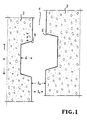
- Fig. 1 shows the gap (1) (longitudinal or transverse gap) of two adjacent tunnel segments (2, 3) made of concrete, which are each provided with a groove (4, 5) (groove depth d, groove width w). Appropriate sealing profiles are now inserted into these grooves. The actual sealing of the gap (1) takes place by compressing the opposite elastomer profiles, the gap distance being reduced from S o to S1. When building tunnels, it must be taken into account that the segments (2, 3) are arranged at an offset X to one another. This tunnel-specific criterion must always be taken into account in leak tests.
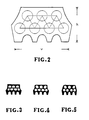
- Fig. 2 shows a sealing profile according to GB-B-2 182 987 with a base width v (breite joint width w) and the height h, the circular channels seen in cross section being offset from one another to form a lattice structure.
- This grid structure is illustrated schematically by the lines from center to center of the channels.
- This structural principle is also the basis of the sealing profiles according to FIGS. 3 to 5, which essentially only have a different shape of the channels.
- FIG. 6 now shows a sealing profile (6) with a two-row arrangement of channels (10, 11, 12, 13, 14, 15), with all channels in each row directly (ie without offset) above the groove grooves (7, 8, 9 ) are arranged, to form webs (lines A, B), which run straight and continuously from the profile base side (16) to the profile back (17). All the webs (A, B) are arranged perpendicular to the profile base side (16) or parallel to the longitudinal center plane Y.
- the channels are essentially semicircular in cross-section, the arcuate part (18, 19) of the channels facing each other.
- the centrally arranged side flanks (20, 20 ') and the side flanks (21, 21') facing the profile back (17) merge into one another with a change in angle.
- the groove grooves (23, 24, 25) and channels (26, 27, 28, 29, 30, 31) with the formation of webs (lines A, B) are also based on the structural principle according to the invention . While the webs (B) arranged in the profile center run perpendicular to the profile base side (32), the outer webs (A) are directed obliquely to the profile center, namely at an angle ⁇ of 10 ⁇ 3 ° (in relation to the longitudinal center plane Y).
- the sealing profile has additional webs (lines C), which are at an angle ⁇ of 45 ⁇ 5 ° (in relation to the longitudinal center plane Y) with simultaneous tangency of the side flank (33, 33 ') and the channels (26, 29, 30; 28 , 30, 31) towards the center of the profile.
- the channels (27, 30) in the profile center are essentially semicircular in shape when viewed in cross section, the arcuate part (36, 37) these channels are arranged to each other.
- the channels located above the outer groove grooves (23, 25) are seen in cross section from asymmetrical (channels 26, 28 of the first row) or of circular shape (channels 29, 31 of the second row).
- the centrally arranged side flanks (33, 33 ') and the side flanks (34, 34') facing the profile back (35) merge into one another with a change in angle.
- Table 2 now summarizes the results of experimental leak tests under tunnel-specific criteria. It should be noted that the sealing profiles according to the invention have a significantly higher sealing performance than the profile types according to FIGS. 2 to 5. This is particularly evident when comparing the sealing profiles according to FIGS. 3 and 7 (Table 3).
- the sealing profile (Fig. 7) in connection with the web system (A, B, C) and a hardness in Shore A of 70 ° is characterized by a particularly high sealing performance of 26 bar.
Landscapes
- Engineering & Computer Science (AREA)
- Structural Engineering (AREA)
- Mining & Mineral Resources (AREA)
- General Life Sciences & Earth Sciences (AREA)
- Civil Engineering (AREA)
- Life Sciences & Earth Sciences (AREA)
- Architecture (AREA)
- Geochemistry & Mineralogy (AREA)
- Geology (AREA)
- Lining And Supports For Tunnels (AREA)
- Gasket Seals (AREA)
- Sealing Material Composition (AREA)
- Road Signs Or Road Markings (AREA)
Abstract
Description
- Die Erfindung betrifft ein Dichtungsprofil gemäß Oberbegriff des Anspruchs 1.
- Die Dichtungsrahmen eines Segmentes aus Beton, Stahl, Stahlbeton oder Gußeisen bestehen zumeist aus vier zusammengesetzten strangförmigen Dichtungsprofilen (Profilbänder) aus elastomerem Werkstoff, d.h. aus Gummi oder gummiähnlichem Kunststoff, wobei die Rahmenecken vorzugsweise nach dem Injektion-Molding-Verfahren hergestellt werden. Von besonderer Bedeutung ist der Tunnelbau in Tübbing-Bauweise mit spezieller Anordnung der Segmente. Häufig genügt es, wenn jedes Segment einen Dichtungsrahmen aufweist. Unter besonderen Umständen kann es jedoch erforderlich werden, jedes Segment mit einem Doppeldichtungsrahmen zu versehen, wobei die beiden parallel verlaufenden Dichtungsrahmen mit einem zusätzlichen Dichtungsquerprofil (EP-A-0 337 177) miteinander verbunden sein können. Die Dichtungsprofile bzw. Dichtungsrahmen befinden sich meistens in einer entsprechenden Nut (Nuttiefe d, Nutbreite w) des Tunnel-Segmentes. Unter Einwirkung einer Kraft verringert sich der Spaltabstand zweier Tunnel-Segmente von so (Abstand im unbelasteten Zustand) auf S₁ (Abstand im belasteten Zustand). Dadurch werden die beiden gegenüberliegenden Elastomerprofile zusammengepreßt, was die Abdichtung des Spaltes zur Folge hat.
- Das erste Dichtungsprofil für Tunnel-Segmente wurde 1968 für den Elbtunnel in Hamburg entwickelt, wobei das Elastomerprofil vier Rillennuten aufwies. Bei diesem weltweit ersten Tunnelprojekt, bei dem Dichtungsprofile zum Einsatz kamen, bestanden die Segmente aus Gußeisen (World Tunnelling, 12/1989, Seite 459, Fig. 6). Bei späteren Tunnelprojekten in Kontinentaleuropa, Asien, Nord- und Südamerika sowie in Nordafrika wurden in zunehmenden Maße Segmente aus Beton eingesetzt. Die hierfür entwickelten Dichtungsprofile waren zumeist mit Rillennuten und Kanälen strukturiert (DE-U-78 22 476, DE-C-28 33 345, GB-B-2 178 114, EP-A-0 255 600, EP-A-0 306 796, EP-A-0 368 174, EP-A-0 414 137).
- In Großbritannien dagegen wurde erst 1983 damit begonnen, bei Tunnelprojekten die Segmente mit Elastomerprofilen abzudichten (GB-B-2 170 561; Don Valley Intercepting Sewer, 2/1985, Seite 16). Die besondere geologische Struktur Großbritanniens, insbesondere im Südenglamd durch die Kalksteinbodenformation, erlaubte es, daß über einen langen Zeitraum hinweg bei dem Bau von Tunneln auf eine Abdichtung mit Elastomerprofilen verzichtet werden konnte. Dadurch daß heute die relativ dünnwandigen Britischen Standardsegmente aus Beton lediglich mit einer entsprechenden Nut für die Aufnahme der Elastomerprofile ausgestattet werden und zudem durch die Beibehaltung ihrer alten Struktur unter Bildung von Parallelringen große Spaltweiten im Krümmungsbereich von Tunneln erzeugen, ist in Großbritannien eine Tunnelbausituation gegeben, die sich von der kontinentaleuropäischen Tunnelbauweise, die den Einsatz von konischen Ringen vorsieht, grundlegend unterscheidet (World Tunnelling, 11/1990, Seiten 415 - 420). Aus diesem Grunde wurde 1985 ein Spezialdichtungsprofil entwickelt, das eine zweireihige Anordnung von Kanälen, die unter Bildung einer Gitterstruktur versetzt zueinander angeordnet sind, aufweist (GB-B-2 182 987). Dieser sogenannte 'Doppeldecker' ist heute das Standardprofil in Großbritannien (Tunnelprojekte: Sheffield 3/4, Oldham, Liverpool, London Water Ring Main, Kanaltunnel auf der englischen Seite), das bei geforderter Dichtigkeit gegenüber einem üblichen Wasserdruck von etwa 3 bar (z.B. 3,2 bar bei Projekt Sheffield 4) für unterschiedliche Spaltabstände, insbesondere im Bereich So von 13 bis 20 mm, eingesetzt werden kann.
- Immer häufiger entstehen große Tunnel projekte in extrem tiefen Lagen. Zur Zeit befindet sich die Eisenbahnverbindung zwischen Frankreich und England in ihrer Bauphase (ADAC Motorwelt, 1/1991, Seiten 16 - 18), wobei sich die drei Tunnelröhren (2 Verkehrstunnel und 1 Service-Tunnel) an der tiefsten Stelle 100 m unter dem Meeresspiegel befinden. Die geforderte Dichtleistung ist 10 bar (20 bar unter Prüfbedingungen). Ein weiteres Projekt dieser Art wird den Großen Belt unterqueren, wobei hier eine Dichtleistung von 8 bar (16 bar unter Prüfbedingungen) gefordert wird. Dies setzt voraus, daß die Elastomerprofile für die Segmente eine langlebige und absolut sichere Dichtfunktion selbst bei starkem Versatz der Segmente besitzen.
- Aufgabe der Erfindung ist es daher, Dichtungsprofile zu entwickeln, die höchsten Anforderungen gerecht werden. Gelöst wird diese Aufgabe in überraschender Weise durch eine Profilstruktur gemäß Kennzeichen des Anspruchs 1 (Merkmalsgruppe d).
- Die Erfindung wird nun anhand von zwei Ausführungsbeispielen unter Bezugnahme auf schematische Zeichnungen sowie in Verbindung mit Daten aus Dichtheitsprüfungen näher erläutert. Es zeigen:
- Fig. 1
- den abzudichtenden Spalt zweier angrenzender Tunnel-Segmente;
- Fig. 2 bis 5
- Dichtungsprofile mit zweireihiger Anordnung der Kanäle gemäß dem Stand der Technik;
- Fig. 6, 7
- Dichtungsprofile mit der erfindungsgemäßen zweireihigem Anordnung der Kanäle.
- Fig. 1 zeigt dem Spalt (1) (Längs- oder Querspalt) zweier angrenzender Tunnel-Segmente (2, 3) aus Beton, die jeweils mit einer Nut (4, 5) (Nuttiefe d, Nutbreite w) versehen sind. In diese Nuten werden nun entsprechende Dichtungsprofile eingesetzt. Die eigentliche Abdichtung des Spaltes (1) erfolgt durch das Zusammenpressen der gegenüberliegenden Elastomerprofile, wobei sich der Spaltabstand von So auf S₁ verringert. Beim Bau von Tunneln muß dabei in Erwägung gezogen werden, daß die Segmente (2, 3) unter einem Versatz X zueinander angeordnet sind. Dieses tunnelspezifische Kriterium muß bei Dichtigkeitsprüfungen stets berücksichtigt werden.
- Fig. 2 zeigt ein Dichtungsprofil gemäß GB-B-2 182 987 mit einer Basisbreite v (≙ Fugenbreite w) und der Höhe h, wobei die im Querschnitt gesehen kreisförmigen Kanäle unter Bildung einer Gitterstruktur versetzt zueinander angeordnet sind. Diese Gitterstruktur wird durch die Linienführung von Mittelpunkt zu Mittelpunkt der Kanäle schematisch verdeutlicht. Dieses Strukturprinzip liegt auch den Dichtungsprofilen gemäß Fig. 3 bis 5 zugrunde, die im wesentlichen lediglich eine andere Form der Kanäle aufweisen.
- Die Tabelle 1 faßt nun hinsichtlich der Dichtungsprofile gemäß Fig. 2 bis 5 die Ergebnisse von experimentellen Dichtheitsprüfungen unter tunnelspezifischen Kriterien zusammen. Dabei liegt die durchschnittliche Dichtleistung bei 4 bar, die bei vielen Tunnelprojekten, insbesondere in Großbritannien, den Dichtheitsanforderungen genügt. Dabei haben die unterschiedlichen Formen und Größen der Kanäle keinen wesentlichen Einfluß auf die Dichtleistung. Benford's Aussage (Construction Today, 5/1990, Seite 15), daß verschiedene Konfigurationen und Größen der Kanäle bei gleicher Grundstruktur (d.h. Gitterstruktur) einen wesentlichen Einfluß auf die Höhe der Dichtleistung haben, wird hiermit widerlegt. Wie die Untersuchung zu dem Dichtprofil gemäß Fig. 3 zeigt, kann die Dichtleistung jedoch verbessert werden, wenn die Härte in Shore A von 65° auf 70° erhöht wird. Der Erhöhung der Shore-Härte zwecks Verbesserung der Dichtleistung sind jedoch Grenzen gesetzt, da es sonst zu Ausbrüchen an den Betonsegmenten kommen kann.
- Fig. 6 zeigt nun ein Dichtungsprofil (6) mit zweireihiger Anordnung von Kanälen (10, 11, 12, 13, 14, 15), wobei in jeder Reihe sämtliche Kanäle direkt (d.h. ohne Versatz) über den Rillennuten (7, 8, 9) angeordnet sind, und zwar unter Bildung vom Stegen (Linienführung A, B), die vom der Profilbasisseite (16) aus zum Profilrücken (17) hin geradlinig und durchgehend verlaufen. Sämtliche Stege (A, B) sind dabei senkrecht zur Profilbasisseite (16) bzw. parallel zur Längsmittelebene Y angeordnet. Die Kanäle sind im Querschnitt gesehen im wesentlichen von halbkreisförmiger Gestalt, wobei der bogenförmige Teil (18, 19) der Kanäle aufeinander zugerichtet ist. Die mittig angeordneten Seitenflanken (20, 20') und die dem Profilrücken (17) zugewandten Seitenflanken (21, 21') gehen unter Winkeländerung ineinander über.
- Bei dem Dichtungsprofil (22) gemäß Fig. 7 liegt den Rillennuten (23, 24, 25) und Kanälen (26, 27, 28, 29, 30, 31) unter Bildung von Stegen (Linienführung A, B) ebenfalls das erfindungsgemäße Strukturprinzip zugrunde. Während die im Profilzentrum angeordneten Stege (B) senkrecht zur Profilbasisseite (32) verlaufen, sind die Außenstege (A) schräg zur Profilmitte gerichtet, und zwar im einem Winkel α von 10 ± 3° (bezogen auf Längsmittelebene Y). Ferner weist das Dichtungsprofil zusätzliche Stege (Linienführung C) auf, die in einem Winkel β von 45 ± 5° (bezogen auf Längsmittelebene Y) unter gleichzeitiger Tangierung der Seitenflanke (33, 33') und der Kanäle (26, 29, 30; 28, 30, 31) auf die Profilmitte zuverlaufen. Die Kanäle (27, 30) im Profilzentrum sind im Querschnitt gesehen im wesentlichen vom halbkreisförmiger Gestalt, wobei der bogenförmige Teil (36, 37) dieser Kanäle zueinander angeordnet ist. Die über den äußeren Rillennuten (23, 25) sich befindenden Kanälen sind im Querschnitt gesehen vom asymmetrischer (Kanäle 26, 28 der ersten Reihe) bzw. von kreisförmiger Gestalt (Kanäle 29, 31 der zweiten Reihe). Die mittig angeordneten Seitenflanken (33, 33') und die zum Profilrücken (35) zugewandten Seitenflanken (34, 34') gehen unter Winkeländerung ineinander über.
- Die Tabelle 2 faßt nun hinsichtlich der Dichtungsprofile gemäß Fig. 6 und 7 die Ergebnisse von expermimentellen Dichtheitsprüfungen unter tunnelspezifischen Kriterien zusammen. Dabei ist festzuhalten, daß die erfindungsgemäßen Dichtungsprofile eine wesentlich höhere Dichtleistung haben als die Profiltypen gemäß Fig. 2 bis 5. Dies wird besonders ersichtlich bei einem Vergleich der Dichtungsprofile gemäß Fig. 3 und 7 (Tabelle 3). Dabei zeichnet sich das Dichtungsprofil (Fig. 7) in Verbindung mit dem Stegensystem (A, B, C) und einer Härte in Shore A von 70° durch eine besonders hohe Dichtleistung von 26 bar aus.
- Auch wenn die beiden Ausführungsbeispiele (Fig. 6, 7) ausschließlich auf Dichtungsprofile mit offenen Rillennuten eingehen, so ist das erfindungsgemäße Strukturprinzip der zweireihigen Anordnung der Kanäle auch auf Profile mit ganz oder teilweise geschlossenen Rillennuten (GB-A-2 017 194) anwendbar.


Claims (13)
- Dichtungsprofil (6, 22) aus elastomerem Werkstoff für mit einer umlaufenden Nut (4, 5) versehene Tunnel-Segmente (2, 3), dasa) an seiner Basisseite (16, 32) in Längsrichtung verlaufende Rillennuten (7, 8, 9; 23, 24, 25),b) ebenfalls in Längsrichtung verlaufende Kanäle (10 bis 15; 26 bis 31), die mehrreihig, insbesondere zweireihig, angeordnet sind sowiec) Seitenflanken (20, 20', 21, 21'; 33, 33', 34, 34'), die nach dem Einsetzen des Profils in die Nut (4, 5) keinen Segmentkontakt (im unbelasteten Zustand) haben, aufweist,
dadurch gekennzeichnet, daßd) in jeder Reihe sämtliche Kanäle (10, 11, 12 bzw. 13, 14, 15; 26, 27, 28 bzw. 29, 30, 31) direkt (d.h. ohne Versatz) über den Rillennuten (7, 8, 9; 23, 24, 25) angeordnet sind, und zwar unter Bildung von Stegen (Linienführung A, B), die von der Profilbasisseite (16, 32) aus zum Profilrücken (17, 35) hin geradlinig und durchgehend verlaufen. - Dichtungsprofil nach Anspruch 1, dadurch gekennzeichnet, daß im jeder Reihe die gleiche Anzahl von Kanälen ist.
- Dichtungsprofil nach Anspruch 2, dadurch gekennzeichnet, daß das Anzahlverhältnis von Kanälen zu Rillennuten 2 : 1 beträgt.
- Dichtungsprofil nach einem der Ansprüche 1 bis 3, dadurch gekennzeichnet, daß sämtliche Stege (A, B) senkrecht zur Profilbasisseite (16) verlaufen.
- Dichtungsprofil nach einem der Ansprüche 1 bis 3, dadurch gekennzeichnet, daß die im Profilzentrum angeordneten Stege (B) senkrecht zur Profilbasisseite (32) verlaufen, während die Außenstege (A) schräg zur Profilmitte (Längsmittelebene Y) gerichtet sind.
- Dichtungsprofil nach Anspruch 5, dadurch gekennzeichnet, daß die Außenstege (A) in einem Winkel α von 10 ± 3° (bezogen auf Längsmittelebene Y) auf die Profilmitte zuverlaufen.
- Dichtungsprofil nach einem der Ansprüche 1 bis 6, dadurch gekennzeichnet, daß zusätzliche Stege (Linienführung C) vorhanden sind, die schräg zur Profilmitte (Längsmittelebene Y) gerichtet sind, und zwar unter Tangierung der Seitenflanken (33, 33') und der Kanäle (26, 29, 30; 28, 30, 31).
- Dichtungsprofil nach Anspruch 7, dadurch gekennzeichnet, daß die Stege (C) in einem Winkel β von 45 ± 5° (bezogen auf Längsmittelebene Y) auf die Profilmitte zuverlaufen.
- Dichtungsprofil nach einem der Ansprüche 1 bis 8, dadurch gekennzeichnet, daß die Kanäle (10, 11, 12; 26, 27, 28) der ersten Reihe (von der Profilbasisseite 16, 32 aus betrachtet) im Querschnitt gesehen eine andere Gestalt (Konfiguration und/oder Größe) aufweisen als die Kanäle (13, 14, 15; 29, 30, 31) der zweiten Reihe.
- Dichtungsprofil nach Anspruch 9, dadurch gekennzeichnet, daß sämtliche Kanäle (10 bis 15) im Querschnitt gesehen im wesentlichen von halbkreisförmiger Gestalt sind, wobei der bogenförmige Teil (18, 19) der Kanäle zueinander angeordnet ist.
- Dichtungsprofil nach Anspruch 9, dadurch gekennzeichnet, daß die Kanäle (27, 30) im Profilzentrum im Querschnitt gesehen im wesentlichen von halbkreisförmiger Gestalt sind, wobei der bogenförmige Teil (36, 37) dieser Kanäle zueinander angeordnet ist, und daß die über den äußeren Rillennuten (23, 25) angeordneten Kanäle im Querschnitt gesehen von asymmetrischer (Kanäle 26, 28 der ersten Reihe) bzw. von kreisförmiger (Kanäle 29, 31 der zweiten Reihe) Gestalt sind.
- Dichtungsprofil nach einem der Ansprüche 1 bis 11, dadurch gekennzeichnet, daß die mittig angeordneten Seitenflanken (20, 20'; 33, 33') und die zum Profilrücken (17, 35) zugewandten Seitenflanken (21, 21'; 34, 34') unter Winkeländerung ineinander übergehen.
- Dichtungsprofil nach einem der Ansprüche 1 bis 12, dadurch gekennzeichnet, daß die Härte in Shore A 70 ± 5° beträgt.
Applications Claiming Priority (4)
| Application Number | Priority Date | Filing Date | Title |
|---|---|---|---|
| DE4003583 | 1990-02-07 | ||
| DE4003583 | 1990-02-07 | ||
| DE4004347 | 1990-02-13 | ||
| DE4004347 | 1990-02-13 |
Publications (2)
| Publication Number | Publication Date |
|---|---|
| EP0441250A1 true EP0441250A1 (de) | 1991-08-14 |
| EP0441250B1 EP0441250B1 (de) | 1994-04-20 |
Family
ID=25889832
Family Applications (1)
| Application Number | Title | Priority Date | Filing Date |
|---|---|---|---|
| EP91101335A Expired - Lifetime EP0441250B1 (de) | 1990-02-07 | 1991-02-01 | Dichtungsprofil für Tunnel-Segmente |
Country Status (5)
| Country | Link |
|---|---|
| EP (1) | EP0441250B1 (de) |
| AT (1) | ATE104743T1 (de) |
| DE (2) | DE59101409D1 (de) |
| DK (1) | DK0441250T3 (de) |
| ES (1) | ES2056503T3 (de) |
Cited By (7)
| Publication number | Priority date | Publication date | Assignee | Title |
|---|---|---|---|---|
| EP0534277A1 (de) | 1991-09-21 | 1993-03-31 | Phoenix Aktiengesellschaft | Dichtungsprofil für Tunnelausbausegmente |
| WO1994016197A1 (de) * | 1993-01-14 | 1994-07-21 | Phoenix Aktiengesellschaft | Dichtungsprofil für tunnelrohrsegmente, insbesondere für einschwimmelemente |
| WO1999002820A1 (de) * | 1997-07-08 | 1999-01-21 | Phoenix Aktiengesellschaft | Dichtanordnung für tunnel-segmente |
| WO1999054593A1 (de) | 1998-04-20 | 1999-10-28 | Hochtief Aktiengesellschaft Vorm. Gebr. Helfmann | Vorrichtung und verfahren zur lagestabilen befestigung eines dichtungselementes an einer schalung |
| DE102009015232A1 (de) | 2009-04-01 | 2010-10-07 | Phoenix Dichtungstechnik Gmbh | Dichtanordnung für Schacht- und Tunnelbauten |
| WO2011063804A2 (de) | 2009-11-30 | 2011-06-03 | Phoenix Dichtungstechnik Gmbh | Dichtanordnung für schacht- und tunnelbauten |
| CN106050275A (zh) * | 2016-07-13 | 2016-10-26 | 同济大学 | 一种盾构隧道管片螺栓孔密封防水装置 |
Families Citing this family (3)
| Publication number | Priority date | Publication date | Assignee | Title |
|---|---|---|---|---|
| DE50205176D1 (de) | 2001-10-11 | 2006-01-12 | Daetwyler Ag | Dichtungsprofil für Tunnel-Segmente |
| EP1723309B1 (de) * | 2004-03-11 | 2012-06-20 | Phoenix Dichtungstechnik GmbH | Dichtanordnung |
| DE102016121452B4 (de) * | 2016-11-09 | 2019-09-19 | CTS Cordes tubes & seals GmbH & Co. KG | Dichtungsprofil, und damit ausgestattete Dichtungsanordnung |
Citations (3)
| Publication number | Priority date | Publication date | Assignee | Title |
|---|---|---|---|---|
| EP0222968A1 (de) * | 1985-11-15 | 1987-05-27 | Phoenix Aktiengesellschaft | Dichtungsprofil für Segmente von Tunnelröhren |
| EP0306796A1 (de) * | 1987-09-05 | 1989-03-15 | Phoenix Aktiengesellschaft | Dichtungsprofil für Tunnel-Segmente |
| GB2210117A (en) * | 1987-12-15 | 1989-06-01 | Phoenix Ag | Sealing profile for tunnel segments |
-
1991
- 1991-02-01 DK DK91101335.7T patent/DK0441250T3/da active
- 1991-02-01 ES ES91101335T patent/ES2056503T3/es not_active Expired - Lifetime
- 1991-02-01 DE DE59101409T patent/DE59101409D1/de not_active Expired - Lifetime
- 1991-02-01 AT AT9191101335T patent/ATE104743T1/de not_active IP Right Cessation
- 1991-02-01 EP EP91101335A patent/EP0441250B1/de not_active Expired - Lifetime
- 1991-02-01 DE DE4103089A patent/DE4103089A1/de not_active Withdrawn
Patent Citations (3)
| Publication number | Priority date | Publication date | Assignee | Title |
|---|---|---|---|---|
| EP0222968A1 (de) * | 1985-11-15 | 1987-05-27 | Phoenix Aktiengesellschaft | Dichtungsprofil für Segmente von Tunnelröhren |
| EP0306796A1 (de) * | 1987-09-05 | 1989-03-15 | Phoenix Aktiengesellschaft | Dichtungsprofil für Tunnel-Segmente |
| GB2210117A (en) * | 1987-12-15 | 1989-06-01 | Phoenix Ag | Sealing profile for tunnel segments |
Cited By (13)
| Publication number | Priority date | Publication date | Assignee | Title |
|---|---|---|---|---|
| EP0534277A1 (de) | 1991-09-21 | 1993-03-31 | Phoenix Aktiengesellschaft | Dichtungsprofil für Tunnelausbausegmente |
| WO1994016197A1 (de) * | 1993-01-14 | 1994-07-21 | Phoenix Aktiengesellschaft | Dichtungsprofil für tunnelrohrsegmente, insbesondere für einschwimmelemente |
| US6238139B1 (en) | 1993-01-14 | 2001-05-29 | Phoenix Aktiengesellschaft | Sealing arrangement |
| WO1999002820A1 (de) * | 1997-07-08 | 1999-01-21 | Phoenix Aktiengesellschaft | Dichtanordnung für tunnel-segmente |
| US6267536B1 (en) | 1997-07-08 | 2001-07-31 | Phoenix Aktiengesellschaft | Sealing arrangement for tunnel segments |
| WO1999054593A1 (de) | 1998-04-20 | 1999-10-28 | Hochtief Aktiengesellschaft Vorm. Gebr. Helfmann | Vorrichtung und verfahren zur lagestabilen befestigung eines dichtungselementes an einer schalung |
| DE102009015232A1 (de) | 2009-04-01 | 2010-10-07 | Phoenix Dichtungstechnik Gmbh | Dichtanordnung für Schacht- und Tunnelbauten |
| WO2010112015A3 (de) * | 2009-04-01 | 2011-03-03 | Phoenix Dichtungstechnik Gmbh | Dichtanordnung für schacht- und tunnelbauten |
| WO2011063804A2 (de) | 2009-11-30 | 2011-06-03 | Phoenix Dichtungstechnik Gmbh | Dichtanordnung für schacht- und tunnelbauten |
| DE102009056063A1 (de) | 2009-11-30 | 2011-07-14 | Phoenix Dichtungstechnik GmbH, 99880 | Dichtanordnung für Schacht- und Tunnelbauten |
| US9222358B2 (en) | 2009-11-30 | 2015-12-29 | Daetwyler Sealing Technologies Deutschland Gmbh | Sealing arrangement for shaft and tunnel constructions |
| CN106050275A (zh) * | 2016-07-13 | 2016-10-26 | 同济大学 | 一种盾构隧道管片螺栓孔密封防水装置 |
| CN106050275B (zh) * | 2016-07-13 | 2018-10-26 | 同济大学 | 一种盾构隧道管片螺栓孔密封防水装置 |
Also Published As
| Publication number | Publication date |
|---|---|
| DE4103089A1 (de) | 1991-08-08 |
| ATE104743T1 (de) | 1994-05-15 |
| EP0441250B1 (de) | 1994-04-20 |
| DK0441250T3 (da) | 1994-07-25 |
| ES2056503T3 (es) | 1994-10-01 |
| DE59101409D1 (de) | 1994-05-26 |
Similar Documents
| Publication | Publication Date | Title |
|---|---|---|
| EP0306796B1 (de) | Dichtungsprofil für Tunnel-Segmente | |
| EP0807204B1 (de) | Dichtanordnung für insbesondere tunnelrohrsegmente | |
| EP0521324B2 (de) | Kabelmuffe | |
| EP0441250B1 (de) | Dichtungsprofil für Tunnel-Segmente | |
| EP0255600A1 (de) | Dichtungsprofil für Segmente von Tunnelröhren | |
| EP1095206B1 (de) | Dichtanordnung | |
| EP0414137B1 (de) | Dichtungsprofil für Tunnel-Segmente | |
| EP0995013A1 (de) | Dichtanordnung für tunnel-segmente | |
| EP1302626B1 (de) | Dichtungsprofil für Tunnel-Segmente | |
| EP0863334B1 (de) | Faltenbalg | |
| EP0629262B1 (de) | Dichtungsprofil für tunnelrohrsegmente, insbesondere für einschwimmelemente | |
| EP0368174B1 (de) | Dichtungsprofil für Tunnel-Segmente | |
| CH677262A5 (de) | ||
| DE602004002083T2 (de) | O-Ring für Pressverbindungen | |
| EP0337177B1 (de) | Dichtung für Tunnel-Segmente | |
| CH686383A5 (de) | Verfahren zur Herstellung einer nicht verschiebbaren Dichtungsprofilleiste und nach diesem Verfahren hergestellte Leiste. | |
| DE3020710C2 (de) | ||
| DE9317172U1 (de) | Dicht-, Zier- oder Abschlußleiste | |
| EP1723309B1 (de) | Dichtanordnung | |
| DE19616143C1 (de) | Tunnelauskleidung mit in Tunnellängsrichtung hintereinander angeordneten Tübbingringen | |
| EP0534277B1 (de) | Dichtungsprofil für Tunnelausbausegmente | |
| DE3829286A1 (de) | Dichtungsprofil fuer tunnel-segmente | |
| DE2224230C3 (de) | Behälter aus Beton-Fertigteilen | |
| DE69005602T2 (de) | Dichtungsprofil für Tunnelausbausegmente. | |
| DE2235158C3 (de) | Fugendichtungsstrang aus gummielastischem Material |
Legal Events
| Date | Code | Title | Description |
|---|---|---|---|
| PUAI | Public reference made under article 153(3) epc to a published international application that has entered the european phase |
Free format text: ORIGINAL CODE: 0009012 |
|
| AK | Designated contracting states |
Kind code of ref document: A1 Designated state(s): AT BE CH DE DK ES FR GB GR IT LI LU NL SE |
|
| 17P | Request for examination filed |
Effective date: 19910829 |
|
| GBC | Gb: translation of claims filed (gb section 78(7)/1977) | ||
| 17Q | First examination report despatched |
Effective date: 19920804 |
|
| GRAA | (expected) grant |
Free format text: ORIGINAL CODE: 0009210 |
|
| AK | Designated contracting states |
Kind code of ref document: B1 Designated state(s): AT BE CH DE DK ES FR GB GR IT LI LU NL SE |
|
| REF | Corresponds to: |
Ref document number: 104743 Country of ref document: AT Date of ref document: 19940515 Kind code of ref document: T |
|
| ITF | It: translation for a ep patent filed | ||
| REF | Corresponds to: |
Ref document number: 59101409 Country of ref document: DE Date of ref document: 19940526 |
|
| GBT | Gb: translation of ep patent filed (gb section 77(6)(a)/1977) |
Effective date: 19940621 |
|
| REG | Reference to a national code |
Ref country code: DK Ref legal event code: T3 |
|
| ET | Fr: translation filed | ||
| REG | Reference to a national code |
Ref country code: GR Ref legal event code: FG4A Free format text: 3012474 |
|
| REG | Reference to a national code |
Ref country code: ES Ref legal event code: FG2A Ref document number: 2056503 Country of ref document: ES Kind code of ref document: T3 |
|
| EAL | Se: european patent in force in sweden |
Ref document number: 91101335.7 |
|
| PLBE | No opposition filed within time limit |
Free format text: ORIGINAL CODE: 0009261 |
|
| STAA | Information on the status of an ep patent application or granted ep patent |
Free format text: STATUS: NO OPPOSITION FILED WITHIN TIME LIMIT |
|
| 26N | No opposition filed | ||
| REG | Reference to a national code |
Ref country code: GB Ref legal event code: IF02 |
|
| PGFP | Annual fee paid to national office [announced via postgrant information from national office to epo] |
Ref country code: GR Payment date: 20041221 Year of fee payment: 15 |
|
| PGFP | Annual fee paid to national office [announced via postgrant information from national office to epo] |
Ref country code: LU Payment date: 20050112 Year of fee payment: 15 |
|
| PGFP | Annual fee paid to national office [announced via postgrant information from national office to epo] |
Ref country code: DK Payment date: 20050201 Year of fee payment: 15 |
|
| PG25 | Lapsed in a contracting state [announced via postgrant information from national office to epo] |
Ref country code: DK Free format text: LAPSE BECAUSE OF NON-PAYMENT OF DUE FEES Effective date: 20060228 Ref country code: LU Free format text: LAPSE BECAUSE OF NON-PAYMENT OF DUE FEES Effective date: 20060228 |
|
| REG | Reference to a national code |
Ref country code: DK Ref legal event code: EBP |
|
| REG | Reference to a national code |
Ref country code: CH Ref legal event code: PFA Owner name: PHOENIX AKTIENGESELLSCHAFT Free format text: PHOENIX AKTIENGESELLSCHAFT#HANNOVERSCHE STRASSE 88#D-21079 HAMBURG (DE) -TRANSFER TO- PHOENIX AKTIENGESELLSCHAFT#HANNOVERSCHE STRASSE 88#D-21079 HAMBURG (DE) |
|
| PG25 | Lapsed in a contracting state [announced via postgrant information from national office to epo] |
Ref country code: GR Free format text: LAPSE BECAUSE OF NON-PAYMENT OF DUE FEES Effective date: 20060904 |
|
| PGFP | Annual fee paid to national office [announced via postgrant information from national office to epo] |
Ref country code: DE Payment date: 20100228 Year of fee payment: 20 |
|
| PGFP | Annual fee paid to national office [announced via postgrant information from national office to epo] |
Ref country code: ES Payment date: 20100726 Year of fee payment: 20 Ref country code: CH Payment date: 20100726 Year of fee payment: 20 Ref country code: NL Payment date: 20100723 Year of fee payment: 20 |
|
| PGFP | Annual fee paid to national office [announced via postgrant information from national office to epo] |
Ref country code: FR Payment date: 20100805 Year of fee payment: 20 Ref country code: SE Payment date: 20100723 Year of fee payment: 20 Ref country code: IT Payment date: 20100726 Year of fee payment: 20 Ref country code: AT Payment date: 20100723 Year of fee payment: 20 |
|
| PGFP | Annual fee paid to national office [announced via postgrant information from national office to epo] |
Ref country code: GB Payment date: 20100722 Year of fee payment: 20 |
|
| REG | Reference to a national code |
Ref country code: DE Ref legal event code: R071 Ref document number: 59101409 Country of ref document: DE |
|
| REG | Reference to a national code |
Ref country code: NL Ref legal event code: V4 Effective date: 20110201 |
|
| REG | Reference to a national code |
Ref country code: CH Ref legal event code: PL |
|
| REG | Reference to a national code |
Ref country code: GB Ref legal event code: PE20 Expiry date: 20110131 |
|
| BE20 | Be: patent expired |
Owner name: *PHOENIX A.G. Effective date: 20110201 |
|
| PGFP | Annual fee paid to national office [announced via postgrant information from national office to epo] |
Ref country code: BE Payment date: 20100729 Year of fee payment: 20 |
|
| REG | Reference to a national code |
Ref country code: ES Ref legal event code: FD2A Effective date: 20110222 |
|
| EUG | Se: european patent has lapsed | ||
| PG25 | Lapsed in a contracting state [announced via postgrant information from national office to epo] |
Ref country code: NL Free format text: LAPSE BECAUSE OF EXPIRATION OF PROTECTION Effective date: 20110201 |
|
| PG25 | Lapsed in a contracting state [announced via postgrant information from national office to epo] |
Ref country code: GB Free format text: LAPSE BECAUSE OF EXPIRATION OF PROTECTION Effective date: 20110131 Ref country code: ES Free format text: LAPSE BECAUSE OF EXPIRATION OF PROTECTION Effective date: 20110202 |
|
| PG25 | Lapsed in a contracting state [announced via postgrant information from national office to epo] |
Ref country code: DE Free format text: LAPSE BECAUSE OF EXPIRATION OF PROTECTION Effective date: 20110201 |