EP0441558B1 - Améliorations relatives à des champs de données pour le contrÔle d'éléments d'image - Google Patents
Améliorations relatives à des champs de données pour le contrÔle d'éléments d'image Download PDFInfo
- Publication number
- EP0441558B1 EP0441558B1 EP91300862A EP91300862A EP0441558B1 EP 0441558 B1 EP0441558 B1 EP 0441558B1 EP 91300862 A EP91300862 A EP 91300862A EP 91300862 A EP91300862 A EP 91300862A EP 0441558 B1 EP0441558 B1 EP 0441558B1
- Authority
- EP
- European Patent Office
- Prior art keywords
- colour
- image
- target
- pixel
- function
- Prior art date
- Legal status (The legal status is an assumption and is not a legal conclusion. Google has not performed a legal analysis and makes no representation as to the accuracy of the status listed.)
- Expired - Lifetime
Links
Images


Classifications
-
- G—PHYSICS
- G06—COMPUTING OR CALCULATING; COUNTING
- G06T—IMAGE DATA PROCESSING OR GENERATION, IN GENERAL
- G06T11/00—Two-dimensional [2D] image generation
- G06T11/10—Texturing; Colouring; Generation of textures or colours
-
- H—ELECTRICITY
- H04—ELECTRIC COMMUNICATION TECHNIQUE
- H04N—PICTORIAL COMMUNICATION, e.g. TELEVISION
- H04N1/00—Scanning, transmission or reproduction of documents or the like, e.g. facsimile transmission; Details thereof
- H04N1/46—Colour picture communication systems
- H04N1/56—Processing of colour picture signals
- H04N1/60—Colour correction or control
-
- H—ELECTRICITY
- H04—ELECTRIC COMMUNICATION TECHNIQUE
- H04N—PICTORIAL COMMUNICATION, e.g. TELEVISION
- H04N1/00—Scanning, transmission or reproduction of documents or the like, e.g. facsimile transmission; Details thereof
- H04N1/46—Colour picture communication systems
- H04N1/56—Processing of colour picture signals
- H04N1/60—Colour correction or control
- H04N1/62—Retouching, i.e. modification of isolated colours only or in isolated picture areas only
Definitions
- the invention relates to methods and apparatus for generating an array of control data, the array having a number of pixels each of which corresponds to a respective pixel in an image.
- control data arrays are commonly termed masks and find wide use in image processing systems. For example, in page layout they may define the areas and positions occupied by the features in the page, as well as the area of each image to be included. In image retouching, or colour correction they may define which pixels of an image are to be modified. In electronic paint systems they may represent the density of the spray from an air brush. In design systems they may indicate the density gradation of a vignette pattern or shadow region.
- Hard masks have 1 bit per pixel. Their purpose is to separate the pixels of an image into two classes, one class to be processed in a certain way and the other to be processed in a different way.
- Soft masks or "mattes" have multiple (usually 8) bits per pixel. They specify for each pixel a density value, which may represent the transparency (or opacity) of the pixel for a mixing operation. Into the latter category also fall soft-edged masks, having a hard interior but a graduated edge. These are typically used for "anti-aliased" compositing of curved shapes in computer graphics applications.
- masks simplifies both the operation and the software design of a product. For the operator the advantages are that fewer items of information need to be kept in mind at any one time. He can concentrate first on making the mask, using a variety of electronic "tools" as appropriate, then on using it to control the scope of some operation, such as image retouching. Similarly the software designer can create one set of routines for making and manipulating masks, and another for the transforms on images or pages.
- a separate mask facilitates the design of hardware for the combination of two or more images for display on a video monitor.
- binary pixel values read from the mask store can be used to control a video-rate switch between the corresponding pixels of source images read synchronously from separate image stores.
- 8-bit pixel mask pixel values read from the mask store can be used to control a video-rate mixer that adds proportions of each of the source image pixels.
- Masks can be generated conventionally in a number of ways.
- the operator might outline and fill an area of an image which is to be one class resulting in all the corresponding control pixels being coded with a binary "1" while the remainder are coded with a binary "0".
- a colour selective technique can be used to define a hard mask. In this technique each pixel of the source image is checked to determine whether the individual colour values (such as red, green, blue) fall into specified ranges. The true/false results are combined logically to give a final true or false (1 or 0) value for the corresponding mask pixel. The mask can then be displayed superimposed over the image.
- the algorithm used in the Crosfield Studio 800 system allows up to four classes of source colour to be defined.
- Each class consists of a range of values for one or more of the CMYK (cyan, magenta, yellow, black) inks (defaulting to 0-100% if not defined).
- the ranges C1, M1, etc are any arbitrary sets of values in each colour. Normally each range would represent one contiguous set of values, such as 40 ⁇ C ⁇ 60, but non-contiguous sets are also allowed.
- US-A-4878178 discloses an image processing device in which data defining the content of a pixel is made up of six binary digits defining R, G and B components and two bits defining label information. The label information is used to select particular pixels for colour modification.
- EP-A-0159691 describe a colour image display system using a histogram technique to determine colours to be displayed.
- a method of generating an array of control data for use as a mask for processing an image comprising selecting at least one target colour, and then for each control data array pixel generating a control value in accordance with a predetermined algorithm which defines the control value as a function of the corresponding image pixel colour components and the corresponding colour component(s) of the target colour(s), the function defining an ellipsoidal region in the colour space of the colour components wherein the generated control values can be ordered on a scale of at least three value classes to define a multi-bit mask and wherein the step of defining the target colour comprises specifying an area of interest within the image; constructing a histogram of pixel values within the specified area of interest and determining from the histogram the median and given percentile points for each colour component, and thereby providing the target colour weighting and spread coefficients for the predetermined algorithm.
- apparatus for generating an array of control data for use as a mask for processing an image, the array having a number of pixels each of which corresponds to a respective pixel in an image
- the apparatus comprising a first store for storing the image data; a second store for storing the control data; and processing means which, for each control data array pixel generates and stores in the second store a control value in accordance with a predetermined algorithm which defines the control value as a function of the corresponding image pixel colour components and the corresponding colour component(s) of at least one preselected target colour, wherein the generated control values can be ordered on a scale of at least three value classes to define a multi-bit mask characterised in that the function performed by the predetermined algorithm defines an ellipsoidal region in the colour space of the colour components; and in that the processing means preselects a target colour following the specification of an area of interest within the image by constructing a histogram of pixel values within the specified area of interest and determining from the
- This invention improves upon the previous colour selective masking technique by obtaining a measure of the proximity of the colour coordinates of an image pixel to some target point in colour space, rather than simply making a binary decision about each colour component independently.
- the predetermined algorithm can define the control value as representing a function of the Euclidean distance in colour space between the image pixel colour and the target colour.
- equation 1 defines the control value in terms of all four colour component values, this is not essential and only one or some of the colour component values could be used. It should also be understood that any other suitable colour space could be used in place of CMYK, which is customary for printing applications. For example, in the frame stores for video display monitors pixels would typically be represented by red, green and blue colour components. In broadcast television, colour is encoded differently for transmission, such as the YIQ signals in the NTSC system. In yet other applications, such as paint and dye formulation, the CIE system is commonly used with LAB or LUV coordinates. The present invention applies without loss of generality to all of these, and other, colour spaces.
- the effect of this function is to have a maximum value at the foreground target colour, a minimum value at the background target colour and intermediate values elsewhere.
- the function may include a thresholding step in which an intermediate control value is compared with a threshold to generate a final, binary control value or the final value may be generated from an intermediate value and tone curves leading to a soft mask.
- an object which may appear generally red may actually contain a number of tints from blacks in deep shadows, intense reds where the object reflects internally, pinks and whites for highlights, and so on. These tints are not necessarily the nearest to the target colour in the first colour space that is available, but span a range extending from the pure colour towards both white and black.
- the initial colour components defining the image in a first colour space are transformed into a second or subsequent colour space from which the control values can be determined.
- the first colour space is transformed so that the colour components defining the central locus of the target colour range lie along the major axis of the second colour space, with the other two axes being perpendicular to the first axis and to each other. From this second colour space it is easy to derive the control values corresponding to each pixel of the image.
- Y T is a target colour component value and N is a scaling coefficient chosen so that the required amount of sensitivity for that colour component is achieved
- N is a scaling coefficient chosen so that the required amount of sensitivity for that colour component is achieved
- outputs from the look-up tables being fed to adders which generate the sum of the outputs, the output from the adders being fed to a fifth look-up table which reduces the accuracy back to eight bits.
- This look-up table is commonly loaded with a linear or square root function.
- the rectangular contour 2 which is shown illustrates, for comparison purposes, the effect of a conventional thresholding technique which simply makes a true/false decision depending upon whether or not C and M are within a range of values spanning the target colour.
- a conventional thresholding technique which simply makes a true/false decision depending upon whether or not C and M are within a range of values spanning the target colour.
- any combination of C and M within the rectangle result in a mask value 1, anywhere outside the rectangle result in a mask value 0.
- the region in colour space can be restricted to an ellipse so that points that were included in the corners of the rectangle will now be excluded.
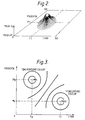
- Figure 2 illustrates the form of the function defined by equation (2) above with the Z-axis representing the magnitude of the function.
- Figure 3 illustrates an example of the function defined in equation (5) above in two dimensions.
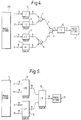
- Figure 4 illustrates a first embodiment of a hardware arrangement for implementing the method.
- respective colour components C, M, Y and K of pixel data in the image store 100 are fed to four look-up tables 3-6 (L1-L4), each having 256 addressable entries with an 8-bit data value stored at each entry.
- the outputs from the look-up tables 3, 4 are fed to an adder 7 while the outputs from the look-up tables 5, 6 are fed to an adder 8.
- the 9-bit outputs from the adders 7, 8 are fed to an adder 9 whose 10-bit output is used to address a look-up table 10 having 1024 entries, each containing an 8-bit mask value, which is stored in the corresponding pixel location in mask store 17.
- Figure 5 illustrates an alternative circuit, which is functionally almost identical to the circuit in Figure 4.
- the colour component data C, M and Y, K are fed in pairs from the image store 1 to look-up tables 11, 12 (L10,L11) each of which has dimensions 64K x 8.
- the outputs from the look-up tables 11, 12 are fed to a further look-up table 13 (L12) to generate the final 8 bit value for storage in the mask store 17.
- the advantage of this arrangement is that the adders are omitted allowing more complex two-dimensional functions to be represented (e.g. ellipses with rotated axes).
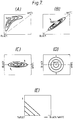
- the user will first define the target colour. This may involve, for example, displaying the image (Fig. 6A) on a monitor and then defining regions in the image having the colour which it is desired to mask.
- a colour-selective mask for the boy's T-shirt is required so that the operator might circle two regions 14, 15 using a cursor or the like and then a further region 16 corresponding to an area which is not to be masked.
- the computer then "plots" all the pixels within the contours 14-16 in colour space and constructs a histogram for the distribution within each colour coordinate as illustrated in Fig. 6B. This histogram is then analysed to determine the median and given percentile points (in this case 10% and 90%) in each colour channel as shown in Fig 6B. The mean is used to define the colour component values of the target colour as shown.
- the operator then instructs the computer to perform the appropriate algorithm as defined by the look-up tables of either the Figure 4 or Figure 5 circuit.
- the resultant mask is then stored in a store 17.
- the operator could subsequently apply a simple threshold operation to the 8-bit data in mask store 17, displaying pixels of the mask where the value exceeds the threshold level by a distinctive colour such as bright green. Interactive adjustment of the threshold level would allow the operator to use judgement as to the optimum setting.
- LCH perceptual colour attributes of lightness, colorfulness and hue
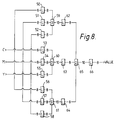
- the initial CMY values are thus applied to respective sets of three of the look-up tables 50-58 which in the first section will convert these colour components to new colour values C', M', Y', to define a set of elliptical contours aligned to the diagonal as shown in Figure 7B.
- the target point is now on the diagonal of the colour cube while the black and white points stay unchanged.
- the actual transformation is conveniently performed by scaling by linear amounts above and below the target colour, ie. by fitting straight lines from the target colour to the white and black points respectively.
- This introduces a geometric discontinuity at the target point, although in most instances this causes no visible discontinuity in the final mask.
- This discontinuity could be eliminated by fitting a higher order curve, such as a parabola, through the target to the white and black points.
- the X' axis approximates the lightness dimension in a perceptual colour space
- the Y', Z' axes approximate the opponent red-green and yellow-blue dimensions respectively.
- the new axes are scaled by respective, different amounts, an origin shift is performed and the resulting component values are squared.
- the output values of these look-up tables 62-64 are reduced to eight bits and then fed to a summation circuit 65 and thence to an output look-up table 66 which may be loaded with a square-root or other function to derive the 8-bit mask value, in similar fashion to LUT 10 of Figure 4.
Landscapes
- Engineering & Computer Science (AREA)
- Multimedia (AREA)
- Signal Processing (AREA)
- Physics & Mathematics (AREA)
- General Physics & Mathematics (AREA)
- Theoretical Computer Science (AREA)
- Image Processing (AREA)
- Color Image Communication Systems (AREA)
- Editing Of Facsimile Originals (AREA)
- Facsimile Image Signal Circuits (AREA)
Claims (9)
- Procédé pour produire un champ de données de commande, à utiliser comme masque en vue de traiter une image, le champ présentant un nombre de pixels dont chacun correspond à un pixel correspondant d'une image, le procédé comportant la sélection d'au moins une couleur-cible et ensuite, pour chaque pixel du champ de données de commande, la production d'une valeur de commande, en accord avec un algorithme prédéterminé qui définit la valeur de commande en fonction des composantes chromatiques du pixel d'image correspondant et de la ou des composantes chromatiques correspondantes de la ou des couleurs-cible, la fonction définissant une région ellipsoídale dans l'espace chromatique des composantes chromatiques, dans laquelle les valeur de commande produites peuvent être rangées sur une échelle d'au moins trois classes de valeurs pour définir un masque multibits, et dans lequel l'étape consistant à définir la couleur-cible comporte la définition d'une région de travail (14-16) dans l'image; la construction de l'histogramme des composantes chromatiques des valeurs de pixel situées dans la zone de travail spécifiée, et la détermination, à partir des histogrammes, de la médiane et de points de percentile donnés pour chaque composante chromatique, et ainsi fournir les coefficients de pondération et de dispersion de la couleur-cible, pour l'algorithme prédéterminé.
- Procédé selon la revendication 1, dans lequel l'algorithme prédéterminé définit la valeur de commande comme représentant une fonction de distance Euclidienne dans l'espace chromatique entre la couleur du pixel d'image et la couleur-cible.
- Procédé selon la revendication 2, dans lequel l'algorithme prédéterminé présente la formeCT, MT, YT et KT sont les valeurs des composantes chromatiques de la couleur-cible,C, M, Y, K sont les valeurs des composantes chromatiques du pixel d'image, eta, b, c et d sont les coefficients de pondération.
- Procédé selon la revendication 1 ou la revendication 2, dans lequel l'algorithme prédéterminé présente la formea est un facteur de normalisation,et b, c gouvernent la largeur des distributions de C,M.
- Procédé selon la revendication 1 ou la revendication 2, dans lequel l'algorithme prédéterminé présente la formefF est la fonction d'avant-planfB est la fonction d'arrière-planet f0 est une constante.
- Procédé selon l'une quelconque des revendications précédentes, qui comporte en outre une étape préliminaire dans laquelle les composantes chromatiques initiales qui définissent l'image dans un premier espace chromatique sont transformées dans un deuxième espace chromatique, ou espace chromatique suivant, à partir duquel les valeurs de commande peuvent être déterminées.
- Procédé selon la revendication 6, dans lequel le premier espace chromatique est transformé de telle sorte que les composantes chromatiques définissant le lieu central de la plage de couleurs-cibles soient situées le long du grand axe du deuxième espace chromatique, les deux autres axes étant perpendiculaires au premier axe et l'un par rapport à l'autre.
- Appareil pour produire un champ de données de commande à utiliser comme masque en vue du traitement d'une image, le champ présentant un nombre de pixels dont chacun correspond à un pixel correspondant d'une image, l'appareil comportant une première mémoire pour conserver les données d'images; une deuxième mémoire pour conserver les données de commande; et un moyen de traitement qui, pour chaque pixel du champ de données de commande, produit et conserve dans la deuxième mémoire une valeur de commande, en accord avec un algorithme prédéterminé qui définit la valeur de commande en fonction des composantes chromatiques du pixel d'image correspondant et de la ou des composantes chromatiques correspondantes d'au moins une couleur-cible présélectionnée, dans lequel les valeurs de commande produites peuvent être rangées sur une échelle d'au moins trois classes de valeurs pour définir un masque multibits; caractérisé en ce que la fonction réalisée par l'algorithme prédéterminé définit une région ellipsoídale dans l'espace chromatique des composantes chromatiques; et en ce que le moyen de traitement présélectionne une couleur-cible après la définition d'une zone de travail dans l'image, en construisant des histogrammes des composantes chromatiques des valeurs de pixel dans la zone de travail définie, et en déterminant à partir des histogrammes la médiane et des points de percentile donnés pour chaque composante chromatique, et ainsi fournir les coefficients de pondération et de dispersion de la couleur-cible, pour l'algorithme prédéterminé.
- Appareil selon la revendication 8, dans lequel les moyens de traitement comprennent quatre tables de référence, qui définissent chacune une fonction de la forme
Applications Claiming Priority (2)
| Application Number | Priority Date | Filing Date | Title |
|---|---|---|---|
| GB909002477A GB9002477D0 (en) | 1990-02-05 | 1990-02-05 | Improvements relating to control data arrays |
| GB9002477 | 1990-02-05 |
Publications (2)
| Publication Number | Publication Date |
|---|---|
| EP0441558A1 EP0441558A1 (fr) | 1991-08-14 |
| EP0441558B1 true EP0441558B1 (fr) | 1998-01-07 |
Family
ID=10670412
Family Applications (1)
| Application Number | Title | Priority Date | Filing Date |
|---|---|---|---|
| EP91300862A Expired - Lifetime EP0441558B1 (fr) | 1990-02-05 | 1991-02-04 | Améliorations relatives à des champs de données pour le contrÔle d'éléments d'image |
Country Status (5)
| Country | Link |
|---|---|
| US (1) | US5105469A (fr) |
| EP (1) | EP0441558B1 (fr) |
| JP (1) | JP2969010B2 (fr) |
| DE (1) | DE69128548T2 (fr) |
| GB (1) | GB9002477D0 (fr) |
Cited By (1)
| Publication number | Priority date | Publication date | Assignee | Title |
|---|---|---|---|---|
| US6856704B1 (en) | 2000-09-13 | 2005-02-15 | Eastman Kodak Company | Method for enhancing a digital image based upon pixel color |
Families Citing this family (31)
| Publication number | Priority date | Publication date | Assignee | Title |
|---|---|---|---|---|
| GB9009722D0 (en) * | 1990-05-01 | 1990-06-20 | Crosfield Electronics Ltd | Improvements relating to colour vignettes |
| US5282046A (en) * | 1990-07-25 | 1994-01-25 | Brother Kogyo Kabushiki Kaisha | Color image forming apparatus having a color-correcting unit |
| US5237409A (en) * | 1990-09-10 | 1993-08-17 | Brother Kogyo Kabushiki Kaisha | Color image forming apparatus using color compressed color data |
| JPH04156779A (ja) * | 1990-10-19 | 1992-05-29 | Matsushita Electric Ind Co Ltd | 色変換装置 |
| US5202935A (en) * | 1990-10-19 | 1993-04-13 | Matsushita Electric Industrial Co., Ltd. | Color conversion apparatus for altering color values within selected regions of a reproduced picture |
| US5295202A (en) * | 1991-08-19 | 1994-03-15 | Eastman Kodak Company | Method and apparatus for replicating a two-color original image with foreground and background colors exchanged |
| CA2077324C (fr) * | 1991-10-07 | 1997-06-24 | Michael R. Campanelli | Systeme et methode d'edition d'images a selection automatique des objets amelioree |
| US5515172A (en) * | 1993-07-19 | 1996-05-07 | Xerox Corporation | Apparatus and method for enhanced color to color conversion |
| US5664171A (en) * | 1994-04-14 | 1997-09-02 | International Business Machines Corporation | System and method for query optimization using quantile values of a large unordered data set |
| EP0693738A3 (fr) * | 1994-06-23 | 1996-11-06 | Dainippon Screen Mfg | Dispositif et méthode pour produire des masques colorés |
| US5880738A (en) * | 1994-08-11 | 1999-03-09 | Canon Information Systems Research Australia Pty Ltd. | Color mapping system utilizing weighted distance error measure |
| AUPM822194A0 (en) * | 1994-09-16 | 1994-10-13 | Canon Inc. | Utilisation of scanned images in an image compositing system |
| JP3400888B2 (ja) * | 1995-03-29 | 2003-04-28 | 大日本スクリーン製造株式会社 | カラー画像の色変更方法 |
| DE69601592T2 (de) * | 1995-05-03 | 1999-09-16 | Agfa-Gevaert N.V., Mortsel | Farbtonbereiche angewandte selektive Farbkorrektur |
| US5815645A (en) * | 1996-07-29 | 1998-09-29 | Eastman Kodak Company | Method of combining two digital images |
| GB9619119D0 (en) * | 1996-09-12 | 1996-10-23 | Discreet Logic Inc | Processing image |
| US6249315B1 (en) | 1997-03-24 | 2001-06-19 | Jack M. Holm | Strategy for pictorial digital image processing |
| EP1489833A1 (fr) * | 1997-06-17 | 2004-12-22 | Seiko Epson Corporation | Procédé et dispositif pour le réglage de la couleur |
| US6108658A (en) * | 1998-03-30 | 2000-08-22 | International Business Machines Corporation | Single pass space efficent system and method for generating approximate quantiles satisfying an apriori user-defined approximation error |
| JP3845854B2 (ja) | 1998-05-21 | 2006-11-15 | ノーリツ鋼機株式会社 | 画像処理方法および画像処理装置 |
| US6343288B1 (en) | 1999-03-12 | 2002-01-29 | International Business Machines Corporation | Single pass space efficient system and method for generating an approximate quantile in a data set having an unknown size |
| US6775028B1 (en) | 2000-02-24 | 2004-08-10 | Lexmark International, Inc. | Non-linear method of mapping the lightness and chroma of a display device gamut onto a printing device gamut |
| US6894806B1 (en) * | 2000-03-31 | 2005-05-17 | Eastman Kodak Company | Color transform method for the mapping of colors in images |
| US6456297B1 (en) * | 2000-05-10 | 2002-09-24 | Adobe Systems Incorporated | Multipole brushing |
| US6781724B1 (en) * | 2000-06-13 | 2004-08-24 | Eastman Kodak Company | Image processing and manipulation system |
| CA2347181A1 (fr) | 2000-06-13 | 2001-12-13 | Eastman Kodak Company | Diverses presentations d'une photo sur un support d'enregistrement photographique couleur permettant la selection |
| JP4480676B2 (ja) * | 2003-12-11 | 2010-06-16 | 富士通株式会社 | 画像処理方法及びプログラム、並びに装置 |
| US7715620B2 (en) * | 2006-01-27 | 2010-05-11 | Lockheed Martin Corporation | Color form dropout using dynamic geometric solid thresholding |
| GB2437338A (en) * | 2006-04-21 | 2007-10-24 | Snell & Wilcox Ltd | Detecting monochrome images from the skew of a statistical distribution of pixel values |
| EP2061008B1 (fr) * | 2007-11-16 | 2011-01-26 | Honda Research Institute Europe GmbH | Procédé et dispositif pour segmentation continue figure-fond dans des images à partir de scènes visuelles dynamiques |
| KR101451134B1 (ko) | 2010-02-12 | 2014-10-15 | 삼성테크윈 주식회사 | 폰트 안티 알리아싱 방법 |
Citations (2)
| Publication number | Priority date | Publication date | Assignee | Title |
|---|---|---|---|---|
| EP0159691A2 (fr) * | 1984-04-27 | 1985-10-30 | International Business Machines Corporation | Système de visualisation d'images en couleurs |
| EP0344976A1 (fr) * | 1988-05-31 | 1989-12-06 | Crosfield Electronics Limited | Appareil pour la génération d'images |
Family Cites Families (6)
| Publication number | Priority date | Publication date | Assignee | Title |
|---|---|---|---|---|
| JPS55142345A (en) * | 1979-04-23 | 1980-11-06 | Dainippon Screen Mfg Co Ltd | Masking operation method in digital color tone control |
| US4488245A (en) * | 1982-04-06 | 1984-12-11 | Loge/Interpretation Systems Inc. | Method and means for color detection and modification |
| JPS60123978A (ja) * | 1983-12-08 | 1985-07-02 | Kubota Ltd | 色信号分離装置 |
| US4642683A (en) * | 1985-05-06 | 1987-02-10 | Eastman Kodak Company | Digital image processing method for images with bimodal tone value distribution |
| US4878178A (en) * | 1985-12-25 | 1989-10-31 | Sharp Kabushiki Kaisha | Image processing device |
| JPS6429079A (en) * | 1987-07-24 | 1989-01-31 | Nippon Denki Home Electronics | Chrominance signal correction system |
-
1990
- 1990-02-05 GB GB909002477A patent/GB9002477D0/en active Pending
-
1991
- 1991-02-04 DE DE69128548T patent/DE69128548T2/de not_active Expired - Fee Related
- 1991-02-04 EP EP91300862A patent/EP0441558B1/fr not_active Expired - Lifetime
- 1991-02-05 US US07/650,492 patent/US5105469A/en not_active Expired - Lifetime
- 1991-02-05 JP JP3100556A patent/JP2969010B2/ja not_active Expired - Fee Related
Patent Citations (2)
| Publication number | Priority date | Publication date | Assignee | Title |
|---|---|---|---|---|
| EP0159691A2 (fr) * | 1984-04-27 | 1985-10-30 | International Business Machines Corporation | Système de visualisation d'images en couleurs |
| EP0344976A1 (fr) * | 1988-05-31 | 1989-12-06 | Crosfield Electronics Limited | Appareil pour la génération d'images |
Cited By (1)
| Publication number | Priority date | Publication date | Assignee | Title |
|---|---|---|---|---|
| US6856704B1 (en) | 2000-09-13 | 2005-02-15 | Eastman Kodak Company | Method for enhancing a digital image based upon pixel color |
Also Published As
| Publication number | Publication date |
|---|---|
| DE69128548T2 (de) | 1998-04-16 |
| EP0441558A1 (fr) | 1991-08-14 |
| US5105469A (en) | 1992-04-14 |
| JP2969010B2 (ja) | 1999-11-02 |
| GB9002477D0 (en) | 1990-04-04 |
| JPH04227585A (ja) | 1992-08-17 |
| DE69128548D1 (de) | 1998-02-12 |
Similar Documents
| Publication | Publication Date | Title |
|---|---|---|
| EP0441558B1 (fr) | Améliorations relatives à des champs de données pour le contrÔle d'éléments d'image | |
| Plataniotis et al. | Color image processing and applications | |
| EP0264281B1 (fr) | Impression en couleurs assorties | |
| US7400763B2 (en) | Smart erasure brush | |
| US5231504A (en) | Method for improved color reproduction using linear mixing calculations based on positional relationships between an original color and an achromatic region in a linear mixing space | |
| CN100551081C (zh) | 一种实现白平衡校正的方法及装置 | |
| US6226010B1 (en) | Color selection tool | |
| US6208351B1 (en) | Conversion of alpha-multiplied color data | |
| US20010014175A1 (en) | Method for rapid color keying of color video images using individual color component look-up-tables | |
| WO1998011510A1 (fr) | Traitement de donnees d'image | |
| JPH04234261A (ja) | カラーイメージを白黒イメージへ写像する方法及び装置 | |
| EP0732844B1 (fr) | Dispositif de correction du contraste | |
| US6185013B1 (en) | Color printing having a plural highlight color image map in a full color image | |
| JP3449860B2 (ja) | 画像のシャープネス処理装置 | |
| US6115078A (en) | Image sharpness processing method and apparatus, and a storage medium storing a program | |
| EP0741492A1 (fr) | Correction sélective de couleur appliquée à plusieurs gammes locales de couleur | |
| US5442717A (en) | Sharpness processing apparatus | |
| Montag et al. | Gamut mapping: Evaluation of chroma clipping techniques for three destination gamuts | |
| Ebner et al. | Gamut mapping from below: Finding minimum perceptual distances for colors outside the gamut volume | |
| US6456295B1 (en) | Method for simulating diffusion on a raster | |
| JP3482106B2 (ja) | 輝度画像生成方法および装置およびこの方法を記録した記録媒体 | |
| Safibullaevna et al. | Processing color images, brightness and color conversion | |
| Saito et al. | Image-dependent three-dimensional gamut mapping using gamut boundary descriptor | |
| Zhang | Color Image Processing | |
| US6295369B1 (en) | Multi-dimensional color image mapping apparatus and method |
Legal Events
| Date | Code | Title | Description |
|---|---|---|---|
| PUAI | Public reference made under article 153(3) epc to a published international application that has entered the european phase |
Free format text: ORIGINAL CODE: 0009012 |
|
| AK | Designated contracting states |
Kind code of ref document: A1 Designated state(s): DE GB |
|
| 17P | Request for examination filed |
Effective date: 19920213 |
|
| RAP1 | Party data changed (applicant data changed or rights of an application transferred) |
Owner name: CROSFIELD ELECTRONICS LIMITED |
|
| 17Q | First examination report despatched |
Effective date: 19960513 |
|
| GRAG | Despatch of communication of intention to grant |
Free format text: ORIGINAL CODE: EPIDOS AGRA |
|
| GRAG | Despatch of communication of intention to grant |
Free format text: ORIGINAL CODE: EPIDOS AGRA |
|
| GRAH | Despatch of communication of intention to grant a patent |
Free format text: ORIGINAL CODE: EPIDOS IGRA |
|
| GRAH | Despatch of communication of intention to grant a patent |
Free format text: ORIGINAL CODE: EPIDOS IGRA |
|
| GRAA | (expected) grant |
Free format text: ORIGINAL CODE: 0009210 |
|
| AK | Designated contracting states |
Kind code of ref document: B1 Designated state(s): DE GB |
|
| REF | Corresponds to: |
Ref document number: 69128548 Country of ref document: DE Date of ref document: 19980212 |
|
| REG | Reference to a national code |
Ref country code: GB Ref legal event code: 732E |
|
| PLBE | No opposition filed within time limit |
Free format text: ORIGINAL CODE: 0009261 |
|
| STAA | Information on the status of an ep patent application or granted ep patent |
Free format text: STATUS: NO OPPOSITION FILED WITHIN TIME LIMIT |
|
| 26N | No opposition filed | ||
| REG | Reference to a national code |
Ref country code: GB Ref legal event code: IF02 |
|
| PGFP | Annual fee paid to national office [announced via postgrant information from national office to epo] |
Ref country code: GB Payment date: 20030129 Year of fee payment: 13 |
|
| PGFP | Annual fee paid to national office [announced via postgrant information from national office to epo] |
Ref country code: DE Payment date: 20030213 Year of fee payment: 13 |
|
| PG25 | Lapsed in a contracting state [announced via postgrant information from national office to epo] |
Ref country code: GB Free format text: LAPSE BECAUSE OF NON-PAYMENT OF DUE FEES Effective date: 20040204 |
|
| PG25 | Lapsed in a contracting state [announced via postgrant information from national office to epo] |
Ref country code: DE Free format text: LAPSE BECAUSE OF NON-PAYMENT OF DUE FEES Effective date: 20040901 |
|
| GBPC | Gb: european patent ceased through non-payment of renewal fee |
Effective date: 20040204 |