EP0441563A2 - Vinylcarbamat-Verbindungen enthaltende Reinigungszusammensetzungen - Google Patents
Vinylcarbamat-Verbindungen enthaltende Reinigungszusammensetzungen Download PDFInfo
- Publication number
- EP0441563A2 EP0441563A2 EP19910300871 EP91300871A EP0441563A2 EP 0441563 A2 EP0441563 A2 EP 0441563A2 EP 19910300871 EP19910300871 EP 19910300871 EP 91300871 A EP91300871 A EP 91300871A EP 0441563 A2 EP0441563 A2 EP 0441563A2
- Authority
- EP
- European Patent Office
- Prior art keywords
- acid
- vinyl
- compound
- polymeric compound
- vinyloxycarbonyl
- Prior art date
- Legal status (The legal status is an assumption and is not a legal conclusion. Google has not performed a legal analysis and makes no representation as to the accuracy of the status listed.)
- Granted
Links
Images

Classifications
-
- C—CHEMISTRY; METALLURGY
- C08—ORGANIC MACROMOLECULAR COMPOUNDS; THEIR PREPARATION OR CHEMICAL WORKING-UP; COMPOSITIONS BASED THEREON
- C08F—MACROMOLECULAR COMPOUNDS OBTAINED BY REACTIONS ONLY INVOLVING CARBON-TO-CARBON UNSATURATED BONDS
- C08F18/00—Homopolymers and copolymers of compounds having one or more unsaturated aliphatic radicals, each having only one carbon-to-carbon double bond, and at least one being terminated by an acyloxy radical of a saturated carboxylic acid, of carbonic acid or of a haloformic acid
-
- C—CHEMISTRY; METALLURGY
- C07—ORGANIC CHEMISTRY
- C07C—ACYCLIC OR CARBOCYCLIC COMPOUNDS
- C07C271/00—Derivatives of carbamic acids, i.e. compounds containing any of the groups, the nitrogen atom not being part of nitro or nitroso groups
- C07C271/06—Esters of carbamic acids
- C07C271/08—Esters of carbamic acids having oxygen atoms of carbamate groups bound to acyclic carbon atoms
- C07C271/10—Esters of carbamic acids having oxygen atoms of carbamate groups bound to acyclic carbon atoms with the nitrogen atoms of the carbamate groups bound to hydrogen atoms or to acyclic carbon atoms
- C07C271/22—Esters of carbamic acids having oxygen atoms of carbamate groups bound to acyclic carbon atoms with the nitrogen atoms of the carbamate groups bound to hydrogen atoms or to acyclic carbon atoms to carbon atoms of hydrocarbon radicals substituted by carboxyl groups
-
- C—CHEMISTRY; METALLURGY
- C11—ANIMAL OR VEGETABLE OILS, FATS, FATTY SUBSTANCES OR WAXES; FATTY ACIDS THEREFROM; DETERGENTS; CANDLES
- C11D—DETERGENT COMPOSITIONS; USE OF SINGLE SUBSTANCES AS DETERGENTS; SOAP OR SOAP-MAKING; RESIN SOAPS; RECOVERY OF GLYCEROL
- C11D3/00—Other compounding ingredients of detergent compositions covered in group C11D1/00
- C11D3/16—Organic compounds
- C11D3/37—Polymers
- C11D3/3746—Macromolecular compounds obtained by reactions only involving carbon-to-carbon unsaturated bonds
- C11D3/3769—(Co)polymerised monomers containing nitrogen, e.g. carbonamides, nitriles or amines
-
- C—CHEMISTRY; METALLURGY
- C11—ANIMAL OR VEGETABLE OILS, FATS, FATTY SUBSTANCES OR WAXES; FATTY ACIDS THEREFROM; DETERGENTS; CANDLES
- C11D—DETERGENT COMPOSITIONS; USE OF SINGLE SUBSTANCES AS DETERGENTS; SOAP OR SOAP-MAKING; RESIN SOAPS; RECOVERY OF GLYCEROL
- C11D3/00—Other compounding ingredients of detergent compositions covered in group C11D1/00
- C11D3/16—Organic compounds
- C11D3/37—Polymers
- C11D3/3746—Macromolecular compounds obtained by reactions only involving carbon-to-carbon unsaturated bonds
- C11D3/3769—(Co)polymerised monomers containing nitrogen, e.g. carbonamides, nitriles or amines
- C11D3/3773—(Co)polymerised monomers containing nitrogen, e.g. carbonamides, nitriles or amines in liquid compositions
Definitions
- the present invention relates to novel vinyl carbamates and polymers including these vinyl carbamates. These novel compounds are effective chelating agents and useful in detergent compositions. These polymers may also be used as antiredeposition agents, dispersants, scale inhibitors, bleach stabilising agents and in a variety of other applications which require hardness sequestration or crystal modification.
- Builders are desirable ingredients in powdered detergent formulations, which optimise the effectiveness of surfactants by sequestering calcium, magnesium and other "hardness” ions present in the wash water that adversely affect detergency.
- detergent builders improve the cleaning powers of detergent compositions is related to a combination of factors such as emulsification of soil particles, solubilisation of water-insoluble materials, promotion of oil suspension in the wash water so as to retard soil redeposition, sequestration of metallic ions, and the like.
- Phosphates such as tripolyphosphates and pyrophosphates
- Phosphates are widely used as builders due to their excellent ability to sequester "hardness" ions.
- the effect of phosphates upon the eutrophication of lakes and streams has been questioned and their use in detergent compositions has been subject to government scrutiny and regulation.
- Alternatives for phosphates are widely used by detergent formulators as builders in detergent formulations. Compositions and materials change frequently as formulators attempt to improve cleaning performance while offering greater convenience in handling at lower material cost.
- the industry has made substantial efforts to find suitable substitutes for phosphates, however, all have one or more drawbacks that offset their value in the formulations.
- FR 2 612 521 (Bernard Brosse) discloses selected chelating polymers similar to those of the invention.
- a second method of improving biodegradability is a method of this invention, namely to couple relatively small biodegradable carboxylates to a polymer backbone which will, through hydrolysable linkages, break down to form polyvinyl alcohol (PVA) or a PVA-like copolymer. Upon hydrolysis, the components are then expected to be biodegradable.
- PVA polyvinyl alcohol
- the polymeric builders herein described contain carbamate linkages with environmentally acceptable amino acids. While not wishing to be bound by theory, it is theorised that the carbamate linkages will break down in the environment to polyvinyl alcohol plus the corresponding amino acid, all of which are reported to be relatively environmentally acceptable. Further, the electrostatic and site specific charge interactions of the compounds of this invention contribute to the builder efficiency.
- the polymers of the invention are effective "hardness" ion sequestering agents which may be employed in detergent compositions as a replacement, in whole or in part, for phosphate builders.
- the invention broadly includes novel monomeric compounds; novel homo- and co-polymers of those monomers; and detergent compositions containing the polymers.
- novel monomeric compounds of the invention are vinyl carbamates of the general Formula I: wherein M is a C1 ⁇ 4 alkyl, hydrogen or a cation which forms a substantially water-soluble salt with said compound at ambient temperatures, and X is either
- a preferred class of vinyl carbonate monomers within the formula I is represented by the formula IV: wherein a and b are independently 0 or a positive integer, preferably 0, 1 or 2; R is hydrogen methyl, ethyl or long-chain alkyl, alkenyl or aryl and M is C1 ⁇ 4 alkyl, hydrogen, or a cation which forms a substantially water-soluble salt with said compound at ambient temperatures.
- b is 0 or 2 and R is hydrogen; when a is 0 and b is 1, R is hydrogen or methyl; and when a is 1 and b is 0, R is hydrogen.
- M is preferably hydrogen, ammonium or an alkali metal.
- novel vinyl carbamates as defined by formulae I and IV have substantial water solubility.
- the invention also provides both homopolymers and copolymers of the vinyl carbamate monomers defined above.
- the polymers may be prepared from the vinyl carbamates by either free radical homopolymerisation or by copolymerisation with one or more other ethylenically unsaturated polymerisable comonomers. Thus, polymers containing two, three or even more comonomers may be employed.
- a first preferred class of polymers within the formula V is represented by the formula VI: wherein m, n, A, a, b and M have the meanings given previously.
- a and b are independently 0 or an integer of 1 or 2.
- R is preferably hydrogen or methyl and M is preferably hydrogen, ammonium or an alkali-metal. More preferably, when a is 0, b is 0 or 2, R is hydrogen; when a is 0, b is 1, R is hydrogen or methyl; and when a is 1, b is 0, R is hydrogen.
- a second preferred class of polymers within the formula V is represented by the formula VII: wherein m, n, A, c, d and e have the meanings given previously.
- a third preferred class of polymers of the invention is represented by general formula VIII: wherein M, A, m and n are as defined above.
- the comonomer providing the units A is an ethylenically unsaturated compound, preferably one copolymerisable with vinyl acetate and/or ethylene.
- Suitable comonomers (A) include ethylenically unsaturated carboxylic acids and their salts, esters and derivatives, such as acrylic acid, methacrylate, methyl methacrylate, crotonic acid, N-methylacrylyl-D-glucosamine, vinyl benzoic acid, vinylacetic acid, methyl acrylate, itaconic acid, acylamide and methyl acrylamide; ethylenically unsaturated dicarboxylic acids and their salts, esters, anhydrides and derivatives such as fumaric acid, maleic acid and maleic anhydride; ethylenically unsaturated alcohols such as allyl alcohol; ethylenically unsaturated amines such as allyl amine; ethylenically unsaturated pyrrols such as N-vinylpyrrolidinone; vinyl ethers such as methyl vinyl ether; alkyl acrylates; alkenyl carboxyalkyl ethers; vinyl
- Suitable vinyl esters of alkanoic acids which may be employed are those having from 1 to 13 carbon atoms and include, for example, vinyl formate, vinyl acetate, vinyl propionate, vinyl butyrate, vinyl isobutyrate, vinyl valerate, vinyl 2-ethyl-hexanoate, vinyl isooctanoate, vinyl nonoate, vinyl decanoate, vinyl pivalate, etc.
- comonomers those comonomers best suited to the polymers' intended use.
- comonomers with known effectiveness as "hardness” ion sequestrants or as detergent builders are selected.
- Other factors, such as cost and detergent formulation compatibility will also guide comonomer selection.
- polyunsaturated polymerisable comonomers may also be present in small amounts, ie up to 5% by weight.
- Such comonomers include those polyethylenically-unsaturated monomers such as lower alkenyl lower alkenoates, for example, vinyl crotonate, allyl acrylate, allyl methacrylate; di-lower alkenyl alkanedioates, for example, diallyl maleate, divinyl adipate, diallyl adipate; di-lower alkenyl benzenedicarboxylates, for example diallyl phthalate; lower alkanediol di-lower alkenoates, for example ethylene glycol diacrylate, ethylene glycol dimethacrylate, butanediol dimethacrylate; lower alkylene bis-acrylamides and lower alkylene bis-methacrylamides, for example, methylene bis-acrylamide; triallyl cyanurate, etc
- the initiator(s), any optional comonomers and the novel carbamate monomer are polymerised in aqueous medium under pressures not exceeding 100 atmospheres in the presence of a catalyst, the aqueous system being maintained by a suitable buffering agent at a pH of 2 to 10, the catalyst being added incrementally or continuously.
- Suitable as polymerisation catalysts are the water-soluble free-radical formers generally used in polymerisation, such as azobisisobutyronitrile (AIBN), hydrogen peroxide, sodium persulphate, potassium persulphate and ammonium persulphate, as well as tert-butyl hydroperoxide, in amounts of 0.01 to 15% by weight, preferably 0.01 to 1% by weight based on the total amount of monomer(s).
- the free-radical formers can be charged in the aqueous solution or added during the polymerisation in doses.
- the polymerisation may be carried out at a pH of between 2 and 10, preferably between 3 and 5.
- customary buffer systems may be used.
- Polymerisation regulators such as mercaptans, aldehydes, chloroform, methylene chloride, and trichloroethylene can also be added in some cases.
- the polymers according to the invention preferably contain at least 5% of units derived from the vinyl carbamate monomer of the formula I, i.e. units of the formula IV in which n is zero. Since homopolymers may be used, the actual vinyl carbamate unit content is therefore preferably from 5 to 100%.
- the polymers may be copolymers, terpolymers or other higher combinations of polymerisable comonomers. In this case, the polymer contains not only vinyl carbamate units but also other repeating units derived from ethylenically unsaturated comonomers, in order to vary the properties of the polymer and particularly its solubility.
- the polymers according to the present invention suitably have a molecular weight of from 1000 to 750000, and preferably of 5000 to 400000.
- the molecular weight of the polymers can be controlled by the usual methods, for example, by varying the concentration of monomer(s), initiator(s) and chain-transfer agent(s).
- the polymers For detergent and sequestrant use, the polymers must be sufficiently water-soluble to function as a builder to sequester hardness ions such as calcium, magnesium and the like.
- the polymers which are expected to benefit from such introduction are generally polymers formed from ethylenically unsaturated monomers copolymerisable with vinyl acetate and/or ethylene.
- Examples of such monomers include ethylenically unsaturated carboxylic acids and their salts, esters, and derivatives such as acrylic acid, methacrylate, methyl methacrylate, crotonic acid, N-methylacrylyl-D-glucosamine, vinyl benzoic acid, vinylacetic acid, itaconic acid, acrylamide, and methyl acrylamide; ethylenically unsaturated dicarboxylic acids and their salts, esters, anhydrides and derivatives such as fumaric acid, maleic acid and maleic anhydride; ethylenically unsaturated alcohols such as allyl alcohol; ethylenically unsaturated amines such as allyl amine; ethylenically unsaturated pyrrols such as N-vinylpyrrolidinone; vinyl ethers such as methyl vinyl ether; alkyl acrylates; alkenyl carboxyalkyl ethers; vinyl esters of carboxylic acids; alkeny
- Polymers of the present invention when in substantially water-soluble salt form, can be used as sequestering agents in a wide variety of detergent or laundry additive compositions.
- Detergent compositions are generally a blend of a surfactant(s), builder(s) and, optionally, ion exchanger(s), filler(s), alkali(s), anticorrosion material(s), antiredeposition material(s), bleach(es), enzyme(s), optical brightener(s), fragrance(s) and other components selected for particular applications.
- Detergent compositions incorporating the polymeric salt of the invention contain as essential components from 0.5% to 98% of a surfactant and from 2% to 99.5% of the polymeric compounds as a detergency builder, suitably in the sodium or ammonium salt form.
- the detergent composition contains, in percent by weight of the composition: (a) 10-60% builder consisting of or including the polymeric compounds of the invention; (b) 2-25% surfactant; (c) optionally, 30% of other ingredients and a sufficient amount of water to either insure fluidity in the case of a liquid or to enhance processibility in the case of a solid granular or powdered detergent.
- Surfactants that are useful in the present invention are the anionic (soap and non-soap), nonionic, zwitterionic and ampholytic compounds.
- the chemical nature of these detergent compounds is not an essential feature of the present invention.
- such detergent compounds are well known to those skilled in the detergent art and the patent and printed literature are replete with disclosures of such compounds. Typical of such literature are "Surface Active Agents” by Schwartz and Perry and "Surface Active Agents and Detergents" by Schwartz, Perry and Berch, the disclosures of which are incorporated by reference herein.
- the polymeric builder can be used either as the sole builder or, where desired, can be used in conjunction with other well-known builders, examples of which include water-soluble salts of phosphates, pyrophosphates, orthophosphates, polyphosphates, phosphonates, carbonates, carboxylates, polycarboxylates, succinates and the like.
- surfactant and builder there may be optionally present additional ingredients which enhance the performance of the detergent composition.
- additional ingredients include the well-known soil suspending agents, hydrotropes, corrosion inhibitors, dyes, perfumes, fillers, optical brighteners, enzymes, suds boosters, suds depressants, germicides, anti-tarnishing agents, cationic detergents, softeners, bleaches, buffers and the like.
- ingredients which may be optionally employed are such components as colouring dyes, suds stabilisers (eg dibutyl phthlate), fluorescent dyes, enzymes, perfumes, antiredeposition agents (eg carboxymethylcellulose), soil shield agents (eg hydropropyl methyl cellulose), bleaches, neutralised copolymers of ethylene and maleic anhydrides (eg EMA resins manufactured by the Monsanto Company), co-surfactants and the like.
- Co-surfactants may be selected from the group consisting of anionic, cationic and zwitterionic surfactants and mixtures thereof.
- the bleaches may be chlorine or oxygen release types.
- the amounts of these additional ingredients or adjuvants may range from 0 to 30% by weight of the composition. Some of the adjuvants may be incorporated during the slurry preparation and others, because of stability considerations, may be post added to a spray-dried product as well known to those skilled in the art.
- the detergent compositions of the present invention may be in any of the usual physical forms for such compositions, such as powders, beads, flakes, bars, tablets, noodles, liquids, pastes and the like.
- the detergent compositions are prepared and utilised in the conventional manner.
- the wash solutions thereof desirably have a pH of 7 to 12, preferably 9 to 11 and contain typically 0.001 to 0.5% and preferably 0.009% to 0.3% by weight of the detergent composition and a corresponding amount of the polymeric compounds of this invention, preferably, for example, 0.005% to 0.3% by weight.
- polymeric salts of the invention can also be utilised in other contexts wherein water hardness sequestration is required.
- Other uses are provided in water softening compositions, devices and methods, bleach stabilisation compositions, and boiler descaling compositions and methods.
- Vinyl carbamates may be prepared via the reaction of vinyl chloroformate and the corresponding amino acid which may be, for example, aspartic acid, N-methyl aspartic acid, aminoadipic acid, glutamic acid, 2-methyl glutamic acid, aminomalonic acid, glycine, alanine, aminobutyric acid, cysteine, ornithine or iminodiacetic acid to yield the corresponding N-VOC (N-vinyloxy carbonyl) amino acid defined in Formulae (1) and (2).
- the HCl produced during the reaction may be neutralised by using at least one additional equivalent of amino acid or other base.
- Acetonitrile, dioxane/water, or other solvent systems may be used in the preparation of these novel vinyl carbamates. Reaction temperatures and times will, of course, vary for different amino acids.
- Vinyl carbamate copolymers may be prepared via the free radical polymerisation of a vinyl carbamate with an ethylenically unsaturated polymerisable comonomer.
- Polymerisation of these novel vinyl carbamates is preferably accomplished in aqueous solution at temperatures of 5-85°C, but preferably at temperatures of 25-65°C with concentrations varying from 1-80%. Polymerisations may be initiated with potassium persulphate but other initiators such as peroxides may also be used.
- Aspartic acid (20.0g, 0.150 mol) was added to a flask containing 180 ml of acetonitrile. Vinyl chloroformate (8.0g, 0.075 mol) was added to the mixture and the mixture was agitated. The mixture was refluxed with continued agitation for 2 hours and cooled to room temperature. The reaction mixture was then filtered. Solvent was removed from the filtrate in vacuo to yield N-VOC aspartic acid. The product was characterised by NMR (1H and 13C) and mass spectrometry.
- aqueous solution of monomers (30-50% w/w) is sparged with a steady stream of nitrogen for 1 hour. Polymerisation is initiated with potassium persulphate (1% of the total weight of monomers). The solution is stirred at ambient temperatures and then heated to a range of about 35-70°C until an increase in viscosity is noted. The polymer is isolated by precipitating from a non-solvent.
- Acrylic Acid (2.9g, 0.040 mol) and N-VOC aspartic acid (2.0g, 0.010 mol, Example 1) were dissolved in 25 ml of water. The solution was then sparged with a steady stream of nitrogen for 1 hour. Potassium persulphate (0.05g, 1.8 x 10 ⁇ 4 mol) was then dissolved in the solution. The solution was stirred at 70°C for 16 hours to allow polymerisation. The polymer was then isolated by precipitation in acetonitrile. The precipitated polymer in turn was analysed by GPC and NMR (1H and 13C). Nitrogen analysis of the polymer showed 11 molar % incorporation of the carbamate monomer. GPC analysis showed a molecular weight (Mw) of >750,000. Calcium binding studies of this polymer showed an upper log K ca value of 5.3 with unoccupied binding sites and a log K ca value of 4.5 with 50% of the binding sites occupied.
- Calcium binding data was obtained at a pH of 10 by titrating 100 ml of 0.05g/l polymer solution at an ionic strength of 0.02-0.03 M (NaCl) with a 0.02 M CaCl2 solution.
- a Radiometer (Trade Mark) calcium ion selective electrode was used to measure free Ca++ ion concentration of the solutions. Data was corrected for dilution during each titration.
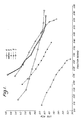
- the Figures show log K ca values versus the fraction of bound sites along the polymer. As polymeric sequestrants chelate hardness ions, the binding of the polymer decreases. This decrease in binding capability is illustrated in the Figures which clearly show the binding of the novel polymeric carbamate builders to be excellent.
- Figure 1 reports calcium binding data for the polymers of Examples 5 and 6 and other previously reported polymeric builders.
- Builder U polyglyoxylic acid
- A polyglyoxylic acid
- B polyacrylic acid
- B had a molecular weight (Mw) of 60,000
- Sokolan (Trade Mark) CP7 C
- the actual values are reported in Table 1.
- Figure 2 reports calcium binding data for the polymer of Example 7 and other previously reported builders - Builder U (A) and polyacrylic acid (B). The actual values are reported in Table 2.
Landscapes
- Chemical & Material Sciences (AREA)
- Organic Chemistry (AREA)
- Chemical Kinetics & Catalysis (AREA)
- Wood Science & Technology (AREA)
- Engineering & Computer Science (AREA)
- Oil, Petroleum & Natural Gas (AREA)
- Life Sciences & Earth Sciences (AREA)
- Health & Medical Sciences (AREA)
- Medicinal Chemistry (AREA)
- Polymers & Plastics (AREA)
- Addition Polymer Or Copolymer, Post-Treatments, Or Chemical Modifications (AREA)
- Detergent Compositions (AREA)
- Organic Low-Molecular-Weight Compounds And Preparation Thereof (AREA)
- Emulsifying, Dispersing, Foam-Producing Or Wetting Agents (AREA)
Applications Claiming Priority (4)
| Application Number | Priority Date | Filing Date | Title |
|---|---|---|---|
| US47566690A | 1990-02-06 | 1990-02-06 | |
| US07/475,660 US5062995A (en) | 1990-02-06 | 1990-02-06 | Polymeric carbamate detergent builders |
| US475660 | 1990-02-06 | ||
| US475666 | 1999-12-30 |
Publications (3)
| Publication Number | Publication Date |
|---|---|
| EP0441563A2 true EP0441563A2 (de) | 1991-08-14 |
| EP0441563A3 EP0441563A3 (en) | 1991-11-27 |
| EP0441563B1 EP0441563B1 (de) | 1995-05-24 |
Family
ID=27044885
Family Applications (1)
| Application Number | Title | Priority Date | Filing Date |
|---|---|---|---|
| EP91300871A Expired - Lifetime EP0441563B1 (de) | 1990-02-06 | 1991-02-04 | Vinylcarbamat-Verbindungen enthaltende Reinigungszusammensetzungen |
Country Status (7)
| Country | Link |
|---|---|
| EP (1) | EP0441563B1 (de) |
| JP (1) | JPH04211044A (de) |
| AU (1) | AU7020491A (de) |
| BR (1) | BR9100468A (de) |
| CA (1) | CA2035248A1 (de) |
| DE (1) | DE69109883T2 (de) |
| ES (1) | ES2073671T3 (de) |
Cited By (9)
| Publication number | Priority date | Publication date | Assignee | Title |
|---|---|---|---|---|
| EP0802177A1 (de) * | 1996-04-16 | 1997-10-22 | Nippon Shokubai Co., Ltd. | Wasserlösliches Monomer,wasserlösliches Polymer,ein Verfahren zu ihrer Herstellung und ihre Verwendung |
| US20120295833A1 (en) * | 2011-05-10 | 2012-11-22 | Adocia | Polysaccharides having an adjustable degree of functionalization |
| US8669227B2 (en) | 2009-03-27 | 2014-03-11 | Adocia | Fast-acting insulin formulation |
| US9018190B2 (en) | 2009-03-27 | 2015-04-28 | Adocia | Functionalized oligosaccharides |
| US9492467B2 (en) | 2011-11-02 | 2016-11-15 | Adocia | Rapid-acting insulin formulation comprising an oligosaccharide |
| US9700599B2 (en) | 2012-11-13 | 2017-07-11 | Adocia | Rapid-acting insulin formulation comprising a substituted anionic compound |
| US9795678B2 (en) | 2014-05-14 | 2017-10-24 | Adocia | Fast-acting insulin composition comprising a substituted anionic compound and a polyanionic compound |
| US10525133B2 (en) | 2014-05-14 | 2020-01-07 | Adocia | Aqueous composition comprising at least one protein and one solubilizing agent, preparation thereof and uses thereof |
| US10792335B2 (en) | 2015-11-16 | 2020-10-06 | Adocia | Rapid-acting insulin composition comprising a substituted citrate |
Families Citing this family (2)
| Publication number | Priority date | Publication date | Assignee | Title |
|---|---|---|---|---|
| FR2675153B1 (fr) * | 1991-04-15 | 1994-07-22 | Rhone Poulenc Chimie | Composition detergente contenant un biopolymere polyimide hydrolysable en milieu lessiviel. |
| US6139767A (en) * | 1996-05-22 | 2000-10-31 | Nippon Shokubai Co., Ltd. | Carboxylated polymers, process for the production of the same, and gels thereof |
Family Cites Families (7)
| Publication number | Priority date | Publication date | Assignee | Title |
|---|---|---|---|---|
| US3711458A (en) * | 1969-08-21 | 1973-01-16 | Research Corp | Substituted and unsubstituted vinyloxycarbonyl groups as amino protecting groups in the syntheses of peptides |
| US4382949A (en) * | 1980-07-31 | 1983-05-10 | Schering Corporation | 2-(Amino acid-thio)-1-carbapen-2-em-3-carboxylic acids and congeners |
| FR2502630A1 (fr) * | 1981-03-24 | 1982-10-01 | Poudres & Explosifs Ste Nale | Polymeres porteurs de groupes anhydrides mixtes de l'acide carbonique et procede pour les fabriquer |
| DE3366926D1 (en) * | 1982-11-16 | 1986-11-20 | Schering Corp | Penems, pharmaceutical compositions containing them, process for preparing them |
| EP0125208A1 (de) * | 1983-05-06 | 1984-11-14 | Ciba-Geigy Ag | Aminoniederalkyl-penem-Verbindungen, Verfahren zu ihrer Herstellung, pharmazeutische Präparate, welche diese Verbindungen enthalten, und Verwendung von letzteren |
| FI853005L (fi) * | 1984-08-09 | 1986-02-10 | Ciba Geigy Ag | Nya aminoalkylpenem-foereningar. |
| FR2612521B1 (fr) * | 1987-03-16 | 1989-07-28 | Centre Nat Rech Scient | Nouveaux polymeres chelatants, leur preparation et leur application, notamment dans le domaine medical, pour capter les ions metalliques en exces dans l'organisme, et comme agents complexants pour la preparation de reactifs utilisables dans le domaine de l'imagerie medicale |
-
1991
- 1991-02-01 CA CA002035248A patent/CA2035248A1/en not_active Abandoned
- 1991-02-04 EP EP91300871A patent/EP0441563B1/de not_active Expired - Lifetime
- 1991-02-04 ES ES91300871T patent/ES2073671T3/es not_active Expired - Lifetime
- 1991-02-04 AU AU70204/91A patent/AU7020491A/en not_active Abandoned
- 1991-02-04 DE DE69109883T patent/DE69109883T2/de not_active Expired - Fee Related
- 1991-02-05 BR BR919100468A patent/BR9100468A/pt not_active Application Discontinuation
- 1991-02-06 JP JP3036755A patent/JPH04211044A/ja active Pending
Cited By (14)
| Publication number | Priority date | Publication date | Assignee | Title |
|---|---|---|---|---|
| EP0802177A1 (de) * | 1996-04-16 | 1997-10-22 | Nippon Shokubai Co., Ltd. | Wasserlösliches Monomer,wasserlösliches Polymer,ein Verfahren zu ihrer Herstellung und ihre Verwendung |
| US5856418A (en) * | 1996-04-16 | 1999-01-05 | Nippon Shokubai Co., Ltd. | Water-soluble monomer, water-soluble polymer and their production process and use |
| US8669227B2 (en) | 2009-03-27 | 2014-03-11 | Adocia | Fast-acting insulin formulation |
| US9018190B2 (en) | 2009-03-27 | 2015-04-28 | Adocia | Functionalized oligosaccharides |
| US20120295833A1 (en) * | 2011-05-10 | 2012-11-22 | Adocia | Polysaccharides having an adjustable degree of functionalization |
| US9492467B2 (en) | 2011-11-02 | 2016-11-15 | Adocia | Rapid-acting insulin formulation comprising an oligosaccharide |
| US9700599B2 (en) | 2012-11-13 | 2017-07-11 | Adocia | Rapid-acting insulin formulation comprising a substituted anionic compound |
| US10583175B2 (en) | 2012-11-13 | 2020-03-10 | Adocia | Rapid-acting insulin formulation comprising a substituted anionic compound |
| US10646551B2 (en) | 2012-11-13 | 2020-05-12 | Adocia | Rapid-acting insulin formulation comprising a substituted anionic compound |
| US10881716B2 (en) | 2012-11-13 | 2021-01-05 | Adocia | Rapid-acting insulin formulation comprising a substituted anionic compound |
| US11324808B2 (en) | 2012-11-13 | 2022-05-10 | Adocia | Rapid-acting insulin formulation comprising a substituted anionic compound |
| US9795678B2 (en) | 2014-05-14 | 2017-10-24 | Adocia | Fast-acting insulin composition comprising a substituted anionic compound and a polyanionic compound |
| US10525133B2 (en) | 2014-05-14 | 2020-01-07 | Adocia | Aqueous composition comprising at least one protein and one solubilizing agent, preparation thereof and uses thereof |
| US10792335B2 (en) | 2015-11-16 | 2020-10-06 | Adocia | Rapid-acting insulin composition comprising a substituted citrate |
Also Published As
| Publication number | Publication date |
|---|---|
| DE69109883T2 (de) | 1995-10-05 |
| EP0441563B1 (de) | 1995-05-24 |
| CA2035248A1 (en) | 1991-08-07 |
| BR9100468A (pt) | 1991-10-29 |
| EP0441563A3 (en) | 1991-11-27 |
| JPH04211044A (ja) | 1992-08-03 |
| ES2073671T3 (es) | 1995-08-16 |
| AU7020491A (en) | 1991-08-08 |
| DE69109883D1 (de) | 1995-06-29 |
Similar Documents
| Publication | Publication Date | Title |
|---|---|---|
| EP0441022B1 (de) | Wasserlösliche Copolymere mit niedrigem Molekulargewicht, Verfahren zu deren Herstellung und diese enthaltende Wasch- und Reinigungsmittel | |
| AU701617B2 (en) | Aqueous process for preparing low molecular weight polymers | |
| US5431846A (en) | Copolymers and detergent compositions containing them | |
| US5273676A (en) | Copolymers with monomers containing polyalkylene oxide blocks, preparation thereof and use thereof | |
| EP0608845A2 (de) | Multifunktionale Maleat Polymere | |
| EP0359055B1 (de) | Waschmittel, die Polydivinylether als Builder verwenden | |
| EP0441563B1 (de) | Vinylcarbamat-Verbindungen enthaltende Reinigungszusammensetzungen | |
| US4702858A (en) | Washing agents containing, as additives, carboxyl-containing copolymers which are neutralized or amidated with amines | |
| US5062995A (en) | Polymeric carbamate detergent builders | |
| US5401807A (en) | Process of increasing the molecular weight of water soluble acrylate polymers by chain combination | |
| ES2293951T3 (es) | Nuevo copolimero soluble en agua y su procedimiento de produccion y uso. | |
| EP0408884B1 (de) | Hydrophob modifizierte Polycarboxylat Polymere und deren Verwendung als Waschmittelbuilder | |
| JP4323700B2 (ja) | 新規水溶性共重合体とその製造方法、用途 | |
| JPS5915359B2 (ja) | 洗剤用ビルダ−及び該洗剤用ビルダ−を用いる洗剤組成物 | |
| EP0641363B1 (de) | Copolymere enthaltende waschmittelzusammensetzungen | |
| EP0634428A2 (de) | Verfahren zur Herstellung von Polymeren | |
| IT8922135A1 (it) | Processo per la produzione di soluzioni acquose di agenti anti-incrostazione e soluzioni cosi' ottenute | |
| US4923941A (en) | Carboxy-functional polymers and their use as detergent additives | |
| JPH04309511A (ja) | ジアリルアミノアルキレン−ホスホナートおよび不飽和カルボン酸より成るコポリマー | |
| EP0391711B1 (de) | Maleinsäureanhydridcopolymere | |
| US6344434B1 (en) | Acrylic polymer, process for the production of the same, biodegradable builder, detergent composition and dispersant | |
| US5302677A (en) | Alkenylaminoalkane-1,1-diphosphonic acid derivatives and copolymers thereof with unsaturated carboxylic acids | |
| EP0435505B1 (de) | Polymere und diese Polymere enthaltende Reinigungsmittelzusammensetzungen | |
| JP4334749B2 (ja) | 液体洗剤用ビルダーおよび液体洗剤組成物 | |
| JPH0741491A (ja) | アルケニルアミノメチレン−ホスホン酸およびこれと 不飽和カルボン酸とのコポリマー |
Legal Events
| Date | Code | Title | Description |
|---|---|---|---|
| PUAI | Public reference made under article 153(3) epc to a published international application that has entered the european phase |
Free format text: ORIGINAL CODE: 0009012 |
|
| AK | Designated contracting states |
Kind code of ref document: A2 Designated state(s): CH DE ES FR GB IT LI NL SE |
|
| PUAL | Search report despatched |
Free format text: ORIGINAL CODE: 0009013 |
|
| AK | Designated contracting states |
Kind code of ref document: A3 Designated state(s): CH DE ES FR GB IT LI NL SE |
|
| 17P | Request for examination filed |
Effective date: 19911227 |
|
| RAP3 | Party data changed (applicant data changed or rights of an application transferred) |
Owner name: UNILEVER N.V. Owner name: UNILEVER PLC |
|
| 17Q | First examination report despatched |
Effective date: 19930924 |
|
| GRAA | (expected) grant |
Free format text: ORIGINAL CODE: 0009210 |
|
| AK | Designated contracting states |
Kind code of ref document: B1 Designated state(s): CH DE ES FR GB IT LI NL SE |
|
| ITF | It: translation for a ep patent filed | ||
| REF | Corresponds to: |
Ref document number: 69109883 Country of ref document: DE Date of ref document: 19950629 |
|
| ET | Fr: translation filed | ||
| REG | Reference to a national code |
Ref country code: ES Ref legal event code: FG2A Ref document number: 2073671 Country of ref document: ES Kind code of ref document: T3 |
|
| PGFP | Annual fee paid to national office [announced via postgrant information from national office to epo] |
Ref country code: SE Payment date: 19960117 Year of fee payment: 6 |
|
| PGFP | Annual fee paid to national office [announced via postgrant information from national office to epo] |
Ref country code: CH Payment date: 19960208 Year of fee payment: 6 |
|
| PGFP | Annual fee paid to national office [announced via postgrant information from national office to epo] |
Ref country code: NL Payment date: 19960213 Year of fee payment: 6 |
|
| PLBE | No opposition filed within time limit |
Free format text: ORIGINAL CODE: 0009261 |
|
| STAA | Information on the status of an ep patent application or granted ep patent |
Free format text: STATUS: NO OPPOSITION FILED WITHIN TIME LIMIT |
|
| 26N | No opposition filed | ||
| PG25 | Lapsed in a contracting state [announced via postgrant information from national office to epo] |
Ref country code: SE Effective date: 19970205 |
|
| PG25 | Lapsed in a contracting state [announced via postgrant information from national office to epo] |
Ref country code: LI Effective date: 19970228 Ref country code: CH Effective date: 19970228 |
|
| PG25 | Lapsed in a contracting state [announced via postgrant information from national office to epo] |
Ref country code: NL Effective date: 19970901 |
|
| REG | Reference to a national code |
Ref country code: CH Ref legal event code: PL |
|
| EUG | Se: european patent has lapsed |
Ref document number: 91300871.0 |
|
| NLV4 | Nl: lapsed or anulled due to non-payment of the annual fee |
Effective date: 19970901 |
|
| PGFP | Annual fee paid to national office [announced via postgrant information from national office to epo] |
Ref country code: FR Payment date: 19980112 Year of fee payment: 8 |
|
| PGFP | Annual fee paid to national office [announced via postgrant information from national office to epo] |
Ref country code: GB Payment date: 19980126 Year of fee payment: 8 Ref country code: DE Payment date: 19980126 Year of fee payment: 8 |
|
| PGFP | Annual fee paid to national office [announced via postgrant information from national office to epo] |
Ref country code: ES Payment date: 19980211 Year of fee payment: 8 |
|
| PG25 | Lapsed in a contracting state [announced via postgrant information from national office to epo] |
Ref country code: GB Free format text: LAPSE BECAUSE OF NON-PAYMENT OF DUE FEES Effective date: 19990204 |
|
| PG25 | Lapsed in a contracting state [announced via postgrant information from national office to epo] |
Ref country code: ES Free format text: LAPSE BECAUSE OF NON-PAYMENT OF DUE FEES Effective date: 19990205 |
|
| GBPC | Gb: european patent ceased through non-payment of renewal fee |
Effective date: 19990204 |
|
| PG25 | Lapsed in a contracting state [announced via postgrant information from national office to epo] |
Ref country code: FR Free format text: LAPSE BECAUSE OF NON-PAYMENT OF DUE FEES Effective date: 19991029 |
|
| PG25 | Lapsed in a contracting state [announced via postgrant information from national office to epo] |
Ref country code: DE Free format text: LAPSE BECAUSE OF NON-PAYMENT OF DUE FEES Effective date: 19991201 |
|
| REG | Reference to a national code |
Ref country code: FR Ref legal event code: ST |
|
| REG | Reference to a national code |
Ref country code: ES Ref legal event code: FD2A Effective date: 20010503 |
|
| PG25 | Lapsed in a contracting state [announced via postgrant information from national office to epo] |
Ref country code: IT Free format text: LAPSE BECAUSE OF NON-PAYMENT OF DUE FEES;WARNING: LAPSES OF ITALIAN PATENTS WITH EFFECTIVE DATE BEFORE 2007 MAY HAVE OCCURRED AT ANY TIME BEFORE 2007. THE CORRECT EFFECTIVE DATE MAY BE DIFFERENT FROM THE ONE RECORDED. Effective date: 20050204 |