EP0441636B1 - Procédé de traitement de surface de matériaux métalliques contenant du titane - Google Patents
Procédé de traitement de surface de matériaux métalliques contenant du titane Download PDFInfo
- Publication number
- EP0441636B1 EP0441636B1 EP91301020A EP91301020A EP0441636B1 EP 0441636 B1 EP0441636 B1 EP 0441636B1 EP 91301020 A EP91301020 A EP 91301020A EP 91301020 A EP91301020 A EP 91301020A EP 0441636 B1 EP0441636 B1 EP 0441636B1
- Authority
- EP
- European Patent Office
- Prior art keywords
- plating
- titanium
- resultant
- carried out
- metallic material
- Prior art date
- Legal status (The legal status is an assumption and is not a legal conclusion. Google has not performed a legal analysis and makes no representation as to the accuracy of the status listed.)
- Expired - Lifetime
Links
Images

Classifications
-
- C—CHEMISTRY; METALLURGY
- C25—ELECTROLYTIC OR ELECTROPHORETIC PROCESSES; APPARATUS THEREFOR
- C25D—PROCESSES FOR THE ELECTROLYTIC OR ELECTROPHORETIC PRODUCTION OF COATINGS; ELECTROFORMING; APPARATUS THEREFOR
- C25D15/00—Electrolytic or electrophoretic production of coatings containing embedded materials, e.g. particles, whiskers, wires
- C25D15/02—Combined electrolytic and electrophoretic processes with charged materials
-
- Y—GENERAL TAGGING OF NEW TECHNOLOGICAL DEVELOPMENTS; GENERAL TAGGING OF CROSS-SECTIONAL TECHNOLOGIES SPANNING OVER SEVERAL SECTIONS OF THE IPC; TECHNICAL SUBJECTS COVERED BY FORMER USPC CROSS-REFERENCE ART COLLECTIONS [XRACs] AND DIGESTS
- Y10—TECHNICAL SUBJECTS COVERED BY FORMER USPC
- Y10T—TECHNICAL SUBJECTS COVERED BY FORMER US CLASSIFICATION
- Y10T428/00—Stock material or miscellaneous articles
- Y10T428/12—All metal or with adjacent metals
- Y10T428/12493—Composite; i.e., plural, adjacent, spatially distinct metal components [e.g., layers, joint, etc.]
- Y10T428/12771—Transition metal-base component
- Y10T428/12806—Refractory [Group IVB, VB, or VIB] metal-base component
- Y10T428/12812—Diverse refractory group metal-base components: alternative to or next to each other
Definitions
- the present invention relates to a process for surface treating a titanium-containing metallic material. More particularly, the present invention relates to a process for surface treating a titanium containing metallic material to form a composite coating layer having an excellent heat resistance, abrasion resistance, and optionally, a high sliding property, and closely adhered to a surface of the titanium-containing metallic material surface.
- titanium-containing metallic materials for example, titanium or titanium alloy materials
- various valve parts and driving system parts of automobiles and autobicycles for example, engine valves, valve springs, valve retainers, connecting rods, rocker arms and valve lifters, which must be light, and parts of pumps for chemical industries, which must have a high resistance to corrosion.
- the titanium-containing metallic materials frequently must have a high heat resistance and abrasion resistance, and optionally, an excellent sliding property.
- the abrasion resistant coating layer is formed by dry plating methods, for example, gas nitriding method, salt bath nitriding method, ionnitriding method, ionplating method, chemical vapor deposition (CVD) method and physical vapor deposition (PVD) method, or by wet plating methods including a pre-treating step by a Marchall method, Thoma method or ASTM method.
- dry plating methods for example, gas nitriding method, salt bath nitriding method, ionnitriding method, ionplating method, chemical vapor deposition (CVD) method and physical vapor deposition (PVD) method, or by wet plating methods including a pre-treating step by a Marchall method, Thoma method or ASTM method.
- the above-mentioned conventional nitriding methods are disadvantageous in that the treated material is greatly deformed due to a high treating temperature, which causes a high thermal strain of the material, and that it takes a long time to form the nitrided hard layer, and thus the productivity of the hardened layer is low.
- the conventional dry and wet plating methods are disadvantageous in that the resultant coating layer exhibits a low adhering strength to the titanium or titanium alloy material, and thus is easily separated during practical use.
- This easily separable coating layer cannot exhibit a high resistance to severe wear conditions.
- a high wear resistant coating layer should have a high abrasion resistance, a high sliding property, and a high close adhering property to the titanium-containing metallic material surface.
- Japanese Unexamined Patent Publication No. 1-79,397 discloses a process for forming a high abrasion-resistant coating layer on a titanium or titanium alloy material by utilizing a Martin-Thoma method.
- This process is disadvantageous in that, since a heat-treatment in an oxidative gas atmosphere is applied to a titanium or titanium alloy material plated with a metal, for example, nickel, by a chemical deposition method, the plated metal layer is oxidized in the heat treatment, and thus the oxidized portion of the plated metal layer must be eliminated before an additional metal coating layer, for example, a chromium coating layer, is formed on the metal (nickel) coating layer. Also, this additional chromium coating layer, which forms an outer most layer of the surface treated material exhibits a poor anti-seizing property and unsatisfactory heat and abrasion resistances.
- An object of the present invention is to provide a process for surface treating a titanium-containing metallic material to form a composite coating layer having an excellent heat resistance and abrasion resistance, and a satisfactory sliding property, and closely and firmly adhered to a surface of the titanium-containing metallic material.
- Another object of the present invention is to provide a process for surface treating a titanium-containing metallic material to form a composite coating layer having a satisfactory anti-seizing property on a surface of the titanium-containing metallic material, without causing an undesirable oxidation of a plated metal layer.
- the process of the present invention comprises at least a surface-cleaning step (A), a first plating step (B), a second plating step (C), a non-oxidative heat-treating step (D), a surface-activating step (E) and a coating step (F), with a heat resistant and abrasion-resistant coating step.
- a surface of a titanium-containing metallic material for example, a titanium or titanium alloy material, is cleaned by a surface-cleaning step.
- the cleaning step includes, for example, a shot blasting operation in which ceramic particles, for example, alumina particles, are shot-blasted toward the surface of the titanium-containing metallic material, a degreasing operation using at least one member selected from alkali solutions, detergent solutions and organic solvents, a pickling operation using an aqueous acid solution, and washing operations with water.
- the pickling operation can be effected by treating the surface of the titanium-containing metallic material with a pickling liquid consisting of, for example, an aqueous solution of about 15% by weight of hydrochloric acid or about 10% by weight of hydrofluoric acid, at room temperature for a time of from 10 seconds to 10 minutes, for example, about 30 seconds, and then washing the pickled surface with water.
- a pickling liquid consisting of, for example, an aqueous solution of about 15% by weight of hydrochloric acid or about 10% by weight of hydrofluoric acid
- the surface-cleaning step effectively enhances the close-adhering property of the surface of the titanium-containing metallic material to the plated metal layer in the following first plating step.
- the oily substance for example, grease
- an organic solvent vapor for example, trichloroethylene vapor
- the cleaned surface of the titanium-containing metallic material is plated with copper or nickel.
- This first plating step is carried out by a strike-plating treatment or flash-plating treatment using a chemical substitution method.
- the strike-plating treatment with copper can be effected by using an aqueous plating solution containing, for example, 60 g/l of copper sulfate, 160 g/l of sodium potassium tartrate (Rochelle salt), and 50 g/l of sodium hydroxide.
- an aqueous plating solution containing, for example, 60 g/l of copper sulfate, 160 g/l of sodium potassium tartrate (Rochelle salt), and 50 g/l of sodium hydroxide.
- the strike-plating treatment with nickel can be carried out by employing an aqueous plating solution containing, for example, 100 g/l of nickel chloride and 30 g/l of hydrochloric acid.
- the strike-plating treatment with copper or nickel is carried out by bringing the strike-plating liquid into contact with the cleaned surface of the titanium-containing metallic material, and flowing an electric current through the strike-plating liquid.
- the strike-plated metal (copper or nickel) layer has a thickness of 1 to 5 »m, more preferably 1 to 3 »m.
- the resultant strike-plated metal layer sometimes does not completely cover the surface of the titanium-containing metallic material. Also, when the thickness is more than 5 »m, the formation of this thick strike-plated metal layer requires a very long time, and thus is not economical.
- the flash-plating treatment with copper can be carried out by using an aqueous treating liquid containing, for example, 10 g/l of copper sulfate, 10 g/l of sodium hydroxide, 20 ml/l of a 37% formaldehyde aqueous solution and 20 g/l of ethylenediaminetetraacetic acid (EDTA), at a predetermined plating temperature, for example, 45°C, using a chemical substitution method.
- an aqueous treating liquid containing, for example, 10 g/l of copper sulfate, 10 g/l of sodium hydroxide, 20 ml/l of a 37% formaldehyde aqueous solution and 20 g/l of ethylenediaminetetraacetic acid (EDTA), at a predetermined plating temperature, for example, 45°C, using a chemical substitution method.
- the flash-plating treatment with nickel can be carried out by using an aqueous plating liquid containing, for example, 30 g/l of nickel chloride, sodium hypophosphite and 10 g/l of sodium citrate, at a predetermined plating temperature, for example, 60°C, using a chemical substitution method.
- the flash-plated metal layer has a thickness of 0.1 to 2 »m, more preferably 0.1 to 1 »m.
- the resultant flash plated metal layer has an uneven thickness. Also, a thickness of more than 2 »m makes no extra contribution to the plating effect of the flash-plated copper or nickel layer, and thus is not economical.
- the copper or nickel layer formed by the strike- or flash-plating treatment and having the above-mentioned thickness effectively enhances the close-adherence of the titanium-containing metallic material to the composite coating layer formed thereon.
- the first plated metal layer surface of the titanium-containing metallic material is electroplated with a member selected from nickel, nickel-phosphorus alloys and composite materials comprising a matrix consisting of a nickel-phosphorus alloy and a number of fine ceramic particles dispersed in the matrix.
- the second plating step (C) with nickel can be carried out by using an aqueous electroplating liquid containing, for example, 800 g/l of nickel sulfamate, 15 g/l of nickel chloride and 30 g/l of boric acid, and flowing an electric current therethrough.
- an aqueous electroplating liquid containing, for example, 800 g/l of nickel sulfamate, 15 g/l of nickel chloride and 30 g/l of boric acid, and flowing an electric current therethrough.
- the second plating step (C) with a nickel-phosphorus alloy can be carried out by employing an aqueous electroplating liquid containing, for example, 800 g/l of nickel sulfamate, 15 g/l of nickel chloride, 30 g/l of boric acid, 3 g/l of sodium hypophosphorite, and flowing an electric current therethrough.
- an aqueous electroplating liquid containing, for example, 800 g/l of nickel sulfamate, 15 g/l of nickel chloride, 30 g/l of boric acid, 3 g/l of sodium hypophosphorite, and flowing an electric current therethrough.
- the second plating step (C) with a nickel-phosphorus alloy-ceramic particle composite material can be effected by using an aqueous electroplating liquid containing, for example, the same compounds as those contained in the nickel-phosphorus alloy plating liquid and fine ceramic particles dispersed in the liquid.
- the fine ceramic particles preferably comprise at least one member selected from SiC, Si3N4 , BN, Al2O3 , WC, ZrB2 , diamond and CrB.
- the temperature of the electroplating liquid, current density to be applied to the electroplating liquid, and the plating times are adjusted to desired values in consideration of the composition of the electroplating liquid and the desired thickness of the second plated metallic layer.
- the thickness of the second plated metallic layer is controlled to a value of 5 to 30 »m.
- the second plated metallic layer having a thickness of 5 to 30 »m is effective for alloying together with the first plated metal layer with titanium in a surface portion of the titanium-containing metallic material to form a Ti-Ni or Ti-Cu alloy layer comprising, for example, Ti2Ni, TiNi, TiNi2 , TiN3, TiCu, TiCu2 or TiCu4, in the next non-oxidative heat-treating step (D).
- This alloy layer is very effective for obtaining a close and firm adherence of the titanium-containing metallic material to the composite coating layer formed by the process of the present invention.
- the resultant second plated metallic layer sometimes does not exhibit a satisfactory adhesion-enhancing effect.
- the adhesion-enhancing effect of the second plate metallic layer is not increased and the cost of forming the second plated metallic layer is needlessly increased.
- the resultant plated nickel layer exhibits a satisfactory hardness at a temperature of up to about 200°C, and the resultant plated nickel-phosphorus alloy layer exhibits a satisfactory hardness at a temperature of up to about 350°C.
- the type of the metal to be plated is selected in consideration of the composition of the heat resistant and abrasion resistant coating layer which will be formed on the second plated metal layer in the coating step (F).
- the second plated titanium-containing metallic material is subjected to a non-oxidative heat treating step (D) in a non-oxidative atmosphere at a temperature of 450°C or more, preferably from 450 to 850°C, for one hour or more.
- the non-oxidative heat treating step (D) is effective for alloying a portion of titanium in the surface portion of the titanium-containing metallic material with nickel and/or copper in the first and second plated metal layers without oxidizing the first and second plated metal layers, to form a titanium alloy layer located between the titanium-containing metallic material and the first and second-plated metal layers.
- This titanium alloy layer is effective for obtaining a close and firm adherence of the titanium-containing metallic material to the composite coating layer formed by the process of the present invention.
- the resultant titanium alloy layer has an undesirably small thickness.
- the non-oxidative heat treating step (D) is carried out under a vacuum pressure of from 10 ⁇ 1 to 10 ⁇ 5 Torr.
- the vacuum pressure is more than 10 ⁇ 1 Torr, the plated metal layers formed in the first and second plating steps (B) and (C) are sometimes undesirably oxidized.
- a vacuum pressure of less than 10 ⁇ 5 Torr is generated at an increased cost, and is unnecessary for the heat treating step (D) of the present invention.
- the non-oxidative heat treating step (D) is carried out in an inert or reductive gas atmosphere comprising at least one member selected from the group consisting of nitrogen, argon and hydrogen.
- the content of oxygen is preferably restricted to a level not exceeding 1% by volume. If the content of oxygen is more than 1% by volume, sometimes the cleaned surface of the titanium-containing metallic layer and the first and second plated metal layers are undesirably oxidized.
- the non-oxidative heat treating step (D) in the inert or reductive gas atmosphere is effective for obtaining a glossy surface of the second plated metal layer.
- the titanium alloy layer is formed between the titanium-containing metallic material and the first and second plated metal layers without oxidizing the first and second plated metal layers. Therefore, the surface of the second plated metal layer can be effectively activated by the next surface activating step (E) and the activated surface can be firmly and closely adhered to a heat resistant and abrasion resistant coating layer formed in the coating step (F). These phenomena were discovered for the first time by the present inventors.
- the non-oxidatively heat treated titanium-containing metallic material is subjected to a surface activating step (E).
- This surface-activating treatment is not limited to a specific method, as long as the treatment is effective for the surface activation of the second plated metal layer surface.
- This surface activating step (E) can be effected, for example, by a simple treatment such that the surface of the non-oxidatively heat treated titanium-containing metallic material is brought into contact with a surface-activating aqueous solution containing 3 to 10% by weight of hydrofluoric acid and 50 to 70% by weight of nitric acid, at room temperature for 1 to 5 seconds.
- This surface activating step (E) is effective for micro-etching the non-oxidatively heat treated surface of the second plated metal layer to enhance the close adherence of the second plated metal layer surface to the heat resistant and abrasion resistant coating layer which will be formed in the next coating step (F).
- the surface activated titanium-containing metallic material is subjected to a coating step (F) in which a heat resistant and abrasion resistant coating layer is formed on the surface activated surface of the second plated metal layer.
- the heat resistant and abrasion resistant coating layer comprises a matrix composed of a member selected from the group consisting of nickel-phosphorus alloys and cobalt, and a number of fine ceramic particles dispersed in the matrix.
- the fine ceramic particles preferably comprise at least one member selected from the group consisting of SiC, Si3N4 , BN, Al2O3 , WC, ZrB2 , diamond and CrB. Those fine ceramic particles preferably have an average particle size of from 0.1 to 10.0 »m.
- the resultant coating layer sometimes exhibits an unsatisfactory abrasion resistance and sliding property. Also, when the average size is more than 10.0 »m, it is difficult to uniformly disperse the resultant ceramic particles in the matrix.
- the surface activated titanium-containing metallic material is subjected to an electroplating operation in a composite electroplating liquid which contains a matrix aqueous solution of metallic compounds for forming the matrix and the fine ceramic particles dispersed in the matrix aqueous solution.
- the matrix aqueous solution comprises, for example, 800 g/l of nickel sulfamate, 15 g/l of nickel chloride, 30 g/l of boric acid and 3 g/l of hypophosphorite.
- the matrix aqueous solution contains, for example, 300 g/l of cobalt sulfamate, 15 g/l of cobalt chloride and 30 g/l of boric acid.
- the fine ceramic particles are dispersed preferably in an amount of from 50 to 300 g/l, for example, 200 g/l, in the matrix aqueous solution.
- the surface activated titanium containing metal material is brought into contact with the above-mentioned composite electroplating liquid and an electric current is flowed through the electroplating liquid to from a heat resistant and abrasion resistant coating layer on the activated surface.
- the coating layer has a thickness of 5 to 500 »m.
- the thickness is less than 5 »m, the resultant coating layer sometimes exhibits an unsatisfactory abrasion resistance. Also, an thickness of more than 500 »m sometimes affects the adherence of the resultant coating layer to adjacent coating layers.
- the nickel-phosphorus alloy matrix deposits Ni3P and hardened by raising the temperature of the coating layer upto about 350°C, and the hardness of the cobalt matrix is not reduced even at a high temperature of about 500°C.
- the content of the fine ceramic particles in the heat resistant and abrasion resistant coating layer is not limitation of the content of the fine ceramic particles in the heat resistant and abrasion resistant coating layer, but preferably the content of the fine ceramic particles is from 2 to 20% bared on the total weight of the coating layer.
- the fine ceramic particles are preferably selected from those with a high microhardness, for example, SiC particles (microhardness: about 3000, Si3N4 particles (microhardness: about 2000), WC particles (microhardness: about 2500) and diamond particles (microhardness: about 8000).
- the coating layer produced by the coating step (F) of the process of the present invention and containing the fine ceramic particles dispersed in the nickel-phosphorus or cobalt matrix exhibits not only a high heat resistance but also a high abrasion resistance when a sliding force or rubbing force is applied thereto.
- the heat resistant and abrasion resistant coating layer-coated titanium-containing metallic material is subjected to the steps of
- the method of the surface roughening treatment is not limited to a specific method.
- the surface roughening step (G) can be effected by applying a sandblast treatment with fine alumina particles with a grid number of from 120 to 270, to the surface of the heat resistant and abrasion resistant coating layer of the coated titanium-containing metallic material.
- the roughened surface is effective for closely and firmly adhering the heat resistant and abrasion resistant coating layer to the solid lubricant coating layer in the next coating step (H).
- the roughened surface preferably has a surface roughness (R Z ) of from 1.0 to 10.0 »m, determined in accordance with Japanese Industrial Standard (JIS) B0601.
- the resultant roughened surface When the surface roughness (R Z ) is less than 1.0 »m, the resultant roughened surface sometimes exhibits an unsatisfactory close adherence to the solid lubricant coating layer. Also, an increase in the surface roughness to a value of more than 10.0 »m does not contribute to an increase of the close adherence of the heat resistant and abrasion resistant coating layer to the solid lubricant coating layer and is disadvantageous in that the tolerance in the dimension of the resultant product becomes large.
- the surface roughened titanium-containing metallic material is finally coated with a solid lubricant coating layer comprising at least one member selected from MoS2 , graphite, boron nitride and fluorine-containing polymer resins, and the resultant solid lubricant coating layer is cured at a predetermined temperature of, preferably from 150°C to 250°C.
- the roughened surface of the heat resistant and abrasion resistant coating layer is cleaned with, for example, an alkali aqueous solution or an organic solvent, before subjecting it to the solid lubricant coating step (H).
- the thickness of the solid lubricant coating layer is not restriction of the thickness of the solid lubricant coating layer, but preferably the thickness is from 5 to 30 »m. When the thickness is in this range, the resultant solid lubricant coating layer has a high durability and exhibits a satisfactory sliding property over a long term.
- Figure 1 is an explanatory cross section of the surface treated titanium-containing metallic plate produced in accordance with the process of the present invention.
- a titanium alloy layer 1 is formed on a titanium-containing metallic plate 2.
- This titanium alloy layer 1 was produced by an non-oxidative heat treatment of a first and second plated titanium-containing metallic plate.
- nickel or copper in the first plated metal layer was alloyed with titanium to form an titanium alloy layer 1.
- This titanium alloy layer 1 is covered by a second plated metallic layer 3, and further covered by a heat resistant and abrasion resistant coating layer 4.
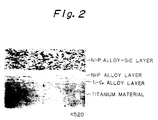
- FIG. 2 is a microscopic view of a cross-section of a surface treated titanium-containing metallic material produced in accordance with the process of the present invention at a magnification of 520.
- This surface-treated material was prepared by first plating a surface of a titanium plate (second type, JIS) with a strike plated copper layer; second plating the surface of the first plated copper layer with an electroplated nickel-phosphorus alloy layer; non-oxidatively heat treating the second plated titanium plate under a vacuum pressure of 10 ⁇ 3 Torr at a temperature of 850°C for 3 hours; surface activating the heat-treated titanium plate with an activating liquid; and coating the surface of the heat treated titanium plate with a heat resistant and abrasion resistant coating layer comprising a matrix consisting of nickel-phosphorus alloy and fine SiC particles in an amount of 5% by weight based on the total weight of the coating layer.
- a titanium-copper alloy layer copper having a thickness of about 15 »m is closly adhered and firmly bonded to the titanium plate, and coated with a plated nickel-phosphorus alloy layer having a thickness of about 20 »m, and then with a heat resistant and abrasion resistant layer comprising a nickel phosphorus alloy matrix and SiC particles dispersed in the matrix and having a thickness of about 50 »m.
- a surface treated titanium plate was produced in accordance with the process of the present invention, by first plating a cleaned surface of a titanium plate (second type, JIS) with a strike plated copper layer having a thickness of 2 »m; second electroplating the surface of the first plated titanium plate with a nickel-phosphorus alloy layer having a thickness of 20 »m; heat treated the second plated titanium plate under the conditions shown in Table 1; surface activating the heat treated titanium plate with an aqueous solution containing 5% by weight of hydrofluorite (HF) and 60% by weight of nitric acid (HNO3) at room temperature for 3 seconds; washing the activated surface with water; and coating the activated surface with a heat resistant and abrasion resistant coating layer comprising a nickel-phosphorus alloy matrix and SiC particles having an average size of 4.5 »m and in an amount of 5% based on the total weight of the coating layer and having a thickness of 50 »m.
- HF hydrofluorite
- HNO3 nitric acid
- a specimen (having a length of 100 m, a width of 50 mm and a thickness of 2.0 mm) of the resultant surface treated titanium plate was subjected to a bending test by using a bending test machine at a cross head speed of 10 mm/min and at a cross head falling distance of 10 mm, to evaluate the adherence of the resultant composite coating layer to the titanium plate.
- the resultant composite coating layer exhibited the adhering property as shown in Table 1 to the titanium plate.
- Fig. 3 shows the relationships between the hardnesses of second plated nickel and nickel-phosphorus alloy layers having a thickness of 50 »m and the heat treating temperature.
- Figure 3 clearly shows that the hardness of the nickel-phosphorus alloy layer increases with an increase in the heat-treating temperature of from about 50°C to about 350°C, while the hardness of the nickel layer decrease with an increase in the heat-treating temperature. Namely, the nickel-phosphorus alloy layer exhibits a higher heat resistance than that of the nickel layer.
- abrasion test pins were prepared in accordance with the process of the present invention by surface cleaning test pins comprising a 6Al-4V-Ti alloy and having a diameter of 10 mm, first plating, second plating and surface activating in the same manner as mentioned above for the surface treated titanium plate, and coating the surface activated pins with the coating layers having the compositions as shown in Table 2.
- the resultant pins were immersed in a lubricating oil (100 ml, trademark: SF-10W-30, made by Kyodo Sekiyu) and then subjected to an abrasion test with an abrading block made from a A2017 aluminum alloy by using a falex abrasion test machine at an abrasion speed of 0.39 m/sec, under a load which was increased stepwise by 25 kg every one minute.
- a lubricating oil 100 ml, trademark: SF-10W-30, made by Kyodo Sekiyu
- the coating layers of run Nos. 11 to 12 produced in accordance with the process of the present invention exhibited a very high anti-seizing property and sliding property.
- abrasion testing pins were produced by the same procedures as mentioned above, except that a heat resistant and abrasion resistant coating layer had a composition as shown in Table 3, and surface roughened by a shot blast treatment under the conditions as shown in Table 3 and then coated with a solid lubricant coating layer as shown in Table 3, and the testing pins were subjected to the abrasion test without treating with the lubricating oil.
- the abrasion test was carried out by using a falex abrasion testing machine and a block consisting of SUJ-2 (hardness: HRC 60, 90° V type) at an abrasion speed of 0.39 m/sec.
- the first plated metal layer was formed by a strike plating a cleaned surface of the titanium alloy pin with copper
- the second plated metallic layer was formed with a nickel-phosphorus alloy
- the non-oxidative heat treating step was carried out under a vacuum pressure of 10 ⁇ 3 Torr at 500° for 3 hours and the heat resistant and abrasion resistant coating layer had a thickness of 20 »m.
- the titanium alloy pin was directly coated with a solid lubricant coating layer without forming the composite coating layer.
- the pin was shot-blasted with alumina particles (grade No. 220), cleaned with an organic solvent, and coated with FBT-116 by a spray method.
- the solid lubricant coating layer was cured at a temperature of 180°C for one hour and had a thickness of 10 »m.
- This solid lubricant coating layer of Run No. 23 exhibited a critical seizing temperature of 65°C.
- the solid lubricant coating layer formed on a surface having a low hardness exhibits an unsatisfactory sliding property and anti-seizing property, and thus the solid lubricant coating layer should be formed on the specific composite coating layer produced by the process of the present invention and having a high hardness.
- Run No. 24 to 27 were carried out in accordance with the process of the present invention.
- the solid lubricant coating layers formed from FBT-116, FH-70 or HMB-4A had a thickness of 10 »m.
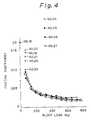
- test pins of run Nos. 24 to 27 exhibited a very low frictional coefficient of 0.02 to 0.04 under a block load of 200 kg or more, as shown in Fig. 4, and a very high critical seizing temperature of 715 to 780 kg as shown in Table 3.
- a titanium pin consisting of a 6Al-4V-Ti alloy and having a diameter of 10 mm and a length of 35 mm was surface treated by the following steps.
- the resultant surface treated titanium alloy pin was lubricated with a lubricating oil (available under the trademark of Nisseki Gear Oil EP 90, from Nihon Sekiyu) and subjected to an abrasion test by using a falex abrasion testing machine and a loading block consisting of SUJ-2 (Hardness (HR): C60), at an abrasion speed of 0.39 m/second.
- abrasion test the block load was increased stepwise by 50 kg every one minute, to determine a critical seizing load at which the testing pin was seized to the block.
- the first plating step (B) were carried out by a strike plating method under the following conditions:
- the second plating step (C) was carried out by an electroplating method under the following conditions:
- the second plating step (C) was carried out by an electroplating method under the following conditions:
- the coating step (F) with the heat resistant and abrasion resistant coating layer was carried out by an electroplating method under the following conditions.
- the resultant surface treated pin was subjected to the same abrasion test as mentioned in Example 1.
- Table 4 clearly shows that the composite coating layers of Examples 1 to 3 formed on the titanium alloy pin in accordance with the process of the present invention exhibited an excellent abrasion resistance in comparison with the conventional chromium coating layer of Comparative Example 1.
- a titanium pin consisting of a 6Al-4V-Ti alloy and having a diameter of 10 mm and a length of 35 mm was surface treated by the following steps.
- the solid lubricant coating layer was cured at 180°C for one hour.
- the resultant surface treated pin was subjected to the same abrasion test as mentioned in Example 1, with the following exceptions.
- the lubricating oil was not applied to the surface treated pin, and thus the pin was tested in a dry condition.
- the abrasion speed was 0.13 m/sec.
- the load was increased stepwise by 32 kg every one minute.
- the critical seizing load of the tested pin is indicated in Table 5.
- the coating step (F) was carried out under the following conditions.
- the same titanium alloy pin as mentioned in Example 4 was surface treated by the following steps.
- the surface of the pin was cleaned by applying a shot blast treatment with alumina particles (grid No. 220), and treating with trichloroethylene vapor at a temperature of 80°C.
- the cleansed surface was coated with the same solid lubricant coating layer as described in Example 4 and having a thickness of 10 »m, and the resultant coating layer was cured at 180°C for one hour.
- the same titanium alloy pin as mentioned in Example 4 was surface treated by the same treating steps (A), (B), (C), (D), (E) and (F) as mentioned in Example 4.
- the resultant surface treated pin was subjected to the same abrasion test as in Example 4.
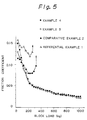
- Table 5 shows that the surface treated titanium alloy pins of Examples 4 and 5 produced in accordance with the process of the present invention exhibited a very high critical seizing load of more than 1000 kg even when no lubricating oil was applied thereto, whereas the pins of Comparative Example 2 and Referential Example 1 were seized under relatively low loads of 320 kg and 256 kg, respectively.
- Fig. 5 shows that the titanium alloy pins of Examples 4 and 5 exhibited a very low friction coefficient of from 0.02 to 0.03 under a high load of more than 800 kg, whereas the pins of Comparative Example 2 and Referential Example 1 exhibited a high frictional coefficient of more than 0.07 under a relatively low load of 300 kg or less.
- a titanium plate (JIS Class 2) having a width of 50 mm, a length of 100 mm and a thickness of 2.0 mm was surface treated by the following steps.
- the surface treated titanium plate was subjected to a bending test and an abrasion test.
- the bending test was carried out to evaluate the close adhering strength of the resultant composite coating layer to the titanium plate, by using a bending test machine (trademark: YONEKUKA CATY-2002S (for two tons) at a cross head speed of 10 mm/min and at a cross head falling distance of 10 mm.
- test results were evaluated in the following manner.
- the abrasion test was carried out in the same manner as mentioned in Example 1 and the test results were evaluated in the following manner.
- the heat resistance of the composite coating layer of the test piece was evaluated in the following manner.
- the current density was changed to 15 A/dm2.
- the vacuum pressure was 10 ⁇ 2 Torr
- the heat treating temperature was 450°C
- the heat treating time was 1.5 hours.
- the thickness of the resultant plated copper layer was changed to 1.2 »m.
- the thickness of the resultant nickel-phosphorus alloy layer was changed to 10 »m.
- the non-oxidative heat treating step (D) was carried out under the following conditions.
- the activating (immersing) time was changed to 2 seconds.
- the SiC was changed to BN in an amount of 200 g/l.
- the first flash plating step (B) was carried out under the following conditions.
- the second electroplating step (C) was carried out under the following conditions.
- the non-oxidative heat treating step (D) was carried out under the following conditions.
- the activating (immersing) time was changed to 5 seconds.
- the titanium plate was replaced by the same Ti-6Al-4V alloy plate as mentioned in Example 7.
- the same nickel flash plating operation as in Example 9 was carried out except that the thickness of the resultant plated nickel layer was changed to 0.2 »m.
- the non-oxidative heat treating step (D) was carried out under the following conditions.
- the surface activating step was carried out under the same conditions as in Example 9.
- the coating step (F) was carried out in the same manner as in Example 8.
- the first flash plating step (B) was carried out in the same manner as mentioned in Example 9, except that the thickness of the resultant first plated nickel layer was changed to 1.5 »m.
- the second electroplating step (C) was carried out under the following conditions.
- the non-oxidative heat treating step (D) was carried out under the following conditions.
- the activating (immersion) time was changed to 2 seconds.
- the SiC in the plating liquid was changed to Al2O3 particles in an amount of 200 g/l.
- the non-oxidative heat treating step (D) was carried out under the following conditions.
- the first plating step (B) was carried out by a strike plating method with copper under the following conditions.
- the second electroplating step (C) was replaced by the same non-electrolytic plating treatment as mentioned in Comparative Example 1.
- the resultant plated nickel-phosphorus alloy layer had a thickness of 20 »m.
- the non-oxidative heat treating step (D) was replaced by an oxidative heat treatment in a Muffle furnace at a temperature of 450°C for 20 hours, and the resultant product was immersed in an aqueous solution containing about 33% by weight of nitric acid at room temperature for 15 minutes to eliminate a resultant oxidized portion of the product, and washed with water.
- the surface activating step (E) was omitted.
- the coating step (F) was replaced by a chromium electroplating treatment under the following conditions.
- the first plating step (B) was carried out by the same copper strike plating procedure as in Comparative Example 4.
- the non-oxidative heat treating step (D) was carried out under the following conditions.
- the first plating step (B) was carried out by a strike plating method with nickel under the following conditions.
- the second plating step (C) was carried out in the same manner as described in Example 9.
- a titanium rod (JIS Class 2) having a diameter of 10 mm and a length of 35 mm or a diameter of 6 mm and a length of 100 mm was surface treated by the following steps.
- the solid lubricant coating layer was cured at 180°C for one hour.
- the resultant surface treated titanium rod was subjected to the same abrasion test as mentioned in Example 1, with the following exceptions.
- the lubricating oil was applied to the surface treated rod and thus the rod was tested in a dry condition.
- the abrasion speed was 0.39 m/second.
- the block load was increased stepwise by 50 kg every one minute.
- the titanium rod was replaced by a titanium alloy rod consisting of a Ti-6Al-4V alloy and having the same dimensions as that in Example 12.
- the thickness of the resultant plated copper layer was changed to 0.2 »m.
- the current density was changed to 15 A/dm2.
- the non-oxidative heat treating step (D) the vacuum pressure was 10 ⁇ 2 Torr, the heat treating temperature was 450°C and the heat treating time was 1.5 hours.
- alumina particles (grid No. 150) were used for the shot blast treatment and the resultant roughened surface had a surface roughness (R Z ) of 3 to 5 »m.
- a solid lubricating liquid (available under the trademark of FH-70) containing a fluorine-containing polymer resin particles dispersed in an epoxy resin binder, was used.
- the resultant solid lubricant coating layer was cured at a temperature of 180°C for one hour and had a thickness of 25 »m.
- the resultant plated copper layer had a thickness of 1.2 »m.
- the resultant plated nickel-phosphorus alloy layer had a thickness of 10 »m.
- the non-oxidative heat treating step (D) was carried out under a vacuum pressure of 10 ⁇ 5 Torr at a temperature of 850°C for one hour.
- the activating (immersing) time was changed to 2 seconds.
- the SiC in the plating liquid was replaced by BN in an amount of 200 g/l.
- alumina particles (grid No. 220) were used for the shot blast treatment, and the roughened surface had a surface roughness (Rz) of 6 to 8 »m.
- a solid lubricating agent available under the trademark of HMB-4A
- MoS2 particles dispersed in a polyamide resin binder
- the first plating step (B) was carried out by a nickel flash plating treatment in the chemical substitution method under the following conditions:
- the plating liquid further contained 200 g/l of WC, and the current density was changed to 15 A/dm2.
- the non-oxidative heat treating step (D) was carried out under a vacuum pressure of 10 ⁇ 2 Torr at a temperature of 550°C for 3 hours.
- the activating (immersing) time was changed to 5 seconds.
- alumina particles (grid No. 180) were used for the shot blast treatment and the resultant roughened surface had a surface roughness (R Z ) of 4 to 6 »m.
- the thickness of the resultant coating layer was changed to 8 »m.
- the titanium rod was replaced by the same titanium alloy (Ti-6Al-4V) rod as mentioned in Example 13.
- the same nickel flash plating procedure as mentioned in Example 15 was carried out except that the thickness of the resultant plated nickel layer was adjusted to 0.2 »m.
- the non-oxidative heat treating step (D) was carried out under a vacuum pressure of 10 ⁇ 5 Torr at a temperature of 800°C for one hour.
- the surface activating step (E) was carried out in the same manner as in Example 15.
- the coating step (H) was carried out in the same manner as in Example 14.
- alumina particles (grid No. 250) were used for the shot blast treatment and the resultant roughened surface had a surface roughness (Rz) of 7 to 9 »m.
- the solid lubricant coating step (H) was carried out in the same manner as in Example 13, except that the resultant solid lubricant coating layer had a thickness of 10 »m.
- the titanium rod was replaced by the same titanium alloy (Ti-6Al-4V) rod as mentioned in Example 13.
- the first plating step (B) was carried out in the same nickel flash plating method as mentioned in Example 15, except that the resultant flash plated nickel layer had a thickness of 1.5 »m.
- the plating layer further contained 200 g/l of BN, the current density was 15 A/dm2 and the resultant plated nickel-phosphorus alloy layer had a thickness of 10 »m.
- the non-oxidative heat treating step (D) was carried out under a vacuum pressure of 10 ⁇ 4 Torr at a temperature of 700°C for 1.5 hours.
- the activating (immersing) time was changed to 2 seconds.
- the SiC in the plating liquid was replaced by 200 g/l of Al2O3 particles.
- the solid lubricant coating step (H) was carried out in the same manner as mentioned in Example 14, except that the resultant solid lubricant coating layer had a thickness of 20 »m.
- the non-oxidative heat treating step (D) was carried out under a vacuum pressure of 10 ⁇ 4 Torr at a temperature of 400°C for 40 minutes.
- alumina particles (grid No. 220) were employed for the shot blast treatment and the roughened surface had a surface roughness (R Z ) of 6 to 8 »m.
- the solid lubricant coating step (H) was carried out in the same manner as in Example 13 and the resultant solid lubricant coating layer had a thickness of 15 »m.
- the surface cleaning step (A) was carried out by applying a shot blast treatment with alumina particles (grid No. 220) to the titanium rod to roughen the surface into a surface roughness (R Z ) of 6 to 8 »m, and cleaning the roughened surface with trichloroethylene vapor.
- the cleaned surface was coated with the same solid lubricant in the same manner as those mentioned in Example 12.
- the first plating step (B) was carried out by the same strike plating method as mentioned in Example 1.
- the non-oxidative heat treating step (D) was carried out under a vacuum pressure of 10 ⁇ 5 Torr at a temperature of 450°C for 3 hours.
- the first plating step (B) was carried out in the same manner as mentioned in Example 1, except that the resultant plated copper layer had a thickness of 2 »m.
- the thickness of the resultant plated nickel-phosphorus alloy layer was 10 »m.
- the non-oxidative heat treating step (D) was carried out under a vacuum pressure of 10 ⁇ 3 Torr at a temperature of 500°C for 3 hours.
- a titanium rod (JIS Class 2) having a diameter of 10 mm and a length of 35 mm or a diameter of 6 mm and a length of 100 mm was surface treated by the following steps.
- the resultant surface treated titanium rod was subjected to the same bending test as mentioned in Example 6 except that the cross head falling distance was 6 mm, to the same dry abrasion test as mentioned in Example 1 in which the lubricating oil was applied to the test piece, and to the same wet abrasion test (II) as mentioned in Example 4, in which the lubricating oil was not applied to the test piece.
- the titanium rod was replaced by the same titanium alloy (Ti-6Al-4V) rod as mentioned in Example 13.
- the first plating step (B) was carried out by a strike plating method under the following conditions.
- the second plating step (C) was carried out under the following conditions.
- the non-oxidative heat treating step (D) was carried out in an argon gas atmosphere at a temperature of 600°C for 2 hours.
- the coating step (F) was carried out under the following conditions.
- the first plating step (B) was carried out by a flash plating treatment in the chemical substitution method under the following conditions.
- the non-oxidative heat treating step (D) was carried out in a 8% hydrogen-nitrogen gas atmosphere at a temperature of 850°C for one hour.
- the activating (immersing) time was changed to 2 seconds.
- the SiC in the plating liquid was replaced by 200 g/l of BN.
- the first plating step (B) was carried out by a flash plating method with nickel under the following conditions.
- the second plating step (C) was carried out in the same manner as mentioned in Example 19.
- the non-oxidative heat treating step (D) was carried out in a nitrogen gas atmosphere at a temperature of 550°C for 3 hours.
- the activating (immersing) time was changed to 5 seconds.
- the coated titanium rod was further subjected to the following surface roughening step (G) and solid lubricant coating step (H).
- the solid lubricant coating layer was cured at 180°C for one hour.
- the titanium rod was replaced by the same titanium alloy rod (Ti-6Al-4V alloy) as mentioned in Example 13.
- the first plating step (B) was carried out by the same copper flash plating method as mentioned in Example 20, except that the thickness of the resultant plated copper layer was adjusted to 1.2 »m.
- the thickness of the resultant plated nickel-phosphorus alloy layer was controlled to 15 »m.
- the oxidative heat treating step (D) was carried out in an argon gas atmosphere at a temperature of 450°C for 1.5 hours.
- the surface activating step (E) was carried out in the same manner as mentioned in Example 21.
- the SiC in the plating liquid was replaced by 200 g/l of WC, and the thickness of the resultant heat resistant and abrasion resistant coating layer was adjusted to 40 »m.
- the coated rod was further subjected to the same surface roughening step (G) and solid lubricant coating step (H) as mentioned in Example 21, with the following exceptions.
- alumina particles (grid No. 250) were employed for the shot blast treatment and the resultant roughened surface had a surface roughness of 7 to 9 »m.
- the FBT-116 was replaced by a solid lubricant liquid FH-70 (trademark) available from KAWAMURA KENKYUSHO, and containing fluorine-containing polymer resin particles dispersed in an epoxy resin binder.
- the thickness of the solid lubricant coating layer was 15 »m.
- the titanium rod was replaced by the same titanium alloy rod (Ti-6Al-4V alloy) as mentioned in Example 13.
- the resultant strike plated copper layer had a thickness of 3 »m.
- the second plating step (C) was carried out in the same manner as mentioned in Example 19, except that the thickness of the plated nickel layer was controlled to 25 »m.
- the non-oxidative heat treating step (D) was carried out in an 8% hydrogen-nitrogen mixed gas atmosphere at a temperature of 700°C for 1.5 hours.
- the activating (immersing) time was changed to 2 seconds.
- the SiC in the plating liquid was replaced by 200 g/l of Al2O3 , and the thickness of the resultant heat resistant and abrasion resistant coating layer was 25 »m.
- the coated rod was subjected to the same surface roughening step (G) and solid lubricant coating step (H) as mentioned in Example 21.
- alumina particles (grid No. 150) were employed for the shot blast treatment, and the roughened surface had a surface roughness (R Z ) of 3 to 5 »m.
- solid lubricant coating step (H) a solid lubricating liquid available under the trademark of HMB-4A and containing MoS2 particles dispersed in a polyamide resin binder, was employed in place of the FBT-116.
- the resultant solid lubricant coating layer had a thickness of 25 »m.
- the non-oxidative heat treating step (D) was carried out in a nitrogen gas atmosphere at a temperature of 400°C for 40 minutes.
- the first plating step (B) was carried out by the same copper flash plating method as mentioned in Example 20.
- the non-oxidative heat treating step (D) was carried out in an 8% hydrogen-nitrogen mixed gas atmosphere at a temperature of 350°C for 3 hours.
- the activating (immersing) time was changed to 2 seconds.
- the coating step (F) was carried out in the same manner as mentioned in Example 20 to form a heat resistant and abrasion resistant coating layer consisting of a nickel-phosphorus alloy matrix and BN particles dispersed in the matrix.
- the coated rod was subjected to the same surface roughening step (G) and solid lubricant coating step (H) as mentioned in Example 21.
- the resultant strike plated copper layer had a thickness of 1 »m.
- the second plating step (C) was omitted and the first plated titanium rod was further plated in the same non-electrolytic nickel-phosphorus alloy plating method as mentioned in Comparative Example 4 by using the NYCO ME BLATING BATH (trademark).
- the plated metallic layer had a thickness of 20 »m.
- the non-oxidative heat treating step (D) was replaced by an oxidative heat treating step in an oxidative atmosphere at a temperature of 450°C for 20 hours in a Muffle furnace, and the heat treated product was immersed in an aqueous solution of about 33% by weight of nitric acid at room temperature for 15 minutes to eliminate the oxidized portion of the product, and then washed with water.
- the surface activating step (E) was omitted and the coating step (F) was replaced by a chromium electro-plating step under the following conditions.
- Table 8 clearly indicates that the composite coating layers of Examples 18 to 23 produced in accordance with the process of the present invention exhibited an excellent close adherence to the titanium containing metallic materials and higher heat and abrasion resistances than those of the conventional chromium layer.
Landscapes
- Chemical & Material Sciences (AREA)
- Engineering & Computer Science (AREA)
- Chemical Kinetics & Catalysis (AREA)
- Electrochemistry (AREA)
- Materials Engineering (AREA)
- Metallurgy (AREA)
- Organic Chemistry (AREA)
- Electroplating Methods And Accessories (AREA)
- Other Surface Treatments For Metallic Materials (AREA)
- Chemically Coating (AREA)
Claims (20)
- Procédé de traitement de surface d'un matériau métallique contenant du titane comprenant les étapes suivantes :(A) nettoyage d'une surface d'un matériau métallique contenant du titane ;(B) première métallisation de la surface nettoyée résultante du matériau métallique contenant du titane avec un élément choisi dans le groupe constitué par le cuivre et le nickel ;(C) seconde métallisation de la première surface métallisée obtenue du matériau métallique contenant du titane avec un élément choisi dans le groupe constitué par le nickel, des alliages nickel-phosphore et des matériaux composites comprenant une matrice constituée d'un alliage nickel-phosphore et d'un nombre de particules fines de céramique dispersées dans la matrice, par un procédé de métallisation électrolytique ;(D) traitement thermique non oxydant du matériau métallique contenant du titane métallisé une seconde fois, à une température de 450°C ou davantage pendant une heure ou davantage ;(E) activation en surface de la surface obtenue du matériau métallique contenant du titane ayant reçu un traitement thermique non oxydant ; et(F) revêtement de la surface activée en surface obtenue du matériau métallique contenant du titane d'une couche de revêtement résistant à la chaleur et résistant à l'abrasion comprenant une matrice comprenant un élément choisi dans le groupe constitué par des alliages nickelphosphore et du cobalt et un nombre de particules fines de céramique dispersées dans la matrice.
- Procédé de traitement de surface selon la revendication 1, dans lequel l'étape de nettoyage comprend une opération de grenaillage, une opération de dégraissage avec au moins un élément choisi parmi des solutions alcalines, des solutions de détergents et des solvants organiques, une opération de décapage avec une solution acide et une opération de lavage avec de l'eau.
- Procédé de traitement de surface selon la revendication 1, dans lequel la première étape de métallisation est effectuée par un traitement de métallisation dans une solution amorce.
- Procédé de traitement de surface selon la revendication 3, dans lequel la couche métallique métallisée dans une solution amorce a une épaisseur de 1 à 5 »m.
- Procédé de traitement de surface selon la revendication 1, dans lequel la première étape de métallisation est effectuée par un traitement de métallisation éclaire.
- Procédé de traitement de surface selon la revendication 5, dans lequel la couche de métal appliquée par métallisation éclaire a une épaisseur de 0,1 à 2 »m.
- Procédé de traitement de surface selon la revendication 1, dans lequel la seconde couche de métal déposée a une épaisseur de 5 à 30 »m.
- Procédé de traitement de surface selon la revendication 1, dans lequel les particules fines de céramique utilisées dans le seconde étape de métallisation comprennent au moins un élément choisi parmi SiC, Si₃N₄, BN, Al₂O₃, WC, ZrO₂, le diamant et CrB.
- Procédé de traitement de surface selon la revendication 1, dans lequel l'étape de traitement thermique non oxydant est effectuée sous un vide de 10⁻¹ à 10⁻⁵ Torr.
- Procédé de traitement de surface selon la revendication 1, dans lequel l'étape de traitement thermique non oxydant est effectuée sous atmosphère de gaz inerte ou réducteur comprenant au moins un élément choisi dans le groupe constitué de l'azote, de l'argon et de l'hydrogène.
- Procédé de traitement de surface selon la revendication 10, dans lequel, dans l'atmosphère de gaz inerte ou réducteur, la teneur en oxygène est limitée à une valeur ne dépassant pas 1 % en volume.
- Procédé de traitement de surface selon la revendication 1, dans lequel l'étape d'activation de la surface est effectuée en mettant la surface de matière métallique contenant du titane ayant reçu un traitement thermique non oxydant, en contact avec une solution aqueuse activant la surface contenant 3 à 10 % en poids d'acide fluorhydrique et 50 à 70 % en poids d'acide nitrique.
- Procédé de traitement de surface selon la revendication 1, dans lequel les particules fines de céramique de la couche de revêtement résistant à la chaleur et résistant à l'abrasion comprennent au moins un élément choisi parmi SiC, Si₃N₄, BN, Al₂O₃, WC, ZrO₂, le diamant et CrB.
- Procédé de traitement de surface selon la revendication 1, dans lequel les particules fines de céramique ont une taille moyenne de particules de 0,1 à 10,0 »m.
- Procédé de traitement de surface selon la revendication 1, dans lequel la couche de revêtement résistant à la chaleur et résistant à l'abrasion a une épaisseur de 5 à 500 »m.
- Procédé de traitement de surface selon la revendication 1, qui comprend, en outre, les étapes suivantes :(G) dégrossissage superficiel de la surface obtenue de la couche de revêtement résistant à la chaleur et résistant à l'abrasion du matériau métallique, contenant du titane, revêtu, et(H) revêtement de la surface dégrossie obtenu du matériau métallique contenant du titane revêtu d'une couche de revêtement de lubrifiant solide comprenant au moins un élément choisi parmi le groupe constitué par le MoS₂, le graphite, le nitrure de bore et les résines de polymère fluoré.
- Procédé de traitement de surface selon la revendication 16, dans lequel la surface dégrossie superficiellement obtenue du matériau métallique contenant du titane revêtu a une rugosité superficielle (RZ), déterminée conformément à la JIS B0601 de 1,0 à 10,0 »m.
- Procédé de traitement de surface selon la revendication 16, dans lequel l'étape de dégrossissage de la surface est effectuée en appliquant un traitement de sablage avec des particules d'alumine ayant un numéro de grille de 120 à 270, sur la surface de la couche de revêtement résistant à la chaleur et résistant à l'abrasion du matériau métallique contenant du titane revêtu.
- Procédé de traitement de surface selon la revendication 16, dans lequel la couche de revêtement de lubrifiant solide obtenue a une épaisseur de 5 à 30 »m.
- Procédé de traitement de surface selon la revendication 16, dans lequel la couche de revêtement de lubrifiant solide est durcie à une température comprise entre 150 °C et 250 °C.
Applications Claiming Priority (6)
| Application Number | Priority Date | Filing Date | Title |
|---|---|---|---|
| JP30494/90 | 1990-02-09 | ||
| JP3049490A JP2686668B2 (ja) | 1990-02-09 | 1990-02-09 | チタン又はチタン合金に耐熱耐摩耗性皮膜を形成させる方法 |
| JP2129268A JP2690598B2 (ja) | 1990-05-21 | 1990-05-21 | チタン又はチタン合金に耐熱耐摩耗性、耐摺動性に優れた皮膜を形成させる方法 |
| JP129268/90 | 1990-05-21 | ||
| JP23899890A JP2690611B2 (ja) | 1990-09-11 | 1990-09-11 | チタンまたはチタン合金に皮膜を形成させる方法 |
| JP238998/90 | 1990-09-11 |
Publications (2)
| Publication Number | Publication Date |
|---|---|
| EP0441636A1 EP0441636A1 (fr) | 1991-08-14 |
| EP0441636B1 true EP0441636B1 (fr) | 1994-06-22 |
Family
ID=27286982
Family Applications (1)
| Application Number | Title | Priority Date | Filing Date |
|---|---|---|---|
| EP91301020A Expired - Lifetime EP0441636B1 (fr) | 1990-02-09 | 1991-02-07 | Procédé de traitement de surface de matériaux métalliques contenant du titane |
Country Status (4)
| Country | Link |
|---|---|
| US (1) | US5116430A (fr) |
| EP (1) | EP0441636B1 (fr) |
| CA (1) | CA2035970C (fr) |
| DE (1) | DE69102553T2 (fr) |
Cited By (2)
| Publication number | Priority date | Publication date | Assignee | Title |
|---|---|---|---|---|
| WO2011002311A1 (fr) * | 2009-06-29 | 2011-01-06 | Auckland Uniservices Limited | Procédé de placage ou de revêtement pour produire un revêtement métal-céramique sur un substrat |
| CN109930187A (zh) * | 2019-04-14 | 2019-06-25 | 广州恒荣电子科技有限公司 | 一种电镀用除油剂 |
Families Citing this family (42)
| Publication number | Priority date | Publication date | Assignee | Title |
|---|---|---|---|---|
| EP0573918A1 (fr) * | 1992-06-05 | 1993-12-15 | Matsushita Electric Industrial Co., Ltd. | Revêtements composites |
| JPH06146825A (ja) * | 1992-11-04 | 1994-05-27 | Fuji Oozx Inc | チタン製エンジンバルブ |
| DE69408829T2 (de) * | 1994-04-28 | 1998-10-22 | Fuji Valve | Verbesserung der Oberflächeneigenschaften eines Maschinenventils aus einer Titanlegierung |
| US5543029A (en) * | 1994-04-29 | 1996-08-06 | Fuji Oozx Inc. | Properties of the surface of a titanium alloy engine valve |
| JP2877013B2 (ja) * | 1994-05-25 | 1999-03-31 | 株式会社神戸製鋼所 | 耐摩耗性に優れた表面処理金属部材およびその製法 |
| US6129262A (en) * | 1997-02-24 | 2000-10-10 | Ford Global Technologies, Inc. | Fluxless brazing of unclad aluminum using selective area plating |
| US6565729B2 (en) | 1998-03-20 | 2003-05-20 | Semitool, Inc. | Method for electrochemically depositing metal on a semiconductor workpiece |
| US6197181B1 (en) * | 1998-03-20 | 2001-03-06 | Semitool, Inc. | Apparatus and method for electrolytically depositing a metal on a microelectronic workpiece |
| TWI223678B (en) * | 1998-03-20 | 2004-11-11 | Semitool Inc | Process for applying a metal structure to a workpiece, the treated workpiece and a solution for electroplating copper |
| JP3404286B2 (ja) * | 1998-04-16 | 2003-05-06 | 日本パーカライジング株式会社 | 金属の表面処理方法、および該表面処理方法により得られた表面を有する金属部材 |
| US6517894B1 (en) | 1998-04-30 | 2003-02-11 | Ebara Corporation | Method for plating a first layer on a substrate and a second layer on the first layer |
| EP1126512A4 (fr) * | 1998-08-11 | 2007-10-17 | Ebara Corp | Procede et appareil de metallisation de plaquettes |
| TW483950B (en) | 1998-12-31 | 2002-04-21 | Semitool Inc | Method, chemistry, and apparatus for high deposition rate solder electroplating on a microelectronic workpiece |
| US6444083B1 (en) * | 1999-06-30 | 2002-09-03 | Lam Research Corporation | Corrosion resistant component of semiconductor processing equipment and method of manufacturing thereof |
| GB2374607A (en) * | 2001-03-20 | 2002-10-23 | Metal Ion Technology Ltd | Plating metal matrix composites |
| US7025866B2 (en) * | 2002-08-21 | 2006-04-11 | Micron Technology, Inc. | Microelectronic workpiece for electrochemical deposition processing and methods of manufacturing and using such microelectronic workpieces |
| US6932897B2 (en) * | 2003-03-03 | 2005-08-23 | Com Dev Ltd. | Titanium-containing metals with adherent coatings and methods for producing same |
| US6913791B2 (en) * | 2003-03-03 | 2005-07-05 | Com Dev Ltd. | Method of surface treating titanium-containing metals followed by plating in the same electrolyte bath and parts made in accordance therewith |
| US7767267B2 (en) * | 2003-06-04 | 2010-08-03 | Wide Open Coatings, Inc. | Method of producing a coated valve retainer |
| US6966539B2 (en) * | 2003-10-31 | 2005-11-22 | Orchid Orthopedic Solutions, Llc | Valve spring retainer |
| US20050092611A1 (en) * | 2003-11-03 | 2005-05-05 | Semitool, Inc. | Bath and method for high rate copper deposition |
| US20050230262A1 (en) * | 2004-04-20 | 2005-10-20 | Semitool, Inc. | Electrochemical methods for the formation of protective features on metallized features |
| US20060040126A1 (en) * | 2004-08-18 | 2006-02-23 | Richardson Rick A | Electrolytic alloys with co-deposited particulate matter |
| US7829793B2 (en) * | 2005-09-09 | 2010-11-09 | Magnecomp Corporation | Additive disk drive suspension manufacturing using tie layers for vias and product thereof |
| US8553364B1 (en) | 2005-09-09 | 2013-10-08 | Magnecomp Corporation | Low impedance, high bandwidth disk drive suspension circuit |
| DE102006011384B4 (de) * | 2006-03-09 | 2019-09-05 | Sms Group Gmbh | Rolle zur Metallbearbeitung, insbesondere Stranggießrolle |
| US20070275137A1 (en) * | 2006-05-25 | 2007-11-29 | Spx Corporation | Food-processing component and method of coating thereof |
| KR100853238B1 (ko) * | 2006-09-28 | 2008-08-20 | 재단법인서울대학교산학협력재단 | 연료전지용 금속제 분리판 및 그 제조방법 |
| DE102008056741A1 (de) | 2008-11-11 | 2010-05-12 | Mtu Aero Engines Gmbh | Verschleissschutzschicht für Tial |
| US8846201B2 (en) * | 2009-03-05 | 2014-09-30 | Nissei Industrial Plastic Co., Ltd. | Composite plated product |
| US8673445B2 (en) * | 2009-07-17 | 2014-03-18 | Nissei Plastic Industrial Co. Ltd. | Composite-plated article and method for producing same |
| CN103243325A (zh) * | 2012-02-06 | 2013-08-14 | 浙江伟星实业发展股份有限公司 | 一种金属制品的表面处理方法 |
| CN103290458B (zh) * | 2013-07-11 | 2015-12-09 | 南京工程学院 | 凹凸棒土改性镍基纳米陶瓷颗粒复合镀层的制备方法 |
| CN103589983A (zh) * | 2013-11-22 | 2014-02-19 | 中国民航大学 | 一种用于增强碳化钨涂层与钛合金基体结合强度的方法 |
| CN103849914B (zh) * | 2014-03-26 | 2015-04-22 | 西安石油大学 | 一种钛合金接箍镀铜的方法 |
| CN105729717B (zh) * | 2014-12-09 | 2018-05-29 | 深圳富泰宏精密工业有限公司 | 金属与树脂的复合体的制备方法及由该方法制得的复合体 |
| EP3564028B1 (fr) * | 2018-05-02 | 2021-06-09 | Hitachi Metals, Ltd. | Matériau métallique dissemblable assemblé et son procédé de fabrication |
| US11225876B2 (en) * | 2019-12-19 | 2022-01-18 | Raytheon Technologies Corporation | Diffusion barrier to prevent super alloy depletion into nickel-CBN blade tip coating |
| CN112176374B (zh) * | 2020-09-21 | 2021-11-30 | 长安大学 | 一种三明治结构的复合膜层及其制备方法 |
| CN114395761B (zh) * | 2022-01-20 | 2024-05-31 | 中国石油大学(华东) | 一种提高基体减摩耐磨性能的方法 |
| CN114990453A (zh) * | 2022-05-26 | 2022-09-02 | 天津荣程联合钢铁集团有限公司 | 一种钛微合金化低合金高强度钢及其生产工艺 |
| CN117144278B (zh) * | 2023-10-27 | 2024-02-20 | 北矿新材科技有限公司 | 一种高温防护涂层制备方法及涂层 |
Family Cites Families (11)
| Publication number | Priority date | Publication date | Assignee | Title |
|---|---|---|---|---|
| US3887732A (en) * | 1970-10-01 | 1975-06-03 | Gen Am Transport | Stress controlled electroless nickel deposits |
| US4371589A (en) * | 1976-08-24 | 1983-02-01 | Warner London Inc. | Process for depositing protective coating and articles produced |
| GB2015032B (en) * | 1979-02-26 | 1982-06-23 | Asahi Glass Co Ltd | Electrodes and processes for preparing them |
| US4857116A (en) * | 1981-11-27 | 1989-08-15 | S R I International | Process for applying coatings of zirconium and/or titanium and a less noble metal to metal substrates and for converting the zirconium and/or titanium to a nitride, carbide, boride, or silicide |
| DE3321231C2 (de) * | 1983-06-11 | 1985-10-31 | MTU Motoren- und Turbinen-Union München GmbH, 8000 München | Verfahren zur Herstellung von Verschleißschutzschichten auf Oberflächen von Bauteilen aus Titan oder Titanbasislegierungen |
| US4761346A (en) * | 1984-11-19 | 1988-08-02 | Avco Corporation | Erosion-resistant coating system |
| US4655884A (en) * | 1985-08-19 | 1987-04-07 | General Electric Company | Nickel plating of refractory metals |
| US4820591A (en) * | 1987-05-11 | 1989-04-11 | Exxon Research And Engineering Company | Corrosion resistant article and method of manufacture |
| US4863810A (en) * | 1987-09-21 | 1989-09-05 | Universal Energy Systems, Inc. | Corrosion resistant amorphous metallic coatings |
| US5009966A (en) * | 1987-12-31 | 1991-04-23 | Diwakar Garg | Hard outer coatings deposited on titanium or titanium alloys |
| US4902535A (en) * | 1987-12-31 | 1990-02-20 | Air Products And Chemicals, Inc. | Method for depositing hard coatings on titanium or titanium alloys |
-
1991
- 1991-02-07 CA CA002035970A patent/CA2035970C/fr not_active Expired - Fee Related
- 1991-02-07 DE DE69102553T patent/DE69102553T2/de not_active Expired - Fee Related
- 1991-02-07 EP EP91301020A patent/EP0441636B1/fr not_active Expired - Lifetime
- 1991-02-08 US US07/653,087 patent/US5116430A/en not_active Expired - Fee Related
Cited By (2)
| Publication number | Priority date | Publication date | Assignee | Title |
|---|---|---|---|---|
| WO2011002311A1 (fr) * | 2009-06-29 | 2011-01-06 | Auckland Uniservices Limited | Procédé de placage ou de revêtement pour produire un revêtement métal-céramique sur un substrat |
| CN109930187A (zh) * | 2019-04-14 | 2019-06-25 | 广州恒荣电子科技有限公司 | 一种电镀用除油剂 |
Also Published As
| Publication number | Publication date |
|---|---|
| EP0441636A1 (fr) | 1991-08-14 |
| US5116430A (en) | 1992-05-26 |
| CA2035970A1 (fr) | 1991-08-10 |
| DE69102553T2 (de) | 1994-10-20 |
| DE69102553D1 (de) | 1994-07-28 |
| CA2035970C (fr) | 1999-06-01 |
Similar Documents
| Publication | Publication Date | Title |
|---|---|---|
| US5116430A (en) | Process for surface treatment titanium-containing metallic material | |
| JP2024528422A (ja) | 表面コーティングを有する可動部品 | |
| EP0681039B1 (fr) | Structure de tige de soupape en alliage de titane pour moteur | |
| CN118215752A (zh) | 具有表面涂层的可移动部件 | |
| JP2690598B2 (ja) | チタン又はチタン合金に耐熱耐摩耗性、耐摺動性に優れた皮膜を形成させる方法 | |
| KR20260012187A (ko) | 표면 코팅을 포함한 밸브 | |
| JPH04333575A (ja) | チタン含有金属材料上に複合被覆膜層を形成する方法 | |
| US5543029A (en) | Properties of the surface of a titanium alloy engine valve | |
| JP2026503838A (ja) | 表面コーティングを含む金型およびダイ | |
| JP2690611B2 (ja) | チタンまたはチタン合金に皮膜を形成させる方法 | |
| JP2686668B2 (ja) | チタン又はチタン合金に耐熱耐摩耗性皮膜を形成させる方法 | |
| EP0679736B1 (fr) | Amélioration des propriétés de surface d'une soupape de moteur en alliage de titane | |
| JPH04246181A (ja) | チタン含有金属材料の表面処理方法 | |
| JP2004011026A (ja) | アルミニウム又はアルミニウム合金の表面処理方法 | |
| Brunelli et al. | Surface hardening of Al 7075 alloy by diffusion treatments of electrolytic Ni coatings | |
| EP1858814A1 (fr) | Revetements texture anti-usure de composants utilises dans la fabrication d'ampoules en verre | |
| US20260126255A1 (en) | Weapons and weapon components including surface coatings | |
| KR20260011664A (ko) | 장식용 표면 코팅을 갖는 물품 | |
| JPH0578900A (ja) | 耐摩耗性金属部材 | |
| JPS62205275A (ja) | タングステンカ−バイト層を有する耐摩耗性物品及びその製造方法 | |
| KR20030090499A (ko) | 티탄 존재 하에서의 금속 모재의 질화 열처리방법 | |
| JPH08246164A (ja) | 金属基複合材料及びその製造方法 | |
| GB2233982A (en) | Co-deposition of fluorinated carbon with electroless nickel | |
| EP4634437A1 (fr) | Outils et éléments de fixation comprenant des revêtements de surface | |
| Laurilliard | Fastener coatings |
Legal Events
| Date | Code | Title | Description |
|---|---|---|---|
| PUAI | Public reference made under article 153(3) epc to a published international application that has entered the european phase |
Free format text: ORIGINAL CODE: 0009012 |
|
| 17P | Request for examination filed |
Effective date: 19910225 |
|
| AK | Designated contracting states |
Kind code of ref document: A1 Designated state(s): BE DE FR GB IT |
|
| 17Q | First examination report despatched |
Effective date: 19931013 |
|
| GRAA | (expected) grant |
Free format text: ORIGINAL CODE: 0009210 |
|
| AK | Designated contracting states |
Kind code of ref document: B1 Designated state(s): BE DE FR GB IT |
|
| REF | Corresponds to: |
Ref document number: 69102553 Country of ref document: DE Date of ref document: 19940728 |
|
| ET | Fr: translation filed | ||
| ITF | It: translation for a ep patent filed | ||
| PGFP | Annual fee paid to national office [announced via postgrant information from national office to epo] |
Ref country code: GB Payment date: 19950110 Year of fee payment: 5 |
|
| PGFP | Annual fee paid to national office [announced via postgrant information from national office to epo] |
Ref country code: FR Payment date: 19950208 Year of fee payment: 5 |
|
| PGFP | Annual fee paid to national office [announced via postgrant information from national office to epo] |
Ref country code: BE Payment date: 19950210 Year of fee payment: 5 |
|
| PLBE | No opposition filed within time limit |
Free format text: ORIGINAL CODE: 0009261 |
|
| STAA | Information on the status of an ep patent application or granted ep patent |
Free format text: STATUS: NO OPPOSITION FILED WITHIN TIME LIMIT |
|
| PGFP | Annual fee paid to national office [announced via postgrant information from national office to epo] |
Ref country code: DE Payment date: 19950426 Year of fee payment: 5 |
|
| 26N | No opposition filed | ||
| PG25 | Lapsed in a contracting state [announced via postgrant information from national office to epo] |
Ref country code: GB Effective date: 19960207 |
|
| PG25 | Lapsed in a contracting state [announced via postgrant information from national office to epo] |
Ref country code: BE Effective date: 19960228 |
|
| BERE | Be: lapsed |
Owner name: NIHON PARKERIZING CO. LTD Effective date: 19960228 |
|
| GBPC | Gb: european patent ceased through non-payment of renewal fee |
Effective date: 19960207 |
|
| PG25 | Lapsed in a contracting state [announced via postgrant information from national office to epo] |
Ref country code: FR Effective date: 19961031 |
|
| PG25 | Lapsed in a contracting state [announced via postgrant information from national office to epo] |
Ref country code: DE Effective date: 19961101 |
|
| REG | Reference to a national code |
Ref country code: FR Ref legal event code: ST |
|
| PG25 | Lapsed in a contracting state [announced via postgrant information from national office to epo] |
Ref country code: IT Free format text: LAPSE BECAUSE OF NON-PAYMENT OF DUE FEES;WARNING: LAPSES OF ITALIAN PATENTS WITH EFFECTIVE DATE BEFORE 2007 MAY HAVE OCCURRED AT ANY TIME BEFORE 2007. THE CORRECT EFFECTIVE DATE MAY BE DIFFERENT FROM THE ONE RECORDED. Effective date: 20050207 |