EP0441638B1 - Light sensitive litho printing plate - Google Patents
Light sensitive litho printing plate Download PDFInfo
- Publication number
- EP0441638B1 EP0441638B1 EP19910301026 EP91301026A EP0441638B1 EP 0441638 B1 EP0441638 B1 EP 0441638B1 EP 19910301026 EP19910301026 EP 19910301026 EP 91301026 A EP91301026 A EP 91301026A EP 0441638 B1 EP0441638 B1 EP 0441638B1
- Authority
- EP
- European Patent Office
- Prior art keywords
- light
- parts
- group
- printing plate
- silicone rubber
- Prior art date
- Legal status (The legal status is an assumption and is not a legal conclusion. Google has not performed a legal analysis and makes no representation as to the accuracy of the status listed.)
- Expired - Lifetime
Links
- 238000007639 printing Methods 0.000 title claims description 46
- 229920002379 silicone rubber Polymers 0.000 claims description 47
- 239000004945 silicone rubber Substances 0.000 claims description 46
- 229920005989 resin Polymers 0.000 claims description 40
- 239000011347 resin Substances 0.000 claims description 40
- 125000000664 diazo group Chemical group [N-]=[N+]=[*] 0.000 claims description 31
- -1 polysiloxane Polymers 0.000 claims description 31
- 238000000034 method Methods 0.000 claims description 27
- WSFSSNUMVMOOMR-UHFFFAOYSA-N Formaldehyde Chemical compound O=C WSFSSNUMVMOOMR-UHFFFAOYSA-N 0.000 claims description 13
- 125000002887 hydroxy group Chemical group [H]O* 0.000 claims description 13
- 125000000217 alkyl group Chemical group 0.000 claims description 11
- 150000008049 diazo compounds Chemical class 0.000 claims description 10
- 150000001875 compounds Chemical class 0.000 claims description 9
- 229920001296 polysiloxane Polymers 0.000 claims description 8
- 125000003545 alkoxy group Chemical group 0.000 claims description 6
- 125000003118 aryl group Chemical group 0.000 claims description 5
- 125000004435 hydrogen atom Chemical group [H]* 0.000 claims description 4
- 125000000391 vinyl group Chemical group [H]C([*])=C([H])[H] 0.000 claims description 4
- 150000001450 anions Chemical class 0.000 claims description 3
- 125000005372 silanol group Chemical group 0.000 claims description 3
- 125000002777 acetyl group Chemical group [H]C([H])([H])C(*)=O 0.000 claims description 2
- 125000003342 alkenyl group Chemical group 0.000 claims description 2
- 150000001412 amines Chemical class 0.000 claims description 2
- 125000004104 aryloxy group Chemical group 0.000 claims description 2
- 125000004432 carbon atom Chemical group C* 0.000 claims description 2
- 125000000524 functional group Chemical group 0.000 claims description 2
- 229910052736 halogen Inorganic materials 0.000 claims description 2
- 150000002367 halogens Chemical class 0.000 claims description 2
- 125000001997 phenyl group Chemical group [H]C1=C([H])C([H])=C(*)C([H])=C1[H] 0.000 claims description 2
- 229910000077 silane Inorganic materials 0.000 claims description 2
- 150000003573 thiols Chemical class 0.000 claims description 2
- 239000010410 layer Substances 0.000 description 86
- 239000000203 mixture Substances 0.000 description 40
- XLYOFNOQVPJJNP-UHFFFAOYSA-N water Substances O XLYOFNOQVPJJNP-UHFFFAOYSA-N 0.000 description 38
- 239000000243 solution Substances 0.000 description 37
- 239000000126 substance Substances 0.000 description 29
- 239000000463 material Substances 0.000 description 22
- WVDDGKGOMKODPV-UHFFFAOYSA-N Benzyl alcohol Chemical compound OCC1=CC=CC=C1 WVDDGKGOMKODPV-UHFFFAOYSA-N 0.000 description 18
- DNIAPMSPPWPWGF-UHFFFAOYSA-N Propylene glycol Chemical compound CC(O)CO DNIAPMSPPWPWGF-UHFFFAOYSA-N 0.000 description 15
- LFQSCWFLJHTTHZ-UHFFFAOYSA-N Ethanol Chemical compound CCO LFQSCWFLJHTTHZ-UHFFFAOYSA-N 0.000 description 12
- 238000006243 chemical reaction Methods 0.000 description 12
- 239000000975 dye Substances 0.000 description 12
- WOBHKFSMXKNTIM-UHFFFAOYSA-N Hydroxyethyl methacrylate Chemical compound CC(=C)C(=O)OCCO WOBHKFSMXKNTIM-UHFFFAOYSA-N 0.000 description 10
- 230000015572 biosynthetic process Effects 0.000 description 10
- 239000011248 coating agent Substances 0.000 description 10
- 238000000576 coating method Methods 0.000 description 10
- 239000003960 organic solvent Substances 0.000 description 10
- 229910052782 aluminium Inorganic materials 0.000 description 9
- XAGFODPZIPBFFR-UHFFFAOYSA-N aluminium Chemical compound [Al] XAGFODPZIPBFFR-UHFFFAOYSA-N 0.000 description 9
- 239000003795 chemical substances by application Substances 0.000 description 9
- 229920006026 co-polymeric resin Polymers 0.000 description 9
- BTJPUDCSZVCXFQ-UHFFFAOYSA-N 2,4-diethylthioxanthen-9-one Chemical compound C1=CC=C2C(=O)C3=CC(CC)=CC(CC)=C3SC2=C1 BTJPUDCSZVCXFQ-UHFFFAOYSA-N 0.000 description 8
- VVQNEPGJFQJSBK-UHFFFAOYSA-N Methyl methacrylate Chemical compound COC(=O)C(C)=C VVQNEPGJFQJSBK-UHFFFAOYSA-N 0.000 description 8
- FZUGPQWGEGAKET-UHFFFAOYSA-N parbenate Chemical compound CCOC(=O)C1=CC=C(N(C)C)C=C1 FZUGPQWGEGAKET-UHFFFAOYSA-N 0.000 description 8
- 239000004094 surface-active agent Substances 0.000 description 8
- 239000003945 anionic surfactant Substances 0.000 description 7
- 238000004043 dyeing Methods 0.000 description 7
- LPEKGGXMPWTOCB-UHFFFAOYSA-N 8beta-(2,3-epoxy-2-methylbutyryloxy)-14-acetoxytithifolin Natural products COC(=O)C(C)O LPEKGGXMPWTOCB-UHFFFAOYSA-N 0.000 description 6
- NLHHRLWOUZZQLW-UHFFFAOYSA-N Acrylonitrile Chemical compound C=CC#N NLHHRLWOUZZQLW-UHFFFAOYSA-N 0.000 description 6
- HEMHJVSKTPXQMS-UHFFFAOYSA-M Sodium hydroxide Chemical compound [OH-].[Na+] HEMHJVSKTPXQMS-UHFFFAOYSA-M 0.000 description 6
- 239000003513 alkali Substances 0.000 description 6
- 235000019445 benzyl alcohol Nutrition 0.000 description 6
- ODQWQRRAPPTVAG-GZTJUZNOSA-N doxepin Chemical compound C1OC2=CC=CC=C2C(=C/CCN(C)C)/C2=CC=CC=C21 ODQWQRRAPPTVAG-GZTJUZNOSA-N 0.000 description 6
- 238000001035 drying Methods 0.000 description 6
- 229940057867 methyl lactate Drugs 0.000 description 6
- XZSZONUJSGDIFI-UHFFFAOYSA-N n-(4-hydroxyphenyl)-2-methylprop-2-enamide Chemical compound CC(=C)C(=O)NC1=CC=C(O)C=C1 XZSZONUJSGDIFI-UHFFFAOYSA-N 0.000 description 6
- 229920000642 polymer Polymers 0.000 description 6
- ROVRRJSRRSGUOL-UHFFFAOYSA-N victoria blue bo Chemical compound [Cl-].C12=CC=CC=C2C(NCC)=CC=C1C(C=1C=CC(=CC=1)N(CC)CC)=C1C=CC(=[N+](CC)CC)C=C1 ROVRRJSRRSGUOL-UHFFFAOYSA-N 0.000 description 6
- 239000006087 Silane Coupling Agent Substances 0.000 description 5
- UKLDJPRMSDWDSL-UHFFFAOYSA-L [dibutyl(dodecanoyloxy)stannyl] dodecanoate Chemical compound CCCCCCCCCCCC(=O)O[Sn](CCCC)(CCCC)OC(=O)CCCCCCCCCCC UKLDJPRMSDWDSL-UHFFFAOYSA-L 0.000 description 5
- 239000002253 acid Substances 0.000 description 5
- ZBCBWPMODOFKDW-UHFFFAOYSA-N diethanolamine Chemical compound OCCNCCO ZBCBWPMODOFKDW-UHFFFAOYSA-N 0.000 description 5
- 230000000694 effects Effects 0.000 description 5
- 239000000178 monomer Substances 0.000 description 5
- ISWSIDIOOBJBQZ-UHFFFAOYSA-N phenol group Chemical group C1(=CC=CC=C1)O ISWSIDIOOBJBQZ-UHFFFAOYSA-N 0.000 description 5
- XNWFRZJHXBZDAG-UHFFFAOYSA-N 2-METHOXYETHANOL Chemical compound COCCO XNWFRZJHXBZDAG-UHFFFAOYSA-N 0.000 description 4
- FBLAHUMENIHUGG-UHFFFAOYSA-N 3-hydroxy-n-(2-methylphenyl)naphthalene-2-carboxamide Chemical compound CC1=CC=CC=C1NC(=O)C1=CC2=CC=CC=C2C=C1O FBLAHUMENIHUGG-UHFFFAOYSA-N 0.000 description 4
- 229920003171 Poly (ethylene oxide) Polymers 0.000 description 4
- QAOWNCQODCNURD-UHFFFAOYSA-L Sulfate Chemical compound [O-]S([O-])(=O)=O QAOWNCQODCNURD-UHFFFAOYSA-L 0.000 description 4
- QAOWNCQODCNURD-UHFFFAOYSA-N Sulfuric acid Chemical compound OS(O)(=O)=O QAOWNCQODCNURD-UHFFFAOYSA-N 0.000 description 4
- XLOMVQKBTHCTTD-UHFFFAOYSA-N Zinc monoxide Chemical compound [Zn]=O XLOMVQKBTHCTTD-UHFFFAOYSA-N 0.000 description 4
- HVVWZTWDBSEWIH-UHFFFAOYSA-N [2-(hydroxymethyl)-3-prop-2-enoyloxy-2-(prop-2-enoyloxymethyl)propyl] prop-2-enoate Chemical compound C=CC(=O)OCC(CO)(COC(=O)C=C)COC(=O)C=C HVVWZTWDBSEWIH-UHFFFAOYSA-N 0.000 description 4
- 229920001577 copolymer Polymers 0.000 description 4
- 235000014113 dietary fatty acids Nutrition 0.000 description 4
- 239000004205 dimethyl polysiloxane Substances 0.000 description 4
- 235000013870 dimethyl polysiloxane Nutrition 0.000 description 4
- 239000006185 dispersion Substances 0.000 description 4
- 239000000194 fatty acid Substances 0.000 description 4
- 229930195729 fatty acid Natural products 0.000 description 4
- 239000003999 initiator Substances 0.000 description 4
- 229910052751 metal Inorganic materials 0.000 description 4
- 239000002184 metal Substances 0.000 description 4
- XULSCZPZVQIMFM-IPZQJPLYSA-N odevixibat Chemical compound C12=CC(SC)=C(OCC(=O)N[C@@H](C(=O)N[C@@H](CC)C(O)=O)C=3C=CC(O)=CC=3)C=C2S(=O)(=O)NC(CCCC)(CCCC)CN1C1=CC=CC=C1 XULSCZPZVQIMFM-IPZQJPLYSA-N 0.000 description 4
- 239000000123 paper Substances 0.000 description 4
- 229920000435 poly(dimethylsiloxane) Polymers 0.000 description 4
- 239000002244 precipitate Substances 0.000 description 4
- FBCQUCJYYPMKRO-UHFFFAOYSA-N prop-2-enyl 2-methylprop-2-enoate Chemical compound CC(=C)C(=O)OCC=C FBCQUCJYYPMKRO-UHFFFAOYSA-N 0.000 description 4
- 150000003839 salts Chemical class 0.000 description 4
- JIAARYAFYJHUJI-UHFFFAOYSA-L zinc dichloride Chemical compound [Cl-].[Cl-].[Zn+2] JIAARYAFYJHUJI-UHFFFAOYSA-L 0.000 description 4
- GZBSIABKXVPBFY-UHFFFAOYSA-N 2,2-bis(hydroxymethyl)propane-1,3-diol;prop-2-enoic acid Chemical compound OC(=O)C=C.OC(=O)C=C.OC(=O)C=C.OC(=O)C=C.OCC(CO)(CO)CO GZBSIABKXVPBFY-UHFFFAOYSA-N 0.000 description 3
- ZWEHNKRNPOVVGH-UHFFFAOYSA-N 2-Butanone Chemical compound CCC(C)=O ZWEHNKRNPOVVGH-UHFFFAOYSA-N 0.000 description 3
- WAEVWDZKMBQDEJ-UHFFFAOYSA-N 2-[2-(2-methoxypropoxy)propoxy]propan-1-ol Chemical compound COC(C)COC(C)COC(C)CO WAEVWDZKMBQDEJ-UHFFFAOYSA-N 0.000 description 3
- CSCPPACGZOOCGX-UHFFFAOYSA-N Acetone Chemical compound CC(C)=O CSCPPACGZOOCGX-UHFFFAOYSA-N 0.000 description 3
- XEKOWRVHYACXOJ-UHFFFAOYSA-N Ethyl acetate Chemical compound CCOC(C)=O XEKOWRVHYACXOJ-UHFFFAOYSA-N 0.000 description 3
- WMFOQBRAJBCJND-UHFFFAOYSA-M Lithium hydroxide Chemical compound [Li+].[OH-] WMFOQBRAJBCJND-UHFFFAOYSA-M 0.000 description 3
- OKKJLVBELUTLKV-UHFFFAOYSA-N Methanol Chemical compound OC OKKJLVBELUTLKV-UHFFFAOYSA-N 0.000 description 3
- KWYUFKZDYYNOTN-UHFFFAOYSA-M Potassium hydroxide Chemical compound [OH-].[K+] KWYUFKZDYYNOTN-UHFFFAOYSA-M 0.000 description 3
- 239000004115 Sodium Silicate Substances 0.000 description 3
- YXFVVABEGXRONW-UHFFFAOYSA-N Toluene Chemical compound CC1=CC=CC=C1 YXFVVABEGXRONW-UHFFFAOYSA-N 0.000 description 3
- ZMANZCXQSJIPKH-UHFFFAOYSA-N Triethylamine Chemical compound CCN(CC)CC ZMANZCXQSJIPKH-UHFFFAOYSA-N 0.000 description 3
- HCHKCACWOHOZIP-UHFFFAOYSA-N Zinc Chemical compound [Zn] HCHKCACWOHOZIP-UHFFFAOYSA-N 0.000 description 3
- 229920005601 base polymer Polymers 0.000 description 3
- 239000011230 binding agent Substances 0.000 description 3
- 230000003197 catalytic effect Effects 0.000 description 3
- UAOMVDZJSHZZME-UHFFFAOYSA-N diisopropylamine Chemical compound CC(C)NC(C)C UAOMVDZJSHZZME-UHFFFAOYSA-N 0.000 description 3
- 239000003822 epoxy resin Substances 0.000 description 3
- QSHDDOUJBYECFT-UHFFFAOYSA-N mercury Chemical compound [Hg] QSHDDOUJBYECFT-UHFFFAOYSA-N 0.000 description 3
- 229910052753 mercury Inorganic materials 0.000 description 3
- 229910001507 metal halide Inorganic materials 0.000 description 3
- 150000005309 metal halides Chemical class 0.000 description 3
- VLKZOEOYAKHREP-UHFFFAOYSA-N n-Hexane Chemical compound CCCCCC VLKZOEOYAKHREP-UHFFFAOYSA-N 0.000 description 3
- 229920003986 novolac Polymers 0.000 description 3
- 239000000049 pigment Substances 0.000 description 3
- 229920006122 polyamide resin Polymers 0.000 description 3
- 229920000647 polyepoxide Polymers 0.000 description 3
- 229920005749 polyurethane resin Polymers 0.000 description 3
- NTHWMYGWWRZVTN-UHFFFAOYSA-N sodium silicate Chemical compound [Na+].[Na+].[O-][Si]([O-])=O NTHWMYGWWRZVTN-UHFFFAOYSA-N 0.000 description 3
- 229910052911 sodium silicate Inorganic materials 0.000 description 3
- 239000007787 solid Substances 0.000 description 3
- 239000002904 solvent Substances 0.000 description 3
- 229910052725 zinc Inorganic materials 0.000 description 3
- 239000011701 zinc Substances 0.000 description 3
- QWOVEJBDMKHZQK-UHFFFAOYSA-N 1,3,5-tris(3-trimethoxysilylpropyl)-1,3,5-triazinane-2,4,6-trione Chemical compound CO[Si](OC)(OC)CCCN1C(=O)N(CCC[Si](OC)(OC)OC)C(=O)N(CCC[Si](OC)(OC)OC)C1=O QWOVEJBDMKHZQK-UHFFFAOYSA-N 0.000 description 2
- OMIGHNLMNHATMP-UHFFFAOYSA-N 2-hydroxyethyl prop-2-enoate Chemical compound OCCOC(=O)C=C OMIGHNLMNHATMP-UHFFFAOYSA-N 0.000 description 2
- XLLIQLLCWZCATF-UHFFFAOYSA-N 2-methoxyethyl acetate Chemical compound COCCOC(C)=O XLLIQLLCWZCATF-UHFFFAOYSA-N 0.000 description 2
- CNPVJWYWYZMPDS-UHFFFAOYSA-N 2-methyldecane Chemical compound CCCCCCCCC(C)C CNPVJWYWYZMPDS-UHFFFAOYSA-N 0.000 description 2
- JWAZRIHNYRIHIV-UHFFFAOYSA-N 2-naphthol Chemical compound C1=CC=CC2=CC(O)=CC=C21 JWAZRIHNYRIHIV-UHFFFAOYSA-N 0.000 description 2
- HBICMRZCQLNXRU-UHFFFAOYSA-N 3,5-dihydroxy-n-(2-hydroxyethyl)benzamide Chemical compound OCCNC(=O)C1=CC(O)=CC(O)=C1 HBICMRZCQLNXRU-UHFFFAOYSA-N 0.000 description 2
- QGZKDVFQNNGYKY-UHFFFAOYSA-N Ammonia Chemical compound N QGZKDVFQNNGYKY-UHFFFAOYSA-N 0.000 description 2
- KAKZBPTYRLMSJV-UHFFFAOYSA-N Butadiene Chemical compound C=CC=C KAKZBPTYRLMSJV-UHFFFAOYSA-N 0.000 description 2
- RYGMFSIKBFXOCR-UHFFFAOYSA-N Copper Chemical compound [Cu] RYGMFSIKBFXOCR-UHFFFAOYSA-N 0.000 description 2
- XEEYBQQBJWHFJM-UHFFFAOYSA-N Iron Chemical compound [Fe] XEEYBQQBJWHFJM-UHFFFAOYSA-N 0.000 description 2
- IMNFDUFMRHMDMM-UHFFFAOYSA-N N-Heptane Chemical compound CCCCCCC IMNFDUFMRHMDMM-UHFFFAOYSA-N 0.000 description 2
- PXHVJJICTQNCMI-UHFFFAOYSA-N Nickel Chemical compound [Ni] PXHVJJICTQNCMI-UHFFFAOYSA-N 0.000 description 2
- JKRZOJADNVOXPM-UHFFFAOYSA-N Oxalic acid dibutyl ester Chemical compound CCCCOC(=O)C(=O)OCCCC JKRZOJADNVOXPM-UHFFFAOYSA-N 0.000 description 2
- 239000004743 Polypropylene Substances 0.000 description 2
- 239000004372 Polyvinyl alcohol Substances 0.000 description 2
- NBBJYMSMWIIQGU-UHFFFAOYSA-N Propionic aldehyde Chemical compound CCC=O NBBJYMSMWIIQGU-UHFFFAOYSA-N 0.000 description 2
- CDBYLPFSWZWCQE-UHFFFAOYSA-L Sodium Carbonate Chemical compound [Na+].[Na+].[O-]C([O-])=O CDBYLPFSWZWCQE-UHFFFAOYSA-L 0.000 description 2
- NOZAQBYNLKNDRT-UHFFFAOYSA-N [diacetyloxy(ethenyl)silyl] acetate Chemical compound CC(=O)O[Si](OC(C)=O)(OC(C)=O)C=C NOZAQBYNLKNDRT-UHFFFAOYSA-N 0.000 description 2
- TVJPBVNWVPUZBM-UHFFFAOYSA-N [diacetyloxy(methyl)silyl] acetate Chemical compound CC(=O)O[Si](C)(OC(C)=O)OC(C)=O TVJPBVNWVPUZBM-UHFFFAOYSA-N 0.000 description 2
- 239000000654 additive Substances 0.000 description 2
- 150000001299 aldehydes Chemical class 0.000 description 2
- 150000001338 aliphatic hydrocarbons Chemical class 0.000 description 2
- 150000003863 ammonium salts Chemical class 0.000 description 2
- 239000002280 amphoteric surfactant Substances 0.000 description 2
- 239000007864 aqueous solution Substances 0.000 description 2
- HUMNYLRZRPPJDN-UHFFFAOYSA-N benzaldehyde Chemical compound O=CC1=CC=CC=C1 HUMNYLRZRPPJDN-UHFFFAOYSA-N 0.000 description 2
- SESFRYSPDFLNCH-UHFFFAOYSA-N benzyl benzoate Chemical compound C=1C=CC=CC=1C(=O)OCC1=CC=CC=C1 SESFRYSPDFLNCH-UHFFFAOYSA-N 0.000 description 2
- IISBACLAFKSPIT-UHFFFAOYSA-N bisphenol A Chemical compound C=1C=C(O)C=CC=1C(C)(C)C1=CC=C(O)C=C1 IISBACLAFKSPIT-UHFFFAOYSA-N 0.000 description 2
- ZTQSAGDEMFDKMZ-UHFFFAOYSA-N butyric aldehyde Natural products CCCC=O ZTQSAGDEMFDKMZ-UHFFFAOYSA-N 0.000 description 2
- 229910052799 carbon Inorganic materials 0.000 description 2
- 239000003054 catalyst Substances 0.000 description 2
- 239000003093 cationic surfactant Substances 0.000 description 2
- 238000009833 condensation Methods 0.000 description 2
- 230000005494 condensation Effects 0.000 description 2
- 238000011109 contamination Methods 0.000 description 2
- 238000001816 cooling Methods 0.000 description 2
- 229910052802 copper Inorganic materials 0.000 description 2
- 239000010949 copper Substances 0.000 description 2
- 238000004132 cross linking Methods 0.000 description 2
- 239000003431 cross linking reagent Substances 0.000 description 2
- 239000012954 diazonium Substances 0.000 description 2
- 150000001989 diazonium salts Chemical class 0.000 description 2
- 238000007598 dipping method Methods 0.000 description 2
- LQZZUXJYWNFBMV-UHFFFAOYSA-N dodecan-1-ol Chemical compound CCCCCCCCCCCCO LQZZUXJYWNFBMV-UHFFFAOYSA-N 0.000 description 2
- 239000000945 filler Substances 0.000 description 2
- BXWNKGSJHAJOGX-UHFFFAOYSA-N hexadecan-1-ol Chemical compound CCCCCCCCCCCCCCCCO BXWNKGSJHAJOGX-UHFFFAOYSA-N 0.000 description 2
- AOGQPLXWSUTHQB-UHFFFAOYSA-N hexyl acetate Chemical compound CCCCCCOC(C)=O AOGQPLXWSUTHQB-UHFFFAOYSA-N 0.000 description 2
- 150000002576 ketones Chemical class 0.000 description 2
- WSFSSNUMVMOOMR-NJFSPNSNSA-N methanone Chemical compound O=[14CH2] WSFSSNUMVMOOMR-NJFSPNSNSA-N 0.000 description 2
- 125000002496 methyl group Chemical group [H]C([H])([H])* 0.000 description 2
- 239000000025 natural resin Substances 0.000 description 2
- 239000002736 nonionic surfactant Substances 0.000 description 2
- 229920002037 poly(vinyl butyral) polymer Polymers 0.000 description 2
- 229920001155 polypropylene Polymers 0.000 description 2
- 229920002451 polyvinyl alcohol Polymers 0.000 description 2
- 229920002545 silicone oil Polymers 0.000 description 2
- 229910052708 sodium Inorganic materials 0.000 description 2
- 239000011734 sodium Substances 0.000 description 2
- 235000019795 sodium metasilicate Nutrition 0.000 description 2
- 159000000000 sodium salts Chemical class 0.000 description 2
- PNGLEYLFMHGIQO-UHFFFAOYSA-M sodium;3-(n-ethyl-3-methoxyanilino)-2-hydroxypropane-1-sulfonate;dihydrate Chemical compound O.O.[Na+].[O-]S(=O)(=O)CC(O)CN(CC)C1=CC=CC(OC)=C1 PNGLEYLFMHGIQO-UHFFFAOYSA-M 0.000 description 2
- 230000008961 swelling Effects 0.000 description 2
- 238000011282 treatment Methods 0.000 description 2
- GETQZCLCWQTVFV-UHFFFAOYSA-N trimethylamine Chemical compound CN(C)C GETQZCLCWQTVFV-UHFFFAOYSA-N 0.000 description 2
- 239000011592 zinc chloride Substances 0.000 description 2
- 235000005074 zinc chloride Nutrition 0.000 description 2
- 239000011787 zinc oxide Substances 0.000 description 2
- QIVUCLWGARAQIO-OLIXTKCUSA-N (3s)-n-[(3s,5s,6r)-6-methyl-2-oxo-1-(2,2,2-trifluoroethyl)-5-(2,3,6-trifluorophenyl)piperidin-3-yl]-2-oxospiro[1h-pyrrolo[2,3-b]pyridine-3,6'-5,7-dihydrocyclopenta[b]pyridine]-3'-carboxamide Chemical compound C1([C@H]2[C@H](N(C(=O)[C@@H](NC(=O)C=3C=C4C[C@]5(CC4=NC=3)C3=CC=CN=C3NC5=O)C2)CC(F)(F)F)C)=C(F)C=CC(F)=C1F QIVUCLWGARAQIO-OLIXTKCUSA-N 0.000 description 1
- PJMXUSNWBKGQEZ-UHFFFAOYSA-N (4-hydroxyphenyl) 2-methylprop-2-enoate Chemical compound CC(=C)C(=O)OC1=CC=C(O)C=C1 PJMXUSNWBKGQEZ-UHFFFAOYSA-N 0.000 description 1
- WXWYJCSIHQKADM-ZNAKCYKMSA-N (e)-n-[bis[[(e)-butan-2-ylideneamino]oxy]-ethenylsilyl]oxybutan-2-imine Chemical compound CC\C(C)=N\O[Si](O\N=C(/C)CC)(O\N=C(/C)CC)C=C WXWYJCSIHQKADM-ZNAKCYKMSA-N 0.000 description 1
- RYHBNJHYFVUHQT-UHFFFAOYSA-N 1,4-Dioxane Chemical compound C1COCCO1 RYHBNJHYFVUHQT-UHFFFAOYSA-N 0.000 description 1
- FRASJONUBLZVQX-UHFFFAOYSA-N 1,4-dioxonaphthalene Natural products C1=CC=C2C(=O)C=CC(=O)C2=C1 FRASJONUBLZVQX-UHFFFAOYSA-N 0.000 description 1
- BOKGTLAJQHTOKE-UHFFFAOYSA-N 1,5-dihydroxynaphthalene Chemical compound C1=CC=C2C(O)=CC=CC2=C1O BOKGTLAJQHTOKE-UHFFFAOYSA-N 0.000 description 1
- CUVLMZNMSPJDON-UHFFFAOYSA-N 1-(1-butoxypropan-2-yloxy)propan-2-ol Chemical compound CCCCOCC(C)OCC(C)O CUVLMZNMSPJDON-UHFFFAOYSA-N 0.000 description 1
- GDXHBFHOEYVPED-UHFFFAOYSA-N 1-(2-butoxyethoxy)butane Chemical compound CCCCOCCOCCCC GDXHBFHOEYVPED-UHFFFAOYSA-N 0.000 description 1
- KBPLFHHGFOOTCA-UHFFFAOYSA-N 1-Octanol Chemical compound CCCCCCCCO KBPLFHHGFOOTCA-UHFFFAOYSA-N 0.000 description 1
- HXKKHQJGJAFBHI-UHFFFAOYSA-N 1-aminopropan-2-ol Chemical compound CC(O)CN HXKKHQJGJAFBHI-UHFFFAOYSA-N 0.000 description 1
- RWNUSVWFHDHRCJ-UHFFFAOYSA-N 1-butoxypropan-2-ol Chemical compound CCCCOCC(C)O RWNUSVWFHDHRCJ-UHFFFAOYSA-N 0.000 description 1
- RRQYJINTUHWNHW-UHFFFAOYSA-N 1-ethoxy-2-(2-ethoxyethoxy)ethane Chemical compound CCOCCOCCOCC RRQYJINTUHWNHW-UHFFFAOYSA-N 0.000 description 1
- RSZXXBTXZJGELH-UHFFFAOYSA-N 2,3,4-tri(propan-2-yl)naphthalene-1-sulfonic acid Chemical compound C1=CC=CC2=C(C(C)C)C(C(C)C)=C(C(C)C)C(S(O)(=O)=O)=C21 RSZXXBTXZJGELH-UHFFFAOYSA-N 0.000 description 1
- IRLYGRLEBKCYPY-UHFFFAOYSA-N 2,5-dimethylbenzenesulfonic acid Chemical compound CC1=CC=C(C)C(S(O)(=O)=O)=C1 IRLYGRLEBKCYPY-UHFFFAOYSA-N 0.000 description 1
- OAYXUHPQHDHDDZ-UHFFFAOYSA-N 2-(2-butoxyethoxy)ethanol Chemical compound CCCCOCCOCCO OAYXUHPQHDHDDZ-UHFFFAOYSA-N 0.000 description 1
- FPZWZCWUIYYYBU-UHFFFAOYSA-N 2-(2-ethoxyethoxy)ethyl acetate Chemical compound CCOCCOCCOC(C)=O FPZWZCWUIYYYBU-UHFFFAOYSA-N 0.000 description 1
- SBASXUCJHJRPEV-UHFFFAOYSA-N 2-(2-methoxyethoxy)ethanol Chemical compound COCCOCCO SBASXUCJHJRPEV-UHFFFAOYSA-N 0.000 description 1
- HZAXFHJVJLSVMW-UHFFFAOYSA-N 2-Aminoethan-1-ol Chemical compound NCCO HZAXFHJVJLSVMW-UHFFFAOYSA-N 0.000 description 1
- PTTPXKJBFFKCEK-UHFFFAOYSA-N 2-Methyl-4-heptanone Chemical compound CC(C)CC(=O)CC(C)C PTTPXKJBFFKCEK-UHFFFAOYSA-N 0.000 description 1
- POAOYUHQDCAZBD-UHFFFAOYSA-N 2-butoxyethanol Chemical compound CCCCOCCO POAOYUHQDCAZBD-UHFFFAOYSA-N 0.000 description 1
- ZNQVEEAIQZEUHB-UHFFFAOYSA-N 2-ethoxyethanol Chemical compound CCOCCO ZNQVEEAIQZEUHB-UHFFFAOYSA-N 0.000 description 1
- SVONRAPFKPVNKG-UHFFFAOYSA-N 2-ethoxyethyl acetate Chemical compound CCOCCOC(C)=O SVONRAPFKPVNKG-UHFFFAOYSA-N 0.000 description 1
- CRWNQZTZTZWPOF-UHFFFAOYSA-N 2-methyl-4-phenylpyridine Chemical compound C1=NC(C)=CC(C=2C=CC=CC=2)=C1 CRWNQZTZTZWPOF-UHFFFAOYSA-N 0.000 description 1
- QTWJRLJHJPIABL-UHFFFAOYSA-N 2-methylphenol;3-methylphenol;4-methylphenol Chemical compound CC1=CC=C(O)C=C1.CC1=CC=CC(O)=C1.CC1=CC=CC=C1O QTWJRLJHJPIABL-UHFFFAOYSA-N 0.000 description 1
- QCDWFXQBSFUVSP-UHFFFAOYSA-N 2-phenoxyethanol Chemical compound OCCOC1=CC=CC=C1 QCDWFXQBSFUVSP-UHFFFAOYSA-N 0.000 description 1
- MFKRHJVUCZRDTF-UHFFFAOYSA-N 3-methoxy-3-methylbutan-1-ol Chemical compound COC(C)(C)CCO MFKRHJVUCZRDTF-UHFFFAOYSA-N 0.000 description 1
- ABSXMLODUTXQDJ-UHFFFAOYSA-N 4-(4-sulfophenyl)benzenesulfonic acid Chemical compound C1=CC(S(=O)(=O)O)=CC=C1C1=CC=C(S(O)(=O)=O)C=C1 ABSXMLODUTXQDJ-UHFFFAOYSA-N 0.000 description 1
- HFGHRUCCKVYFKL-UHFFFAOYSA-N 4-ethoxy-2-piperazin-1-yl-7-pyridin-4-yl-5h-pyrimido[5,4-b]indole Chemical compound C1=C2NC=3C(OCC)=NC(N4CCNCC4)=NC=3C2=CC=C1C1=CC=NC=C1 HFGHRUCCKVYFKL-UHFFFAOYSA-N 0.000 description 1
- FUGYGGDSWSUORM-UHFFFAOYSA-N 4-hydroxystyrene Chemical compound OC1=CC=C(C=C)C=C1 FUGYGGDSWSUORM-UHFFFAOYSA-N 0.000 description 1
- FZLSDZZNPXXBBB-KDURUIRLSA-N 5-chloro-N-[3-cyclopropyl-5-[[(3R,5S)-3,5-dimethylpiperazin-1-yl]methyl]phenyl]-4-(6-methyl-1H-indol-3-yl)pyrimidin-2-amine Chemical compound C[C@H]1CN(Cc2cc(Nc3ncc(Cl)c(n3)-c3c[nH]c4cc(C)ccc34)cc(c2)C2CC2)C[C@@H](C)N1 FZLSDZZNPXXBBB-KDURUIRLSA-N 0.000 description 1
- HWTDMFJYBAURQR-UHFFFAOYSA-N 80-82-0 Chemical compound OS(=O)(=O)C1=CC=CC=C1[N+]([O-])=O HWTDMFJYBAURQR-UHFFFAOYSA-N 0.000 description 1
- RSWGJHLUYNHPMX-UHFFFAOYSA-N Abietic-Saeure Natural products C12CCC(C(C)C)=CC2=CCC2C1(C)CCCC2(C)C(O)=O RSWGJHLUYNHPMX-UHFFFAOYSA-N 0.000 description 1
- NIXOWILDQLNWCW-UHFFFAOYSA-M Acrylate Chemical compound [O-]C(=O)C=C NIXOWILDQLNWCW-UHFFFAOYSA-M 0.000 description 1
- 229920000178 Acrylic resin Polymers 0.000 description 1
- 239000004925 Acrylic resin Substances 0.000 description 1
- 239000004254 Ammonium phosphate Substances 0.000 description 1
- NOWKCMXCCJGMRR-UHFFFAOYSA-N Aziridine Chemical compound C1CN1 NOWKCMXCCJGMRR-UHFFFAOYSA-N 0.000 description 1
- ZOXJGFHDIHLPTG-UHFFFAOYSA-N Boron Chemical compound [B] ZOXJGFHDIHLPTG-UHFFFAOYSA-N 0.000 description 1
- OYPRJOBELJOOCE-UHFFFAOYSA-N Calcium Chemical compound [Ca] OYPRJOBELJOOCE-UHFFFAOYSA-N 0.000 description 1
- OKTJSMMVPCPJKN-UHFFFAOYSA-N Carbon Chemical compound [C] OKTJSMMVPCPJKN-UHFFFAOYSA-N 0.000 description 1
- VEXZGXHMUGYJMC-UHFFFAOYSA-M Chloride anion Chemical compound [Cl-] VEXZGXHMUGYJMC-UHFFFAOYSA-M 0.000 description 1
- VYZAMTAEIAYCRO-UHFFFAOYSA-N Chromium Chemical compound [Cr] VYZAMTAEIAYCRO-UHFFFAOYSA-N 0.000 description 1
- KLHYPYAETJWSBK-UHFFFAOYSA-J Cl[Zn](Cl)(Cl)Cl Chemical compound Cl[Zn](Cl)(Cl)Cl KLHYPYAETJWSBK-UHFFFAOYSA-J 0.000 description 1
- IEPRKVQEAMIZSS-UHFFFAOYSA-N Di-Et ester-Fumaric acid Natural products CCOC(=O)C=CC(=O)OCC IEPRKVQEAMIZSS-UHFFFAOYSA-N 0.000 description 1
- IEPRKVQEAMIZSS-WAYWQWQTSA-N Diethyl maleate Chemical compound CCOC(=O)\C=C/C(=O)OCC IEPRKVQEAMIZSS-WAYWQWQTSA-N 0.000 description 1
- DKMROQRQHGEIOW-UHFFFAOYSA-N Diethyl succinate Chemical compound CCOC(=O)CCC(=O)OCC DKMROQRQHGEIOW-UHFFFAOYSA-N 0.000 description 1
- ROSDSFDQCJNGOL-UHFFFAOYSA-N Dimethylamine Chemical compound CNC ROSDSFDQCJNGOL-UHFFFAOYSA-N 0.000 description 1
- BRLQWZUYTZBJKN-UHFFFAOYSA-N Epichlorohydrin Chemical compound ClCC1CO1 BRLQWZUYTZBJKN-UHFFFAOYSA-N 0.000 description 1
- QUSNBJAOOMFDIB-UHFFFAOYSA-N Ethylamine Chemical compound CCN QUSNBJAOOMFDIB-UHFFFAOYSA-N 0.000 description 1
- PEDCQBHIVMGVHV-UHFFFAOYSA-N Glycerol Natural products OCC(O)CO PEDCQBHIVMGVHV-UHFFFAOYSA-N 0.000 description 1
- VEXZGXHMUGYJMC-UHFFFAOYSA-N Hydrochloric acid Chemical compound Cl VEXZGXHMUGYJMC-UHFFFAOYSA-N 0.000 description 1
- DGAQECJNVWCQMB-PUAWFVPOSA-M Ilexoside XXIX Chemical compound C[C@@H]1CC[C@@]2(CC[C@@]3(C(=CC[C@H]4[C@]3(CC[C@@H]5[C@@]4(CC[C@@H](C5(C)C)OS(=O)(=O)[O-])C)C)[C@@H]2[C@]1(C)O)C)C(=O)O[C@H]6[C@@H]([C@H]([C@@H]([C@H](O6)CO)O)O)O.[Na+] DGAQECJNVWCQMB-PUAWFVPOSA-M 0.000 description 1
- AMIMRNSIRUDHCM-UHFFFAOYSA-N Isopropylaldehyde Chemical compound CC(C)C=O AMIMRNSIRUDHCM-UHFFFAOYSA-N 0.000 description 1
- JGFBQFKZKSSODQ-UHFFFAOYSA-N Isothiocyanatocyclopropane Chemical compound S=C=NC1CC1 JGFBQFKZKSSODQ-UHFFFAOYSA-N 0.000 description 1
- NTIZESTWPVYFNL-UHFFFAOYSA-N Methyl isobutyl ketone Chemical compound CC(C)CC(C)=O NTIZESTWPVYFNL-UHFFFAOYSA-N 0.000 description 1
- UIHCLUNTQKBZGK-UHFFFAOYSA-N Methyl isobutyl ketone Natural products CCC(C)C(C)=O UIHCLUNTQKBZGK-UHFFFAOYSA-N 0.000 description 1
- CTQNGGLPUBDAKN-UHFFFAOYSA-N O-Xylene Chemical compound CC1=CC=CC=C1C CTQNGGLPUBDAKN-UHFFFAOYSA-N 0.000 description 1
- 229910019142 PO4 Inorganic materials 0.000 description 1
- 239000004698 Polyethylene Substances 0.000 description 1
- 239000004111 Potassium silicate Substances 0.000 description 1
- KHPCPRHQVVSZAH-HUOMCSJISA-N Rosin Natural products O(C/C=C/c1ccccc1)[C@H]1[C@H](O)[C@@H](O)[C@@H](O)[C@@H](CO)O1 KHPCPRHQVVSZAH-HUOMCSJISA-N 0.000 description 1
- 229920001800 Shellac Polymers 0.000 description 1
- 229910000831 Steel Inorganic materials 0.000 description 1
- ATJFFYVFTNAWJD-UHFFFAOYSA-N Tin Chemical compound [Sn] ATJFFYVFTNAWJD-UHFFFAOYSA-N 0.000 description 1
- XSTXAVWGXDQKEL-UHFFFAOYSA-N Trichloroethylene Chemical compound ClC=C(Cl)Cl XSTXAVWGXDQKEL-UHFFFAOYSA-N 0.000 description 1
- GSEJCLTVZPLZKY-UHFFFAOYSA-N Triethanolamine Chemical compound OCCN(CCO)CCO GSEJCLTVZPLZKY-UHFFFAOYSA-N 0.000 description 1
- SLINHMUFWFWBMU-UHFFFAOYSA-N Triisopropanolamine Chemical compound CC(O)CN(CC(C)O)CC(C)O SLINHMUFWFWBMU-UHFFFAOYSA-N 0.000 description 1
- XTXRWKRVRITETP-UHFFFAOYSA-N Vinyl acetate Chemical compound CC(=O)OC=C XTXRWKRVRITETP-UHFFFAOYSA-N 0.000 description 1
- BZHJMEDXRYGGRV-UHFFFAOYSA-N Vinyl chloride Chemical compound ClC=C BZHJMEDXRYGGRV-UHFFFAOYSA-N 0.000 description 1
- 229920002433 Vinyl chloride-vinyl acetate copolymer Polymers 0.000 description 1
- IKHGUXGNUITLKF-XPULMUKRSA-N acetaldehyde Chemical compound [14CH]([14CH3])=O IKHGUXGNUITLKF-XPULMUKRSA-N 0.000 description 1
- 238000007259 addition reaction Methods 0.000 description 1
- 150000001298 alcohols Chemical class 0.000 description 1
- 125000001931 aliphatic group Chemical group 0.000 description 1
- 150000003973 alkyl amines Chemical class 0.000 description 1
- 150000005215 alkyl ethers Chemical class 0.000 description 1
- 125000003277 amino group Chemical group 0.000 description 1
- 229910021529 ammonia Inorganic materials 0.000 description 1
- 229910000148 ammonium phosphate Inorganic materials 0.000 description 1
- 235000019289 ammonium phosphates Nutrition 0.000 description 1
- 229940051880 analgesics and antipyretics pyrazolones Drugs 0.000 description 1
- 150000004945 aromatic hydrocarbons Chemical class 0.000 description 1
- 238000005452 bending Methods 0.000 description 1
- 229960002903 benzyl benzoate Drugs 0.000 description 1
- 229910052796 boron Inorganic materials 0.000 description 1
- HQABUPZFAYXKJW-UHFFFAOYSA-N butan-1-amine Chemical compound CCCCN HQABUPZFAYXKJW-UHFFFAOYSA-N 0.000 description 1
- PWLNAUNEAKQYLH-UHFFFAOYSA-N butyric acid octyl ester Natural products CCCCCCCCOC(=O)CCC PWLNAUNEAKQYLH-UHFFFAOYSA-N 0.000 description 1
- 229910052791 calcium Inorganic materials 0.000 description 1
- 239000011575 calcium Substances 0.000 description 1
- 150000001734 carboxylic acid salts Chemical class 0.000 description 1
- 229960000541 cetyl alcohol Drugs 0.000 description 1
- 229910052804 chromium Inorganic materials 0.000 description 1
- 239000011651 chromium Substances 0.000 description 1
- 229910017052 cobalt Inorganic materials 0.000 description 1
- 239000010941 cobalt Substances 0.000 description 1
- GUTLYIVDDKVIGB-UHFFFAOYSA-N cobalt atom Chemical compound [Co] GUTLYIVDDKVIGB-UHFFFAOYSA-N 0.000 description 1
- 239000013065 commercial product Substances 0.000 description 1
- 230000000052 comparative effect Effects 0.000 description 1
- 238000006482 condensation reaction Methods 0.000 description 1
- 229930003836 cresol Natural products 0.000 description 1
- 230000003247 decreasing effect Effects 0.000 description 1
- JQZRVMZHTADUSY-UHFFFAOYSA-L di(octanoyloxy)tin Chemical compound [Sn+2].CCCCCCCC([O-])=O.CCCCCCCC([O-])=O JQZRVMZHTADUSY-UHFFFAOYSA-L 0.000 description 1
- MNNHAPBLZZVQHP-UHFFFAOYSA-N diammonium hydrogen phosphate Chemical compound [NH4+].[NH4+].OP([O-])([O-])=O MNNHAPBLZZVQHP-UHFFFAOYSA-N 0.000 description 1
- HPNMFZURTQLUMO-UHFFFAOYSA-N diethylamine Chemical compound CCNCC HPNMFZURTQLUMO-UHFFFAOYSA-N 0.000 description 1
- 229940019778 diethylene glycol diethyl ether Drugs 0.000 description 1
- XXJWXESWEXIICW-UHFFFAOYSA-N diethylene glycol monoethyl ether Chemical compound CCOCCOCCO XXJWXESWEXIICW-UHFFFAOYSA-N 0.000 description 1
- SBZXBUIDTXKZTM-UHFFFAOYSA-N diglyme Chemical compound COCCOCCOC SBZXBUIDTXKZTM-UHFFFAOYSA-N 0.000 description 1
- LVTYICIALWPMFW-UHFFFAOYSA-N diisopropanolamine Chemical compound CC(O)CNCC(C)O LVTYICIALWPMFW-UHFFFAOYSA-N 0.000 description 1
- 229940043279 diisopropylamine Drugs 0.000 description 1
- 235000019329 dioctyl sodium sulphosuccinate Nutrition 0.000 description 1
- NMYPVNCHTWFDNI-UHFFFAOYSA-L disodium naphthalene-1-sulfonate Chemical compound [Na+].[Na+].C1=CC=C2C(S(=O)(=O)[O-])=CC=CC2=C1.C1=CC=C2C(S(=O)(=O)[O-])=CC=CC2=C1 NMYPVNCHTWFDNI-UHFFFAOYSA-L 0.000 description 1
- RZMWTGFSAMRLQH-UHFFFAOYSA-L disodium;2,2-dihexyl-3-sulfobutanedioate Chemical compound [Na+].[Na+].CCCCCCC(C([O-])=O)(C(C([O-])=O)S(O)(=O)=O)CCCCCC RZMWTGFSAMRLQH-UHFFFAOYSA-L 0.000 description 1
- YHAIUSTWZPMYGG-UHFFFAOYSA-L disodium;2,2-dioctyl-3-sulfobutanedioate Chemical compound [Na+].[Na+].CCCCCCCCC(C([O-])=O)(C(C([O-])=O)S(O)(=O)=O)CCCCCCCC YHAIUSTWZPMYGG-UHFFFAOYSA-L 0.000 description 1
- GVGUFUZHNYFZLC-UHFFFAOYSA-N dodecyl benzenesulfonate;sodium Chemical compound [Na].CCCCCCCCCCCCOS(=O)(=O)C1=CC=CC=C1 GVGUFUZHNYFZLC-UHFFFAOYSA-N 0.000 description 1
- QELUYTUMUWHWMC-UHFFFAOYSA-N edaravone Chemical compound O=C1CC(C)=NN1C1=CC=CC=C1 QELUYTUMUWHWMC-UHFFFAOYSA-N 0.000 description 1
- 150000002148 esters Chemical class 0.000 description 1
- FWDBOZPQNFPOLF-UHFFFAOYSA-N ethenyl(triethoxy)silane Chemical compound CCO[Si](OCC)(OCC)C=C FWDBOZPQNFPOLF-UHFFFAOYSA-N 0.000 description 1
- 150000002170 ethers Chemical class 0.000 description 1
- 150000002194 fatty esters Chemical class 0.000 description 1
- 238000001914 filtration Methods 0.000 description 1
- 239000011888 foil Substances 0.000 description 1
- VOOLKNUJNPZAHE-UHFFFAOYSA-N formaldehyde;2-methylphenol Chemical compound O=C.CC1=CC=CC=C1O VOOLKNUJNPZAHE-UHFFFAOYSA-N 0.000 description 1
- 239000011521 glass Substances 0.000 description 1
- 235000011187 glycerol Nutrition 0.000 description 1
- 150000008282 halocarbons Chemical class 0.000 description 1
- LNEPOXFFQSENCJ-UHFFFAOYSA-N haloperidol Chemical compound C1CC(O)(C=2C=CC(Cl)=CC=2)CCN1CCCC(=O)C1=CC=C(F)C=C1 LNEPOXFFQSENCJ-UHFFFAOYSA-N 0.000 description 1
- 238000010438 heat treatment Methods 0.000 description 1
- 239000003112 inhibitor Substances 0.000 description 1
- 229910052742 iron Inorganic materials 0.000 description 1
- JJWLVOIRVHMVIS-UHFFFAOYSA-N isopropylamine Chemical compound CC(C)N JJWLVOIRVHMVIS-UHFFFAOYSA-N 0.000 description 1
- 239000003350 kerosene Substances 0.000 description 1
- 239000011133 lead Substances 0.000 description 1
- WPBNNNQJVZRUHP-UHFFFAOYSA-L manganese(2+);methyl n-[[2-(methoxycarbonylcarbamothioylamino)phenyl]carbamothioyl]carbamate;n-[2-(sulfidocarbothioylamino)ethyl]carbamodithioate Chemical compound [Mn+2].[S-]C(=S)NCCNC([S-])=S.COC(=O)NC(=S)NC1=CC=CC=C1NC(=S)NC(=O)OC WPBNNNQJVZRUHP-UHFFFAOYSA-L 0.000 description 1
- 150000002739 metals Chemical class 0.000 description 1
- FQPSGWSUVKBHSU-UHFFFAOYSA-N methacrylamide Chemical compound CC(=C)C(N)=O FQPSGWSUVKBHSU-UHFFFAOYSA-N 0.000 description 1
- GEMHFKXPOCTAIP-UHFFFAOYSA-N n,n-dimethyl-n'-phenylcarbamimidoyl chloride Chemical compound CN(C)C(Cl)=NC1=CC=CC=C1 GEMHFKXPOCTAIP-UHFFFAOYSA-N 0.000 description 1
- POVITWJTUUJBNK-UHFFFAOYSA-N n-(4-hydroxyphenyl)prop-2-enamide Chemical group OC1=CC=C(NC(=O)C=C)C=C1 POVITWJTUUJBNK-UHFFFAOYSA-N 0.000 description 1
- YKYONYBAUNKHLG-UHFFFAOYSA-N n-Propyl acetate Natural products CCCOC(C)=O YKYONYBAUNKHLG-UHFFFAOYSA-N 0.000 description 1
- VOVZXURTCKPRDQ-CQSZACIVSA-N n-[4-[chloro(difluoro)methoxy]phenyl]-6-[(3r)-3-hydroxypyrrolidin-1-yl]-5-(1h-pyrazol-5-yl)pyridine-3-carboxamide Chemical compound C1[C@H](O)CCN1C1=NC=C(C(=O)NC=2C=CC(OC(F)(F)Cl)=CC=2)C=C1C1=CC=NN1 VOVZXURTCKPRDQ-CQSZACIVSA-N 0.000 description 1
- UUIQMZJEGPQKFD-UHFFFAOYSA-N n-butyric acid methyl ester Natural products CCCC(=O)OC UUIQMZJEGPQKFD-UHFFFAOYSA-N 0.000 description 1
- 150000004780 naphthols Chemical class 0.000 description 1
- 229910052759 nickel Inorganic materials 0.000 description 1
- 230000003647 oxidation Effects 0.000 description 1
- 238000007254 oxidation reaction Methods 0.000 description 1
- QNGNSVIICDLXHT-UHFFFAOYSA-N para-ethylbenzaldehyde Natural products CCC1=CC=C(C=O)C=C1 QNGNSVIICDLXHT-UHFFFAOYSA-N 0.000 description 1
- 229920001568 phenolic resin Polymers 0.000 description 1
- 150000002989 phenols Chemical class 0.000 description 1
- 229920006287 phenoxy resin Polymers 0.000 description 1
- 239000013034 phenoxy resin Substances 0.000 description 1
- WVDDGKGOMKODPV-ZQBYOMGUSA-N phenyl(114C)methanol Chemical compound O[14CH2]C1=CC=CC=C1 WVDDGKGOMKODPV-ZQBYOMGUSA-N 0.000 description 1
- NBIIXXVUZAFLBC-UHFFFAOYSA-K phosphate Chemical compound [O-]P([O-])([O-])=O NBIIXXVUZAFLBC-UHFFFAOYSA-K 0.000 description 1
- 239000010452 phosphate Substances 0.000 description 1
- 238000006552 photochemical reaction Methods 0.000 description 1
- 239000003504 photosensitizing agent Substances 0.000 description 1
- 239000002985 plastic film Substances 0.000 description 1
- 229920006255 plastic film Polymers 0.000 description 1
- 239000004014 plasticizer Substances 0.000 description 1
- 229920002239 polyacrylonitrile Polymers 0.000 description 1
- 229920005668 polycarbonate resin Polymers 0.000 description 1
- 239000004431 polycarbonate resin Substances 0.000 description 1
- 229920001225 polyester resin Polymers 0.000 description 1
- 239000004645 polyester resin Substances 0.000 description 1
- 229920000573 polyethylene Polymers 0.000 description 1
- 229920001451 polypropylene glycol Polymers 0.000 description 1
- 229920002689 polyvinyl acetate Polymers 0.000 description 1
- 239000011118 polyvinyl acetate Substances 0.000 description 1
- NNHHDJVEYQHLHG-UHFFFAOYSA-N potassium silicate Chemical compound [K+].[K+].[O-][Si]([O-])=O NNHHDJVEYQHLHG-UHFFFAOYSA-N 0.000 description 1
- 229910052913 potassium silicate Inorganic materials 0.000 description 1
- 235000019353 potassium silicate Nutrition 0.000 description 1
- 238000002360 preparation method Methods 0.000 description 1
- 229940090181 propyl acetate Drugs 0.000 description 1
- HUAZGNHGCJGYNP-UHFFFAOYSA-N propyl butyrate Chemical compound CCCOC(=O)CCC HUAZGNHGCJGYNP-UHFFFAOYSA-N 0.000 description 1
- 230000001681 protective effect Effects 0.000 description 1
- 239000011241 protective layer Substances 0.000 description 1
- JEXVQSWXXUJEMA-UHFFFAOYSA-N pyrazol-3-one Chemical class O=C1C=CN=N1 JEXVQSWXXUJEMA-UHFFFAOYSA-N 0.000 description 1
- 150000003242 quaternary ammonium salts Chemical class 0.000 description 1
- 239000011541 reaction mixture Substances 0.000 description 1
- 230000002940 repellent Effects 0.000 description 1
- 239000005871 repellent Substances 0.000 description 1
- 238000007788 roughening Methods 0.000 description 1
- 239000004208 shellac Substances 0.000 description 1
- ZLGIYFNHBLSMPS-ATJNOEHPSA-N shellac Chemical compound OCCCCCC(O)C(O)CCCCCCCC(O)=O.C1C23[C@H](C(O)=O)CCC2[C@](C)(CO)[C@@H]1C(C(O)=O)=C[C@@H]3O ZLGIYFNHBLSMPS-ATJNOEHPSA-N 0.000 description 1
- 229940113147 shellac Drugs 0.000 description 1
- 235000013874 shellac Nutrition 0.000 description 1
- 229910000029 sodium carbonate Inorganic materials 0.000 description 1
- 235000017550 sodium carbonate Nutrition 0.000 description 1
- 229940080264 sodium dodecylbenzenesulfonate Drugs 0.000 description 1
- KZOJQMWTKJDSQJ-UHFFFAOYSA-M sodium;2,3-dibutylnaphthalene-1-sulfonate Chemical compound [Na+].C1=CC=C2C(S([O-])(=O)=O)=C(CCCC)C(CCCC)=CC2=C1 KZOJQMWTKJDSQJ-UHFFFAOYSA-M 0.000 description 1
- FGDMJJQHQDFUCP-UHFFFAOYSA-M sodium;2-propan-2-ylnaphthalene-1-sulfonate Chemical compound [Na+].C1=CC=CC2=C(S([O-])(=O)=O)C(C(C)C)=CC=C21 FGDMJJQHQDFUCP-UHFFFAOYSA-M 0.000 description 1
- 239000003381 stabilizer Substances 0.000 description 1
- 239000010959 steel Substances 0.000 description 1
- 125000001424 substituent group Chemical group 0.000 description 1
- 150000003460 sulfonic acids Chemical class 0.000 description 1
- CXVGEDCSTKKODG-UHFFFAOYSA-N sulisobenzone Chemical compound C1=C(S(O)(=O)=O)C(OC)=CC(O)=C1C(=O)C1=CC=CC=C1 CXVGEDCSTKKODG-UHFFFAOYSA-N 0.000 description 1
- 238000003786 synthesis reaction Methods 0.000 description 1
- 238000012719 thermal polymerization Methods 0.000 description 1
- 229910052718 tin Inorganic materials 0.000 description 1
- 239000011135 tin Substances 0.000 description 1
- KHPCPRHQVVSZAH-UHFFFAOYSA-N trans-cinnamyl beta-D-glucopyranoside Natural products OC1C(O)C(O)C(CO)OC1OCC=CC1=CC=CC=C1 KHPCPRHQVVSZAH-UHFFFAOYSA-N 0.000 description 1
- RYFMWSXOAZQYPI-UHFFFAOYSA-K trisodium phosphate Chemical compound [Na+].[Na+].[Na+].[O-]P([O-])([O-])=O RYFMWSXOAZQYPI-UHFFFAOYSA-K 0.000 description 1
- NQPDZGIKBAWPEJ-UHFFFAOYSA-N valeric acid Chemical compound CCCCC(O)=O NQPDZGIKBAWPEJ-UHFFFAOYSA-N 0.000 description 1
- 229920002554 vinyl polymer Polymers 0.000 description 1
- 238000005406 washing Methods 0.000 description 1
- 239000002699 waste material Substances 0.000 description 1
- 229910052724 xenon Inorganic materials 0.000 description 1
- FHNFHKCVQCLJFQ-UHFFFAOYSA-N xenon atom Chemical compound [Xe] FHNFHKCVQCLJFQ-UHFFFAOYSA-N 0.000 description 1
- 239000008096 xylene Substances 0.000 description 1
Classifications
-
- G—PHYSICS
- G03—PHOTOGRAPHY; CINEMATOGRAPHY; ANALOGOUS TECHNIQUES USING WAVES OTHER THAN OPTICAL WAVES; ELECTROGRAPHY; HOLOGRAPHY
- G03F—PHOTOMECHANICAL PRODUCTION OF TEXTURED OR PATTERNED SURFACES, e.g. FOR PRINTING, FOR PROCESSING OF SEMICONDUCTOR DEVICES; MATERIALS THEREFOR; ORIGINALS THEREFOR; APPARATUS SPECIALLY ADAPTED THEREFOR
- G03F7/00—Photomechanical, e.g. photolithographic, production of textured or patterned surfaces, e.g. printing surfaces; Materials therefor, e.g. comprising photoresists; Apparatus specially adapted therefor
- G03F7/004—Photosensitive materials
- G03F7/09—Photosensitive materials characterised by structural details, e.g. supports, auxiliary layers
- G03F7/105—Photosensitive materials characterised by structural details, e.g. supports, auxiliary layers having substances, e.g. indicators, for forming visible images
-
- G—PHYSICS
- G03—PHOTOGRAPHY; CINEMATOGRAPHY; ANALOGOUS TECHNIQUES USING WAVES OTHER THAN OPTICAL WAVES; ELECTROGRAPHY; HOLOGRAPHY
- G03F—PHOTOMECHANICAL PRODUCTION OF TEXTURED OR PATTERNED SURFACES, e.g. FOR PRINTING, FOR PROCESSING OF SEMICONDUCTOR DEVICES; MATERIALS THEREFOR; ORIGINALS THEREFOR; APPARATUS SPECIALLY ADAPTED THEREFOR
- G03F7/00—Photomechanical, e.g. photolithographic, production of textured or patterned surfaces, e.g. printing surfaces; Materials therefor, e.g. comprising photoresists; Apparatus specially adapted therefor
- G03F7/004—Photosensitive materials
- G03F7/075—Silicon-containing compounds
- G03F7/0752—Silicon-containing compounds in non photosensitive layers or as additives, e.g. for dry lithography
Definitions
- This invention relates to a method for preparing a printing plate, more particularly to method using a positive-working a light-sensitive litho printing plate which can give a printing plate requiring no dampening water with a sharp image after developing, and further will not contaminate hands or clothing after developing, etc.
- a light-sensitive litho printing plate (hereinafter called “plate material” if necessary) requiring no dampening water, one having a light-sensitive layer and an ink repellent layer provided successively by coating on a support are known.
- a litho printing plate (hereinafter called “printing plate” if necessary) can be obtained.
- Such plate materials include those which dissolve the unexposed portion (image portion) of the light-sensitive material by use of a developer and remove the silicone rubber layer of the upper layer accompanied therewith as described in Japanese Patent Publication No. 22781/1980, and those which adhere the exposed portion (non-image portion) firmly to the light-sensitive layer by photoadhesion and remove only the silicone rubber layer at the unexposed portion (image portion) by swelling it with an organic solvent as disclosed in Japanese Unexamined Patent Publication No. 26923/1979.
- those of the type which remove only the silicone rubber at the unexposed portion (image portion) by swelling it with an organic solvent involve the problem that, when the image is observed after developing, it can only be seen with difficulty, because only the silicone rubber layer is removed by developing.
- the present inventors have carried out intensive studies in order to improve the above-mentioned problems, and consequently have found that not only can a printing plate with a sharp image be obtained, but also the hands or clothing will not be contaminated with a dyeing solution, nor will the automatic developing machine be contaminated, by incorporating a substance which forms color through the reaction with a component in the processing solution into the light-sensitive layer.
- an object of the present invention is to provide a light-sensitive litho printing plate requiring no dampening water which can give a sharp image after developing, and further will not contaminate hands or clothing, or contaminate an automatic developing machine with a dyeing solution after developing, etc.
- the above-mentioned object of the present invention has been accomplished by a method for preparing a printing plate, which method comprises exposing a positive working light-sensitive litho printing plate comprising a support, a light-sensitive layer and a silicone rubber layer provided thereon, wherein the light sensitive layer comprises at least one of a diazo resin or a diazo compound, developing the exposed printing plate to form a colour during developing or after developing.
- the specific feature resides in incorporating a substance which forms a color simultaneously with developing or in the processing after developing into the light-sensitive layer of the positive working light-sensitive litho printing plate requiring no dampening water. More specifically, this embodiment includes the case when a diazo resin or diazo compound color forming substance is contained in the light-sensitive layer and a substance which forms a color through the reaction with the color forming substance, namely a coupler, is contained in the developer or a processing solution after developing, and the case when a color forming substance and a coupler are contained in the light-sensitive layer.
- the color forming substance reacts with the coupler through the catalytic action of a substance in the processing solution to form a dye and effect color formation.
- the diazo resin or diazo compound color forming substance contained in the light-sensitive layer is a light-sensitive substance which undergoes photochemical reaction by exposure, whereby it will lose the ability to react with the component (coupler) in the processing solution or the light-sensitive layer and hence effect no color formation.
- the light-sensitive layer remaining on the non-image line portion has lost the ability to effect color formation, and therefore no color formation will occur even if the processing solution penetrates through the silicone rubber layer existing thereon.
- the printing plate can show a particularly advantageous level of contrast between the image line portion and the non-image line portion.
- the substance which forms a color through the reaction with a coupler is a diazo resin, or a salt or a diazo compound, such as a hydrochloride, a tetrafluoroboric acid salt, a hexafluorophosphoric acid salt, a zinc chloride complex, etc., as exemplified by the specific compounds shown below:
- the content of the diazo resin may be from 10% by weight to 90% by weight, preferably from 30% by weight to 70% by weight, in the solids of the light-sensitive composition.
- the content of the diazo compound may be from 5 to 45% by weight, preferably from 10 to 30% by weight.
- a substance which forms a dye through reaction with the diazonium salt color forming substance existing in the light-sensitive layer, namely a coupler, and the coupler may include acylacetanilides, 1,3-substituted pyrazolones, phenols, naphthols, etc.
- Specific compounds may include, for example, ⁇ -naphthol, 1-phenyl-3-methyl-5-pyrazolone, 1,5-dihydroxynaphthalene, or otherwise the couplers shown below.
- the content of the coupler when incorporated in the processing solution, may be from 0.1 % by weight to 20 % by weight, preferably from 1 % by weight to 10 % by weight, based on the processing solution.
- a coupler When a coupler is incorporated in the light-sensitive layer, it may be contained in an amount of from 0.2 % by weight to 40 % by weight, preferably from 1 % by weight to 30 % by weight, in the solids of the light-sensitive composition.
- the present invention after exposure of the light-sensitive litho printing plate requiring no dampening water having a diazo resin or diazo compound which forms a color simultaneously with developing or processing after developing incorporated in the above-described light-sensitive layer, by effecting color formation simultaneously with developing or processing with a processing solution when processed with the processing solution after developing, a printing plate excellent in layout proof can be obtained.
- the processing solution contains a coupler
- it may contain, in addition to the above-described coupler, an organic solvent which dissolves the coupler, water, a surfactant, or an alkali agent which has the catalytic action for the reaction between the color forming substance and the coupler.
- the light-sensitive layer When the light-sensitive layer contains a coupler, it may contain an organic solvent, water, a surfactant, an alkali agent, etc. In this case, because no coupler is required to be dispersed or dissolved in the processing solution, the amounts of the organic solvent and the surfactant used can be decreased and advantageous effects can be obtained in aspects of the working environment and in waste solution disposal of the processing solution.
- the processing solution containing a substance reactive with the diazo resin or diazo compound color forming substance existing in tne light-sensitive layer or a coupler or having the catalytic action for reaction with the color forming substance in the light-sensitive layer may be either the same as or different from the developer, but should be preferably the same as the developer, because it is more preferable that color formation can be effected simultaneously with developing.
- the silicone rubber layer optionally used in the method of the present invention one composed mainly of a linear organic polysiloxane having hydroxyl groups in the main chain having the repeating units shown by the following formula [I] and a molecular weight of some 1000 to some 100,000 or at the ends of the main chain is preferred.
- n is 2 or more
- R is an alkyl group having 1 to 10 carbon atoms, a halogenated alkyl group, an alkoxyl group, a vinyl group, an aryl group or a silanol group (OH group), with 60 % or more of R being preferably methyl groups.
- the above-mentioned silanol group (OH group) may be either in the main chain or at the ends of the main chain, but preferably at the ends of the main chain.
- the silane coupling agent (or silicone crosslinking agent) suitable for use in the method of the present invention may be a silane compound represented by the formula: R n SiX 4-n (wherein n is an integer of 1 to 3, R represents a monovalent group such as alkyl, aryl, alkenyl or a combination of these, and these groups may also have functional groups such as halogen, amine, hydroxy, alkoxy, aryloxy, thiol, etc.
- X represents a substituent such as -OH, -OR 2 , -OAc, -Cl, -Br, -I, etc.
- R 2 and R 3 represent the same as the above R, and may be either the same or different.
- Ac represents acetyl group).
- Useful silicone rubber compounds for use in the method of the present invention are those obtained by a condensation reaction between such silicone base polymers and the silicone crosslinking agent as described above.
- silane coupling agent suitable for use in the method of the present invention may include HN[(CH 2 ) 3 Si(OMe) 3 ] 2 , vinyltriethoxysilane, Cl(CH 2 ) 3 Si(OMe) 3 , CH 3 Si(OAc) 3 , HS(CH 2 ) 3 Si(OMe) 3 , vinyltris(methyl ethyl ketoxime)silane, etc.
- the above-mentioned silicone rubber compound is also available as a commercial product, including, for example, YE-3085 manufactured by Toshiba Silicone.
- Other useful silicone rubber compounds can be also obtained by reaction of the base polymer as described above with a silicone oil having repeating units represented by the following formula [IIj, or by an addition reaction with a base polymer of silicone of which about 3 % of R are vinyl groups, or a reaction mutually between said silicone oils. (wherein R is as defined for R in formula [I] above, m is 2 or more, and n is integer 0 or 1 or more).
- the crosslinking reaction is carried out by use of a catalyst.
- a catalyst there may be employed organic carboxylic acid salts of metals such as tin, zinc, cobalt, lead, calcium, manganese, etc., as exemplified by dibutyltin laurate, tin (II) octoate, cobalt naphthenate, etc. or chloroplatinic acid, etc.
- a a filler can be also mixed therein.
- Silicone rubbers previously mixed with fillers are commercially available as silicone rubber stocks or silicone rubber dispersions, and when it is desirable to obtain a silicone rubber film by coating as in the present invention, a dispersion of RTV or LTV silicone rubber may be preferably employed. Examples of such dispersions may include silicone rubber dispersions for paper coating such as Syl Off 23, SRX-257, SH237, etc.
- a silane coupling agent having amino groups may be preferably contained.
- Examples of preferable silane coupling agents may include the following:
- a small amount of a photosensitizer may be added.
- the silicone rubber layer used in the method of the present invention can be prepared by dissolving a silicone rubber in an appropriate solvent, then coating on the light-sensitive layer and drying.
- any known light-sensitive composition can be used, but preferably a diazo resin and a photopolymerizable compound may be used, particularly preferably a diazo resin which can function also as the substance which forms a color through the reaction with the component (coupler) in the processing solution and/or the light-sensitive layer.
- the diazo resin suitable for use in the method of the present invention includes various resins, but preferably, a diazo resin as represented by the condensation between p-diazodiphenylamine and formaldehyde, which resin is insoluble in water and soluble in an organic solvent, preferably one insoluble in water and soluble in conventional organic solvents as described in Japanese Patent Publications Nos. 1167/1972 and 43890/1982. Particularly preferably, a diazo resin represented by the following formula [III] may be employed.
- R 1 , R 2 and R 3 represent a hydrogen atom, an alkyl group or an alkoxy group
- R 4 represents a hydrogen atom, an alkyl group or a phenyl group
- X represents an anion
- Y represents -NH-, -S- or -O-].
- diazo compounds as mentioned above can be used, and preferable examples may include 4-diazodiphenylamine, 3-methoxy-4-diazodiphenylamine, 3-ethoxy-4-diazodiphenylamine.
- aldehyde which may be used as the condensing agent with the above-mentioned diazo monomer
- formaldehyde acetaldehyde, propionaldehyde, butylaldehyde, isobutylaldehyde, or benzaldehyde, etc.
- a water-soluble diazo resin can be obtained by use of chloride ions or tetrachlorozinc acid, etc., or alternatively a diazo resin soluble in an organic solvent can be obtained by use of boron tetrafluoride, hexafluorophosphoric acid, triisopropylnaphthalenesulfonic acid, 4,4'-biphenyldisulfonic acid, 2,5-dimethylbenzenesulfonic acid, 2-nitrobenzenesulfonic acid, 2-methoxy-4-hydroxy-5-benzoyl-benzenesulfonic acid, etc.
- a diazo resin comprising hexafluorophosphoric acid may be employed.
- the diazo resin should preferably be used as a mixture with a film forming resin (binder), particularly a lipophilic polymeric compound having hydroxyl groups.
- a film forming resin binder
- a lipophilic polymeric compound having hydroxyl groups there may be included monomers having aliphatic hydroxyl groups in the side chain, such as 2-hydroxyethyl acrylate or a copolymer of 2-hydroxyethyl methacrylate and other monomers copolymerizable therewith.
- polyvinylbutyral resin, polyurethane resin, polyamide resin, epoxy resin, novolac resin, other natural resins, etc. may be also added.
- various polymeric compounds can be used, preferably copolymers of monomers having aromatic hdyroxyl groups such as N-(4-hydroxyphenyl)acrylamide, N-(4-hydroxyphenyl)methacrylamide, o-, m- or p-hydroxystyrene, o-, m- or p-hydroxyphenyl methacrylate as described in Japanese Unexamined Patent Publication No. 98613/1979; polymers containing hydroxyethyl acrylate units or hydroxyethyl methacrylate units as the main repeating units as described in U.S.
- Patent 4,123,276 natural resins such as shellac, rosin, etc.; polyvinyl alcohol; polyamide resins as described in U.S. Patent 3,751,757; ; linear polyurethane resins, phthalated resins of polyvinyl alcohol, epoxy resins condensed from bisphenol A and epichlorohydrin, as described in U.S. Patent 3,660,097; and as alkali-soluble resins, novolac resins, vinyl type polymers having phenolic hydroxyl groups, condensed resins of polyvalent phenol and aldehyde or ketone as described in Japanese Unexamined Patent Publication No. 57841/1980; and so on.
- novolac resins may include phenolformaldehyde resins, cresol-formaldehyde resin, phenol-cresol-formaldehyde copolycondensed resins, copolycondensed resins of p-substituted phenol with phenol, or cresol and formaldehyde.
- binders may be contained in amounts of from 10 to 95 % by weight, preferably from 40 to 80 % by weight, in the solids of the light-sensitive composition.
- the diazo resin may be contained in an amount of from 5 to 80 % by weight, preferably from 15 to 60 % by weight.
- additives to be added optionally in the above-mentioned light-sensitive composition such as ink receptive agents, surfactants, sensitizers, stabilizers, thermal polymerization inhibitors, plasticizers, dyes, pigments, etc. depend on the kinds of additives, but may be generally from 0.01 to 20 % by weight, preferably from 0.05 to 10 % by weight, based on the light-sensitive composition contained in the light-sensitive coating solution.
- the support suitable for use as the plate material in the method of the present invention should be preferably one which can provide bending characteristics suitable for use in a conventional litho printing machine taking into account the load applied during printing.
- metal plates such as those made of aluminum, zinc, copper, steel, etc., and metal plates having chromium, zinc, copper, nickel, aluminum and iron, etc. plated or vapor deposited thereon, paper, plastic films and glass plates, resin coated paper, paper having metal foil such as of aluminum, etc. laminated thereon.
- An aluminum plate is preferred.
- the treatment on the support itself for improvement of adhesion as mentioned above is not particularly limited, but various surface roughening treatments may be included.
- a primer layer may be also provided on the support, and said primer layer may include, for example, polyester resin, vinyl chloride-vinyl acetate copolymer, acrylic resin, vinyl chloride resin, polyamide resin, polyvinyl butyral resin, epoxy resin, acrylate type copolymer, vinyl acetate type copolymer, phenoxy resin, polyurethane resin, polycarbonate resin, polyacrylonitrile butadiene, polyvinyl acetate, etc.
- silane coupling agents for example, silane coupling agents, organic titanates, etc. are also effective.
- the support has a thickness of from 50 to 1000 ⁇ m, preferably from 100 to 300 ⁇ m, the light-sensitive layer from 0.05 to 10 ⁇ m, preferably from 0.5 to 5.0 ⁇ m, and the silicone rubber layer from 0.5 to 100 ⁇ m, preferably from 1 to 4 ⁇ m.
- the silicone rubber layer may also have a protective layer on its upper surface, if desired.
- the plate material requiring no dampening water may be prepared, for example, as described below.
- a composition solution to constitute the light-sensitive layer is coated and dried by use of a conventional coater such as reverse roll coater, air knife coater, Meyer bar coater, etc, or a rotary coating device such as a wheeler.
- a conventional coater such as reverse roll coater, air knife coater, Meyer bar coater, etc
- a rotary coating device such as a wheeler.
- a primer layer can be provided between the support and the light-sensitive layer in the same manner as in provision of said light-sensitive layer and cured by heating or exposure, followed by coating and drying of the light-sensitive layer, and further a silicone rubber solution can be coated according to the same method on the light-sensitive layer and heated generally at a temperature of from 100 to 120 °C for several minutes to be sufficiently cured, thereby forming a silicone rubber layer.
- a protective film can be formed on said silicone rubber layer by means of a laminator.
- a positive film which is an original manuscript is vacuum adhered on the surface of a posi-type plate material and subjected to exposure.
- the light source for this exposure there may be employed a mercury lamp, carbon arc lamp, xenon lamp, metal halide lamp, fluorescent lamp, etc. which abundantly generate UV-rays.
- the positive film is peeled off and developed with a developer.
- a developer those known in the art as developers for the plate material and requiring no dampening water can be utilized, preferably an aqueous developer.
- the aqueous developer can include developers containing 30 % by weight or more, preferably from 50 % by weight to 98 % by weight, of water and an organic solvent, a surfactant, and further preferably containing an alkali agent.
- a substance reactive with the above-mentioned color forming substance or the above-mentioned coupler is contained so that the color forming substance existing in the light-sensitive layer can form a color simultaneously with developing.
- organic solvent contained in the developer comprising water as the main component
- anionic surfactants As the surfactant to be added in the developer for use with the present invention, there may be included anionic surfactants, nonionic surfactants, cationic surfactants and amphoteric surfactants, specifically those as set forth below:
- nonionic surfactant there may be included polyoxyethylene alkyl ethers, polyoxyethylene alkyl phenol ethers, polyethylene fatty acid esters, sorbitane fatty acid esters, polyoxyethylene sorbitane fatty acid esters, glycerine fatty acid esters, oxyethylene oxypropylene block polymers, etc.
- alkylamine salts As the cationic surfactant, alkylamine salts, quaternary ammonium salts, polyoxyethylene alkylamines, etc. may be included.
- alkyl betaines may be included, and among these, anionic surfactants are suitable.
- surfactants can be used either singly or as a combination of two or more kinds.
- the amount of the surfactant to be used with the present invention may be suitably from 0.01 % by weight to 60 % by weight, preferably from 0.1 % by weight to 10 % by weight.
- alkali agent to be used with the present invention, there may be included:
- the alkali agent may be used in an amount of from 0.05% by weight to 20 % by weight, preferably from 0.2 % by weight to 10 % by weight.
- Developing can be carried out by rubbing with a pad containing the developer as described above or by pouring the developer onto the plate surface followed by rubbing with a brush, etc.
- a printing plate may be obtained in which a part of the light-sensitive layer at the unexposed portion and the silicone rubber are removed, or the light-sensitive layer color formed by removal only of the silicone rubber layer is exposed. A printing plate having the silicone rubber layer and the light-sensitive layer substantially without color formation in the exposed portion is thus obtained.
- the reaction mixture under ice-cooling was added dropwise into 500 ml of ethanol, and the precipitates formed were filtered. After washing with ethanol, the precipitates were dissolved in 100 ml of pure water, and into the solution was added a cold conc. aqueous solution containing 6.8 g of zinc chloride dissolved therein.
- the precipitates formed were filtered, then washed with ethanol and this was dissolved in 150 ml of pure water. Into the solution was added cold conc. aqueous solution containing 8 g of ammonium hexafluorophosphate dissolved therein. The precipitates formed were collected by filtration, washed with water and dried to obtain a diazo resin - 1.
- An aluminum plate with a thickness of 0.24 mm was defatted by dipping in an aqueous 3 % sodium hydroxide, washed with water and subjected to anodic oxidation in an aqueous 32 % sulfuric acid under the conditions of a temperature of 30 °C, at 5 A/dm 2 for 10 seconds.
- the plate was then washed with water, dipped in an aqueous 2 % sodium metasilicate at a temperature of 85 °C for 37 seconds, further in water (pH 8.5) of 90 °C for 25 seconds, washed with water and dried to give an aluminum plate a.
- the aluminum plate a was coated with a primer layer composition having the following composition, dried at 85 °C for 3 minutes and subjected to whole surface exposure of 1000 mJ/cm 2 by use of a 3 KW ultra-high pressure mercury lamp. Further, the coating was dried at 100 °C for 4 minutes and dried to form a primer layer with a thickness of 3.0 ⁇ m.
- a light-sensitive composition having the following composition, followed by drying at 100 °C for 2 minutes, to form a light-sensitive layer with a thickness of 1.2 ⁇ m.
- Diazo resin - 1 50 parts (2) Copolymer resin - 1 of 2-hydroxyethyl methacrylate, N-(4-hydroxyphenyl)methacrylamide, methyl methacrylate, acrylonitrile with a molar ratio of 20/10/50/20 50 parts (3) Victoria Pure Blue BOH (dye, manufactured by Hodogaya Kagaku K.K.) 1 part (5) Methyl lactate 1900 parts
- Example - 1 A litho printing plate material requiring no dampening water was obtained in the same manner as in Example - 1 except for changing the light-sensitive composition, the silicone rubber layer composition and the developer in Example - 1 as follows.
- Dimethylpolysiloxane having hydroxyl groups at the both ends 100 parts Triacetoxyvinylsilane 5 parts 1-Trimethoxysilylpropyl-3,5-diallyl isocyanurate 2.5 parts Dibutyltin laurate 0.8 part Isopar E (manufactured by Esso Chemical) 900 parts
- Example - 1 the dots were well reproduced to give a printing plate with a light-sensitive layer in which the image line portion was color formed in blue at the unexposed portion.
- Example - 2 A litho printing plate material requiring no dampening water was obtained in the same manner as in Example - 1 except for changing the light-sensitive composition in Example - 2 as follows.
- the dots were well reproduced similarly to those in Example - 1, to give a printing plate with a light-sensitive layer in which the image line portion was color formed in blue at the unexposed portion.
- a litho printing plate material requiring no dampening water was obtained in the same manner as in Example - 3 except for changing 15 parts of (1) 2,5-diethoxy-4-morpholino-benzenediazoniumfluoroborate to 15 parts of the Copolymer resin - 2.
- Example - 1 A printing plate with well reproduced dots similar to those in Example - 1 was obtained, but no color formation of the image line portion occurred, with the image after developing being indistinct, and dyeing of the image line portion with a dye solution was necessary.
- Example - 1 A litho printing plate requiring no dampening water was obtained in the same manner as in Example - 1 except for changing the developer in Example - 1 as follows.
- the dots were well reproduced to give a printing plate in which the image line portion was color formed in red at the unexposed portion.
- the aluminum plate as prepared in Example 1 was coated with a primer layer composition having the following composition, dried at 85 °C for 3 minutes, and then subjected to whole surface exposure of 1000 mJ/cm 2 by use of a 3 KW ultra-high pressure mercury lamp. Further, the coating was dried at 100 °C for 4 minutes to form a primer layer with a thickness of 3.0 ⁇ m.
- a light-sensitive composition having the following composition, followed by drying at 100 °C for 2 minutes, to form a light-sensitive layer with a thickness of 1.2 ⁇ m.
- a printing plate material requiring no dampening water was obtained in the same manner as in Example - 1 except for changing the light-sensitive composition, the silicone rubber layer composition, and the developer as follows.
- Dimethylpolysiloxane having hydroxyl groups at both ends 100 parts Triacetoxyvinylsilane 5 parts 1-Trimethoxysilylpropyl-3,5-diallylisocyanurate 2.5 parts Dibutyltin laurate 0.8 part Isopar E (manufactured by Esso Chemical) 900 parts
- the dots were well reproduced similar to those in Example - 1 to give a printing plate with a light-sensitive layer in which the image line portion was color formed in blue at the unexposed portion.
- Example - 2 A litho printing plate material requiring no dampening water was obtained in a similar manner to Example - 1 except for changing the light-sensitive composition of Example - 2 as follows.
- the dots were well reproduced similar to those in Example - 1 to give a printing plate with a light-sensitive layer in which the image line portion was color formed in blue at the unexposed portion.
- Example - 5 A litho printing plate requiring no dampening water was obtained in the same manner as in Example - 5 except for changing (4) in the light-sensitive composition of Example - 1 to that shown below. (4) N-(2-hydroxyethyl)-3,5-dihydroxybenzamide 15 parts
- Example 5 After exposure of the litho printing plate material requiring no dampening water obtained in Example 5, developing was carried out with the developer - 6 shown below, in a similar manner to Example - 5. Subsequently, the plate material was dipped in the processing solution - 1 shown below for one minute. The dots were well reproduced similar to those in Example - 5 to give a printing plate in which the image line portion was color formed in blue at the unexposed portion.
- the image line portion at this time was not color formed during developing, and was color formed for the first time when processed with the processing solution - 1.
- the present invention by the use of at least one of the color forming substances and couplers in the light-sensitive layer, and effecting color formation through the component in the processing solution, can exhibit the excellent effects of sharp images after developing and no contamination of hands and clothing with the dyeing solution after developing, or contamination of an automatic developing machine.
Landscapes
- Physics & Mathematics (AREA)
- General Physics & Mathematics (AREA)
- Engineering & Computer Science (AREA)
- Architecture (AREA)
- Structural Engineering (AREA)
- Photosensitive Polymer And Photoresist Processing (AREA)
Description
- This invention relates to a method for preparing a printing plate, more particularly to method using a positive-working a light-sensitive litho printing plate which can give a printing plate requiring no dampening water with a sharp image after developing, and further will not contaminate hands or clothing after developing, etc.
- A light-sensitive litho printing plate (hereinafter called "plate material" if necessary) requiring no dampening water, one having a light-sensitive layer and an ink repellent layer provided successively by coating on a support are known. By subjecting the plate material to exposure and developing, a litho printing plate (hereinafter called "printing plate" if necessary) can be obtained.
- Such plate materials include those which dissolve the unexposed portion (image portion) of the light-sensitive material by use of a developer and remove the silicone rubber layer of the upper layer accompanied therewith as described in Japanese Patent Publication No. 22781/1980, and those which adhere the exposed portion (non-image portion) firmly to the light-sensitive layer by photoadhesion and remove only the silicone rubber layer at the unexposed portion (image portion) by swelling it with an organic solvent as disclosed in Japanese Unexamined Patent Publication No. 26923/1979.
- Among them, those of the type which remove only the silicone rubber at the unexposed portion (image portion) by swelling it with an organic solvent involve the problem that, when the image is observed after developing, it can only be seen with difficulty, because only the silicone rubber layer is removed by developing.
- This problem has been solved, for example in Japanese Unexamined Patent Publications Nos. 103103/1979, 133153/1988, etc., in which it is specifically disclosed to dye the light-sensitive layer or the primer layer exposed after developing with a dye, but these introduce problems on account of use of a dyeing solution such that the hands or clothing are contaminated with a dyeing solution remaining on the printing plate surface, or that the the automatic developing machine is contaminated with the dyeing solution.
- Accordingly, the present inventors have carried out intensive studies in order to improve the above-mentioned problems, and consequently have found that not only can a printing plate with a sharp image be obtained, but also the hands or clothing will not be contaminated with a dyeing solution, nor will the automatic developing machine be contaminated, by incorporating a substance which forms color through the reaction with a component in the processing solution into the light-sensitive layer.
- Therefore, an object of the present invention is to provide a light-sensitive litho printing plate requiring no dampening water which can give a sharp image after developing, and further will not contaminate hands or clothing, or contaminate an automatic developing machine with a dyeing solution after developing, etc.
- The above-mentioned object of the present invention has been accomplished by a method for preparing a printing plate, which method comprises exposing a positive working light-sensitive litho printing plate comprising a support, a light-sensitive layer and a silicone rubber layer provided thereon,
wherein the light sensitive layer comprises at least one of a diazo resin or a diazo compound, developing the exposed printing plate to form a colour during developing or after developing. - In the present invention, the specific feature resides in incorporating a substance which forms a color simultaneously with developing or in the processing after developing into the light-sensitive layer of the positive working light-sensitive litho printing plate requiring no dampening water. More specifically, this embodiment includes the case when a diazo resin or diazo compound color forming substance is contained in the light-sensitive layer and a substance which forms a color through the reaction with the color forming substance, namely a coupler, is contained in the developer or a processing solution after developing, and the case when a color forming substance and a coupler are contained in the light-sensitive layer.
- In the latter case, the color forming substance reacts with the coupler through the catalytic action of a substance in the processing solution to form a dye and effect color formation.
- Preferably, the diazo resin or diazo compound color forming substance contained in the light-sensitive layer is a light-sensitive substance which undergoes photochemical reaction by exposure, whereby it will lose the ability to react with the component (coupler) in the processing solution or the light-sensitive layer and hence effect no color formation. In this case, the light-sensitive layer remaining on the non-image line portion has lost the ability to effect color formation, and therefore no color formation will occur even if the processing solution penetrates through the silicone rubber layer existing thereon.
- Hence, the printing plate can show a particularly advantageous level of contrast between the image line portion and the non-image line portion.
- By the above-mentioned processing solution is meant either a developer or a solution for processing the litho printing plate after developing. The substance which forms a color through the reaction with a coupler is a diazo resin, or a salt or a diazo compound, such as a hydrochloride, a tetrafluoroboric acid salt, a hexafluorophosphoric acid salt, a zinc chloride complex, etc., as exemplified by the specific compounds shown below:

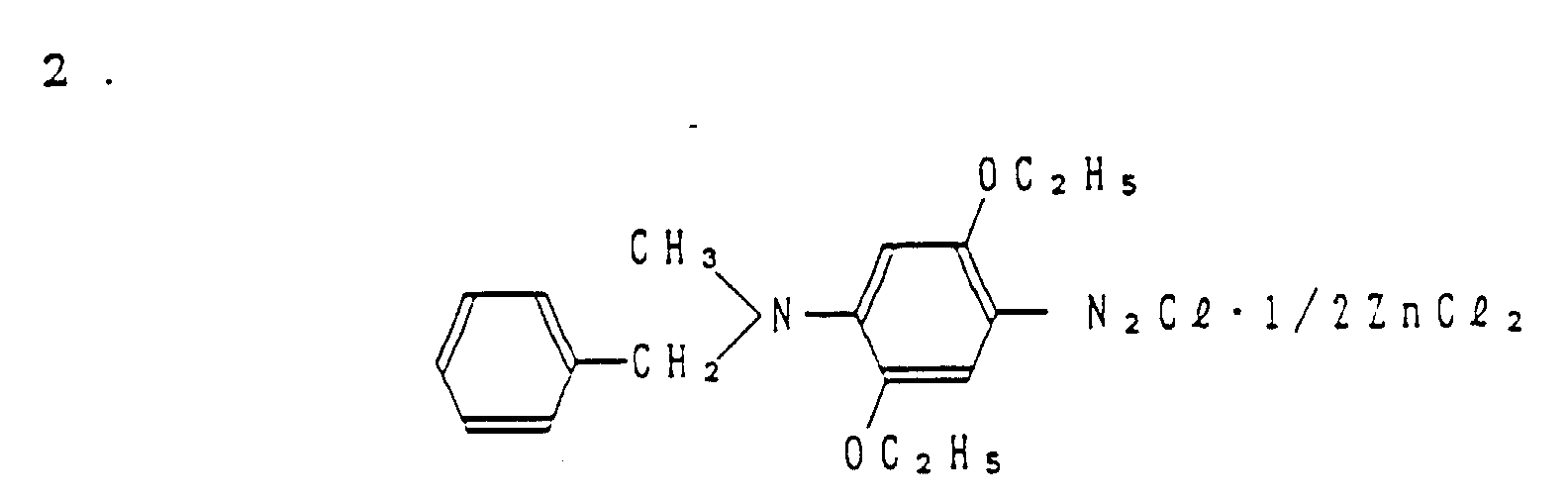
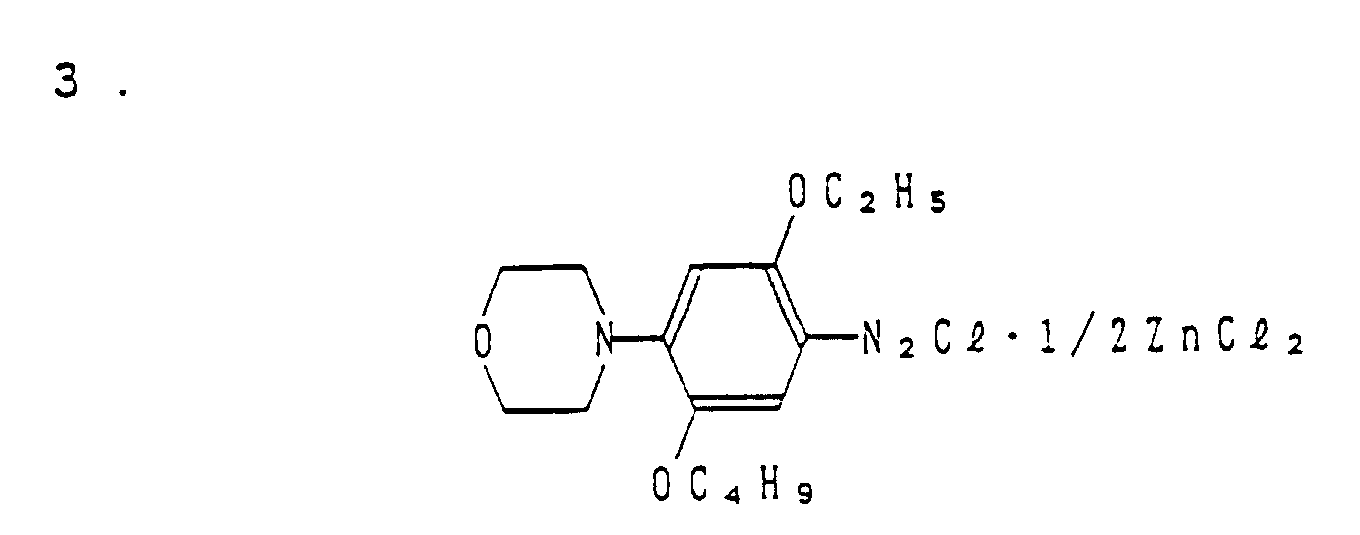

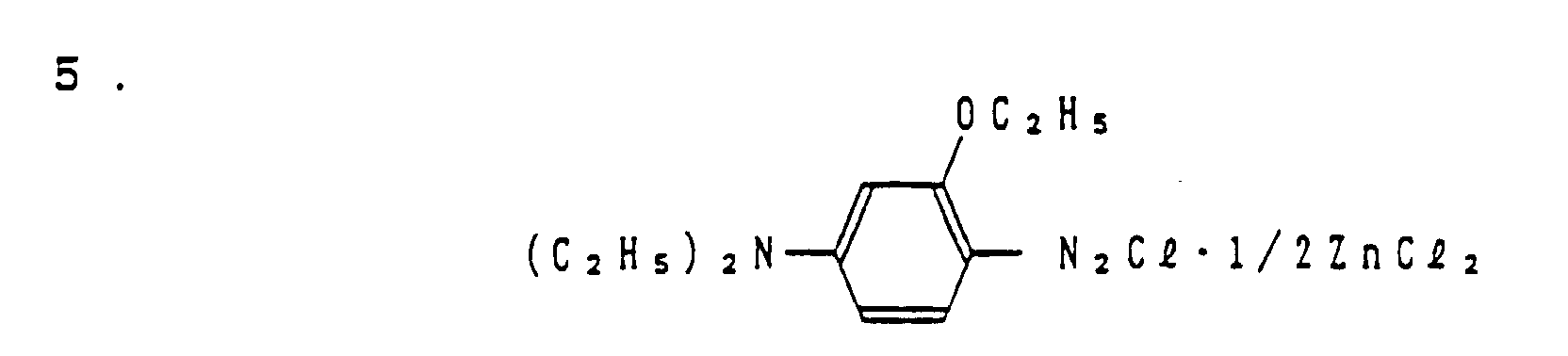
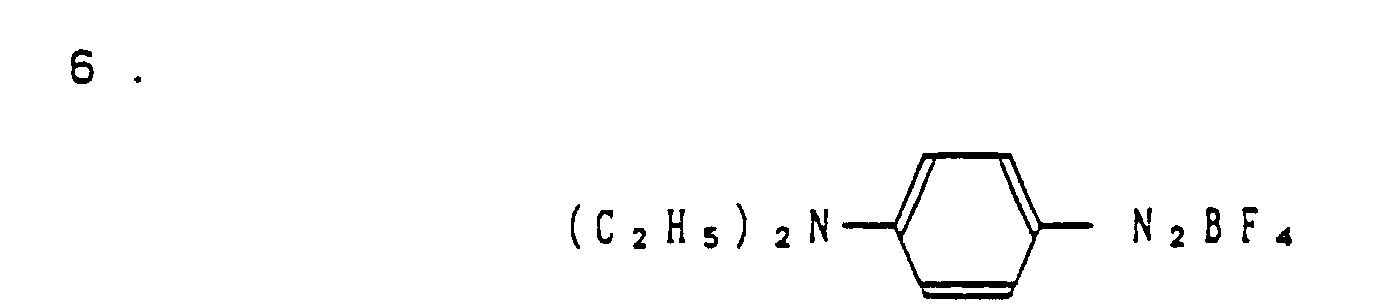
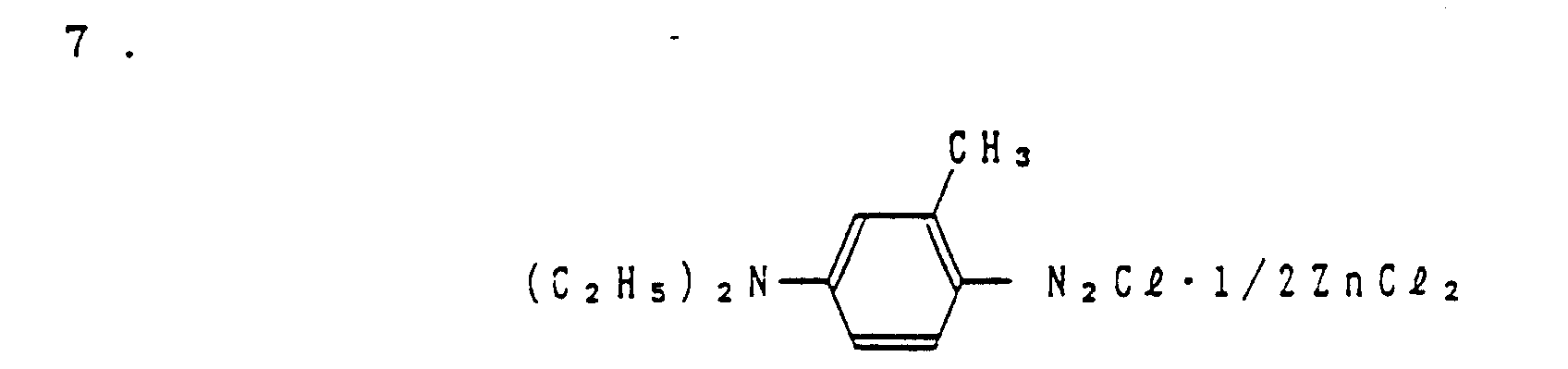
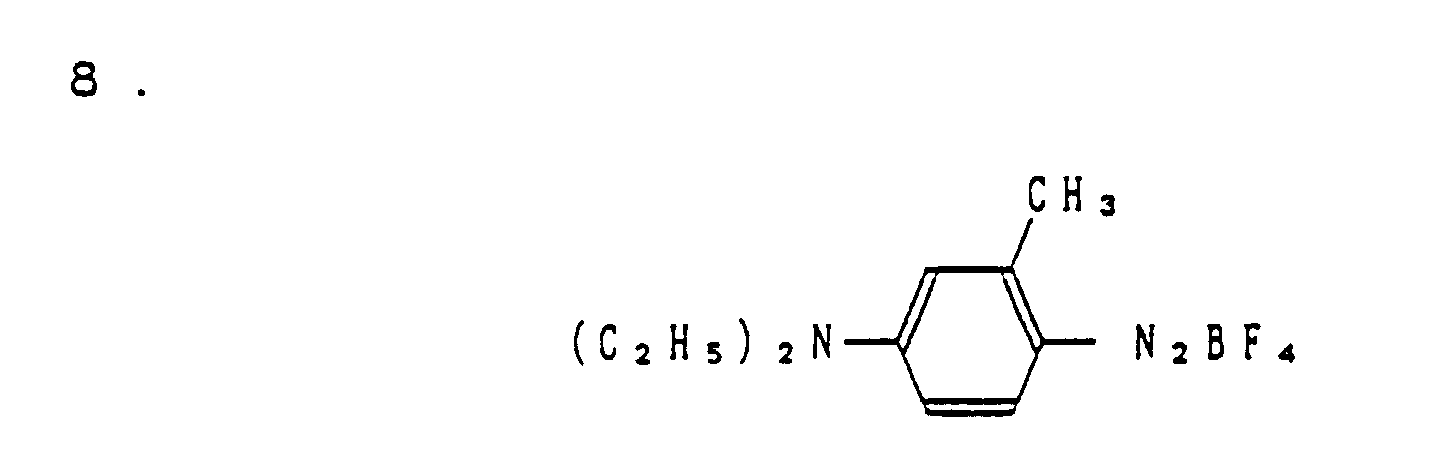
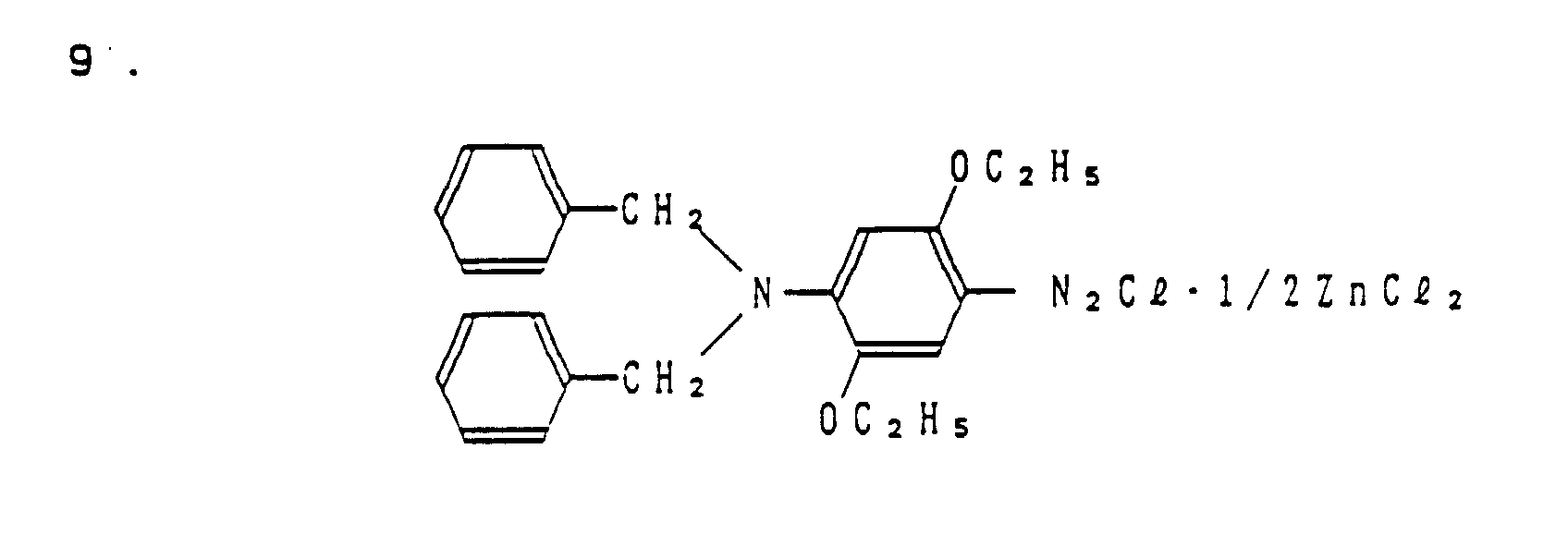
 The content of the diazo resin may be from 10% by weight to 90% by weight, preferably from 30% by weight to 70% by weight, in the solids of the light-sensitive composition.
- The content of the diazo compound may be from 5 to 45% by weight, preferably from 10 to 30% by weight.
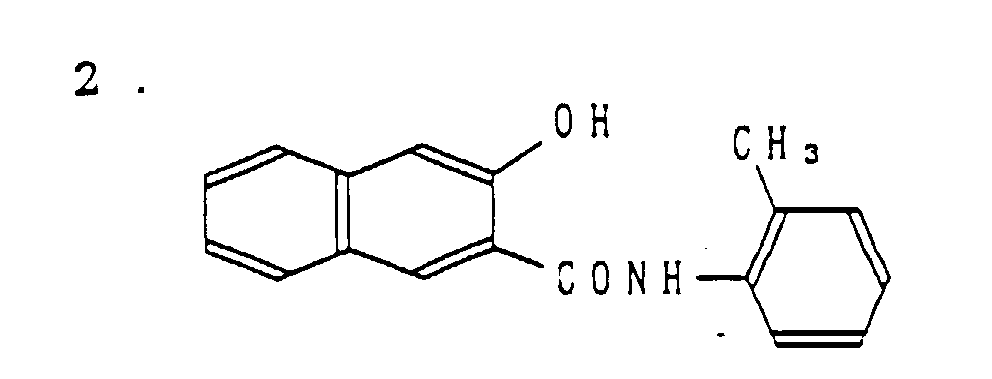
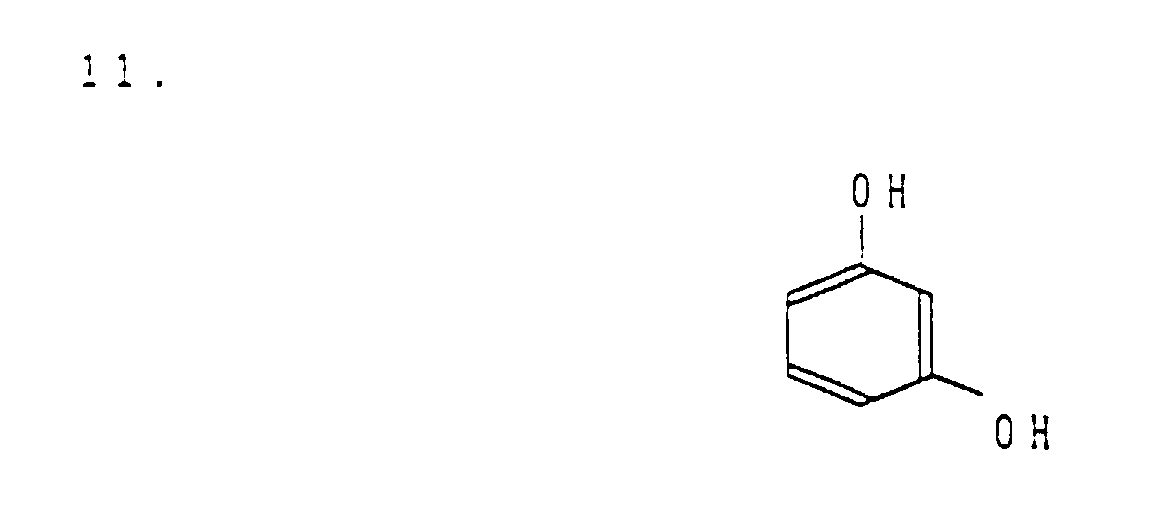
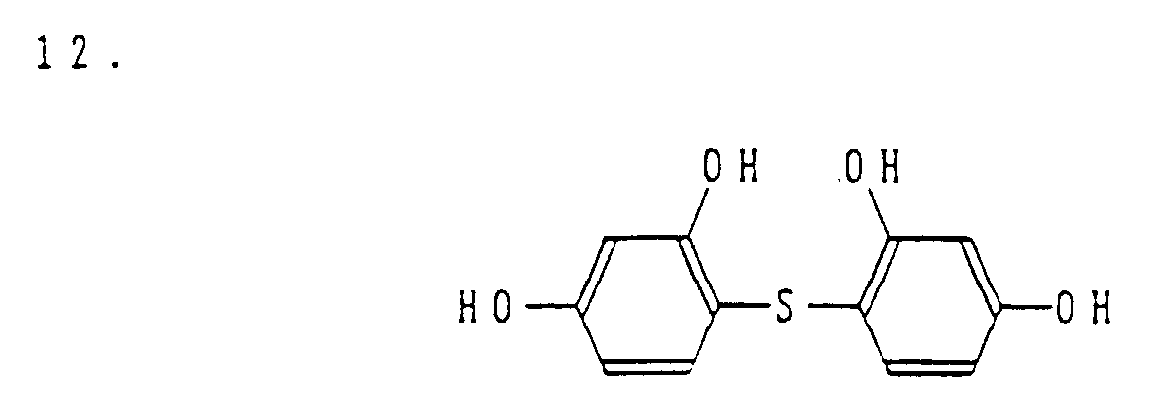
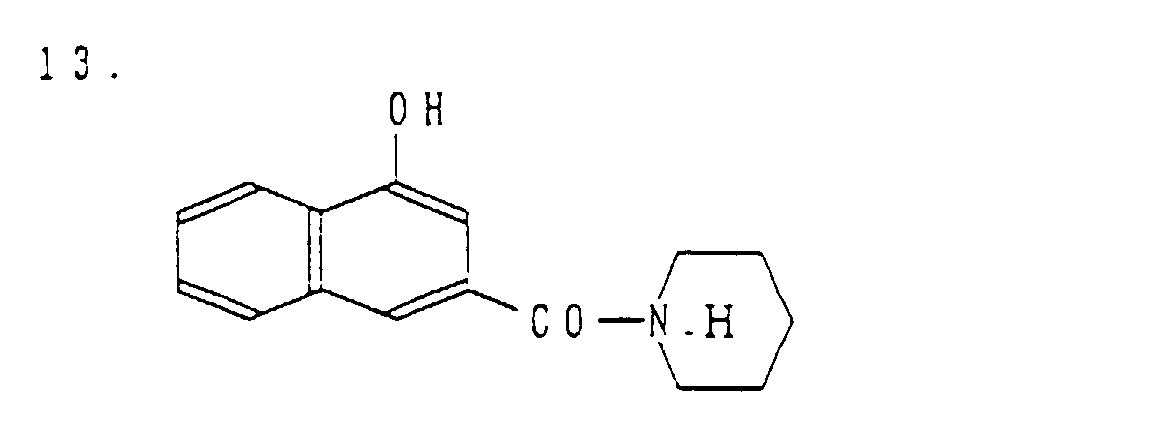
- In the above-mentioned processing solution and/or the light-sensitive layer, a substance is included which forms a dye through reaction with the diazonium salt color forming substance existing in the light-sensitive layer, namely a coupler, and the coupler may include acylacetanilides, 1,3-substituted pyrazolones, phenols, naphthols, etc.
- Specific compounds may include, for example, β-naphthol, 1-phenyl-3-methyl-5-pyrazolone, 1,5-dihydroxynaphthalene, or otherwise the couplers shown below.
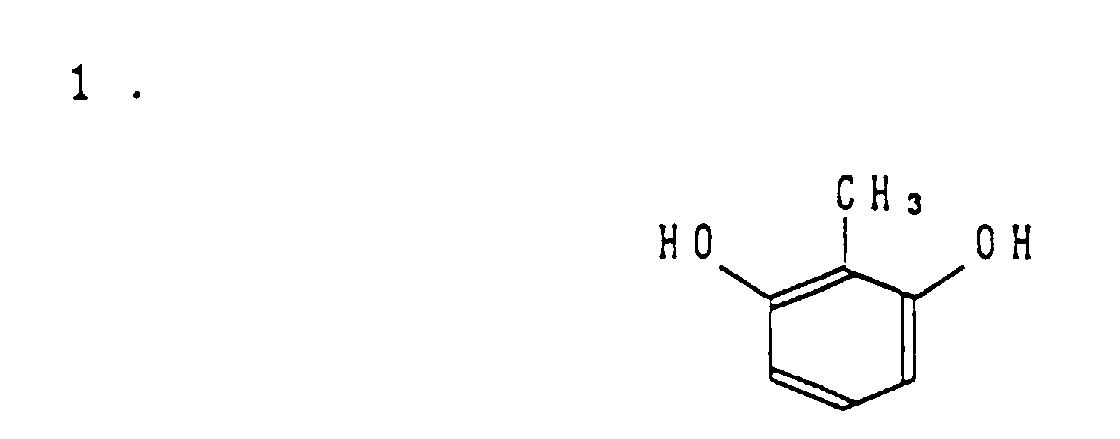


- The content of the coupler, when incorporated in the processing solution, may be from 0.1 % by weight to 20 % by weight, preferably from 1 % by weight to 10 % by weight, based on the processing solution.
- When a coupler is incorporated in the light-sensitive layer, it may be contained in an amount of from 0.2 % by weight to 40 % by weight, preferably from 1 % by weight to 30 % by weight, in the solids of the light-sensitive composition.
- In the present invention, after exposure of the light-sensitive litho printing plate requiring no dampening water having a diazo resin or diazo compound which forms a color simultaneously with developing or processing after developing incorporated in the above-described light-sensitive layer, by effecting color formation simultaneously with developing or processing with a processing solution when processed with the processing solution after developing, a printing plate excellent in layout proof can be obtained.
- When the processing solution contains a coupler, it may contain, in addition to the above-described coupler, an organic solvent which dissolves the coupler, water, a surfactant, or an alkali agent which has the catalytic action for the reaction between the color forming substance and the coupler.
- When the light-sensitive layer contains a coupler, it may contain an organic solvent, water, a surfactant, an alkali agent, etc. In this case, because no coupler is required to be dispersed or dissolved in the processing solution, the amounts of the organic solvent and the surfactant used can be decreased and advantageous effects can be obtained in aspects of the working environment and in waste solution disposal of the processing solution.
- The processing solution containing a substance reactive with the diazo resin or diazo compound color forming substance existing in tne light-sensitive layer or a coupler or having the catalytic action for reaction with the color forming substance in the light-sensitive layer may be either the same as or different from the developer, but should be preferably the same as the developer, because it is more preferable that color formation can be effected simultaneously with developing.
- As the silicone rubber layer optionally used in the method of the present invention, one composed mainly of a linear organic polysiloxane having hydroxyl groups in the main chain having the repeating units shown by the following formula [I] and a molecular weight of some 1000 to some 100,000 or at the ends of the main chain is preferred.Here, n is 2 or more, R is an alkyl group having 1 to 10 carbon atoms, a halogenated alkyl group, an alkoxyl group, a vinyl group, an aryl group or a silanol group (OH group), with 60 % or more of R being preferably methyl groups. The above-mentioned silanol group (OH group) may be either in the main chain or at the ends of the main chain, but preferably at the ends of the main chain.

- The silane coupling agent (or silicone crosslinking agent) suitable for use in the method of the present invention may be a silane compound represented by the formula:-Cl, -Br, -I, etc. Here, R2 and R3 represent the same as the above R, and may be either the same or different. Ac represents acetyl group).

- Useful silicone rubber compounds for use in the method of the present invention are those obtained by a condensation reaction between such silicone base polymers and the silicone crosslinking agent as described above.
- Specific examples of the silane coupling agent suitable for use in the method of the present invention may include HN[(CH2)3Si(OMe)3]2, vinyltriethoxysilane, Cl(CH2)3Si(OMe)3, CH3Si(OAc)3, HS(CH2)3Si(OMe)3, vinyltris(methyl ethyl ketoxime)silane, etc.
- The above-mentioned silicone rubber compound is also available as a commercial product, including, for example, YE-3085 manufactured by Toshiba Silicone. Other useful silicone rubber compounds can be also obtained by reaction of the base polymer as described above with a silicone oil having repeating units represented by the following formula [IIj, or by an addition reaction with a base polymer of silicone of which about 3 % of R are vinyl groups, or a reaction mutually between said silicone oils.(wherein R is as defined for R in formula [I] above, m is 2 or more, and n is integer 0 or 1 or more).

- For obtaining the silicone rubber compound by such a crosslinking reaction, the crosslinking reaction is carried out by use of a catalyst. As such catalyst, there may be employed organic carboxylic acid salts of metals such as tin, zinc, cobalt, lead, calcium, manganese, etc., as exemplified by dibutyltin laurate, tin (II) octoate, cobalt naphthenate, etc. or chloroplatinic acid, etc.
- For the purpose of obtaining a silicone rubber compound which can stand the frictional force occurring during the printing operation by improving the strength of the silicone rubber, a a filler can be also mixed therein. Silicone rubbers previously mixed with fillers are commercially available as silicone rubber stocks or silicone rubber dispersions, and when it is desirable to obtain a silicone rubber film by coating as in the present invention, a dispersion of RTV or LTV silicone rubber may be preferably employed. Examples of such dispersions may include silicone rubber dispersions for paper coating such as Syl Off 23, SRX-257, SH237, etc.
- In the method of the present invention, it is preferable to employ a silicone rubber of the condensation crosslinked type.
- In the silicone rubber layer, for further improvement of adhesion, a silane coupling agent having amino groups may be preferably contained.
- Examples of preferable silane coupling agents may include the following:
- (a) H2NCH2CH2NH(CH2)3Si(OCH3)3
- (b) H2NCE2CH2NH(CH2)3Si(OCH3)2(CH3)
- (c) H2N(CH2)3Si(OEt)- 3
-
- In the silicone rubber layer to be used in the method of the present invention, a small amount of a photosensitizer may be added.
- The silicone rubber layer used in the method of the present invention can be prepared by dissolving a silicone rubber in an appropriate solvent, then coating on the light-sensitive layer and drying.
- As the light-sensitive composition to be used in the method of the present invention, any known light-sensitive composition can be used, but preferably a diazo resin and a photopolymerizable compound may be used, particularly preferably a diazo resin which can function also as the substance which forms a color through the reaction with the component (coupler) in the processing solution and/or the light-sensitive layer.
- In the following, the light-sensitive composition is described in detail.
- (1) Light-sensitive composition containing a diazo resin: The diazo resin suitable for use in the method of the present invention includes various resins, but preferably, a diazo resin as represented by the condensation between p-diazodiphenylamine and formaldehyde, which resin is insoluble in water and soluble in an organic solvent, preferably one insoluble in water and soluble in conventional organic solvents as described in Japanese Patent Publications Nos. 1167/1972 and 43890/1982. Particularly preferably, a diazo resin represented by the following formula [III] may be employed.[wherein R1, R2 and R3 represent a hydrogen atom, an alkyl group or an alkoxy group, R4 represents a hydrogen atom, an alkyl group or a phenyl group, X represents an anion, and Y represents -NH-, -S- or -O-].

- As the diazo monomer in the diazo resin which may be used in the method of the present invention, diazo compounds as mentioned above can be used, and preferable examples may include 4-diazodiphenylamine, 3-methoxy-4-diazodiphenylamine, 3-ethoxy-4-diazodiphenylamine.
- As the aldehyde which may be used as the condensing agent with the above-mentioned diazo monomer, for example, there may be included formaldehyde, acetaldehyde, propionaldehyde, butylaldehyde, isobutylaldehyde, or benzaldehyde, etc.
- Further, as the anion, a water-soluble diazo resin can be obtained by use of chloride ions or tetrachlorozinc acid, etc., or alternatively a diazo resin soluble in an organic solvent can be obtained by use of boron tetrafluoride, hexafluorophosphoric acid, triisopropylnaphthalenesulfonic acid, 4,4'-biphenyldisulfonic acid, 2,5-dimethylbenzenesulfonic acid, 2-nitrobenzenesulfonic acid, 2-methoxy-4-hydroxy-5-benzoyl-benzenesulfonic acid, etc. Particularly preferably, a diazo resin comprising hexafluorophosphoric acid may be employed.
- The diazo resin should preferably be used as a mixture with a film forming resin (binder), particularly a lipophilic polymeric compound having hydroxyl groups. As such lipophilic polymeric compound, there may be included monomers having aliphatic hydroxyl groups in the side chain, such as 2-hydroxyethyl acrylate or a copolymer of 2-hydroxyethyl methacrylate and other monomers copolymerizable therewith. Other than these, if necessary, polyvinylbutyral resin, polyurethane resin, polyamide resin, epoxy resin, novolac resin, other natural resins, etc. may be also added.
- Otherwise, as the binder to be used in combination with the diazonium salt, various polymeric compounds can be used, preferably copolymers of monomers having aromatic hdyroxyl groups such as N-(4-hydroxyphenyl)acrylamide, N-(4-hydroxyphenyl)methacrylamide, o-, m- or p-hydroxystyrene, o-, m- or p-hydroxyphenyl methacrylate as described in Japanese Unexamined Patent Publication No. 98613/1979; polymers containing hydroxyethyl acrylate units or hydroxyethyl methacrylate units as the main repeating units as described in U.S. Patent 4,123,276; natural resins such as shellac, rosin, etc.; polyvinyl alcohol; polyamide resins as described in U.S. Patent 3,751,757; ; linear polyurethane resins, phthalated resins of polyvinyl alcohol, epoxy resins condensed from bisphenol A and epichlorohydrin, as described in U.S. Patent 3,660,097; and as alkali-soluble resins, novolac resins, vinyl type polymers having phenolic hydroxyl groups, condensed resins of polyvalent phenol and aldehyde or ketone as described in Japanese Unexamined Patent Publication No. 57841/1980; and so on. Examples of novolac resins may include phenolformaldehyde resins, cresol-formaldehyde resin, phenol-cresol-formaldehyde copolycondensed resins, copolycondensed resins of p-substituted phenol with phenol, or cresol and formaldehyde.
- These binders may be contained in amounts of from 10 to 95 % by weight, preferably from 40 to 80 % by weight, in the solids of the light-sensitive composition. On the other hand, the diazo resin may be contained in an amount of from 5 to 80 % by weight, preferably from 15 to 60 % by weight.
- The amounts of additives to be added optionally in the above-mentioned light-sensitive composition such as ink receptive agents, surfactants, sensitizers, stabilizers, thermal polymerization inhibitors, plasticizers, dyes, pigments, etc. depend on the kinds of additives, but may be generally from 0.01 to 20 % by weight, preferably from 0.05 to 10 % by weight, based on the light-sensitive composition contained in the light-sensitive coating solution.
- The support suitable for use as the plate material in the method of the present invention should be preferably one which can provide bending characteristics suitable for use in a conventional litho printing machine taking into account the load applied during printing. For example, there may be included metal plates such as those made of aluminum, zinc, copper, steel, etc., and metal plates having chromium, zinc, copper, nickel, aluminum and iron, etc. plated or vapor deposited thereon, paper, plastic films and glass plates, resin coated paper, paper having metal foil such as of aluminum, etc. laminated thereon.
- An aluminum plate is preferred.
- The treatment on the support itself for improvement of adhesion as mentioned above is not particularly limited, but various surface roughening treatments may be included.
- Before coating the support with the light-sensitive layer, for obtaining sufficient adhesion between the light-sensitive layer and the support, a primer layer may be also provided on the support, and said primer layer may include, for example, polyester resin, vinyl chloride-vinyl acetate copolymer, acrylic resin, vinyl chloride resin, polyamide resin, polyvinyl butyral resin, epoxy resin, acrylate type copolymer, vinyl acetate type copolymer, phenoxy resin, polyurethane resin, polycarbonate resin, polyacrylonitrile butadiene, polyvinyl acetate, etc.
- As the anchor agent constituting the above-mentioned primer layer, for example, silane coupling agents, organic titanates, etc. are also effective.
- The thicknesses of the respective layers constituting the plate material for use in the present invention are as described below. That is, the support has a thickness of from 50 to 1000 µm, preferably from 100 to 300 µm, the light-sensitive layer from 0.05 to 10 µm, preferably from 0.5 to 5.0 µm, and the silicone rubber layer from 0.5 to 100 µm, preferably from 1 to 4 µm.
- The silicone rubber layer may also have a protective layer on its upper surface, if desired.
- The plate material requiring no dampening water may be prepared, for example, as described below.
- On a support, a composition solution to constitute the light-sensitive layer is coated and dried by use of a conventional coater such as reverse roll coater, air knife coater, Meyer bar coater, etc, or a rotary coating device such as a wheeler.
- If necessary, a primer layer can be provided between the support and the light-sensitive layer in the same manner as in provision of said light-sensitive layer and cured by heating or exposure, followed by coating and drying of the light-sensitive layer, and further a silicone rubber solution can be coated according to the same method on the light-sensitive layer and heated generally at a temperature of from 100 to 120 °C for several minutes to be sufficiently cured, thereby forming a silicone rubber layer. If necessary, a protective film can be formed on said silicone rubber layer by means of a laminator.
- Next, the method for preparing the printing plate requiring no dampening water using the plate material requiring no dampening water in accordance with the present invention is described.
- A positive film which is an original manuscript is vacuum adhered on the surface of a posi-type plate material and subjected to exposure. As the light source for this exposure, there may be employed a mercury lamp, carbon arc lamp, xenon lamp, metal halide lamp, fluorescent lamp, etc. which abundantly generate UV-rays.
- Next, the positive film is peeled off and developed with a developer. As the developer, those known in the art as developers for the plate material and requiring no dampening water can be utilized, preferably an aqueous developer.
- The aqueous developer can include developers containing 30 % by weight or more, preferably from 50 % by weight to 98 % by weight, of water and an organic solvent, a surfactant, and further preferably containing an alkali agent.
- More preferably, a substance reactive with the above-mentioned color forming substance or the above-mentioned coupler is contained so that the color forming substance existing in the light-sensitive layer can form a color simultaneously with developing.
- As the organic solvent contained in the developer comprising water as the main component, there may be included, for example, aliphatic hydrocarbons (hexane, heptane, "Isopar E, H, G" (Esso Chemical, trade names of aliphatic hydrocarbons) or gasoline, kerosene, etc.), aromatic hydrocarbons (toluene, xylene, etc.), or halogenated hydrocarbons (Triclene, etc.), alcohols (methanol, ethanol, 1-butoxy-2-propanol, 3-methyl-3-methoxybutanol, benzyl alcohol, etc.), ethers (methyl cellosolve, ethyl cellosolve, butyl cellosolve, phenyl cellosolve, methyl carbitol, ethyl carbitol, butyl carbitol, dioxane, diethylene glycol dimethyl ether, diethylene glycol diethyl ether, diethylene glycol dibutyl ether, ethylene glycol dibutyl ether, propylene glycol, dipropylene glycol butyl ether, tripropylene glycol methyl ether, polypropylene glycol methyl ether, etc.), ketones (acetone, methyl ethyl ketone, methyl isobutyl ketone, diisobutyl ketone, 4-methyl-1,3-dioxorane-2-one, etc.), esters (ethyl acetate, propyl acetate, hexyl acetate, methyl butyrate, propyl butyrate, diethyl succinate, dibutyl oxalate, diethyl maleate, benzyl benzoate, methyl cellosolve acetate, cellosolve acetate, carbitol acetate, etc.), and so on.
- As the surfactant to be added in the developer for use with the present invention, there may be included anionic surfactants, nonionic surfactants, cationic surfactants and amphoteric surfactants, specifically those as set forth below:
- (1) Higher alcohol sulfates (e.g. sodium salt of lauryl alcohol sulfate, ammonium salt of octylalcohol sulfate, ammonium salt of lauryl alcohol sulfate, secondary sodium alkyl sulfate, etc.);
- (2) Aliphatic alcohol phosphate salts (e.g. sodium salt of cetyl alcohol phosphate, etc.);
- (3) Alkylaryl sulfonic acid salts (e.g. sodium dodecylbenzenesulfonate, sodium isopropylnaphthalenesulfonate, sodium dinaphthalenesulfonate, sodium metadinitrobenzenesulfonate, etc.);
- (4) Alkylamidesulfonic acid salts: eg.

- (5) Sulfonic acid salts of dibasic fatty esters (e.g. sodium dioctyl sulfosuccinate, sodium dihexyl sulfosuccinate, etc.);
- (6) formaldehyde condensate of alkylnaphthalenesulfonic acid salts (e.g. formaldehyde condensate of sodium dibutylnaphthalenesulfonate).
-
- As the nonionic surfactant, there may be included polyoxyethylene alkyl ethers, polyoxyethylene alkyl phenol ethers, polyethylene fatty acid esters, sorbitane fatty acid esters, polyoxyethylene sorbitane fatty acid esters, glycerine fatty acid esters, oxyethylene oxypropylene block polymers, etc.
- As the cationic surfactant, alkylamine salts, quaternary ammonium salts, polyoxyethylene alkylamines, etc. may be included.
- As the amphoteric surfactant, alkyl betaines may be included, and among these, anionic surfactants are suitable.
- These surfactants can be used either singly or as a combination of two or more kinds.
- The amount of the surfactant to be used with the present invention may be suitably from 0.01 % by weight to 60 % by weight, preferably from 0.1 % by weight to 10 % by weight.
- Further, as the alkali agent to be used with the present invention, there may be included:
- (1) inorganic alkali agents such as sodium silicate, potassium silicate, potassium hydroxide, sodium hydroxide, lithium hydroxide, secondary or tertiary sodium or ammonium phosphate, sodium metasilicate, sodium carbonate, ammonia, etc.;
- (2) organic amine compounds such as mono-, di- or trimethylamine, mono-, di- or triethylamine, , mono- or diisopropylamine, n-butylamine, mono-, di- or triethanolamine, mono-, di- or triisopropanolamine, ethylenimine, ethylenediimine, etc.
-
- The alkali agent may be used in an amount of from 0.05% by weight to 20 % by weight, preferably from 0.2 % by weight to 10 % by weight.
- Developing can be carried out by rubbing with a pad containing the developer as described above or by pouring the developer onto the plate surface followed by rubbing with a brush, etc.
- By developing as described above, a printing plate may be obtained in which a part of the light-sensitive layer at the unexposed portion and the silicone rubber are removed, or the light-sensitive layer color formed by removal only of the silicone rubber layer is exposed. A printing plate having the silicone rubber layer and the light-sensitive layer substantially without color formation in the exposed portion is thus obtained.
- An amount 14.5 g (50 mmole) of p-diazodiphenylamine sulfate was dissolved under ice-cooling in 40.9 g of conc. sulfuric acid. Into the solution was added slowly 1.35 g (45 mmole) of p-formaldehyde so that the reaction temperature did not exceed 10 °C.
- The reaction mixture under ice-cooling was added dropwise into 500 ml of ethanol, and the precipitates formed were filtered. After washing with ethanol, the precipitates were dissolved in 100 ml of pure water, and into the solution was added a cold conc. aqueous solution containing 6.8 g of zinc chloride dissolved therein.
- The precipitates formed were filtered, then washed with ethanol and this was dissolved in 150 ml of pure water. Into the solution was added cold conc. aqueous solution containing 8 g of ammonium hexafluorophosphate dissolved therein. The precipitates formed were collected by filtration, washed with water and dried to obtain a diazo resin - 1.
- An aluminum plate with a thickness of 0.24 mm was defatted by dipping in an aqueous 3 % sodium hydroxide, washed with water and subjected to anodic oxidation in an aqueous 32 % sulfuric acid under the conditions of a temperature of 30 °C, at 5 A/dm2 for 10 seconds. The plate was then washed with water, dipped in an aqueous 2 % sodium metasilicate at a temperature of 85 °C for 37 seconds, further in water (pH 8.5) of 90 °C for 25 seconds, washed with water and dried to give an aluminum plate a.
- The aluminum plate a was coated with a primer layer composition having the following composition, dried at 85 °C for 3 minutes and subjected to whole surface exposure of 1000 mJ/cm2 by use of a 3 KW ultra-high pressure mercury lamp. Further, the coating was dried at 100 °C for 4 minutes and dried to form a primer layer with a thickness of 3.0 µm.
-
(1) Diazo resin - 1 8 parts (2) Copolymer resin - 1 of 2-hydroxyethyl methacrylate, methyl methacrylate with a molar ratio of 34/64 92 parts (3) FINEX - 25 (zinc oxide pigment, manufactured by Sakai Kagaku K.K.) 30 parts (4) Methyl cellosolve 870 parts - Next, on the above-mentioned primer layer was coated a light-sensitive composition having the following composition, followed by drying at 100 °C for 2 minutes, to form a light-sensitive layer with a thickness of 1.2 µm.
-
(1) Diazo resin - 1 50 parts (2) Copolymer resin - 1 of 2-hydroxyethyl methacrylate, N-(4-hydroxyphenyl)methacrylamide, methyl methacrylate, acrylonitrile with a molar ratio of 20/10/50/20 50 parts (3) Victoria Pure Blue BOH (dye, manufactured by Hodogaya Kagaku K.K.) 1 part (5) Methyl lactate 1900 parts - Next, on the above-mentioned light-sensitive layer was coated the following silicone rubber composition to a dry weight of 1.8 g/m2, followed by drying at 90 °C for 10 minutes.
-
(1) Dimethylpolysiloxane having hydroxyl groups at the both ends (molecular weight:82,000) 100 parts (2) Triacetoxymethylsilane 5 parts (3) 1,3,5-Tris(trimethoxysilylpropyl) isocyanurate 2.5 parts (4) Dibutyltin laurate 0.8 part (5) Isopar E (manufactured by Esso Chemical) 900 parts - Next, on the above-mentioned silicone rubber layer was laminated a polypropylene film with a thickness of 5 µ to obtain a water-free litho plate.
- After a positive film was vacuum adhered onto the upper surface of the above-described plate material, exposure was effected by use of a metal halide lamp as the light source. Next, after dipping in the following developer - 1 for one minute, the silicone rubber layer at the unexposed portion was removed, by rubbing the surface of the plate material with a pad impregnated with a developer. The dots were well reproduced to give a printing plate with a light-sensitive layer in which the image line portion was color formed in blue at the unexposed portion.
-
Benzyl alcohol 2 parts Pellex NBL (35 % aqueous anionic surfactant solution, manufactured by Kao-Atlas) 6 parts Diethanolamine 2 parts 2-Hydroxy-N-(2-methylphenyl)-3-naphthoamide 3 parts Propylene glycol 20 parts Water 67 parts - A litho printing plate material requiring no dampening water was obtained in the same manner as in Example - 1 except for changing the light-sensitive composition, the silicone rubber layer composition and the developer in Example - 1 as follows.
-
(1) Diazo resin- 1 15 parts (2) Copolymer resin - 2 of 2-hydroxyethyl methacrylate, N-(4-hydroxyphenyl)methacrylamide, methyl methacrylate, acrylonitrile, allyl methacrylate with a molar ratio of 20/10/50/10/10 50 parts (3) Pentaerythritol triacrylate 15 parts (4) Tetramethylomethane tetraacrylate 20 parts (5) Victoria Pure Blue BOH (dye, manufactured by Hodogaya Kagaku K.K.) 1 part (6) Kayacure DETX (2,4-Diethylthioxanthon photopolymerization initiator, manufactured by Nippon Kayaku K.K.) 5 parts (7) Kayacure EPA (p-Dimethylamino benzoic acid ethyl ester photopolymerization promotor, manufactured by Nippon Kayaku K.K.) 2 parts (8) Methyl lactate 1900 parts -
Dimethylpolysiloxane having hydroxyl groups at the both ends (molecular weight 82,000) 100 parts Triacetoxyvinylsilane 5 parts 1-Trimethoxysilylpropyl-3,5-diallyl isocyanurate 2.5 parts Dibutyltin laurate 0.8 part Isopar E (manufactured by Esso Chemical) 900 parts -
Benzyl alcohol 2 parts Pellex NBL (aqueous 35 % anionic surfactant, manufactured by Kao-Atlas) 17 parts Diethanolamine 2 parts 2-Hydroxy-N-(2-methylphenyl)-3-naphthoamide 3 parts Tripropylene glycol monomethyl ether 45 parts Isopar H (isoparaffinic solvent, manufactured by Esso Chemical K.K.) 6 parts Water 25 parts - Similarly as in Example - 1, the dots were well reproduced to give a printing plate with a light-sensitive layer in which the image line portion was color formed in blue at the unexposed portion.
- A litho printing plate material requiring no dampening water was obtained in the same manner as in Example - 1 except for changing the light-sensitive composition in Example - 2 as follows.
-
(1) 2,5-Diethoxy-4-morpholinobenzenediazonium- fluoroborate 15 parts (2) Copolymer resin - 2 of 2-hydroxyethyl methacrylate, N-(4-hydroxyphenyl)methacrylamide, methyl methacrylate, acrylonitrile, allyl methacrylate with a molar ratio of 20/10/50/10/10 50 parts (3) Pentaerythritol triacrylate 15 parts (4) Tetramethylolmethane tetraacrylate 20 parts (5) Victoria Pure Blue BOH (dye, manufactured by Hodogaya Kagaku K.K.) 1 part (6) Kayacure DETX (2,4-Diethylthioxanthone photopolymerization initiator,manufactured by Nippon Kayaku K.K.) 5 parts (7) Kayacure EPA (p-Dimethylamino benzoic acid ethyl ester photopolymerization promotor, manufactured by Nippon Kayaku K.K.) 2 parts (8) Methyl lactate 1900 parts - The dots were well reproduced similarly to those in Example - 1, to give a printing plate with a light-sensitive layer in which the image line portion was color formed in blue at the unexposed portion.
- A litho printing plate material requiring no dampening water was obtained in the same manner as in Example - 3 except for changing 15 parts of (1) 2,5-diethoxy-4-morpholino-benzenediazoniumfluoroborate to 15 parts of the Copolymer resin - 2.
- A printing plate with well reproduced dots similar to those in Example - 1 was obtained, but no color formation of the image line portion occurred, with the image after developing being indistinct, and dyeing of the image line portion with a dye solution was necessary.
- A litho printing plate requiring no dampening water was obtained in the same manner as in Example - 1 except for changing the developer in Example - 1 as follows.
-
Benzyl alcohol 2 parts Pellex NBL (35 % aqueous anionic surfactant, manufactured by Kao-Atlas) 6 parts Diethanolamine 2 parts N-(2-hydroxyethyl)-3,5-dihydroxybenzamide 3 parts Propylene glycol 20 parts Water 67 parts - The dots were well reproduced to give a printing plate in which the image line portion was color formed in red at the unexposed portion.
- The aluminum plate as prepared in Example 1 was coated with a primer layer composition having the following composition, dried at 85 °C for 3 minutes, and then subjected to whole surface exposure of 1000 mJ/cm2 by use of a 3 KW ultra-high pressure mercury lamp. Further, the coating was dried at 100 °C for 4 minutes to form a primer layer with a thickness of 3.0 µm.
-
(1) Diazo resin - 1 8 parts (2) Copolymer resin - 1 of 2-hydroxyethyl methacrylate and methyl methacrylate with a molar ratio of 34/64 92 parts (3) FINEX - 25 (zinc oxide pigment, manufactured by Sakai Kagaku K.K.) 30 parts (4) Methyl cellosolve 870 parts - Next, on the above-mentioned primer layer was coated a light-sensitive composition having the following composition, followed by drying at 100 °C for 2 minutes, to form a light-sensitive layer with a thickness of 1.2 µm.
-
(1) Diazo resin - 1 50 parts (2) Copolymer resin - 1 of 2-hydroxyethyl methacrylate, N-(4-hydroxyphenyl)methacrylamide, methyl methacrylate, acrylonitrile with a molar ratio of 20/10/50/20 50 parts (3) Victoria Pure Blue BOH (dye, manufactured by Hodogaya Kagaku K.K.) 1 part (4) 2-Hydroxy-N-(2-methylphenyl)-3-naphtoamide 15 parts (5) Methyl lactate 1900 parts - Next, on the above-mentioned light-sensitive layer was coated the following silicone rubber composition to a dry weight of 1.8 g/m2, followed by drying at 90 °C for 10 minutes.
-
(1) Dimethylpolysiloxane having hydroxyl groups at both ends (molecular weight 82,000) 100 parts (2) Triacetoxymethylsilane 5 parts (3) 1,3,5-Tris(trimethoxysilylpropyl) isocyanurate 2.5 parts (4) Dibutyltin laurate 0.8 part (5) Isopar E (manufactured by Esso Chemical) 900 parts - Next, on the above-mentioned silicone rubber layer was lamianted a polypropylene film with a thickness of 5 µ to give a litho printing plate requiring no dampening water.
- After a positive film was vacuum adhered onto the upper surface of the above-mentioned plate material, exposure was effected by use of a metal halide lamp as the light source. Next, the plate material was dipped in the following developer - 4, and then the surface of the plate material was rubbed with a pad impregnated with the developer to remove the silicone rubber layer at the unexposed portion, whereby the dots were well reproduced to obtain a printing plate with a light-sensitive layer in which the image line portion was color formed in blue at the unexposed portion
-
Benzyl alcohol 2 parts Pellex NBL (35 % aqueous anionic surfactant, manufactured by Kao-Atlas) 6 parts Diethanolamine 2 parts Propylene glycol 20 parts Water 67 parts - A printing plate material requiring no dampening water was obtained in the same manner as in Example - 1 except for changing the light-sensitive composition, the silicone rubber layer composition, and the developer as follows.
-
(1) Diazo resin - 1 15 parts (2) Copolymer resin - 2 of 2-hydroxyethyl methacrylate, -(4-hydroxyphenyl)methacrylamide, methyl methacrylate, acrylonitrile, allyl methacrylate with a molar ratio of 20/10/50/10/10 50 parts (3) Pentaerythritol triacrylate 15 parts (4) Tetramethylolmethane tetraacrylate 20 parts (5) Victoria Pure Blue BOH (dye, manufactured by Hodogaya Kagaku K.K.) 1 part (6) Kayacure DETX (2,4-Diethylthioxanthone photopolymerization initiator, manufactured by Nippon Kayaku K.K.) 5 parts (7) Kayacure EPA (p-Dimethylamino benzoic acid ethyl ester photopolymerization promotor, manufactured by Nippon Kayaku K.K.) 2 parts (8) 2-Hydroxy-N-(2-methylphenyl)-3-naphthoamide 15 parts (9) Methyl lactate 1900 parts -
Dimethylpolysiloxane having hydroxyl groups at both ends (molecular weight 82,000) 100 parts Triacetoxyvinylsilane 5 parts 1-Trimethoxysilylpropyl-3,5-diallylisocyanurate 2.5 parts Dibutyltin laurate 0.8 part Isopar E (manufactured by Esso Chemical) 900 parts -
Benzyl alcohol 2 parts Pellex NBL (35 % aqueous anionic surfactant, manufactured by Kao-Atlas) 17 parts Diethanolamine 2 parts Tripropylene glycol monomethyl ether Isopar H (isoparaffinic solvent, manufactured 45 parts by Esso Chemical K.K.) 6 parts Water 25 parts - The dots were well reproduced similar to those in Example - 1 to give a printing plate with a light-sensitive layer in which the image line portion was color formed in blue at the unexposed portion.
- A litho printing plate material requiring no dampening water was obtained in a similar manner to Example - 1 except for changing the light-sensitive composition of Example - 2 as follows.
-
(1) 2,5-Diethoxy-4-morpholinobenzenediazoniumfluoroborate 15 parts (2) Copolymer resin - 2 of 2-hydroxyethyl methacrylate, N-(4-hydroxyphenyl)methacryl amide, methyl methacrylate, acrylonitrile, allyl methacrylate with a molar ratio of 20/10/50/10/10 50 parts (3) Pentaerythritol triacrylate 15 parts (4) Tetramethylolmethane tetraacrylate 20 parts (5) Victoria Pure Blue BOH (dye, manufactured by Hodogaya Kagaku K.K.) 1 part (6) Kayacure DETX (2,4-Diethylthioxanthone photopolymerization initiator, manufactured by Nippon Kayaku K.K.) 5 parts (7) Kayacure EPA (p-Dimethylamino benzoic acid ethyl ester photopolymerization promotor, manufactured by Nippon Kayaku K.K.) 2 parts (8) 2-Hydroxy-N-(2-methylphenyl)-3-naphthoamide 15 parts (9) Methyl lactate 1900 parts - The dots were well reproduced similar to those in Example - 1 to give a printing plate with a light-sensitive layer in which the image line portion was color formed in blue at the unexposed portion.
- A litho printing plate requiring no dampening water was obtained in the same manner as in Example - 5 except for changing (4) in the light-sensitive composition of Example - 1 to that shown below.
(4) N-(2-hydroxyethyl)-3,5-dihydroxybenzamide 15 parts - When exposed and developed in a similar manner to Example 1, dots were well reproduced to give a printing plate with a light-sensitive layer in which the image line portion was color formed in red at the unexposed portion
- After exposure of the litho printing plate material requiring no dampening water obtained in Example 5, developing was carried out with the developer - 6 shown below, in a similar manner to Example - 5. Subsequently, the plate material was dipped in the processing solution - 1 shown below for one minute. The dots were well reproduced similar to those in Example - 5 to give a printing plate in which the image line portion was color formed in blue at the unexposed portion.
-
Benzyl alcohol 2 parts Pellex NBL 6 parts Propylene glycol 22 parts Water 70 parts -
Monoethanolamine 3 parts Water 97 parts - The image line portion at this time was not color formed during developing, and was color formed for the first time when processed with the processing solution - 1.
- The present invention, by the use of at least one of the color forming substances and couplers in the light-sensitive layer, and effecting color formation through the component in the processing solution, can exhibit the excellent effects of sharp images after developing and no contamination of hands and clothing with the dyeing solution after developing, or contamination of an automatic developing machine.
Claims (9)
- A method for preparing a printing plate, which method comprises exposing a positive working light-sensitive litho printing plate comprising a support, a light-sensitive layer and a silicone rubber layer provided thereon,
wherein the light sensitive layer comprises at least one of a diazo resin or a diazo compound, developing the exposed printing plate to form a colour during developing or after developing. - A method according to claim 1, wherein the diazo resin is a condensate of p-diazodiphenylamine and formaldehyde.
- A method according to claim 2, wherein the condensate is represented by the following formula III:wherein R1 and R3 each independently represent a hydrogen atom, an alkyl group or an alkoxy group, R4 represents a hydrogen atom, an alkyl group or a phenyl group, X represents an anion, and Y represents -NH-, -S- or -O-.

- A method according to claim 1, wherein the diazo compound is chosen from:


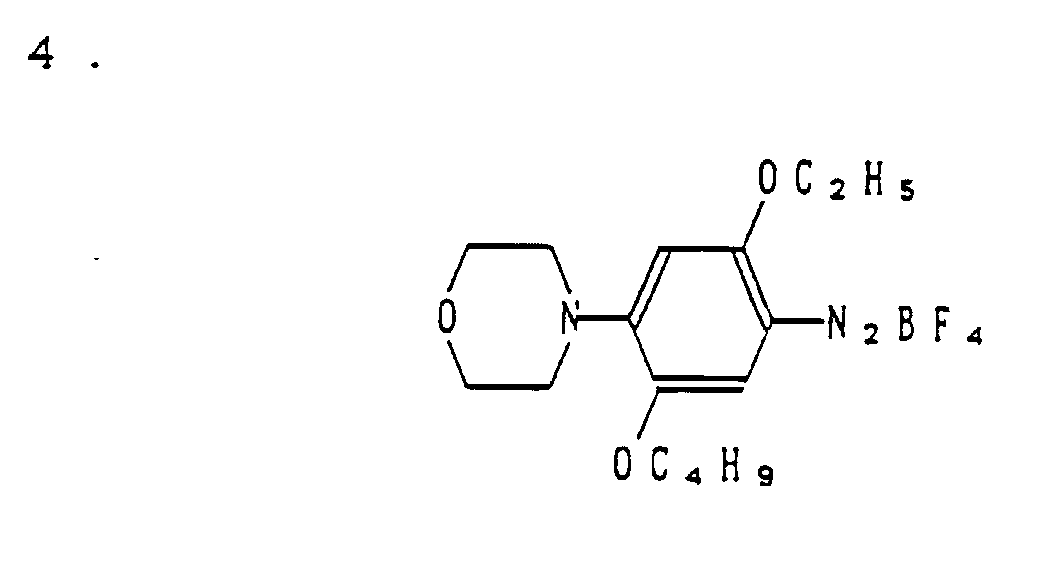


- A method according to any preceding claim, wherein the light sensitive layer comprises a photopolymerizable compound.
- A method according to any preceding claim, wherein the developing is carried out by a processing solution.
- A method acording to any preceding claim, wherein the silicone rubber layer comprises a linear organic polysiloxane represented by following formula (I):wherein n is 2 or more, R is an alkyl group having 1 to 10 carbon atoms, a halogenated alkyl group, an alkoxyl group, a vinyl group, an aryl group or a silanol group (OH group).

- A method according to any preceding claim wherein the silicone rubber is obtainable by condensing the polysiloxane and a silane compound represented by the formula RnSiX4-n wherein n is from 1 to 3, the R groups may be the same or different and are each chosen from a monovalent group such as an alkyl, aryl, alkenyl or the combination of these, and these groups have at least one functional group such as halogen, amine, hydroxyl, alkoxy, aryloxy and thiol, X represents -OH, -OR2, -PAc,-Cl, -Br and -I wherein R2 and R3 may be the same or different and are defined as for R above, and Ac represents an acetyl group.
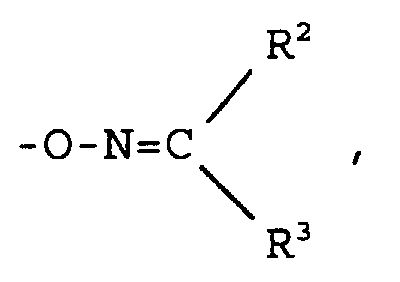
- A method according to any preceding claim wherein at least one of the developer, the processing solution or the light-sensitive layer comprises a coupler chosen from:
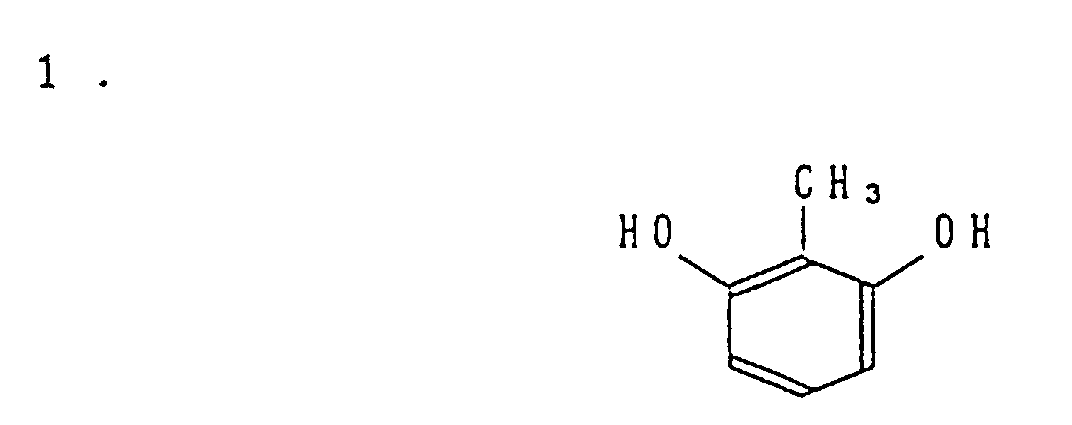
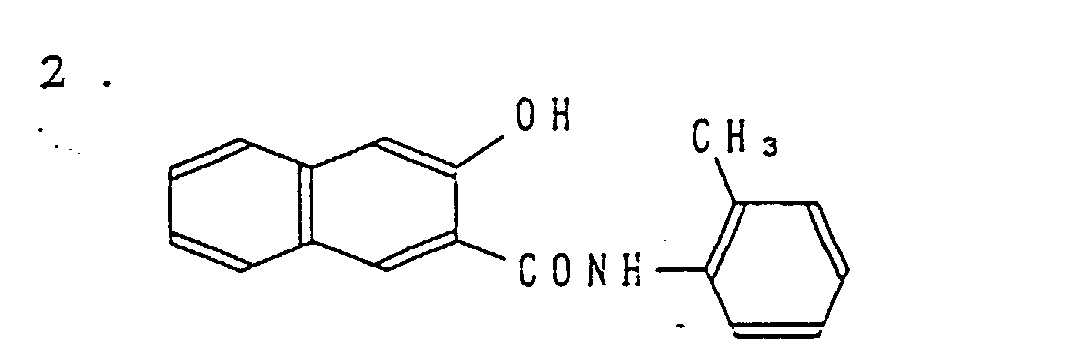

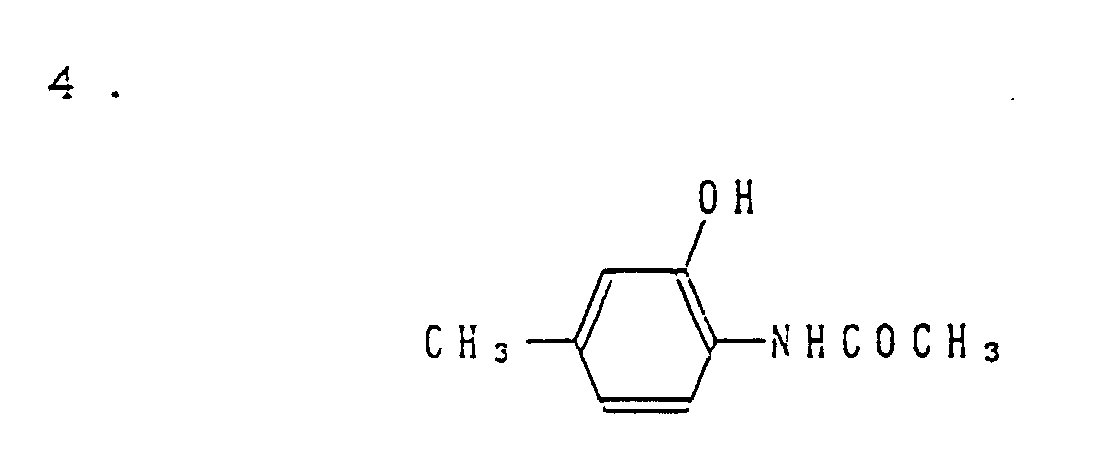


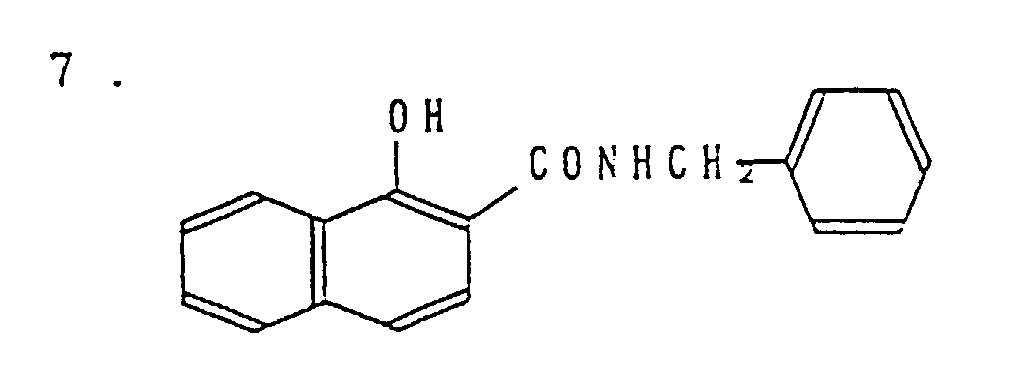


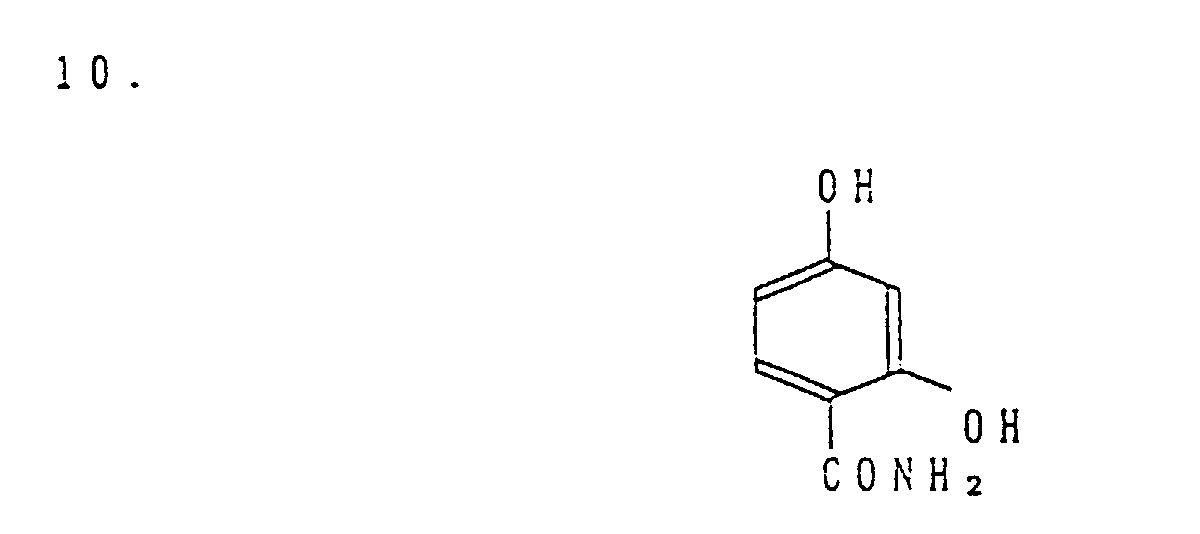


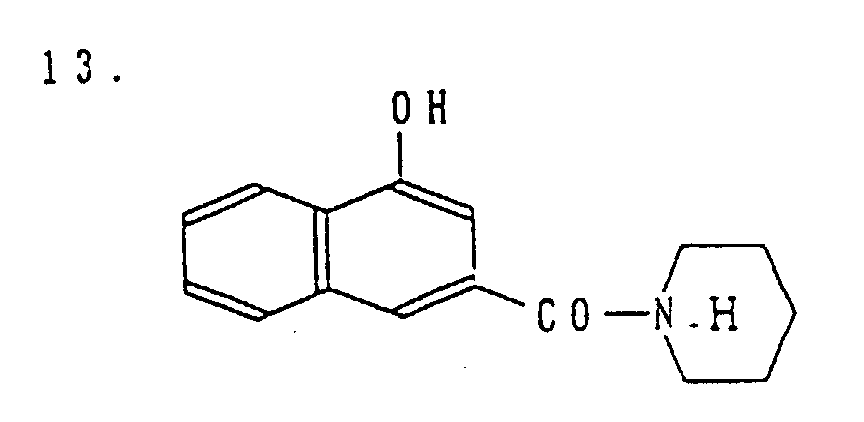
Applications Claiming Priority (6)
| Application Number | Priority Date | Filing Date | Title |
|---|---|---|---|
| JP29333/90 | 1990-02-08 | ||
| JP2933390 | 1990-02-08 | ||
| JP2933390 | 1990-02-08 | ||
| JP14742690A JPH03273249A (en) | 1990-02-08 | 1990-06-07 | Dampening-waterless photosensitive planographic printing plate |
| JP147426/90 | 1990-06-07 | ||
| JP14742690 | 1990-06-07 |
Publications (3)
| Publication Number | Publication Date |
|---|---|
| EP0441638A2 EP0441638A2 (en) | 1991-08-14 |
| EP0441638A3 EP0441638A3 (en) | 1992-06-17 |
| EP0441638B1 true EP0441638B1 (en) | 1999-10-13 |
Family
ID=26367519
Family Applications (1)
| Application Number | Title | Priority Date | Filing Date |
|---|---|---|---|
| EP19910301026 Expired - Lifetime EP0441638B1 (en) | 1990-02-08 | 1991-02-07 | Light sensitive litho printing plate |
Country Status (1)
| Country | Link |
|---|---|
| EP (1) | EP0441638B1 (en) |
Families Citing this family (2)
| Publication number | Priority date | Publication date | Assignee | Title |
|---|---|---|---|---|
| JPH04147261A (en) * | 1990-10-11 | 1992-05-20 | Konica Corp | Damping-waterless photosensitive planographic printing plate |
| GB9516694D0 (en) | 1995-08-15 | 1995-10-18 | Horsell Plc | Water-less lithographic plates |
Family Cites Families (22)
| Publication number | Priority date | Publication date | Assignee | Title |
|---|---|---|---|---|
| US2752372A (en) | 1947-09-13 | 1956-06-26 | Organon | 3, 14, 21-trihydroxy pregnanediones-(11, 20) and process |
| US2732297A (en) | 1948-11-03 | 1956-01-24 | Decorating ceramic objects | |
| US2732301A (en) | 1952-10-15 | 1956-01-24 | Chxcxch | |
| DE1119510B (en) | 1956-03-14 | 1961-12-14 | Bayer Ag | Process for the production of insoluble, crosslinked high molecular weight polyesters |
| US2956878A (en) | 1956-11-13 | 1960-10-18 | Eastman Kodak Co | Photosensitive polymers and their applications in photography |
| BE588325A (en) | 1959-03-24 | |||
| US3453237A (en) | 1959-07-21 | 1969-07-01 | Eastman Kodak Co | Light-sensitive polymers having a linear chain containing the styryl ketone group |
| US3707373A (en) | 1969-03-17 | 1972-12-26 | Eastman Kodak Co | Lithographic plate developers |
| US3660097A (en) | 1969-11-28 | 1972-05-02 | Polychrome Corp | Diazo-polyurethane light-sensitive compositions |
| DE2105547A1 (en) | 1971-02-06 | 1972-08-10 | Tente Rollen GmbH & Co, 5678 Wermelskirchen Tente | Swivel castor, especially for shopping carts in self-service shops |
| US4072527A (en) | 1972-09-27 | 1978-02-07 | E. I. Du Pont De Nemours And Company | Oxygen barrier layers for photopolymerizable elements |
| JPS5319205B2 (en) | 1973-03-27 | 1978-06-20 | ||
| US4123276A (en) | 1974-02-28 | 1978-10-31 | Fuji Photo Film Co., Ltd. | Photosensitive composition |
| JPS5498613A (en) | 1978-01-09 | 1979-08-03 | Konishiroku Photo Ind Co Ltd | Photosensitive composition |
| JPS54103103A (en) | 1978-01-27 | 1979-08-14 | Toray Industries | Plate making method of lithograph printing block |
| JPS5557841A (en) | 1978-10-20 | 1980-04-30 | Konishiroku Photo Ind Co Ltd | Photosensitive composition |
| JPS5522781A (en) | 1979-05-24 | 1980-02-18 | Canon Inc | Image scanning and recording system |
| JPS5743890A (en) | 1980-08-29 | 1982-03-12 | Fuji Xerox Co Ltd | Heat transfer recording medium |
| JPS60192948A (en) * | 1984-03-14 | 1985-10-01 | Fuji Photo Film Co Ltd | Negative type photosensitive lithographic plate requiring no dampening water and its manufacture |
| JPS63133153A (en) | 1986-11-26 | 1988-06-04 | Fuji Photo Film Co Ltd | Damping-waterless photosensitive lithographic printing plate |
| DE3738863A1 (en) * | 1987-11-16 | 1989-05-24 | Hoechst Ag | LIGHT-SENSITIVE PRINTING PLATE FOR WATERLESS OFFSET PRINTING |
| US5122438A (en) * | 1989-11-02 | 1992-06-16 | Konica Corporation | Method for developing a waterless light-sensitive lithographic plate |
-
1991
- 1991-02-07 EP EP19910301026 patent/EP0441638B1/en not_active Expired - Lifetime
Also Published As
| Publication number | Publication date |
|---|---|
| EP0441638A3 (en) | 1992-06-17 |
| EP0441638A2 (en) | 1991-08-14 |
Similar Documents
| Publication | Publication Date | Title |
|---|---|---|
| JPH04247458A (en) | Photosensitive material for damping waterless planographic plate | |
| US4861698A (en) | Photosensitive lithographic plate using no dampening water | |
| US5225309A (en) | Light-sensitive litho printing plate with cured diazo primer layer, diazo resin/salt light-sensitive layer containing a coupler and silicone rubber overlayer | |
| US5122438A (en) | Method for developing a waterless light-sensitive lithographic plate | |
| US4826752A (en) | Dry photosensitive lithographic plate comprising a silicon rubber layer containing an aromatic aminosilane | |
| EP0763780B1 (en) | Lithographic printing plate requiring no fountain solution | |
| EP0480388B1 (en) | Light-sensitive litho printing plate requiring no dampening water | |
| EP0441638A2 (en) | Light sensitive litho printing plate | |
| GB2206973A (en) | Water-less photosensitive lithographic plate | |
| JP2814279B2 (en) | Waterless photosensitive lithographic printing plate developer | |
| EP1444552A1 (en) | Method for reuse of loaded developer | |
| JPH03273249A (en) | Dampening-waterless photosensitive planographic printing plate | |
| JPH03273247A (en) | Photosensitive planographic printing plate that does not require dampening water | |
| JPH0527449A (en) | Processing method for photosensitive planographic printing plate requiring no dampening water | |
| EP0560347A1 (en) | Method for preparing dry lithographic plates | |
| JPH04122933A (en) | Dyeing liquid for waterless planographic printing plate | |
| JPH05323588A (en) | No fountain solution Photosensitive lithographic printing plate | |
| JPH04257857A (en) | Coloring method of damping waterless photosensitive planographic form plate | |
| JPH04254857A (en) | Photosensitive lithographic printing plate that does not require dampening water | |
| JPH063811A (en) | No dampening water required Photosensitive lithographic printing plate | |
| JPH01179047A (en) | Damping waterless photosensitive planographic master plate | |
| JPH0498261A (en) | Dyeing liquid for waterless planographic printing plate | |
| JPH0545867A (en) | Plate making method for dampening waterless photosensitive planographic printing plate | |
| JPH07199478A (en) | Photosensitive composition and method for forming image | |
| JPH06202313A (en) | Photosensitive lithographic printing plate needing no moistening water |
Legal Events
| Date | Code | Title | Description |
|---|---|---|---|
| PUAI | Public reference made under article 153(3) epc to a published international application that has entered the european phase |
Free format text: ORIGINAL CODE: 0009012 |
|
| AK | Designated contracting states |
Kind code of ref document: A2 Designated state(s): DE FR GB NL |
|
| PUAL | Search report despatched |
Free format text: ORIGINAL CODE: 0009013 |
|
| AK | Designated contracting states |
Kind code of ref document: A3 Designated state(s): DE FR GB NL |
|
| 17P | Request for examination filed |
Effective date: 19921109 |
|
| RAP1 | Party data changed (applicant data changed or rights of an application transferred) |
Owner name: MITSUBISHI CHEMICAL CORPORATION Owner name: KONICA CORPORATION |
|
| 17Q | First examination report despatched |
Effective date: 19961105 |
|
| GRAG | Despatch of communication of intention to grant |
Free format text: ORIGINAL CODE: EPIDOS AGRA |
|
| GRAG | Despatch of communication of intention to grant |
Free format text: ORIGINAL CODE: EPIDOS AGRA |
|
| GRAG | Despatch of communication of intention to grant |
Free format text: ORIGINAL CODE: EPIDOS AGRA |
|
| GRAH | Despatch of communication of intention to grant a patent |
Free format text: ORIGINAL CODE: EPIDOS IGRA |
|
| GRAG | Despatch of communication of intention to grant |
Free format text: ORIGINAL CODE: EPIDOS AGRA |
|
| GRAH | Despatch of communication of intention to grant a patent |
Free format text: ORIGINAL CODE: EPIDOS IGRA |
|
| GRAH | Despatch of communication of intention to grant a patent |
Free format text: ORIGINAL CODE: EPIDOS IGRA |
|
| GRAA | (expected) grant |
Free format text: ORIGINAL CODE: 0009210 |
|
| AK | Designated contracting states |
Kind code of ref document: B1 Designated state(s): DE FR GB NL |
|
| PG25 | Lapsed in a contracting state [announced via postgrant information from national office to epo] |
Ref country code: NL Free format text: LAPSE BECAUSE OF FAILURE TO SUBMIT A TRANSLATION OF THE DESCRIPTION OR TO PAY THE FEE WITHIN THE PRESCRIBED TIME-LIMIT Effective date: 19991013 Ref country code: FR Free format text: LAPSE BECAUSE OF FAILURE TO SUBMIT A TRANSLATION OF THE DESCRIPTION OR TO PAY THE FEE WITHIN THE PRESCRIBED TIME-LIMIT Effective date: 19991013 |
|
| REF | Corresponds to: |
Ref document number: 69131698 Country of ref document: DE Date of ref document: 19991118 |
|
| PG25 | Lapsed in a contracting state [announced via postgrant information from national office to epo] |
Ref country code: DE Free format text: LAPSE BECAUSE OF FAILURE TO SUBMIT A TRANSLATION OF THE DESCRIPTION OR TO PAY THE FEE WITHIN THE PRESCRIBED TIME-LIMIT Effective date: 20000114 |
|
| PGFP | Annual fee paid to national office [announced via postgrant information from national office to epo] |
Ref country code: GB Payment date: 20000202 Year of fee payment: 10 |
|
| EN | Fr: translation not filed | ||
| NLV1 | Nl: lapsed or annulled due to failure to fulfill the requirements of art. 29p and 29m of the patents act | ||
| PLBE | No opposition filed within time limit |
Free format text: ORIGINAL CODE: 0009261 |
|
| STAA | Information on the status of an ep patent application or granted ep patent |
Free format text: STATUS: NO OPPOSITION FILED WITHIN TIME LIMIT |
|
| 26N | No opposition filed | ||
| PG25 | Lapsed in a contracting state [announced via postgrant information from national office to epo] |
Ref country code: GB Free format text: LAPSE BECAUSE OF NON-PAYMENT OF DUE FEES Effective date: 20010207 |
|
| GBPC | Gb: european patent ceased through non-payment of renewal fee |
Effective date: 20010207 |