EP0442635B1 - Novel initiators for cationic polymerization - Google Patents
Novel initiators for cationic polymerization Download PDFInfo
- Publication number
- EP0442635B1 EP0442635B1 EP91300764A EP91300764A EP0442635B1 EP 0442635 B1 EP0442635 B1 EP 0442635B1 EP 91300764 A EP91300764 A EP 91300764A EP 91300764 A EP91300764 A EP 91300764A EP 0442635 B1 EP0442635 B1 EP 0442635B1
- Authority
- EP
- European Patent Office
- Prior art keywords
- group
- trifluoromethanesulfonato
- polymerization
- recited
- tetrakis
- Prior art date
- Legal status (The legal status is an assumption and is not a legal conclusion. Google has not performed a legal analysis and makes no representation as to the accuracy of the status listed.)
- Expired - Lifetime
Links
- 239000003999 initiator Substances 0.000 title claims description 25
- 238000010538 cationic polymerization reaction Methods 0.000 title claims description 21
- WYURNTSHIVDZCO-UHFFFAOYSA-N Tetrahydrofuran Chemical class C1CCOC1 WYURNTSHIVDZCO-UHFFFAOYSA-N 0.000 claims description 44
- -1 cyclic anhydrides Chemical class 0.000 claims description 39
- 238000000034 method Methods 0.000 claims description 38
- 239000000203 mixture Substances 0.000 claims description 27
- 238000006116 polymerization reaction Methods 0.000 claims description 27
- 150000001768 cations Chemical class 0.000 claims description 24
- 239000000178 monomer Substances 0.000 claims description 20
- 125000000217 alkyl group Chemical group 0.000 claims description 18
- 125000003118 aryl group Chemical group 0.000 claims description 16
- 239000003054 catalyst Substances 0.000 claims description 10
- 230000000737 periodic effect Effects 0.000 claims description 8
- 239000003505 polymerization initiator Substances 0.000 claims description 8
- 230000000977 initiatory effect Effects 0.000 claims description 7
- 150000001875 compounds Chemical class 0.000 claims description 6
- 229910052731 fluorine Inorganic materials 0.000 claims description 6
- MGFYSGNNHQQTJW-UHFFFAOYSA-N iodonium Chemical compound [IH2+] MGFYSGNNHQQTJW-UHFFFAOYSA-N 0.000 claims description 6
- XLYOFNOQVPJJNP-UHFFFAOYSA-O oxonium Chemical compound [OH3+] XLYOFNOQVPJJNP-UHFFFAOYSA-O 0.000 claims description 6
- WVIICGIFSIBFOG-UHFFFAOYSA-N pyrylium Chemical compound C1=CC=[O+]C=C1 WVIICGIFSIBFOG-UHFFFAOYSA-N 0.000 claims description 6
- RWSOTUBLDIXVET-UHFFFAOYSA-O sulfonium Chemical compound [SH3+] RWSOTUBLDIXVET-UHFFFAOYSA-O 0.000 claims description 6
- 125000005537 sulfoxonium group Chemical group 0.000 claims description 6
- PXGOKWXKJXAPGV-UHFFFAOYSA-N Fluorine Chemical compound FF PXGOKWXKJXAPGV-UHFFFAOYSA-N 0.000 claims description 5
- 239000012954 diazonium Substances 0.000 claims description 5
- 239000011737 fluorine Substances 0.000 claims description 5
- 229910052736 halogen Inorganic materials 0.000 claims description 5
- 150000002367 halogens Chemical group 0.000 claims description 5
- 125000005517 carbenium group Chemical group 0.000 claims description 4
- IJGRMHOSHXDMSA-UHFFFAOYSA-O diazynium Chemical compound [NH+]#N IJGRMHOSHXDMSA-UHFFFAOYSA-O 0.000 claims description 4
- 239000001257 hydrogen Substances 0.000 claims description 4
- 229910052739 hydrogen Inorganic materials 0.000 claims description 4
- SPVXKVOXSXTJOY-UHFFFAOYSA-O selenonium Chemical compound [SeH3+] SPVXKVOXSXTJOY-UHFFFAOYSA-O 0.000 claims description 4
- 150000001541 aziridines Chemical class 0.000 claims description 3
- 229910052799 carbon Inorganic materials 0.000 claims description 3
- 150000003951 lactams Chemical class 0.000 claims description 2
- 150000002596 lactones Chemical class 0.000 claims description 2
- 150000002918 oxazolines Chemical class 0.000 claims description 2
- 150000002921 oxetanes Chemical class 0.000 claims description 2
- 150000003527 tetrahydropyrans Chemical class 0.000 claims description 2
- 150000002431 hydrogen Chemical group 0.000 claims 2
- 150000002118 epoxides Chemical class 0.000 claims 1
- 125000000391 vinyl group Chemical group [H]C([*])=C([H])[H] 0.000 claims 1
- 229920002554 vinyl polymer Polymers 0.000 claims 1
- XKRFYHLGVUSROY-UHFFFAOYSA-N Argon Chemical compound [Ar] XKRFYHLGVUSROY-UHFFFAOYSA-N 0.000 description 46
- RTZKZFJDLAIYFH-UHFFFAOYSA-N Diethyl ether Chemical compound CCOCC RTZKZFJDLAIYFH-UHFFFAOYSA-N 0.000 description 41
- NFHFRUOZVGFOOS-UHFFFAOYSA-N palladium;triphenylphosphane Chemical compound [Pd].C1=CC=CC=C1P(C=1C=CC=CC=1)C1=CC=CC=C1.C1=CC=CC=C1P(C=1C=CC=CC=1)C1=CC=CC=C1.C1=CC=CC=C1P(C=1C=CC=CC=1)C1=CC=CC=C1.C1=CC=CC=C1P(C=1C=CC=CC=1)C1=CC=CC=C1 NFHFRUOZVGFOOS-UHFFFAOYSA-N 0.000 description 35
- 150000001450 anions Chemical class 0.000 description 34
- 238000002360 preparation method Methods 0.000 description 27
- DWCSXQCXXITVKE-UHFFFAOYSA-N triethyloxidanium Chemical compound CC[O+](CC)CC DWCSXQCXXITVKE-UHFFFAOYSA-N 0.000 description 26
- 125000004432 carbon atom Chemical group C* 0.000 description 25
- 229910052786 argon Inorganic materials 0.000 description 23
- 239000000243 solution Substances 0.000 description 23
- YMWUJEATGCHHMB-UHFFFAOYSA-N Dichloromethane Chemical compound ClCCl YMWUJEATGCHHMB-UHFFFAOYSA-N 0.000 description 21
- OKKJLVBELUTLKV-UHFFFAOYSA-N Methanol Chemical compound OC OKKJLVBELUTLKV-UHFFFAOYSA-N 0.000 description 21
- VLKZOEOYAKHREP-UHFFFAOYSA-N n-Hexane Chemical compound CCCCCC VLKZOEOYAKHREP-UHFFFAOYSA-N 0.000 description 21
- YLQBMQCUIZJEEH-UHFFFAOYSA-N tetrahydrofuran Natural products C=1C=COC=1 YLQBMQCUIZJEEH-UHFFFAOYSA-N 0.000 description 21
- 239000007787 solid Substances 0.000 description 17
- 150000003839 salts Chemical class 0.000 description 16
- 238000006243 chemical reaction Methods 0.000 description 13
- 230000000269 nucleophilic effect Effects 0.000 description 13
- 229920000642 polymer Polymers 0.000 description 13
- XLYOFNOQVPJJNP-UHFFFAOYSA-N water Chemical class O XLYOFNOQVPJJNP-UHFFFAOYSA-N 0.000 description 13
- 150000004645 aluminates Chemical class 0.000 description 12
- HOXINJBQVZWYGZ-UHFFFAOYSA-N fenbutatin oxide Chemical compound C=1C=CC=CC=1C(C)(C)C[Sn](O[Sn](CC(C)(C)C=1C=CC=CC=1)(CC(C)(C)C=1C=CC=CC=1)CC(C)(C)C=1C=CC=CC=1)(CC(C)(C)C=1C=CC=CC=1)CC(C)(C)C1=CC=CC=C1 HOXINJBQVZWYGZ-UHFFFAOYSA-N 0.000 description 12
- BTBUEUYNUDRHOZ-UHFFFAOYSA-N Borate Chemical compound [O-]B([O-])[O-] BTBUEUYNUDRHOZ-UHFFFAOYSA-N 0.000 description 11
- 239000002253 acid Substances 0.000 description 11
- 239000002904 solvent Substances 0.000 description 10
- 125000005520 diaryliodonium group Chemical group 0.000 description 9
- OZLBDYMWFAHSOQ-UHFFFAOYSA-N diphenyliodanium Chemical compound C=1C=CC=CC=1[I+]C1=CC=CC=C1 OZLBDYMWFAHSOQ-UHFFFAOYSA-N 0.000 description 9
- 239000000463 material Substances 0.000 description 9
- LNTHITQWFMADLM-UHFFFAOYSA-N gallic acid Chemical compound OC(=O)C1=CC(O)=C(O)C(O)=C1 LNTHITQWFMADLM-UHFFFAOYSA-N 0.000 description 8
- AJDIZQLSFPQPEY-UHFFFAOYSA-N 1,1,2-Trichlorotrifluoroethane Chemical compound FC(F)(Cl)C(F)(Cl)Cl AJDIZQLSFPQPEY-UHFFFAOYSA-N 0.000 description 7
- CMWINYFJZCARON-UHFFFAOYSA-N 6-chloro-2-(4-iodophenyl)imidazo[1,2-b]pyridazine Chemical compound C=1N2N=C(Cl)C=CC2=NC=1C1=CC=C(I)C=C1 CMWINYFJZCARON-UHFFFAOYSA-N 0.000 description 7
- 239000002841 Lewis acid Substances 0.000 description 7
- ZWAJLVLEBYIOTI-UHFFFAOYSA-N cyclohexene oxide Chemical compound C1CCCC2OC21 ZWAJLVLEBYIOTI-UHFFFAOYSA-N 0.000 description 7
- FWFSEYBSWVRWGL-UHFFFAOYSA-N cyclohexene oxide Natural products O=C1CCCC=C1 FWFSEYBSWVRWGL-UHFFFAOYSA-N 0.000 description 7
- 239000012955 diaryliodonium Substances 0.000 description 7
- UVECLJDRPFNRRQ-UHFFFAOYSA-N ethyl trifluoromethanesulfonate Chemical compound CCOS(=O)(=O)C(F)(F)F UVECLJDRPFNRRQ-UHFFFAOYSA-N 0.000 description 7
- 150000004820 halides Chemical class 0.000 description 7
- 150000007517 lewis acids Chemical class 0.000 description 7
- LYGJENNIWJXYER-UHFFFAOYSA-N nitromethane Chemical compound C[N+]([O-])=O LYGJENNIWJXYER-UHFFFAOYSA-N 0.000 description 7
- WEVYAHXRMPXWCK-UHFFFAOYSA-N Acetonitrile Chemical compound CC#N WEVYAHXRMPXWCK-UHFFFAOYSA-N 0.000 description 6
- UIIMBOGNXHQVGW-UHFFFAOYSA-M Sodium bicarbonate Chemical compound [Na+].OC([O-])=O UIIMBOGNXHQVGW-UHFFFAOYSA-M 0.000 description 6
- 229910052783 alkali metal Inorganic materials 0.000 description 6
- 229910052782 aluminium Inorganic materials 0.000 description 6
- 125000002091 cationic group Chemical group 0.000 description 6
- LJSQFQKUNVCTIA-UHFFFAOYSA-N diethyl sulfide Chemical compound CCSCC LJSQFQKUNVCTIA-UHFFFAOYSA-N 0.000 description 6
- 239000004215 Carbon black (E152) Substances 0.000 description 5
- 150000007513 acids Chemical class 0.000 description 5
- XAGFODPZIPBFFR-UHFFFAOYSA-N aluminium Chemical compound [Al] XAGFODPZIPBFFR-UHFFFAOYSA-N 0.000 description 5
- 229930195733 hydrocarbon Natural products 0.000 description 5
- 229910052751 metal Inorganic materials 0.000 description 5
- 239000002184 metal Substances 0.000 description 5
- 239000002244 precipitate Substances 0.000 description 5
- 238000003756 stirring Methods 0.000 description 5
- 239000000725 suspension Substances 0.000 description 5
- ITMCEJHCFYSIIV-UHFFFAOYSA-N triflic acid Chemical compound OS(=O)(=O)C(F)(F)F ITMCEJHCFYSIIV-UHFFFAOYSA-N 0.000 description 5
- WLOQLWBIJZDHET-UHFFFAOYSA-N triphenylsulfonium Chemical compound C1=CC=CC=C1[S+](C=1C=CC=CC=1)C1=CC=CC=C1 WLOQLWBIJZDHET-UHFFFAOYSA-N 0.000 description 5
- 239000012953 triphenylsulfonium Substances 0.000 description 5
- 0 Cc(c(F)c(c(*)c1F)F)c1F Chemical compound Cc(c(F)c(c(*)c1F)F)c1F 0.000 description 4
- LCGLNKUTAGEVQW-UHFFFAOYSA-N Dimethyl ether Chemical compound COC LCGLNKUTAGEVQW-UHFFFAOYSA-N 0.000 description 4
- BRLQWZUYTZBJKN-UHFFFAOYSA-N Epichlorohydrin Chemical compound ClCC1CO1 BRLQWZUYTZBJKN-UHFFFAOYSA-N 0.000 description 4
- JUJWROOIHBZHMG-UHFFFAOYSA-N Pyridine Chemical compound C1=CC=NC=C1 JUJWROOIHBZHMG-UHFFFAOYSA-N 0.000 description 4
- 150000001340 alkali metals Chemical class 0.000 description 4
- TWAOQVMPIYQPKG-UHFFFAOYSA-N ethanone Chemical compound C[C+]=O TWAOQVMPIYQPKG-UHFFFAOYSA-N 0.000 description 4
- 238000001914 filtration Methods 0.000 description 4
- 229910052758 niobium Inorganic materials 0.000 description 4
- 239000010955 niobium Substances 0.000 description 4
- 239000000047 product Substances 0.000 description 4
- 230000005855 radiation Effects 0.000 description 4
- 238000010992 reflux Methods 0.000 description 4
- 229910052709 silver Inorganic materials 0.000 description 4
- 229910052715 tantalum Inorganic materials 0.000 description 4
- 229910052718 tin Inorganic materials 0.000 description 4
- ITMCEJHCFYSIIV-UHFFFAOYSA-M triflate Chemical compound [O-]S(=O)(=O)C(F)(F)F ITMCEJHCFYSIIV-UHFFFAOYSA-M 0.000 description 4
- QDNCLIPKBNMUPP-UHFFFAOYSA-N trimethyloxidanium Chemical compound C[O+](C)C QDNCLIPKBNMUPP-UHFFFAOYSA-N 0.000 description 4
- VDFVNEFVBPFDSB-UHFFFAOYSA-N 1,3-dioxane Chemical compound C1COCOC1 VDFVNEFVBPFDSB-UHFFFAOYSA-N 0.000 description 3
- BQCADISMDOOEFD-UHFFFAOYSA-N Silver Chemical compound [Ag] BQCADISMDOOEFD-UHFFFAOYSA-N 0.000 description 3
- PMZURENOXWZQFD-UHFFFAOYSA-L Sodium Sulfate Chemical compound [Na+].[Na+].[O-]S([O-])(=O)=O PMZURENOXWZQFD-UHFFFAOYSA-L 0.000 description 3
- QYKIQEUNHZKYBP-UHFFFAOYSA-N Vinyl ether Chemical class C=COC=C QYKIQEUNHZKYBP-UHFFFAOYSA-N 0.000 description 3
- 125000000129 anionic group Chemical group 0.000 description 3
- BVLXNPRUOXPBII-UHFFFAOYSA-K bis(trifluoromethylsulfonyloxy)gallanyl trifluoromethanesulfonate Chemical compound [Ga+3].[O-]S(=O)(=O)C(F)(F)F.[O-]S(=O)(=O)C(F)(F)F.[O-]S(=O)(=O)C(F)(F)F BVLXNPRUOXPBII-UHFFFAOYSA-K 0.000 description 3
- 229910052796 boron Inorganic materials 0.000 description 3
- 229910052733 gallium Inorganic materials 0.000 description 3
- 150000002430 hydrocarbons Chemical class 0.000 description 3
- XMBWDFGMSWQBCA-UHFFFAOYSA-N hydrogen iodide Chemical compound I XMBWDFGMSWQBCA-UHFFFAOYSA-N 0.000 description 3
- 239000007788 liquid Substances 0.000 description 3
- GUCVJGMIXFAOAE-UHFFFAOYSA-N niobium atom Chemical compound [Nb] GUCVJGMIXFAOAE-UHFFFAOYSA-N 0.000 description 3
- 238000001556 precipitation Methods 0.000 description 3
- 239000002243 precursor Substances 0.000 description 3
- 229960000380 propiolactone Drugs 0.000 description 3
- 125000002577 pseudohalo group Chemical group 0.000 description 3
- 239000004332 silver Substances 0.000 description 3
- 229910000030 sodium bicarbonate Inorganic materials 0.000 description 3
- 235000017557 sodium bicarbonate Nutrition 0.000 description 3
- 241000894007 species Species 0.000 description 3
- 125000005409 triarylsulfonium group Chemical group 0.000 description 3
- UIDDBKQHVSHHNO-UHFFFAOYSA-N 2,4,6-trimethylpyrylium Chemical compound CC1=CC(C)=[O+]C(C)=C1 UIDDBKQHVSHHNO-UHFFFAOYSA-N 0.000 description 2
- NYEZZYQZRQDLEH-UHFFFAOYSA-N 2-ethyl-4,5-dihydro-1,3-oxazole Chemical compound CCC1=NCCO1 NYEZZYQZRQDLEH-UHFFFAOYSA-N 0.000 description 2
- VHUUQVKOLVNVRT-UHFFFAOYSA-N Ammonium hydroxide Chemical compound [NH4+].[OH-] VHUUQVKOLVNVRT-UHFFFAOYSA-N 0.000 description 2
- ZOXJGFHDIHLPTG-UHFFFAOYSA-N Boron Chemical compound [B] ZOXJGFHDIHLPTG-UHFFFAOYSA-N 0.000 description 2
- HEDRZPFGACZZDS-UHFFFAOYSA-N Chloroform Chemical compound ClC(Cl)Cl HEDRZPFGACZZDS-UHFFFAOYSA-N 0.000 description 2
- GYHNNYVSQQEPJS-UHFFFAOYSA-N Gallium Chemical compound [Ga] GYHNNYVSQQEPJS-UHFFFAOYSA-N 0.000 description 2
- 229910021578 Iron(III) chloride Inorganic materials 0.000 description 2
- VYPSYNLAJGMNEJ-UHFFFAOYSA-N Silicium dioxide Chemical compound O=[Si]=O VYPSYNLAJGMNEJ-UHFFFAOYSA-N 0.000 description 2
- PPBRXRYQALVLMV-UHFFFAOYSA-N Styrene Chemical compound C=CC1=CC=CC=C1 PPBRXRYQALVLMV-UHFFFAOYSA-N 0.000 description 2
- 239000007983 Tris buffer Substances 0.000 description 2
- QQQCWVDPMPFUGF-ZDUSSCGKSA-N alpinetin Chemical compound C1([C@H]2OC=3C=C(O)C=C(C=3C(=O)C2)OC)=CC=CC=C1 QQQCWVDPMPFUGF-ZDUSSCGKSA-N 0.000 description 2
- 239000000908 ammonium hydroxide Substances 0.000 description 2
- 230000015572 biosynthetic process Effects 0.000 description 2
- 239000013256 coordination polymer Substances 0.000 description 2
- 229920001795 coordination polymer Polymers 0.000 description 2
- HGCIXCUEYOPUTN-UHFFFAOYSA-N cyclohexene Chemical compound C1CCC=CC1 HGCIXCUEYOPUTN-UHFFFAOYSA-N 0.000 description 2
- 125000000113 cyclohexyl group Chemical group [H]C1([H])C([H])([H])C([H])([H])C([H])(*)C([H])([H])C1([H])[H] 0.000 description 2
- ZSWFCLXCOIISFI-UHFFFAOYSA-N cyclopentadiene Chemical compound C1C=CC=C1 ZSWFCLXCOIISFI-UHFFFAOYSA-N 0.000 description 2
- SBQIJPBUMNWUKN-UHFFFAOYSA-M diphenyliodanium;trifluoromethanesulfonate Chemical compound [O-]S(=O)(=O)C(F)(F)F.C=1C=CC=CC=1[I+]C1=CC=CC=C1 SBQIJPBUMNWUKN-UHFFFAOYSA-M 0.000 description 2
- 238000001035 drying Methods 0.000 description 2
- 230000000694 effects Effects 0.000 description 2
- FJKIXWOMBXYWOQ-UHFFFAOYSA-N ethenoxyethane Chemical compound CCOC=C FJKIXWOMBXYWOQ-UHFFFAOYSA-N 0.000 description 2
- 125000001495 ethyl group Chemical group [H]C([H])([H])C([H])([H])* 0.000 description 2
- 229920006158 high molecular weight polymer Polymers 0.000 description 2
- 125000004435 hydrogen atom Chemical group [H]* 0.000 description 2
- ICIWUVCWSCSTAQ-UHFFFAOYSA-M iodate Chemical compound [O-]I(=O)=O ICIWUVCWSCSTAQ-UHFFFAOYSA-M 0.000 description 2
- 229910052740 iodine Inorganic materials 0.000 description 2
- 150000002500 ions Chemical class 0.000 description 2
- 229910052742 iron Inorganic materials 0.000 description 2
- RBTARNINKXHZNM-UHFFFAOYSA-K iron trichloride Chemical compound Cl[Fe](Cl)Cl RBTARNINKXHZNM-UHFFFAOYSA-K 0.000 description 2
- 125000002496 methyl group Chemical group [H]C([H])([H])* 0.000 description 2
- RSIZHSFCPFZAJC-UHFFFAOYSA-N naphthalen-1-yl(diphenyl)sulfanium Chemical compound C1=CC=CC=C1[S+](C=1C2=CC=CC=C2C=CC=1)C1=CC=CC=C1 RSIZHSFCPFZAJC-UHFFFAOYSA-N 0.000 description 2
- 150000002924 oxiranes Chemical class 0.000 description 2
- XYFCBTPGUUZFHI-UHFFFAOYSA-O phosphonium Chemical compound [PH4+] XYFCBTPGUUZFHI-UHFFFAOYSA-O 0.000 description 2
- 239000000843 powder Substances 0.000 description 2
- UMJSCPRVCHMLSP-UHFFFAOYSA-N pyridine Natural products COC1=CC=CN=C1 UMJSCPRVCHMLSP-UHFFFAOYSA-N 0.000 description 2
- JUJWROOIHBZHMG-UHFFFAOYSA-O pyridinium Chemical compound C1=CC=[NH+]C=C1 JUJWROOIHBZHMG-UHFFFAOYSA-O 0.000 description 2
- 239000002002 slurry Substances 0.000 description 2
- 229940071182 stannate Drugs 0.000 description 2
- 125000005402 stannate group Chemical group 0.000 description 2
- 239000000126 substance Substances 0.000 description 2
- 125000001424 substituent group Chemical group 0.000 description 2
- 238000006467 substitution reaction Methods 0.000 description 2
- 150000003871 sulfonates Chemical class 0.000 description 2
- 150000003460 sulfonic acids Chemical class 0.000 description 2
- 239000006228 supernatant Substances 0.000 description 2
- GUVRBAGPIYLISA-UHFFFAOYSA-N tantalum atom Chemical compound [Ta] GUVRBAGPIYLISA-UHFFFAOYSA-N 0.000 description 2
- 125000000999 tert-butyl group Chemical group [H]C([H])([H])C(*)(C([H])([H])[H])C([H])([H])[H] 0.000 description 2
- UDFDQZHQZUACRP-UHFFFAOYSA-N tripropyloxidanium Chemical compound CCC[O+](CCC)CCC UDFDQZHQZUACRP-UHFFFAOYSA-N 0.000 description 2
- 229910052726 zirconium Inorganic materials 0.000 description 2
- APPOKADJQUIAHP-GGWOSOGESA-N (2e,4e)-hexa-2,4-diene Chemical compound C\C=C\C=C\C APPOKADJQUIAHP-GGWOSOGESA-N 0.000 description 1
- ZKVMMSGRDBQIOQ-UHFFFAOYSA-N 1,1,2-trichloro-1-fluoroethane Chemical compound FC(Cl)(Cl)CCl ZKVMMSGRDBQIOQ-UHFFFAOYSA-N 0.000 description 1
- WNXJIVFYUVYPPR-UHFFFAOYSA-N 1,3-dioxolane Chemical compound C1COCO1 WNXJIVFYUVYPPR-UHFFFAOYSA-N 0.000 description 1
- QWLDMJLRJJUTCB-UHFFFAOYSA-N 1-[keto(dimethyl)sulfuraniumyl]ethane Chemical compound CC[S+](C)(C)=O QWLDMJLRJJUTCB-UHFFFAOYSA-N 0.000 description 1
- OZCMOJQQLBXBKI-UHFFFAOYSA-N 1-ethenoxy-2-methylpropane Chemical compound CC(C)COC=C OZCMOJQQLBXBKI-UHFFFAOYSA-N 0.000 description 1
- QJJDJWUCRAPCOL-UHFFFAOYSA-N 1-ethenoxyoctadecane Chemical compound CCCCCCCCCCCCCCCCCCOC=C QJJDJWUCRAPCOL-UHFFFAOYSA-N 0.000 description 1
- UJGVUACWGCQEAO-UHFFFAOYSA-N 1-ethylaziridine Chemical compound CCN1CC1 UJGVUACWGCQEAO-UHFFFAOYSA-N 0.000 description 1
- RPLSBADGISFNSI-UHFFFAOYSA-N 2,2-dimethyl-1,3-dioxane Chemical compound CC1(C)OCCCO1 RPLSBADGISFNSI-UHFFFAOYSA-N 0.000 description 1
- JCLWSSWBHYGHLP-UHFFFAOYSA-N 2,2-dioctyl-1,3-dioxolane Chemical compound CCCCCCCCC1(CCCCCCCC)OCCO1 JCLWSSWBHYGHLP-UHFFFAOYSA-N 0.000 description 1
- FALRKNHUBBKYCC-UHFFFAOYSA-N 2-(chloromethyl)pyridine-3-carbonitrile Chemical compound ClCC1=NC=CC=C1C#N FALRKNHUBBKYCC-UHFFFAOYSA-N 0.000 description 1
- IMSODMZESSGVBE-UHFFFAOYSA-N 2-Oxazoline Chemical compound C1CN=CO1 IMSODMZESSGVBE-UHFFFAOYSA-N 0.000 description 1
- NUNKLRNANFBFIP-UHFFFAOYSA-N 2-decyl-4,5-dihydro-1,3-oxazole Chemical compound CCCCCCCCCCC1=NCCO1 NUNKLRNANFBFIP-UHFFFAOYSA-N 0.000 description 1
- JWUJQDFVADABEY-UHFFFAOYSA-N 2-methyltetrahydrofuran Chemical compound CC1CCCO1 JWUJQDFVADABEY-UHFFFAOYSA-N 0.000 description 1
- LNEMDIUSUQPKIP-UHFFFAOYSA-N 2-phenyl-1,3-dioxane Chemical compound O1CCCOC1C1=CC=CC=C1 LNEMDIUSUQPKIP-UHFFFAOYSA-N 0.000 description 1
- ZXTHWIZHGLNEPG-UHFFFAOYSA-N 2-phenyl-4,5-dihydro-1,3-oxazole Chemical compound O1CCN=C1C1=CC=CC=C1 ZXTHWIZHGLNEPG-UHFFFAOYSA-N 0.000 description 1
- CCHJOAVOTFFIMP-UHFFFAOYSA-N 2-phenyloxetane Chemical compound O1CCC1C1=CC=CC=C1 CCHJOAVOTFFIMP-UHFFFAOYSA-N 0.000 description 1
- RMYJVZSWXBHMQA-UHFFFAOYSA-N 3-propyloxane Chemical compound CCCC1CCCOC1 RMYJVZSWXBHMQA-UHFFFAOYSA-N 0.000 description 1
- OECTYKWYRCHAKR-UHFFFAOYSA-N 4-vinylcyclohexene dioxide Chemical compound C1OC1C1CC2OC2CC1 OECTYKWYRCHAKR-UHFFFAOYSA-N 0.000 description 1
- NPSBNWMHALOXRF-UHFFFAOYSA-N 7-oxabicyclo[2.2.1]heptane Chemical compound C1CC2CCC1O2.C1CC2CCC1O2 NPSBNWMHALOXRF-UHFFFAOYSA-N 0.000 description 1
- YPWFNLSXQIGJCK-UHFFFAOYSA-N 7-oxabicyclo[2.2.1]heptane Chemical compound C1CC2CCC1O2 YPWFNLSXQIGJCK-UHFFFAOYSA-N 0.000 description 1
- ZCYVEMRRCGMTRW-UHFFFAOYSA-N 7553-56-2 Chemical compound [I] ZCYVEMRRCGMTRW-UHFFFAOYSA-N 0.000 description 1
- QGZKDVFQNNGYKY-UHFFFAOYSA-O Ammonium Chemical compound [NH4+] QGZKDVFQNNGYKY-UHFFFAOYSA-O 0.000 description 1
- 241001120493 Arene Species 0.000 description 1
- NOWKCMXCCJGMRR-UHFFFAOYSA-N Aziridine Chemical compound C1CN1 NOWKCMXCCJGMRR-UHFFFAOYSA-N 0.000 description 1
- BVKZGUZCCUSVTD-UHFFFAOYSA-M Bicarbonate Chemical compound OC([O-])=O BVKZGUZCCUSVTD-UHFFFAOYSA-M 0.000 description 1
- CPELXLSAUQHCOX-UHFFFAOYSA-M Bromide Chemical compound [Br-] CPELXLSAUQHCOX-UHFFFAOYSA-M 0.000 description 1
- QURKFFXCGIWPPN-UHFFFAOYSA-N C1=CC=CC=C1[Se+](C=1C2=CC=CC=C2C=CC=1)C1=CC=CC=C1 Chemical compound C1=CC=CC=C1[Se+](C=1C2=CC=CC=C2C=CC=1)C1=CC=CC=C1 QURKFFXCGIWPPN-UHFFFAOYSA-N 0.000 description 1
- OKRCGQIKJOICSL-UHFFFAOYSA-N C=1C=CC2=CC=CC=C2C=1[S+](=O)(CC)C1=CC=CC=C1 Chemical compound C=1C=CC2=CC=CC=C2C=1[S+](=O)(CC)C1=CC=CC=C1 OKRCGQIKJOICSL-UHFFFAOYSA-N 0.000 description 1
- FNZCYXMJAYTVMJ-UHFFFAOYSA-N C=1C=CC=CC=1C(S=O)C1=CC=CC=C1 Chemical compound C=1C=CC=CC=1C(S=O)C1=CC=CC=C1 FNZCYXMJAYTVMJ-UHFFFAOYSA-N 0.000 description 1
- CXHSKAHZHCXPQZ-UHFFFAOYSA-N CCCCCCCCCCCCCCCCCC[S+](=O)(CC)C1=CC=CC=C1 Chemical compound CCCCCCCCCCCCCCCCCC[S+](=O)(CC)C1=CC=CC=C1 CXHSKAHZHCXPQZ-UHFFFAOYSA-N 0.000 description 1
- MAJKWQLADKSWLB-UHFFFAOYSA-N CCCCCCCCCCCCCCCCCC[Se+](CCCCCCCCCCCCCCCCCC)CCCCCCCCCCCCCCCCCC Chemical compound CCCCCCCCCCCCCCCCCC[Se+](CCCCCCCCCCCCCCCCCC)CCCCCCCCCCCCCCCCCC MAJKWQLADKSWLB-UHFFFAOYSA-N 0.000 description 1
- MPSMGZFGANDKHQ-UHFFFAOYSA-N CCCCCC[Se+](CCCCCC)CCCCCC Chemical compound CCCCCC[Se+](CCCCCC)CCCCCC MPSMGZFGANDKHQ-UHFFFAOYSA-N 0.000 description 1
- RUVVJXSYUPYMIK-UHFFFAOYSA-N CC[S+](=O)(CC)C1=CC=CC=C1 Chemical compound CC[S+](=O)(CC)C1=CC=CC=C1 RUVVJXSYUPYMIK-UHFFFAOYSA-N 0.000 description 1
- BVKZGUZCCUSVTD-UHFFFAOYSA-L Carbonate Chemical compound [O-]C([O-])=O BVKZGUZCCUSVTD-UHFFFAOYSA-L 0.000 description 1
- VEXZGXHMUGYJMC-UHFFFAOYSA-M Chloride anion Chemical compound [Cl-] VEXZGXHMUGYJMC-UHFFFAOYSA-M 0.000 description 1
- XFXPMWWXUTWYJX-UHFFFAOYSA-N Cyanide Chemical compound N#[C-] XFXPMWWXUTWYJX-UHFFFAOYSA-N 0.000 description 1
- RWSOTUBLDIXVET-UHFFFAOYSA-N Dihydrogen sulfide Chemical class S RWSOTUBLDIXVET-UHFFFAOYSA-N 0.000 description 1
- IAYPIBMASNFSPL-UHFFFAOYSA-N Ethylene oxide Chemical compound C1CO1 IAYPIBMASNFSPL-UHFFFAOYSA-N 0.000 description 1
- KRHYYFGTRYWZRS-UHFFFAOYSA-N Fluorane Chemical compound F KRHYYFGTRYWZRS-UHFFFAOYSA-N 0.000 description 1
- KRHYYFGTRYWZRS-UHFFFAOYSA-M Fluoride anion Chemical compound [F-] KRHYYFGTRYWZRS-UHFFFAOYSA-M 0.000 description 1
- 238000003547 Friedel-Crafts alkylation reaction Methods 0.000 description 1
- 238000005727 Friedel-Crafts reaction Methods 0.000 description 1
- 238000004566 IR spectroscopy Methods 0.000 description 1
- VQTUBCCKSQIDNK-UHFFFAOYSA-N Isobutene Chemical group CC(C)=C VQTUBCCKSQIDNK-UHFFFAOYSA-N 0.000 description 1
- 238000005684 Liebig rearrangement reaction Methods 0.000 description 1
- RRJZCACJJKZDNV-UHFFFAOYSA-N Methyldiazonium ion Chemical compound C[N+]#N RRJZCACJJKZDNV-UHFFFAOYSA-N 0.000 description 1
- 238000005481 NMR spectroscopy Methods 0.000 description 1
- 229910002651 NO3 Inorganic materials 0.000 description 1
- NHNBFGGVMKEFGY-UHFFFAOYSA-N Nitrate Chemical compound [O-][N+]([O-])=O NHNBFGGVMKEFGY-UHFFFAOYSA-N 0.000 description 1
- MWUXSHHQAYIFBG-UHFFFAOYSA-N Nitric oxide Chemical group O=[N] MWUXSHHQAYIFBG-UHFFFAOYSA-N 0.000 description 1
- LGRFSURHDFAFJT-UHFFFAOYSA-N Phthalic anhydride Natural products C1=CC=C2C(=O)OC(=O)C2=C1 LGRFSURHDFAFJT-UHFFFAOYSA-N 0.000 description 1
- ZLMJMSJWJFRBEC-UHFFFAOYSA-N Potassium Chemical compound [K] ZLMJMSJWJFRBEC-UHFFFAOYSA-N 0.000 description 1
- 229910021607 Silver chloride Inorganic materials 0.000 description 1
- AWMVMTVKBNGEAK-UHFFFAOYSA-N Styrene oxide Chemical compound C1OC1C1=CC=CC=C1 AWMVMTVKBNGEAK-UHFFFAOYSA-N 0.000 description 1
- DHXVGJBLRPWPCS-UHFFFAOYSA-N Tetrahydropyran Chemical compound C1CCOCC1 DHXVGJBLRPWPCS-UHFFFAOYSA-N 0.000 description 1
- ATJFFYVFTNAWJD-UHFFFAOYSA-N Tin Chemical compound [Sn] ATJFFYVFTNAWJD-UHFFFAOYSA-N 0.000 description 1
- QCWXUUIWCKQGHC-UHFFFAOYSA-N Zirconium Chemical compound [Zr] QCWXUUIWCKQGHC-UHFFFAOYSA-N 0.000 description 1
- YTEISYFNYGDBRV-UHFFFAOYSA-N [(dimethyl-$l^{3}-silanyl)oxy-dimethylsilyl]oxy-dimethylsilicon Chemical compound C[Si](C)O[Si](C)(C)O[Si](C)C YTEISYFNYGDBRV-UHFFFAOYSA-N 0.000 description 1
- UBGLVJVWWRDJDL-UHFFFAOYSA-K [B+3].[O-]S(=O)(=O)C(F)(F)F.[O-]S(=O)(=O)C(F)(F)F.[O-]S(=O)(=O)C(F)(F)F Chemical compound [B+3].[O-]S(=O)(=O)C(F)(F)F.[O-]S(=O)(=O)C(F)(F)F.[O-]S(=O)(=O)C(F)(F)F UBGLVJVWWRDJDL-UHFFFAOYSA-K 0.000 description 1
- ZEHBVFZOFKRVJW-UHFFFAOYSA-M [I+].[O-]S(=O)(=O)C(F)(F)F Chemical compound [I+].[O-]S(=O)(=O)C(F)(F)F ZEHBVFZOFKRVJW-UHFFFAOYSA-M 0.000 description 1
- 239000000370 acceptor Substances 0.000 description 1
- FXXACINHVKSMDR-UHFFFAOYSA-N acetyl bromide Chemical compound CC(Br)=O FXXACINHVKSMDR-UHFFFAOYSA-N 0.000 description 1
- 150000001298 alcohols Chemical class 0.000 description 1
- 150000001335 aliphatic alkanes Chemical class 0.000 description 1
- 229910052784 alkaline earth metal Inorganic materials 0.000 description 1
- 150000001342 alkaline earth metals Chemical class 0.000 description 1
- 125000003342 alkenyl group Chemical group 0.000 description 1
- 125000003545 alkoxy group Chemical group 0.000 description 1
- 150000001350 alkyl halides Chemical class 0.000 description 1
- 239000002168 alkylating agent Substances 0.000 description 1
- 229940100198 alkylating agent Drugs 0.000 description 1
- 230000029936 alkylation Effects 0.000 description 1
- 238000005804 alkylation reaction Methods 0.000 description 1
- 150000003863 ammonium salts Chemical class 0.000 description 1
- 150000004945 aromatic hydrocarbons Chemical class 0.000 description 1
- 150000005840 aryl radicals Chemical class 0.000 description 1
- CIZVQWNPBGYCGK-UHFFFAOYSA-N benzenediazonium Chemical compound N#[N+]C1=CC=CC=C1 CIZVQWNPBGYCGK-UHFFFAOYSA-N 0.000 description 1
- VEZXCJBBBCKRPI-UHFFFAOYSA-N beta-propiolactone Chemical compound O=C1CCO1 VEZXCJBBBCKRPI-UHFFFAOYSA-N 0.000 description 1
- SUAVNZMIOODRBR-UHFFFAOYSA-N bis(trifluoromethylsulfonyloxy)boranyl trifluoromethanesulfonate Chemical compound FC(F)(F)S(=O)(=O)OB(OS(=O)(=O)C(F)(F)F)OS(=O)(=O)C(F)(F)F SUAVNZMIOODRBR-UHFFFAOYSA-N 0.000 description 1
- 239000004327 boric acid Substances 0.000 description 1
- 229910052794 bromium Inorganic materials 0.000 description 1
- MPCVYAVDVXEPTK-UHFFFAOYSA-N butane Chemical compound CCC[CH2+] MPCVYAVDVXEPTK-UHFFFAOYSA-N 0.000 description 1
- JHIWVOJDXOSYLW-UHFFFAOYSA-N butyl 2,2-difluorocyclopropane-1-carboxylate Chemical compound CCCCOC(=O)C1CC1(F)F JHIWVOJDXOSYLW-UHFFFAOYSA-N 0.000 description 1
- 125000005626 carbonium group Chemical group 0.000 description 1
- 150000007942 carboxylates Chemical class 0.000 description 1
- 239000003153 chemical reaction reagent Substances 0.000 description 1
- 239000013626 chemical specie Substances 0.000 description 1
- 229910052801 chlorine Inorganic materials 0.000 description 1
- HAURRGANAANPSQ-UHFFFAOYSA-N cis-2,4,6-Trimethyl-2,4,6-triphenylcyclotrisiloxane Chemical compound O1[Si](C)(C=2C=CC=CC=2)O[Si](C)(C=2C=CC=CC=2)O[Si]1(C)C1=CC=CC=C1 HAURRGANAANPSQ-UHFFFAOYSA-N 0.000 description 1
- 239000010949 copper Substances 0.000 description 1
- 150000001879 copper Chemical class 0.000 description 1
- 125000004093 cyano group Chemical group *C#N 0.000 description 1
- 150000004292 cyclic ethers Chemical class 0.000 description 1
- MXIRHCBUSWBUKI-UHFFFAOYSA-N decane Chemical compound CCCCCCCCC[CH2+] MXIRHCBUSWBUKI-UHFFFAOYSA-N 0.000 description 1
- 230000001627 detrimental effect Effects 0.000 description 1
- 150000001983 dialkylethers Chemical class 0.000 description 1
- 150000001993 dienes Chemical class 0.000 description 1
- JMYWXXUTFZSEHR-UHFFFAOYSA-N diethyl(phenyl)sulfanium Chemical compound CC[S+](CC)C1=CC=CC=C1 JMYWXXUTFZSEHR-UHFFFAOYSA-N 0.000 description 1
- 239000004205 dimethyl polysiloxane Substances 0.000 description 1
- OTPACTHANLONFL-UHFFFAOYSA-N dimethyl(phenyl)oxidanium Chemical compound C[O+](C)C1=CC=CC=C1 OTPACTHANLONFL-UHFFFAOYSA-N 0.000 description 1
- ZNESGOPELDPBFG-UHFFFAOYSA-N dimethyl(phenyl)selanium Chemical compound C[Se+](C)C1=CC=CC=C1 ZNESGOPELDPBFG-UHFFFAOYSA-N 0.000 description 1
- HICOKSVOUCMYLQ-UHFFFAOYSA-N dimethyliodanium Chemical compound C[I+]C HICOKSVOUCMYLQ-UHFFFAOYSA-N 0.000 description 1
- HEOXCQPJNLHTBK-UHFFFAOYSA-N dioctadecyliodanium Chemical compound CCCCCCCCCCCCCCCCCC[I+]CCCCCCCCCCCCCCCCCC HEOXCQPJNLHTBK-UHFFFAOYSA-N 0.000 description 1
- RSJLWBUYLGJOBD-UHFFFAOYSA-M diphenyliodanium;chloride Chemical compound [Cl-].C=1C=CC=CC=1[I+]C1=CC=CC=C1 RSJLWBUYLGJOBD-UHFFFAOYSA-M 0.000 description 1
- ORKZATPRQQSLDT-UHFFFAOYSA-N diphenylmethanethiol Chemical compound C=1C=CC=CC=1C(S)C1=CC=CC=C1 ORKZATPRQQSLDT-UHFFFAOYSA-N 0.000 description 1
- NRCHURFARBKHAO-UHFFFAOYSA-L disodium hydrogen carbonate hydrogen sulfate Chemical compound [Na+].[Na+].OC(O)=O.[O-]S([O-])(=O)=O NRCHURFARBKHAO-UHFFFAOYSA-L 0.000 description 1
- 238000007323 disproportionation reaction Methods 0.000 description 1
- 238000004090 dissolution Methods 0.000 description 1
- 125000006575 electron-withdrawing group Chemical group 0.000 description 1
- 238000000921 elemental analysis Methods 0.000 description 1
- NHOGGUYTANYCGQ-UHFFFAOYSA-N ethenoxybenzene Chemical compound C=COC1=CC=CC=C1 NHOGGUYTANYCGQ-UHFFFAOYSA-N 0.000 description 1
- GNOGEOVZOOFKIA-UHFFFAOYSA-N ethyl(dimethyl)sulfanium Chemical compound CC[S+](C)C GNOGEOVZOOFKIA-UHFFFAOYSA-N 0.000 description 1
- YOGQQGPLIIDMGU-UHFFFAOYSA-N ethyl(phenyl)iodanium Chemical compound CC[I+]C1=CC=CC=C1 YOGQQGPLIIDMGU-UHFFFAOYSA-N 0.000 description 1
- GYDVKYKVHPFGQD-UHFFFAOYSA-N ethyl-naphthalen-1-yl-phenylsulfanium Chemical compound C=1C=CC2=CC=CC=C2C=1[S+](CC)C1=CC=CC=C1 GYDVKYKVHPFGQD-UHFFFAOYSA-N 0.000 description 1
- RWNWXCBKLXNXLK-UHFFFAOYSA-N ethyl-octadecyl-phenylsulfanium Chemical compound CCCCCCCCCCCCCCCCCC[S+](CC)C1=CC=CC=C1 RWNWXCBKLXNXLK-UHFFFAOYSA-N 0.000 description 1
- 230000002349 favourable effect Effects 0.000 description 1
- 239000000706 filtrate Substances 0.000 description 1
- UQSQSQZYBQSBJZ-UHFFFAOYSA-M fluorosulfonate Chemical compound [O-]S(F)(=O)=O UQSQSQZYBQSBJZ-UHFFFAOYSA-M 0.000 description 1
- 238000005227 gel permeation chromatography Methods 0.000 description 1
- 239000011491 glass wool Substances 0.000 description 1
- VOZRXNHHFUQHIL-UHFFFAOYSA-N glycidyl methacrylate Chemical compound CC(=C)C(=O)OCC1CO1 VOZRXNHHFUQHIL-UHFFFAOYSA-N 0.000 description 1
- 229910052735 hafnium Inorganic materials 0.000 description 1
- 125000005843 halogen group Chemical group 0.000 description 1
- 238000010438 heat treatment Methods 0.000 description 1
- 125000005842 heteroatom Chemical group 0.000 description 1
- ARYCMMXDYDFSTM-UHFFFAOYSA-N hexane-1-diazonium Chemical compound CCCCCC[N+]#N ARYCMMXDYDFSTM-UHFFFAOYSA-N 0.000 description 1
- LPBKAYCHHCYWBG-UHFFFAOYSA-N hexyl(propyl)iodanium Chemical compound CCCCCC[I+]CCC LPBKAYCHHCYWBG-UHFFFAOYSA-N 0.000 description 1
- 229910000040 hydrogen fluoride Inorganic materials 0.000 description 1
- RWSOTUBLDIXVET-UHFFFAOYSA-M hydrosulfide Chemical compound [SH-] RWSOTUBLDIXVET-UHFFFAOYSA-M 0.000 description 1
- XLYOFNOQVPJJNP-UHFFFAOYSA-M hydroxide Chemical compound [OH-] XLYOFNOQVPJJNP-UHFFFAOYSA-M 0.000 description 1
- 125000002887 hydroxy group Chemical group [H]O* 0.000 description 1
- 239000011630 iodine Substances 0.000 description 1
- 230000002427 irreversible effect Effects 0.000 description 1
- 239000011968 lewis acid catalyst Substances 0.000 description 1
- 239000003446 ligand Substances 0.000 description 1
- FPYJFEHAWHCUMM-UHFFFAOYSA-N maleic anhydride Chemical compound O=C1OC(=O)C=C1 FPYJFEHAWHCUMM-UHFFFAOYSA-N 0.000 description 1
- 229910052748 manganese Inorganic materials 0.000 description 1
- 238000004949 mass spectrometry Methods 0.000 description 1
- 238000002844 melting Methods 0.000 description 1
- 230000008018 melting Effects 0.000 description 1
- 229910001507 metal halide Inorganic materials 0.000 description 1
- 150000005309 metal halides Chemical class 0.000 description 1
- 239000007769 metal material Substances 0.000 description 1
- 150000001457 metallic cations Chemical class 0.000 description 1
- OIRDBPQYVWXNSJ-UHFFFAOYSA-N methyl trifluoromethansulfonate Chemical compound COS(=O)(=O)C(F)(F)F OIRDBPQYVWXNSJ-UHFFFAOYSA-N 0.000 description 1
- XJRBAMWJDBPFIM-UHFFFAOYSA-N methyl vinyl ether Chemical compound COC=C XJRBAMWJDBPFIM-UHFFFAOYSA-N 0.000 description 1
- YKTSAHBOSLDIBX-UHFFFAOYSA-N methyl(phenyl)iodanium Chemical compound C[I+]C1=CC=CC=C1 YKTSAHBOSLDIBX-UHFFFAOYSA-N 0.000 description 1
- PLQJNIUHGLSVEJ-UHFFFAOYSA-N naphthalen-1-yl(diphenyl)oxidanium Chemical compound C1=CC=CC=C1[O+](C=1C2=CC=CC=C2C=CC=1)C1=CC=CC=C1 PLQJNIUHGLSVEJ-UHFFFAOYSA-N 0.000 description 1
- PRWQLVBHDHYCAD-UHFFFAOYSA-N naphthalen-1-ylmethanone Chemical compound C1(=CC=CC2=CC=CC=C12)[C+]=O PRWQLVBHDHYCAD-UHFFFAOYSA-N 0.000 description 1
- WMPJPAMWRAOQSU-UHFFFAOYSA-N naphthalene-1,2-dicarbaldehyde Chemical compound C1=CC=CC2=C(C=O)C(C=O)=CC=C21 WMPJPAMWRAOQSU-UHFFFAOYSA-N 0.000 description 1
- URXNVXOMQQCBHS-UHFFFAOYSA-N naphthalene;sodium Chemical compound [Na].C1=CC=CC2=CC=CC=C21 URXNVXOMQQCBHS-UHFFFAOYSA-N 0.000 description 1
- 125000001624 naphthyl group Chemical group 0.000 description 1
- 230000007935 neutral effect Effects 0.000 description 1
- 229910052759 nickel Inorganic materials 0.000 description 1
- 239000012038 nucleophile Substances 0.000 description 1
- HMMGMWAXVFQUOA-UHFFFAOYSA-N octamethylcyclotetrasiloxane Chemical compound C[Si]1(C)O[Si](C)(C)O[Si](C)(C)O[Si](C)(C)O1 HMMGMWAXVFQUOA-UHFFFAOYSA-N 0.000 description 1
- 125000002347 octyl group Chemical group [H]C([*])([H])C([H])([H])C([H])([H])C([H])([H])C([H])([H])C([H])([H])C([H])([H])C([H])([H])[H] 0.000 description 1
- 125000002524 organometallic group Chemical group 0.000 description 1
- AHHWIHXENZJRFG-UHFFFAOYSA-N oxetane Chemical compound C1COC1 AHHWIHXENZJRFG-UHFFFAOYSA-N 0.000 description 1
- 230000003647 oxidation Effects 0.000 description 1
- 238000007254 oxidation reaction Methods 0.000 description 1
- 229910052760 oxygen Inorganic materials 0.000 description 1
- YHBDIEWMOMLKOO-UHFFFAOYSA-I pentachloroniobium Chemical compound Cl[Nb](Cl)(Cl)(Cl)Cl YHBDIEWMOMLKOO-UHFFFAOYSA-I 0.000 description 1
- VLTRZXGMWDSKGL-UHFFFAOYSA-M perchlorate Inorganic materials [O-]Cl(=O)(=O)=O VLTRZXGMWDSKGL-UHFFFAOYSA-M 0.000 description 1
- VLTRZXGMWDSKGL-UHFFFAOYSA-N perchloric acid Chemical compound OCl(=O)(=O)=O VLTRZXGMWDSKGL-UHFFFAOYSA-N 0.000 description 1
- JGTNAGYHADQMCM-UHFFFAOYSA-N perfluorobutanesulfonic acid Chemical compound OS(=O)(=O)C(F)(F)C(F)(F)C(F)(F)C(F)(F)F JGTNAGYHADQMCM-UHFFFAOYSA-N 0.000 description 1
- 239000003208 petroleum Substances 0.000 description 1
- 125000001997 phenyl group Chemical group [H]C1=C([H])C([H])=C(*)C([H])=C1[H] 0.000 description 1
- YHMBVLGLFVDLDS-UHFFFAOYSA-N phenyl(2-phenylethynyl)iodanium Chemical compound C=1C=CC=CC=1[I+]C#CC1=CC=CC=C1 YHMBVLGLFVDLDS-UHFFFAOYSA-N 0.000 description 1
- UIVYRGNJIZIXRC-UHFFFAOYSA-N phenylmethanone Chemical compound O=[C+]C1=CC=CC=C1 UIVYRGNJIZIXRC-UHFFFAOYSA-N 0.000 description 1
- 239000003504 photosensitizing agent Substances 0.000 description 1
- ZWLUXSQADUDCSB-UHFFFAOYSA-N phthalaldehyde Chemical compound O=CC1=CC=CC=C1C=O ZWLUXSQADUDCSB-UHFFFAOYSA-N 0.000 description 1
- 229920000435 poly(dimethylsiloxane) Polymers 0.000 description 1
- 229910052700 potassium Inorganic materials 0.000 description 1
- 239000011591 potassium Substances 0.000 description 1
- XAEFZNCEHLXOMS-UHFFFAOYSA-M potassium benzoate Chemical compound [K+].[O-]C(=O)C1=CC=CC=C1 XAEFZNCEHLXOMS-UHFFFAOYSA-M 0.000 description 1
- FJWLWIRHZOHPIY-UHFFFAOYSA-N potassium;hydroiodide Chemical compound [K].I FJWLWIRHZOHPIY-UHFFFAOYSA-N 0.000 description 1
- 125000001436 propyl group Chemical group [H]C([*])([H])C([H])([H])C([H])([H])[H] 0.000 description 1
- 238000010526 radical polymerization reaction Methods 0.000 description 1
- 150000003254 radicals Chemical class 0.000 description 1
- 239000011541 reaction mixture Substances 0.000 description 1
- 230000009257 reactivity Effects 0.000 description 1
- 239000012925 reference material Substances 0.000 description 1
- 239000011347 resin Substances 0.000 description 1
- 229920005989 resin Polymers 0.000 description 1
- 238000007789 sealing Methods 0.000 description 1
- 239000000377 silicon dioxide Substances 0.000 description 1
- ADZWSOLPGZMUMY-UHFFFAOYSA-M silver bromide Chemical compound [Ag]Br ADZWSOLPGZMUMY-UHFFFAOYSA-M 0.000 description 1
- HKZLPVFGJNLROG-UHFFFAOYSA-M silver monochloride Chemical compound [Cl-].[Ag+] HKZLPVFGJNLROG-UHFFFAOYSA-M 0.000 description 1
- QRUBYZBWAOOHSV-UHFFFAOYSA-M silver trifluoromethanesulfonate Chemical compound [Ag+].[O-]S(=O)(=O)C(F)(F)F QRUBYZBWAOOHSV-UHFFFAOYSA-M 0.000 description 1
- QDRKDTQENPPHOJ-UHFFFAOYSA-N sodium ethoxide Chemical compound [Na+].CC[O-] QDRKDTQENPPHOJ-UHFFFAOYSA-N 0.000 description 1
- 229940014800 succinic anhydride Drugs 0.000 description 1
- 229910052717 sulfur Inorganic materials 0.000 description 1
- 239000003930 superacid Substances 0.000 description 1
- 239000010414 supernatant solution Substances 0.000 description 1
- 238000003786 synthesis reaction Methods 0.000 description 1
- OEIMLTQPLAGXMX-UHFFFAOYSA-I tantalum(v) chloride Chemical compound Cl[Ta](Cl)(Cl)(Cl)Cl OEIMLTQPLAGXMX-UHFFFAOYSA-I 0.000 description 1
- 125000000858 thiocyanato group Chemical group *SC#N 0.000 description 1
- 238000010555 transalkylation reaction Methods 0.000 description 1
- XDQXIEKWEFUDFK-UHFFFAOYSA-N tributylsulfanium Chemical compound CCCC[S+](CCCC)CCCC XDQXIEKWEFUDFK-UHFFFAOYSA-N 0.000 description 1
- KKHYGJFAHMJREW-UHFFFAOYSA-N triethylselanium Chemical compound CC[Se+](CC)CC KKHYGJFAHMJREW-UHFFFAOYSA-N 0.000 description 1
- WCZKTXKOKMXREO-UHFFFAOYSA-N triethylsulfanium Chemical compound CC[S+](CC)CC WCZKTXKOKMXREO-UHFFFAOYSA-N 0.000 description 1
- 125000002827 triflate group Chemical group FC(S(=O)(=O)O*)(F)F 0.000 description 1
- FCPRZFWDVUXXNH-UHFFFAOYSA-M trifluoromethanesulfonate;2,4,6-trimethylpyrylium Chemical compound [O-]S(=O)(=O)C(F)(F)F.CC1=CC(C)=[O+]C(C)=C1 FCPRZFWDVUXXNH-UHFFFAOYSA-M 0.000 description 1
- JHKBMYNOLVYFHD-UHFFFAOYSA-N trimethyl(trimethylsilyloxysilyloxy)silane Chemical class C[Si](C)(C)O[SiH2]O[Si](C)(C)C JHKBMYNOLVYFHD-UHFFFAOYSA-N 0.000 description 1
- JLTRXTDYQLMHGR-UHFFFAOYSA-N trimethylaluminium Chemical compound C[Al](C)C JLTRXTDYQLMHGR-UHFFFAOYSA-N 0.000 description 1
- BWJVPBNHAHLFAZ-UHFFFAOYSA-N trimethylselenonium Chemical compound C[Se+](C)C BWJVPBNHAHLFAZ-UHFFFAOYSA-N 0.000 description 1
- NRZWQKGABZFFKE-UHFFFAOYSA-N trimethylsulfonium Chemical compound C[S+](C)C NRZWQKGABZFFKE-UHFFFAOYSA-N 0.000 description 1
- YRYSAWZMIRQUBO-UHFFFAOYSA-N trimethylsulfoxonium Chemical compound C[S+](C)(C)=O YRYSAWZMIRQUBO-UHFFFAOYSA-N 0.000 description 1
- YYDUMMMTAYKTRG-UHFFFAOYSA-N trioctadecyloxidanium Chemical compound CCCCCCCCCCCCCCCCCC[O+](CCCCCCCCCCCCCCCCCC)CCCCCCCCCCCCCCCCCC YYDUMMMTAYKTRG-UHFFFAOYSA-N 0.000 description 1
- OGBBLSOPKGNKHZ-UHFFFAOYSA-N triphenyloxidanium Chemical compound C1=CC=CC=C1[O+](C=1C=CC=CC=1)C1=CC=CC=C1 OGBBLSOPKGNKHZ-UHFFFAOYSA-N 0.000 description 1
- AMCZOMYXYYYAPT-UHFFFAOYSA-N triphenylselanium Chemical compound C1=CC=CC=C1[Se+](C=1C=CC=CC=1)C1=CC=CC=C1 AMCZOMYXYYYAPT-UHFFFAOYSA-N 0.000 description 1
- ZFEAYIKULRXTAR-UHFFFAOYSA-M triphenylsulfanium;chloride Chemical compound [Cl-].C1=CC=CC=C1[S+](C=1C=CC=CC=1)C1=CC=CC=C1 ZFEAYIKULRXTAR-UHFFFAOYSA-M 0.000 description 1
- 125000002221 trityl group Chemical group [H]C1=C([H])C([H])=C([H])C([H])=C1C([*])(C1=C(C(=C(C(=C1[H])[H])[H])[H])[H])C1=C([H])C([H])=C([H])C([H])=C1[H] 0.000 description 1
- OLFPYUPGPBITMH-UHFFFAOYSA-N tritylium Chemical compound C1=CC=CC=C1[C+](C=1C=CC=CC=1)C1=CC=CC=C1 OLFPYUPGPBITMH-UHFFFAOYSA-N 0.000 description 1
- 239000011345 viscous material Substances 0.000 description 1
Classifications
-
- C—CHEMISTRY; METALLURGY
- C07—ORGANIC CHEMISTRY
- C07F—ACYCLIC, CARBOCYCLIC OR HETEROCYCLIC COMPOUNDS CONTAINING ELEMENTS OTHER THAN CARBON, HYDROGEN, HALOGEN, OXYGEN, NITROGEN, SULFUR, SELENIUM OR TELLURIUM
- C07F5/00—Compounds containing elements of Groups 3 or 13 of the Periodic Table
- C07F5/003—Compounds containing elements of Groups 3 or 13 of the Periodic Table without C-Metal linkages
-
- C—CHEMISTRY; METALLURGY
- C08—ORGANIC MACROMOLECULAR COMPOUNDS; THEIR PREPARATION OR CHEMICAL WORKING-UP; COMPOSITIONS BASED THEREON
- C08F—MACROMOLECULAR COMPOUNDS OBTAINED BY REACTIONS ONLY INVOLVING CARBON-TO-CARBON UNSATURATED BONDS
- C08F4/00—Polymerisation catalysts
-
- C—CHEMISTRY; METALLURGY
- C07—ORGANIC CHEMISTRY
- C07F—ACYCLIC, CARBOCYCLIC OR HETEROCYCLIC COMPOUNDS CONTAINING ELEMENTS OTHER THAN CARBON, HYDROGEN, HALOGEN, OXYGEN, NITROGEN, SULFUR, SELENIUM OR TELLURIUM
- C07F15/00—Compounds containing elements of Groups 8, 9, 10 or 18 of the Periodic Table
- C07F15/02—Iron compounds
- C07F15/025—Iron compounds without a metal-carbon linkage
-
- C—CHEMISTRY; METALLURGY
- C07—ORGANIC CHEMISTRY
- C07F—ACYCLIC, CARBOCYCLIC OR HETEROCYCLIC COMPOUNDS CONTAINING ELEMENTS OTHER THAN CARBON, HYDROGEN, HALOGEN, OXYGEN, NITROGEN, SULFUR, SELENIUM OR TELLURIUM
- C07F19/00—Metal compounds according to more than one of main groups C07F1/00 - C07F17/00
- C07F19/005—Metal compounds according to more than one of main groups C07F1/00 - C07F17/00 without metal-C linkages
-
- C—CHEMISTRY; METALLURGY
- C07—ORGANIC CHEMISTRY
- C07F—ACYCLIC, CARBOCYCLIC OR HETEROCYCLIC COMPOUNDS CONTAINING ELEMENTS OTHER THAN CARBON, HYDROGEN, HALOGEN, OXYGEN, NITROGEN, SULFUR, SELENIUM OR TELLURIUM
- C07F5/00—Compounds containing elements of Groups 3 or 13 of the Periodic Table
- C07F5/02—Boron compounds
- C07F5/022—Boron compounds without C-boron linkages
-
- C—CHEMISTRY; METALLURGY
- C07—ORGANIC CHEMISTRY
- C07F—ACYCLIC, CARBOCYCLIC OR HETEROCYCLIC COMPOUNDS CONTAINING ELEMENTS OTHER THAN CARBON, HYDROGEN, HALOGEN, OXYGEN, NITROGEN, SULFUR, SELENIUM OR TELLURIUM
- C07F5/00—Compounds containing elements of Groups 3 or 13 of the Periodic Table
- C07F5/02—Boron compounds
- C07F5/04—Esters of boric acids
-
- C—CHEMISTRY; METALLURGY
- C07—ORGANIC CHEMISTRY
- C07F—ACYCLIC, CARBOCYCLIC OR HETEROCYCLIC COMPOUNDS CONTAINING ELEMENTS OTHER THAN CARBON, HYDROGEN, HALOGEN, OXYGEN, NITROGEN, SULFUR, SELENIUM OR TELLURIUM
- C07F5/00—Compounds containing elements of Groups 3 or 13 of the Periodic Table
- C07F5/06—Aluminium compounds
- C07F5/069—Aluminium compounds without C-aluminium linkages
-
- C—CHEMISTRY; METALLURGY
- C07—ORGANIC CHEMISTRY
- C07F—ACYCLIC, CARBOCYCLIC OR HETEROCYCLIC COMPOUNDS CONTAINING ELEMENTS OTHER THAN CARBON, HYDROGEN, HALOGEN, OXYGEN, NITROGEN, SULFUR, SELENIUM OR TELLURIUM
- C07F7/00—Compounds containing elements of Groups 4 or 14 of the Periodic Table
- C07F7/003—Compounds containing elements of Groups 4 or 14 of the Periodic Table without C-Metal linkages
-
- C—CHEMISTRY; METALLURGY
- C08—ORGANIC MACROMOLECULAR COMPOUNDS; THEIR PREPARATION OR CHEMICAL WORKING-UP; COMPOSITIONS BASED THEREON
- C08G—MACROMOLECULAR COMPOUNDS OBTAINED OTHERWISE THAN BY REACTIONS ONLY INVOLVING UNSATURATED CARBON-TO-CARBON BONDS
- C08G4/00—Condensation polymers of aldehydes or ketones with polyalcohols; Addition polymers of heterocyclic oxygen compounds containing in the ring at least once the grouping —O—C—O—
-
- C—CHEMISTRY; METALLURGY
- C08—ORGANIC MACROMOLECULAR COMPOUNDS; THEIR PREPARATION OR CHEMICAL WORKING-UP; COMPOSITIONS BASED THEREON
- C08G—MACROMOLECULAR COMPOUNDS OBTAINED OTHERWISE THAN BY REACTIONS ONLY INVOLVING UNSATURATED CARBON-TO-CARBON BONDS
- C08G59/00—Polycondensates containing more than one epoxy group per molecule; Macromolecules obtained by polymerising compounds containing more than one epoxy group per molecule using curing agents or catalysts which react with the epoxy groups
- C08G59/18—Macromolecules obtained by polymerising compounds containing more than one epoxy group per molecule using curing agents or catalysts which react with the epoxy groups ; e.g. general methods of curing
- C08G59/68—Macromolecules obtained by polymerising compounds containing more than one epoxy group per molecule using curing agents or catalysts which react with the epoxy groups ; e.g. general methods of curing characterised by the catalysts used
- C08G59/687—Macromolecules obtained by polymerising compounds containing more than one epoxy group per molecule using curing agents or catalysts which react with the epoxy groups ; e.g. general methods of curing characterised by the catalysts used containing sulfur
-
- C—CHEMISTRY; METALLURGY
- C08—ORGANIC MACROMOLECULAR COMPOUNDS; THEIR PREPARATION OR CHEMICAL WORKING-UP; COMPOSITIONS BASED THEREON
- C08G—MACROMOLECULAR COMPOUNDS OBTAINED OTHERWISE THAN BY REACTIONS ONLY INVOLVING UNSATURATED CARBON-TO-CARBON BONDS
- C08G6/00—Condensation polymers of aldehydes or ketones only
-
- C—CHEMISTRY; METALLURGY
- C08—ORGANIC MACROMOLECULAR COMPOUNDS; THEIR PREPARATION OR CHEMICAL WORKING-UP; COMPOSITIONS BASED THEREON
- C08G—MACROMOLECULAR COMPOUNDS OBTAINED OTHERWISE THAN BY REACTIONS ONLY INVOLVING UNSATURATED CARBON-TO-CARBON BONDS
- C08G65/00—Macromolecular compounds obtained by reactions forming an ether link in the main chain of the macromolecule
- C08G65/02—Macromolecular compounds obtained by reactions forming an ether link in the main chain of the macromolecule from cyclic ethers by opening of the heterocyclic ring
- C08G65/04—Macromolecular compounds obtained by reactions forming an ether link in the main chain of the macromolecule from cyclic ethers by opening of the heterocyclic ring from cyclic ethers only
- C08G65/06—Cyclic ethers having no atoms other than carbon and hydrogen outside the ring
- C08G65/08—Saturated oxiranes
- C08G65/10—Saturated oxiranes characterised by the catalysts used
- C08G65/105—Onium compounds
-
- C—CHEMISTRY; METALLURGY
- C08—ORGANIC MACROMOLECULAR COMPOUNDS; THEIR PREPARATION OR CHEMICAL WORKING-UP; COMPOSITIONS BASED THEREON
- C08G—MACROMOLECULAR COMPOUNDS OBTAINED OTHERWISE THAN BY REACTIONS ONLY INVOLVING UNSATURATED CARBON-TO-CARBON BONDS
- C08G65/00—Macromolecular compounds obtained by reactions forming an ether link in the main chain of the macromolecule
- C08G65/02—Macromolecular compounds obtained by reactions forming an ether link in the main chain of the macromolecule from cyclic ethers by opening of the heterocyclic ring
- C08G65/04—Macromolecular compounds obtained by reactions forming an ether link in the main chain of the macromolecule from cyclic ethers by opening of the heterocyclic ring from cyclic ethers only
- C08G65/06—Cyclic ethers having no atoms other than carbon and hydrogen outside the ring
- C08G65/16—Cyclic ethers having four or more ring atoms
- C08G65/20—Tetrahydrofuran
Definitions
- This invention relates to novel salt compounds containing onium cations and non-nucleophilic complex metallate anions and more particularly, it relates to anions with at least partially fluorinated ligands coordinated to the metal. It also relates to the use of the compounds as novel initiators for the cationic polymerization of various monomers.
- lodonium, oxonium, sulfonium, sulfoxonium, and various other onium salts are well known in the art, particularly as initiators of cationic and free radical polymerization.
- the effectiveness of these onium salts as initiators in cationic polymerizations, and particularly in achieving high molecular weight polymers, is known to be greatly influenced by the nucleophilic nature of the anion employed in the salt.
- non-nucleophilic anions function much better than their nucleophilic counterparts. This is because strong nucleophilic anions have a much greater tendency to terminate the polymer chain than do non-nucleophilic anions.
- nucleophilic anions which are recognized as being detrimental counterions include fluoride, chloride, bromide, iodide, bisulfide, cyanide, bicarbonate, carbonate, nitrate, hydroxide, carboxylates, sulfonates, and trifluoromethanesulfonate (also referred to commonly as "triflate").
- non-nucleophilic anions examples include hexafluorophosphate (1-), hexafluoroarsenate (1-), tetrafluoroborate (1-), hexafluoroantimonate (1-), tetraphenylborate (1-), and perchlorate.
- the use of such non-nucleophilic ions as counterions for nucleophilic sensitive cations is known, e.g., triethyloxonium tetrafluoroborate is a known stable complex. (see Meerwein, H. Org. Syn. 1966, 113, 120).
- Triflate species when paired with various materials, have been used as counterions.
- the trifluoromethanesulfonate substituted tin centered anion is known as a counterion in organometallic complexes involving the + oxidation state of tin (see Mallela, et al., Can. J. Chem. 1987, 65, 2640).
- tetrakis(trifluoromethanesulfonato)iodate (1-) anion has been prepared as salts with alkali metals (see Dalziel, J. R.; Aubke, F., Inorg. Chem.
- U.S. Patent No. 4,721,559 discloses the use of boron, aluminum, and gallium perfluoroalkane sulfonates as Friedel-Crafts catalysts.
- U.S. Patent No. 4,547,474 discloses the use of C 10 to C 18 perfluorinated alkanesulfonic acid based superacidic catalysts in various hydrocarbon conversion processes.
- U.S. Patent No. 4,472,268 discloses a process for upgrading natural gasoline by treatment with a liquid ternary catalyst system comprising trifluoromethanesulfonic acid and hydrogen fluoride in conjunction with a Lewis Acid catalyst of the formula MX n where M is selected from Groups IIIA, IVB, or V elements of the Periodic Table, X is halogen, and n is a number varying from 3 to 6.
- the present invention provides an effective initiator for the cationic polymerization of a wide variety of cationically polymerizable monomers. Also provided is a process using the initiators of this invention in cationic polymerization reactions.
- the inventive initiator comprises an onium cation which is effective in the cationic polymerization of various monomers and a non-nucleophilic anion which does not interfere with cationic polymerization reactions.
- the inventive initiator comprises a compound which may be represented by the following formula:
- novel polymerization process of the present invention comprises intimately contacting a cationically polymerizable monomer with a cationic polymerization initiator of the formula
- perfluorosulfonato-containing compounds are known in the prior art and have been used as counterion ions with simple cations, e.g., potassium iodine tetrakis(trifluoromethanesulfonate)iodate (1-) (see Dalziel, J. R.; Aubke, F. Inorg. Chem. 1973, 12, 2707).
- the initiators of the present invention differ because the cationic species is an alkyl or aryl substituted non-metallic cation and not an alkali metal like potassium and additionally, iodine is not within the scope of anion of the present invention.
- the foregoing reference also makes no mention of using the potassium salt of iodine triflate in hydrocarbon conversion reactions.
- perfluoroalkanesulfonates of boron, aluminum, and gallium disclosed in U.S. Pat. No. 4,721,559 are all charge neutral species unlike the negatively charged anionic species of the present invention.
- the perfluorinated alkanesulfonic acids disclosed in U.S. Pat. No. 4,547,474 are conventional protic acids containing an anion with no metallic substance. Furthermore, the sulfonic acids are all absorbed on supports, such as silica, to which Lewis acids are bonded. The present invention does not require supports to absorb the cation and anion of the initiator.
- U.S. Patent No. 3,842,019 discloses a process for the curing of cationic sensitive monomers, such as epoxides, vinylethers, N-vinyl compounds, aziridines, etc., by using sulfonic acid salts, such as CF 3 S0 3 Ag, as latent catalysts.
- cationic sensitive monomers such as epoxides, vinylethers, N-vinyl compounds, aziridines, etc.
- sulfonic acid salts such as CF 3 S0 3 Ag
- the present invention pertains to certain alkyl or aryl substituted onium cations in combination with at least partially fluorinated alkanesulfanatometallate counterions.
- a particularly effective cationic polymerization initiator is achieved because the onium cations are all effective initiators of cationic polymerization and the at least partially fluorinated counterions employed are all non-nucleophilic and therefore serve to terminate the polymerization reaction less than conventional, prior art polymerization terminators do. Consequently, as will be seen by the examples later herein, the inventive polymerization initiators help produce higher molecular weight polymers.
- novel cationic polymerization initiators of the present invention may be represented by the formula:
- Non-limiting examples of these cations include, but are not limited to: trialkyloxonium, preferably trialkyloxonium having from 3 to 54 carbon atoms (e.g., trimethyloxonium, triethyloxonium, trihexyloxonium, trioctadecyloxonium, etc.); alkyldiaryloxonium, preferably alkyldiaryloxonium having from 8 to 60 carbon atoms (e.g., dimethylphenyloxonium, octylmethylnaphthyloxonium, etc.); aryldialkyloxonium, preferably aryldialkyloxonium having from 14 to 48 carbon atoms; triaryloxonium, preferably triaryloxonium having from 18 to 45 carbon atoms (e.g., triphenyloxonium, diphenyl(naphthyl)oxonium, etc.); trialkylsulfonium, preferably trialkylsulfonium having from 3 to
- the substituents on the oxonium, sulfonium, sulfoxonium, and iodonium cations may either be individually distinct or be connected to each other so as to form one or more rings, including aromatic rings, containing the heteroatom O, S, or I.
- onium cations employed in the present invention are prepared by those methods which are well known to those skilled in the art. Typically in the same reaction that the onium canon is formed, an anionic (counterion) species will also be formed and thus an onium salt is created in the overall process.
- trialkyloxonium salts with perhalogenated complex anions are generally prepared by alkylation of dialkyl ethers using alkyl halides as alkylating agents in the presence of strong halide acceptors such as halogenated Lewis acids (Perst, H. Carbonium lons; Olah, G.A.; Schleyer, P.v.R., Eds.; John Wiley & Sons, New York, 1976, 1961-2047).
- oxonium salts may also be prepared by using perfluoroalkanesulfonated Lewis acid - ether adducts in the presence of epichlorohydrin via the intermediacy of an inner oxonium salt similar to procedures known in the art to incorporate the perfluorinated anions in the oxonium salts (see Meerwein, H.; Battenberg, E.; Gold, H.; Pfeil, E.; William, G. J. Prakt. Chem. 1939, 154, 83; Meerwein, H.; Hinz, G.; Hoffman, P.; Kronig, E.; Pfeil, E. J. Prakt. Chem., 1937, 147, 257; and Meerwein, H. Org. Synth. 1966, 46, 113).
- Trialkyloxonium salts of the present invention may also be prepared by using secondary oxonium ion salts with a per(perfluoroalkanesulfonated) complex anion using diazo alkanes similar to the procedure known in the art for the preparation of certain perfluorinated oxonium salts (see Klages, F.; Meuresch, H. Chem. Ber. 1952, 85, 863; and Klages, F.; Meuresch, H.; Steppich, W. Ann. Chem. Liebigs. 1955, 592, 116).
- Oxonium salts of the present invention are also prepared using trans-alkylation reactions.
- trimethyloxonium tetrakis(trifluoromethanesulfonato)aluminate was prepared using triethyloxonium tetrakis(trifluoromethanesulfonato)aluminate in dimethyl ether in respectable yield.
- Diaryliodonium salts of the present invention can be prepared by the action of diaryliodonium perfluoroalkanesulfonates on appropriate perfluoroalkanated Lewis acids (e.g., diaryliodonium tetrakis-(trifluoromethanesulfonato)borate(1-)), or by the action of diaryliodonium perfluoroalkanesulfonates on appropriate halogenated Lewis acids followed by removal of halides using required amounts of perfluoroalkanesulfonic acid.
- suitable perfluoroalkanated Lewis acids e.g., diaryliodonium tetrakis-(trifluoromethanesulfonato)borate(1-)
- diaryliodonium perfluoroalkanesulfonates on appropriate halogenated Lewis acids followed by removal of halides using required amounts of perfluoroalkanesulfonic acid.
- diaryliodonium perfluoroalkanesulfonates the corresponding halides or pseudohalides can be employed with perfluoroalkanesulfoated or halogenated Lewis acids followed by a stoichiometric amount of perfluoroalkanesulfonic acid.
- Diaryliodonium salts of the present invention are also conveniently prepared using the corresponding halides with appropriate metal salts of a per-(perfluoroalkanesulfonated) complex anion (e.g., coinage and alkali metal salts as exemplified by the preparation of diphenyliodonium tetrakis(trifluoromethanesulfonato)borate(1-) using silver tetrakis-(trifluoromethanesulfonato)borate(1-)).
- This procedure is similar to those known in the art viz. use of alkali metal salts with perfluorinated anions (see Crivello, J.V.; Lam, H.W. J. Polym. Sci.
- Metal salts of per-(perfluoroalkanesulfonated) complex anions used in the preparation of said iodonium salts may conveniently be replaced by conjugate Br ⁇ nsted Lewis superacids having same type of complex anion similar to procedures known in the art (Pappas, S.P.; Pappas, B.C.; Gatechair, L.R. J. Polym. Sci., Polym. Chem. Ed. 1984, 22, 69).
- diaryliodonium salts may equally be applied to that of triarylsulfonium salts of the present invention.
- the sulfonium salts may also be prepared by the action of a diaryliodonium salt/per(perfluoroalkanesulfonated) complex anion on a diarylsulfide using a copper salt as catalyst (see Crivello, J.V.; Lam, H.W. J. Polym. Sci., Polym. Chem. Ed. 1979, 17, 977.
- each R is independently selected from the group consisting of: wherein R 1 represents either hydrogen, halogen, an alkyl group or an aryl group and F is fluorine.
- each R will individually represent a perfluorinated alkyl radical or a perfluorinated aryl radical and most preferably, a C, -C, o perfluorinated alkyl radical.
- M is an element chosen from Groups 3-15, inclusive, of the Periodic Table as depicted in Chemical and Engineering News 1985, 63, 26.
- M is an element chosen from Groups 4-14 of the Periodic Table, and more preferably is chosen from the group of B, Al, Ga, Sn, Fe, Zr, Hf, Nb, and Ta.
- z is 1, 2, 3, or 4 and a, b, and n are integers such that z is less than or equal to n and the product of integer a multiplied by integer b equals z.
- alkyl group is intended to include not only pure hydrocarbon alkyl chains such as methyl, ethyl, octyl, cyclohexyl, isooctyl, tert-butyl and the like, but also such alkyl chains bearing such conventional substituents in the art such as hydroxyl, alkoxy, phenyl, halo (F, Cl, Br, I), cyano, nitro, amino, etc.
- alkyl radical on the other hand is limited to the inclusion of only pure hydrocarbon alkyl chains such as methyl, ethyl, propyl, cyclohexyl, isooctyl, tert-butyl, and the like.
- the anion of the present invention can be formed in the same reaction with the onium cation thereby creating an onium salt as described earlier herein, there may be instances, as will be seen by the Examples, where it is appropriate to synthesize the anionic species separately and then combine it with an onium cation that has been separated from an onium salt.
- perfluoroalkanesulfonated complex anions of the present invention can themselves be prepared by one or more of the following general procedures:
- Suitable monomers for polymerization by the initiators of the present invention are those which can be polymerized cationically through initiation by an alkyl, or aryl containing cation; examples include, but are not limited to, cyclic ethers such as epoxides (e.g., styrene oxide, vinylcyclohexene dioxide, glycidyl- methacrylate, ethylene oxide, epichlorohydrin, etc.), oxetanes (e.g., oxetane, phenyloxetane, etc.), tetrahydrofurans (e.g., tetrahydrofuran, 2-methyltetrahydrofuran, etc.), tetrahydropyrans (tetrahydropyran, 3-propyltetrahydropyran, etc.), etc.; alkenyl monomers such as styrene and its homologs, alkenylfurans, conjugated dienes
- the monomer and cationic polymerization initiator should be brought into intimate contact with one another in order to initiate polymerization.
- "intimate contact" between the initiator and the monomer occurs when the two are brought into such direct or close physical contact that one or more cationic groups which initiate polymerization are transferred from the initiator to the monomer. Typically this is done in solution. In some instances, depending upon the type of cationic initiator used, it will be preferable to use heat or actinic radiation to induce initiation of polymerization or increase its rate.
- auxiliary conditions used in conjunction with certain cations is well known in the art, such as, for example, the use of heat in conjunction with oxonium cations and the use of actinic radiation and a photosensitizer in conjunction with iodonium cations.
- Conditions for cationic polymerization of monomers is well known in the art. For example, it is desirable to have essentially anhydrous solution conditions. It is also desirable to have high purity monomers. In order to effect many cationic polymerizations, it is necessary to supply a source of heat. In the case of photoinitiators, it is necessary to expose the photoinitiator to actinic radiation.
- This example describes the preparation of triethyloxonium tetrakis(trifluoromethanesulfonato)aluminate (1-).
- This example describes the preparation of triethyloxonium tetrakis(trifluoromethanesulfonato)gallate (1-).
- This example describes the preparation of trimethyloxonium tetrakis(trifluoromethanesulfonato)aluminate (1-).
- the beige solid was transferred to a Schlenk flask in the dry box and washed several times with dry 1,1,2-trichlorotrifluoroethane and finally dried in vacuo at 50 0 C for 2 hr, 2.6 g (90% yield).
- This example describes the preparation of trimethyloxonium tetrakis(trifluoromethanesulfonato)gallate (1- ).
- This example describes the preparation of tri-n-propyloxonium tetrakis(trifluoromethanesulfonato)-aluminate (1-).
- This example describes the preparation of tri-n-propyloxonium tetrakis(trifluoromethanesulfonato)gallate (1-).
- This example describes the preparation of triethylsulfonium tetrakis(trifluoromethanesulfonato)aluminate (1-).
- This example describes the preparation of diphenyliodonium tetrakis(trifluoromethanesulfonato)borate (1-).
- the precipitate was treated with a mixture of anhydrous sodium sulfate and sodium bicarbonate in dry tetrahydrofuran.
- the tetrahydrofuran solution was filtered, concentrated under reduced pressure and precipitated using hexane, filtered, and dried in vacuo, 4.1 g (95% yield).
- This example describes an alternate preparation of diphenyliodonium tetrakis(trifluoromethanesulfonato)-borate (1-).
- This example describes the preparation of acetylium tetrakis(trifluoromethanesulfonato)borate(1-).
- a well stirred solution of 6.6 g (9.24 mmol) silver tetrakis(trifluoromethanesulfonato)borate in 20 ml liquid S0 2 at -40 ° C was added 1.14 g (9.24 mmol) acetyl bromide. Silver bromide precipitated immediately, and the mixture was stirred for an additional 30 min.
- the solution was quickly filtered through glass wool in a cooled Schlenk flask (-30 ° C), and the solvent was removed at this temperature under reduced pressure.
- Acetylium tetrakis(trifluoromethylsulfonato)borate (1-) was obtained as an off-white solid, 5.0 g (83% yield).
- This example describes the preparation of 2,4,6-trimethylpyrylium tetrakis(trifluoromethanesulfonato)-borate (1-).
- This example demonstrates the preparation of diphenyliodonium tetrakis(trifluoromethanesulfonato)-ferrate (1-).
- Diphenyliodonium trifluoromethanesulfonate 2.65 g, (6.1 mmol) was added to a suspension of 1.0 g (6.1 mmol) ferric chloride in 20 ml dry 1,1,2-trichlorotrifluoroethane. The mixture was heated to reflux for 6 hr to obtain diphenyliodonium trichloro(trifluoromethanesulfonato)ferrate as a solid. To said solid 1.62 ml trifluoromethanesulfonic acid was added dropwise and the reaction mixture was further refluxed overnight.
- the beige solid formed was dissolved in dry nitromethane containing 0.5 g anhydrous sodium sulfate and sodium bicarbonate and the solution was filtered after stirring. Removal of the solvent in vacuo diphenyliodonium tetrakis(trifluoromethanesulfonato)ferrate (1-), 5.2 g (91% yield).
- This example describes the preparation of triethyloxonium hexakis(trifluoromethanesulfonato)stannate (1-).
- Tetrahydrofuran (89 g, 1.2 mol) was distilled from sodium-naphthalene into a dry 250 ml Schlenk flask under argon. Onium salt initiator was added directly from another Schlenk flask under argon with stirring. The solution was stirred for more than 12 hrs at room temperature, at which time the gelled material was completely dissolved in a solution of water/tetrahydrofuran (1:20), using a mechanical stirrer. Addition of methanol precipitated a flocculent solid, which was filtered and dried in vacuo to give polytetramethylene ether. Results are summarized in Table 1.
- the precipitated polymer was filtered, washed with methanol, and dried in vacuo, yield 98%.
- the yield was 69% in 4 hr.
- D3 hexamethyltrisiloxane
- triethyloxonium tetrakis-(trifluoromethanesulfonato)aluminate 77 mg
- Polymerization initiated immediately and the mixture was allowed to stand for 4 hr.
- the viscous material was dissolved in hexane and polydimethylsiloxane was precipitated from pyridine, filtered, and dried in vacuo for 24 hr, 82% yield.
- the resulting polymer was purified by dissolving it in tetrahydrofuran, precipitation with petroleum ether, filtration, and drying in vacuo, 62% yield. Polymerization with triethyloxonium tetrakis(trifluoromethanesulfonato)gallate was similarly carried out in 37% yield.
- This example describes the preparation of triethyloxonium hexakis(trifluoromethanesulfonato)tantalate.
- triethyloxonium hexakis(trifluoromethanesulfonato)tantalate (1-) 0.6 g (3.3 mmol) ethyl trifluoromethanesulfonate was added to 2.1 g (2.2 mmol) pentakis(trifluoromethanesulfonato)tantalum, prepared above, in 25 ml dry ether under argon. The mixture was slowly refluxed for 10 hr. The lower phase which formed was washed several times with dry ether, and dried in vacuo to obtain triethyloxonium hexakis(trifluoromethanesulfonato)tantalate (1-) in 83% yield.
- This example describes the polymerization of cyclohexene oxide with diphenyliodonium tetrakis-(trifluoromethanesulfonato)ferrate (1-): a solution of 3 ml cyclohexene oxide in 3 ml dry dichloromethane containing 30 mg iodonium salt was subjected to irradiation with a medium pressure Hg lamp (Hanovia, 450 W, distance of 2 cm) for 15 min. The colored gelled material was cooled and diluted in tetrahydrofuran. Polycyclohexene oxide was precipitated by addition to methanol and dried in vacuo, 65% isolated yield.
- This example describes the preparation of triphenylsulfonium tetrakis(trifluoromethanesulfonato)ferrate (1-): 1.4 g (8.7 mmol) ferric chloride was added to a suspension of 2.6 g (8.7 mmol) triphenylsulfonium chloride in 15 ml dry 1,1,2-trichlorotrifluoroethaneT"". The mixture was refluxed for 1 hr to give a gray solid precipitate. Dropwise addition of 3.1 ml (34.8 mmol) trifluoromethanesulfonic acid was followed by heating the mixture to reflux for 6 hr. The solvent was removed under reduced pressure and 20 ml dry nitromethane was added.
- inventive polymerization initiators produces polymers with greater molecular weights as compared to non-inventive or conventional initiators, i.e. (C 2 H 5 ) 3 0+BF ⁇ 4 and (C 2 H 5 ) 3 0 + PF - 6 .
- Tetrahydrofuran was bulk polymerized according to example 14 (20 g tetrahydrofuran, 200 mg tetrakis-(perfluorobutanesulfonato)aluminate (1-), 25 hr reaction), to give a 52% yield of polytetramethylene ether.
- Ethyl trifluoromethanesulfonate (1.2 g, 6.6 mmol) was added to a solution of 1.5 g (2.1 mmol) tetrakis-(trifluoromethanesulfonato)zirconium prepared according to the procedure of Schmeiber, M.; Sartori, P.; Lippsmeier, B. Chem. Ber. 1970, 103, 868, in 20 ml dry ether under argon.
- This material was used to polymerize tetrahydrofuran and cyclohexene oxide according to examples 14 and 15, respectively.
- tetrahydrofuran 10 g tetrahydrofuran, 67 mg triethyloxonium hexakis-(trifluoromethanesulfonato)zirconate (2-), 14 hr
- a 58% yield was obtained, while in the latter case (2 g cyclohexene oxide 2 g dichloromethane, 0 °C, 10 min), a 70% yield was obtained.
- Acetylium hexakis(trifluoromethanesulfonato)niobate (1-) was prepared according to the procedure of example 10 in 88% yield.
- the salt thus prepared was used to polymerize tetrahydrofuran and cyclohexene according to the procedures of examples 14 and 15 in 54% (12 hr, 25 °C) and 61% (15 min, 0 °C) yields, respectively.
Landscapes
- Chemical & Material Sciences (AREA)
- Organic Chemistry (AREA)
- Health & Medical Sciences (AREA)
- Chemical Kinetics & Catalysis (AREA)
- Medicinal Chemistry (AREA)
- Polymers & Plastics (AREA)
- Engineering & Computer Science (AREA)
- Materials Engineering (AREA)
- Organic Low-Molecular-Weight Compounds And Preparation Thereof (AREA)
- Polymerization Catalysts (AREA)
- Other Resins Obtained By Reactions Not Involving Carbon-To-Carbon Unsaturated Bonds (AREA)
Description
- This invention relates to novel salt compounds containing onium cations and non-nucleophilic complex metallate anions and more particularly, it relates to anions with at least partially fluorinated ligands coordinated to the metal. It also relates to the use of the compounds as novel initiators for the cationic polymerization of various monomers.
- lodonium, oxonium, sulfonium, sulfoxonium, and various other onium salts are well known in the art, particularly as initiators of cationic and free radical polymerization. The effectiveness of these onium salts as initiators in cationic polymerizations, and particularly in achieving high molecular weight polymers, is known to be greatly influenced by the nucleophilic nature of the anion employed in the salt. Generally, non-nucleophilic anions function much better than their nucleophilic counterparts. This is because strong nucleophilic anions have a much greater tendency to terminate the polymer chain than do non-nucleophilic anions.
- Examples of nucleophilic anions which are recognized as being detrimental counterions include fluoride, chloride, bromide, iodide, bisulfide, cyanide, bicarbonate, carbonate, nitrate, hydroxide, carboxylates, sulfonates, and trifluoromethanesulfonate (also referred to commonly as "triflate").
- Examples of non-nucleophilic anions include hexafluorophosphate (1-), hexafluoroarsenate (1-), tetrafluoroborate (1-), hexafluoroantimonate (1-), tetraphenylborate (1-), and perchlorate. The use of such non-nucleophilic ions as counterions for nucleophilic sensitive cations is known, e.g., triethyloxonium tetrafluoroborate is a known stable complex. (see Meerwein, H. Org. Syn. 1966, 113, 120).
- Triflate species, when paired with various materials, have been used as counterions. For example, the trifluoromethanesulfonate substituted tin centered anion is known as a counterion in organometallic complexes involving the + oxidation state of tin (see Mallela, et al., Can. J. Chem. 1987, 65, 2640). By further way of example, tetrakis(trifluoromethanesulfonato)iodate (1-) anion has been prepared as salts with alkali metals (see Dalziel, J. R.; Aubke, F., Inorg. Chem. 1973, 12, 2707) and tetrakis(trifluoromethanesulfonato)-boric acid is known in the art for use in Friedel-Crafts alkylations (see Miethchen, R. et al., Chem. 1986, 26, 168).
- U.S. Patent No. 4,721,559 discloses the use of boron, aluminum, and gallium perfluoroalkane sulfonates as Friedel-Crafts catalysts.
- U.S. Patent No. 4,547,474 discloses the use of C10 to C18 perfluorinated alkanesulfonic acid based superacidic catalysts in various hydrocarbon conversion processes.
- U.S. Patent No. 4,472,268 discloses a process for upgrading natural gasoline by treatment with a liquid ternary catalyst system comprising trifluoromethanesulfonic acid and hydrogen fluoride in conjunction with a Lewis Acid catalyst of the formula MXn where M is selected from Groups IIIA, IVB, or V elements of the Periodic Table, X is halogen, and n is a number varying from 3 to 6.
- The present invention provides an effective initiator for the cationic polymerization of a wide variety of cationically polymerizable monomers. Also provided is a process using the initiators of this invention in cationic polymerization reactions.
- Briefly, the inventive initiator comprises an onium cation which is effective in the cationic polymerization of various monomers and a non-nucleophilic anion which does not interfere with cationic polymerization reactions. The inventive initiator comprises a compound which may be represented by the following formula:
- y . b+[(RS03)nM)lz-
- Y is a cation selected from the group consisting of oxonium, sulfonium, sulfoxonium, selenonium, iodonium, diazonium, pyrylium, carbenium, and acylium cations;
- R is independently selected from the group consisting of:

- R1 is hydrogen, halogen, an alkyl group or an aryl group;
- F is fluorine;
- M is an element chosen from Groups 3-15, inclusive, of the Periodic table;
- z is 1, 2, 3, or 4; and a, b, and n are integers with the proviso z n n and that integer a multiplied by integer b equals z.
- The novel polymerization process of the present invention comprises intimately contacting a cationically polymerizable monomer with a cationic polymerization initiator of the formula
- Yab+[(RSO3)nM]z_
- Various types of perfluorosulfonato-containing compounds are known in the prior art and have been used as counterion ions with simple cations, e.g., potassium iodine tetrakis(trifluoromethanesulfonate)iodate (1-) (see Dalziel, J. R.; Aubke, F. Inorg. Chem. 1973, 12, 2707). The initiators of the present invention differ because the cationic species is an alkyl or aryl substituted non-metallic cation and not an alkali metal like potassium and additionally, iodine is not within the scope of anion of the present invention. The foregoing reference also makes no mention of using the potassium salt of iodine triflate in hydrocarbon conversion reactions.
- S. R. Mallela et al. disclosed the existence of a series of hetero-bimetallic fluorosulfonate bridged coordination polymers of the type M(!!)Sn(S03F)6 wherein M(II) = Mn, Fe, Co, Ni, or Cu. (see Mallela, S.P. et al, Can. J. Chem. 1987, 65, 2649). The present invention differs from this reference because the cation in the present invention is alkyl- or aryl-substituted and the anion contains alkyl or aryl groups, the presence of which in the anion help to prevent the termination of the polymer chain by a strong nucleophile such as fluorine. No disclosure is given by the reference for use of the disclosed coordination polymer in any hydrocarbon conversion reactions such as cationic polymerization.
- The perfluoroalkanesulfonates of boron, aluminum, and gallium, disclosed in U.S. Pat. No. 4,721,559 are all charge neutral species unlike the negatively charged anionic species of the present invention.
- The perfluorinated alkanesulfonic acids disclosed in U.S. Pat. No. 4,547,474 are conventional protic acids containing an anion with no metallic substance. Furthermore, the sulfonic acids are all absorbed on supports, such as silica, to which Lewis acids are bonded. The present invention does not require supports to absorb the cation and anion of the initiator.
- U.S. Patent No. 3,842,019 discloses a process for the curing of cationic sensitive monomers, such as epoxides, vinylethers, N-vinyl compounds, aziridines, etc., by using sulfonic acid salts, such as CF3S03Ag, as latent catalysts.
- Unlike the prior art, the present invention pertains to certain alkyl or aryl substituted onium cations in combination with at least partially fluorinated alkanesulfanatometallate counterions. A particularly effective cationic polymerization initiator is achieved because the onium cations are all effective initiators of cationic polymerization and the at least partially fluorinated counterions employed are all non-nucleophilic and therefore serve to terminate the polymerization reaction less than conventional, prior art polymerization terminators do. Consequently, as will be seen by the examples later herein, the inventive polymerization initiators help produce higher molecular weight polymers.
- The novel cationic polymerization initiators of the present invention may be represented by the formula:
- y . b+[(RS03)nM)lz-
- Y is a cation selected from the group consisting of oxonium, sulfonium, sulfoxonium, selenonium, iodonium, diazonium, pyrylium, carbenium, and acylium cations.
- Non-limiting examples of these cations include, but are not limited to: trialkyloxonium, preferably trialkyloxonium having from 3 to 54 carbon atoms (e.g., trimethyloxonium, triethyloxonium, trihexyloxonium, trioctadecyloxonium, etc.); alkyldiaryloxonium, preferably alkyldiaryloxonium having from 8 to 60 carbon atoms (e.g., dimethylphenyloxonium, octylmethylnaphthyloxonium, etc.); aryldialkyloxonium, preferably aryldialkyloxonium having from 14 to 48 carbon atoms; triaryloxonium, preferably triaryloxonium having from 18 to 45 carbon atoms (e.g., triphenyloxonium, diphenyl(naphthyl)oxonium, etc.); trialkylsulfonium, preferably trialkylsulfonium having from 3 to 54 carbon atoms (e.g., trimethylsulfonium, tributylsulfonium, dimethylethylsulfonium, etc.); alkyldiarylsulfonium, preferably alkyldiarylsulfonium having from 8 to 60 carbon atoms (e.g., diphenylmethylsulfonium, ethylphenylnaphthylsulfonium, etc.); aryldialkylsulfonium, preferably aryldialkylsulfonium having from 14 to 48 carbon atoms (e.g., diethylphenylsulfonium, ethyloctadecyl- phenylsulfonium, etc.); triarylsulfonium, preferably triarylsulfonium having from 18 to 45 carbon atoms (e.g., triphenylsulfonium, diphenylnaphthylsulfonium, etc.); trialkylsulfoxonium, preferably trialkylsulfoxonium having from 3 to 54 carbon atoms (e.g., trimethylsulfoxonium, tributylsulfoxonium, dimethylethylsulfoxonium, etc.); alkyldiarylsulfoxonium, preferably alkyldiarylsulfoxonium having from 8 to 60 carbon atoms (e.g., diphenylmethylsulfoxonium, ethylphenylnaphthylsulfoxonium, etc.); aryldialkylsulfoxonium, preferably aryldialkylsulfoxonium having from 14 to 48 carbon atoms (e.g., diethylphenylsulfoxonium, ethyloctadecyl- phenylsulfoxonium, etc.); triarylsulfoxonium, preferably triarylsulfoxonium having from 18 to 45 carbon atoms (e.g., triphenylsulfonium, diphenylnaphthylsulfonium, etc.); trialkylselenonium, preferably trialkylselenonium having from 3 to 54 carbon atoms (e.g., trimethylselenonium, triethylselenonium, trihexyl- selenonium, trioctadecylselenonium, etc.); alkyldiarylselenonium, preferably alkyldiarylselenonium having from 8 to 60 carbon atoms (e.g., dimethylphenylselenonium, octylmethylnaphthylselenonium, etc.); aryldialkylselenonium, preferably aryldialkylselenonium having from 14 to 48 carbon atoms (e.g., triarylselenonium, preferably triarylselenonium having from 18 to 45 carbon atoms (e.g., triphenylselenonium, diphenyl-(naphthyl)selenonium, etc.); dialkyliodonium, preferably dialkyliodonium having from 2 to 36 carbon atoms (e.g., dimethyliodonium, hexylpropyliodonium, dioctadecyliodonium, etc.); alkylaryliodonium, preferably alkylaryliodonium having from 7 to 33 carbon atoms (e.g., methylphenyliodonium, ethylphenyliodonium, etc.); alkynylaryliodonium, preferably alkynylaryliodonium having from 8 to 33 carbon atoms (e.g., phenyl-(phenylethynyl)iodonium, naphthyl(phenylethynyl)iodonium, etc.); diaryliodonium, preferably diaryliodonium having 12 to 30 carbon atoms (e.g., diphenyliodonium, naphthylphenyliodonium, etc.); alkyldiazonium, preferably alkyldiazonium having from 1 to 18 carbon atoms (e.g., methyldiazonium, hexyldiazonium, etc.); aryldiazonium, preferably aryldiazonium having from 6 to 15 carbon atoms (e.g., phenyldiazonium, naphthyl- diazonium, etc.); alkylacylium, preferably alkylacylium having from 2 to 19 carbon atoms (e.g., acetylium, butylium, decylium, etc.); arylacylium, preferably arylacylium having from 7 to 16 carbon atoms (e.g., benzoylium, naphthoylium, etc.); triarylcarbenium such as triphenylcarbenium (i.e., trityl), etc.; and pyrylium, preferably pyrylium having from 5 to 50 carbon atoms. The substituents on the oxonium, sulfonium, sulfoxonium, and iodonium cations may either be individually distinct or be connected to each other so as to form one or more rings, including aromatic rings, containing the heteroatom O, S, or I.
- The onium cations employed in the present invention are prepared by those methods which are well known to those skilled in the art. Typically in the same reaction that the onium canon is formed, an anionic (counterion) species will also be formed and thus an onium salt is created in the overall process. For example, trialkyloxonium salts with perhalogenated complex anions are generally prepared by alkylation of dialkyl ethers using alkyl halides as alkylating agents in the presence of strong halide acceptors such as halogenated Lewis acids (Perst, H. Carbonium lons; Olah, G.A.; Schleyer, P.v.R., Eds.; John Wiley & Sons, New York, 1976, 1961-2047). Additionally, oxonium salts may also be prepared by using perfluoroalkanesulfonated Lewis acid - ether adducts in the presence of epichlorohydrin via the intermediacy of an inner oxonium salt similar to procedures known in the art to incorporate the perfluorinated anions in the oxonium salts (see Meerwein, H.; Battenberg, E.; Gold, H.; Pfeil, E.; William, G. J. Prakt. Chem. 1939, 154, 83; Meerwein, H.; Hinz, G.; Hoffman, P.; Kronig, E.; Pfeil, E. J. Prakt. Chem., 1937, 147, 257; and Meerwein, H. Org. Synth. 1966, 46, 113).
- Trialkyloxonium salts of the present invention may also be prepared by using secondary oxonium ion salts with a per(perfluoroalkanesulfonated) complex anion using diazo alkanes similar to the procedure known in the art for the preparation of certain perfluorinated oxonium salts (see Klages, F.; Meuresch, H. Chem. Ber. 1952, 85, 863; and Klages, F.; Meuresch, H.; Steppich, W. Ann. Chem. Liebigs. 1955, 592, 116). Furthermore, disproportionation of the perfluoroalkanesulfonated strong Lewis acid-ether adducts also gives oxonium salts similar to those described herein (see Goodrich, R.A.; Treichel, P.M. J. Am. Chem. Soc. 1966, 88, 3509). Oxonium salts of the present invention are also prepared using trans-alkylation reactions. Thus, trimethyloxonium tetrakis(trifluoromethanesulfonato)aluminate was prepared using triethyloxonium tetrakis(trifluoromethanesulfonato)aluminate in dimethyl ether in respectable yield.
- Diaryliodonium salts of the present invention can be prepared by the action of diaryliodonium perfluoroalkanesulfonates on appropriate perfluoroalkanated Lewis acids (e.g., diaryliodonium tetrakis-(trifluoromethanesulfonato)borate(1-)), or by the action of diaryliodonium perfluoroalkanesulfonates on appropriate halogenated Lewis acids followed by removal of halides using required amounts of perfluoroalkanesulfonic acid. In lieu of diaryliodonium perfluoroalkanesulfonates, the corresponding halides or pseudohalides can be employed with perfluoroalkanesulfoated or halogenated Lewis acids followed by a stoichiometric amount of perfluoroalkanesulfonic acid. Diaryliodonium salts of the present invention are also conveniently prepared using the corresponding halides with appropriate metal salts of a per-(perfluoroalkanesulfonated) complex anion (e.g., coinage and alkali metal salts as exemplified by the preparation of diphenyliodonium tetrakis(trifluoromethanesulfonato)borate(1-) using silver tetrakis-(trifluoromethanesulfonato)borate(1-)). This procedure is similar to those known in the art viz. use of alkali metal salts with perfluorinated anions (see Crivello, J.V.; Lam, H.W. J. Polym. Sci. Symp. 1976, 36, 383; and U.S. Pat. Nos. 4,151,175; 4,238,394; 4,683,317; 4,529,490 to Crivello). Metal salts of per-(perfluoroalkanesulfonated) complex anions used in the preparation of said iodonium salts may conveniently be replaced by conjugate Brønsted Lewis superacids having same type of complex anion similar to procedures known in the art (Pappas, S.P.; Pappas, B.C.; Gatechair, L.R. J. Polym. Sci., Polym. Chem. Ed. 1984, 22, 69).
- The procedures outlined for the preparation of diaryliodonium salts may equally be applied to that of triarylsulfonium salts of the present invention. The sulfonium salts, however, may also be prepared by the action of a diaryliodonium salt/per(perfluoroalkanesulfonated) complex anion on a diarylsulfide using a copper salt as catalyst (see Crivello, J.V.; Lam, H.W. J. Polym. Sci., Polym. Chem. Ed. 1979, 17, 977.
- The non-nucleophilic anion of the cationic polymerization initiator of the present invention is described by the formula:
- [(RS03)nM]Z-
- In the foregoing formula each R is independently selected from the group consisting of:
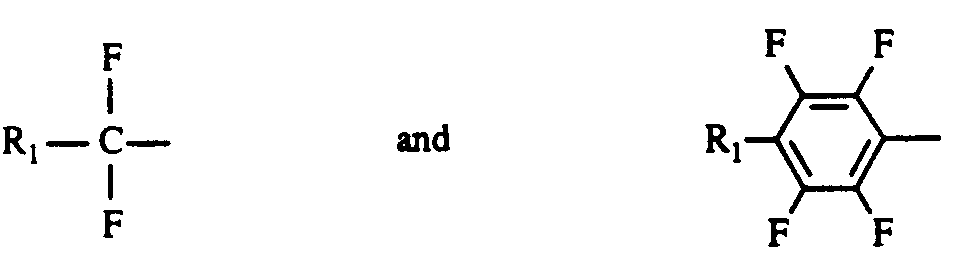
- M is an element chosen from Groups 3-15, inclusive, of the Periodic Table as depicted in Chemical and Engineering News 1985, 63, 26. Preferably M is an element chosen from Groups 4-14 of the Periodic Table, and more preferably is chosen from the group of B, Al, Ga, Sn, Fe, Zr, Hf, Nb, and Ta.
- In the foregoing formula, z is 1, 2, 3, or 4 and a, b, and n are integers such that z is less than or equal to n and the product of integer a multiplied by integer b equals z.
- As is well understood in this technical area, a large degree of substitution is not only tolerated, but is often advisable. As a means of simplifying the discussion and recitation of these groups, the terms "group" and "radical" are used to differentiate between chemical species that allow for substitution or which may be substituted. For example, the phrase "alkyl group" is intended to include not only pure hydrocarbon alkyl chains such as methyl, ethyl, octyl, cyclohexyl, isooctyl, tert-butyl and the like, but also such alkyl chains bearing such conventional substituents in the art such as hydroxyl, alkoxy, phenyl, halo (F, Cl, Br, I), cyano, nitro, amino, etc. The phrase "alkyl radical" on the other hand is limited to the inclusion of only pure hydrocarbon alkyl chains such as methyl, ethyl, propyl, cyclohexyl, isooctyl, tert-butyl, and the like.
- Although the anion of the present invention can be formed in the same reaction with the onium cation thereby creating an onium salt as described earlier herein, there may be instances, as will be seen by the Examples, where it is appropriate to synthesize the anionic species separately and then combine it with an onium cation that has been separated from an onium salt.
- Thus, perfluoroalkanesulfonated complex anions of the present invention can themselves be prepared by one or more of the following general procedures:
- (1) Reaction of a perfluoroalkanesulfonated strong Lewis acid with a perfluoroalkanesulfonated precursor. Suitable precursors include, but are not limited to, alkali metal and alkaline earth metal perfluoroalkanesulfonates; ammonium and phosphonium, including alkyl and aryl substituted ammonium and phosphonium, perfluoroalkanesulfonates; alkyl perfluoroalkanesulfonates; pyridinium and substituted pyridinium perfluoroalkanesulfonates.
- (2) Removal of halides (e.g., F-, Cl-, Br-, I-) or pseudo-halides (i.e., strongly electron withdrawing groups such as cyano, nitrosyl, thiocyanato, and the like) from a perhalogenated or per(pseudo-halogenated) or mixed halogenated-perfluoroalkanesulfonated complex anion by stoichiometric amounts of perfluoroalkanesulfonic acids at sub-zero or higher temperature depending on the reactivity of the anion toward acids used. Removal of halide from the corresponding complex anion may also be effected by using coinage or alkali metal perfluoroalkanesulfonates (e.g., silver triflate) to cause the precipitation of metal halides.
- (3) Removal of alkyls, aryls, halides or pseudo-halides from a peralkylated, perarylated, peralkarylated, mixed alkyl-halogenated, mixed aryl-halogenated or mixed pseudo-halogenated complex anion by using appropriate equivalents of perfluoroalkanesulfonic acid under conditions mentioned in (2). Because formation of alkanes or arenes by the action of acid is a highly favorable irreversible thermodynamic process, it may result in ready preparation of the complex anions of present invention. Many metal alkyls are extremely reactive even to weak acids (e.g., alcohols (see Mole, T.; Jeffery, E.A. Organoaluminum Compounds; Elsevier: New York, 1972); Giannini, U.; Zucchini, U.; Albizzati, E.; D'Angelo, R. Chem. Comm., 1969, 1174; Giannini, U.; Zucchini, U. Chem. Comm., 1968, 940; Pedley, J.B.; Marshall, E.M. J. Phys. Chem., Ref. Data. 1984, 12, 967; Smoes, S.; Myers, C.E.; Drowart, J. Chem. Phys. Lett. 1971, 8, 10; Gupta, S.K.; Gingerich, K.A. J. Chem. Phys. 1981, 74, 3584; Steams, C.A.; Kohl, F.J. High Temp. Sci. 1974, 6, 284).
- Suitable monomers for polymerization by the initiators of the present invention are those which can be polymerized cationically through initiation by an alkyl, or aryl containing cation; examples include, but are not limited to, cyclic ethers such as epoxides (e.g., styrene oxide, vinylcyclohexene dioxide, glycidyl- methacrylate, ethylene oxide, epichlorohydrin, etc.), oxetanes (e.g., oxetane, phenyloxetane, etc.), tetrahydrofurans (e.g., tetrahydrofuran, 2-methyltetrahydrofuran, etc.), tetrahydropyrans (tetrahydropyran, 3-propyltetrahydropyran, etc.), etc.; alkenyl monomers such as styrene and its homologs, alkenylfurans, conjugated dienes (e.g., cyclopentadiene, 2,4-hexadiene, etc.), isobutylene, vinyl ethers (e.g., methyl vinyl ether, ethyl vinyl ether, octadecyl vinyl ether, phenyl vinyl ether, etc.) including fluorinated vinyl ethers; lactones (e.g., ,8-propiolactone, y-butyrolactone, o-caprolactone, etc.); oxazolines (e.g., oxazoline, 2-phenyloxazoline, 2-decyloxazoline, etc.); aziridines (e.g., aziridine, N-ethylaziridine, etc.); cyclosiloxanes (e.g., hexamethyltrisiloxanes, octamethylcyclotetrasiloxane, triphenyltrimethylcyclotrisiloxane, etc.); ketals (e.g., 1,3-dioxolane, 1,3-dioxane, 2,2-dimethyl-1,3-dioxane, 2-phenyl-1,3-dioxane, 2,2-dioctyl-1,3-dioxolane, etc.); cyclic anhydrides (e.g., phthalic anhydride, maleic anhydride, succinic anhydride, etc.); lactams (e.g., ,8-propiolactam, y-butyrolactam, o-caprolactam, etc.); and aryl dialdehydes (e.g., 1,2-benzenedicarboxal- dehyde, 1,3-benzenedicarboxaldheyde, 1,2-naphthalenedialdehyde, etc.).
- The monomer and cationic polymerization initiator should be brought into intimate contact with one another in order to initiate polymerization. As used herein, "intimate contact" between the initiator and the monomer occurs when the two are brought into such direct or close physical contact that one or more cationic groups which initiate polymerization are transferred from the initiator to the monomer. Typically this is done in solution. In some instances, depending upon the type of cationic initiator used, it will be preferable to use heat or actinic radiation to induce initiation of polymerization or increase its rate. The auxiliary conditions used in conjunction with certain cations is well known in the art, such as, for example, the use of heat in conjunction with oxonium cations and the use of actinic radiation and a photosensitizer in conjunction with iodonium cations.
- Conditions for cationic polymerization of monomers is well known in the art. For example, it is desirable to have essentially anhydrous solution conditions. It is also desirable to have high purity monomers. In order to effect many cationic polymerizations, it is necessary to supply a source of heat. In the case of photoinitiators, it is necessary to expose the photoinitiator to actinic radiation.
- The following non-limiting examples further illustrate the present invention.
- The materials prepared in the following examples were analyzed by one or more of the following techniques and gave results consistent with the assigned identities: 'H, 27AI, 13C, 11B nuclear magnetic resonance, melting point, elemental analysis, mass spectroscopy, infrared spectroscopy, and in the case of polymers gel permeation chromatography.
- All materials were obtained from Aldrich Chemical Company (Milwaukee, Wisconsin) unless otherwise indicated.
- This example describes the preparation of triethyloxonium tetrakis(trifluoromethanesulfonato)aluminate (1-).
- To a well stirred slurry of 4.2 g (8.86 mmol) aluminum trifluoromethanesulfonate in 40 ml dry ether in a Schlenk flask under dry argon was added 4.6 ml (36 mmol) ethyl trifluoromethanesulfonate. The mixture was refluxed for about 20 hr during which a beige precipitate formed. The supernatant solution was removed and fresh ether was added to restore the original volume, and the mixture was refluxed under argon an additional hour. The procedure was repeated 4 times and finally the ether was removed and the beige solid dried in vacuo at 50-100 0 C for 2 hours to isolate the oxonium salt, 5.6 g (88% yield).
- This example describes the preparation of triethyloxonium tetrakis(trifluoromethanesulfonato)gallate (1-).
- The procedure of example 1 was followed using 4.59 g gallium trifluoromethanesulfonate in place of the aluminum trifluoromethanesulfonate. The oxonium salt, 5.5 g was obtained (81% yield).
- This example describes the preparation of trimethyloxonium tetrakis(trifluoromethanesulfonato)aluminate (1-).
- In a dry box 2.1 g (4.43 mmol) aluminum trifluoromethanesulfonate and 2 ml (18 mmol) methyl trifluoromethanesulfonate were added to 30 ml dry 1,1,2-trichlorotrifluoroethane in an autoclave equipped with a magnetic stirrer. About 30 g dimethyl ether was condensed into the autoclave by application of a low temperature bath. After sealing the autoclave was heated to 40 ° C for 8-12 hr. The autoclave was cooled to room temperature and slowly discharged. The beige solid was transferred to a Schlenk flask in the dry box and washed several times with dry 1,1,2-trichlorotrifluoroethane and finally dried in vacuo at 50 0 C for 2 hr, 2.6 g (90% yield).
- This example describes the preparation of trimethyloxonium tetrakis(trifluoromethanesulfonato)gallate (1- ).
- According to the procedure of example 3, 2.3 g (4.43 mmol) of gallium trifluoromethanesulfonate was employed in place of aluminum trifluoromethanesulfonate to give 2.7 g of product as a solid (84% yield).
- This example describes the preparation of tri-n-propyloxonium tetrakis(trifluoromethanesulfonato)-aluminate (1-).
- To a well stirred solution of 6.3 g (13.2 mmol) aluminum trifluoromethanesulfonate in 50 ml dry n-propyl ether in a Schlenk flask under dry argon was added 0.8 ml (10 mmol) epichlorohydrin. The mixture was stirred at room temperature for 4 hr. The beige precipitate was washed several times with n-propyl ether and dried in vacuo at 50 0 C for 2 hr, 9.0 g (89% yield).
- This example describes the preparation of tri-n-propyloxonium tetrakis(trifluoromethanesulfonato)gallate (1-).
- According to the procedure of example 5, 6.9 g (13.3 mmol) gallium trifluoromethanesulfonate was used in place of aluminum trifluoromethanesulfonate to give 9.2 g of product as a solid (85% yield).
- This example describes the preparation of triethylsulfonium tetrakis(trifluoromethanesulfonato)aluminate (1-).
- To a well stirred slurry of 2.1 g (4.43 mmol) aluminum trifluoromethanesulfonate in 20 ml dry diethyl sulfide in a Schlenk flask under dry argon and the mixture was refluxed for 6 hr. The supernatant diethyl sulfide was removed and the viscous lower phase was washed several times with diethyl sulfide under reflux, and then dried in vacuo at 50 0 C for 3 hr, 3.1 g (94% yield).
- This example describes the preparation of diphenyliodonium tetrakis(trifluoromethanesulfonato)borate (1-).
- To a suspension of 2.1 g (4.89 mmol) diphenyliodonium trifluoromethanesulfonate in 20 ml 1,1,2-trichlorotrifluoroethane was added dropwise a solution of 2.2 g (4.8 mmol) boron trifluoromethanesulfonate in 1,1,2-trichlorotrifluoroethaneT"". The mixture was stirred under dry argon for 3 hr at room temperature. Diphenyliodonium tetrakis(trifluoro-methanesulfonato)borate was precipitated following dissolution of the precursor. The precipitate was treated with a mixture of anhydrous sodium sulfate and sodium bicarbonate in dry tetrahydrofuran. The tetrahydrofuran solution was filtered, concentrated under reduced pressure and precipitated using hexane, filtered, and dried in vacuo, 4.1 g (95% yield).
- This example describes an alternate preparation of diphenyliodonium tetrakis(trifluoromethanesulfonato)-borate (1-).
- To a mixture of 1.5 g (4.8 mmol) diphenyliodonium chloride in 20 ml dry nitromethane, was added an equimolar solution of silver tetrakis(trifluoromethanesulfonato)borate in nitromethane was added in one portion at room temperature. After stirring for 2 hrs the precipitated silver chloride was filtered off and the filtrate was dried over anhydrous sodium sulfate-sodium bicarbonate as described in Ex. 8 and then concentrated under reduced pressure. Hexane was added to cause precipitation of the iodonium tetrakis-(trifluoromethanesulfonato)borate, 3.9 g (90% yield).
- This example describes the preparation of acetylium tetrakis(trifluoromethanesulfonato)borate(1-). To a well stirred solution of 6.6 g (9.24 mmol) silver tetrakis(trifluoromethanesulfonato)borate in 20 ml liquid S02 at -40 °C, was added 1.14 g (9.24 mmol) acetyl bromide. Silver bromide precipitated immediately, and the mixture was stirred for an additional 30 min. The solution was quickly filtered through glass wool in a cooled Schlenk flask (-30 ° C), and the solvent was removed at this temperature under reduced pressure. Acetylium tetrakis(trifluoromethylsulfonato)borate (1-) was obtained as an off-white solid, 5.0 g (83% yield).
- This example describes the preparation of 2,4,6-trimethylpyrylium tetrakis(trifluoromethanesulfonato)-borate (1-).
- A solution of 2.3 g (5.1 mmol) boron tris(trifluoromethanesulfonate) in 1,1,2-trichlorotrifluoroethane was added dropwise to a well stirred solution of 1.2 g (5.1 mmol) 2,4,6-trimethylpyrylium trifluoromethanesulfonate (Org. Syn., 4, 1114) in 10 ml chloroform. The mixture was stirred for 30 min and hexane was added and the resultant precipitate was removed by filtration, and dried in vacuo to give 2,4,6-trimethylpyrylium tetrakis(trifluoromethylsulfonato)borate as an off-white solid, 3.0 g (81 % yield).
- This example demonstrates the preparation of diphenyliodonium tetrakis(trifluoromethanesulfonato)-ferrate (1-).
- Diphenyliodonium trifluoromethanesulfonate 2.65 g, (6.1 mmol) was added to a suspension of 1.0 g (6.1 mmol) ferric chloride in 20 ml dry 1,1,2-trichlorotrifluoroethane. The mixture was heated to reflux for 6 hr to obtain diphenyliodonium trichloro(trifluoromethanesulfonato)ferrate as a solid. To said solid 1.62 ml trifluoromethanesulfonic acid was added dropwise and the reaction mixture was further refluxed overnight. The beige solid formed was dissolved in dry nitromethane containing 0.5 g anhydrous sodium sulfate and sodium bicarbonate and the solution was filtered after stirring. Removal of the solvent in vacuo diphenyliodonium tetrakis(trifluoromethanesulfonato)ferrate (1-), 5.2 g (91% yield).
- This example describes the preparation of triethyloxonium hexakis(trifluoromethanesulfonato)stannate (1-).
- To a suspension of 3 g (4.2 mmol) tetrakis(trifluoromethanesulfonato)tin in dry diethyl ether under argon was added 3 g (16.8 mmol) ethyl triflate. The mixture was refluxed for 14 hr. The precipitated oxonium salt was washed several times with refluxing dry ether to remove excess ethyl trifluoromethanesulfonate. The resultant solid was dried at about 50 ° C and triethyloxonium hexakis(trifluoromethanesulfonato)stannate (2-) was obtained as a white solid, 3.8 g (80% yield).
- The following examples demonstrate that the salts of the present invention are useful as initiators for cationic polymerization.
- Polymerization of tetrahydrofuran: Tetrahydrofuran (89 g, 1.2 mol) was distilled from sodium-naphthalene into a dry 250 ml Schlenk flask under argon. Onium salt initiator was added directly from another Schlenk flask under argon with stirring. The solution was stirred for more than 12 hrs at room temperature, at which time the gelled material was completely dissolved in a solution of water/tetrahydrofuran (1:20), using a mechanical stirrer. Addition of methanol precipitated a flocculent solid, which was filtered and dried in vacuo to give polytetramethylene ether. Results are summarized in Table 1.

- Polymerization of cyclohexene oxide: into a dry 100 ml Schlenk flask under argon, and equipped with a magnetic stirbar, was placed 4 ml dry cyclohexene oxide, 4 ml dry dichloromethane. Onium salt initiator (70 mg) was added at -10 ° C with stirring. The mixture was stirred 15 min at a temperature of -10 ° C to 0°C, then quenched with aqueous ammonium hydroxide. The polymer was precipitated with methanol and dried in vacuo. Results are shown in Table 2.

- Polymerization of a-phthalaldehyde: a solution of 18.7 mg triethyloxonium tetrakis-(trifluoromethylsulfonato)aluminate in dry nitromethane was added under argon to a 100 ml Schlenk flask containing 25 ml dry methylene chloride, a magnetic stirbar, and 5.2 g of a-phthalaldehyde cooled to -78 °C. The reaction was allowed to continue for 18 hr. Pre-cooled dry pyridine (10 ml) was added to the reaction at - 78 °C, and the reaction was poured into a mechanically stirred solution of methanol. The precipitated polymer was filtered, washed with methanol, and dried in vacuo, yield 98%. When the above polymerization was carried out using triethyloxonium tetrakis(trifluoromethanesulfonato)gallate as initiator, the yield was 69% in 4 hr.
- Polymerization of ,8-propiolactone: A solution of 30 mg triethyloxonium tetrakis-(trifluoromethanesulfonato)aluminate in 1 ml dry nitromethane was added to a 25 ml Schlenk flask cooled to 0 ° C under argon and containing 1 g β-propiolactone in 1 ml dry dichloromethane. The reaction was allowed to stand for 18 hr at 0°C, then quenched with a few drops of water. Solvent was removed under reduced pressure and the polymer was precipitated using hexane, filtered, and dried in vacuo, 95% yield. When the above procedure was repeated with tetrakis(trifluoromethanesulfonato)gallate as the initiator, similar results were obtained.
- Polymerization of isobutyl vinyl ether: this monomer was polymerized in dry hexane according to the method of example 17. The polymer was terminated using aqueous ammonium hydroxide solution, precipitated from methanol, filtered, and dried in vacuo. The results are summarized in Table 3.

- Polymerization of 2-ethyloxazoline: freshly distilled 2-ethyloxazoline, 15 g (0.15 mol), was placed in a dry 100 ml Schlenk flask and the system was evacuated. Dry argon was introduced followed by addition of 70 mg triethyloxonium tetrakis(trifluoromethanesulfonato)aluminate under argon at room temperature. The argon in the flask was evacuated and the flask and contents were allowed to stand for 10 days at which time a completely gelled material was obtained. The reaction was terminated with water and the polymer was subsequently dissolved in acetonitrile and precipitated with ether. The precipitated polymer was isolated by filtration and drying in vacuo, 82% yield. Polymerization with the corresponding tetrakis-(trifluoromethanesulfonato)gallate was similarly carried out, 71 % yield.
- Polymerization of hexamethyltrisiloxane (hereinafter referred to as "D3"): triethyloxonium tetrakis-(trifluoromethanesulfonato)aluminate, 77 mg, was added to a solution of 5 g freshly sublimed D3 in freshly distilled methylene chloride (dried over P205). Polymerization initiated immediately and the mixture was allowed to stand for 4 hr. The viscous material was dissolved in hexane and polydimethylsiloxane was precipitated from pyridine, filtered, and dried in vacuo for 24 hr, 82% yield.
- Polymerization of 1,3-dioxane: A jacketed tube equipped with a magnetic stirrer and argon inlet tube was charged with 5.8 g (65 mmol) freshly distilled 1,3-dioxane and 14 ml dry nitromethane. The system was freeze-thaw degassed and 80 mg triethyloxonium tetrakis(trifluoromethanesulfonato)aluminate was added under argon at -15°C and the reaction was allowed to continue for 15 hr. The polymerization was quenched by addition of a 5-fold excess (based on initiator) of sodium ethoxide in methanol. The resulting polymer was purified by dissolving it in tetrahydrofuran, precipitation with petroleum ether, filtration, and drying in vacuo, 62% yield. Polymerization with triethyloxonium tetrakis(trifluoromethanesulfonato)gallate was similarly carried out in 37% yield.
- Polymerization of 7-oxabicyclo[2.2.1 ]heptane (1,4-epoxycyclohexane): a solution of 5.6 g (57 mmol) freshly distilled 1,4-epoxycyclohexane in 16 ml dry dichloromethane contained in a jacketed tube was cooled to 0°C. Triethyloxonium tetrakis(trifluoromethanesulfonato)aluminate, 100 mg, was added under argon. The reaction was allowed to continue at this temperature for 5 days. The resulting polymer was isolated by filtration and dried in vacuo, 73% yield. Polymerization with triethyloxonium tetrakis-(trifluoromethanesulfonato)gallate was similarly carried out in 46% yield.
- Preparation of pentakis(trifluoromethanesulfonato)niobium: 5.6 ml trifluoromethanesulfonic acid was added dropwise to 3.4 g (12.5 mmol) niobium pentachloride in 40 ml dry 1,1,2-trichlorofluoroethaneTM under argon. The mixture was refluxed for 4 days. Removal of the solvent in vacuo gave pentakis-(trifluoromethanesulfonato)niobium as a white powder.
- Preparation of triethyloxonium hexakis(trifluoromethanesulfonato)niobate: 1.8 g (2.1 mmol) pentakis-(trifluoromethanesulfonato)niobium, prepared above, was added to 20 ml dry ether. Ethyl trifluoromethanesulfonate (1.1 g, 6.3 mmol) was added with stirring under dry argon. The mixture was slowly refluxed for 10 hr. The solvent and unreacted ethyl trifluoromethanesulfonate were removed in vacuo to give triethyloxonium hexakis(trifluoromethanesulfonato)niobate as a white solid, 87% yield.
- The material obtained above was used to initiate polymerization of tetrahydrofuran according to the procedure of example 14 (9 g tetrahydrofuran, 82 mg triethyloxonium hexakis(trifluoromethanesulfonato)-niobate, 14 hr) to give 8.2 g of polytetramethylene ether, 68% isolated yield.
- This example describes the preparation of triethyloxonium hexakis(trifluoromethanesulfonato)tantalate.
- Preparation of pentakis(trifluoromethanesulfonato)tantalum: 2.9 ml (33 mmole) trifluoromethanesulfonic acid was added dropwise to 2.3 g (6.4 mmol) tantalum pentachloride in 30 ml dry Freon TI -113. The mixture was refluxed for 7 days. The solvent was removed in vacuo to give pentakis(trifluoromethanesulfonato)-tantalum as an off white viscous resin.
- Preparation of triethyloxonium hexakis(trifluoromethanesulfonato)tantalate (1-): 0.6 g (3.3 mmol) ethyl trifluoromethanesulfonate was added to 2.1 g (2.2 mmol) pentakis(trifluoromethanesulfonato)tantalum, prepared above, in 25 ml dry ether under argon. The mixture was slowly refluxed for 10 hr. The lower phase which formed was washed several times with dry ether, and dried in vacuo to obtain triethyloxonium hexakis(trifluoromethanesulfonato)tantalate (1-) in 83% yield.
- This material was used to polymerize tetrahydrofuran according to the procedure of example 14 (10 g tetrahydrofuran, 6.0 mg triethyloxonium hexakis(trifluoromethanesulfonato)tantalate, 12 hr) to give 6.3 g of polytetramethylene ether, 63% yield.
- This example describes the polymerization of cyclohexene oxide with diphenyliodonium tetrakis-(trifluoromethanesulfonato)ferrate (1-): a solution of 3 ml cyclohexene oxide in 3 ml dry dichloromethane containing 30 mg iodonium salt was subjected to irradiation with a medium pressure Hg lamp (Hanovia, 450 W, distance of 2 cm) for 15 min. The colored gelled material was cooled and diluted in tetrahydrofuran. Polycyclohexene oxide was precipitated by addition to methanol and dried in vacuo, 65% isolated yield.
- The procedure was performed again in 3 ml acetonitrile as solvent (60 min exposure) to give 36% isolated yield.
- The procedure was performed again without solvent (15 min exposure) to give 82% isolated yield.
- This example describes the preparation of triphenylsulfonium tetrakis(trifluoromethanesulfonato)ferrate (1-): 1.4 g (8.7 mmol) ferric chloride was added to a suspension of 2.6 g (8.7 mmol) triphenylsulfonium chloride in 15 ml dry 1,1,2-trichlorotrifluoroethaneT"". The mixture was refluxed for 1 hr to give a gray solid precipitate. Dropwise addition of 3.1 ml (34.8 mmol) trifluoromethanesulfonic acid was followed by heating the mixture to reflux for 6 hr. The solvent was removed under reduced pressure and 20 ml dry nitromethane was added. The solution was dried (and residual acid removed) over 0.5 g anhydrous sodium sulfate and 0.2 g sodium bicarbonate. The supernatant liquid was filtered and the solvent removed under reduced pressure to obtain triphenylsulfonium tetrakis(trifluoromethanesulfonato)ferrate (1-) as an off-white solid, 6.7 g (87% yield).
- According to the procedure of example 25, 20 mg triphenylsulfonium tetrakis(trifluoromethanesulfonato)-ferrate (1-) and 4 ml cyclohexene oxide were irradiated for 10 min to give polycyclohexene oxide, 3.2 g (83% yield).
- This example demonstrates that oxonium salts of the present invention polymerize tetrahydrofuran result in high molecular weight polymers. Tetrahydrofuran was bulk polymerized with triethyloxonium salts according to the procedure described in example 14 to give polytetramethylene ether. The results are shown in Table 4.

- This example provides a comparison of high molecular weight polytetramethylene ether prepared using the onium salts of the present invention with those prepared according to corresponding prior art methods. Tetrahydrofuran was polymerized according to the method of Rozenberg et al. Polym. Sci. USSR 1964, 6, 2246 and Yamashita et al. Die Makro. Chemie 1971, 142, 171. The results are presented in Table 5.

- The above data indicate that the use of the inventive polymerization initiators produces polymers with greater molecular weights as compared to non-inventive or conventional initiators, i.e. (C2H5)30+BF―4 and (C2H5)30+PF- 6.
- This example illustrates that anions of the present invention, which have extended chain perfluorosulfonato groups on the metal of the anion, are also useful.
- Preparation of tris(perfluorobutanesulfanto)aluminum: to a suspension of 91.g (30.3 mmole) per- fluorobutanesulfonic acid (prepared according to Haszeldine, R.N.; Gramstad, T. J. Chem. Soc. 1956, 173) in 30 ml dry 1,1,2-trichlorotrifluoroethane, 0.7 g (10.1 mmole) trimethylaluminum in hexane was added dropwise under dry argon. The mixture was refluxed for 24 hrs. The product was vacuum filtered and washed several times with dry 1,1,2-trichlorotrifluoroethane and finally dried in vacuo to obtain tris-(perfluorobutanesulfonato)aluminum as a white powder, 89g (95% yield).
- Preparation of tris(perfluorobutanesulfonato)aluminum: 3 g, (3.2 mol), prepared according to Haszeldine, R.N.; Gramstad, T. J. Chem. Soc. 1956, 173), was suspended in dry ether and 3 equivalents of epichlorohydrin were added under dry argon. The mixture was refluxed for 24 hr. The precipitated solid was washed several times with dry ether and finally dried in vacuo to give tetrakis(perfluorobutanesulfonato)-aluminate (1-) in 78% yield.
- Tetrahydrofuran was bulk polymerized according to example 14 (20 g tetrahydrofuran, 200 mg tetrakis-(perfluorobutanesulfonato)aluminate (1-), 25 hr reaction), to give a 52% yield of polytetramethylene ether.
- This example demonstrates the preparation of triethyloxonium hexakis(trifluoromethanesulfonato)-zirconate (2-).
- Ethyl trifluoromethanesulfonate (1.2 g, 6.6 mmol) was added to a solution of 1.5 g (2.1 mmol) tetrakis-(trifluoromethanesulfonato)zirconium prepared according to the procedure of Schmeiber, M.; Sartori, P.; Lippsmeier, B. Chem. Ber. 1970, 103, 868, in 20 ml dry ether under argon. The mixture was slowly refluxed for 10 hr, and the precipitated solid was washed several times with dry ether and finally dried in vacuo at 40 ° C for 2 hr to give triethyloxonium hexakis(trifluoromethanesulfonato)zirconate (2-) in 89% yield.
- This material was used to polymerize tetrahydrofuran and cyclohexene oxide according to examples 14 and 15, respectively. In the case of tetrahydrofuran (10 g tetrahydrofuran, 67 mg triethyloxonium hexakis-(trifluoromethanesulfonato)zirconate (2-), 14 hr) a 58% yield was obtained, while in the latter case (2 g cyclohexene oxide 2 g dichloromethane, 0 °C, 10 min), a 70% yield was obtained.
- Acetylium hexakis(trifluoromethanesulfonato)niobate (1-) was prepared according to the procedure of example 10 in 88% yield. The salt thus prepared was used to polymerize tetrahydrofuran and cyclohexene according to the procedures of examples 14 and 15 in 54% (12 hr, 25 °C) and 61% (15 min, 0 °C) yields, respectively.
- As can be seen from these examples, the synthesis of all the compounds within the scope of the invention can be performed by selecting the appropriate reagents and using the teachings of this specification and the reference materials cited.
wherein:
as defined above, thereby initiating polymerization of said monomer. Preferably, the intimate contacting is done in solution. Generally, the mere intimate contacting of the initiator and monomer will be sufficient to effect initiation of cationic polymerization. However, it will be preferable in some cases, depending upon the type of initiator, to help induce initiation or accelerate the reaction through the use of heat or actinic radiation.
wherein:
and serves as a counterion to the cationic species Ya b+.
Claims (12)


Applications Claiming Priority (2)
| Application Number | Priority Date | Filing Date | Title |
|---|---|---|---|
| US07/478,939 US5084586A (en) | 1990-02-12 | 1990-02-12 | Novel initiators for cationic polymerization |
| US478939 | 1990-02-12 |
Publications (2)
| Publication Number | Publication Date |
|---|---|
| EP0442635A1 EP0442635A1 (en) | 1991-08-21 |
| EP0442635B1 true EP0442635B1 (en) | 1995-11-08 |
Family
ID=23902016
Family Applications (1)
| Application Number | Title | Priority Date | Filing Date |
|---|---|---|---|
| EP91300764A Expired - Lifetime EP0442635B1 (en) | 1990-02-12 | 1991-01-31 | Novel initiators for cationic polymerization |
Country Status (7)
| Country | Link |
|---|---|
| US (1) | US5084586A (en) |
| EP (1) | EP0442635B1 (en) |
| JP (1) | JPH04214704A (en) |
| KR (1) | KR910015596A (en) |
| AU (1) | AU631476B2 (en) |
| CA (1) | CA2034168A1 (en) |
| DE (1) | DE69114316D1 (en) |
Families Citing this family (95)
| Publication number | Priority date | Publication date | Assignee | Title |
|---|---|---|---|---|
| US5254664A (en) * | 1991-12-31 | 1993-10-19 | Nippon Shokubai Co., Ltd. | Curing composition |
| FR2688790B1 (en) * | 1992-03-23 | 1994-05-13 | Rhone Poulenc Chimie | COMPOSITIONS BASED ON POLYORGANOSILOXANES WITH CROSSLINKABLE FUNCTIONAL GROUPS AND THEIR USE FOR THE PRODUCTION OF ANTI-ADHESIVE COATINGS. |
| FR2688783A1 (en) * | 1992-03-23 | 1993-09-24 | Rhone Poulenc Chimie | NOVEL BORONES OF ONIUM OR ORGANOMETALLIC COMPLEX CATIONIC PRIMERS FOR POLYMERIZATION. |
| US6147184A (en) * | 1992-03-23 | 2000-11-14 | Rhone-Poulenc Chimie | Onium borates/borates of organometallic complexes and cationic initiation of polymerization therewith |
| US5635585A (en) * | 1992-10-21 | 1997-06-03 | E. I. Du Pont De Nemours And Company | Polymerization of, and depolymerization to, cyclic ethers using selected metal compound catalysts |
| US5990264A (en) * | 1993-02-23 | 1999-11-23 | E. I. Du Pont De Nemours And Company | Copolymerization of tetrahydrofurans and cyclic anhydrides |
| US5478920A (en) * | 1993-07-16 | 1995-12-26 | E. I. Du Pont De Nemours And Company | Cyclic ether polymerization using silicon compound accelerators |
| US5514728A (en) * | 1993-07-23 | 1996-05-07 | Minnesota Mining And Manufacturing Company | Catalysts and initiators for polymerization |
| US5677412A (en) * | 1994-02-17 | 1997-10-14 | E. I. Du Pont De Nemours And Company | Preparation of poly(ether-urethanes) from cyclic ethers and organic isocyanates |
| US5430122A (en) * | 1994-02-17 | 1995-07-04 | E. I. Du Pont De Nemours And Company | Preparation of poly(ether-urethanes) from cyclic ethers and organic isocyanates |
| US6008307A (en) * | 1994-04-28 | 1999-12-28 | Exxon Chemical Patents Inc | Process for producing olefin polymers using cationic catalysts |
| US6291389B1 (en) * | 1994-04-28 | 2001-09-18 | Exxonmobil Chemical Patents Inc. | Cationic polymerization catalysts |
| ES2200778T3 (en) * | 1994-10-28 | 2004-03-16 | E.I. Dupont De Nemours And Company | POLYMERIZATION OF CYCLE ETERES USING CATALYSTS OF SELECTED METAL COMPOUNDS. |
| US5614650A (en) * | 1995-03-07 | 1997-03-25 | Sandler; Stanley R. | Zirconium compounds of sulfonic acids |
| US6572693B1 (en) | 1999-10-28 | 2003-06-03 | 3M Innovative Properties Company | Aesthetic dental materials |
| JP4800535B2 (en) * | 1999-10-28 | 2011-10-26 | スリーエム イノベイティブ プロパティズ カンパニー | Dental material containing nano-sized silica particles |
| US6730156B1 (en) | 1999-10-28 | 2004-05-04 | 3M Innovative Properties Company | Clustered particle dental fillers |
| US6376590B2 (en) | 1999-10-28 | 2002-04-23 | 3M Innovative Properties Company | Zirconia sol, process of making and composite material |
| US6387981B1 (en) | 1999-10-28 | 2002-05-14 | 3M Innovative Properties Company | Radiopaque dental materials with nano-sized particles |
| EP1598699A3 (en) | 2000-05-23 | 2009-05-20 | Aprilis, Inc. | Data storage medium comprising colloidal metal and preparation process thereof |
| US20020151626A1 (en) * | 2001-02-08 | 2002-10-17 | Hisashi Isaka | Curing composition |
| KR100408290B1 (en) * | 2001-07-06 | 2003-12-03 | 삼성전자주식회사 | Apparatus equipped with damper |
| CA2364756A1 (en) * | 2001-12-10 | 2003-06-10 | Nova Chemicals Corporation | Catalyst activator |
| JP4748938B2 (en) * | 2002-01-31 | 2011-08-17 | スリーエム イノベイティブ プロパティズ カンパニー | Dental paste, dental article, and method |
| US7091259B2 (en) * | 2002-07-03 | 2006-08-15 | 3M Innovative Properties Company | Dental fillers, pastes, and compositions prepared therefrom |
| US7449146B2 (en) * | 2002-09-30 | 2008-11-11 | 3M Innovative Properties Company | Colorimetric sensor |
| US20040062682A1 (en) * | 2002-09-30 | 2004-04-01 | Rakow Neal Anthony | Colorimetric sensor |
| US6841333B2 (en) * | 2002-11-01 | 2005-01-11 | 3M Innovative Properties Company | Ionic photoacid generators with segmented hydrocarbon-fluorocarbon sulfonate anions |
| US7025791B2 (en) * | 2002-12-02 | 2006-04-11 | Gi Dynamics, Inc. | Bariatric sleeve |
| US6777460B2 (en) * | 2002-12-23 | 2004-08-17 | 3M Innovative Properties Company | Curing agents for cationically curable compositions |
| US6984261B2 (en) * | 2003-02-05 | 2006-01-10 | 3M Innovative Properties Company | Use of ceramics in dental and orthodontic applications |
| US7122294B2 (en) * | 2003-05-22 | 2006-10-17 | 3M Innovative Properties Company | Photoacid generators with perfluorinated multifunctional anions |
| US7030169B2 (en) * | 2003-09-26 | 2006-04-18 | 3M Innovative Properties Company | Arylsulfinate salts in initiator systems for polymeric reactions |
| US7064152B2 (en) * | 2003-09-26 | 2006-06-20 | 3M Innovative Properties Company | Arylsulfinate salts in photoinitiator systems for polymerization reactions |
| US7250452B2 (en) * | 2003-09-26 | 2007-07-31 | 3M Innovative Properties Company | Dental compositions and methods with arylsulfinate salts |
| US7026367B2 (en) * | 2003-09-26 | 2006-04-11 | 3M Innovative Properties Company | Photoiniators having triarylsulfonium and arylsulfinate ions |
| US7192991B2 (en) * | 2003-11-26 | 2007-03-20 | 3M Innovative Properties Company | Cationically curable composition |
| US7553670B2 (en) * | 2004-04-28 | 2009-06-30 | 3M Innovative Properties Company | Method for monitoring a polymerization in a three-dimensional sample |
| JP2006282633A (en) * | 2005-04-04 | 2006-10-19 | Sanshin Chem Ind Co Ltd | Sulfonium compound and polymerizable composition |
| US7767143B2 (en) * | 2006-06-27 | 2010-08-03 | 3M Innovative Properties Company | Colorimetric sensors |
| US20080003420A1 (en) * | 2006-06-29 | 2008-01-03 | 3M Innovative Properties Company | Transfer hardcoat films for graphic substrates |
| CN101610749B (en) * | 2006-12-28 | 2013-01-02 | 3M创新有限公司 | Dental filler and methods |
| US20090000727A1 (en) * | 2007-06-29 | 2009-01-01 | Kanta Kumar | Hardcoat layers on release liners |
| US20090004478A1 (en) * | 2007-06-29 | 2009-01-01 | 3M Innovative Properties Company | Flexible hardcoat compositions, articles, and methods |
| US20090155596A1 (en) * | 2007-12-12 | 2009-06-18 | 3M Innovative Properties Company | Nozzle sealing composition and method |
| JP4901889B2 (en) * | 2008-02-18 | 2012-03-21 | ソニーケミカル&インフォメーションデバイス株式会社 | Magnetic sheet composition, magnetic sheet, and method for producing magnetic sheet |
| US8192590B1 (en) * | 2008-04-14 | 2012-06-05 | University Of Central Florida Research Foundation, Inc. | Microwave-assisted formation of sulfonium photoacid generators |
| CN101942084B (en) * | 2010-09-25 | 2012-01-25 | 浙江大学 | Method for catalytic synthesis of polytetrahydrofuran in the presence of trifloromethanesulfonic acid rare earth metallic compounds |
| US8785517B2 (en) | 2011-05-25 | 2014-07-22 | 3M Innovative Properties Company | Pressure-sensitive adhesives with onium-epdxy crosslinking system |
| EP2723812B1 (en) | 2011-06-23 | 2016-04-13 | 3M Innovative Properties Company | Pressure-sensitive adhesives with onium-epoxy resin crosslinking system |
| EP2809512B1 (en) | 2012-02-03 | 2019-06-05 | 3M Innovative Properties Company | Primer compositions for optical films |
| US20150368524A1 (en) | 2013-03-13 | 2015-12-24 | 3M Innovative Properties Company | Adhesives comprising epoxy-acid crosslinked groups and methods |
| WO2015051095A1 (en) | 2013-10-04 | 2015-04-09 | 3M Innovative Properties Company | Dental mill blank |
| US9732173B2 (en) | 2014-04-24 | 2017-08-15 | 3M Innovative Properties Co. | Compositions comprising cleavable crosslinker and methods |
| KR102349012B1 (en) | 2014-09-05 | 2022-01-10 | 쓰리엠 이노베이티브 프로퍼티즈 컴파니 | Heat conformable curable adhesive films |
| WO2016140950A1 (en) | 2015-03-05 | 2016-09-09 | 3M Innovative Properties Company | Composite material having ceramic fibers |
| JP6469887B2 (en) | 2015-04-16 | 2019-02-13 | スリーエム イノベイティブ プロパティズ カンパニー | Quantum dot articles having a thiol-alkene-epoxy matrix |
| JP6422598B2 (en) | 2015-04-16 | 2018-11-14 | スリーエム イノベイティブ プロパティズ カンパニー | Quantum dot articles having a thiol-epoxy matrix |
| JP2018529832A (en) | 2015-09-15 | 2018-10-11 | スリーエム イノベイティブ プロパティズ カンパニー | Additive-stabilized composite nanoparticles |
| CN108026444B (en) | 2015-09-15 | 2020-08-04 | 3M创新有限公司 | Additive-stabilized composite nanoparticles |
| JP6983766B2 (en) | 2015-09-28 | 2021-12-17 | スリーエム イノベイティブ プロパティズ カンパニー | Patterned film articles and methods containing a cleavable crosslinker |
| EP3377591A1 (en) | 2015-11-18 | 2018-09-26 | 3M Innovative Properties Company | Copolymeric stabilizing carrier fluid for nanoparticles |
| CN108699433B (en) | 2016-02-17 | 2020-08-14 | 3M创新有限公司 | Quantum dots with stable fluorochemical copolymers |
| KR20180128956A (en) | 2016-04-01 | 2018-12-04 | 쓰리엠 이노베이티브 프로퍼티즈 컴파니 | Quantum dots with fluorochemical stabilizers |
| WO2017200824A1 (en) | 2016-05-20 | 2017-11-23 | 3M Innovative Properties Company | Quantum dots with mixed amine and thiol ligands |
| US11345849B2 (en) | 2016-07-20 | 2022-05-31 | 3M Innovative Properties Company | Stabilizing styrenic polymer for quantum dots |
| KR20190031505A (en) | 2016-07-20 | 2019-03-26 | 쓰리엠 이노베이티브 프로퍼티즈 컴파니 | Stabilized styrene polymers for quantum dots |
| EP3336111A1 (en) * | 2016-12-16 | 2018-06-20 | ARLANXEO Canada Inc. | Initiator system for cationic polymerization of olefins |
| CA2953163A1 (en) * | 2016-12-23 | 2018-06-23 | Sce France | Compositions based on an element from the boron family and their uses in electrolyte compositions |
| US20200115630A1 (en) | 2017-03-14 | 2020-04-16 | 3M Innovative Properties Company | Additive stabilized composite nanoparticles |
| EP3850022B1 (en) | 2018-09-14 | 2026-05-13 | Solventum Intellectual Properties Company | Composite materials including ceramic fibers and nanoclusters, dental products, kits, and methods of making and using same |
| EP3725820B1 (en) | 2019-04-16 | 2022-04-06 | Henkel AG & Co. KGaA | Use of functionalized alpha-angelica lactones |
| EP3798246B1 (en) | 2019-09-27 | 2024-01-31 | Henkel AG & Co. KGaA | One component (1k) composition based on modified epoxy resin |
| WO2021074734A1 (en) | 2019-10-14 | 2021-04-22 | 3M Innovative Properties Company | Compositions comprising cyclic olefins and thermally conductive filler |
| EP3831862B1 (en) | 2019-12-04 | 2023-06-28 | Henkel AG & Co. KGaA | One component (1k) composition based on epoxy resin |
| EP3831863B1 (en) | 2019-12-04 | 2023-07-05 | Henkel AG & Co. KGaA | One component (1k) composition based on epoxy resin |
| KR102915528B1 (en) | 2019-12-20 | 2026-01-21 | 쓰리엠 이노베이티브 프로퍼티즈 캄파니 | Adhesive articles, adhesive compositions and methods comprising polymers and polymerizable cyclic olefins |
| WO2021124156A1 (en) | 2019-12-20 | 2021-06-24 | 3M Innovative Properties Company | Method of pattern coating adhesive composition comprising unpolymerized cyclic olefin and latent catalyst, adhesive compositions and articles |
| EP3916033B1 (en) | 2020-05-28 | 2025-10-29 | Henkel AG & Co. KGaA | One component (1k) composition based on epoxy resin |
| US12325182B2 (en) | 2020-10-13 | 2025-06-10 | Cabot Corporation | Conductive photo-curable compositions for additive manufacturing |
| EP4012000A1 (en) | 2020-12-11 | 2022-06-15 | Bostik SA | Photocurable adhesive composition |
| EP4050060A1 (en) | 2021-02-26 | 2022-08-31 | Henkel AG & Co. KGaA | A photocurable adhesive or sealant composition |
| EP4050061B1 (en) | 2021-02-26 | 2025-10-15 | Henkel AG & Co. KGaA | Near-infrared (nir) sensitized adhesive and sealant compositions |
| EP4183807A1 (en) | 2021-11-18 | 2023-05-24 | Henkel AG & Co. KGaA | Copolymer and hot melt compositions comprising said copolymer |
| CN118302472A (en) | 2021-12-16 | 2024-07-05 | 3M创新有限公司 | Compositions comprising cleavable cross-linking agents |
| PL4332144T3 (en) | 2022-09-05 | 2025-10-13 | Henkel Ag & Co. Kgaa | One-component (1K) curable adhesive composition |
| WO2024074908A1 (en) | 2022-10-03 | 2024-04-11 | 3M Innovative Properties Company | Adhesive composition comprising polar (meth)acrylate monomer and epoxy resin, articles and methods |
| CN120051504A (en) | 2022-10-07 | 2025-05-27 | 3M创新有限公司 | Articles, methods, and compositions comprising a cyclic olefin, a catalyst, and a second polymerizable material |
| EP4709792A1 (en) | 2023-05-12 | 2026-03-18 | 3M Innovative Properties Company | Curable compositions with low storage modulus |
| EP4719766A1 (en) | 2023-06-02 | 2026-04-08 | 3M Innovative Properties Company | Articles comprising adhesive and film suitable for disassembly and methods |
| WO2024243984A1 (en) | 2023-06-02 | 2024-12-05 | 3M Innovative Properties Company | Articles comprising adhesive and multilayer film suitable for disassembly and methods |
| EP4481913A1 (en) | 2023-06-20 | 2024-12-25 | Henkel AG & Co. KGaA | Electronics assembly having electrochemically debondable components |
| EP4566808A1 (en) | 2023-12-06 | 2025-06-11 | Henkel AG & Co. KGaA | Bonded structure comprising an electrochemically debondable adhesive |
| EP4631988A1 (en) | 2024-04-11 | 2025-10-15 | Henkel AG & Co. KGaA | Thermally conductive potting composition |
| EP4714994A1 (en) | 2024-09-19 | 2026-03-25 | Henkel AG & Co. KGaA | Two-component composition providing fire retardency |
Family Cites Families (8)
| Publication number | Priority date | Publication date | Assignee | Title |
|---|---|---|---|---|
| US4610829A (en) * | 1968-08-21 | 1986-09-09 | Produits Chimiques Ugine Kuhlmann | Polyfluorinated sulphonic acids and their derivatives |
| FR2042937A5 (en) * | 1969-04-04 | 1971-02-12 | Minnesota Mining & Mfg | |
| US4108747A (en) * | 1976-07-14 | 1978-08-22 | General Electric Company | Curable compositions and method for curing such compositions |
| IT1129809B (en) * | 1979-03-26 | 1986-06-11 | Ugine Kuhlmann | CATALYTIC COMPOSITION FOR THE CONVERSION OF HYDROCARBONS AND PROCEDURE FOR THE DEHYDRATION OF PERFLUOROALCANSOLPHONIC ACIDS INTENDED TO BE PART OF THE BEAUTIFUL COMPOSITION |
| US4472268A (en) * | 1983-01-18 | 1984-09-18 | El Paso Products Company | Upgrading of natural gasoline with trifluoromethane sulfonic acid, hydrofluoric acid and Lewis acid catalyst |
| CN1005265B (en) * | 1985-04-12 | 1989-09-27 | 福建师范大学 | New Aluminum System Coupling Agent |
| US4721559A (en) * | 1986-10-17 | 1988-01-26 | Olah George A | Boron, aluminum and gallium perfluoro alkanesulfonate and resinsulfonate catalysts |
| CA2002873A1 (en) * | 1988-11-21 | 1990-05-21 | Franklin Donald Saeva | Onium salts and the use thereof as photoinitiators |
-
1990
- 1990-02-12 US US07/478,939 patent/US5084586A/en not_active Expired - Fee Related
-
1991
- 1991-01-09 AU AU69286/91A patent/AU631476B2/en not_active Ceased
- 1991-01-15 CA CA002034168A patent/CA2034168A1/en not_active Abandoned
- 1991-01-31 EP EP91300764A patent/EP0442635B1/en not_active Expired - Lifetime
- 1991-01-31 DE DE69114316T patent/DE69114316D1/en not_active Expired - Lifetime
- 1991-02-08 JP JP3017496A patent/JPH04214704A/en active Pending
- 1991-02-11 KR KR1019910002268A patent/KR910015596A/en not_active Withdrawn
Also Published As
| Publication number | Publication date |
|---|---|
| JPH04214704A (en) | 1992-08-05 |
| US5084586A (en) | 1992-01-28 |
| CA2034168A1 (en) | 1991-08-13 |
| KR910015596A (en) | 1991-09-30 |
| AU6928691A (en) | 1991-08-15 |
| DE69114316D1 (en) | 1995-12-14 |
| EP0442635A1 (en) | 1991-08-21 |
| AU631476B2 (en) | 1992-11-26 |
Similar Documents
| Publication | Publication Date | Title |
|---|---|---|
| US5124417A (en) | Initiators for cationic polymerization | |
| US5084586A (en) | Novel initiators for cationic polymerization | |
| US5668192A (en) | Onium borates/borates of organometallic complexes and cationic initiation of polymerization therewith | |
| EP1046663B1 (en) | Polymerization of cyclic ethers using selected metal compound catalysts | |
| US4359589A (en) | Process for making linear polyethers | |
| JPS5813603A (en) | Living polymers and manufacture | |
| US6632960B2 (en) | Diaryliodonium salt catalysts made from iodotoluene and a method for preparing them | |
| KR100283272B1 (en) | Polymerization and Depolymerization of Cyclic Ethers Using Selected Metal Compound Catalysts | |
| US6147184A (en) | Onium borates/borates of organometallic complexes and cationic initiation of polymerization therewith | |
| US5478920A (en) | Cyclic ether polymerization using silicon compound accelerators | |
| JPS584053B2 (en) | HMF6 trialkyloxonium epihalohydrin | |
| US5475069A (en) | Polymerization of vinyl ethers | |
| GB1561968A (en) | Cationic polymerisation | |
| EP0308031B1 (en) | Polymeric surfactants | |
| US3300503A (en) | Nitrogen-containing fluoro-phosphoranes | |
| JP3912457B2 (en) | Polymerization catalyst composition for propylene oxide | |
| US3631002A (en) | Polymerization of olefins | |
| JPH0395183A (en) | Porphyrin derivative having a polymerizable group and method for producing the same | |
| JP3848812B2 (en) | Method for ring-opening polymerization of cyclic ether | |
| US6580007B1 (en) | Method for preparing tetrakis (pentafluorophenyl) borate derivatives | |
| KR100283271B1 (en) | Depolymerization of Polyethers Using Selected Metal Compound Catalysts | |
| Kondo et al. | Methyl 5-epoxyacetylsalicylate: Preparation and copolymerization | |
| Lewis et al. | Advances in acid mediated polymerizations | |
| Bakalo | Catalytic polymerisation of 1, 2-epoxides | |
| Cook et al. | Cationic-Initiated Ring-Opening Polymerization of Cyclopropenone Ketals. I. Monomer Synthesis and Polymer Structure |
Legal Events
| Date | Code | Title | Description |
|---|---|---|---|
| PUAI | Public reference made under article 153(3) epc to a published international application that has entered the european phase |
Free format text: ORIGINAL CODE: 0009012 |
|
| AK | Designated contracting states |
Kind code of ref document: A1 Designated state(s): BE CH DE ES FR GB IT LI NL |
|
| 17P | Request for examination filed |
Effective date: 19920304 |
|
| 17Q | First examination report despatched |
Effective date: 19940525 |
|
| GRAA | (expected) grant |
Free format text: ORIGINAL CODE: 0009210 |
|
| ITF | It: translation for a ep patent filed | ||
| AK | Designated contracting states |
Kind code of ref document: B1 Designated state(s): BE CH DE ES FR GB IT LI NL |
|
| PG25 | Lapsed in a contracting state [announced via postgrant information from national office to epo] |
Ref country code: FR Effective date: 19951108 Ref country code: ES Free format text: THE PATENT HAS BEEN ANNULLED BY A DECISION OF A NATIONAL AUTHORITY Effective date: 19951108 Ref country code: BE Effective date: 19951108 |
|
| REF | Corresponds to: |
Ref document number: 69114316 Country of ref document: DE Date of ref document: 19951214 |
|
| PG25 | Lapsed in a contracting state [announced via postgrant information from national office to epo] |
Ref country code: LI Effective date: 19960131 Ref country code: CH Effective date: 19960131 |
|
| PG25 | Lapsed in a contracting state [announced via postgrant information from national office to epo] |
Ref country code: GB Effective date: 19960208 |
|
| PG25 | Lapsed in a contracting state [announced via postgrant information from national office to epo] |
Ref country code: DE Effective date: 19960209 |
|
| REG | Reference to a national code |
Ref country code: CH Ref legal event code: NV Representative=s name: E. BLUM & CO. PATENTANWAELTE |
|
| EN | Fr: translation not filed | ||
| PG25 | Lapsed in a contracting state [announced via postgrant information from national office to epo] |
Ref country code: NL Effective date: 19960801 |
|
| PLBE | No opposition filed within time limit |
Free format text: ORIGINAL CODE: 0009261 |
|
| REG | Reference to a national code |
Ref country code: CH Ref legal event code: PL |
|
| STAA | Information on the status of an ep patent application or granted ep patent |
Free format text: STATUS: NO OPPOSITION FILED WITHIN TIME LIMIT |
|
| GBPC | Gb: european patent ceased through non-payment of renewal fee |
Effective date: 19960208 |
|
| NLV4 | Nl: lapsed or anulled due to non-payment of the annual fee |
Effective date: 19960801 |
|
| 26N | No opposition filed | ||
| PG25 | Lapsed in a contracting state [announced via postgrant information from national office to epo] |
Ref country code: IT Free format text: LAPSE BECAUSE OF NON-PAYMENT OF DUE FEES;WARNING: LAPSES OF ITALIAN PATENTS WITH EFFECTIVE DATE BEFORE 2007 MAY HAVE OCCURRED AT ANY TIME BEFORE 2007. THE CORRECT EFFECTIVE DATE MAY BE DIFFERENT FROM THE ONE RECORDED. Effective date: 20050131 |