EP0443534B1 - Overload detection system for a machine tool - Google Patents
Overload detection system for a machine tool Download PDFInfo
- Publication number
- EP0443534B1 EP0443534B1 EP91102372A EP91102372A EP0443534B1 EP 0443534 B1 EP0443534 B1 EP 0443534B1 EP 91102372 A EP91102372 A EP 91102372A EP 91102372 A EP91102372 A EP 91102372A EP 0443534 B1 EP0443534 B1 EP 0443534B1
- Authority
- EP
- European Patent Office
- Prior art keywords
- drive
- driven
- toolholder
- teeth
- overload detection
- Prior art date
- Legal status (The legal status is an assumption and is not a legal conclusion. Google has not performed a legal analysis and makes no representation as to the accuracy of the status listed.)
- Expired - Lifetime
Links
Images


Classifications
-
- B—PERFORMING OPERATIONS; TRANSPORTING
- B23—MACHINE TOOLS; METAL-WORKING NOT OTHERWISE PROVIDED FOR
- B23Q—DETAILS, COMPONENTS, OR ACCESSORIES FOR MACHINE TOOLS, e.g. ARRANGEMENTS FOR COPYING OR CONTROLLING; MACHINE TOOLS IN GENERAL CHARACTERISED BY THE CONSTRUCTION OF PARTICULAR DETAILS OR COMPONENTS; COMBINATIONS OR ASSOCIATIONS OF METAL-WORKING MACHINES, NOT DIRECTED TO A PARTICULAR RESULT
- B23Q17/00—Arrangements for observing, indicating or measuring on machine tools
- B23Q17/09—Arrangements for observing, indicating or measuring on machine tools for indicating or measuring cutting pressure or for determining cutting-tool condition, e.g. cutting ability, load on tool
-
- B—PERFORMING OPERATIONS; TRANSPORTING
- B23—MACHINE TOOLS; METAL-WORKING NOT OTHERWISE PROVIDED FOR
- B23Q—DETAILS, COMPONENTS, OR ACCESSORIES FOR MACHINE TOOLS, e.g. ARRANGEMENTS FOR COPYING OR CONTROLLING; MACHINE TOOLS IN GENERAL CHARACTERISED BY THE CONSTRUCTION OF PARTICULAR DETAILS OR COMPONENTS; COMBINATIONS OR ASSOCIATIONS OF METAL-WORKING MACHINES, NOT DIRECTED TO A PARTICULAR RESULT
- B23Q11/00—Accessories fitted to machine tools for keeping tools or parts of the machine in good working condition or for cooling work; Safety devices specially combined with or arranged in, or specially adapted for use in connection with, machine tools
- B23Q11/04—Arrangements preventing overload of tools, e.g. restricting load
-
- F—MECHANICAL ENGINEERING; LIGHTING; HEATING; WEAPONS; BLASTING
- F16—ENGINEERING ELEMENTS AND UNITS; GENERAL MEASURES FOR PRODUCING AND MAINTAINING EFFECTIVE FUNCTIONING OF MACHINES OR INSTALLATIONS; THERMAL INSULATION IN GENERAL
- F16D—COUPLINGS FOR TRANSMITTING ROTATION; CLUTCHES; BRAKES
- F16D43/00—Automatic clutches
- F16D43/02—Automatic clutches actuated entirely mechanically
- F16D43/20—Automatic clutches actuated entirely mechanically controlled by torque, e.g. overload-release clutches, slip-clutches with means by which torque varies the clutching pressure
-
- Y—GENERAL TAGGING OF NEW TECHNOLOGICAL DEVELOPMENTS; GENERAL TAGGING OF CROSS-SECTIONAL TECHNOLOGIES SPANNING OVER SEVERAL SECTIONS OF THE IPC; TECHNICAL SUBJECTS COVERED BY FORMER USPC CROSS-REFERENCE ART COLLECTIONS [XRACs] AND DIGESTS
- Y10—TECHNICAL SUBJECTS COVERED BY FORMER USPC
- Y10T—TECHNICAL SUBJECTS COVERED BY FORMER US CLASSIFICATION
- Y10T408/00—Cutting by use of rotating axially moving tool
- Y10T408/13—Cutting by use of rotating axially moving tool with randomly-actuated stopping means
- Y10T408/14—Responsive to condition of Tool or tool-drive
Definitions
- the present invention relates generally to an overload detection system for a machine tool according to the pre-characterizing part of claim 1.
- Such system is known from EP-A-0 038 886.
- This prior art device needs two phase detectors, one for each gear.
- the device would become far simpler and less expensive in construction if it could do with a single phase detector.
- the two phase detectors have proved to be very easy to give rise to errors in the computation of the cutting torque, as the cuttings produced during machine tool operation unavoidably attach to and accumulate on them.
- JP-U-54-10060 proposes another cutting torque detection system.
- This second known system comprises a rotary member mounted fast on the spindle, a screw stud on a chuck support, and a torsion spring between the rotary member and the chuck support.
- the screw stud is rotatably engaged with the rotary member.
- the torsion spring yields when the cutting torque exceeds a predetermined limit, resulting in a relative phase displacement between rotary member and chuck support and, consequently, in the axial displacement of the screw stud. This axial displacement of the screw stud indicates the excessive torque on the cutting tool.
- JP-B-63-28742 teaches how to detect excessive thrust load on the cutting tool.
- a spool attached to a collet chuck is mounted within a hollow spindle for axial displace- ment relative to the same.
- the spindle has formed therein three fluid passageways to make up a thrust sensing valve in combination with the spool.
- the fluid passageways communicate with pressure operated switches which are selectively actuated upon linear displacement of the spool relative to the spindle in the event of the development of an excessive thrust load on the cutting tool.
- the overload detection system disclosed in the above-mentioned EP-A-0 038 886 comprises a torque detector.
- a torque detector When a drill member is subjected to a torque exceeding a preset value, the rotation of a spindle is delayed relative to a driving sleeve, so that a relative rotary movement takes place between the spindle and the sleeve (a relative phase displacement).
- cam surfaces provided on the spindle urge cam surfaces of a reaction rod to move the same axially rearward. Rotary movement is translated into axial movement.
- the present invention aims at the provision of an overload detection system for a machine tool that is simpler in construction and more reliable in operation than the listed prior art devices. This is achieved by the features of claim 1.
- the system of the present invention has the capability of both torque load and thrust load, besides being capable of detecting torque load only.
- the invention provides an overload detection system for a machine tool of the type having a drive spindle for imparting rotation to a cutting tool.
- the overload detection system comprises a tool-holder assembly which is broadly divided into a drive toolholder to be coupled to the drive spindle for joint rotation therewith, and a driven toolholder having means for holding a desired cutting tool such as a drill.
- the a driven toolholder is coupled to the drive toolholder so as to be at least rotatable relative to the same through a preassigned angle about a toolholder axis common to the drive spindle and the drive and the driven toolholders.
- a coiled torsion spring or like resilient means is provided for between drive toolholder and driven toolholder for torque transmission from the former to the latter.
- the drive and the driven toolholders have intermeshing teeth with clearances therebetween.
- a phase detector such as a proximity switch detects a relative phase displacement that will occur between the intermeshing teeth against the force of the torsion spring upon development of abnormal torque load on the cutting tool.
- the intermeshing teeth have bevels in sliding engagement with each other. Accordingly, a relative phase displacement also takes place between the two sets of teeth upon axial displacement of the driven toolholder toward the drive toolholder against the force of second resilient means, so that not only abnormal torque load but also abnormal thrust load on the cutting tool is detectable by the single phase detector.
- the invention also teaches an electronic overload detection circuit to be connected to the phase detector.
- the overload detection circuit produces a warning signal upon development of abnormal torque load, or abnormal thrust load, on the cutting tool.
- the machine tool itself needs no substantial alteration at all in construction, all that is required being to mount the toolholder assembly to the drive spindle of the machine tool and to mount the phase detector in a fixed position adjacent the circular path of the intermeshing teeth of the toolholder assembly. Therefore, the overload detection system of this invention finds universal use with machine tools of many different constructions. Any overload on the cutting tool is accurately detectable no matter how small the cutting tool may be in diameter.
- the illustrated machine tool has a spindlehead 15 with a drive spindle 17 rotatably mounted therein.
- the drive spindle 17 has a tapered hole 17 a for driving engagement with a toolholder assembly 1 constructed in accordance with the novel concepts of this invention.
- the toolholder assembly 1 comprises a drive toolholder 2 and a driven toolholder 21 held end to end in axial alignment and operatively coupled together in a manner to be detailed subsequently.
- the drive toolholder 2 has a tapered shank 2 a and a collar 3, both formed in one piece therewith.
- the tapered shank 2 a is snugly received in the hole 17 a of matching shape in the drive spindle 17.
- a thrust rod or shaft 4 is mounted in the hollow in the drive toolholder 2 extends into the driven toolholder 21 for rotatably supporting the same.
- the thrust rod 4 together with the driven toolholder 21 thereon is axially slidable in the hollow in the drive toolholder 2.
- a helical compression spring 5 butts endwise against the thrust rod 4. The compression spring 5 is to bear against the thrust load to be exerted on a cutting tool 13 (e.g.
- the compression spring 5 is to yield when the thrust load on the cutting tool 13 exceeds a predetermined limit, permitting the thrust rod 4 to retract to the right, as viewed in FIG. 1, with the cutting tool 13 and the driven toolholder 21.
- the driven toolholder 21 carries a collet chuck 23 of any known or suitable construction on its front or left hand end, as viewed in FIG. 1.
- the collet chuck 23 conventionally supports the cutting tool 13.
- the driven toolholder 21 is rotatably mounted to the thrust rod 4 via two combined thrust and radial ball bearings 9 and 10.
- a torque adjuster 28 of approximately tubular shape is coaxially mounted to the driven toolholder 21 via a connector tube 24 which is threadedly engaged with the driven toolholder.
- the torque adjuster 28 is capable of both angular and axial displacement relative to the connector tube 24 and hence to the driven toolholder 21.
- a helical compression spring 29 acts between drive toolholder 2 and torque adjuster 28 for biasing the latter forwardly into abutment against the driven toolholder 21 via the connector tube 24.
- the thrust rod 4 has its front end portion 6 shaped into frustoconical shape for engagement in the bearing 9. Slidably fitted over the thrust rod 4, a sleeve 7 has its rear end portion 8 also shaped into frustoconical shape for engagement in the other bearing 10.
- a helical compression spring 12 extends between a pair of spring retainers 7 a and 11.
- the spring retainer 7 a is formed in one piece with the sleeve 7.
- the other spring retainer 11 is fitted over the thrust rod 4 and locked against detachment therefrom by a collar 11 a on the thrust rod.
- the compression spring 12 acts to preload the bearings 9 and 10 via the frustoconical end portions 6 and 8 of the thrust rod 4 and the sleeve 7.
- a coiled torsion spring for torque transmission from drive toolholder 2 to driven toolholder 21.
- the torsion spring 25 has one end anchored to the drive toolholder 2 and the other end to the connector tube 24 on the driven toolholder 21.
- the following means are provided for the adjustment of the torsional strength of this torsion spring 25.
- the connector tube 24 has at least one, preferably two, lockpins 26 formed in diametrically opposite positions on its rear end face opposed to the torque adjuster 28.
- the lockpins 26 are capable of selective engagement in an annular row of blind holes 27 cut in the front end face of the torque adjuster 28 at constant angular spacings about the axis of the toolholder assembly 1. Normally, and as shown in FIG. 1, the lockpins 26 are engaged in two selected ones of the holes 27 under the bias of a helical compression spring 29 acting between drive toolholder 2 and torque adjuster 28.
- the torque adjuster 28 may first be backed away from the connector tube 24 against the force of the compression spring 29, thereby disengaging the lockpins 26 from the holes 27. Then the connector tube 24 may be revolved together with the driven toolholder 21 in either direction to a required angular position relative to the torque adjuster 28. Then the torque adjuster 28 may be allowed to travel forwardly under the force of the compression spring 29, with the consequent reengagement of the lockpins 26 in the two selected ones of the annular row of holes 27 in the torque adjuster.
- the capital 9 in FIG. 1 generally designates means for sensing the angular displacement of the driven toolholder 21 with respect to the drive toolholder 2.
- the description of this sensing means Q follows.
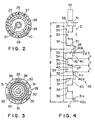
- the torque adjuster 28 has a plurality of, three in this particular embodiment, recesses 30 cut in its outer surface, thereby providing as many uncut portions or teeth 31 disposed at constant angular spacings about the axis of the toolholder assembly 1.
- the angular spacings between the torque adjuster teeth 31 are 120 degrees in this particular embodiment and are designated in FIG. 4.
- FIG. 4 also indicates that the drive toolholder 2 has a plurality of, three in this particular embodiment, teeth 34 extending parallel to the toolholder axis and received between the torque adjuster teeth 31.
- the teeth 34 on the drive toolholder 2 will be referred to as the drive teeth, and the teeth 31 on the torque adjuster 28 as the driven teeth, by way of contradistinction from each other.
- phase detector is disposed at 45 adjacent the path of the interdigitating drive teeth 34 and driven teeth 31 for detecting the relative phase displacement therebetween.
- the phase detector takes the form of a proximity switch in this and additional embodiments of the invention disclosed herein and will therefore be referred to as such hereinafter in this specification.
- Each drive tooth 34 has a central projection 35 extending toward the torque adjuster 28.
- Each projection 35 has a circumferential dimension less than that of each driven tooth 31, so that a pair of shoulders 40 are formed by each drive tooth 34 on both sides of its central projection 35.
- Three pairs of circumferential spacings 38 and 39 are thus defined between the opposite sides 32 and 33 of the driven teeth 31 and the opposite sides 36 and 37 of the projections 35 of the drive teeth 34.
- the proximity switch 45 is off when opposed to these spacings 38 and 39.
- Each driven tooth 31 has a bevel 31 a on one of its corners for abutting engagement with a bevel 40 a of one of the shoulders 40 of each drive tooth 34.
- These bevels 31 a and 40 a are to butt on each other under the force of the torsion spring 25, with a circumferential clearance a normally created between the side 40 b of each drive tooth 34 and the side 33 of each driven tooth 31.
- the bevels 31 a and 40 a constitute motion translating means 43 for translating the axial displacement of the driven toolholder 21, and hence of the torque adjuster 28, under excessive thrust load into the angular displacement of the driven teeth 31 relative to the drive teeth 34.
- such bevels may be formed on only either of the drive and driven teeth for sliding engagement with the required corners of the other of the drive and driven teeth.
- Other means could be employed as well for the accomplishment of the same objective.
- the required corners of the driven teeth 31 and drive teeth 34 might be rounded, instead of being beveled as in the illustrated embodiment.
- Another example might be guide slots and pins slidably engaged therein.
- each driven tooth 31, the projection 35 of each drive tooth 34, and the noted spacings 38 and 39 between the driven teeth and the projections of the drive teeth are normally all of the same circumferential dimension L , each spanning an angle of thirty degrees about the toolholder axis in this particular embodiment.
- the proximity switch 45 is bracketed at 16 to the spindlehead 15 and electrically connected to an overload detection circuit 50.
- a phototube may be employed in place of the proximity switch 45, provided that it be protected in any known or suitable way against the adverse effects of the cuttings and cutting oil during machine tool operation.
- the overload detection circuit 50 includes a spindle pulse generator 51 herein shown as a serial connection of a frequency to voltage converter (FVC) 52 and a voltage to frequency converter (VFC) 53.
- the proximity switch 45 is connected directly to the FVC 52.
- the spindle pulse generator 51 averages and multiplies the pulses generated by the proximity switch 45 and puts out a series of spindle pulses at a prescribed rate per revolution of the drive spindle 17.
- a gate circuit 54 has an input connected directly to the proximity switch 45 and another to the spindle pulse generator 51. The gate circuit 54 is open each time the proximity switch 45 is off, permitting the passage of the spindle pulses therethrough.
- the output of the gate circuit 54 is connected to a bidirectional counter 55, which has another input connected to the proximity switch 45 via an add/subtract switching circuit 56.
- This switching' circuit 56 causes the counter 55 to alternately add and subtract the incoming spindle pulses during the successive on-off cycles of the proximity switch 45.
- a comparator circuit 57 has three inputs connected respectively to the counter 55, the add/subtract switching circuit 56, and a setting circuit 58.
- the add/subtract switching circuit 56 delivers to the comparator circuit 57 a judgment command when the proximity switch 45 goes on.
- the comparator circuit 57 responds to this judgment command by judging whether or not the count of the counter 55 is more than a reference value that has been preset on the setting circuit 58.
- An output circuit 60 produces a warning signal if the counter count is more than the preset reference value.
- a reset circuit 59 functions to reset the counter each time the judgment has been made by the comparator circuit.
- the reference value to be preset on the setting circuit 58 may be equal to the difference, plus an allowable range of deviations, between the counts of the counter 55 when the proximity switch 45 is opposed to the spacings 38 and 39, FIG. 4, between the driven teeth 31 and the projections 35 of the drive teeth 34, with no load exerted on the cutting tool 13.
- This difference may be zero in this embodiment, so that the reference value may represent only an allowable range of deviations for the successive pulse counts to be made by the counter 55 during the operation of the machine tool.
- the overload detection circuit of FIG. 5 is susceptible to a variety of modifications within the broad teaching hereof.
- the spindle pulses may be obtained from the encoder, not shown, associated with the servomotor, also not shown, driving the spindle 17.
- other pulses may be input to the counter at a constant repetition rate from a suitable source of such pulses, and an overload detection signal may be produced when the difference between the pulse counts at the spacings 38 and 39 exceeds a reference value.
- the reference value must vary with the speed of revolution of the drive spindle 17, so that it may be amended with the spindle speed.
- the torque of the drive spindle 17 will be imparted directly to the drive toolholder 2 and thence, via the torsion spring 25, to the driven toolholder 21.
- the proximity switch 45 will alternately go on and off as the drive teeth 34, the driven teeth 31, and the spacings 38 and 39 therebetween travel past the proximity switch. Being spaced a considerable distance away from the cutting tool 13, the proximity switch 45 will function properly without being affected by the cuttings or by the cutting oil.
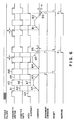
- the proximity switch 45 At A 1 in FIG. 6 is shown the proximity switch 45 to be off, being opposed to one spacing 38 between drive tooth 34 and driven tooth 31.
- the gate circuit 54 will be open during this time, as indicated at A 2 in FIG. 6, permitting the spindle pulses to pass therethrough into the bidirectional counter 55.
- the counter 55 Under the add command A 3 of the add/subtract switching circuit 56, the counter 55 will count the spindle pulses in an increasing direction, as at A 4.
- the proximity switch 45 will go on, as at A 5, when the projection 35 of one drive tooth 34 subsequently comes opposite the same. Then the gate circuit 54 will become closed, as at A 6, and the add/subtract switching circuit 56 will start the production of a subtract command A 7. Consequently, when the proximity switch 45 subsequently goes off, as at A 8, upon detection of the next spacing 39 between drive tooth 34 and driven tooth 31, the counter 55 will subtract (A 9) the incoming spindle pulses from the sum of such pulses that have been counted at A 4.
- the add/subtract switching circuit 56 will deliver a judgment command to the comparator circuit 57 when the proximity switch 45 subsequently goes on at A 10 upon detection of one driven tooth 31.
- the comparator circuit 57 will respond to this judgment command by comparing the count of the counter 55 with the reference value t that has been preset on the setting circuit 58.
- the cutting torque will exceed the value predetermined by the strength of the torsion spring 25 in the event of the blunting of the cutting tool 13, or of the excessive accumulation of the cuttings.
- a phase lag will occur between drive teeth 34 and driven teeth 31 because of the provision of the clearances a therebetween, and the sides 40 b of the drive teeth 34 will relatively move into abutment against the sides 33 of the driven teeth 31.
- the circumferential dimension of the spacings 38 therebetween will decrease to L - a whereas the circumferential dimension of the other spacings 39 will increase to L + a .
- FIG. 6 shows the spindle pulses being counted by the counter 55 in an increasing direction at B 1 and in a decreasing direction at B 2 in the event of the above noted abnormal increase in cutting torque.
- the resulting count will be equivalent to -2 a , as indicated at B 3. Since the absolute value of this count will be more than the preset reference value t , the output circuit 60 will go high to give a warning C against excessive torque.
- the warning signal C may be utilized in any convenient way.
- the unshown spindle drive motor may be set out of rotation, or a stepback command may be generated, in response to the warning signal.
- an additional counter may be provided for counting the warnings made by the overload detection circuit 50, and the cutting tool 13 may be replaced whenever such warnings have been counted to a predetermined number.
- the counter 55 may count the spindle pulses in an increasing direction when the proximity switch 45 is opposed to the spacing 39, and in a decreasing direction when the proximity switch is opposed to the spacing 38.
- the resulting count at B 6 will be +2 a in this case.
- the comparator circuit 57 compares the absolute value of the count with the reference value t , the output circuit 60 will generate the desired warning C . All the required functions of the overload detection circuit 50 may be performed by a preprogrammed computer within the scope of this invention.
- the counter 55 in the event of the development of abnormal cutting torque, the counter 55 produces an output equivalent to twice the clearance a between drive teeth 34 and driven teeth 31. Overload will therefore be infallibly detected through minimal relative phase displacement between the drive and the driven teeth. In other words, a minimal increase in cutting torque in excess of the value determined by the torsion spring 25 will be sensed in an instant, making it possible to make any necessary countermeasure without delay.
- the toolholder assembly 1 of FIGS. 1-4 is also constructed for the detection of excessive thrust loading on the cutting tool 13, as in the event of its wearout.
- the compression spring 5 behind the thrust rod 4 will be fully extended in the absence of such excessive thrust load, holding the drive teeth 34 and driven teeth 31 in their relative positions indicated by the solid lines in FIG. 4.
- the compression spring 5 will yield, permitting the thrust rod 4 to retract to the right, as viewed in FIG. 1, with the driven toolholder 21 relative to the drive toolholder 2.
- the consequent rearward displacement of the driven teeth 31 will be translated into their angular displacement relative to the drive teeth 34 as the bevels 31 a of the driven teeth slide on the bevels 40 a of the drive teeth.
- the angle of such rotation of the driven teeth 31 corresponds to the clearances a between the drive and the driven teeth.
- the overload detection circuit 50 of FIG. 5 can therefore detect the abnormal thrust load, producing the warning C through the procedure set forth above with reference to FIG. 6.
- the relative phase displacement of the drive and the driven teeth is utilized for the detection of both angular and axial overloads on the cutting tool.
- the construction of the toolholder assembly can therefore be much simpler than heretofore, and the single proximity switch with the associated overload detection circuit suffices to give warnings upon development of both angular and axial overloads.
Landscapes
- Engineering & Computer Science (AREA)
- Mechanical Engineering (AREA)
- General Engineering & Computer Science (AREA)
- Machine Tool Sensing Apparatuses (AREA)
- Force Measurement Appropriate To Specific Purposes (AREA)
- Gripping On Spindles (AREA)
Applications Claiming Priority (2)
| Application Number | Priority Date | Filing Date | Title |
|---|---|---|---|
| JP2039274A JPH0741519B2 (ja) | 1990-02-20 | 1990-02-20 | 過負荷トルク検出装置 |
| JP39274/90 | 1990-02-20 |
Publications (2)
| Publication Number | Publication Date |
|---|---|
| EP0443534A1 EP0443534A1 (en) | 1991-08-28 |
| EP0443534B1 true EP0443534B1 (en) | 1994-06-08 |
Family
ID=12548584
Family Applications (1)
| Application Number | Title | Priority Date | Filing Date |
|---|---|---|---|
| EP91102372A Expired - Lifetime EP0443534B1 (en) | 1990-02-20 | 1991-02-19 | Overload detection system for a machine tool |
Country Status (5)
| Country | Link |
|---|---|
| US (1) | US5155473A (ja) |
| EP (1) | EP0443534B1 (ja) |
| JP (1) | JPH0741519B2 (ja) |
| KR (1) | KR930011854B1 (ja) |
| DE (1) | DE69102302T2 (ja) |
Families Citing this family (18)
| Publication number | Priority date | Publication date | Assignee | Title |
|---|---|---|---|---|
| TW201713B (ja) * | 1991-01-30 | 1993-03-11 | Toyowa Kogyo Kk | |
| JP3644129B2 (ja) * | 1996-05-20 | 2005-04-27 | ブラザー工業株式会社 | 切削加工装置およびその異常検出方法 |
| DE19646381A1 (de) * | 1996-11-11 | 1998-05-14 | Hilti Ag | Handgerät |
| DE19646382A1 (de) * | 1996-11-11 | 1998-05-14 | Hilti Ag | Handgerät |
| US5876158A (en) * | 1997-12-03 | 1999-03-02 | Beiter; Russell R. | Drive collet assembly for a tap with overdrive protection |
| US6808345B2 (en) * | 2001-10-16 | 2004-10-26 | Toshiba Kikai Kabushiki Kaisha | Tool, tool holder, and machine tool |
| US7395871B2 (en) * | 2003-04-24 | 2008-07-08 | Black & Decker Inc. | Method for detecting a bit jam condition using a freely rotatable inertial mass |
| GB2427006A (en) * | 2005-06-10 | 2006-12-13 | Black & Decker Inc | Overload clutch with two predetermined torque levels |
| DE102006040090A1 (de) * | 2006-08-28 | 2008-03-06 | Rieth, Stephan, Dipl.-Ing. | Fräswerkzeug, insbesondere einer Handfräsmaschine zum Fräsen von Fasen |
| US8277154B2 (en) * | 2008-05-30 | 2012-10-02 | The Boeing Company | Adaptive thrust sensor drilling |
| TW200950306A (en) * | 2008-06-10 | 2009-12-01 | Mobiletron Electronics Co Ltd | Electric motor resistance torque control and battery discharging protection circuit |
| US8925169B2 (en) * | 2011-09-21 | 2015-01-06 | The Boeing Company | Drill force indicator for hand-operated drills |
| CN103056700B (zh) * | 2011-10-24 | 2015-06-03 | 鸿富锦精密工业(深圳)有限公司 | 刀座 |
| KR101407861B1 (ko) * | 2013-04-15 | 2014-06-16 | 김선현 | 절삭공구의 마멸 감지장치 및 이를 이용한 절삭공구의 마멸 감지방법 |
| CN104634492B (zh) * | 2014-12-16 | 2017-05-24 | 同高先进制造科技(太仓)有限公司 | 高精度双向力反馈双向承载伸缩装置 |
| JP7274195B2 (ja) * | 2018-10-04 | 2023-05-16 | 国立研究開発法人産業技術総合研究所 | 過負荷保護機構を備えた動力伝達機構 |
| CN112258803A (zh) * | 2020-10-21 | 2021-01-22 | 内蒙古上海庙矿业有限责任公司 | 一种刮板输送机预警装置和预警方法 |
| JP7790715B2 (ja) * | 2022-03-18 | 2025-12-23 | 株式会社ダイヤ精機製作所 | スピンドルユニット及びこれを備えた加工装置 |
Family Cites Families (11)
| Publication number | Priority date | Publication date | Assignee | Title |
|---|---|---|---|---|
| JPS5410060A (en) * | 1977-06-23 | 1979-01-25 | Matsushita Electric Ind Co Ltd | Hair dresser |
| JPS5415354A (en) * | 1977-07-07 | 1979-02-05 | Nippon Sangyo Gijutsu Kk | Method of and device for purifying waste water containing cyanogen |
| US4304511A (en) * | 1977-08-15 | 1981-12-08 | Kenji Machida | Critical torque detector |
| US4208904A (en) * | 1978-07-17 | 1980-06-24 | Resco, Inc. | Method of measuring long shaft torque |
| EP0038886A1 (en) * | 1980-04-28 | 1981-11-04 | Kenji Machida | Critical torque detector |
| US4488443A (en) * | 1983-01-20 | 1984-12-18 | Simmonds Precision Products, Inc. | Expanded range monopole torque measuring system |
| JPS59142049A (ja) * | 1983-01-28 | 1984-08-15 | Mitsubishi Electric Corp | 工具異常検出装置 |
| JPS6159233A (ja) * | 1984-08-31 | 1986-03-26 | Hitachi Ltd | トルク検出器 |
| JPH0698906B2 (ja) * | 1986-07-21 | 1994-12-07 | 株式会社今仙電機製作所 | 自動車用パワ−シ−ト装置 |
| GB2208716B (en) * | 1987-08-12 | 1991-02-27 | Smiths Industries Plc | Speed and torque sensors |
| DD269816A1 (de) * | 1987-12-30 | 1989-07-12 | Chemieanlagenbaukombinat Bt Ch | Verfahren und vorrichtung zur sicherung von bohr- und gewindeschneidwerkzeugen |
-
1990
- 1990-02-20 JP JP2039274A patent/JPH0741519B2/ja not_active Expired - Fee Related
- 1990-12-14 KR KR1019900020624A patent/KR930011854B1/ko not_active Expired - Fee Related
-
1991
- 1991-02-15 US US07/657,164 patent/US5155473A/en not_active Expired - Fee Related
- 1991-02-19 DE DE69102302T patent/DE69102302T2/de not_active Expired - Fee Related
- 1991-02-19 EP EP91102372A patent/EP0443534B1/en not_active Expired - Lifetime
Also Published As
| Publication number | Publication date |
|---|---|
| US5155473A (en) | 1992-10-13 |
| DE69102302T2 (de) | 1994-09-22 |
| JPH03281148A (ja) | 1991-12-11 |
| EP0443534A1 (en) | 1991-08-28 |
| JPH0741519B2 (ja) | 1995-05-10 |
| DE69102302D1 (de) | 1994-07-14 |
| KR930011854B1 (ko) | 1993-12-21 |
| KR910015364A (ko) | 1991-09-30 |
Similar Documents
| Publication | Publication Date | Title |
|---|---|---|
| US5155473A (en) | Torque and thrust overload detection system for a machine tool | |
| EP0497312B1 (en) | Toolholder device for machine tools | |
| EP2316598B1 (en) | Turret tool holder | |
| US6331093B1 (en) | Compensator for multi-tool boring bar | |
| WO1998025722A1 (en) | Turret tool rest | |
| US6312200B1 (en) | Method and apparatus for adjusting a tool cartridge, such as a cutter body | |
| EP0233410B1 (en) | Portable lathe | |
| US6257109B1 (en) | Automatic lathe and method of controlling same | |
| US4483055A (en) | Secondary working apparatus | |
| CA1251907A (en) | Self centering quick change cutting tool assembly | |
| US6609441B1 (en) | Indexing device | |
| US4507025A (en) | Combined torque and thrust overload responsive tool holder | |
| EP0576272A2 (en) | Device for driving a detachable tool member, and combination comprising the device and a boring and facing head | |
| US4715102A (en) | Machine tool | |
| US4762037A (en) | Face and internal turning head | |
| EP0128980B1 (en) | Drive mechanisms for machines | |
| KR20010042495A (ko) | 분할장치 | |
| US4593588A (en) | Face drive for lathe | |
| GB2081612A (en) | Tool turret | |
| GB2208107A (en) | Revolving tool-carrier turret | |
| EP1409197B1 (en) | Chuck for the support and alternative positioning of fixed and rotatable tools for drilling and/or milling, in tool machines | |
| CN208743711U (zh) | 一种用于立式加工中心的双主轴系统 | |
| JP2751643B2 (ja) | 工具ホルダ | |
| JPH0740202A (ja) | 工具ホルダ | |
| JP2900715B2 (ja) | 工具ホルダ |
Legal Events
| Date | Code | Title | Description |
|---|---|---|---|
| PUAI | Public reference made under article 153(3) epc to a published international application that has entered the european phase |
Free format text: ORIGINAL CODE: 0009012 |
|
| 17P | Request for examination filed |
Effective date: 19910219 |
|
| AK | Designated contracting states |
Kind code of ref document: A1 Designated state(s): CH DE FR GB IT LI |
|
| 17Q | First examination report despatched |
Effective date: 19921218 |
|
| GRAA | (expected) grant |
Free format text: ORIGINAL CODE: 0009210 |
|
| AK | Designated contracting states |
Kind code of ref document: B1 Designated state(s): CH DE FR GB IT LI |
|
| REF | Corresponds to: |
Ref document number: 69102302 Country of ref document: DE Date of ref document: 19940714 |
|
| ET | Fr: translation filed | ||
| ITF | It: translation for a ep patent filed | ||
| PLBE | No opposition filed within time limit |
Free format text: ORIGINAL CODE: 0009261 |
|
| STAA | Information on the status of an ep patent application or granted ep patent |
Free format text: STATUS: NO OPPOSITION FILED WITHIN TIME LIMIT |
|
| 26N | No opposition filed | ||
| PGFP | Annual fee paid to national office [announced via postgrant information from national office to epo] |
Ref country code: FR Payment date: 20010130 Year of fee payment: 11 |
|
| PGFP | Annual fee paid to national office [announced via postgrant information from national office to epo] |
Ref country code: GB Payment date: 20010214 Year of fee payment: 11 |
|
| PGFP | Annual fee paid to national office [announced via postgrant information from national office to epo] |
Ref country code: DE Payment date: 20010420 Year of fee payment: 11 |
|
| PGFP | Annual fee paid to national office [announced via postgrant information from national office to epo] |
Ref country code: CH Payment date: 20010529 Year of fee payment: 11 |
|
| REG | Reference to a national code |
Ref country code: GB Ref legal event code: IF02 |
|
| PG25 | Lapsed in a contracting state [announced via postgrant information from national office to epo] |
Ref country code: GB Free format text: LAPSE BECAUSE OF NON-PAYMENT OF DUE FEES Effective date: 20020219 |
|
| PG25 | Lapsed in a contracting state [announced via postgrant information from national office to epo] |
Ref country code: LI Free format text: LAPSE BECAUSE OF NON-PAYMENT OF DUE FEES Effective date: 20020228 Ref country code: CH Free format text: LAPSE BECAUSE OF NON-PAYMENT OF DUE FEES Effective date: 20020228 |
|
| PG25 | Lapsed in a contracting state [announced via postgrant information from national office to epo] |
Ref country code: DE Free format text: LAPSE BECAUSE OF NON-PAYMENT OF DUE FEES Effective date: 20020903 |
|
| GBPC | Gb: european patent ceased through non-payment of renewal fee |
Effective date: 20020219 |
|
| REG | Reference to a national code |
Ref country code: CH Ref legal event code: PL |
|
| PG25 | Lapsed in a contracting state [announced via postgrant information from national office to epo] |
Ref country code: FR Free format text: LAPSE BECAUSE OF NON-PAYMENT OF DUE FEES Effective date: 20021031 |
|
| REG | Reference to a national code |
Ref country code: FR Ref legal event code: ST |
|
| PG25 | Lapsed in a contracting state [announced via postgrant information from national office to epo] |
Ref country code: IT Free format text: LAPSE BECAUSE OF NON-PAYMENT OF DUE FEES;WARNING: LAPSES OF ITALIAN PATENTS WITH EFFECTIVE DATE BEFORE 2007 MAY HAVE OCCURRED AT ANY TIME BEFORE 2007. THE CORRECT EFFECTIVE DATE MAY BE DIFFERENT FROM THE ONE RECORDED. Effective date: 20050219 |