EP0443546A2 - Semiconductor device storage jig - Google Patents
Semiconductor device storage jig Download PDFInfo
- Publication number
- EP0443546A2 EP0443546A2 EP91102437A EP91102437A EP0443546A2 EP 0443546 A2 EP0443546 A2 EP 0443546A2 EP 91102437 A EP91102437 A EP 91102437A EP 91102437 A EP91102437 A EP 91102437A EP 0443546 A2 EP0443546 A2 EP 0443546A2
- Authority
- EP
- European Patent Office
- Prior art keywords
- vessel
- conductive member
- jig according
- recesses
- external terminals
- Prior art date
- Legal status (The legal status is an assumption and is not a legal conclusion. Google has not performed a legal analysis and makes no representation as to the accuracy of the status listed.)
- Ceased
Links
Images



Classifications
-
- H—ELECTRICITY
- H10—SEMICONDUCTOR DEVICES; ELECTRIC SOLID-STATE DEVICES NOT OTHERWISE PROVIDED FOR
- H10P—GENERIC PROCESSES OR APPARATUS FOR THE MANUFACTURE OR TREATMENT OF DEVICES COVERED BY CLASS H10
- H10P72/00—Handling or holding of wafers, substrates or devices during manufacture or treatment thereof
- H10P72/10—Handling or holding of wafers, substrates or devices during manufacture or treatment thereof using carriers specially adapted therefor, e.g. front opening unified pods [FOUP]
- H10P72/19—Handling or holding of wafers, substrates or devices during manufacture or treatment thereof using carriers specially adapted therefor, e.g. front opening unified pods [FOUP] closed carriers
- H10P72/1904—Handling or holding of wafers, substrates or devices during manufacture or treatment thereof using carriers specially adapted therefor, e.g. front opening unified pods [FOUP] closed carriers specially adapted for containing chips, dies or ICs
-
- H—ELECTRICITY
- H10—SEMICONDUCTOR DEVICES; ELECTRIC SOLID-STATE DEVICES NOT OTHERWISE PROVIDED FOR
- H10P—GENERIC PROCESSES OR APPARATUS FOR THE MANUFACTURE OR TREATMENT OF DEVICES COVERED BY CLASS H10
- H10P72/00—Handling or holding of wafers, substrates or devices during manufacture or treatment thereof
- H10P72/10—Handling or holding of wafers, substrates or devices during manufacture or treatment thereof using carriers specially adapted therefor, e.g. front opening unified pods [FOUP]
- H10P72/19—Handling or holding of wafers, substrates or devices during manufacture or treatment thereof using carriers specially adapted therefor, e.g. front opening unified pods [FOUP] closed carriers
- H10P72/1924—Handling or holding of wafers, substrates or devices during manufacture or treatment thereof using carriers specially adapted therefor, e.g. front opening unified pods [FOUP] closed carriers characterised by atmosphere control
- H10P72/1926—Handling or holding of wafers, substrates or devices during manufacture or treatment thereof using carriers specially adapted therefor, e.g. front opening unified pods [FOUP] closed carriers characterised by atmosphere control characterised by the presence of atmosphere modifying elements inside or attached to the closed carrier
- H10P72/1928—Handling or holding of wafers, substrates or devices during manufacture or treatment thereof using carriers specially adapted therefor, e.g. front opening unified pods [FOUP] closed carriers characterised by atmosphere control characterised by the presence of atmosphere modifying elements inside or attached to the closed carrier characterised by the presence of antistatic elements
Definitions
- the present invention relates to a jig and a jig structure for storing a semiconductor device.
- a semiconductor circuit element (to be referred to as an IC chip hereinafter) has low heat resistance but is expected to be used in an any temperature atmosphere. For this reason, it is very important for the IC chip to have high reliability at high temperatures. High-temperature storage and high-temperature tests are required for IC chips.
- An IC chip is susceptible to static electricity. Since static electricity has a high voltage, if an electrostatic voltage is applied to the IC chip even for a very short interval, elements in the IC chip are damaged. In order to prevent this, the external terminals of the IC chip are grounded to discharge the electrostatic voltage to the outside of the chip.
- the most effective jig for grounding all the external terminals of the IC chip is the IC socket, as described above.
- the IC socket cannot be used at a temperature exceeding the melting point (about 308°C ) of its material, thus posing a problem. As a result, the high-temperature storage or high-temperature test cannot be performed while the external terminals are kept grounded.
- a jig for storing a semiconductor device having external terminals at a predetermined temperature comprising a vessel which has a recess for receiving the external terminals and which has a melting point higher than at least the predetermined temperature, a conductive member which is made of a material having a melting point lower than the melting point of the vessel and which is filled in the recess, and means, electrically connected to the conductive member, for grounding the conductive member.
- the conductive member having a melting point lower than that of the vessel is filled in the recess of the vessel.
- the ambient temperature is the melting point or more of the conductive member and is less than the melting point of the vessel, only the conductive member is melted in the vessel.
- the IC chip is inserted into the vessel, the external terminals of the IC chip are dipped in the molten conductive member.
- the molten conductive member is grounded, all the external terminals are kept grounded. For this reason, the IC chip can be stored at a temperature which allows a molten state of the conductive material and which is the melting point or less of the vessel, while all the external terminals of the IC chip are kept grounded.
- a conductive member 2 of a metal such as gallium is placed in a rectangular parallelepiped vessel 1 made of aluminum to a depth h , and a DIP (Dual-Inline Package) 4 is placed therein. External terminals 4a of the DIP 4 are kept inserted into the conductive member 2. A ground terminal 3 for grounding the external terminals 4a is formed on the outer side surface of the vessel 1.
- the melting point of gallium is 29.78°C
- the melting point of aluminum is 660°C.
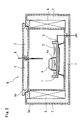
- Fig. 2 shows a state wherein the jig of this embodiment is placed in a high-temperature test unit 5.
- This high-temperature test unit comprises a casing 5a and a lid 5b.
- a heater 6 is incorporated in the side wall of the casing 5a.
- a heat-insulating material 7 is filled outside the heater 6 and in the bottom portion of the casing 5a.
- a temperature measuring element 8 such as a thermocouple is arranged at the central portion of the lid 5b.
- the heat-insulating material 7 is filled around the temperature measuring element 8.
- the semiconductor device storage jig according to this embodiment is placed in the casing 5a.
- a high-temperature of about 350°C is maintained in the high-temperature test unit 5.
- a melting point a of the material of the vessel 1 of the jig, an ambient temperature b , and a melting point c of the conductive member 2 must satisfy the following condition: a > b > c
- the ground terminal 3 for grounding the conductive member 2 is grounded outside the vessel 1.
- the vessel has a rectangular parallelepiped shape.
- the shape of the vessel is not limited to a specific shape if it can contain a conductive member therein.
- a recess may be formed in the inner bottom surface of the vessel to receive and hold the external terminals of the DIP 4 to prevent movement of the DIP 4.
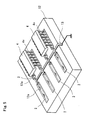
- Fig. 3 shows a semiconductor device storage jig according to the second embodiment of the present invention.
- This storage jig is constituted by integrally forming two insulating plates made of a ceramic material or the like. Two parallel rectangular holes 9a are formed in an upper plate 9. A clamping portion 9b is formed in each hole 9a to clamp external elements 4a of a DIP 4. A metal wiring 11 is formed between the upper plate 9 and a lower plate 10. This metal wiring 11 is located in the bottoms of the two holes 9a and is grounded outside the storage jig. Since the upper ceramic plate 9 and the lower ceramic plate 10 are hermetically bonded to each other, a conductive member 2 does not leak along the metal wiring 11 even if the conductive member 2 is melted.
- Fig. 4 shows a state wherein the DIP 4 is inserted into the upper ceramic plate 9 of the storage jig.
- the external electrodes 4a of the DIP 4 are clamped between the clamping portions 9b.
- the metal wiring 11 is connected at the bottoms of the holes 9a, and the molten conductive member 2 is stored in the holes 9a. Therefore, the external terminals 4a of the DIP 4 are grounded through the molten conductive member 2.
- FIG. 5 shows a semiconductor device storage jig according to the third embodiment of the present invention.
- This storage jig is constituted by a ceramic plate 12. Eight rectangular holes 12a are formed in the upper surface of the ceramic plate 12. A liquid conductive member 2 is filled in each hole 12a. A metal wiring 13 is dipped in the conductive member 2 in these holes 12a. The end portion of the metal wiring 13 is grounded.
- two DIPs 4 are inserted into the four holes 12a, and all the external terminals 4a are properly grounded.
- the DIP is used as a semiconductor device.
- the present invention is not limited to this type of semiconductor device.
- the present invention is also applicable to an IC or LSI of a different type.
- the combination of the materials of the vessel and the conductive member is not limited to the specific one described above. Any combination may be selected if the above condition is satisfied.
- a semiconductor device storage jig As described above, potentials of external terminals of a semiconductor device stored in the vessel can be kept equal to each other. In addition, storage and a test in a high-temperature environment can be performed by properly selecting the material of the vessel.
Landscapes
- Packaging Frangible Articles (AREA)
- Testing Or Measuring Of Semiconductors Or The Like (AREA)
- Container, Conveyance, Adherence, Positioning, Of Wafer (AREA)
- Testing Of Individual Semiconductor Devices (AREA)
- Packaging Of Annular Or Rod-Shaped Articles, Wearing Apparel, Cassettes, Or The Like (AREA)
Abstract
Description
- The present invention relates to a jig and a jig structure for storing a semiconductor device.
- A semiconductor circuit element (to be referred to as an IC chip hereinafter) has low heat resistance but is expected to be used in an any temperature atmosphere. For this reason, it is very important for the IC chip to have high reliability at high temperatures. High-temperature storage and high-temperature tests are required for IC chips.
- In high-temperature storage and high-temperature tests of IC chips, external terminals of an IC chip are placed in direct contact with a metal plate, or the external terminals of the IC chip are kept in a floating state by using a plastic magazine jig. When each external terminal of the IC chip is to be grounded, it can be achieved by using an IC socket.
- An IC chip is susceptible to static electricity. Since static electricity has a high voltage, if an electrostatic voltage is applied to the IC chip even for a very short interval, elements in the IC chip are damaged. In order to prevent this, the external terminals of the IC chip are grounded to discharge the electrostatic voltage to the outside of the chip. The most effective jig for grounding all the external terminals of the IC chip is the IC socket, as described above. The IC socket, however, cannot be used at a temperature exceeding the melting point (about 308°C ) of its material, thus posing a problem. As a result, the high-temperature storage or high-temperature test cannot be performed while the external terminals are kept grounded.
- It is an object of the present invention to solve the above problem and to provide a semiconductor device storage jig capable of storing a semiconductor device in a grounded state even at a high temperature.
- There is provided a jig for storing a semiconductor device having external terminals at a predetermined temperature, comprising a vessel which has a recess for receiving the external terminals and which has a melting point higher than at least the predetermined temperature, a conductive member which is made of a material having a melting point lower than the melting point of the vessel and which is filled in the recess, and means, electrically connected to the conductive member, for grounding the conductive member.
- In the semiconductor device storage jig according to the present invention, the conductive member having a melting point lower than that of the vessel is filled in the recess of the vessel. When the ambient temperature is the melting point or more of the conductive member and is less than the melting point of the vessel, only the conductive member is melted in the vessel. When the IC chip is inserted into the vessel, the external terminals of the IC chip are dipped in the molten conductive member. When the molten conductive member is grounded, all the external terminals are kept grounded. For this reason, the IC chip can be stored at a temperature which allows a molten state of the conductive material and which is the melting point or less of the vessel, while all the external terminals of the IC chip are kept grounded.
- The present invention will become more fully understood from the detailed description given hereinbelow and the accompanying drawings which are given by way of illustration only, and thus are not to be considered as limiting the present invention.
- Further scope of applicability of the present invention will become apparent from the detailed description given hereinafter. However, it should be understood that the detailed description and specific examples, while indicating preferred embodiments of the invention, are given by way of illustration only, since various changes and modifications within the spirit and scope of the invention will become apparent to those skilled in the art from this detailed description.
-
- Fig. 1 is a perspective view showing a state wherein a semiconductor device is stored in a semiconductor device storage jig according to the first embodiment of the present invention;
- Fig. 2 is a longitudinal sectional view showing a state wherein the storage jig according to the first embodiment is stored in a high-temperature test unit;
- Fig. 3 is a partial cutaway perspective view showing an outer appearance of a semiconductor device storage jig according to the second embodiment of the present invention;
- Fig. 4 is a longitudinal sectional view along a plane including a pair of external terminals in a state wherein a semiconductor device is stored in the storage jig according to the second embodiment of the present invention; and
- Fig. 5 is a perspective view showing an outer appearance of a semiconductor device of the third embodiment of the present invention in a state wherein two semiconductor devices are stored.
- An embodiment according to the present invention will be described with reference to the accompanying drawings.
- Components designated by the same reference numerals have the same functions, and a repetitive description thereof will not be made.
- As shown in Fig. 1, a
conductive member 2 of a metal such as gallium is placed in a rectangularparallelepiped vessel 1 made of aluminum to a depth h, and a DIP (Dual-Inline Package) 4 is placed therein.External terminals 4a of theDIP 4 are kept inserted into theconductive member 2. Aground terminal 3 for grounding theexternal terminals 4a is formed on the outer side surface of thevessel 1. - The melting point of gallium is 29.78°C, and the melting point of aluminum is 660°C. When this
vessel 1 is placed at a temperature of, e.g., 40°C, aluminum of thevessel 1 is kept in a solid phase, but gallium of theconductive member 2 is transformed into a liquid phase. Theexternal terminals 4a of theDIP 4 are dipped in the molten gallium, so that all theexternal terminals 4a are kept in contact with the moltenconductive member 2. In this case, since theconductive member 2 is grounded through thevessel 1 and theexternal terminals 3, all theexternal terminals 4a of theDIP 4 are grounded. In this state, even if a high voltage such as a high electrostatic voltage is applied to any one of theexternal terminals 4a of theDIP 4, all the external terminals are grounded, and an integrated circuit and the like inside theDIP 4 are not damaged. - A high-temperature test using the semiconductor device storage jig of this embodiment will be described below.
- Fig. 2 shows a state wherein the jig of this embodiment is placed in a high-
temperature test unit 5. This high-temperature test unit comprises acasing 5a and alid 5b. Aheater 6 is incorporated in the side wall of thecasing 5a. A heat-insulatingmaterial 7 is filled outside theheater 6 and in the bottom portion of thecasing 5a. A temperature measuringelement 8 such as a thermocouple is arranged at the central portion of thelid 5b. The heat-insulatingmaterial 7 is filled around thetemperature measuring element 8. The semiconductor device storage jig according to this embodiment is placed in thecasing 5a. A high-temperature of about 350°C is maintained in the high-temperature test unit 5. In this case, a melting point a of the material of thevessel 1 of the jig, an ambient temperature b, and a melting point c of theconductive member 2 must satisfy the following condition:
a > b > c
- As a combination of materials satisfying the above condition, aluminum, iron, copper or the like is used as a material of the
vessel 1, and potassium, gallium, cesium or the like is used as theconductive member 2. - The
ground terminal 3 for grounding theconductive member 2 is grounded outside thevessel 1. - The present invention is not limited to the particular embodiment described above. Various changes and modifications may be made within the spirit and scope of the invention.
- In the above embodiment, the vessel has a rectangular parallelepiped shape. However, the shape of the vessel is not limited to a specific shape if it can contain a conductive member therein.
- A recess may be formed in the inner bottom surface of the vessel to receive and hold the external terminals of the
DIP 4 to prevent movement of theDIP 4. - Fig. 3 shows a semiconductor device storage jig according to the second embodiment of the present invention. This storage jig is constituted by integrally forming two insulating plates made of a ceramic material or the like. Two parallel
rectangular holes 9a are formed in anupper plate 9. Aclamping portion 9b is formed in eachhole 9a to clampexternal elements 4a of aDIP 4. Ametal wiring 11 is formed between theupper plate 9 and alower plate 10. Thismetal wiring 11 is located in the bottoms of the twoholes 9a and is grounded outside the storage jig. Since the upperceramic plate 9 and the lowerceramic plate 10 are hermetically bonded to each other, aconductive member 2 does not leak along themetal wiring 11 even if theconductive member 2 is melted. - Fig. 4 shows a state wherein the
DIP 4 is inserted into the upperceramic plate 9 of the storage jig. Theexternal electrodes 4a of theDIP 4 are clamped between the clampingportions 9b. Themetal wiring 11 is connected at the bottoms of theholes 9a, and the moltenconductive member 2 is stored in theholes 9a. Therefore, theexternal terminals 4a of theDIP 4 are grounded through the moltenconductive member 2. - A recess may be formed to receive a plurality of DIPs. Fig. 5 shows a semiconductor device storage jig according to the third embodiment of the present invention. This storage jig is constituted by a
ceramic plate 12. Eightrectangular holes 12a are formed in the upper surface of theceramic plate 12. A liquidconductive member 2 is filled in eachhole 12a. Ametal wiring 13 is dipped in theconductive member 2 in theseholes 12a. The end portion of themetal wiring 13 is grounded. In this embodiment, twoDIPs 4 are inserted into the fourholes 12a, and all theexternal terminals 4a are properly grounded. - In the above embodiment, the DIP is used as a semiconductor device. However, the present invention is not limited to this type of semiconductor device. For example, the present invention is also applicable to an IC or LSI of a different type. In addition, the combination of the materials of the vessel and the conductive member is not limited to the specific one described above. Any combination may be selected if the above condition is satisfied.
- In a semiconductor device storage jig according to the present invention, as described above, potentials of external terminals of a semiconductor device stored in the vessel can be kept equal to each other. In addition, storage and a test in a high-temperature environment can be performed by properly selecting the material of the vessel.
- From the invention thus described, it will be obvious that the invention may be varied in many ways. Such variations are not to be regarded as a departure from the spirit and scope of the invention, and all such modifications as would be obvious to one skilled in the art are intended to be included within the scope of the following claims.
Claims (12)
- A jig for storing a semiconductor device having external terminals at a predetermined temperature, comprising a vessel which has a recess for receiving said external terminals and which has a melting point higher than at least the predetermined temperature, a conductive member which is made of a material having a melting point lower than the melting point of said vessel and which is filled in said recess, and a conductive terminal being connected to said conductive member.
- A jig according to claim 1, wherein said vessel is made of an insulating material, and said conductive terminal is connected to ground.
- A jig according to claim 1, wherein said vessel is made of a conductive member in place of having said conductive terminal, and said vessel is connected to ground.
- A high temperature test apparatus in use of the jig according to claim 1, a casing which seals the jig in an atmosphere inside thereof, means for adjusting the atmosphere temperature, and means for connecting said cnductive terminal to a ground.
- A jig according to claim 2, wherein said conductive member has a melting point lower than the predetermined temperature.
- A jig according to claim 2, wherein there are plurality of recesses and said recesses are connected to plurality of conductive terminals, each of said conductive terminals not being connected together.
- A jig according to claim 2, wherein said vessel has at least a pair of recesses, each of said pair of recesses receiving said external terminals in line.
- A jig according to claim 2, further comprising a holding portion, formed at an inlet of each of said recesses, for holding said external terminals.
- A jig according to claim 2, wherein said conductive terminal is located on the bottoms of said recesses.
- A jig according to claim 7, wherein said conductive terminal is made of a common metal wiring arranged in bottom portions of said recesses.
- A jig according to claim 7, wherein said conductive terminal comprises a common metal wiring connected to said conductive member filled in at least said pair of recesses.
- A jig according to claim 8, wherein said conductive member is filled in a recess lower in level than said holding portion.
Applications Claiming Priority (2)
| Application Number | Priority Date | Filing Date | Title |
|---|---|---|---|
| JP39284/90 | 1990-02-20 | ||
| JP2039284A JPH03241851A (en) | 1990-02-20 | 1990-02-20 | Semiconductor device storage jig |
Publications (2)
| Publication Number | Publication Date |
|---|---|
| EP0443546A2 true EP0443546A2 (en) | 1991-08-28 |
| EP0443546A3 EP0443546A3 (en) | 1992-01-15 |
Family
ID=12548860
Family Applications (1)
| Application Number | Title | Priority Date | Filing Date |
|---|---|---|---|
| EP19910102437 Ceased EP0443546A3 (en) | 1990-02-20 | 1991-02-20 | Semiconductor device storage jig |
Country Status (6)
| Country | Link |
|---|---|
| US (1) | US5245276A (en) |
| EP (1) | EP0443546A3 (en) |
| JP (1) | JPH03241851A (en) |
| KR (1) | KR950000100B1 (en) |
| AU (1) | AU650251B2 (en) |
| CA (1) | CA2036004A1 (en) |
Families Citing this family (4)
| Publication number | Priority date | Publication date | Assignee | Title |
|---|---|---|---|---|
| US20060215336A1 (en) * | 2005-03-24 | 2006-09-28 | Honeywell International Inc. | ESD foam ground clip |
| JP2012220404A (en) * | 2011-04-12 | 2012-11-12 | Sony Computer Entertainment Inc | Operation testing device for electronic apparatus, operation testing method and method of manufacturing electronic apparatus |
| JP7263060B2 (en) * | 2019-03-11 | 2023-04-24 | 株式会社日本マイクロニクス | Electrical connection device |
| KR20230059461A (en) | 2021-10-26 | 2023-05-03 | 삼성전자주식회사 | Detergent feeding device for clothes treating apparatus |
Family Cites Families (15)
| Publication number | Priority date | Publication date | Assignee | Title |
|---|---|---|---|---|
| DE2214491A1 (en) * | 1972-03-24 | 1973-10-04 | Sergio Bellan | HYDRAULIC LIFTING EQUIPMENT |
| US3976916A (en) * | 1975-01-15 | 1976-08-24 | Consan Pacific Incorporated | Antistatic equipment |
| GB1568750A (en) * | 1977-08-03 | 1980-06-04 | Perrens R | Television apparatus |
| US4327832A (en) * | 1980-06-26 | 1982-05-04 | Thielex Plastics Corporation | Container for packaging semiconductor components |
| DE3130324A1 (en) * | 1981-07-31 | 1983-02-17 | GAO Gesellschaft für Automation und Organisation mbH, 8000 München | CARRIER ELEMENT FOR AN IC COMPONENT |
| US4472756A (en) * | 1981-09-30 | 1984-09-18 | Senichi Masuda | Duct type charge eliminator |
| US4623951A (en) * | 1982-05-24 | 1986-11-18 | Hughes Aircraft Company | Electrically conductive composite structure |
| US4484243A (en) * | 1982-09-30 | 1984-11-20 | General Electric Company | Protective circuit arrangement for a sheathed heating element |
| US4677520A (en) * | 1985-09-13 | 1987-06-30 | James Price | Static charge protector for integrated circuits |
| JPS62105379A (en) * | 1985-11-01 | 1987-05-15 | 株式会社日立製作所 | Connector |
| US4711350A (en) * | 1986-10-27 | 1987-12-08 | Wei Hsiung Yen | Inspectable antistatic container for packing electrical or electronic devices |
| GB2214491A (en) * | 1988-01-21 | 1989-09-06 | Dowty Electronic Components | Semiconductor product carriers |
| DE3810594A1 (en) * | 1988-03-29 | 1989-10-12 | Heigl Helmuth | ARRANGEMENT TO PROTECT INTEGRATED COMPONENTS FROM DAMAGE DUE TO UNCONTROLLED ELECTROSTATIC DISCHARGE IN HANDLING SYSTEMS |
| US4954878A (en) * | 1989-06-29 | 1990-09-04 | Digital Equipment Corp. | Method of packaging and powering integrated circuit chips and the chip assembly formed thereby |
| US4999023A (en) * | 1989-11-14 | 1991-03-12 | Unisys Corporation | High density low reactance socket |
-
1990
- 1990-02-20 JP JP2039284A patent/JPH03241851A/en active Pending
-
1991
- 1991-02-08 CA CA002036004A patent/CA2036004A1/en not_active Abandoned
- 1991-02-12 AU AU71009/91A patent/AU650251B2/en not_active Ceased
- 1991-02-20 KR KR1019910002737A patent/KR950000100B1/en not_active Expired - Fee Related
- 1991-02-20 EP EP19910102437 patent/EP0443546A3/en not_active Ceased
- 1991-02-20 US US07/657,858 patent/US5245276A/en not_active Expired - Fee Related
Also Published As
| Publication number | Publication date |
|---|---|
| AU650251B2 (en) | 1994-06-16 |
| EP0443546A3 (en) | 1992-01-15 |
| KR950000100B1 (en) | 1995-01-09 |
| JPH03241851A (en) | 1991-10-29 |
| KR920000121A (en) | 1992-01-10 |
| US5245276A (en) | 1993-09-14 |
| AU7100991A (en) | 1991-08-22 |
| CA2036004A1 (en) | 1991-08-21 |
Similar Documents
| Publication | Publication Date | Title |
|---|---|---|
| EP0239322A2 (en) | Cooled component assembly | |
| US4371912A (en) | Method of mounting interrelated components | |
| US5260601A (en) | Edge-mounted, surface-mount package for semiconductor integrated circuit devices | |
| US4766371A (en) | Test board for semiconductor packages | |
| EP0333374A2 (en) | Edge-mounted, surface-mount package for semiconductor integrated circuit devices | |
| KR101445397B1 (en) | Adapters for sockets | |
| US4992987A (en) | Battery package for integrated circuits | |
| JPS63117443A (en) | Circuit module holder | |
| EP0098028A2 (en) | Hermetically sealable package for hybrid solid-state electronic devices and the like | |
| GB2212754A (en) | Electronic componenet chip holder and method of handling electronic component chips | |
| US3550766A (en) | Flat electronic package assembly | |
| US4885662A (en) | Circuit module connection system | |
| US4734820A (en) | Cryogenic packaging scheme | |
| JPH0412624B2 (en) | ||
| US5245276A (en) | Semiconductor device storage jig | |
| US3909678A (en) | Packaging structure for a plurality of wafer type integrated circuit elements | |
| US4272140A (en) | Arrangement for mounting dual-in-line packaged integrated circuits to thick/thin film circuits | |
| US3447040A (en) | Micro-element carrier-connector | |
| EP0095391B1 (en) | Mounting leadless chip-carriers | |
| US3105868A (en) | Circuit packaging module | |
| US3278018A (en) | Handling miniature solid-state devices | |
| EP0145327A2 (en) | Electrical interface arrangement | |
| US2935722A (en) | Electrical socket connector with mercury contact | |
| US4767983A (en) | Test fixture for electronic device packages | |
| EP0505193B1 (en) | Cover for electrical components package |
Legal Events
| Date | Code | Title | Description |
|---|---|---|---|
| PUAI | Public reference made under article 153(3) epc to a published international application that has entered the european phase |
Free format text: ORIGINAL CODE: 0009012 |
|
| AK | Designated contracting states |
Kind code of ref document: A2 Designated state(s): DE FR GB IT NL |
|
| PUAL | Search report despatched |
Free format text: ORIGINAL CODE: 0009013 |
|
| AK | Designated contracting states |
Kind code of ref document: A3 Designated state(s): DE FR GB IT NL |
|
| 17P | Request for examination filed |
Effective date: 19920311 |
|
| 17Q | First examination report despatched |
Effective date: 19921116 |
|
| GRAG | Despatch of communication of intention to grant |
Free format text: ORIGINAL CODE: EPIDOS AGRA |
|
| STAA | Information on the status of an ep patent application or granted ep patent |
Free format text: STATUS: THE APPLICATION HAS BEEN REFUSED |
|
| 18R | Application refused |
Effective date: 19970504 |