EP0443567A1 - Sealing base for waste landfill - Google Patents
Sealing base for waste landfill Download PDFInfo
- Publication number
- EP0443567A1 EP0443567A1 EP91102509A EP91102509A EP0443567A1 EP 0443567 A1 EP0443567 A1 EP 0443567A1 EP 91102509 A EP91102509 A EP 91102509A EP 91102509 A EP91102509 A EP 91102509A EP 0443567 A1 EP0443567 A1 EP 0443567A1
- Authority
- EP
- European Patent Office
- Prior art keywords
- layer
- seal according
- base seal
- active
- inactive
- Prior art date
- Legal status (The legal status is an assumption and is not a legal conclusion. Google has not performed a legal analysis and makes no representation as to the accuracy of the status listed.)
- Withdrawn
Links
- 238000007789 sealing Methods 0.000 title claims abstract description 41
- 239000002699 waste material Substances 0.000 title claims abstract description 15
- 229910052500 inorganic mineral Inorganic materials 0.000 claims abstract description 26
- 239000011707 mineral Substances 0.000 claims abstract description 26
- 230000035699 permeability Effects 0.000 claims abstract description 17
- 239000003344 environmental pollutant Substances 0.000 claims abstract description 15
- 239000000463 material Substances 0.000 claims abstract description 15
- 231100000719 pollutant Toxicity 0.000 claims abstract description 15
- 239000000126 substance Substances 0.000 claims abstract description 11
- 239000003566 sealing material Substances 0.000 claims abstract description 9
- 239000002689 soil Substances 0.000 claims abstract description 7
- 238000001179 sorption measurement Methods 0.000 claims description 12
- 239000000440 bentonite Substances 0.000 claims description 6
- 229910000278 bentonite Inorganic materials 0.000 claims description 6
- SVPXDRXYRYOSEX-UHFFFAOYSA-N bentoquatam Chemical group O.O=[Si]=O.O=[Al]O[Al]=O SVPXDRXYRYOSEX-UHFFFAOYSA-N 0.000 claims description 6
- 239000004927 clay Substances 0.000 claims description 6
- XLYOFNOQVPJJNP-UHFFFAOYSA-N water Substances O XLYOFNOQVPJJNP-UHFFFAOYSA-N 0.000 claims description 5
- OKTJSMMVPCPJKN-UHFFFAOYSA-N Carbon Chemical compound [C] OKTJSMMVPCPJKN-UHFFFAOYSA-N 0.000 claims description 4
- XEEYBQQBJWHFJM-UHFFFAOYSA-N Iron Chemical compound [Fe] XEEYBQQBJWHFJM-UHFFFAOYSA-N 0.000 claims description 4
- 235000012211 aluminium silicate Nutrition 0.000 claims description 4
- 239000002985 plastic film Substances 0.000 claims description 4
- 229920006255 plastic film Polymers 0.000 claims description 4
- VYPSYNLAJGMNEJ-UHFFFAOYSA-N silicon dioxide Inorganic materials O=[Si]=O VYPSYNLAJGMNEJ-UHFFFAOYSA-N 0.000 claims description 4
- 229910021647 smectite Inorganic materials 0.000 claims description 3
- 150000004649 carbonic acid derivatives Chemical class 0.000 claims description 2
- 150000001805 chlorine compounds Chemical class 0.000 claims description 2
- HNPSIPDUKPIQMN-UHFFFAOYSA-N dioxosilane;oxo(oxoalumanyloxy)alumane Chemical compound O=[Si]=O.O=[Al]O[Al]=O HNPSIPDUKPIQMN-UHFFFAOYSA-N 0.000 claims description 2
- 239000010881 fly ash Substances 0.000 claims description 2
- 150000004679 hydroxides Chemical class 0.000 claims description 2
- UQSXHKLRYXJYBZ-UHFFFAOYSA-N iron oxide Inorganic materials [Fe]=O UQSXHKLRYXJYBZ-UHFFFAOYSA-N 0.000 claims description 2
- AMWRITDGCCNYAT-UHFFFAOYSA-L manganese oxide Inorganic materials [Mn].O[Mn]=O.O[Mn]=O AMWRITDGCCNYAT-UHFFFAOYSA-L 0.000 claims description 2
- PPNAOCWZXJOHFK-UHFFFAOYSA-N manganese(2+);oxygen(2-) Chemical class [O-2].[Mn+2] PPNAOCWZXJOHFK-UHFFFAOYSA-N 0.000 claims description 2
- 235000019353 potassium silicate Nutrition 0.000 claims description 2
- 239000000843 powder Substances 0.000 claims description 2
- 239000010453 quartz Substances 0.000 claims description 2
- 235000019355 sepiolite Nutrition 0.000 claims description 2
- NTHWMYGWWRZVTN-UHFFFAOYSA-N sodium silicate Chemical compound [Na+].[Na+].[O-][Si]([O-])=O NTHWMYGWWRZVTN-UHFFFAOYSA-N 0.000 claims description 2
- 150000003467 sulfuric acid derivatives Chemical class 0.000 claims description 2
- 239000010457 zeolite Substances 0.000 claims description 2
- 229910052625 palygorskite Inorganic materials 0.000 claims 2
- 230000009257 reactivity Effects 0.000 claims 2
- 239000005995 Aluminium silicate Substances 0.000 claims 1
- 239000004113 Sepiolite Substances 0.000 claims 1
- 229910021536 Zeolite Inorganic materials 0.000 claims 1
- 229910001583 allophane Inorganic materials 0.000 claims 1
- 229960000892 attapulgite Drugs 0.000 claims 1
- 229910001748 carbonate mineral Inorganic materials 0.000 claims 1
- NLYAJNPCOHFWQQ-UHFFFAOYSA-N kaolin Chemical compound O.O.O=[Al]O[Si](=O)O[Si](=O)O[Al]=O NLYAJNPCOHFWQQ-UHFFFAOYSA-N 0.000 claims 1
- 229910000273 nontronite Inorganic materials 0.000 claims 1
- 239000010451 perlite Substances 0.000 claims 1
- 235000019362 perlite Nutrition 0.000 claims 1
- 229910052624 sepiolite Inorganic materials 0.000 claims 1
- 238000006243 chemical reaction Methods 0.000 abstract description 4
- 230000035484 reaction time Effects 0.000 abstract description 2
- 230000003472 neutralizing effect Effects 0.000 abstract 1
- 239000003643 water by type Substances 0.000 abstract 1
- 235000012216 bentonite Nutrition 0.000 description 7
- 239000002734 clay mineral Substances 0.000 description 6
- 230000007774 longterm Effects 0.000 description 5
- 230000000694 effects Effects 0.000 description 3
- 239000003673 groundwater Substances 0.000 description 3
- 238000010348 incorporation Methods 0.000 description 3
- 239000000203 mixture Substances 0.000 description 3
- DGAQECJNVWCQMB-PUAWFVPOSA-M Ilexoside XXIX Chemical compound C[C@@H]1CC[C@@]2(CC[C@@]3(C(=CC[C@H]4[C@]3(CC[C@@H]5[C@@]4(CC[C@@H](C5(C)C)OS(=O)(=O)[O-])C)C)[C@@H]2[C@]1(C)O)C)C(=O)O[C@H]6[C@@H]([C@H]([C@@H]([C@H](O6)CO)O)O)O.[Na+] DGAQECJNVWCQMB-PUAWFVPOSA-M 0.000 description 2
- 239000000149 chemical water pollutant Substances 0.000 description 2
- 150000001875 compounds Chemical class 0.000 description 2
- 239000013078 crystal Substances 0.000 description 2
- 238000004090 dissolution Methods 0.000 description 2
- 230000007613 environmental effect Effects 0.000 description 2
- 239000002920 hazardous waste Substances 0.000 description 2
- 231100001240 inorganic pollutant Toxicity 0.000 description 2
- 230000003993 interaction Effects 0.000 description 2
- 238000000034 method Methods 0.000 description 2
- 230000005012 migration Effects 0.000 description 2
- 238000013508 migration Methods 0.000 description 2
- 230000008569 process Effects 0.000 description 2
- 239000011435 rock Substances 0.000 description 2
- 239000011734 sodium Substances 0.000 description 2
- 229910052708 sodium Inorganic materials 0.000 description 2
- 238000012546 transfer Methods 0.000 description 2
- OYPRJOBELJOOCE-UHFFFAOYSA-N Calcium Chemical group [Ca] OYPRJOBELJOOCE-UHFFFAOYSA-N 0.000 description 1
- HCHKCACWOHOZIP-UHFFFAOYSA-N Zinc Chemical compound [Zn] HCHKCACWOHOZIP-UHFFFAOYSA-N 0.000 description 1
- 239000000654 additive Substances 0.000 description 1
- 229910000323 aluminium silicate Inorganic materials 0.000 description 1
- 239000011575 calcium Substances 0.000 description 1
- 229910052791 calcium Inorganic materials 0.000 description 1
- 230000008859 change Effects 0.000 description 1
- 238000005056 compaction Methods 0.000 description 1
- 238000009264 composting Methods 0.000 description 1
- 238000007872 degassing Methods 0.000 description 1
- 238000013461 design Methods 0.000 description 1
- 238000010586 diagram Methods 0.000 description 1
- GUJOJGAPFQRJSV-UHFFFAOYSA-N dialuminum;dioxosilane;oxygen(2-);hydrate Chemical compound O.[O-2].[O-2].[O-2].[Al+3].[Al+3].O=[Si]=O.O=[Si]=O.O=[Si]=O.O=[Si]=O GUJOJGAPFQRJSV-UHFFFAOYSA-N 0.000 description 1
- 238000009792 diffusion process Methods 0.000 description 1
- 239000010791 domestic waste Substances 0.000 description 1
- 238000010828 elution Methods 0.000 description 1
- 238000005538 encapsulation Methods 0.000 description 1
- 238000005516 engineering process Methods 0.000 description 1
- 238000000605 extraction Methods 0.000 description 1
- 238000001914 filtration Methods 0.000 description 1
- 239000004746 geotextile Substances 0.000 description 1
- 229910001385 heavy metal Inorganic materials 0.000 description 1
- 238000009434 installation Methods 0.000 description 1
- 150000002500 ions Chemical class 0.000 description 1
- CYPPCCJJKNISFK-UHFFFAOYSA-J kaolinite Chemical compound [OH-].[OH-].[OH-].[OH-].[Al+3].[Al+3].[O-][Si](=O)O[Si]([O-])=O CYPPCCJJKNISFK-UHFFFAOYSA-J 0.000 description 1
- 229910052622 kaolinite Inorganic materials 0.000 description 1
- 238000002386 leaching Methods 0.000 description 1
- 238000012423 maintenance Methods 0.000 description 1
- 239000012528 membrane Substances 0.000 description 1
- 229910000000 metal hydroxide Inorganic materials 0.000 description 1
- 150000004692 metal hydroxides Chemical class 0.000 description 1
- 229910052901 montmorillonite Inorganic materials 0.000 description 1
- 239000004033 plastic Substances 0.000 description 1
- 238000012797 qualification Methods 0.000 description 1
- 238000005067 remediation Methods 0.000 description 1
- 230000000717 retained effect Effects 0.000 description 1
- 239000000565 sealant Substances 0.000 description 1
- 239000000377 silicon dioxide Substances 0.000 description 1
- 230000009466 transformation Effects 0.000 description 1
- 238000004078 waterproofing Methods 0.000 description 1
- 239000011701 zinc Substances 0.000 description 1
- 229910052725 zinc Inorganic materials 0.000 description 1
Images
Classifications
-
- B—PERFORMING OPERATIONS; TRANSPORTING
- B09—DISPOSAL OF SOLID WASTE; RECLAMATION OF CONTAMINATED SOIL
- B09B—DISPOSAL OF SOLID WASTE NOT OTHERWISE PROVIDED FOR
- B09B1/00—Dumping solid waste
-
- E—FIXED CONSTRUCTIONS
- E02—HYDRAULIC ENGINEERING; FOUNDATIONS; SOIL SHIFTING
- E02D—FOUNDATIONS; EXCAVATIONS; EMBANKMENTS; UNDERGROUND OR UNDERWATER STRUCTURES
- E02D31/00—Protective arrangements for foundations or foundation structures; Ground foundation measures for protecting the soil or the subsoil water, e.g. preventing or counteracting oil pollution
- E02D31/002—Ground foundation measures for protecting the soil or subsoil water, e.g. preventing or counteracting oil pollution
- E02D31/004—Sealing liners
Definitions
- the present invention relates to a basic seal of a landfill.
- Waste is checked and compacted in landfills without or after pretreatment. The space required for this can be reduced if the waste is burned with energy before being deposited or if part of the waste is used for agriculture by composting.
- Legal regulations require the protection of the underground and groundwater when setting up landfills. If there is no naturally dense subsoil at the site of the landfill, in most cases a landfill base seal is made. Certain chemical residues can also be introduced into a landfill that is located above the groundwater table and the subsoil of which is sealed off from the groundwater, under the appropriate management and under the supervision of trained personnel, without causing any nuisance or damage to the environment. Long-term behavior must also be included in the assessment of environmental compatibility.
- Long-term security measures mainly include leachate removal, degassing, stability and maintenance of the recultivation measures.
- the general aim of all basic waterproofing is to retain landfill leachate and the pollutants it contains as completely as possible. For this reason, a sealing system is required to have the lowest possible permeability and the highest possible sorption capacity.
- the mineral sealing layer should be applied in six layers, each 25 cm thick; a permeability coefficient k ⁇ 10-10 m / s should be achieved.
- the proportion of clay minerals in this mineral sealing layer is to be matched to the required adsorption capacity and should be at least 10 percent by weight.
- the well-known basic seals i.e.
- the conventional sealing materials such as plastic film and mineral seal have a very low water permeability. If, for example, the mineral seal consists of a swellable clay mineral mixture such as bentonite, there is also a very high sorption capacity.
- the sealing materials mentioned see FINSTERWALDER, K. (1989): Material transport processes in landfill casings of contaminated sites - Your influence on the design of the seals - In: JESSBERGER (ed.): Exploration and remediation of contaminated sites. 99-106, Balkema, Rotterdam). A mere encapsulation in a rubber skin may be tight for years or decades, but a sudden failure is like a time bomb.
- the task underlying the present invention is - starting from the aforementioned prior art - to see that a basic seal is created for a landfill, with which on the one hand the highest possible removal of pollutants from the leachate of domestic and hazardous waste landfills, and on the other hand long-term stability of a minimal permeability for the leachate itself are guaranteed.
- the basic seal is therefore based on a combined installation of at least two (preferably mineral) sealing layers with two specific different functions or modes of operation.
- This multiple base seal thus consists of at least two separate sealing layers, one of which takes on the sorption task and the other ensures long-term low permeability.
- a lower sealing layer adjacent to the natural soil consists of an "inactive”, very resistant sealing material, while an upper sealing layer facing the waste is made up of an "active” material that is very unstable with chemical solutions.
- the '' inactive '' sealing layer preferably consists of a very fine-grained material which has a very low permeability. Natural kaolinitic clays or kaolin-modified clays are primarily suitable here. The remuneration can be improved by adding very finely ground quartz powder or water glass. In addition to kaolines, other chemically very stable clays can also be used. It is essential that the materials from which the "inactive" sealing layer is built are in any case chemically very stable, poorly soluble mineral phases. In the event that smectite material is also to be incorporated in the "inactive" layer, care must be taken that the smectite is calcium in this case, since it is not as reactive as the sodium variant.
- the “active" sealing layer is made up of minerals with a very high sorption capacity, such as smectites (main mineral of bentonites), palygorskites, sepiolites, allophanes, zeolites, nontronites, attapulgites, beringites, pearlites as well as iron and manganese oxides and hydroxides and / or also very reactive mineral phases such as carbonates, sulfates and Chlorides, which due to their very high solubility can form compounds with inorganic pollutants extremely quickly.
- the smectites to be incorporated in the "active" sealing layer should preferably have a sodium character, since they have the highest sorption properties.
- Suitable sealing materials are natural clays enriched with the minerals described above or clays tempered with bentonite or the minerals described above.
- mineral materials such as activated carbon and / or fly ash can also not be used in the “active” sealing layer, or only partially.
- the seal can be additionally reinforced by a built-in plastic film above and / or below the "inactive” layer and / or above the "active” layer.
- the reactive "active" sealing layer removes as many pollutants as possible from the leachate, which are defined on the surfaces or in the crystal or as a new mineral phase. Over time, however, these reactions in the active layer lead to a complete transformation of this "active" sealing layer, which also leads to a change in the soil mechanical properties, i.e. especially associated with an increase in permeability.
- the stability of a very low permeability is ensured by the incorporation of a landfill layer which is not reactive towards the pollutants, the so-called “inactive” sealing layer, which is preferably formed from a kaolinitic clay. This also ensures that the leachate is retained for as long as possible and so the reaction time between the "active" sealing layer and the pollutants lasts for a very long time.
- the permeability of the "inactive" sealing layer can be kept so low by choosing an appropriate pressure gradient that it comes to rest in the flowless area. However, this is not absolutely necessary and may also not be desirable, since this would prevent convective transport, but would not make it possible to switch off diffusive transport. Therefore, the k-values of the "inactive" sealing layer can only be reduced to the extent that the convective mass transfer is as large as the diffusive mass transfer.
- the convective transport is chosen to be smaller than the diffusive transport by means of complex compaction measures or other additives, this is, on the one hand, superfluous since the migration of pollutants is not influenced thereby; on the other hand, a certain passage of water through the "inactive" sealing layer is desirable, because of a complete build-up of the Leachate in the landfill could lead to complete leaching, which is not, however, desirable.
- the thicknesses i.e. The thickness of the two sealing layers installed in combination should be selected as follows.
- the "active" sealing layer as far as possible all pollutants should be able to react with the existing sorption material, so that all pollutants are removed from the leachate; the reaction potential is therefore equal to the elution potential.
- the thickness of the "inactive" sealing layer is to be chosen so that the water speed is slightly less or equal to the diffusive transport speed.
- the permeability for kaolins may not be as low as for bentonites and other chemically reactive clays, it is ensured that the permeability once achieved with kaolins is stable over long periods of time.
- the landfill body is to be installed in such a way that it can react with the surrounding rock or the built-in mineral seal in such a way that it hermetically seals itself against the hydra-extraction or biosphere, i.e. sealed.
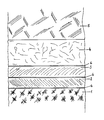
- an “inactive” sealing layer 2 of the basic seal according to the invention there is initially an “inactive” sealing layer 2 of the basic seal according to the invention above the grown floor 1. Their main task is to securely seal the floor 1 and the waste 5 against each other. Above the “inactive” sealing layer 2 there is an “active” sealing layer 3, the task of which is to bind the pollutants from percolating leachate by chemical reaction. On the “active” sealing layer 3 there is a so-called drainage layer 4, which in turn separates the base seal as a unit from the waste 5 to be deposited.
- the effect of the sealing layers can be further enhanced by installing a plastic film 6 above and / or below the "inactive" sealing layer and / or above the "active” sealing layer.
- the strengthened basic sealing is shown in the diagram.
Landscapes
- Engineering & Computer Science (AREA)
- Environmental & Geological Engineering (AREA)
- Life Sciences & Earth Sciences (AREA)
- Hydrology & Water Resources (AREA)
- General Life Sciences & Earth Sciences (AREA)
- Mining & Mineral Resources (AREA)
- Paleontology (AREA)
- Civil Engineering (AREA)
- General Engineering & Computer Science (AREA)
- Structural Engineering (AREA)
- Processing Of Solid Wastes (AREA)
- Solid-Sorbent Or Filter-Aiding Compositions (AREA)
Abstract
Description
Die vorliegende Erfindung bezieht sich auf eine Basisabdichtung einer Abfalldeponie.The present invention relates to a basic seal of a landfill.
In Deponien werden Abfälle ohne oder nach Vorbehandlung kontrolliert und verdichtet abgelagert. Der dafür erforderliche Flächenbedarf kann vermindert werden, wenn die Abfälle vor der Ablagerung unter Energieausnutzung verbrannt werden oder wenn ein Teil der Abfälle durch Kompostierung landwirtschaftlich verwertet wird. Gesetzliche Vorschriften fordern bei der Einrichtung von Deponien den Schutz des Untergrundes und des Grundwassers. Wenn am Standort der Deponie kein naturdichter Untergrund vorhanden ist, so wird in den meisten Fällen eine Deponiebasisabdichtung vorgenommen. In eine Deponie, die oberhalb des Grundwasserspiegels angelegt wird und deren Untergrund gegen das Grundwasser abgedichtet ist, können bei entsprechender Betriebsführung und unter Aufsicht von geschultem Personal auch bestimmte chemische Rückstände eingebracht werden, ohne daß Belästigungen oder Schädigungen der Umwelt eintreten. In die Abschätzung der Umweltverträglichkeit ist insbesondere auch das Langzeitverhalten einzubeziehen. Maßnahmen zur Langzeitsicherung sind hauptsächlich Sickerwasserbeseitigung, Entgasung, Sicherung der Standfestigkeit und Pflege der Rekultivierungsmaßnahmen.
Das generelle Ziel sämtlicher Basisabdichtungen ist die möglichst vollständige Zurückhaltung von Deponiesickerwässern und der darin enthaltenen Schadstoffe. Deshalb werden an ein Abdichtungssystem die Forderungen nach einer möglichst geringen Durchlässigkeit und nach einer möglichst hohen Sorptionskapazität gestellt.Waste is checked and compacted in landfills without or after pretreatment. The space required for this can be reduced if the waste is burned with energy before being deposited or if part of the waste is used for agriculture by composting. Legal regulations require the protection of the underground and groundwater when setting up landfills. If there is no naturally dense subsoil at the site of the landfill, in most cases a landfill base seal is made. Certain chemical residues can also be introduced into a landfill that is located above the groundwater table and the subsoil of which is sealed off from the groundwater, under the appropriate management and under the supervision of trained personnel, without causing any nuisance or damage to the environment. Long-term behavior must also be included in the assessment of environmental compatibility. Long-term security measures mainly include leachate removal, degassing, stability and maintenance of the recultivation measures.
The general aim of all basic waterproofing is to retain landfill leachate and the pollutants it contains as completely as possible. For this reason, a sealing system is required to have the lowest possible permeability and the highest possible sorption capacity.
Diese Forderungen sollen gemäß dem Entwurf der technischen Anleitung "Sonderabfall" mit einer Basisabdichtung folgenden Mindestaufbaus erfüllt werden:
- 150 cm mineralische Dichtungsschicht,
- 2,5 mm Kunststoffdichtungsbahn,
- Geotextil- und Entwässerungssystem.
- 150 cm mineral sealing layer,
- 2.5 mm plastic sealing membrane,
- Geotextile and drainage system.
Die mineralische Dichtungsschicht soll dabei in sechs Lagen mit je 25 cm Dicke aufgebracht werden; damit soll ein Durchlässigkeitsbeiwert k<10-¹⁰ m/s erreicht werden. Der Anteil an Tonmineralien an dieser mineralischen Dichtungsschicht ist dabei auf das erforderliche Adsorptionsvermögen abzustimmen und soll mindestens 10 Gewichts-Prozent betragen.The mineral sealing layer should be applied in six layers, each 25 cm thick; a permeability coefficient k <10-¹⁰ m / s should be achieved. The proportion of clay minerals in this mineral sealing layer is to be matched to the required adsorption capacity and should be at least 10 percent by weight.
Die bekannten Basisabdichtungen, d.h. die konventionellen Abdichtungsmaterialien wie Kunststoff-Folie und mineralische Dichtung weisen eine sehr geringe Wasserdurchlässigkeit auf. Besteht die mineralische Dichtung beispielsweise aus einem quellfähigen Tonmineralgemisch wie Bentonit, so ist auch eine sehr hohe Sorptionskapazität gegeben. Für die genannten Dichtungsmaterialien kann allerdings bei einem chemischen Angriff die für den sicheren Betrieb einer Deponie geforderte und zu fordernde Beständigkeit über geschichtliche Zeiträume hinweg betrachtet nicht eindeutig nachgewiesen werden (vergleiche FINSTERWALDER, K. (1989): Stofftransport Prozesse in Deponie-Ummantelungen von Altlasten - Ihr Einfluß auf den Entwurf der Abdichtungen. - In: JESSBERGER (Hrsg.): Erkundung und Sanierung von Altlasten. 99-106, Balkema, Rotterdam). Eine bloße Einkapselung in eine Gummihaut mag zwar während Jahren oder Jahrzehnten dicht sein, ein plötzliches Versagen kommt jedoch einer Zeitbombe gleich.The well-known basic seals, i.e. The conventional sealing materials such as plastic film and mineral seal have a very low water permeability. If, for example, the mineral seal consists of a swellable clay mineral mixture such as bentonite, there is also a very high sorption capacity. In the case of a chemical attack, however, the resistance required and required for the safe operation of a landfill over historical periods cannot be clearly demonstrated for the sealing materials mentioned (see FINSTERWALDER, K. (1989): Material transport processes in landfill casings of contaminated sites - Your influence on the design of the seals - In: JESSBERGER (ed.): Exploration and remediation of contaminated sites. 99-106, Balkema, Rotterdam). A mere encapsulation in a rubber skin may be tight for years or decades, but a sudden failure is like a time bomb.
Bei einer Basisabdichtung aus Bentonit oder bentonitähnlichen Tongemischen nimmt die Permeabilität infolge der Sorptionsprozesse allmählich zu. Dies ist einerseits in der Praxis durch nach einigen Jahren aufgetretene und beobachtete Tonmineralveränderungen belegt (vergleiche ECHLE, W., CEVRIM, M. & DULLMANN, H. (1988): Tonmineralogische, chemische und geotechnische Veränderungen in mineralischen Basisabdichtungen nach langjährigem Deponiebetrieb.- In: CZURDA, K.A. & WAGNER J.-F. (Hrsg): Tone in der Umwelttechnik. Schr.Angew. Geol.Karlsruhe, 4:99-121, Karlsruhe); andererseits ist dies aber auch aufgrund theoretischer Überlegungen absehbar (vergleiche LAHANN, R.W. & ROBERSON, H.E. (1980): Dissolution of silica from montmorillonite: effect of solution chemistry.- Geochim. Cosmochim. Acta, 44). Aufgrund kristallchemischer und thermodynamischer Überlegungen gelangen LIPPMANN (vergleiche LIPPMANN, F. (1979): Stabilitätsbeziehungen der Tonminerale.- N. Jb. Miner Abh., 136) sowie MAY et al. (vergleiche MAY, H.M. et al. (1986): Aqueous dissolution, solubilities and thermodynamic stabilities of common aluminosilicate clay minerals: kaolinite and smectites.- Geochim. Cosmochim. Acta 50) zu der Erkenntnis, daß Illite und Smektite vollständig instabile Phasen darstellen. Die Zunahme der Durchlässigkeit bentonitischer Abdichtungsmaterialien nach ihrer Behandlung mit organischen Stoffen konnte experimentell nachgewiesen werden (vergleiche ALTHER, G.R. (1987): The Qualification of Bentonite as a Soil Sealant.- Engineering Geology, 23:177-191, Amsterdam; ANDERSON, D. (1982): Does landfill leachate make clay liners more permeable? - Civil Engineering ASCE, 9:66-69; HASENPATT, R. (1988): Bodenmechanische Veränderungen reiner Tone durch Adsorption chemischer Verbindungen.- Mitt. Institut f. Grundbau und Bodenmechanik ETH Zürich, 134; HASENPATT, R. et al. (1988): Durchlässigkeit und Diffusion in Tonen.- Mitt. Insitut f. Grundbau und Bodenmechanik ETH Zürich, 13:65-76, Zürich). Auch die Wechselwirkungen zwischen anorganischen Schadstoffen und Smektiten beeinträchtigen die Durchlässigkeit der Tone. Durch den Einbau einzelner Schwermetallionen sowie die Einlagerung von Metallhydroxidschichten in die Zwischenschichten der Smektite kommt es zu einer Chloritisierung, wodurch die Austauschkapazität der Smektite stark herabgesetzt wird. Dies führt wiederum zu Volumenveränderungen und zum Verlust der Quellfähigkeit, sowie der Plastizität (vergleiche WAGNER, J.-F. (1988): Migration of lead and zinc in different clay rocks.- Int. Symp. Hydrogeology and safety of radiactive and indrustrial hazardous waste disposal.- IAH, Orleans, Doc. B.R.G.M. No. 160:617-628, Orleans).With a basic seal made of bentonite or bentonite-like clay mixtures, the permeability gradually increases as a result of the sorption processes. On the one hand, this is demonstrated in practice by clay mineral changes that have occurred and been observed after a few years (see ECHLE, W., CEVRIM, M. & DULLMANN, H. (1988): Clay mineralogical, chemical and geotechnical changes in mineral base seals after many years of landfill operation. - In : CZURDA, KA & WAGNER J.-F. (ed.): Tone in environmental technology. Schr.Angew. Geol.Karlsruhe, 4: 99-121, Karlsruhe); on the other hand, this is also foreseeable based on theoretical considerations (see LAHANN, RW & ROBERSON, HE (1980): Dissolution of silica from montmorillonite: effect of solution chemistry.- Geochim. Cosmochim. Acta, 44). Based on crystal chemical and thermodynamic considerations, LIPPMANN (see LIPPMANN, F. (1979): Stability Relationships of Clay Minerals - N. Jb. Miner Abh., 136) and MAY et al. (see MAY, HM et al. (1986): Aqueous dissolution, solubilities and thermodynamic stabilities of common aluminosilicate clay minerals: kaolinite and smectites.- Geochim. Cosmochim. Acta 50) to the finding that illites and smectites are complete represent unstable phases. The increase in permeability of bentonite sealing materials after their treatment with organic substances has been demonstrated experimentally (see ALTHER, GR (1987): The Qualification of Bentonite as a Soil Sealant.- Engineering Geology, 23: 177-191, Amsterdam; ANDERSON, D. (1982): Does landfill leachate make clay liners more permeable? - Civil Engineering ASCE, 9: 66-69; HASENPATT, R. (1988): Soil mechanical changes in pure clays through adsorption of chemical compounds. - Mitt. Institut f. Grundbau und Bodenmechanik ETH Zurich, 134; HASENPATT, R. et al. (1988): Permeability and diffusion in clays - Mitt. Insitut f. Grundbau und Bodenmechanik ETH Zurich, 13: 65-76, Zürich). The interactions between inorganic pollutants and smectites also affect the permeability of the clays. The incorporation of individual heavy metal ions and the incorporation of metal hydroxide layers in the intermediate layers of the smectites lead to chloritization, which greatly reduces the exchange capacity of the smectites. This in turn leads to changes in volume and loss of swellability, as well as plasticity (see WAGNER, J.-F. (1988): Migration of lead and zinc in different clay rocks.- Int.Symp.Hydrogeology and safety of radiactive and industrial hazardous waste disposal.- IAH, Orleans, Doc.BRGM No. 160: 617-628, Orleans).
Letztendlich ist die Langzeitstabilität der Smektite infolge der ständig ablaufenden Wechselwirkungen mit den Sickerwasserkomponenten nicht gegeben. Aus diesem Grunde werden zunehmend mineralische Dichtungsmaterialien aus stabileren Tonmineralgemischen, sogenannten kaolinitischen Tonen, verwendet. Diese zeigen aber nur minimale Sorptionseigenschaften, so daß sie dem Sickerwasser auch nur ein Minimum an Schadstoffen entziehen können.Ultimately, the long-term stability of smectites is not given due to the ongoing interaction with the leachate components. For this reason, mineral sealing materials made from more stable clay mineral mixtures, so-called kaolinitic clays, are increasingly being used. However, these show only minimal sorption properties, so that they can remove only a minimum of pollutants from the leachate.
Die der vorliegenden Erfindung zugrunde liegende Aufgabe ist - ausgehend vom vorgenannten Stand der Technik- darin zu sehen, daß eine Basisabdichtung für eine Deponie geschaffen wird, mit der einerseits eine höchst mögliche Schadstoffentfernung aus dem Sickerwasser von Haus- und Sondermülldeponien, und andererseits eine Langzeitstabilität einer minimalen Durchlässigkeit für das Sickerwasser selbst gewährleistet sind.The task underlying the present invention is - starting from the aforementioned prior art - to see that a basic seal is created for a landfill, with which on the one hand the highest possible removal of pollutants from the leachate of domestic and hazardous waste landfills, and on the other hand long-term stability of a minimal permeability for the leachate itself are guaranteed.
Diese Aufgabe wird gemäß der vorliegenden Erfindung dadurch gelöst, daß mindestens zwei getrennte mineralische Dichtungsschichten vorgesehen sind, deren eine, nämlich die dem Abfall zugewandte (im folgenden "aktive" Schicht genannte) Schicht aus einem gegenüber chemischen Lösungen instabilen Material besteht, und deren zweite, nämlich die dem gewachsenen Boden zugewandte (im folgenden "inaktive" Schicht genannte) Schicht aus einem beständigen Dichtungsmaterial besteht.This object is achieved according to the present invention in that at least two separate mineral sealing layers are provided, one of which, namely the layer facing the waste (hereinafter referred to as the "active" layer) made of a material which is unstable with respect to chemical solutions consists, and the second, namely the layer facing the grown soil (hereinafter referred to as "inactive" layer) consists of a durable sealing material.
Mit anderen als im Patentanspruch 1 gebrauchten Worten basiert die Basisabdichtung somit auf einem kombinierten Einbau von mindestens zwei (vorzugsweise mineralischen) Dichtungschichten mit zwei spezifischen unterschiedlichen Funktions- beziehungsweise Wirkungsweisen. Diese mehrfache Basisabdichtung besteht also aus mindestens zwei getrennten Dichtungsschichten, von denen eine die Sorptionsaufgabe übernimmt und die andere eine langzeitlich geringe Durchlässigkeit gewährleistet.In other words than used in
Durch den Einbau einer "mehrfachen Basisabdichtung", d.h. zweier verschiedener lagen mit unterschiedlicher Funktionsweise, ist eine möglichst große Filterwirkung für Schadstoffe ebenso gegeben, wie eine große und beständige Dichtigkeit gegenüber Wasser. Bezogen auf den konkreten Verwendungsbeziehungsweise Anwendungsfall besteht eine dem natürlichen Boden benachbarte untere Dichtungsschicht dabei aus einem "inaktiven", sehr beständigen Dichtungsmaterial, während eine dem Abfall zugewandte obere Dichtungsschicht aus einem gegenüber chemischen Lösungen sehr instabilen "aktiven" Material aufgebaut ist.By installing a "multiple base seal", i.e. two different layers with different functions, the greatest possible filtering effect for pollutants is given, as well as a large and permanent seal against water. In relation to the specific application or application, a lower sealing layer adjacent to the natural soil consists of an "inactive", very resistant sealing material, while an upper sealing layer facing the waste is made up of an "active" material that is very unstable with chemical solutions.
Die ''inaktive'' Dichtungsschicht besteht vorzugsweise aus einem sehr feinkörnigen Material, welches eine sehr geringe Permeabilität aufweist. Hier kommen in erster Linie natürliche kaolinitische Tone oder mit Kaolin vergütete Tone in Frage. Die Vergütung kann dabei durch Zugabe von sehr fein gemahlenem Quarzmehl oder Wasserglas noch verbessert werden. Neben Kaolinen kommen auch andere, chemisch sehr stabile Tone in Betracht. Wesentlich ist, daß die Materialien, aus denen die "inaktive" Dichtungsschicht aufgebaut ist, auf jeden Fall chemisch sehr stabile, schwer lösliche Mineralphasen darstellen. Für den Fall, daß auch in der "inaktiven" Schicht smektitisches Material einzubauen ist, ist darauf zu achten, daß in diesem Falle der Smektit Kalzium-Charakter besitzt, da dieser nicht so reaktiv wie die Natriumvariante ist.
Die "aktive" Dichtungsschicht wird aufgebaut aus Mineralien mit sehr hoher Sorptionsfähigkeit, wie zum Beispiel Smektiten (Hauptmineral der Bentonite), Palygorskiten, Sepioliten, Allophanen, Zeolithen, Nontroniten, Attapulgiten, Beringiten, Perliten sowie Eisen- und Manganoxiden und -hydroxiden und/oder auch sehr reaktionsfreudigen Mineralphasen wie Carbonaten, Sulfaten und Chloriden, welche durch ihre sehr hohe Löslichkeit äußerst rasch Verbindungen mit anorganischen Schadstoffen eingehen können. Die in der "aktiven" Dichtungsschicht einzubauende Smektite sollten möglichst einen Natrium-Charakter besitzen, da diese die höchsten Sorptionseigenschaften aufweisen. Als Dichtungsmaterial kommen natürliche mit den oben beschriebenen Mineralien angereicherte Tone oder mit Bentonit beziehungsweise den oben beschriebenen Mineralien vergütete Tone in Betracht. Daneben können in der "aktiven" Dichtungsschicht auch nicht oder nur zum Teil mineralische Materialien wie Aktivkohle und/oder Flugasche Verwendung finden. Die Dichtung kann durch eine eingebaute Kunststoff-Folie-oberhalb und/oder unterhalb der "inaktiven" Schicht und/oder oberhalb der "aktiven" Schicht-zusätzlich verstärkt werden.The '' inactive '' sealing layer preferably consists of a very fine-grained material which has a very low permeability. Natural kaolinitic clays or kaolin-modified clays are primarily suitable here. The remuneration can be improved by adding very finely ground quartz powder or water glass. In addition to kaolines, other chemically very stable clays can also be used. It is essential that the materials from which the "inactive" sealing layer is built are in any case chemically very stable, poorly soluble mineral phases. In the event that smectite material is also to be incorporated in the "inactive" layer, care must be taken that the smectite is calcium in this case, since it is not as reactive as the sodium variant.
The "active" sealing layer is made up of minerals with a very high sorption capacity, such as smectites (main mineral of bentonites), palygorskites, sepiolites, allophanes, zeolites, nontronites, attapulgites, beringites, pearlites as well as iron and manganese oxides and hydroxides and / or also very reactive mineral phases such as carbonates, sulfates and Chlorides, which due to their very high solubility can form compounds with inorganic pollutants extremely quickly. The smectites to be incorporated in the "active" sealing layer should preferably have a sodium character, since they have the highest sorption properties. Suitable sealing materials are natural clays enriched with the minerals described above or clays tempered with bentonite or the minerals described above. In addition, mineral materials such as activated carbon and / or fly ash can also not be used in the “active” sealing layer, or only partially. The seal can be additionally reinforced by a built-in plastic film above and / or below the "inactive" layer and / or above the "active" layer.
Die reaktionsfreudige "aktive" Dichtungsschicht entzieht dabei dem Sickerwasser möglichst viele Schadstoffe, welche an den Oberflächen beziehungsweise im Kristall oder als neue Mineralphase festgelegt werden. Diese Reaktionen in der aktiven Schicht führen allerdings mit der Zeit zu einer vollständigen Umbildung dieser "aktiven" Dichtungsschicht, was auch mit einer Veränderung der bodenmechanischen Eigenschaften, d.h. vor allem auch mit einer Heraufsetzung der Permeabilität, verbunden ist. Die Beständigkeit einer sehr geringen Permeabilität wird durch den Einbau einer gegenüber den Schadstoffen nicht reaktionsfähigen Deponieschicht, der sogenannten "inaktiven" Dichtungsschicht gewährleistet, die vorzugsweise aus einem kaolinitischen Ton gebildet wird. Hierdurch wird auch gewährleistet, daß die Sickerwässer möglichst lange zurückgehalten werden und so die Reaktionszeit zwischen der "aktiven" Dichtungsschicht und den Schadstoffen sehr lange anhält.The reactive "active" sealing layer removes as many pollutants as possible from the leachate, which are defined on the surfaces or in the crystal or as a new mineral phase. Over time, however, these reactions in the active layer lead to a complete transformation of this "active" sealing layer, which also leads to a change in the soil mechanical properties, i.e. especially associated with an increase in permeability. The stability of a very low permeability is ensured by the incorporation of a landfill layer which is not reactive towards the pollutants, the so-called "inactive" sealing layer, which is preferably formed from a kaolinitic clay. This also ensures that the leachate is retained for as long as possible and so the reaction time between the "active" sealing layer and the pollutants lasts for a very long time.
Die Durchlässigkeit der "inaktiven" Dichtungsschicht kann durch Wahl eines entsprechenden Druckgradienten so gering gehalten werden, daß sie im strömungslosen Bereich zu liegen kommt. Dies ist allerdings nicht unbedingt erforderlich und unter Umständen auch nicht wünschenswert, da hierdurch zwar der konvektive Transport verhindert würde, der diffusive Transport aber nicht auszuschalten wäre. Deshalb sind die k-Werte der "inaktiven" Dichtungsschicht nur insoweit herabzusetzen, als der konvektive Stofftransport ähnlich groß ist wie der diffusive Stofftransport. Wird durch aufwendige Verdichtungsmaßnahmen oder andere Zusätze der konvektive Transport kleiner als der diffusive Transport gewählt, so ist dies zum einen überflüssig, da die Schadstoffwanderung hierdurch nicht beeinflußt wird; zum anderen ist ein gewisser Wasserdurchtritt durch die "inaktive" Dichtungsschicht erwünscht, da durch einen völligen Aufstau der Sickerwässer in der Deponie eine vollkommene Auslaugung stattfinden könnte, was jedoch nicht unbedingt wünschenswert ist.The permeability of the "inactive" sealing layer can be kept so low by choosing an appropriate pressure gradient that it comes to rest in the flowless area. However, this is not absolutely necessary and may also not be desirable, since this would prevent convective transport, but would not make it possible to switch off diffusive transport. Therefore, the k-values of the "inactive" sealing layer can only be reduced to the extent that the convective mass transfer is as large as the diffusive mass transfer. If the convective transport is chosen to be smaller than the diffusive transport by means of complex compaction measures or other additives, this is, on the one hand, superfluous since the migration of pollutants is not influenced thereby; on the other hand, a certain passage of water through the "inactive" sealing layer is desirable, because of a complete build-up of the Leachate in the landfill could lead to complete leaching, which is not, however, desirable.
Die Dicken, d.h. Mächtigkeiten der beiden in Kombination eingebauten Dichtungsschichten sind wie folgt zu wählen. In der "aktiven" Dichtungsschicht sollen möglichst alle Schadstoffe mit dem vorhandenen Sorptionsmaterial reagieren können, so daß dem Sickerwasser sämtliche Schadstoffe entzogen werden; das Reaktionspontential ist also gleich groß dem Eluationspotential. Die Mächtigkeit der "inaktiven" Dichtungsschicht ist so zu wählen, daß die Wassergeschwindigkeit etwas kleiner beziehungsweise gleich groß der diffusiven Transportgeschwindigkeit ist. Zwar ist die Durchlässigkeit für Kaoline möglicherweise nicht so gering wie für Bentonite und andere chemisch reaktive Tone, es ist aber gewährleistet, daß bei Kaolinen die einmal erzielte Durchlässigkeit über lange Zeiträume beständig ist.The thicknesses, i.e. The thickness of the two sealing layers installed in combination should be selected as follows. In the "active" sealing layer, as far as possible all pollutants should be able to react with the existing sorption material, so that all pollutants are removed from the leachate; the reaction potential is therefore equal to the elution potential. The thickness of the "inactive" sealing layer is to be chosen so that the water speed is slightly less or equal to the diffusive transport speed. Although the permeability for kaolins may not be as low as for bentonites and other chemically reactive clays, it is ensured that the permeability once achieved with kaolins is stable over long periods of time.
Insgesamt ist noch anzumerken, daß der Deponiekörper so einzubauen ist, daß er mit dem umgebenden Gestein oder aber der eingebauten mineralischen Abdichtung so reagieren kann, daß er sich selbst hermetisch gegen die Hydrobeziehungsweise Biosphäre abschließt, d.h. versiegelt.All in all, it should also be noted that the landfill body is to be installed in such a way that it can react with the surrounding rock or the built-in mineral seal in such a way that it hermetically seals itself against the hydra-extraction or biosphere, i.e. sealed.
Die Erfindung wird nachfolgend anhand einer Schemadarstellung eines Vertikalschnitts durch eine Deponie mit einer erfindungsgemäßen mehrfachen Basisabdichtung nochmals erläutert.The invention is explained again below using a schematic representation of a vertical section through a landfill with a multiple base seal according to the invention.
Über dem gewachsenen Boden 1 befindet sich zunächst eine "inaktive" Dichtungsschicht 2 der erfindungsgemäßen Basisabdichtung. Deren wesentliche Aufgabe besteht darin, den Boden 1 und den Abfall 5 gegeneinander sicher abzudichten. Über der "inaktiven" Dichtungsschicht 2 befindet sich eine "aktive" Dichtungsschicht 3, deren Aufgabe darin besteht, die Schadstoffe aus durchsickerndem Sickerwasser durch chemische Reaktion zu binden. Auf der "aktiven" Dichtungsschicht 3 liegt eine sogenannte Dränschicht 4 auf, die ihrerseits die Basisabdichtung als Einheit betrachtet vom zu deponierenden Abfall 5 trennt. Die Wirkung der Dichtungsschichten kann zusätzlich noch dadurch verstärkt werden, daß oberhalb und /oder unterhalb der "inaktiven" Dichtungsschicht und/oder oberhalb der "aktiven" Dichtungsschicht eine Kunststoff-Folie 6 eingebaut wird. Die insoweit verstärkte Basisabdichtung ist in der Schemadarstellung gezeichnet.There is initially an "inactive" sealing layer 2 of the basic seal according to the invention above the
Claims (12)
Applications Claiming Priority (2)
| Application Number | Priority Date | Filing Date | Title |
|---|---|---|---|
| DE19904005839 DE4005839A1 (en) | 1990-02-23 | 1990-02-23 | MINERAL BASE SEALING OF A WASTE DISCHARGE |
| DE4005839 | 1990-02-23 |
Publications (1)
| Publication Number | Publication Date |
|---|---|
| EP0443567A1 true EP0443567A1 (en) | 1991-08-28 |
Family
ID=6400878
Family Applications (1)
| Application Number | Title | Priority Date | Filing Date |
|---|---|---|---|
| EP91102509A Withdrawn EP0443567A1 (en) | 1990-02-23 | 1991-02-21 | Sealing base for waste landfill |
Country Status (2)
| Country | Link |
|---|---|
| EP (1) | EP0443567A1 (en) |
| DE (1) | DE4005839A1 (en) |
Cited By (7)
| Publication number | Priority date | Publication date | Assignee | Title |
|---|---|---|---|---|
| EP0671510A1 (en) * | 1991-05-10 | 1995-09-13 | Rudolf G. Hofinger | Method of making an impervious liner and an impervious liner which is made according to this method |
| DE19506446C1 (en) * | 1995-02-24 | 1996-06-13 | Bilfinger Berger Bau | Sealing wall compsn. used to line walls, e.g. in refineries |
| WO1998001630A1 (en) * | 1996-07-05 | 1998-01-15 | Bilfinger + Berger Bauaktiengesellschaft | Capillary barrier for sealing external surfaces |
| EP1015141A4 (en) * | 1996-12-06 | 2000-07-05 | Ernest E Carter Jr | In situ construction of containment vault under a radioactive or hazardous waste site |
| WO2003041739A1 (en) | 2001-11-13 | 2003-05-22 | Takeda Chemical Industries, Ltd. | Anticaner agents |
| WO2012006981A1 (en) * | 2010-07-12 | 2012-01-19 | K + S Aktiengesellschaft | Base seal for a stockpile, in particular a residual salt stockpile |
| US8920693B2 (en) | 2011-02-04 | 2014-12-30 | Universität Kassel | Method for the production of a fiber-reinforced thermoplastic polymer and extrusion die and device for the temperature control a fiber strand impregnated with a polymer melt |
Families Citing this family (4)
| Publication number | Priority date | Publication date | Assignee | Title |
|---|---|---|---|---|
| DE4300915A1 (en) * | 1993-01-15 | 1994-07-21 | Peter Dr Grathwohl | Dump sealing |
| DE4313931A1 (en) * | 1993-04-28 | 1994-11-03 | Dyckerhoff & Widmann Ag | Arrangement for retaining the pollutants from polluted landfill leachate waters |
| DE19647901C2 (en) * | 1996-11-20 | 2001-05-10 | Jan Burmeister | Procedure for preventing or reducing the discharge of pollutants from landfills |
| DE102023124476A1 (en) * | 2023-09-11 | 2025-03-13 | Huesker Synthetic Gmbh | Multi-layer landfill base for filtration of leachate |
Citations (5)
| Publication number | Priority date | Publication date | Assignee | Title |
|---|---|---|---|---|
| US2531427A (en) * | 1946-05-03 | 1950-11-28 | Ernst A Hauser | Modified gel-forming clay and process of producing same |
| WO1983001204A1 (en) * | 1981-09-30 | 1983-04-14 | Radian Corp | Method of organic waste disposal |
| EP0216751A2 (en) * | 1985-09-19 | 1987-04-01 | OMV Aktiengesellschaft | In situ method for making impervious or sealing or decontaminating old disposals, i.e. consolidated waste disposals, so-called old deposits, and contaminated sites |
| EP0292491A1 (en) * | 1986-02-04 | 1988-11-30 | SNELL, Thomas Bartlett | Improvements relating to vehicle wheels |
| EP0338438A1 (en) * | 1988-04-16 | 1989-10-25 | CPM Ceramic Patent Management, Inc. | Process for treating or processing clay or clayey masses, process for disposing of harmful substances by clay or clayey masses, and dumping ground sealing or lining by clay or clayey masses |
-
1990
- 1990-02-23 DE DE19904005839 patent/DE4005839A1/en not_active Withdrawn
-
1991
- 1991-02-21 EP EP91102509A patent/EP0443567A1/en not_active Withdrawn
Patent Citations (5)
| Publication number | Priority date | Publication date | Assignee | Title |
|---|---|---|---|---|
| US2531427A (en) * | 1946-05-03 | 1950-11-28 | Ernst A Hauser | Modified gel-forming clay and process of producing same |
| WO1983001204A1 (en) * | 1981-09-30 | 1983-04-14 | Radian Corp | Method of organic waste disposal |
| EP0216751A2 (en) * | 1985-09-19 | 1987-04-01 | OMV Aktiengesellschaft | In situ method for making impervious or sealing or decontaminating old disposals, i.e. consolidated waste disposals, so-called old deposits, and contaminated sites |
| EP0292491A1 (en) * | 1986-02-04 | 1988-11-30 | SNELL, Thomas Bartlett | Improvements relating to vehicle wheels |
| EP0338438A1 (en) * | 1988-04-16 | 1989-10-25 | CPM Ceramic Patent Management, Inc. | Process for treating or processing clay or clayey masses, process for disposing of harmful substances by clay or clayey masses, and dumping ground sealing or lining by clay or clayey masses |
Cited By (10)
| Publication number | Priority date | Publication date | Assignee | Title |
|---|---|---|---|---|
| EP0671510A1 (en) * | 1991-05-10 | 1995-09-13 | Rudolf G. Hofinger | Method of making an impervious liner and an impervious liner which is made according to this method |
| DE19506446C1 (en) * | 1995-02-24 | 1996-06-13 | Bilfinger Berger Bau | Sealing wall compsn. used to line walls, e.g. in refineries |
| US6280521B1 (en) | 1995-12-08 | 2001-08-28 | Carter Ernest E Jr | Grout compositions for construction of subterranean barriers |
| US6569235B2 (en) | 1995-12-08 | 2003-05-27 | Ernest E. Carter, Jr. | Grout compositions for construction of subterranean barriers |
| US6860936B2 (en) | 1995-12-08 | 2005-03-01 | Ernest E. Carter, Jr. | Grout compositions for construction of subterranean barriers |
| WO1998001630A1 (en) * | 1996-07-05 | 1998-01-15 | Bilfinger + Berger Bauaktiengesellschaft | Capillary barrier for sealing external surfaces |
| EP1015141A4 (en) * | 1996-12-06 | 2000-07-05 | Ernest E Carter Jr | In situ construction of containment vault under a radioactive or hazardous waste site |
| WO2003041739A1 (en) | 2001-11-13 | 2003-05-22 | Takeda Chemical Industries, Ltd. | Anticaner agents |
| WO2012006981A1 (en) * | 2010-07-12 | 2012-01-19 | K + S Aktiengesellschaft | Base seal for a stockpile, in particular a residual salt stockpile |
| US8920693B2 (en) | 2011-02-04 | 2014-12-30 | Universität Kassel | Method for the production of a fiber-reinforced thermoplastic polymer and extrusion die and device for the temperature control a fiber strand impregnated with a polymer melt |
Also Published As
| Publication number | Publication date |
|---|---|
| DE4005839A1 (en) | 1991-09-05 |
Similar Documents
| Publication | Publication Date | Title |
|---|---|---|
| EP0292941B1 (en) | Arrangement for retaining contaminants from contaminated landfill leachates with an inorganic sealing layer and method of manufacturing said layer | |
| DE2741661C2 (en) | Process for lining waste drums with a leak-proof, closed casing | |
| DE69014036T2 (en) | Process for sealing permeable loose rock. | |
| DE3526508C2 (en) | ||
| EP0443567A1 (en) | Sealing base for waste landfill | |
| DE102007023595A1 (en) | Method for the long-term safekeeping of solution-filled caverns by means of underlays with industrial wastes and a further use of the displaced solution inventory in industrial processes | |
| DE3717884C2 (en) | ||
| DE19540387C2 (en) | Sealing system for a landfill construction as well as for securing contaminated sites and processes for the production of this sealing system | |
| DE60215549T2 (en) | PROCESS FOR CLEANING CONTAMINATED SOIL USING MICROORGANISMS | |
| DE4322331C2 (en) | Process for the immobilization of inorganic or organic pollutants contained in materials | |
| DE19851256A1 (en) | Immobilizing and/or compacting waste material comprises forming an aqueous suspension comprises ground clay in water, mixing with the waste material and directly adding an inorganic hydraulic binder | |
| DE3889115T2 (en) | WAREHOUSE. | |
| DE19733740C2 (en) | Surface penetration-reducing surface coverage of deposits | |
| EP0407546B1 (en) | Process for consolidating and sealing old refuse dumps | |
| DE2856875C2 (en) | Method of filling the interstices in a subterranean cavity containing radioactive waste | |
| CH682502A5 (en) | Construction of mineral sealing layer for waste disposal dump - by determn. of permeability, montmorillonite content and swelling clay content and adjustment w.r.t. safety requirements by addn. of additive, esp. organophilic bentonite | |
| DE4429346A1 (en) | Prodn. of bonding material contg. soil from dewatered sewage | |
| EP0091469A4 (en) | Method of immobilizing organic contaminants and non-flowable matrix produced therefrom. | |
| EP1020415B1 (en) | Process for solidifying dusty to coarse-grained contaminated noxious waste | |
| Keith | Characterization and permeability of sepiolite, palygorskite, and other commercial clays and their applicability for use as impermeable barriers in waste disposal | |
| DE68906634T2 (en) | Garbage dump with a storage room, provided with an impermeable wall made of a material with pozzolanic properties. | |
| WO1995033894A9 (en) | METHOD FOR SEALING SOIL FORMATIONS, ESPECIALLY FOR REALIZING CONTROLLED DISCHARGES WITHOUT DRAINAGE | |
| DE29724457U1 (en) | Surface penetration-reducing surface coverage of deposits on the earth's surface | |
| DD301556A7 (en) | METHOD FOR SAVING RADIOACTIVE RESTAURANT HALDEN | |
| EP1649943B1 (en) | Process for treating burning landfills |
Legal Events
| Date | Code | Title | Description |
|---|---|---|---|
| PUAI | Public reference made under article 153(3) epc to a published international application that has entered the european phase |
Free format text: ORIGINAL CODE: 0009012 |
|
| AK | Designated contracting states |
Kind code of ref document: A1 Designated state(s): AT BE CH DE DK ES FR GB GR IT LI LU NL SE |
|
| RBV | Designated contracting states (corrected) |
Designated state(s): AT BE DE ES FR GB NL |
|
| 17P | Request for examination filed |
Effective date: 19920214 |
|
| 17Q | First examination report despatched |
Effective date: 19920427 |
|
| STAA | Information on the status of an ep patent application or granted ep patent |
Free format text: STATUS: THE APPLICATION IS DEEMED TO BE WITHDRAWN |
|
| 18D | Application deemed to be withdrawn |
Effective date: 19950930 |