EP0443987B1 - Procédé et dispositif d'embrouillage et de désembrouillage d'un signal vidéo - Google Patents
Procédé et dispositif d'embrouillage et de désembrouillage d'un signal vidéo Download PDFInfo
- Publication number
- EP0443987B1 EP0443987B1 EP91810115A EP91810115A EP0443987B1 EP 0443987 B1 EP0443987 B1 EP 0443987B1 EP 91810115 A EP91810115 A EP 91810115A EP 91810115 A EP91810115 A EP 91810115A EP 0443987 B1 EP0443987 B1 EP 0443987B1
- Authority
- EP
- European Patent Office
- Prior art keywords
- line
- image
- memory
- image line
- video signal
- Prior art date
- Legal status (The legal status is an assumption and is not a legal conclusion. Google has not performed a legal analysis and makes no representation as to the accuracy of the status listed.)
- Expired - Lifetime
Links
Images


Classifications
-
- H—ELECTRICITY
- H04—ELECTRIC COMMUNICATION TECHNIQUE
- H04N—PICTORIAL COMMUNICATION, e.g. TELEVISION
- H04N7/00—Television systems
- H04N7/16—Analogue secrecy systems; Analogue subscription systems
- H04N7/167—Systems rendering the television signal unintelligible and subsequently intelligible
- H04N7/169—Systems operating in the time domain of the television signal
- H04N7/1696—Systems operating in the time domain of the television signal by changing or reversing the order of active picture signal portions
Definitions
- the present invention relates to a method for scrambling and descrambling a video signal and finds its application mainly in pay-TV systems for which it is essential to scramble the video broadcast and to descramble or decode the broadcast at the subscriber who has an appropriate decoder and who has the right to watch the broadcast program.
- a number of corresponding scrambling and descrambling methods are known which aim to make the image and / or the sound emitted incomprehensible or to make their vision and / or their hearing uncomfortable.
- a known method comprises, at the transmission level, steps consisting in scrambling, according to a determined scrambling function, sequences of the video signal each comprising a group of lines, this scrambling function possibly being different for each sequence, and broadcasting each sequence of the scrambled video signal; whereas at the reception level, the sequences of the scrambled video signal received are stored and then descrambled.
- a scrambling method which consists in permuting a constant number of lines of the video image, according to a determined permutation function.
- descrambling consists in performing the opposite function to that used on transmission to swap this certain number of image lines. Since it is not technically easy to swap a large number of image lines in this way, we are currently limited to around 32 swapped lines.
- Such a method is known from document US-A-4 405 942.
- This so-called "fixed block permutation" method has the disadvantage of requiring a large memory on reception because, at the time of end of sending on the television, to be able to immediately send the rest of the image, you must have a sequence of the following 32 stored lines.
- This method is relatively simple to implement at the transmission level, but problems of reliability, security and cost arise at the reception level, given the large number of decoders. Furthermore, this process lacks security against certain forms of piracy. It is indeed possible to find the order of permutations, even if this order changes frequently during the emission.
- Another known scrambling method which can moreover be combined with the fixed block permutation method, consists in performing, on each image line broadcast, a rotation according to a variable predetermined value. On reception, the clear image line is found by simply performing a complementary rotation of the received image line.
- the present invention aims to avoid the drawbacks which have just been mentioned, that is to say to increase the reliability and security of the process at the reception level, while making it possible to reduce the size of the memory of each decoder, so the cost.
- the method according to the invention consists in that, on transmission, a first video sequence is scrambled according to a first scrambling function, and another sequence of the video signal is scrambled according to another scrambling function .
- the other sequence of the scrambled video signal according to the other scrambling function is stored by replacing the first sequence of the scrambled video signal according to the first scrambling function by replacing the lines of the first sequence with lines of the other sequence.
- the other sequence of the video signal is stored scrambled according to a function which is equal to a determined combination of the first scrambling function and the other scrambling function.
- the scrambling function of the lines stored at the reception is a relative function and not absolute in the sense that this function is a combination of the scrambling functions of the successive lines.
- Each scrambling function can consist in successively broadcasting a group of lines of the video image in an order different from the normal order corresponding to the clear image.
- a memory comprising a determined number of memory lines, each memory line being able to store a received image line, the storage of a received image line causing the the line previously stored in this memory line is sent to a television.
- each scrambling function can include, for each image line, its diffusion by starting at a determined variable location of the image line and going to its end, continuing the diffusion from the start of the image line up to said determined location, thereby causing the image line to rotate on itself by a variable determined value corresponding to said determined location.
- a memory comprising a determined number of memory lines, each memory line being able to store a received image line having undergone, during transmission, some rotation.
- the storage of an image line thus received is carried out so as to cause the destocking and the sending to a television set of the image line previously stored in this memory line having undergone another rotation, this destocking is performing in the normal order of the image line free of rotation, so that this image line is sent directly to the television to constitute the image in clear.
- each memory line which is constituted so as to be able to carry out a circular permutation, can comprise a certain number of memory cells corresponding to each image point of a line of image.
- the storage of a next image line having undergone a certain rotation is carried out in the memory box corresponding to the start of the image line previously stored in the memory line and which had undergone another rotation.
- the destocking of this previously stored image line is therefore carried out simultaneously with storage, from the box in which the end of the previously stored image line is stored. Of this way, as the next image line is stored with rotation, it is at the same time the destocking of the previous image line is carried out in a normal order, that is to say say free of rotation, for its direct sending on the television.
- the storage in the memory line of the next image line having undergone a rotation of a certain value can be carried out by starting with the last information of this image line with rotation.
- the value of the rotation of the next image line as it is stored in the memory line is equal to the value of the rotation of the next image line as it was broadcast, added to the value of the rotation of the image line previously stored in the same memory line as it had been stored in this memory line.
- the information of this next image line located in the vicinity of its cut in the line during transmission is stored with a certain weighting in order to perform during storage a smoothing of the image line.
- the storage in the memory line of a following image line which has undergone a rotation of a certain value is carried out by starting with information situated at a predetermined constant offset with respect to the last information of this picture line.
- the circular permutation of the stored image line is continued according to another predetermined offset, by effecting, during each permutation during this offset, a correction of the information contained in the box where the storage was made, in order to smooth the line image near its cut made during transmission.
- the invention also relates to a system for scrambling and descrambling a video signal for implementing the claimed method.
- This system includes a transmitting station arranged to scramble sequences of the video signal as described above, and to broadcast each group of lines of the video image in an order different from the normal order corresponding to the clear image.
- receiving stations that is to say subscribers' decoders, each comprising means for storing the sequences of the scrambled video signal received, and then descrambling these sequences of the video signal.
- the transmitting station of the system is arranged so as to scramble a first sequence of the video signal according to a first scrambling function and to scramble another sequence of the video signal according to another scrambling function, for example by fixed block permutation and / or by circular permutation.
- Each reception station or decoder comprises a memory comprising a determined number of memory lines, each memory line being able to store a received image line so that each sequence of the scrambled video signal is stored by replacing a line of a first sequence by a line of another sequence, this according to a scrambling function which is equal to a combination of the scrambling functions of these two lines.
- the system is furthermore arranged so that the storage of an image line received in a memory line of a receiving station causes the line previously stored in this memory line to be sent to a television set.
- the normal order of the image lines to generate the clear image this by re-permutation of the lines and / or by a complementary rotation during this destocking.
- Another aspect of the invention relates to a device for storing and descrambling a scrambled video signal according to the method described above using, on reception, a decoder, provided with a memory, also arranged as described below. above.
- a conventional video signal 1 is distinguished, in which there is a synchronization signal 2, a burst of identification of the subcarrier (commonly called burst) 3 and an image signal 4 including digitized information of luminance and / or chrominance.
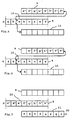
- each image line 4 is scrambled on transmission by making it undergo a rotation of a certain variable determined value, randomly or pseudo-randomly, as shown in Figure 1.
- a digitized image line conventionally comprises a large number, for example 256 or 512, of digitized samples, but for simplicity we have shown in the figures only eight samples a, b, c, d, e, f, g, h .
- Line X is cut at level x and another line Z, whether consecutive or not but which must be stored at reception to replace line X, is cut at level z.
- FIG. 2 shows the scrambled lines X and Z as they appear on a television without descrambling. It is said that such a tangled line has undergone a circular permutation or a rotation on itself.
- the memory lines are shown storing the scrambled image lines on transmission and diffusing them as they are.
- FIG. 4 a mode of addressing and storing the scrambled image lines received by the subscriber's decoder is shown.
- a storage memory 8 commonly called a buffer, comprising, for example, 32 memory lines, each memory line being able to store the digitized information of an entire image line.
- a broadcast line Z replaces in buffer 8 a previous line X located in the same memory line n of buffer 8.
- the storage of the image line z in line n of buffer 8 causes the previous image line X to exit and send it to the television, possibly after reshaping or canceling the rotation.
- each image line is rotated by a certain variable variable value.
- This mode of scrambling by rotation of the image line is well known in the prior art and is found in many known scrambling methods.
- the line Z with rotation arriving at the reception comes to replace, in the line of memory n of the buffer 8, of a line X preceding in s 'introducing into the line n of the buffer, not by an end, but by a certain box 10 which contains the information a from the start of the image line X previously stored in this memory line n of the buffer 8.
- Each memory line in buffer 8 is arranged so as to perform a circular permutation of the information contained, during each introduction by any of these memory boxes of new information.
- the image line Z broadcast with rotation at a given instant is stored on reception in a memory line (or buffer memory) 9.
- This line Z presents the address n , that is to say that it is intended to be stored in the memory line n of buffer 8.
- the information d ′ in the last box of line 9 is then stored in box 10 of the line of memory n, that is to say the box which contained the information a from the beginning of the line X previously stored.
- This introduction of the information d ′, replacing the information a in box 10, causes the shift by circular permutation of all the information a, b, c, d, e, f, g, h present in the line from memory n.
- the last information h does not go to box 10, but is destocked and is sent to another line of memory (or buffer memory) 11.
- the scrambling function real (picture line Z starting with c ′ in figure 7) is a combination of the initial scrambling function (picture line Z starting with e ′ in figure 5) and the scrambling function of previous image line (image line X starting with g in line n of buffer 8 in Figure 5).
- the scrambling function is a rotation of a certain variable value
- the value of the real rotation of the image line Z is equal to the value of its initial rotation, added (or subtracted) to the value of rotation of the previously stored line X.
- Figure 8 shows how such smoothing can be done.
- the line n of the buffer 8 is loaded with an image line Z in a manner similar to that of FIG. 7.
- the introduction is continued by the memory box 10 a small number of new successive values (for example two successive values e ′ and d ′ which are slightly modified to become e0 ′ and d0 ′, that is to say that they are weighted so that there is no visible offset on the television at the level of the z cut of the image line Z.
Landscapes
- Engineering & Computer Science (AREA)
- Multimedia (AREA)
- Signal Processing (AREA)
- Television Signal Processing For Recording (AREA)
- Two-Way Televisions, Distribution Of Moving Picture Or The Like (AREA)
- Compression Or Coding Systems Of Tv Signals (AREA)
- Picture Signal Circuits (AREA)
- Studio Circuits (AREA)
- Details Of Television Scanning (AREA)
- Television Systems (AREA)
Applications Claiming Priority (2)
| Application Number | Priority Date | Filing Date | Title |
|---|---|---|---|
| CH564/90 | 1990-02-21 | ||
| CH564/90A CH683580A5 (fr) | 1990-02-21 | 1990-02-21 | Procédé et dispositif d'embrouillage et de désembrouillage d'un signal vidéo. |
Publications (2)
| Publication Number | Publication Date |
|---|---|
| EP0443987A1 EP0443987A1 (fr) | 1991-08-28 |
| EP0443987B1 true EP0443987B1 (fr) | 1995-10-18 |
Family
ID=4189930
Family Applications (1)
| Application Number | Title | Priority Date | Filing Date |
|---|---|---|---|
| EP91810115A Expired - Lifetime EP0443987B1 (fr) | 1990-02-21 | 1991-02-21 | Procédé et dispositif d'embrouillage et de désembrouillage d'un signal vidéo |
Country Status (7)
| Country | Link |
|---|---|
| EP (1) | EP0443987B1 (da) |
| AT (1) | ATE129375T1 (da) |
| CH (1) | CH683580A5 (da) |
| DE (1) | DE69113834T2 (da) |
| DK (1) | DK0443987T3 (da) |
| ES (1) | ES2079053T3 (da) |
| GR (1) | GR3018631T3 (da) |
Families Citing this family (1)
| Publication number | Priority date | Publication date | Assignee | Title |
|---|---|---|---|---|
| MY108367A (en) * | 1991-09-30 | 1996-09-30 | Thomson Consumer Electronics S A | Method and apparatus for secure transmisson of video signals. |
Family Cites Families (6)
| Publication number | Priority date | Publication date | Assignee | Title |
|---|---|---|---|---|
| US4405942A (en) * | 1981-02-25 | 1983-09-20 | Telease, Inc. | Method and system for secure transmission and reception of video information, particularly for television |
| EP0115097B1 (fr) * | 1982-12-20 | 1987-06-03 | La Radiotechnique Portenseigne | Générateur de séquences numériques pseudoaléatoires |
| US4563702A (en) * | 1983-05-27 | 1986-01-07 | M/A-Com Linkabit, Inc. | Video signal scrambling and descrambling systems |
| JPS60102074A (ja) * | 1983-11-09 | 1985-06-06 | Nec Corp | テレビジヨン映像信号スクランブル方式 |
| FR2561478B1 (fr) * | 1984-03-16 | 1987-06-26 | Labo Electronique Physique | Dispositif de dechiffrement et de decodage d'images de television codees selon le standard mac et brouillees par application aux signaux video de permutations circulaires |
| DE3832611C2 (de) * | 1987-09-30 | 1998-05-14 | Thomson Brandt Gmbh | Verschachtelung eines Videosignals |
-
1990
- 1990-02-21 CH CH564/90A patent/CH683580A5/fr not_active IP Right Cessation
-
1991
- 1991-02-21 EP EP91810115A patent/EP0443987B1/fr not_active Expired - Lifetime
- 1991-02-21 ES ES91810115T patent/ES2079053T3/es not_active Expired - Lifetime
- 1991-02-21 DE DE69113834T patent/DE69113834T2/de not_active Expired - Lifetime
- 1991-02-21 DK DK91810115.5T patent/DK0443987T3/da active
- 1991-02-21 AT AT91810115T patent/ATE129375T1/de not_active IP Right Cessation
-
1996
- 1996-01-10 GR GR960400051T patent/GR3018631T3/el unknown
Also Published As
| Publication number | Publication date |
|---|---|
| DE69113834D1 (de) | 1995-11-23 |
| DK0443987T3 (da) | 1996-01-29 |
| GR3018631T3 (en) | 1996-04-30 |
| ATE129375T1 (de) | 1995-11-15 |
| EP0443987A1 (fr) | 1991-08-28 |
| DE69113834T2 (de) | 1996-05-23 |
| ES2079053T3 (es) | 1996-01-01 |
| CH683580A5 (fr) | 1994-03-31 |
Similar Documents
| Publication | Publication Date | Title |
|---|---|---|
| EP0469106B1 (fr) | Procede d'embrouillage et de desembrouillage d'un signal video | |
| EP0841813B1 (fr) | Procédé pour la mise à jour du logiciel d'un récepteur vidéo | |
| EP0426923B1 (fr) | Procédé d'embrouillage et de désembrouillage de signaux vidéo composites et dispositif de mise en oeuvre | |
| EP0754391A1 (fr) | Procede de diffusion de programmes a acces conditionnel progressif et a separation du flux d'information et recepteur correspondant | |
| EP0019545B1 (fr) | Système de vidéographie muni de moyens de protection contre les erreurs de transmission | |
| BE1007882A3 (fr) | Procede de diffusion de programmes a acces conditionnel permettant un acces progressif et procede d'acces progressif a de tels programmes. | |
| FR2743245A1 (fr) | Dispositif de demultiplexage | |
| EP1883239A1 (fr) | Méthode de stockage et d'exploitation d'un évènement audio/video diffusé | |
| EP0119945B1 (fr) | Procédés et dispositifs d'embrouillage et de désembrouillage pour images de télévision | |
| EP0772361B1 (fr) | Procédé permettant la mise en cascade de modules d'accès conditionnel détachables, circuit d'insertion d'une séquence prédéfinie et circuit de détection de ladite séquence pour la mise en oeuvre du procédé | |
| EP1217831B1 (fr) | Procédé et dispositif de filtrage des données relatives au guide électronique de programmes d'un téléviseur | |
| EP0603045B1 (fr) | Procédé de constitution de multiplex numérique et dispositif de mise en oeuvre dudit procédé | |
| EP0443987A1 (fr) | Procédé et dispositif d'embrouillage et de désembrouillage d'un signal vidéo | |
| EP0126495B1 (fr) | Dispositif de déchiffrement d'images de télévision brouillées par permutations circulaires | |
| FR3069996B1 (fr) | Procede de lecture d'un flux multimedia chiffre avec acces rapide au contenu en clair et dispositif d'utilisation | |
| EP2860984A1 (fr) | Méthode de traitement de messages de contrôle et module de sécurité pour la mise en oeuvre de cette méthode | |
| EP0380181B1 (fr) | Etage d'émission pour système de transmission d'images de télévision à définition étendue, système de transmission incluant un tel étage, et étage de réception pour un tel système | |
| EP1705915A1 (fr) | Procédé de gestion de l'accès à des données à accès conditionnel pour un zapping rapide | |
| EP0338915B1 (fr) | Procédé de diffusion de programmes de télévision dérivé du type MAC/Paquets, et installation de mise en oeuvre du procédé | |
| CA2364827C (fr) | Procede et dispositif de gestion d'informations dans un systeme de communication interactif | |
| FR2818857A1 (fr) | Procede et dispositif associe de memorisation de sous pages teletexte | |
| WO2016008913A1 (fr) | Procede de changement de chaine et passerelle pour des flux tv numeriques | |
| FR2726722A1 (fr) | Procede de deroutage de paquets destines a etre mis en oeuvre dans une unite de reception d'un systeme de transmission de donnees numeriques arrangees en paquets | |
| EP1346574A1 (fr) | Procede de diffusion de signaux d'image electronique en trame embrouillee | |
| FR3044853A1 (fr) | Procede de changement de service d'un decodeur de television numerique equipe d'une pluralite de tuners |
Legal Events
| Date | Code | Title | Description |
|---|---|---|---|
| PUAI | Public reference made under article 153(3) epc to a published international application that has entered the european phase |
Free format text: ORIGINAL CODE: 0009012 |
|
| AK | Designated contracting states |
Kind code of ref document: A1 Designated state(s): AT BE CH DE DK ES FR GB GR IT LI LU NL SE |
|
| 17P | Request for examination filed |
Effective date: 19911009 |
|
| 17Q | First examination report despatched |
Effective date: 19930930 |
|
| RAP1 | Party data changed (applicant data changed or rights of an application transferred) |
Owner name: NAGRA PLUS S.A. |
|
| GRAA | (expected) grant |
Free format text: ORIGINAL CODE: 0009210 |
|
| AK | Designated contracting states |
Kind code of ref document: B1 Designated state(s): AT BE CH DE DK ES FR GB GR IT LI LU NL SE |
|
| REF | Corresponds to: |
Ref document number: 129375 Country of ref document: AT Date of ref document: 19951115 Kind code of ref document: T |
|
| REF | Corresponds to: |
Ref document number: 69113834 Country of ref document: DE Date of ref document: 19951123 |
|
| GBT | Gb: translation of ep patent filed (gb section 77(6)(a)/1977) |
Effective date: 19951113 |
|
| ITF | It: translation for a ep patent filed | ||
| REG | Reference to a national code |
Ref country code: ES Ref legal event code: FG2A Ref document number: 2079053 Country of ref document: ES Kind code of ref document: T3 |
|
| REG | Reference to a national code |
Ref country code: DK Ref legal event code: T3 |
|
| REG | Reference to a national code |
Ref country code: GR Ref legal event code: FG4A Free format text: 3018631 |
|
| PLBE | No opposition filed within time limit |
Free format text: ORIGINAL CODE: 0009261 |
|
| 26N | No opposition filed | ||
| REG | Reference to a national code |
Ref country code: GB Ref legal event code: IF02 |
|
| PGFP | Annual fee paid to national office [announced via postgrant information from national office to epo] |
Ref country code: CH Payment date: 20100223 Year of fee payment: 20 Ref country code: ES Payment date: 20100222 Year of fee payment: 20 Ref country code: DK Payment date: 20100210 Year of fee payment: 20 Ref country code: LU Payment date: 20100225 Year of fee payment: 20 |
|
| PGFP | Annual fee paid to national office [announced via postgrant information from national office to epo] |
Ref country code: FR Payment date: 20100226 Year of fee payment: 20 Ref country code: IT Payment date: 20100220 Year of fee payment: 20 |
|
| PGFP | Annual fee paid to national office [announced via postgrant information from national office to epo] |
Ref country code: AT Payment date: 20100212 Year of fee payment: 20 Ref country code: DE Payment date: 20100219 Year of fee payment: 20 Ref country code: GB Payment date: 20100218 Year of fee payment: 20 |
|
| PGFP | Annual fee paid to national office [announced via postgrant information from national office to epo] |
Ref country code: NL Payment date: 20100215 Year of fee payment: 20 |
|
| PGFP | Annual fee paid to national office [announced via postgrant information from national office to epo] |
Ref country code: BE Payment date: 20100401 Year of fee payment: 20 |
|
| PGFP | Annual fee paid to national office [announced via postgrant information from national office to epo] |
Ref country code: SE Payment date: 20100212 Year of fee payment: 20 |
|
| PGFP | Annual fee paid to national office [announced via postgrant information from national office to epo] |
Ref country code: GR Payment date: 20100219 Year of fee payment: 20 |
|
| REG | Reference to a national code |
Ref country code: DE Ref legal event code: R071 Ref document number: 69113834 Country of ref document: DE |
|
| BE20 | Be: patent expired |
Owner name: S.A. *NAGRA PLUS Effective date: 20110221 |
|
| REG | Reference to a national code |
Ref country code: CH Ref legal event code: PL |
|
| REG | Reference to a national code |
Ref country code: NL Ref legal event code: V4 Effective date: 20110221 |
|
| REG | Reference to a national code |
Ref country code: ES Ref legal event code: FD2A Effective date: 20110228 |
|
| REG | Reference to a national code |
Ref country code: DK Ref legal event code: EUP |
|
| REG | Reference to a national code |
Ref country code: GB Ref legal event code: PE20 Expiry date: 20110220 |
|
| EUG | Se: european patent has lapsed | ||
| PG25 | Lapsed in a contracting state [announced via postgrant information from national office to epo] |
Ref country code: NL Free format text: LAPSE BECAUSE OF EXPIRATION OF PROTECTION Effective date: 20110221 |
|
| PG25 | Lapsed in a contracting state [announced via postgrant information from national office to epo] |
Ref country code: GB Free format text: LAPSE BECAUSE OF EXPIRATION OF PROTECTION Effective date: 20110220 Ref country code: ES Free format text: LAPSE BECAUSE OF EXPIRATION OF PROTECTION Effective date: 20110222 |
|
| PG25 | Lapsed in a contracting state [announced via postgrant information from national office to epo] |
Ref country code: DE Free format text: LAPSE BECAUSE OF EXPIRATION OF PROTECTION Effective date: 20110221 |