EP0444293B1 - Verfahren zur Herstellung von mindestens eine aromatische Estergruppe enthaltenden Kohlensäurediestern - Google Patents
Verfahren zur Herstellung von mindestens eine aromatische Estergruppe enthaltenden Kohlensäurediestern Download PDFInfo
- Publication number
- EP0444293B1 EP0444293B1 EP90124852A EP90124852A EP0444293B1 EP 0444293 B1 EP0444293 B1 EP 0444293B1 EP 90124852 A EP90124852 A EP 90124852A EP 90124852 A EP90124852 A EP 90124852A EP 0444293 B1 EP0444293 B1 EP 0444293B1
- Authority
- EP
- European Patent Office
- Prior art keywords
- alkyl
- employed
- carbonic acid
- formula
- process according
- Prior art date
- Legal status (The legal status is an assumption and is not a legal conclusion. Google has not performed a legal analysis and makes no representation as to the accuracy of the status listed.)
- Expired - Lifetime
Links
- 0 CC(*)*1(C2)C2CCC1 Chemical compound CC(*)*1(C2)C2CCC1 0.000 description 2
Classifications
-
- C—CHEMISTRY; METALLURGY
- C07—ORGANIC CHEMISTRY
- C07C—ACYCLIC OR CARBOCYCLIC COMPOUNDS
- C07C68/00—Preparation of esters of carbonic or haloformic acids
- C07C68/06—Preparation of esters of carbonic or haloformic acids from organic carbonates
Definitions
- the invention relates to a process for the preparation of carbonic diesters containing at least one aromatic ester group from carbonic diesters containing at least one aliphatic ester group by catalyzed transesterification, polymeric hydroxystannoxanes being used as catalysts.
- Fe and Sn are only sufficiently effective and selective in the case of titanium compounds.
- the titanium catalysts have the disadvantage that they color the end products strongly red to brown, which has a particularly negative effect on products which are difficult to clean by distillation and recrystallization.
- Straight-chain or branched C1-C18-alkyl is, for example, methyl, ethyl, propyl, isopropyl, butyl, isobutyl, t-butyl, the isomeric pentyls, hexyls, octyls (including 2-ethylhexyl), decyls, dodecyls, hexadecyls and octadecyls.
- C3-C8-cycloalkyl is, for example, cyclopropyl, cyclopentyl, methyl-cyclopentyl, cyclohexyl, methyl-cyclohexyl, cycloheptyl and cyclooctyl.
- C6-C14 aryl is, for example, phenyl, biphenylyl, naphthyl, anthryl.
- C7-C15 aralkyl is, for example, benzyl, phenylethyl, phenylpropyl, phenylbutyl, naphthyl-methyl, naphthyl-ethyl, anthryl-methyl.
- C1-C18 alkylene radicals that bridge two polyhydroxystannoxane chains can be straight-chain or branched and are, for example, linear and branched alkylene radicals such as 1,2-ethylene, 1,2- and 1,3-propylene, 1,4-butylene, 1.6 -Hexylene etc.
- C6-C14 arylene radicals which bridge two polyhydroxystannoxane chains are, for example, 1,2-phenylene, 1,3-phenylene, 1,4-phenylene, 2,2'-biphenylene, 4,4'-biphenylene and other arylenes corresponding to the above aromatic radicals.
- radicals present in the substituents mentioned, in particular the aromatic radicals can be substituted one to four times by C1-C4-alkyl, C1-C4-alkoxy, C1-C4-alkylthio, phenyl, phenoxy or phenylthio.
- hydroxystannoxanes Mixtures of several hydroxystannoxanes can of course also be used. Such a mixture can consist of hydroxystannoxanes which have different substituents from the above meaning. However, such a mixture can also consist of hydroxystannoxanes in which there are different numbers of recurring monomer units of the above formula (II) or (III). The number of recurring monomer units of the above formulas can be 3-30, preferably 3-20.
- polymeric hydroxystannoxanes which can be used according to the invention are: Poly (ethylhydroxystannoxane), poly (propylhydroxystannoxane), poly (butylhydroxystannoxane), poly (octylhydroxystannoxane), poly (methylhydroxystannoxane), poly (undecylhydroxystannoxane), poly (dodecylhydroxystannoxane), poly (phenylhydroxystannoxane), poly (4-methylphenyl) hydroxyl and poly (4-methoxyphenyl hydroxystannoxane).
- particularly important polymeric hydroxystannoxanes are: poly (propylhydroxystannoxane), poly (butylhydroxystannoxane) and poly (octylhydroxystannoxane).
- the polymeric hydroxystannoxanes to be used according to the invention are accessible, for example, by alkaline hydrolysis of monoorganotin trihalides. Freshly prepared, they are preferably in trimeric cyclic form (six-membered ring), but are converted into higher molecular weight species by storage, faster by thermal treatment. Here dehydration and sometimes also networking occur.
- the main cyclic oligomers do not contain end groups; in the case of open-chain species there are hydroxyl, alkoxy, halogen end groups or other end groups familiar to the person skilled in the art.
- the polymeric hydroxystannoxanes or a mixture of several of them are used in a catalytic amount, for example in an amount of 0.001-20% by weight, preferably 0.005-5% by weight, particularly preferably 0.005-2% by weight, all based on the carbonic acid diesters used containing at least one aliphatic ester group.
- the catalyzed transesterification according to the invention is understood to be the replacement of one or two aliphatic ester groups by one or two aromatic ester groups.
- This can be, for example, the reaction of an aliphatic-aromatic carbonic acid diester with a phenol to form a purely aromatic carbonic acid diester, optionally with two different aromatic ester groups. It can also be the reaction of a purely aliphatic carbonic acid diester with a phenol to form an aliphatic-aromatic or to a purely aromatic carbonic acid diester.
- an aliphatic ester group could be exchanged first, for example by limiting the amount of phenol, and then the second aliphatic ester group could be exchanged, optionally with a different phenol, so that carbonic acid esters with two different aromatic ester groups can also be obtained here.
- the catalyzed transesterification according to the invention can also be the disproportionation of a mixed aliphatic-aromatic carbonic acid diester to a purely aromatic carbonic acid diester and a purely aliphatic carbonic acid diester which can likewise be separated off by distillation.
- a bisphenol can also be used as the phenol for the transesterification.
- the weight ratio between the carbonic acid diester used, which contains at least one aliphatic ester group, and such a phenol can be varied within wide limits, for example from 1:99 to 99: 1, preferably 1: 9 to 9: 1.
- the diaryl carbonic acid diester is formed, in the case of a large excess of purely aliphatic carbonic acid diester, preferably the mixed aliphatic-aromatic carbonic acid diester.
- bisphenols and at least 2 equivalents of carbonic acid diesters are used, biscarbonates are formed which still have aliphatic or aromatic monoester groups at the ends of the molecules.
- C6-C12 aryl is, for example, phenyl, biphenylyl or naphthyl, preferably phenyl.
- substituents from the group C1-C4-alkyl, C1-C4-alkoxy, cyano, fluorine, chlorine, bromine (chlorine is preferred halogen) and nitro come into consideration.
- Important carbonic acid diesters containing two aliphatic ester groups to be used are, for example: Dimethyl carbonate, diethyl carbonate, dibutyl carbonate, diisopropyl carbonate, dicyclohexyl carbonate, dioctyl carbonate and particularly preferably dimethyl and diethyl carbonate.
- Important aliphatic-aromatic carbonic acid diesters to be used are, for example: Methyl phenyl carbonate, ethyl phenyl carbonate, butyl phenyl carbonate, methyl cresyl carbonate and their homologues.
- Alkylene groups are connected to the aromatic nuclei by two different carbon atoms, that is to say in a 1,2-, 1,3-, 1,4-, 1,5-, 2,3- or 2,4-linkage; Alkylidene groups are connected to the aromatic nuclei via the same carbon atom, that is to say in a 1,1, 2,2 or 3,3 linkage. Cycloalkylene and cycloalkylidene can be substituted 1 to 3 times by methyl or ethyl.
- phenols are: Unsubstituted phenol, o-, m- or p-cresol, o-, m- or p-chlorophenol, o-, m- or p-ethylphenol, o-, m- or p-propylphenol, o-, m- or p-nitrophenol, 2,6-dimethylphenol, 2,4-dimethylphenol and 3,4-dimethylphenol.
- the bisphenols used in the transesterification are particularly preferably those in which X or Y and the hydroxyl groups are in the o-, o'-, p-, p'- or o-, p'-position to one another.
- Bisphenols which are particularly preferred are those of the formulas in which R13, R14 and Y have the meaning given above.
- Bisphenol A is particularly important among these.
- the inventive method is carried out at a temperature of 50-300 ° C, preferably 100-250 ° C.
- the pressure is generally not critical and can be in the wide range of 0.5-50 bar, preferably 1-10 bar.
- solvents which are suitable according to the invention are: Aromatic (halogen) hydrocarbons, such as toluene, xylenes, chlorobenzene, dichlorobenzenes, trimethylbenzenes, biphenyl, and (cyclo) aliphatic hydrocarbons, such as hexane, heptane, isooctane, cyclohexane, decalin, ligroin, petroleum ether, and aliphatic and aromatic nitriles and ketones, Acetone, acetonitrile, acetylbenzene, benzonitrile and others.
- Aromatic (halogen) hydrocarbons such as toluene, xylenes, chlorobenzene, dichlorobenzenes, trimethylbenzenes, biphenyl
- aliphatic hydrocarbons such as hexane, heptane, isooctane, cyclohexane, decalin,
- the transesterification mixture is brought to the desired reaction temperature in an apparatus with a sufficient column and the aliphatic alcohol to be split off is distilled off overhead.
- disproportionation in which an aliphatic-aromatic Carbonic acid diester the completely aromatic carbonic acid diester and the completely aliphatic carbonic acid diester are formed, the generally more volatile completely aliphatic carbonic acid diester can be distilled off overhead. The more volatile substance can be separated off in the manner described using an inert solvent or gas stream.
- a hot extraction apparatus consisting of a multi-neck sump flask, an extraction attachment (tube with an inserted extraction sleeve) and a reflux condenser were used.
- the reaction rates were determined by determining the product formation (ethylphenyl carbonate and diphenyl carbonate) as a function of the reaction time using gas chromatography (GC).
- Examples 1-4 clearly show the considerably greater transesterification activity of the catalysts according to the invention, both in terms of the formation of the aliphatic-aromatic ethylphenyl carbonate and of the diaromatic diphenyl carbonate, in comparison with the polymeric tin catalysts from Example 2 (corresponding to DE-OS 3 445 552 ) or to the monomeric titanium and tin alcoholates from Examples 3 and 4 (corresponding to DE-OS 2 528 412 and DE-OS 2 552 907).
- the only slight discoloration in comparison with the titanium esters according to Example 3 is also clear.
Landscapes
- Chemical & Material Sciences (AREA)
- Organic Chemistry (AREA)
- Organic Low-Molecular-Weight Compounds And Preparation Thereof (AREA)
- Low-Molecular Organic Synthesis Reactions Using Catalysts (AREA)
Description
- Die Erfindung betrifft ein Verfahren zur Herstellung von mindestens eine aromatische Estergruppe enthaltenden Kohlensäurediestern aus mindestens eine aliphatische Estergruppe enthaltenden Kohlensäurediestern durch katalysierte Umesterung, wobei als Katalysatoren polymere Hydroxystannoxane eingesetzt werden.
- Die Herstellung von aromatischen und aliphatisch-aromatischen Kohlensäureestern durch Umesterung, ausgehend von aliphatischen Kohlensäureestern und Phenolen ist prinzipiell bekannt, Dabei handelt es sich um eine Gleichgewichtsreaktion, wobei die Lage des Gleichgewichts fast vollständig in Richtung der aliphatisch substituierten Kohlensäureester verschoben ist. Daher ist es verhältnismäßig leicht, aus aromatischen Kohlensäureestern und Alkoholen aliphatische Kohlensäureester herzustellen, während die Reaktion im umgekehrten Sinn nur dann gut gelingt, wenn sehr reaktive und selektive Katalysatoren zur Verfügung stehen. Daher hat es nicht an Versuchen gefehlt, geeignete Katalysatoren für den genannten Zweck zu entwickeln. Beispielsweise wurden zur Umesterung von aliphatischen Kohlensäureestern mit Phenolen starke Basen, wie Alkalihydroxid, vorgeschlagen. Diese Katalysatoren sind jedoch nur wenig reaktiv und wenig selektiv, da in einer Nebenreaktion in erheblichem Maße Kohlendioxid unter gleichzeitiger Bildung von Ethern herausgespalten wird.
- Die in DE-A 2 528 412 und 2 552 907 zur Herstellung von aromatischen Kohlensäureestern empfohlenen Lewis-Säure-Katalysatoren aus der Gruppe der Metallhalogenide oder entsprechender Acyloxy-, Alkoxy- und Aryloxy-Verbindungen von Al, Ti, U, V, Zn, Fe und Sn sind nur im Falle der Titanverbindungen ausreichend wirksam und selektiv. Die Titankatalysatoren haben aber den Nachteil, daß sie die Endprodukte stark rot bis braun färben, was vor allem bei Produkten, die schwierig durch Destillation und Umkristallisation zu reinigen sind, negativ ins Gewicht fällt.
- In DE-A 3 445 552 werden für die genannte Umesterung polymere Zinnverbindungen mit wiederkehrenden Struktureinheiten der Formel

empfohlen, worin - Rx und Ry
- jeweils einwertige Kohlenwasserstoffreste bedeuten.
- Es wurde nun überraschenderweise gefunden, daß bei der Substitution von Alkylestergruppen durch Arylestergruppen in Kohlensäurediestern durch Umesterung polymere Hydroxystannoxane der nachfolgenden Formel (II) als Katalysatoren erheblich wirksamer sind, als die polymeren Zinnkatalysatoren der obigen Formel (I), wobei gleichzeitig eine sehr hohe Selektivität erreicht wird.
- Die Erfindung betrifft demnach ein Verfahren zur Herstellung von mindestens eine aromatische Estergruppe enthaltenden Kohlensäurediestern aus mindestens eine aliphatische Estergruppe enthaltenden Kohlensäurediestern durch katalysierte Umsetzung, daß dadurch gekennzeichnet ist, daß als Katalysator ein polymeres Hydroxystannoxan oder ein Gemisch mehrerer von ihnen mit Monomereinheiten der Formel
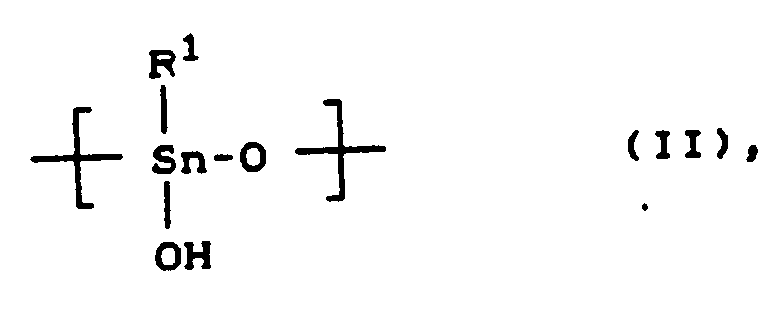
in der - R¹
- geradkettiges oder verzweigtes C₁-C₁₈-Alkyl, C₃-C₈-Cycloalkyl, C₆-C₁₄-Aryl, C₇-C₁₅-Aralkyl oder einen zwei polyhydroxystannoxanketten verbrückenden C₁-C₁₈-Alkylenrest oder C₆-C₁₄-Arylenrest bedeutet, in einer Menge von 0,001-20 Gew.-%, bezogen auf den eingesetzten mindestens eine aliphatische Estergruppe enthaltenden Kohlensäurediester, eingesetzt wird.
- Geradkettiges oder verzweigtes C₁-C₁₈-Alkyl ist beispielsweise Methyl, Ethyl, Propyl, Isopropyl, Butyl, Isobutyl, t.-Butyl, die isomeren Pentyle, Hexyle, Octyle (u.a. 2-Ethylhexyl), Decyle, Dodecyle, Hexadecyle und Octadecyle.
- C₃-C₈-Cycloalkyl ist beispielsweise Cyclopropyl, Cyclopentyl, Methyl-cyclopentyl, Cyclohexyl, Methyl-cyclohexyl, Cycloheptyl und Cyclooctyl.
- C₆-C₁₄-Aryl ist beispielsweise Phenyl, Biphenylyl, Naphthyl, Anthryl.
- C₇-C₁₅-Aralkyl ist beispielsweise Benzyl, Phenylethyl, Phenylpropyl, Phenylbutyl, Naphthyl-methyl, Naphthyl-ethyl, Anthryl-methyl.
- C₁-C₁₈-Alkylenreste, die zwei Polyhydroxystannoxanketten verbrücken, können geradkettig oder verzweigt sein und sind beispielsweise lineare und verzweigte Alkylenreste wie 1,2-Ethylen, 1,2- und 1,3-Propylen, 1,4-Butylen, 1,6-Hexylen etc.
- C₆-C₁₄-Arylenreste, die zwei Polyhydroxystannoxanketten verbrücken, sind beispielsweise 1,2-Phenylen, 1,3-Phenylen, 1,4-Phenylen, 2,2'-Biphenylen, 4,4'-Biphenylen und weitere den obigen aromatischen Resten entsprechende Arylene.
- Die in den genannten Substituenten vorhandenen Reste, insbesondere die aromatischen Reste, können ein- bis vierfach durch C₁-C₄-Alkyl, C₁-C₄-Alkoxy, C₁-C₄-Alkylthio, Phenyl, Phenoxy oder Phenylthio substituiert sein.
- In bevorzugter Weise werden polymere Hydroxystannoxane der Formel

eingesetzt, worin - R²
- geradkettiges oder verzweigtes C₃-C₁₂-Alkyl, Phenyl oder Benzyl bedeutet.
- Selbstverständlich können auch Gemische mehrerer Hydroxystannoxane eingesetzt werden. Ein solches Gemisch kann aus Hydroxystannoxanen bestehen, die unterschiedliche Substituenten aus dem obigen Bedeutungsumfang aufweisen. Ein solches Gemisch kann jedoch auch aus Hydroxystannoxanen bestehen, bei denen unterschiedlich viele wiederkehrende Monomereinheiten der obigen Formel (II) bzw. (III) vorliegen. Die Zahl der wiederkehrenden Monomereinheiten der obigen Formeln kann 3-30, bevorzugt 3-20, betragen.
- Besonders bevorzugte polymere Hydroxystannoxane sind solche mit Monomereinheiten der Formel

in der - R³
- geradkettiges oder verzweigtes C₃-C₈-Alkyl bedeutet.
- Beispiele für erfindungsgemäß einsetzbare polymere Hydroxystannoxane sind:
Poly(ethylhydroxystannoxan), Poly(propylhydroxystannoxan), Poly(butylhydroxystannoxan), Poly(octylhydroxystannoxan), Poly(methylhydroxystannoxan), Poly(undecylhydroxystannoxan), Poly(dodecylhydroxystannoxan), Poly(phenylhydroxystannoxan), Poly(4-methylphenyl-hydroxystannoxan) und Poly(4-methoxyphenyl-hydroxystannoxan). Besonders wichtige polymere Hydroxystannoxane sind beispielsweise: Poly(propylhydroxystannoxan), Poly(butylhydroxystannoxan) und Poly(octylhydroxystannoxan). - Die erfindungsgemäß einzusetzenden polymeren Hydroxystannoxane sind beispielsweise gemäß DE-AS 12 27 658 durch alkalische Hydrolyse von Monoorganozinntrihalogeniden zugänglich. Sie liegen, frisch hergestellt, vorzugsweise in trimerer cyclischer Form (Sechsring) vor, gehen aber durch Lagerung, schneller durch thermische Behandlung, in höhermolekulare Spezies über. Hierbei ereignen sich Wasserabspaltung und teilweise auch Vernetzung. Die hauptsächlich vorliegenden cyclischen Oligomeren enthalten keine Endgruppen; bei offenkettigen Spezies liegen Hydroxyl-, Alkoxy-, Halogenendgruppen oder andere dem Fachmann geläufige Endgruppen vor.
- Die polymeren Hydroxystannoxane oder ein Gemisch mehrerer von ihnen werden in einer katalytischen Menge eingesetzt, beispielsweise in einer Menge von 0,001-20 Gew.-%, bevorzugt 0,005-5 Gew.-%, besonders bevorzugt 0,005-2 Gew.-%, alles bezogen auf den eingesetzten mindestens eine aliphatische Estergruppe enthaltenden Kohlensäurediester.
- Als erfindungsgemäße katalysierte Umesterung ist der Austausch einer oder zweier aliphatischer Estergruppen durch eine oder zwei aromatische Estergruppen zu verstehen. Dies kann beispielsweise die Umsetzung eines aliphatisch-aromatischen Kohlensäurediesters mit einem Phenol zu einem rein aromatischen Kohlensäurediester, gegebenenfalls mit zwei unterschiedlichen aromatischen Estergruppen, sein. Es kann weiterhin die Umsetzung eines rein aliphatischen Kohlensäurediesters mit einem Phenol zu einem aliphatisch-aromatischen oder zu einem rein aromatischen Kohlensäurediester sein. In diesem Fall könnte zunächst, etwa durch Begrenzung der Phenolmenge, eine aliphatische Estergruppe ausgetauscht und danach, gegebenenfalls durch ein unterschiedliches Phenol, die zweite aliphatische Estergruppe ausgetauscht werden, so daß auch hier Kohlensäureester mit zwei verschiedenen aromatischen Estergruppen erhältlich sind.
- In beiden genannten Fällen wird der leichter flüchtige aliphatische Esteralkohol destillativ aus dem Umsetzungsgemisch entfernt. Schließlich kann die erfindungsgemäße katalysierte Umesterung auch die Disproportionierung eines gemischten aliphatisch-aromatischen Kohlensäurediesters zu einem rein aromatischen Kohlensäurediester und einem destillativ ebenfalls abtrennbaren rein aliphatischen Kohlensäurediester sein.
- Als Phenol zur Umesterung kann auch ein Bisphenol eingesetzt werden.
- Für den Fall der Umesterung unter Einsatz eines Phenols kann das Gewichtsverhältnis zwischen dem eingesetzten mindestens eine aliphatische Estergruppe enthaltenden Kohlensäurediester und einem solchen Phenol in weiten Grenzen variiert werden, beispielsweise von 1:99 bis 99:1, bevorzugt 1:9 bis 9:1. Dabei wird im Falle eines großen Überschusses an Phenol hauptsächlich der Diarylkohlensäurediester, im Fall eines großen Überschusses an rein aliphatischem Kohlensäurediester, vorzugsweise der gemischte aliphatisch-aromatische Kohlensäurediester gebildet. Bei Verwendung von Bisphenolen und mindestens 2 Äquivalenten Kohlensäurediester werden Biscarbonate gebildet, die an den Molekülenden noch aliphatische oder aromatische Monoestergruppen aufweisen. Beim Einsatz etwa äquivalenter Mengen Bisphenol und Kohlensäurediester erhält man zunächst Monocarbonate mit einer freien phenolischen Hydroxylgruppe des Bisphenols. Unter verschärften Reaktionsbedingungen entstehen hieraus oligomere oder polymere aromatische Carbonate. Die verschiedenartig substituierten Kohlensäurediester können problemlos, beispielsweise durch Destillation, voneinander getrennt werden.
- Erfindungsgemäß eizusetzende mindestens eine aliphatische Estergruppe enthaltende Kohlensäurediester sind solche der Formel
R⁴O-CO-OR⁵ (V),
worin - R⁴ und R⁵
- unabhängig voneinander geradkettiges oder verzweigtes C₁-C₁₂-Alkyl oder C₃-C₈-Cycloalkyl bedeuten, wobei weiterhin R⁴ substituiertes oder nicht substituiertes C₆-C₁₂-Aryl bedeuten kann.
- In bevorzugter Form werden Kohlensäurediester der Formel
R⁶O-CO-OR⁷ (VI)
eingesetzt, in der - R⁶ und R⁷
- unabhänig voneinander geradkettiges oder verzweigtes C₁-C₈-Alkyl, Cyclopropyl, Cyclopentyl oder Cyclohexyl bedeuten, wobei weiterhin R⁶ substituiertes oder nicht substituiertes Phenyl bedeuten kann.
- Alkyl und Cycloalkyl haben den oben genannten Bedeutungsumfang. C₆-C₁₂-Aryl ist beispielsweise Phenyl, Biphenylyl oder Naphthyl, bevorzugt Phenyl. Für den Fall einer Substitution von C₆-C₁₂-Aryl kommen ein oder zwei Substituenten aus der Gruppe C₁-C₄-Alkyl, C₁-C₄-Alkoxy, Cyano, Fluor, Chlor, Brom (Chlor ist bevorzugtes Halogen) und Nitro in Betracht.
- Wichtige einzusetzende zwei aliphatische Estergruppen enthaltende Kohlensäurediester sind beispielsweise:
Dimethylcarbonat, Diethylcarbonat, Dibutylcarbonat, Diisopropylcarbonat, Dicyclohexylcarbonat, Dioctylcarbonat und besonders bevorzugt Dimethyl- und Diethylcarbonat. - Wichtige einzusetzende aliphatisch-aromatische Kohlensäurediester sind beispielsweise:
Methyl-phenyl-carbonat, Ethyl-phenyl-carbonat, Butyl-phenyl-carbonat, Methyl-kresyl-carbonat und ihre Homologen. - Für den Fall, daß die Umesterung mit Hilfe eines Phenols vorgenommen wird, wird ein solches der Formel

eingesetzt, in der - R⁸
- Wasserstoff, C₁-C₄-Alkyl, C₂-C₄-Alkenyl, C₁-C₄-Alkoxy, C₅-C₆-Cycloalkyl, Phenyl, Fluor, Chlor, Brom, Cyano oder Nitro bedeutet;
- R⁹
- für Wasserstoff, C₁-C₄-Alkyl, C₂-C₄-Alkenyl, C₁-C₄-Alkoxy, Fluor, Chlor oder Brom steht und
- R¹⁰
- Wasserstoff, C₁-C₄-Alkyl oder die Gruppe

wobei R⁹ und R¹⁰ gemeinsam auch einen anellierten Benzolkern bedeuten können. - Alkylengruppen sind über zwei verschiedene C-Atome mit den aromatischen Kernen verbunden, also in 1,2-, 1,3-, 1,4-, 1,5-, 2,3- oder 2,4-Verknüpfung; Alkylidengruppen sind über das gleiche C-Atom mit den aromatischen Kernen verbunden, also in 1,1-, 2,2- oder 3,3-Verknüpfung. Cycloalkylen und Cycloalkyliden können 1 bis 3-fach durch Methyl oder Ethyl substituiert sein.
- Als Monophenole werden zur Umesterung in bevorzugter Weise solche der Formel

eingesetzt, in der - R¹¹ und R¹²
- unabhängig voneinander Wasserstoff, C₁-C₄-Alkyl, C₅-C₆-Cycloalkyl oder Chlor bedeuten, wobei R¹¹ zusätzlich Nitro bedeuten kann.
- Als Phenole seien beispielhaft genannt:
Nicht substituiertes Phenol, o-, m- oder p-Kresol, o-, m- oder p-Chlorphenol, o-, m- oder p-Ethylphenol, o-, m- oder p-Propylphenol, o-, m- oder p-Nitrophenol, 2,6-Dimethylphenol, 2,4-Dimethylphenol und 3,4-Dimethylphenol. - Bevorzugte Bisphenole sind solche der Formel

in der - R¹³ und R¹⁴
- unabhängig voneinander Wasserstoff, C₁-C₄-Alkyl, C₂-C₄-Alkenyl, C₁-C₄-Alkoxy, C₅-C₆-Cycloalkyl, Fluor, Chlor oder Brom bedeuten, wobei R¹³ zusätzlich Nitro bedeuten kann, und
- Y
- für eine Einfachbindung, -CH₂-, C₂-C₅-Alkyliden, C₅-C₁₀-Cycloalkyliden, Schwefel oder -SO₂- steht.
- Als Bisphenole werden zur Umesterung in besonders bevorzugter Weise solche eingesetzt, in denen X oder Y und die Hydroxylgruppen in o-,o'-, p-,p'- oder o-,p'-Stellung zueinander stehen.
- Ganz besonders bevorzugte Bisphenole sind solche der Formeln

in denen R¹³, R¹⁴ und Y die obengenannte Bedeutung haben. - Als Bisphenole seien beispielsweise genannt:
2,2-Bis(4'-hydroxyphenyl)-propan (= Bisphenol A), Bis(4-hydroxyphenyl)-methan, 1,1-Bis(4'-hydroxyphenyl)-cyclohexan, 2,2-Bis(3',5'-dimethyl-4'-hydroxyphenyl)-propan, 2,2'- und 4,4'-Dihydroxy-biphenyl, Bis(5-methyl-2-hydroxyphenyl)-methan, Bis(3,5-dimethyl-2-hydroxyphenyl)-methan, Bis(3-tert.-butyl-5-methyl-2-hydroxyphenyl)-methan, 1,1-Bis-(4'-hydroxyphenyl-)3,5,5-trimethylcyclohexan. Besonders wichtig unter diesen ist das Bisphenol A. - Erfindungsgemäß erhältliche mindestens eine aromatische Estergruppe enthaltende Kohlensäurediester sind solche der Formel
R¹⁵O-CO-OR¹⁶ (XIII),
in der - R¹⁵ und R¹⁶
- unabhängig voneinander substituiertes oder nicht substituiertes C₆-C₁₂-Aryl bedeuten kann, das in der oben angegebenen Weise substituiert sein kann, wobei weiterhin R¹⁵ geradkettiges oder verzweigtes C₁-C₁₂-Alkyl oder C₃-C₈-Cycloalkyl bedeuten kann.
- Das erfindungsgemäße Verfahren wird bei einer Temperatur von 50-300° C, bevorzugt 100-250° C, durchgeführt. Der Druck ist grundsätzlich nicht kritisch und kann im weiten Bereich von 0,5-50 bar, bevorzugt 1-10 bar liegen.
- Erfindungsgemäß kann ohne jedes Lösungsmittel, also in der Schmelze der umzusetzenden Stoffe, gearbeitet werden. Es ist jedoch gleichermaßen möglich, in einem bezüglich der Reaktion inerten Lösungsmittel zu arbeiten. Die Arbeitsweise unter Benutzung eines solchen inerten Lösungsmittels kann beispielsweise dann von Bedeutung sein, wenn der durch die Umesterung entstehende aliphatische Alkohol mit Hilfe eines solchen Lösungsmittels leichter aus den Reaktionsgemisch entfernt werden kann. Lösungsmittel die erfindungsgemäß geeignet sind, sind beispielsweise:
Aromatische (Halogen)Kohlenwasserstoffe, wie Toluol, Xylole, Chlorbenzol, Dichlorbenzole, Trimethylbenzole, Biphenyl, und (cyclo)aliphatische Kohlenwasserstoffe, wie Hexan, Heptan, Isooctan, Cyclohexan, Dekalin, Ligroin, Petrolether, sowie aliphatische und aromatische Nitrile und Ketone, wie Aceton, Acetonitril, Acetylbenzol, Benzonitril und andere. - Eine mögliche Verfahrensweise besteht darin, daß das Umesterungsgemisch in einer Apparatur mit einer ausreichenden Kolonne auf die gewünschte Reaktionstemperatur gebracht wird und der herauszuspaltende aliphatische Alkohol über Kopf abdestilliert wird. Für den Fall einer Disproportionierung, bei der aus einem aliphatischaromatischen Kohlensäurediester der vollständig aromatische Kohlensäurediester und der vollständig aliphatische Kohlensäurediester entstehen, kann der im allgemeinen leichter flüchtige vollständig aliphatische Kohlensäurediester über Kopf abdestilliert werden. Die Abtrennung des leichter flüchtigen Stoffes kann in der beschriebenen Weise unter Benutzung eines inerten Lösungsmittels oder Gasstromes erfolgen. Weiterhin ist es möglich, einen oder beide Ausgangsstoffe nur zum Teil vorzulegen und nach Anlaufen der Reaktion in die Schmelze oder Lösung des Reaktionsgemisches nachzudosieren.
- Die nachfolgenden Beispiele zeigen die besonders gesteigerte katalytische Reaktivität der erfindungsgemäßen polymeren Hydroxystannoxane im Vergleich mit den in der Beschreibungseinleitung genannten Katalysatoren des Standes der Technik.
- Zur Bestimmung der katalytischen Wirksamkeit des jeweiligen Katalysators unter gleichen Bedingungen wurde eine Heißextraktionsapparatur, bestehend aus Mehrhalssumpfkolben, einem Extraktionsaufsatz (Rohr mit eingesetzter Extraktionshülse) und Rückflußkühler benutzt. Im Sumpfkolben wurde jeweils ein Gemisch aus 29,5 g (0,25 Mol) Diethylcarbonat und 47,1 g (0,50 Mol) Phenol zum Sieden gebracht, so daß das leichter flüchtige Diethylcarbonat in den Extraktionsaufsatz destillierte und die mit jeweils 10 g Molekularsieb (Baylith TE 144 der Fa. Bayer) gefüllte Extraktionshülse gleichmäßig durchströmte. Durch Zugabe des zu untersuchenden Katalysators (1 mval) in den Sumpfkolben, wurde die Reaktion in Gang gebracht (Zeit t = 0), dabei das gebildete Ethanol aus dem Reaktionsgemisch mit Hilfe von Diethylcarbonat herausgeschleppt und am Molekularsieb selektiv und dauerhaft gebunden. Durch Bestimmung der Produktbildung (Ethylphenylcarbonat und Diphenylcarbonat) in Abhängikeit von der Reaktionszeit mit Hilfe der Gaschromatographie (GC) wurden die Reaktionsgeschwindigkeiten ermittelt.


- Aus den Ergebnissen der Beispiele 1-4 erkennt man deutlich die erheblich größere Umesterungsaktivität der erfindungsgemäßen Katalysatoren sowohl in bezug auf Bildung des aliphatisch-aromatischen Ethylphenylcarbonats als auch des diaromatischen Diphenylcarbonats im Vergleich zu den polymeren Zinnkatalysatoren aus Beispiel 2 (entsprechend DE-OS 3 445 552) oder zu den monomeren Titan- und Zinnalkoholaten aus den Beispielen 3 und 4 (entsprechend DE-OS 2 528 412 und DE-OS 2 552 907). Deutlich ist auch die nur geringe Verfärbung im Vergleich mit den Titanestern nach Beispiel 3.
- Nach der in den Beispielen 1 bis 5 beschriebenen Verfahrensweise wurde die Umesterung eines Gemisches aus 35,4 g (0,30 Mol) Diethylcarbonat und 34,2 g (0,15 Mol) Bisphenol A in Abhängigkeit verschiedener Katalysatoren (je 1 mval) untersucht. Mit Hilfe der Gaschromatographie (GC) wurde die Produktbildung (Bisphenol-A-monoethylcarbonat und Bisphenol-A-bisethylcarbonat) in Abhängigkeit von der Reaktionszeit als Maß für die Reaktionsgeschwindigkeit ermittelt.

Claims (10)
- Verfahren zur Herstellung von mindestens eine aromatische Estergruppe enthaltenden Kohlensäurediestern aus mindestens eine aliphatische Estergruppe enthaltenden Kohlensäurediestern durch katalysierte Umesterung, dadurch gekennzeichnet, daß als Katalysator ein polymeres Hydroxystannoxan oder ein Gemisch mehrerer von ihnen mit Monomereinheiten der Formel
 R¹ geradkettiges oder verzeigtes C₁-C₁₈-Alkyl, C₃-C₈-Cycloalkyl, C₆-C₁₄-Aryl, C₇-C₁₅-Aralkyl oder einen zwei Polyhydroxystannoxanketten verbrückenden C₁-C₁₈-Alkylenrest oder C₆-C₁₄-Arylenrest bedeutet,
in einer Menge von 0,001-20 Gew.-%, bezogen auf den eingesetzten mindestens eine aliphatische Estergruppe enthaltenden Kohlensäurediester, eingesetzt wird. - Verfahren nach Anspruch 1, dadurch gekennzeichnet, daß ein polymeres Hydroxystannoxan oder ein Gemisch mehrerer von ihnen mit Monomereinheiten der Formel
 R² geradkettiges oder verzweigtes C₃-C₁₂-Alkyl, Phenyl oder Benzyl bedeutet.
 - Verfahren nach Anspruch 2, dadurch gekennzeichnet, daß ein polymeres Hydroxystannoxan oder ein Gemisch mehrerer von ihnen mit Monomereinheiten der Formel
 R³ geradkettiges oder verzweigtes C₃-C₈-Alkyl bedeutet.
 - Verfahren nach Anspruch 1, dadurch gekennzeichnet, daß der Katalysator in einer Menge von 0,005-5 Gew.-%, bevorzugt 0,005-2 Gew.-%, eingesetzt wird.
- Verfahren nach Anspruch 1, dadurch gekennzeichnet, daß mindestens eine aliphatische Estergruppe enthaltende Kohlensäurediester der Formel
R⁴O-CO-OR⁵
eingesetzt werden, in derR⁴ und R⁵ unabhängig voneinander geradkettiges oder verzweigtes C₁-C₁₂-Alkyl oder C₃-C₈-Cycloalkyl bedeuten, wobei weiterhin R⁴ substituiertes oder nicht substituiertes C₆-C₁₂-Aryl bedeuten kann. - Verfahren nach Anspruch 5, dadurch gekennzeichnet, daß mindestens eine aliphatische Estergruppe enthaltende Kohlensäurediester der Formel
R⁶O-CO-OR⁷
eingesetzt werden, in derR⁶ und R⁷ unabhänig voneinander geradkettiges oder verzweigtes C₁-C₈-Alkyl, Cyclopropyl, Cyclopentyl oder Cyclohexyl bedeuten, wobei weiterhin R⁶ substituiertes oder nicht substituiertes Phenyl bedeuten kann. - Verfahren nach Anspruch 1, dadurch gekennzeichnet, daß zur Umesterung ein Phenol der Formel
 R⁸ Wasserstoff, C₁-C₄-Alkyl, C₂-C₄-Alkenyl, C₁-C₄-Alkoxy, C₅-C₆-Cycloalkyl, Phenyl, Fluor, Chlor, Brom, Cyano oder Nitro bedeutet;R⁹ für Wasserstoff, C₁-C₄-Alkyl, C₂-C₄-Alkenyl, C₁-C₄-Alkoxy, Fluor, Chlor oder Brom steht undR¹⁰ Wasserstoff, C₁-C₄-Alkyl oder die Gruppe
wobei R⁹ und R¹⁰ gemeinsam auch einen anellierten Benzolkern bedeuten können. - Verfahren nach Anspruch 7, dadurch gekennzeichnet, daß ein Phenol der Formel
 R¹¹ und R¹² unabhängig voneinander Wasserstoff, C₁-C₄-Alkyl, C₅-C₆-Cycloalkyl oder Chlor bedeuten, wobei R¹¹ zusätzlich Nitro bedeuten kann.
 - Verfahren nach Anspruch 7, dadurch gekennzeichnet, daß ein Bisphenol der Formel
 R¹³ und R¹⁴ unabhängig voneinander Wasserstoff, C₁-C₄-Alkyl, C₂-C₄-Alkenyl, C₁-C₄-Alkoxy, C₅-C₆-Cycloalkyl, Fluor, Chlor oder Brom bedeuten, wobei R¹³ zusätzlich Nitro bedeuten kann, undY für eine Einfachbindung, -CH₂-, C₂-C₅-Alkyliden, C₅-C₁₀-Cycloalkyliden, Schwefel oder -SO₂- steht.
 - Verfahren nach Anspruch 1, dadurch gekennzeichnet, daß bei einer Temperatur von 50-300° C, bevorzugt 100-250° C gearbeitet wird.
Applications Claiming Priority (2)
| Application Number | Priority Date | Filing Date | Title |
|---|---|---|---|
| DE4006520 | 1990-03-02 | ||
| DE4006520A DE4006520A1 (de) | 1990-03-02 | 1990-03-02 | Verfahren zur herstellung von mindestens eine aromatische estergruppe enthaltenden kohlensaeurediestern |
Publications (2)
| Publication Number | Publication Date |
|---|---|
| EP0444293A1 EP0444293A1 (de) | 1991-09-04 |
| EP0444293B1 true EP0444293B1 (de) | 1993-11-18 |
Family
ID=6401256
Family Applications (1)
| Application Number | Title | Priority Date | Filing Date |
|---|---|---|---|
| EP90124852A Expired - Lifetime EP0444293B1 (de) | 1990-03-02 | 1990-12-20 | Verfahren zur Herstellung von mindestens eine aromatische Estergruppe enthaltenden Kohlensäurediestern |
Country Status (4)
| Country | Link |
|---|---|
| US (1) | US5149856A (de) |
| EP (1) | EP0444293B1 (de) |
| JP (1) | JP2848541B2 (de) |
| DE (2) | DE4006520A1 (de) |
Families Citing this family (15)
| Publication number | Priority date | Publication date | Assignee | Title |
|---|---|---|---|---|
| DE4036594A1 (de) * | 1990-11-16 | 1992-05-21 | Bayer Ag | Verfahren zur herstellung von aromatischen kohlensaeurediestern |
| US5627301A (en) * | 1994-03-29 | 1997-05-06 | Council Of Scientific & Industrial Research | Process for the preparation of mono-alkylcarbonate of bisphenols |
| CA2207146A1 (en) * | 1996-05-28 | 1997-11-28 | Atofina Chemicals, Inc. | Catalyst for low temperature cure of blocked isocyanates |
| US5770672A (en) * | 1997-04-03 | 1998-06-23 | Elf Atochem North America, Inc. | Catalyst for low temperature cure of blocked isocyanates |
| US6093842A (en) * | 1998-09-25 | 2000-07-25 | General Electric Company | Process for continuous production of carbonate esters |
| EP1995233A3 (de) | 2007-05-25 | 2010-06-02 | Bayer MaterialScience AG | Verfahren zur Herstellung von Diaryl- oder Arylalkylcarbonaten aus Dialkylcarbonaten |
| DE102007044033A1 (de) | 2007-09-14 | 2009-03-19 | Bayer Materialscience Ag | Verfahren zur Herstellung von Diaryl- oder Alkylarylcarbonaten aus Dialkylcarbonaten |
| DE102007055266A1 (de) | 2007-11-20 | 2009-05-28 | Bayer Materialscience Ag | Verfahren zur Reinigung von Diarylcarbonaten |
| DE102008029514A1 (de) | 2008-06-21 | 2009-12-24 | Bayer Materialscience Ag | Verfahren zur Herstellung von Diarylcarbonaten aus Dialkylcarbonaten |
| DE102009016853A1 (de) | 2009-04-08 | 2010-10-14 | Bayer Materialscience Ag | Verfahren zur Herstellung von Diaryl- oder Alkylarylcarbonaten aus Dialkylcarbonaten |
| DE102009053370A1 (de) | 2009-11-14 | 2011-05-19 | Bayer Materialscience Ag | Verfahren zur Reinigung von Dialkylcarbonaten |
| US9249082B2 (en) | 2010-02-09 | 2016-02-02 | King Abdulaziz City for Science and Technology (KACST) | Synthesis of dimethyl carbonate from carbon dioxide and methanol |
| DE102010042937A1 (de) | 2010-10-08 | 2012-04-12 | Bayer Materialscience Aktiengesellschaft | Verfahren zur Herstellung von Diarylcarbonaten aus Dialkylcarbonaten |
| EP2650278A1 (de) | 2012-04-11 | 2013-10-16 | Bayer MaterialScience AG | Verfahren zur Herstellung von Diarylcarbonaten aus Dialkylcarbonaten |
| US9765012B2 (en) | 2012-12-18 | 2017-09-19 | Covestro Deutschland Ag | Method for producing diaryl carbonate |
Family Cites Families (4)
| Publication number | Priority date | Publication date | Assignee | Title |
|---|---|---|---|---|
| DE2736062A1 (de) * | 1977-08-10 | 1979-02-22 | Bayer Ag | Verfahren zur herstellung aromatischer kohlensaeureester |
| US4552704A (en) * | 1983-12-27 | 1985-11-12 | General Electric Company | Process for the production of aromatic carbonates |
| US4554110A (en) * | 1983-12-27 | 1985-11-19 | General Electric Company | Process for the preparation of aromatic carbonates |
| US5034557A (en) * | 1988-04-16 | 1991-07-23 | Mitsui Petrochemical Industries, Ltd. | Process for production of aromatic carbonate compound |
-
1990
- 1990-03-02 DE DE4006520A patent/DE4006520A1/de not_active Withdrawn
- 1990-12-20 EP EP90124852A patent/EP0444293B1/de not_active Expired - Lifetime
- 1990-12-20 DE DE90124852T patent/DE59003553D1/de not_active Expired - Fee Related
-
1991
- 1991-02-20 US US07/657,930 patent/US5149856A/en not_active Expired - Fee Related
- 1991-02-27 JP JP3053616A patent/JP2848541B2/ja not_active Expired - Lifetime
Also Published As
| Publication number | Publication date |
|---|---|
| DE59003553D1 (de) | 1993-12-23 |
| US5149856A (en) | 1992-09-22 |
| JPH04211635A (ja) | 1992-08-03 |
| EP0444293A1 (de) | 1991-09-04 |
| DE4006520A1 (de) | 1991-09-05 |
| JP2848541B2 (ja) | 1999-01-20 |
Similar Documents
| Publication | Publication Date | Title |
|---|---|---|
| EP0444293B1 (de) | Verfahren zur Herstellung von mindestens eine aromatische Estergruppe enthaltenden Kohlensäurediestern | |
| EP0485855B1 (de) | Verfahren zur Herstellung von aromatischen Kohlensäurediestern | |
| EP0000880B1 (de) | Verfahren zur Herstellung aromatischer Kohlensäureester | |
| EP0000879B1 (de) | Verfahren zur Herstellung aromatischer Kohlensäureester | |
| DE2446004C3 (de) | Verfahren zur Herstellung besonders reiner aromatischer Cyansäureester | |
| DE19810745C2 (de) | Flüssige Katalysatorformulierung aus Tetraphenylphosphoniumphenolat und Phenol und deren Verwendung | |
| DE2528412B2 (de) | Verfahren zur Herstellung von aromatischen Carbonaten | |
| DE3445552A1 (de) | Verbessertes verfahren zur herstellung von aromatischen carbonaten | |
| EP0039452B1 (de) | Verfahren zur Herstellung aromatischer Polycarbonate | |
| DE4403075A1 (de) | Verfahren zur kontinuierlichen Herstellung von Diarylcarbonaten | |
| EP0614877B1 (de) | Verfahren zur kontinuierlichen Herstellung von Arylcarbonaten | |
| EP0040741B1 (de) | Verfahren zur Herstellung von Chlorameisensäurearylestern | |
| DE2745589B2 (de) | Verfahren zur Herstellung von p-Alkylphenolen | |
| DE19609057A1 (de) | Verfahren zur Herstellung von Diarylcarbonaten und den daraus erhältlichen Polycarbonaten | |
| DE2750043A1 (de) | Verwendung von borsaeureestern zum stabilisieren von phosphitfreien polycarbonaten | |
| KR940009031B1 (ko) | 비스(디알킬페닐)펜타에리트리톨 디포스파이트의 제조방법 | |
| DE2255639C3 (de) | Ester der phosphorigen Säure | |
| DE68906202T2 (de) | Verfahren zur Herstellung von Arylethylphenolen mit einem (oder mehreren) Alkyl-Substituenten in der Ethylgruppe und deren Verwendung. | |
| DE1668848A1 (de) | Verfahren zur Herstellung von AEtherperoxyden aus alpha-substituierten Vinylaethern und neue AEtherperoxyde | |
| DE2736059C3 (de) | Verfahren zur Herstellung von 2,6-Di-tert-butylphenol | |
| EP0608710B1 (de) | Verfahren zur kontinuierlichen Herstellung von Arylcarbonaten | |
| EP0245792B1 (de) | Verfahren zur Herstellung von Carbonsäureestern | |
| EP0043482A2 (de) | Verfahren zur Herstellung von Arylphosphonyl-Verbindungen | |
| DE1224492B (de) | Verfahren zur Herstellung hochmolekularer thermoplastischer Polycarbonate | |
| EP0544074A1 (de) | Verfahren zur Herstellung von ortho-substituierten Alkylphenolen und Katalysator hierfür |
Legal Events
| Date | Code | Title | Description |
|---|---|---|---|
| PUAI | Public reference made under article 153(3) epc to a published international application that has entered the european phase |
Free format text: ORIGINAL CODE: 0009012 |
|
| 17P | Request for examination filed |
Effective date: 19901220 |
|
| AK | Designated contracting states |
Kind code of ref document: A1 Designated state(s): CH DE FR GB IT LI |
|
| 17Q | First examination report despatched |
Effective date: 19930329 |
|
| GRAA | (expected) grant |
Free format text: ORIGINAL CODE: 0009210 |
|
| AK | Designated contracting states |
Kind code of ref document: B1 Designated state(s): CH DE FR GB IT LI |
|
| REF | Corresponds to: |
Ref document number: 59003553 Country of ref document: DE Date of ref document: 19931223 |
|
| GBT | Gb: translation of ep patent filed (gb section 77(6)(a)/1977) |
Effective date: 19931125 |
|
| ITF | It: translation for a ep patent filed | ||
| ET | Fr: translation filed | ||
| PLBE | No opposition filed within time limit |
Free format text: ORIGINAL CODE: 0009261 |
|
| STAA | Information on the status of an ep patent application or granted ep patent |
Free format text: STATUS: NO OPPOSITION FILED WITHIN TIME LIMIT |
|
| 26N | No opposition filed | ||
| ITTA | It: last paid annual fee | ||
| PGFP | Annual fee paid to national office [announced via postgrant information from national office to epo] |
Ref country code: DE Payment date: 19981116 Year of fee payment: 9 |
|
| PGFP | Annual fee paid to national office [announced via postgrant information from national office to epo] |
Ref country code: CH Payment date: 19981126 Year of fee payment: 9 |
|
| PGFP | Annual fee paid to national office [announced via postgrant information from national office to epo] |
Ref country code: FR Payment date: 19981216 Year of fee payment: 9 |
|
| PGFP | Annual fee paid to national office [announced via postgrant information from national office to epo] |
Ref country code: GB Payment date: 19981224 Year of fee payment: 9 |
|
| PG25 | Lapsed in a contracting state [announced via postgrant information from national office to epo] |
Ref country code: GB Free format text: LAPSE BECAUSE OF NON-PAYMENT OF DUE FEES Effective date: 19991220 |
|
| PG25 | Lapsed in a contracting state [announced via postgrant information from national office to epo] |
Ref country code: LI Free format text: LAPSE BECAUSE OF NON-PAYMENT OF DUE FEES Effective date: 19991231 Ref country code: CH Free format text: LAPSE BECAUSE OF NON-PAYMENT OF DUE FEES Effective date: 19991231 |
|
| GBPC | Gb: european patent ceased through non-payment of renewal fee |
Effective date: 19991220 |
|
| PG25 | Lapsed in a contracting state [announced via postgrant information from national office to epo] |
Ref country code: FR Free format text: LAPSE BECAUSE OF NON-PAYMENT OF DUE FEES Effective date: 20000831 |
|
| PG25 | Lapsed in a contracting state [announced via postgrant information from national office to epo] |
Ref country code: DE Free format text: LAPSE BECAUSE OF NON-PAYMENT OF DUE FEES Effective date: 20001003 |
|
| REG | Reference to a national code |
Ref country code: FR Ref legal event code: ST |
|
| PG25 | Lapsed in a contracting state [announced via postgrant information from national office to epo] |
Ref country code: IT Free format text: LAPSE BECAUSE OF NON-PAYMENT OF DUE FEES;WARNING: LAPSES OF ITALIAN PATENTS WITH EFFECTIVE DATE BEFORE 2007 MAY HAVE OCCURRED AT ANY TIME BEFORE 2007. THE CORRECT EFFECTIVE DATE MAY BE DIFFERENT FROM THE ONE RECORDED. Effective date: 20051220 |