EP0444293B1 - Procédé de préparation de diesters d'acide carbonique contenant au moins un groupement ester aromatique - Google Patents
Procédé de préparation de diesters d'acide carbonique contenant au moins un groupement ester aromatique Download PDFInfo
- Publication number
- EP0444293B1 EP0444293B1 EP90124852A EP90124852A EP0444293B1 EP 0444293 B1 EP0444293 B1 EP 0444293B1 EP 90124852 A EP90124852 A EP 90124852A EP 90124852 A EP90124852 A EP 90124852A EP 0444293 B1 EP0444293 B1 EP 0444293B1
- Authority
- EP
- European Patent Office
- Prior art keywords
- alkyl
- employed
- carbonic acid
- formula
- process according
- Prior art date
- Legal status (The legal status is an assumption and is not a legal conclusion. Google has not performed a legal analysis and makes no representation as to the accuracy of the status listed.)
- Expired - Lifetime
Links
- 0 CC(*)*1(C2)C2CCC1 Chemical compound CC(*)*1(C2)C2CCC1 0.000 description 2
Classifications
-
- C—CHEMISTRY; METALLURGY
- C07—ORGANIC CHEMISTRY
- C07C—ACYCLIC OR CARBOCYCLIC COMPOUNDS
- C07C68/00—Preparation of esters of carbonic or haloformic acids
- C07C68/06—Preparation of esters of carbonic or haloformic acids from organic carbonates
Definitions
- the invention relates to a process for the preparation of carbonic diesters containing at least one aromatic ester group from carbonic diesters containing at least one aliphatic ester group by catalyzed transesterification, polymeric hydroxystannoxanes being used as catalysts.
- Fe and Sn are only sufficiently effective and selective in the case of titanium compounds.
- the titanium catalysts have the disadvantage that they color the end products strongly red to brown, which has a particularly negative effect on products which are difficult to clean by distillation and recrystallization.
- Straight-chain or branched C1-C18-alkyl is, for example, methyl, ethyl, propyl, isopropyl, butyl, isobutyl, t-butyl, the isomeric pentyls, hexyls, octyls (including 2-ethylhexyl), decyls, dodecyls, hexadecyls and octadecyls.
- C3-C8-cycloalkyl is, for example, cyclopropyl, cyclopentyl, methyl-cyclopentyl, cyclohexyl, methyl-cyclohexyl, cycloheptyl and cyclooctyl.
- C6-C14 aryl is, for example, phenyl, biphenylyl, naphthyl, anthryl.
- C7-C15 aralkyl is, for example, benzyl, phenylethyl, phenylpropyl, phenylbutyl, naphthyl-methyl, naphthyl-ethyl, anthryl-methyl.
- C1-C18 alkylene radicals that bridge two polyhydroxystannoxane chains can be straight-chain or branched and are, for example, linear and branched alkylene radicals such as 1,2-ethylene, 1,2- and 1,3-propylene, 1,4-butylene, 1.6 -Hexylene etc.
- C6-C14 arylene radicals which bridge two polyhydroxystannoxane chains are, for example, 1,2-phenylene, 1,3-phenylene, 1,4-phenylene, 2,2'-biphenylene, 4,4'-biphenylene and other arylenes corresponding to the above aromatic radicals.
- radicals present in the substituents mentioned, in particular the aromatic radicals can be substituted one to four times by C1-C4-alkyl, C1-C4-alkoxy, C1-C4-alkylthio, phenyl, phenoxy or phenylthio.
- hydroxystannoxanes Mixtures of several hydroxystannoxanes can of course also be used. Such a mixture can consist of hydroxystannoxanes which have different substituents from the above meaning. However, such a mixture can also consist of hydroxystannoxanes in which there are different numbers of recurring monomer units of the above formula (II) or (III). The number of recurring monomer units of the above formulas can be 3-30, preferably 3-20.
- polymeric hydroxystannoxanes which can be used according to the invention are: Poly (ethylhydroxystannoxane), poly (propylhydroxystannoxane), poly (butylhydroxystannoxane), poly (octylhydroxystannoxane), poly (methylhydroxystannoxane), poly (undecylhydroxystannoxane), poly (dodecylhydroxystannoxane), poly (phenylhydroxystannoxane), poly (4-methylphenyl) hydroxyl and poly (4-methoxyphenyl hydroxystannoxane).
- particularly important polymeric hydroxystannoxanes are: poly (propylhydroxystannoxane), poly (butylhydroxystannoxane) and poly (octylhydroxystannoxane).
- the polymeric hydroxystannoxanes to be used according to the invention are accessible, for example, by alkaline hydrolysis of monoorganotin trihalides. Freshly prepared, they are preferably in trimeric cyclic form (six-membered ring), but are converted into higher molecular weight species by storage, faster by thermal treatment. Here dehydration and sometimes also networking occur.
- the main cyclic oligomers do not contain end groups; in the case of open-chain species there are hydroxyl, alkoxy, halogen end groups or other end groups familiar to the person skilled in the art.
- the polymeric hydroxystannoxanes or a mixture of several of them are used in a catalytic amount, for example in an amount of 0.001-20% by weight, preferably 0.005-5% by weight, particularly preferably 0.005-2% by weight, all based on the carbonic acid diesters used containing at least one aliphatic ester group.
- the catalyzed transesterification according to the invention is understood to be the replacement of one or two aliphatic ester groups by one or two aromatic ester groups.
- This can be, for example, the reaction of an aliphatic-aromatic carbonic acid diester with a phenol to form a purely aromatic carbonic acid diester, optionally with two different aromatic ester groups. It can also be the reaction of a purely aliphatic carbonic acid diester with a phenol to form an aliphatic-aromatic or to a purely aromatic carbonic acid diester.
- an aliphatic ester group could be exchanged first, for example by limiting the amount of phenol, and then the second aliphatic ester group could be exchanged, optionally with a different phenol, so that carbonic acid esters with two different aromatic ester groups can also be obtained here.
- the catalyzed transesterification according to the invention can also be the disproportionation of a mixed aliphatic-aromatic carbonic acid diester to a purely aromatic carbonic acid diester and a purely aliphatic carbonic acid diester which can likewise be separated off by distillation.
- a bisphenol can also be used as the phenol for the transesterification.
- the weight ratio between the carbonic acid diester used, which contains at least one aliphatic ester group, and such a phenol can be varied within wide limits, for example from 1:99 to 99: 1, preferably 1: 9 to 9: 1.
- the diaryl carbonic acid diester is formed, in the case of a large excess of purely aliphatic carbonic acid diester, preferably the mixed aliphatic-aromatic carbonic acid diester.
- bisphenols and at least 2 equivalents of carbonic acid diesters are used, biscarbonates are formed which still have aliphatic or aromatic monoester groups at the ends of the molecules.
- C6-C12 aryl is, for example, phenyl, biphenylyl or naphthyl, preferably phenyl.
- substituents from the group C1-C4-alkyl, C1-C4-alkoxy, cyano, fluorine, chlorine, bromine (chlorine is preferred halogen) and nitro come into consideration.
- Important carbonic acid diesters containing two aliphatic ester groups to be used are, for example: Dimethyl carbonate, diethyl carbonate, dibutyl carbonate, diisopropyl carbonate, dicyclohexyl carbonate, dioctyl carbonate and particularly preferably dimethyl and diethyl carbonate.
- Important aliphatic-aromatic carbonic acid diesters to be used are, for example: Methyl phenyl carbonate, ethyl phenyl carbonate, butyl phenyl carbonate, methyl cresyl carbonate and their homologues.
- Alkylene groups are connected to the aromatic nuclei by two different carbon atoms, that is to say in a 1,2-, 1,3-, 1,4-, 1,5-, 2,3- or 2,4-linkage; Alkylidene groups are connected to the aromatic nuclei via the same carbon atom, that is to say in a 1,1, 2,2 or 3,3 linkage. Cycloalkylene and cycloalkylidene can be substituted 1 to 3 times by methyl or ethyl.
- phenols are: Unsubstituted phenol, o-, m- or p-cresol, o-, m- or p-chlorophenol, o-, m- or p-ethylphenol, o-, m- or p-propylphenol, o-, m- or p-nitrophenol, 2,6-dimethylphenol, 2,4-dimethylphenol and 3,4-dimethylphenol.
- the bisphenols used in the transesterification are particularly preferably those in which X or Y and the hydroxyl groups are in the o-, o'-, p-, p'- or o-, p'-position to one another.
- Bisphenols which are particularly preferred are those of the formulas in which R13, R14 and Y have the meaning given above.
- Bisphenol A is particularly important among these.
- the inventive method is carried out at a temperature of 50-300 ° C, preferably 100-250 ° C.
- the pressure is generally not critical and can be in the wide range of 0.5-50 bar, preferably 1-10 bar.
- solvents which are suitable according to the invention are: Aromatic (halogen) hydrocarbons, such as toluene, xylenes, chlorobenzene, dichlorobenzenes, trimethylbenzenes, biphenyl, and (cyclo) aliphatic hydrocarbons, such as hexane, heptane, isooctane, cyclohexane, decalin, ligroin, petroleum ether, and aliphatic and aromatic nitriles and ketones, Acetone, acetonitrile, acetylbenzene, benzonitrile and others.
- Aromatic (halogen) hydrocarbons such as toluene, xylenes, chlorobenzene, dichlorobenzenes, trimethylbenzenes, biphenyl
- aliphatic hydrocarbons such as hexane, heptane, isooctane, cyclohexane, decalin,
- the transesterification mixture is brought to the desired reaction temperature in an apparatus with a sufficient column and the aliphatic alcohol to be split off is distilled off overhead.
- disproportionation in which an aliphatic-aromatic Carbonic acid diester the completely aromatic carbonic acid diester and the completely aliphatic carbonic acid diester are formed, the generally more volatile completely aliphatic carbonic acid diester can be distilled off overhead. The more volatile substance can be separated off in the manner described using an inert solvent or gas stream.
- a hot extraction apparatus consisting of a multi-neck sump flask, an extraction attachment (tube with an inserted extraction sleeve) and a reflux condenser were used.
- the reaction rates were determined by determining the product formation (ethylphenyl carbonate and diphenyl carbonate) as a function of the reaction time using gas chromatography (GC).
- Examples 1-4 clearly show the considerably greater transesterification activity of the catalysts according to the invention, both in terms of the formation of the aliphatic-aromatic ethylphenyl carbonate and of the diaromatic diphenyl carbonate, in comparison with the polymeric tin catalysts from Example 2 (corresponding to DE-OS 3 445 552 ) or to the monomeric titanium and tin alcoholates from Examples 3 and 4 (corresponding to DE-OS 2 528 412 and DE-OS 2 552 907).
- the only slight discoloration in comparison with the titanium esters according to Example 3 is also clear.
Landscapes
- Chemical & Material Sciences (AREA)
- Organic Chemistry (AREA)
- Organic Low-Molecular-Weight Compounds And Preparation Thereof (AREA)
- Low-Molecular Organic Synthesis Reactions Using Catalysts (AREA)
Claims (10)
- Procédé de préparation de diesters carboniques contenant au moins un groupe ester aromatique à partir de diesters carboniques contenant au moins un groupe ester aliphatique par transestérification catalysée, caractérisé en ce que l'on utilise en tant que catalyseur un hydroxystannoxane polymère ou un mélange de plusieurs hydroxystannoxanes polymères à motifs monomères de formule
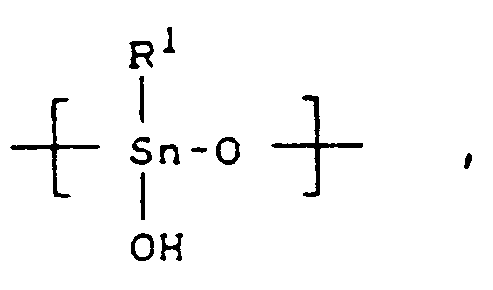
R¹ représente un groupe alkyle à chaîne droite ou ramifiée en C₁-C₁₈, cycloalkyle en C₃-C₈, aryle en C₆-C₁₄, aralkyle en C₇-C₁₅, ou un pont alkylène en C₁-C₁₈ ou arylène en C₆-C₁₄ reliant deux chaînes de polyhydroxystannoxane,
en quantité de 0,001 à 20 % du poids du diester carbonique mis en oeuvre qui contient au moins un groupe ester aliphatique. - Procédé selon la revendication 1, caractérisé en ce que l'on utilise un hydroxystannoxane polymère ou un mélange de plusieurs hydroxystannoxanes polymères à motifs monomères de formule

R² représente un groupe alkyle à chaîne droite ou ramifiée en C₃-C₁₂, phényle ou benzyle. - Procédé selon la revendication 2, caractérisé en ce que l'on utilise un hydroxystannoxane polymère ou un mélange de plusieurs hydroxystannoxanes polymères à motifs monomères de formule

R³ représente un groupe alkyle à chaîne droite ou ramifiée en C₃-C₈. - Procédé selon la revendication 1, caractérisé en ce que l'on utilise le catalyseur en quantité de 0,005 à 5 % en poids, de préférence de 0,005 à 2 % en poids.
- Procédé selon la revendication 1, caractérisé en ce que l'on met en oeuvre un diester carbonique contenant au moins un groupe ester aliphatique, de formule
R⁴O-CO-OR⁵
dans laquelle
R⁴ et R⁵ représentent chacun indépendamment l'un de l'autre, un groupe alkyle à chaîne droite ou ramifiée en C₁-C₁₂ ou cycloalkyle en C₃-C₈, R⁴ pouvant en outre représenter un groupe aryle en C₆-C₁₂ substitué ou non. - Procédé selon la revendication 5, caractérisé en ce que l'on met en oeuvre un diester carbonique contenant au moins un groupe ester aliphatique, de formule
R⁶O-CO-OR⁷
dans laquelle
R⁶ et R⁷ représentent chacun, indépendamment l'un de l'autre, un groupe alkyle à chaîne droite ou ramifiée en C₁-C₈, cyclopropyle, cyclopentyle ou cyclohexyle, R⁶ pouvant en outre représenter un groupe phényle substitué ou non. - Procédé selon la revendication 1, caractérisé en ce que l'on met en oeuvre pour la transestérification un phénol de formule

R⁸ représente l'hydrogène, un groupe alkyle en C₁-C₄, alcényle en C₂-C₄, alcoxy en C₁-C₄, cycloalkyle en C₅-C₆, phényle, le fluor, le chlore, le brome, un groupe cyano ou nitro;
R⁹ représente l'hydrogène, un groupe alkyle en C₁-C₄, alcényle en C₂-C₄, alcoxy en C₁-C₄, le fluor, le chlore ou le brome et
R¹⁰ représente l'hydrogène, un groupe alkyle en C₁-C₄ ou le groupe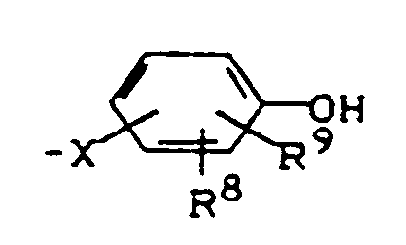
R⁹ et R¹⁰ pouvant également représenter ensemble un noyau benzénique condensé. - Procédé selon la revendication 7, caractérisé en ce que l'on met en oeuvre un phénol de formule

R¹¹ et R¹² représentent chacun, indépendamment l'un de l'autre, I'hydrogène, un groupe alkyle en C₁-C₄, cycloalkyle en C₅-C₆ ou le chlore, R¹¹ pouvant en outre représenter un groupe nitro. - Procédé selon la revendication 7, caractérisé en ce que l'on met en oeuvre un bis-phénol de formule
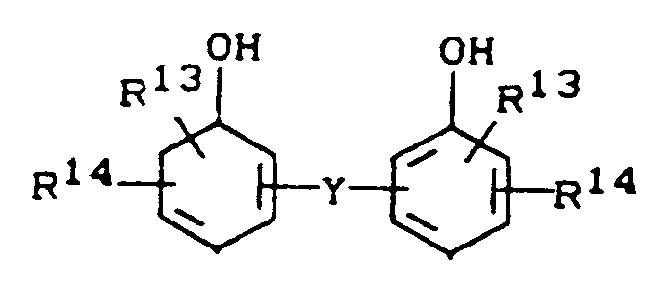
R¹³ et R¹⁴ représentent chacun, indépendamment l'un de l'autre, I'hydrogène, un groupe alkyle en C₁-C₄, alcényle en C₂-C₄, alcoxy en C₁-C₄, cycloalkyle en C₅-C₆, le fluor, le chlore ou le brome, R¹³ pouvant en outre représenter un groupe nitro et
Y représente une liaison simple, -CH₂-, un groupe alkylidène en C₂-C₅, cycloalkylidène en C₅-C₁₀, le soufre ou -SO₂-. - Procédé selon la revendication 1, caractérisé en ce que l'on opère à une température de 50 à 300°C, de préférence de 100 à 250°C.
Applications Claiming Priority (2)
| Application Number | Priority Date | Filing Date | Title |
|---|---|---|---|
| DE4006520 | 1990-03-02 | ||
| DE4006520A DE4006520A1 (de) | 1990-03-02 | 1990-03-02 | Verfahren zur herstellung von mindestens eine aromatische estergruppe enthaltenden kohlensaeurediestern |
Publications (2)
| Publication Number | Publication Date |
|---|---|
| EP0444293A1 EP0444293A1 (fr) | 1991-09-04 |
| EP0444293B1 true EP0444293B1 (fr) | 1993-11-18 |
Family
ID=6401256
Family Applications (1)
| Application Number | Title | Priority Date | Filing Date |
|---|---|---|---|
| EP90124852A Expired - Lifetime EP0444293B1 (fr) | 1990-03-02 | 1990-12-20 | Procédé de préparation de diesters d'acide carbonique contenant au moins un groupement ester aromatique |
Country Status (4)
| Country | Link |
|---|---|
| US (1) | US5149856A (fr) |
| EP (1) | EP0444293B1 (fr) |
| JP (1) | JP2848541B2 (fr) |
| DE (2) | DE4006520A1 (fr) |
Families Citing this family (15)
| Publication number | Priority date | Publication date | Assignee | Title |
|---|---|---|---|---|
| DE4036594A1 (de) * | 1990-11-16 | 1992-05-21 | Bayer Ag | Verfahren zur herstellung von aromatischen kohlensaeurediestern |
| US5627301A (en) * | 1994-03-29 | 1997-05-06 | Council Of Scientific & Industrial Research | Process for the preparation of mono-alkylcarbonate of bisphenols |
| CA2207146A1 (fr) * | 1996-05-28 | 1997-11-28 | Atofina Chemicals, Inc. | Catalyseur pour durcissement a faible temperature d'isocyanates bloques |
| US5770672A (en) * | 1997-04-03 | 1998-06-23 | Elf Atochem North America, Inc. | Catalyst for low temperature cure of blocked isocyanates |
| US6093842A (en) * | 1998-09-25 | 2000-07-25 | General Electric Company | Process for continuous production of carbonate esters |
| EP1995233A3 (fr) | 2007-05-25 | 2010-06-02 | Bayer MaterialScience AG | Procédé de fabrication de carbonates de diaryle ou d'arylalkyle à partir de carbonates de dialkyle |
| DE102007044033A1 (de) | 2007-09-14 | 2009-03-19 | Bayer Materialscience Ag | Verfahren zur Herstellung von Diaryl- oder Alkylarylcarbonaten aus Dialkylcarbonaten |
| DE102007055266A1 (de) | 2007-11-20 | 2009-05-28 | Bayer Materialscience Ag | Verfahren zur Reinigung von Diarylcarbonaten |
| DE102008029514A1 (de) | 2008-06-21 | 2009-12-24 | Bayer Materialscience Ag | Verfahren zur Herstellung von Diarylcarbonaten aus Dialkylcarbonaten |
| DE102009016853A1 (de) | 2009-04-08 | 2010-10-14 | Bayer Materialscience Ag | Verfahren zur Herstellung von Diaryl- oder Alkylarylcarbonaten aus Dialkylcarbonaten |
| DE102009053370A1 (de) | 2009-11-14 | 2011-05-19 | Bayer Materialscience Ag | Verfahren zur Reinigung von Dialkylcarbonaten |
| US9249082B2 (en) | 2010-02-09 | 2016-02-02 | King Abdulaziz City for Science and Technology (KACST) | Synthesis of dimethyl carbonate from carbon dioxide and methanol |
| DE102010042937A1 (de) | 2010-10-08 | 2012-04-12 | Bayer Materialscience Aktiengesellschaft | Verfahren zur Herstellung von Diarylcarbonaten aus Dialkylcarbonaten |
| EP2650278A1 (fr) | 2012-04-11 | 2013-10-16 | Bayer MaterialScience AG | Procédé de fabrication de diarylcarbonates à partir de dialkylcarbonates |
| US9765012B2 (en) | 2012-12-18 | 2017-09-19 | Covestro Deutschland Ag | Method for producing diaryl carbonate |
Family Cites Families (4)
| Publication number | Priority date | Publication date | Assignee | Title |
|---|---|---|---|---|
| DE2736062A1 (de) * | 1977-08-10 | 1979-02-22 | Bayer Ag | Verfahren zur herstellung aromatischer kohlensaeureester |
| US4552704A (en) * | 1983-12-27 | 1985-11-12 | General Electric Company | Process for the production of aromatic carbonates |
| US4554110A (en) * | 1983-12-27 | 1985-11-19 | General Electric Company | Process for the preparation of aromatic carbonates |
| US5034557A (en) * | 1988-04-16 | 1991-07-23 | Mitsui Petrochemical Industries, Ltd. | Process for production of aromatic carbonate compound |
-
1990
- 1990-03-02 DE DE4006520A patent/DE4006520A1/de not_active Withdrawn
- 1990-12-20 EP EP90124852A patent/EP0444293B1/fr not_active Expired - Lifetime
- 1990-12-20 DE DE90124852T patent/DE59003553D1/de not_active Expired - Fee Related
-
1991
- 1991-02-20 US US07/657,930 patent/US5149856A/en not_active Expired - Fee Related
- 1991-02-27 JP JP3053616A patent/JP2848541B2/ja not_active Expired - Lifetime
Also Published As
| Publication number | Publication date |
|---|---|
| DE59003553D1 (de) | 1993-12-23 |
| US5149856A (en) | 1992-09-22 |
| JPH04211635A (ja) | 1992-08-03 |
| EP0444293A1 (fr) | 1991-09-04 |
| DE4006520A1 (de) | 1991-09-05 |
| JP2848541B2 (ja) | 1999-01-20 |
Similar Documents
| Publication | Publication Date | Title |
|---|---|---|
| EP0444293B1 (fr) | Procédé de préparation de diesters d'acide carbonique contenant au moins un groupement ester aromatique | |
| EP0485855B1 (fr) | Procédé de préparation de diesters arômatiques d'acide carbonique | |
| EP0000880B1 (fr) | Procédé pour préparer des carbonates aromatiques | |
| EP0000879B1 (fr) | Procédé pour préparer des carbonates aromatiques | |
| DE2446004C3 (de) | Verfahren zur Herstellung besonders reiner aromatischer Cyansäureester | |
| DE19810745C2 (de) | Flüssige Katalysatorformulierung aus Tetraphenylphosphoniumphenolat und Phenol und deren Verwendung | |
| DE2528412B2 (de) | Verfahren zur Herstellung von aromatischen Carbonaten | |
| DE3445552A1 (de) | Verbessertes verfahren zur herstellung von aromatischen carbonaten | |
| EP0039452B1 (fr) | Procédé de préparation de polycarbonates aromatiques | |
| DE4403075A1 (de) | Verfahren zur kontinuierlichen Herstellung von Diarylcarbonaten | |
| EP0614877B1 (fr) | Procédé de préparation continue de carbonates d'aryle | |
| EP0040741B1 (fr) | Procédé de préparation d'arylesters de l'acide chloroformique | |
| DE2745589B2 (de) | Verfahren zur Herstellung von p-Alkylphenolen | |
| DE19609057A1 (de) | Verfahren zur Herstellung von Diarylcarbonaten und den daraus erhältlichen Polycarbonaten | |
| DE2750043A1 (de) | Verwendung von borsaeureestern zum stabilisieren von phosphitfreien polycarbonaten | |
| KR940009031B1 (ko) | 비스(디알킬페닐)펜타에리트리톨 디포스파이트의 제조방법 | |
| DE2255639C3 (de) | Ester der phosphorigen Säure | |
| DE68906202T2 (de) | Verfahren zur Herstellung von Arylethylphenolen mit einem (oder mehreren) Alkyl-Substituenten in der Ethylgruppe und deren Verwendung. | |
| DE1668848A1 (de) | Verfahren zur Herstellung von AEtherperoxyden aus alpha-substituierten Vinylaethern und neue AEtherperoxyde | |
| DE2736059C3 (de) | Verfahren zur Herstellung von 2,6-Di-tert-butylphenol | |
| EP0608710B1 (fr) | Procédé de préparation continue de carbonates d'aryle | |
| EP0245792B1 (fr) | Procédé de préparation d'esters d'acides carboxyliques | |
| EP0043482A2 (fr) | Procédé de préparation de composés aryl-phosphonyle | |
| DE1224492B (de) | Verfahren zur Herstellung hochmolekularer thermoplastischer Polycarbonate | |
| EP0544074A1 (fr) | Procédé pour la préparation d'alkylphénols ortho-substitués et catalyseur pour ce procédé |
Legal Events
| Date | Code | Title | Description |
|---|---|---|---|
| PUAI | Public reference made under article 153(3) epc to a published international application that has entered the european phase |
Free format text: ORIGINAL CODE: 0009012 |
|
| 17P | Request for examination filed |
Effective date: 19901220 |
|
| AK | Designated contracting states |
Kind code of ref document: A1 Designated state(s): CH DE FR GB IT LI |
|
| 17Q | First examination report despatched |
Effective date: 19930329 |
|
| GRAA | (expected) grant |
Free format text: ORIGINAL CODE: 0009210 |
|
| AK | Designated contracting states |
Kind code of ref document: B1 Designated state(s): CH DE FR GB IT LI |
|
| REF | Corresponds to: |
Ref document number: 59003553 Country of ref document: DE Date of ref document: 19931223 |
|
| GBT | Gb: translation of ep patent filed (gb section 77(6)(a)/1977) |
Effective date: 19931125 |
|
| ITF | It: translation for a ep patent filed | ||
| ET | Fr: translation filed | ||
| PLBE | No opposition filed within time limit |
Free format text: ORIGINAL CODE: 0009261 |
|
| STAA | Information on the status of an ep patent application or granted ep patent |
Free format text: STATUS: NO OPPOSITION FILED WITHIN TIME LIMIT |
|
| 26N | No opposition filed | ||
| ITTA | It: last paid annual fee | ||
| PGFP | Annual fee paid to national office [announced via postgrant information from national office to epo] |
Ref country code: DE Payment date: 19981116 Year of fee payment: 9 |
|
| PGFP | Annual fee paid to national office [announced via postgrant information from national office to epo] |
Ref country code: CH Payment date: 19981126 Year of fee payment: 9 |
|
| PGFP | Annual fee paid to national office [announced via postgrant information from national office to epo] |
Ref country code: FR Payment date: 19981216 Year of fee payment: 9 |
|
| PGFP | Annual fee paid to national office [announced via postgrant information from national office to epo] |
Ref country code: GB Payment date: 19981224 Year of fee payment: 9 |
|
| PG25 | Lapsed in a contracting state [announced via postgrant information from national office to epo] |
Ref country code: GB Free format text: LAPSE BECAUSE OF NON-PAYMENT OF DUE FEES Effective date: 19991220 |
|
| PG25 | Lapsed in a contracting state [announced via postgrant information from national office to epo] |
Ref country code: LI Free format text: LAPSE BECAUSE OF NON-PAYMENT OF DUE FEES Effective date: 19991231 Ref country code: CH Free format text: LAPSE BECAUSE OF NON-PAYMENT OF DUE FEES Effective date: 19991231 |
|
| GBPC | Gb: european patent ceased through non-payment of renewal fee |
Effective date: 19991220 |
|
| PG25 | Lapsed in a contracting state [announced via postgrant information from national office to epo] |
Ref country code: FR Free format text: LAPSE BECAUSE OF NON-PAYMENT OF DUE FEES Effective date: 20000831 |
|
| PG25 | Lapsed in a contracting state [announced via postgrant information from national office to epo] |
Ref country code: DE Free format text: LAPSE BECAUSE OF NON-PAYMENT OF DUE FEES Effective date: 20001003 |
|
| REG | Reference to a national code |
Ref country code: FR Ref legal event code: ST |
|
| PG25 | Lapsed in a contracting state [announced via postgrant information from national office to epo] |
Ref country code: IT Free format text: LAPSE BECAUSE OF NON-PAYMENT OF DUE FEES;WARNING: LAPSES OF ITALIAN PATENTS WITH EFFECTIVE DATE BEFORE 2007 MAY HAVE OCCURRED AT ANY TIME BEFORE 2007. THE CORRECT EFFECTIVE DATE MAY BE DIFFERENT FROM THE ONE RECORDED. Effective date: 20051220 |