EP0444350B1 - Verfahren zur Herstellung von selbststabilisierten Halbleitergittern - Google Patents
Verfahren zur Herstellung von selbststabilisierten Halbleitergittern Download PDFInfo
- Publication number
- EP0444350B1 EP0444350B1 EP90313661A EP90313661A EP0444350B1 EP 0444350 B1 EP0444350 B1 EP 0444350B1 EP 90313661 A EP90313661 A EP 90313661A EP 90313661 A EP90313661 A EP 90313661A EP 0444350 B1 EP0444350 B1 EP 0444350B1
- Authority
- EP
- European Patent Office
- Prior art keywords
- layer
- inp
- ingaasp
- grooves
- grating
- Prior art date
- Legal status (The legal status is an assumption and is not a legal conclusion. Google has not performed a legal analysis and makes no representation as to the accuracy of the status listed.)
- Expired - Lifetime
Links
Images


Classifications
-
- H—ELECTRICITY
- H10—SEMICONDUCTOR DEVICES; ELECTRIC SOLID-STATE DEVICES NOT OTHERWISE PROVIDED FOR
- H10P—GENERIC PROCESSES OR APPARATUS FOR THE MANUFACTURE OR TREATMENT OF DEVICES COVERED BY CLASS H10
- H10P14/00—Formation of materials, e.g. in the shape of layers or pillars
- H10P14/20—Formation of materials, e.g. in the shape of layers or pillars of semiconductor materials
- H10P14/29—Formation of materials, e.g. in the shape of layers or pillars of semiconductor materials characterised by the substrates
- H10P14/2901—Materials
- H10P14/2907—Materials being Group IIIA-VA materials
- H10P14/2909—Phosphides
-
- H—ELECTRICITY
- H01—ELECTRIC ELEMENTS
- H01S—DEVICES USING THE PROCESS OF LIGHT AMPLIFICATION BY STIMULATED EMISSION OF RADIATION [LASER] TO AMPLIFY OR GENERATE LIGHT; DEVICES USING STIMULATED EMISSION OF ELECTROMAGNETIC RADIATION IN WAVE RANGES OTHER THAN OPTICAL
- H01S5/00—Semiconductor lasers
- H01S5/10—Construction or shape of the optical resonator, e.g. extended or external cavity, coupled cavities, bent-guide, varying width, thickness or composition of the active region
- H01S5/12—Construction or shape of the optical resonator, e.g. extended or external cavity, coupled cavities, bent-guide, varying width, thickness or composition of the active region the resonator having a periodic structure, e.g. in distributed feedback [DFB] lasers
-
- H—ELECTRICITY
- H01—ELECTRIC ELEMENTS
- H01S—DEVICES USING THE PROCESS OF LIGHT AMPLIFICATION BY STIMULATED EMISSION OF RADIATION [LASER] TO AMPLIFY OR GENERATE LIGHT; DEVICES USING STIMULATED EMISSION OF ELECTROMAGNETIC RADIATION IN WAVE RANGES OTHER THAN OPTICAL
- H01S5/00—Semiconductor lasers
- H01S5/10—Construction or shape of the optical resonator, e.g. extended or external cavity, coupled cavities, bent-guide, varying width, thickness or composition of the active region
- H01S5/12—Construction or shape of the optical resonator, e.g. extended or external cavity, coupled cavities, bent-guide, varying width, thickness or composition of the active region the resonator having a periodic structure, e.g. in distributed feedback [DFB] lasers
- H01S5/1228—DFB lasers with a complex coupled grating, e.g. gain or loss coupling
-
- H—ELECTRICITY
- H10—SEMICONDUCTOR DEVICES; ELECTRIC SOLID-STATE DEVICES NOT OTHERWISE PROVIDED FOR
- H10P—GENERIC PROCESSES OR APPARATUS FOR THE MANUFACTURE OR TREATMENT OF DEVICES COVERED BY CLASS H10
- H10P14/00—Formation of materials, e.g. in the shape of layers or pillars
- H10P14/20—Formation of materials, e.g. in the shape of layers or pillars of semiconductor materials
- H10P14/24—Formation of materials, e.g. in the shape of layers or pillars of semiconductor materials using chemical vapour deposition [CVD]
-
- H—ELECTRICITY
- H10—SEMICONDUCTOR DEVICES; ELECTRIC SOLID-STATE DEVICES NOT OTHERWISE PROVIDED FOR
- H10P—GENERIC PROCESSES OR APPARATUS FOR THE MANUFACTURE OR TREATMENT OF DEVICES COVERED BY CLASS H10
- H10P14/00—Formation of materials, e.g. in the shape of layers or pillars
- H10P14/20—Formation of materials, e.g. in the shape of layers or pillars of semiconductor materials
- H10P14/32—Formation of materials, e.g. in the shape of layers or pillars of semiconductor materials characterised by intermediate layers between substrates and deposited layers
- H10P14/3202—Materials thereof
- H10P14/3214—Materials thereof being Group IIIA-VA semiconductors
- H10P14/3218—Phosphides
-
- H—ELECTRICITY
- H10—SEMICONDUCTOR DEVICES; ELECTRIC SOLID-STATE DEVICES NOT OTHERWISE PROVIDED FOR
- H10P—GENERIC PROCESSES OR APPARATUS FOR THE MANUFACTURE OR TREATMENT OF DEVICES COVERED BY CLASS H10
- H10P14/00—Formation of materials, e.g. in the shape of layers or pillars
- H10P14/20—Formation of materials, e.g. in the shape of layers or pillars of semiconductor materials
- H10P14/32—Formation of materials, e.g. in the shape of layers or pillars of semiconductor materials characterised by intermediate layers between substrates and deposited layers
- H10P14/3202—Materials thereof
- H10P14/3214—Materials thereof being Group IIIA-VA semiconductors
- H10P14/3221—Arsenides
-
- H—ELECTRICITY
- H10—SEMICONDUCTOR DEVICES; ELECTRIC SOLID-STATE DEVICES NOT OTHERWISE PROVIDED FOR
- H10P—GENERIC PROCESSES OR APPARATUS FOR THE MANUFACTURE OR TREATMENT OF DEVICES COVERED BY CLASS H10
- H10P14/00—Formation of materials, e.g. in the shape of layers or pillars
- H10P14/20—Formation of materials, e.g. in the shape of layers or pillars of semiconductor materials
- H10P14/34—Deposited materials, e.g. layers
- H10P14/3402—Deposited materials, e.g. layers characterised by the chemical composition
- H10P14/3414—Deposited materials, e.g. layers characterised by the chemical composition being group IIIA-VIA materials
- H10P14/3418—Phosphides
-
- H—ELECTRICITY
- H10—SEMICONDUCTOR DEVICES; ELECTRIC SOLID-STATE DEVICES NOT OTHERWISE PROVIDED FOR
- H10P—GENERIC PROCESSES OR APPARATUS FOR THE MANUFACTURE OR TREATMENT OF DEVICES COVERED BY CLASS H10
- H10P14/00—Formation of materials, e.g. in the shape of layers or pillars
- H10P14/20—Formation of materials, e.g. in the shape of layers or pillars of semiconductor materials
- H10P14/34—Deposited materials, e.g. layers
- H10P14/3402—Deposited materials, e.g. layers characterised by the chemical composition
- H10P14/3414—Deposited materials, e.g. layers characterised by the chemical composition being group IIIA-VIA materials
- H10P14/3421—Arsenides
-
- H—ELECTRICITY
- H01—ELECTRIC ELEMENTS
- H01S—DEVICES USING THE PROCESS OF LIGHT AMPLIFICATION BY STIMULATED EMISSION OF RADIATION [LASER] TO AMPLIFY OR GENERATE LIGHT; DEVICES USING STIMULATED EMISSION OF ELECTROMAGNETIC RADIATION IN WAVE RANGES OTHER THAN OPTICAL
- H01S5/00—Semiconductor lasers
- H01S5/30—Structure or shape of the active region; Materials used for the active region
- H01S5/32—Structure or shape of the active region; Materials used for the active region comprising PN junctions, e.g. hetero- or double- heterostructures
- H01S5/323—Structure or shape of the active region; Materials used for the active region comprising PN junctions, e.g. hetero- or double- heterostructures in AIIIBV compounds, e.g. AlGaAs-laser, InP-based laser
- H01S5/3235—Structure or shape of the active region; Materials used for the active region comprising PN junctions, e.g. hetero- or double- heterostructures in AIIIBV compounds, e.g. AlGaAs-laser, InP-based laser emitting light at a wavelength longer than 1000 nm, e.g. InP-based 1300 nm and 1500 nm lasers
- H01S5/32391—Structure or shape of the active region; Materials used for the active region comprising PN junctions, e.g. hetero- or double- heterostructures in AIIIBV compounds, e.g. AlGaAs-laser, InP-based laser emitting light at a wavelength longer than 1000 nm, e.g. InP-based 1300 nm and 1500 nm lasers based on In(Ga)(As)P
-
- Y—GENERAL TAGGING OF NEW TECHNOLOGICAL DEVELOPMENTS; GENERAL TAGGING OF CROSS-SECTIONAL TECHNOLOGIES SPANNING OVER SEVERAL SECTIONS OF THE IPC; TECHNICAL SUBJECTS COVERED BY FORMER USPC CROSS-REFERENCE ART COLLECTIONS [XRACs] AND DIGESTS
- Y10—TECHNICAL SUBJECTS COVERED BY FORMER USPC
- Y10S—TECHNICAL SUBJECTS COVERED BY FORMER USPC CROSS-REFERENCE ART COLLECTIONS [XRACs] AND DIGESTS
- Y10S148/00—Metal treatment
- Y10S148/072—Heterojunctions
-
- Y—GENERAL TAGGING OF NEW TECHNOLOGICAL DEVELOPMENTS; GENERAL TAGGING OF CROSS-SECTIONAL TECHNOLOGIES SPANNING OVER SEVERAL SECTIONS OF THE IPC; TECHNICAL SUBJECTS COVERED BY FORMER USPC CROSS-REFERENCE ART COLLECTIONS [XRACs] AND DIGESTS
- Y10—TECHNICAL SUBJECTS COVERED BY FORMER USPC
- Y10S—TECHNICAL SUBJECTS COVERED BY FORMER USPC CROSS-REFERENCE ART COLLECTIONS [XRACs] AND DIGESTS
- Y10S148/00—Metal treatment
- Y10S148/095—Laser devices
-
- Y—GENERAL TAGGING OF NEW TECHNOLOGICAL DEVELOPMENTS; GENERAL TAGGING OF CROSS-SECTIONAL TECHNOLOGIES SPANNING OVER SEVERAL SECTIONS OF THE IPC; TECHNICAL SUBJECTS COVERED BY FORMER USPC CROSS-REFERENCE ART COLLECTIONS [XRACs] AND DIGESTS
- Y10—TECHNICAL SUBJECTS COVERED BY FORMER USPC
- Y10S—TECHNICAL SUBJECTS COVERED BY FORMER USPC CROSS-REFERENCE ART COLLECTIONS [XRACs] AND DIGESTS
- Y10S148/00—Metal treatment
- Y10S148/119—Phosphides of gallium or indium
Definitions
- This invention relates to semiconductor processing and more particularly to processing semiconductor gratings (corrugations).
- Semiconductor gratings are useful in such contexts as an optical filter and a distributed feedback (DFB) laser.
- the optical feedback is supplied by a semiconductor grating layer which is fabricated as an epitaxial (crystal) layer in proximity to an epitaxial active layer (light-generating region) of the laser.
- Such epitaxial regrowth advantageously is performed at temperatures high enough to prevent proliferation of defects in the epitaxially regrown InP cladding layers, typically temperatures in the approximate range of 600°C to 650°C or more. At these temperatures, I have found that the topping layer taught by P. Daste et al does not prevent defects in the regrown InP cladding layer. These defects are undesirable because during laser operation they tend to propagate into the active layer and degrade laser lifetime.
- This invention provides a method according to Claim 1 for fabricating self-stabilized corrugated semiconductor layers (semiconductor gratings)--i.e., which are stable at the relatively high temperatures required for the subsequent growth of epitaxial layer(s) for the remaining structure, such as a binary semiconductor cladding layer for a DFB laser.
- the invention is based upon my discovery that the relatively thin topping layer used in prior art is not sufficiently thick to prevent degradation of the corrugations. This degradation of the corrugations is probably caused by a subsequent mass transport of InGaAsP--and hence change in its chemical composition from place to place--at the relatively high temperatures (above approximately 600 to 650°C) required for the subsequent epitaxial growth of InP cladding over the grating.
- a desirably self-stabilized grating is achieved by epitaxially growing in succession two chemically different semiconductor layers located on a semiconductor buffer layer, followed by forming grooves (apertures) penetrating through the top layer and at least a portion of the depth of the bottom layer and preferably all the way through the bottom layer, even to the extent whereby trenches are formed in the buffer layer (located underneath the bottom layer).
- the layers are then heated to a sufficiently high temperature prior to further crystal growth of the remaining structure, whereby material of the top layer mass transports and buries the entire surface of the bottom layer everywhere with the material of the top layer and thereby stabilizes the bottom layer during further epitaxial growth of the remaining structure.
- substantially buries it is meant that the bottom of the top layer substantially everywhere is located above the top of the bottom layer, and at those points where the bottom of the top layer goes below the top of the bottom layer it does not do so by more than about 30% of the thickness of the bottom layer.
- the volume of material situated in the top layer after the grooves have been formed, but before the heating should be greater than the volume of the grooves in the bottom layer (plus grooves in the buffer layer, if any).
- a (desirable) duty cycle of corrugations equal to about one-half--i.e., half the volume of the grating layer being occupied by grooves--the thickness of the top layer should be greater than the thickness of the bottom layer.
- a DFB grating for a laser structure is fabricated on an InP substrate.
- Each of the resulting grating strips is thus composed of a strip of InGaAsP capped by a strip of InP.
- This structure is heated prior to further crystal growth, whereby the InP from the burial layer of InP mass-transports before the quaternary InGaAsP has an opportunity to do so, and thus InP buries the quaternary strip beneath it.
- the InP layer thus preserves the InGaAsP grating before the latter can degrade:
- the InP locks in (buries) the quaternary InGaAsP prior to epitaxial growth of the rest of the laser structure.
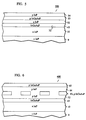
- an n-type InP monocrystalline semiconductor body (substrate) 9 there are epitaxially grown--for example, in an epitaxial reactor--an InP n-type buffer layer 10, a lattice-matched n-type InGaAsP layer 11 and an n-type InP layer 12, to form the structure 100.
- the thickness of the InP layer 12 is typically about 70 nm, while that of the InGaAsP layer 11 is about 50 nm.
- the lattice matched InGaAsP has an energy bandgap corresponding to a vacuum wavelength of between about 1.1 to 1.3 »m.
- grooves 20 (FIG. 2) is formed in the top surface, to form the structure 200.
- these grooves (apertures) 20 all run perpendicular to the plane of the drawing.
- the grooves 20 typically penetrate all the way through the layer 12, to form a (discontinuous) InP layer 22 and through the InGaAsP layer 11, to form a discontinuous InGaAsP layer 21.
- the grooves 20 penetrate all the way through the layer 11, whereby trenches (not shown) are formed in the buffer layer 10.
- the masking for etching the grooves is arranged so that about a half of the top surface of the buffer layer 10 is coated with the layer 21--i.e., to produce a duty cycle of the grating equal to about a half.
- the thickness of the binary InP layer 12 is greater than the thickness of the quaternary layer 11.
- undercutting into the layer 21 can occur, depending upon the etching technique used, as known in the art. In any event, the volume of InP remaining in the layer 22 (just after etching) is greater than the volume of the grooves in the InGaAsP layer 21 (including undercuts therein, if any, plus trenches in the buffer layer 10, if any).
- the mask is removed, and the structure 200 is then heated to form the structure 300 shown in FIG. 3. That is, the structure 200 is heated, inside the epitaxial reactor, to a sufficient temperature for a sufficient time--typically about in the approximate range of 650 to 700°C for about 5 minutes in an atmosphere of H2 and phosphine (PH3,5x10 ⁇ 4 mole fraction)--whereby a mass transport of InP (from the InP layer 22) covers all previously exposed portions of the InGaAsP layer 21. Note that as a result of the heating, the top surface of the InP layer 32 becomes smoother, while the InP of the layer 22 buries the layer 21. The dotted line 30 indicates a coming into contact of the InP of the layers 32 and 10.
- the surface of the InP layer 32 is advantageously made more nearly planar.
- more n-type InP is epitaxially grown on the top surface of the InP layer 32, to form a more nearly uniformly thick InP layer 42 for further epitaxial growth thereon.
- an undoped InGaAsP layer 43 there is epitaxially grown upon the top surface of this InP layer 42 an undoped InGaAsP layer 43.
- epitaxially grown in succession a p-type InP layer 44 and a p-type InGaAsP layer 45.
- mesas (not shown) can be etched which are filled with current-blocking layers of p- and n- semi-insulating InP.
- the entire structure then can be buried as known in the art with a relatively thick epitaxial p-type InP and a relatively thin epitaxial contact layer of p+ InGaAs (not shown).
- the laser is finished by forming electrodes (not shown) on the top and the bottom surfaces of the structure 400, as well as forming isolation between, or physically separating, neighboring laser structures being built on a single substrate, as known in the art.
- the layers 21, 42, 43, 44 and 45 respectively, can serve as grating, spacer, active, cladding, and capping layers for the laser structure 400. All the above-mentioned epitaxial growth steps can be performed, for example, by MOCVD, VPE, or LPE.
- the spacer layer 42 has a thickness of about 0.1 »m and a doping level of about 1018 cm ⁇ 3;
- the active layer 43 has a thickness of about 0.1 »m and a carrier concentration of about 1016 cm ⁇ 3;
- the cladding layer 44 has a thickness of about 0.6 »m and a doping level of about 2x1018 cm ⁇ 3;
- the capping layer 45 has a thickness of about 0.2 »m and a doping level of about 1019 cm ⁇ 3.
- the grating is fabricated above, rather than beneath, the active layer. In this way, the slight indeterminacy and/or nonuniformity in the thickness of the InP layer 42 (FIG. 4) can be avoided, if desired.
- a structure 500 is prepared including an n-type substrate 9, an n-type buffer layer 10, an n-type InGaAsP active layer 43, a 100 to 200 nm thick p-type InP spacer layer 52, a 30 to 100 nm thick p-type InGaAsP grating precursor layer 53, and a 60 to 120 nm thick p-type InP burial layer 54.
- FIGS. 5 and 6 Elements in FIGS. 5 and 6 that are the same as, or similar to, those in FIGS. 1-4 have been given the same reference numerals. All dimensions are approximate. In any event, however, the InP burial layer 54 is advantageously thicker than the grating precursor layer 53.
- grooves are etched through the burial layer 54 and the grating precursor layer 53 down to the spacer layer 52, to form an InGaAsP grating layer 63 (FIG. 6).
- the mask is removed, and the structure is heated to a temperature in the approximate range of about 650 to 700°C, whereby the InP burial layer 54 buries the InGaAsP grating layer 63 with InP.
- FIG. 6 Next (FIG. 6), more p-type InP is grown on the surface of the remains of InP burial layer, to form an InP cladding layer 64, typically about 0.8 »m thick. Then a p-type InGaAsP capping layer 65 having a thickness of typically about 0.12 »m is formed on the top surface of the cladding layer 64, to form the (preliminary) laser structure 600. To complete the laser, using silicon dioxide stripes as a mask, mesas (not shown) can be etched which are filled with current-blocking layers of p- and n- semi-insulating InP.
- the entire structure can be buried as known in the art with a relatively thick epitaxial p-type InP and a relatively thin epitaxial contact layer of p+ InGaAs (not shown). Electrode stripes (not shown) running parallel to the stripes of the grating 63 can then be deposited on top and bottom surfaces of the resulting laser structure, as known in the art.
Landscapes
- Physics & Mathematics (AREA)
- Condensed Matter Physics & Semiconductors (AREA)
- General Physics & Mathematics (AREA)
- Electromagnetism (AREA)
- Optics & Photonics (AREA)
- Semiconductor Lasers (AREA)
Claims (8)
- Verfahren zur Herstellung eines Beugungsgitters (21, 63) für eine Laservorrichtung mit verteilter Rückkopplung (300, 600) mit folgenden Schritten:
Züchten auf einer oberen Hauptfläche einer ersten Schicht (10) ersten Halbleitermaterials einer zweiten Schicht (11) zweiten Halbleitermaterials;
Züchten auf der zweiten Schicht (11) zweiten Halbleitermaterials einer dritten Schicht (12) dritten Halbleitermaterials;
Bilden einer Mehrzahl von Furchen (20), die jeweils die dritte Schicht und mindestens einen Teil der Stärke der zweiten Schicht durchdringen und sich wahlweise in die erste Schicht erstrecken, dadurch gekennzeichnet, daß
die Stärke der dritten Schicht (12) dafür ausreicht, daß nach Bildung der Furchen das Volumen des dritten Materials in der dritten Schicht (22) größer als das Volumen der Furchen (20) in der zweiten Schicht (21) zuzüglich jedes beliebigen Volumens der Furchen in der ersten Schicht (10) ist; und
die erste, zweite und dritte Schicht auf eine Temperatur angewärmt werden, die dazu ausreicht, einen Massentransport des dritten Materials der dritten Schicht zu verursachen, wodurch die gesamte Oberfläche der Furchen in der zweiten Schicht und jede Oberfläche der Furchen in der ersten Schicht im wesentlichen unter dem dritten Material vergraben wird. - Verfahren nach Anspruch 1, weiterhin dadurch gekennzeichnet, daß die dritte Schicht eine Stärke aufweist, die größer als die der zweiten Schicht ist.
- Verfahren nach Anspruch 1 oder 2, weiterhin dadurch gekennzeichnet, daß jede der Furchen die gesamte Stärke der zweiten Schicht durchdringt.
- Verfahren nach einem der vorhergehenden Ansprüche, weiterhin dadurch gekennzeichnet, daß das zweite Material im wesentlichen aus Indiumgalliumarsenidphosphid besteht.
- Verfahren nach einem der vorhergehenden Ansprüche, weiterhin dadurch gekennzeichnet, daß das dritte Material im wesentlichen aus Indiumphosphid besteht.
- Verfahren zur Herstellung eines Halbleiterlasers mit den in Anspruch 1 oder 2 angegebenen Schritten, gefolgt vom Züchten einer weiteren Schicht dritten Materials auf der Oberfläche der dritten Schicht.
- Verfahren nach Anspruch 6, wobei das dritte Material InP ist.
- Verfahren nach Anspruch 7, wobei das erste Material InP ist.
Applications Claiming Priority (2)
| Application Number | Priority Date | Filing Date | Title |
|---|---|---|---|
| US486577 | 1990-02-28 | ||
| US07/486,577 US5023198A (en) | 1990-02-28 | 1990-02-28 | Method for fabricating self-stabilized semiconductor gratings |
Publications (3)
| Publication Number | Publication Date |
|---|---|
| EP0444350A2 EP0444350A2 (de) | 1991-09-04 |
| EP0444350A3 EP0444350A3 (en) | 1992-01-29 |
| EP0444350B1 true EP0444350B1 (de) | 1995-07-05 |
Family
ID=23932429
Family Applications (1)
| Application Number | Title | Priority Date | Filing Date |
|---|---|---|---|
| EP90313661A Expired - Lifetime EP0444350B1 (de) | 1990-02-28 | 1990-12-14 | Verfahren zur Herstellung von selbststabilisierten Halbleitergittern |
Country Status (4)
| Country | Link |
|---|---|
| US (1) | US5023198A (de) |
| EP (1) | EP0444350B1 (de) |
| JP (1) | JPH04216693A (de) |
| DE (1) | DE69020717T2 (de) |
Cited By (1)
| Publication number | Priority date | Publication date | Assignee | Title |
|---|---|---|---|---|
| US20120033214A1 (en) * | 2005-09-30 | 2012-02-09 | Hiperscan Gmbh | Micro-optical Electromagnetic Radiation Diffraction Grating and Method for Manufacture |
Families Citing this family (17)
| Publication number | Priority date | Publication date | Assignee | Title |
|---|---|---|---|---|
| JPH088394B2 (ja) * | 1989-06-30 | 1996-01-29 | 三菱電機株式会社 | 半導体レーザおよびその製造方法 |
| JP2982422B2 (ja) * | 1991-09-20 | 1999-11-22 | 三菱電機株式会社 | 半導体レーザおよびその製造方法 |
| JPH05152677A (ja) * | 1991-11-28 | 1993-06-18 | Nec Corp | 半導体レーザ装置 |
| US5208824A (en) * | 1991-12-12 | 1993-05-04 | At&T Bell Laboratories | Article comprising a DFB semiconductor laser |
| JPH05267781A (ja) * | 1991-12-24 | 1993-10-15 | Samsung Electron Co Ltd | レーザダイオード及びレーザダイオードアレイの製造方法 |
| US5323266A (en) * | 1993-02-26 | 1994-06-21 | United States Of America As Represented By The Secretary Of The Air Force | Electroformed buried gratings for high-power shared aperture systems |
| US5319666A (en) * | 1993-04-07 | 1994-06-07 | At&T Bell Laboratories | Article comprising a distributed feedback laser |
| DE69406049T2 (de) * | 1993-06-04 | 1998-04-16 | Sharp Kk | Lichtmittierende Halbleitervorrichtung mit einer dritten Begrenzungsschicht |
| JP3977920B2 (ja) * | 1998-05-13 | 2007-09-19 | 富士通株式会社 | 半導体装置の製造方法 |
| US6285698B1 (en) | 1998-09-25 | 2001-09-04 | Xerox Corporation | MOCVD growth of InGaN quantum well laser structures on a grooved lower waveguiding layer |
| DE10200360B4 (de) * | 2002-01-08 | 2004-01-08 | Forschungsverbund Berlin E.V. | Verfahren zur Herstellung eines Braggschen Gitters in einer Halbleiterschichtenfolge mittels Ätzen und Halbleiterbauelement |
| JP2004119467A (ja) * | 2002-09-24 | 2004-04-15 | Mitsubishi Electric Corp | 半導体レーザ装置 |
| EP1645893A1 (de) * | 2004-10-08 | 2006-04-12 | Fraunhofer-Gesellschaft zur Förderung der angewandten Forschung e.V. | Beugungsgitter für elektromagnetische Strahlung sowie Verfahren zur Herstellung |
| JP2008288284A (ja) * | 2007-05-15 | 2008-11-27 | Sumitomo Electric Ind Ltd | 半導体光素子及びその製造方法 |
| JP5181787B2 (ja) * | 2008-04-01 | 2013-04-10 | 三菱電機株式会社 | 半導体素子の製造方法 |
| CN106410606B (zh) * | 2016-07-01 | 2018-03-06 | 苏州全磊光电有限公司 | 一种dfb激光器的外延结构及其制备方法 |
| CN113937616B (zh) * | 2021-09-26 | 2023-03-07 | 中国科学院长春光学精密机械与物理研究所 | 半导体激光器阵列、半导体激光器单管及其制备方法 |
Family Cites Families (9)
| Publication number | Priority date | Publication date | Assignee | Title |
|---|---|---|---|---|
| JPS5946083A (ja) * | 1982-09-09 | 1984-03-15 | Nippon Telegr & Teleph Corp <Ntt> | 周期構造を有する半導体レ−ザの製法 |
| JPS59127891A (ja) * | 1983-01-11 | 1984-07-23 | Nec Corp | 分布帰還型半導体レ−ザの製造方法 |
| JPS6065588A (ja) * | 1983-09-21 | 1985-04-15 | Agency Of Ind Science & Technol | 半導体レ−ザの製造方法 |
| US4786951A (en) * | 1985-02-12 | 1988-11-22 | Mitsubishi Denki Kabushiki Kaisha | Semiconductor optical element and a process for producing the same |
| JPS624386A (ja) * | 1985-07-01 | 1987-01-10 | Fujitsu Ltd | 化合物半導体装置の製造方法 |
| JPS62163385A (ja) * | 1986-01-14 | 1987-07-20 | Sony Corp | 分布帰還型半導体レ−ザの製造方法 |
| JPS62189785A (ja) * | 1986-02-17 | 1987-08-19 | Kokusai Denshin Denwa Co Ltd <Kdd> | 分布ブラツグ反射器を有する半導体装置 |
| JPH07105553B2 (ja) * | 1986-06-17 | 1995-11-13 | ソニー株式会社 | 分布帰還型半導体レーザの製造方法 |
| JPS6424279A (en) * | 1987-07-21 | 1989-01-26 | Konishiroku Photo Ind | Developing method |
-
1990
- 1990-02-28 US US07/486,577 patent/US5023198A/en not_active Expired - Lifetime
- 1990-12-14 EP EP90313661A patent/EP0444350B1/de not_active Expired - Lifetime
- 1990-12-14 DE DE69020717T patent/DE69020717T2/de not_active Expired - Lifetime
-
1991
- 1991-02-28 JP JP3033933A patent/JPH04216693A/ja active Pending
Cited By (2)
| Publication number | Priority date | Publication date | Assignee | Title |
|---|---|---|---|---|
| US20120033214A1 (en) * | 2005-09-30 | 2012-02-09 | Hiperscan Gmbh | Micro-optical Electromagnetic Radiation Diffraction Grating and Method for Manufacture |
| US10591651B2 (en) * | 2005-09-30 | 2020-03-17 | Hiperscan Gmbh | Micro-optical electromagnetic radiation diffraction grating and method for manufacture |
Also Published As
| Publication number | Publication date |
|---|---|
| JPH04216693A (ja) | 1992-08-06 |
| DE69020717D1 (de) | 1995-08-10 |
| US5023198A (en) | 1991-06-11 |
| DE69020717T2 (de) | 1996-01-04 |
| EP0444350A3 (en) | 1992-01-29 |
| EP0444350A2 (de) | 1991-09-04 |
Similar Documents
| Publication | Publication Date | Title |
|---|---|---|
| US5023198A (en) | Method for fabricating self-stabilized semiconductor gratings | |
| US5082799A (en) | Method for fabricating indium phosphide/indium gallium arsenide phosphide buried heterostructure semiconductor lasers | |
| US4099305A (en) | Fabrication of mesa devices by MBE growth over channeled substrates | |
| US5260230A (en) | Method of manufacturing buried heterostructure semiconductor laser | |
| JP2686764B2 (ja) | 光半導体素子の製造方法 | |
| EP0423535B1 (de) | Halbleiteranordnung hergestellt mittels einer epitaxialen Technik und Verfahren zur Herstellung dieser Anordnung | |
| US5065200A (en) | Geometry dependent doping and electronic devices produced thereby | |
| US5073893A (en) | Semiconductor structure and semiconductor laser device | |
| US5013684A (en) | Buried disordering sources in semiconductor structures employing photo induced evaporation enhancement during in situ epitaxial growth | |
| EP0114109B1 (de) | Halbleiterlaser-Vorrichtung und Verfahren zu deren Herstellung | |
| US4648940A (en) | Process for manufacturing a semiconductor laser having a buried ribbon | |
| EP0527615A1 (de) | Verfahren zur Herstellung eines abstimmbaren Halbleiterlasers | |
| EP0190737B1 (de) | Verfahren zur Herstellung eines Halbleiterlasers mit versenktem Heteroübergang | |
| US4149175A (en) | Solidstate light-emitting device | |
| US5311533A (en) | Index-guided laser array with select current paths defined by migration-enhanced dopant incorporation and dopant diffusion | |
| US5465266A (en) | Index-guided laser on a ridged (001) substrate | |
| US5561681A (en) | Semiconductor laser | |
| US7184640B2 (en) | Buried heterostructure device fabricated by single step MOCVD | |
| US5043291A (en) | Method of manufacturing a broadband high emission power semiconductor laser from a BRS type buried stripe structure, and resulting laser | |
| US4966863A (en) | Method for producing a semiconductor laser device | |
| US5382543A (en) | Semiconductor device manufacturing method capable of correctly forming active regions | |
| US5222091A (en) | Structure for indium phosphide/indium gallium arsenide phosphide buried heterostructure semiconductor | |
| JPH05110186A (ja) | モノリシツク光素子およびその製造方法 | |
| US4737237A (en) | Process for producing a buried strip semiconductor laser with or without a defractive network | |
| JPH05299764A (ja) | 半導体レーザの製造方法 |
Legal Events
| Date | Code | Title | Description |
|---|---|---|---|
| PUAI | Public reference made under article 153(3) epc to a published international application that has entered the european phase |
Free format text: ORIGINAL CODE: 0009012 |
|
| AK | Designated contracting states |
Kind code of ref document: A2 Designated state(s): DE FR GB IT |
|
| PUAL | Search report despatched |
Free format text: ORIGINAL CODE: 0009013 |
|
| AK | Designated contracting states |
Kind code of ref document: A3 Designated state(s): DE FR GB IT |
|
| 17P | Request for examination filed |
Effective date: 19920715 |
|
| 17Q | First examination report despatched |
Effective date: 19940224 |
|
| RAP3 | Party data changed (applicant data changed or rights of an application transferred) |
Owner name: AT&T CORP. |
|
| GRAA | (expected) grant |
Free format text: ORIGINAL CODE: 0009210 |
|
| AK | Designated contracting states |
Kind code of ref document: B1 Designated state(s): DE FR GB IT |
|
| ITF | It: translation for a ep patent filed | ||
| ET | Fr: translation filed | ||
| REF | Corresponds to: |
Ref document number: 69020717 Country of ref document: DE Date of ref document: 19950810 |
|
| PLBE | No opposition filed within time limit |
Free format text: ORIGINAL CODE: 0009261 |
|
| STAA | Information on the status of an ep patent application or granted ep patent |
Free format text: STATUS: NO OPPOSITION FILED WITHIN TIME LIMIT |
|
| 26N | No opposition filed | ||
| REG | Reference to a national code |
Ref country code: GB Ref legal event code: IF02 |
|
| PGFP | Annual fee paid to national office [announced via postgrant information from national office to epo] |
Ref country code: IT Payment date: 20091223 Year of fee payment: 20 Ref country code: GB Payment date: 20091218 Year of fee payment: 20 Ref country code: FR Payment date: 20100108 Year of fee payment: 20 |
|
| PGFP | Annual fee paid to national office [announced via postgrant information from national office to epo] |
Ref country code: DE Payment date: 20091222 Year of fee payment: 20 |
|
| REG | Reference to a national code |
Ref country code: GB Ref legal event code: PE20 Expiry date: 20101213 |
|
| PG25 | Lapsed in a contracting state [announced via postgrant information from national office to epo] |
Ref country code: GB Free format text: LAPSE BECAUSE OF EXPIRATION OF PROTECTION Effective date: 20101213 |
|
| PG25 | Lapsed in a contracting state [announced via postgrant information from national office to epo] |
Ref country code: DE Free format text: LAPSE BECAUSE OF EXPIRATION OF PROTECTION Effective date: 20101214 |