EP0444504B1 - Verfahren zur Verwertung mindestens von Bestandteiles eines bei einer Verbrennung entstehenden Rauchgases - Google Patents
Verfahren zur Verwertung mindestens von Bestandteiles eines bei einer Verbrennung entstehenden Rauchgases Download PDFInfo
- Publication number
- EP0444504B1 EP0444504B1 EP91102376A EP91102376A EP0444504B1 EP 0444504 B1 EP0444504 B1 EP 0444504B1 EP 91102376 A EP91102376 A EP 91102376A EP 91102376 A EP91102376 A EP 91102376A EP 0444504 B1 EP0444504 B1 EP 0444504B1
- Authority
- EP
- European Patent Office
- Prior art keywords
- waste
- hydrocarbons
- gas
- gases
- oxygen
- Prior art date
- Legal status (The legal status is an assumption and is not a legal conclusion. Google has not performed a legal analysis and makes no representation as to the accuracy of the status listed.)
- Expired - Lifetime
Links
- 238000000034 method Methods 0.000 title claims description 18
- 239000003546 flue gas Substances 0.000 title claims description 16
- UGFAIRIUMAVXCW-UHFFFAOYSA-N Carbon monoxide Chemical compound [O+]#[C-] UGFAIRIUMAVXCW-UHFFFAOYSA-N 0.000 title claims description 14
- CURLTUGMZLYLDI-UHFFFAOYSA-N Carbon dioxide Chemical compound O=C=O CURLTUGMZLYLDI-UHFFFAOYSA-N 0.000 claims description 40
- 150000002430 hydrocarbons Chemical class 0.000 claims description 33
- 229930195733 hydrocarbon Natural products 0.000 claims description 32
- 239000007789 gas Substances 0.000 claims description 27
- XLYOFNOQVPJJNP-UHFFFAOYSA-N water Substances O XLYOFNOQVPJJNP-UHFFFAOYSA-N 0.000 claims description 22
- 229910002092 carbon dioxide Inorganic materials 0.000 claims description 20
- 239000002699 waste material Substances 0.000 claims description 20
- QVGXLLKOCUKJST-UHFFFAOYSA-N atomic oxygen Chemical compound [O] QVGXLLKOCUKJST-UHFFFAOYSA-N 0.000 claims description 16
- 239000001301 oxygen Substances 0.000 claims description 16
- 229910052760 oxygen Inorganic materials 0.000 claims description 16
- 238000002485 combustion reaction Methods 0.000 claims description 13
- 239000001569 carbon dioxide Substances 0.000 claims description 11
- 239000000126 substance Substances 0.000 claims description 11
- 239000004215 Carbon black (E152) Substances 0.000 claims description 9
- OKTJSMMVPCPJKN-UHFFFAOYSA-N Carbon Chemical compound [C] OKTJSMMVPCPJKN-UHFFFAOYSA-N 0.000 claims description 7
- 229910052799 carbon Inorganic materials 0.000 claims description 7
- 239000000203 mixture Substances 0.000 claims description 5
- 239000001257 hydrogen Substances 0.000 claims description 4
- 229910052739 hydrogen Inorganic materials 0.000 claims description 4
- 239000007788 liquid Substances 0.000 claims description 3
- 239000000463 material Substances 0.000 claims description 3
- 238000000354 decomposition reaction Methods 0.000 claims description 2
- 238000005984 hydrogenation reaction Methods 0.000 claims description 2
- VUZPPFZMUPKLLV-UHFFFAOYSA-N methane;hydrate Chemical compound C.O VUZPPFZMUPKLLV-UHFFFAOYSA-N 0.000 claims description 2
- 239000002910 solid waste Substances 0.000 claims description 2
- 239000002904 solvent Substances 0.000 claims description 2
- CREMABGTGYGIQB-UHFFFAOYSA-N carbon carbon Chemical compound C.C CREMABGTGYGIQB-UHFFFAOYSA-N 0.000 claims 1
- 239000011203 carbon fibre reinforced carbon Substances 0.000 claims 1
- 239000000567 combustion gas Substances 0.000 claims 1
- 230000007812 deficiency Effects 0.000 claims 1
- 125000004435 hydrogen atom Chemical class [H]* 0.000 claims 1
- 239000004033 plastic Substances 0.000 claims 1
- 229920003023 plastic Polymers 0.000 claims 1
- 239000010913 used oil Substances 0.000 claims 1
- -1 wherein gaseous Substances 0.000 claims 1
- 238000003786 synthesis reaction Methods 0.000 description 11
- 230000015572 biosynthetic process Effects 0.000 description 10
- 229960004424 carbon dioxide Drugs 0.000 description 10
- IJGRMHOSHXDMSA-UHFFFAOYSA-N Atomic nitrogen Chemical compound N#N IJGRMHOSHXDMSA-UHFFFAOYSA-N 0.000 description 6
- OKKJLVBELUTLKV-UHFFFAOYSA-N Methanol Chemical compound OC OKKJLVBELUTLKV-UHFFFAOYSA-N 0.000 description 4
- 229910002091 carbon monoxide Inorganic materials 0.000 description 4
- 239000003054 catalyst Substances 0.000 description 4
- VNWKTOKETHGBQD-UHFFFAOYSA-N methane Chemical compound C VNWKTOKETHGBQD-UHFFFAOYSA-N 0.000 description 4
- 239000002918 waste heat Substances 0.000 description 4
- UFHFLCQGNIYNRP-UHFFFAOYSA-N Hydrogen Chemical compound [H][H] UFHFLCQGNIYNRP-UHFFFAOYSA-N 0.000 description 3
- 239000010808 liquid waste Substances 0.000 description 3
- 238000004519 manufacturing process Methods 0.000 description 3
- 229910052757 nitrogen Inorganic materials 0.000 description 3
- 239000013502 plastic waste Substances 0.000 description 3
- 229910002090 carbon oxide Inorganic materials 0.000 description 2
- 238000004140 cleaning Methods 0.000 description 2
- 239000003344 environmental pollutant Substances 0.000 description 2
- 239000003921 oil Substances 0.000 description 2
- 231100000719 pollutant Toxicity 0.000 description 2
- 238000004056 waste incineration Methods 0.000 description 2
- 241000196324 Embryophyta Species 0.000 description 1
- LFQSCWFLJHTTHZ-UHFFFAOYSA-N Ethanol Chemical compound CCO LFQSCWFLJHTTHZ-UHFFFAOYSA-N 0.000 description 1
- 240000004064 Poterium sanguisorba Species 0.000 description 1
- 239000004809 Teflon Substances 0.000 description 1
- 229920006362 Teflon® Polymers 0.000 description 1
- 238000009903 catalytic hydrogenation reaction Methods 0.000 description 1
- 238000006243 chemical reaction Methods 0.000 description 1
- 239000003638 chemical reducing agent Substances 0.000 description 1
- 238000001816 cooling Methods 0.000 description 1
- 230000006735 deficit Effects 0.000 description 1
- 239000010791 domestic waste Substances 0.000 description 1
- 230000000694 effects Effects 0.000 description 1
- 235000019441 ethanol Nutrition 0.000 description 1
- 239000004744 fabric Substances 0.000 description 1
- 230000002349 favourable effect Effects 0.000 description 1
- 239000000446 fuel Substances 0.000 description 1
- 239000002737 fuel gas Substances 0.000 description 1
- 239000010795 gaseous waste Substances 0.000 description 1
- 239000003502 gasoline Substances 0.000 description 1
- 238000002156 mixing Methods 0.000 description 1
- 230000004048 modification Effects 0.000 description 1
- 238000012986 modification Methods 0.000 description 1
- 239000010813 municipal solid waste Substances 0.000 description 1
- 229920000098 polyolefin Polymers 0.000 description 1
- 239000002994 raw material Substances 0.000 description 1
- 238000000926 separation method Methods 0.000 description 1
- 239000007787 solid Substances 0.000 description 1
- 238000005507 spraying Methods 0.000 description 1
Images
Classifications
-
- C—CHEMISTRY; METALLURGY
- C07—ORGANIC CHEMISTRY
- C07C—ACYCLIC OR CARBOCYCLIC COMPOUNDS
- C07C1/00—Preparation of hydrocarbons from one or more compounds, none of them being a hydrocarbon
- C07C1/02—Preparation of hydrocarbons from one or more compounds, none of them being a hydrocarbon from oxides of a carbon
-
- B—PERFORMING OPERATIONS; TRANSPORTING
- B01—PHYSICAL OR CHEMICAL PROCESSES OR APPARATUS IN GENERAL
- B01D—SEPARATION
- B01D53/00—Separation of gases or vapours; Recovering vapours of volatile solvents from gases; Chemical or biological purification of waste gases, e.g. engine exhaust gases, smoke, fumes, flue gases, aerosols
- B01D53/34—Chemical or biological purification of waste gases
- B01D53/46—Removing components of defined structure
- B01D53/72—Organic compounds not provided for in groups B01D53/48 - B01D53/70, e.g. hydrocarbons
-
- C—CHEMISTRY; METALLURGY
- C07—ORGANIC CHEMISTRY
- C07C—ACYCLIC OR CARBOCYCLIC COMPOUNDS
- C07C1/00—Preparation of hydrocarbons from one or more compounds, none of them being a hydrocarbon
- C07C1/02—Preparation of hydrocarbons from one or more compounds, none of them being a hydrocarbon from oxides of a carbon
- C07C1/10—Preparation of hydrocarbons from one or more compounds, none of them being a hydrocarbon from oxides of a carbon from carbon monoxide with water vapour
-
- C—CHEMISTRY; METALLURGY
- C07—ORGANIC CHEMISTRY
- C07C—ACYCLIC OR CARBOCYCLIC COMPOUNDS
- C07C273/00—Preparation of urea or its derivatives, i.e. compounds containing any of the groups, the nitrogen atoms not being part of nitro or nitroso groups
- C07C273/02—Preparation of urea or its derivatives, i.e. compounds containing any of the groups, the nitrogen atoms not being part of nitro or nitroso groups of urea, its salts, complexes or addition compounds
- C07C273/04—Preparation of urea or its derivatives, i.e. compounds containing any of the groups, the nitrogen atoms not being part of nitro or nitroso groups of urea, its salts, complexes or addition compounds from carbon dioxide and ammonia
-
- Y—GENERAL TAGGING OF NEW TECHNOLOGICAL DEVELOPMENTS; GENERAL TAGGING OF CROSS-SECTIONAL TECHNOLOGIES SPANNING OVER SEVERAL SECTIONS OF THE IPC; TECHNICAL SUBJECTS COVERED BY FORMER USPC CROSS-REFERENCE ART COLLECTIONS [XRACs] AND DIGESTS
- Y02—TECHNOLOGIES OR APPLICATIONS FOR MITIGATION OR ADAPTATION AGAINST CLIMATE CHANGE
- Y02P—CLIMATE CHANGE MITIGATION TECHNOLOGIES IN THE PRODUCTION OR PROCESSING OF GOODS
- Y02P20/00—Technologies relating to chemical industry
- Y02P20/141—Feedstock
Definitions
- Waste includes household waste, special waste, shredded goods and the like.
- the waste is burned with oxygen in a suitable furnace, the exhaust gases are cooled in a waste heat boiler and then largely freed of pollutants in a suitable gas cleaning system.
- This combustion process creates flue gas, and existing hydrocarbons are mainly burned to carbon dioxide and water and released into the environment. Since the nitrogen ballast that is present when burning with air is missing, the combustion exhaust gases have only low nitrogen contents, depending on the nitrogen content in the waste to be incinerated. Carbon dioxide is a very undesirable combustion product these days because it contributes to the so-called "greenhouse effect".
- EP-A-0 079 207 "Process for the production of hydrocarbons and oxygenated derivatives thereof by the catalytic hydrogenation of carbondioxide" shows: m CO2 + n H2 ⁇ o CH4 + p CH3OH + q CO While so-called synthesis gases specially produced for the synthesis of hydrocarbons have been used, but syntheses with top gases and water gas have also been carried out, it has been proposed for the first time with DE-A 35 25 479 that CO2 formed from the combustion of gases at a high temperature Converting methane and water vapor into a gas consisting mainly of CO and H2, which is suitable as a synthesis gas for a wide variety of synthesis products. Based on this prior art, the invention has for its object to propose a method of the type described above, with the cheap raw material sources for the production of hydrocarbons can be tapped, the process should be largely emission-free, so that in particular avoided carbon dioxide emissions becomes.
- hydrocarbon-containing and / or carbon-containing substances are burned with high-percentage oxygen and the carbon dioxide and / or carbon monoxide and steam gases which are produced during the combustion are used for the synthesis of hydrocarbons.
- the primary fuel namely carbon or hydrocarbonaceous materials, such as. B. garbage, shredder debris, special waste and the like.
- the primary fuel namely carbon or hydrocarbonaceous materials, such as. B. garbage, shredder debris, special waste and the like.
- Are burned with oxygen-containing gases, and the resulting carbon oxides and possibly water vapor can be converted in various ways into hydrocarbons of different compositions.
- a reduction of the CO2 contained in the flue gas and possibly also the H2O is carried out by injecting gaseous, liquid, granulated or crushed solid waste hydrocarbons, such as. B.
- the flue gases from waste incineration with oxygen mainly contain carbon dioxide and water vapor.
- certain CO contents can be set in the flue gas.
- Another possibility according to the invention of generating CO in the exhaust gas is to first carry out a complete combustion of the waste with oxygen to carbon dioxide and water vapor and then to reduce the carbon dioxide to carbon monoxide by spraying liquid waste hydrocarbons into the hot exhaust gas.
- Water can also be injected into the hot gas and converted into steam.
- Ratio of H2O CO a ratio of 1.0 - 1.5: 3. If you pass this gas mixture at normal pressure or elevated pressure at temperatures of 220 - 300 ° C over suitable catalysts, hydrocarbons of various compositions are formed. With the help of oxygen, they can also be converted into hydrocarbon derivatives.
- a synthesis gas By injecting liquid waste hydrocarbons and water into the hot flue gas, a synthesis gas can be generated, which mainly consists of CO and H2: C3H8 + 3 H2O ⁇ 3 CO + 7 H2 C3H8 + 3 CO2 ⁇ 6 CO + 4 H2
- the hydrogen required for this can be obtained by the decomposition of water, the resulting oxygen can be used immediately for the combustion of the carbon and / or hydrocarbonaceous substances.
- the energy for water separation is advantageously obtained from the combustion of the carbon and / or hydrocarbonaceous substances themselves.
- granular or pulverized waste hydrocarbons such as plastic waste in any combination
- hydrocarbon-containing, liquid, gaseous or granular waste materials such as. B. PCB-containing waste oil or the like.
- solid hydrocarbon-containing waste materials such as. B. polyolefins
- the flue gases leave the incinerator at a temperature above 1,200 ° C, pass through a waste heat boiler and, after cooling to approx. 300 ° C, are used in a gas cleaning system, e.g. B. a high temperature fabric filter made of Teflon, dedusted. Then they are in a conventional and known synthesis device, which is equipped with appropriate catalysts, in the desired hydrocarbons or oxygen-containing hydrocarbon derivatives converted.
- FIG. 1 An example of variant 1 is shown in FIG. 1
- This variant is a modification of variant 1 insofar as only CO2 is reduced to CO by injecting liquid waste hydrocarbons. At the same time, so much water is injected into the hot gases before or after the waste heat boiler that the known optimal ratio CO to H2O is set depending on the desired hydrocarbon compound.
Landscapes
- Chemical & Material Sciences (AREA)
- Organic Chemistry (AREA)
- Engineering & Computer Science (AREA)
- Chemical Kinetics & Catalysis (AREA)
- General Chemical & Material Sciences (AREA)
- Oil, Petroleum & Natural Gas (AREA)
- Health & Medical Sciences (AREA)
- Biomedical Technology (AREA)
- Environmental & Geological Engineering (AREA)
- Analytical Chemistry (AREA)
- Treating Waste Gases (AREA)
- Exhaust Gas Treatment By Means Of Catalyst (AREA)
Description
- In der WO-A-8903241 "Verfahren zur Beseitigung von Abfällen durch Verbrennen mit Sauerstoff" ist ein Verfahren beschrieben worden, bei dem Abfälle anstatt mit Verbrennungsluft mit hochprozentigem Sauerstoff verbrannt werden. Unter Abfällen sind dort u. a. Hausmüll, Sonderabfälle, Shreddergut und dgl. erwähnt worden. Die Abfälle werden in einem geeigneten Ofen mit Sauerstoff verbrannt, die Abgase in einem Abhitzekessel abgekühlt und dann in einer geeigneten Gasreinigungsanlage von Schadstoffen weitgehend befreit. Bei diesem Verbrennungsvorgang entsteht Rauchgas, und es werden vorhandene Kohlenwasserstoffe hauptsächlich zu Kohlendioxid und Wasser verbrannt und in die Umwelt entlassen. Da der Stickstoffbalast, der beim Verbrennen mit Luft vorhanden ist, fehlt, haben die Verbrennungsabgase nur geringe Stickstoff-Gehalte in Abhängigkeit vom Stickstoffgehalt in den zu verbrennenden Abfällen.
Kohlendioxid ist heutzutage ein sehr unerwünschtes Verbrennungsprodukt, da es zum sogenannten "Treibhauseffekt" beiträgt.
Aus der Literatur und der Praxis sind viele Verfahren bekannt, bei denen Kohlenoxide zu Kohlenwasserstoffen unterschiedlichster Zusammensetzung unter Verwendung geeigneter Katalysatoren hydriert werden.
Es seien hier z. B. Fischer-Tropsch Benzinsynthese
n CO + 2 n H₂ ⇄ H - (CH₂)n - H
oder die Methanol-Synthese
CO + 2 H₂ ⇄ CH₃ OH
erwähnt.
Auch Kohlenmonoxid und Wasserdampf lassen sich bei geeigneten Mischungsverhältnissen und bestimmten Katalysatoren in verschiedene Kohlenwasserstoffe umwandeln, wie Herr Kölbel und Frau Engelhardt nachgewiesen haben:
m CO + n H₂O ⇄ o CH₂ + p C₂H₅OH + q CO₂
Die Hydrierung von Kohlenmonoxid mit Wasserstoff ist ebenfalls möglich, wie z. B. die EP-A-0 079 207 "Process for the production of hydrocarbons and oxygenated derivatives thereof by the catalytic hydrogenation of carbondioxide" zeigt:
m CO₂ + n H₂ ⇄ o CH₄ + p CH₃OH + q CO
Während bisher für die Synthesen von Kohlenwasserstoffen eigens dafür hergestellte sogenannte Synthesegase verwendet wurden, aber auch schon Synthesen mit Gichtgasen und Wassergas durchgeführt wurden, ist erstmalig mit der DE-A 35 25 479 vorgeschlagen worden, aus der Verbrennung von Gasen entstandenes CO₂ bei hoher Temperatur mit Methan und Wasserdampf in ein hauptsächlich aus CO und H₂ bestehendes Gas umzuwandeln, das als Synthesegas für verschiedenste Synthese-Produkte geeignet ist.
Ausgehend von diesem Stand der Technik, liegt der Erfindung die Aufgabe zugrunde, ein Verfahren der eingangs beschriebenen Art vorzuschlagen, mit dem billige Rohstoffquellen für die Gewinnung von Kohlenwasserstoffen erschlossen werden können, wobei das Verfahren weitgehend emissionsfrei durchführbar sein soll, so daß insbesondere die Kohlendioxidemission vermieden wird. - Diese Aufgabe ist erfindungsgemäß dadurch gelöst, daß kohlenwasserstoffhaltige und/oder kohlenstoffhaltige Stoffe mit hochprozentigem Sauerstoff verbrannt und die bei der Verbrennung anfallenden Kohlendioxid und/oder Kohlenmonoxid sowie Wasserdampf enthaltenden Rauchgase zur Synthese von Kohlenwasserstoffen benutzt werden. Es kann somit in dem hier vorgeschlagenen Verfahren der primäre Brennstoff, nämlich kohlenstoff- bzw. kohlenwasserstoffhaltige Materialien, wie z. B. Müll, Shredderschutt, Sonderabfälle und dgl., mit sauerstoffhaltigen Gasen verbrannt werden, und es können die dabei anfallenden, im Rauchgas enthaltenen Kohlenoxide und ggf. Wasserdampf auf verschiedenste Art und Weise in Kohlenwasserstoffe verschiedener Zusammensetzung umgewandelt werden. Eine Reduktion des im Rauchgas enthaltenen CO₂ und ggf. auch des H₂O erfolgt durch Eindüsen von gasförmigen, flüssigen, granulierten oder zerkleinerten festen Abfall-Kohlenwasserstoffen, wie z. B. Altöl, Lösungsmitteln oder Kunststoffabfällen. Eine Kohlendioxidemission wird so vermieden.
Normalerweise enthalten die Rauchgase der Abfallverbrennung mit Sauerstoff - wie bereits oben erwähnt - hauptsächlich Kohlendioxid und Wasserdampf. Verbrennt man jedoch, wie nach der Erfindung weiter vorgeschlagen, mit einem Sauerstoff-Unterschuß, lassen sich bestimmte CO-Gehalte im Rauchgas einstellen. - Eine andere, nach der Erfindung noch vorgeschlagene Möglichkeit der Erzeugung von CO im Abgas besteht darin, erst eine vollständige Verbrennung der Abfälle mit Sauerstoff zu Kohlendioxid und Wasserdampf durchzuführen und dann in das heiße Abgas durch Eindüsen flüssiger Abfall-Kohlenwasserstoffe das Kohlendioxid zu Kohlenmonoxid zu reduzieren. Es kann weiter zusätzlich Wasser in das heiße Gas eingedüst und in Dampf umgewandelt werden. Hierbei ist ein besonders günstiges Verhältnis von H₂O : CO ein Verhältnis von 1,0 - 1,5:3. Leitet man dieses Gasgemisch bei Normaldruck oder erhöhtem Druck bei Temperaturen von 220 - 300 °C über geeignete Katalysatoren, so entstehen Kohlenwasserstoffe unterschiedlichster Zusammensetzung. Mit Hilfe von Sauerstoff können sie auch in Kohlenwasserstoffderivate umgewandelt werden.
Durch Eindüsen von flüssigen Abfall-Kohlenwasserstoffen und Wasser in das heiße Rauchgas kann ein Synthesegas erzeugt werden, das hauptsächlich aus CO und H₂ besteht:
C₃H₈ + 3 H₂O ⇄ 3 CO + 7 H₂
C₃H₈ + 3 CO₂ ⇄ 6 CO + 4 H₂
Je größer das Verhältnis Wasserstoff zu Kohlenstoff in den Abfall-Kohlenwasserstoffen ist, umso günstiger ist das Verhältnis des aus der Müllverbrennung stammenden CO₂ zu dem benötigten Abfall-Kohlenwasserstoff.
Man kann jedoch auch die CO₂-haltigen Rauchgase unmittelbar mit H₂ hydrieren. Der hierfür benötigte Wasserstoff kann durch die Zerlegung von Wasser gewonnen werden, wobei der dabei anfallende Sauerstoff sofort zur Verbrennung der kohlenstoff- und/oder kohlenwasserstoffhaltigen Stoffe verwendet werden kann. Die Energie zur Wasserzerlegung gewinnt man vorteilhafterweise aus der Verbrennung der kohlenstoff- und/oder kohlenwasserstoffhaltigen Stoffe selbst. Vorteilhafterweise können als Reduktionsmittel neben gasförmigen Abfall-Kohlenwasserstoffen insbesondere auch granulierte oder pulverisierte Abfall-Kohlenwasserstoffe, wie Kunststoffabfälle in beliebiger Kombination, verwendet werden. Dies ist möglich, weil diese Kunststoffabfälle bei z. B. 1000 °C in 0,5 Sek. rückstandsfrei vergasen.
Auch weitere Verwertungen oder Anwendungen der beschriebenen Rauchgase sind denkbar. So wird z. B. nach der Erfindung vorgeschlagen, die bei der Verbrennung von kohlenwasserstoffhaltigen und/oder kohlenstoffhaltigen Stoffen entstehenden Rauchgase in bestehenden Anlagen zur Erzeugung von Synthesegas, Brenngas, Reduktionsgas oder anderen verwertbaren Gasen mindestens zusätzlich zu den dort bisher verwendeten Stoffen einzubringen. Diese Maßnahme kann vor oder nach der Reduktion erfolgen, und es gelingt hierdurch, zusätzliche Kohlendioxidemissionen und sonstige Schadstoffemissionen zu vermeiden, und es können mit dieser Maßnahme die dort bisher verwendeten Stoffe teilweise oder auch vollständig ersetzt werden. - Das erfindungsgemäße Verfahren wird wie folgt beschrieben:
- Die Verbrennung der genannten Stoffe mit Sauerstoff erfolgt in bekannter Weise. In die heißen Rauchgase werden kohlenwasserstoffhaltige, flüssige, gasförmige oder granulierte Abfallstoffe, wie z. B. PCB-haltiges Abfallöl oder dgl., oder feste kohlenwasserstoffhaltige Abfallstoffe, wie z. B. Polyolefine, vor dem Abhitzekessel eingebracht. Dadurch erfolgt eine Umwandlung
CO₂ + H₂O + KW ⇄ CO + H₂
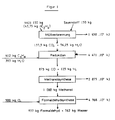
Die Rauchgase verlassen den Verbrennungsofen mit einer Temperatur über 1 200 °C, passieren einen Abhitzekessel und werden nach Abkühlung auf ca. 300 °C in einer Gasreinigungsanlage, z. B. einem Hochtemperatur-Gewebefilter aus Teflon, entstaubt. Anschließend werden sie in einer üblichen und bekannten Synthese-Vorrichtung, die mit entsprechenden Katalysatoren ausgestattet ist, in die gewünschten Kohlenwasserstoffe oder sauerstoffhaltigen Kohlenwasserstoff-Derivate umgewandelt. - In der Figur 1 ist ein Beispiel für die Variante 1 dargestellt.
- Diese Variante ist eine Abwandlung der Variante 1 insoweit, als nur CO₂ durch Eindüsen von flüssigen Abfall-Kohlenwasserstoffen zu CO reduziert wird. Gleichzeitig wird in die heißen Gase vor oder nach dem Abhitzekessel soviel Wasser eingespritzt, daß das bekannte optimale Verhältnis CO zu H₂O je nach gewünschter Kohlenwasserstoffverbindung eingestellt wird.
Claims (9)
- Verfahren zur Verwertung der bei der Verbrennung von kohlenwasserstoffhaltigen und/oder kohlenstoffhaltigen Stoffen mit hochprozentigem Sauerstoff entstehenden Rauchgase, wobei in das Rauchgas gasförmige, flüssige oder granulierte oder zerkleinerte feste Abfall-Kohlenwasserstoffe zur Reduktion von im Rauchgas enthaltenen Kohlendioxid und Wasserdampf eingedüst werden und die dabei entstehenden Gase einer Umwandlung in Kohlenwasserstoffe zugeführt werden.
- Verfahren nach Anspruch 1 dadurch gekennzeichnet, daß
es sich bei den zur Verbrennung gelangenden Stoffen um Abfälle, insbesondere Müll, Sondermüll oder Shreddergut, handelt. - Verfahren nach den Ansprüchen 1 und 2
dadurch gekennzeichnet, daß
es sich bei den Abfall-Kohlenwasserstoffen um Altöl, Lösungsmittel oder Kunststoffabfälle handelt. - Verfahren nach den Ansprüchen 1 bis 3
dadurch gekennzeichnet, daß
die Verbrennung mit hochprozentigem Sauerstoff mit einem Sauerstoffunterschuß durchgeführt wird. - Verfahren nach den Ansprüchen 1 bis 4
dadurch gekennzeichnet, daß
die entstehenden Gase vor einer Umwandlung in Kohlenwasserstoffe abgekühlt und gereinigt werden. - Verfahren nach den Ansprüchen 1 bis 5
dadurch gekennzeichnet, daß
in das heiße Rauchgas Abfall-Kohlenwasserstoffe und Wasser eingedüst werden, woraufhin dieses Gasgemisch vor der Weiterverwendung abgekühlt und gereinigt wird. - Verfahren nach Anspruch 6 dadurch gekennzeichnet, daß
Abfall-Kohlenwasserstoffe und Wasser in einer Menge eingedüst werden, daß sich ein H₂O : CO-Verhältnis von 1,0 - 1,5 : 3 einstellt. - Verfahren nach einem der Ansprüche 1 bis 7
dadurch gekennzeichnet, daß
die behandelten Rauchgase in bestehende Anlagen zur Erzeugung von Synthesegas, Brenngas, Reduktionsgas oder anderen verwertbaren Gasen mindestens zusätzlich zu den dort bisher verwendeten Stoffen eingebracht werden. - Verfahren nach den Ansprüchen 1 bis 8
dadurch gekennzeichnet, daß
der zur Hydrierung benötigte Wasserstoff durch die Zerlegung von Wasser gewonnen und der dabei anfallende Sauerstoff für die Verbrennung der kohlenstoff- und/oder kohlenwasserstoffhaltigen Stoffe verwendet wird.
Applications Claiming Priority (6)
| Application Number | Priority Date | Filing Date | Title |
|---|---|---|---|
| DE4006104A DE4006104A1 (de) | 1990-02-27 | 1990-02-27 | Verfahren zur verwertung der beim verbrennen von kohlenwasserstoffhaltigen abfaellen mit sauerstoff anfallenden kohlenoxide |
| DE4006104 | 1990-02-27 | ||
| DE4026201 | 1990-08-18 | ||
| DE4026201A DE4026201A1 (de) | 1990-08-18 | 1990-08-18 | Verfahren zum umwandeln von kohlenmonoxid, kohlendioxid und wasser aus rauchgasen in kohlenwasserstoffe |
| DE4038905A DE4038905A1 (de) | 1990-08-18 | 1990-12-06 | Verfahren zum umwandeln von kohlenmonoxid, kohlendioxid und wasser aus rauchgasen in kohlenwasserstoffe |
| DE4038905 | 1990-12-06 |
Publications (3)
| Publication Number | Publication Date |
|---|---|
| EP0444504A2 EP0444504A2 (de) | 1991-09-04 |
| EP0444504A3 EP0444504A3 (en) | 1991-10-23 |
| EP0444504B1 true EP0444504B1 (de) | 1995-04-05 |
Family
ID=27200911
Family Applications (1)
| Application Number | Title | Priority Date | Filing Date |
|---|---|---|---|
| EP91102376A Expired - Lifetime EP0444504B1 (de) | 1990-02-27 | 1991-02-20 | Verfahren zur Verwertung mindestens von Bestandteiles eines bei einer Verbrennung entstehenden Rauchgases |
Country Status (2)
| Country | Link |
|---|---|
| EP (1) | EP0444504B1 (de) |
| DE (1) | DE59105068D1 (de) |
Citations (1)
| Publication number | Priority date | Publication date | Assignee | Title |
|---|---|---|---|---|
| WO1989003241A1 (fr) * | 1987-10-16 | 1989-04-20 | Reinhard Fischer | Procede d'elimination de dechets par combustion enrichie avec de l'oxygene |
Family Cites Families (6)
| Publication number | Priority date | Publication date | Assignee | Title |
|---|---|---|---|---|
| US3660023A (en) * | 1970-02-02 | 1972-05-02 | Dow Chemical Co | Process for recovering carbon dioxide from stack gas |
| EP0079207A1 (de) * | 1981-11-07 | 1983-05-18 | The British Petroleum Company p.l.c. | Verfahren zur Herstellung von Kohlenwasserstoffen und deren Sauerstoff enthaltenden Derivaten durch katalytische Hydrierung von Kohlendioxyd |
| BR8203296A (pt) * | 1982-06-04 | 1984-01-10 | Tecnolumen Engenharia Ltda | Processo para aproveitamento de residuos organicos e hidrogenio proveniente de eletrolise d'agua,com producao de gases de composicao e poder calorifico controlados |
| FR2557555B1 (fr) * | 1983-12-30 | 1987-05-15 | Inst Francais Du Petrole | Nouveau procede de fabrication de gaz de synthese utilisable notamment pour la production de methanol |
| GB8426344D0 (en) * | 1984-10-18 | 1984-11-21 | British Petroleum Co Plc | Conversion process |
| DE3525479A1 (de) * | 1985-07-17 | 1987-01-29 | Josef Hubert Schick | Verfahren zum erzeugen von waermeenergie durch verbrennen einer kohlenwasserstoffverbindung und gleichzeitiger wiedergewinnung des in dieser enthaltenen kohlenstoffs |
-
1991
- 1991-02-20 DE DE59105068T patent/DE59105068D1/de not_active Expired - Fee Related
- 1991-02-20 EP EP91102376A patent/EP0444504B1/de not_active Expired - Lifetime
Patent Citations (1)
| Publication number | Priority date | Publication date | Assignee | Title |
|---|---|---|---|---|
| WO1989003241A1 (fr) * | 1987-10-16 | 1989-04-20 | Reinhard Fischer | Procede d'elimination de dechets par combustion enrichie avec de l'oxygene |
Also Published As
| Publication number | Publication date |
|---|---|
| EP0444504A2 (de) | 1991-09-04 |
| DE59105068D1 (de) | 1995-05-11 |
| EP0444504A3 (en) | 1991-10-23 |
Similar Documents
| Publication | Publication Date | Title |
|---|---|---|
| EP0563777B1 (de) | Verfahren zur Herstellung von Synthesegas durch thermische Behandlung von metallische und organische Bestandteile enthaltenden Reststoffen | |
| DE4109231C2 (de) | Verfahren zur Verwertung halogenbelasteter kohlenstoffhaltiger Abfallstoffe | |
| DE4231771A1 (de) | Verfahren zur Verstromung von Kunststoffabfällen | |
| DE3133562C2 (de) | Verfahren zur Herstellung flüssiger Kohlenwasserstoffe durch katalytische Hydrierung von Kohle in Gegenwart von Wasser | |
| DE102008032166A1 (de) | Verfahren und Vorrichtung zur Herstellung von teerfreiem Synthesgas aus Biomasse | |
| DE102008047201B4 (de) | Verfahren und Vorrichtung zur Produktion von Synthesegas und zum Betreiben eines Verbrennungsmotors damit | |
| DE4336580A1 (de) | Verfahren zur Aufarbeitung von kommunalem Kunststoffabfall | |
| DE10393892T5 (de) | Verwendung eines chemischen Lösungsmittels zum Abtrennen von Co2 aus einem H2S-reichen Strom | |
| DE2825429A1 (de) | Verfahren zur pyrolyse von muell | |
| DE3124672A1 (de) | Verfahren zur herstellung von calciumcarbid | |
| EP2148135B1 (de) | Verfahren und Vorrichtung zur thermischen Behandlung von Abfallgütern | |
| DE2323654C3 (de) | Verfahren zur Umwandlung von festen Abfällen in verwertbare gasförmige Produkte | |
| WO2015106790A1 (de) | Verfahren zur thermischen spaltung von organischen abfallstoffen | |
| EP0444504A2 (de) | Verfahren zur Verwertung mindestens von Bestandteiles eines bei einer Verbrennung entstehenden Rauchgases | |
| DE19956560A1 (de) | Verfahren zur Erzeugung von erneuerbaren Brenn- und Kraftstoffen | |
| EP0704518A1 (de) | Verfahren und Anlage zur thermischen Verwertung von Abfallstoffen | |
| DE4006104A1 (de) | Verfahren zur verwertung der beim verbrennen von kohlenwasserstoffhaltigen abfaellen mit sauerstoff anfallenden kohlenoxide | |
| DE4029879A1 (de) | Verfahren zum umwandeln von kunststoffabfaellen in hoehere kohlenwasserstoffe | |
| DE4026201A1 (de) | Verfahren zum umwandeln von kohlenmonoxid, kohlendioxid und wasser aus rauchgasen in kohlenwasserstoffe | |
| DE4107046A1 (de) | Verfahren und vorrichtung zum verwerten von organischen abfaellen | |
| DE19718184A1 (de) | Verfahren und Vorrichtung zur energetischen Nutzung von Brennstoffen, insbesondere Biobrennstoffen | |
| DE4218521C2 (de) | Verfahren zur Verwertung von Kunststoffolienabfällen und Verbundwerkstoffen mit Folienanteilen | |
| DE69001181T2 (de) | Verfahren zur herstellung von synthesegas aus festen brennstoffen, die aus festen staedtischen oder industriellen abfaellen stammen. | |
| CH676124A5 (de) | ||
| DE4035164C1 (en) | Waste residues incineration system - heats carbonisation plant using flue gases from high calorific valve waste |
Legal Events
| Date | Code | Title | Description |
|---|---|---|---|
| PUAI | Public reference made under article 153(3) epc to a published international application that has entered the european phase |
Free format text: ORIGINAL CODE: 0009012 |
|
| PUAL | Search report despatched |
Free format text: ORIGINAL CODE: 0009013 |
|
| AK | Designated contracting states |
Kind code of ref document: A2 Designated state(s): BE DE FR GB IT NL |
|
| AK | Designated contracting states |
Kind code of ref document: A3 Designated state(s): BE DE FR GB IT NL |
|
| 17P | Request for examination filed |
Effective date: 19920211 |
|
| 17Q | First examination report despatched |
Effective date: 19931206 |
|
| GRAA | (expected) grant |
Free format text: ORIGINAL CODE: 0009210 |
|
| AK | Designated contracting states |
Kind code of ref document: B1 Designated state(s): BE DE FR GB IT NL |
|
| REF | Corresponds to: |
Ref document number: 59105068 Country of ref document: DE Date of ref document: 19950511 |
|
| ET | Fr: translation filed | ||
| ITF | It: translation for a ep patent filed | ||
| GBT | Gb: translation of ep patent filed (gb section 77(6)(a)/1977) |
Effective date: 19950706 |
|
| PLBE | No opposition filed within time limit |
Free format text: ORIGINAL CODE: 0009261 |
|
| STAA | Information on the status of an ep patent application or granted ep patent |
Free format text: STATUS: NO OPPOSITION FILED WITHIN TIME LIMIT |
|
| 26N | No opposition filed | ||
| PGFP | Annual fee paid to national office [announced via postgrant information from national office to epo] |
Ref country code: DE Payment date: 20000221 Year of fee payment: 10 |
|
| PGFP | Annual fee paid to national office [announced via postgrant information from national office to epo] |
Ref country code: FR Payment date: 20010111 Year of fee payment: 11 |
|
| PGFP | Annual fee paid to national office [announced via postgrant information from national office to epo] |
Ref country code: GB Payment date: 20010118 Year of fee payment: 11 |
|
| PGFP | Annual fee paid to national office [announced via postgrant information from national office to epo] |
Ref country code: NL Payment date: 20010129 Year of fee payment: 11 |
|
| PGFP | Annual fee paid to national office [announced via postgrant information from national office to epo] |
Ref country code: BE Payment date: 20010212 Year of fee payment: 11 |
|
| PG25 | Lapsed in a contracting state [announced via postgrant information from national office to epo] |
Ref country code: DE Free format text: LAPSE BECAUSE OF NON-PAYMENT OF DUE FEES Effective date: 20011201 |
|
| REG | Reference to a national code |
Ref country code: GB Ref legal event code: IF02 |
|
| PG25 | Lapsed in a contracting state [announced via postgrant information from national office to epo] |
Ref country code: GB Free format text: LAPSE BECAUSE OF NON-PAYMENT OF DUE FEES Effective date: 20020220 |
|
| PG25 | Lapsed in a contracting state [announced via postgrant information from national office to epo] |
Ref country code: BE Free format text: LAPSE BECAUSE OF NON-PAYMENT OF DUE FEES Effective date: 20020228 |
|
| BERE | Be: lapsed |
Owner name: FISCHER REINHARD Effective date: 20020228 |
|
| PG25 | Lapsed in a contracting state [announced via postgrant information from national office to epo] |
Ref country code: NL Free format text: LAPSE BECAUSE OF NON-PAYMENT OF DUE FEES Effective date: 20020901 |
|
| GBPC | Gb: european patent ceased through non-payment of renewal fee |
Effective date: 20020220 |
|
| PG25 | Lapsed in a contracting state [announced via postgrant information from national office to epo] |
Ref country code: FR Free format text: LAPSE BECAUSE OF NON-PAYMENT OF DUE FEES Effective date: 20021031 |
|
| NLV4 | Nl: lapsed or anulled due to non-payment of the annual fee |
Effective date: 20020901 |
|
| REG | Reference to a national code |
Ref country code: FR Ref legal event code: ST |
|
| PG25 | Lapsed in a contracting state [announced via postgrant information from national office to epo] |
Ref country code: IT Free format text: LAPSE BECAUSE OF NON-PAYMENT OF DUE FEES;WARNING: LAPSES OF ITALIAN PATENTS WITH EFFECTIVE DATE BEFORE 2007 MAY HAVE OCCURRED AT ANY TIME BEFORE 2007. THE CORRECT EFFECTIVE DATE MAY BE DIFFERENT FROM THE ONE RECORDED. Effective date: 20050220 |