EP0444866B1 - Steuerungssystem für eine Fahrzeugsicherheitsvorrichtung - Google Patents
Steuerungssystem für eine Fahrzeugsicherheitsvorrichtung Download PDFInfo
- Publication number
- EP0444866B1 EP0444866B1 EP91301521A EP91301521A EP0444866B1 EP 0444866 B1 EP0444866 B1 EP 0444866B1 EP 91301521 A EP91301521 A EP 91301521A EP 91301521 A EP91301521 A EP 91301521A EP 0444866 B1 EP0444866 B1 EP 0444866B1
- Authority
- EP
- European Patent Office
- Prior art keywords
- circuits
- outputs
- integrating
- circuit
- input terminal
- Prior art date
- Legal status (The legal status is an assumption and is not a legal conclusion. Google has not performed a legal analysis and makes no representation as to the accuracy of the status listed.)
- Expired - Lifetime
Links
- 230000001133 acceleration Effects 0.000 claims description 105
- 230000007257 malfunction Effects 0.000 claims description 51
- 230000004913 activation Effects 0.000 claims description 15
- 230000005764 inhibitory process Effects 0.000 claims description 7
- 230000003213 activating effect Effects 0.000 claims 3
- 238000010586 diagram Methods 0.000 description 6
- 239000000872 buffer Substances 0.000 description 5
- 238000010276 construction Methods 0.000 description 5
- 230000007423 decrease Effects 0.000 description 4
- 239000003990 capacitor Substances 0.000 description 2
- 230000000694 effects Effects 0.000 description 2
- 230000003321 amplification Effects 0.000 description 1
- 239000000470 constituent Substances 0.000 description 1
- 230000003247 decreasing effect Effects 0.000 description 1
- 239000007788 liquid Substances 0.000 description 1
- 239000000463 material Substances 0.000 description 1
- 230000004048 modification Effects 0.000 description 1
- 238000012986 modification Methods 0.000 description 1
- 238000003199 nucleic acid amplification method Methods 0.000 description 1
- 230000001360 synchronised effect Effects 0.000 description 1
Images


Classifications
-
- B—PERFORMING OPERATIONS; TRANSPORTING
- B60—VEHICLES IN GENERAL
- B60R—VEHICLES, VEHICLE FITTINGS, OR VEHICLE PARTS, NOT OTHERWISE PROVIDED FOR
- B60R21/00—Arrangements or fittings on vehicles for protecting or preventing injuries to occupants or pedestrians in case of accidents or other traffic risks
- B60R21/01—Electrical circuits for triggering passive safety arrangements, e.g. airbags, safety belt tighteners, in case of vehicle accidents or impending vehicle accidents
- B60R21/013—Electrical circuits for triggering passive safety arrangements, e.g. airbags, safety belt tighteners, in case of vehicle accidents or impending vehicle accidents including means for detecting collisions, impending collisions or roll-over
- B60R21/0132—Electrical circuits for triggering passive safety arrangements, e.g. airbags, safety belt tighteners, in case of vehicle accidents or impending vehicle accidents including means for detecting collisions, impending collisions or roll-over responsive to vehicle motion parameters, e.g. to vehicle longitudinal or transversal deceleration or speed value
- B60R21/0133—Electrical circuits for triggering passive safety arrangements, e.g. airbags, safety belt tighteners, in case of vehicle accidents or impending vehicle accidents including means for detecting collisions, impending collisions or roll-over responsive to vehicle motion parameters, e.g. to vehicle longitudinal or transversal deceleration or speed value by integrating the amplitude of the input signal
-
- B—PERFORMING OPERATIONS; TRANSPORTING
- B60—VEHICLES IN GENERAL
- B60R—VEHICLES, VEHICLE FITTINGS, OR VEHICLE PARTS, NOT OTHERWISE PROVIDED FOR
- B60R21/00—Arrangements or fittings on vehicles for protecting or preventing injuries to occupants or pedestrians in case of accidents or other traffic risks
- B60R21/01—Electrical circuits for triggering passive safety arrangements, e.g. airbags, safety belt tighteners, in case of vehicle accidents or impending vehicle accidents
- B60R21/013—Electrical circuits for triggering passive safety arrangements, e.g. airbags, safety belt tighteners, in case of vehicle accidents or impending vehicle accidents including means for detecting collisions, impending collisions or roll-over
- B60R21/0132—Electrical circuits for triggering passive safety arrangements, e.g. airbags, safety belt tighteners, in case of vehicle accidents or impending vehicle accidents including means for detecting collisions, impending collisions or roll-over responsive to vehicle motion parameters, e.g. to vehicle longitudinal or transversal deceleration or speed value
-
- G—PHYSICS
- G01—MEASURING; TESTING
- G01P—MEASURING LINEAR OR ANGULAR SPEED, ACCELERATION, DECELERATION, OR SHOCK; INDICATING PRESENCE, ABSENCE, OR DIRECTION, OF MOVEMENT
- G01P21/00—Testing or calibrating of apparatus or devices covered by the preceding groups
Definitions
- This invention relates to a control system for a vehicle safety device such as an air bag.
- This control system comprises an acceleration sensing circuit for outputting voltage corresponding to the acceleration of the vehicle, an amplifier circuit for amplifying the output from the acceleration sensing circuit, integrating means for integrating the output from the amplifier circuit, collision judgment means for comparing the integral value from the integrating means with a threshold level so as to judge whether or not a vehicle collision has occurred, and a drive circuit responsive to a collision judgment signal from the collision judgment means so as to supply electric current to thereby expand the air bag.
- the collision judgment means may decide the collision with the result that the air bag is inadvertently activated.
- U. S. Patent No. 4,836,024 constituting the prior art of the present invention discloses a control system provided with two acceleration sensors. The outputs of the two acceleration sensors are in phase with each other with respect to the acceleration and deceleration in the direction of running of the vehicle.
- US-A-4336024 discloses all features of the preamble of claims 1 to 3.
- An acceleration sensor disclosed in Japanese Laid-Open Patent Application No:30693/80 is similar in construction to an acceleration sensor used in one embodiment of the present invention.
- control systems for a vehicle safety device corresponding to independent claims 1-3.
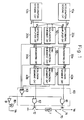
- Fig. 1 shows a general construction of a control system for controlling a squib 1 of an air bag (vehicle safety device).
- the control system comprises a pair of acceleration sensing circuits 10a and 10b, a pair of differential amplifier circuits 20a and 20b, a pair of integrating circuits 30a and 30b, a pair of collision judgment circuits 40a and 40b, first, second and third malfunction judgment circuits 50, 55 and 56, an activation inhibition circuit 60, and a drive circuit 70.
- the outputs of the pair of acceleration sensing circuits 10a and 10b correspond to the acceleration of the vehicle, and are in opposite phase with each other.
- the pair of differential amplifier circuits 20a and 20b amplify the outputs of the pair of acceleration sensing circuits 10a and 10b in a differential manner, and the outputs of the two differential amplifier circuits 20a and 20b are in opposite phase with each other.
- the pair of integrating circuits 30a and 30b integrate the output of the pair of differential amplifier circuits 20a and 20b, respectively.
- the integral outputs of the two integrating circuits 30a and 30b are in opposite phase with each other.
- the pair of collision judgment circuits 40a and 40b are responsive respectively to the integral outputs from the pair of integrating circuits 40a and 40b so as to judge whether or not a collision has occurred.
- the first malfunction judgment circuit 50 is responsive to the outputs of the acceleration sensing circuits 10a and 10b so as to judge whether or not the acceleration sensing circuits 10a and 10b are subjected to a malfunction.
- the second malfunction judgment circuit 55 is responsive to the outputs of the differential amplifier circuits 20a and 20b so as to judge whether or not the acceleration sensing circuits 10a and 10b, as well as the differential amplifier circuits 20a and 20b, are subjected to a malfunction.
- the third malfunction judgment circuit 56 is responsive to the outputs of the integrating circuits 30a and 30b so as to judge whether or not the acceleration sensing circuits 10a and 10b, the differential amplifier circuits 20a and 20b, and the integrating circuits 30a and 30b are subjected to a malfunction.
- the drive circuit 70 when receiving the collision judgment signals from both the pair of the collision judgment circuits 40a and 40b, effects the ignition of the squib 1.
- the malfunction judgment signal is outputted any one of the three malfunction judgment circuits 50, 55 and 56, the activation inhibition circuit 60 is responsive to this malfunction judgment signal to inhibit the ignition of the squib 1.
- the acceleration sensing circuits 10a and 10b comprise respective piezoelectric elements (acceleration sensors) 11a and 11b, and a common reference voltage generating circuit 13.
- the reference voltage generating circuit 13 is composed of serially-connected resistors R1 and R2, and is connected at one terminal to a constant voltage source Vcc and connected at the other terminal to the ground.
- the other terminals of the piezoelectric elements 11a and 11b are connected to buffers 14a and 14b, respectively.
- a bias resistor RBa is connected between the opposite terminals of the piezoelectric element 11a
- a bias resistor RBb is connected between the opposite terminals of the piezoelectric element 11b.
- Voltages V1a and V1b each of which is the sum of the reference voltage Vr and a signal component corresponding to the acceleration/deceleration, are produced at the other terminals of the piezoelectric elements 11a and 11b, respectively.
- the piezoelectric elements 11a and 11b are mounted on front and rear surfaces of a common base plate (base member) 12, respectively.
- the base plate 12 is made of a rigid material, and is mounted on a suitable portion of the vehicle, the base plate 12 extending in a direction perpendicular to the longitudinal direction of the vehicle, that is, the direction A of running of the vehicle.
- the piezoelectric elements 11a and 11b are equal to each other in characteristics, and are subjected to an equal inertia force when the vehicle is accelerated or decelerated. Therefore, the piezoelectric elements 11a and 11b output signal components of the same magnitude which are in synchronism with each other.
- the piezoelectric elements 11a and 11b are mounted respectively on the front and rear surfaces of the base plate 12, one of these elements is subjected to a compressive force during the time when the other is subjected to a pulling force. Therefore, the signal components of the output voltages V1a and V1b are in opposite phase with each other with respect to the reference voltage Vr. More specifically, when the acceleration is zero, the output voltages V1a and V1b are both maintained at the reference voltage Vr.
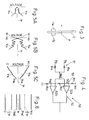
- one piezoelectric element 11a When a negative acceleration (i.e., deceleration) is produced by a collision or the like, one piezoelectric element 11a is subjected to a pulling force, so that its output voltage V1a goes below the reference voltage Vr whereas the other piezoelectric element is subjected to a compressive force, so that its output voltage V1b goes above the reference voltage Vr, as shown in Fig. 5A.
- a negative acceleration i.e., deceleration
- the output voltage V1a goes above the reference voltage Vr, and the output voltage V1b goes below the reference voltage Vr.
- the output voltages V1a and V1b of the piezoelectric elements 11a and 11b are fed respectively to the differential amplifier circuits 20a and 20b via the respective buffers 14a and 14b.
- the differential amplifier circuits 20a and 20b include respective operational amplifiers 21a and 21b which have respective negative feedback resistors R3a and R3b connected thereto.
- the output voltage V1a of one acceleration sensing circuit 10a is fed to an inverting input terminal of one operational amplifier 21a via a resistor R4a
- the output voltage V1b of the other acceleration sensing circuit 10b is fed to a non-inverting input terminal of the operational amplifier 21a via a resistor R5a.
- the operational amplifier 21b of the other differential amplifier 20b is connected to the acceleration sensing circuits 10a and 10b in a manner opposite to the above.
- the output voltage V1b of the acceleration sensing circuit 10b is fed to an inverting input terminal of the operational amplifier 21b via a resistor R4b, and the output voltage V1a of the acceleration sensing circuit 10a is fed to a non-inverting input terminal of the operational amplifier 21b via a resistor R5b.
- a reference voltage source Vr and an offset voltage source Vo connected together in the reverse direction, is connected to the non-inverting input terminal of the operational amplifier 21a of the differential amplifier 20a via a resistor R6a so that this non-inverting input terminal can be supplied with voltage (Vr - Vo).
- the reference voltage source Vr and the offset voltage source Vo connected together in the normal direction, is connected to the non-inverting input terminal of the operational amplifier 21b via a resistor R6b so that this non-inverting input terminal can be supplied with voltage (Vr + Vo).
- the purpose of the offset voltage Vo will be described later.
- V2a (-V1a + V1b) ⁇ A + Vr - Vo
- V2b (V1a - V1b) ⁇ A + Vr + Vo
- V2a Vr - Vo
- V2b Vr + Vo
- the output voltages V2a and V2b corresponding to the deceleration are in opposite phase with each other with respect to the reference voltage Vr, and the difference between the output voltage V2a and the reference voltage Vr and the difference between the output voltage V2b and the reference voltage Vr is equal to each other in absolute value, and this absolute value is represented by
- the output voltage V2a of the differential amplifier circuit 20a becomes higher than the reference voltage Vr whereas the output voltage V2b of the differential amplifier circuit 20b becomes lower than the reference voltage Vr, as shown in Fig. 5B.
- the reverse is the case.
- the integrating circuits 30a and 30b have respective operational amplifiers 31a and 31b.
- the operational amplifiers 31a and 31b have respective capacitors 32a and 32b connected thereto in a negative feedback manner.
- the output voltages V2a and V2b of the differential amplifier circuits 20a and 20b are fed respectively to inverting input terminals of the operational amplifiers 31a and 31b via respective resistors R10a and R10b.
- the reference voltage Vr is supplied to non-inverting input terminals of the operational amplifiers 31a and 31b from the above-mentioned reference voltage source.
- the voltage V2a inputted to the inverting input terminal of one integrating circuit 30a is lower than the reference voltage Vr inputted to the non-inverting input terminal thereof, so that the output voltage V3a of the integrating circuit 30a increases to the constant voltage Vcc.
- a circuit for limiting the output voltage V3a to the constant voltage Vcc is omitted here.
- the voltage V2b inputted to the inverting input terminal of the other integrating circuit 30b is higher than the reference voltage Vr inputted to the non-inverting input terminal thereof, so that the output voltage V3b of the integrating circuit 30b decreases to a very small voltage close to zero volt.
- a circuit for limiting the output voltage V3b to this very small voltage is omitted.
- the integrating circuits 30a and 30b effect the integrating operation. Namely, since the input voltage V2a is higher than the reference voltage Vr, the output voltage V3a of one integrating circuit 30a decreases from the constant voltage Vcc as shown in Fig. 5C. Also, since the input voltage V2b is lower than the reference voltage Vr, the output voltage V3b of the other integrating circuit 30b increases from the very small voltage close to zero volt. As is clear from Fig. 5C, the output voltages V3a and V3b of the integrating circuits 30a and 30b are in opposite phase with each other with respect to the reference voltage Vr.
- the collision judgment circuits 40a and 40b have respective comparators 41a and 41b.
- the output voltage V3a of the integrating circuit 30a is inputted to an inverting input terminal of one comparator 41a.
- the output voltage V3b of the integrating circuit 30b is inputted to a non-inverting input terminal of the other comparator 41b.
- the collision judgment circuits 40a and 40b have a common threshold voltage generating circuit 43.
- the threshold voltage generating circuit 43 is composed of serially-connected three resistors R11, R12 and R13, and one terminal of this circuit 43 is connected to the constant voltage source Vcc whereas the other terminal thereof is grounded. Two voltages, obtained by dividing the constant voltage Vcc by the three resistors R11, R12 and R13, are inputted as threshold voltages Tha and Thb to a non-inverting input terminal of the comparator 41a and an inverting input terminal of the comparator 41b, respectively. As shown in Fig. 5C, the threshold voltages Tha and Thb differ the same amount in opposite directions from the reference voltage Vr.
- the threshold voltage Tha supplied to one comparator 41a is higher than the reference voltage Vr
- the threshold voltage Thb supplied to the other comparator 41b is lower than the reference voltage Vr.
- the comparators 41a and 41b output respective collision judgment signal of a high level.
- the first malfunction judgment circuit 50 comprises an adder circuit 51, a window comparator 52 consisting of two comparators 52a and 52b, a threshold voltage generating circuit 53.
- This adder voltage Vad is supplied to an inverting input terminal of the comparator 52a and a non-inverting input terminal of the comparator 52b.
- the threshold voltage generating circuit 53 consists of three resistors R21, R22 and R23 connected in series with one another. One terminal of this circuit 53 is connected to the constant voltage source Vcc whereas the other terminal thereof is grounded. Two voltages, obtained by dividing the constant voltage Vcc by the resistors R21, R22 and R23, are supplied as threshold voltages Tha' and Thb' to a non-inverting input terminal of the comparator 52a and an inverting input terminal of the comparator 52b. As shown in Fig. 6, the threshold voltages Tha' and Thb' differ the same amount from the reference voltage Vr in opposite directions. On threshold voltage Tha' is higher than the reference voltage Vr and is lower than 3Vr/2, and the other threshold voltage Thb' is lower than the reference voltage Vr and is higher than Vr/2.
- the first malfunction judgment circuit 50 judges whether or not the acceleration sensing circuits 10a and 10b is subjected to a malfunction. More specifically, if the acceleration sensing circuits 10a and 10b are normal, the signal components of the output voltages V1a and V1b which correspond to the acceleration/deceleration cancel each other, so that the adder voltage Vad is maintained at the reference voltage Vr. This will be appreciated by introducing the above formulas (1) and (2) into the above formula (13). Therefore, in this case, the adder voltage Vad is between the two threshold voltages Tha' and Thb', and the output of the window comparator 52 is at the high level.
- the threshold voltage Tha' is set to a relatively low level sufficiently below 3Vr/2, as shown in Fig. 6.
- the adder voltage Vad is Vr/2 and hence is below the threshold voltage Thb'.
- the output of the window comparator 52 is rendered to the low level (malfunction judgment signal).
- the threshold voltage Thb' is set to a relatively high level sufficiently above Vr/2, as shown in Fig. 6.
- the second malfunction judgment circuit 55 and the third malfunction judgment circuit 56 are similar in construction to the first malfunction judgment circuit 50, and therefore their detailed construction are not shown here, and detailed explanation thereof is not given here. Briefly, the second malfunction judgment circuit 55 adds the outputs of the differential amplifier circuits 20a and 20b, and compares this addition output with two threshold voltages, and outputs a malfunction judgment signal of a low level when the addition output is not in an allowable range of between these two threshold voltages.
- the third malfunction judgment circuit 56 adds the outputs of the integrating circuits 30a and 30b, and compares this addition output with two threshold voltages so as to judge a malfunction.
- the malfunction judgment signal of the second malfunction judgment circuit 55 indicates that at least one of the acceleration sensing circuits 10a and 10b and the differential amplifier circuits 20a and 20b is subjected to a malfunction.
- the malfunction judgment signal of the third malfunction judgment circuit 56 indicates that at least one of the acceleration sensing circuits 10a and 10b, the differential amplifier circuits 20a and 20b and the integrating circuits 30a and 30b is subjected to a malfunction. Therefore, in order to detect only a malfunction of the acceleration sensing circuits 10a and 10b, only one of the malfunction judgment circuits 50, 55 and 56 may be provided.
- the activation inhibition circuit 60 includes NAND circuit 61, AND circuit 62 and negative logic OR circuit 63.
- the output stage of the collision judgment circuit 40a is connected to one input terminal of the NAND circuit 61, and the output stage of the collision judgment circuit 40b is connected to one input terminal of the AND circuit 62.
- the output stages of the malfunction judgment circuits 50, 55 and 56 are connected to three input terminals of the negative lock OR circuit 63, respectively.
- An output terminal of the negative logic OR circuit 63 is connected to the other input terminal of the NAND circuit 61 and the other input terminal of the AND circuit 62.
- the drive circuit 70 includes a first transistor 71 of the PNP type and a second transistor 72 of the NPN type serially connected together, the first and second transistors 71 and 72 being arranged in this order from a battery V B toward the ground.
- the squib 1 is connected between the two transistors 71 and 72.
- An energy reservoir (not shown), in the form of a capacitor of a large capacity, and a booster circuit (not shown) for increasing the voltage of the energy reservoir to a level higher than the voltage of the voltage source are connected between the first transistor 71 and the battery V B , the energy reservoir and the booster circuit being arranged in this order toward the voltage source.
- the base of the first transistor 71 is connected to an output terminal of the NAND circuit 61, and the base of the second transistor 72 is connected to an output terminal of the AND circuit 62.
- the acceleration sensing circuits 10a and 10b, the differential amplifier circuits 20a and 20b and the integrating circuits 30a and 30b are normal, the low-level malfunction judgment signal is not outputted from any of the malfunction judgment circuits 50, 55 and 56, and the output of the negative logic OR circuit 63 is at the high level. Therefore, in this normal condition, when the collision judgment signals of the high level are outputted respectively from the collision judgment circuits 40a and 40b, the transistors 71 and 72 are turned on, and therefore electric current is supplied to the squib 1 from the energy reservoir, so that the squib 1 is ignited to thereby expand the air bag.
- the outputs of the differential amplifier circuits 20a and 20b abnormally increase or decrease.
- the integral outputs V3a and V3b may exceed the threshold voltages Tha and Thb, respectively, so that the collision judgment signals may be outputted respectively from the two collision judgment circuits 40a and 40b at the same time.
- the activation inhibition circuit 60 is operated. More specifically, as mentioned above, since the malfunction judgment signals of the low level are outputted respectively from the malfunction judgment circuits 50, 55 and 56, the low-level signal is outputted from the negative logic circuit 63, so that the NAND circuit 61 and the AND circuit 62 are closed. As a result, the transistors 71 and 72 are inhibited from being turned on, thereby positively preventing an inadvertent activation of the air bag.
- the control system further comprises an alarm lamp 80.
- One terminal of the alarm lamp 80 is connected to the output terminal of the negative logic OR circuit 63 via a buffer 81, and the other terminal thereof is connected to the battery V B .
- the output of the negative logic OR circuit 63 goes low, so that the alarm lamp 80 is turned on, thereby informing the passenger of the vehicle of the malfunction.
- the differential amplifier circuits 20a and 20b serve to remove noises produced in the acceleration sensing circuits 10a and 10b. As described above, the noises are in phase with each other, and when the noises in phase with each other are added respectively to the output voltages V1a and V1b the acceleration sensing circuits 10a and 10b, the noises cancel each other at the differential amplifier circuits 20a and 20b, so that any noise component is not contained in each of the output voltages V2a and V2b of the differential amplifier circuits 20a and 20b. Therefore, the outputs of the integrating circuits 30a and 30b are maintained at the normal level. As a result, a collision judgment due to the above noises will not be made, thus preventing an inadvertent activation of the air bag.
- the inadvertent activation of the air bag can be prevented. More specifically, for example, when noises causing the integral outputs V3a and V3b to drop are produced in either the differential amplifier circuits 20a and 20b or the integrating circuits 30a and 30b, there is a possibility that the integral value V3a may go below the threshold voltage Tha, so that the collision judgment signal may be outputted from one collision judgment circuit 40a. In this case, however, the other integral output V3b goes toward zero volt, and will not exceed the threshold voltage Thb. Therefore, the other collision judgment circuit 40b never outputs the collision judgment signal.
- the collision judgment signal may be outputted from the collision judgment circuit 40b. In this case, however, the collision judgment signal is not outputted from the collision judgment circuit 40a. As a result, even in the worst case, only one of the two transistors 71 and 72 is turned on, so that the inadvertent activation of the air bag can be prevented.
- the piezoelectric elements 11a and 11b may be mounted on the same surface (e.g. the front surface) of the base plate 12.
- the piezoelectric elements 11a and 11b output signals in phase with each other.
- one acceleration sensing circuit 10b has an inverting amplifier circuit 15 interposed between the piezoelectric element 11b and the buffer 14b.
- the inverting amplifier circuit 15, together with the piezoelectric element 11b, is sealed and insulated from noises.
- the inverting amplifier circuit 15 comprises an operational amplifier 16, a negative feedback resistor Rx, and an input resistor Ry.
- the amplification degree (factor) of the inverting amplifier circuit 15 is "1".
- the output of the piezoelectric element 11b is inverted by the inverting amplifier circuit 15 into V1b which is in opposite phase with the output via of the acceleration sensing circuit 10a.
- the acceleration sensors are not limited to the piezoelectric elements, and may comprises strain gauges 111a and 111b as shown in Figs. 9 and 10. More specifically, a leaf spring (base member) 101 is received within a casing 100 fixedly mounted on the vehicle. The upper end of the leaf spring 101 is fixedly secured to the casing 100 by fixing members 102. A weight 103 is secured to the lower end of the leaf spring 101. The strain gauges 111a and 111b are bonded to the opposite surfaces of the leaf spring 101, respectively. A damper liquid 105 is held in the casing 100.
- the leaf spring 101 and the strain gauges 111a and 111b are disposed perpendicularly to the direction A of running of the vehicle.
- the weight 103 is moved rearward due to an inertia force, so that the leaf spring 101 is resiliently deformed.
- one strain gauge 111a is expanded whereas the other strain gauge 111b is contracted.
- the weight 103 is moved forward, so that one strain gauge 111a is contracted whereas the other strain gauge 111b is expanded.
- Fig. 11 shows acceleration sensing circuits 110a and 110b having the strain gauges 111a and 111b, respectively. More specifically, the acceleration sensing circuit 110a comprises a resistor 115 and the strain gauge 111a connected in series therewith, and the acceleration sensing circuit 110b comprises a resistor 116 and the strain gauge 111b connected in series therewith. In this embodiment, the resistors 115 and 116 have the same value or resistivity.
- the acceleration sensing circuits 110a and 110b are connected to a common constant voltage source Vcc.
- a voltage at the junction point between the resistor 115 and the strain gauge 111a is represented by v1a'
- a voltage at the junction point between the resistor 116 and the strain gauge 111b is represented by V1b′.
- Vr reference voltage
- one strain gauge 111a is contracted and is decreased in resistivity, so that one output voltage v1a' becomes lower than the reference voltage Vr.
- the other strain gauge 111b is expanded and is increased in resistivity, so that the other output voltage V1b′ becomes higher than the reference voltage Vr.
- the reverse is achieved at the time of the acceleration. In this manner, the voltages v1a' and V1b' in opposite phase with each other with respect to the reference voltage Vr are outputted.
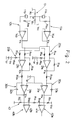
- Figs. 12 to 14 show modified control systems, respectively, and those parts of these Figures identical in construction to those of the embodiment of Fig. 1 are omitted.
- differential integrating circuits 130a and 130b are used.
- An output V2a of a differential amplifier circuit 20a is fed to an inverting input terminal of one differential integrating circuit 130a, and an output V2b of a differential amplifier circuit 20b is fed to a non-inverting input terminal of the differential integrating circuit 130a.
- the output V2b of the differential amplifier circuit 20b is fed to an inverting input terminal of the other differential integrating circuit 130b, and the output V2a of the differential amplifier circuit 20a is fed to a non-inverting input terminal of the differential integrating circuit 130b.
- the outputs of the differential integrating circuits 130a and 130b are in opposite phase with each other.
- in-phase noises produced in acceleration sensing circuits 10a and 10b cancel each other at the differential amplifier circuits 20a and 20b, and even if part of these noises remain in the outputs of the differential amplifier circuits 20a and 20b, they cancel each other at the differential integrating circuits 130a and 130b.
- in-phase noises applied to the outputs of the differential amplifier circuits 20a and 20b cancel each other at the differential integrating circuits 130a and 130b.
- inverting amplifier circuits 120a and 120b are used, and instead of the integrating circuits 30a and 30b, differential integrating circuits 130a and 130b (differential calculation means) are used.
- the condition of connection of input terminals of the differential integrating circuit 130a to the inverting amplifier circuits 120a and 120b is opposite to the condition of connection of input terminals of the differential integrating circuit 130b to the inverting amplifier circuits 120a and 120b.
- the outputs of the two differential integrating circuits 130a and 130b are in opposite phase with each other.
- the differential integrating circuits 130a and 130b differentially integrate outputs V2a' and V2b' of the inverting amplifier circuits 120a and 120b so as to remove noises applied to acceleration sensing circuits 10a and 10b or the inverting amplifier circuits 120a and 120b.
- inverting amplifier circuits 120a and 120b are used.
- noises applied to acceleration sensing circuits 10a and 10b are not removed, but are contained in the outputs of integrating circuits 30a and 30b.
- this noise is in phase with the output of one of the acceleration sensing circuits 10a and 10b, but is in opposite phase with the output of the other acceleration sensing circuit. Therefore, even in the worst case, only one of collision judgment circuits 40a and 40b (Fig. 1) decides the collision, and therefore the inadvertent activation of the air bag is prevented.
- the present invention is not restricted to the above embodiments, and various modifications can be made.
- the differential calculation, the integrating calculation, the collision judgment and the malfunction judgment may be carried out by a microcomputer.
- the control system of the present invention can be applied not only to the air bag but also to a seat belt-tightening device.
Landscapes
- Engineering & Computer Science (AREA)
- Mechanical Engineering (AREA)
- Physics & Mathematics (AREA)
- General Physics & Mathematics (AREA)
- Air Bags (AREA)
Claims (8)
- Steuersystem für eine Fahrzeugsicherheitseinrichtung mit:(a) einer ersten und einer zweiten Beschleunigungssensorschaltung (10a, 10b), von denen jede einen Beschleunigungssensor (11a, 11b) hat, wobei die Ausgänge der Beschleunigungssensorschaltungen einer Verzögerung eines Fahrzeugs in einer Fahrtrichtung des Fahrzeugs entsprechen;(b) einer ersten und einer zweiten Verstärkerschaltung (20a, 20b);(c) einem Paar von integrierenden Schaltungen (30a, 30b);(d) einem Paar von Kollisionsbeurteilungsschaltungen (40a, 40b), von denen jede den Ausgang einer entsprechenden der integrierenden Schaltungen (30a, 30b) mit einem Schwellenwert vergleicht und ein Kollisionsbeurteilungssignal ausgibt, wenn der Ausgang der entsprechenden der integrierenden Schaltungen (30a, 30b) den Schwellenwert überschreitet; und(e) einer Antriebsschaltung (70), die die Fahrzeugsicherheitseinrichtung (1) aktiviert, wenn sie die Kollisionsbeurteilungssignale von dem Paar von Kollisionsbeurteilungsschaltungen (40a, 40b) zur selben Zeit empfängt;dadurch gekennzeichnet, daß
die Ausgänge der ersten und der zweiten Beschleunigungssensorschaltung (10a, 10b) in entgegengesetzter Phase zueinander sind;
eine erste und eine zweite Differentialverstärkerschaltung (20a, 20b) als die erste und die zweite Verstärkerschaltung verwendet werden, wobei die Ausgänge der ersten und der zweiten Beschleunigungssensorschaltung (10a, 10b) jeweils einem nicht-invertierenden Eingangsanschluß und einem invertierenden Eingangsanschluß der ersten Differentialverstärkerschaltung (20a) zugeführt werden und wobei die Ausgänge der ersten und der zweiten Beschleunigungssensorschaltung (10a, 10b) jeweils einem invertierenden Eingangsanschluß und einem nichtinvertierenden Eingangsanschluß der zweiten Differentialverstärkerschaltung (20b) zugeführt werden, wodurch die Ausgänge der ersten und der zweiten Differentialverstärkerschaltung (20a, 20b) in entgegengesetzter Phase zueinander sind; und
das Paar von integrierenden Schaltungen (30a, 30b) jeweils die Ausgänge der ersten und der zweiten Differentialverstärkerschaltung (20a, 20b) empfängt und integriert, wodurch die Integralausgänge des Paars von integrierenden Schaltungen (30a, 30b) in entgegengesetzter Phase zueinander sind. - Steuersystem für eine Fahrzeugsicherheitseinrichtung mit:(a) einer ersten und einer zweiten Beschleunigungssensorschaltung (10a, 10b), von denen jede einen Beschleunigungssensor (11a, 11b) hat, wobei die Ausgänge der Beschleunigungssensorschaltungen einer Verzögerung eines Fahrzeugs in einer Fahrtrichtung des Fahrzeugs entsprechen;(b) einer ersten und einer zweiten Verstärkerschaltung (20a, 20b);(c) einem Paar von integrierenden Schaltungen (130a, 130b);(d) einem Paar von Kollisionsbeurteilungsschaltungen (40a, 40b), von denen jede den Ausgang einer entsprechenden der integrierenden Schaltungen (130a, 130b) mit einem Schwellenwert vergleicht und ein Kollisionsbeurteilungssignal ausgibt, wenn der Ausgang der entsprechenden der integrierenden Schaltungen (130a, 130b) den Schwellenwert überschreitet; und(e) einer Antriebsschaltung (70), die die Fahrzeugsicherheitseinrichtung (1) aktiviert, wenn sie die Kollisionsbeurteilungssignale von dem Paar von Kollisionsbeurteilungsschaltungen (40a, 40b) zur selben Zeit empfängt;dadurch gekennzeichnet, daß
die Ausgänge der ersten und der zweiten Beschleunigungssensorschaltung (10a, 10b) in entgegengesetzter Phase zueinander sind;
eine erste und eine zweite Differentialverstärkerschaltung (20a, 20b) als die erste und die zweite Verstärkerschaltung verwendet werden, wobei die Ausgänge der ersten und der zweiten Beschleunigungssensorschaltung (10a, 10b) jeweils einem nicht-invertierenden Eingangsanschluß und einem invertierenden Eingangsanschluß der ersten Differentialverstärkerschaltung (20a) zugeführt werden und wobei die Ausgänge der ersten und der zweiten Beschleunigungssensorschaltung (10a, 10b) jeweils einem invertierenden Eingangsanschluß und einem nicht-invertierenden Eingangsanschluß der zweiten Differentialverstärkerschaltung (20b) zugeführt werden, wodurch die Ausgänge der ersten und der zweiten Differentialverstärkerschaltung (20a, 20b) in entgegengesetzter Phase zueinander sind; und
eine erste und eine zweite integrierende Differentialschaltung (130a, 130b) als das Paar von integrierenden Schaltungen verwendet wird, wobei die Ausgänge der ersten und der zweiten Differentialverstärkerschaltung (20a, 20b) jeweils einem nicht-invertierenden Eingangsanschluß und einem invertierenden Eingangsanschluß der ersten integrierenden Differentialschaltung (130a) zugeführt werden, wobei die Ausgänge der ersten und der zweiten Differentialverstärkerschaltung (20a, 20b) jeweils einem invertierenden Eingangsanschluß und einem nicht-invertierenden Eingangsanschluß der zweiten integrierenden Differentialschaltung (130b) zugeführt werden, wodurch die Ausgänge der ersten und der zweiten integrierenden Differentialschaltung (130a, 130b) in entgegengesetzter Phase zueinander sind. - Steuersystem für eine Fahrzeugsicherheitseinrichtung mit:(a) einer ersten und einer zweiten Beschleunigungssensorschaltung (10a, 10b), von denen jede einen Beschleunigungssensor (11a, 11b) hat, wobei die Ausgänge der Beschleunigungssensorschaltungen einer Verzögerung eines Fahrzeugs in einer Fahrtrichtung des Fahrzeugs entsprechen;(b) einer ersten und einer zweiten Verstärkerschaltung (120a, 120b);(c) einem Paar von integrierenden Schaltungen (130a, 130b);(d) einem Paar von Kollisionsbeurteilungsschaltungen (40a, 40b), von denen jede den Ausgang einer entsprechenden der integrierenden Schaltungen (130a, 130b) mit einem Schwellenwert vergleicht und ein Kollisionsbeurteilungssignal ausgibt, wenn der Ausgang der entsprechenden der integrierenden Schaltungen (130a, 130b) den Schwellenwert überschreitet; und(e) einer Antriebsschaltung (70), die die Fahrzeugsicherheitseinrichtung (1) aktiviert, wenn sie die Kollisionsbeurteilungssignale von dem Paar von Kollisionsbeurteilungsschaltungen (40a, 40b) zur selben Zeit empfängt;dadurch gekennzeichnet, daß
die Ausgänge der ersten und der zweiten Beschleunigungssensorschaltung (10a, 10b) in entgegengesetzter Phase zueinander sind;
die erste und die zweite Verstärkerschaltung (120a, 120b) jeweils die Ausgänge der ersten und der zweiten Beschleunigungssensorschaltung (10a, 10b) empfangen und verstärken, wodurch die Ausgänge der ersten und der zweiten Verstärkerschaltung (120a, 120b) in entgegengesetzter Phase zueinander sind;
eine erste und eine zweite integrierende Differentialschaltung (130a, 130b) als das Paar von integrierenden Schaltungen verwendet wird, wobei die Ausgänge der ersten und der zweiten Verstärkerschaltung (120a, 120b) jeweils einem nicht-invertierenden Eingangsanschluß und einem invertierenden Eingangsanschluß der ersten integrierenden Differentialschaltung (130a) zugeführt werden, wobei die Ausgänge der ersten und der zweiten Verstärkerschaltung (120a, 120b) jeweils einem invertierenden Eingangsanschluß und einem nicht-invertierenden Eingangsanschluß der zweiten integrierenden Differentialschaltung (130b) zugeführt werden, wodurch die Ausgänge der ersten und der zweiten integrierenden Differentialschaltung (130a, 130b) in entgegengesetzter Phase zueinander sind. - Steuersystem nach den Ansprüchen 1, 2 oder 3, wobei eine Fehlfunktionsbeurteilungseinrichtung (50) vorgesehen ist zum Addieren der Ausgänge des Paars von Beschleunigungssensorschaltungen und zum Vergleichen dieses addierten Wertes mit zwei unterschiedlichen Schwellenwerten und zum Beurteilen, daß eine Fehlfunktion in einem des Paars von Beschleunigungssensorschaltungen aufgetreten ist, wenn der addierte Wert außerhalb des Bereiches zwischen den zwei Schwellenwerten liegt.
- Steuersystem nach Anspruch 4, wobei eine Aktivierungshemmeinrichtung (60) vorgesehen ist, die auf die Fehlfunktionsbeurteilung durch die Fehlfunktionsbeurteilungseinrichtung (50) anspricht, um die Aktivierung der Fahrzeugsicherheitseinrichtung zu hemmen.
- Steuersystem nach Anspruch 1, 2 oder 3, wobei das Paar von Beschleunigungssensoren (11a, 11b, 111a, 111b) auf einem gemeinsamen Basiselement (12, 101) montiert ist, welches an dem Fahrzeug montiert ist.
- Steuersystem nach Anspruch 6, wobei das Basiselement eine starre bzw. feste Platte (12) aufweist, deren Ebene senkrecht zur Fahrtrichtung des Fahrzeugs angeordnet ist, wobei das Paar von Beschleunigungssensoren jeweils piezoelektrische Elemente (11a, 11b) aufweist, die an einer Vorder- bzw. einer Rückseite der starren Platte montiert sind.
- Steuersystem nach Anspruch 6, wobei das Basiselement eine Blattfeder (101) aufweist, deren Ebene senkrecht zur Fahrtrichtung des Fahrzeugs angeordnet ist, wobei das Paar von Beschleunigungssensoren jeweils Spannungs- bzw. Deformationsmeßgeräte (111a, 111b) aufweist, die auf einer Vorderseite bzw. einer Rückseite der Blattfeder montiert sind.
Applications Claiming Priority (2)
| Application Number | Priority Date | Filing Date | Title |
|---|---|---|---|
| JP47289/90 | 1990-03-01 | ||
| JP2047289A JPH03253440A (ja) | 1990-03-01 | 1990-03-01 | 車両安全装置のための制御システム |
Publications (2)
| Publication Number | Publication Date |
|---|---|
| EP0444866A1 EP0444866A1 (de) | 1991-09-04 |
| EP0444866B1 true EP0444866B1 (de) | 1993-09-22 |
Family
ID=12771131
Family Applications (1)
| Application Number | Title | Priority Date | Filing Date |
|---|---|---|---|
| EP91301521A Expired - Lifetime EP0444866B1 (de) | 1990-03-01 | 1991-02-26 | Steuerungssystem für eine Fahrzeugsicherheitsvorrichtung |
Country Status (4)
| Country | Link |
|---|---|
| US (1) | US5208484A (de) |
| EP (1) | EP0444866B1 (de) |
| JP (1) | JPH03253440A (de) |
| DE (1) | DE69100381T2 (de) |
Families Citing this family (44)
| Publication number | Priority date | Publication date | Assignee | Title |
|---|---|---|---|---|
| WO1990003289A1 (en) * | 1988-09-17 | 1990-04-05 | Robert Bosch Gmbh | Apparatus and method for tripping a system for the protection of occupants of a vehicle |
| DE3921250A1 (de) * | 1989-06-29 | 1991-01-03 | Bosch Gmbh Robert | Insassen-sicherheitssystem und verfahren zum betreiben desselben |
| JPH03246139A (ja) * | 1990-02-23 | 1991-11-01 | Zexel Corp | 車両安全装置のための制御システム |
| JPH04203969A (ja) * | 1990-11-29 | 1992-07-24 | Mitsubishi Electric Corp | 車両の衝突検出装置 |
| JP2755502B2 (ja) * | 1991-04-19 | 1998-05-20 | センサー・テクノロジー株式会社 | 衝突センサ |
| DE69215426T2 (de) * | 1991-04-23 | 1997-03-27 | Nippon Denso Co | Auslösesystem für eine Kraftfahrzeuginsassen-Schutzeinrichtung |
| JP2580405B2 (ja) * | 1991-06-04 | 1997-02-12 | 株式会社デンソー | 車両用乗員保護装置の起動装置 |
| JP2773486B2 (ja) * | 1991-09-12 | 1998-07-09 | 日産自動車株式会社 | 乗員保護制御装置 |
| US5422965A (en) * | 1992-02-18 | 1995-06-06 | Hitachi, Ltd. | Air bag operation device |
| JP2793084B2 (ja) * | 1992-05-29 | 1998-09-03 | 三菱電機株式会社 | 乗員保護装置の起動装置 |
| JP3141534B2 (ja) * | 1992-06-22 | 2001-03-05 | トヨタ自動車株式会社 | エアバック制御装置 |
| JPH0640308A (ja) * | 1992-07-21 | 1994-02-15 | Naldec Kk | 車両の安全装置 |
| EP0592205B1 (de) * | 1992-10-07 | 1998-01-07 | Nec Corporation | Halbleitermessaufnehmer mit Schaltung zur Feststellung von Fehlern |
| US5610817A (en) * | 1993-02-08 | 1997-03-11 | Breed Automotive Technology, Inc. | Passenger restraint system with an electronic crash sensor |
| JP3392180B2 (ja) * | 1993-05-10 | 2003-03-31 | ボッシュ エレクトロニクス株式会社 | 車両用安全装置の制御システム |
| JP3268092B2 (ja) * | 1993-11-15 | 2002-03-25 | 本田技研工業株式会社 | 車両ロードシミュレータ |
| JP2941643B2 (ja) * | 1994-04-14 | 1999-08-25 | 三菱自動車工業株式会社 | 乗員保護装置の起動装置 |
| DE4425846A1 (de) * | 1994-07-21 | 1996-01-25 | Telefunken Microelectron | Verfahren zur Auslösung von Seitenairbags einer passiven Sicherheitseinrichtung für Kraftfahrzeuge |
| US5995892A (en) * | 1995-06-12 | 1999-11-30 | Denso Corporation | Triggering device for safety apparatus |
| JP3011092B2 (ja) * | 1995-06-12 | 2000-02-21 | 株式会社デンソー | 安全装置の起動装置 |
| US6095554A (en) * | 1995-06-15 | 2000-08-01 | Trw Inc. | Method and apparatus for sensing side impact crash conditions with an enhanced safing function |
| US5826902A (en) * | 1996-01-22 | 1998-10-27 | Trw Inc. | Method and apparatus for sensing impact crash conditions with safing function |
| US5758899A (en) * | 1995-06-15 | 1998-06-02 | Trw Inc. | Method and apparatus for providing a safing function for side impact crash sensing systems |
| JP3335815B2 (ja) * | 1995-10-12 | 2002-10-21 | 三菱電機株式会社 | 乗員保護装置の起動装置 |
| DE19549083B4 (de) * | 1995-12-29 | 2010-06-17 | Robert Bosch Gmbh | Sicherheitssystem |
| GB2310303B (en) * | 1996-02-13 | 1999-07-28 | Autoliv Dev | Improvements in or relating to a crash detector arrangement |
| WO1998012904A1 (de) * | 1996-09-19 | 1998-03-26 | Siemens Aktiengesellschaft | Airbag-steuergerät |
| US5746444A (en) * | 1996-09-27 | 1998-05-05 | Trw Inc. | Method and apparatus for single point sensing of front and side impact crash conditions |
| DE19644324A1 (de) * | 1996-10-24 | 1998-04-30 | Autoliv Dev | Auslösevorrichtung |
| US5845729A (en) * | 1996-12-09 | 1998-12-08 | Delco Electronics Corp. | Logic level arming sensor for supplemental inflatable restraint |
| US6216070B1 (en) * | 1997-09-29 | 2001-04-10 | Calsonic Kansei Corporation | Passenger protecting apparatus |
| GB2355099B (en) * | 1999-10-05 | 2003-03-12 | Autoliv Dev | Improvements in or relating to a vehicle safety arrangement |
| DE10027184B4 (de) * | 2000-05-31 | 2005-06-30 | Siemens Ag | Anordnung und Verfahren zur Aufprallerkennung in einem Fahrzeug |
| US6520536B2 (en) * | 2001-05-04 | 2003-02-18 | Trw Inc. | Method and apparatus for controlling an occupant side restraining device with enhanced side safing function |
| JP3695351B2 (ja) * | 2001-05-14 | 2005-09-14 | トヨタ自動車株式会社 | 乗員保護装置の起動装置 |
| WO2005014342A1 (de) * | 2003-07-30 | 2005-02-17 | Conti Temic Microelectronic Gmbh | Vorrichtung und verfahren zur messung von beschleunigungen für ein fahrzeug-insassenschutzsystem |
| JP2005106664A (ja) * | 2003-09-30 | 2005-04-21 | Mitsubishi Electric Corp | 加速度検出装置及びこれを用いた乗員保護システム |
| DE10360138A1 (de) * | 2003-12-20 | 2005-07-21 | Daimlerchrysler Ag | System zur Erkennung einer Kollision eines Kraftfahrzeuges |
| JP2006105622A (ja) * | 2004-09-30 | 2006-04-20 | Honda Motor Co Ltd | 慣性センサユニット |
| JP2007030766A (ja) * | 2005-07-28 | 2007-02-08 | Denso Corp | 乗員保護システム |
| DE102007030627A1 (de) * | 2007-07-02 | 2009-01-08 | Continental Automotive Gmbh | Steuerung eines Aktuators einer Bremse eines Kraftfahrzeugs |
| CN101758812B (zh) * | 2010-02-01 | 2012-01-25 | 上海东方久乐汽车安全气囊有限公司 | 防止安全气囊误点火的检测系统及方法 |
| US9925867B2 (en) | 2016-01-11 | 2018-03-27 | Ford Global Technologies, Llc | Fuel control regulator system with acoustic pliability |
| US10017142B2 (en) | 2016-09-12 | 2018-07-10 | Ford Global Technologies, Llc | Filtration of acoustic contaminate from vehicle safety sensors |
Family Cites Families (13)
| Publication number | Priority date | Publication date | Assignee | Title |
|---|---|---|---|---|
| DE2222038C3 (de) * | 1972-05-05 | 1978-07-06 | Messerschmitt-Boelkow-Blohm Gmbh, 8000 Muenchen | Prüfschaltung für die Auslösevorrichtung einer dem Schutz der Insassen eines Fahrzeuges während eines Unfalles dienenden Sicherheitseinrichtung |
| US3960691A (en) * | 1975-01-31 | 1976-06-01 | The Singer Company | Tactical rate sensor |
| DE2655604C2 (de) * | 1976-12-08 | 1984-11-29 | Robert Bosch Gmbh, 7000 Stuttgart | Verzögerungsaufnehmer zur Auslösung von Insassenschutzvorrichtungen im Kraftfahrzeug |
| DE2835999A1 (de) * | 1978-08-17 | 1980-03-06 | Bosch Gmbh Robert | Beschleunigungsaufnehmer, insbesondere zur ausloesung von insassenschutzvorrichtungen in kraftfahrzeugen |
| US4366465A (en) * | 1981-10-02 | 1982-12-28 | Ford Motor Company | False failure detection prevention in an air bag diagnostic system |
| JPS631975A (ja) * | 1986-06-20 | 1988-01-06 | Atsugi Motor Parts Co Ltd | 加速度センサ |
| DE3717427C3 (de) * | 1987-05-23 | 1994-09-01 | Deutsche Aerospace | Aufprallsensor für Kraftfahrzeuge |
| DE3736294A1 (de) * | 1987-10-27 | 1989-05-11 | Messerschmitt Boelkow Blohm | Einrichtung zur funktionskontrolle von beschleunigungssensoren |
| DE3816589A1 (de) * | 1988-05-16 | 1989-11-23 | Messerschmitt Boelkow Blohm | Einrichtung zur ausloesung einer passiven sicherheitseinrichtung |
| US4984463A (en) * | 1988-09-28 | 1991-01-15 | Nippon Soken, Inc. | Two-dimensional acceleration sensor |
| DE3920091A1 (de) * | 1989-04-06 | 1990-10-11 | Bosch Gmbh Robert | Sicherheitseinrichtung fuer fahrzeuginsassen |
| JPH0669788B2 (ja) * | 1989-07-21 | 1994-09-07 | アスコ株式会社 | 車輌用安全装置 |
| JPH0343058U (de) * | 1989-09-06 | 1991-04-23 |
-
1990
- 1990-03-01 JP JP2047289A patent/JPH03253440A/ja active Pending
-
1991
- 1991-02-22 US US07/659,563 patent/US5208484A/en not_active Expired - Fee Related
- 1991-02-26 DE DE91301521T patent/DE69100381T2/de not_active Expired - Fee Related
- 1991-02-26 EP EP91301521A patent/EP0444866B1/de not_active Expired - Lifetime
Also Published As
| Publication number | Publication date |
|---|---|
| EP0444866A1 (de) | 1991-09-04 |
| DE69100381D1 (de) | 1993-10-28 |
| JPH03253440A (ja) | 1991-11-12 |
| DE69100381T2 (de) | 1994-03-31 |
| US5208484A (en) | 1993-05-04 |
Similar Documents
| Publication | Publication Date | Title |
|---|---|---|
| US5208484A (en) | Control system for vehicle safety device | |
| US4638179A (en) | Extended response trigger circuit | |
| US5083276A (en) | System for controlling safety device for vehicle | |
| EP0434678B1 (de) | Airbag-system zum schützen von kraftfahrzeuginsassen | |
| JP2847426B2 (ja) | 車輌用安全システムの作動チェック方法 | |
| JP2761303B2 (ja) | エアバッグシステムの衝突検出装置 | |
| US6513383B1 (en) | Acceleration sensor and acceleration detection system | |
| EP0511556B1 (de) | Kollisionssensor | |
| US5977651A (en) | Drive circuit for vehicle occupant safety apparatus | |
| US5205582A (en) | Occupant protective system | |
| EP0343579B1 (de) | Elektrische Auslösungsanordnung für eine Sicherheitseinrichtung in Kraftfahrzeugen | |
| US4979763A (en) | Method and apparatus for sensing a vehicle crash | |
| EP0675820A4 (de) | Airbag system für kraftfahrzeug. | |
| CA2074105A1 (en) | Acceleration sensor unit having self-checking function | |
| EP0794436A1 (de) | Analoge/digitale Rückkopplungsschaltung zur Minimierung von Gleichspannungsoffsetveränderungen bei einem Analogsignal | |
| US5129673A (en) | Electronic device | |
| US6373147B1 (en) | Control apparatus of occupant protection device | |
| US6029497A (en) | Process for driving a sensor with offset control | |
| US5594647A (en) | Apparatus for determining emergency conditions of a vehicle | |
| JPH04287749A (ja) | 車両用乗員保護システムのための故障判定装置 | |
| JPH04146847A (ja) | 車両の衝突検出装置 | |
| JPS60226209A (ja) | 回路装置 | |
| JPH0761320A (ja) | 衝撃検知装置 | |
| JP2000355264A (ja) | 乗員姿勢検出装置 | |
| US7000946B2 (en) | Temperature compensated air bag control system |
Legal Events
| Date | Code | Title | Description |
|---|---|---|---|
| PUAI | Public reference made under article 153(3) epc to a published international application that has entered the european phase |
Free format text: ORIGINAL CODE: 0009012 |
|
| AK | Designated contracting states |
Kind code of ref document: A1 Designated state(s): DE GB |
|
| 17P | Request for examination filed |
Effective date: 19920120 |
|
| 17Q | First examination report despatched |
Effective date: 19920522 |
|
| GRAA | (expected) grant |
Free format text: ORIGINAL CODE: 0009210 |
|
| AK | Designated contracting states |
Kind code of ref document: B1 Designated state(s): DE GB |
|
| REF | Corresponds to: |
Ref document number: 69100381 Country of ref document: DE Date of ref document: 19931028 |
|
| RAP2 | Party data changed (patent owner data changed or rights of a patent transferred) |
Owner name: AIRBAG SYSTEMS COMPANY LTD |
|
| PLBE | No opposition filed within time limit |
Free format text: ORIGINAL CODE: 0009261 |
|
| STAA | Information on the status of an ep patent application or granted ep patent |
Free format text: STATUS: NO OPPOSITION FILED WITHIN TIME LIMIT |
|
| 26N | No opposition filed | ||
| REG | Reference to a national code |
Ref country code: GB Ref legal event code: 732E |
|
| REG | Reference to a national code |
Ref country code: GB Ref legal event code: IF02 |
|
| REG | Reference to a national code |
Ref country code: GB Ref legal event code: 732E |
|
| PGFP | Annual fee paid to national office [announced via postgrant information from national office to epo] |
Ref country code: GB Payment date: 20040225 Year of fee payment: 14 |
|
| PGFP | Annual fee paid to national office [announced via postgrant information from national office to epo] |
Ref country code: DE Payment date: 20040304 Year of fee payment: 14 |
|
| PG25 | Lapsed in a contracting state [announced via postgrant information from national office to epo] |
Ref country code: GB Free format text: LAPSE BECAUSE OF NON-PAYMENT OF DUE FEES Effective date: 20050226 |
|
| PG25 | Lapsed in a contracting state [announced via postgrant information from national office to epo] |
Ref country code: DE Free format text: LAPSE BECAUSE OF NON-PAYMENT OF DUE FEES Effective date: 20050901 |
|
| GBPC | Gb: european patent ceased through non-payment of renewal fee |
Effective date: 20050226 |