EP0444903A2 - Thin-film perpendicular magnetic recording and reproducing head - Google Patents
Thin-film perpendicular magnetic recording and reproducing head Download PDFInfo
- Publication number
- EP0444903A2 EP0444903A2 EP91301595A EP91301595A EP0444903A2 EP 0444903 A2 EP0444903 A2 EP 0444903A2 EP 91301595 A EP91301595 A EP 91301595A EP 91301595 A EP91301595 A EP 91301595A EP 0444903 A2 EP0444903 A2 EP 0444903A2
- Authority
- EP
- European Patent Office
- Prior art keywords
- film
- magnetic
- set forth
- thin
- head
- Prior art date
- Legal status (The legal status is an assumption and is not a legal conclusion. Google has not performed a legal analysis and makes no representation as to the accuracy of the status listed.)
- Withdrawn
Links
Images


Classifications
-
- G—PHYSICS
- G11—INFORMATION STORAGE
- G11B—INFORMATION STORAGE BASED ON RELATIVE MOVEMENT BETWEEN RECORD CARRIER AND TRANSDUCER
- G11B5/00—Recording by magnetisation or demagnetisation of a record carrier; Reproducing by magnetic means; Record carriers therefor
- G11B5/127—Structure or manufacture of heads, e.g. inductive
- G11B5/1278—Structure or manufacture of heads, e.g. inductive specially adapted for magnetisations perpendicular to the surface of the record carrier
Definitions
- This invention relates to an improvement in a thin-film perpendicular magnetic recording and reproducing head for a computer, tape, picture recording, etc. More particularly, it is a thin-film perpendicular magnetic recording and reproducing head which comprises a magnetic member for a return path adapted to face a magnetic recording medium, and having orthogonal grooves filled with a non-magnetic material, and a plurality of layers formed one upon another immediately above the intersection of the grooves, and which exhibits improved output characteristics attained by the exposure of the magnetic member on its side facing a main magnetic-pole film and along the track width.
- a thin-film perpendicular magnetic recording and reproducing head (hereinafter referred to simply as "thin-film magnetic head”) generally has a very small magnetic circuit and employs a thin magnetic film having a high permeability and a high saturation magnetic flux density, and is, therefore, suitable for achieving a high recording density. It has a high degree of dimensional accuracy and yet is inexpensive, as it is manufactured by a process based on semiconductor technology. This type of head is, therefore, expected to become a main type of perpendicular magnetic head.
- the thin-film magnetic heads include an inductive head which is used for recording or reproducing, and a head of the magnetic resistance effect type for reproducing.
- FIGURES 5(a) and 5(b) of the accompanying drawings are a schematic front elevational view showing that surface of the transducer portion of a known thin-film head which is adapted to face a magnetic recording medium, and a perpendicular sectional and side elevational view of the head, respectively.
- the head comprises a magnetic member 10 composed of e.g. soft ferrite, a non-magnetic material 3 forming a gap layer, a thin-film conductor coil 4, an insulating film layer 5, a thick magnetic film 7 formed from e.g.
- a Permalloy, Sendust, or amorphous cobalt alloy serving to prevent the magnetic saturation of a main magnetic-pole film during recording, the main magnetic-pole film 8, and a protective film 9, which lie one upon another as shown in FIGURE 5(b).
- a plurality of layers have ends exposed in a surface facing the magnetic recording medium 30, and the magnetic member 10 for a return path to the recording medium 30 has a groove 2 which is filled with the non-magnetic material 3.
- the non-magnetic material 3 and the magnetic member 10, however, have therebetween a boundary plane 12 which is parallel to the main magnetic-pole film 8, as shown in FIGURE 5(a).
- a head including a magnetic member having orthogonal grooves, and at least a thin-film conductor coil, an inter-laminar insulating film, a main magnetic-pole film and a protective film formed one upon another immediately above the intersection of the grooves enables the magnetic flux to return not only to the area facing the main magnetic-pole film, but also along the track width, and exhibits an improved reproducing output.
- a thin-film perpendicular magnetic recording and reproducing head including a magnetic member for a return path having a principal surface formed with a first groove extending in parallel to a sliding surface adapted to face a magnetic recording medium, a non-magnetic material filling the groove, and at least a thin-film conductor coil, an interlaminar insulating film, a main magnetic-pole film and a protective film formed one upon another, the magnetic member being connected to the main magnetic-pole film though a via hole portion, the head having an exposed laminated surface defining the sliding surface, characterized in that the magnetic member has also a second groove formed in its principal surface, crossing the first groove orthogonally, and filled with a non-magnetic material, the conductor coil and the films being formed immediately above the intersection of the first and second narrow groove, the second groove being exposed in the sliding surface, and having a width which is smaller than that of the first groove, and is larger by 1 to 100 microns than that of the main magnetic-pole
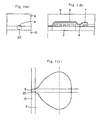
- the thin-film head of this invention is characterized by including a magnetic member for a return path which is so shaped adjacent to a sliding surface adapted to face a magnetic recording medium, as to extend not only in the area facing a main magnetic-pole film, but also along the track width, though it has a portion interrupted by a non-magnetic material, as shown in FIGURES 1(a) to 1(c).
- the thin-film head of this invention can be manufactured easily and efficiently by using a grooved magnetic substrate 1 composed of a magnetic material, such as Ni-Zn or Mn-Zn ferrite, and having a principal surface formed with a plurality of spaced apart main grooves 2 each having a flat or stepped bottom, and a plurality of spaced apart narrow grooves 20 crossing the main grooves 2 at right angles thereto, the grooves 2 and 20 being filled with a non-magnetic material 3, such as glass, SiO2, Al2O3 or barium titanate, as shown in FIGURE 2.
- a non-magnetic material such as glass, SiO2, Al2O3 or barium titanate
- Each main or first groove 2 serves to prevent the leakage of magnetic flux between a main magnetic pole and a magnetic member for a return path.
- Each narrow or second groove 20 defines a gap layer having a width which is slightly (1 to 100 microns) larger than the track width.
- the substrate 1 is used to make by a process including a series of steps a plurality of perpendicular thin-film heads each having a narrow groove 20 which is specifically sized and shaped relative to a main magnetic-pole film 8 in the sliding surface along which a magnetic recording medium is slidable, as shown in FIGURE 1(a).
- the magnetic head of this invention enables the magnetic flux produced by the main magnetic-pole film to return not only to the area facing it, but also along the track width, and exhibits improved recording and reproducing properties.
- Each of the main grooves 2 in the principal surface of the magnetic substrate 1 preferably has a width which is equal to the distance between the end of the thick magnetic film 7 and the end of the via hole portion 6 when the thin-film head assembly is made, and a depth of 3 to 100 microns
- each narrow groove 20 preferably has a width which is larger by 1 to 100 microns than that of the main magnetic-pole film 8, and a depth of 3 to 100 microns which is at least equal to that of the main groove 2.
- a plurality of main grooves each having a width of 0.15 mm, a depth of 0.025 mm and a length of 50 mm were formed by machining in a precisely finished surface of a substrate formed from Ni-Zn ferrite.
- a plurality of narrow grooves each having a width of 0.075 mm, a depth of 0.025 mm and a length of 50 mm were likewise formed so as to cross the main grooves at right angles thereto.
- the grooves were filled with Al2O3 in such a way that it might not form any more than one bubble larger than 5 microns per cubic millimeter.
- the surface of the substrate was mechanochemically polished.
- a copper film was formed by sputtering to form a thin-film conductor coil in a particular pattern on the polished surface of the substrate.
- An interlaminar insulating film was formed from a polyimide resin to cover the coil and its surface was smoothed by an etchback method.
- a thick magnetic film was formed by sputtering from an amorphous cobalt alloy in a particular pattern over the insulating film.
- a thin main magnetic-pole film was formed by sputtering from an amorphous cobalt alloy in a particular pattern on the thick magnetic film.
- a protective film was formed from Al2O3 on the top of the whole assembly.
- the assembly was cut to an appropriate size and shape to give a perpendicular thin-film head including a magnetic member for a return path having a specific groove configuration relative to the main magnetic-pole film in its sliding surface adapted to face a recording medium.
- a perpendicular thin-film head was likewise made from a substrate of Ni-Zn ferrite having a groove measuring 0.3 mm in width and 0.025 mm in depth, filled with glass, and defining a conventional gap layer.
- the two heads having different groove configurations were tested for their reproducing output characteristics.
- the characteristics were determined by self recording and reproducing under the conditions as set forth below.
- Powder - MgO powder having a particle size not exceeding 0.02 micron
- Machine used A 15 inch single-sided lapping machine
- Diamond - Powder having a particle size of 0.5 to 1 micron
Landscapes
- Engineering & Computer Science (AREA)
- Manufacturing & Machinery (AREA)
- Magnetic Heads (AREA)
Abstract
Description
- This invention relates to an improvement in a thin-film perpendicular magnetic recording and reproducing head for a computer, tape, picture recording, etc. More particularly, it is a thin-film perpendicular magnetic recording and reproducing head which comprises a magnetic member for a return path adapted to face a magnetic recording medium, and having orthogonal grooves filled with a non-magnetic material, and a plurality of layers formed one upon another immediately above the intersection of the grooves, and which exhibits improved output characteristics attained by the exposure of the magnetic member on its side facing a main magnetic-pole film and along the track width.
- A thin-film perpendicular magnetic recording and reproducing head (hereinafter referred to simply as "thin-film magnetic head") generally has a very small magnetic circuit and employs a thin magnetic film having a high permeability and a high saturation magnetic flux density, and is, therefore, suitable for achieving a high recording density. It has a high degree of dimensional accuracy and yet is inexpensive, as it is manufactured by a process based on semiconductor technology. This type of head is, therefore, expected to become a main type of perpendicular magnetic head.
- The thin-film magnetic heads include an inductive head which is used for recording or reproducing, and a head of the magnetic resistance effect type for reproducing.
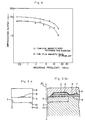
- Reference is made to FIGURES 5(a) and 5(b) of the accompanying drawings, which are a schematic front elevational view showing that surface of the transducer portion of a known thin-film head which is adapted to face a magnetic recording medium, and a perpendicular sectional and side elevational view of the head, respectively. The head comprises a
magnetic member 10 composed of e.g. soft ferrite, anon-magnetic material 3 forming a gap layer, a thin-film conductor coil 4, aninsulating film layer 5, a thickmagnetic film 7 formed from e.g. a Permalloy, Sendust, or amorphous cobalt alloy and serving to prevent the magnetic saturation of a main magnetic-pole film during recording, the main magnetic-pole film 8, and aprotective film 9, which lie one upon another as shown in FIGURE 5(b). - In this type of head, a plurality of layers have ends exposed in a surface facing the
magnetic recording medium 30, and themagnetic member 10 for a return path to therecording medium 30 has agroove 2 which is filled with thenon-magnetic material 3. Thenon-magnetic material 3 and themagnetic member 10, however, have therebetween aboundary plane 12 which is parallel to the main magnetic-pole film 8, as shown in FIGURE 5(a). This arrangement allows the magnetic flux produced by the main magnetic pole to return only to the surface facing it, and disables the head to produce a satisfactorily high reproducing output. - Under these circumstances, it is an object of this invention to provide a thin-film perpendicular magnetic recording and reproducing head which enables the effective return of the magnetic flux produced by the main magnetic pole and thereby exhibits improved reproducing output characteristics.
- We, the inventors of this invention, have done a great deal of research work to realize a magnetic member for a return path along which the magnetic flux can be returned effectively, and thereby a thin-film magnetic head having an improved reproducing output, and have found that a head including a magnetic member having orthogonal grooves, and at least a thin-film conductor coil, an inter-laminar insulating film, a main magnetic-pole film and a protective film formed one upon another immediately above the intersection of the grooves enables the magnetic flux to return not only to the area facing the main magnetic-pole film, but also along the track width, and exhibits an improved reproducing output.
- The object of this invention is, therefore, attained by a thin-film perpendicular magnetic recording and reproducing head including a magnetic member for a return path having a principal surface formed with a first groove extending in parallel to a sliding surface adapted to face a magnetic recording medium, a non-magnetic material filling the groove, and at least a thin-film conductor coil, an interlaminar insulating film, a main magnetic-pole film and a protective film formed one upon another, the magnetic member being connected to the main magnetic-pole film though a via hole portion, the head having an exposed laminated surface defining the sliding surface, characterized in that the magnetic member has also a second groove formed in its principal surface, crossing the first groove orthogonally, and filled with a non-magnetic material, the conductor coil and the films being formed immediately above the intersection of the first and second narrow groove, the second groove being exposed in the sliding surface, and having a width which is smaller than that of the first groove, and is larger by 1 to 100 microns than that of the main magnetic-pole film adjacent to its end exposed in the sliding surface, and a depth of 3 to 100 microns which is equal to, or larger than, that of the first groove, the magnetic member being exposed in the laminated surface in the vicinity of the main magnetic-pole film adjacent to its exposed end.
-
- FIGURES 1(a), 1(b) and 1(c) are schematic front elevational, perpendicular sectional, and top plain views, respectively, of a thin-film magnetic head embodying this invention;
- FIGURE 2 is a perspective view of a magnetic substrate embodying this invention;
- FIGURES 3(a) to 3(f) are a set of views illustrating a process for manufacturing the thin-film magnetic head of this invention;
- FIGURE 4 is a graph comparing the reproducing outputs of the thin-film magnetic head of this invention and a known head; and
- FIGURES 5(a) and 5(b) are schematic front elevational and perpendicular sectional views, respectively, of the known thin-film magnetic head.
- The thin-film head of this invention is characterized by including a magnetic member for a return path which is so shaped adjacent to a sliding surface adapted to face a magnetic recording medium, as to extend not only in the area facing a main magnetic-pole film, but also along the track width, though it has a portion interrupted by a non-magnetic material, as shown in FIGURES 1(a) to 1(c).
- The thin-film head of this invention can be manufactured easily and efficiently by using a grooved
magnetic substrate 1 composed of a magnetic material, such as Ni-Zn or Mn-Zn ferrite, and having a principal surface formed with a plurality of spaced apartmain grooves 2 each having a flat or stepped bottom, and a plurality of spaced apartnarrow grooves 20 crossing themain grooves 2 at right angles thereto, thegrooves non-magnetic material 3, such as glass, SiO₂, Al₂O₃ or barium titanate, as shown in FIGURE 2. - Each main or
first groove 2 serves to prevent the leakage of magnetic flux between a main magnetic pole and a magnetic member for a return path. Each narrow orsecond groove 20 defines a gap layer having a width which is slightly (1 to 100 microns) larger than the track width. Thesubstrate 1 is used to make by a process including a series of steps a plurality of perpendicular thin-film heads each having anarrow groove 20 which is specifically sized and shaped relative to a main magnetic-pole film 8 in the sliding surface along which a magnetic recording medium is slidable, as shown in FIGURE 1(a). - The magnetic head of this invention enables the magnetic flux produced by the main magnetic-pole film to return not only to the area facing it, but also along the track width, and exhibits improved recording and reproducing properties.
- A process for manufacturing the thin-film magnetic head of this invention will now be described by way of example with reference to FIGURES 2 and 3(a) to 3(f).
- (1) A plurality of spaced apart
main grooves 2 and a plurality of spaced apartnarrow grooves 20 crossing themain grooves 2 are formed in one principal surface of amagnetic substrate 1 formed from Ni-Zn or Mn-Zn ferrite, as shown in FIGURE 2. Anon-magnetic material 3, such as glass, SiO₂, Al₂O₃ or barium titanate, is caused by melting or sputtering to fill thegrooves substrate 1 carrying thenon-magnetic material 3 in thegrooves substrate 1 as shown in FIGURE 2 is obtained. - (2) The
magnetic substrate 1 is cut to form a plurality ofmagnetic members 10. A thin-film conductor coil 4 is formed by sputtering or vacuum deposition from e.g. Au, Cu, Cr or Al on the polished surface of eachmagnetic member 10, as shown in FIGURE 3(a). If themagnetic member 10 is of Mn-Zn ferrite, an insulating film layer is formed thereon before theconductor coil 4 is formed. - (3) An interlaminar
insulating film 5 is formed to make electrical insulation between theconductor coil 4 and a thickmagnetic film 7 defining a main magnetic pole as will hereinafter be described, as shown in FIGURE 3(d). Theinsulating film 5 may be of an inorganic oxide such as SiO₂ or Al₂O₃, or of an organic material such as polyimide. - (4) As the
insulating film 5 has an uneven surface formed by theconductor coil 4, its surface is smoothed by a precision polishing method using e.g. diamond, or by an etchback method until it has a roughness not exceeding 500 Å. - (5) A
via hole portion 6 for connecting themagnetic member 10 to the thickmagnetic film 7 to be formed as will hereinafter be described is formed in theinsulating film 5 by e.g. ionic or chemical etching, as shown in FIGURE 3(c). - (6) The thick
magnetic film 7 is formed by e.g. sputtering, vacuum deposition or ion plating in a particular pattern from e.g. a Permalloy, Sendust, or other iron alloy, or an amorphous material on the Surface of theinsulating film 5 and the surface of themagnetic member 10 in thevia hole portion 6, as shown in FIGURE 3(d). - (7) A main magnetic-
pole film 8 is formed by e.g. sputtering, vacuum deposition or ion plating in a particular pattern on the thickmagnetic film 7, as shown in FIGURE 3(e). - (8) A
protective film 9 is formed over thefilm 8, as shown in FIGURE 3(f). - (9) The assembly is cut to an appropriate size and shape across the main and
narrow grooves - Each of the
main grooves 2 in the principal surface of themagnetic substrate 1 preferably has a width which is equal to the distance between the end of the thickmagnetic film 7 and the end of thevia hole portion 6 when the thin-film head assembly is made, and a depth of 3 to 100 microns, and eachnarrow groove 20 preferably has a width which is larger by 1 to 100 microns than that of the main magnetic-pole film 8, and a depth of 3 to 100 microns which is at least equal to that of themain groove 2. - The invention will now be described more specifically with reference to an example.
- A plurality of main grooves each having a width of 0.15 mm, a depth of 0.025 mm and a length of 50 mm were formed by machining in a precisely finished surface of a substrate formed from Ni-Zn ferrite. A plurality of narrow grooves each having a width of 0.075 mm, a depth of 0.025 mm and a length of 50 mm were likewise formed so as to cross the main grooves at right angles thereto.
- The grooves were filled with Al₂O₃ in such a way that it might not form any more than one bubble larger than 5 microns per cubic millimeter. The surface of the substrate was mechanochemically polished. A copper film was formed by sputtering to form a thin-film conductor coil in a particular pattern on the polished surface of the substrate.
- An interlaminar insulating film was formed from a polyimide resin to cover the coil and its surface was smoothed by an etchback method. A thick magnetic film was formed by sputtering from an amorphous cobalt alloy in a particular pattern over the insulating film. A thin main magnetic-pole film was formed by sputtering from an amorphous cobalt alloy in a particular pattern on the thick magnetic film. A protective film was formed from Al₂O₃ on the top of the whole assembly.
- The assembly was cut to an appropriate size and shape to give a perpendicular thin-film head including a magnetic member for a return path having a specific groove configuration relative to the main magnetic-pole film in its sliding surface adapted to face a recording medium.
- For the sake of comparison, a perpendicular thin-film head was likewise made from a substrate of Ni-Zn ferrite having a groove measuring 0.3 mm in width and 0.025 mm in depth, filled with glass, and defining a conventional gap layer.
- The two heads having different groove configurations were tested for their reproducing output characteristics. The characteristics were determined by self recording and reproducing under the conditions as set forth below.
- CoCr/NiFe double-layered film, perpendicular coercive force Hc = 500 Oe, protective film/carbon.
- Both had a track width, TW, of 50 microns.
- 7.5 m/sec.
- 1800 rpm.
- Machine used - A 15 inch MCP machine;
- Polisher - Nonwoven fabric;
- Powder - MgO powder having a particle size not exceeding 0.02 micron;
- Rotating speed - 20 rpm;
- Pressure - 0.5 kg/mm².
- Machine used - A 15 inch single-sided lapping machine;
- Polisher - An Sn plate;
- Diamond - Powder having a particle size of 0.5 to 1 micron;
- Rotating speed - 30 rpm;
- Pressure - 0.5 kg/mm².
- Disk rotating speed - 1800 rpm;
- Medium - CoCr/NiFe;
- Recording frequency - 0.5 to 20 MHz;
- Recording current - 20 mAp-P;
- Relative velocity - 7.5 m/sec.
- The results are shown in FIGURE 4. As is obvious therefrom, the head of this invention exhibited very good reproducing output characteristics, as compared with the comparative head.
Claims (24)
- A thin-film perpendicular magnetic recording and reproducing head including a magnetic member for a return path having a principal surface formed with a first groove extending in parallel to a sliding surface adapted to face a magnetic recording medium, a non-magnetic material filling said groove, and at least a thin-film conductor coil, an interlaminar insulating film, a main magnetic-pole film and a protective film formed one upon another, the magnetic member being connected to the main magnetic-pole film through a via hole portion, said head having an exposed laminated surface defining said sliding surface, the improvement wherein said magnetic member has also a second groove formed in said principal surface, crossing said first groove at right angles thereto, and filled with a non-magnetic material, said coil and said films being formed immediately above the intersection of said first and second grooves, said second groove being exposed in said sliding surface, and having a width which is slightly larger than that of said main magnetic-pole film adjacent to its end exposed in said sliding surface, and a depth which is at least equal to that of said first groove, said magnetic member being exposed in said laminated surface in the vicinity of said main magnetic-pole film adjacent to said exposed end thereof.
- A thin-film head as set forth in claim 1, wherein said exposed laminated surface is formed by said magnetic member, said non-magnetic material filling said second groove, said main magnetic-pole film and said protective film.
- A thin-film head as set forth in claim 1, wherein said width of said second groove is larger by 1 to 100 microns than that of said main magnetic-pole film, and said depth thereof is from 3 to 100 microns.
- A thin-film head as set forth in claim 1, wherein said magnetic member is of a material selected from the group consisting of Mn-Zn and Ni-Zn ferrites.
- A thin-film head as set forth in claim 1, wherein said non-magnetic material is a material selected from the group consisting of glass, SiO₂, Al₂O₃ and barium titanate.
- A thin-film head as set forth in claim 1, wherein said conductor coil is of a material selected from the group consisting of Au, Cu, Cr and Al.
- A thin-film head as set forth in claim 6, wherein said conductor coil comprises a film formed by a method selected from sputtering and vacuum deposition.
- A thin-film head as set forth in claim 1, wherein said magnetic member is of Mn-Zn ferrite, and is isolated from said conductor coil by an insulating film layer.
- A thin-film head as set forth in claim 1, wherein said insulating film is of a material selected from the group consisting of SiO₂, Al₂O₃ and a polyimide resin.
- A thin-film head as set forth in claim 1, wherein said via hole is defined through an area formed in said insulating film by a method selected from ionic and chemical etching.
- A thin-film head as set forth in claim 1, wherein said main magnetic-pole film and a thick magnetic film on which said main magnetic-pole film lies are of a material selected from the group consisting of iron alloys known as Permalloys and Sendusts, and amorphous alloys.
- A thin-film head as set forth in claim 1, wherein said main magnetic-pole film and a thick magnetic film on which said main magnetic-pole film lies are the products of a method selected from sputtering, vacuum deposition and ion plating.
- A process for manufacturing a thin-film magnetic head comprising:
forming a plurality of spaced apart first grooves and a plurality of spaced apart second grooves crossing said first grooves at right angles thereto in one principal surface of a magnetic substrate;
filling said grooves with a non-magnetic material;
polishing said principal surface;
forming a thin-film conductor coil on said polished surface immediately above each intersection of said first and second grooves defining an individual magnetic substrate;
forming an interlaminar insulating film on said coil and making a smooth surface on said insulating film;
removing a portion of said insulating film to expose a part of said magnetic member for a return path;
forming a thick magnetic film on said surface of said insulating film and said part of said magnetic substrate in such a way as to make a specific pattern;
forming a main magnetic-pole film on said thick magnetic film;
forming a protective film over said main magnetic-pole film to make a laminated assembly; and
cutting said assembly appropriately across said first and second grooves to expose a laminated sliding surface which is adapted to face a magnetic recording medium, and in which said magnetic member is exposed in the vicinity of said main magnetic-pole film, said second grooves having a width which is larger by 1 to 100 microns than that of said main magnetic-pole film adjacent to said sliding surface, and a depth of 3 to 100 microns which is at least equal to that of said first grooves. - A process as set forth in claim 13, wherein said exposed sliding surface is defined by said magnetic member, said non-magnetic material filling said second grooves, said main magnetic-pole film and said protective film.
- A process as set forth in claim 13, wherein said magnetic substrate is formed from a material selected from the group consisting of Mn-Zn and Ni-Zn ferrites.
- A process as set forth in claim 13, wherein said substrate is formed from Mn-Zn-Zn ferrite, and an insulating layer is provided between said magnetic member and said coil.
- A process as set forth in claim 13, wherein said non-magnetic material is selected from the group consisting of glass, SiO₂, Al₂O₃ and barium titanate.
- A process as set forth in claim 13, wherein said conductor coil is formed from a material selected from the group consisting of Au, Cu, Cr and Al.
- A process as set forth in claim 18, wherein said coil is formed by a method selected from sputtering and vacuum deposition.
- A process as set forth in claim 13, wherein said insulating film is formed from a material selected from the group consisting of SiO₂, Al₂O₃ and a polyimide resin.
- A process as set forth in claim 13, wherein said smooth surface is made on said insulating film by a method selected from precision polishing and etching.
- A process as set forth in claim 13, wherein said portion of said insulating film is removed by a method selected from ionic and chemical etching.
- A process as set forth in claim 13, wherein said thick magnetic film and said main magnetic-pole film are formed from a material selected from the group consisting of iron alloys known as Permalloys and Sendusts, and amorphous alloys.
- A process as set forth in claim 23, wherein said thick magnetic film and said main magnetic-pole film are formed by a method selected from sputtering, evaporation and plating.
Applications Claiming Priority (2)
| Application Number | Priority Date | Filing Date | Title |
|---|---|---|---|
| JP50292/90 | 1990-02-28 | ||
| JP2050292A JPH03252906A (en) | 1990-02-28 | 1990-02-28 | Thin-film head for perpendicular magnetic recording and reproducing |
Publications (2)
| Publication Number | Publication Date |
|---|---|
| EP0444903A2 true EP0444903A2 (en) | 1991-09-04 |
| EP0444903A3 EP0444903A3 (en) | 1992-01-08 |
Family
ID=12854837
Family Applications (1)
| Application Number | Title | Priority Date | Filing Date |
|---|---|---|---|
| EP19910301595 Withdrawn EP0444903A3 (en) | 1990-02-28 | 1991-02-27 | Thin-film perpendicular magnetic recording and reproducing head |
Country Status (3)
| Country | Link |
|---|---|
| US (1) | US5198950A (en) |
| EP (1) | EP0444903A3 (en) |
| JP (1) | JPH03252906A (en) |
Families Citing this family (3)
| Publication number | Priority date | Publication date | Assignee | Title |
|---|---|---|---|---|
| JP3943337B2 (en) * | 2000-11-10 | 2007-07-11 | Tdk株式会社 | Manufacturing method of thin film magnetic head |
| US6882258B2 (en) * | 2001-02-27 | 2005-04-19 | General Electric Company | Mechanical bell alarm assembly for a circuit breaker |
| US7116517B1 (en) * | 2002-12-18 | 2006-10-03 | Western Digital (Fremont), Inc. | Stitched pole write element with a T-shaped pole tip portion |
Family Cites Families (5)
| Publication number | Priority date | Publication date | Assignee | Title |
|---|---|---|---|---|
| JPS57123516A (en) * | 1981-01-23 | 1982-08-02 | Matsushita Electric Ind Co Ltd | Thin-film magnetic head |
| JPS59203213A (en) * | 1983-05-04 | 1984-11-17 | Sumitomo Special Metals Co Ltd | Magnetic substrate of groove structure and its production |
| DE3527468A1 (en) * | 1984-08-01 | 1986-02-06 | Matsushita Electric Industrial Co., Ltd., Kadoma, Osaka | MAGNETIC HEAD FOR CROSS-MAGNETIC RECORDING AND PLAYBACK |
| US4777074A (en) * | 1985-08-12 | 1988-10-11 | Sumitomo Special Metals Co., Ltd. | Grooved magnetic substrates and method for producing the same |
| JPS63195816A (en) * | 1987-02-09 | 1988-08-12 | Sumitomo Special Metals Co Ltd | Production of thin film head |
-
1990
- 1990-02-28 JP JP2050292A patent/JPH03252906A/en active Pending
-
1991
- 1991-02-14 US US07/655,167 patent/US5198950A/en not_active Expired - Fee Related
- 1991-02-27 EP EP19910301595 patent/EP0444903A3/en not_active Withdrawn
Also Published As
| Publication number | Publication date |
|---|---|
| JPH03252906A (en) | 1991-11-12 |
| US5198950A (en) | 1993-03-30 |
| EP0444903A3 (en) | 1992-01-08 |
Similar Documents
| Publication | Publication Date | Title |
|---|---|---|
| US5225953A (en) | Magnetic thin film head of a single magnetic pole for perpendicular recording and reproduction | |
| US6190764B1 (en) | Inductive write head for magnetic data storage media | |
| CA1147855A (en) | Thin film magnetic head | |
| CA1151767A (en) | Magnetic head for perpendicular magnetic recording system | |
| EP0281931B1 (en) | Magnetic head | |
| EP0357236A2 (en) | A batch fabrication process for magnetic heads | |
| US5181151A (en) | Thin-film perpendicular magnetic recording and reproducing head having thin magnetic shield film on side surfaces | |
| US5167062A (en) | Method of manufacturing magnetic write/read head and fabrication method | |
| US6101067A (en) | Thin film magnetic head with a particularly shaped magnetic pole piece and spaced relative to an MR element | |
| US6504677B1 (en) | Multi-layer stitched write head design for high data rate application | |
| US4843507A (en) | Magnetic head with laminated structure | |
| US4768121A (en) | Magnetic head formed by composite main pole film and winding core for perpendicular magnetic recording | |
| US4811142A (en) | Magnetic head for vertical magnetic recording and method of producing same | |
| US5198950A (en) | Thin-film perpendicular magnetic recording and reproducing head | |
| US5218499A (en) | Thin-film magnetic head for perpendicular magnetic recording having a magnetic member with grooves crossing at right angles formed in a principal surface thereof | |
| US5267392A (en) | Method of manufacturing a laminated high frequency magnetic transducer | |
| JPH06338033A (en) | Composite thin film magnetic head | |
| KR950009849B1 (en) | Magnetic head | |
| JP2720097B2 (en) | Perpendicular magnetic recording / reproducing thin film head | |
| JPH03252909A (en) | Magnetic substrate of groove structure for thin-film head for perpendicular magnetic recording and reproducing | |
| JPS6362804B2 (en) | ||
| JPS62114113A (en) | thin film magnetic head | |
| US5778514A (en) | Method for forming a transducing head | |
| JP2761969B2 (en) | Laminated substrate for perpendicular magnetic recording / reproducing thin film head | |
| JPH04307408A (en) | Perpendicular magnetic recording and reproducing thin film head |
Legal Events
| Date | Code | Title | Description |
|---|---|---|---|
| PUAI | Public reference made under article 153(3) epc to a published international application that has entered the european phase |
Free format text: ORIGINAL CODE: 0009012 |
|
| AK | Designated contracting states |
Kind code of ref document: A2 Designated state(s): DE FR NL |
|
| PUAL | Search report despatched |
Free format text: ORIGINAL CODE: 0009013 |
|
| AK | Designated contracting states |
Kind code of ref document: A3 Designated state(s): DE FR NL |
|
| 17P | Request for examination filed |
Effective date: 19920706 |
|
| 17Q | First examination report despatched |
Effective date: 19940802 |
|
| STAA | Information on the status of an ep patent application or granted ep patent |
Free format text: STATUS: THE APPLICATION IS DEEMED TO BE WITHDRAWN |
|
| 18D | Application deemed to be withdrawn |
Effective date: 19941213 |