EP0445589A2 - Verfahren zur Herstellung von 1,4-Alkylendiaminen - Google Patents
Verfahren zur Herstellung von 1,4-Alkylendiaminen Download PDFInfo
- Publication number
- EP0445589A2 EP0445589A2 EP91102495A EP91102495A EP0445589A2 EP 0445589 A2 EP0445589 A2 EP 0445589A2 EP 91102495 A EP91102495 A EP 91102495A EP 91102495 A EP91102495 A EP 91102495A EP 0445589 A2 EP0445589 A2 EP 0445589A2
- Authority
- EP
- European Patent Office
- Prior art keywords
- oxides
- hydrogen
- catalyst
- hydrogenation catalysts
- nickel
- Prior art date
- Legal status (The legal status is an assumption and is not a legal conclusion. Google has not performed a legal analysis and makes no representation as to the accuracy of the status listed.)
- Granted
Links
- 238000000034 method Methods 0.000 title claims abstract description 16
- 238000002360 preparation method Methods 0.000 title claims abstract description 5
- 239000003054 catalyst Substances 0.000 claims abstract description 38
- 238000005984 hydrogenation reaction Methods 0.000 claims abstract description 23
- 239000001257 hydrogen Substances 0.000 claims abstract description 20
- 229910052739 hydrogen Inorganic materials 0.000 claims abstract description 20
- XEEYBQQBJWHFJM-UHFFFAOYSA-N Iron Chemical compound [Fe] XEEYBQQBJWHFJM-UHFFFAOYSA-N 0.000 claims abstract description 18
- PXHVJJICTQNCMI-UHFFFAOYSA-N Nickel Chemical compound [Ni] PXHVJJICTQNCMI-UHFFFAOYSA-N 0.000 claims abstract description 18
- UFHFLCQGNIYNRP-UHFFFAOYSA-N Hydrogen Chemical compound [H][H] UFHFLCQGNIYNRP-UHFFFAOYSA-N 0.000 claims abstract description 16
- 229910052742 iron Inorganic materials 0.000 claims abstract description 9
- WPBNNNQJVZRUHP-UHFFFAOYSA-L manganese(2+);methyl n-[[2-(methoxycarbonylcarbamothioylamino)phenyl]carbamothioyl]carbamate;n-[2-(sulfidocarbothioylamino)ethyl]carbamodithioate Chemical compound [Mn+2].[S-]C(=S)NCCNC([S-])=S.COC(=O)NC(=S)NC1=CC=CC=C1NC(=S)NC(=O)OC WPBNNNQJVZRUHP-UHFFFAOYSA-L 0.000 claims abstract description 9
- 229910052759 nickel Inorganic materials 0.000 claims abstract description 9
- VYZAMTAEIAYCRO-UHFFFAOYSA-N Chromium Chemical compound [Cr] VYZAMTAEIAYCRO-UHFFFAOYSA-N 0.000 claims abstract description 8
- ZOKXTWBITQBERF-UHFFFAOYSA-N Molybdenum Chemical compound [Mo] ZOKXTWBITQBERF-UHFFFAOYSA-N 0.000 claims abstract description 8
- OAICVXFJPJFONN-UHFFFAOYSA-N Phosphorus Chemical compound [P] OAICVXFJPJFONN-UHFFFAOYSA-N 0.000 claims abstract description 8
- 229910052804 chromium Inorganic materials 0.000 claims abstract description 8
- 239000011651 chromium Substances 0.000 claims abstract description 8
- 229910052750 molybdenum Inorganic materials 0.000 claims abstract description 8
- 239000011733 molybdenum Substances 0.000 claims abstract description 8
- 229910052698 phosphorus Inorganic materials 0.000 claims abstract description 8
- 239000011574 phosphorus Substances 0.000 claims abstract description 8
- 150000002910 rare earth metals Chemical group 0.000 claims abstract description 8
- WFKWXMTUELFFGS-UHFFFAOYSA-N tungsten Chemical compound [W] WFKWXMTUELFFGS-UHFFFAOYSA-N 0.000 claims abstract description 8
- 229910052721 tungsten Inorganic materials 0.000 claims abstract description 8
- 239000010937 tungsten Substances 0.000 claims abstract description 8
- 229910000428 cobalt oxide Inorganic materials 0.000 claims abstract description 7
- IVMYJDGYRUAWML-UHFFFAOYSA-N cobalt(ii) oxide Chemical compound [Co]=O IVMYJDGYRUAWML-UHFFFAOYSA-N 0.000 claims abstract description 7
- 229910052706 scandium Inorganic materials 0.000 claims abstract description 7
- SIXSYDAISGFNSX-UHFFFAOYSA-N scandium atom Chemical compound [Sc] SIXSYDAISGFNSX-UHFFFAOYSA-N 0.000 claims abstract description 7
- 229910052727 yttrium Inorganic materials 0.000 claims abstract description 7
- VWQVUPCCIRVNHF-UHFFFAOYSA-N yttrium atom Chemical compound [Y] VWQVUPCCIRVNHF-UHFFFAOYSA-N 0.000 claims abstract description 7
- 150000002431 hydrogen Chemical class 0.000 claims abstract description 4
- 125000000008 (C1-C10) alkyl group Chemical group 0.000 claims abstract description 3
- 125000001797 benzyl group Chemical group [H]C1=C([H])C([H])=C(C([H])=C1[H])C([H])([H])* 0.000 claims abstract description 3
- 125000001997 phenyl group Chemical group [H]C1=C([H])C([H])=C(*)C([H])=C1[H] 0.000 claims abstract description 3
- 125000001424 substituent group Chemical group 0.000 claims abstract description 3
- 239000003513 alkali Substances 0.000 claims description 5
- 239000000203 mixture Substances 0.000 claims description 5
- 229910052751 metal Inorganic materials 0.000 claims description 3
- 239000002184 metal Substances 0.000 claims description 3
- 150000002739 metals Chemical class 0.000 claims description 3
- 229910052761 rare earth metal Inorganic materials 0.000 claims 1
- 238000006243 chemical reaction Methods 0.000 abstract description 7
- 229910052783 alkali metal Inorganic materials 0.000 abstract description 3
- 150000001340 alkali metals Chemical class 0.000 abstract description 3
- 229910052784 alkaline earth metal Inorganic materials 0.000 abstract description 3
- 150000001342 alkaline earth metals Chemical class 0.000 abstract description 3
- 230000000737 periodic effect Effects 0.000 abstract 1
- QGZKDVFQNNGYKY-UHFFFAOYSA-N Ammonia Chemical compound N QGZKDVFQNNGYKY-UHFFFAOYSA-N 0.000 description 32
- IAHFWCOBPZCAEA-UHFFFAOYSA-N succinonitrile Chemical compound N#CCCC#N IAHFWCOBPZCAEA-UHFFFAOYSA-N 0.000 description 15
- WYURNTSHIVDZCO-UHFFFAOYSA-N Tetrahydrofuran Chemical compound C1CCOC1 WYURNTSHIVDZCO-UHFFFAOYSA-N 0.000 description 12
- 229910021529 ammonia Inorganic materials 0.000 description 11
- 239000000243 solution Substances 0.000 description 11
- OKKJLVBELUTLKV-UHFFFAOYSA-N Methanol Chemical compound OC OKKJLVBELUTLKV-UHFFFAOYSA-N 0.000 description 7
- QVYARBLCAHCSFJ-UHFFFAOYSA-N butane-1,1-diamine Chemical compound CCCC(N)N QVYARBLCAHCSFJ-UHFFFAOYSA-N 0.000 description 6
- 229910000069 nitrogen hydride Inorganic materials 0.000 description 5
- IJGRMHOSHXDMSA-UHFFFAOYSA-N Atomic nitrogen Chemical compound N#N IJGRMHOSHXDMSA-UHFFFAOYSA-N 0.000 description 4
- VYPSYNLAJGMNEJ-UHFFFAOYSA-N Silicium dioxide Chemical compound O=[Si]=O VYPSYNLAJGMNEJ-UHFFFAOYSA-N 0.000 description 4
- GUTLYIVDDKVIGB-UHFFFAOYSA-N cobalt atom Chemical class [Co] GUTLYIVDDKVIGB-UHFFFAOYSA-N 0.000 description 4
- JEIPFZHSYJVQDO-UHFFFAOYSA-N iron(III) oxide Inorganic materials O=[Fe]O[Fe]=O JEIPFZHSYJVQDO-UHFFFAOYSA-N 0.000 description 4
- 239000007788 liquid Substances 0.000 description 4
- 239000002904 solvent Substances 0.000 description 4
- WEOKHGKSYLOTPP-UHFFFAOYSA-N 2-methylbutanedinitrile Chemical compound N#CC(C)CC#N WEOKHGKSYLOTPP-UHFFFAOYSA-N 0.000 description 3
- LFQSCWFLJHTTHZ-UHFFFAOYSA-N Ethanol Chemical compound CCO LFQSCWFLJHTTHZ-UHFFFAOYSA-N 0.000 description 3
- CPLXHLVBOLITMK-UHFFFAOYSA-N Magnesium oxide Chemical compound [Mg]=O CPLXHLVBOLITMK-UHFFFAOYSA-N 0.000 description 3
- ZMXDDKWLCZADIW-UHFFFAOYSA-N N,N-Dimethylformamide Chemical compound CN(C)C=O ZMXDDKWLCZADIW-UHFFFAOYSA-N 0.000 description 3
- RWRDLPDLKQPQOW-UHFFFAOYSA-N Pyrrolidine Chemical compound C1CCNC1 RWRDLPDLKQPQOW-UHFFFAOYSA-N 0.000 description 3
- CDBYLPFSWZWCQE-UHFFFAOYSA-L Sodium Carbonate Chemical compound [Na+].[Na+].[O-]C([O-])=O CDBYLPFSWZWCQE-UHFFFAOYSA-L 0.000 description 3
- -1 butane diamine Chemical class 0.000 description 3
- 239000010941 cobalt Substances 0.000 description 3
- 229910017052 cobalt Inorganic materials 0.000 description 3
- AMWRITDGCCNYAT-UHFFFAOYSA-L manganese oxide Inorganic materials [Mn].O[Mn]=O.O[Mn]=O AMWRITDGCCNYAT-UHFFFAOYSA-L 0.000 description 3
- 238000004519 manufacturing process Methods 0.000 description 3
- 239000000463 material Substances 0.000 description 3
- GNRSAWUEBMWBQH-UHFFFAOYSA-N nickel(II) oxide Inorganic materials [Ni]=O GNRSAWUEBMWBQH-UHFFFAOYSA-N 0.000 description 3
- 239000000047 product Substances 0.000 description 3
- 239000011541 reaction mixture Substances 0.000 description 3
- 239000000126 substance Substances 0.000 description 3
- YLQBMQCUIZJEEH-UHFFFAOYSA-N tetrahydrofuran Natural products C=1C=COC=1 YLQBMQCUIZJEEH-UHFFFAOYSA-N 0.000 description 3
- KKCBUQHMOMHUOY-UHFFFAOYSA-N Na2O Inorganic materials [O-2].[Na+].[Na+] KKCBUQHMOMHUOY-UHFFFAOYSA-N 0.000 description 2
- NBIIXXVUZAFLBC-UHFFFAOYSA-N Phosphoric acid Chemical compound OP(O)(O)=O NBIIXXVUZAFLBC-UHFFFAOYSA-N 0.000 description 2
- UIIMBOGNXHQVGW-UHFFFAOYSA-M Sodium bicarbonate Chemical compound [Na+].OC([O-])=O UIIMBOGNXHQVGW-UHFFFAOYSA-M 0.000 description 2
- GWEVSGVZZGPLCZ-UHFFFAOYSA-N Titan oxide Chemical compound O=[Ti]=O GWEVSGVZZGPLCZ-UHFFFAOYSA-N 0.000 description 2
- WGLPBDUCMAPZCE-UHFFFAOYSA-N Trioxochromium Chemical compound O=[Cr](=O)=O WGLPBDUCMAPZCE-UHFFFAOYSA-N 0.000 description 2
- 239000007864 aqueous solution Substances 0.000 description 2
- AXCZMVOFGPJBDE-UHFFFAOYSA-L calcium dihydroxide Chemical compound [OH-].[OH-].[Ca+2] AXCZMVOFGPJBDE-UHFFFAOYSA-L 0.000 description 2
- 239000000920 calcium hydroxide Substances 0.000 description 2
- 229910001861 calcium hydroxide Inorganic materials 0.000 description 2
- UFMZWBIQTDUYBN-UHFFFAOYSA-N cobalt dinitrate Chemical compound [Co+2].[O-][N+]([O-])=O.[O-][N+]([O-])=O UFMZWBIQTDUYBN-UHFFFAOYSA-N 0.000 description 2
- 229910001981 cobalt nitrate Inorganic materials 0.000 description 2
- 230000000052 comparative effect Effects 0.000 description 2
- QDOXWKRWXJOMAK-UHFFFAOYSA-N dichromium trioxide Chemical compound O=[Cr]O[Cr]=O QDOXWKRWXJOMAK-UHFFFAOYSA-N 0.000 description 2
- 238000004821 distillation Methods 0.000 description 2
- MVFCKEFYUDZOCX-UHFFFAOYSA-N iron(2+);dinitrate Chemical compound [Fe+2].[O-][N+]([O-])=O.[O-][N+]([O-])=O MVFCKEFYUDZOCX-UHFFFAOYSA-N 0.000 description 2
- MRELNEQAGSRDBK-UHFFFAOYSA-N lanthanum oxide Inorganic materials [O-2].[O-2].[O-2].[La+3].[La+3] MRELNEQAGSRDBK-UHFFFAOYSA-N 0.000 description 2
- 239000000395 magnesium oxide Substances 0.000 description 2
- NUJOXMJBOLGQSY-UHFFFAOYSA-N manganese dioxide Chemical compound O=[Mn]=O NUJOXMJBOLGQSY-UHFFFAOYSA-N 0.000 description 2
- MIVBAHRSNUNMPP-UHFFFAOYSA-N manganese(2+);dinitrate Chemical compound [Mn+2].[O-][N+]([O-])=O.[O-][N+]([O-])=O MIVBAHRSNUNMPP-UHFFFAOYSA-N 0.000 description 2
- JKQOBWVOAYFWKG-UHFFFAOYSA-N molybdenum trioxide Chemical compound O=[Mo](=O)=O JKQOBWVOAYFWKG-UHFFFAOYSA-N 0.000 description 2
- 229910052757 nitrogen Inorganic materials 0.000 description 2
- KTUFCUMIWABKDW-UHFFFAOYSA-N oxo(oxolanthaniooxy)lanthanum Chemical compound O=[La]O[La]=O KTUFCUMIWABKDW-UHFFFAOYSA-N 0.000 description 2
- 239000000843 powder Substances 0.000 description 2
- 239000008262 pumice Substances 0.000 description 2
- KIDHWZJUCRJVML-UHFFFAOYSA-N putrescine Chemical compound NCCCCN KIDHWZJUCRJVML-UHFFFAOYSA-N 0.000 description 2
- 239000000377 silicon dioxide Substances 0.000 description 2
- KDYFGRWQOYBRFD-UHFFFAOYSA-N succinic acid Chemical compound OC(=O)CCC(O)=O KDYFGRWQOYBRFD-UHFFFAOYSA-N 0.000 description 2
- DLYUQMMRRRQYAE-UHFFFAOYSA-N tetraphosphorus decaoxide Chemical compound O1P(O2)(=O)OP3(=O)OP1(=O)OP2(=O)O3 DLYUQMMRRRQYAE-UHFFFAOYSA-N 0.000 description 2
- RYHBNJHYFVUHQT-UHFFFAOYSA-N 1,4-Dioxane Chemical compound C1COCCO1 RYHBNJHYFVUHQT-UHFFFAOYSA-N 0.000 description 1
- ODINCKMPIJJUCX-UHFFFAOYSA-N Calcium oxide Chemical compound [Ca]=O ODINCKMPIJJUCX-UHFFFAOYSA-N 0.000 description 1
- OKTJSMMVPCPJKN-UHFFFAOYSA-N Carbon Chemical compound [C] OKTJSMMVPCPJKN-UHFFFAOYSA-N 0.000 description 1
- SECXISVLQFMRJM-UHFFFAOYSA-N N-Methylpyrrolidone Chemical compound CN1CCCC1=O SECXISVLQFMRJM-UHFFFAOYSA-N 0.000 description 1
- 239000004677 Nylon Substances 0.000 description 1
- 239000004480 active ingredient Substances 0.000 description 1
- 239000011149 active material Substances 0.000 description 1
- 150000001298 alcohols Chemical class 0.000 description 1
- 229910000147 aluminium phosphate Inorganic materials 0.000 description 1
- 150000001412 amines Chemical class 0.000 description 1
- 230000015572 biosynthetic process Effects 0.000 description 1
- 239000001273 butane Substances 0.000 description 1
- 239000011575 calcium Substances 0.000 description 1
- 229910052799 carbon Inorganic materials 0.000 description 1
- 239000000969 carrier Substances 0.000 description 1
- 229910000421 cerium(III) oxide Inorganic materials 0.000 description 1
- 239000000470 constituent Substances 0.000 description 1
- 238000001816 cooling Methods 0.000 description 1
- 150000004292 cyclic ethers Chemical class 0.000 description 1
- 230000006837 decompression Effects 0.000 description 1
- 238000010790 dilution Methods 0.000 description 1
- 239000012895 dilution Substances 0.000 description 1
- NLQFUUYNQFMIJW-UHFFFAOYSA-N dysprosium(III) oxide Inorganic materials O=[Dy]O[Dy]=O NLQFUUYNQFMIJW-UHFFFAOYSA-N 0.000 description 1
- VQCBHWLJZDBHOS-UHFFFAOYSA-N erbium(III) oxide Inorganic materials O=[Er]O[Er]=O VQCBHWLJZDBHOS-UHFFFAOYSA-N 0.000 description 1
- 150000002170 ethers Chemical class 0.000 description 1
- 238000001914 filtration Methods 0.000 description 1
- 150000003948 formamides Chemical class 0.000 description 1
- CMIHHWBVHJVIGI-UHFFFAOYSA-N gadolinium(III) oxide Inorganic materials [O-2].[O-2].[O-2].[Gd+3].[Gd+3] CMIHHWBVHJVIGI-UHFFFAOYSA-N 0.000 description 1
- 239000007789 gas Substances 0.000 description 1
- 239000008187 granular material Substances 0.000 description 1
- 230000002779 inactivation Effects 0.000 description 1
- 239000011261 inert gas Substances 0.000 description 1
- 239000000543 intermediate Substances 0.000 description 1
- AXZKOIWUVFPNLO-UHFFFAOYSA-N magnesium;oxygen(2-) Chemical compound [O-2].[Mg+2] AXZKOIWUVFPNLO-UHFFFAOYSA-N 0.000 description 1
- 239000011572 manganese Substances 0.000 description 1
- 229910044991 metal oxide Inorganic materials 0.000 description 1
- 150000004706 metal oxides Chemical class 0.000 description 1
- OFBQJSOFQDEBGM-UHFFFAOYSA-N n-pentane Natural products CCCCC OFBQJSOFQDEBGM-UHFFFAOYSA-N 0.000 description 1
- PLDDOISOJJCEMH-UHFFFAOYSA-N neodymium oxide Inorganic materials [O-2].[O-2].[O-2].[Nd+3].[Nd+3] PLDDOISOJJCEMH-UHFFFAOYSA-N 0.000 description 1
- GNMQOUGYKPVJRR-UHFFFAOYSA-N nickel(III) oxide Inorganic materials [O-2].[O-2].[O-2].[Ni+3].[Ni+3] GNMQOUGYKPVJRR-UHFFFAOYSA-N 0.000 description 1
- KBJMLQFLOWQJNF-UHFFFAOYSA-N nickel(ii) nitrate Chemical compound [Ni+2].[O-][N+]([O-])=O.[O-][N+]([O-])=O KBJMLQFLOWQJNF-UHFFFAOYSA-N 0.000 description 1
- 229920001778 nylon Polymers 0.000 description 1
- TWNQGVIAIRXVLR-UHFFFAOYSA-N oxo(oxoalumanyloxy)alumane Chemical compound O=[Al]O[Al]=O TWNQGVIAIRXVLR-UHFFFAOYSA-N 0.000 description 1
- PZFKDUMHDHEBLD-UHFFFAOYSA-N oxo(oxonickeliooxy)nickel Chemical compound O=[Ni]O[Ni]=O PZFKDUMHDHEBLD-UHFFFAOYSA-N 0.000 description 1
- RVTZCBVAJQQJTK-UHFFFAOYSA-N oxygen(2-);zirconium(4+) Chemical compound [O-2].[O-2].[Zr+4] RVTZCBVAJQQJTK-UHFFFAOYSA-N 0.000 description 1
- RPDHFTHLNASALF-UHFFFAOYSA-N pentane-2,2-diamine Chemical compound CCCC(C)(N)N RPDHFTHLNASALF-UHFFFAOYSA-N 0.000 description 1
- 239000002244 precipitate Substances 0.000 description 1
- 238000001556 precipitation Methods 0.000 description 1
- 238000005086 pumping Methods 0.000 description 1
- 150000003235 pyrrolidines Chemical class 0.000 description 1
- FKTOIHSPIPYAPE-UHFFFAOYSA-N samarium(III) oxide Inorganic materials [O-2].[O-2].[O-2].[Sm+3].[Sm+3] FKTOIHSPIPYAPE-UHFFFAOYSA-N 0.000 description 1
- 150000003335 secondary amines Chemical class 0.000 description 1
- 235000012239 silicon dioxide Nutrition 0.000 description 1
- 239000011734 sodium Substances 0.000 description 1
- 235000017557 sodium bicarbonate Nutrition 0.000 description 1
- 229910000030 sodium bicarbonate Inorganic materials 0.000 description 1
- 235000017550 sodium carbonate Nutrition 0.000 description 1
- 229910000029 sodium carbonate Inorganic materials 0.000 description 1
- 239000000758 substrate Substances 0.000 description 1
- 239000001384 succinic acid Substances 0.000 description 1
- 150000003512 tertiary amines Chemical class 0.000 description 1
- 239000004408 titanium dioxide Substances 0.000 description 1
- ZNOKGRXACCSDPY-UHFFFAOYSA-N tungsten(VI) oxide Inorganic materials O=[W](=O)=O ZNOKGRXACCSDPY-UHFFFAOYSA-N 0.000 description 1
- 239000010457 zeolite Substances 0.000 description 1
- 229910001928 zirconium oxide Inorganic materials 0.000 description 1
Classifications
-
- C—CHEMISTRY; METALLURGY
- C07—ORGANIC CHEMISTRY
- C07C—ACYCLIC OR CARBOCYCLIC COMPOUNDS
- C07C209/00—Preparation of compounds containing amino groups bound to a carbon skeleton
- C07C209/44—Preparation of compounds containing amino groups bound to a carbon skeleton by reduction of carboxylic acids or esters thereof in presence of ammonia or amines, or by reduction of nitriles, carboxylic acid amides, imines or imino-ethers
- C07C209/48—Preparation of compounds containing amino groups bound to a carbon skeleton by reduction of carboxylic acids or esters thereof in presence of ammonia or amines, or by reduction of nitriles, carboxylic acid amides, imines or imino-ethers by reduction of nitriles
Definitions
- This present invention relates to a new process for the preparation of 1,4-alkylenediamines by reacting succinic dinitriles over hydrogenation catalysts, the cobalt oxide and one or more oxides of the elements iron, nickel, manganese, chromium, molybdenum, tungsten, phosphorus and one or more oxides of the Contain alkali, alkaline earth, rare earth group of PSE, scandium and / or yttrium.
- DE-A-902 616 describes a semi-continuous procedure by pumping succinic acid dinitrile in THF to a mixture of Ra-Co, CaO, THF and NH3 at 200 bar H2 (see also Houben Weyl, Vol. XI, I, pp. 558-559 ). The yields are 89-93%. This method is also unsuitable for the production of large amounts of butanediamine, since the catalyst quickly becomes inactive.
- DE-A 954 416 discloses the continuous hydrogenation of succinonitrile over a cobalt catalyst applied to silica strands and neutralized by adding 0.25% phosphoric acid. The yields are approximately 92%.
- DE-A-1 593 764 relates to the continuous hydrogenation in the presence of NH3 over a catalyst which consists of 30% by weight cobalt on pumice and has been impregnated with a 10% by weight aqueous Na2CO3 solution.
- the aforementioned catalysts are characterized by very rapid inactivation. The service life is less than 3 days, as is also shown by comparative example 7.
- hydrogenation catalysts which is characterized in that the hydrogenation catalysts are cobalt oxide and one or more oxides of the elements iron, Contain nickel, manganese, chromium, molybdenum, tungsten, phosphorus and one or more oxides of the alkali, alkaline earth, rare earth group of PSE, scandium and / or yttrium.
- the process according to the invention is generally carried out at temperatures from 30 to 250 ° C., preferably 50 to 170 ° C., in particular 60 to 150 ° C. and pressures from 50 to 350 bar, preferably 150 to 350 bar, using a catalyst, the cobalt oxide and one or more oxides, preferably one to three of the elements iron, nickel, manganese, chromium, molybdenum, tungsten, phosphorus and one or more oxides, preferably one to three oxides, particularly preferably an oxide of the alkali metal, the alkaline earth metal containing rare earth group, scandium or yttrium.
- Suitable oxides of the elements iron, nickel, manganese, chromium, molybdenum, tungsten, phosphorus are, for example, Fe2O3, NiO, Ni2O3, MnO2, Mn3O4, MoO3, CrO3, Cr2O3, WO3 and P2O5.
- Suitable oxides of the alkali or alkaline earth groups are, for example, LiO2, Na2O, K2O, MgO, CaO, SrO and BaO.
- Suitable oxides of the rare earth group are, for example, La2O3, Ce2O3, Gd2O3, Dy2O3, Sm2O3, Nd2O3 or Er2O3.
- Catalytically active mass is understood to mean that mass of the metal oxides mentioned without support materials.
- the catalysts can consist of 5 to 100% by weight of catalytically active material.
- catalysts are e.g. B. those whose catalytically active mass to 20 to 95 wt .-%, preferably 40 to 90 wt .-% cobalt oxide and 0.5 to 60 wt .-%, preferably 1 to 40 wt .-% of one or more oxides of the elements iron, nickel, manganese, chromium, molybdenum, tungsten or phosphorus, preferably one or more oxides of the metals manganese, nickel or iron and 0.5 to 20% by weight of one or more oxides of alkali metal or alkaline earth metal, the rare earth group, scandium or yttrium.
- the catalysts can be used as full catalysts, e.g. B. as granules, or also applied to inert carriers, for example silicon dioxide, aluminum oxide, zeolites, titanium dioxide, magnesium oxide, pumice, zirconium oxide or carbon.
- inert carriers for example silicon dioxide, aluminum oxide, zeolites, titanium dioxide, magnesium oxide, pumice, zirconium oxide or carbon.
- the catalyst, which contains the metallic constituents in the form of their oxides, is usually activated by a hydrogen treatment before use, the oxides being partially reduced to the metals.
- the hydrogen used for the hydrogenation is generally used in a larger stoichiometric excess of 1 to 25 times, preferably 2 to 10 times the amount stoichiometrically necessary. It can be returned to the reaction as cycle gas.
- the hydrogen is generally used in a technically pure manner. Addition of inert gases, e.g. Nitrogen, but do not interfere with the course of the reaction.
- ammonia is advantageous to prevent the formation of secondary amines, e.g. Push back pyrrolidines.
- the molar ratios of ammonia to succinonitriles are from 1: 1 to 100: 1, preferably from 2: 1 to 20: 1.
- the succinic dinitriles of the formula II are used as a substance or as a solution in a suitable solvent.
- suitable solvents are e.g. Ethers such as cyclic ethers e.g. Tetrahydrofuran or dioxane, alcohols such as C1-C4 alcohol, e.g. Methanol or ethanol or other solvents common to hydrogenation such as formamides e.g. Dimethylformamide or N-methyl-pyrrolidone.
- the hydrogenation can be carried out batchwise, preferably continuously on a fixed bed, for example as a trickle or bottoms procedure.
- the procedure is, for example, that a succinonitrile or its solution is placed together with the catalyst in a high-pressure autoclave, ammonia and hydrogen are both injected in excess and the reaction mixture is heated. After the reaction is over cooled, the catalyst separated and the reaction mixture fractionally distilled.
- One proceeds continuously, for example, by metering in succinic dinitriles or their solution, ammonia and hydrogen in the desired ratio from above into a vertical reactor which is coated with one of the catalysts mentioned (trickle mode). The stated pressure and temperature conditions are maintained during the reaction.
- the reaction mixture is cooled and broken down into liquid and gaseous components (hydrogen) in a separator.
- the liquid discharge is freed of ammonia and solvent and purified by distillation. Ammonia, hydrogen and part of the raw discharge can be returned to the reactor to complete the reaction and remove the heat of reaction.
- 1,4-alkylenediamines of the formula I can be obtained in yields> 97% with catalyst service lives> 2 months.
- 1,4-alkylenediamines are valuable intermediates.
- 1,4-butanediamine is used as an amine component in Nylon®-4,6.
- aqueous solution containing cobalt nitrate, iron nitrate and manganese nitrate and a 30% aqueous sodium bicarbonate solution are metered into a stirred tank via separate pumps in such a way that a constant pH of 6.5 is maintained.
- the temperature in the precipitation tank is kept at 50 ° C.
- the precipitate is pumped onto a filter press and washed free of Na.
- the filter paste is mixed in a mixer with calcium hydroxide powder (10% CaO based on the sum of the oxides), dried and calcined at 500 ° C.
- the resulting product is compressed in a kneader and converted into a deformable consistency.
- the material is extruded, dried and calcined again at 650 ° C.
- the 4 mm extrudates have the following chemical composition (calculated without loss on ignition): 65.2 wt% CoO 4.7 wt .-% Mn3O4 10.0 wt% CaO 20.1 wt .-% Fe2O3
- the catalyst pre-product is precipitated, filtered and washed out with soda solution in the same way as described for catalyst A.
- the filter paste is mixed in a mixer with calcium hydroxide powder (10% CaO based on the sum of the oxides), dried and again calcined at 500 ° C.
- the resulting product is compacted in a kneader and transferred into a deformable consistency.
- the material is extruded, dried and calcined again at 650 ° C.
- the 4 mm extrudates have the following chemical composition (calculated without loss on ignition): 69.2% by weight of CoO 4.9% by weight of Mn3O4 5.5% by weight NiO 10.4% by weight Fe2O3 10.0% by weight CaO
- a reactor suitable for the bottom procedure with a length of 2 m and a diameter of 41 mm is filled with catalyst strands with a length of 7 mm and a diameter of 4 mm.
- the catalyst contains the following active ingredients: 70.3% CoO, 10.5% NiO, 5.2% MnO, 14.0% Na2O.
- At the bottom of the reactor is a 40 percent.
- Hydrogen and Ammonia are also introduced from below.
- a circulation of 40 l / h is set.
- the discharge is worked up as described in Example 5.
- the following mass fractions are obtained at 80 ° C.: Butanediamine 98.7%, pyrrolidine ⁇ 0.5%, residue 0.8%.
- Catalyst B The service life of Catalyst B was longer than 2 months, while the other two catalysts forced shutdown after a short time due to blockages.
Landscapes
- Chemical & Material Sciences (AREA)
- Organic Chemistry (AREA)
- Organic Low-Molecular-Weight Compounds And Preparation Thereof (AREA)
- Low-Molecular Organic Synthesis Reactions Using Catalysts (AREA)
Abstract
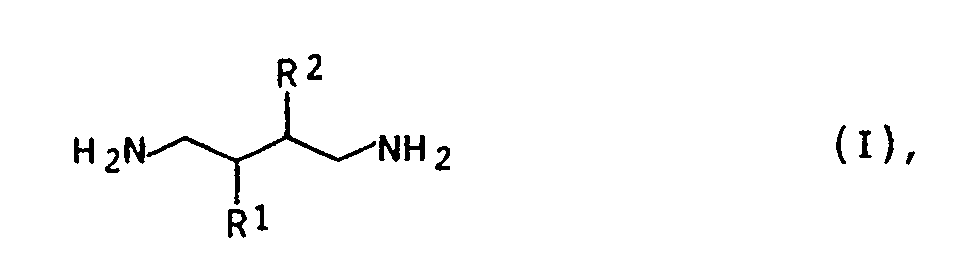
in der die Substituenten R¹ und R² unabhängig voneinander Wasserstoff, C₁- bis C₁₀-Alkyl, Phenyl oder Benzyl bedeuten, durch Umsetzung von Bernsteinsäuredinitrilen der allgemeinen Formel II
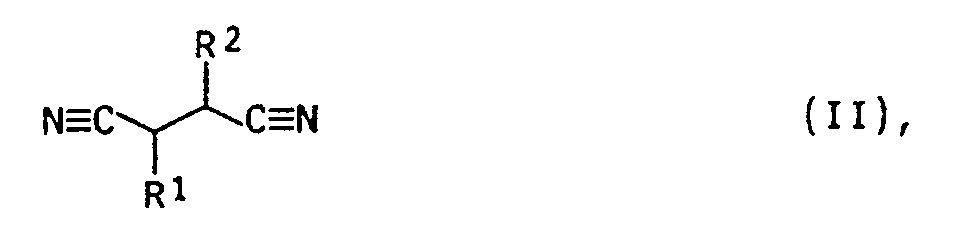
in der R¹ und R² die oben genannten Bedeutungen haben, mit Wasserstoff bei Temperaturen von 30 bis 250°C und Drücken von 50 bis 350 bar an Hydrierkatalysatoren, in dem die Hydrierkatalysatoren Kobaltoxid und ein oder mehrere Oxide der Elemente Eisen, Nickel, Mangan, Chrom, Molybdän, Wolfram, Phosphor und ein oder mehrere Oxide der Alkali-, Erdalkali-, Seltenen Erdengruppe des PSE, von Scandium und/oder von Yttrium enthalten.
Description
- Diese vorliegende Erfindung betrifft ein neues Verfahren zur Herstellung von 1,4-Alkylendiaminen durch Umsetzung von Bernsteinsäuredinitrilen an Hydrierkatalysatoren, die Kobaltoxid und ein oder mehrere Oxide der Elemente Eisen, Nickel, Mangan, Chrom, Molybdän, Wolfram, Phosphor und ein oder mehrere Oxide der Alkali-, Erdalkali-, Seltenen Erdengruppe des PSE, von Scandium und/oder von Yttrium enthalten.
- Aus der US-A-2 166 183 und der US-A-2 232 598 ist die diskontinuierliche Hydrierung von Bernsteinsäuredinitril an aktiviertem Kobaltpulver (im Autoklaven) mit Ausbeuten von 36 bzw. 70 % bekannt. Die JP 47/18809 und die JP 60/260544 geben für die diskontinuierliche Hydrierung von Bernsteinsäuredinitril an Kobalt-Katalysatoren in Gegenwart von Ca(OH)₂ und NH₃ bzw. NH₃ allein, Ausbeuten in Höhe von 68 % bzw. 73 % Butandiamin an. Ebenfalls Butandiaminausbeute von ca. 70 % werden für die diskontinuierliche Hydrierung von Bernsteinsäuredinitril an Ra-Co in Gegenwart von tertiären Aminen in der FR-A-2 248 265 beschrieben. Aus der JP 48/13305 und der JP 54/40524 sind Ausbeuten von 97 % bei der diskontinuierlichen Hydrierung von Bernsteinsäuredinitril an Ra-Co in Gegenwart von NH₃ und Mn bekannt. Dieses Verfahren arbeitet jedoch mit 130 g Katalysator auf 100 g Substrat in hoher Verdünnung und ist deshalb aufgrund seiner geringen Raumzeitausbeute zur Herstellung größerer Mengen Butandiamin ungeeignet.
- Die DE-A-902 616 beschreibt eine halbkontinuierliche Fahrweise durch Zupumpen von Bernsteinsäuredinitril in THF zu einer Mischung aus Ra-Co, CaO, THF und NH₃ bei 200 bar H₂ (s. a. Houben Weyl, Bd. XI, I, S. 558-559). Die Ausbeuten betragen 89-93 %. Auch dieses Verfahren eignet sich nicht zur Herstellung größerer Mengen Butandiamin, da der Katalysator rasch inaktiv wird.
- Aus der DE-A 954 416 ist die kontinuierliche Hydrierung von Bernsteinsäuredinitril an einem auf Kieselsäuresträngen aufgebrachtem, durch Zusatz von 0,25 % Phosphorsäure neutralisiertem, Kobaltkatalysator bekannt. Die Ausbeuten betragen ca. 92 %. Die DE-A-1 593 764 betrifft die kontinuierliche Hydrierung in Gegenwart von NH₃ an einem Katalysator, der aus 30 Gew.- % Kobalt auf Bimsstein besteht und mit einer 10 gew.-%igen wäßrigen Na₂CO₃-Lösung getränkt wurde. Die zuvorgenannten Katalysatoren zeichnen sich jedoch durch sehr rasche Inaktivierung aus. Die Standzeiten liegen unter 3 Tagen wie auch Vergleichsbeispiel 7 zeigt.
- Es bestand deshalb die Aufgabe, ein verfahren zu finden, das den zuvorgenannten Nachteilen abhilft.
- Demgemäß wurde ein neues und verbessertes Verfahren zur Herstellung von 1,4-Alkylendiaminen der allgemeinen Formel I

in der die Substituenten R¹ und R² unabhängig voneinander Wasserstoff, C₁- bis C₁₀-Alkyl, Phenyl oder Benzyl bedeuten, durch Umsetzung von Bernsteinsäuredinitrilen der allgemeinen Formel II
in der R¹ und R² die oben genannten Bedeutungen haben, mit Wasserstoff bei Temperaturen von 30 bis 250°C und Drücken von 50 bis 350 bar an Hydrierkatalysatoren gefunden, welches dadurch gekennzeichnet ist, daß die Hydrierkatalysatoren Kobaltoxid und ein oder mehrere Oxide der Elemente Eisen, Nickel, Mangan, Chrom, Molybdän, Wolfram, Phosphor und ein oder mehrere Oxide der Alkali-, Erdalkali-, Seltenen Erdengruppe des PSE, von Scandium und/oder von Yttrium enthalten. - Nach dem erfindungsgemäßen Verfahren arbeitet man im allgemeinen bei Temperaturen von 30 bis 250°C, vorzugsweise 50 bis 170°C, insbesondere 60 bis 150°C und Drücken von 50 bis 350 bar, vorzugsweise 150 bis 350 bar, wobei man einen Katalysator verwendet, der Kobaltoxid und ein oder mehrere Oxide, vorzugsweise ein bis drei der Elemente Eisen, Nickel, Mangan, Chrom, Molybdän, Wolfram, Phosphor und ein oder mehrere Oxide, vorzugsweise ein bis drei Oxide, besonders bevorzugt ein Oxid der Alkali-, der Erdalkali-, der Seltenen Erdengruppe, Scandium oder Yttrium enthält. Als Oxide der Elemente Eisen, Nickel, Mangan, Chrom, Molybdän, Wolfram, Phosphor eignen sich z.B. Fe₂O₃, NiO, Ni₂O₃, MnO₂, Mn₃O₄, MoO₃, CrO₃, Cr₂O₃, WO₃ und P₂O₅. Als Oxide der Alkali- oder Erdalkaligruppe kommen z.B. LiO₂, Na₂O, K₂O, MgO, CaO, SrO und BaO in Betracht. Als Oxide der Seltenen Erdengruppe eignen sich z.B. La₂O₃, Ce₂O₃, Gd₂O₃, Dy₂O₃, Sm₂O₃, Nd₂O₃ oder Er₂O₃. Unter katalytisch aktiver Masse versteht man diejenige Masse der genannten Metalloxide ohne Trägermaterialien. Die Katalysatoren können von 5 bis 100 Gew.-% aus katalytisch aktiver Masse bestehen.
- Besonders geeignete Katalysatoren sind z. B. solche, deren katalytisch aktive Masse zu 20 bis 95 Gew.-%, vorzugsweise 40 bis 90 Gew.-% Kobaltoxid und 0,5 bis 60 Gew.-%, vorzugsweise 1 bis 40 Gew.-% aus einem oder mehreren Oxiden der Elemente Eisen, Nickel, Mangan, Chrom, Molybdän, Wolfram oder Phosphor, vorzugsweise einem oder mehreren Oxiden der Metalle Mangan, Nickel oder Eisen und 0,5 bis 20 Gew.-% aus einem oder mehreren Oxiden der Alkali- oder Erdalkali-, der Seltenen Erdengruppe, Scandium oder Yttrium bestehen.
- Die Katalysatoren können als Vollkatalysatoren, z. B. als Granulat, oder auch aufgetragen auf inerte Träger, beispielsweise Siliciumdioxid, Aluminiumoxid, Zeolithe, Titandioxid, Magnesiumoxid, Bims, Zirkonoxid oder Kohlenstoff verwendet werden. Der Katalysator, der die metallischen Bestandteile in Form ihrer Oxide enthält, wird in der Regel vor einem Einsatz durch eine Wasserstoffbehandlung aktiviert, wobei die Oxide teilweise zu den Metallen reduziert werden.
- Der zur Hydrierung verwendete Wasserstoff wird im allgemeinen im größeren stöchiometrischen Überschuß vom 1- bis 25-fachen, vorzugsweise vom 2- bis bis 10-fachen der stöchiometrisch notwendigen Menge verwendet. Er kann als Kreisgas in die Reaktion zurückgeführt werden. Der Wasserstoff kommt im allgemeinen technisch rein zum Einsatz. Beimengen von Inertgasen, z.B. Stickstoff, stören jedoch den Reaktionsablauf nicht.
- Ein Zusatz von Ammoniak ist vorteilhaft, um die Bildung von sekundären Aminen, z.B. Pyrrolidinen weiter zurückzudrängen. Man arbeitet im allgemeinen mit Molverhältnissen von Ammoniak zu Bernsteinsäuredinitrilen von 1:1 bis 100:1, vorzugsweise von 2:1 bis 20:1.
- Die Bernsteinsäuredinitrile der Formel II werden als Substanz oder als Lösung in einem geeigneten Lösungsmittel eingesetzt. Geeignete Lösungsmittel sind z.B. Ether, wie cyclische Ether, z.B. Tetrahydrofuran oder Dioxan, Alkohole, wie C₁-C₄-Alkohol, z.B. Methanol oder Ethanol oder andere für Hydrierungen an sich übliche Lösungsmittel, wie Formamiden, z.B. Dimethylformamid oder N-Methyl-pyrrolidon.
- Die Hydrierung kann diskontinuierlich, vorzugsweise kontinuierlich am Festbett z.B. als Riesel- oder Sumpffahrweise durchgeführt werden. Bei diskontinuierlichem Betrieb verfährt man z.B. so, daß man ein Bernsteinsäuredinitril oder dessen Lösung zusammen mit dem Katalysator in einen Hochdruckautoklaven gibt, Ammoniak und Wasserstoff beide im Überschuß aufpreßt und das Reaktionsgemisch erhitzt. Nach Ende der Reaktion wird abgekühlt, der Katalysator abgetrennt und das Reaktionsgemisch fraktioniert destilliert.
- Kontinuierlich verfährt man beispielsweise so, daß man in einen senkrecht stehenden Reaktor, der mit einem der genannten Katalysatoren beschichtet ist, von oben Bernsteinsäuredinitrile oder deren Lösung, Ammoniak und Wasserstoff in dem gewünschten Verhältnis zudosiert (Rieselfahrweise). Während der Reaktion werden die genannten Druck- und Temperaturbedingungen eingehalten. Am Reaktorausgang wird das Reaktionsgemisch gekühlt und in einem Abscheider in flüssige und gasförmige Bestandteile (Wasserstoff) zerlegt. Der flüssig Austrag wird von Ammoniak und Lösungsmittel befreit und destillativ gereinigt. Ammoniak, Wasserstoff und ein Teil des Rohaustrages können in den Reaktor zur Vervollständigung der Reaktion und Abführung der Reaktionswärme zurückgeführt werden.
- Unter diesen Bedingungen gelingt es, 1,4-Alkylendiamine der Formel I in Ausbeuten > 97 % bei Katalysatorstandzeiten > 2 Monate zu erhalten.
- 1,4-Alkylendiamine sind wertvolle Zwischenprodukte. So findet beispielsweise 1,4-Butandiamin als Amin-Komponente in Nylon®-4,6 Verwendung.
- Die in den nachstehenden Beispielen genannten Prozente sind Gewichtsprozente.
- Eine wäßrige Lösung, die Kobaltnitrat, Eisennitrat und Mangannitrat enthält und eine 30 %ige wäßrige Natriumbicarbonatlösung werden über getrennte Pumpen so in einen Rührbehälter dosiert, daß ein konstanter pH-Wert von 6,5 eingehalten wird. Dabei wird die Temperatur im Fällungsbehälter auf 50°C gehalten.
- Das Fällungsprodukt wird auf eine Filterpresse gepumpt und Na-frei gewaschen.
- Die Filterpaste wird in einem Mischer mit Calciumhydroxid-Pulver (10 % CaO bezogen auf die Summe der Oxide) gemischt, getrocknet und bei 500°C calciniert. Das so entstandene Produkt wird in einem Kneter verdichtet und in eine verformbare Konsistenz übergeführt. Das Material wird extrudiert, getrocknet und nochmals bei 650°C calciniert. Die 4-mm-Extrudate haben folgende chemische Zusammensetzung (glühverlustfrei berechnet):
65,2 Gew.-% CoO
4,7 Gew.-% Mn₃O₄
10,0 Gew.-% CaO
20,1 Gew.-% Fe₂O₃ - Aus einer wäßrigen Lösung die Cobaltnitrat, Eisennitrat, Nickelnitrat und Mangannitrat enthält, wird in gleicher Weise wie bei Katalysator A beschrieben, mit Sodalösung das Katalysatorvorpordukt ausgefällt, filtriert und ausgewaschen.
- Die Filterpaste wird in einem Mischer mit Calciumhydroxid-Pulver (10 % CaO bezogen auf die Summe der Oxide) gemischt, getrocknet und wiederum bei 500°C calciniert. Das so entstandene Produkt wird in einem Kneter verdichtet und in einer verformbaren Konsistenz übergeführt. Das Material wird extrudiert, getrocknet und nochmals bei 650°C calciniert. Die 4-mm-Extrudate haben folgende chemische Zusammensetzung (glühverlustfrei berechnet):
69,2 Gew.% CoO
4,9 Gew.% Mn₃O₄
5,5 Gew.% NiO
10,4 Gew.% Fe₂O₃
10,0 Gew.% CaO - 50 g Methylbernsteinsäuredinitril 2 (R¹ = CH₃, R² = H), 50 g Tetrahydrofuran und 10 g des Katalysators A (in einem Maschendrahtkorb) werden in einem Autoklaven vorgelegt. Er wird mit Stickstoff gespült und 120 ml Ammoniak zugegeben. Man heizt auf 100°C auf und preßt 300 bar Wasserstoff auf, wobei stündlich Wasserstoff nachgepreßt wird. Nach Ende der Wasserstoffaufnahme, Abkühlen, Entspannen und Filtrieren und Einengen werden durch Destillation 52,0 g (95,8 %) Methylbutandiamin 1 (R¹ = CH₃, R² = H) erhalten.
- Man verfährt wie in Beispiel 2 beschrieben, setzt jedoch einen Katalysator ein, der zu 65,3 % aus CoO, 5,2 % aus MnO, 10,3 % aus Fe₂O₃ und 19,2 % aus La₂O₃ besteht. Man erhält 53,9 g (99,4 %) Methylbutandiamin 1.
- Man verfährt wie in Beispiel 3 beschrieben, setzt jedoch 50 g Bernsteinsäuredinitril 2 (R¹ = H, R² = H) ein. Es werden 54,2 g (98,5 %) Butandiamin 1 (R¹ = H, R² = H) erhalten.
- Ein Rieselreaktor mit der Länge von 3 m und einem Innendurchmesser von 16 mm wird mit dem Katalysator B (s. Beispiel 1) gefüllt. Am Kopfende des Reaktors wird eine 50 proz. Lösung von Bernsteinsäuredinitril 2 (R¹ = H, R² = H) in Tetrahydrofuran eingeleitet. Bei einem stündlichen Zulauf von 250 ml/h der Bernsteinsäuredinitril-Lösung, der unten angegebenen Menge Ammoniak und einem Wasserstoffdruck von 300 bar wird ein Flüssigkeitsumlauf von 9 l/h eingestellt. Es werden 3 Versuche bei unterschiedlichen Temperaturen durchgeführt. Die Austräge werden eingeengt und destilliert. Man erhält die in der nachstehenden Tabelle angegebenen Massenanteile:

- Ein für die Sumpffahrweise geeigneter Reaktor mit einer Länge von 2 m und einem Durchmesser von 41 mm wird mit Katalyatorsträngen der Länge 7 mm und dem Durchmesser von 4 mm gefüllt. Der Katalysator enthält die folgenden aktiven Bestandteile: 70,3 % CoO, 10,5 % NiO, 5,2 % MnO, 14,0 % Na₂O. Am unteren Ende des Reaktors wird eine 40 proz. Lösung von Bernsteinsäuredinitril 2 (R¹ = H, R² = H) in Methanol eingeleitet. Wasserstoff und Ammoniak werden ebenfalls von unten eingeleitet. Bei einem stündlichen Zulauf von 700 ml/h Dinitril-Methanol-Lösung, 500 ml/h Ammoniak und einem Wasserstoffdruck von 300 bar wird ein Umlauf von 40 l/h eingestellt. Man arbeitet den Austrag wie in Beispiel 5 geschildert auf. Bei 80oC werden folgende Massenanteile erhalten: Butandiamin 98,7 %, Pyrrolidin < 0,5 %, Rückstand 0,8 %.
- Der Rieselreaktor von Beispiel 5 wurde nacheinander mit dem Katalysator aus DE-A-954 416, Beispiel 3, DE-A-1 593 764, Beispiel 1, und dem Katalysator B, Beispiel 1 (diese Schrift) gefüllt, und jeweils mit 150 ml/h einer 50 proz. Lösung von Bernsteinsäuredintril (R¹ = H, R² = H) in THF, 240 ml/h Ammoniak beschickt bei einem Flüssigkeitsumlauf von 9 l/h, einer Temperatur von 100oC und einem Wasserstoffdruck von 300 bar. Nach Aufarbeitung wie in Beispiel 5 geschildert werden in Abhängigkeit von der Zeit folgende Butandiaminausbeuten erhalten:

- Die Standzeit des Katalysators B war größer als 2 Monate, während die beiden anderen Katalysatoren schon nach kurzer Zeit aufgrund von Verstopfungen zum Abstellen zwangen.
Claims (2)
- Verfahren zur Herstellung von 1,4-Alkylendiaminen der allgemeinen Formel I


- Verfahren nach Anspruch 1, dadurch gekennzeichnet, daß die Hydrierkatalysatoren als katalytisch aktive Masse 20 bis 95 Gew.-% Kobaltoxid, 0,5 bis 60 Gew.-% Oxide der Metalle Mangan, Nickel, Eisen, Chrom, Molybdän, Wolfram oder Phosphor und 0,5 bis 20 Gew.-% Oxide der Alkali- oder Erdalkali-, der Seltenen Erdengruppe, Scandium oder Yttrium enthalten.
Applications Claiming Priority (2)
| Application Number | Priority Date | Filing Date | Title |
|---|---|---|---|
| DE4006979 | 1990-03-06 | ||
| DE4006979A DE4006979A1 (de) | 1990-03-06 | 1990-03-06 | Verfahren zur herstellung von 1,4-alkylendiaminen |
Publications (3)
| Publication Number | Publication Date |
|---|---|
| EP0445589A2 true EP0445589A2 (de) | 1991-09-11 |
| EP0445589A3 EP0445589A3 (en) | 1991-11-21 |
| EP0445589B1 EP0445589B1 (de) | 1995-05-03 |
Family
ID=6401515
Family Applications (1)
| Application Number | Title | Priority Date | Filing Date |
|---|---|---|---|
| EP91102495A Expired - Lifetime EP0445589B1 (de) | 1990-03-06 | 1991-02-21 | Verfahren zur Herstellung von 1,4-Alkylendiaminen |
Country Status (5)
| Country | Link |
|---|---|
| US (1) | US5254738A (de) |
| EP (1) | EP0445589B1 (de) |
| JP (1) | JP2871874B2 (de) |
| DE (2) | DE4006979A1 (de) |
| ES (1) | ES2071139T3 (de) |
Cited By (4)
| Publication number | Priority date | Publication date | Assignee | Title |
|---|---|---|---|---|
| US5696048A (en) * | 1995-05-09 | 1997-12-09 | Basf Aktiengesellschaft | Cobalt catalysts |
| US5844114A (en) * | 1993-05-14 | 1998-12-01 | Dsm N.V. | Method for the selective hydrogenation of a dinitrile compound |
| WO2007104663A1 (de) * | 2006-03-10 | 2007-09-20 | Basf Se | Mischoxid-katalysatoren |
| WO2008053113A1 (fr) * | 2006-10-27 | 2008-05-08 | Ceca | Procede de synthese de diamines et/ou de triamines primaires de haute purete |
Families Citing this family (10)
| Publication number | Priority date | Publication date | Assignee | Title |
|---|---|---|---|---|
| DE4325847A1 (de) * | 1993-07-31 | 1995-02-02 | Basf Ag | Kobaltkatalysatoren |
| DE19518023A1 (de) * | 1995-05-17 | 1996-11-21 | Bayer Ag | Verfahren zur Herstellung von d,l-Menthol aus d-Menthol |
| DE19518024A1 (de) * | 1995-05-17 | 1996-11-21 | Bayer Ag | Verfahren zur Herstellung von d,l-Menthol |
| WO2002004345A1 (en) * | 2000-07-07 | 2002-01-17 | National University Of Singapore | Method for hydrogen production |
| EP1325905A1 (de) * | 2001-12-11 | 2003-07-09 | Dsm N.V. | Verfahren zur Herstellung von Bersteinsäuredinitril |
| DE102007011484A1 (de) * | 2007-03-07 | 2008-09-11 | Evonik Degussa Gmbh | Verfahren zur Herstellung von Trimethylhexamethylendiamin |
| EP2571840A1 (de) * | 2010-05-19 | 2013-03-27 | BioAmber S.A.S. | Verfahren zur herstellung von diaminobutan (dab), bernsteindinitril (sdn) und succinamid (dam) |
| JP2013528603A (ja) * | 2010-05-19 | 2013-07-11 | ビオアンブ,ソシエテ パ アクシオンス シンプリフィエ | ジアミノブタン(dab)、コハク酸ジニトリル(sdn)及びスクシンアミド(dam)を生産する方法 |
| KR101491783B1 (ko) * | 2013-05-20 | 2015-02-11 | 롯데케미칼 주식회사 | 환원성 아민화 반응용 촉매 및 이의 용도 |
| JP6671350B2 (ja) | 2014-08-28 | 2020-03-25 | ビーエーエスエフ ソシエタス・ヨーロピアBasf Se | コバルト完全接触触媒を使用して第一級アミンを製造する方法 |
Family Cites Families (10)
| Publication number | Priority date | Publication date | Assignee | Title |
|---|---|---|---|---|
| FR682595A (fr) * | 1929-09-12 | 1930-05-30 | Plaque tournante à bras emboutis avec rebords et retours | |
| US2232598A (en) * | 1938-09-17 | 1941-02-18 | Du Pont | Hydrogenation of nitriles |
| US2166183A (en) * | 1938-09-24 | 1939-07-18 | Du Pont | Hydrogenation of aliphatic dinitriles |
| DE902616C (de) * | 1943-12-28 | 1954-01-25 | Bayer Ag | Verfahren zur Herstellung von Tetramethylendiamin |
| DE1259899B (de) * | 1965-06-19 | 1968-02-01 | Basf Ag | Verfahren zur Herstellung von Aminen |
| DE1593764A1 (de) * | 1967-02-11 | 1970-12-10 | Basf Ag | Verfahren zur Herstellung von 1,4-Alkylendiaminen |
| US3987099A (en) * | 1970-05-02 | 1976-10-19 | Chemische Werke Huls Aktiengesellschaft | Process for hydrogenation of dodecanedioic acid dinitrile |
| FR2248265A1 (en) * | 1973-10-19 | 1975-05-16 | Rhone Poulenc Sa | Biprim. diamines prepd. by hydrogenation of dinitriles - with Raney cobalt and amine, pref. heterocyclic |
| FR2543945B2 (fr) * | 1982-03-26 | 1985-07-19 | Inst Francais Du Petrole | Procede de fabrication d'un melange de methanol et d'alcools superieurs, a partir de gaz de synthese |
| DE3935112A1 (de) * | 1989-10-21 | 1991-04-25 | Basf Ag | Verfahren zur herstellung von aminen |
-
1990
- 1990-03-06 DE DE4006979A patent/DE4006979A1/de not_active Withdrawn
-
1991
- 1991-02-19 US US07/657,632 patent/US5254738A/en not_active Expired - Lifetime
- 1991-02-21 ES ES91102495T patent/ES2071139T3/es not_active Expired - Lifetime
- 1991-02-21 EP EP91102495A patent/EP0445589B1/de not_active Expired - Lifetime
- 1991-02-21 DE DE59105348T patent/DE59105348D1/de not_active Expired - Lifetime
- 1991-03-01 JP JP3036090A patent/JP2871874B2/ja not_active Expired - Fee Related
Cited By (6)
| Publication number | Priority date | Publication date | Assignee | Title |
|---|---|---|---|---|
| US5844114A (en) * | 1993-05-14 | 1998-12-01 | Dsm N.V. | Method for the selective hydrogenation of a dinitrile compound |
| US5696048A (en) * | 1995-05-09 | 1997-12-09 | Basf Aktiengesellschaft | Cobalt catalysts |
| WO2007104663A1 (de) * | 2006-03-10 | 2007-09-20 | Basf Se | Mischoxid-katalysatoren |
| RU2434676C2 (ru) * | 2006-03-10 | 2011-11-27 | Басф Се | Катализатор на основе смешанных оксидов для гидрирования органических соединений, способ его получения и способ гидрирования |
| RU2434676C9 (ru) * | 2006-03-10 | 2012-12-27 | Басф Се | Катализатор на основе смешанных оксидов для гидрирования органических соединений, способ его получения и способ гидрирования |
| WO2008053113A1 (fr) * | 2006-10-27 | 2008-05-08 | Ceca | Procede de synthese de diamines et/ou de triamines primaires de haute purete |
Also Published As
| Publication number | Publication date |
|---|---|
| JPH05262700A (ja) | 1993-10-12 |
| EP0445589A3 (en) | 1991-11-21 |
| DE4006979A1 (de) | 1991-09-12 |
| US5254738A (en) | 1993-10-19 |
| DE59105348D1 (de) | 1995-06-08 |
| EP0445589B1 (de) | 1995-05-03 |
| JP2871874B2 (ja) | 1999-03-17 |
| ES2071139T3 (es) | 1995-06-16 |
Similar Documents
| Publication | Publication Date | Title |
|---|---|---|
| EP0445589B1 (de) | Verfahren zur Herstellung von 1,4-Alkylendiaminen | |
| EP0070397B1 (de) | Verfahren und Katalysator zur Herstellung von cyclischen Iminen | |
| EP0636617B1 (de) | Verfahren zur Herstellung von N-(2-Hydroxyethyl)-piperazin | |
| DE10024542A1 (de) | Verfahren zur Herstellung von gesättigten C3-C20-Alkoholen | |
| EP1220824B1 (de) | Kontinuierliches verfahren zur herstellung von zimtaldehyd- und dihydrozimtaldehydderivaten | |
| DE2905507C2 (de) | ||
| EP0424738B1 (de) | Verfahren zur Herstellung von Aminen | |
| EP0711267B1 (de) | Verfahren zur herstellung von 1,4-butandiol | |
| DE4008322A1 (de) | Verfahren zur herstellung von n-arylsubstituierten 2-aminoalkyl-2-hydroxyalkylaminen und n-arylsubstituierten piperazinen | |
| EP0105146B1 (de) | Verfahren zur Herstellung von Diaminen oder Diamingemischen | |
| EP0790232B1 (de) | Verfahren zur Herstellung eines Gemisches aus Cyclohexylamin und Dicyclohexylamin | |
| EP0113044B1 (de) | Diisocyanate oder Diisocyanat-Gemische, ein Verfahren zu ihrer Herstellung, sowie ihre Verwendung zur Herstellung von Polyurethankunststoffen | |
| EP0460474B1 (de) | Verfahren zur Herstellung von N-substituierten Pyrrolidonen | |
| DE2602894A1 (de) | Hydrierungskatalysator | |
| DE3002342A1 (de) | Verfahren zur herstellung von morpholin | |
| DE19936208A1 (de) | Kontinuierliches Verfahren zur Herstellung von 2-Phenylethanol aus Styroloxid | |
| EP0104531A1 (de) | Gegebenenfalls Isomerengemische darstellende cycloaliphatische Diisocyanate, ein Verfahren zu ihrer Herstellung, sowie ihre Verwendung als Ausgangsmaterialien bei der Herstellung von Polyurethankunststoffen | |
| EP0107124B1 (de) | Verfahren zur Herstellung von 1,3-Diamino-2,2-dialkylpropanen | |
| DE102006000995A1 (de) | Verfahren zur kontinuierlichen Herstellung eines primären aromatischen Amins | |
| DE1468779C3 (de) | ||
| DE19754571A1 (de) | Verfahren zur Herstellung von variablen Gemischen aus Cyclohexylamin und Dicyclohexylamin | |
| EP0481351A2 (de) | Verfahren zur Herstellung von 2-Pyrrolidinonen | |
| EP0108323A1 (de) | Verfahren zur Herstellung von N-alkylsubstituierten Cyclohexylaminen | |
| DE2238452A1 (de) | Verfahren zur kontinuierlichen herstellung von hexamethylendiamin durch hydrierung von adiponitril | |
| EP4685129A1 (de) | Verfahren zur hydrierung von mda |
Legal Events
| Date | Code | Title | Description |
|---|---|---|---|
| PUAI | Public reference made under article 153(3) epc to a published international application that has entered the european phase |
Free format text: ORIGINAL CODE: 0009012 |
|
| AK | Designated contracting states |
Kind code of ref document: A2 Designated state(s): BE CH DE ES FR GB IT LI NL |
|
| PUAL | Search report despatched |
Free format text: ORIGINAL CODE: 0009013 |
|
| AK | Designated contracting states |
Kind code of ref document: A3 Designated state(s): BE CH DE ES FR GB IT LI NL |
|
| 17P | Request for examination filed |
Effective date: 19911015 |
|
| 17Q | First examination report despatched |
Effective date: 19931021 |
|
| GRAA | (expected) grant |
Free format text: ORIGINAL CODE: 0009210 |
|
| AK | Designated contracting states |
Kind code of ref document: B1 Designated state(s): BE CH DE ES FR GB IT LI NL |
|
| REF | Corresponds to: |
Ref document number: 59105348 Country of ref document: DE Date of ref document: 19950608 |
|
| REG | Reference to a national code |
Ref country code: ES Ref legal event code: FG2A Ref document number: 2071139 Country of ref document: ES Kind code of ref document: T3 |
|
| ITF | It: translation for a ep patent filed | ||
| GBT | Gb: translation of ep patent filed (gb section 77(6)(a)/1977) |
Effective date: 19950605 |
|
| ET | Fr: translation filed | ||
| PLBE | No opposition filed within time limit |
Free format text: ORIGINAL CODE: 0009261 |
|
| STAA | Information on the status of an ep patent application or granted ep patent |
Free format text: STATUS: NO OPPOSITION FILED WITHIN TIME LIMIT |
|
| 26N | No opposition filed | ||
| REG | Reference to a national code |
Ref country code: GB Ref legal event code: IF02 |
|
| PGFP | Annual fee paid to national office [announced via postgrant information from national office to epo] |
Ref country code: ES Payment date: 20100312 Year of fee payment: 20 Ref country code: CH Payment date: 20100215 Year of fee payment: 20 |
|
| PGFP | Annual fee paid to national office [announced via postgrant information from national office to epo] |
Ref country code: FR Payment date: 20100223 Year of fee payment: 20 Ref country code: IT Payment date: 20100217 Year of fee payment: 20 |
|
| PGFP | Annual fee paid to national office [announced via postgrant information from national office to epo] |
Ref country code: BE Payment date: 20100215 Year of fee payment: 20 Ref country code: DE Payment date: 20100303 Year of fee payment: 20 Ref country code: GB Payment date: 20100202 Year of fee payment: 20 |
|
| PGFP | Annual fee paid to national office [announced via postgrant information from national office to epo] |
Ref country code: NL Payment date: 20100209 Year of fee payment: 20 |
|
| REG | Reference to a national code |
Ref country code: DE Ref legal event code: R071 Ref document number: 59105348 Country of ref document: DE |
|
| BE20 | Be: patent expired |
Owner name: *BASF A.G. Effective date: 20110221 |
|
| REG | Reference to a national code |
Ref country code: CH Ref legal event code: PL |
|
| REG | Reference to a national code |
Ref country code: NL Ref legal event code: V4 Effective date: 20110221 |
|
| REG | Reference to a national code |
Ref country code: GB Ref legal event code: PE20 Expiry date: 20110220 |
|
| PG25 | Lapsed in a contracting state [announced via postgrant information from national office to epo] |
Ref country code: NL Free format text: LAPSE BECAUSE OF EXPIRATION OF PROTECTION Effective date: 20110221 |
|
| REG | Reference to a national code |
Ref country code: ES Ref legal event code: FD2A Effective date: 20110614 |
|
| PG25 | Lapsed in a contracting state [announced via postgrant information from national office to epo] |
Ref country code: GB Free format text: LAPSE BECAUSE OF EXPIRATION OF PROTECTION Effective date: 20110220 Ref country code: ES Free format text: LAPSE BECAUSE OF EXPIRATION OF PROTECTION Effective date: 20110222 |
|
| PG25 | Lapsed in a contracting state [announced via postgrant information from national office to epo] |
Ref country code: DE Free format text: LAPSE BECAUSE OF EXPIRATION OF PROTECTION Effective date: 20110221 |