EP0445642B1 - 2-Amino-(fluoralkoxy-pyrimidine) und Verfahren zu ihrer Herstellung - Google Patents
2-Amino-(fluoralkoxy-pyrimidine) und Verfahren zu ihrer Herstellung Download PDFInfo
- Publication number
- EP0445642B1 EP0445642B1 EP91102906A EP91102906A EP0445642B1 EP 0445642 B1 EP0445642 B1 EP 0445642B1 EP 91102906 A EP91102906 A EP 91102906A EP 91102906 A EP91102906 A EP 91102906A EP 0445642 B1 EP0445642 B1 EP 0445642B1
- Authority
- EP
- European Patent Office
- Prior art keywords
- mol
- amino
- pyrimidine
- reaction
- mixture
- Prior art date
- Legal status (The legal status is an assumption and is not a legal conclusion. Google has not performed a legal analysis and makes no representation as to the accuracy of the status listed.)
- Expired - Lifetime
Links
- 238000000034 method Methods 0.000 title claims description 14
- 238000002360 preparation method Methods 0.000 title description 7
- 238000006243 chemical reaction Methods 0.000 claims description 33
- ZAMOUSCENKQFHK-UHFFFAOYSA-N Chlorine atom Chemical compound [Cl] ZAMOUSCENKQFHK-UHFFFAOYSA-N 0.000 claims description 18
- 239000000460 chlorine Substances 0.000 claims description 18
- 229910052801 chlorine Inorganic materials 0.000 claims description 18
- QGZKDVFQNNGYKY-UHFFFAOYSA-N Ammonia Chemical compound N QGZKDVFQNNGYKY-UHFFFAOYSA-N 0.000 claims description 14
- 150000001412 amines Chemical class 0.000 claims description 13
- 229910052736 halogen Inorganic materials 0.000 claims description 12
- 150000002367 halogens Chemical class 0.000 claims description 11
- 229910052739 hydrogen Inorganic materials 0.000 claims description 11
- 239000001257 hydrogen Substances 0.000 claims description 11
- 150000002431 hydrogen Chemical class 0.000 claims description 9
- 229910021529 ammonia Inorganic materials 0.000 claims description 7
- BAVYZALUXZFZLV-UHFFFAOYSA-N Methylamine Chemical compound NC BAVYZALUXZFZLV-UHFFFAOYSA-N 0.000 claims description 6
- 125000004178 (C1-C4) alkyl group Chemical group 0.000 claims description 5
- PJPCZIFFIFRVDY-UHFFFAOYSA-N 4-chloro-5-(difluoromethoxy)-6-fluoropyrimidin-2-amine Chemical compound NC1=NC(F)=C(OC(F)F)C(Cl)=N1 PJPCZIFFIFRVDY-UHFFFAOYSA-N 0.000 claims description 5
- UFHFLCQGNIYNRP-UHFFFAOYSA-N Hydrogen Chemical compound [H][H] UFHFLCQGNIYNRP-UHFFFAOYSA-N 0.000 claims description 5
- 229910052731 fluorine Inorganic materials 0.000 claims description 5
- 239000011737 fluorine Substances 0.000 claims description 5
- 150000005695 2-halopyrimidines Chemical class 0.000 claims description 4
- ITXBMHOQSSEJKJ-UHFFFAOYSA-N 4-fluoro-6-(trifluoromethoxy)pyrimidin-2-amine Chemical compound NC1=NC(F)=CC(OC(F)(F)F)=N1 ITXBMHOQSSEJKJ-UHFFFAOYSA-N 0.000 claims description 4
- PXGOKWXKJXAPGV-UHFFFAOYSA-N Fluorine Chemical compound FF PXGOKWXKJXAPGV-UHFFFAOYSA-N 0.000 claims description 4
- 238000004519 manufacturing process Methods 0.000 claims description 4
- 125000000876 trifluoromethoxy group Chemical group FC(F)(F)O* 0.000 claims description 4
- 125000004765 (C1-C4) haloalkyl group Chemical group 0.000 claims description 3
- OFIBGCLZVGHCSM-UHFFFAOYSA-N 4,6-dichloro-5-(difluoromethoxy)pyrimidin-2-amine Chemical compound NC1=NC(Cl)=C(OC(F)F)C(Cl)=N1 OFIBGCLZVGHCSM-UHFFFAOYSA-N 0.000 claims description 3
- PYNFENDWSOVBBE-UHFFFAOYSA-N 4-chloro-6-(trifluoromethoxy)pyrimidin-2-amine Chemical compound NC1=NC(Cl)=CC(OC(F)(F)F)=N1 PYNFENDWSOVBBE-UHFFFAOYSA-N 0.000 claims description 3
- CZPWVGJYEJSRLH-UHFFFAOYSA-N Pyrimidine Chemical compound C1=CN=CN=C1 CZPWVGJYEJSRLH-UHFFFAOYSA-N 0.000 claims description 3
- 125000004789 chlorodifluoromethoxy group Chemical group ClC(O*)(F)F 0.000 claims description 2
- 150000007530 organic bases Chemical class 0.000 claims description 2
- GOJUJUVQIVIZAV-UHFFFAOYSA-N 2-amino-4,6-dichloropyrimidine-5-carbaldehyde Chemical group NC1=NC(Cl)=C(C=O)C(Cl)=N1 GOJUJUVQIVIZAV-UHFFFAOYSA-N 0.000 claims 2
- RTZKZFJDLAIYFH-UHFFFAOYSA-N Diethyl ether Chemical compound CCOCC RTZKZFJDLAIYFH-UHFFFAOYSA-N 0.000 description 46
- OKKJLVBELUTLKV-UHFFFAOYSA-N Methanol Chemical compound OC OKKJLVBELUTLKV-UHFFFAOYSA-N 0.000 description 43
- 239000000203 mixture Substances 0.000 description 34
- 150000001875 compounds Chemical class 0.000 description 26
- 238000003756 stirring Methods 0.000 description 25
- YMWUJEATGCHHMB-UHFFFAOYSA-N Dichloromethane Chemical compound ClCCl YMWUJEATGCHHMB-UHFFFAOYSA-N 0.000 description 24
- 239000007858 starting material Substances 0.000 description 23
- -1 2-methyl-thio-pyrimidine compound Chemical class 0.000 description 14
- CSNNHWWHGAXBCP-UHFFFAOYSA-L Magnesium sulfate Chemical compound [Mg+2].[O-][S+2]([O-])([O-])[O-] CSNNHWWHGAXBCP-UHFFFAOYSA-L 0.000 description 14
- 239000002904 solvent Substances 0.000 description 13
- XEKOWRVHYACXOJ-UHFFFAOYSA-N Ethyl acetate Chemical compound CCOC(C)=O XEKOWRVHYACXOJ-UHFFFAOYSA-N 0.000 description 12
- WQDUMFSSJAZKTM-UHFFFAOYSA-N Sodium methoxide Chemical compound [Na+].[O-]C WQDUMFSSJAZKTM-UHFFFAOYSA-N 0.000 description 12
- VEXZGXHMUGYJMC-UHFFFAOYSA-N Hydrochloric acid Chemical compound Cl VEXZGXHMUGYJMC-UHFFFAOYSA-N 0.000 description 11
- WYURNTSHIVDZCO-UHFFFAOYSA-N Tetrahydrofuran Chemical compound C1CCOC1 WYURNTSHIVDZCO-UHFFFAOYSA-N 0.000 description 10
- 239000011541 reaction mixture Substances 0.000 description 10
- XLYOFNOQVPJJNP-UHFFFAOYSA-N water Substances O XLYOFNOQVPJJNP-UHFFFAOYSA-N 0.000 description 10
- WEVYAHXRMPXWCK-UHFFFAOYSA-N Acetonitrile Chemical compound CC#N WEVYAHXRMPXWCK-UHFFFAOYSA-N 0.000 description 9
- MVPPADPHJFYWMZ-UHFFFAOYSA-N chlorobenzene Chemical compound ClC1=CC=CC=C1 MVPPADPHJFYWMZ-UHFFFAOYSA-N 0.000 description 9
- 239000012074 organic phase Substances 0.000 description 9
- ODNBVEIAQAZNNM-UHFFFAOYSA-N 1-(6-chloroimidazo[1,2-b]pyridazin-3-yl)ethanone Chemical compound C1=CC(Cl)=NN2C(C(=O)C)=CN=C21 ODNBVEIAQAZNNM-UHFFFAOYSA-N 0.000 description 8
- GUNJVIDCYZYFGV-UHFFFAOYSA-K Antimony trifluoride Inorganic materials F[Sb](F)F GUNJVIDCYZYFGV-UHFFFAOYSA-K 0.000 description 8
- BZLVMXJERCGZMT-UHFFFAOYSA-N Methyl tert-butyl ether Chemical compound COC(C)(C)C BZLVMXJERCGZMT-UHFFFAOYSA-N 0.000 description 8
- 239000003208 petroleum Substances 0.000 description 8
- RFFLAFLAYFXFSW-UHFFFAOYSA-N 1,2-dichlorobenzene Chemical compound ClC1=CC=CC=C1Cl RFFLAFLAYFXFSW-UHFFFAOYSA-N 0.000 description 7
- 239000002585 base Substances 0.000 description 7
- 238000004821 distillation Methods 0.000 description 7
- 229910052943 magnesium sulfate Inorganic materials 0.000 description 7
- 235000019341 magnesium sulphate Nutrition 0.000 description 7
- 238000005660 chlorination reaction Methods 0.000 description 6
- QPJVMBTYPHYUOC-UHFFFAOYSA-N methyl benzoate Chemical compound COC(=O)C1=CC=CC=C1 QPJVMBTYPHYUOC-UHFFFAOYSA-N 0.000 description 6
- 125000004397 aminosulfonyl group Chemical group NS(=O)(=O)* 0.000 description 5
- VMPVEPPRYRXYNP-UHFFFAOYSA-I antimony(5+);pentachloride Chemical compound Cl[Sb](Cl)(Cl)(Cl)Cl VMPVEPPRYRXYNP-UHFFFAOYSA-I 0.000 description 5
- 125000003917 carbamoyl group Chemical group [H]N([H])C(*)=O 0.000 description 5
- 239000007795 chemical reaction product Substances 0.000 description 5
- 238000004587 chromatography analysis Methods 0.000 description 5
- 238000001035 drying Methods 0.000 description 5
- 239000000706 filtrate Substances 0.000 description 5
- 239000002244 precipitate Substances 0.000 description 5
- 150000003230 pyrimidines Chemical class 0.000 description 5
- YLQBMQCUIZJEEH-UHFFFAOYSA-N tetrahydrofuran Natural products C=1C=COC=1 YLQBMQCUIZJEEH-UHFFFAOYSA-N 0.000 description 5
- 125000003866 trichloromethyl group Chemical group ClC(Cl)(Cl)* 0.000 description 5
- WSLDOOZREJYCGB-UHFFFAOYSA-N 1,2-Dichloroethane Chemical compound ClCCCl WSLDOOZREJYCGB-UHFFFAOYSA-N 0.000 description 4
- KISBMXSGOVDCDN-UHFFFAOYSA-N 2,4-difluoro-6-(trichloromethoxy)pyrimidine Chemical compound FC1=CC(OC(Cl)(Cl)Cl)=NC(F)=N1 KISBMXSGOVDCDN-UHFFFAOYSA-N 0.000 description 4
- YLZYSVYZMDJYOT-UHFFFAOYSA-N 2-methoxypyrimidine Chemical compound COC1=NC=CC=N1 YLZYSVYZMDJYOT-UHFFFAOYSA-N 0.000 description 4
- SZNYYWIUQFZLLT-UHFFFAOYSA-N 2-methyl-1-(2-methylpropoxy)propane Chemical compound CC(C)COCC(C)C SZNYYWIUQFZLLT-UHFFFAOYSA-N 0.000 description 4
- KZBUYRJDOAKODT-UHFFFAOYSA-N Chlorine Chemical compound ClCl KZBUYRJDOAKODT-UHFFFAOYSA-N 0.000 description 4
- XTHFKEDIFFGKHM-UHFFFAOYSA-N Dimethoxyethane Chemical compound COCCOC XTHFKEDIFFGKHM-UHFFFAOYSA-N 0.000 description 4
- VYPSYNLAJGMNEJ-UHFFFAOYSA-N Silicium dioxide Chemical compound O=[Si]=O VYPSYNLAJGMNEJ-UHFFFAOYSA-N 0.000 description 4
- RDOXTESZEPMUJZ-UHFFFAOYSA-N anisole Chemical compound COC1=CC=CC=C1 RDOXTESZEPMUJZ-UHFFFAOYSA-N 0.000 description 4
- 239000003054 catalyst Substances 0.000 description 4
- 150000008280 chlorinated hydrocarbons Chemical class 0.000 description 4
- 239000012230 colorless oil Substances 0.000 description 4
- 239000007789 gas Substances 0.000 description 4
- 230000002363 herbicidal effect Effects 0.000 description 4
- 239000000741 silica gel Substances 0.000 description 4
- 229910002027 silica gel Inorganic materials 0.000 description 4
- QPFMBZIOSGYJDE-UHFFFAOYSA-N 1,1,2,2-tetrachloroethane Chemical compound ClC(Cl)C(Cl)Cl QPFMBZIOSGYJDE-UHFFFAOYSA-N 0.000 description 3
- VOVTVPDZAVIJDT-UHFFFAOYSA-N 2,4-difluoro-6-(trifluoromethoxy)pyrimidine Chemical compound FC1=CC(OC(F)(F)F)=NC(F)=N1 VOVTVPDZAVIJDT-UHFFFAOYSA-N 0.000 description 3
- OISVCGZHLKNMSJ-UHFFFAOYSA-N 2,6-dimethylpyridine Chemical compound CC1=CC=CC(C)=N1 OISVCGZHLKNMSJ-UHFFFAOYSA-N 0.000 description 3
- DFIFTFZOMGXZSG-UHFFFAOYSA-N 2-chloro-4-(trichloromethoxy)-6-(trichloromethyl)pyrimidine Chemical compound ClC1=NC(OC(Cl)(Cl)Cl)=CC(C(Cl)(Cl)Cl)=N1 DFIFTFZOMGXZSG-UHFFFAOYSA-N 0.000 description 3
- IIYQWAOWZXPHDX-UHFFFAOYSA-N 4-chloro-5-(difluoromethoxy)-2,6-difluoropyrimidine Chemical compound FC(F)OC1=C(F)N=C(F)N=C1Cl IIYQWAOWZXPHDX-UHFFFAOYSA-N 0.000 description 3
- QTBSBXVTEAMEQO-UHFFFAOYSA-N Acetic acid Chemical compound CC(O)=O QTBSBXVTEAMEQO-UHFFFAOYSA-N 0.000 description 3
- WFDIJRYMOXRFFG-UHFFFAOYSA-N Acetic anhydride Chemical compound CC(=O)OC(C)=O WFDIJRYMOXRFFG-UHFFFAOYSA-N 0.000 description 3
- UHOVQNZJYSORNB-UHFFFAOYSA-N Benzene Chemical compound C1=CC=CC=C1 UHOVQNZJYSORNB-UHFFFAOYSA-N 0.000 description 3
- KRHYYFGTRYWZRS-UHFFFAOYSA-N Fluorane Chemical compound F KRHYYFGTRYWZRS-UHFFFAOYSA-N 0.000 description 3
- ZMANZCXQSJIPKH-UHFFFAOYSA-N Triethylamine Chemical compound CCN(CC)CC ZMANZCXQSJIPKH-UHFFFAOYSA-N 0.000 description 3
- ZDINGUUTWDGGFF-UHFFFAOYSA-N antimony(5+) Chemical class [Sb+5] ZDINGUUTWDGGFF-UHFFFAOYSA-N 0.000 description 3
- 238000001816 cooling Methods 0.000 description 3
- 239000013078 crystal Substances 0.000 description 3
- 125000004428 fluoroalkoxy group Chemical group 0.000 description 3
- 238000010438 heat treatment Methods 0.000 description 3
- 229910000040 hydrogen fluoride Inorganic materials 0.000 description 3
- 239000000543 intermediate Substances 0.000 description 3
- 125000000956 methoxy group Chemical group [H]C([H])([H])O* 0.000 description 3
- HVQWYKPSNHGIDD-UHFFFAOYSA-N methyl 2-isocyanatosulfonylbenzoate Chemical compound COC(=O)C1=CC=CC=C1S(=O)(=O)N=C=O HVQWYKPSNHGIDD-UHFFFAOYSA-N 0.000 description 3
- UHZYTMXLRWXGPK-UHFFFAOYSA-N phosphorus pentachloride Chemical compound ClP(Cl)(Cl)(Cl)Cl UHZYTMXLRWXGPK-UHFFFAOYSA-N 0.000 description 3
- 239000000047 product Substances 0.000 description 3
- 238000010992 reflux Methods 0.000 description 3
- 0 *C1NC(N*)=NC(*)=C1* Chemical compound *C1NC(N*)=NC(*)=C1* 0.000 description 2
- LGXVIGDEPROXKC-UHFFFAOYSA-N 1,1-dichloroethene Chemical group ClC(Cl)=C LGXVIGDEPROXKC-UHFFFAOYSA-N 0.000 description 2
- DURPTKYDGMDSBL-UHFFFAOYSA-N 1-butoxybutane Chemical compound CCCCOCCCC DURPTKYDGMDSBL-UHFFFAOYSA-N 0.000 description 2
- JTPNRXUCIXHOKM-UHFFFAOYSA-N 1-chloronaphthalene Chemical compound C1=CC=C2C(Cl)=CC=CC2=C1 JTPNRXUCIXHOKM-UHFFFAOYSA-N 0.000 description 2
- PZHIWRCQKBBTOW-UHFFFAOYSA-N 1-ethoxybutane Chemical compound CCCCOCC PZHIWRCQKBBTOW-UHFFFAOYSA-N 0.000 description 2
- NVJUHMXYKCUMQA-UHFFFAOYSA-N 1-ethoxypropane Chemical compound CCCOCC NVJUHMXYKCUMQA-UHFFFAOYSA-N 0.000 description 2
- JHVMDANMDMQXMH-UHFFFAOYSA-N 2,4-dichloro-6-(trichloromethoxy)pyrimidine Chemical compound ClC1=CC(OC(Cl)(Cl)Cl)=NC(Cl)=N1 JHVMDANMDMQXMH-UHFFFAOYSA-N 0.000 description 2
- HSYWYCGJNMVGKA-UHFFFAOYSA-N 2,4-dichloro-6-(trichloromethyl)pyrimidine Chemical compound ClC1=CC(C(Cl)(Cl)Cl)=NC(Cl)=N1 HSYWYCGJNMVGKA-UHFFFAOYSA-N 0.000 description 2
- BQBDCNMEJCZKSO-UHFFFAOYSA-N 2,4-difluoro-6-methoxypyrimidine Chemical compound COC1=CC(F)=NC(F)=N1 BQBDCNMEJCZKSO-UHFFFAOYSA-N 0.000 description 2
- MJRCEEUDKZMWSY-UHFFFAOYSA-N 2-(trichloromethoxy)pyrimidine Chemical compound ClC(Cl)(Cl)OC1=NC=CC=N1 MJRCEEUDKZMWSY-UHFFFAOYSA-N 0.000 description 2
- KDSNLYIMUZNERS-UHFFFAOYSA-N 2-methylpropanamine Chemical compound CC(C)CN KDSNLYIMUZNERS-UHFFFAOYSA-N 0.000 description 2
- TYGZDLWCUDLONC-UHFFFAOYSA-N 4,6-dichloro-5-(difluoromethoxy)-n-methylpyrimidin-2-amine Chemical compound CNC1=NC(Cl)=C(OC(F)F)C(Cl)=N1 TYGZDLWCUDLONC-UHFFFAOYSA-N 0.000 description 2
- UVTFRIRLGHFCEN-UHFFFAOYSA-N 4-(trifluoromethoxy)-6-(trifluoromethyl)pyrimidin-2-amine Chemical compound NC1=NC(OC(F)(F)F)=CC(C(F)(F)F)=N1 UVTFRIRLGHFCEN-UHFFFAOYSA-N 0.000 description 2
- QFUFHFKTJLYULX-UHFFFAOYSA-N 4-chloro-5-(difluoromethoxy)-6-fluoro-n-methylpyrimidin-2-amine Chemical compound CNC1=NC(F)=C(OC(F)F)C(Cl)=N1 QFUFHFKTJLYULX-UHFFFAOYSA-N 0.000 description 2
- SPIFMIDGJHTTJE-UHFFFAOYSA-N 4-chloro-5-(difluoromethoxy)pyrimidin-2-amine Chemical class C1=C(C(=NC(=N1)N)Cl)OC(F)F SPIFMIDGJHTTJE-UHFFFAOYSA-N 0.000 description 2
- FKNQCJSGGFJEIZ-UHFFFAOYSA-N 4-methylpyridine Chemical compound CC1=CC=NC=C1 FKNQCJSGGFJEIZ-UHFFFAOYSA-N 0.000 description 2
- VVJKKWFAADXIJK-UHFFFAOYSA-N Allylamine Chemical compound NCC=C VVJKKWFAADXIJK-UHFFFAOYSA-N 0.000 description 2
- WKBOTKDWSSQWDR-UHFFFAOYSA-N Bromine atom Chemical compound [Br] WKBOTKDWSSQWDR-UHFFFAOYSA-N 0.000 description 2
- HEDRZPFGACZZDS-UHFFFAOYSA-N Chloroform Chemical compound ClC(Cl)Cl HEDRZPFGACZZDS-UHFFFAOYSA-N 0.000 description 2
- AQZGPSLYZOOYQP-UHFFFAOYSA-N Diisoamyl ether Chemical compound CC(C)CCOCCC(C)C AQZGPSLYZOOYQP-UHFFFAOYSA-N 0.000 description 2
- ROSDSFDQCJNGOL-UHFFFAOYSA-N Dimethylamine Chemical compound CNC ROSDSFDQCJNGOL-UHFFFAOYSA-N 0.000 description 2
- QUSNBJAOOMFDIB-UHFFFAOYSA-N Ethylamine Chemical compound CCN QUSNBJAOOMFDIB-UHFFFAOYSA-N 0.000 description 2
- WHXSMMKQMYFTQS-UHFFFAOYSA-N Lithium Chemical compound [Li] WHXSMMKQMYFTQS-UHFFFAOYSA-N 0.000 description 2
- FYYHWMGAXLPEAU-UHFFFAOYSA-N Magnesium Chemical compound [Mg] FYYHWMGAXLPEAU-UHFFFAOYSA-N 0.000 description 2
- LSDPWZHWYPCBBB-UHFFFAOYSA-N Methanethiol Chemical compound SC LSDPWZHWYPCBBB-UHFFFAOYSA-N 0.000 description 2
- JLTDJTHDQAWBAV-UHFFFAOYSA-N N,N-dimethylaniline Chemical compound CN(C)C1=CC=CC=C1 JLTDJTHDQAWBAV-UHFFFAOYSA-N 0.000 description 2
- OFBQJSOFQDEBGM-UHFFFAOYSA-N Pentane Chemical compound CCCCC OFBQJSOFQDEBGM-UHFFFAOYSA-N 0.000 description 2
- JUJWROOIHBZHMG-UHFFFAOYSA-N Pyridine Chemical compound C1=CC=NC=C1 JUJWROOIHBZHMG-UHFFFAOYSA-N 0.000 description 2
- SMWDFEZZVXVKRB-UHFFFAOYSA-N Quinoline Chemical compound N1=CC=CC2=CC=CC=C21 SMWDFEZZVXVKRB-UHFFFAOYSA-N 0.000 description 2
- 229940100389 Sulfonylurea Drugs 0.000 description 2
- HEDRZPFGACZZDS-MICDWDOJSA-N Trichloro(2H)methane Chemical compound [2H]C(Cl)(Cl)Cl HEDRZPFGACZZDS-MICDWDOJSA-N 0.000 description 2
- 239000004480 active ingredient Substances 0.000 description 2
- 238000007792 addition Methods 0.000 description 2
- 229910052783 alkali metal Inorganic materials 0.000 description 2
- GDTBXPJZTBHREO-UHFFFAOYSA-N bromine Substances BrBr GDTBXPJZTBHREO-UHFFFAOYSA-N 0.000 description 2
- 229910052794 bromium Inorganic materials 0.000 description 2
- 239000003795 chemical substances by application Substances 0.000 description 2
- 239000000470 constituent Substances 0.000 description 2
- SBZXBUIDTXKZTM-UHFFFAOYSA-N diglyme Chemical compound COCCOCCOC SBZXBUIDTXKZTM-UHFFFAOYSA-N 0.000 description 2
- XBDQKXXYIPTUBI-UHFFFAOYSA-N dimethylselenoniopropionate Natural products CCC(O)=O XBDQKXXYIPTUBI-UHFFFAOYSA-N 0.000 description 2
- 150000002170 ethers Chemical class 0.000 description 2
- MTZQAGJQAFMTAQ-UHFFFAOYSA-N ethyl benzoate Chemical compound CCOC(=O)C1=CC=CC=C1 MTZQAGJQAFMTAQ-UHFFFAOYSA-N 0.000 description 2
- NUJOXMJBOLGQSY-UHFFFAOYSA-N manganese dioxide Chemical compound O=[Mn]=O NUJOXMJBOLGQSY-UHFFFAOYSA-N 0.000 description 2
- UZKWTJUDCOPSNM-UHFFFAOYSA-N methoxybenzene Substances CCCCOC=C UZKWTJUDCOPSNM-UHFFFAOYSA-N 0.000 description 2
- GHDIHPNJQVDFBL-UHFFFAOYSA-N methoxycyclohexane Chemical compound COC1CCCCC1 GHDIHPNJQVDFBL-UHFFFAOYSA-N 0.000 description 2
- LQNUZADURLCDLV-UHFFFAOYSA-N nitrobenzene Chemical compound [O-][N+](=O)C1=CC=CC=C1 LQNUZADURLCDLV-UHFFFAOYSA-N 0.000 description 2
- FAIAAWCVCHQXDN-UHFFFAOYSA-N phosphorus trichloride Chemical compound ClP(Cl)Cl FAIAAWCVCHQXDN-UHFFFAOYSA-N 0.000 description 2
- XHXFXVLFKHQFAL-UHFFFAOYSA-N phosphoryl trichloride Chemical compound ClP(Cl)(Cl)=O XHXFXVLFKHQFAL-UHFFFAOYSA-N 0.000 description 2
- 239000002798 polar solvent Substances 0.000 description 2
- WGYKZJWCGVVSQN-UHFFFAOYSA-N propylamine Chemical compound CCCN WGYKZJWCGVVSQN-UHFFFAOYSA-N 0.000 description 2
- 230000005855 radiation Effects 0.000 description 2
- 230000035484 reaction time Effects 0.000 description 2
- 239000000126 substance Substances 0.000 description 2
- YROXIXLRRCOBKF-UHFFFAOYSA-N sulfonylurea Chemical class OC(=N)N=S(=O)=O YROXIXLRRCOBKF-UHFFFAOYSA-N 0.000 description 2
- VZGDMQKNWNREIO-UHFFFAOYSA-N tetrachloromethane Chemical compound ClC(Cl)(Cl)Cl VZGDMQKNWNREIO-UHFFFAOYSA-N 0.000 description 2
- IMNIMPAHZVJRPE-UHFFFAOYSA-N triethylenediamine Chemical compound C1CN2CCN1CC2 IMNIMPAHZVJRPE-UHFFFAOYSA-N 0.000 description 2
- GETQZCLCWQTVFV-UHFFFAOYSA-N trimethylamine Chemical compound CN(C)C GETQZCLCWQTVFV-UHFFFAOYSA-N 0.000 description 2
- QFUSOYKIDBRREL-NSCUHMNNSA-N (e)-but-2-en-1-amine Chemical compound C\C=C\CN QFUSOYKIDBRREL-NSCUHMNNSA-N 0.000 description 1
- OCJBOOLMMGQPQU-UHFFFAOYSA-N 1,4-dichlorobenzene Chemical compound ClC1=CC=C(Cl)C=C1 OCJBOOLMMGQPQU-UHFFFAOYSA-N 0.000 description 1
- 125000006021 1-methyl-2-propenyl group Chemical group 0.000 description 1
- AVFZOVWCLRSYKC-UHFFFAOYSA-N 1-methylpyrrolidine Chemical class CN1CCCC1 AVFZOVWCLRSYKC-UHFFFAOYSA-N 0.000 description 1
- NTSYSQNAPGMSIH-UHFFFAOYSA-N 2,4,6-trifluoropyrimidine Chemical compound FC1=CC(F)=NC(F)=N1 NTSYSQNAPGMSIH-UHFFFAOYSA-N 0.000 description 1
- HPIDXXPTDPCZOG-UHFFFAOYSA-N 2,4-bis(trichloromethyl)-6-(trifluoromethyl)-1,3,5-triazine Chemical compound FC(F)(F)C1=NC(C(Cl)(Cl)Cl)=NC(C(Cl)(Cl)Cl)=N1 HPIDXXPTDPCZOG-UHFFFAOYSA-N 0.000 description 1
- YBZIAKNGFPHHSL-UHFFFAOYSA-N 2,4-dichloro-1h-pyrimidin-4-amine Chemical compound NC1(Cl)NC(Cl)=NC=C1 YBZIAKNGFPHHSL-UHFFFAOYSA-N 0.000 description 1
- QAXVWUZCDWFCES-UHFFFAOYSA-N 2,4-dichloro-6-(trifluoromethoxy)pyrimidine Chemical compound FC(F)(F)OC1=CC(Cl)=NC(Cl)=N1 QAXVWUZCDWFCES-UHFFFAOYSA-N 0.000 description 1
- ZSNZDRHTTWBNGI-UHFFFAOYSA-N 2,4-dichloro-6-methoxypyrimidine Chemical compound COC1=CC(Cl)=NC(Cl)=N1 ZSNZDRHTTWBNGI-UHFFFAOYSA-N 0.000 description 1
- FOZTVENDKSOBGF-UHFFFAOYSA-N 2-(trifluoromethoxy)pyrimidine Chemical compound FC(F)(F)OC1=NC=CC=N1 FOZTVENDKSOBGF-UHFFFAOYSA-N 0.000 description 1
- NGNBDVOYPDDBFK-UHFFFAOYSA-N 2-[2,4-di(pentan-2-yl)phenoxy]acetyl chloride Chemical compound CCCC(C)C1=CC=C(OCC(Cl)=O)C(C(C)CCC)=C1 NGNBDVOYPDDBFK-UHFFFAOYSA-N 0.000 description 1
- XQCZBXHVTFVIFE-UHFFFAOYSA-N 2-amino-4-hydroxypyrimidine Chemical class NC1=NC=CC(O)=N1 XQCZBXHVTFVIFE-UHFFFAOYSA-N 0.000 description 1
- 125000004974 2-butenyl group Chemical group C(C=CC)* 0.000 description 1
- 125000000069 2-butynyl group Chemical group [H]C([H])([H])C#CC([H])([H])* 0.000 description 1
- CGSUBWIFMMLTQM-UHFFFAOYSA-N 2-chloro-4-(dichloromethoxy)-6-(trichloromethyl)pyrimidine Chemical compound ClC(Cl)OC1=CC(C(Cl)(Cl)Cl)=NC(Cl)=N1 CGSUBWIFMMLTQM-UHFFFAOYSA-N 0.000 description 1
- NPWXDCIHFNVNPM-UHFFFAOYSA-N 2-chloro-4-methoxy-6-(trichloromethyl)pyrimidine Chemical compound COC1=CC(C(Cl)(Cl)Cl)=NC(Cl)=N1 NPWXDCIHFNVNPM-UHFFFAOYSA-N 0.000 description 1
- JEQDSBVHLKBEIZ-UHFFFAOYSA-N 2-chloropropanoyl chloride Chemical compound CC(Cl)C(Cl)=O JEQDSBVHLKBEIZ-UHFFFAOYSA-N 0.000 description 1
- YIDXXZVUTPZXJO-UHFFFAOYSA-N 2-fluoro-4-(trifluoromethoxy)-6-(trifluoromethyl)pyrimidine Chemical compound FC1=NC(OC(F)(F)F)=CC(C(F)(F)F)=N1 YIDXXZVUTPZXJO-UHFFFAOYSA-N 0.000 description 1
- 125000006022 2-methyl-2-propenyl group Chemical group 0.000 description 1
- XWKFPIODWVPXLX-UHFFFAOYSA-N 2-methyl-5-methylpyridine Natural products CC1=CC=C(C)N=C1 XWKFPIODWVPXLX-UHFFFAOYSA-N 0.000 description 1
- VXDHQYLFEYUMFY-UHFFFAOYSA-N 2-methylprop-2-en-1-amine Chemical compound CC(=C)CN VXDHQYLFEYUMFY-UHFFFAOYSA-N 0.000 description 1
- 125000003903 2-propenyl group Chemical group [H]C([*])([H])C([H])=C([H])[H] 0.000 description 1
- 125000001494 2-propynyl group Chemical group [H]C#CC([H])([H])* 0.000 description 1
- ASVKKRLMJCWVQF-UHFFFAOYSA-N 3-buten-1-amine Chemical compound NCCC=C ASVKKRLMJCWVQF-UHFFFAOYSA-N 0.000 description 1
- 125000004975 3-butenyl group Chemical group C(CC=C)* 0.000 description 1
- 125000000474 3-butynyl group Chemical group [H]C#CC([H])([H])C([H])([H])* 0.000 description 1
- ONDDJHISRITRPI-UHFFFAOYSA-N 4,6-bis(trifluoromethoxy)pyrimidin-2-amine Chemical compound NC1=NC(OC(F)(F)F)=CC(OC(F)(F)F)=N1 ONDDJHISRITRPI-UHFFFAOYSA-N 0.000 description 1
- JUBRSVAZDBEETN-UHFFFAOYSA-N 4,6-difluoro-2-methoxypyrimidine Chemical compound COC1=NC(F)=CC(F)=N1 JUBRSVAZDBEETN-UHFFFAOYSA-N 0.000 description 1
- HWZBQXQELLKTDD-UHFFFAOYSA-N 4-chloro-5-(difluoromethoxy)-6-(trifluoromethyl)pyrimidin-2-amine Chemical compound NC1=NC(Cl)=C(OC(F)F)C(C(F)(F)F)=N1 HWZBQXQELLKTDD-UHFFFAOYSA-N 0.000 description 1
- UHPACNHCCUGLQZ-UHFFFAOYSA-N 4-chloro-5-(difluoromethoxy)-6-methoxy-n-methylpyrimidin-2-amine Chemical compound CNC1=NC(Cl)=C(OC(F)F)C(OC)=N1 UHPACNHCCUGLQZ-UHFFFAOYSA-N 0.000 description 1
- IUAWIRJLIUXHCP-UHFFFAOYSA-N 4-chloro-5-(difluoromethoxy)-6-methoxypyrimidin-2-amine Chemical compound COC1=NC(N)=NC(Cl)=C1OC(F)F IUAWIRJLIUXHCP-UHFFFAOYSA-N 0.000 description 1
- HGRJIWPTIHJCGK-UHFFFAOYSA-N 4-chloro-5-(difluoromethoxy)-n-methyl-6-(trifluoromethyl)pyrimidin-2-amine Chemical compound CNC1=NC(Cl)=C(OC(F)F)C(C(F)(F)F)=N1 HGRJIWPTIHJCGK-UHFFFAOYSA-N 0.000 description 1
- JNQMAISIDFXHIP-UHFFFAOYSA-N 4-chloro-n-methyl-6-(trifluoromethoxy)pyrimidin-2-amine Chemical compound CNC1=NC(Cl)=CC(OC(F)(F)F)=N1 JNQMAISIDFXHIP-UHFFFAOYSA-N 0.000 description 1
- RZZLVEKMAJTRHB-UHFFFAOYSA-N 4-methoxy-6-(trifluoromethoxy)pyrimidin-2-amine Chemical compound COC1=CC(OC(F)(F)F)=NC(N)=N1 RZZLVEKMAJTRHB-UHFFFAOYSA-N 0.000 description 1
- ZLANTIAFHGZRIB-UHFFFAOYSA-N 5-chloro-2-fluoro-4-(trifluoromethoxy)-6-(trifluoromethyl)pyrimidine Chemical compound FC1=NC(OC(F)(F)F)=C(Cl)C(C(F)(F)F)=N1 ZLANTIAFHGZRIB-UHFFFAOYSA-N 0.000 description 1
- UOADAOGHOKZUCA-UHFFFAOYSA-N 6-chloro-5-(difluoromethoxy)-2-n,4-n,4-n-trimethylpyrimidine-2,4-diamine Chemical compound CNC1=NC(Cl)=C(OC(F)F)C(N(C)C)=N1 UOADAOGHOKZUCA-UHFFFAOYSA-N 0.000 description 1
- OYPRJOBELJOOCE-UHFFFAOYSA-N Calcium Chemical compound [Ca] OYPRJOBELJOOCE-UHFFFAOYSA-N 0.000 description 1
- VGCXGMAHQTYDJK-UHFFFAOYSA-N Chloroacetyl chloride Chemical compound ClCC(Cl)=O VGCXGMAHQTYDJK-UHFFFAOYSA-N 0.000 description 1
- NDUPDOJHUQKPAG-UHFFFAOYSA-N Dalapon Chemical compound CC(Cl)(Cl)C(O)=O NDUPDOJHUQKPAG-UHFFFAOYSA-N 0.000 description 1
- ZAFNJMIOTHYJRJ-UHFFFAOYSA-N Diisopropyl ether Chemical compound CC(C)OC(C)C ZAFNJMIOTHYJRJ-UHFFFAOYSA-N 0.000 description 1
- DGAQECJNVWCQMB-PUAWFVPOSA-M Ilexoside XXIX Chemical compound C[C@@H]1CC[C@@]2(CC[C@@]3(C(=CC[C@H]4[C@]3(CC[C@@H]5[C@@]4(CC[C@@H](C5(C)C)OS(=O)(=O)[O-])C)C)[C@@H]2[C@]1(C)O)C)C(=O)O[C@H]6[C@@H]([C@H]([C@@H]([C@H](O6)CO)O)O)O.[Na+] DGAQECJNVWCQMB-PUAWFVPOSA-M 0.000 description 1
- JGFZNNIVVJXRND-UHFFFAOYSA-N N,N-Diisopropylethylamine (DIPEA) Chemical compound CCN(C(C)C)C(C)C JGFZNNIVVJXRND-UHFFFAOYSA-N 0.000 description 1
- SVYKKECYCPFKGB-UHFFFAOYSA-N N,N-dimethylcyclohexylamine Chemical compound CN(C)C1CCCCC1 SVYKKECYCPFKGB-UHFFFAOYSA-N 0.000 description 1
- NPYPAHLBTDXSSS-UHFFFAOYSA-N Potassium ion Chemical compound [K+] NPYPAHLBTDXSSS-UHFFFAOYSA-N 0.000 description 1
- FAPWRFPIFSIZLT-UHFFFAOYSA-M Sodium chloride Chemical class [Na+].[Cl-] FAPWRFPIFSIZLT-UHFFFAOYSA-M 0.000 description 1
- 150000008065 acid anhydrides Chemical class 0.000 description 1
- 229910052784 alkaline earth metal Inorganic materials 0.000 description 1
- 125000003342 alkenyl group Chemical group 0.000 description 1
- 150000001462 antimony Chemical class 0.000 description 1
- 229940118888 barium cation Drugs 0.000 description 1
- NZMBEOVSCFWSKC-UHFFFAOYSA-N barium(1+) Chemical compound [Ba+] NZMBEOVSCFWSKC-UHFFFAOYSA-N 0.000 description 1
- 238000009835 boiling Methods 0.000 description 1
- MEXUFEQDCXZEON-UHFFFAOYSA-N bromochlorodifluoromethane Chemical compound FC(F)(Cl)Br MEXUFEQDCXZEON-UHFFFAOYSA-N 0.000 description 1
- YLBIBZCIFHPPKA-UHFFFAOYSA-N but-2-yn-1-amine Chemical compound CC#CCN YLBIBZCIFHPPKA-UHFFFAOYSA-N 0.000 description 1
- JDCBWJCUHSVVMN-UHFFFAOYSA-N but-3-en-2-amine Chemical compound CC(N)C=C JDCBWJCUHSVVMN-UHFFFAOYSA-N 0.000 description 1
- XSBPYGDBXQXSCU-UHFFFAOYSA-N but-3-yn-1-amine Chemical compound NCCC#C XSBPYGDBXQXSCU-UHFFFAOYSA-N 0.000 description 1
- ZZRMYOZQUCUWFT-UHFFFAOYSA-N but-3-yn-2-amine Chemical compound CC(N)C#C ZZRMYOZQUCUWFT-UHFFFAOYSA-N 0.000 description 1
- HQABUPZFAYXKJW-UHFFFAOYSA-N butan-1-amine Chemical compound CCCCN HQABUPZFAYXKJW-UHFFFAOYSA-N 0.000 description 1
- 239000006227 byproduct Substances 0.000 description 1
- 229910052791 calcium Inorganic materials 0.000 description 1
- 239000011575 calcium Substances 0.000 description 1
- 150000001732 carboxylic acid derivatives Chemical class 0.000 description 1
- 230000003197 catalytic effect Effects 0.000 description 1
- 238000006555 catalytic reaction Methods 0.000 description 1
- 239000012320 chlorinating reagent Substances 0.000 description 1
- 125000004775 chlorodifluoromethyl group Chemical group FC(F)(Cl)* 0.000 description 1
- 239000012043 crude product Substances 0.000 description 1
- 239000004643 cyanate ester Substances 0.000 description 1
- 230000006735 deficit Effects 0.000 description 1
- AZSZCFSOHXEJQE-UHFFFAOYSA-N dibromodifluoromethane Chemical compound FC(F)(Br)Br AZSZCFSOHXEJQE-UHFFFAOYSA-N 0.000 description 1
- 125000004774 dichlorofluoromethyl group Chemical group FC(Cl)(Cl)* 0.000 description 1
- 230000000694 effects Effects 0.000 description 1
- 150000002148 esters Chemical class 0.000 description 1
- SQURCHYIFCYSOF-UHFFFAOYSA-N ethyl 2-isocyanatosulfonylbenzoate Chemical compound CCOC(=O)C1=CC=CC=C1S(=O)(=O)N=C=O SQURCHYIFCYSOF-UHFFFAOYSA-N 0.000 description 1
- 125000001495 ethyl group Chemical group [H]C([H])([H])C([H])([H])* 0.000 description 1
- 238000001704 evaporation Methods 0.000 description 1
- 230000008020 evaporation Effects 0.000 description 1
- 238000000605 extraction Methods 0.000 description 1
- 238000001914 filtration Methods 0.000 description 1
- 125000003709 fluoroalkyl group Chemical group 0.000 description 1
- 125000001188 haloalkyl group Chemical group 0.000 description 1
- IXCSERBJSXMMFS-UHFFFAOYSA-N hydrogen chloride Substances Cl.Cl IXCSERBJSXMMFS-UHFFFAOYSA-N 0.000 description 1
- 229910000041 hydrogen chloride Inorganic materials 0.000 description 1
- 239000012433 hydrogen halide Substances 0.000 description 1
- 229910000039 hydrogen halide Inorganic materials 0.000 description 1
- 238000011065 in-situ storage Methods 0.000 description 1
- 239000011261 inert gas Substances 0.000 description 1
- 239000012442 inert solvent Substances 0.000 description 1
- 239000003999 initiator Substances 0.000 description 1
- 239000002198 insoluble material Substances 0.000 description 1
- GJRQTCIYDGXPES-UHFFFAOYSA-N iso-butyl acetate Natural products CC(C)COC(C)=O GJRQTCIYDGXPES-UHFFFAOYSA-N 0.000 description 1
- 125000000959 isobutyl group Chemical group [H]C([H])([H])C([H])(C([H])([H])[H])C([H])([H])* 0.000 description 1
- FGKJLKRYENPLQH-UHFFFAOYSA-M isocaproate Chemical compound CC(C)CCC([O-])=O FGKJLKRYENPLQH-UHFFFAOYSA-M 0.000 description 1
- 239000012948 isocyanate Substances 0.000 description 1
- 150000002513 isocyanates Chemical class 0.000 description 1
- 238000002955 isolation Methods 0.000 description 1
- 125000001449 isopropyl group Chemical group [H]C([H])([H])C([H])(*)C([H])([H])[H] 0.000 description 1
- JJWLVOIRVHMVIS-UHFFFAOYSA-N isopropylamine Chemical compound CC(C)N JJWLVOIRVHMVIS-UHFFFAOYSA-N 0.000 description 1
- OQAGVSWESNCJJT-UHFFFAOYSA-N isovaleric acid methyl ester Natural products COC(=O)CC(C)C OQAGVSWESNCJJT-UHFFFAOYSA-N 0.000 description 1
- 239000007788 liquid Substances 0.000 description 1
- 229910052744 lithium Inorganic materials 0.000 description 1
- 229910052749 magnesium Inorganic materials 0.000 description 1
- 239000011777 magnesium Substances 0.000 description 1
- 238000005259 measurement Methods 0.000 description 1
- 239000000155 melt Substances 0.000 description 1
- NBTOZLQBSIZIKS-UHFFFAOYSA-N methoxide Chemical compound [O-]C NBTOZLQBSIZIKS-UHFFFAOYSA-N 0.000 description 1
- JUXHBGFABDBELU-UHFFFAOYSA-N methyl benzoate;sodium Chemical compound [Na].COC(=O)C1=CC=CC=C1 JUXHBGFABDBELU-UHFFFAOYSA-N 0.000 description 1
- 125000002496 methyl group Chemical group [H]C([H])([H])* 0.000 description 1
- 238000012544 monitoring process Methods 0.000 description 1
- 125000004108 n-butyl group Chemical group [H]C([H])([H])C([H])([H])C([H])([H])C([H])([H])* 0.000 description 1
- ZYZXKDYLFBNXGS-UHFFFAOYSA-N n-methyl-4,6-bis(trifluoromethoxy)pyrimidin-2-amine Chemical compound CNC1=NC(OC(F)(F)F)=CC(OC(F)(F)F)=N1 ZYZXKDYLFBNXGS-UHFFFAOYSA-N 0.000 description 1
- QFUPJFCMVBZJML-UHFFFAOYSA-N n-methyl-4-(trifluoromethoxy)-6-(trifluoromethyl)pyrimidin-2-amine Chemical compound CNC1=NC(OC(F)(F)F)=CC(C(F)(F)F)=N1 QFUPJFCMVBZJML-UHFFFAOYSA-N 0.000 description 1
- 125000004123 n-propyl group Chemical group [H]C([H])([H])C([H])([H])C([H])([H])* 0.000 description 1
- 150000002825 nitriles Chemical class 0.000 description 1
- 150000002828 nitro derivatives Chemical class 0.000 description 1
- 239000012038 nucleophile Substances 0.000 description 1
- 230000003647 oxidation Effects 0.000 description 1
- 238000007254 oxidation reaction Methods 0.000 description 1
- 238000012856 packing Methods 0.000 description 1
- 239000012071 phase Substances 0.000 description 1
- 238000001556 precipitation Methods 0.000 description 1
- 238000012545 processing Methods 0.000 description 1
- AMLFJZRZIOZGPW-UHFFFAOYSA-N prop-1-en-1-amine Chemical compound CC=CN AMLFJZRZIOZGPW-UHFFFAOYSA-N 0.000 description 1
- JKANAVGODYYCQF-UHFFFAOYSA-N prop-2-yn-1-amine Chemical compound NCC#C JKANAVGODYYCQF-UHFFFAOYSA-N 0.000 description 1
- 235000019260 propionic acid Nutrition 0.000 description 1
- FVSKHRXBFJPNKK-UHFFFAOYSA-N propionitrile Chemical compound CCC#N FVSKHRXBFJPNKK-UHFFFAOYSA-N 0.000 description 1
- UMJSCPRVCHMLSP-UHFFFAOYSA-N pyridine Natural products COC1=CC=CN=C1 UMJSCPRVCHMLSP-UHFFFAOYSA-N 0.000 description 1
- IUVKMZGDUIUOCP-BTNSXGMBSA-N quinbolone Chemical compound O([C@H]1CC[C@H]2[C@H]3[C@@H]([C@]4(C=CC(=O)C=C4CC3)C)CC[C@@]21C)C1=CCCC1 IUVKMZGDUIUOCP-BTNSXGMBSA-N 0.000 description 1
- 230000002040 relaxant effect Effects 0.000 description 1
- 150000003839 salts Chemical class 0.000 description 1
- 125000002914 sec-butyl group Chemical group [H]C([H])([H])C([H])([H])C([H])(*)C([H])([H])[H] 0.000 description 1
- BHRZNVHARXXAHW-UHFFFAOYSA-N sec-butylamine Chemical compound CCC(C)N BHRZNVHARXXAHW-UHFFFAOYSA-N 0.000 description 1
- 229910052708 sodium Inorganic materials 0.000 description 1
- 239000011734 sodium Substances 0.000 description 1
- 238000000967 suction filtration Methods 0.000 description 1
- YBBRCQOCSYXUOC-UHFFFAOYSA-N sulfuryl dichloride Chemical compound ClS(Cl)(=O)=O YBBRCQOCSYXUOC-UHFFFAOYSA-N 0.000 description 1
- 239000000725 suspension Substances 0.000 description 1
- 238000003786 synthesis reaction Methods 0.000 description 1
- YBRBMKDOPFTVDT-UHFFFAOYSA-N tert-butylamine Chemical compound CC(C)(C)N YBRBMKDOPFTVDT-UHFFFAOYSA-N 0.000 description 1
- OBSZRRSYVTXPNB-UHFFFAOYSA-N tetraphosphorus Chemical compound P12P3P1P32 OBSZRRSYVTXPNB-UHFFFAOYSA-N 0.000 description 1
- 231100000331 toxic Toxicity 0.000 description 1
- 230000002588 toxic effect Effects 0.000 description 1
- 125000002023 trifluoromethyl group Chemical group FC(F)(F)* 0.000 description 1
- RKBCYCFRFCNLTO-UHFFFAOYSA-N triisopropylamine Chemical compound CC(C)N(C(C)C)C(C)C RKBCYCFRFCNLTO-UHFFFAOYSA-N 0.000 description 1
- 230000007306 turnover Effects 0.000 description 1
- 238000009281 ultraviolet germicidal irradiation Methods 0.000 description 1
- 238000010626 work up procedure Methods 0.000 description 1
Classifications
-
- C—CHEMISTRY; METALLURGY
- C07—ORGANIC CHEMISTRY
- C07D—HETEROCYCLIC COMPOUNDS
- C07D239/00—Heterocyclic compounds containing 1,3-diazine or hydrogenated 1,3-diazine rings
- C07D239/02—Heterocyclic compounds containing 1,3-diazine or hydrogenated 1,3-diazine rings not condensed with other rings
- C07D239/24—Heterocyclic compounds containing 1,3-diazine or hydrogenated 1,3-diazine rings not condensed with other rings having three or more double bonds between ring members or between ring members and non-ring members
- C07D239/28—Heterocyclic compounds containing 1,3-diazine or hydrogenated 1,3-diazine rings not condensed with other rings having three or more double bonds between ring members or between ring members and non-ring members with hetero atoms or with carbon atoms having three bonds to hetero atoms with at the most one bond to halogen, directly attached to ring carbon atoms
- C07D239/46—Two or more oxygen, sulphur or nitrogen atoms
- C07D239/47—One nitrogen atom and one oxygen or sulfur atom, e.g. cytosine
-
- C—CHEMISTRY; METALLURGY
- C07—ORGANIC CHEMISTRY
- C07D—HETEROCYCLIC COMPOUNDS
- C07D239/00—Heterocyclic compounds containing 1,3-diazine or hydrogenated 1,3-diazine rings
- C07D239/02—Heterocyclic compounds containing 1,3-diazine or hydrogenated 1,3-diazine rings not condensed with other rings
- C07D239/24—Heterocyclic compounds containing 1,3-diazine or hydrogenated 1,3-diazine rings not condensed with other rings having three or more double bonds between ring members or between ring members and non-ring members
- C07D239/28—Heterocyclic compounds containing 1,3-diazine or hydrogenated 1,3-diazine rings not condensed with other rings having three or more double bonds between ring members or between ring members and non-ring members with hetero atoms or with carbon atoms having three bonds to hetero atoms with at the most one bond to halogen, directly attached to ring carbon atoms
- C07D239/46—Two or more oxygen, sulphur or nitrogen atoms
- C07D239/52—Two oxygen atoms
Definitions
- Pyrimidines I are valuable intermediates for organic synthesis, especially for the production of crop protection products.
- EP-A 271 833 discloses a process for the preparation of 4,6-disubstituted 2-aminopyrimidines, in which a propanediimidate is reacted with a cyanate ester.
- EP-A 169 815 describes N-arylsulfonyl-N'-pyrimidinolureas, in the preparation of which 4-chlorodifluoromethoxy-2-aminopyrimidine derivatives are used as intermediates.
- the 4-chlorodifluoromethoxy-2-aminopyrimidine derivatives are prepared by reacting 2-amino-4-hydroxypyrimidine derivatives with difluorobromochloromethane or difluorodibromomethane in the presence of a base.
- the reaction can be described in the case of using 2,4-difluoro-6-trifluoromethoxy-pyrimidine and ammonia by the following scheme:
- the process provides new 2-amino- (fluoroalkoxypyrimidines) in a simple and economical way in high yield and purity. Contrary to expectations, fluoroalkoxy groups are not substituted under the reaction conditions. In view of the prior art, all of these advantageous properties are surprising.
- Preferred end products I and accordingly preferred starting materials II are those in the formulas of R1 being hydrogen, C1-C4alkyl such as methyl, ethyl, n-propyl, i-propyl, n-butyl, sec-butyl, i-butyl, tert.- Butyl; C3-C4 alkenyl such as 2-propenyl, 2-methylethenyl, 2-butenyl, 3-butenyl, 1-methyl-2-propenyl or 2-methyl-2-propenyl; C3-C4-alkynyl such as propargyl, 2-butynyl, 3-butynyl or 1-methyl-2-propynyl, R2 and R3 independently of one another hydrogen, fluorine, chlorine, bromine, trichloromethyl, dichlorofluoromethyl, chlorodifluoromethyl, trifluoromethyl, 1,1-dichloro -2, 2,2-trifluoroethyl, 1,
- ammonia methylamine, ethylamine, n-propylamine, isopropylamine, n-butylamine, isobutylamine, sec-butylamine, tert-butylamine, 2-propenylamine, 2-methylethenylamine , 2-butenylamine, 3-butenylamine, 1-methyl-2-propenylamine, 2-methyl-2-propenylamine, propargylamine, 2-butynylamine, 3-butynylamine and 1-methyl-2-propynylamine.
- the 2-halogenopyrimidines II can be reacted in an aprotic polar solvent with the amines III at a temperature of -80 to 40 ° C., the amine III being used either in excess, based on II, or using an organic auxiliary base .
- the reaction of the 2-halopyrimidine II with the amine III can be carried out in the absence or advantageously in the presence of a solvent.
- the solvents listed below are particularly suitable as solvents: Ethers such as methyl tert-butyl ether, diethyl ether, ethyl propyl ether, n-butyl ethyl ether, di-n-butyl ether, diisobutyl ether, diisoamyl ether, diisopropyl ether, cyclohexyl methyl ether, tetrahydrofuran, 1,2-dimethoxyethane, diethylene glycol dimethyl ether and anisole, esters such as ethyl acetate and isobutyl acetate and chlorinated hydrocarbons such as methylene chloride, 1,1,2,2-tetrachloroethane, 1,1-dichlorethylene, 1,2-dichloroethane, chlorobenzene, 1,2-d
- the solvent is expediently used in an amount of 100 to 2000% by weight, preferably 400 to 1200% by weight, based on the starting material II.
- 1.8 to 2.5, in particular 1.95 to 2.2, mol equivalents of the amine III, based on the starting material II, are added to a mixture of starting material II in one of the abovementioned solvents within 0.5 to 2 hours (- 80) to 40 ° C, preferably -70 to 25 ° C, stirring until the reaction is complete (about 3 hours) and then allowed to warm up to 25 ° C for working up.
- an organic auxiliary base is expediently additionally used in order to trap the hydrogen halide formed.
- Common organic bases such as trimethylamine, triethylamine, N-ethyl-diisopropylamine, triisopropylamine, N, N-dimethylaniline, N, N-dimethylcyclohexylamine, N-methylpyrrolidines, pyridine, quinoline, ⁇ -, ⁇ -, ⁇ -picoline are suitable as auxiliary bases , 2,4- and 2,6-lutidine and triethylene diamine.
- additions of 0.9 to 1.1 equivalents of the auxiliary base, based on the starting material II are sufficient.
- the reaction can be carried out under pressure or under pressure, continuously or batchwise.
- reaction mixture is extracted with water to remove the salts, dried and the organic phase is purified, e.g. B. by chromatography.
- organic phase can also be concentrated directly and the residue stirred with a solvent.
- Hal in the reaction scheme stands for fluorine, chlorine or bromine.
- Ethers such as methyl tert-butyl ether, diethyl ether, ethyl propyl ether, n-butyl ethyl ether, di-n-butyl ether, diisobutyl ether, diisoamyl ether, di-isoopropyl ether, cyclohexyl methyl ether, tetrahydrofuran, 1,2-dimethoxyethane, diethylene glycol dimethyl ether and anisole, chlorinated hydrocarbons, chlorinated hydrocarbons 1,2,2-tetrachloroethane, 1,1-dichloroethylene, chlorobenzene, 1,2-dichlorobenzene and 1-chloronaphthalene and mixtures thereof.
- Ethers such as methyl tert-butyl ether, diethyl ether, ethyl propyl ether, n-butyl ethyl ether, di-n-butyl ether
- the solvent is expediently used in an amount of 100 to 2000% by weight, preferably 500 to 1500% by weight, based on the starting material.
- the reaction of the starting materials IV is expediently carried out directly in excess methanol as solvent.
- an alkali metal methoxide is added in an equivalent amount or an excess or deficit of up to 5 mol%, based on the starting material, to a suspension of the starting material in 5 to 20 times the amount by weight of methanol as solvent, based on the starting material IV, within up to one hour at a temperature of about -20 to 80 o C.
- stirring is then continued for about 1/2 to 8 hours at 0 to 120 o C, preferably 0 to 100 o C. .
- the chlorination of methoxy-pyrimidine with chlorine to the trichloromethoxypyrimidine is carried out, for example, at a temperature of 60 to 180 ° C.
- Elemental chlorine or chlorine-releasing substances such as sulfuryl chloride or phosphorus pentachloride are suitable as chlorinating agents.
- Chlorine can also be produced in situ by oxidation of hydrochloric acid, for example with manganese dioxide or by anodic chlorination.
- the chlorination can be carried out in the presence of an inert solvent, for example a chlorinated hydrocarbon such as chloroform, carbon tetrachloride, chlorobenzene, 1,2-, 1,3- or 1,4-dichlorobenzene, a nitrile such as acetonitrile, propionitrile, a nitro compound such as nitrobenzene, a carboxylic acid such as acetic acid, propionic acid, an acid anhydride such as acetic anhydride, an acid chloride such as chloroacetyl chloride, ⁇ -chloropropionic acid chloride, ⁇ , ⁇ -dichloropropionic acid chloride, an inorganic acid halide such as phosphorus trichloride or phosphorus oxychloride or preferably without solvent in the melt of the starting material.
- an inert solvent for example a chlorinated hydrocarbon such as chloroform, carbon tetrachloride, chlorobenzene, 1,
- the reaction can be accelerated by adding a radical initiator; as such, irradiation with light, preferably UV light, or the addition of ⁇ , ⁇ '-azoisobutyronitrile, is expedient, in an amount of 0.2 to 7 mol%, based on the starting material.
- a radical initiator as such, irradiation with light, preferably UV light, or the addition of ⁇ , ⁇ '-azoisobutyronitrile, is expedient, in an amount of 0.2 to 7 mol%, based on the starting material.
- the reaction can also be accelerated by adding a catalyst; phosphorus pentachloride is suitable as such, advantageously in an amount of 0.5 to 7 mol%, based on the starting material V. In this case, the starting material V is initially introduced together with the catalyst and the chlorination is then started.
- the phosphorus pentachloride one can also form a starting component forming this under the reaction conditions, e.g. B. phosphorus trichlor
- Starting material V can be reacted with chlorine in approximately stoichiometric amount or preferably in excess, advantageously with 3.1 to 11, in particular 3.3 to 5, moles of chlorine per equivalent of methoxy in the starting material V.
- the reaction can be carried out continuously or batchwise at a temperature of from 60 to 180 ° C., advantageously from 100 to 150 ° C., without pressure or under pressure.
- chlorination is carried out at 1 bar, it is advantageous to use 3.3 to 5 mol of chlorine gas, based on one equivalent of methoxy in the starting material V, which corresponds to a chlorine conversion of 91 to 60%.
- suitable equipment e.g. B. by applying moderate pressure, advantageously 1 to 10 bar, or by using a bubble column, the chlorine conversion can be increased.
- the chlorine gas is advantageously allowed to come into contact with the organic phase for as long as possible, for example by stirring it vigorously or the chlorine gas having to penetrate a thick layer of the organic phase.
- the reaction time is generally about 0.5 to 12 hours.
- the procedure is such that the required amount of chlorine gas is introduced into the liquid starting material V with vigorous stirring within 0.5 to 12 hours, preferably 1 to 10 hours, initially at a temperature of 60 to 80 o C begins and this - if necessary using the exothermic nature of the reaction - continuously increases, so that towards the end the reaction is carried out at a temperature of 100 to 150 o C.
- the exothermic character must be taken into account by external cooling or suitable metering of the amount of chlorine; as the reaction subsides, the cooling bath is removed and, if necessary, can be reheated.
- the end products can be worked up and isolated in the customary manner. For example, residues of hydrogen chloride, chlorine or catalyst can be removed from the hot organic phase using an inert gas; an already quite pure crude product remains in high yield. It can be further purified by distillation or chromatography or used directly for further reactions.
- reaction of trichloromethoxypyrimidine VI with a halogen exchange agent is carried out, for example, at a temperature of 0 to 170 ° C.
- Antimony trifluoride in the presence or absence of catalytic amounts of an antimony (V) salt, for example antimony (V) chloride or hydrogen fluoride, are suitable as halogen exchange agents.
- an excess of 1 to 200, preferably 5 to 20 mol% of antimony trifluoride per trichloromethyl equivalent is expediently used.
- the catalyst amount of antimony (V) salt is between 1 to 20, preferably 5 to 18 mol% per trichloromethyl equivalent.
- the starting material VI is metered in at 90 to 130 o C to the mixture of the halogen exchange means and then heated between 10 and 120 minutes to a temperature between 140 to 170 o C. The mixture is then worked up by distillation.
- reaction can also be carried out continuously, adding the starting material VI at 140 to 170 ° C. in the course of 10 to about 120 minutes and, at the same time, distilling off the lower-boiling end product II formed under reduced pressure. Traces of entraining antimony salts can be extracted by extraction with conc. Remove hydrochloric acid.
- the halogen exchange can also be carried out with hydrogen fluoride at 0 to 170 ° C., preferably 40 to 120 ° C.
- the starting material VI is mixed with an excess of 300 to 700, preferably 350 to 400 mol% hydrogen fluoride per trichloromethyl equivalent in an autoclave and the mixture is subsequently stirred for 10 minutes to about 10 hours. A reaction time of about 4 hours is generally sufficient. After relaxing and removing volatile constituents, the mixture is worked up as described.
- the new 2-amino- (fluoroalkoxy-pyrimidines) I are valuable intermediates for the production of crop protection products.
- they can be converted into the corresponding 2-amino-6-methoxy-4 by reacting, for example, 2-amino-4-fluoro-6-trifluoromethoxy-pyrimidine with methanol -Trifluoromethoxy-pyrimidine are converted, which reacts with 2-carbomethoxy-benzenesulfonyl isocyanate to give herbicidal sulfonylureas.
- they can also be reacted directly with the isocyanate mentioned to give herbicidal sulfonylureas.
- Chlorine was introduced into a mixture of 210 g (0.802 mol) a) and 260 mg (0.0016 mol), ⁇ , ⁇ '-azoisobutyronitrile under UV irradiation and gas chromatographic control of the course of the reaction at a temperature of initially 110 ° C., whereby even after removing the heating bath, a reaction temperature of 140 o C was reached. After the reaction had subsided, a total of 341 g (4.8 mol) of chlorine were passed in at 120 ° C. for 5 1/2 hours. From 40 ° C., 70 ml of n-pentane were added to the cooling reaction mixture for precipitation. The precipitate was filtered off, washed with petroleum ether and dried to give 163 g (55% d. Th.) Of the title compound of mp. 67-69 o C received.
- the filtrate (113.8 g) consisted of 83% of the title compound, 4% 2-chloro-4-dichloromethoxy-6-trichloromethylpyrimidine and 9% 2,4-dichloro-6-trichloromethylpyrimidine.
- the overall yield of the title compound was 87.6% of theory. Th.
- Example III.5 2 - (((4-Fluoro-6-trifluoromethoxy-1,3-pyrimidin-2-yl) aminocarbonyl) aminosulfonyl) benzoic acid methyl ester
- Example III.7 2 - (((4-Methoxy-6-trifluoromethoxy-1,3-pyrimidin-2-yl) aminocarbonyl) aminosulfonyl) benzoic acid methyl ester
- Example III.8 2 - (((4-Methoxy-6-trifluoromethoxy-1, 3-pyrimidin-2-yl) aminocarbonyl) aminosulfonyl) benzoic acid methyl ester sodium salt
Landscapes
- Chemical & Material Sciences (AREA)
- Organic Chemistry (AREA)
- Agricultural Chemicals And Associated Chemicals (AREA)
- Plural Heterocyclic Compounds (AREA)
- Organic Low-Molecular-Weight Compounds And Preparation Thereof (AREA)
- Indole Compounds (AREA)
Description
- Die Erfindung betrifft neue 2-Amino-(fluoralkoxy-pyrimidine) der allgemeinen Formel I,

in der - R¹
- Wasserstoff, C₁-C₄-Alkyl, C₃-C₄-Alkenyl oder C₃-C₄-Alkinyl
- R²
- Wasserstoff, Halogen oder C₁-C₄-Halogenalkyl sowie auch einen Trifluor- bzw. Chlordifluormethoxyrest
- R³
- Wasserstoff
- n
- 0 oder 1
- Die Pyrimidine I sind wertvolle Zwischenprodukte für organische Synthesen, insbesondere für die Herstellung von Pflanzenschutzmitteln.
- In der Literatur finden sich vielfältige Hinweise, die aufgrund ähnlicher elektronischer Eigenschaften Fluoralkyl- und Fluoralkoxygruppen mit denen der Halogene gleichsetzen. pKa-Messungen (Proc. Acad. Sci. 134, 1207 (1960), J. Am. Chem. Soc. 83, 4860, (1961)) belegen, daß beispielsweise Fluoralkoxygruppen induktiv Elektronen ziehen, umgekehrt aufgrund ihrer Resonanzfähigkeit aber auch als Elektronendonor fungieren. Über alle Effekte gemessen ist die Trifluormethoxygruppe sogar stärker desaktivierend als die Halogene, so daß man auch von "Super-Halogenen" spricht (J. Am. Chem. Soc. 83, 4860, 1961). Dies gilt gleichermaßen für ihre Substituierbarkeit durch Nucleophile. Chemical Abstracts 87, 53396 belegt beispielsweise, daß 2,4-Bis(trichlormethyl)-6-trifluormethyl-1,3,5-triazin beim Rühren in Benzol mit basischen Aminen zwei Halogenalkylgruppen austauscht. Die Fähigkeit des Trifluormethoxyrestes als Austrittsgruppe zu fungieren wird beispielsweise auch in der Zuckerchemie benutzt (CA. 105, 115325; 107, 96978).
- Vor diesem Hintergrund sind daher die bestehenden Verfahren zur Herstellung von 2-Amino-(fluoralkoxy-pyrimidinen) sehr umständlich und aufwendig. Beispielsweise muß ein entsprechend 2-Halogen-substituiertes Pyrimidin zunächst mit dem giftigen Methylmercaptan in die 2-Methyl-thio-pyrimidinverbindung umgewandelt, dann zum 2-Methylsulfonylderivat oxidiert und dann mit Amin nucleophil wieder verdrängt werden (US-A 4 542 216).
- Aus der EP-A 271 833 ist ein Verfahren zur Herstellung von 4,6-disubstituierten 2-Aminopyrimidinen bekannt, bei dem ein Propandiimidat mit einem Cyansäureester umgesetzt werden.
- Die EP-A 169 815 beschreibt N-Arylsulfonyl-N'-pyrimidinolharnstoffe, bei deren Herstellung 4-Chlordifluoromethoxy-2-aminopyrimidinderivate als Zwischenprodukte verwendet werden. Die 4-Chlordifluoromethoxy-2- aminopyrimidinderivate werden durch Umsetzung von 2-Amino-4-hydroxypyrimidinderivaten mit Difluorbromchlormethan oder Difluordibrommethan in Gegenwart einer Base hergestellt.
- Demgemäß wurde gefunden, daß man die neuen 2-Amino-(fluoralkoxy-pyrimidine) der allgemeinen Formel I,

in der
R¹, R², R³ und n die vorgenannte Bedeutung besitzen vorteilhaft erhält, wenn man 2-Halogen-pyrimidine der Formel II,
in der Hal für Fluor oder Chlor steht und R², R³ und n die vorgenannte Bedeutung besitzen, mit einem Amin der Formel III,
H-NH-R¹ III
in der R¹ die vorgenannte Bedeutung hat, umsetzt. - Die Umsetzung kann für den Fall der Verwendung von 2,4-Difluor-6-trifluormethoxy-pyrimidin und Ammoniak durch folgendes Schema beschrieben werden:
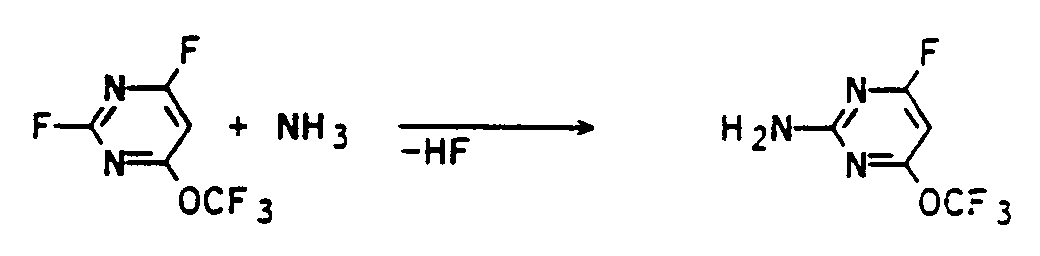
Das Verfahren liefert auf einfachem und wirtschaftlichem Weg neue 2-Amino-(fluoralkoxy-pyrimidine) in hoher Ausbeute und Reinheit. Entgegen der Erwartung werden Fluoralkoxygruppen unter den Reaktionsbedingungen nicht substituiert. Im Hinblick auf den Stand der Technik sind alle diese vorteilhaften Eigenschaften überraschend. - Bevorzugte Endstoffe I und dementsprechend bevorzugte Ausgangsstoffe II sind solche, in deren Formeln R¹ Wasserstoff, C₁-C₄-Alkyl wie Methyl, Ethyl, n-Propyl, i-Propyl, n-Butyl, sek-Butyl, i-Butyl, tert.-Butyl; C₃-C₄-Alkenyl wie 2-Propenyl, 2-Methylethenyl, 2-Butenyl, 3-Butenyl, 1-Methyl-2-propenyl oder 2-Methyl-2-propenyl; C₃-C₄-Alkinyl wie Propargyl, 2-Butinyl, 3-Butinyl oder 1-Methyl-2-propinyl, R² und R³ unabhängig voneinander Wasserstoff, Fluor, Chlor, Brom, Trichlormethyl, Dichlorfluormethyl, Chlordifluormethyl, Trifluormethyl, 1,1-Dichlor-2, 2,2-trifluorethyl, 1,1,2,2,2-Pentafluorethyl oder 1,1,2,2,2-Pentachlorethyl, darüberhinaus R² auch einen Trifluor- bzw. Chlordifluormethoxyrest und n 0 oder 1 bedeuten.
- Unter den Aminen, welche eingesetzt werden können, sollen die folgenden erwähnt werden: Ammoniak, Methylamin, Ethylamin, n-Propylamin, Isopropylamin, n-Butylamin, Isobutylamin, sek.-Butylamin, tert.-Butylamin, 2-Propenylamin, 2-Methylethenylamin, 2-Butenylamin, 3-Butenylamin, 1-Methyl-2-propenylamin, 2-Methyl-2-propenylamin, Propargylamin, 2-Butinylamin, 3-Butinylamin und 1-Methyl-2-propinylamin.
- Die 2-Halogen-pyrimidine II können in einem aprotisch polaren Lösungsmittel mit den Aminen III bei einer Temperatur von -80 bis 40oC umgesetzt werden, wobei man das Amin III entweder in einem Überschuß, bezogen auf II, einsetzt oder eine organische Hilfsbase verwendet.
- Die Umsetzung des 2-Halogen-pyrimidins II mit dem Amin III kann in Abwesenheit oder vorteilhaft in Gegenwart eines Lösungsmittels vorgenommen werden. Als Lösungsmittel sind insbesondere die nachfolgend aufgeführten geeignet:
Ether wie Methyl-tert.-butylether, Diethylether, Ethylpropylether, n-Butylethylether, Di-n-butylether, Diisobutylether, Diisoamylether, Diisopropylether, Cyclohexylmethylether, Tetrahydrofuran, 1,2-Dimethoxyethan, Diethylenglykoldimethylether und Anisol, Ester wie Ethylacetat, n-Butylacetat und Isobutylacetat sowie chlorierte Kohlenwasserstoffe wie Methylenchlorid, 1,1,2,2-Tetrachlorethan, 1,1-Dichlorethylen, 1,2-Dichlorethan, Chlorbenzol, 1,2-Dichlorbenzol und 1-Chlornaphthalin und Gemische dieser Lösungsmittel. - Zweckmäßig verwendet man das Lösungsmittel in einer Menge von 100 bis 2000 Gew.%, vorzugsweise 400 bis 1200 Gew.%, bezogen auf den Ausgangsstoff II.
- Vorteilhaft gibt man 1,8 bis 2,5, insbesondere 1,95 bis 2,2 Molequivalent des Amins III, bezogen auf den Ausgangsstoff II innerhalb 0,5 bis 2 Stunden zu einer Mischung von Ausgangsstoff II in einem der vorgenannten Lösungsmittel bei (-80) bis 40°C, Vorzugsweise -70 bis 25°C, rührt bis zur Vervollständigung der Reaktion nach (ca. 3 Stunden) und läßt dann zur Aufarbeitung auf 25°C erwärmen.
- Setzt man nur ungefähr stöchiometrische Mengen des Amins III ein, so verwendet man zweckmäßig zusätzlich eine organische Hilfsbase, um den entstehenden Halogenwasserstoff abzufangen. Als Hilfsbase eignen sich dazu übliche organische Basen wie Trimethylamin, Triethylamin, N-Ethyl-diisopropylamin, Triisopropylamin, N,N-Dimethylanilin, N,N-Dimethylcyclohexylamin, N-Methylpyrrolidln, Pyridin, Chinolin, α-,β-,γ-Picolin, 2,4- und 2,6-Lutidin und Triethylendiamin. Im allgemeinen sind Zusätze von 0,9 bis 1,1 Equivalenten der Hilfsbase, bezogen auf den Ausgangsstoff II, ausreichend.
- Die Reaktion kann drucklos oder unter Druck, kontinuierlich oder diskontinuierlich durchgeführt werden.
- Die Aufarbeitung kann in üblicher Weise erfolgen, z.B. extrahiert man das Umsetzungsgemisch mit Wasser zur Entfernung der Salze, trocknet und reinigt die organische Phase, z. B. durch Chromatographie. Man kann jedoch auch direkt die organische Phase einengen und den Rückstand mit einem Lösungsmittel verrühren.
- Im Hinblick auf ihre Weiterverarbeitung zu herbiziden Wirkstoffen, z.B. Sulfonylharnstoffderivaten, sind folgende Pyrimidine der Formel I besonders bevorzugt:
2-Amino-4-chlor-6-trifluormethoxy-pyrimidin,
2-Amino-4-fluor-6-trifluormethoy-pyrimidin,
2-Amino-4-chlor-6-chlordifluormethoxy-pyrimidin,
2-Amino-4-fluor-6-chlordifluormethoxy-pyrimidin,
2-Amino-4,6-bis-trifluormethoxy-pyrimidin,
2-Amino-4,6-bis-chlordifluormethoxy-pyrimidin,
2-Amino-4-trifluormethoxy-6-trifluormethyl-pyrimidin,
2-Amino-4-chlordifluormethoxy-6-trifluormethyl-pyrimidin,
2-Methylamino-4-chlor-6-trifluormethoxy-pyrimidin,
2-Methylamino-4-fluor-6-trifluormethoy-pyrimidin,
2-Methylamino-4-chlor-6-chlordifluormethoxy-pyrimidin,
2-Methylemino-4-fluor-6-chlordifluormethoxy-pyrimidin,
2-Methylamino-4,6-bis-trifluormethoxy-pyrimidin,
2-Methylamino-4,6-bis-chlordifluormethoxy-pyrimidin,
2-Methylamino-4-trifluormethoxy-6-trifluormethyl-pyrimidin,
2-Methylamino-4-chlordifluormethoxy-6-trifluormethyl-pyrimidin,
2-Allylamino-4-chlor-6-trifluormethoxy-pyrimidin,
2-Allylamino-4-fluor-6-trifluormethoy-pyrimidin,
2-Allylamino-4-chlor-6-chlordifluormethoxy-pyrimidin,
2-Allylamino-4-fluor-6-chlordifluormethoxy-pyrimidin,
2-Allylamino-4,6-bis-trifluormethoxy-pyrimidin,
2-Allylamino-4,6-bis-chlordifluormethoxy-pyrimidin,
2-Allylamino-4-trifluormethoxy-6-trifluormethyl-pyrimidin,
2-Allylamino-4-chlordifluormethoxy-6-trifluormethyl-pyrimidin,
Der Herstellung der als Ausgangsstoffe II benötigten 2-Halogenpyrimidine erfolgt nach dem in der zeitgleichen deutschen Anmeldung P 40 07 317.3 (O.Z. 0050/41450) beschriebenen Verfahren, das durch folgendes Reaktionsschema dargestellt wird:
So kann man beispielsweise ein 2,4,6-Trihalogenpyrimidin IV in einem aprotisch polaren Lösungsmittel - a) mit Methanol in Anwesenheit oder Abwesenheit einer Base oder
- b) mit einem Methanolat, wobei M¹ ein Alkalimetallkation wie Lithium-, Natrium- und Kaliumkation oder das Equivalent eines Erdalkalimetallkations wie Magnesium-, Calcium- und Bariumkation bedeutet, in Gegenwart von Methanol
- Hal im Reaktionsschema steht für Fluor, Chlor oder Brom.
- Für die Umsetzung des Trihalogenpyrimidins mit Methanol sind folgende Lösungsmittel geeignet:
Ether wie Methyl-tert.-butylether, Diethylether, Ethylpropylether, n-Butylethylether, Di-n-butylether, Diisobutylether, Diisoamylether, Di-isoopropylether, Cyclohexylmethylether, Tetrahydrofuran, 1,2-Dimethoxyethan, Diethylenglycoldimethylether und Anisol, chlorierte Kohlenwasserstoffe wie 1,1,2,2-Tetrachlorethan, 1,1-Dichlorethylen, Chlorbenzol, 1,2-Dichlorbenzol und 1-Chlornaphthalin sowie entsprechende Gemische. - Zweckmäßig verwendet man das Lösungsmittel in einer Menge von 100 bis 2000 Gew.-% vorzugsweise 500 bis 1500 Gew.%, bezogen auf den Ausgangsstoff.
- Zweckmäßig führt man jedoch die Umsetzung der Ausgangsstoffe IV direkt in überschüssigem Methanol als Lösungsmittel durch. Gegebenenfalls gibt man ein Alkalimethanolat in einer equivalenten Menge oder einem Über- oder Unterschuß von bis zu 5 Mol-%, bezogen auf den Ausgangsstoff, zu einer Suspension des Ausgangsstoffes in der 5- bis 20-fachen Gewichtsmenge Methanol als Lösungsmittel, bezogen auf den Ausgangsstoff IV, innerhalb bis zu einer Stunde bei einer Temperatur von ca. -20 bis 80oC. Zur Beendigung der Umsetzung rührt man dann noch ca. 1/2 bis 8 Stunden bei 0 bis 120oC, vorzugsweise 0 bis 100oC nach.
- Zur Isolierung der Methoxy-pyrimidine dienen die hierfür in der Literatur üblichen Aufarbeitungsmethoden.
- Die Chlorierung des Methoxy-pyrimidins mit Chlor zu dem Trichlormethoxypyrimidin führt man beispielsweise bei einer Temperatur von 60 bis 180oC durch.
- Als Chlorierungsmittel sind elementares Chlor oder Chlor abgebende Substanzen wie Sulfurylchlorid oder Phosphorpentachlorid geeignet. Chlor kann dabei auch in situ durch Oxydation von Chlorwasserstoffsäure, beispielsweise mit Braunstein oder durch anodische Chlorierung hergestellt werden.
- Die Chlorierung kann in Gegenwart eines inerten Lösungsmittels, beispielsweise einem chlorierten Kohlenwasserstoff wie Chloroform, Tetrachlorkohlenstoff, Chlorbenzol, 1,2-, 1,3- oder 1,4-Dichlorbenzol, einem Nitril wie Acetonitril, Propionitril, einer Nitroverbindung wie Nitrobenzol, einer Carbonsäure wie Essigsäure, Propionsäure, einem Säureanhydrid wie Essigsäureanhydrid, einem Säurechlorid wie Chloracetylchlorid, α-Chlorpropionsäurechlorid, α,α-Dichlorpropionsäurechlorid, einem anorganischen Säurehalogenid wie Phosphortrichlorid oder Phosphoroxychlorid oder bevorzugt ohne Lösungsmittel in der Schmelze des Ausgangsstoffes durchgeführt werden.
- Gegebenenfalls kann man die Reaktion durch Zugabe eines Radikalstarters beschleunigen; als solcher eignet sich die Bestrahlung mit Licht, vorzugsweise UV-Licht oder die Zugabe von α,α'-Azoisobutyronitril, zweckmäßig in einer Menge von 0,2 bis 7 Mol-%, bezogen auf den Ausgangsstoff. Man kann die Reaktion auch durch Zugabe eines Katalysators beschleunigen; als solcher eignet sich Phosphorpentachlorid, zweckmäßig in einer Menge von 0,5 bis 7 Mol-% bezogen auf den Ausgangsstoff V. In diesem Fall legt man den Ausgangsstoff V zusammen mit dem Katalysator vor und beginnt dann mit der Chlorierung. Statt des Phosphorpentachlorids kann man auch eine dieses unter den Reaktionsbedingungen bildende Ausgangskomponente, z. B. Phosphortrichlorid oder gelben Phosphor, zugeben und dann mit der Chlorierung beginnen.
- Ausgangsstoff V kann mit Chlor in annähernd stöchiometrischer Menge oder vorzugsweise im Überschuß, vorteilhaft mit 3,1 bis 11, insbesondere 3,3 bis 5 Mol Chlor je Equivalent Methoxy in dem Ausgangsstoff V umgesetzt werden. Die Umsetzung kann bei einer Temperatur von 60 bis 180oC, vorteilhaft von 100 bis 150oC, drucklos oder unter Druck kontinuierlich oder diskontinuierlich durchgeführt werden.
- Chloriert man bei 1 bar, so werden zweckmäßig 3,3 bis 5 Mol Chlorgas, bezogen auf ein Equivalent Methoxy in dem Ausgangsstoff V, eingesetzt, was einem Chlorumsatz von 91 bis 60 % entspricht. Durch geeignete apparative Maßnahmen, z. B. durch Anwendung von mäßigem Überdruck, zweckmäßig 1 bis 10 bar, oder durch Verwendung einer Blasensäule, läßt sich der Chlorumsatz erhöhen. Vorteilhaft läßt man das Chlorgas möglichst lange mit der organischen Phase in Berührung kommen, indem diese beispielsweise stark gerührt wird oder das Chlorgas eine dicke Schicht der organischen Phase durchdringen muß.
- Die Reaktionszeit beträgt im allgemeinen etwa 0,5 bis 12 Stunden.
- In einer bevorzugten Ausführungsform des Verfahrens geht man so vor, daß man innerhalb von 0,5 bis 12 Stunden, vorzugsweise 1 bis 10 Stunden die erforderliche Menge Chlorgas unter intensivem Rühren in den flüssigen Ausgangsstoff V einleitet, wobei man zunächst bei einer Temperatur von 60 bis 80oC beginnt und diese - gegebenenfalls unter Ausnutzung des exothermen Charakters der Reaktion - kontinuierlich steigert, so daß gegen Ende die Umsetzung bei einer Temperatur von 100 bis 150oC durchgeführt wird. Bei größeren Reaktionsansätzen muß dem exothermen Charakter durch äußere Kühlung bzw. geeignete Dosierung der Chlormenge Rechnung getragen; mit dem Abflauen der Reaktion entfernt man das Kältebad und kann gegebenenfalls noch nacherhitzen.
- Die Aufarbeitung und Isolierung der Endstoffe kann in üblicher Weise erfolgen. Beispielsweise kann man aus der heißen organischen Phase mittels eines Inertgases Reste an Chlorwasserstoff, Chlor oder Katalysator austragen; dabei hinterbleibt in hoher Ausbeute ein bereits recht reines Rohprodukt. Durch Destillation oder Chromatographie kann es weiter gereinigt oder aber direkt für weitere Umsetzungen eingesetzt werden.
- Die Umsetzung des Trichlormethoxy-pyrimidins VI mit einem Halogenaustauschmittel führt man beispielsweise bei einer Temperatur von 0 bis 170oC durch.
- Als Halogenaustauschmittel sind Antimontrifluorid in Gegenwart oder Abwesenheit katalytischer Mengen eines Antimon(V)salzes, z.B. Antimon(V)chlorid oder Fluorwasserstoff geeignet.
- Zweckmäßig verwendet man einen Überschuß von 1 bis 200, vorzugsweise 5 bis 20 Mol-% Antimontrifluorid pro Trichlormethylequivalent. Die Katalysatormenge an Antimon(V)salz beträgt zwischen 1 bis 20, vorzugsweise 5 bis 18 Mol-% pro Trichlormethylequivalent. Vorzugsweise dosiert man den Ausgangsstoff VI bei 90 bis 130oC zu der Mischung des Halogenaustauschmittels und erwärmt dann noch zwischen 10 und ca. 120 Minuten auf eine Temperatur zwischen 140 bis 170oC. Anschließend wird durch Destillation aufgearbeitet.
- Man kann die Reaktion jedoch auch kontinuierlich führen, den Ausgangsstoff VI bei 140 bis 170°C innerhalb 10 bis ca. 120 Minuten zugeben und gleichzeitig unter vermindertem Druck den entstehenden niedriger siedenden Endstoff II abdestillieren. Spuren mitgerissender Antimonsalze lassen sich durch Extraktion mit konz. Salzsäure beseitigen.
- Arbeitet man ohne Antimon(V)salz-Katalyse oder setzt nur geringe Mengen, z. B. 0,2 bis 1 Mol-% ein, und reduziert die Menge an Antimontrifluorid auf 60 bis 90 Mol-% pro Trichlormethylequivalent, so bleibt der Halogenaustausch auf der Chlordifluormethoxystufe stehen.
- Anstelle von Antimontrifluorid kann der Halogenaustausch auch mit Fluorwasserstoff bei 0 bis 170oC, vorzugsweise 40 bis 120oC, durchgeführt werden. Hierzu versetzt man in einem Autoklaven den Ausgangsstoff VI mit einem Überschuß von 300 bis 700, vorzugsweise 350 bis 400 Mol-% Fluorwasserstoff pro Trichlormethylequivalent und rührt 10 Minuten bis ca. 10 Stunden nach. Im allgemeinen ist eine Nachreaktionszeit von ca. 4 Stunden ausreichend. Nach dem Entspannen und der Entfernung flüchtiger Bestandteile wird wie beschrieben aufgearbeitet.
- Die neuen 2-Amino-(fluoralkoxy-pyrimidine) I sind wertvolle Zwischenprodukte für die Herstellung von Pflanzenschutzmitteln. Nach dem Verfahren der zeitgleichen deutschen Patentanmeldung P 40 07 683.0 (O.Z. 0050/41452) können sie durch Umsetzung von beispielsweise 2-Amino-4-fluor-6-trifluormethoxy-pyrimidin mit Methanol in das entsprechende 2-Amino-6-methoxy-4-trifluormethoxy-pyrimidin umgewandelt werden, das mit 2-Carbomethoxy-benzolsulfonylisocyanat zu herbiziden Sulfonylharnstoffen reagiert. Sie können aber auch direkt mit dem genannten Isocyanat zu herbiziden Sulfonylharnstoffen umgesetzt werden.
- 293,1 g (1,692 mol) 3%ige Natriummethylatlösung wurden innerhalb 1 1/2 Stunden bei 0 bis 5oC unter Rühren zu einer Lösung von 434 g (1,692 mol) 2,6-Dichlor-4-trichlormethylpyrimidin in 1 l 1,2-Dichlorethan gegeben. Es wurde 1 Stunde bei 0 bis 5oC und 12 Stunden bei 25oC gerührt. Das Reaktionsgemisch wurde mit Wasser und mit gesättigter Kochsalzlösung extrahiert. Nach dem Trocknen über Magnesiumsulfat und Einengen erhielt man 423 g (95 % d. Th.) der Titelverbindung als fast farbloses Öl. ¹H-NMR (CDCl₃) (ppm) OCH₃ (s/3H) 4,1; CH (s/1H) 7,25.
- In eine Mischung von 210 g (0,802 mol) a) und 260 mg (0,0016 mol), α,α'-Azoisobutyronitril wurden unter UV-Bestrahlung und gaschromatographischer Kontrolle des Reaktionsverlaufs bei einer Temperatur von zunächst 110oC Chlor eingeleitet, wobei sich auch nach Entfernen der Heizbades eine Reaktionstemperatur von 140oC einstellte. Nach dem Abklingen der Reaktion wurden während 5 1/2 Stunden bei 120oC insgesamt 341 g (4,8 mol) Chlor eingeleitet. Zu dem erkaltenden Reaktionsgemisch rührte man ab 40oC 70 ml n-Pentan zur Ausfällung hinzu. Der Niederschlag wurde abgesaugt, mit Petrolether gewaschen und getrocknet, wobei man 163 g (55 % d. Th.) der Titelverbindung vom Fp. 67-69oC erhielt.
- Das Filtrat (113,8 g) bestand nach dem Gaschromatogramm zu 83 % aus der Titelverbindung, 4 % 2-Chlor-4-dichlormethoxy-6-trichlormethylpyrimidin und 9 % 2,4-Dichlor-6-trichlormethylpyrimidin. Die Gesamtausbeute der Titelverbindung betrug 87,6 % d. Th.
- Zu einer Mischung aus 250 g (1,865 mol) 2,4,6-Trifluorpyrimidin in 1,4 l Methanol wurden bei -20oC innerhalb von 45 Minuten 335,8 g (1,865 mol) 30%iges Natriummethylat (in Methanol) gegeben und weitere 30 Minuten bei dieser Temperatur gerührt. Anschließend ließ man auf 25oC erwärmen und engte die Reaktionsmischung auf ca. 1/5 ihres Volumens ein.
- Das so erhaltene Gemisch wurde zwischen Diethylether und Wasser verteilt, wonach die organische Phase über Magnesiumsulfat getrocknet und eingeengt wurde. Nach Destillation (1,1 m Kolonne, 3 mm V-Füllkörper) erhielt man 141,6 g (52 % d. Th.) der Titelverbindung von Kp.: 144-145°C.
- Aus dem Destillationsrückstand erhielt man durch Destillation über einen Normag-Aufsatz 114,4 g (42 % d. Th.) an 4,6-Difluor-2-methoxy-pyrimidin vom Kp.: 157-161oC.
- 210 g (2,96 mol) Chlor wurden unter UV-Bestrahlung und gaschromatographischer Kontrolle des Reaktionsverlaufs während 2 1/2 Stunden unter Rühren bei 130oC in 123 g (0,843 mol) 2,4-Difluor-6-methoxy-pyrimidin eingeleitet. Das Reaktionsgemisch wurde über eine 10-cm-Vigreux-Kolonne im Vakuum destilliert, wobei man 190,2 g (90,5 % d. Th.) der Titelverbindung vom Sdp. 40-43oC/0,2 mbar erhielt.
- Unter Rühren, UV-Bestrahlung und gaschromatographischer Kontrolle des Reaktionsverlaufs wurden 303 g (4,27 mol) Chlor während 1/2 Stunde bei 80oC, 1 Stunde bei 100oC, 3 Stunden bei 120oC und 3 Stunden bei 150oC in eine Mischung von 209 g (1,168 Mol) 2,6-Dichlor-4-methoxy-pyrimidin und 2 g (0,012 mol) α,α'-Azoisobutyronitril eingeleitet. Anschließend wurde das Reaktionsgemisch im Vakuum über eine 50-cm-Kolonne mit 4 mm V₂-A-Raschigringen destilliert. Man erhielt 241,3 g (73 % d. Th.) der Titelverbindung vom Sdp. 87-88oC/0,4 mbar; Fp. 55-56oC.
- 49,9 g (0,2 mol) 2,4-Difluor-6-trichlormethoxy-pyrimidin wurde bei 100oC innerhalb 15 Minuten unter Rühren zu einer Mischung von 39,3 g (0,22 mol) Antimontrifluorid und 9,38 g (0,031 mol) Antimonpentachlorid gegeben. Innerhalb 25 Minuten wurde die Badtemperatur von 100 auf 150oC erhöht und 30 Minuten nachgerührt, wobei sich zwischen 120 bis 125oC Rückfluß einstellte. Durch anschließende Destillation erhielt man 37,1 g (92,7 % d. Th.) der Titelverbindung vom Sdp. 125-127oC.
- 93 g (0,373 mol) 2,4-Difluor-6-trichlormethoxy-pyrimidin wurden bei 100oC innerhalb 10 Minuten unter Rühren zu einer Mischung von 44,5 g (0,249 mol) Antimontrifluorid und 0,94 g (0,0031 mol) Antimonpentachlorid gegeben. Innerhalb 25 Minuten wurde die Badtemperatur von 100 auf 175oC erhöht, wobei sich bei 145oC Rückfluß einstellte. Nach 1 1/2 Stunden Rühren wurde das Reaktionsprodukt bei 146-150oC abdestilliert. Das Destillat wurde in 200 ml Methylenchlorid gelöst, mit 6 n Salzsäure extrahiert und über Magnesiumsulfat getrocknet. Nach dem Einengen im Vakuum erhielt man als Rückstand die Titelverbindung in einer Ausbeute von 63,7 g = 78,8 % d. Th.
- 80 g (0,219 mol) 2-Chlor-4-trichlormethyl-6-trichlormethoxy-pyrimidin wurden innerhalb 5 Minuten unter Rühren bei 100o zu einer Mischung von 93,9 g (0,525 mol) Antimontrifluorid und 18,7 g (0,0627 mol) Antimonpentachlorid gegeben. Innerhalb 10 Minuten wurde die Badtemperatur auf 140oC erhöht und 1 Stunde nachgerührt, wobei sich starker Rückfluß einstellte. Das Reaktionsprodukt wurde bei 135-140oC, gegen Schluß bei 95oC/50 mbar, überdestilliert. Das Destillat wurde in Methylenchlorid aufgenommen, mit 6 n Salzsäure extrahiert und über Magnesiumsulfat getrocknet. Nach dem Einengen im Vakuum erhielt man die Titelverbindung in einer Ausbeute von 35,9 g (65,5 % d. Th.).
- 115 g (0,407 mol) 2,4-Dichlor-6-trichlormethoxy-pyrimidin wurden innerhalb 5 Minuten unter Rühren bei 100oC zu einer Mischung von 80 g (0,447 mol) Antimontrifluorid und 18,77 g (0,0627 mol) Antimonpentachlorid gegeben, wobei sich die Reaktionstemperatur bis auf 140oC erhöhte. Es wurde noch 45 Minuten bei 150oC gerührt. Zur Destillation wurde ein Druck von 210 mbar eingestellt, wobei die Titelverbindung bei 128oC überging; letzte flüchtige Bestandteile wurden bei 110oC/22 mbar übergetrieben. Das Destillat wurde in Methylenchlorid gelöst, mit 6 n Salzsäure extrahiert und über Magnesiumsulfat getrocknet. Nach dem Einengen im Vakuum erhielt man die Titelverbindung in einer Ausbeute von 80 g (84,4 % d. Th.) als farbloses Öl vom nD²⁵ = 1,4604.
- 9,8 g (0,578 mol) gasförmiges Ammoniak wurden innerhalb einer Stunde bei -75 bis -70oC unter Rühren in eine Mischung von 62,5 g (0,289 mol) 2,4-Difluor-6-chlordifluormethoxy-pyrimidin in 300 ml Tetrahydrofuran eingegast. Es wurde eine Stunde bei -70oC gerührt und dann auf Raumtemperatur erwärmt. Der ausgefallene Niederschlag wurde abgesaugt, zwischen Essigester und Wasser verteilt und die organische Phase über Magnesiumsulfat getrocknet. Das Reaktionsfiltrat wurde eingeengt, in der obigen Essigesterphase gelöst, über Kieselgel mit Petrolether:Ether = 5:1 chromatographiert und eingeengt. Man erhielt 46,5 g (75,3 % d. Th.) der Titelverbindung als farblose Kristalle vom Fp. 77-80oC.
- 8,7 g (0,51 mol) gasförmiges Ammoniak wurden innerhalb 1 Stunde bei - 75 bis -70oC unter Rühren in eine Mischung von 51 g (0,255 mol) 2,4-Difluor-6-trifluormethoxy-pyrimidin in 200 ml Diethylether eingegast. Es wurde noch 1 1/2 Stunden bei -70oC und 1 Stunde bei Raumtemperatur gerührt. Das Reaktionsgemisch wurde im Vakuum eingeengt, in Methylenchlorid aufgenommen und mit Wasser extrahiert. Nach dem Trocknen der organischen Phase, Einengen und Chromatographieren über Kieselgel mit Petrolether:Ether = 8:1 erhielt man 38,1 g (75,6 % d. Th.) der Titelverbindung als farblose Kristalle vom Fp. 86-89oC.
- 4,3 g (0,25 mol) gasförmiges Ammoniak wurden innerhalb 45 Minuten unter Rühren bei -50 bis -45°C in eine Mischung von 23,3 g (0,1 mol) 2,4-Di-chlor-6-trifluormethoxy-pyrimidin in 150 ml Methyl-tert.-butylether eingeleitet. Es wurde 30 Minuten bei -50oC, 1 Stunde bei -30oC und 1 Stunde bei 25oC gerührt. Der ausgefallene Niederschlag wurde abgesaugt, mit Wasser gewaschen und getrocknet, wobei man 5,4 g (33,1 % d. Th.) 4-Amino-2,4-dichlorpyrimidin vom Fp. 270-272oC als Nebenprodukt erhielt. Das Filtrat wurde mit Wasser gewaschen, getrocknet, teilweise im Vakuum eingeengt und mit Petrolether:Ether = 5:1 frakioniert chromatographiert, wobei man in den ersten Fraktionen 3 g (12,8 % d. Th.) Ausgangsmaterial als farbloses Öl und im Nachlauf 9 g (42 % d. Th.) der Titelverbindung als farblose Kristalle vom Fp. 55-56°C erhielt. Der Umsatz betrug 48,3 %.
- 20,3 g (0,0938 mol) 4-Chlordifluormethoxy-2,6-difluor-pyrimidin wurden in 150 ml Tetrahydrofuran vorgelegt und bei -70 bis -60oC innerhalb 30 Minuten unter Rühren mit 5,8 g (0,188 mol) gasförmigem Methylamin versetzt. Es wurde jeweils 1 Stunde bei -70oC, 0oC und 25oC gerührt. Nach dem Einengen des Reaktionsgemisches im Vakuum wurde der Rückstand mit Wasser verrührt, mit Essigester extrahiert und der Extrakt über Magnesiumsulfat getrocknet. Es wurde zum Teil im Vakuum eingeengt und dann über Kieselgel mit Ether/Petrolether 1:5 fraktioniert chromatographiert. Die ersten Fraktionen enthielten die Titelverbindung vom Fp. 57-61oC in einer Ausbeute von 12,5 g (58,5 %).
- 4,7 g (0,278 mol) gasförmiges Ammoniak wurden unter Rühren bei -75 bis -70°C innerhalb 1 Stunde in eine Mischung von 38,0 g (0,147 mol) 2-Fluor(chlor)-4-trifluormethoxy-6-trifluormethyl-pyrimidin in 150 ml Diethylether eingegast. Es wurde jeweils 2 Stunden bei -75 und nach dem Erwärmen bei 25oC gerührt. Nach dem Absaugen von dem aufgefallenen Niederschlag wurde die organische Phase mit Wasser 3x extrahiert, getrocknet und teilweise eingeengt. Nach dem Chromatographieren mit Methyl-tert.-butylether über Kieselgel erhielt man 20,4 g (56,1 % d. Th.) der Titelverbindung vom Fp. 47-49oC.
- 2,7 g (0,015 mol) 30%iges Natriummethylat wurden innerhalb 15 Minuten unter Rühren bei -5 bis 0oC zu 2,95 g (0,015 mol) 2-Amino-4-fluor-6-trifluormethoxy-pyrimidin in 50 ml Methanol gegeben. Nach 1 Stunde Rühren bei 0oC und Erwärmen auf 25oC wurde das Reaktionsgemisch im Vakuum eingeengt, mit Wasser verrührt und 2x mit Methylenchlorid extrahiert. Nach dem Trocknen und Einengen im Vakuum erhielt man 3,1 g (98 % d. Th.) der Titelverbindung mit nD²⁵ = 1,4770.
- 26,1 g (0, 145 mol) 30%iges Natriummethylat wurden innerhalb 15 Minuten unter Rühren bei -10 bis 0oC zu 31,0 g (0,145 mol) 2-Amino-4-chlordifluormethoxy-6-fluorpyrimidin in 300 ml Methanol gegeben. Es wurde 30 Minuten bei 0oC und 1 Stunde bei 25oC gerührt. Das Reaktionsgemisch wurde im Vakuum eingeengt und wie oben aufgearbeitet. Man erhielt 31,6 g (96,6 % d. Th.) der Titelverbindung als farbloses Öl mit nD²² = 1,5039.
- 4,7 g (0,026 mol) 30%iges Natriummethylat wurden innerhalb 10 Minuten unter Rühren bei 0oC zu 6,0 g (0,0263 mol) 4-Chlordifluormethoxy-6-fluor-2-methylamino-pyrimidin in 100 ml Methanol gegeben. Es wurde jeweils 1 Stunde bei 0oC und bei 25oC gerührt. Nach üblicher Aufarbeitung erhielt man 6,3 g (100 % d. Th.) der Titelverbindung vom Fp. 49-53oC.
- 1,9 g (0,0417 mol) gasförmiges Dimethylamin wurden innerhalb 10 Minuten unter Rühren bei 0°C in eine Mischung von 8,9 g (0,0417 mol) 2-Amino-4-chlordifluormethoxy-6-fluor-pyrimidin in 100 ml Tetrahydrofuran eingeleitet. Es wurde 1 Stunde bei 0°C und 2 Stunden bei 25°C gerührt. Nach üblicher Aufarbeitung erhielt man 9,7 g (97,5 % d. Th.) der Titelverbindung vom Fp. 127-130°C.
- 3,6 g (0,015 mol) 2-Isocyanatosulfonyl-benzoesäuremethylester in 15 ml 1,2-Dichlorethan wurden innerhalb 15 Minuten bei 25°C unter Rühren zu einer Mischung von 2,95 g (0,015 mol) 2-Amino-4-fluor-6-trifluormethoxy-pyrimidin in 100 ml 1,2-Dichlorethan gegeben und 12 Stunden bei 25°C gerührt. Die Reaktionslösung wurde im Vakuum eingeengt und der Rückstand mit Ether/Petrolether 1:1 verrührt. Nach dem Absaugen und Trocknen erhielt man 4,8 g (73,3 % d. Th.) der Titelverbindung vom Fp. 157-161°C.
- 2,55 g (0,01 mol) 2-Isocyanatosulfonyl-benzoesäure-ethylester in 10 ml Methylenchlorid wurden innerhalb 10 Minuten unter Rühren bei 25°C zu einer Mischung von 2,1 g (0,01 mol) 2-Amino-4-chlor-6-trifluormethoxy-pyrimidin in 100 ml Methylenchlorid gegeben. Es wurde 12 Stunden bei 25°C gerührt und von wenig Unlöslichem abgesaugt. Nach dem Einengen des Filtrats im Vakuum, Verrühren des Rückstandes mit Ether/Petrolether 1:1, Absaugen und Trocknen erhielt man 4,0 g (85,4 % d. Th.) der Titelverbindung vom Fp. 148-151°C.
- 4,8 g (0,02 mol) 2-Isocyanatosulfonyl-benzoesäuremethylester in 10 ml Acetonitril wurden innerhalb 15 Minuten unter Rühren bei 25°C zu einer Mischung von 4,1 g (0,02 mol) 2-Amino-4-methoxy-6-trifluormethoxy-pyrimidin in 100 ml Acetonitril gegeben und 12 Stunden nachgerührt. Nach dem Abtrennen des ausgefallenen Niederschlages (2,4 g vom Fp. 141-143oC) wurde das Filtrat im Vakuum eingeengt und mit Ether/Petrolether verrührt, abgesaugt und getrocknet. Man erhielt weitere 4,3 g der Titelverbindung vom Fp. 141-143oC. Die Gesamtausbeute betrug 6,7 g (74,4 % d. Th.).
- 2,4 g (0,053 mol) 2-(((4-Methoxy-6-trifluormethoxy-1,3-pyrimidin-2-yl) -aminocarbonyl)aminosulfonyl)-benzoesäuremethylester (Wirkstoffbeispiel 5.001) wurden in 50 ml Methanol gelöst, bei 25°C mit 1,0 g (0,053 mol) 30%iger Natriummethylatlösung in Methanol versetzt und 10 Minuten gerührt. Nach dem Abdestillieren des Lösungsmittels bei vermindertem Druck erhielt man 2,5 g (100 % d. Th.) der Titelverbindung vom Fp. 175oC.
Claims (9)
- Substituierte 2-Amino-(fluoralkoxy-pyrimidine) der allgemeinen Formel I,
 R¹ Wasserstoff, C₁-C₄-Alkyl, C₃-C₄-Alkenyl oder C₃-C₄-AlkinylR² Wasserstoff, Halogen oder C₁-C₄-Halogenalkyl sowie auch einen Trifluor- bzw. ChlordifluormethoxyrestR³ Wasserstoff undn 0 oder 1bedeuten.
 - Verfahren zur Herstellung von 2-Amino-(fluoralkoxy-pyrimidinen) der allgemeinen Formel I,
 R¹ Wasserstoff, C₁-C₄-Alkyl, C₃-C₄-Alkenyl oder C₃-C₄-AlkinylR² Wasserstoff, Halogen oder C₁-C₄-Halogenalkyl,R³ Wasserstoff undn 0 oder 1bedeuten,
dadurch gekennzeichnet, daß man 2-Halogen-pyrimidine der Formel II,
H-NH-R¹ III,
in der R¹ die vorgenannte Bedeutung hat, ggf. in Gegenwart einer organischen Hilfsbase, umsetzt. - Verfahren nach Anspruch 2, dadurch gekennzeichnet, daß man als Amin Ammoniak verwendet.
- Verfahren nach Anspruch 2, dadurch gekennzeichnet, daß man als Amin Methylamin einsetzt.
- Verfahren nach den Ansprüchen 2 und 4, dadurch gekennzeichnet, daß man die Umsetzung bei einer Temperatur von -80 bis 40°C durchführt.
- 2-Amino-4-fluor-6-trifluormethoxy-pyrimidin.
- 2-Amino-4-chlor-6-trifluormethoxy-pyrimidin.
- 2-Amino-4-chlordifluormethoxy-6-fluor-pyrimidin.
- 2-Amino-4-chlor-6-chlordifluormethoxy-pyrimidin.
Applications Claiming Priority (2)
| Application Number | Priority Date | Filing Date | Title |
|---|---|---|---|
| DE4007316A DE4007316A1 (de) | 1990-03-08 | 1990-03-08 | 2-amino-(fluoralkoxy-pyrimidine) und verfahren zu ihrer herstellung |
| DE4007316 | 1990-03-08 |
Publications (2)
| Publication Number | Publication Date |
|---|---|
| EP0445642A1 EP0445642A1 (de) | 1991-09-11 |
| EP0445642B1 true EP0445642B1 (de) | 1995-07-12 |
Family
ID=6401695
Family Applications (1)
| Application Number | Title | Priority Date | Filing Date |
|---|---|---|---|
| EP91102906A Expired - Lifetime EP0445642B1 (de) | 1990-03-08 | 1991-02-28 | 2-Amino-(fluoralkoxy-pyrimidine) und Verfahren zu ihrer Herstellung |
Country Status (6)
| Country | Link |
|---|---|
| US (2) | US5283332A (de) |
| EP (1) | EP0445642B1 (de) |
| JP (1) | JP2957296B2 (de) |
| CA (1) | CA2037528C (de) |
| DE (2) | DE4007316A1 (de) |
| ES (1) | ES2074182T3 (de) |
Families Citing this family (3)
| Publication number | Priority date | Publication date | Assignee | Title |
|---|---|---|---|---|
| DE4007683A1 (de) | 1990-03-10 | 1991-09-12 | Basf Ag | Herbizide sulfonylharnstoffe, verfahren und zwischenprodukte zu ihrer herstellung |
| CN106632077B (zh) * | 2016-10-10 | 2019-01-22 | 上海再启生物技术有限公司 | 一种2-氨基-4-溴嘧啶的制备方法 |
| CN120717957B (zh) * | 2025-08-15 | 2025-10-31 | 苏州开元民生科技股份有限公司 | 一种2-氨基-4,6-二甲氧基嘧啶的制备方法 |
Family Cites Families (10)
| Publication number | Priority date | Publication date | Assignee | Title |
|---|---|---|---|---|
| US4443243A (en) * | 1981-07-16 | 1984-04-17 | Ciba-Geigy Corporation | N-Phenylsulfonyl-N-triazinylureas |
| US4480101A (en) * | 1981-07-16 | 1984-10-30 | Ciba-Geigy Corporation | Fluoroalkoxy-aminopyrimidines |
| MA19680A1 (fr) * | 1982-01-11 | 1983-10-01 | Novartis Ag | N- arylsulfonyl - n' - pyrimidinylurees. |
| US4518776A (en) * | 1982-07-19 | 1985-05-21 | Ciba Geigy Corporation | Process for producing sulfonylureas |
| US4643760A (en) * | 1983-12-08 | 1987-02-17 | Ciba-Geigy Corporation | Herbicidal sulfonylureas |
| US4542216A (en) * | 1984-03-27 | 1985-09-17 | Ciba Geigy Corporation | Process for producing fluoroalkoxyaminopyrimidines |
| DE3565983D1 (de) * | 1984-07-26 | 1988-12-08 | Ciba Geigy Ag | N-arylsulfonyl-n'-triazinyl- and -pyrimidinyl ureas |
| DE3642832A1 (de) * | 1986-12-16 | 1988-06-30 | Hoechst Ag | Verfahren zur herstellung von aminopyrimidinen |
| DE3642986A1 (de) * | 1986-12-17 | 1988-07-07 | Bosch Gmbh Robert | Korrekturverfahren fuer die koppelortung von landfahrzeugen |
| DE3900471A1 (de) * | 1989-01-10 | 1990-07-12 | Basf Ag | Verfahren zur herstellung von 2-amino-4-fluorpyrimidinderivaten |
-
1990
- 1990-03-08 DE DE4007316A patent/DE4007316A1/de not_active Withdrawn
-
1991
- 1991-02-28 DE DE59105948T patent/DE59105948D1/de not_active Expired - Lifetime
- 1991-02-28 EP EP91102906A patent/EP0445642B1/de not_active Expired - Lifetime
- 1991-02-28 ES ES91102906T patent/ES2074182T3/es not_active Expired - Lifetime
- 1991-03-04 US US07/663,975 patent/US5283332A/en not_active Expired - Fee Related
- 1991-03-04 CA CA002037528A patent/CA2037528C/en not_active Expired - Fee Related
- 1991-03-06 JP JP3040272A patent/JP2957296B2/ja not_active Expired - Fee Related
-
1993
- 1993-09-13 US US08/102,752 patent/US6235904B1/en not_active Expired - Fee Related
Also Published As
| Publication number | Publication date |
|---|---|
| EP0445642A1 (de) | 1991-09-11 |
| US5283332A (en) | 1994-02-01 |
| DE59105948D1 (de) | 1995-08-17 |
| DE4007316A1 (de) | 1991-09-12 |
| US6235904B1 (en) | 2001-05-22 |
| ES2074182T3 (es) | 1995-09-01 |
| JPH04211669A (ja) | 1992-08-03 |
| JP2957296B2 (ja) | 1999-10-04 |
| CA2037528C (en) | 2003-08-19 |
| CA2037528A1 (en) | 1991-09-09 |
Similar Documents
| Publication | Publication Date | Title |
|---|---|---|
| DE60029696T2 (de) | Fluorierungsmittel, verfahren zu seiner herstellung und seine anwendung | |
| EP0195346A2 (de) | 3-Aryluracile und deren Verwendung zur Unkrautbekämpfung | |
| EP1616863A1 (de) | Verfahren zur Herstellung Kernfluorierter Aromaten | |
| EP0463464B1 (de) | Verfahren zur Herstellung von 2-Chlor-5-methyl-pyridin | |
| EP0341693B1 (de) | Verfahren zur Herstellung von O-substituierten Hydroxylaminen | |
| EP0445642B1 (de) | 2-Amino-(fluoralkoxy-pyrimidine) und Verfahren zu ihrer Herstellung | |
| EP0579020B1 (de) | Verfahren zur Herstellung von 5-(Trifluormethyl)-uracil und die neuen Verbindungen 2,4-Dichlor-5-trichlormethylpyrimidin und 2,4-Difluor-5-trifluormethyl-pyrimidin | |
| EP0547411B1 (de) | Verfahren zur Herstellung von 2-substituierten 4,6-Dialkoxypyrimidinen | |
| EP0469462B1 (de) | 2-Amino-(fluoralkoxy-1,3,5-triazine) und Verfahren zu ihrer Herstellung | |
| EP0445644B1 (de) | Trifluor- bzw. Chlordifluormethoxypyrimidine und Verfahren zu ihrer Herstellung | |
| EP0378089B1 (de) | Verfahren zur Herstellung von 2-Amino-4-fluorpyrimidinderivaten | |
| EP1515954B1 (de) | Verfahren zur herstellung von 4,6-dichlor-5-fluorpyrimidin | |
| EP0470434B1 (de) | Trifluor- bzw. Chlordifluormethoxy-1,3,5,-triazine und Verfahren zu ihrer Herstellung | |
| EP0708758B1 (de) | Verfahren zur herstellung von 5-chlor-4-hydroxypyrimidinen, 2-chlorenamine als zwischenprodukte dieses verfahrens und deren verwendung | |
| DE1670973A1 (de) | Fluortriazinverbindungen | |
| EP0151939A2 (de) | Verfahren zur Herstellung von Pyrimidindionen und Dihydroxypyrimidinen, sowie neue Pyrimidindione und Dihydroxypyrimidine | |
| DE4024867A1 (de) | Verfahren zur herstellung von oxyguanidinen | |
| DD221736A1 (de) | Verfahren zur herstellung von 2,4,6-trifluor-1,3-diazinen | |
| DD281186A5 (de) | Verfahren zur herstellung von 6-alkyl-4-amino-pyrimidinen | |
| DE3927788A1 (de) | Verfahren zur herstellung von sulfonylisoharnstoffen |
Legal Events
| Date | Code | Title | Description |
|---|---|---|---|
| PUAI | Public reference made under article 153(3) epc to a published international application that has entered the european phase |
Free format text: ORIGINAL CODE: 0009012 |
|
| 17P | Request for examination filed |
Effective date: 19910627 |
|
| AK | Designated contracting states |
Kind code of ref document: A1 Designated state(s): BE CH DE ES FR GB IT LI NL |
|
| 17Q | First examination report despatched |
Effective date: 19940407 |
|
| GRAA | (expected) grant |
Free format text: ORIGINAL CODE: 0009210 |
|
| AK | Designated contracting states |
Kind code of ref document: B1 Designated state(s): BE CH DE ES FR GB IT LI NL |
|
| REF | Corresponds to: |
Ref document number: 59105948 Country of ref document: DE Date of ref document: 19950817 |
|
| GBT | Gb: translation of ep patent filed (gb section 77(6)(a)/1977) |
Effective date: 19950731 |
|
| REG | Reference to a national code |
Ref country code: ES Ref legal event code: FG2A Ref document number: 2074182 Country of ref document: ES Kind code of ref document: T3 |
|
| ITF | It: translation for a ep patent filed | ||
| ET | Fr: translation filed | ||
| PLBE | No opposition filed within time limit |
Free format text: ORIGINAL CODE: 0009261 |
|
| STAA | Information on the status of an ep patent application or granted ep patent |
Free format text: STATUS: NO OPPOSITION FILED WITHIN TIME LIMIT |
|
| 26N | No opposition filed | ||
| REG | Reference to a national code |
Ref country code: GB Ref legal event code: IF02 |
|
| PGFP | Annual fee paid to national office [announced via postgrant information from national office to epo] |
Ref country code: NL Payment date: 20040205 Year of fee payment: 14 |
|
| PGFP | Annual fee paid to national office [announced via postgrant information from national office to epo] |
Ref country code: FR Payment date: 20040210 Year of fee payment: 14 |
|
| PGFP | Annual fee paid to national office [announced via postgrant information from national office to epo] |
Ref country code: GB Payment date: 20040225 Year of fee payment: 14 |
|
| PGFP | Annual fee paid to national office [announced via postgrant information from national office to epo] |
Ref country code: ES Payment date: 20040227 Year of fee payment: 14 Ref country code: CH Payment date: 20040227 Year of fee payment: 14 |
|
| PGFP | Annual fee paid to national office [announced via postgrant information from national office to epo] |
Ref country code: DE Payment date: 20040311 Year of fee payment: 14 |
|
| PGFP | Annual fee paid to national office [announced via postgrant information from national office to epo] |
Ref country code: BE Payment date: 20040506 Year of fee payment: 14 |
|
| PG25 | Lapsed in a contracting state [announced via postgrant information from national office to epo] |
Ref country code: LI Free format text: LAPSE BECAUSE OF NON-PAYMENT OF DUE FEES Effective date: 20050228 Ref country code: IT Free format text: LAPSE BECAUSE OF NON-PAYMENT OF DUE FEES;WARNING: LAPSES OF ITALIAN PATENTS WITH EFFECTIVE DATE BEFORE 2007 MAY HAVE OCCURRED AT ANY TIME BEFORE 2007. THE CORRECT EFFECTIVE DATE MAY BE DIFFERENT FROM THE ONE RECORDED. Effective date: 20050228 Ref country code: GB Free format text: LAPSE BECAUSE OF NON-PAYMENT OF DUE FEES Effective date: 20050228 Ref country code: CH Free format text: LAPSE BECAUSE OF NON-PAYMENT OF DUE FEES Effective date: 20050228 Ref country code: BE Free format text: LAPSE BECAUSE OF NON-PAYMENT OF DUE FEES Effective date: 20050228 |
|
| PG25 | Lapsed in a contracting state [announced via postgrant information from national office to epo] |
Ref country code: ES Free format text: LAPSE BECAUSE OF NON-PAYMENT OF DUE FEES Effective date: 20050301 |
|
| PG25 | Lapsed in a contracting state [announced via postgrant information from national office to epo] |
Ref country code: DE Free format text: LAPSE BECAUSE OF THE APPLICANT RENOUNCES Effective date: 20050415 |
|
| BERE | Be: lapsed |
Owner name: *BASF A.G. Effective date: 20050228 |
|
| PG25 | Lapsed in a contracting state [announced via postgrant information from national office to epo] |
Ref country code: NL Free format text: LAPSE BECAUSE OF NON-PAYMENT OF DUE FEES Effective date: 20050901 |
|
| REG | Reference to a national code |
Ref country code: CH Ref legal event code: PL |
|
| GBPC | Gb: european patent ceased through non-payment of renewal fee |
Effective date: 20050228 |
|
| PG25 | Lapsed in a contracting state [announced via postgrant information from national office to epo] |
Ref country code: FR Free format text: LAPSE BECAUSE OF NON-PAYMENT OF DUE FEES Effective date: 20051031 |
|
| NLV4 | Nl: lapsed or anulled due to non-payment of the annual fee |
Effective date: 20050901 |
|
| REG | Reference to a national code |
Ref country code: FR Ref legal event code: ST Effective date: 20051031 |
|
| REG | Reference to a national code |
Ref country code: ES Ref legal event code: FD2A Effective date: 20050301 |
|
| BERE | Be: lapsed |
Owner name: *BASF A.G. Effective date: 20050228 |