EP0445943B1 - Dispositif de détection d'ondes optiques cohérentes indépendant de la polarisation - Google Patents
Dispositif de détection d'ondes optiques cohérentes indépendant de la polarisation Download PDFInfo
- Publication number
- EP0445943B1 EP0445943B1 EP91301470A EP91301470A EP0445943B1 EP 0445943 B1 EP0445943 B1 EP 0445943B1 EP 91301470 A EP91301470 A EP 91301470A EP 91301470 A EP91301470 A EP 91301470A EP 0445943 B1 EP0445943 B1 EP 0445943B1
- Authority
- EP
- European Patent Office
- Prior art keywords
- phase
- polarization
- output
- signals
- component
- Prior art date
- Legal status (The legal status is an assumption and is not a legal conclusion. Google has not performed a legal analysis and makes no representation as to the accuracy of the status listed.)
- Expired - Lifetime
Links
- 230000010287 polarization Effects 0.000 title claims description 118
- 238000001514 detection method Methods 0.000 title claims description 12
- 230000001427 coherent effect Effects 0.000 title claims description 9
- 230000003287 optical effect Effects 0.000 claims description 37
- 230000003111 delayed effect Effects 0.000 claims description 6
- 238000011084 recovery Methods 0.000 claims description 3
- 239000000835 fiber Substances 0.000 description 8
- 230000010363 phase shift Effects 0.000 description 4
- 230000001419 dependent effect Effects 0.000 description 3
- 238000000034 method Methods 0.000 description 3
- 239000013307 optical fiber Substances 0.000 description 3
- 230000008901 benefit Effects 0.000 description 2
- 230000001902 propagating effect Effects 0.000 description 2
- 230000011664 signaling Effects 0.000 description 2
- 239000000758 substrate Substances 0.000 description 2
- 229910003327 LiNbO3 Inorganic materials 0.000 description 1
- 230000015556 catabolic process Effects 0.000 description 1
- 230000008859 change Effects 0.000 description 1
- 238000006243 chemical reaction Methods 0.000 description 1
- 238000006731 degradation reaction Methods 0.000 description 1
- 238000005516 engineering process Methods 0.000 description 1
- 238000012986 modification Methods 0.000 description 1
- 230000004048 modification Effects 0.000 description 1
- 230000008569 process Effects 0.000 description 1
- 230000000644 propagated effect Effects 0.000 description 1
- 230000035945 sensitivity Effects 0.000 description 1
- 238000000926 separation method Methods 0.000 description 1
Images


Classifications
-
- H—ELECTRICITY
- H04—ELECTRIC COMMUNICATION TECHNIQUE
- H04B—TRANSMISSION
- H04B10/00—Transmission systems employing electromagnetic waves other than radio-waves, e.g. infrared, visible or ultraviolet light, or employing corpuscular radiation, e.g. quantum communication
- H04B10/25—Arrangements specific to fibre transmission
- H04B10/2507—Arrangements specific to fibre transmission for the reduction or elimination of distortion or dispersion
- H04B10/2572—Arrangements specific to fibre transmission for the reduction or elimination of distortion or dispersion due to forms of polarisation-dependent distortion other than PMD
-
- H—ELECTRICITY
- H04—ELECTRIC COMMUNICATION TECHNIQUE
- H04B—TRANSMISSION
- H04B10/00—Transmission systems employing electromagnetic waves other than radio-waves, e.g. infrared, visible or ultraviolet light, or employing corpuscular radiation, e.g. quantum communication
- H04B10/60—Receivers
- H04B10/61—Coherent receivers
-
- H—ELECTRICITY
- H04—ELECTRIC COMMUNICATION TECHNIQUE
- H04B—TRANSMISSION
- H04B10/00—Transmission systems employing electromagnetic waves other than radio-waves, e.g. infrared, visible or ultraviolet light, or employing corpuscular radiation, e.g. quantum communication
- H04B10/60—Receivers
- H04B10/61—Coherent receivers
- H04B10/614—Coherent receivers comprising one or more polarization beam splitters, e.g. polarization multiplexed [PolMux] X-PSK coherent receivers, polarization diversity heterodyne coherent receivers
-
- H—ELECTRICITY
- H04—ELECTRIC COMMUNICATION TECHNIQUE
- H04B—TRANSMISSION
- H04B10/00—Transmission systems employing electromagnetic waves other than radio-waves, e.g. infrared, visible or ultraviolet light, or employing corpuscular radiation, e.g. quantum communication
- H04B10/60—Receivers
- H04B10/61—Coherent receivers
- H04B10/65—Intradyne, i.e. coherent receivers with a free running local oscillator having a frequency close but not phase-locked to the carrier signal
Definitions
- the present invention relates to a polarization independent coherent lightwave detection arrangement and, more particularly, to a coherent detection arrangement where only the polarization state of the local oscillator must be known to recover information from the transmitted optical signal.
- the arrangement utilizes only a single polarization beam splitter to provide polarization independent operation.
- Optical lightwave detection systems have been extensively described in the literature. Such systems offer nearly ideal detection sensitivity, as well as selectivity similar to that obtained at radio frequencies.
- coherent lightwave systems which use heterodyne/homodyne techniques, the polarization state of the local oscillator must be matched to the polarization state of the incoming transmitted signal in order to achieve accurate recovery of the data. Any departure from polarization matching will result in degradation of the system performance.
- One solution to the problem of polarization matching is the utilization of a polarization diversity receiver arrangement which insures correct operation of the system, despite any fluctuations in the polarization state of the received data signal.
- a polarization diversity arrangement functions to split both signals into known, orthogonal polarization states and separately manipulate each orthogonal component.
- the optical hybrid of the present invention may simultaneously process a pair of message signals without requiring any additional components.
- the message signals are applied to orthogonal input ports of the polarization beam splitter.
- the orthogonality between the resultant components at the splitter output results in a system with relatively low crosstalk.
- a pair of local oscillators (operating at different frequencies) is then used to demodulate and recover the separate data signals.
- an optical hybrid may be modified to provide both polarization and phase diversity.
- Phase diversity allows for the use of broader linewidth lasers by providing a first pair of outputs with relative phases of 0° and 180° and a second pair of outputs with relative phases of 90° and 270°.
- the optical hybrid of this particular embodiment of the present invention utilizes two such phase diversity arrangements, one for each polarization state. Therefore, the output from the hybrid consists of eight separate optical signals - four of each polarization state.
- the optical hybrid may be monolithic in form, with the polarization beam splitter and set of polarization maintaining optical couplers formed as part of an optical substrate and interconnecting polarization maintaining integrated optical waveguides utilized to couple together the various devices.
- the optical hybrid may be formed using discrete devices, with polarization maintaining optical fiber used to interconnect the devices.
- FIG. 1 A coherent lightwave detection system 10 which is insensitive to, or independent of, the polarization state of the received message signal is illustrated in FIG. 1.
- system 10 includes an optical hybrid 11 for reception of the incoming optical signals and a receiver 13 which converts the output of optical hybrid 11 into an electrical representation of the recovered data signal.
- optical hybrid 11 receives as a pair of inputs a received lightwave message signal E s (t) and a local oscillator lightwave signal E LO (t).
- M(t) represents the DPSK modulation signal having values of either +1 for a logic "1" or -1 for a logic "0".
- the value ⁇ s is defined as the carrier frequency and ⁇ s (t) is the phase noise associated with the carrier.
- E LO (t) 2P LO cos[ ⁇ LO t+ ⁇ LO (t)], where ⁇ LO is the carrier frequency and ⁇ LO (t) is the phase noise associated with the carrier.
- message signal E s (t) is first applied as an input to a polarization beam splitting means 12 which functions to split signal E s (t) into a pair of orthogonal components.
- Means 12 may comprise a polarization beam splitting cube, a fiber polarizer, or any other device capable of providing the required polarization splitting function.
- the orthogonal components will be referred to as a "vertical" (V ⁇ ) component E V (t) and a “horizontal" ( ⁇ ) component E H (t).
- the quantity "p” is unknown and in most cases will vary as a function of time.
- Component E H (t) is then coupled into a first section 14 of polarization maintaining waveguide and propagates through hybrid 11 into a first polarization maintaining coupler 16.
- component E V (t) is coupled into a second section 18 of polarization maintaining waveguide and is applied as an input to a second polarization maintaining coupler 20.
- polarization maintaining waveguide as used throughout this description is presumed to include polarization optical fiber or, alternatively, polarization maintaining integrated waveguides, the latter utilized when optical hybrid 11 is formed as a monolithic structure, incorporating integrated waveguides within an optical substrate.
- local oscillator signal E LO (t) is applied as an input to a third polarization maintaining coupler 22 of hybrid 11, which functions to split signal E LO (t) into relatively equal power components. Since the polarization state of the local oscillator is known (and is fixed as a function of time), coupler 22 may be designed to evenly split the power P LO of the local oscillator between the two output branches.
- E LO1 (t) E LO (t) 2
- E LO2 (t) j E LO (t) 2
- E LO1 (t) P LO cos[ ⁇ LO t+ ⁇ LO (t)]
- E LO2 (t) P LO sin[ ⁇ LO t+ ⁇ LO (t)].
- local oscillator component E LO1 (t) is subsequently launched into a section 24 of polarization maintaining waveguide which is coupled as the second input to first polarization maintaining coupler 16.
- polarization maintaining waveguides 14, 18, 24 and 26 are applied to couplers 16 and 20 such that the inputs thereto are of the same polarization state and will therefore combine as they travel through their respective couplers.
- the local oscillator is linearly polarized and launched in polarization maintaining waveguides 24 and 26 such that it will align with the "horizontal" polarization component E H (t) of message signal E s (t). Therefore, the combination of E H (t) with E LO1 (t) in first coupler 16 will naturally provide their sum without any need for adjustment.
- E H1 (t) [E H (t) + jE LO1 (t)] 2
- E H2 (t) [E LO1 (t) + jE H (t)] 2
- E H1 (t) M(t)p P s cos( ⁇ s t+ ⁇ s (t)+ ⁇ H ) + P LO 2 sin ( ⁇ LO t+ ⁇ LO (t)+ ⁇ H )
- E H2 (t) M(t)p P s sin( ⁇ s t+ ⁇ s (t)+ ⁇ H ) + P LO 2 cos ( ⁇ LO t+ ⁇ LO (t)+ ⁇ H )
- ⁇ H and ⁇ H are defined as the phase shift introduced by hybrid component 16.
- section 18 (or, section 26) of polarization maintaining waveguide is modified so as to affect a 90° rotation at the input to coupler 20.
- the rotation will insure that component E V (t) will align with local oscillator component E LO2 (t). If waveguides 18, 26 are formed of polarization maintaining optical fiber, the rotation may be easily accomplished simply by physically rotating the appropriate fiber 90° at the input to coupler 20.
- signals E H1 (t) and E H2 (t) are applied as inputs to a first balanced receiver 32 which functions to convert the optical signals into electrical representations thereof.
- signal E H1 (t) is applied as an input to a first photodiode 34 and signal E H2 (t) is applied as an input to a second photodiode 36.
- the photocurrent outputs are then combined in an amplifier 38 to provide as an output of first balanced receiver 32 a photocurrent denoted i H (t).
- signals E V1 (t) and E V2 (t) are applied as inputs to a second balanced receiver 40, including a pair of photodiodes 42,44 and an amplifier 46, where second balanced receiver will generate as an output a second photocurrent, denoted i V (t).
- E H1 2 (t) P LO 4 + pP s 2 + M(t)p P LO P s 2 sin( ⁇ IF + ⁇ (t))
- E H2 2 (t) P LO 2 + pP s 2 + M(t)p P LO P s 2 sin( ⁇ IF t+ ⁇ (t))
- ⁇ (t) ⁇ LO (t)- ⁇ s (t)
- ⁇ IF is the intermediate frequency defined as ⁇ LO - ⁇ s .
- photocurrent i H (t) is applied as an input to a first squaring device 50 and photocurrent i V (t) is applied as an input to a second squaring device 52.
- Device 50 in this particular example, a delay demodulator
- the delay is illustrated in FIG. 1 as a loop within device 50.
- i V 2 (t) 2C 2 M(t)M(t- ⁇ )(1-p 2 )P LO P s cos( ⁇ ).
- the delay ⁇ in each squaring device 50,52 should be essentially identical.
- the squared output currents i H 2 (t) and i V 2 (t) are subsequently filtered by a pair of bandpass filters 58,60 to remove any unwanted harmonic components.
- the filtered signals î H 2 (t) and î V 2 (t) are then electrically summed in an adding means 62 to provide the output recovered message signal R(t) from detection system 10.
- the system as shown in FIG. 1 may be used, as mentioned above, to recover a pair of separate input signals, without requiring any additional components.
- a second input signal E' s (t) is applied as a second input to polarization beam splitter 12 in a manner such that the output components from splitter 12 will be orthogonal with respect to original signal E s (t). That is, the components of both signals traveling along waveguide 14 will be orthogonal and, similarly, the components traveling along waveguide 18 will be orthogonal.
- the properties of a polarization maintaining waveguide are such that orthogonal polarizations of the same state will both be guided, with minimal crosstalk.
- E' LO (t) (at a frequency other than ⁇ LO ) is applied to the remaining input of coupler 22 for mixing with E' s (t) to provide the same types of mixed signals as discussed above. Utilizing the same hybrid 11 and receiver 13, therefore, the application of a second message signal will results in the recovery of a second data signal, denoted R′(t) in FIG. 1.
- FIG. 2 illustrates a particular detection arrangement 100 which is capable of providing these functions.
- Phase diversity is particularly useful in relieving the narrow linewidth restriction of the laser sources, as discussed above.
- an optical hybrid may be used to form a set of four optical signals with a firstpair having a relative phase difference of 0° and 180°, and a second pair with relative phases of 90° and 270°. Any change in phase of the signals at the input to the hybrid will thus be canceled by the summing operation performed on the set of output signals, similar to the polarization diversity calculations described above.
- arrangement 100 is seen to comprise an optical hybrid 110 which is capable of providing polarization and phase independent outputs, and a receiver 130 which includes two separate receiver units 132 and 134.
- the received message signal E s (t) is applied as an input to polarization beam splitter 12 which provides as the pair of orthogonal outputs signals E H (t) and E V (t), where signal E H (t) propagates along first section 14 of polarization maintaining fiber and signal E V (t) propagates along second section 18 of polarization maintaining fiber.
- the linearly polarized local oscillator signal E LO (t) is evenly divided, in terms of optical power, by polarization maintaining coupler 22 into first and second components E LO1 (t) and E LO2 (t), with component E LO1 (t) propagating along section 24 of polarization maintaining fiber and component E LO2 (t) propagating along section 26 of polarization maintaining fiber.
- the portion of optical hybrid 110 discussed to this point is identical to that described hereinabove in association with FIG. 1.
- couplers 16 and 20 of hybrid 11 in FIG. 1 are replaced in accordance with this phase independent embodiment of the present invention by first and second phase diversity hybrids 160 and 200, respectively.
- phase diversity hybrid 160 includes four separate polarization maintaining couplers and phase shifting means.
- signal component E H (t) is applied as an input to a first coupler 162 which functions to split E H (t) into two separate signals, where coupler 162 functions in the same manner as the polarization maintaining couplers previously described.
- local oscillator component E LO1 (t) is applied as an input to a second coupler 164 which functions to split component E LO1 (t) into two separate signals.
- the four outputs from couplers 162 and 164 are then phase delayed relative to one another such that there is a 90° phase shift between the two message signals and, similarly, a 90° phase shift between the two local oscillator signals.
- a first phase shifter 166 is illustrated as coupled to the first output from coupler 162, with a second phase shifter 168 illustrated as coupled to the second output from coupler 164.
- the phase-delayed message signal is then combined with the non-delayed local oscillator signal in a third coupler 170, where the two outputs from coupler 170 will be a pair of signals with a relative phase difference of 180°.
- the signal appearing at ports AH and BH of phase hybrid 160 will be linearly polarized (i.e., include only cosine terms).
- the remaining message signal component is mixed with the phase-delayed local oscillator signal in a fourth coupler 172, where the pair of outputs from coupler 172 appearing at ports CH and DH will also have a phase difference of 180°, but will be circularly polarized (i.e., include only sine terms) which are orthogonal to the outputs at ports AH and BH. Therefore, the outputs from ports BH, CH, and DH can be defined as having a phase relation of 180°, 90°, and 270° with respect to the output from port AH.
- the set of four outputs from ports AH, BH, CH and DH of hybrid 160 will all be of the same polarization, defined as the "horizontal" polarization in FIG. 2.
- the set of four outputs may then be applied as inputs to a first balanced receiver unit 132 of receiver 130, where receiver unit 132 is similar in design to receiver 13 of FIG. 1.
- the output from receiver unit 132 is thus a current I H (t) which is independent of the phase of the incoming signals.
- phase diversity hybrid 200 which is identical in form and function to phase diversity hybrid 160 described above. Therefore, the output of phase diversity hybrid 200 will be a set of four signals mixing components E V (t) and E LO2 (t), with the signals at ports BV, CV and DV having a phase relation of 180°, 90°, and 270°, respectively, with the output from port AV.
- the four "vertical" outputs are then applied as inputs to a second balanced receiver unit 134, identical to receiver unit 132 defined above. Second balanced receiver unit 134 thus produces as an output a current I V (t) which is independent of phase of the incoming signals.
- the recovered message signal R(t) is formed in arrangement 100 of FIG. 2 by combining the output currents I H (t) and I V (t) from receiver units 132 and 134, respectively in an adder 140. As above, the summation of adder 140 will remove the polarization dependent terms from the recovered message signal.
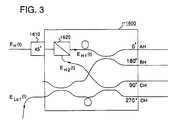
- FIG. 3 illustrates an alternative phase diversity hybrid 1600 which may be utilized in the arrangement illustrated in FIG. 2.
- coupler 162 of hybrid 160 is replaced in this embodiment with a 45° rotator 1610 and a polarization beam splitter 1620.
- rotator 1610 is positioned at the interface of polarization maintaining fiber 14 and hybrid 1600 so as to provide a 45° rotation to component E H (t).
- the rotation allows for polarization beam splitter 1620 to then divide signal E H (t) into substantially equal components which then propagate through phase shifter 166 and couplers 170, 172 as described above.
- component E V (t) may be propagated through a second 45° rotator with the rotated signal being provided as an input to a second polarization beam splitter.
- the rotation of signal E V (t) thus provides as the output from the splitter a pair of signals of relatively equal power.
- another embodiment of the present invention may utilize an alternative demodulating arrangement including single photodiode receivers, instead of the pairs of photodiodes used in the balanced receiver configuration of FIGs. 1 and 2.
- the present invention is not limited to systems utilizing DPSK modulation, since alternative signaling schemes, including but not limited to FSK (frequency-shift keyed) or ASK (amplitude-shift keyed) modulation could also be utilized with the optical hybrid of the present invention.
Landscapes
- Physics & Mathematics (AREA)
- Electromagnetism (AREA)
- Engineering & Computer Science (AREA)
- Computer Networks & Wireless Communication (AREA)
- Signal Processing (AREA)
- Optical Communication System (AREA)
Claims (4)
- Coupleur hybride optique destiné à assurer une récupération de signaux indépendante de la polarisation dans un système de détection d'onde lumineuse cohérente, le coupleur hybride comportant :des moyens (12) de séparation à polarisation pour diviser un premier signal de message d'onde lumineuse incident (Es(t)) en des première (EH1(t)) et seconde (EV1(t)) composantes orthogonales ayant respectivement un premier et un second état de polarisation,des moyens (22) pour diviser un premier signal d'oscillateur local de fréquence connue et d'état de polarisation connu en des première (ELO1(t)) et seconde (ELO2(t)) composantes de puissances sensiblement égales,des premiers moyens (16) de combinaison pour mélanger la composante ayant le premier état de polarisation du signal de message à la composante associée ayant le premier état de polarisation du premier signal d'oscillateur local; etdes seconds moyens (20) de combinaison pour mélanger la composante ayant le second état de polarisation du signal de message à la composante associée ayant le second état de polarisation du premier signal d'oscillateur local;caractérisé en ce queles moyens à polarisation sont également conçus pour diviser un second signal de message d'onde lumineuse incident (E's(t)) en des première (EH2(t)) et seconde (EV2(t)) composantes orthogonales présentant respectivement les premier et second états de polarisation, les composantes des premier et second signaux de messages sortant des moyens de séparation de telle manière que la composante ayant le premier état de polarisation de chaque signal de message se propage suivant le même trajet de signal que la composante ayant le second état de polarisation de l'autre signal de message; en ce quele moyen de division est également conçu pour diviser un second signal d'oscillateur local ayant une fréquence différente du premier signal d'oscillateur, en des première (E'LO1(t)) et seconde (E'LO2(t)) composantes de puissances sensiblement égales; et en ce queles premiers moyens de combinaison sont conçus pour mélanger les composantes superposées ayant les premier et second états de polarisation des premier et second signaux de messages, respectivement avec les composantes superposées ayant les états de polarisation associés des premier et second signaux d'oscillateur; etles seconds moyens de combinaison sont conçus pour mélanger les composantes superposées ayant les premier et second états de polarisation des premier et second signaux de messages, respectivement avec les composantes superposées ayant les états de polarisation associés des premier et second signaux d'oscillateur.
- Coupleur hybride optique selon la revendication 1, dans lequel le coupleur hybride est en outre capable d'assurer une indépendance de phase, les premier et second moyens de combinaison comprenant chacun des moyens (160,200) à diversité de phase pouvant élaborer, en tant que pluralité de signaux de sortie combinés, une première paire de signaux qui sont séparés en phase de 180° et sont polarisés linéairement, et une seconde paire de signaux qui sont séparés en phase de 180° et sont polarisés circulairement.
- Coupleur hybride optique selon la revendication 2, dans lequel chaque moyen de combinaison à diversité de phase comprendun premier coupleur (162) à conservation de polarisation sensible à la composante de signal de message associée en fournissant, en tant que sorties distinctes, des premier et second signaux qui dépendent de cette composante;un second coupleur (164) à conservation de polarisation sensible à la composante de signal d'oscillateur local associée en fournissant, en tant que sorties distinctes, des premier et second signaux dépendant de cette composante;des premiers moyens (166) d'ajustement de phase pour faire subir une rotation de phase de 90° à une sortie du premier coupleur par rapport à la sortie restante du premier coupleur;des seconds moyens (168) d'ajustement de phase pour faire subir une rotation de phase de 90° à une sortie du second coupleur par rapport à la sortie restante du second coupleur;un troisième coupleur (170) à conservation de polarisation sensible à la sortie des premiers moyens d'ajustement de phase et au signal d'oscillateur local non retardé en fournissant, sous la forme d'une paire de sorties, la première paire de signaux ayant l'état de polarisation associé, qui sont séparés en phase de 180°; etun quatrième coupleur (172) à conservation de polarisation sensible à la sortie des seconds moyens d'ajustement de phase et au signal de message non retardé en fournissant, en tant que sortie, une paire de signaux ayant l'état de polarisation associé, qui sont séparés en phase de 180° et déphasés de 90° par rapport à la sortie du troisième coupleur à conservation de polarisation.
- Coupleur hybride optique selon la revendication 2, dans lequel chacun des moyens de combinaison à diversité de phase comprennentdes moyens (1610) de rotation pour faire subir une rotation de 45° à la composante de signal de message associée;des moyens (1620) de séparation de faisceaux à polarisation couplés à la sortie des moyens de rotation pour fournir une paire de sorties de signaux de messages, les sorties ayant des puissances sensiblement égales;des premiers moyens (164) de combinaison couplés pour recevoir la composante d'oscillateur local associée, pour fournir, en tant que paire de sorties, des parties séparées de la composante d'oscillateur local associée, ces parties ayant des puissances relativement égales l'une à l'autre;des premiers moyens (166) d'ajustement de phase pour retarder la phase d'une sortie de la séparatrice de faisceaux à polarisation de 90° par rapport à la sortie restante;des seconds moyens (168) d'ajustement de phase pour retarder la phase d'une sortie des premiers moyens de combinaison de 90° par rapport à la sortie restante;des seconds moyens (170) de combinaison couplés pour recevoir la composante de message retardée en phase et la composante d'oscillateur local non retardée et pour fournir en tant que première sortie, une paire de signaux qui sont séparés en phase de 180°, les premier et second moyens de combinaison à conservation de polarisation comprenant chacun des moyens à diversité de phase pouvant élaborer, en tant qu'ensemble de sorties séparées, une première paire de signaux qui sont séparés en phase de 180° et sont polarisés linéairement, et une seconde paire de signaux qui sont séparés en phase de 180° et sont polarisés circulairement; etdes troisième moyens (172) de combinaison couplés pour recevoir la composante d'oscillateur local retardée en phase et la composante de message non retardée et pour fournir, en tant que seconde sortie, une paire de signaux qui sont séparés en phase de 180° et déphasés de 90° par rapport à la sortie des seconds moyens de combinaison.
Applications Claiming Priority (2)
| Application Number | Priority Date | Filing Date | Title |
|---|---|---|---|
| US488568 | 1990-03-05 | ||
| US07/488,568 US5060312A (en) | 1990-03-05 | 1990-03-05 | Polarization independent coherent lightwave detection arrangement |
Publications (3)
| Publication Number | Publication Date |
|---|---|
| EP0445943A2 EP0445943A2 (fr) | 1991-09-11 |
| EP0445943A3 EP0445943A3 (en) | 1992-07-15 |
| EP0445943B1 true EP0445943B1 (fr) | 1996-09-25 |
Family
ID=23940183
Family Applications (1)
| Application Number | Title | Priority Date | Filing Date |
|---|---|---|---|
| EP91301470A Expired - Lifetime EP0445943B1 (fr) | 1990-03-05 | 1991-02-25 | Dispositif de détection d'ondes optiques cohérentes indépendant de la polarisation |
Country Status (4)
| Country | Link |
|---|---|
| US (1) | US5060312A (fr) |
| EP (1) | EP0445943B1 (fr) |
| JP (1) | JPH0828682B2 (fr) |
| DE (1) | DE69122285T2 (fr) |
Families Citing this family (70)
| Publication number | Priority date | Publication date | Assignee | Title |
|---|---|---|---|---|
| US5258615A (en) * | 1990-08-03 | 1993-11-02 | Gpt Limited | Optical fiber monitoring by detection of polarization variations |
| JPH04144320A (ja) * | 1990-10-05 | 1992-05-18 | Hitachi Ltd | ホモダイン光受信装置 |
| ES2101797T3 (es) * | 1991-09-06 | 1997-07-16 | Nederland Ptt | Sistemas de transmision para la transmision de señales independientemente de la polarizacion. |
| US5388088A (en) * | 1992-04-02 | 1995-02-07 | At&T Corp. | Multiple polarization sensitive detection arrangement for fiber optic communications |
| DE4230932A1 (de) * | 1992-09-16 | 1994-06-16 | Deutsche Aerospace | Einrichtung für die Erzeugung von Rückkopplungssignalen zur Regelung optischer Überwachungskreise (PLL) |
| CA2112175A1 (fr) * | 1993-03-08 | 1994-09-09 | Neal S. Bergano | Methode pour reduire la degradation et l'affaiblissement non lineaires des signaux dans un systeme de transmission optique a grande distance |
| US5473463A (en) * | 1993-05-13 | 1995-12-05 | Koninklijke Ptt Nederland N.V. | Optical hybrid |
| US5400164A (en) * | 1993-09-10 | 1995-03-21 | At&T Corp. | Polarization-insensitive optical four-photon mixer |
| US5654818A (en) * | 1996-02-09 | 1997-08-05 | The United States Of America As Represented By The United States National Aeronautics And Space Administration | Polarization independent electro-optic modulator |
| DE69624680T2 (de) * | 1996-04-05 | 2003-09-18 | Nippon Telegraph And Telephone Corp., Tokio/Tokyo | AM/FM Umsetzer und Lichtwellensignalübertragungssystem |
| US5903393A (en) * | 1997-12-04 | 1999-05-11 | Kalibjian; Ralph | Optical-hybrid etalons for simultaneous phase- and polarization-diversity operations |
| US6548801B1 (en) * | 2000-01-13 | 2003-04-15 | Agilent Technologies, Inc. | System and method for optical heterodyne detection of an optical signal |
| US6259529B1 (en) * | 2000-02-17 | 2001-07-10 | Agilent Technologies, Inc. | Wavelength-selective polarization-diverse optical heterodyne receiver |
| US7167651B2 (en) * | 2000-09-26 | 2007-01-23 | Celight, Inc. | System and method for code division multiplexed optical communication |
| US7110677B2 (en) * | 2001-09-26 | 2006-09-19 | Celight, Inc. | Method and system for optical time division multiplexed fiber communications with coherent detection |
| US6407848B1 (en) | 2000-12-27 | 2002-06-18 | All Optical Networks, Inc. | Servo-stabilized-phase, differential coherence detector |
| US6473222B2 (en) | 2000-12-27 | 2002-10-29 | John N. Hait | Hyper-heterodyning, expanded bandpass apparatus and method |
| US7327913B2 (en) * | 2001-09-26 | 2008-02-05 | Celight, Inc. | Coherent optical detector and coherent communication system and method |
| US7272271B2 (en) * | 2001-09-26 | 2007-09-18 | Celight, Inc. | Electro-optical integrated transmitter chip for arbitrary quadrature modulation of optical signals |
| DE10243141B4 (de) | 2002-09-17 | 2006-05-11 | Siemens Ag | Verfahren zur Übertragung von optischen Polarisationsmultiplexsignalen |
| JP3808820B2 (ja) * | 2002-10-08 | 2006-08-16 | 日本電信電話株式会社 | 光サンプリング方法、装置およびプログラム |
| US7460793B2 (en) * | 2002-12-11 | 2008-12-02 | Michael George Taylor | Coherent optical detection and signal processing method and system |
| US7529481B1 (en) * | 2003-03-13 | 2009-05-05 | State Of Oregon Acting By And Through The State Board Of Higher Education On Behalf Of The University Of Oregon | Linear optical sampling methods and apparatus |
| US7068374B2 (en) * | 2003-06-09 | 2006-06-27 | Agilent Technologies, Inc. | Phase-diverse coherent optical spectrum analyzer |
| US7483600B2 (en) * | 2003-07-02 | 2009-01-27 | Celight, Inc. | Integrated coherent optical detector |
| US7502118B2 (en) * | 2003-09-22 | 2009-03-10 | Celight, Inc. | High sensitivity coherent photothermal interferometric system and method for chemical detection |
| US8064767B2 (en) * | 2003-09-22 | 2011-11-22 | Celight, Inc. | Optical orthogonal frequency division multiplexed communications with coherent detection |
| US7426035B2 (en) * | 2003-09-22 | 2008-09-16 | Celight, Inc. | System and method for chemical sensing using trace gas detection |
| US7242481B2 (en) * | 2003-09-22 | 2007-07-10 | Celight, Inc. | Laser vibrometry with coherent detection |
| US7315699B2 (en) * | 2004-04-26 | 2008-01-01 | Lucent Technologies Inc. | Optical device for extracting a sideband signal from a composite signal including orthogonally modulated signals |
| US7826752B1 (en) * | 2005-06-02 | 2010-11-02 | Level 3 Communications, Llc | Optical transmission apparatuses, methods, and systems |
| JP2007218628A (ja) * | 2006-02-14 | 2007-08-30 | Nippon Telegr & Teleph Corp <Ntt> | 偏波状態測定器及び光サンプリング装置 |
| US7877020B1 (en) | 2006-04-28 | 2011-01-25 | Hrl Laboratories, Llc | Coherent RF-photonic link linearized via a negative feedback phase-tracking loop |
| US7941059B1 (en) * | 2006-04-28 | 2011-05-10 | Hrl Laboratories, Llc | Down conversion for distortion free recovery of a phase modulated optical signal |
| CN100383572C (zh) * | 2006-05-08 | 2008-04-23 | 中国科学院上海光学精密机械研究所 | 电控相移空间光桥接器 |
| US7869054B2 (en) * | 2006-05-26 | 2011-01-11 | Medeikon Corporation | Polarization insensitive multiple probe |
| US7809284B2 (en) * | 2006-06-23 | 2010-10-05 | Alcatel-Lucent Usa Inc. | System and method for receiving coherent, polarization-multiplexed optical signals |
| JP4531740B2 (ja) * | 2006-12-15 | 2010-08-25 | 富士通株式会社 | コヒーレント光受信機 |
| JP5034770B2 (ja) * | 2007-08-16 | 2012-09-26 | 富士通株式会社 | コヒーレント光受信器および光通信システム |
| US7873286B2 (en) * | 2007-10-19 | 2011-01-18 | Ciena Corporation | Optical receiver systems and methods for polarization demultiplexing, PMD compensation, and DXPSK demodulation |
| US8437645B2 (en) * | 2007-12-06 | 2013-05-07 | Google Inc. | System and method for coherent detection of optical signals |
| US8204378B1 (en) | 2008-03-27 | 2012-06-19 | Tektronix, Inc. | Coherent optical signal processing |
| US8213752B2 (en) * | 2008-06-09 | 2012-07-03 | Chapman David J | Coherent optical mixer and a method of coherent detection of light |
| US20100021163A1 (en) * | 2008-07-24 | 2010-01-28 | The University Of Melbourne | Method and system for polarization supported optical transmission |
| EP2326978A2 (fr) * | 2008-08-19 | 2011-06-01 | Alcatel-Lucent USA Inc. | Détecteurs optiques cohérents monolithiques |
| US20100054761A1 (en) * | 2008-08-28 | 2010-03-04 | Young-Kai Chen | Monolithic coherent optical detectors |
| KR101104550B1 (ko) | 2008-10-21 | 2012-01-11 | 한국과학기술원 | Wdm-pon에서의 광 검출 장치 및 방법 |
| US20100158521A1 (en) * | 2008-12-18 | 2010-06-24 | Alcatel-Lucent Usa Inc. | Optical mixer for coherent detection of polarization-multiplexed signals |
| US8103166B2 (en) | 2009-01-12 | 2012-01-24 | Alcatel Lucent | Multi-wavelength coherent receiver with a shared optical hybrid and a multi-wavelength local oscillator |
| WO2010107439A1 (fr) | 2009-03-20 | 2010-09-23 | Alcatel-Lucent Usa Inc. | Capteur optique cohérent comportant un réseau de guides d'onde à fonctions multiples |
| JP5444877B2 (ja) * | 2009-06-24 | 2014-03-19 | 富士通株式会社 | デジタルコヒーレント受信器 |
| US8275224B2 (en) * | 2009-08-14 | 2012-09-25 | Alcatel Lucent | Coherent receiver having an interleave-chirped arrayed waveguide grating |
| WO2011027895A1 (fr) | 2009-09-07 | 2011-03-10 | 古河電気工業株式会社 | Démodulateur de type plc et système de transmission optique |
| KR20110030136A (ko) * | 2009-09-17 | 2011-03-23 | 한국전자통신연구원 | 편광 분리기, 광학 하이브리드 그리고 그것들을 포함하는 광 수신기 |
| US8849126B2 (en) * | 2011-01-10 | 2014-09-30 | At&T Intellectual Property I, L.P. | Electronic phase conjugation for impairment compensation in a fiber communication system |
| US8676009B2 (en) * | 2011-03-15 | 2014-03-18 | Alcatel Lucent | Monolithic photonic integrated circuit |
| WO2012130275A1 (fr) * | 2011-03-28 | 2012-10-04 | Agilent Technologies, Inc. | Analyseur de spectre optique hétérodyne |
| US20120288286A1 (en) * | 2011-05-12 | 2012-11-15 | Alcatel-Lucent Usa Inc. | Optical receiver for amplitude-modulated signals |
| JP5667021B2 (ja) * | 2011-09-22 | 2015-02-12 | 日本電信電話株式会社 | フォトミキサおよび光電子集積回路 |
| WO2013047333A1 (fr) * | 2011-09-29 | 2013-04-04 | 日本電気株式会社 | Circuit d'onde lumineuse plan et récepteur optique |
| US20130128907A1 (en) * | 2011-11-08 | 2013-05-23 | Optoplex Corporation | Coherent Micro-mixer |
| US9002150B2 (en) | 2012-05-08 | 2015-04-07 | General Dynamics Advanced Information Systems, Inc. | Optical sensing system and method |
| US9917672B2 (en) | 2013-08-09 | 2018-03-13 | Technical University Of Denmark | Wireless distributed antenna MIMO |
| JP6346803B2 (ja) * | 2014-06-23 | 2018-06-20 | 株式会社フジクラ | 光受信回路およびその調整方法 |
| WO2016162904A1 (fr) * | 2015-04-10 | 2016-10-13 | National Institute Of Information And Communications Technology | Récepteur pour détection auto-homodyne insensible à la polarisation pour des systèmes de multiplexage à répartition dans l'espace |
| US10651947B2 (en) * | 2018-02-20 | 2020-05-12 | Futurewei Technologies, Inc. | Coherent detection with remotely delivered local oscillators |
| CN111698027A (zh) * | 2019-03-13 | 2020-09-22 | 中兴通讯股份有限公司 | 一种相干检测方法及相干接收机 |
| CN113406744B (zh) * | 2021-06-28 | 2022-07-22 | 中国电子科技集团公司信息科学研究院 | 傅里叶型波导分光芯片 |
| EP4239912B1 (fr) | 2022-03-03 | 2026-04-29 | EFFECT Photonics B.V. | Circuit intégré photonique et système opto-électronique le comprenant |
| CN115065417B (zh) * | 2022-08-11 | 2022-10-21 | 北京中科国光量子科技有限公司 | 一种偏振无关相干接收装置 |
Family Cites Families (7)
| Publication number | Priority date | Publication date | Assignee | Title |
|---|---|---|---|---|
| CA1290019C (fr) * | 1986-06-20 | 1991-10-01 | Hideo Kuwahara | Recepteur de signaux lumineux a dedoublement |
| US4718120A (en) * | 1986-11-24 | 1988-01-05 | American Telephone And Telegraph Company, At&T Bell Laboratories | Polarization insensitive coherent lightwave detector |
| US4829598A (en) * | 1987-01-22 | 1989-05-09 | Siemens Aktiengesellschaft | Optical receiver with an optical coupler and an electronic amplifier |
| JPS6477520A (en) * | 1987-09-18 | 1989-03-23 | Toshiba Corp | Device for joining film |
| JPH01178940A (ja) * | 1987-12-29 | 1989-07-17 | Nec Corp | 偏波ダイバーシチ光受信装置 |
| JPH01211737A (ja) * | 1988-02-19 | 1989-08-24 | Fujitsu Ltd | コヒーレント光通信用偏波ダイバーシティ光受信装置 |
| JPH01237529A (ja) * | 1988-03-18 | 1989-09-22 | Hitachi Ltd | 光受信器 |
-
1990
- 1990-03-05 US US07/488,568 patent/US5060312A/en not_active Expired - Lifetime
-
1991
- 1991-02-25 EP EP91301470A patent/EP0445943B1/fr not_active Expired - Lifetime
- 1991-02-25 DE DE69122285T patent/DE69122285T2/de not_active Expired - Fee Related
- 1991-03-04 JP JP3061088A patent/JPH0828682B2/ja not_active Expired - Fee Related
Also Published As
| Publication number | Publication date |
|---|---|
| US5060312A (en) | 1991-10-22 |
| JPH0828682B2 (ja) | 1996-03-21 |
| DE69122285T2 (de) | 1997-03-20 |
| DE69122285D1 (de) | 1996-10-31 |
| JPH0715386A (ja) | 1995-01-17 |
| EP0445943A3 (en) | 1992-07-15 |
| EP0445943A2 (fr) | 1991-09-11 |
Similar Documents
| Publication | Publication Date | Title |
|---|---|---|
| EP0445943B1 (fr) | Dispositif de détection d'ondes optiques cohérentes indépendant de la polarisation | |
| CA1253571A (fr) | Detecteur de lumiere coherente insensible a la polarisation | |
| EP0409260B1 (fr) | Récepteur pour communication optique cohérente | |
| EP0247738B1 (fr) | Récepteur optique cohérent à hétérodynage indépendant de la polarisation | |
| JP3001943B2 (ja) | 偏波スイッチング光源、光受信装置及びコヒーレント光伝送システム | |
| EP0337644B1 (fr) | Procédé et appareil de transmission d'information | |
| EP3075083B1 (fr) | Récepteur optique cohérent indépendant de la polarisation | |
| EP0198239B1 (fr) | Récepteur optique | |
| EP0241039B1 (fr) | Sytème de transmission par fibre optique utilisant une modulation de polarisation et une détection hétérodyne cohérente | |
| SG174462A1 (en) | Coherent optical detector having a multifunctional waveguide grating | |
| US5027436A (en) | Optical hybrid for coherent detection systems | |
| GB2110895A (en) | Coherent detection and demodulation of a phase-modulated carrier wave in a random polarization state | |
| EP0245026B1 (fr) | Mélangeur optique hétérodyne procurant une réjection des fréquences-images | |
| EP0246004B1 (fr) | Mélangeurs optiques hétérodynes à photodiode unique | |
| CA1308440C (fr) | Methode de communication optique a diversite de polarisation et appareil utilisant cette methode | |
| EP0265278B1 (fr) | Démodulateur pour modulation à déplacement de fréquence optique | |
| GB2214381A (en) | Optical phase-diversity receivers | |
| EP0564042B1 (fr) | Procédé de mise en action d'un hybride optique | |
| Singh et al. | New phase and polarization-insensitive receivers for coherent optical fibre communication systems |
Legal Events
| Date | Code | Title | Description |
|---|---|---|---|
| PUAI | Public reference made under article 153(3) epc to a published international application that has entered the european phase |
Free format text: ORIGINAL CODE: 0009012 |
|
| AK | Designated contracting states |
Kind code of ref document: A2 Designated state(s): DE FR GB |
|
| PUAL | Search report despatched |
Free format text: ORIGINAL CODE: 0009013 |
|
| AK | Designated contracting states |
Kind code of ref document: A3 Designated state(s): DE FR GB |
|
| 17P | Request for examination filed |
Effective date: 19921207 |
|
| RAP3 | Party data changed (applicant data changed or rights of an application transferred) |
Owner name: AT&T CORP. |
|
| 17Q | First examination report despatched |
Effective date: 19950329 |
|
| GRAH | Despatch of communication of intention to grant a patent |
Free format text: ORIGINAL CODE: EPIDOS IGRA |
|
| GRAH | Despatch of communication of intention to grant a patent |
Free format text: ORIGINAL CODE: EPIDOS IGRA |
|
| GRAA | (expected) grant |
Free format text: ORIGINAL CODE: 0009210 |
|
| AK | Designated contracting states |
Kind code of ref document: B1 Designated state(s): DE FR GB |
|
| REF | Corresponds to: |
Ref document number: 69122285 Country of ref document: DE Date of ref document: 19961031 |
|
| ET | Fr: translation filed | ||
| PLBE | No opposition filed within time limit |
Free format text: ORIGINAL CODE: 0009261 |
|
| STAA | Information on the status of an ep patent application or granted ep patent |
Free format text: STATUS: NO OPPOSITION FILED WITHIN TIME LIMIT |
|
| 26N | No opposition filed | ||
| REG | Reference to a national code |
Ref country code: GB Ref legal event code: IF02 |
|
| PGFP | Annual fee paid to national office [announced via postgrant information from national office to epo] |
Ref country code: DE Payment date: 20020328 Year of fee payment: 12 |
|
| PGFP | Annual fee paid to national office [announced via postgrant information from national office to epo] |
Ref country code: FR Payment date: 20030122 Year of fee payment: 13 |
|
| PGFP | Annual fee paid to national office [announced via postgrant information from national office to epo] |
Ref country code: GB Payment date: 20030124 Year of fee payment: 13 |
|
| PG25 | Lapsed in a contracting state [announced via postgrant information from national office to epo] |
Ref country code: DE Free format text: LAPSE BECAUSE OF NON-PAYMENT OF DUE FEES Effective date: 20030902 |
|
| PG25 | Lapsed in a contracting state [announced via postgrant information from national office to epo] |
Ref country code: GB Free format text: LAPSE BECAUSE OF NON-PAYMENT OF DUE FEES Effective date: 20040225 |
|
| GBPC | Gb: european patent ceased through non-payment of renewal fee |
Effective date: 20040225 |
|
| PG25 | Lapsed in a contracting state [announced via postgrant information from national office to epo] |
Ref country code: FR Free format text: LAPSE BECAUSE OF NON-PAYMENT OF DUE FEES Effective date: 20041029 |
|
| REG | Reference to a national code |
Ref country code: FR Ref legal event code: ST |