EP0445952B1 - Carbonate de calcium stabilisé contre les acides, procédé de production et méthode d'utilisation dans la fabrication de papier acide - Google Patents
Carbonate de calcium stabilisé contre les acides, procédé de production et méthode d'utilisation dans la fabrication de papier acide Download PDFInfo
- Publication number
- EP0445952B1 EP0445952B1 EP91301573A EP91301573A EP0445952B1 EP 0445952 B1 EP0445952 B1 EP 0445952B1 EP 91301573 A EP91301573 A EP 91301573A EP 91301573 A EP91301573 A EP 91301573A EP 0445952 B1 EP0445952 B1 EP 0445952B1
- Authority
- EP
- European Patent Office
- Prior art keywords
- acid
- calcium carbonate
- finely divided
- conjugate base
- calcium
- Prior art date
- Legal status (The legal status is an assumption and is not a legal conclusion. Google has not performed a legal analysis and makes no representation as to the accuracy of the status listed.)
- Expired - Lifetime
Links
- VTYYLEPIZMXCLO-UHFFFAOYSA-L Calcium carbonate Chemical compound [Ca+2].[O-]C([O-])=O VTYYLEPIZMXCLO-UHFFFAOYSA-L 0.000 title claims description 246
- 229910000019 calcium carbonate Inorganic materials 0.000 title claims description 113
- 238000000034 method Methods 0.000 title claims description 32
- 230000002378 acidificating effect Effects 0.000 title claims description 15
- 238000004519 manufacturing process Methods 0.000 title description 7
- NBIIXXVUZAFLBC-UHFFFAOYSA-N Phosphoric acid Chemical compound OP(O)(O)=O NBIIXXVUZAFLBC-UHFFFAOYSA-N 0.000 claims description 96
- 239000002253 acid Substances 0.000 claims description 74
- 239000002585 base Substances 0.000 claims description 47
- 229910000147 aluminium phosphate Inorganic materials 0.000 claims description 46
- 239000003715 calcium chelating agent Substances 0.000 claims description 36
- GCLGEJMYGQKIIW-UHFFFAOYSA-H sodium hexametaphosphate Chemical group [Na]OP1(=O)OP(=O)(O[Na])OP(=O)(O[Na])OP(=O)(O[Na])OP(=O)(O[Na])OP(=O)(O[Na])O1 GCLGEJMYGQKIIW-UHFFFAOYSA-H 0.000 claims description 32
- 235000019982 sodium hexametaphosphate Nutrition 0.000 claims description 32
- 239000001577 tetrasodium phosphonato phosphate Substances 0.000 claims description 32
- 239000000203 mixture Substances 0.000 claims description 28
- 239000002002 slurry Substances 0.000 claims description 23
- 239000000463 material Substances 0.000 claims description 18
- KRKNYBCHXYNGOX-UHFFFAOYSA-N citric acid Chemical compound OC(=O)CC(O)(C(O)=O)CC(O)=O KRKNYBCHXYNGOX-UHFFFAOYSA-N 0.000 claims description 15
- 239000000945 filler Substances 0.000 claims description 13
- QTBSBXVTEAMEQO-UHFFFAOYSA-N Acetic acid Chemical compound CC(O)=O QTBSBXVTEAMEQO-UHFFFAOYSA-N 0.000 claims description 12
- MUBZPKHOEPUJKR-UHFFFAOYSA-N Oxalic acid Chemical compound OC(=O)C(O)=O MUBZPKHOEPUJKR-UHFFFAOYSA-N 0.000 claims description 12
- 239000007787 solid Substances 0.000 claims description 11
- 229940088417 precipitated calcium carbonate Drugs 0.000 claims description 10
- KCXVZYZYPLLWCC-UHFFFAOYSA-N EDTA Chemical compound OC(=O)CN(CC(O)=O)CCN(CC(O)=O)CC(O)=O KCXVZYZYPLLWCC-UHFFFAOYSA-N 0.000 claims description 8
- 229960001484 edetic acid Drugs 0.000 claims description 8
- LSNNMFCWUKXFEE-UHFFFAOYSA-N Sulfurous acid Chemical compound OS(O)=O LSNNMFCWUKXFEE-UHFFFAOYSA-N 0.000 claims description 7
- 239000007864 aqueous solution Substances 0.000 claims description 6
- 150000001875 compounds Chemical class 0.000 claims description 6
- UEZVMMHDMIWARA-UHFFFAOYSA-N Metaphosphoric acid Chemical compound OP(=O)=O UEZVMMHDMIWARA-UHFFFAOYSA-N 0.000 claims description 5
- KGBXLFKZBHKPEV-UHFFFAOYSA-N boric acid Chemical compound OB(O)O KGBXLFKZBHKPEV-UHFFFAOYSA-N 0.000 claims description 5
- 239000004327 boric acid Substances 0.000 claims description 5
- 159000000007 calcium salts Chemical class 0.000 claims description 5
- 239000003446 ligand Substances 0.000 claims description 5
- 230000003287 optical effect Effects 0.000 claims description 5
- VILCJCGEZXAXTO-UHFFFAOYSA-N 2,2,2-tetramine Chemical compound NCCNCCNCCN VILCJCGEZXAXTO-UHFFFAOYSA-N 0.000 claims description 4
- RPNUMPOLZDHAAY-UHFFFAOYSA-N Diethylenetriamine Chemical compound NCCNCCN RPNUMPOLZDHAAY-UHFFFAOYSA-N 0.000 claims description 4
- DGAQECJNVWCQMB-PUAWFVPOSA-M Ilexoside XXIX Chemical compound C[C@@H]1CC[C@@]2(CC[C@@]3(C(=CC[C@H]4[C@]3(CC[C@@H]5[C@@]4(CC[C@@H](C5(C)C)OS(=O)(=O)[O-])C)C)[C@@H]2[C@]1(C)O)C)C(=O)O[C@H]6[C@@H]([C@H]([C@@H]([C@H](O6)CO)O)O)O.[Na+] DGAQECJNVWCQMB-PUAWFVPOSA-M 0.000 claims description 4
- 235000019738 Limestone Nutrition 0.000 claims description 4
- DGEZNRSVGBDHLK-UHFFFAOYSA-N [1,10]phenanthroline Chemical compound C1=CN=C2C3=NC=CC=C3C=CC2=C1 DGEZNRSVGBDHLK-UHFFFAOYSA-N 0.000 claims description 4
- 229910052783 alkali metal Inorganic materials 0.000 claims description 4
- 239000006028 limestone Substances 0.000 claims description 4
- 238000002156 mixing Methods 0.000 claims description 4
- 230000007935 neutral effect Effects 0.000 claims description 4
- 235000006408 oxalic acid Nutrition 0.000 claims description 4
- 239000011734 sodium Substances 0.000 claims description 4
- 229910052708 sodium Inorganic materials 0.000 claims description 4
- 229960001124 trientine Drugs 0.000 claims description 4
- 238000000576 coating method Methods 0.000 claims description 3
- 239000000843 powder Substances 0.000 claims description 3
- 150000001340 alkali metals Chemical class 0.000 claims description 2
- -1 and the like Substances 0.000 claims 3
- 239000011248 coating agent Substances 0.000 claims 2
- 239000000562 conjugate Substances 0.000 claims 1
- 235000010216 calcium carbonate Nutrition 0.000 description 88
- 235000011007 phosphoric acid Nutrition 0.000 description 44
- 239000002245 particle Substances 0.000 description 12
- 150000003839 salts Chemical class 0.000 description 10
- GWEVSGVZZGPLCZ-UHFFFAOYSA-N Titan oxide Chemical compound O=[Ti]=O GWEVSGVZZGPLCZ-UHFFFAOYSA-N 0.000 description 8
- AXCZMVOFGPJBDE-UHFFFAOYSA-L calcium dihydroxide Chemical compound [OH-].[OH-].[Ca+2] AXCZMVOFGPJBDE-UHFFFAOYSA-L 0.000 description 8
- 239000000920 calcium hydroxide Substances 0.000 description 8
- 229910001861 calcium hydroxide Inorganic materials 0.000 description 8
- 238000013019 agitation Methods 0.000 description 7
- FUFJGUQYACFECW-UHFFFAOYSA-L calcium hydrogenphosphate Chemical compound [Ca+2].OP([O-])([O-])=O FUFJGUQYACFECW-UHFFFAOYSA-L 0.000 description 5
- 239000007789 gas Substances 0.000 description 5
- 239000000243 solution Substances 0.000 description 5
- 239000000725 suspension Substances 0.000 description 5
- CURLTUGMZLYLDI-UHFFFAOYSA-N Carbon dioxide Chemical compound O=C=O CURLTUGMZLYLDI-UHFFFAOYSA-N 0.000 description 4
- 229910019142 PO4 Inorganic materials 0.000 description 4
- 229920000388 Polyphosphate Polymers 0.000 description 4
- 229940005740 hexametaphosphate Drugs 0.000 description 4
- 239000001205 polyphosphate Substances 0.000 description 4
- 235000011176 polyphosphates Nutrition 0.000 description 4
- 239000004408 titanium dioxide Substances 0.000 description 4
- 239000007900 aqueous suspension Substances 0.000 description 3
- 235000021317 phosphate Nutrition 0.000 description 3
- QORWJWZARLRLPR-UHFFFAOYSA-H tricalcium bis(phosphate) Chemical compound [Ca+2].[Ca+2].[Ca+2].[O-]P([O-])([O-])=O.[O-]P([O-])([O-])=O QORWJWZARLRLPR-UHFFFAOYSA-H 0.000 description 3
- 229910000391 tricalcium phosphate Inorganic materials 0.000 description 3
- VYPSYNLAJGMNEJ-UHFFFAOYSA-N Silicium dioxide Chemical compound O=[Si]=O VYPSYNLAJGMNEJ-UHFFFAOYSA-N 0.000 description 2
- RAHZWNYVWXNFOC-UHFFFAOYSA-N Sulphur dioxide Chemical compound O=S=O RAHZWNYVWXNFOC-UHFFFAOYSA-N 0.000 description 2
- 150000007513 acids Chemical class 0.000 description 2
- 239000000654 additive Substances 0.000 description 2
- 230000000996 additive effect Effects 0.000 description 2
- 150000001450 anions Chemical class 0.000 description 2
- 230000015572 biosynthetic process Effects 0.000 description 2
- 239000007853 buffer solution Substances 0.000 description 2
- YYRMJZQKEFZXMX-UHFFFAOYSA-L calcium bis(dihydrogenphosphate) Chemical compound [Ca+2].OP(O)([O-])=O.OP(O)([O-])=O YYRMJZQKEFZXMX-UHFFFAOYSA-L 0.000 description 2
- 239000001569 carbon dioxide Substances 0.000 description 2
- 229910002092 carbon dioxide Inorganic materials 0.000 description 2
- 238000006243 chemical reaction Methods 0.000 description 2
- 239000004927 clay Substances 0.000 description 2
- XPPKVPWEQAFLFU-UHFFFAOYSA-N diphosphoric acid Chemical compound OP(O)(=O)OP(O)(O)=O XPPKVPWEQAFLFU-UHFFFAOYSA-N 0.000 description 2
- 239000002270 dispersing agent Substances 0.000 description 2
- 239000006185 dispersion Substances 0.000 description 2
- 239000000839 emulsion Substances 0.000 description 2
- 239000007788 liquid Substances 0.000 description 2
- 229910000150 monocalcium phosphate Inorganic materials 0.000 description 2
- NBIIXXVUZAFLBC-UHFFFAOYSA-K phosphate Chemical compound [O-]P([O-])([O-])=O NBIIXXVUZAFLBC-UHFFFAOYSA-K 0.000 description 2
- 239000010452 phosphate Substances 0.000 description 2
- 239000000049 pigment Substances 0.000 description 2
- 229920000137 polyphosphoric acid Polymers 0.000 description 2
- 238000001556 precipitation Methods 0.000 description 2
- 238000002360 preparation method Methods 0.000 description 2
- DLYUQMMRRRQYAE-UHFFFAOYSA-N tetraphosphorus decaoxide Chemical compound O1P(O2)(=O)OP3(=O)OP1(=O)OP2(=O)O3 DLYUQMMRRRQYAE-UHFFFAOYSA-N 0.000 description 2
- XLYOFNOQVPJJNP-UHFFFAOYSA-N water Substances O XLYOFNOQVPJJNP-UHFFFAOYSA-N 0.000 description 2
- BTBUEUYNUDRHOZ-UHFFFAOYSA-N Borate Chemical compound [O-]B([O-])[O-] BTBUEUYNUDRHOZ-UHFFFAOYSA-N 0.000 description 1
- VEXZGXHMUGYJMC-UHFFFAOYSA-M Chloride anion Chemical compound [Cl-] VEXZGXHMUGYJMC-UHFFFAOYSA-M 0.000 description 1
- KRKNYBCHXYNGOX-UHFFFAOYSA-K Citrate Chemical compound [O-]C(=O)CC(O)(CC([O-])=O)C([O-])=O KRKNYBCHXYNGOX-UHFFFAOYSA-K 0.000 description 1
- 235000008733 Citrus aurantifolia Nutrition 0.000 description 1
- KRHYYFGTRYWZRS-UHFFFAOYSA-N Fluorane Chemical compound F KRHYYFGTRYWZRS-UHFFFAOYSA-N 0.000 description 1
- KRHYYFGTRYWZRS-UHFFFAOYSA-M Fluoride anion Chemical compound [F-] KRHYYFGTRYWZRS-UHFFFAOYSA-M 0.000 description 1
- FYYHWMGAXLPEAU-UHFFFAOYSA-N Magnesium Chemical compound [Mg] FYYHWMGAXLPEAU-UHFFFAOYSA-N 0.000 description 1
- ZLMJMSJWJFRBEC-UHFFFAOYSA-N Potassium Chemical compound [K] ZLMJMSJWJFRBEC-UHFFFAOYSA-N 0.000 description 1
- 235000011941 Tilia x europaea Nutrition 0.000 description 1
- RTAQQCXQSZGOHL-UHFFFAOYSA-N Titanium Chemical compound [Ti] RTAQQCXQSZGOHL-UHFFFAOYSA-N 0.000 description 1
- 230000032683 aging Effects 0.000 description 1
- 229910000318 alkali metal phosphate Inorganic materials 0.000 description 1
- 229910052782 aluminium Inorganic materials 0.000 description 1
- XAGFODPZIPBFFR-UHFFFAOYSA-N aluminium Chemical compound [Al] XAGFODPZIPBFFR-UHFFFAOYSA-N 0.000 description 1
- 230000003139 buffering effect Effects 0.000 description 1
- 239000011575 calcium Substances 0.000 description 1
- XAAHAAMILDNBPS-UHFFFAOYSA-L calcium hydrogenphosphate dihydrate Chemical compound O.O.[Ca+2].OP([O-])([O-])=O XAAHAAMILDNBPS-UHFFFAOYSA-L 0.000 description 1
- 230000015556 catabolic process Effects 0.000 description 1
- 239000003795 chemical substances by application Substances 0.000 description 1
- 239000008139 complexing agent Substances 0.000 description 1
- 238000000354 decomposition reaction Methods 0.000 description 1
- 238000006731 degradation reaction Methods 0.000 description 1
- 230000001419 dependent effect Effects 0.000 description 1
- 235000011180 diphosphates Nutrition 0.000 description 1
- 238000009826 distribution Methods 0.000 description 1
- 230000000694 effects Effects 0.000 description 1
- 239000007792 gaseous phase Substances 0.000 description 1
- 238000010438 heat treatment Methods 0.000 description 1
- 229910000040 hydrogen fluoride Inorganic materials 0.000 description 1
- 230000007062 hydrolysis Effects 0.000 description 1
- 238000006460 hydrolysis reaction Methods 0.000 description 1
- 239000004615 ingredient Substances 0.000 description 1
- 229910052500 inorganic mineral Inorganic materials 0.000 description 1
- 239000004571 lime Substances 0.000 description 1
- 239000011777 magnesium Substances 0.000 description 1
- 229910052749 magnesium Inorganic materials 0.000 description 1
- 230000014759 maintenance of location Effects 0.000 description 1
- 229910052751 metal Inorganic materials 0.000 description 1
- 239000002184 metal Substances 0.000 description 1
- 125000005341 metaphosphate group Chemical group 0.000 description 1
- 235000010755 mineral Nutrition 0.000 description 1
- 239000011707 mineral Substances 0.000 description 1
- 239000003973 paint Substances 0.000 description 1
- 150000003013 phosphoric acid derivatives Chemical class 0.000 description 1
- 150000003016 phosphoric acids Chemical class 0.000 description 1
- 239000011591 potassium Substances 0.000 description 1
- 229910052700 potassium Inorganic materials 0.000 description 1
- 159000000001 potassium salts Chemical class 0.000 description 1
- 238000000634 powder X-ray diffraction Methods 0.000 description 1
- 239000002244 precipitate Substances 0.000 description 1
- 239000002243 precursor Substances 0.000 description 1
- 239000000047 product Substances 0.000 description 1
- 229940048084 pyrophosphate Drugs 0.000 description 1
- 229940005657 pyrophosphoric acid Drugs 0.000 description 1
- 238000009877 rendering Methods 0.000 description 1
- 239000000377 silicon dioxide Substances 0.000 description 1
- 238000004381 surface treatment Methods 0.000 description 1
- 239000012756 surface treatment agent Substances 0.000 description 1
- 239000004094 surface-active agent Substances 0.000 description 1
- 238000003786 synthesis reaction Methods 0.000 description 1
- 239000010936 titanium Substances 0.000 description 1
- 229910052719 titanium Inorganic materials 0.000 description 1
- UNXRWKVEANCORM-UHFFFAOYSA-N triphosphoric acid Chemical compound OP(O)(=O)OP(O)(=O)OP(O)(O)=O UNXRWKVEANCORM-UHFFFAOYSA-N 0.000 description 1
- 230000036967 uncompetitive effect Effects 0.000 description 1
- 239000002699 waste material Substances 0.000 description 1
- 150000003751 zinc Chemical class 0.000 description 1
Images

Classifications
-
- C—CHEMISTRY; METALLURGY
- C01—INORGANIC CHEMISTRY
- C01F—COMPOUNDS OF THE METALS BERYLLIUM, MAGNESIUM, ALUMINIUM, CALCIUM, STRONTIUM, BARIUM, RADIUM, THORIUM, OR OF THE RARE-EARTH METALS
- C01F11/00—Compounds of calcium, strontium, or barium
- C01F11/18—Carbonates
-
- D—TEXTILES; PAPER
- D21—PAPER-MAKING; PRODUCTION OF CELLULOSE
- D21H—PULP COMPOSITIONS; PREPARATION THEREOF NOT COVERED BY SUBCLASSES D21C OR D21D; IMPREGNATING OR COATING OF PAPER; TREATMENT OF FINISHED PAPER NOT COVERED BY CLASS B31 OR SUBCLASS D21G; PAPER NOT OTHERWISE PROVIDED FOR
- D21H17/00—Non-fibrous material added to the pulp, characterised by its constitution; Paper-impregnating material characterised by its constitution
- D21H17/63—Inorganic compounds
- D21H17/67—Water-insoluble compounds, e.g. fillers, pigments
- D21H17/69—Water-insoluble compounds, e.g. fillers, pigments modified, e.g. by association with other compositions prior to incorporation in the pulp or paper
-
- C—CHEMISTRY; METALLURGY
- C01—INORGANIC CHEMISTRY
- C01F—COMPOUNDS OF THE METALS BERYLLIUM, MAGNESIUM, ALUMINIUM, CALCIUM, STRONTIUM, BARIUM, RADIUM, THORIUM, OR OF THE RARE-EARTH METALS
- C01F11/00—Compounds of calcium, strontium, or barium
- C01F11/18—Carbonates
- C01F11/185—After-treatment, e.g. grinding, purification, conversion of crystal morphology
-
- C—CHEMISTRY; METALLURGY
- C09—DYES; PAINTS; POLISHES; NATURAL RESINS; ADHESIVES; COMPOSITIONS NOT OTHERWISE PROVIDED FOR; APPLICATIONS OF MATERIALS NOT OTHERWISE PROVIDED FOR
- C09C—TREATMENT OF INORGANIC MATERIALS, OTHER THAN FIBROUS FILLERS, TO ENHANCE THEIR PIGMENTING OR FILLING PROPERTIES ; PREPARATION OF CARBON BLACK ; PREPARATION OF INORGANIC MATERIALS WHICH ARE NO SINGLE CHEMICAL COMPOUNDS AND WHICH ARE MAINLY USED AS PIGMENTS OR FILLERS
- C09C1/00—Treatment of specific inorganic materials other than fibrous fillers; Preparation of carbon black
- C09C1/02—Compounds of alkaline earth metals or magnesium
- C09C1/021—Calcium carbonates
-
- D—TEXTILES; PAPER
- D21—PAPER-MAKING; PRODUCTION OF CELLULOSE
- D21H—PULP COMPOSITIONS; PREPARATION THEREOF NOT COVERED BY SUBCLASSES D21C OR D21D; IMPREGNATING OR COATING OF PAPER; TREATMENT OF FINISHED PAPER NOT COVERED BY CLASS B31 OR SUBCLASS D21G; PAPER NOT OTHERWISE PROVIDED FOR
- D21H17/00—Non-fibrous material added to the pulp, characterised by its constitution; Paper-impregnating material characterised by its constitution
- D21H17/63—Inorganic compounds
- D21H17/67—Water-insoluble compounds, e.g. fillers, pigments
- D21H17/675—Oxides, hydroxides or carbonates
-
- C—CHEMISTRY; METALLURGY
- C01—INORGANIC CHEMISTRY
- C01P—INDEXING SCHEME RELATING TO STRUCTURAL AND PHYSICAL ASPECTS OF SOLID INORGANIC COMPOUNDS
- C01P2004/00—Particle morphology
- C01P2004/10—Particle morphology extending in one dimension, e.g. needle-like
- C01P2004/11—Particle morphology extending in one dimension, e.g. needle-like with a prismatic shape
-
- C—CHEMISTRY; METALLURGY
- C01—INORGANIC CHEMISTRY
- C01P—INDEXING SCHEME RELATING TO STRUCTURAL AND PHYSICAL ASPECTS OF SOLID INORGANIC COMPOUNDS
- C01P2004/00—Particle morphology
- C01P2004/60—Particles characterised by their size
- C01P2004/61—Micrometer sized, i.e. from 1-100 micrometer
-
- C—CHEMISTRY; METALLURGY
- C01—INORGANIC CHEMISTRY
- C01P—INDEXING SCHEME RELATING TO STRUCTURAL AND PHYSICAL ASPECTS OF SOLID INORGANIC COMPOUNDS
- C01P2004/00—Particle morphology
- C01P2004/60—Particles characterised by their size
- C01P2004/62—Submicrometer sized, i.e. from 0.1-1 micrometer
-
- C—CHEMISTRY; METALLURGY
- C01—INORGANIC CHEMISTRY
- C01P—INDEXING SCHEME RELATING TO STRUCTURAL AND PHYSICAL ASPECTS OF SOLID INORGANIC COMPOUNDS
- C01P2006/00—Physical properties of inorganic compounds
- C01P2006/12—Surface area
Definitions
- This invention relates to an acid-stabilized form of calcium carbonate, a process for producing this material, and to a method for use of the material as a filler material in the making of neutral to weakly acidic paper to improve the optical properties of the resulting paper.
- Titanium dioxide and calcined clay have traditionally been used as filler materials in the making of neutral to weakly acidic paper, to improve the optical properties of the resulting paper, particularly its brightness. These materials, however, especially titanium dioxide, have the disadvantage of being very expensive, which results in a high cost of manufacturing the paper, and consequently, the need to charge a high, uncompetitive price for such paper.
- Calcium carbonate particularly precipitated calcium carbonate
- This material results in a paper with enhanced optical properties.
- Calcium carbonate is also significantly less expensive than titanium dioxide, consequently there are appreciable economic advantages to its use.
- Calcium carbonate cannot generally be used as a filler in acidic paper because it decomposes in an acidic environment. Consequently, there has long been a need to develop a calcium carbonate based material which is acid stabilized and resistant to decomposition at low pH, so that it can be used as a filler material in the manufacture of acidic paper, such as groundwood paper, where use of an alkaline filler would have a negative impact on the final paper properties.
- U.S. Patent No. 4,018,877 discloses the addition of a complex-forming agent such as a polyphosphate, particularly sodium hexametaphosphate, during the end of the first carbonation stage of an multi-step calcium carbonate production process, preferably after the bulk of the calcium carbonate precipitation has occurred, or during the subsequent ageing or second carbonation step.
- a complex-forming agent such as a polyphosphate, particularly sodium hexametaphosphate
- the amount of complexing agent used ranges from 0.001 to 5 weight percent of the calcium carbonate produced.
- U.S. Patent No. 4,157,379 similarly discloses the addition of a soluble metal salt such as an alkali metal phosphate, after primary carbonation of an aqueous suspension of calcium hydroxide.
- the amount of salt added is from about 0.001 to 0.5 mole percent of calcium hydroxide in the starting suspension.
- the phosphoric acid or salt thereof added during preparation of the calcium carbonate has the effect of making the resulting calcium carbonate product acid-resistant.
- the acid or salt addition is to the calcium hydroxide suspension prior to or during carbonation or to the calcium carbonate precursor just after precipitation, rather than to the final calcium carbonate particles.
- U.S. Patent No. 4,793,985 discloses the addition of from 0.2 to 0.4 weight percent of a dispersing agent such as water soluble salts of polyphosphoric acid or phosphates, particularly, sodium hexametaphosphate, to a slurry of ground calcium carbonate, in order to improve solids distribution within the liquid, as part of a process for producing an ultrafine calcium carbonate with an average particle size of less than 2 microns.
- a dispersing agent such as water soluble salts of polyphosphoric acid or phosphates, particularly, sodium hexametaphosphate
- U.S. Patent No. 4,219,590 discloses the treatment of calcium carbonate particles of not more than 20 microns average particle diameter with an acid gas capable of reacting with the calcium carbonate, such as the acid gas obtained by heating phosphoric acid, in order to finely uniformize the calcium carbonate particle size and coat the particle surface with the calcium salt of the acid gas.
- an acid gas capable of reacting with the calcium carbonate, such as the acid gas obtained by heating phosphoric acid
- the acid gas is hydrogen fluoride, sulfur dioxide, phosphoric anhydride or a chloride or fluoride of titanium, aluminum or silica
- the resulting calcium carbonate particles demonstrate reduced solubility in acids.
- the process is based on a solid-gaseous phase contact in a fluidized bed type reactor.
- Japanese Patent No. 030,812/82 discloses a method for improving the surface of calcium carbonate particles using an aqueous solution of a condensed phosphate, only, such as a metaphosphate or pyrophosphate, which is added to an aqueous calcium carbonate suspension.
- the method gives calcium carbonate particles an acid resistance and reduces the pH of the particles by 0.1 - 5.0.
- a form of calcium carbonate as defined in the claims which is acid-stabilized to enable its use as a filler material in the making of neutral to weakly acidic paper, and a process as defined in the claims for producing this acid-stable calcium carbonate, based on the addition of a compound which is a calcium-chelating agent and/or a conjugate base, followed by a weak acid, to finely divided calcium carbonate in a solid-liquid reaction and coating process, have been discovered.
- a preferred calcium-chelating agent or conjugate base and weak acid pair is sodium hexametaphosphate and phosphoric acid.
- the acid-stabilized form of calcium carbonate produced according to the present invention has been found to be particularly effective as a filler material in papermaking in that it produces a paper with enhanced optical properties, especially, improved pigment scattering coefficient, opacity, and brightness.
- the acid-stabilized calcium carbonate of this invention is also economical and significantly less expensive than previously used titanium dioxide and calcined clay fillers.
- the material prepared according to this invention is also useful as a pigment in paint.
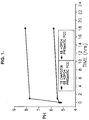
- Fig. 1 shows the pH stability over time of precipitated calcium carbonate which has been acid-stabilized with sodium hexametaphosphate and phosphoric acid.
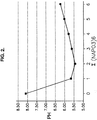
- Fig. 2 shows the final pH after extended agitation of precipitated calcium carbonate acid-stabilized with varying levels of sodium hexametaphosphate and 6 weight percent phosphoric acid.
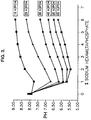
- Fig. 3 shows the final pH after extended agitation of precipitated calcium carbonate acid-stabilized with varying levels of sodium hexametaphosphate and phosphoric acid.
- Fig. 4 shows the pH stability over time of calcium carbonate in the form of fine ground limestone which has been acid-stabilized with sodium hexametaphosphate and phosphoric acid and with phosphoric acid only.
- Acid-stable calcium carbonate is a form of calcium carbonate that is stable in a mildly acidic environment.
- the ability of acid-stable calcium carbonate to resist degradation in a mildly acidic environment is due to a buffering action between an absorbed or reacted calcium-chelating agent or a conjugate base on the surface of the calcium carbonate and a weak acid in solution.
- the calcium-chelating agent or conjugate base when applied to the surface of the calcium carbonate, acts to reduce the solubility of the surface of the calcium carbonate.
- the anions of the calcium-chelating agent or the conjugate base and the anions of the weak acid may be the same, although it is not required that they be the same.
- the weak acid may be any weak acid such as phosphoric or sulfurous acid, with phosphoric acid being preferred.
- the buffered, acid-stable calcium carbonate of the present invention can be any weak acid/conjugate base system, such as citric acid/citrate, sulfurous acid/sulfite, boric acid/borate, and combinations thereof.
- calcium carbonate is acid-stabilized by mixing therewith at least about 0.1 weight percent of a calcium-chelating agent or a conjugate base and at least about 0.1 weight percent of a weak acid.
- the calcium-chelating agent is a compound selected from the group consisting of sodium hexametaphosphate, which is preferred, and common multi-dentate chelating ligands, including ethylene diamine tetra-acetic acid (EDTA), triethylene tetramine, diethylene triamine, o-phenanthroline, oxalic acid and the like.
- the conjugate base of the present invention is an alkali metal or calcium salt of a weak acid. Preferably, it is a sodium or calcium salt.
- Sodium hexametaphosphate in addition to being a calcium-chelating agent, is also a conjugate base, and is a preferred example of a conjugate base in the present invention as well.
- Some embodiments of the weak acid are phosphoric acid, metaphosphoric acid, hexametaphosphoric acid, citric acid, boric acid, sulfurous acid, acetic acid and mixtures thereof. Phosphoric acid is preferred.
- the calcium-chelating agent or conjugate base is from about 1 to about 2 weight percent of the final mixture, and the weak acid is from about 1 to about 4 weight percent of the final mixture.
- the calcium carbonate is preferably finely divided and it can be either a precipitated calcium carbonate or a natural ground limestone.
- the calcium-chelating agent or conjugate base is first mixed with the finely divided calcium carbonate.
- the weak acid is then added to the mixture and the combined mixture is agitated for a sufficiently long period of time to ensure uniform mixing of the ingredients.
- the calcium-chelating agent or the conjugate base is mixed with the finely divided calcium carbonate.
- the weak acid is provided in a paper furnish with which the calcium carbonate-containing mixture, as the filler material, is then combined and further mixed during the papermaking process.
- both the calcium-chelating agent or the conjugate base and the weak acid are provided in a paper furnish which is added to the calcium carbonate during the paper making process.
- the components of the acid stabilized calcium carbonate can be dynamically added to a calcium carbonate-containing paper mixture in a paper making machine as part of a paper furnish, at various times in the course of the papermaking process.
- a preferred pair of calcium-chelating agent or conjugate base and weak acid is sodium hexametaphosphate and phosphoric acid.
- the finely divided calcium carbonate may be in a form either as a dry powder or an aqueous slurry with up to about 60 weight percent solids content.
- the calcium-chelating agent or conjugate base can be utilized in a form either as a solid or as an aqueous solution. It has been found that when the finely divided calcium carbonate is in dry powder form, it is preferable to utilize an aqueous solution of the calcium-chelating agent or conjugate base, rather than the solid form, in order to facilitate homogeneous mixing. Where the calcium carbonate is in the form of an aqueous slurry, the solid form of the calcium-chelating agent or conjugate base readily dissolves therein and is the preferred form if it is desired to minimize the overall volume of the mixture.
- the weak acids utilizable according to the invention may be utilized in pure concentrated form or as an aqueous solution.
- the level of addition of the calcium-chelating agent or conjugate base needed to acid-stabilize the calcium carbonate is as low as about 0.1 weight percent, on a total final mixture weight basis.
- the level of weak acid addition needed to stabilize the calcium carbonate is also as low as about 0.1 weight percent, on a total final mixture weight basis.
- the weak acid may be the same acid as the week acid part of the conjugate base or it may be different.
- a preferred conjugate base/weak acid pair according to the invention is sodium hexametaphosphate and phosphoric acid.
- the polyphosphate backbone of the hexametaphosphate exhibits a sequestering action which enables the hexametaphosphate to react with the calcium carbonate surface thereby lowering the solubility of the calcium carbonate.
- phosphoric acid is added to calcium carbonate, initially the pH of the slurry is lowered to approximately 5.0. However, within a few minutes of agitation, the pH rises to 8.0.
- the species that are believed to be formed when the phosphoric acid is added to calcium carbonate are Ca(H 2 PO 4 ) 2 , CaHPO 4 and Ca 3 (PO 4 ) 2 .
- the above-described three component system consists of calcium carbonate, a calcium-chelating agent or a conjugate base, such as sodium hexametaphosphate, and a weak acid, such as phosphoric acid.
- a calcium-chelating agent or conjugate base and weak acid are usable in this system, but sodium hexametaphosphate and phosphoric acid are preferred.
- All calcium carbonates utilized in the following examples were precipitated from Pfizer lime from the Adams, MA limestone quarry or were undispersed fine ground limestone also from the Adams, MA limestone quarry. All of the precipitated calcium carbonates used in the following examples were prismatic in morphology, with surface area of 7 - 11 m 2 /g and average particle sizes of 0.7 to 1.4 microns. The pH of all precipitated calcium carbonate slurries was adjusted to 8.0 using carbon dioxide.
- a 15% by weight solids slurry of prismatic calcium carbonate was divided into seven 4-liter portions to which from 0 to 6 percent by weight of sodium hexametaphosphate, based on the dry weight of calcium carbonate, was added in 1 percent increments, followed by the addition of 6% of phosphoric acid, based on the dry weight of calcium carbonate.
- the materials were then agitated for 18 hours to determine the acid stability. After 18 hours, the samples that had been treated with phosphoric acid only had reached a final pH of 8.2, whereas the samples that had been treated with sodium hexametaphosphate prior to phosphoric acid addition had final pH's below 6.5. This can be seen in Figure 2.
- Undispersed fine ground limestone from the Pfizer Adams limestone quarry in MA was made into a 15% by weight solids slurry.
- the pH of the slurry was 9.2.
- sodium hexametaphosphate was added (1% by weight based on dry calcium carbonate), followed by an addition of phosphoric acid (2% by weight based on dry calcium carbonate).
- the pH of this slurry, initially and after 24 hours of agitation was compared to the pH of 2000 ml of a 15% by weight solids slurry of the same ground limestone to which 2% of phosphoric acid, based on the dry weight of calcium carbonate, was added. Initially, the pH's of both slurries was 5.5 - 5.7.
Landscapes
- Chemical & Material Sciences (AREA)
- Organic Chemistry (AREA)
- Inorganic Chemistry (AREA)
- Life Sciences & Earth Sciences (AREA)
- Geology (AREA)
- Paper (AREA)
- Compounds Of Alkaline-Earth Elements, Aluminum Or Rare-Earth Metals (AREA)
- Pigments, Carbon Blacks, Or Wood Stains (AREA)
Claims (13)
- Carbonate de calcium finement divisé rendu stable à l'acide caractérisé par le fait que le carbonate de calcium est revêtu d'un revêtement de stabilisation à l'acide formé par un mélange d'au moins environ 0,1% en poids d'un composé choisi parmi un agent chélatant du calcium et une base conjuguée, qui est un sel de métal alcalin ou de calcium d'un acide faible, avec au moins environ 0,1% en poids d'un acide faible, de telle sorte que lorsque la base conjuguée est choisie, la part d'acide faible de celle-ci et l'acide faible sont identiques ou sont différents et sont choisis parmi l'acide phosphorique, l'acide métaphosphorique, l'acide hexamétaphosphorique, l'acide citrique, l'acide borique, l'acide sulfureux, l'acide acétique et des mélanges de ceux-ci, avec le reste pour fournir 100% en poids étant du carbonate de calcium finement divisé, de telle sorte que le carbonate de calcium est revêtu par et est en équilibre avec l'agent chélatant du calcium ou la base conjuguée et l'acide faible.
- Carbonate de calcium finement divisé rendu stable à l'acide selon la revendication 1, dans lequel la base conjuguée est un sel de sodium ou de calcium d'un acide faible.
- Carbonate de calcium finement divisé rendu stable à l'acide selon la revendication 1, dans lequel la base conjuguée est l'hexamétaphosphate de sodium.
- Carbonate de calcium finement divisé rendu stable à l'acide selon la revendication 1, dans lequel la base conjuguée est l'hexamétaphosphate de sodium et l'acide faible est l'acide phosphorique.
- Carbonate de calcium finement divisé rendu stable à l'acide selon la revendication 1, dans lequel l'agent chélatant du calcium est choisi parmi l'hexamétaphosphate de sodium et des ligands chélatants classiques à plusieurs atomes coordinateurs.
- Carbonate de calcium finement divisé rendu stable à l'acide selon la revendication 5, dans lequel le ligand chélatant classique à plusieurs atomes coordinateurs est choisi parmi l'acide éthylène-diamino-tétracétique (EDTA), la triéthylène-tétramine, la diéthylène-triamine, l'o-phénanthroline, l'acide oxalique et semblables.
- Carbonate de calcium finement divisé rendu stable à l'acide selon la revendication 1, dans lequel le carbonate de calcium est choisi parmi du carbonate de calcium précipité et du calcaire naturel finement broyé.
- Carbonate de calcium finement divisé rendu stable à l'acide selon la revendication 1, dans lequel l'agent chélatant du calcium ou la base conjuguée représente d'environ 1 à environ 2% en poids du mélange final et l'acide faible représente d'environ 1 à environ 4% en poids du mélange final.
- Procédé de production d'un carbonate de calcium finement divisé rendu stable à l'acide caractérisé parles étapes consistant :a) à former un mélange en ajoutant au carbonate de calcium finement divisé préformé, au moins environ 0,1% en poids, rapportés au poids sec du carbonate de calcium, d'un composé choisi parmi un agent chélatant du calcium, choisi parmi l'hexamétaphosphate de sodium et des ligands chélatants classiques à plusieurs atomes coordonnés, comprenant l'acide éthylène-diamino-tétraacétique (EDTA), la triéthylène-tétramine, la diéthylène-triamine, l'o-phénanthroline, l'acide oxalique et semblables et une base conjuguée qui est un sel de métal alcalin d'un acide faible;b) à ajouter au moins environ 0,1% en poids d'un acide faible, rapportés au poids sec du carbonate de calcium, au mélange pour réduire le pH du mélange final résultant à une valeur comprise entre environ 5 et environ 7, de telle sorte que lorsqu'on choisit la base conjuguée, la part d'acide faible de celle-ci et l'acide faible sont identiques ou sont différents, ledit acide faible étant choisi parmi l'acide phosphorique, l'acide métaphosphorique, l'acide hexamétaphosphorique, l'acide citrique, l'acide borique, l'acide sulfureux, l'acide acétique et des mélanges de ceux-ci ; etc) à agiter le mélange final pour assurer un mélange uniforme.
- Procédé selon la revendication 9, dans lequel lorsque le carbonate de calcium finement divisé est une poudre sèche, l'agent chélatant du calcium ou la base conjuguée est dans une solution aqueuse et lorsque le carbonate de calcium finement divisé est une suspension aqueuse, l'agent chélatant du calcium ou la base conjuguée est un solide ou est dans une solution aqueuse.
- Procédé selon la revendication 9, dans lequel lorsque le carbonate de calcium finement divisé rendu stable à l'acide est utilisé en tant qu'une matière de charge dans la fabrication du papier, l'acide faible est ajouté en tant que partie d'un chargement de papier au mélange de carbonate de calcium finement divisé et de l'agent chélatant du calcium ou de la base conjuguée.
- Procédé selon la revendication 9, dans lequel lorsque le carbonate de calcium finement divisé rendu stable à l'acide est utilisé en tant qu'une matière de charge dans la fabrication du papier, à la fois l'agent chélatant du calcium ou la base conjuguée et l'acide faible sont fournis en tant que partie d'un chargement de papier, de telle sorte que l'agent chélatant du calcium ou la base conjuguée est ajouté en premier au mélange contenant le carbonate de calcium finement divisé et l'acide faible est ensuite ajouté au mélange résultant ci-dessus de carbonate de calcium finement divisé et d'agent chélatant du calcium ou de base conjuguée durant le procédé de fabrication du papier.
- Procédé d'amélioration des propriétés optiques de papier neutre à faiblement acidifère caractérisé par l'utilisation en tant qu'une matière de charge dans la fabrication du papier de carbonate de calcium finement divisé, qui a été rendu stable à l'acide avec au moins environ 0,1% en poids d'un revêtement de stabilisation à l'acide formé d'un composé choisi parmi :
un agent chélatant du calcium choisi parmi l'hexamétaphosphate de sodium et des ligands chélatants classiques à plusieurs atomes coordinateurs comprenant l'acide éthylène-diamino-tétraacétique (EDTA), la triéthylène-tétramine, la diéthylène-triamine, l'o-phénanthroline, l'acide oxalique et semblables; et
une base conjuguée qui est un sel de métal alcalin d'un acide faible;
avec au moins environ 0,1% en poids d'un acide faible;
de telle sorte que lorsqu'on choisit la base conjuguée, la part d'acide faible de celle-ci et l'acide faible sont identiques ou sont différents, ledit acide faible étant choisi parmi l'acide phosphorique, l'acide métaphosphorique, l'acide hexamétaphosphorique, l'acide citrique, l'acide borique, l'acide sulfureux, l'acide acétique et des mélanges de ceux-ci ; avec
l'agent chélatant du calcium ou la base conjuguée étant d'environ 1 à environ 2% en poids du mélange final et l'acide faible étant d'environ 1 à environ 4% en poids du mélange final.
Applications Claiming Priority (2)
| Application Number | Priority Date | Filing Date | Title |
|---|---|---|---|
| US491366 | 1990-03-09 | ||
| US07/491,366 US5043017A (en) | 1990-03-09 | 1990-03-09 | Acid-stabilized calcium carbonate, process for its production and method for its use in the manufacture of acidic paper |
Publications (2)
| Publication Number | Publication Date |
|---|---|
| EP0445952A1 EP0445952A1 (fr) | 1991-09-11 |
| EP0445952B1 true EP0445952B1 (fr) | 1996-08-28 |
Family
ID=23951903
Family Applications (1)
| Application Number | Title | Priority Date | Filing Date |
|---|---|---|---|
| EP91301573A Expired - Lifetime EP0445952B1 (fr) | 1990-03-09 | 1991-02-27 | Carbonate de calcium stabilisé contre les acides, procédé de production et méthode d'utilisation dans la fabrication de papier acide |
Country Status (11)
| Country | Link |
|---|---|
| US (1) | US5043017A (fr) |
| EP (1) | EP0445952B1 (fr) |
| JP (1) | JP3127001B2 (fr) |
| KR (1) | KR930001213B1 (fr) |
| AU (2) | AU7276691A (fr) |
| BR (1) | BR9100922A (fr) |
| CA (1) | CA2035808C (fr) |
| DE (1) | DE69121605T2 (fr) |
| ES (1) | ES2091866T3 (fr) |
| FI (2) | FI108155B (fr) |
| MX (1) | MX166378B (fr) |
Cited By (1)
| Publication number | Priority date | Publication date | Assignee | Title |
|---|---|---|---|---|
| RU2283394C1 (ru) * | 2005-02-15 | 2006-09-10 | Открытое акционерное общество "Центральный научно-исследовательский институт бумаги" (ОАО "ЦНИИБ") | Способ получения пигмента для изготовления бумаги и картона |
Families Citing this family (66)
| Publication number | Priority date | Publication date | Assignee | Title |
|---|---|---|---|---|
| US5269818A (en) * | 1990-03-13 | 1993-12-14 | Pfizer Inc | Rhombohedral calcium carbonate and accelerated heat-aging process for the production thereof |
| US5227025A (en) * | 1990-03-13 | 1993-07-13 | Pfizer Inc | Rhombohedral calcium carbonate and accelerated heat-aging process for the production thereof |
| AU2157292A (en) * | 1991-06-04 | 1993-01-08 | Minerals Technologies Inc. | Precipitated calcium carbonate particles from basic calcium carbonate |
| JPH07509684A (ja) * | 1992-04-03 | 1995-10-26 | ミネラルズ・テクノロジーズ・インコーポレーテッド | クラスター状沈降炭酸カルシウム粒子 |
| US5380361A (en) * | 1993-03-12 | 1995-01-10 | Minerals Technologies, Inc. | Modified filler material for alkaline paper and method of use thereof in alkaline paper making |
| US5360515A (en) * | 1993-08-25 | 1994-11-01 | The Research Foundation Of The State University Of New York | Method for reducing thermal and light-induced brightness reversion in lignin-containing pulps |
| US5593488A (en) * | 1995-08-24 | 1997-01-14 | Ecc International Inc. | Acid resistant calcium carbonate composition and uses therefor |
| US5531821A (en) * | 1995-08-24 | 1996-07-02 | Ecc International Inc. | Surface modified calcium carbonate composition and uses therefor |
| US5599388A (en) * | 1995-08-24 | 1997-02-04 | Ecc International Inc. | Acid resistant calcium carbonate composition containing an aluminum salt, uses therefor and processes for its production |
| US5647902A (en) * | 1995-10-20 | 1997-07-15 | Ecc International Inc. | Stabilized calcium carbonate composition using sodium carbonate and mixtures of acids and uses therefor |
| US5593489A (en) * | 1995-10-20 | 1997-01-14 | Ecc International Inc. | Acid resistant carbonate composition containing an aluminum or magnesium hydroxide methods of preparation and uses therefor |
| US5711799A (en) * | 1996-03-13 | 1998-01-27 | Ecc International Inc. | Acid tolerant calcium carbonate composition and uses therefor |
| US6083317A (en) * | 1996-11-05 | 2000-07-04 | Imerys Pigments, Inc. | Stabilized calcium carbonate composition using sodium silicate and one or more weak acids or alum and uses therefor |
| US6228161B1 (en) * | 1996-12-30 | 2001-05-08 | Minerals Technologies Inc. | Use of calcium carbonate in an acidic aqueous media |
| US5913973A (en) * | 1997-07-08 | 1999-06-22 | Ecc International Inc. | Method for producing high solids aqueous acid-resistant calcium carbonate suspensions and product thereof |
| FI103520B1 (fi) | 1998-03-03 | 1999-07-15 | Aga Ab | Parannetut paperinvalmistusmenetelmät |
| EP1033597A4 (fr) | 1998-09-17 | 2005-09-28 | Matsushita Electric Industrial Co Ltd | Lentille de couplage et module laser semiconducteur |
| FR2787802B1 (fr) * | 1998-12-24 | 2001-02-02 | Pluss Stauffer Ag | Nouvelle charge ou pigment ou mineral traite pour papier, notamment pigment contenant du caco3 naturel, son procede de fabrication, compositions les contenant, et leurs applications |
| FI104003B (fi) | 1999-02-08 | 1999-10-29 | Aga Ab | Stabiloitu täyteaine, sen valmistus ja käyttö |
| US6251356B1 (en) | 1999-07-21 | 2001-06-26 | G. R. International, Inc. | High speed manufacturing process for precipitated calcium carbonate employing sequential perssure carbonation |
| US6440209B1 (en) | 2000-02-09 | 2002-08-27 | Engelhard Corpoartion | Composite pigments comprising in-situ precipitated metal carbonate crystals |
| US6685908B1 (en) | 2000-03-06 | 2004-02-03 | 3P Technologies Ltd. | Precipitated aragonite and a process for producing it |
| US20030213937A1 (en) * | 2001-02-22 | 2003-11-20 | Isaac Yaniv | Precipitated aragonite and a process for producing it |
| US20030161894A1 (en) * | 2001-09-05 | 2003-08-28 | 3P Technologies Ltd. | Precipitated aragonite and a process for producing it |
| US7048900B2 (en) | 2001-01-31 | 2006-05-23 | G.R. International, Inc. | Method and apparatus for production of precipitated calcium carbonate and silicate compounds in common process equipment |
| US7056419B2 (en) * | 2002-09-30 | 2006-06-06 | American Air Liquide, Inc. | Methods for modifying electrical properties of papermaking compositions using carbon dioxide |
| FR2852600B1 (fr) | 2003-03-18 | 2005-06-10 | Nouveau pigment mineral contenant du carbonate de calcium, suspension aqueuse le contenant et ses usages | |
| FR2871474B1 (fr) | 2004-06-11 | 2006-09-15 | Omya Development Ag | Nouveau pigment mineral sec contenant du carbonate de calcium, suspension aqueuse le contenant et ses usages |
| US20060003117A1 (en) * | 2004-06-14 | 2006-01-05 | Specialty Minerals (Michigan) Inc. | Ink jet recording paper |
| KR20130036350A (ko) * | 2004-12-22 | 2013-04-11 | 솔베이(소시에떼아노님) | 알칼리 토금속 카르보네이트의 내산성 입자 |
| RU2283392C1 (ru) * | 2005-02-15 | 2006-09-10 | Открытое акционерное общество "Центральный научно-исследовательский институт бумаги" (ОАО "ЦНИИБ") | Способ получения пигмента для изготовления бумаги и картона |
| RU2283393C1 (ru) * | 2005-02-15 | 2006-09-10 | Открытое акционерное общество "Центральный научно-исследовательский институт бумаги" (ОАО "ЦНИИБ") | Способ получения пигмента для изготовления бумаги и картона |
| EP1752499A1 (fr) * | 2005-07-25 | 2007-02-14 | Omya Development AG | Procédé pour disperser et/ou broyer et/or concentrer du carbonate de calzium dans un milieu aqueuse, en faisant usage d'une solution aqueuse de composés de zirconium. |
| US7964063B2 (en) * | 2006-08-11 | 2011-06-21 | Georgia Tech Research Corporation | Methods and compositions for papermaking |
| EP1974807B1 (fr) * | 2007-03-21 | 2010-03-03 | Omya Development Ag | Processus de suppression de composés à perturbations endocrines |
| SI1974806T1 (sl) * | 2007-03-21 | 2012-01-31 | Omya Development Ag | Postopek za čiščenje vode |
| EP2053162A1 (fr) * | 2007-10-26 | 2009-04-29 | SAPPI Netherlands Services B.V. | Formulation de revêtement pour papier offset et papier revêtu avec celle-ci |
| DK2070991T3 (da) | 2007-12-12 | 2010-12-20 | Omya Development Ag | Fremgangsmåde til frembringelse af overflademodificeret, udfældet calciumcarbonat |
| US8034759B2 (en) * | 2008-10-31 | 2011-10-11 | Ecolab Usa Inc. | Enhanced stability peracid compositions |
| SI2264109T1 (sl) | 2009-06-15 | 2012-07-31 | Omya Development Ag | Postopek za pripravo površinsko reakcijsko obdelanega kalcijevega karbonata in njegova uporaba |
| PT2264108E (pt) | 2009-06-15 | 2012-05-23 | Omya Development Ag | Processo para preparar um carbonato de cálcio feito reagir em superfície utilizando um ácido fraco |
| PT2377900E (pt) * | 2010-04-16 | 2013-11-07 | Omya Int Ag | Processo para preparar um material mineral com superfície modificada seus produtos resultantes e suas utilizações |
| US8387282B2 (en) | 2010-04-26 | 2013-03-05 | Nike, Inc. | Cable tightening system for an article of footwear |
| US8586156B2 (en) | 2010-05-04 | 2013-11-19 | International Paper Company | Coated printable substrates resistant to acidic highlighters and printing solutions |
| AU2011280943B2 (en) | 2010-07-23 | 2013-06-13 | International Paper Company | Coated printable substrates providing higher print quality and resolution at lower ink usage |
| JP5903215B2 (ja) * | 2011-02-28 | 2016-04-13 | シスメックス株式会社 | ループスアンチコアグラント検出用試薬キット及びループスアンチコアグラントの存否を判定する方法 |
| CN102702795B (zh) * | 2012-05-02 | 2014-03-05 | 石家庄市三兴钙业有限公司 | 聚氨酯胶专用纳米碳酸钙的制备方法 |
| PL2679638T3 (pl) | 2012-06-28 | 2016-02-29 | Omya Int Ag | Wodna zawiesina minerału i/lub wypełniacza i/lub pigmentu o dużej zawartości części stałych w środowisku o kwaśnym pH |
| WO2016033446A1 (fr) | 2014-08-29 | 2016-03-03 | Blue Planet, Ltd. | Pigments carbonatés, et procédés de fabrication et d'utilisation de ceux-ci |
| EP3045503A1 (fr) | 2015-01-15 | 2016-07-20 | Omya International AG | Carbonate de calcium traité en surface avec une stabilité améliorée dans des environnements ayant un pH de 4,5 à 7 |
| CN108026700A (zh) * | 2015-09-08 | 2018-05-11 | 日本制纸株式会社 | 磷酸钙微粒与纤维的复合体及其制造方法 |
| EP3275948A1 (fr) | 2016-07-25 | 2018-01-31 | Omya International AG | Procédé de préparation de carbonate de calcium traité par réaction en surface |
| JP7155127B2 (ja) * | 2016-09-08 | 2022-10-18 | シェーファー・カーク・ゲーエムベーハー・ウント・コンパニー・カーゲー | 阻害性炭酸カルシウム添加剤 |
| US11760874B2 (en) | 2016-09-08 | 2023-09-19 | Schaefer Kalk Gmbh & Co. Kg | Composite powder containing calcium carbonate and having microstructured particles having inhibiting calcium carbonate |
| AU2017324138B2 (en) * | 2016-09-08 | 2022-04-07 | Karl Leibinger Asset Management Gmbh & Co. Kg | Method for producing an implant using a calcium carbonate-containing composite powder comprising microstructured particles |
| PL3509733T3 (pl) | 2016-09-08 | 2020-11-16 | Schaefer Kalk Gmbh & Co. Kg | Zawierający sól wapnia proszek kompozytowy z cząstkami z mikrostrukturą |
| ES2984033T3 (es) | 2016-09-08 | 2024-10-28 | Schaefer Kalk Gmbh & Co Kg | Polvo compuesto que contiene carbonato de calcio con partículas microestructuradas |
| EP3509656B1 (fr) * | 2016-09-08 | 2020-07-22 | Karl Leibinger Medizintechnik GmbH & Co. KG | Procédé de préparation d'un implant comprenant une poudre composite contenant du carbonate de calcium a petites parties micro-structurees comportant du carbonate de calcium inhibant |
| JP7019923B2 (ja) * | 2016-09-08 | 2022-02-16 | カール ライビンガー メディツィンテクニック ゲーエムベーハー ウント コー. カーゲー | 抑制性炭酸カルシウムを含有するインプラント |
| RU2676292C1 (ru) * | 2017-12-19 | 2018-12-27 | Федеральное государственное унитарное предприятие "Комбинат "Электрохимприбор" | Способ получения карбоната кальция |
| US11040898B2 (en) * | 2018-06-05 | 2021-06-22 | The Regents Of The University Of California | Buffer-free process cycle for CO2 sequestration and carbonate production from brine waste streams with high salinity |
| EP3725851A1 (fr) | 2019-04-16 | 2020-10-21 | Omya International AG | Procédé de préparation de carbonate de calcium traité par réaction en surface |
| SG11202112173YA (en) | 2019-06-14 | 2021-12-30 | Univ California | Alkaline cation enrichment and water electrolysis to provide co2 mineralization and global-scale carbon management |
| KR20240093572A (ko) | 2021-10-18 | 2024-06-24 | 더 리전트 오브 더 유니버시티 오브 캘리포니아 | Mg(oh)2 생산 및 co2 광물화를 가능하도록 하는 해수 전기분해 |
| WO2023158879A1 (fr) | 2022-02-21 | 2023-08-24 | Carbonbuilt | Procédés et systèmes pour la séquestration du co 2 émis par la biomasse dans le béton et les agrégats |
| EP4508020A1 (fr) | 2022-04-12 | 2025-02-19 | CarbonBuilt | Procédé pour la production de systèmes liants hydrauliques-par carbonatation par activation mécanochimique de matières minérales |
Family Cites Families (10)
| Publication number | Priority date | Publication date | Assignee | Title |
|---|---|---|---|---|
| DE2059624A1 (de) * | 1969-12-04 | 1971-06-09 | Rohan George Alexander | Kalkpulver und Verfahren zu seiner Herstellung |
| US4115187A (en) * | 1970-03-31 | 1978-09-19 | Welwyn Hall Research Association | Agglomerated fillers used in paper |
| GB1347071A (en) * | 1971-07-01 | 1974-02-13 | Starch Products Ltd | Paper fillers |
| GB1447566A (en) * | 1974-02-14 | 1976-08-25 | Ici Ltd | Production of calcium carbonate |
| JPS5390199A (en) * | 1977-01-20 | 1978-08-08 | Shiraishi Kogyo Kaisha Ltd | Method of modifying calcium carbonate |
| JPS53129200A (en) * | 1977-04-18 | 1978-11-10 | Shiraishi Kogyo Kk | Dispersant for calcium carbonate |
| US4244933A (en) * | 1978-04-05 | 1981-01-13 | Shiraishi Kogyo Kaisha, Ltd. | Calcium carbonate particles and processes for preparing same |
| JPS5686015A (en) * | 1979-12-12 | 1981-07-13 | Mitsubishi Electric Corp | Sampling signal malfunction monitor |
| US4793985A (en) * | 1982-08-23 | 1988-12-27 | J. M. Huber Corporation | Method of producing ultrafine ground calcium carbonate |
| EP0179597B1 (fr) * | 1984-10-18 | 1993-02-03 | Pfizer Inc. | Carbonate de calcium précipité de forme sphérique, sa préparation et son utilisation |
-
1990
- 1990-03-09 US US07/491,366 patent/US5043017A/en not_active Expired - Lifetime
-
1991
- 1991-02-06 CA CA002035808A patent/CA2035808C/fr not_active Expired - Lifetime
- 1991-02-27 DE DE69121605T patent/DE69121605T2/de not_active Expired - Lifetime
- 1991-02-27 ES ES91301573T patent/ES2091866T3/es not_active Expired - Lifetime
- 1991-02-27 EP EP91301573A patent/EP0445952B1/fr not_active Expired - Lifetime
- 1991-03-07 BR BR919100922A patent/BR9100922A/pt not_active IP Right Cessation
- 1991-03-08 AU AU72766/91A patent/AU7276691A/en not_active Abandoned
- 1991-03-08 FI FI911183A patent/FI108155B/fi active
- 1991-03-08 MX MX024828A patent/MX166378B/es unknown
- 1991-03-08 KR KR1019910003718A patent/KR930001213B1/ko not_active Expired - Lifetime
- 1991-03-11 JP JP03127002A patent/JP3127001B2/ja not_active Expired - Lifetime
-
1993
- 1993-05-20 AU AU38703/93A patent/AU665634B2/en not_active Ceased
-
2000
- 2000-12-12 FI FI20002724A patent/FI111972B/fi active IP Right Grant
Cited By (1)
| Publication number | Priority date | Publication date | Assignee | Title |
|---|---|---|---|---|
| RU2283394C1 (ru) * | 2005-02-15 | 2006-09-10 | Открытое акционерное общество "Центральный научно-исследовательский институт бумаги" (ОАО "ЦНИИБ") | Способ получения пигмента для изготовления бумаги и картона |
Also Published As
| Publication number | Publication date |
|---|---|
| FI911183A0 (fi) | 1991-03-08 |
| CA2035808A1 (fr) | 1991-09-10 |
| FI911183L (fi) | 1991-09-10 |
| KR930001213B1 (ko) | 1993-02-22 |
| JP3127001B2 (ja) | 2001-01-22 |
| FI20002724L (fi) | 2000-12-12 |
| US5043017A (en) | 1991-08-27 |
| AU3870393A (en) | 1993-08-05 |
| JPH04227665A (ja) | 1992-08-17 |
| BR9100922A (pt) | 1991-11-05 |
| CA2035808C (fr) | 1997-03-04 |
| AU665634B2 (en) | 1996-01-11 |
| MX166378B (es) | 1993-01-04 |
| EP0445952A1 (fr) | 1991-09-11 |
| FI111972B (fi) | 2003-10-15 |
| DE69121605D1 (de) | 1996-10-02 |
| DE69121605T2 (de) | 1997-03-06 |
| ES2091866T3 (es) | 1996-11-16 |
| AU7276691A (en) | 1991-10-10 |
| KR910016627A (ko) | 1991-11-05 |
| FI108155B (fi) | 2001-11-30 |
Similar Documents
| Publication | Publication Date | Title |
|---|---|---|
| US5043017A (en) | Acid-stabilized calcium carbonate, process for its production and method for its use in the manufacture of acidic paper | |
| US5156719A (en) | Acid-stabilized calcium carbonate, process for its production and method for its use in the manufacture of acidic paper | |
| AU731405B2 (en) | The use of calcium carbonate in an acidic aqueous media | |
| US5584923A (en) | Surface modified calcium carbonate composition and uses therefor | |
| FI101217B (fi) | Saostettu kalsiumkarbonaatti | |
| US6083317A (en) | Stabilized calcium carbonate composition using sodium silicate and one or more weak acids or alum and uses therefor | |
| KR20120037937A (ko) | 표면-반응된 탄산칼슘의 제조 방법 및 그 탄산칼슘의 용도 | |
| US5599388A (en) | Acid resistant calcium carbonate composition containing an aluminum salt, uses therefor and processes for its production | |
| WO2003016216A2 (fr) | Procede servant a diminuer la solubilite du dihydrate de sulfate de calcium dans une suspension aqueuse et son procede de preparation | |
| MXPA99006190A (en) | The use of calcium carbonate in an acidic aqueous media | |
| HK1082722B (en) | The use of calcium carbonate in an acidic aqueous medium |
Legal Events
| Date | Code | Title | Description |
|---|---|---|---|
| PUAI | Public reference made under article 153(3) epc to a published international application that has entered the european phase |
Free format text: ORIGINAL CODE: 0009012 |
|
| 17P | Request for examination filed |
Effective date: 19910307 |
|
| AK | Designated contracting states |
Kind code of ref document: A1 Designated state(s): BE CH DE ES FR GB IT LI NL SE |
|
| 17Q | First examination report despatched |
Effective date: 19930924 |
|
| REG | Reference to a national code |
Ref country code: GB Ref legal event code: 732E |
|
| RAP1 | Party data changed (applicant data changed or rights of an application transferred) |
Owner name: MINERALS TECHNOLOGIES INC. |
|
| GRAH | Despatch of communication of intention to grant a patent |
Free format text: ORIGINAL CODE: EPIDOS IGRA |
|
| GRAH | Despatch of communication of intention to grant a patent |
Free format text: ORIGINAL CODE: EPIDOS IGRA |
|
| GRAA | (expected) grant |
Free format text: ORIGINAL CODE: 0009210 |
|
| AK | Designated contracting states |
Kind code of ref document: B1 Designated state(s): BE CH DE ES FR GB IT LI NL SE |
|
| REG | Reference to a national code |
Ref country code: CH Ref legal event code: NV Representative=s name: E. BLUM & CO. PATENTANWAELTE |
|
| REF | Corresponds to: |
Ref document number: 69121605 Country of ref document: DE Date of ref document: 19961002 |
|
| ET | Fr: translation filed | ||
| ITF | It: translation for a ep patent filed | ||
| REG | Reference to a national code |
Ref country code: ES Ref legal event code: FG2A Ref document number: 2091866 Country of ref document: ES Kind code of ref document: T3 |
|
| PLBE | No opposition filed within time limit |
Free format text: ORIGINAL CODE: 0009261 |
|
| STAA | Information on the status of an ep patent application or granted ep patent |
Free format text: STATUS: NO OPPOSITION FILED WITHIN TIME LIMIT |
|
| 26N | No opposition filed | ||
| PGFP | Annual fee paid to national office [announced via postgrant information from national office to epo] |
Ref country code: ES Payment date: 19980223 Year of fee payment: 8 |
|
| PG25 | Lapsed in a contracting state [announced via postgrant information from national office to epo] |
Ref country code: ES Free format text: LAPSE BECAUSE OF NON-PAYMENT OF DUE FEES Effective date: 19990301 |
|
| REG | Reference to a national code |
Ref country code: ES Ref legal event code: FD2A Effective date: 20010503 |
|
| REG | Reference to a national code |
Ref country code: GB Ref legal event code: IF02 |
|
| REG | Reference to a national code |
Ref country code: CH Ref legal event code: PFA Owner name: MINERALS TECHNOLOGIES INC. Free format text: MINERALS TECHNOLOGIES INC.#THE CHRYSLER BUILDING, 405 LEXINGTON AVENUE#NEW YORK, NEW YORK 10174 (US) -TRANSFER TO- MINERALS TECHNOLOGIES INC.#THE CHRYSLER BUILDING, 405 LEXINGTON AVENUE#NEW YORK, NEW YORK 10174 (US) |
|
| PGFP | Annual fee paid to national office [announced via postgrant information from national office to epo] |
Ref country code: SE Payment date: 20091223 Year of fee payment: 20 |
|
| PGFP | Annual fee paid to national office [announced via postgrant information from national office to epo] |
Ref country code: CH Payment date: 20100218 Year of fee payment: 20 |
|
| PGFP | Annual fee paid to national office [announced via postgrant information from national office to epo] |
Ref country code: IT Payment date: 20100213 Year of fee payment: 20 Ref country code: FR Payment date: 20100222 Year of fee payment: 20 |
|
| PGFP | Annual fee paid to national office [announced via postgrant information from national office to epo] |
Ref country code: GB Payment date: 20100107 Year of fee payment: 20 Ref country code: DE Payment date: 20100226 Year of fee payment: 20 |
|
| PGFP | Annual fee paid to national office [announced via postgrant information from national office to epo] |
Ref country code: NL Payment date: 20100208 Year of fee payment: 20 |
|
| PGFP | Annual fee paid to national office [announced via postgrant information from national office to epo] |
Ref country code: BE Payment date: 20100402 Year of fee payment: 20 |
|
| REG | Reference to a national code |
Ref country code: DE Ref legal event code: R071 Ref document number: 69121605 Country of ref document: DE |
|
| BE20 | Be: patent expired |
Owner name: *MINERALS TECHNOLOGIES INC. Effective date: 20110227 |
|
| REG | Reference to a national code |
Ref country code: CH Ref legal event code: PL |
|
| REG | Reference to a national code |
Ref country code: NL Ref legal event code: V4 Effective date: 20110227 |
|
| REG | Reference to a national code |
Ref country code: GB Ref legal event code: PE20 Expiry date: 20110226 |
|
| EUG | Se: european patent has lapsed | ||
| PG25 | Lapsed in a contracting state [announced via postgrant information from national office to epo] |
Ref country code: NL Free format text: LAPSE BECAUSE OF EXPIRATION OF PROTECTION Effective date: 20110227 |
|
| PG25 | Lapsed in a contracting state [announced via postgrant information from national office to epo] |
Ref country code: GB Free format text: LAPSE BECAUSE OF EXPIRATION OF PROTECTION Effective date: 20110226 |
|
| PG25 | Lapsed in a contracting state [announced via postgrant information from national office to epo] |
Ref country code: DE Free format text: LAPSE BECAUSE OF EXPIRATION OF PROTECTION Effective date: 20110227 |