EP0446363A1 - System zum evaluieren eines sektors, worin sich eine bewegliche station befindet - Google Patents
System zum evaluieren eines sektors, worin sich eine bewegliche station befindet Download PDFInfo
- Publication number
- EP0446363A1 EP0446363A1 EP90913538A EP90913538A EP0446363A1 EP 0446363 A1 EP0446363 A1 EP 0446363A1 EP 90913538 A EP90913538 A EP 90913538A EP 90913538 A EP90913538 A EP 90913538A EP 0446363 A1 EP0446363 A1 EP 0446363A1
- Authority
- EP
- European Patent Office
- Prior art keywords
- sector
- sectors
- mobile station
- frequencies
- zone
- Prior art date
- Legal status (The legal status is an assumption and is not a legal conclusion. Google has not performed a legal analysis and makes no representation as to the accuracy of the status listed.)
- Granted
Links
Images



Classifications
-
- H—ELECTRICITY
- H04—ELECTRIC COMMUNICATION TECHNIQUE
- H04W—WIRELESS COMMUNICATION NETWORKS
- H04W64/00—Locating users or terminals or network equipment for network management purposes, e.g. mobility management
-
- H—ELECTRICITY
- H04—ELECTRIC COMMUNICATION TECHNIQUE
- H04W—WIRELESS COMMUNICATION NETWORKS
- H04W16/00—Network planning, e.g. coverage or traffic planning tools; Network deployment, e.g. resource partitioning or cells structures
- H04W16/24—Cell structures
Definitions
- This invention is applicable to mobile radio communication.
- This invention relates, more particularly, to a method of deciding in which sector one mobile station stays in a mobile communIcation system where a radio zone covered by (referred to as a zone herein) one base station is divided into several sectors in operation.
- a zone covered by a base station is divided into plural sectors and each sector is covered by an antenna having directivity.
- Such method is advantageous in that interferences between sectors can be reduced by the directivity of the antennas, and that the frequency utilization efficiency is improved as the distance between cells which are using the same frequency channels is shortened.
- it is necessary for a mobile station to find out the serial numbers of the zone and of the sector in which the station stays at the time in order to set up a voIce channel before the start of communication.
- a mobile station Even in the prior art mobile communication system where a zone is not divided into sectors, a mobile station sometimes must decide in which zone to stay.
- a mobile station scans control channels assigned respectively to the zones, and detects a zone in which the station stays from the frequency (the serial number) of which control channel the station could receive.
- the frequency the serial number
- a station if a zone is divided into sectors, it is possible for a station to discriminate a sector by its frequency.
- sectors are assigned with control channels of different frequencies, and a mobile station decides in which sector it stays by detecting the frequency or channel it can receive or if a plurality of such channels exists, by measuring receiving levels of these frequencies, comparing them and discriminating that with the maximum reception level.
- the number of control channels which one mobile station receiver must scan for discriminating the sectors is large. Further, as it generally takes a certain amount of time to monitor the receiving level of a channel, the time required from activation of the power switch of a mobile station to when communication is ready with a set up control channel becomes inconveniently long.
- each zone is assigned with control channels of the same frequency.
- the system cannot rely on the aforementioned method to locate a sector where a mobile station exists simply by scanning the frequencies of control channels and detecting the frequency with the maximum receiving level. Instead, a base station measures an upward control channel signal issued from a mobile station and compares with other signals to locate the relevant sector.
- the signal generated by a mobile station for a base station is called an upward sIgnal while the one generated from the base station for mobile stations is called a downward signal).
- the station when a mobile station turns on the power source at the start, or when the zone where it stays needs to be located, the station first scans the frequencies of control channels assigned to dIfferent zones, measures and compares the receiving levels thereof, discriminates the control channel frequency which has the maximum receiving level, and uses the frequency of the upward control channel corresponding with the discriminated frequency.
- the base station receives the upward signal by using an individual receiver allocated to each sector.
- the base station measures and compares the levels at which each of the receivers receives the signal, detects the sector in which the relevant mobile station stays from the number of the individual receiver with the maximum level. In this system, the burden imposed on the base station becomes great as the individual receivers for the sectors of a zone should measure and compares the levels.
- This invention intends to solve such problematic aspects of the prior art, and aims at providing a system wherein a base station can be built with simple facilities without requiring measurement and comparison of levels.
- This invention aims to provide a system where the frequency utilization efficiency is hi9h.
- This invention aims to provide a system which has a high precision in sector discrimination.
- This invention aims to provide a system of locating a sector where a mobile station exists with a higher relIability of paging signal reception.
- This invention relates to a decision method for locating a sector in which a mobile station exists, comprising plural mobile stations including transmitter/receivers thereof, and a base station which includes transmitter/receivers for communicating with plural mobile stations, wherein each of the plural zones is divided into sectors, said transmitter/receivers of the base station include a first transmitter/receiver means which transmits/receives signals of frequencies including the control channels assigned to each of said zones via a directive antenna, said each mobile station transmitter/receiver includes a second transmitter/receiver means which transmits/receives signals of frequencies including said control channels.
- the system of this invention is characterized in that said first transmitter/receiver means further comprises a transmitter means which transmits the signals of the sector individual frequencies assigned to different sectors via each directive antenna, said second transmitter/receiver means includes a receiver means which receives signals of the individual frequency of said each sector, a measuring means which measures the receiving level of the signals of the individual frequency of each sector and the signal of the frequency including each control channel, and a decision means which discriminates the zone and sector where the particular mobile station exists based on the result of the measurement.
- the second transmitter/receiver means is structured preferably with a detector means which compares the ratio of the receiving levels of signals of the individual frequency of a sector detected by said decision means as the sector where the station is present against the signal of the frequency of control channel of thus detected zone with a predetermined threshold value, and detects movement thereof between the sectors within the zone.
- the transmitter means at the base station transmits signals of sector individual frequencies each allocated to a sector via a directive antenna.
- the receiver of a mobile station receives the output signal from said means while the measuring means measures the receiving levels of the signal of each sector individual frequency and of the signal of the frequency including each control channel.
- the decision means of the mobile station detects the own zone and sector of the station based on the frequency including the control channel with a higher receiving level and the sector individual frequency.
- the same station can reduce the number of frequencies which the station should monitor by using the ratio in the receiving levels of the signal of the sector individual frequency and of the signal of the frequency which includes the control channel of the zone for detection of the movement between the sectors within the zone to thereby shorten the time required for detecting the movement and improve the intermittent ratio.
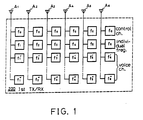
- Fig. 1 is a block diagram to show a base station transmitter/receiver of the first embodiment of the decision method for locating a sector of a mobile station according to this invention.
- Fig. 2 is a block diagram to show a mobile station transmitter/receiver of the first embodiment of the decision method for locating a sector of a mobile station according to this invention.
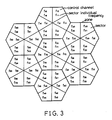
- Fig. 3 is a structural view of a control channel and sector individual frequency of the decision method for locating a sector of a mobile station according to this invention.
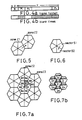
- Fig. 4 is a frame format of a control channel of the decision method for locating a sector of a mobile station according to this invention.
- Fig. 5 is a view to show the movement between zones of the decision method for locating a sector of a mobile station according to this invention.
- Fig. 6 is a view to show the movement between sectors within a zone of the decision method for locating a zone of a mobile station according to this invention.
- Fig. 7 is a view to show the sectors adjacent to the sector where a mobile station exists of the decision method for locating a sector of a mobile station according to this invention.
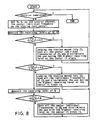
- Fig. 8 is a flow chart of the operation to detect the movement between sectors in a zone of the decision method for locating a sector of a mobile station according to this invention.
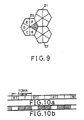
- Fig. 9 is a view to show the arrangement of zones and sectors of the decision method for locating a sector of a mobile station.
- Fig. 10 is a format of voice channel of the decision method for locating a sector of a mobile station according to this invention.
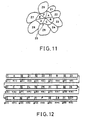
- Fig. 11 is a view to show another arrangement of zones and sectors of the decision method for locating a sector of a mobile station.
- Fig. 12 is a frame format of broadcasting information of a base station of the decision method for locating a sector of a mobile station according to this invention.
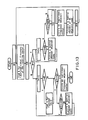
- Fig. 13 is a flow chart of the operation to obtain the control channels of the adjacent zones and individual frequencies of the adjacent sectors based on the broadcasting information from the base station of the decision method for locating a sector of a mobile station according to this invention.
- Fig. 14 is a frame format of broadcasting information of another base station of the decision method for locating a sector of a mobile station according to this invention.
- Fig. 15 is a chart to show correspondence between the order of identification numbers of sector individual frequencies broadcast from a base station of the decision method for locating a sector of a mobile station according to this invention.
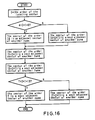
- Fig. 16 is a flow chart of the operation which detects the individual frequencies of adjacent sectors from the broadcast sector individual frequency of the decision method for locating a sector of a mobile station according to this invention.
- Fig. 17 is a view to show an irregular zone/sector arrangement of the decision method for locating a sector of a mobile station according to this invention.
- Fig. 18 is a flow chart of the operation which detects adjacent sector individual frequencies of the other zones from the broadcast information of the decision method for locating a sector of a mobile station according to this invention.
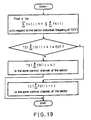
- Fig. 19 is a flow chart to obtain zone control channels of adjacent sectors of another zone from broadcasting information of the decision method for locating a sector of a mobile station according to this invention.
- Fig. 1 is a block diagram of an embodiment of the base station transmitter/receiver of the decision method for locating a sector of a mobile station according to this invention.
- Fig. 2 is a block diagram to show an embodiment of a mobile station transmitter/receiver of the decision method for locating a sector of a mobile station according to this invention. From Fig. 3, the relation between a zone and sectors will be easily understood.
- the system includes plural mobile stations having transmitter/receivers, a base station having a transmitter/receiver to communicate with said mobile stations, and zones each of which is further divided into sectors.
- the transmitter/receiver of the base station includes a first transmitter/receiver means 200 which transmits or receives signals of the frequency f0 including a control channel which is assigned to each of the zones via directive antennas A1 through A6.
- the transmitter/receiver of each mobile station comprises a second transmitter/receiver means 100 which transmits/receives signals of the frequency f0 including the control channel and an antenna 180.
- the second means 100 comprises a demodulator 110, a band pass filter 120, a frequency converter 130, a control unit 150 and a part of a synthesizer 170.
- This invention system is characterized in that said first transmitter/receiver means 200 includes transmitter means which transmits signals f1 through f6 of sector individual frequencies assigned to respective sectors via directive antennas A1 through A6, and said second transmitter/receiver means 100 includes a receiver means which receives signals f1 through f6 of said sector individual frequencies, a level measuring circuit 140 as a measuring means which measures the receiving levels of the signals of sector individual frequencies and of the signals of the frequencies of the control channels, a part of the control unit 150 and a frequency memory 160 as the means for deciding which discriminates the zone and sector for the station based on the result of the measurement by the circuit 140.
- Fig. 3 is a structural view to show the relation of control channels and sector individual frequencies of this invention system.
- Fig. 4 is a frame format of the invention system.
- Fig. 5 is a view to show the movement between zones of this invention system.
- Fig. 6 is a view to show the movement between sectors of a zone in which a mobile station exists.
- Fig. 7 is a view to show sectors adjacent to the sector in which a mobile station stays according to the present invention.
- Fig. 8 is a flow chart to show the operation for detecting movement of a station between sectors of a zone according to this invention system.
- Fig. 9 is a chart to show a zone/sector arrangement of this invention system.
- Fig. 10 is a format of voice channel of this invention system.
- Fig. 11 is a view to show another zone/sector arrangement of this invention system.
- Fig. 12 is a frame format of broadcasting information from the base station thereof
- Fig. 13 is a flow chart of the operation for detecting the control channels of adjacent zones and adjacent sector individual frequencies based on the broadcasting information thereof
- Fig. 14 is a frame format of still another broadcasting information from the base station thereof.
- Fig. 15 is a chart to show correspondence between the order of identification numbers of the sector individual frequencies which is broadcast from the base station and the sector arrangements of the system
- Fig. 16 is a flow chart for obtaining the individual frequencies of sectors adjacent to the sector where the mobile station stays out of the informed sector individual frequencies, Fig.
- Fig. 17 is a view to show the irregular zone and sector arrangement of this invention system
- Fig. 18 is a flow chart to obtain individual frequencies of adjacent sectors in other zones out of the broadcasting information of this invention system.
- Fig. 19 is a flow chart to obtain control channels of the adjacent sectors in other zones in the system thereof.
- Table 1 shows correspondence between the zones and the control channels of this invention system, Table 2 correspondence of the sectors and the sector individual frequencies, Table 3 the content of non-volatile memory of the mobile station transmitter/receiver, and Table 4 correspondence between the frequencies which a mobile station should store and the identification numbers thereof in a system where a base station broadcasts the sector individual frequencies of the system.
- Table 5 shows correspondence between the order of broadcasting from the base station and the identification numbers of the system, and Table 6 shows tables which the base station broadcasts to mobile stations in the system according to this invention.
- f10, f20, f30, f40, f50, f60, and f70 denote frequencies of the control channels assigned to respective zones.
- the figures f11 - f16, f21 - f26, ..., f71 - f76 denote the sector individual frequencies which are constantly transmitted from the base station.
- Fig. 1 shows a structure where a zone is divided into six sectors wherein each of the antennas A1 through A6 is allocated to each sector.
- Antennas A1 through A6 are respectively connected to transmitter/receivers of the frequency F0 of the control channel of the zone, the sector indivisual frequencies f1 , f2 , f3 , f4 , f5 ,f6 and voice channels of the sectors.
- the system shown in Fig. 1 is structured to have the transmitter/receivers for the frequencies f0 of control channels in the number corresponding to that of sectors, signals from one transmitter/receiver may be distributed to the power supply sections of sectors.
- the level measuring circuit 140 is the circuit for measuring the receiving levels of the signal frequencies
- the synthesizer 170 is controlled by the controller 150, and the frequencies are selected by the converter 130 and the band pass filter 120.
- a mobile station When a power switch is turned on, a mobile station scans control channels assigned to zones to measure the receiving levels and compare them. In minimizing errors due to fading, it is more effective to switch to a high speed and repeat short measuring cycles for plural times per frequency rather than to measure levels of a frequency once.
- the scanning time may be shortened by omitting the frequencies with the levels which are formed extraordinarily low by the first measurement. From the result of scanning, the control channel with the strongest receiving level is judged as the zone in which the particular mobile station stays.
- the mobile station scans the sector individual frequencies of the zone when the receiving channel of the control channel is not used, measures the receiving levels and compares them in order to render sector judgement. It is quite obvious from Fig. 4(a) that a control channel has blank sections not used for reception.
- the letter X in Fig. 4(a) denotes a broadcasting section and Y a paging section. As the paging section is divided into sub-sections and a mobile station receives paging information only of a sub-section to which it belongs, the station does not have to receive control channels of the zone of the paging sections of other sub-sections. This produces blank time and permits receiving other frequencies.
- Fig. 4(a) denotes a broadcasting section and Y a paging section.
- shaded sections denote blank times of the paging section Y of the group of the mobile stations. Because there are blank times in the control channels for receiving, the mobile station can receive and at the same time measure the sector individual frequencies and judges that the sector having the sector individual frequency having the strongest receiving level is the sector in which the station exists.
- control channels are structured to repeat the same frequency in the unit of seven zones. It is assumed that the sector in which the particular mobile station stays is the sector having the individual frequency of f73.
- the mobile station first scans the control channels f10, f20, ..., f70. Then, it scans the sector individual frequencies f71, f72, ..., f76 of the zone of which control channel is f70 and judges that the sector where the station stays is f73.
- the mobile station After judging the sector for activation, the mobile station advances to the state of waiting for paging. While waiting, the mobile station is constantly moving, the movement thereof between the sectors and the zones are monitored.
- the mobile station can learn its movement between zones by monitoring control channels which are assigned to zones respectively in one-to-one relation, and learn movement between sectors in the zone by monitoring the sector individual frequencies. For instance, when a mobile station moves as shown in Fig. 5, as the control channel having the strongest receiving level moves from the zone Z1 to the zone Z2, the station can learn that it has moved from the zone Z1 to the zone Z2. In the case where a station moves from one sector to another sector of the same zone, as shown in Fig.
- the strongest receiving level changes from the sector individual frequency of the sector S1 of the six sectors of the zone to that of the sector S2, and it becomes obvious that the station moves from the sector S1 to the sector S2.
- the movement between the cells is learned by monitoring the control channels in the above example, the movement between both sectors and zones in the waiting state may be learned by monitoring the sector individual frequencies alone. It may be learned by measuring and comparing the receiving levels of individual frequencies of sectors adjacent to the sector where the mobile station exists irrespective of zones. As shown in Fig 7, if it is assumed that the station stays in a sector S1, the station measures and compares the receiving levels of the individual frequencies of adjacent sectors, the sectors S2 through S6 of the same zone and the sectors S7 through S10 of other zones where the station possibly moves to. If the receiving levels are strong in the sectors S2 through S6, it is judged that the station moves within the zone. On the other hand, if they are strong in the sectors of S7 through S10, it is judged that the station moves to another zone.
- the number of sector individual frequencies is reduced, it may shorten the detecting time of the movement.
- the reduction of the number of sector individual frequencies means an increase in time where no reception is being made, or an improvement of intermittent ratio. In other words, it saves consumption power of a mobile station, especially of a portable unit, prolongs the life of a battery, and improves the quantity of service.
- the number of sectors which are monitored is 4. Compared to the method where all the sectors including those contacting the sector 1 with points are monitored, the number decreased from 10 to 4 or less than a half to thereby save time.
- the method of scanning from the sector of higher probability may be used for monitoring the control channels. The number of scanning may be reduced if the monitoring of a control channel of a zone having a higher probability in movement is preferentially scanned.
- the above mentioned monitoring of the movements between the zones and sectors is the method of scanning the frequencies of adjacent zones, comparing them and discriminating the frequency with the strongest receiving level as the frequency of the zone or sector where a particular mobile station exists.
- the movement between the sectors in a zone may be monitored by another method. Instead of constantly monitoring individual frequencies of the adjacent sectors of the zone, the method usually monitors only [the individual frequency of the sector where the station exists]/[control channel of the zone in which the station exists].
- the control channels are of the same frequency for all of the sectors of the zone, there is hardly any directivity in the level distribution thereof.
- the sector individual frequency differs from one sector to another and has directivity; in other words, the receiving level may be strong in one sector but weak in another.
- the mobile station measures and compares the frequency of the sector adjacent to the former one or the one it moves into, and judges into which sector it moves.
- FIG. 8 shows the flow chart of the operation wherein the above method is applied to monitoring of the movement between the sectors of a zone.
- the monitoring of control channels of adjacent zones is used in order to detect the movement between the zones.
- a method which switches to another frequency in a time slot other than the communication slot by using TDMA (time division multiplex access method) or a method wherein a receiver for level monitoring is installed at a mobile station should be applied.
- the communication channels at TDMA may be structured as shown in Fig. 10 wherein the slot used for the communication is a part of the TDMA frames.
- a zone or sector may be judged as in the waiting time by using the blank time as such blank times are produced when not receiving the voice channels.
- the letters ST in Fig. 10(a) denote a slot used for the communication while the shaded portions in Fig. 10(b) denote blank times.
- the burden on the base station is not heavy since the control channels and the sector individual frequencies of a mobile station are measured and compared in the receiving levels.
- a mobile station can receive signals of a sufficient length and measure the receiving levels for a sufficient time to thereby enable precise decision of a sector.
- control channels are assigned to zones rather than sectors, the frequency utilization efficiency of the channels is quite high.
- the number of the frequencies which should be scanned before a control channel is detected and the state becomes ready for paging is nine. If control channels are assigned differently to sectors, the number of frequencies scanned is 42. This invention system becomes therefore "ready state" within about one fifth of the time conventionally needed. The time needed for turning on to the ready state is shortened, and the time needed from switching the control channel for the different zone and preparing for the ready state is also reduced. Further, as control channels are assigned to zones and as the same control channel is used within a zone, the control channels do not need to be switched from one to the other for movement between the sectors in a zone. This makes paging possible even if the decision of a sector is delayed or erroneously made.
- the first embodiment for a mobile station to learn the sector individual frequency is the method in which the sector individual frequency stored by the station in a non-volatile memory.
- Table 3 shows the structure of the contents stored in a memory.
- the letters f10 - f70 denote frequencies of the control channels assigned to cells.
- the letters f11 - f16 , ..., f71 - f76 denote sector individual frequecies. If the arrangement of the zones and sectors is regular, it is possible to learn the control channels and individual frequencies of adjacent zones and sectors out of the information stored in the non-volatile memory.
- the second embodiment for a mobile station to learn the sector individual frequencies is the method in which a base station informs the sector individual frequencies to mobile stations.
- this method may be used for the control channels so that the base station informs the control channels of the zones adjacent to the zone where the station stays.
- the method is advantageous as it can be flexibly used even if the arrangement of the zones/sectors is irregular when it should obtain the control channels of adjacent zones or the individual frequencies of the adjacent sectors.
- the amount of broadcasting information increases compared with the case where mobile stations are stored in memories, and it is preferable to reduce the amount of information.
- the content of broadcast information may be only the sector individual frequencies of a zone or the individual frequencies of the sectors of a zone where a mobile station exists and of the sectors adjacent thereto depending on the monitor method for the movement thereof.
- the number of control channels which are to be monitored may be reduced by informing not only the sector individual frequencies but also the control channels of the adjacent zones.
- a base station broadcasts to mobile stations the frequencies to be monitored
- the base station informs the sector individual frequencies in the zone where it stays and the control channels of adjacent zones.
- the control channel of the zone informs the individual frequencies of the sectors A through F of the zone and the control channels of the zones which are adjacent to the sectors as shown in Fig. 12.
- the parts marked with the letters A, ..., F are the parts in which the sector individual frequencies of the sectors A through F will be informed and those marked with Z1 through Z8 are the parts in which the control channels of the zones Z1 through Z8 will be informed. denote the bits for identifying the sector individual frequencies from the zone control channels.
- the mobile station will obtain them from the broadcasting information in accordance with the operation flow shown in Fig. 13. It is assumed that the functions f and g have the values shown in Fig. 13.
- Fig. 14 is shown another example of the broadcasting information structure where the sector individual frequencies of the zone wherein the mobile station stays and the control channels of adjacent zones should be informed.
- the letter V denotes parts in which the sector individual frequencies should be informed while W denote the parts in which the control channels of the zones adjacent thereto should be informed.
- the mobile station receives the part of the sector A of the sector individual broadcasting part V to learn its own individual frequency. Then, the station reads out the part of the sector A of the part W the adjacent zone control channels' broadcasting information to learn the control channels of the zones adjacent to its own zone are for Z8, Z1, Z2 and Z3.
- This method can improve the intermittent ratio as the mobile station of the sector A must receive the broadcasting information aimed at the sector A alone.
- Fig. 15 shows correspondence between the order of ID numbers of the sector individual frequencies to be informed and the sector arrangement while Table 5 shows correspondence between the order and the ID numbers.
- Fig. 16 shows in flow chart the method to obtain the sector in which a mobile station exists and its adjacent sectors by means of the table which is informed by the base station. For example, if the mobile station stays in the sector of the order 1, adjacent sectors of the other zones will be the sectors of the order 18, 7, 8 and 9 from Fig. 16.
- the method mentioned may be used for the case where the arrangement of zones and sectors is irregular.
- the method is exemplified below wherein the control channels of the adjacent zones is informed.
- Fig. 17 shows an irregular case wherein the sectors within the same zone are identified with letters A through F. In this case, the number of adjacent zones is seven and the number of adjacent sectors in the other zones which contact the zone B by line is six. This case is irregular compared to the case shown in Fig. 15 where the number of adjacent zones is six and the adjacent sectors of other zones is four.
- What the base station should inform are the ID number of the sector individual frequencies of the zone where the mobile station stays, the individual frequency ID numbers of the sectors in other zones on which the sectors of its own zone contact, and the control channels of the contacting sections of the other zones.
- the base station first of all informs the ID numbers of the sector individual frequencies of the zone where the mobile station stays from the sectors A to F as shown in the first table or Table 6(a) in the alphabetical order.
- the adjacent sectors of the other zones correspond with the sectors of the zone where the mobile station stays. It prioritizes the sector which contacts with the other sector(s) most. For instance, as the sector S4 contacts only with the sector B, it is judged that it corresponds to the sector B. If a sector contacts with plural sectors like the sector S8 with the sectors B and C, the sector C is prioritized as it contacts with the sector S8 in a larger area, and judged to correspond with the sector S8. Then, the base station informs the number of adjacent sectors in other zones corresponding to the sectors A through F in the alphabetical order like Table 6(c).
- the table groups the sectors in the unit of a zone and notifies the number of sectors of each zone starting from the sector S1. In this case, as they are grouped in (Sector S1), (S2, S3), (S4, S5, S6), (S7, S8), (S9), (S10, S11, S12), (S13, S14), (S15), it informs like
- Figs. 18 and 19 show the method to obtain the individual frequencies of the adjacent sectors of other zones contacting with the sector in which a mobile station exists and the control channels of zones to which the sectors belong by means of the information of the broadcasting tables.
- T2(i) denotes the values which belong to the order i in the second table
- T3(i) the values which belong to the order (i) of the third table
- T4 the values which belong to the order (i) in the forth table.
- EOT end of table
- the broadcasting method mentioned above has been described so far on assumption that the base station does not know in which sector a mobile station in question stays.
- the method is applicable to the time of switching on and in the waiting state. But after a commmunication is started and the base station has learned the sector where the mobile station exists, the base station has to inform only the individual frequencies of the adjacent sectors of the same zone and the control channels of the adjacent zones.
- the mobile station learns these frequencies from the broadcasting information in accordance with a certain procedure, but during a communication, the base station informs simply the frequencies as they are.
- a part of the communication channels may be used for the channels through which the base station informs the mobile station of those frequencies during a communication by means of frequency division multiplex or time division multiplex.
- communication channels are assigned to respective mobile stations during a communication, they can transmit information exclusive to each station. Taking advantage of the feature, the broadcasting method is practically feasible.
- Communication channels may be used for the sector individual frequencies by assigning a certain predetermined channel to each sector and using the channel as the individual frequency for identifying the sector.
- the communication channels do not need to have any special information in their content for sector identification but must constantly issue radio waves at their unique frequencies. If channels are preferentially assigned to communication, almost no demerit will be produced even if they have to constantly issue radio waves.
- carriers without modulation may be used as the sector individual frequencies. They need not to be modulated as they do not have to transmit any information but are used simply to identify the receiving levels for identification of sectors. As carriers without modulation have almost no frequency band, they hardly impose extra burden on the other components even if their frequencies are utilized.
- the sector individual frequencies may be the control channels which transmit the control signals for respective sectors or the frequencies for user packets.
- This invention has been described referring to the case where a system is divided into sectors, but this method is applicable to decide the zones in the system where plural base stations are used as a unit in the control channel structure and assigned with individual frequencies respectively.
- the assignment of individual frequencies may be made in plural stages. More specifically, plural number of units to each of which is assigned the individual frequency is grouped and then the group is assigned with another individual frequency. By assigning them in two hierarchical stages, the number of scans for identification of the position of a mobile station may be simplified as the individual frequencies of the larger groups are first scanned and then those of downstream groups are sequentially scanned.
- this invention achieves a high utilization efficiency of the frequencies as one control channel is assigned to one zone instead of one sector. It is advantageous as it needs not to measure the receiving levels at the base station and therefore can reduce the burden imposed on the base station.
- the method according to this invention can improve paging signal reception reliability and sector decision precision and shorten the time required from the activation to preparation of ready condition for paging.
- This invention method can reduce the number of frequencies which should be monitored, shorten the time for detecting movement, and improve the intermittent ratio as it uses the measurement and comparison of relative values of the control channels of the zone in which a mobile station stays and individual frequency of the sector it stays for detecting the movement within the zone.
- This invention can reduce the number of frequencies which should be monitored as the method for the base station informs mobile stations of the sector individual frequencies and the control channels of the zone may be used to the irregular arrangement of zones and sectors to learn the control channels of the adjacent zones and individual frequencies of the adjacent sectors.
- Control channel Sector individual frequency f10 f11, f12, f13, f14, f15, f16 f20 f21, f22, f23, f24, f25, f26 f30 f31, f32, f33, f34, f35, f36 f40 f41, f42, f43, f44, f45, f46 f50 f51, f52, f53, f54, f55, f
Landscapes
- Engineering & Computer Science (AREA)
- Computer Networks & Wireless Communication (AREA)
- Signal Processing (AREA)
- Mobile Radio Communication Systems (AREA)
Applications Claiming Priority (3)
| Application Number | Priority Date | Filing Date | Title |
|---|---|---|---|
| JP1242468A JP2873320B2 (ja) | 1989-09-19 | 1989-09-19 | 移動局の在圏セクタ判定方式 |
| JP242468/89 | 1989-09-19 | ||
| PCT/JP1990/001190 WO1991004616A1 (fr) | 1989-09-19 | 1990-09-18 | Systeme d'evaluation d'un secteur dans lequel se trouve une station mobile |
Publications (3)
| Publication Number | Publication Date |
|---|---|
| EP0446363A1 true EP0446363A1 (de) | 1991-09-18 |
| EP0446363A4 EP0446363A4 (en) | 1992-10-14 |
| EP0446363B1 EP0446363B1 (de) | 1995-10-18 |
Family
ID=17089532
Family Applications (1)
| Application Number | Title | Priority Date | Filing Date |
|---|---|---|---|
| EP90913538A Expired - Lifetime EP0446363B1 (de) | 1989-09-19 | 1990-09-18 | System zum evaluieren eines sektors, worin sich eine bewegliche station befindet |
Country Status (5)
| Country | Link |
|---|---|
| US (1) | US5230081A (de) |
| EP (1) | EP0446363B1 (de) |
| JP (1) | JP2873320B2 (de) |
| DE (1) | DE69023118T2 (de) |
| WO (1) | WO1991004616A1 (de) |
Cited By (8)
| Publication number | Priority date | Publication date | Assignee | Title |
|---|---|---|---|---|
| EP0568824A3 (en) * | 1992-04-08 | 1994-03-02 | Us West Inc | System for marking zones in a cellular service area |
| EP0648028A1 (de) * | 1993-10-07 | 1995-04-12 | Nec Corporation | Mobiles Kommunikationssystem |
| EP0616750A4 (de) * | 1991-12-11 | 1995-04-19 | Motorola Inc | Werte aus der energiereservenbilanz gebrauchender weiterreichentscheidungsalgorithmus. |
| RU2121227C1 (ru) * | 1992-10-27 | 1998-10-27 | Телефонактиеболагет Лм Эрикссон | Способ приема данных в стандартной сети gsm, касающихся дополнительных услуг в системе msc и vlr |
| GB2324680A (en) * | 1997-04-26 | 1998-10-28 | Ico Services Ltd | Locating a radio communication unit |
| WO1998053561A3 (en) * | 1997-05-16 | 1999-02-04 | Nokia Telecommunications Oy | Method of determining transmission direction, and radio system |
| EP1370106A3 (de) * | 1993-10-28 | 2005-07-20 | QUALCOMM Incorporated | Verfahren und Vorrichtung zur Reduzierung der von Basisstationen übertragenen mittleren abwärtsverbindungsleistung während eines sanften Weiterreichens |
| WO2006002216A1 (en) * | 2004-06-21 | 2006-01-05 | Qualcomm Incorporated | Method for rapidly locating and transmitting data to a mobile device in a wireless communication network |
Families Citing this family (46)
| Publication number | Priority date | Publication date | Assignee | Title |
|---|---|---|---|---|
| DE4102408A1 (de) * | 1991-01-28 | 1992-08-06 | Grundig Emv | Verfahren zur sender- bzw. regionalkennung in gleichwellennetzen |
| JP2949533B2 (ja) * | 1991-09-03 | 1999-09-13 | 日本電信電話株式会社 | 移動通信無線ゾーン構成方法 |
| ATE167607T1 (de) * | 1992-04-24 | 1998-07-15 | Siemens Ag | Zellulares mobilfunksystem |
| US5648763A (en) * | 1992-10-05 | 1997-07-15 | Trimble Navigation, Ltd. | Method and apparatus for global position responsive security system |
| FR2709894B1 (fr) * | 1993-09-10 | 1995-10-20 | Alcatel Mobile Comm France | Procédé de détermination, par une station mobile d'un système de radiocommunications cellulaire, du type de la cellule à laquelle elle est rattachée, station mobile et station de base. |
| TW351886B (en) * | 1993-09-27 | 1999-02-01 | Ericsson Telefon Ab L M | Using two classes of channels with different capacity |
| US5774805A (en) * | 1994-02-24 | 1998-06-30 | Gte Mobile Communications Service Corporation | Multi-mode communication network with handset-selected channel assignments |
| US5551061A (en) * | 1994-02-24 | 1996-08-27 | Motorola, Inc. | Apparatus and method in a radio communication system for distinguishing an identifier of a nearby transmitter from that of a more distant transmitter |
| US5493286A (en) * | 1994-03-10 | 1996-02-20 | Motorola, Inc. | Method for providing communications within a geographic region |
| DE4408953C2 (de) * | 1994-03-16 | 1996-04-04 | Deutsche Telekom Mobil | Verfahren zur Ortsbestimmung von Mobilstationen und Anordnung zur Durchführung des Verfahrens |
| US5537460A (en) * | 1994-07-08 | 1996-07-16 | Holliday, Jr.; Robert O. | Method and apparatus for determining the precise location of a modified cellular telephone using registration messages and reverse control channel transmission |
| US20070064771A1 (en) * | 1994-08-29 | 2007-03-22 | Interdigital Technology Corporation | Receiving and selectively transmitting frequency hopped data signals using a plurality of antennas |
| US5623535A (en) * | 1994-09-08 | 1997-04-22 | Lucent Technologies Inc. | Operations of cellular communications systems based on mobility and teletraffic statistics collected by mobile units |
| US5508707A (en) * | 1994-09-28 | 1996-04-16 | U S West Technologies, Inc. | Method for determining position by obtaining directional information from spatial division multiple access (SDMA)-equipped and non-SDMA-equipped base stations |
| GB2304250A (en) * | 1995-08-12 | 1997-03-12 | Nat Vulcan Safety Products Ltd | Tracking a moveable object |
| US5797097A (en) * | 1995-11-02 | 1998-08-18 | Bellsouth Corporation | Method and apparatus for identifying the location of a roaming pager |
| GB2308275B (en) * | 1995-12-11 | 2000-02-09 | Motorola Ltd | Cellular communication system and re-use pattern therefor |
| CA2200518C (en) * | 1996-03-21 | 2000-11-14 | Etsuhiro Nakano | Cdma mobile communication scheme with effective use of sector configuration |
| US6493561B1 (en) | 1996-06-24 | 2002-12-10 | Fujitsu Limited | Mobile communication system enabling efficient use of small-zone base stations |
| US6047186A (en) * | 1997-10-06 | 2000-04-04 | Nortel Networks Corporation | Method and system for solving cellular communications frequency planning problem |
| US6504830B1 (en) * | 1998-06-15 | 2003-01-07 | Telefonaktiebolaget Lm Ericsson Publ | Method, apparatus, and system for fast base synchronization and sector identification |
| US6167285A (en) * | 1998-07-27 | 2000-12-26 | Gte Wireless Service Corporation | Method and apparatus for allowing cordless communication attempts in a multiple mode system |
| US6269246B1 (en) | 1998-09-22 | 2001-07-31 | Ppm, Inc. | Location determination using RF fingerprinting |
| US6393294B1 (en) * | 1998-09-22 | 2002-05-21 | Polaris Wireless, Inc. | Location determination using RF fingerprinting |
| US6546252B1 (en) | 1998-12-18 | 2003-04-08 | Telefonaktiebolaget Lm Ericsson (Publ) | System and method for estimating interfrequency measurements used for radio network function |
| FR2789246B1 (fr) * | 1999-02-02 | 2006-06-09 | France Telecom | Systeme de transmission de services lies a des zones geographiques de pertinence et recepteur prevu pour etre utilise avec ledit systeme de transmission |
| US6718177B1 (en) | 1999-09-20 | 2004-04-06 | Cellemetry, Llc | System for communicating messages via a forward overhead control channel for a programmable logic control device |
| US7783508B2 (en) | 1999-09-20 | 2010-08-24 | Numerex Corp. | Method and system for refining vending operations based on wireless data |
| US6856808B1 (en) | 1999-10-29 | 2005-02-15 | Cellmetry, Llc | Interconnect system and method for multiple protocol short message services |
| US7245928B2 (en) | 2000-10-27 | 2007-07-17 | Cellemetry, Llc | Method and system for improved short message services |
| US6718237B1 (en) | 2002-03-28 | 2004-04-06 | Numerex Investment Corp. | Method for reducing capacity demands for conveying geographic location information over capacity constrained wireless systems |
| US7986742B2 (en) | 2002-10-25 | 2011-07-26 | Qualcomm Incorporated | Pilots for MIMO communication system |
| US20040081131A1 (en) | 2002-10-25 | 2004-04-29 | Walton Jay Rod | OFDM communication system with multiple OFDM symbol sizes |
| US8320301B2 (en) | 2002-10-25 | 2012-11-27 | Qualcomm Incorporated | MIMO WLAN system |
| US7280467B2 (en) * | 2003-01-07 | 2007-10-09 | Qualcomm Incorporated | Pilot transmission schemes for wireless multi-carrier communication systems |
| US9473269B2 (en) | 2003-12-01 | 2016-10-18 | Qualcomm Incorporated | Method and apparatus for providing an efficient control channel structure in a wireless communication system |
| US7323970B1 (en) | 2004-01-21 | 2008-01-29 | Numerex Corporation | Method and system for remote interaction with a vehicle via wireless communication |
| CA2562705A1 (en) * | 2004-04-15 | 2005-11-17 | Qualcomm Flarion Technologies, Inc. | Multi-carrier communications methods and apparatus |
| JP4824485B2 (ja) * | 2006-03-20 | 2011-11-30 | 株式会社エヌ・ティ・ティ・ドコモ | 周辺情報報知方法、基地局および移動機 |
| US7844237B2 (en) * | 2006-04-27 | 2010-11-30 | Microsoft Corporation | Radio frequency signal for determining location |
| WO2007136723A2 (en) | 2006-05-17 | 2007-11-29 | Numerex Corp. | System and method for prolonging wireless data product's life |
| US20080125144A1 (en) * | 2006-11-24 | 2008-05-29 | Ville Ruutu | Location Determination |
| JP4690466B2 (ja) * | 2006-12-08 | 2011-06-01 | 富士通株式会社 | 隣接セクタ間干渉低減方法及び基地局装置 |
| US8265605B2 (en) | 2007-02-06 | 2012-09-11 | Numerex Corp. | Service escrowed transportable wireless event reporting system |
| US8792889B2 (en) * | 2007-10-02 | 2014-07-29 | Qualcomm Incorporated | Method and apparatus for performing inter-frequency handoff in a wireless communication network |
| CA2965947A1 (en) * | 2014-11-05 | 2016-05-12 | Fujitsu Limited | Wireless communication system, base station apparatus, terminal device, and transmission method |
Family Cites Families (6)
| Publication number | Priority date | Publication date | Assignee | Title |
|---|---|---|---|---|
| JPS58187033A (ja) * | 1982-04-26 | 1983-11-01 | Nippon Telegr & Teleph Corp <Ntt> | 移動通信制御方式 |
| JPS59161139A (ja) * | 1983-03-04 | 1984-09-11 | Nippon Telegr & Teleph Corp <Ntt> | 移動通信方式の制御方式 |
| JPS6069923A (ja) * | 1983-09-27 | 1985-04-20 | Matsushita Electric Ind Co Ltd | 移動通信における基地局ゾ−ン構成方法 |
| DE3411014A1 (de) * | 1984-03-24 | 1985-09-26 | Standard Elektrik Lorenz Ag, 7000 Stuttgart | Nachrichtenuebertragungssystem |
| US4797947A (en) * | 1987-05-01 | 1989-01-10 | Motorola, Inc. | Microcellular communications system using macrodiversity |
| JPH0622345B2 (ja) * | 1988-01-14 | 1994-03-23 | 東京電力株式会社 | 移動体通信方式 |
-
1989
- 1989-09-19 JP JP1242468A patent/JP2873320B2/ja not_active Expired - Fee Related
-
1990
- 1990-09-18 EP EP90913538A patent/EP0446363B1/de not_active Expired - Lifetime
- 1990-09-18 DE DE69023118T patent/DE69023118T2/de not_active Expired - Fee Related
- 1990-09-18 US US07/689,834 patent/US5230081A/en not_active Expired - Fee Related
- 1990-09-18 WO PCT/JP1990/001190 patent/WO1991004616A1/ja not_active Ceased
Cited By (10)
| Publication number | Priority date | Publication date | Assignee | Title |
|---|---|---|---|---|
| EP0616750A4 (de) * | 1991-12-11 | 1995-04-19 | Motorola Inc | Werte aus der energiereservenbilanz gebrauchender weiterreichentscheidungsalgorithmus. |
| EP0568824A3 (en) * | 1992-04-08 | 1994-03-02 | Us West Inc | System for marking zones in a cellular service area |
| RU2121227C1 (ru) * | 1992-10-27 | 1998-10-27 | Телефонактиеболагет Лм Эрикссон | Способ приема данных в стандартной сети gsm, касающихся дополнительных услуг в системе msc и vlr |
| EP0648028A1 (de) * | 1993-10-07 | 1995-04-12 | Nec Corporation | Mobiles Kommunikationssystem |
| US5548807A (en) * | 1993-10-07 | 1996-08-20 | Nec Corporation | Mobile communication system comprising base stations each having omnidirectional antenna for reception of interference wave |
| EP1370106A3 (de) * | 1993-10-28 | 2005-07-20 | QUALCOMM Incorporated | Verfahren und Vorrichtung zur Reduzierung der von Basisstationen übertragenen mittleren abwärtsverbindungsleistung während eines sanften Weiterreichens |
| GB2324680A (en) * | 1997-04-26 | 1998-10-28 | Ico Services Ltd | Locating a radio communication unit |
| WO1998053561A3 (en) * | 1997-05-16 | 1999-02-04 | Nokia Telecommunications Oy | Method of determining transmission direction, and radio system |
| AU737485B2 (en) * | 1997-05-16 | 2001-08-23 | Nokia Networks Oy | Method of determining transmission direction, and radio system |
| WO2006002216A1 (en) * | 2004-06-21 | 2006-01-05 | Qualcomm Incorporated | Method for rapidly locating and transmitting data to a mobile device in a wireless communication network |
Also Published As
| Publication number | Publication date |
|---|---|
| EP0446363A4 (en) | 1992-10-14 |
| EP0446363B1 (de) | 1995-10-18 |
| US5230081A (en) | 1993-07-20 |
| WO1991004616A1 (fr) | 1991-04-04 |
| JPH03104430A (ja) | 1991-05-01 |
| JP2873320B2 (ja) | 1999-03-24 |
| DE69023118D1 (de) | 1995-11-23 |
| DE69023118T2 (de) | 1996-06-27 |
Similar Documents
| Publication | Publication Date | Title |
|---|---|---|
| EP0446363A1 (de) | System zum evaluieren eines sektors, worin sich eine bewegliche station befindet | |
| EP0419244B1 (de) | Zuteilungsverfahren von Funksteuerkanälen in Mobil-Kommunikationen | |
| US5970057A (en) | Method and apparatus for distinguishing between a digital control channel and a digital traffic channel in a radiocommunication system | |
| US5722078A (en) | Method and apparatus for locating a digital control channel in a downbanded cellular radiocommunication system | |
| EP0419243B1 (de) | Kanalzuweisungsverfahren | |
| US4527284A (en) | Adjacent radio cells paging channel chaining system | |
| KR100319309B1 (ko) | 이동통신시스템 | |
| EP0364190B1 (de) | Verfahren und Einrichtung zum Diversity-Sendeempfangsbetrieb | |
| US6532223B1 (en) | Communication method, transmission method, reception method, base station and terminal | |
| EP0318033A2 (de) | Verfahren zum Umschalten in einem digitalen Zellularmobilkommunikationssystem und mobile Einheit | |
| US5161249A (en) | Sectored voice channels with rear lobe protection | |
| RU98119397A (ru) | Способ и устройство для обнаружения цифрового канала управления в сотовой системе радиосвязи нижних диапазонов | |
| KR100254575B1 (ko) | 이동통신 시스템의 채널대체방법, 이동통신망 및 이동국 | |
| JPH04200032A (ja) | 移動通信方式 | |
| EP1075157B1 (de) | Verfahren zur beurteilung der zuteilung einer funkverbindung in einem mobilen kommunikationssytem sowie funkverbindungssteuerung | |
| EP1143756A1 (de) | Mobiles kommunikationsendgerät sowie steuerungsverfahren für das weiterreichen | |
| JPS58187033A (ja) | 移動通信制御方式 | |
| JP2656758B2 (ja) | 移動通信システムの無線ゾーン間チャネル切替方式 | |
| AU649422B2 (en) | Sectored voice channels with rear lobe protection | |
| AU720332B2 (en) | A method and apparatus for locating a digital control channel in a radiocommunication system | |
| JPH05218954A (ja) | 通話中チャネル切替におけるゾーン選択方法 | |
| JPH04322523A (ja) | 移動通信セル判定方式 | |
| CA2287015A1 (en) | A method and apparatus for locating a digital control channel in a radiocommunication system | |
| JPH04347939A (ja) | ゾーン判定方法 |
Legal Events
| Date | Code | Title | Description |
|---|---|---|---|
| PUAI | Public reference made under article 153(3) epc to a published international application that has entered the european phase |
Free format text: ORIGINAL CODE: 0009012 |
|
| AK | Designated contracting states |
Kind code of ref document: A1 Designated state(s): DE GB SE |
|
| 17P | Request for examination filed |
Effective date: 19910917 |
|
| A4 | Supplementary search report drawn up and despatched |
Effective date: 19920827 |
|
| AK | Designated contracting states |
Kind code of ref document: A4 Designated state(s): DE GB SE |
|
| 17Q | First examination report despatched |
Effective date: 19940309 |
|
| RAP1 | Party data changed (applicant data changed or rights of an application transferred) |
Owner name: NTT MOBILE COMMUNICATIONS NETWORK INC. Owner name: NIPPON TELEGRAPH AND TELEPHONE CORPORATION |
|
| GRAA | (expected) grant |
Free format text: ORIGINAL CODE: 0009210 |
|
| AK | Designated contracting states |
Kind code of ref document: B1 Designated state(s): DE GB SE |
|
| REF | Corresponds to: |
Ref document number: 69023118 Country of ref document: DE Date of ref document: 19951123 |
|
| PLBE | No opposition filed within time limit |
Free format text: ORIGINAL CODE: 0009261 |
|
| STAA | Information on the status of an ep patent application or granted ep patent |
Free format text: STATUS: NO OPPOSITION FILED WITHIN TIME LIMIT |
|
| 26N | No opposition filed | ||
| PGFP | Annual fee paid to national office [announced via postgrant information from national office to epo] |
Ref country code: SE Payment date: 20000906 Year of fee payment: 11 |
|
| PGFP | Annual fee paid to national office [announced via postgrant information from national office to epo] |
Ref country code: DE Payment date: 20000911 Year of fee payment: 11 |
|
| PGFP | Annual fee paid to national office [announced via postgrant information from national office to epo] |
Ref country code: GB Payment date: 20000913 Year of fee payment: 11 |
|
| PG25 | Lapsed in a contracting state [announced via postgrant information from national office to epo] |
Ref country code: GB Free format text: LAPSE BECAUSE OF NON-PAYMENT OF DUE FEES Effective date: 20010918 |
|
| PG25 | Lapsed in a contracting state [announced via postgrant information from national office to epo] |
Ref country code: SE Free format text: LAPSE BECAUSE OF NON-PAYMENT OF DUE FEES Effective date: 20010919 |
|
| REG | Reference to a national code |
Ref country code: GB Ref legal event code: IF02 |
|
| PG25 | Lapsed in a contracting state [announced via postgrant information from national office to epo] |
Ref country code: DE Free format text: LAPSE BECAUSE OF NON-PAYMENT OF DUE FEES Effective date: 20020501 |
|
| EUG | Se: european patent has lapsed |
Ref document number: 90913538.6 |
|
| GBPC | Gb: european patent ceased through non-payment of renewal fee |
Effective date: 20010918 |