EP0446465A2 - Procédé pour décolorer et dessaler le jus ou moût de fruits - Google Patents
Procédé pour décolorer et dessaler le jus ou moût de fruits Download PDFInfo
- Publication number
- EP0446465A2 EP0446465A2 EP90124514A EP90124514A EP0446465A2 EP 0446465 A2 EP0446465 A2 EP 0446465A2 EP 90124514 A EP90124514 A EP 90124514A EP 90124514 A EP90124514 A EP 90124514A EP 0446465 A2 EP0446465 A2 EP 0446465A2
- Authority
- EP
- European Patent Office
- Prior art keywords
- electrolyte
- fraction
- juice
- cation exchanger
- fruit juice
- Prior art date
- Legal status (The legal status is an assumption and is not a legal conclusion. Google has not performed a legal analysis and makes no representation as to the accuracy of the status listed.)
- Granted
Links
- 235000015203 fruit juice Nutrition 0.000 title claims abstract description 21
- 238000000034 method Methods 0.000 title claims abstract description 18
- 238000011033 desalting Methods 0.000 title claims abstract description 8
- 150000001768 cations Chemical class 0.000 claims abstract description 38
- 230000002378 acidificating effect Effects 0.000 claims abstract description 13
- 150000003839 salts Chemical group 0.000 claims abstract description 10
- 239000000126 substance Substances 0.000 claims description 15
- 235000011389 fruit/vegetable juice Nutrition 0.000 claims description 11
- 238000004587 chromatography analysis Methods 0.000 claims description 9
- MYRTYDVEIRVNKP-UHFFFAOYSA-N 1,2-Divinylbenzene Chemical compound C=CC1=CC=CC=C1C=C MYRTYDVEIRVNKP-UHFFFAOYSA-N 0.000 claims description 8
- 150000002500 ions Chemical class 0.000 claims description 5
- 229920000172 poly(styrenesulfonic acid) Polymers 0.000 claims description 5
- 239000003792 electrolyte Substances 0.000 description 33
- 235000000346 sugar Nutrition 0.000 description 15
- 150000001450 anions Chemical class 0.000 description 11
- 238000004042 decolorization Methods 0.000 description 11
- 238000010612 desalination reaction Methods 0.000 description 9
- 235000019674 grape juice Nutrition 0.000 description 6
- XLYOFNOQVPJJNP-UHFFFAOYSA-N water Substances O XLYOFNOQVPJJNP-UHFFFAOYSA-N 0.000 description 6
- 239000000203 mixture Substances 0.000 description 5
- 238000010828 elution Methods 0.000 description 4
- 238000005342 ion exchange Methods 0.000 description 4
- 235000015206 pear juice Nutrition 0.000 description 4
- 230000008929 regeneration Effects 0.000 description 4
- 238000011069 regeneration method Methods 0.000 description 4
- 239000011347 resin Substances 0.000 description 4
- 229920005989 resin Polymers 0.000 description 4
- 238000000926 separation method Methods 0.000 description 4
- HEMHJVSKTPXQMS-UHFFFAOYSA-M Sodium hydroxide Chemical compound [OH-].[Na+] HEMHJVSKTPXQMS-UHFFFAOYSA-M 0.000 description 3
- 239000003086 colorant Substances 0.000 description 3
- 230000007423 decrease Effects 0.000 description 3
- 239000000975 dye Substances 0.000 description 3
- 239000011521 glass Substances 0.000 description 3
- 238000011068 loading method Methods 0.000 description 3
- 229940005642 polystyrene sulfonic acid Drugs 0.000 description 3
- 150000008163 sugars Chemical class 0.000 description 3
- 239000002253 acid Substances 0.000 description 2
- 239000008367 deionised water Substances 0.000 description 2
- 229910021641 deionized water Inorganic materials 0.000 description 2
- -1 potassium tartrate) Chemical class 0.000 description 2
- 244000102216 Crateva tapia Species 0.000 description 1
- 241001163394 Medinilla magnifica Species 0.000 description 1
- 244000272739 Vitis cinerea Species 0.000 description 1
- 238000010521 absorption reaction Methods 0.000 description 1
- 150000007513 acids Chemical class 0.000 description 1
- 125000003277 amino group Chemical group 0.000 description 1
- 229930002877 anthocyanin Natural products 0.000 description 1
- 235000010208 anthocyanin Nutrition 0.000 description 1
- 239000004410 anthocyanin Substances 0.000 description 1
- 150000004636 anthocyanins Chemical class 0.000 description 1
- 238000004140 cleaning Methods 0.000 description 1
- 239000012141 concentrate Substances 0.000 description 1
- 238000002474 experimental method Methods 0.000 description 1
- 238000000605 extraction Methods 0.000 description 1
- 239000003925 fat Substances 0.000 description 1
- 238000011049 filling Methods 0.000 description 1
- 235000013379 molasses Nutrition 0.000 description 1
- 239000007800 oxidant agent Substances 0.000 description 1
- AVTYONGGKAJVTE-OLXYHTOASA-L potassium L-tartrate Chemical compound [K+].[K+].[O-]C(=O)[C@H](O)[C@@H](O)C([O-])=O AVTYONGGKAJVTE-OLXYHTOASA-L 0.000 description 1
- 229910001414 potassium ion Inorganic materials 0.000 description 1
- 159000000001 potassium salts Chemical class 0.000 description 1
- 239000001472 potassium tartrate Substances 0.000 description 1
- 229940111695 potassium tartrate Drugs 0.000 description 1
- 235000011005 potassium tartrates Nutrition 0.000 description 1
- 102000004169 proteins and genes Human genes 0.000 description 1
- 108090000623 proteins and genes Proteins 0.000 description 1
- 230000000717 retained effect Effects 0.000 description 1
- 239000002351 wastewater Substances 0.000 description 1
Images

Classifications
-
- A—HUMAN NECESSITIES
- A23—FOODS OR FOODSTUFFS; TREATMENT THEREOF, NOT COVERED BY OTHER CLASSES
- A23L—FOODS, FOODSTUFFS OR NON-ALCOHOLIC BEVERAGES, NOT OTHERWISE PROVIDED FOR; PREPARATION OR TREATMENT THEREOF
- A23L2/00—Non-alcoholic beverages; Dry compositions or concentrates therefor; Preparation or treatment thereof
- A23L2/70—Clarifying or fining of non-alcoholic beverages; Removing unwanted matter
- A23L2/78—Clarifying or fining of non-alcoholic beverages; Removing unwanted matter by ion-exchange
Definitions
- the invention relates to a new method for desalting and decolorizing fruit juice and must.
- the desalination filters consisting of strongly acidic cation exchangers and weakly basic anion exchangers have been preceded by filters filled with special strongly basic decolorization resins. But even these decolorization resins were so strongly deactivated by the dyes after only a few working cycles that they had to be cleaned by extensive treatment with oxidizing agents.
- the invention therefore relates to a method for desalting and decolorizing fruit juices, in particular pear juice and grape juice and must using ion exchangers; the process is characterized in that the fruit juices (must) are chromatographed on strongly acidic cation exchangers in the salt form.
- Chromatography means the loaded, ie the salt exchanger, cation exchanger with a constant flow rate (direction of flow: from top to bottom) with a certain one, previously by preliminary tests the amount of fruit juice (must) determined (to be loaded) and then to elute the charged cation exchanger by introducing demineralized water, likewise at a constant flow rate and flow direction from top to bottom.
- the work cycle starts again by charging the cation exchanger with fruit juice (must).
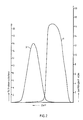
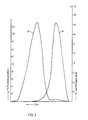
- the fraction change in the eluate is usually carried out at the intersection of the elution curve of the electrolyte (curve A in FIGS. 1, 2 and 3) with the elution curve of the non-electrolyte (curve B in FIGS. 1, 2 and 3).
- the time at which the fraction change is made is also moved away from the intersection of the electrolyte and non-electrolyte curve into the electrolyte or non-electrolyte area.
- the capacity of the cation exchanger used in g dry substance / l resin for the amount of sugar to be absorbed from the fruit juice was determined.
- the strongly acidic cation exchangers are mixed with an amount of fruit juice such that about 30 to 80 g of the dry substance contained in the juice are accounted for in 1 liter of cation exchangers.
- the degree of desalination and decolorization depend on the ratio of cation exchanger / amount of dry substance applied in the sense that the degree of desalination and decolorization decrease with increasing degree of loading (amount of dry substance per liter of resin and cycle). For reasons of economy, one is generally satisfied with degrees of desalination and decolorization of 90 to 95%.
- Chromatography i.e. Loading and elution is preferred to accelerate equilibrium at elevated temperatures, e.g. at 40 to 90 ° C, particularly preferably 50 to 80 ° C.
- Weakly crosslinked gel-type cation exchangers are preferably used as strongly acidic cation exchangers Based on polystyrene sulfonic acid, for example with 2 to 12 wt .-%, preferably with 4 to 8 wt .-% divinylbenzene crosslinked polystyrene sulfonic acids.
- the strongly acidic cation exchangers can be used in the Na+, K+ or Ca2+ form for the process according to the invention. Since the fruit juices (must) mostly contain potassium salts (e.g. potassium tartrate), the use of a cation exchanger loaded with K+ is recommended. In this way, a recharge of the cation exchanger during the chromatography is avoided and regeneration is saved. In order to avoid a recharge of the cation exchanger in the K+ form due to the Mg2+ and Ca2+ ions contained in the juice in small quantities, it is recommended to connect the chromatography filter with a cation exchanger loaded with K+ ions to re-salt the juice .
- potassium salts e.g. potassium tartrate
- the dry matter content of the fruit juices and must which can be desalinated and decolorized according to the invention can be between 10 and 70% by weight, preferably between 10 and 50% by weight.
- the process according to the invention has the advantage, in addition to the fact that it only works with a cation exchanger and does not require an anion exchanger, the further advantage that the cation exchanger does not require regeneration and therefore, in contrast to desalination by ion exchange, there is no pollution of the waste water with regeneration chemicals .
- An ion exchanger filter (glass tube sealed at the lower end with a liquid-permeable plate, inner diameter of the glass tube: 25 mm, height of the glass tube: 950 mm) is mixed with 440 ml of a strongly acidic gel-type cation exchanger (polystyrene sulfonic acid crosslinked with 4% by weight divinylbenzene) filled the K+ shape (filling height: 893 mm) and with 95.8 ml of a must made from rose grapes (must temperature: 60 ° C) with a linear flow rate of 1 m / h (flow direction: from top to bottom) (Dry matter (TS) content of the must: 21.1% by weight; degree of loading: 50 g dry matter / l cation exchanger).
- a strongly acidic gel-type cation exchanger polystyrene sulfonic acid crosslinked with 4% by weight divinylbenzene
- the cation exchanger is treated with deionized water (water temperature: 70 ° C) with a linear flow rate of also 1 m / h.
- the two fractions obtained in this way are then examined for their content of dry matter, salt and color.
- the table below compares the values found during the examination with the corresponding values of the raw juice.
- a comparison of the stated values for raw juice and non-electrolyte fraction shows that the non-electrolyte fraction has a degree of desalination of 97.7% and a degree of decolorization of 97.4%.
- the concentration of the non-electrolyte fraction is 21.1% by chromatography. TS dropped to 12.5%.
- the amount of substance (dry substance) applied to the cation exchanger is distributed as follows: 3.7 g are found in the electrolyte fraction and 18.36 g in the non-electrolyte fraction.
- the 3.7 g dry substance contained in the electrolyte fraction is composed of 1.3 g electrolyte and 2.4 g non-electrolyte.
- the work cycle was repeated a total of 100 times without a change in the composition of the fractions obtained being observed.
- the cation exchanger was only charged with 77 ml of must, ie with 40 g of dry substance / l of the cation exchanger. Chromatography was carried out under the conditions described above (temperature, flow rates, etc.). The eluate fraction was also changed at the intersection of the electrolyte and non-electrolyte curve (see FIG. 2).
- Table 2 compares the values found in the examination of the electrolyte fraction and non-electrolyte fraction obtained with the corresponding values of the added must.
- a comparison of the stated values for raw juice and non-electrolyte fraction shows that the non-electrolyte fraction has a degree of desalination of 99.5% and a degree of decolorization of 98.8%.
- the concentration of the non-electrolyte fraction drops from 21.1% TS to 10.6% due to the chromatography.
- the amount of substance (dry substance) applied to the cation exchanger is distributed as follows: 2.56 g are found in the electrolyte fraction and 15.03 g in the non-electrolyte fraction.
- the 2.56 g dry substance contained in the electrolyte fraction is composed of 1.05 g electrolyte and 1.52 g non-electrolyte.
- the ion exchange filter described in Example 1 is filled with 440 ml of a strongly acidic gel-like cation exchanger (with 6% by weight of divinylbenzene cross-linked polystyrene sulfonic acid) in the K+ form and with 44 ml of a pear juice concentrate (dry matter content: 50%) in one Temperature of 60 ° C with a linear flow rate of 1 m / h (flow direction: from top to bottom). Then the cation exchanger is treated with deionized water (water temperature: 60 ° C) at a linear flow rate of also 1 m / h (flow direction: from top to bottom).
- the eluate fraction is changed at the point in time at which the conductivity curve A intersects with the dry substance curve B (see FIG. 3).
- the two fractions thus obtained are then examined for their content of salt, dry matter and color (see Table 3).
Landscapes
- Health & Medical Sciences (AREA)
- Nutrition Science (AREA)
- Life Sciences & Earth Sciences (AREA)
- Chemical & Material Sciences (AREA)
- Engineering & Computer Science (AREA)
- Food Science & Technology (AREA)
- Polymers & Plastics (AREA)
- Non-Alcoholic Beverages (AREA)
- Treatment Of Water By Ion Exchange (AREA)
- Apparatuses For Bulk Treatment Of Fruits And Vegetables And Apparatuses For Preparing Feeds (AREA)
Applications Claiming Priority (2)
| Application Number | Priority Date | Filing Date | Title |
|---|---|---|---|
| DE4005579A DE4005579A1 (de) | 1990-02-22 | 1990-02-22 | Verfahren zum entfaerben und entsalzen von fruchtsaft und -most |
| DE4005579 | 1990-02-22 |
Publications (4)
| Publication Number | Publication Date |
|---|---|
| EP0446465A2 true EP0446465A2 (fr) | 1991-09-18 |
| EP0446465A3 EP0446465A3 (en) | 1992-03-18 |
| EP0446465B1 EP0446465B1 (fr) | 1994-03-02 |
| EP0446465B2 EP0446465B2 (fr) | 1996-09-25 |
Family
ID=6400727
Family Applications (1)
| Application Number | Title | Priority Date | Filing Date |
|---|---|---|---|
| EP90124514A Expired - Lifetime EP0446465B2 (fr) | 1990-02-22 | 1990-12-18 | Procédé pour décolorer et dessaler le jus ou moût de fruits |
Country Status (5)
| Country | Link |
|---|---|
| US (1) | US5106638A (fr) |
| EP (1) | EP0446465B2 (fr) |
| DE (2) | DE4005579A1 (fr) |
| ES (1) | ES2049905T5 (fr) |
| GR (1) | GR3021558T3 (fr) |
Families Citing this family (5)
| Publication number | Priority date | Publication date | Assignee | Title |
|---|---|---|---|---|
| ATE276675T1 (de) * | 1997-04-03 | 2004-10-15 | Bucher Alimentech Ltd | Verfahren zur verminderung der patulinkonzentration in obstsaften |
| US6387425B1 (en) | 2000-01-24 | 2002-05-14 | Meiji Seika Kaisha Ltd. | Method for producing low potassium juice with improved taste and product thereof |
| US6582390B1 (en) * | 2000-11-08 | 2003-06-24 | Endovascular Technologies, Inc. | Dual lumen peel-away sheath introducer |
| US7264837B2 (en) | 2003-04-02 | 2007-09-04 | Tropicana Products, Inc. | Resin deacidification of citrus juice and high acid maintenance |
| US7935189B2 (en) * | 2007-06-21 | 2011-05-03 | Cantine Foraci S.R.L. | Process and plant for producing sugar products from grapes |
Family Cites Families (13)
| Publication number | Priority date | Publication date | Assignee | Title |
|---|---|---|---|---|
| US2667417A (en) * | 1951-10-19 | 1954-01-26 | Delmousee George | Purification and stabilization of fruit juices by ion exchange treatment |
| US3437491A (en) * | 1966-01-27 | 1969-04-08 | E & J Gallo | Two-stage sequential ion exchange treatment for wine improvement |
| US3801717A (en) * | 1972-06-23 | 1974-04-02 | Coca Cola Co | Treatment of fruit juices |
| FR2210358A1 (en) * | 1972-12-13 | 1974-07-12 | Seghia Ets | Stabilisation of grape juice by ion exchange - in a column contg. sulphonated ion exchange resin |
| FR2378040B1 (fr) * | 1977-01-24 | 1981-01-02 | Rhone Poulenc Ind | |
| US4288462A (en) * | 1980-02-04 | 1981-09-08 | Amf Incorporated | Method for removing cationic contaminants from beverages |
| US4500556A (en) * | 1982-03-31 | 1985-02-19 | General Foods Corporation | Anthocyanin colorant from grape pomace |
| US4522836A (en) * | 1983-05-19 | 1985-06-11 | Mitco Water Laboratories, Inc. | Upflow ion exchange treatment of natural edible juices containing high acidity and suspended solids |
| US4676988A (en) * | 1984-03-19 | 1987-06-30 | General Mills, Inc. | Low-acid juice-milk beverages, juice and milk components therefor and methods of preparation |
| US4666721A (en) * | 1985-06-21 | 1987-05-19 | The Dow Chemical Company | Process of removing acids from juice |
| US4775541A (en) * | 1986-09-12 | 1988-10-04 | Mitco Water Laboratories, Inc. | Ion exchange method of treating liquid fermentation products to reduce the content of coloring matter therein |
| US4898742A (en) * | 1987-03-02 | 1990-02-06 | Heublein, Inc. | Process for the decharacterization of base wine |
| DE3814572C1 (fr) * | 1988-04-29 | 1989-05-11 | Rainer 8634 Rodach De Moebus |
-
1990
- 1990-02-22 DE DE4005579A patent/DE4005579A1/de not_active Withdrawn
- 1990-12-18 EP EP90124514A patent/EP0446465B2/fr not_active Expired - Lifetime
- 1990-12-18 DE DE90124514T patent/DE59004809D1/de not_active Expired - Fee Related
- 1990-12-18 ES ES90124514T patent/ES2049905T5/es not_active Expired - Lifetime
-
1991
- 1991-02-15 US US07/656,351 patent/US5106638A/en not_active Expired - Fee Related
-
1996
- 1996-11-06 GR GR960402935T patent/GR3021558T3/el unknown
Also Published As
| Publication number | Publication date |
|---|---|
| DE4005579A1 (de) | 1991-08-29 |
| ES2049905T3 (es) | 1994-05-01 |
| DE59004809D1 (de) | 1994-04-07 |
| EP0446465B2 (fr) | 1996-09-25 |
| US5106638A (en) | 1992-04-21 |
| EP0446465B1 (fr) | 1994-03-02 |
| ES2049905T5 (es) | 1996-12-01 |
| EP0446465A3 (en) | 1992-03-18 |
| GR3021558T3 (en) | 1997-02-28 |
Similar Documents
| Publication | Publication Date | Title |
|---|---|---|
| DE68923821T2 (de) | Verfahren zur Gewinnung von Betain aus Melassen. | |
| DE2362211C3 (de) | Verfahren zur Aufarbeitung von Melassen | |
| DE1567249C3 (de) | Verfahren und Anlage zum Reinigen von Zuckerlösungen | |
| EP0258854B1 (fr) | Utilistion d'un adsorbant pour enlever le pyrrolidone de vinyle des solutions de polymère de pyrrolidone de vinyle | |
| EP0446465B1 (fr) | Procédé pour décolorer et dessaler le jus ou moût de fruits | |
| DE69122304T2 (de) | Verfahren zur Abtrennung organischer Substanzen | |
| DE2802789B2 (de) | Verfahren zum Reinigen von wäßrigen Anthocyanlösungen | |
| Wada | Eine neue Methode zur Lebendbeobachtung der Mitose bei den Tradescantia-Haarzellen | |
| DE2511904B2 (de) | Verfahren zur Aufarbeitung von Melassen | |
| DE2826120B2 (de) | Verfahren zur Gewinnung von Xylit aus Endsirupen der Xylitkristallisation | |
| EP0473087A2 (fr) | Procédé pour abaisser la concentration d'une solution d'un ion ou d'un groupe d'ions particuliers | |
| DE617706C (de) | Verfahren zum Entfaerben und Klaeren von waessrigen Loesungen | |
| DE1767584C3 (de) | Neutralisation von Ionenaustauscher-Regeneraten | |
| DE2232093C3 (de) | Verfahren zur Gewinnung von Zucker aus Melasse nach dem lonenausschlußverfahren | |
| DE940118C (de) | Verfahren zur Gewinnung von Reduktinsaeure | |
| DE1533839C (de) | Verfahren zur Entphosphorung von Eisenerzen mittels starker Mineralsauren | |
| DE941012C (de) | Verfahren zur Gewinnung und Reinigung von Polymyxin | |
| DE2904781A1 (de) | Verfahren zur reinigung von zuckersirup durch elektrodialyse | |
| DE1533839B1 (de) | Verfahren zur Entphosphorung von Eisenerz mittels starker Mineralsaeuren | |
| DE589945C (de) | Herstellung von Basenaustauschern | |
| CH154323A (de) | Flüssigkeitsschalter. | |
| DE361594C (de) | Verfahren zum Reinigen von Zuckersaeften | |
| DE1567248A1 (de) | Verfahren zur Gewinnung von Fluessigzucker hoher Reinheit aus Rohrmelassen | |
| DE948005C (de) | Verfahren zur fraktionierten Trennung von Vitaminen des B-Typs und des B-Typs aus Loesungen unter Verwendung von Ionenaustauschern | |
| DE1792177C3 (de) | Verfahren zur organischen Reinigung von wäßrigen Wasserstoff peroxydlösungen |
Legal Events
| Date | Code | Title | Description |
|---|---|---|---|
| PUAI | Public reference made under article 153(3) epc to a published international application that has entered the european phase |
Free format text: ORIGINAL CODE: 0009012 |
|
| 17P | Request for examination filed |
Effective date: 19901218 |
|
| AK | Designated contracting states |
Kind code of ref document: A2 Designated state(s): DE ES FR GR IT |
|
| PUAL | Search report despatched |
Free format text: ORIGINAL CODE: 0009013 |
|
| AK | Designated contracting states |
Kind code of ref document: A3 Designated state(s): DE ES FR GR IT |
|
| 17Q | First examination report despatched |
Effective date: 19930226 |
|
| GRAA | (expected) grant |
Free format text: ORIGINAL CODE: 0009210 |
|
| AK | Designated contracting states |
Kind code of ref document: B1 Designated state(s): DE ES FR GR IT |
|
| REF | Corresponds to: |
Ref document number: 59004809 Country of ref document: DE Date of ref document: 19940407 |
|
| ITF | It: translation for a ep patent filed | ||
| REG | Reference to a national code |
Ref country code: ES Ref legal event code: FG2A Ref document number: 2049905 Country of ref document: ES Kind code of ref document: T5 |
|
| ET | Fr: translation filed | ||
| REG | Reference to a national code |
Ref country code: GR Ref legal event code: FG4A Free format text: 3011941 |
|
| PLBI | Opposition filed |
Free format text: ORIGINAL CODE: 0009260 |
|
| 26 | Opposition filed |
Opponent name: ROHM AND HAAS COMPANY Effective date: 19941130 |
|
| PLAW | Interlocutory decision in opposition |
Free format text: ORIGINAL CODE: EPIDOS IDOP |
|
| PLAW | Interlocutory decision in opposition |
Free format text: ORIGINAL CODE: EPIDOS IDOP |
|
| PUAH | Patent maintained in amended form |
Free format text: ORIGINAL CODE: 0009272 |
|
| STAA | Information on the status of an ep patent application or granted ep patent |
Free format text: STATUS: PATENT MAINTAINED AS AMENDED |
|
| 27A | Patent maintained in amended form |
Effective date: 19960925 |
|
| AK | Designated contracting states |
Kind code of ref document: B2 Designated state(s): DE ES FR GR IT |
|
| PG25 | Lapsed in a contracting state [announced via postgrant information from national office to epo] |
Ref country code: GR Free format text: THE PATENT HAS BEEN ANNULLED BY A DECISION OF A NATIONAL AUTHORITY Effective date: 19961106 |
|
| ET3 | Fr: translation filed ** decision concerning opposition | ||
| ITF | It: translation for a ep patent filed | ||
| REG | Reference to a national code |
Ref country code: ES Ref legal event code: DC2A Kind code of ref document: T5 Effective date: 19961030 |
|
| REG | Reference to a national code |
Ref country code: GR Ref legal event code: FG4A Free format text: 3021558 |
|
| PGFP | Annual fee paid to national office [announced via postgrant information from national office to epo] |
Ref country code: ES Payment date: 19981211 Year of fee payment: 9 |
|
| PGFP | Annual fee paid to national office [announced via postgrant information from national office to epo] |
Ref country code: DE Payment date: 19991116 Year of fee payment: 10 |
|
| PGFP | Annual fee paid to national office [announced via postgrant information from national office to epo] |
Ref country code: GR Payment date: 19991118 Year of fee payment: 10 |
|
| PGFP | Annual fee paid to national office [announced via postgrant information from national office to epo] |
Ref country code: FR Payment date: 19991210 Year of fee payment: 10 |
|
| PG25 | Lapsed in a contracting state [announced via postgrant information from national office to epo] |
Ref country code: ES Free format text: LAPSE BECAUSE OF NON-PAYMENT OF DUE FEES Effective date: 20001219 |
|
| PG25 | Lapsed in a contracting state [announced via postgrant information from national office to epo] |
Ref country code: FR Free format text: LAPSE BECAUSE OF NON-PAYMENT OF DUE FEES Effective date: 20010831 |
|
| REG | Reference to a national code |
Ref country code: FR Ref legal event code: ST |
|
| PG25 | Lapsed in a contracting state [announced via postgrant information from national office to epo] |
Ref country code: DE Free format text: LAPSE BECAUSE OF NON-PAYMENT OF DUE FEES Effective date: 20011002 |
|
| REG | Reference to a national code |
Ref country code: ES Ref legal event code: FD2A Effective date: 20020112 |
|
| PG25 | Lapsed in a contracting state [announced via postgrant information from national office to epo] |
Ref country code: IT Free format text: LAPSE BECAUSE OF NON-PAYMENT OF DUE FEES;WARNING: LAPSES OF ITALIAN PATENTS WITH EFFECTIVE DATE BEFORE 2007 MAY HAVE OCCURRED AT ANY TIME BEFORE 2007. THE CORRECT EFFECTIVE DATE MAY BE DIFFERENT FROM THE ONE RECORDED. Effective date: 20051218 |