EP0446583B1 - Knitted fabric - Google Patents
Knitted fabric Download PDFInfo
- Publication number
- EP0446583B1 EP0446583B1 EP91100804A EP91100804A EP0446583B1 EP 0446583 B1 EP0446583 B1 EP 0446583B1 EP 91100804 A EP91100804 A EP 91100804A EP 91100804 A EP91100804 A EP 91100804A EP 0446583 B1 EP0446583 B1 EP 0446583B1
- Authority
- EP
- European Patent Office
- Prior art keywords
- knitted
- needle
- needle bed
- web
- webs
- Prior art date
- Legal status (The legal status is an assumption and is not a legal conclusion. Google has not performed a legal analysis and makes no representation as to the accuracy of the status listed.)
- Expired - Lifetime
Links
- 239000004744 fabric Substances 0.000 title claims description 57
- 238000000034 method Methods 0.000 claims description 34
- 238000009940 knitting Methods 0.000 claims description 28
- 230000008878 coupling Effects 0.000 claims description 20
- 238000010168 coupling process Methods 0.000 claims description 20
- 238000005859 coupling reaction Methods 0.000 claims description 20
- 238000004519 manufacturing process Methods 0.000 claims description 10
- 230000015572 biosynthetic process Effects 0.000 claims description 2
- 238000005516 engineering process Methods 0.000 description 4
- FGUUSXIOTUKUDN-IBGZPJMESA-N C1(=CC=CC=C1)N1C2=C(NC([C@H](C1)NC=1OC(=NN=1)C1=CC=CC=C1)=O)C=CC=C2 Chemical compound C1(=CC=CC=C1)N1C2=C(NC([C@H](C1)NC=1OC(=NN=1)C1=CC=CC=C1)=O)C=CC=C2 FGUUSXIOTUKUDN-IBGZPJMESA-N 0.000 description 2
- 238000009958 sewing Methods 0.000 description 2
- 206010000496 acne Diseases 0.000 description 1
- 238000005755 formation reaction Methods 0.000 description 1
- 239000000463 material Substances 0.000 description 1
Images

Classifications
-
- D—TEXTILES; PAPER
- D04—BRAIDING; LACE-MAKING; KNITTING; TRIMMINGS; NON-WOVEN FABRICS
- D04B—KNITTING
- D04B1/00—Weft knitting processes for the production of fabrics or articles not dependent on the use of particular machines; Fabrics or articles defined by such processes
- D04B1/22—Weft knitting processes for the production of fabrics or articles not dependent on the use of particular machines; Fabrics or articles defined by such processes specially adapted for knitting goods of particular configuration
-
- D—TEXTILES; PAPER
- D10—INDEXING SCHEME ASSOCIATED WITH SUBLASSES OF SECTION D, RELATING TO TEXTILES
- D10B—INDEXING SCHEME ASSOCIATED WITH SUBLASSES OF SECTION D, RELATING TO TEXTILES
- D10B2403/00—Details of fabric structure established in the fabric forming process
- D10B2403/02—Cross-sectional features
- D10B2403/021—Lofty fabric with equidistantly spaced front and back plies, e.g. spacer fabrics
-
- D—TEXTILES; PAPER
- D10—INDEXING SCHEME ASSOCIATED WITH SUBLASSES OF SECTION D, RELATING TO TEXTILES
- D10B—INDEXING SCHEME ASSOCIATED WITH SUBLASSES OF SECTION D, RELATING TO TEXTILES
- D10B2403/00—Details of fabric structure established in the fabric forming process
- D10B2403/02—Cross-sectional features
- D10B2403/022—Lofty fabric with variably spaced front and back plies, e.g. spacer fabrics
- D10B2403/0222—Lofty fabric with variably spaced front and back plies, e.g. spacer fabrics with at least one baggy or puckered ply
Definitions
- the invention relates to a knitted fabric consisting of a first and a second knitted fabric web which is coupled to one another in places.
- a knitted component is also known from EP-A-0 339 227, in which two knitted fabric panels are connected to one another by pile threads running between the two panels and are also held at a mutual distance from one another by stiffening the pile threads.
- the invention has for its object to manufacture knitted structures of the type mentioned in one piece with a desired shape on a knitting machine and so that the knitted structure has stable knitted walls on all sides.
- the object is achieved according to the invention in that the mutual coupling of the two knitted webs takes place with spacing by means of at least one third knitted web which runs between the two other knitted webs and is connected to them by knitting technology.
- the inner walls that is to say the parts connecting the top walls to one another, are also designed as stable knitted webs and do not consist only of individual connecting threads.
- the inner walls are not subsequently connected to the top walls by sewing, but in terms of knitting technology, which is achieved by a one-piece production of the knitted structure on a knitting machine.
- Modern programmable flat knitting machines allow such a one-piece production of spatially complicated knitted structures in an economical manner.
- the third knitted fabric can run, for example, in a meandering manner between the two other knitted fabrics and can be connected to them at several points by knitting technology.
- the two outer knitted fabrics and also the additional inner coupling knitted fabrics can each be designed as shaped knitted fabrics by reducing or widening or by known spiked formations, which give the entire knitted fabric a desired specific spatial shape. This can also be achieved in that the knitted webs serving the coupling are produced with different section or total lengths and / or widths.
- Knitted structures designed according to the invention can be used for clothing purposes, but predominantly for technical structures in which a subsequent treatment of the knitted webs and also an at least partial filling of the gaps formed can be used.
- the knitted structures can be produced in a two-bed flat knitting machine with a transfer device in various ways.
- Two exemplary embodiments of knitted structures with knitted webs in 1: 1 or plain / right weave are listed in subclaims 7 and 8.
- Various exemplary embodiments of knitted structures constructed according to the invention and the course of the thread in the two production methods mentioned are explained in more detail below with reference to the accompanying drawing.
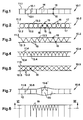
- FIG. 1 shows a cross section through a first knitted fabric 10.1, the outer surfaces of which are formed by a first knitted sheet 11.1 and a second knitted sheet 12.1.
- the two knitted webs 11.1 and 12.1 are coupled to one another by a plurality of third or additional knitted webs 13.1, which are arranged here at a uniform distance from one another, as a result of which the space between the two knitted webs 11.1 and 12.1 is divided into individual chambers 14.
- the additional knitted webs 13.1 are connected to the two outer knitted webs 11.1 and 12.1 at the coupling points identified by the reference number 15, that is to say by means of stitches or tuck handles, and not through subsequent sewing together. Rather, the knitted structure is produced in one piece on a two-bed flat knitting machine, as will be explained below in connection with FIGS. 8 and 9.
- the two outer knitted webs 11.2 and 12.2 are coupled to one another by hose-like additional knitted webs 13.2, which are knitted at the coupling points 15 with the two outer knitted webs 11.2, 12.2 or to one another.
- the knitted structure 10.2 is subdivided into a plurality of tubular chambers 16 and triangular chambers 17 by the tubular additional knitted fabric webs 13.2.
- FIG. 3 shows a schematic cross section of a knitted fabric 10.3, in which the two outer knitted webs 11.3 and 12.3 are connected to one another by a third knitted web 13.3 running in a meandering manner between them, which is connected to the knitted webs 11.3 and 12.3 at several points 15 in terms of knitting technology.
- the knitted fabric 10.3 is accordingly divided into chambers 18 with a triangular cross section.
- FIG. 4 shows a knitted structure 10.4, in which the coupling knitted webs 13.4 between the two outer knitted webs 11.4 and 12.4 have a Y-like cross section.
- the coupling knitted webs 13.5 intersect between the two outer knitted webs 11.5 and 12.5, a knitting connection also being present at the crossing points 15.
- pimples 19 are incorporated in the edge regions of the two outer knitted webs 11.6 and 12.6, which lead to the bulge of these knitted webs outwards and accordingly to inner chambers 20 with different cross sections.
- the inner coupling fabric webs 13.6 are longer in the region of the bulges, as the two fabric webs 13.6 'show.
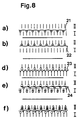
- FIG. 8 shows the course of the thread in a first method for producing a knitted fabric with outer knitted webs and additional knitted webs or coupling knitted webs connecting these outer knitted webs, carried out on a two-bed flat knitting machine with a transfer device.
- Each row of double dashes symbolizes, in a known manner, the needles of the first or front needle bed I in the lower row of rows and the needles of the second or rear needle bed II in the upper row of strings 21 knitted for the first knitted fabric 11.
- a row of tubular stitches 22 for the second knitted fabric 12 is also knitted in the second needle bed II with every second needle.
- Process steps a) and b) are repeated until a desired length of the first and second Knitted fabric 11, 12 of the knitted fabric is made.
- a catch row 23 is formed with each needle of the first needle bed I, which results in the aforementioned knitting connection of a third knitted fabric 13 at a coupling point 15 of the knitted fabric with the first knitted fabric 11.
- a method step e) with every second needle that was not used in method step a) of the first needle bed I, a tubular stitch row 24 is formed for the third knitted web.
- This process step e) is repeated until the third or additional knitted web 13 has reached a desired length.
- a method step f) in the first needle bed I the stitches formed on every second needle are transferred to needles of the second needle bed II, thereby creating the knitting connection between the third knitted fabric 13 and the second knitted fabric 12. If the process steps a) and b) are then continued again, a next length section of the first and second knitted webs 11, 12 is produced. The process steps described are then repeated until a desired knitted structure length is reached.
- a tubular stitch row 26 is first knitted with each needle of the first needle bed I in a process step a), then a tubular stitch row 27 is then processed in a process step b) with each needle of the second needle bed II.
- the two process steps are repeated several times , the first knitted sheet 11 from the tubular stitch rows 26 and the tubular stitch rows 27 the second knitted fabric 12 is formed to a length after which a third or coupling knitted fabric 13 is to start.
- a row of tubular stitches 28 is knitted with every second needle of the first needle bed I in a method step d) and further rows of tubular stitches 28 are added until a desired length of the coupling knitted web 13 is reached.
- a method step f the stitches last formed in the first needle bed I on every second needle are reassigned to needles of the second needle bed II, thereby creating the technical connection between the third knitted fabric 13 and the second knitted fabric 12.
- Process steps a) and b) are then repeated until a further length section of the first knitted fabric 11 and the second knitted fabric 12 is created and the next coupling point 15 is reached, at which a third knitted fabric 13 is to start again.
- a tubular stitch row 29 is formed with every second needle of the second needle bed II and further such tubular stitch rows 29 are added until a desired length of the third knitted web 13 is reached again.
- a method step k the stitches last formed in the second needle bed II on every second needle are reassigned to needles of the first needle bed I in order to achieve the knitting connection of the third knitted fabric 13 with the first knitted fabric 11.
- the process steps described are then repeated until the knitted structure has reached a desired overall length.
- FIGS. 8 and 9 relate to the production of a knitted fabric 10.1 according to FIG. 1 in a different knitted web structure.
- different and also a larger number of individual method steps result in order to achieve the different design and guidance of the coupling knitted webs 13.
Landscapes
- Engineering & Computer Science (AREA)
- Textile Engineering (AREA)
- Knitting Of Fabric (AREA)
- Knitting Machines (AREA)
Description
Die Erfindung betrifft ein Gestrickgebilde, bestehend aus einer ersten und einer zweiten, stellenweise miteinander gekoppelten Gestrickbahn.The invention relates to a knitted fabric consisting of a first and a second knitted fabric web which is coupled to one another in places.
Es ist bekannt, z.B. aus der US-A-2 372 497, auf Strickmaschinen gleichzeitig parallel zueinander zwei getrennte Gestrickbahnen herzustellen und auch stellenweise miteinander zu verbinden, so daß sich ein doppellagiges, in einzelne Taschen untergliedertes Gestrickgebilde ergibt. Aus der EP-A-0 339 227 ist auch ein gewirktes Bauteil bekannt bei welchem zwei gewirkte Stoffbahnen durch zwischen den beiden Bahnen verlaufende Polfäden miteinander verbunden und durch eine Versteifung der Polfäden auch in einem gegenseitigen Abstand voneinander gehalten sind.It is known, for example from US-A-2 372 497, to simultaneously produce two separate knitted webs on knitting machines in parallel with one another and also to connect them to one another in places, so that a double-layer knitted structure formed into individual pockets results. A knitted component is also known from EP-A-0 339 227, in which two knitted fabric panels are connected to one another by pile threads running between the two panels and are also held at a mutual distance from one another by stiffening the pile threads.
Der Erfindung liegt die Aufgabe zugrunde, Gestrickgebilde der eingangs genannten Art mit einer gewünschten Formgebung einstückig auf einer Strickmaschine und so zu fertigen, daß das Gestrickgebilde allseits stabile Strickwandungen besitzt.The invention has for its object to manufacture knitted structures of the type mentioned in one piece with a desired shape on a knitting machine and so that the knitted structure has stable knitted walls on all sides.
Die gestellte Aufgabe wird erfindungsgemäß dadurch gelöst, daß die gegenseitige Koppelung der beiden Gestrickbahnen unter Abstandshaltung mittels mindestens einer dritten Gestrickbahn erfolgt, die zwischen den beiden anderen Gestrickbahnen verläuft und mit ihnen stricktechnisch verbunden ist.The object is achieved according to the invention in that the mutual coupling of the two knitted webs takes place with spacing by means of at least one third knitted web which runs between the two other knitted webs and is connected to them by knitting technology.
Bei dem erfindungsgemäß ausgebildeten Gestrickgebilde sind auch die Innenwandungen, also die die Deckwandungen miteinander verbindenden Teile, als stabile Gestrickbahnen ausgebildet und bestehen nicht nur aus einzelnen Verbindungsfäden. Außerdem sind die Innenwandungen mit den Deckwandungen nicht nachträglich durch Vernähen verbunden, sondern stricktechnisch, was durch eine einstückige Herstellung des Gestrickgebildes auf einer Strickmaschine erreicht wird. Moderne programmierbare Flachstrickmaschinen erlauben eine solche einstückige Herstellung auch räumlich komplizierter Gestrickgebilde auf wirtschaftliche Weise.In the knitted structure constructed according to the invention, the inner walls, that is to say the parts connecting the top walls to one another, are also designed as stable knitted webs and do not consist only of individual connecting threads. In addition, the inner walls are not subsequently connected to the top walls by sewing, but in terms of knitting technology, which is achieved by a one-piece production of the knitted structure on a knitting machine. Modern programmable flat knitting machines allow such a one-piece production of spatially complicated knitted structures in an economical manner.
Bei dem erfindungsgemäß ausgebildeten Gestrickgebilde kann die dritte Gestrickbahn beispielsweise mäanderartig zwischen den beiden anderen Gestrickbahnen verlaufen und an mehreren Stellen stricktechnisch mit ihnen verbunden sein. Die Koppelung der ersten und der zweiten Gestrickbahn. welche die Außenflächen des Gestrickgebildes bestimmen, kann aber auch durch mehrere zusätzliche Gestrickbahnen erfolgen, die in gegenseitigem Abstand mit den beiden äußeren Gestrickbahnen stricktechnisch verbunden sind. Dabei können die beiden äußeren Gestrickbahnen und auch die zusätzlichen inneren Koppelungs-Gestrickbahnen durch Mindern oder Weitern oder durch bekannte Spickelbildungen jeweils als Formgestrickbahnen ausgebildet sein, die dem ganzen Gestrickgebilde eine gewünschte bestimmte Raumform verleihen. Dies kann auch dadurch erreicht werden, daß der Koppelung dienende Gestrickbahnen mit unterschiedlichen Abschnitts- oder Gesamtlängen und/oder -breiten hergestellt werden. Auch können die einzelnen Gestrickbahnen mit unterschiedlicher Festigkeit und auch mit unterschiedlichem Garnmaterial hergestellt werden. Erfindungsgemäß ausgebildete Gestrickgebilde können für Bekleidungszwecke, vorwiergend aber für technische Strukturen, bei welchen eine nachträgliche Behandlung der Gestrickbahnen und auch ein mindestens telweises Ausfüllen der gebildeten Zwischenräume erfolgen kann, Verwendung finden.In the knitted fabric formed according to the invention, the third knitted fabric can run, for example, in a meandering manner between the two other knitted fabrics and can be connected to them at several points by knitting technology. The coupling of the first and the second knitted fabric. which determine the outer surfaces of the knitted structure, but can also by several additional knitted fabrics take place, which are mutually connected with the two outer knitted webs knitting. In this case, the two outer knitted fabrics and also the additional inner coupling knitted fabrics can each be designed as shaped knitted fabrics by reducing or widening or by known spiked formations, which give the entire knitted fabric a desired specific spatial shape. This can also be achieved in that the knitted webs serving the coupling are produced with different section or total lengths and / or widths. The individual knitted fabrics can also be produced with different strength and also with different yarn material. Knitted structures designed according to the invention can be used for clothing purposes, but predominantly for technical structures in which a subsequent treatment of the knitted webs and also an at least partial filling of the gaps formed can be used.
Die Herstellung der Gestrickgebilde auf einer zweibettigen Flachstrickmaschine mit Umhängeeinrichtung kann auf verschiedene Weise erfolgen. Zwei Ausführungsbeispiele für Gestrickgebilde mit Gestrickbahnen in 1:1- oder Glatt/Rechts-Bindung sind in den Unteransprüchen 7 und 8 aufgeführt. Nachfolgend werden verschiedene Ausführungsbeispiele von erfindungsgemäß ausgebildeten Gestrickgebilden und der Fadenverlauf bei den erwähnten beiden Herstellverfahren anhand der beiliegenden Zeichnung näher erläutert.The knitted structures can be produced in a two-bed flat knitting machine with a transfer device in various ways. Two exemplary embodiments of knitted structures with knitted webs in 1: 1 or plain / right weave are listed in subclaims 7 and 8. Various exemplary embodiments of knitted structures constructed according to the invention and the course of the thread in the two production methods mentioned are explained in more detail below with reference to the accompanying drawing.
Im einzelnen zeigen:
- Fig. 1 - 5
- schematische Querschnitte durch fünf verschiedene Ausführungsbeispiele des Gestrickgebildes:
- Fig. 6
- eine Teildraufsicht auf ein sechstes Ausführungsbeispiel eines Gestrickgebildes;
- Fig. 7
- einen schematischen Querschnitt durch das Gestrickgebilde nach Fig. 6 entlang der Linie VII - VII in Fig. 6;
- Fig. 8
- eine Fadenlaufdarstellung für ein erstes Verfahrensbeispiel zur Herstellung eines der Gestrickgebilde auf einer zweibettigen Flachstrickmaschine;
- Fig. 9
- eine Fadenlaufdarstellune für ein zweites Herstellungsverfahrensbeispiel.
- 1 - 5
- schematic cross sections through five different embodiments of the knitted fabric:
- Fig. 6
- a partial plan view of a sixth embodiment of a knitted fabric;
- Fig. 7
- a schematic cross section through the knitted fabric of Figure 6 along the line VII - VII in Fig. 6.
- Fig. 8
- a thread representation for a first method example for producing one of the knitted structures on a two-bed flat knitting machine;
- Fig. 9
- a thread run representation for a second manufacturing process example.
Fig. 1 zeigt einen Querschnitt durch ein erstes Gestrickgebilde 10.1, dessen Außenflächen durch eine erste Gestrickbahn 11.1 und eine zweite Gestrickbahn 12.1 gebildet sind. Die beiden Gestrickbahnen 11.1 und 12.1 sind durch mehrere, hier in gleichmäßigem Abstand voneinander angeordnete dritte oder zusätzliche Gestrickbahnen 13.1 miteinander gekoppelt, wodurch der Zwischenraum zwischen den beiden Gestrickbahnen 11.1 und 12.1 in einzelne Kammern 14 unterteilt ist. Die zusätzlichen Gestrickbahnen 13.1 sind mit den beiden äußeren Gestrickbahnen 11.1 und 12.1 an den mit der Bezugsziffer 15 gekennzeichneten Koppelungsstellen stricktechnisch, also durch Maschen oder Fanghenkel, verbunden, und nicht etwa durch nachträgliches Zusammennähen. Vielmehr wird das Gestrickgebilde einstückig auf einer zweibettigen Flachstrickmaschine hergestellt, wie nachfolgend noch in Verbindung mit den Fig. 8 und 9 erläutert wird.1 shows a cross section through a first knitted fabric 10.1, the outer surfaces of which are formed by a first knitted sheet 11.1 and a second knitted sheet 12.1. The two knitted webs 11.1 and 12.1 are coupled to one another by a plurality of third or additional knitted webs 13.1, which are arranged here at a uniform distance from one another, as a result of which the space between the two knitted webs 11.1 and 12.1 is divided into
Bei dem Gestrickgebilde 10.2 nach Fig. 2 sind die beiden äußeren Gestrickbahnen 11.2 und 12.2 durch schlauchartige zusätzliche Gestrickbahnen 13.2 miteinander gekoppelt, die an den Koppelungsstellen 15 stricktechnisch mit den beiden äußeren Gestrickbahnen 11.2, 12.2 oder miteinander verbunden sind. Durch die schlauchartigen zusätzlichen Gestrickbahnen 13.2 ist das Gestrickgebilde 10.2 in mehrere schlauchartige Kammern 16 und dreieckige Kammern 17 unterteilt.In the knitted fabric 10.2 according to FIG. 2, the two outer knitted webs 11.2 and 12.2 are coupled to one another by hose-like additional knitted webs 13.2, which are knitted at the
Fig. 3 zeigt im schematischen Querschnitt ein Gestrickgebilde 10.3, bei welchem die beiden äußeren Gestrickbahnen 11.3 und 12.3 durch eine mäanderartig zwischen ihnen verlaufende dritte Gestrickbahn 13.3 miteinander verbunden sind, die an mehreren Stellen 15 stricktechnisch mit den Gestrickbahnen 11.3 und 12.3 verbunden ist. Das Gestrickgebilde 10.3 ist dementsprechend in Kammern 18 mit drei-eckigem Querschnitt unterteilt.3 shows a schematic cross section of a knitted fabric 10.3, in which the two outer knitted webs 11.3 and 12.3 are connected to one another by a third knitted web 13.3 running in a meandering manner between them, which is connected to the knitted webs 11.3 and 12.3 at
Fig. 4 zeigt ein Gestrickgebilde 10.4, bei welchem die Koppelungsgestrickbahnen 13.4 zwischen den beiden äußeren Gestrickbahnen 11.4 und 12.4 einen Y-artigen Querschnitt aufweisen. Bei dem in Fig. 5 gezeigten Gestrickgebilde 10.5 kreuzen sich die Koppelungsgestrickbahnen 13.5 zwischen den beiden äußeren Gestrickbahnen 11.5 und 12.5, wobei auch an den Kreuzungsstellen 15 eine stricktechnische Verbindung vorhanden ist.FIG. 4 shows a knitted structure 10.4, in which the coupling knitted webs 13.4 between the two outer knitted webs 11.4 and 12.4 have a Y-like cross section. In the knitted fabric 10.5 shown in FIG. 5, the coupling knitted webs 13.5 intersect between the two outer knitted webs 11.5 and 12.5, a knitting connection also being present at the
Bei dem in den Fig. 6 und 7 dargestellten Gestrickgebilde 10.6 sind in Randbereichen der beiden äußeren Gestrickbahnen 11.6 und 12.6 Spickel 19 eingearbeitet, die zu einer Ausbuchtung dieser Gestrickbahnen nach außen und dementsprechend zu Innenkammern 20 mit unterschiedlichem Querschnitt führen. Die inneren Koppelungsgestrickbahnen 13.6 sind im Bereich der Ausbuchtungen länger gestaltet, wie die beiden Gestrickbahnen 13.6' zeigen.In the knitted fabric 10.6 shown in FIGS. 6 and 7,
Fig. 8 zeigt den Fadenverlauf in einem ersten Verfahren zur Herstellung eines Gestrickgebildes mit äußeren Gestrickbahnen und diese äußeren Gestrickbahnen miteinander verbindenden zusätzlichen Gestrickbahnen oder Koppelungsgestrickbahnen, ausgeführt auf einer zweibettigen Flachstrickmaschine mit Umhängeeinrichtung. Jede Doppelstrichreihe symbolisiert in bekannter Weise in der unteren Strichreihe die Nadeln des ersten oder vorderen Nadelbettes I und in der oberen Strichreihe die Nadeln des zweiten oder hinteren Nadelbettes II. Zunächst wird in einem ersten Verfahrensschritt a) im ersten Nadelbett I mit jeder zweiten Nadel eine Schlauchmaschenreihe 21 für die erste Gestrickbahn 11 gestrickt. Anschließend wird in einem zweiten Verfahrensschritt b) im zweiten Nadelbett II mit jeder zweiten Nadel ebenfalls eine Schlauchmaschenreihe 22 für die zweite Gestrickbahn 12 gestrickt. Die Verfahrensschritte a) und b) werden so lange wiederholt, bis ein gewünschter Längenabschnitt der ersten und zweiten Gestrickbahn 11, 12 des Gestrickgebildes gefertigt ist. Dann wird in einem Verfahrensschritt d) mit jeder Nadel des ersten Nadelbettes I eine Fangreihe 23 gebildet, welche die erwähnte stricktechnische Verbindung einer dritten Gestrickbahn 13 an einer Koppelungsstelle 15 des Gestrickgebildes mit der ersten Gestrickbahn 11 ergibt. Anschließend wird in einem Verfahrensschritt e) mit jeder zweiten Nadel, die im Verfahrensschritt a) nicht eingesetzt war, des ersten Nadelbettes I eine Schlauchmaschenreihe 24 für die dritte Gestrickbahn gebildet. Dieser Verfahrensschritt e) wird wiederholt, bis die dritte oder zusätzliche Gestrickbahn 13 eine gewünschte Länge erreicht hat. Dann werden in einem Verfahrensschritt f) im ersten Nadelbett I die auf jeder zweiten Nadel gebildeten Maschen auf Nadeln des zweiten Nadelbettes II umgehängt und dadurch die stricktechnische Verbindung der dritten Gestrickbahn 13 mit der zweiten Gestrickbahn 12 geschaffen. Wird nun anschließend wieder mit den Verfahrensschritten a) und b) weitergestrickt, wird ein nächster Längenabschnitt der ersten und zweiten Gestrickbahn 11, 12 gefertigt. Die beschriebenen Verfahrensschritte werden dann so lange wiederholt, bis eine gewünschte Gestrickgebildelänge erreicht ist.8 shows the course of the thread in a first method for producing a knitted fabric with outer knitted webs and additional knitted webs or coupling knitted webs connecting these outer knitted webs, carried out on a two-bed flat knitting machine with a transfer device. Each row of double dashes symbolizes, in a known manner, the needles of the first or front needle bed I in the lower row of rows and the needles of the second or rear needle bed II in the upper row of
Bei dem in Fig. 9 dargestellten Herstellverfahren wird zunächst in einem Verfahrensschritt a) mit jeder Nadel des ersten Nadelbettes I eine Schlauchmaschenreihe 26 gestrickt, anschließend in einem Verfahrensschritt b) mit jeder Nadel des zweiten Nadelbettes II eine Schlauchmaschenreihe 27. Die beiden Verfahrensschritte werden mehrfach wiederholt, wobei aus den Schlauchmaschenreihen 26 die erste Gestrickbahn 11 und aus den Schlauchmaschenreihen 27 die zweite Gestrickbahn 12 bis auf eine Länge gebildet werden nach welcher eine dritte oder Koppelungs-Gestrickbahn 13 ansetzen soll. An dieser Stelle 15 wird in einem Verfahrensschritt d) mit jeder zweiten Nadel des ersten Nadelbettes I eine Schlauchmaschenreihe 28 gestrickt und werden weitere Schlauchmaschenreihen 28 angefügt, bis eine gewünschte Länge der Koppelungsgestrickbahn 13 erreicht ist. Dann werden in einem Verfahrensschritt f) die zuletzt im ersten Nadelbett I auf jeder zweiten Nadel gebildeten Maschen auf Nadeln des zweiten Nadelbettes II umgehängt und dadurch die stricktechnische Verbindung der dritten Gestrickbahn 13 mit der zweiten Gestrickbahn 12 geschaffen. Anschließend werden die Verfahrensschritte a) und b) so lange wiederholt, bis ein weiterer Längenabschnitt der ersten Gestrickbahn 11 und der zweiten Gestrickbahn 12 geschaffen und die nächste Koppelungsstelle 15 erreicht ist, an welcher wieder eine dritte Gestrickbahn 13 ansetzen soll. An dieser Stelle (Verfahrensschritt h)) wird mit jeder zweiten Nadel des zweiten Nadelbettes II eine Schlauchmaschenreihe 29 gebildet und weitere solcher Schlauchmaschenreihen 29 angefügt, bis wieder eine gewünschte Länge der dritten Gestrickbahn 13 erreicht ist. Dann werden in einem Verfahrensschritt k) die zuletzt im zweiten Nadelbett II auf jeder zweiten Nadel gebildeten Maschen auf Nadeln des ersten Nadelbettes I umgehängt, um die stricktechnische Verbindung der dritten Gestrickbahn 13 mit der ersten Gestrickbahn 11 zu erreichen. Anschließend werden die beschriebenen Verfahrensschritte so lange wiederholt, bis das Gestrickgebilde eine gewünschte Gesamtlänge erreicht hat.In the manufacturing process shown in FIG. 9, a
Die in Verbindung mit den Fig. 8 und 9 beschriebenen Verfahren betreffen die Herstellung eines Gestrickgebildes 10.1 gemäß Fig. 1 in unterschiedlicher Gestrickbahnstruktur. Bei der Herstellung anderer Querschnittsformen der Gestrickgebilde ergeben sich andere und auch eine größere Anzahl einzelner Verfahrensschritte, um die unterschiedliche Gestaltung und Führung der Koppelungsgestrickbahnen 13 zu erreichen.The methods described in connection with FIGS. 8 and 9 relate to the production of a knitted fabric 10.1 according to FIG. 1 in a different knitted web structure. When producing other cross-sectional shapes of the knitted structures, different and also a larger number of individual method steps result in order to achieve the different design and guidance of the coupling knitted webs 13.
Claims (8)
- Knitted fabric (11, 12, 13), consisting of a first and a second knitted web coupled together in places, characterised in that the coupling is effected, with spacing, by means of at least a third knitted web (13) which extends between the other two knitted webs (11, 12) forming the outer walls of a three-dimensional knitted fabric and is connected thereto by knitting by means of coupling points (15).
- Knitted fabric according to claim 1, characterised in that the third knitted web (13) meanders between the other two knitted webs (11, 12) and is connected thereto by knitting at several points (15) (Fig. 3).
- Knitted fabric according to claim 1, characterised in that the coupling of the first and second knitted webs (11, 12) is effected by means of several additional knitted webs (13) which are connected by knitting with mutual spacing to the first and the second knitted webs (11, 12).
- Knitted fabric according to one of claims 1 to 3, characterised in that the first and/or the second knitted web (11, 12) is/are designed as a shaped knitted web by narrowing or widening or gusset formation.
- Knitted fabric according to one of claims 1 to 4, characterised in that the at least one additional knitted web (13) serving for coupling has varying section lengths or overall length and/or width (e.g. Fig. 7).
- Knitted fabric according to one of claims 1 to 5, characterized in that the at least one additional knitted web (13) serving for coupling is knitted with a different strength compared to other additional knitted webs of this kind and/or to the first and second knitted webs (11, 12).
- Process for the manufacture of a knitted fabric according to one of claims 1 to 6 on a rib flat knitting machine with a transfer device, characterised by the successive process steps:a) knitting a tubular knit course (21) with every second needle in the first needle bed (I);b) knitting a tubular knit course (22) with every second needle in the second needle bed (II);c) repeating process steps a) and b) several times in order to form a desired section length for the first and the second knitted webs (11, 12);d) forming a tuck course (23) with each needle of the first needle bed (I);e) forming a tubular knit course (24) with every second needle of the first needle bed (I) not used in process step a);f) repeating process step e) several times until a desired length is achieved for the resulting third knitted web (13);g) transferring stitches formed on every second needle in the first needle bed (I) to needles of the second needle bed (II);h) repeating process steps a) - g) until a desired knitted fabric length is achieved.
- Process for the manufacture of a knitted fabric according to one of claims 1 to 6 on a rib flat knitting machine with a transfer device, characterised by the successive process steps:a) knitting a tubular knit course (26) with each needle of the first needle bed (I);b) knitting a tubular knit course (27) with each needle of the second needle bed (II);c) repeating process steps a) and b) several times until a desired section length is achieved for the resulting first knitted web (11) and second knitted web (12);d) knitting a tubular knit course (28) with every second needle of the first needle bed (I);e) repeating process step d) several times until a desired length is achieved for the third knitted web (13);f) transferring stitches formed on every second needle in the first needle bed (I) to needles of the second needle bed (II);g) repeating process steps a) and b) several times until a desired length is achieved for a further section of the first knitted web (11) and the second knitted web (12);h) knitting a tubular knit course (29) with every second needle of the second needle bed (II);i) repeating process step h) until a desired length is achieved for a third knitted web (13);k) transferring stitches formed on every second needle in the second needle bed (II) to needles of the first needle bed (I);l) repeating process steps a) - k) until a desired knitted fabric length is achieved.
Applications Claiming Priority (2)
| Application Number | Priority Date | Filing Date | Title |
|---|---|---|---|
| DE4008057A DE4008057A1 (en) | 1990-03-14 | 1990-03-14 | KNITTED PATTERN |
| DE4008057 | 1990-03-14 |
Publications (2)
| Publication Number | Publication Date |
|---|---|
| EP0446583A1 EP0446583A1 (en) | 1991-09-18 |
| EP0446583B1 true EP0446583B1 (en) | 1995-04-19 |
Family
ID=6402126
Family Applications (1)
| Application Number | Title | Priority Date | Filing Date |
|---|---|---|---|
| EP91100804A Expired - Lifetime EP0446583B1 (en) | 1990-03-14 | 1991-01-23 | Knitted fabric |
Country Status (5)
| Country | Link |
|---|---|
| US (1) | US5284031A (en) |
| EP (1) | EP0446583B1 (en) |
| JP (1) | JPH04228657A (en) |
| DE (2) | DE4008057A1 (en) |
| ES (1) | ES2071842T3 (en) |
Cited By (4)
| Publication number | Priority date | Publication date | Assignee | Title |
|---|---|---|---|---|
| CN102758302A (en) * | 2011-04-28 | 2012-10-31 | 株式会社岛精机制作所 | Knitting method of tubular knitted fabric, and tubular knitted fabric |
| CN103046216A (en) * | 2011-10-17 | 2013-04-17 | 株式会社岛精机制作所 | Knitting method of spacer fabric and spacer fabric |
| US11589637B2 (en) | 2013-04-19 | 2023-02-28 | Adidas Ag | Layered shoe upper |
| US11849796B2 (en) | 2014-10-02 | 2023-12-26 | Adidas Ag | Flat weft-knitted upper for sports shoes |
Families Citing this family (40)
| Publication number | Priority date | Publication date | Assignee | Title |
|---|---|---|---|---|
| GB9101444D0 (en) * | 1991-01-23 | 1991-03-06 | Courtaulds Advanced Materials | Thermal insulation materials |
| WO1994013162A1 (en) * | 1992-12-15 | 1994-06-23 | Jockey Australia | Knitted fabric and method for producing a knitted fabric |
| ATE183784T1 (en) * | 1993-02-22 | 1999-09-15 | Keiper Recaro Gmbh Co | SPACER TEXTILE MATERIAL OF VARIABLE THICKNESS, PRODUCTION PROCESS AND USES THEREOF |
| JP3384506B2 (en) * | 1993-03-30 | 2003-03-10 | ソニー株式会社 | Semiconductor substrate manufacturing method |
| DE4419985C2 (en) * | 1994-06-08 | 1996-04-04 | Univ Dresden Tech | Multi-layer knitted fabric and process for its manufacture |
| JP2706760B2 (en) * | 1994-10-07 | 1998-01-28 | 株式会社島精機製作所 | How to organize |
| US10899106B1 (en) | 1996-02-05 | 2021-01-26 | Teledyne Brown Engineering, Inc. | Three-dimensional, knitted, multi-spectral electro-magnetic detection resistant, camouflaging textile |
| DE19616004A1 (en) * | 1996-04-18 | 1997-10-23 | Beckmann Wolfgang Dr | Method for connecting several knitted parts on a flat knitting machine |
| US5735145A (en) * | 1996-05-20 | 1998-04-07 | Monarch Knitting Machinery Corporation | Weft knit wicking fabric and method of making same |
| DE19636208A1 (en) * | 1996-09-05 | 1998-03-12 | Keiper Recaro Gmbh Co | Elastic multi-layer knitted fabric |
| JP3164528B2 (en) * | 1997-02-17 | 2001-05-08 | 株式会社島精機製作所 | Joint knitting method of knitted fabric by flat knitting machine |
| DE19739136A1 (en) * | 1997-09-06 | 1999-03-11 | Stoll & Co H | Method for connecting two knitted parts on a flat knitting machine |
| US6139513A (en) * | 1998-06-02 | 2000-10-31 | Royce Medical Company | Orthopaedic support with hardenable double knit type material |
| US6427493B1 (en) * | 1998-07-31 | 2002-08-06 | Concord Fabrics, Inc. | Synthetic knit fabric having superior wicking and moisture management properties |
| GB9818978D0 (en) * | 1998-09-02 | 1998-10-21 | Smith & Nephew | Orthapaedic articles |
| JP3047008B1 (en) * | 1998-11-26 | 2000-05-29 | 株式会社島精機製作所 | Knitting method of knitted garment with connecting part formed |
| RU2163944C1 (en) * | 2000-04-14 | 2001-03-10 | Волгоградский государственный технический университет | Double knit fabric |
| TW494155B (en) * | 2001-10-26 | 2002-07-11 | Hour Well Entpr Co Ltd | Method for knitting seamless multi-layered cloth |
| US7611999B2 (en) * | 2002-11-16 | 2009-11-03 | Mcmurray Brian | Decorative faced multi-layer weft knit spacer fabric, method, and articles made therefrom |
| US7360378B2 (en) * | 2004-06-22 | 2008-04-22 | Russell Corporation | Knitted fabric with dual layer construction and method for making |
| JP4769059B2 (en) * | 2005-10-21 | 2011-09-07 | 株式会社島精機製作所 | Cylindrical knitted fabric having partitions and its knitting method |
| RU2307034C1 (en) * | 2006-06-08 | 2007-09-27 | Государственное образовательное учреждение высшего профессионального образования Волгоградский государственный технический университет (ВолгГТУ) | Composite material |
| US7867057B2 (en) * | 2007-03-27 | 2011-01-11 | Maidenform, Inc. | Bra wings using elastic spacer fabric |
| US7867056B2 (en) * | 2007-04-23 | 2011-01-11 | Maidenform, Inc. | Bra wings using elastic spacer fabric |
| DE102009015369A1 (en) * | 2009-03-27 | 2010-09-30 | Kobleder Strickmode Gmbh & Co. | Garment or part of a garment |
| DE102010003211B8 (en) | 2010-03-24 | 2012-05-16 | Technische Universität Dresden | Flat knitting method and multilayer, multi-axially reinforced, three-dimensional spacer structure |
| WO2012162540A1 (en) * | 2011-05-24 | 2012-11-29 | Lee David E | Knitted fabrics and methods of producing the same |
| ITBI20110003U1 (en) * | 2011-06-29 | 2012-12-30 | Tessitore Filippo Vaglio | NEW FABRIC WITH DOUBLE LAYER, IN PARTICULAR FOR INTIMATE AND SPORTS CLOTHING, WITH IMPROVED BREATHABLE AND THERMAL INSULATION PROPERTIES. |
| DE102012206062B4 (en) | 2012-04-13 | 2019-09-12 | Adidas Ag | SHOE UPPER PART |
| US9591875B2 (en) | 2012-09-21 | 2017-03-14 | R. J. Reynolds Tobacco Company | Fibrous composite tobacco-containing materials |
| US9386800B2 (en) | 2012-09-21 | 2016-07-12 | R.J. Reynolds Tobacco Company | Fibrous composite tobacco-containing materials |
| US12250994B2 (en) | 2013-04-19 | 2025-03-18 | Adidas Ag | Shoe |
| DE102013207156B4 (en) | 2013-04-19 | 2025-12-24 | Adidas Ag | shoe, especially a sports shoe |
| US11666113B2 (en) | 2013-04-19 | 2023-06-06 | Adidas Ag | Shoe with knitted outer sole |
| DE102013207155B4 (en) | 2013-04-19 | 2020-04-23 | Adidas Ag | Shoe upper |
| DE102013107800A1 (en) * | 2013-07-22 | 2015-01-22 | Visiotex GmbH | Production of a shoe with a shaft of a three-dimensionally shaped knit fabric |
| DE102013107803A1 (en) * | 2013-07-22 | 2015-01-22 | Visiotex GmbH | Elastic shoe |
| DE102014202432B4 (en) | 2014-02-11 | 2017-07-27 | Adidas Ag | Improved football boot |
| CN112921477B (en) * | 2019-12-05 | 2022-07-12 | 智能针织软件(深圳)有限公司 | Weaving method of double-layer clothes and computerized flat knitting machine |
| US20230212795A1 (en) * | 2021-12-30 | 2023-07-06 | Under Armour, Inc. | Knit fabric for apparel |
Family Cites Families (36)
| Publication number | Priority date | Publication date | Assignee | Title |
|---|---|---|---|---|
| DE7122633U (en) * | 1971-09-30 | Vyzkumny Ustav Pletarzskiy | Relief patterned voluminous textile fabric | |
| US395942A (en) * | 1889-01-08 | Robert m | ||
| US709827A (en) * | 1902-02-25 | 1902-09-23 | Louis N D Williams | Knitted fabric. |
| US853667A (en) * | 1903-04-21 | 1907-05-14 | Robert w scott | Knitted fabric. |
| US872163A (en) * | 1906-12-11 | 1907-11-26 | Robert w scott | Knitted fabric. |
| US864440A (en) * | 1907-01-10 | 1907-08-27 | Robert w scott | Knitted web. |
| US2004699A (en) * | 1932-05-13 | 1935-06-11 | Krautkopf Simon | Method of knitting tubular fabric |
| US2002271A (en) * | 1933-10-18 | 1935-05-21 | Lombardi Vincent | Knitted fabric |
| US2140937A (en) * | 1935-08-06 | 1938-12-20 | Improved Products & Machinery | Knitted fabric |
| US2290976A (en) * | 1940-12-18 | 1942-07-28 | Colorspace Patent Corp | Looped textile fabric |
| US2372497A (en) * | 1943-06-16 | 1945-03-27 | Clark Co Inc David | Fabric and method of making the same |
| DE1022346B (en) * | 1953-11-12 | 1958-01-09 | Wilh Bleyle O H G | Double-layer elastic knitwear |
| DE1044337B (en) * | 1956-02-04 | 1958-11-20 | Fahrradwerk Elite Diamant Veb | Flat knitting machine |
| GB1034422A (en) * | 1962-03-30 | 1966-06-29 | Whyte & Smith Ltd | Improvements in or relating to knitted articles |
| CH485896A (en) * | 1963-11-15 | 1970-02-15 | Paliz Ag | Double bed knitting machine |
| US3430462A (en) * | 1964-02-27 | 1969-03-04 | Hanes Corp | Method and apparatus for knitting run-resistant fabric |
| GB1175677A (en) * | 1966-03-15 | 1969-12-23 | Monk Sutton In Ahsfield Ltd Sa | Improvements in or relating to Flat Twin Bed Knitting Machines |
| GB1185299A (en) * | 1966-06-07 | 1970-03-25 | Courtaulds Ltd | Knitting Method |
| US3422691A (en) * | 1966-10-05 | 1969-01-21 | Guardian Electric Mfg Co | Overtravel control mechanism for stepping switches |
| US3472047A (en) * | 1966-12-01 | 1969-10-14 | Fahrradwerk Elite Diamant Veb | Thread alternating device for flat knitting machines |
| US3501930A (en) * | 1967-05-16 | 1970-03-24 | Chadbourn Inc | Sheer knit fabric |
| CS155336B1 (en) * | 1970-12-14 | 1974-05-30 | ||
| JPS5142225B1 (en) * | 1971-06-12 | 1976-11-15 | ||
| JPS4924187A (en) * | 1972-06-26 | 1974-03-04 | ||
| DE2313651C3 (en) * | 1973-03-19 | 1978-03-23 | Burlington Ag, Basel (Schweiz) | Process for the incorporation of rough threads into a right-right knitted fabric |
| IT1039834B (en) * | 1974-07-29 | 1979-12-10 | Universale Maschinenfabrik Dr | STRAIGHT KNITTED WEAVING MACHINE WITH FOUR NEEDLE READS Juxtaposed |
| DE2729518B1 (en) * | 1977-06-30 | 1978-10-19 | Werner Arndt | Knitted or knitted right / left knitwear intended for sewing on or on |
| JPS57101043A (en) * | 1980-12-16 | 1982-06-23 | Silver Seiko | Transfering method and apparatus |
| FR2540526B1 (en) * | 1983-02-04 | 1985-10-04 | Bat Taraflex | ADJUSTED TEXTILE STRUCTURE OF THE TYPE CONSISTING OF THREADED KNITTED KNIT AND METHOD FOR OBTAINING IT |
| EP0172948B1 (en) * | 1984-08-31 | 1988-10-26 | Atelier De Construction Steiger S.A. | Flat bed knitting machine |
| JPS6325004U (en) * | 1986-07-31 | 1988-02-18 | ||
| DE3643357A1 (en) * | 1986-12-18 | 1988-06-23 | Medima Werke Karl Scheurer Kg | Multi-layer fabric |
| JPS6468547A (en) * | 1987-09-04 | 1989-03-14 | Shima Seiki Mfg | Traverse knitting machine |
| SU1562366A1 (en) * | 1988-03-03 | 1990-05-07 | Всесоюзный заочный институт текстильной и легкой промышленности | Multilayer knitted fabric and method of manufacturing same |
| DE3813741C2 (en) * | 1988-04-23 | 1998-12-24 | Vorwerk Co Interholding | Knitted component and process for its manufacture |
| DE8907090U1 (en) * | 1989-06-02 | 1989-11-23 | Gerwi Strickmoden Gertrud Wierzchowski GmbH, 4355 Waltrop | Knitted fabric, especially machine-knitted fabric |
-
1990
- 1990-03-14 DE DE4008057A patent/DE4008057A1/en not_active Withdrawn
-
1991
- 1991-01-23 EP EP91100804A patent/EP0446583B1/en not_active Expired - Lifetime
- 1991-01-23 DE DE59105214T patent/DE59105214D1/en not_active Expired - Fee Related
- 1991-01-23 ES ES91100804T patent/ES2071842T3/en not_active Expired - Lifetime
- 1991-03-13 JP JP3126962A patent/JPH04228657A/en active Pending
-
1992
- 1992-09-21 US US07/947,950 patent/US5284031A/en not_active Expired - Fee Related
Cited By (4)
| Publication number | Priority date | Publication date | Assignee | Title |
|---|---|---|---|---|
| CN102758302A (en) * | 2011-04-28 | 2012-10-31 | 株式会社岛精机制作所 | Knitting method of tubular knitted fabric, and tubular knitted fabric |
| CN103046216A (en) * | 2011-10-17 | 2013-04-17 | 株式会社岛精机制作所 | Knitting method of spacer fabric and spacer fabric |
| US11589637B2 (en) | 2013-04-19 | 2023-02-28 | Adidas Ag | Layered shoe upper |
| US11849796B2 (en) | 2014-10-02 | 2023-12-26 | Adidas Ag | Flat weft-knitted upper for sports shoes |
Also Published As
| Publication number | Publication date |
|---|---|
| EP0446583A1 (en) | 1991-09-18 |
| DE4008057A1 (en) | 1991-09-19 |
| ES2071842T3 (en) | 1995-07-01 |
| JPH04228657A (en) | 1992-08-18 |
| DE59105214D1 (en) | 1995-05-24 |
| US5284031A (en) | 1994-02-08 |
Similar Documents
| Publication | Publication Date | Title |
|---|---|---|
| EP0446583A1 (en) | Knitted fabric | |
| DE69110296T2 (en) | TUBULAR KNIT WITH SLIT. | |
| EP0864681B1 (en) | Method for making knitwear on a flat bed knitting machine | |
| EP0874076A2 (en) | Method for making spatial, one- or more layered knitted articles on a flat bed knitting machine | |
| EP1148161B1 (en) | Method for making knitwear with several knitting levels | |
| EP0900868B1 (en) | Method for making knitwear on a flat bed knitting machine | |
| DD217553B3 (en) | METHOD AND DEVICE FOR PRODUCING A TEXTILE TRACK | |
| DE19739239C1 (en) | Effect fabric obtained by flat bed knitting with different stitch sizes within row | |
| DE3937406A1 (en) | METHOD FOR PRODUCING A THREE-DIMENSIONALLY SHAPED KNITWEAR ON A FLAT-KNITTING MACHINE | |
| EP0864680B1 (en) | Method for making knitwear on a flat bed knitting machine | |
| EP1918438B1 (en) | Method for producing a tubular flat knit fabric with the plating technique | |
| CH615963A5 (en) | Process for the mechanical knitting of a one-piece garment blank | |
| EP0821090A2 (en) | Method for manufacturing seamless open or closed at the edges connected flat knitted articles | |
| EP1055754B1 (en) | Method for making tubular knitwear on a flat bed knitting machine | |
| EP1522616B1 (en) | Method of making a knitted garment | |
| EP0851050B1 (en) | Method for manufacturing a tubular knitted article | |
| EP1070777A2 (en) | Joining several knitted fabrics on a flat bed knitting machine | |
| DE1144432B (en) | Process for the production of tubular goods with colored surface patterns in pendulum knitting on circular knitting machines | |
| EP1288360B1 (en) | Method of forming stitch loops extending over several needles | |
| EP0575774B1 (en) | Method for manufacturing bulky knitwear | |
| DE102019215970A1 (en) | CONNECTING METHOD FOR A KNITTED AND CONNECTED KNITTED | |
| EP0228660A1 (en) | Warp-knitted fabric with a base layer of tricot lappings and franse lappings and with interlaced pile loops | |
| EP1683900B1 (en) | Method of making rib-knit sections | |
| DE3217629A1 (en) | KNITTED OR KNITTED TAPE WITH REGULAR EDGES FOR BORDERING A GOODS AND METHOD FOR PRODUCING SUCH TAPES | |
| DE3838958C1 (en) | Prodn. of multicolour Jacquard ware - by laying threads in areas where no meshes are formed with them, into every 2nd needle of rear needle row |
Legal Events
| Date | Code | Title | Description |
|---|---|---|---|
| PUAI | Public reference made under article 153(3) epc to a published international application that has entered the european phase |
Free format text: ORIGINAL CODE: 0009012 |
|
| AK | Designated contracting states |
Kind code of ref document: A1 Designated state(s): CH DE ES FR GB IT LI |
|
| 17P | Request for examination filed |
Effective date: 19920218 |
|
| 17Q | First examination report despatched |
Effective date: 19940412 |
|
| GRAA | (expected) grant |
Free format text: ORIGINAL CODE: 0009210 |
|
| AK | Designated contracting states |
Kind code of ref document: B1 Designated state(s): CH DE ES FR GB IT LI |
|
| ITF | It: translation for a ep patent filed | ||
| ET | Fr: translation filed | ||
| GBT | Gb: translation of ep patent filed (gb section 77(6)(a)/1977) |
Effective date: 19950420 |
|
| REF | Corresponds to: |
Ref document number: 59105214 Country of ref document: DE Date of ref document: 19950524 |
|
| REG | Reference to a national code |
Ref country code: ES Ref legal event code: FG2A Ref document number: 2071842 Country of ref document: ES Kind code of ref document: T3 |
|
| PGFP | Annual fee paid to national office [announced via postgrant information from national office to epo] |
Ref country code: CH Payment date: 19960123 Year of fee payment: 6 |
|
| PLBE | No opposition filed within time limit |
Free format text: ORIGINAL CODE: 0009261 |
|
| STAA | Information on the status of an ep patent application or granted ep patent |
Free format text: STATUS: NO OPPOSITION FILED WITHIN TIME LIMIT |
|
| 26N | No opposition filed | ||
| PG25 | Lapsed in a contracting state [announced via postgrant information from national office to epo] |
Ref country code: LI Effective date: 19970131 Ref country code: CH Effective date: 19970131 |
|
| REG | Reference to a national code |
Ref country code: CH Ref legal event code: PL |
|
| PGFP | Annual fee paid to national office [announced via postgrant information from national office to epo] |
Ref country code: FR Payment date: 20000111 Year of fee payment: 10 |
|
| PGFP | Annual fee paid to national office [announced via postgrant information from national office to epo] |
Ref country code: GB Payment date: 20000119 Year of fee payment: 10 |
|
| PG25 | Lapsed in a contracting state [announced via postgrant information from national office to epo] |
Ref country code: GB Free format text: LAPSE BECAUSE OF NON-PAYMENT OF DUE FEES Effective date: 20010123 |
|
| GBPC | Gb: european patent ceased through non-payment of renewal fee |
Effective date: 20010123 |
|
| PG25 | Lapsed in a contracting state [announced via postgrant information from national office to epo] |
Ref country code: FR Free format text: LAPSE BECAUSE OF NON-PAYMENT OF DUE FEES Effective date: 20010928 |
|
| REG | Reference to a national code |
Ref country code: FR Ref legal event code: ST |
|
| PGFP | Annual fee paid to national office [announced via postgrant information from national office to epo] |
Ref country code: ES Payment date: 20031218 Year of fee payment: 14 |
|
| PG25 | Lapsed in a contracting state [announced via postgrant information from national office to epo] |
Ref country code: IT Free format text: LAPSE BECAUSE OF NON-PAYMENT OF DUE FEES;WARNING: LAPSES OF ITALIAN PATENTS WITH EFFECTIVE DATE BEFORE 2007 MAY HAVE OCCURRED AT ANY TIME BEFORE 2007. THE CORRECT EFFECTIVE DATE MAY BE DIFFERENT FROM THE ONE RECORDED. Effective date: 20050123 |
|
| PG25 | Lapsed in a contracting state [announced via postgrant information from national office to epo] |
Ref country code: ES Free format text: LAPSE BECAUSE OF NON-PAYMENT OF DUE FEES Effective date: 20050124 |
|
| PGFP | Annual fee paid to national office [announced via postgrant information from national office to epo] |
Ref country code: DE Payment date: 20050207 Year of fee payment: 15 |
|
| REG | Reference to a national code |
Ref country code: ES Ref legal event code: FD2A Effective date: 20050124 |
|
| PG25 | Lapsed in a contracting state [announced via postgrant information from national office to epo] |
Ref country code: DE Free format text: LAPSE BECAUSE OF NON-PAYMENT OF DUE FEES Effective date: 20060801 |