EP0446893A1 - Method of manufacturing semiconducting devices having floating gates - Google Patents
Method of manufacturing semiconducting devices having floating gates Download PDFInfo
- Publication number
- EP0446893A1 EP0446893A1 EP91103833A EP91103833A EP0446893A1 EP 0446893 A1 EP0446893 A1 EP 0446893A1 EP 91103833 A EP91103833 A EP 91103833A EP 91103833 A EP91103833 A EP 91103833A EP 0446893 A1 EP0446893 A1 EP 0446893A1
- Authority
- EP
- European Patent Office
- Prior art keywords
- region
- substrate
- ion
- gate electrode
- manufacturing
- Prior art date
- Legal status (The legal status is an assumption and is not a legal conclusion. Google has not performed a legal analysis and makes no representation as to the accuracy of the status listed.)
- Granted
Links
Images


Classifications
-
- H—ELECTRICITY
- H10—SEMICONDUCTOR DEVICES; ELECTRIC SOLID-STATE DEVICES NOT OTHERWISE PROVIDED FOR
- H10D—INORGANIC ELECTRIC SEMICONDUCTOR DEVICES
- H10D62/00—Semiconductor bodies, or regions thereof, of devices having potential barriers
- H10D62/10—Shapes, relative sizes or dispositions of the regions of the semiconductor bodies; Shapes of the semiconductor bodies
- H10D62/13—Semiconductor regions connected to electrodes carrying current to be rectified, amplified or switched, e.g. source or drain regions
- H10D62/149—Source or drain regions of field-effect devices
- H10D62/151—Source or drain regions of field-effect devices of IGFETs
-
- H—ELECTRICITY
- H10—SEMICONDUCTOR DEVICES; ELECTRIC SOLID-STATE DEVICES NOT OTHERWISE PROVIDED FOR
- H10D—INORGANIC ELECTRIC SEMICONDUCTOR DEVICES
- H10D30/00—Field-effect transistors [FET]
- H10D30/01—Manufacture or treatment
- H10D30/021—Manufacture or treatment of FETs having insulated gates [IGFET]
- H10D30/0411—Manufacture or treatment of FETs having insulated gates [IGFET] of FETs having floating gates
-
- H—ELECTRICITY
- H10—SEMICONDUCTOR DEVICES; ELECTRIC SOLID-STATE DEVICES NOT OTHERWISE PROVIDED FOR
- H10D—INORGANIC ELECTRIC SEMICONDUCTOR DEVICES
- H10D62/00—Semiconductor bodies, or regions thereof, of devices having potential barriers
- H10D62/10—Shapes, relative sizes or dispositions of the regions of the semiconductor bodies; Shapes of the semiconductor bodies
- H10D62/17—Semiconductor regions connected to electrodes not carrying current to be rectified, amplified or switched, e.g. channel regions
- H10D62/213—Channel regions of field-effect devices
- H10D62/221—Channel regions of field-effect devices of FETs
- H10D62/235—Channel regions of field-effect devices of FETs of IGFETs
- H10D62/299—Channel regions of field-effect devices of FETs of IGFETs having lateral doping variations
- H10D62/307—Channel regions of field-effect devices of FETs of IGFETs having lateral doping variations the doping variations being parallel to the channel lengths
-
- H—ELECTRICITY
- H10—SEMICONDUCTOR DEVICES; ELECTRIC SOLID-STATE DEVICES NOT OTHERWISE PROVIDED FOR
- H10P—GENERIC PROCESSES OR APPARATUS FOR THE MANUFACTURE OR TREATMENT OF DEVICES COVERED BY CLASS H10
- H10P30/00—Ion implantation into wafers, substrates or parts of devices
- H10P30/20—Ion implantation into wafers, substrates or parts of devices into semiconductor materials, e.g. for doping
- H10P30/22—Ion implantation into wafers, substrates or parts of devices into semiconductor materials, e.g. for doping using masks
- H10P30/221—Ion implantation into wafers, substrates or parts of devices into semiconductor materials, e.g. for doping using masks characterised by the angle between the ion beam and the mask
-
- H—ELECTRICITY
- H10—SEMICONDUCTOR DEVICES; ELECTRIC SOLID-STATE DEVICES NOT OTHERWISE PROVIDED FOR
- H10P—GENERIC PROCESSES OR APPARATUS FOR THE MANUFACTURE OR TREATMENT OF DEVICES COVERED BY CLASS H10
- H10P30/00—Ion implantation into wafers, substrates or parts of devices
- H10P30/20—Ion implantation into wafers, substrates or parts of devices into semiconductor materials, e.g. for doping
- H10P30/222—Ion implantation into wafers, substrates or parts of devices into semiconductor materials, e.g. for doping characterised by the angle between the ion beam and the crystal planes or the main crystal surface
-
- H—ELECTRICITY
- H10—SEMICONDUCTOR DEVICES; ELECTRIC SOLID-STATE DEVICES NOT OTHERWISE PROVIDED FOR
- H10B—ELECTRONIC MEMORY DEVICES
- H10B69/00—Erasable-and-programmable ROM [EPROM] devices not provided for in groups H10B41/00 - H10B63/00, e.g. ultraviolet erasable-and-programmable ROM [UVEPROM] devices
Definitions
- the present invention relates to a method of manufacturing a semiconductor device. More particularly, the invention is applicable to the formation of a floating-gate type memory cell in the manufacture of a non-volatile semiconductor memory.
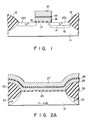
- Fig. 1 designates a conventional non-volatile memory presented for explaining the DSA structure.
- the reference numeral 11 designates a P-type silicon substrate, 12 oxidized film for separation, 13a a source region containing N+ type impurities, 13b a drain region containing N+ type impurities, 14 a floating gate, 15 a control gate, 16 a region containing P type impurities, 17 a channel region, 18 a gate insulation film, and 19 designates an insulation film between gate electrodes, respectively.
- the region 16 containing P type impurities having density stronger than that is present in the center of the channel region 17 is provided by way of surround the drain region 13b of an N-channel type cell transistor.
- the region 16 is hereinafter merely called the "P-pocket" region.
- profile of the density of impurities in the P-pocket region 16 adjacent to an edge of the drain region 13b of the floating gate is particularly important.
- the density of impurities in the P-pocket region 16 close to an edge of the drain region 13b must constantly be held stronger than that is present in the channel region 17. Nevertheless, since the P-pocket region 16 is formed by means of P-type impurities aides by injection of ion after completing the formation of stratified gate electrodes, it results in the occurrence of problem described below.
- the edge of the drain 13b is covered with stacked gate electrodes.
- a conventional ion injection method in order to prevent occurrence of "channeling effect", in other words, in order to prevent ion from deeply being injected beyond path which allows easy passage of ion, only a maximum of 7 degrees of angle is applied to the injection of ion against the normal of the silicon substrate 11, and thus, the P-type impurities cannot fully be injected into the region close to the drain region 13b below the floating gate 14.
- any conventional art injects ion needed for the formation of the P-pocket region 16, and then executes an annealing process to diffuse the P-type impurities into such region father than the edge of the drain region 13b below the channel region 17 before eventually injecting ion needed for the formation of the source and drain regions 13a and 13b.
- an additional round of annealing process is needed for the formation of the P-pocket region 16 containing the DSA structure.
- the junction breakdown voltage is determined by the breakdown voltage of a high P-type impurity region formed of the overlapping portions the P-pocket region and a channel stopper region located below an isolation region, and by the breakdown voltage of the pn junction formed between the N+ regions of the regions 13a and 13b. Because of this, the junction breakdown voltage is largely dependent on the distribution of the density of impurities present in those adjacent regions.
- the object of the invention is to provide a novel method of manufacturing a semiconductor device which promotes own capability of controlling profile of the density of P-type impurities in the drain or source regions adjoining the channel region of a stacked gate type non-volatile memory cell so that own performance capability can be promoted furthermore.
- the invention provides a novel method of manufacturing a semiconductor device comprising those sequential steps including the following; forming a floating gate electrode on an insulation film formed on a layer, said floating gate electrode located above that region of the layer in which a first conductivity type channel is to be formed, and forming a control gate on another insulation film formed on the floating gate electrode; and injecting ions of an impurity having a first conductivity type into a semiconductor substrate at an angle of at least 8° to the normal to the substrate, thereby to form a region having a high concentration of the first conductivity type impurity, in the vicinity of a boundary a diffusion layer which contains an impurity of a second conductivity type and which is to form a drain region of a transistor having said control gate electrode.
- the method embodied by the invention characteristically executes those sequential steps including the following;
- the system embodied by the invention continuously or intermittently rotates the semiconductor substrate while injecting impurities into superimposed gate electrode layers in conjunction with ion for the formation of a P-pocket region; next, the system injects ion into lateral surface of the superimposed gate electrode layers by applying a minimum of 8 degrees of angle in order to promote the density of impurities in the P-pocket region adjacent to the edge of the drain region below the floating gate electrode.
- the system embodied by the invention can securely vary voltage available for accelerating the ion injection speed and also vary the angle for injecting ion into the semiconductor substrate as well. Based on those techniques mentioned above, the system embodied by the invention simultaneously controls the profile of the density of impurities in the ion-injected region and the "short-channel" effect from occurrence, thus effectively promoting the data writing efficiency.
- the system embodied by the invention injects ion into the semiconductor substrate by applying a minimum of 8 degrees and a maximum of 60 degrees of angle against the normal of this substrate. This is because, like any conventional art, if ion were injected into the substrate at a maximum of 7 degrees of angle against the normal of the substrate, then the effect of strengthening the density of impurities will be minimized in the P-pocket region adjacent to the edge of the drain region below the floating gate electrode. Injection of ion at a minimum of 8 degrees of angle initiates promotion of density of impurities beyond the conventionally available level. Conversely, if the ion injection angle exceeds 60 degrees, then difficulty is present in the effect of fully injecting ion into the substrate. Since the system embodied by the invention injects ion at a minimum of 8 degrees against the normal of the substrate, the above-cited channel effect arises. Nevertheless, since ion is deeply injected, no critical problem arises.
- the system embodied by the invention forms a field insulation film 22 and a channel stopper region 23 on the surface of a P-type silicone substrate 21, then separates elements.
- the P-type silicone substrate 21 is superficially provided with a gate insulation film 24 having about 20 nm of thickness.
- a gate insulation film 24 having about 20 nm of thickness.
- the art embodied by the invention forms the channel region merely by applying the P-type impurities held in the P-type silicone substrate 21 without injecting the ionized P-type impurities therein for strengthening the density.
- the system forms phosphor-doped polycrystalline silicon layer 25 on the gate insulation film 24, where this layer 24 is available for composing a floating gate electrode.
- thermally oxidized film 26 having about 20 nm of thickness is formed on the polycrystalline silicone layer 25 by applying a thermal oxidation process.
- the system forms the secondary phosphor-doped polycrystalline silicon layer 27 on the thermally oxidized film 26 (see Fig. 2A), where this layer 27 is available for composing a control gate electrode.
- the system injects the P-type impurities into the P-type silicon substrate 21 in conjunction with ion by way of self-aligned the stacked gate electrode unit serving as mask, and then forms up ion-injected P-type layers 32a and 32b adjoining those regions predetermined to become source and drain regions.
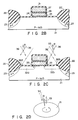
- Ion is injected into the P-type silicon substrate 21 while continuously rotating it more than 1 round per minute by injecting more than 5 ⁇ 1012 cm ⁇ 2 of a dosed amount of boron by applying 10 ⁇ ⁇ ⁇ 45 degrees of angle against the normal 33 of the silicone substrate 21 (see Fig. 2C and 2D).
- care be taken to inject ionized impurities by properly adjusting the density of impurities to be stronger than that is present in the center of the channel region and weaker than that is present in the drain region of this cell transistor.
- the process of ion injection can be implemented in accordance with the method of manufacturing semiconductor device based on the condition specified by the expression shown below.
- X p designates the mean projected range of the P-type conductive impurities injected into the P-pocket region in conjunction with ion from the surface of the P-type silicone substrate;
- ⁇ designates the angle at which ion is injected against the normal of the P-type silicon substrate;
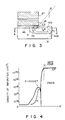
- X jl designates the extended distance of the edge of the drain or source region as a result of elongation in the direction of the channel region below the stacked gate electrode unit by effect of diffusion until reaching the final production step after completing the ion injection process (see Fig. 3).
- the density of impurities in the P-pocket region at the edge of the drain region can sufficiently be strengthened only when the product of tan ⁇ and the distance X p designating the mean projected range of the P-type impurities injected into the P-pocket region together with ion from the surface of the P-type silicone substrate is greater than the distance X jl designating the distance of the edge of the drain region diffused into the portion below the floating gate electrode. This allows the P-pocket region to fully exert own functional effect.
- the P-type impurities were not deeply injected, then it will cause the P-type impurities to be absorbed into the superficial oxidized film generated by the following thermal treatment including oxidation, thus resulting in the ineffective application of the P-type impurities.
- the P-pocket region is effective when the value of ⁇ is more than 28 degrees.
- the embodiment of the invention allows the P-type impurities to effectively be injected into the P-pocket region by applying a minimum of 8 degrees and a maximum of 60 degrees as well.
- the reference numeral 34 shown in Figs. 2C and 2D designates beam of ion containing P-type impurities.
- the reference numeral 36a and 36b designate ionized P-type impurities injected into field edge.
- the reference numeral 21 designates the rotating P-type silicon substrate.
- the P-type impurities contained in ion is injected into the substrate by way of self-aligned the stacked gate electrode unit functioning as mask, and then N-type ion-injected layers 39a and 39b are respectively formed.
- ion is injected into the P-type silicone substrate 21 so that the injection can be oriented in parallel with the lateral surface of the stacked gate electrode unit or at an angle of 7° to the normal to the surface of the silicon substrate 21.
- 5 ⁇ 1015 cm ⁇ 2 of a dosed amount of ionized arsenic is injected into the silicon substrate 21.
- the reference numeral 38 shown in Fig. 2E designates beam of ionized N-type impurities.
- a thermal process such as an annealing process is executed at 900°C in order to activate ionized impurities and recover the oxidized film 24, 31 from damage incurred from the said two injections of ion.
- the ion-injected P-type layers 32a and 32b respectively form P-pocket regions 40a and 40b.
- the ion-injected N-type layers 32a and 32b respectively form source and drain regions 41a and 41b.
- an insulation film 42 above the source and drain regions 41a and 41b is perforated to provide a contact hole 43.
- an aluminium electrode 44 is formed, thus completing the production of an EPROM cell (see Fig. 2F).
- the reference numeral 45 shown in Fig. 2F designates the portion where the P-pocket region and the channel stopper region overlap each other.
- the reference numeral 46 designates the channel region.
- the density of P-type impurities in the P-pocket region adjacent to the edge of the drain region can securely be strengthened, where the density of P-type impurities makes up the decisive factor of the DSA structure.
- the efficiency of writing data into the cell memory is promoted.
- "short-channel" effect is improved, thus easily allowing materialization of finer size of the cell and integration of densely built circuits as well.
- Fig. 3 designates the sectional views of those regions adjacent to the drain edge of the cell embodied by the invention.
- the P-pocket region shown in Fig. 3 with a broken line designates the case in which the conventional ion injection method is applied to the formation of the P-pocket region of the above embodiment.
- the reference character X j shown in Fig. 3 designates the depth of the junction of the drain region 41b, whereas X jl designates the extended distance of the edge of the drain or source region as a result of elongation in the direction of the channel region below the floating gate electrode by effect of diffusion until reaching the final production process after completing the ion injection process.
- Fig. 3 designates the sectional views of those regions adjacent to the drain edge of the cell embodied by the invention.
- the P-pocket region shown in Fig. 3 with a broken line designates the case in which the conventional ion injection method is applied to the formation of the P-pocket region of the above embodiment.
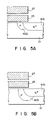
- FIG. 4 graphically designates concrete distribution of the density of impurities across the A-A' section shown in Fig. 3.
- the density of boron shown by means of a broken line designates the case in which the conventional ion injection method is applied to the formation of the P-pocket region of the above embodiment.
- the system of manufacturing the semiconductor device according to the invention provides those useful advantages described below.
- the scope of the invention is by no means confined to the embodiment thus far described, but the invention is also applicable to a variety of uses.
- the above embodiment has formed the P-pocket region by way of covering the source and drain regions (see Fig. 2F).
- the P-pocket region shown in Figs. 5A and 5B can also locally be provided via a masking process by causing the P-type silicon substrate 21 to stand sill or intermittently rotate itself.
- the description of the above embodiment has solely referred to the case of forming up the P-pocket region on both sides of the drain and source regions, it is quite apparent that the embodiment can also provide the P-pocket region solely on the part of the drain region or the source region via a masking process. Furthermore, although the above description has solely referred to the N-channel type cell transistor, the embodiment of the invention is also applicable to the P-channel type cell transistor as well.
Landscapes
- Non-Volatile Memory (AREA)
- Semiconductor Memories (AREA)
Abstract

Description
- The present invention relates to a method of manufacturing a semiconductor device. More particularly, the invention is applicable to the formation of a floating-gate type memory cell in the manufacture of a non-volatile semiconductor memory.
- Recently, as a result of successful materialization of non-volatile memory units incorporating vast memory capacity, contraction of the dimension of memory cell and the data writing time is strongly urged among the concerned. To solve this problem, a proposal has been raised on the "diffusion self-aligned" (hereinafter called "DSA") structure from the standpoint of the structure of the memory cell. Fig. 1 designates a conventional non-volatile memory presented for explaining the DSA structure. The reference numeral 11 designates a P-type silicon substrate, 12 oxidized film for separation, 13a a source region containing N⁺ type impurities, 13b a drain region containing N⁺ type impurities, 14 a floating gate, 15 a control gate, 16 a region containing P type impurities, 17 a channel region, 18 a gate insulation film, and 19 designates an insulation film between gate electrodes, respectively. As shown in Fig. 1, according to the DSA structure, the
region 16 containing P type impurities having density stronger than that is present in the center of thechannel region 17 is provided by way of surround thedrain region 13b of an N-channel type cell transistor. Theregion 16 is hereinafter merely called the "P-pocket" region. In writing data provision of the P-pocket region 16 promotes intensity of electric field of thechannel region 17 adjacent to thedrain region 13b to allow more amount of current to flow into thefloating gate 14. In particular, there is problem inherent in the floating gate type cell transistor in terms of the resistance of the cell transistor against "punch-through" effect. Concretely, when a floating gate type field effect transistor is made available for the cell, on the way of feeding a voltage to thedrain region 13b, due to capacitive coupling effect between thefloating gate 14 and thedrain region 13b, potential of thefloating gate 14 is lifted. As a result, unlike any single-gate type transistor, "punch-through" effect can easily be applied to the cell transistor. The shorter the length of the gate of transistor, the easier the occurrence of this phenomenon. Actually, this makes up the most critical problem among the concerned in the effort to contract the size of the cell transistor. On the other hand, provision of the "P-pocket"region 16 suppresses expansion of depletion, thus promoting the resistance of the cell transistor against occurrence of the "punch-through" phenomenon. This in turn advantageously promotes contraction of the size of the cell. - Due to the above reason, application of the DSA structure to the formation of the floating type memory cell transistor accelerates the speed of writing data in it, and yet, promotes the resistance of this cell transistor against occurrence of the "punch-through" phenomenon, and therefore, the DSA structure is quite essential for such a large-capacitive non volatile memory today.
- In order to fully generate proper function of an N-channel type cell transistor incorporating the DSA structure mentioned above, profile of the density of impurities in the P-
pocket region 16 adjacent to an edge of thedrain region 13b of the floating gate is particularly important. To securely promote the resistance of the cell transistor against the "punch-through" phenomenon and accelerate the data writing speed, the density of impurities in the P-pocket region 16 close to an edge of thedrain region 13b must constantly be held stronger than that is present in thechannel region 17. Nevertheless, since the P-pocket region 16 is formed by means of P-type impurities aides by injection of ion after completing the formation of stratified gate electrodes, it results in the occurrence of problem described below. - The edge of the
drain 13b is covered with stacked gate electrodes. When injecting ion by applying a conventional ion injection method, in order to prevent occurrence of "channeling effect", in other words, in order to prevent ion from deeply being injected beyond path which allows easy passage of ion, only a maximum of 7 degrees of angle is applied to the injection of ion against the normal of the silicon substrate 11, and thus, the P-type impurities cannot fully be injected into the region close to thedrain region 13b below thefloating gate 14. Because of this, actually, any conventional art injects ion needed for the formation of the P-pocket region 16, and then executes an annealing process to diffuse the P-type impurities into such region father than the edge of thedrain region 13b below thechannel region 17 before eventually injecting ion needed for the formation of the source anddrain regions 13a and 13b. In this case, an additional round of annealing process is needed for the formation of the P-pocket region 16 containing the DSA structure. - Because of this additional annealing process, the conventional art cannot simultaneously execute the double ion injection processes, and yet, an additional round of patterning process must also be executed. When providing the P-
pocket region 16 by diffusing the P-type impurities as mentioned above, profile of the density of impurities cannot perfectly be controlled, and yet, enough density of the P-type impurities cannot be generated in such region close to thedrain region 13b. Furthermore, the annealing process needed for the formation of the P-pocket region 16 gravely affects the profile of the density of the P-type impurities. Furthermore, when providing the P-pocket region 16, in order to thermally diffuse the P-type impurities in the lateral direction to full extent and maintain enough density of the impurities in the diffused region, substantial dose of ion must be injected. This in turn expands capacity at junctions and weakens the junction breakdown voltage. In particular, the junction breakdown voltage is determined by the breakdown voltage of a high P-type impurity region formed of the overlapping portions the P-pocket region and a channel stopper region located below an isolation region, and by the breakdown voltage of the pn junction formed between the N⁺ regions of theregions 13a and 13b. Because of this, the junction breakdown voltage is largely dependent on the distribution of the density of impurities present in those adjacent regions. - The object of the invention is to provide a novel method of manufacturing a semiconductor device which promotes own capability of controlling profile of the density of P-type impurities in the drain or source regions adjoining the channel region of a stacked gate type non-volatile memory cell so that own performance capability can be promoted furthermore.
- The invention provides a novel method of manufacturing a semiconductor device comprising those sequential steps including the following; forming a floating gate electrode on an insulation film formed on a layer, said floating gate electrode located above that region of the layer in which a first conductivity type channel is to be formed, and forming a control gate on another insulation film formed on the floating gate electrode; and injecting ions of an impurity having a first conductivity type into a semiconductor substrate at an angle of at least 8° to the normal to the substrate, thereby to form a region having a high concentration of the first conductivity type impurity, in the vicinity of a boundary a diffusion layer which contains an impurity of a second conductivity type and which is to form a drain region of a transistor having said control gate electrode.
- More particularly, to achieve the above object, the method embodied by the invention characteristically executes those sequential steps including the following; The system embodied by the invention continuously or intermittently rotates the semiconductor substrate while injecting impurities into superimposed gate electrode layers in conjunction with ion for the formation of a P-pocket region; next, the system injects ion into lateral surface of the superimposed gate electrode layers by applying a minimum of 8 degrees of angle in order to promote the density of impurities in the P-pocket region adjacent to the edge of the drain region below the floating gate electrode. In contrast with the inability of any conventional art, the system embodied by the invention can securely vary voltage available for accelerating the ion injection speed and also vary the angle for injecting ion into the semiconductor substrate as well. Based on those techniques mentioned above, the system embodied by the invention simultaneously controls the profile of the density of impurities in the ion-injected region and the "short-channel" effect from occurrence, thus effectively promoting the data writing efficiency.
- The system embodied by the invention injects ion into the semiconductor substrate by applying a minimum of 8 degrees and a maximum of 60 degrees of angle against the normal of this substrate. This is because, like any conventional art, if ion were injected into the substrate at a maximum of 7 degrees of angle against the normal of the substrate, then the effect of strengthening the density of impurities will be minimized in the P-pocket region adjacent to the edge of the drain region below the floating gate electrode. Injection of ion at a minimum of 8 degrees of angle initiates promotion of density of impurities beyond the conventionally available level. Conversely, if the ion injection angle exceeds 60 degrees, then difficulty is present in the effect of fully injecting ion into the substrate. Since the system embodied by the invention injects ion at a minimum of 8 degrees against the normal of the substrate, the above-cited channel effect arises. Nevertheless, since ion is deeply injected, no critical problem arises.
- This invention can be more fully understood from the following detailed description when taken in conjunction with the accompanying drawings, in which:
- Fig. 1 designates a sectional view of a conventional non-volatile memory cell;
- Figs. 2A through 2F are respectively explanatory of sequential steps of manufacturing the semiconductor device according to an embodiment of the invention;
- Fig. 3 designates sectional views of those regions adjacent to the drain region;
- Fig. 4 graphically designates profile of the density of impurities present in the P-pocket region shown in Fig. 3;
- Figs. 5A and 5B respectively designate sectional views of the essential components of another embodiment of the invention; and
- Fig. 6 is characteristic chart of the resistance of the cell transistor against occurrence of the "punch-through" phenomenon.
- Referring now to the N-channel type semiconductor device shown in Figs. 2A through 2F, the method of manufacturing an EPROM cell transistor according to an embodiment of the invention is described below.
- First, as is conventionally performed, the system embodied by the invention forms a
field insulation film 22 and achannel stopper region 23 on the surface of a P-type silicone substrate 21, then separates elements. Next, by applying a thermal oxidation process, the P-type silicone substrate 21 is superficially provided with agate insulation film 24 having about 20 nm of thickness. In order to properly adjust threshold voltage of the cell transistor, conventionally, only after forming up thegate insulation film 24, ionized P-type impurities are injected into the channel region. On the other hand, since it is possible for the art embodied by the invention to properly adjust the threshold voltage of the cell transistor based on specific conditions applicable to the injection of ion into the P-pocket region (where these conditions include the injection angle, dosed amount, and accelerated voltage), actually, the art embodied by the invention forms the channel region merely by applying the P-type impurities held in the P-type silicone substrate 21 without injecting the ionized P-type impurities therein for strengthening the density. - Next, the system forms phosphor-doped
polycrystalline silicon layer 25 on thegate insulation film 24, where thislayer 24 is available for composing a floating gate electrode. Next, thermally oxidizedfilm 26 having about 20 nm of thickness is formed on thepolycrystalline silicone layer 25 by applying a thermal oxidation process. Then, the system forms the secondary phosphor-dopedpolycrystalline silicon layer 27 on the thermally oxidized film 26 (see Fig. 2A), where thislayer 27 is available for composing a control gate electrode. - Next, patterning processes are sequentially executed against the secondary phosphor-doped
polycrystalline silicon layer 27, the thermally oxidizedfilm 26, and the first phosphor-dopedpolycrystalline silicon layer 25, respectively. As a result, stacked gate electrode unit composed of thecontrol gate electrode 27, the secondgate insulation film 26, and the floatinggate electrode 25, is thus completed. Then, anoxide film 31 is formed on the stacked gate electrode unit and the surface of the P-type silicon substrate 21, respectively (see Fig. 2B). - Next, the system injects the P-type impurities into the P-
type silicon substrate 21 in conjunction with ion by way of self-aligned the stacked gate electrode unit serving as mask, and then forms up ion-injected P-type layers type silicon substrate 21 while continuously rotating it more than 1 round per minute by injecting more than 5 × 10¹² cm⁻² of a dosed amount of boron by applying 10 ≦ ϑ ≦ 45 degrees of angle against the normal 33 of the silicone substrate 21 (see Fig. 2C and 2D). In this case, it is suggested that care be taken to inject ionized impurities by properly adjusting the density of impurities to be stronger than that is present in the center of the channel region and weaker than that is present in the drain region of this cell transistor. - In this case, the process of ion injection can be implemented in accordance with the method of manufacturing semiconductor device based on the condition specified by the expression shown below.

where Xp designates the mean projected range of the P-type conductive impurities injected into the P-pocket region in conjunction with ion from the surface of the P-type silicone substrate; ϑ designates the angle at which ion is injected against the normal of the P-type silicon substrate; and Xjl designates the extended distance of the edge of the drain or source region as a result of elongation in the direction of the channel region below the stacked gate electrode unit by effect of diffusion until reaching the final production step after completing the ion injection process (see Fig. 3). - More particularly, the density of impurities in the P-pocket region at the edge of the drain region can sufficiently be strengthened only when the product of tan ϑ and the distance Xp designating the mean projected range of the P-type impurities injected into the P-pocket region together with ion from the surface of the P-type silicone substrate is greater than the distance Xjl designating the distance of the edge of the drain region diffused into the portion below the floating gate electrode. This allows the P-pocket region to fully exert own functional effect.
- In this case, if the depth Xp of the injected ion coincides with the depth Xj of the junction of the diffused drain layer and if the width were Xj/2 ≦ Xp ≦ 2Xj, then, it is possible for the embodiment of the invention to effectively strengthen the density of the P-type impurities at the largest-curvature spot of the edge of the drain region so that ideal effect can be provided for the "punch-through" of the cell transistor. This in turn effectively suppresses occurrence of "short channel" effect.
- On the other hand, if the P-type impurities were not deeply injected, then it will cause the P-type impurities to be absorbed into the superficial oxidized film generated by the following thermal treatment including oxidation, thus resulting in the ineffective application of the P-type impurities.
- Fig. 6 designates the dependence of the "punch through" characteristic under a specific condition on the angel ϑ applied to the injection of P-type impurities, where the condition includes Xj = 0.2 µm, Xjl ≃ 0.16, and Xp = 0.30 µm, respectively. In this case, based on the expression shown above, it is presumed that the P-pocket region is effective when the value of ϑ is more than 28 degrees. As is clear from Fig. 6, when ϑ = 0° and ϑ = 15°, in other words, when the P-type impurities are injected into the substrate at an angle less than 28 degrees, resistance against the "punch through" voltage sharply declines if the floating gate electrode had less than 0.6 mm of length. On the other hand, when the P-type impurities are injected into the substrate at an angle ϑ = 30° wider than 28°, then the resistance against the "punch through" effect is significantly improved. Sufficient effect is maintained until the length of the floating gate electrode reaches 0.5 µm.
- As mentioned above, the embodiment of the invention allows the P-type impurities to effectively be injected into the P-pocket region by applying a minimum of 8 degrees and a maximum of 60 degrees as well.
- The
reference numeral 34 shown in Figs. 2C and 2D designates beam of ion containing P-type impurities. Thereference numeral 36a and 36b designate ionized P-type impurities injected into field edge. Thereference numeral 21 designates the rotating P-type silicon substrate. - In the next step, the P-type impurities contained in ion is injected into the substrate by way of self-aligned the stacked gate electrode unit functioning as mask, and then N-type ion-injected
layers type silicone substrate 21 so that the injection can be oriented in parallel with the lateral surface of the stacked gate electrode unit or at an angle of 7° to the normal to the surface of thesilicon substrate 21. For example, 5 × 10¹⁵ cm⁻² of a dosed amount of ionized arsenic is injected into thesilicon substrate 21. Thereference numeral 38 shown in Fig. 2E designates beam of ionized N-type impurities. - In the following step, a thermal process such as an annealing process is executed at 900°C in order to activate ionized impurities and recover the oxidized
film type layers pocket regions 40a and 40b. On the other hand, the ion-injected N-type layers drain regions 41a and 41b. In the next step, based on the conventional method of manufacturing a MOS integrated circuit, aninsulation film 42 above the source anddrain regions 41a and 41b is perforated to provide acontact hole 43. Next, analuminium electrode 44 is formed, thus completing the production of an EPROM cell (see Fig. 2F). Thereference numeral 45 shown in Fig. 2F designates the portion where the P-pocket region and the channel stopper region overlap each other. Thereference numeral 46 designates the channel region. - According to the method of manufacturing the EPROM cell transistor mentioned above, the density of P-type impurities in the P-pocket region adjacent to the edge of the drain region can securely be strengthened, where the density of P-type impurities makes up the decisive factor of the DSA structure. As a result, the efficiency of writing data into the cell memory is promoted. Furthermore, by virtue of the contracted dimension of the cell, "short-channel" effect is improved, thus easily allowing materialization of finer size of the cell and integration of densely built circuits as well.
- Fig. 3 designates the sectional views of those regions adjacent to the drain edge of the cell embodied by the invention. The P-pocket region shown in Fig. 3 with a broken line designates the case in which the conventional ion injection method is applied to the formation of the P-pocket region of the above embodiment. The reference character Xj shown in Fig. 3 designates the depth of the junction of the
drain region 41b, whereas Xjl designates the extended distance of the edge of the drain or source region as a result of elongation in the direction of the channel region below the floating gate electrode by effect of diffusion until reaching the final production process after completing the ion injection process. Fig. 4 graphically designates concrete distribution of the density of impurities across the A-A' section shown in Fig. 3. The density of boron shown by means of a broken line designates the case in which the conventional ion injection method is applied to the formation of the P-pocket region of the above embodiment. - The system of manufacturing the semiconductor device according to the invention provides those useful advantages described below.
- (1) The density of impurities in the P-
pocket region 40b adjacent to the floatinggate electrode 25 can be promoted to such a level stronger than that of thechannel region 46. In consequence, electric field in the periphery of thedrain region 41b is intensified to result in the generation of a greater amount of hot electrons. This in turn promotes the efficiency of writing data into the cell memory. - (2) Owing to those advantages described in the above paragraph (1), the pn junction between the source or drain region and the P-pocket region can be composed of extremely dense impurities to prevent depletion from expanding itself. As a result, the effective length of channel in the cell transistor can fully be secured to suppress occurrence of "short-channel" effect.
- (3) Owing to those advantages described in the above paragraphs (1) and (2), threshold voltage of the cell transistor can be activated merely by means of the P-pocket region, and therefore, injection of ion conventionally needed for the provision of channel for the cell transistor can be deleted.
- (4) According to the method embodied by the invention, in connection with the profile of the density of P-type impurities in the P-pocket region, such a region affecting the efficiency of writing data into the memory cell, in other words, the region adjoining the drain edge below the floating
gate electrode 25, and such a region affecting the "short-channel" effect, in other words, the portion adjoining the bottom of the drain region below the floatinggate electrode 25, can independently be controlled by injecting ion twice in various accelerating voltage or angle for example. Accordingly, the system embodied by the invention can flexibly deal with any variation of the cell structure and variable factors generated in the course of thermal treatment after completing the formation of the cell transistor. - (5) The system embodied by the invention dispenses with the thermal process other wise needed for any conventional ion injection system to form the P-pocket region.
- (6) Owing to the advantage described in the above paragraph (5), the system embodied by the invention allows a process for injecting ion for forming the P-pocket region of the cell transistor and another process for injecting ion for forming the source and drain regions of this transistor to simultaneously be executed once, thus deleting the patterning process by means of a masking process.
- (7) According to the method embodied by the invention, due to transmitting or scattering at the field edge of the
region 45 overlapped by the channel-stopper region 23 below theisolation region 22 and the P-pocket region 16, ion containing the P-type impurities has graded profile ranging from the surface of the substrate to the innermost region of this substrate. When obliquely injecting ion into the P-pocket region by rotating wafer, the amount of the ionized P-type impurities injected below the field edge is maximized in the direction of thelayer 36b in the P-pocket region of the later 32b for example, whereas little of the ionized P-type impurities is injected in the direction of the layer 36a, and thus, the density of the P-type impurities at theportion 45 overlapped by the P-pocket region 36b and thechannel stopper region 22 is weakened (see Fig. 2C). Because of this, unlike the pn junction made as a result of forming the P-pocket region according to the conventional ion injection method, owing to the effect of weakening the density of the P-type impurities adjoining the pn junction and also owing to the effect of slackened gradient of the density of the P-type impurities, the strength of the pn junction at theportion 45 is effectively reinformed. - It should be understood that the scope of the invention is by no means confined to the embodiment thus far described, but the invention is also applicable to a variety of uses. For example, the above embodiment has formed the P-pocket region by way of covering the source and drain regions (see Fig. 2F). However, it is apparent that the P-pocket region shown in Figs. 5A and 5B can also locally be provided via a masking process by causing the P-
type silicon substrate 21 to stand sill or intermittently rotate itself. - Although the description of the above embodiment has solely referred to the case of forming up the P-pocket region on both sides of the drain and source regions, it is quite apparent that the embodiment can also provide the P-pocket region solely on the part of the drain region or the source region via a masking process. Furthermore, although the above description has solely referred to the N-channel type cell transistor, the embodiment of the invention is also applicable to the P-channel type cell transistor as well.
-
- (1) The density of impurities in the P-pocket region adjacent to the floating gate electrode can be promoted to such a level stronger than that of the channel region. In consequence, electric field in the periphery of the drain region is intensified to result in the generation of a greater amount of hot electrons. This in turn promotes the efficiency of writing data into the cell memory.
- (2) Owing to those advantages described in the above paragraph (1), the pn region between the source or drain region and the P-pocket region can be composed of extremely dense impurities to prevent depletion from expanding itself. As a result, the effective length of channel in the cell transistor can fully be secured to suppress occurrence of "short-channel" effect.
- (3) Owing to those advantages described in the above paragraphs (1) and (2), operation of the cell transistor can be activated merely by means of the P-pocket region, and thus, injection of ion conventionally needed for the provision of channel region for the cell transistor can be deleted.
- (4) According to the method embodied by the invention, in consideration of the profile of the density of P-type impurities in the P-pocket region, such a region affecting the efficiency of writing data into the cell memory and such a region affecting the "short-channel" effect can independently be controlled, and as a result, the method of manufacturing the semiconductor device embodied by the invention can flexibly deal with any variation of the cell structure and variable factors arising from thermal treatment to be done after completing the formation of the cell transistor.
- (5) The system embodied by the invention dispenses with the thermal process otherwise needed for any conventional ion injection system to form the P-pocket region.
- (6) Owing to the advantage described in the above paragraph (5), the system embodied by the invention allows a process for injecting ion for forming up the P-pocket region of the cell transistor and another process for injecting ion for forming the source and drain regions of this transistor to simultaneously be executed once, thus deleting the patterning process by means of a masking process.
- (7) According to the system embodied by the invention, due to transmitting or scattering at the field edge of the region overlapped by the channel-stopper region below the element-separating region and the P-pocket region, ion containing the P-type impurities has graded profile from the surface to the innermost region of the substrate. Furthermore, when obliquely injecting the ionized P-type impurities into the P-pocket region by rotating wafer, a relatively less amount of the ionized P-type impurities is injected below the field edge. In consequence, unlike the pn junction made as a result of forming the P-pocket region according to the conventional ion injection method, owing to the effect of weakening the density of the P-type impurities adjoining the pn junction and also owing to the effect slackened gradient of the density of the P-type impurities, the strength of the pn junction is promoted.
- Reference signs in the claims are intended for better understanding and shall not limit the scope.
Claims (9)
- A method of manufacturing a semiconductor device comprising the steps of;
forming a floating gate electrode (25) on an insulation film (24) formed on a layer, said floating gate electrode located above that region of the layer in which a first conductivity type channel is to be formed, and forming a control gate (27) on another insulation film (26) formed on the floating gate electrode; and
injecting ions of an impurity having a first conductivity type into a semiconductor substrate (21) at an angle of at least 8° to the normal to the substrate, thereby to form a region (40b) having a high concentration of the first conductivity type impurity, in the vicinity of a boundary a diffusion layer which contains an impurity of a second conductivity type and which is to form a drain region (41b) of a transistor having said control gate electrode. - The method according to claim 1, characterized in that said step of injecting the impurity ions comprises a step of forming a region (40a) having a high concentration of the first conductivity type impurity, in the vicinity of a boundary a diffusion layer which contains an impurity of the second conductivity type and which is to form a source region (41a) of the transistor.
- The method of manufacturing the semiconductor device according to claim 1 or 2, characterized by further comprising a step of injecting said impurities into said region by applying specific density which is stronger than that is held in the center of the channel region (46) of said transistor and weaker than that is held in the drain region of said transistor.
- The method of manufacturing the semiconductor device according to claim 1 or 2, characterized in that said process for injecting ion into substrate is executed by continuously rotating said semiconductor substrate.
- The method of manufacturing the semiconductor device according to claim 1 or 2, characterized in that said process for injecting ion into said substrate is executed by intermittently rotating said substrate.
- The method of manufacturing the semiconductor device according to claim 1 or 2, characterized in that said process for injecting ion into said substrate is executed by applying a maximum of sixty (60) degrees of angles against the normal of said substrate.
- The method of manufacturing the semiconductor device according to claim 1 or 2, characterized in that said process for injecting ion into said substrate executed by applying a minimum of eight degrees of angle against the normal of said substrate is consummated simultaneous with injection of ion executed for the formation of the source and drain regions of said transistor.
- The method of manufacturing the semiconductor device according to claim 1 or 2, characterized in that said process for injecting ion into said semiconductor substrate is executed in accordance with the condition specified by an expression shown below;

where Xp designates the mean projected range of the first conductive impurities injected into said substrate in conjunction with ion from the surface of said substrate; ϑ designates the angle at which ion is injected against the normal of said substrate; and Xjl designates the extended distance of the edge of drain or source region as a result of elongation in the direction of channel region below said stacked gate electrode unit by effect of diffusion until reaching the final production process after completing the ion injection process. - The method of manufacturing the semiconductor device according to claim 1 or 2, characterized by further comprising a step of ion injection in order that Xp can satisfy the condition specified by an expression shown below;

where Xp designates the mean projected range of the first conductive impurities injected into said semiconductor substrate in conjunction with ion from the surface of said substrate; and Xj designates the depth of junction of diffused drain layer of said substrate.
Applications Claiming Priority (2)
| Application Number | Priority Date | Filing Date | Title |
|---|---|---|---|
| JP61531/90 | 1990-03-13 | ||
| JP6153190 | 1990-03-13 |
Publications (2)
| Publication Number | Publication Date |
|---|---|
| EP0446893A1 true EP0446893A1 (en) | 1991-09-18 |
| EP0446893B1 EP0446893B1 (en) | 1997-05-21 |
Family
ID=13173783
Family Applications (1)
| Application Number | Title | Priority Date | Filing Date |
|---|---|---|---|
| EP91103833A Expired - Lifetime EP0446893B1 (en) | 1990-03-13 | 1991-03-13 | Method of manufacturing semiconducting devices having floating gates |
Country Status (4)
| Country | Link |
|---|---|
| US (1) | US5147811A (en) |
| EP (1) | EP0446893B1 (en) |
| KR (1) | KR940010930B1 (en) |
| DE (1) | DE69126156T2 (en) |
Cited By (10)
| Publication number | Priority date | Publication date | Assignee | Title |
|---|---|---|---|---|
| WO1995008843A1 (en) * | 1993-09-24 | 1995-03-30 | Vlsi Technology, Inc. | Latid implants for increasing the effective width of transistor elements in a semiconductor device |
| US5444279A (en) * | 1993-08-11 | 1995-08-22 | Micron Semiconductor, Inc. | Floating gate memory device having discontinuous gate oxide thickness over the channel region |
| EP0656663A3 (en) * | 1993-12-01 | 1995-08-30 | Nec Corp | Non-volatile semiconductor memory device and methods for erasing and manufacturing it. |
| WO1995024057A3 (en) * | 1994-03-03 | 1995-11-23 | Rohm Corp | Low voltage one transistor flash eeprom cell using fowler-nordheim programming and erase |
| EP0696050A1 (en) * | 1994-07-18 | 1996-02-07 | STMicroelectronics S.r.l. | EPROM and Flash-EEPROM non-volatile memory and method of manufacturing the same |
| GB2301709A (en) * | 1995-06-02 | 1996-12-11 | Hyundai Electronics Ind | Method of forming a junction in a flash eeprom cell |
| EP0731494A3 (en) * | 1995-03-08 | 1998-05-20 | Advanced Micro Devices, Inc. | Method for fabricating an integrated circuit using boron implant methodology |
| EP0744754A3 (en) * | 1995-05-25 | 1999-03-17 | AT&T Corp. | Method and apparatus for hot carrier injection |
| US5895950A (en) * | 1993-09-06 | 1999-04-20 | U.S. Philips Corporation | Semiconductor device having a non-volatile memory and method of manufacturing such a semiconductor device |
| WO2000019511A1 (en) * | 1998-09-29 | 2000-04-06 | Advanced Micro Devices, Inc. | Deposition of oxide layer on the gate |
Families Citing this family (43)
| Publication number | Priority date | Publication date | Assignee | Title |
|---|---|---|---|---|
| US5258319A (en) * | 1988-02-19 | 1993-11-02 | Mitsubishi Denki Kabushiki Kaisha | Method of manufacturing a MOS type field effect transistor using an oblique ion implantation step |
| JPH05121763A (en) * | 1991-10-30 | 1993-05-18 | Rohm Co Ltd | Manufacture of semiconductor memory device |
| US5625212A (en) * | 1992-03-23 | 1997-04-29 | Matsushita Electric Industrial Co., Ltd. | Semiconductor memory device and method of manufacturing the same |
| US5432107A (en) * | 1992-11-04 | 1995-07-11 | Matsushita Electric Industrial Co., Ltd. | Semiconductor fabricating method forming channel stopper with diagonally implanted ions |
| JP3050717B2 (en) * | 1993-03-24 | 2000-06-12 | シャープ株式会社 | Method for manufacturing semiconductor device |
| JPH06291181A (en) * | 1993-03-30 | 1994-10-18 | Nippon Steel Corp | Manufacture of semiconductor device |
| JP2536413B2 (en) * | 1993-06-28 | 1996-09-18 | 日本電気株式会社 | Method for manufacturing semiconductor integrated circuit device |
| US5372957A (en) * | 1993-07-22 | 1994-12-13 | Taiwan Semiconductor Manufacturing Company | Multiple tilted angle ion implantation MOSFET method |
| US5308780A (en) * | 1993-07-22 | 1994-05-03 | United Microelectronics Corporation | Surface counter-doped N-LDD for high hot carrier reliability |
| US5432106A (en) * | 1993-08-02 | 1995-07-11 | United Microelectronics Corporation | Manufacture of an asymmetric non-volatile memory cell |
| US5496747A (en) * | 1993-08-02 | 1996-03-05 | United Microelectronics Corporation | Split-gate process for non-volatile memory |
| EP0655778A3 (en) * | 1993-11-25 | 1996-01-03 | Matsushita Electronics Corp | Method of manufacturing semiconductor memory devices. |
| US5409848A (en) * | 1994-03-31 | 1995-04-25 | Vlsi Technology, Inc. | Angled lateral pocket implants on p-type semiconductor devices |
| US5441906A (en) * | 1994-04-04 | 1995-08-15 | Motorola, Inc. | Insulated gate field effect transistor having a partial channel and method for fabricating |
| US5427964A (en) * | 1994-04-04 | 1995-06-27 | Motorola, Inc. | Insulated gate field effect transistor and method for fabricating |
| US5482878A (en) * | 1994-04-04 | 1996-01-09 | Motorola, Inc. | Method for fabricating insulated gate field effect transistor having subthreshold swing |
| US5543337A (en) * | 1994-06-15 | 1996-08-06 | Lsi Logic Corporation | Method for fabricating field effect transistor structure using symmetrical high tilt angle punchthrough implants |
| US5413945A (en) * | 1994-08-12 | 1995-05-09 | United Micro Electronics Corporation | Blanket N-LDD implantation for sub-micron MOS device manufacturing |
| US5468981A (en) * | 1994-09-01 | 1995-11-21 | Advanced Micro Devices, Inc. | Self-aligned buried channel/junction stacked gate flash memory cell |
| US5700728A (en) * | 1994-11-07 | 1997-12-23 | United Microelectronics Corporation | Method of forming an MNOS/MONOS by employing large tilt angle ion implantation underneath the field oxide |
| US5801076A (en) * | 1995-02-21 | 1998-09-01 | Advanced Micro Devices, Inc. | Method of making non-volatile memory device having a floating gate with enhanced charge retention |
| KR970004074A (en) * | 1995-06-05 | 1997-01-29 | 빈센트 비. 인그라시아 | Insulated gate field effect transistor and its manufacturing method |
| JPH09148542A (en) * | 1995-11-17 | 1997-06-06 | Sharp Corp | Semiconductor memory device and manufacturing method thereof |
| US5719425A (en) * | 1996-01-31 | 1998-02-17 | Micron Technology, Inc. | Multiple implant lightly doped drain (MILDD) field effect transistor |
| US6346439B1 (en) * | 1996-07-09 | 2002-02-12 | Micron Technology, Inc. | Semiconductor transistor devices and methods for forming semiconductor transistor devices |
| US5849615A (en) * | 1996-02-22 | 1998-12-15 | Micron Technology, Inc. | Semiconductor processing method of fabricating field effect transistors |
| US5793088A (en) * | 1996-06-18 | 1998-08-11 | Integrated Device Technology, Inc. | Structure for controlling threshold voltage of MOSFET |
| US5770880A (en) * | 1996-09-03 | 1998-06-23 | Harris Corporation | P-collector H.V. PMOS switch VT adjusted source/drain |
| US6236085B1 (en) | 1996-11-11 | 2001-05-22 | Denso Corporation | Semiconductor memory device having high-concentration region around electric-field moderating layer in substrate |
| US5998274A (en) * | 1997-04-10 | 1999-12-07 | Micron Technology, Inc. | Method of forming a multiple implant lightly doped drain (MILDD) field effect transistor |
| US6127222A (en) * | 1997-12-16 | 2000-10-03 | Advanced Micro Devices, Inc. | Non-self-aligned side channel implants for flash memory cells |
| US6103602A (en) * | 1997-12-17 | 2000-08-15 | Advanced Micro Devices, Inc. | Method and system for providing a drain side pocket implant |
| US6087219A (en) * | 1998-06-19 | 2000-07-11 | Taiwan Semiconductor Manufacturing Company | Highly reliable flash memory structure with halo source |
| JP3264323B2 (en) * | 1998-07-31 | 2002-03-11 | 日本電気株式会社 | Reverse profiling method |
| US6284603B1 (en) * | 2000-07-12 | 2001-09-04 | Chartered Semiconductor Manufacturing Inc. | Flash memory cell structure with improved channel punch-through characteristics |
| US6524914B1 (en) * | 2000-10-30 | 2003-02-25 | Advanced Micro Devices, Inc. | Source side boron implanting and diffusing device architecture for deep sub 0.18 micron flash memory |
| KR100373855B1 (en) | 2001-01-20 | 2003-02-26 | 삼성전자주식회사 | Nand type flash memory device and method of forming the same |
| US6673664B2 (en) * | 2001-10-16 | 2004-01-06 | Sharp Laboratories Of America, Inc. | Method of making a self-aligned ferroelectric memory transistor |
| US6878589B1 (en) * | 2003-05-06 | 2005-04-12 | Advanced Micro Devices, Inc. | Method and system for improving short channel effect on a floating gate device |
| US7393752B2 (en) * | 2005-07-25 | 2008-07-01 | Freescale Semiconductor, Inc. | Semiconductor devices and method of fabrication |
| KR101563770B1 (en) * | 2009-02-18 | 2015-10-27 | 난징 유니버시티 | Photosensitive detector with composite dielectric gate mosfet and singal reading method thereof |
| KR101974439B1 (en) | 2012-06-11 | 2019-05-02 | 삼성전자 주식회사 | Semiconductor device and fabricated method thereof |
| US10497570B2 (en) | 2015-06-16 | 2019-12-03 | Mitsubishi Electric Corporation | Method for manufacturing semiconductor device having buffer layer |
Citations (3)
| Publication number | Priority date | Publication date | Assignee | Title |
|---|---|---|---|---|
| US4232439A (en) * | 1976-11-30 | 1980-11-11 | Vlsi Technology Research Association | Masking technique usable in manufacturing semiconductor devices |
| US4771012A (en) * | 1986-06-13 | 1988-09-13 | Matsushita Electric Industrial Co., Ltd. | Method of making symmetrically controlled implanted regions using rotational angle of the substrate |
| EP0333583A2 (en) * | 1988-03-14 | 1989-09-20 | Fujitsu Limited | Method of producing a semiconductor device |
Family Cites Families (3)
| Publication number | Priority date | Publication date | Assignee | Title |
|---|---|---|---|---|
| JPS57130475A (en) * | 1981-02-06 | 1982-08-12 | Mitsubishi Electric Corp | Semiconductor memory storage and its manufacture |
| JPS5893279A (en) * | 1981-11-30 | 1983-06-02 | Fujitsu Ltd | Manufacture of semiconductor device |
| JPS5961185A (en) * | 1982-09-30 | 1984-04-07 | Fujitsu Ltd | Manufacture of metal insulator semiconductor field-effect semiconductor device |
-
1991
- 1991-03-07 KR KR1019910003652A patent/KR940010930B1/en not_active Expired - Fee Related
- 1991-03-11 US US07/666,912 patent/US5147811A/en not_active Expired - Lifetime
- 1991-03-13 DE DE69126156T patent/DE69126156T2/en not_active Expired - Fee Related
- 1991-03-13 EP EP91103833A patent/EP0446893B1/en not_active Expired - Lifetime
Patent Citations (3)
| Publication number | Priority date | Publication date | Assignee | Title |
|---|---|---|---|---|
| US4232439A (en) * | 1976-11-30 | 1980-11-11 | Vlsi Technology Research Association | Masking technique usable in manufacturing semiconductor devices |
| US4771012A (en) * | 1986-06-13 | 1988-09-13 | Matsushita Electric Industrial Co., Ltd. | Method of making symmetrically controlled implanted regions using rotational angle of the substrate |
| EP0333583A2 (en) * | 1988-03-14 | 1989-09-20 | Fujitsu Limited | Method of producing a semiconductor device |
Non-Patent Citations (2)
| Title |
|---|
| JOURNAL OF ELECTRONIC ENGINEERING vol. 26, no. 267, March 1989, pages 128-131, Tokyo, JP; T. HORI et al.: "A New Submicron p-Channel MOSFET with LATIPS (Large-Tilt-Angle Implanted Punchthrough Stopper)" * |
| PATENT ABSTRACTS OF JAPAN vol. 6, no. 230 (E-142)(1108), 16 November 1982; & JP - A - 57130475 (MITSUBISHI DENKI) 12.08.1982 * |
Cited By (19)
| Publication number | Priority date | Publication date | Assignee | Title |
|---|---|---|---|---|
| US5444279A (en) * | 1993-08-11 | 1995-08-22 | Micron Semiconductor, Inc. | Floating gate memory device having discontinuous gate oxide thickness over the channel region |
| US5604366A (en) * | 1993-08-11 | 1997-02-18 | Micron Technology, Inc. | Floating gate memory device having discontinuous gate oxide thickness over the channel region |
| US5895950A (en) * | 1993-09-06 | 1999-04-20 | U.S. Philips Corporation | Semiconductor device having a non-volatile memory and method of manufacturing such a semiconductor device |
| WO1995008843A1 (en) * | 1993-09-24 | 1995-03-30 | Vlsi Technology, Inc. | Latid implants for increasing the effective width of transistor elements in a semiconductor device |
| EP0656663A3 (en) * | 1993-12-01 | 1995-08-30 | Nec Corp | Non-volatile semiconductor memory device and methods for erasing and manufacturing it. |
| US5535158A (en) * | 1993-12-01 | 1996-07-09 | Nec Corporation | Non-volatile semiconductor memory device and method for erasure and production thereof |
| WO1995024057A3 (en) * | 1994-03-03 | 1995-11-23 | Rohm Corp | Low voltage one transistor flash eeprom cell using fowler-nordheim programming and erase |
| EP0933821A3 (en) * | 1994-03-03 | 1999-08-11 | Rohm Corporation | Low voltage one transistor flash eeprom cell using fowler-nordheim programming and erase |
| US5587947A (en) * | 1994-03-03 | 1996-12-24 | Rohm Corporation | Low voltage one transistor flash EEPROM cell using Fowler-Nordheim programming and erase |
| US5687120A (en) * | 1994-03-03 | 1997-11-11 | Rohn Corporation | Low voltage one transistor flash eeprom cell using fowler-nordheim programming and erase |
| US5689459A (en) * | 1994-03-03 | 1997-11-18 | Rohm Corporation | Low voltage one transistor flash EEPROM cell using Fowler-Nordheim programming and erase |
| EP0696050A1 (en) * | 1994-07-18 | 1996-02-07 | STMicroelectronics S.r.l. | EPROM and Flash-EEPROM non-volatile memory and method of manufacturing the same |
| US5712814A (en) * | 1994-07-18 | 1998-01-27 | Sgs-Thomson Microelectronics S.R.L. | Nonvolatile memory cell and a method for forming the same |
| US5920776A (en) * | 1994-07-18 | 1999-07-06 | Sgs-Thomson Microelectronics, S.R.L. | Method of making asymmetric nonvolatile memory cell |
| EP0731494A3 (en) * | 1995-03-08 | 1998-05-20 | Advanced Micro Devices, Inc. | Method for fabricating an integrated circuit using boron implant methodology |
| EP0744754A3 (en) * | 1995-05-25 | 1999-03-17 | AT&T Corp. | Method and apparatus for hot carrier injection |
| GB2301709B (en) * | 1995-06-02 | 1999-04-21 | Hyundai Electronics Ind | Method of forming a junction in a flash eeprom cell |
| GB2301709A (en) * | 1995-06-02 | 1996-12-11 | Hyundai Electronics Ind | Method of forming a junction in a flash eeprom cell |
| WO2000019511A1 (en) * | 1998-09-29 | 2000-04-06 | Advanced Micro Devices, Inc. | Deposition of oxide layer on the gate |
Also Published As
| Publication number | Publication date |
|---|---|
| EP0446893B1 (en) | 1997-05-21 |
| KR940010930B1 (en) | 1994-11-19 |
| DE69126156T2 (en) | 1997-10-09 |
| DE69126156D1 (en) | 1997-06-26 |
| US5147811A (en) | 1992-09-15 |
Similar Documents
| Publication | Publication Date | Title |
|---|---|---|
| US5147811A (en) | Method of manufacturing semiconductor device by controlling the profile of the density of p-type impurities in the source/drain regions | |
| US4342149A (en) | Method of making very short channel length MNOS and MOS devices by double implantation of one conductivity type subsequent to other type implantation | |
| KR930008007B1 (en) | ROM manufacturing method | |
| EP0164449B1 (en) | Process for producing a semiconductor integrated circuit device including a misfet | |
| US5337274A (en) | Nonvolatile semiconductor memory device having adjacent memory cells and peripheral transistors separated by field oxide | |
| US5925914A (en) | Asymmetric S/D structure to improve transistor performance by reducing Miller capacitance | |
| KR0137625B1 (en) | Structure and manufacture of semiconductor | |
| KR20000069811A (en) | Well boosting threshold voltage rollup | |
| JP2558961B2 (en) | Method for manufacturing semiconductor device | |
| US4330850A (en) | MNOS Memory cell | |
| US5397727A (en) | Method of forming a floating gate programmable read only memory cell transistor | |
| EP0459398B1 (en) | Manufacturing method of a channel in MOS semiconductor devices | |
| EP0452817B1 (en) | Semiconductor device with MOS-transistors and method of manufacturing the same | |
| KR100194008B1 (en) | Manufacturing method of semiconductor device having various kinds of MOSFET | |
| JPH0210775A (en) | Ion implantation semiconductor device | |
| JP2562688B2 (en) | Method for manufacturing semiconductor device | |
| US6509237B2 (en) | Flash memory cell fabrication sequence | |
| JP2727590B2 (en) | MIS type semiconductor device | |
| JP2595058B2 (en) | Manufacturing method of nonvolatile semiconductor memory device | |
| KR100233294B1 (en) | Semiconductor memory device and its fabrication method | |
| KR100624922B1 (en) | Manufacturing Method of Flash Memory Device | |
| KR100217899B1 (en) | Method of manufacturing transistor of semiconductor device | |
| JP2957586B2 (en) | Method for manufacturing nonvolatile memory cell | |
| JP2880885B2 (en) | Semiconductor integrated circuit device and method of manufacturing the same | |
| KR100204800B1 (en) | MOS transistor manufacturing method |
Legal Events
| Date | Code | Title | Description |
|---|---|---|---|
| PUAI | Public reference made under article 153(3) epc to a published international application that has entered the european phase |
Free format text: ORIGINAL CODE: 0009012 |
|
| 17P | Request for examination filed |
Effective date: 19910313 |
|
| AK | Designated contracting states |
Kind code of ref document: A1 Designated state(s): DE FR GB |
|
| 17Q | First examination report despatched |
Effective date: 19950126 |
|
| GRAG | Despatch of communication of intention to grant |
Free format text: ORIGINAL CODE: EPIDOS AGRA |
|
| GRAH | Despatch of communication of intention to grant a patent |
Free format text: ORIGINAL CODE: EPIDOS IGRA |
|
| GRAH | Despatch of communication of intention to grant a patent |
Free format text: ORIGINAL CODE: EPIDOS IGRA |
|
| GRAA | (expected) grant |
Free format text: ORIGINAL CODE: 0009210 |
|
| AK | Designated contracting states |
Kind code of ref document: B1 Designated state(s): DE FR GB |
|
| REF | Corresponds to: |
Ref document number: 69126156 Country of ref document: DE Date of ref document: 19970626 |
|
| ET | Fr: translation filed | ||
| PGFP | Annual fee paid to national office [announced via postgrant information from national office to epo] |
Ref country code: FR Payment date: 19980310 Year of fee payment: 8 |
|
| PLBE | No opposition filed within time limit |
Free format text: ORIGINAL CODE: 0009261 |
|
| STAA | Information on the status of an ep patent application or granted ep patent |
Free format text: STATUS: NO OPPOSITION FILED WITHIN TIME LIMIT |
|
| 26N | No opposition filed | ||
| REG | Reference to a national code |
Ref country code: GB Ref legal event code: 746 Effective date: 19981008 |
|
| PG25 | Lapsed in a contracting state [announced via postgrant information from national office to epo] |
Ref country code: DE Free format text: LAPSE BECAUSE OF NON-PAYMENT OF DUE FEES Effective date: 19981201 |
|
| PG25 | Lapsed in a contracting state [announced via postgrant information from national office to epo] |
Ref country code: FR Free format text: LAPSE BECAUSE OF NON-PAYMENT OF DUE FEES Effective date: 19991130 |
|
| REG | Reference to a national code |
Ref country code: FR Ref legal event code: ST |
|
| REG | Reference to a national code |
Ref country code: GB Ref legal event code: IF02 |
|
| PGFP | Annual fee paid to national office [announced via postgrant information from national office to epo] |
Ref country code: GB Payment date: 20070307 Year of fee payment: 17 |
|
| GBPC | Gb: european patent ceased through non-payment of renewal fee |
Effective date: 20080313 |
|
| PG25 | Lapsed in a contracting state [announced via postgrant information from national office to epo] |
Ref country code: GB Free format text: LAPSE BECAUSE OF NON-PAYMENT OF DUE FEES Effective date: 20080313 |