EP0446968A2 - Quantificateur vectoriel - Google Patents
Quantificateur vectoriel Download PDFInfo
- Publication number
- EP0446968A2 EP0446968A2 EP91108921A EP91108921A EP0446968A2 EP 0446968 A2 EP0446968 A2 EP 0446968A2 EP 91108921 A EP91108921 A EP 91108921A EP 91108921 A EP91108921 A EP 91108921A EP 0446968 A2 EP0446968 A2 EP 0446968A2
- Authority
- EP
- European Patent Office
- Prior art keywords
- vector
- output
- frame
- block
- distortion
- Prior art date
- Legal status (The legal status is an assumption and is not a legal conclusion. Google has not performed a legal analysis and makes no representation as to the accuracy of the status listed.)
- Granted
Links
Images



Classifications
-
- G—PHYSICS
- G06—COMPUTING OR CALCULATING; COUNTING
- G06T—IMAGE DATA PROCESSING OR GENERATION, IN GENERAL
- G06T9/00—Image coding
- G06T9/008—Vector quantisation
-
- G—PHYSICS
- G06—COMPUTING OR CALCULATING; COUNTING
- G06T—IMAGE DATA PROCESSING OR GENERATION, IN GENERAL
- G06T7/00—Image analysis
- G06T7/20—Analysis of motion
- G06T7/223—Analysis of motion using block-matching
-
- H—ELECTRICITY
- H04—ELECTRIC COMMUNICATION TECHNIQUE
- H04N—PICTORIAL COMMUNICATION, e.g. TELEVISION
- H04N19/00—Methods or arrangements for coding, decoding, compressing or decompressing digital video signals
- H04N19/10—Methods or arrangements for coding, decoding, compressing or decompressing digital video signals using adaptive coding
- H04N19/134—Methods or arrangements for coding, decoding, compressing or decompressing digital video signals using adaptive coding characterised by the element, parameter or criterion affecting or controlling the adaptive coding
- H04N19/146—Data rate or code amount at the encoder output
- H04N19/152—Data rate or code amount at the encoder output by measuring the fullness of the transmission buffer
-
- H—ELECTRICITY
- H04—ELECTRIC COMMUNICATION TECHNIQUE
- H04N—PICTORIAL COMMUNICATION, e.g. TELEVISION
- H04N19/00—Methods or arrangements for coding, decoding, compressing or decompressing digital video signals
- H04N19/50—Methods or arrangements for coding, decoding, compressing or decompressing digital video signals using predictive coding
-
- H—ELECTRICITY
- H04—ELECTRIC COMMUNICATION TECHNIQUE
- H04N—PICTORIAL COMMUNICATION, e.g. TELEVISION
- H04N19/00—Methods or arrangements for coding, decoding, compressing or decompressing digital video signals
- H04N19/50—Methods or arrangements for coding, decoding, compressing or decompressing digital video signals using predictive coding
- H04N19/503—Methods or arrangements for coding, decoding, compressing or decompressing digital video signals using predictive coding involving temporal prediction
- H04N19/51—Motion estimation or motion compensation
-
- H—ELECTRICITY
- H04—ELECTRIC COMMUNICATION TECHNIQUE
- H04N—PICTORIAL COMMUNICATION, e.g. TELEVISION
- H04N19/00—Methods or arrangements for coding, decoding, compressing or decompressing digital video signals
- H04N19/90—Methods or arrangements for coding, decoding, compressing or decompressing digital video signals using coding techniques not provided for in groups H04N19/10-H04N19/85, e.g. fractals
- H04N19/94—Vector quantisation
-
- G—PHYSICS
- G06—COMPUTING OR CALCULATING; COUNTING
- G06T—IMAGE DATA PROCESSING OR GENERATION, IN GENERAL
- G06T2207/00—Indexing scheme for image analysis or image enhancement
- G06T2207/10—Image acquisition modality
- G06T2207/10016—Video; Image sequence
Definitions
- the present invention relates to a vector quantizer for quantizing the vector of image information and audio information.
- a vector quantizer as shown in Fig. 3, which will be described later, is known in addition to those vector quantizers of the prior art.
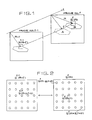
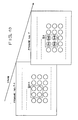
- the principle of the vector quantizer will be described prior to the description of the vector quantizer of Fig. 3. Referring to Fig. 1, assuming that an object has moved on the screen during the period from a frame No. f-1 to a frame No. f from a position A to a position B, then a block S f (R) including a plurality of the lattice samples of an image signal around a position vector R in the frame No. f becomes approximately equal to the block S f-1 (R-r) of the image signal at a position determined by subtracting a movement vector r from a position vector R in the frame No. f-1.
- FIG. 3 showing an example of the constitution of a conventional vector quantizer of this kind, there are shown an A/D converter 1, a raster/block scan converter 2, a frame memory 3, a movement vector detector 4, a variable delay circuit 5, a subtractor 6, a scalar quantizer 7, an adder 8 and a variable-length encoder 9.
- the A/D converter 1 converts an analog picture input signal 101 into the corresponding digital signal and gives a digital picture signal sequence 102 according to the sequence of raster scanning.
- the output procedure of the raster scan digital picture signal sequence 102 on the time series of the picture signal is converted into block scaning by the raster/block scan converter 2, and thereby the digital picture signal sequence is converted into a block scan picture input signal 103 arranged sequentially in lattice block units (the interior of the block is raster scanning) from the top to the bottom and from the left to the right on the screen.
- a regenerative picture signal 104 of one frame before regenerated according to interframe DPCM loop is read from the frame memory 3.
- the movement vectors (u, v) corresponds to the horizontal and the vertical shifts of the picture element of the block of the regenerative picture signal 104 of one frame before.
- the variable delay circuit 5 block-shifts the one-frame preceding regenerative picture signal 104 by the movement vector and gives a predictive picture signal 106 which is the closest to the present block scan picture input signal 103.
- the subtractor 6 calculates the differential between the block scan picture input signal 103 and the predictive picture signal 106 and gives a predictive error picture signal 107 to the scalar quantizer 7.
- the scalar quantizer 7 converts the predictive error picture signal 106 into a predictive error quantization picture signal 108 reduced in quantization level at picture element unit.
- the adder 8 adds the predictive error quantization picture signal 108 and the predictive picture signal 106 and gives a regenerative picture signal 109 including scalar quantization error to the frame memory 3.
- the frame memory performs delaying operation to delay the present regenerative picture signal 109 by one frame.
- the predictive picture signal 106 is p f (m, n)
- the predictive error signal 107 is ⁇ f (m, n)
- scalar quantization noise is Q f s (m, n)
- the predictive error quantization signal 108 is ⁇ f (m, n)
- the one-frame preceding regenerative picture signal 104 is ⁇ f-1 (m, n)
- Z -f denotes delay corresponding to one frame.
- Fig. 5 shows an example of the constitution of the movement vector detector 4 for carrying out movement compensation.
- FIG. 5 there are shown an analogy degree computation circuit 10, a movement region line memory 11, a line memory control circuit 12, an analogy degree comparator 13 and a movement vector latch 14.
- the movement vector detector 4 gives S f (R) produced by blocking a plurality of the sequences of the present picture input signal 103 to the analogy degree computation circuit 10.
- the lines of the one-frame preceding regenerative picture signal 104 stored in the frame memory 3 corresponding to the tracking range of the movement region of S f (R) are stored in the movement region line memory 11.
- the line memory control circuit 12 sends sequentially the blocks adjacent to a plurality of blocks S f-1 (R+r) of the one-frame preceding regenerative image signal 104 to the analogy degree computation circuit 10.
- the analogy degree computation circuit 10 computes the analogy degree L(u, v) of the blocks in the neighborhood of S f (R) and S f-1 (R-r) and the analogy degree comparator 13 determines the minimum analogy degree Since u and v corresponds to the horizontal and the vertical address shifts of blocks in the movement region line memory 11 respectively, the analogy degree comparator 13 gives a movement detection strobing signal 111 to the movement vector latch 14 when the analogy degree is minimized, to take in a movement vector address 112.
- the movement vector latch 14 sends the displacement r of S f-1 (R-r) relative to S f (R) minimizing the analogy degree L(u, v) as a movement vector 105 to the variable delay circuit 5 and the variable-length encoder 9 of Fig. 3.
- variable-length encoder 9 of Fig. 3 processes the movement vector 105 and the predictive error quantization signal 108 through variable-length encoding to reduce the amount of information of the picture signal.
- the variable-length encoding enables the transmission of the movement compensation inter-frame encoding output 110 at a low bit rate.
- the conventional movement compensation inter-frame encoder is constituted as described hereinbefore, the movement compensation operation is performed for every block and the inter-frame DPCM operation is performed for every picture element. Accordingly, the identification between the minute variation of the screen and noise is impossible and the variable-length encoding of the movement vector and the predictive error quantization signal is difficult. Furthermore, since the control of the variation of the quantity of produced information resulting from the variation of the movement scalar is difficult, a large loss is inevitable when transmission is carried out through a transmission channel of a fixed transmission capacity. Still further, encoding the predictive error quantization signal for every picture element is inefficient. Since the movement compensation system is liable to be affected by transmission channel error, the frame memory needs to be reset or repeated transmission when transmission channel error occurs, which requires long resetting time.
- An object of the present invention is to provide a vector quantizer capable of efficiently encoding a compensation predictive error signal at a reduced bit rate by performing adaptive vector quantization after judging the significance of the compensation predictive error signal in blocks, and capable of movement compensation inter-frame vector encoding in which variable-length encoding of movement vector is facilitated and information production control is achieved easily.
- Further object of the present invention is to provide a vector quantizer capable of preventing the accumulation of vector quantization errors by inserting a low pass filter in the output of a frame memory and changing over the mode to vector-quantize the blocks themselves of a picture signal sequence instead of the blocks of a predictive error signal when the correlation between successive frames is very low, and capable of restricting the sudden increase of vector quantization error even when the frame changes greatly.
- Still further object of the present invention is to provide a vector quantizer capable of improving dynamic picture encoding efficiency by processing an output vector constituted from the picture signal of the preceding frame by the use of the correlation between frames through dynamic vector quantization and processing the residual error signal further through fixed vector quantization.
- Still further object of the present invention is to provide a vector quantizer having, in cascaded connection, a dynamic vector quantizer for quantizing dynamic vectors and the like and a differential vector quantizer each being constituted to perform coding by the use of a set of output vectors having the least distortion, and thereby capable of encoding periodic signals such as picture signals extremely efficiently.
- Further object of the present invention is to provide a dynamic multi-stage vector quantizer capable of eliminating the redundant component between frames by providing a dynamic preliminary vector quantizer to perform vector quantization while updating a code table in blocks and capable of achieving highly efficient encoding at a further reduced bit rate through the average value separation and the amplitude normalization vector quantization of residual signals in blocks by a fixed last vector quantizer.
- Still further object of the present invention is to provide a sequential approximation vector quantizer employing tree search vector quantization in the vector quantization segment and capable of preventing unnatural regenerated picture when the picture changes suddenly even if the feedback control of the amount of data is performed, through sequential approximation at each stage, namely, through the variable control of the number of stages.
- Still further object of the present invention is to provide a picture signal vector quantizer of high coding efficiency, designed to vector-quantize a picture signal by blocking the difference between the picture signal and the picture element of the preceding neighbor frame corresponding to the same position on the screen over the channels after sampling the picture signal in channels and digitizing the picture signal, and capable of transmitting a plurality of channels through a single channel by deciding, on the basis of the inter-frame difference of the neighbor picture element which has already been coded and transmitted and the inter-frame difference of the picture element to be transmitted, whether or not the present picture element has made a significant change with respect to the preceding neighbor frame, by encoding and transmitting the information when the present picture element has not made any significant change and improving the efficiency of vector quantization by normalizing the inter-frame difference of the picture element to be transmitted by the use of the inter-frame difference of the neighbor picture element when the present picture element has made a significant change.
- This embodiment is an inter-frame vector quantizer capable of performing highly efficient coding of picture signals by the use of the correlation between picture signals in consecutive scenes.
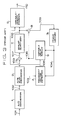
- Fig.6 is a block diagram showing the constitution of an encoder.
- indicated at 701 is a digitized picture signal sequence
- at 702 is a raster/block scan converter for blocking every plurality of picture signal sequences 701 arranged along the direction of raster scanning
- at 703 is blocked picture signal sequence
- at 704 is a subtracter
- at 705 is the predictive error signal sequence of the blocked picture signal
- at 706 is a movement detection vector quantized encoder
- at 707 is a vector quantization coded output
- at 708 is a vector quantization decoder
- at 709 is a vector quantization decoded output, i.e., a regenerative predictive error signal sequence
- at 710 is an adder
- at 711 is a block of regenerated picture signal sequences
- at 712 is a frame memory
- at 713 is a block of regenerative picture signal sequences delayed by a one-
- Fig.9 shows the details of an exemplary constitution of the vector quantization encoder 706.
- Fig.7 indicated at 717 is a mean value separating circuit, at 718 is an amplitude normalizing circuit, at 719 is the inter-frame difference of the block of picture signal sequences normalized with respect to amplitude after separating the mean value, at 720 is a mean value calculated by the mean value separating circuit 717, at 721 is the amplitude calculated by the amplitude normalizing circuit 718, at 722 is a movement detection circuit for deciding, on the basis of the mean value 720 and the amplitude 721, whether or not the blocked picture signal sequences which are presently being processed have made any significant movement with respect to the block of picture signal sequences located at the same position in the one-frame cycle preceding frame, at 723 is the dicision signal given by the movement detection circuit 722, at 724 is a code table address counter, at 725 is a code table index, at 726 is an output vector code table memory, at 727 is a code table output
- Fig.8 shows the details of the constitution of the vector quantization decoder 708.
- indicated at 732 is a reception latch
- at 733 is an amplitude regenerating circuit
- at 734 is a mean value regenerating circuit.
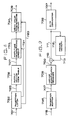
- Fig.9 shows an exemplary constitution of the decoder.
- indicated at 735 is a reception buffer
- at 736 is a block/raster scan converter which acts reversely to the raster/block scan converter 702 and at 737 is a regenerated picture signal sequences.
- this encoder is based on the conception of the inter-frame DPCM system.
- the digitized picture signal sequences 701 are regarded as square lattice samples, however, the input is given in an order along the raster scanning direction.
- the raster/block scan converter 702 partitions the picture signal sequences 701 in blocks as shown in Fig.10 and provides these blocks as output signal.
- the differences 705 between the signal source vectors 703 and the blocks 713 of the predictive signal sequences calculated by the subtractor 704 is ⁇ f
- the blocks 709 of the regenerative differential signal sequences formed by the vector quantization encoder 706 and the vector quantization decoder 708 is ⁇ f
- the predictive signal sequences 713 given by the frame memory 712 is P f .
- the general actions of the encoder shown in Fig.8 are expressed by where Q is a vector quantization error and Z -f is a delay of one-frame cycle caused by the frame memory 712.
- P f is equal to the regenerative signal sequence ⁇ f-1 of the block S f-1 of picture signal sequences one-frame cycle before the signal source vector 703, namely, the picture signal sequence at the same position in the frame No. f-1.
- the vector quantization coded output 707 obtained through the above-mentioned process is the difference between the signal source vector 703 and the block 713 of the predictive signal sequences namely, a result of data-compression of the block ⁇ f 705 of the predictive error signals by the vector quantization encoder 706 and the output 707 is given to the transmission buffer 714, and then given to the transmission line as the encoder output 716.
- a block composed of k pieces of samples (k is the plural number) is regarded as an input vector in k-dimensional signal space
- output vectors which have minimum distortion with respect to input vectors which are given sequentially are selected from a set of output vectors prepared previously on the basis of the probability distribution of input vectors so that the distortion with respect to the input vector is generally minimized
- the indices attached to the selected output vectors are quantized and given as outputs.
- output vectors corresponding to the indices are read from the same set of output vectors prepared also in the decoding section.
- the amplitude may be calculated by formulas other than formula (3), such as, for example,
- the input vectors can be distributed at random within a limited range in k-dimensional signal space, and thereby the efficiency of vector quantization is improved.
- the set of output vectors needs to be prepared on the basis of the distribution of the input vectors processed through the mean value separation normalizing process and, after the output vectors have been read in the decoding section, processes reverse to the mean value separation normalizing process, such as amplitude regeneration and mean value regeneration, need to be implemented.
- vector quantization may be such a vector quantization omitting those reverse processes.
- Mean value separation normalized output vectors prepared on the basis of the probability distribution density of the mean value separation normalized input vector so that the distortion from the mean value separation normalized input vectors is generally minimized are written previously in the output vector code table memory 726.
- the distortion calculating circuit 728 calculates the difference between the mean value separation normalized input vector S 719 and the mean value separation normalized output vector y ⁇ 727.
- Several distortion calculating methods are available, for example, such as those shown below. where d( X , y ⁇ ) is distortion.
- the minimum distortion detecting circuit 729 gives a strobing signal 730 when a distortion d( X , y ⁇ ) which is smaller than the past minimum distortion is found.
- the latch 731 stores the index 725.
- the index i of a mean value separation normalized output vector which minimizes distortion from the mean value separation normalized input vector is stored in the latch 731.
- the index, the mean value ⁇ 720 and the amplitude ⁇ 721 form the vector quantization coded output.
- the data is compressed further by the use of the correlation between successive scenes. Since the input vectors are blocked predictive error signals, the input vectors are distributed around a zero vector.
- the amount of data can be reduced considerably by setting a threshold to regard input vectors distributed near the zero vector as zero vectors and providing neither index, mean value nor amplitude.
- the movement detecting circuit 722 receives the mean value ⁇ 720 and the amplitude ⁇ 721 and decides whether or not the block of the predictive error signal sequences can be regarded as a zero vector, namely, the present block has made any significant variation (movement) with respect to the corresponding block in the one-frame cycle preceding frame. This decision is made by examining the mean value and the amplitude with respect to a threshold T ⁇ as when ⁇ ⁇ T ⁇ and ⁇ ⁇ T ⁇ , significant movement has not been made and when ⁇ > T or ⁇ > T ⁇ , significant movement has been made.
- the latch 731 gives only a signal indicating "no movement” when a code indicating "no movement” is given as the result 723 of movement detection and gives the index 725, the mean value 720 and the amplitude 721 in addition to a signal indicating "movement” as a vector quantization coded output signal 707.
- the transmission buffer 714 keeps monitoring the amount of information transmitted and gives a feedback control signal 715 to control the threshold T ⁇ . Thus the amount of information transmitted is controlled.
- the latch 732 receives the vector quantization coded output 707.
- the latch 732 Upon the reception of a signal indicating "movement", the latch 732 reads a mean value separation normalized output vector y ⁇ 727 from the output code table memory 726 according to the index i 725.
- the reception buffer 734 receives the encoder output 716 and decodes the vector quantization coded output signal 707.
- the vector quantization decoder 708 decodes, as described above, the output vector, i.e., the predictive error signal sequences ⁇ f 709, and the adder 710 and the frame memory 712 regenerate the block ⁇ f 711 of regenerated picture signal sequences through operation based on the following formulas, where Q is vector quantization error and Z -f is a delay of one-frame cycle.
- the block/raster converter 736 scans in the raster scanning direction and converts the blocked regenerated picture signal sequences ⁇ f 711 to provide regenerated picture signal sequences 737.
- each node corresponds to k-dimensional signal space R k and to a space formed by partitioning R k in steps respectively.
- Each node has a representative point, which is the output vector of k dimensions.
- the output vectors of each step are produced on the basis of the distribution of input vectors so that the total sum of distortions between the input vectors and the output vectors is minimized. That is, the stepped partition of the space is made on the basis of the distribution of input vectors in R k .
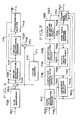
- Fig. 14 shows an exemplary constitution of an encoder according to the present invention.
- Fig. 14 shows an exemplary constitution of an encoder according to the present invention.
- At 701 are digitized picture signal sequences
- at 702 is a raster/block scan converter
- at 703 are blocked picture signals
- at 704 is a subtractor
- at 705 is a block of predictive error signals
- at 738 is a TSVQ encoder based on the above-mentioned principle
- at 739 is a TSVQ encoder output
- at 740 is a TSVQ decoder
- at 741 is a TSVQ decoder output
- at 710 is an adder
- at 742 is a block of regenerated picture signals
- at 712 is a frame memory
- at 743 is an output of the frame memory 712, i.e., a block of predictive signals
- at 744 is a transmission buffer
- at 745 is a feedback control signal
- at 746 is an encoder output.
- Fig. 13 shows the details of an exemplary constitution of the TSVQ encoder 738.
- indicated at 747 is a limiter which measures the distance between an input vector and the origin and quantizes the input vector into a zero vector when the distance is smaller than a threshold
- at 748 is a zero vector detection signal given when an input vector is quantized into a zero vector by the limiter 747
- at 749 is a coding controller
- at 750 is a first-stage TSVQ encoder
- at 751 is an output vector index given at a stage where the search has been made as far as the first-stage TSVQ encoder
- at 752 is a second-stage TSVQ encoder
- at 753 is an output vector index given at a stage where search has been made as far as the second-stage TSVQ encoder 752
- at 754 is a third-stage TSVQ encoder and at 755 is an output vector index given at a stage where the search has been made as far as the third-stage TSVQ encoder
- Fig. 14 shows the further details of an exemplary constitution of the second-stage TSVQ encoder 752.
- indicated at 756 is a second-stage output vector code table memory
- at 757 is a parallel distortion calculating circuit
- at 758 is a distortion comparator
- at 759 is a resultant signal of comparison given by the distortion comparator 758
- at 760 is an index register.
- Fig. 15 shows an exemplary constitution of the TSVQ decoder 740.
- indicated at 761 is an index latch
- at 762 is an output vector index
- at 763 is an output vector code table memory.
- Fig. 16 shows an exemplary constitution of a decoder according to the present invention.
- indicated at 764 is a reception buffer and at 765 are regenerated picture signal sequences.
- Digitized picture signal sequences 701 are samples given sequentially along the direction of raster scanning.
- the raster/block scan converter 702 blocks every k picture signal sequences and scans and converts the blocks sequentially.
- ⁇ f is the difference 705 between the signal source vector 703 and the block 743 of predictive signals, calculated by the subtracter 704, ⁇ f is a TSVQ decoded output formed by the TSVQ encoder 738 and the TSVQ decoder 739, i.e., a block 741 of the regenerated predictive error signals, ⁇ f is a block of regenerated signals, and P f is a block 743 of predictive signals obtained as a block of regenerated picture signals delayed by one-frame cycle by the frame memory 713.
- the basic actions of the encoder shown in Fig.12 are expressed by: where Q is a vector quantization error and z -t is a delay of one-frame cycle caused by the frame memory 712.
- the encoder is constituted on the basis of the inter-frame DPCM system.
- the transmission buffer 744 receives a TSVQ coded output 739 and gives a coded output 746 to a transmission line.
- the transmission buffer 744 monitors the amount of transmitted information and controls the amount of coded data in the TSVQ encoder 738 according to the feedback control signal 745.
- the mode of this control, the TSVQ encoder and the TSVQ decoder will be described in connection with Figs. 13, 14 and 15. Suppose an output vector set Y of a binary tree structure as shown in Fig. 11 is obtained.
- Y is formed previously on the basis of the distribution of input vectors so that the total sum of the distortions of the vectors belonging to each step of the binary tree from the input vectors is minimized.
- Tree search vector quantization if the repetition of comparison for distortion between paired two output vectors and an input vector to decide paired two output vectors to be compared at the next step.
- the three steps of the tree shown in Fig. 11 correspond to the first-stage TSVQ encoder 750, the second-stage TSVQ encoder 752 and the third-stage TSVQ encoder 754 of Fig. 13.
- the block ⁇ f 705 of predictive error signals is given as an input vector.
- the limiter 747 calculates the distortion of the input vector from the origin (zero vector) and regards the input vector 705 as a zero vector when the distortion is smaller than a predetermined threshold and gives a zero vector detection signal 748.
- This process is expressed by: when d( ⁇ ⁇ f , 0 ⁇ ) ⁇ T ⁇ , ⁇ ⁇ f ⁇ 0 (10) where T ⁇ is a threshold, ⁇ f is an input vector and d( ⁇ f , 0 ) is the distortion of the input vector from the zero vector.
- T ⁇ is a threshold
- ⁇ f is an input vector
- d( ⁇ f , 0 ) is the distortion of the input vector from the zero vector.
- the input vectors which have not been regarded as a zero vector are processed through the first-, the second- and the third-stage TSVQ encoders for tree search vector quantization.
- the distortion between the input vector and paired two output vectors assigned through the distortion comparison at the preceding stage is calculated to select one of the paired two vectors which has a smaller distortion from the input vector than the other. This information is added to the results of comparison given by the preceding stages and is sent to the next stage.
- the result of comparison at the previous stages is neither necessary nor available.
- the result of distortion comparison at the first stage is i1 751.
- the distortion between the input vector and a pair of output vectors assigned on the basis of i1 is calculated.
- the result of the calculation is added to i1 to form i2.
- the third stage receives the input vector ⁇ f an i2 and gives an index i3. For example, as shown in Fig. 11, suppose "zero" is assigned when the left branch is selected and "1" is assigned when the right branch is selected.
- i1, i2 and i3 are expressed by one-digit, two-digit and three-digit binary numbers respectively corresponding to the indices of the output vectors.
- the number of stages of tree search vector quantization is controlled variably by the feedback control signal for variable-length coding.
- the coding controller 749 receives the feedback control signal 745, the zero vector detection signal 748, the index i1 751, the index i2 753 and the index i3 755 and, when the input vector is regarded as a zero vector, codes a code corresponding to zero vector. then the input vector is not regarded as a zero vector, the coding controller codes i1, i2 or i3 on the basis of the feedback control signal 745 as an output vector index.
- the transmission line namely, the consecutive approximation of the input vector at each stage
- the output of a stage closer to the first stage is coded and, when the transmission line has a reserve, the output of the last stage is coded.
- the amount of information of the input of a stage closer to the first stage is smaller, therefore, the amount of information to be coded is controlled in the manner as mentioned above.
- Fig. 14 shows an exemplary constitution of the second-stage TSVQ encoder 752.
- Output vectors corresponding to the second step of the output vector set Y are stored in the second-stage output vector code table memory 756.
- the second-stage output vector code table memory 752 provides a pair of output vectors assigned by the index 751 of the preceding stage.
- the parallel distortion calculating circuit 757 calculates the distortions of the pair of output vectors from the input vector 705 and the distortion comparator 758 compares the distortions and gives the result of comparison as a control signal 759.
- the index register 760 adds the result of distortion comparison at the second stage to the index 751 given by the preceding stage and gives a second-stage index 753.
- the actions of the first stage and the third stage are almost the same as that of the second stage, except that the respective output vector code table memories of the first, second and third stages store output vector sets corresponding to the first, second and third stages respectively and that the first stage is not provided with the index of the preceding stage.
- All the output vectors belonging to the output vector set Y and zero vectors are stored in the output vector code table memory 763 of the TSVQ decoder 740.
- the index latch 761 decodes the code of the zero vector or the index of the output vector on the basis of the TSVQ coded output 739 and reads a TSVQ decoded output 741 from the output vector code table memory 763.
- the operation of the decoder of this invention will be described in connection with Fig. 16.
- the reception buffer 764 receives the encoder output 746 and decodes the TSVQ coded output 739.
- the TSVQ decoder 740 decodes the output vectors as described earlier and the adder 710 and the frame memory 712 regenerate the block ⁇ f of regenerative picture signal suquences through operation given by: where Q is a vector quantization error, Z -t is a delay of one-frame cycle caused by the frame memory 712 and ⁇ f is a block of regenerative predictive error signals obtained as output vectors.
- the block/raster scan converter 736 scans the block ⁇ f 742 along the direction of raster scanning and converts the same into a regenerated picture signal sequences 765.
- This embodiment is applicable to wide technical range relating to television transmission without being limited particularly to inter-frame coding and is also applicable to a sequential approximation quantizer capable of controlling the amount of data.
Landscapes
- Engineering & Computer Science (AREA)
- Multimedia (AREA)
- Signal Processing (AREA)
- Physics & Mathematics (AREA)
- General Physics & Mathematics (AREA)
- Theoretical Computer Science (AREA)
- Computer Vision & Pattern Recognition (AREA)
- Compression Or Coding Systems Of Tv Signals (AREA)
- Compression, Expansion, Code Conversion, And Decoders (AREA)
Applications Claiming Priority (17)
| Application Number | Priority Date | Filing Date | Title |
|---|---|---|---|
| JP58163617A JPS6055790A (ja) | 1983-09-06 | 1983-09-06 | ベクトル量子化方式フレ−ム間符号化装置 |
| JP163617/83 | 1983-09-06 | ||
| JP59001669A JPS60146363A (ja) | 1984-01-09 | 1984-01-09 | 動き補償フレ−ム間ベクトル符号化器 |
| JP1669/84 | 1984-01-09 | ||
| JP6473/84 | 1984-01-18 | ||
| JP59006473A JPS60150339A (ja) | 1984-01-18 | 1984-01-18 | 画像のサブサンプルベクトル量子化器 |
| JP59014606A JPS60158787A (ja) | 1984-01-30 | 1984-01-30 | フレ−ム間ベクトル符号化器 |
| JP14606/84 | 1984-01-30 | ||
| JP59014607A JPS60158788A (ja) | 1984-01-30 | 1984-01-30 | 動き補償ベクトル量子化器 |
| JP14607/84 | 1984-01-30 | ||
| JP17281/84 | 1984-02-02 | ||
| JP59017281A JPS60162391A (ja) | 1984-02-02 | 1984-02-02 | 逐次近似ベクトル量子化器 |
| JP32918/84 | 1984-02-23 | ||
| JP59032918A JPS60177782A (ja) | 1984-02-23 | 1984-02-23 | ダイナミツク多段ベクトル量子化器 |
| JP59049901A JPS60194686A (ja) | 1984-03-15 | 1984-03-15 | ダイナミツク多段ベクトル量子化器 |
| JP49901/84 | 1984-03-15 | ||
| EP84110641A EP0137314B1 (fr) | 1983-09-06 | 1984-09-06 | Quantificateur de vecteurs pour de l'information image |
Related Parent Applications (1)
| Application Number | Title | Priority Date | Filing Date |
|---|---|---|---|
| EP84110641.2 Division | 1984-09-06 |
Publications (3)
| Publication Number | Publication Date |
|---|---|
| EP0446968A2 true EP0446968A2 (fr) | 1991-09-18 |
| EP0446968A3 EP0446968A3 (en) | 1993-03-17 |
| EP0446968B1 EP0446968B1 (fr) | 1995-07-05 |
Family
ID=27571445
Family Applications (5)
| Application Number | Title | Priority Date | Filing Date |
|---|---|---|---|
| EP91108921A Expired - Lifetime EP0446968B1 (fr) | 1983-09-06 | 1984-09-06 | Quantificateur vectoriel |
| EP84110641A Expired - Lifetime EP0137314B1 (fr) | 1983-09-06 | 1984-09-06 | Quantificateur de vecteurs pour de l'information image |
| EP91108920A Expired - Lifetime EP0451879B1 (fr) | 1983-09-06 | 1984-09-06 | Quantificateur vectoriel |
| EP91108385A Withdrawn EP0450664A1 (fr) | 1983-09-06 | 1984-09-06 | Quantificateur de vecteurs pour l'information d'image |
| EP91108993A Expired - Lifetime EP0457362B1 (fr) | 1983-09-06 | 1984-09-06 | Quantificateur de vecteurs |
Family Applications After (4)
| Application Number | Title | Priority Date | Filing Date |
|---|---|---|---|
| EP84110641A Expired - Lifetime EP0137314B1 (fr) | 1983-09-06 | 1984-09-06 | Quantificateur de vecteurs pour de l'information image |
| EP91108920A Expired - Lifetime EP0451879B1 (fr) | 1983-09-06 | 1984-09-06 | Quantificateur vectoriel |
| EP91108385A Withdrawn EP0450664A1 (fr) | 1983-09-06 | 1984-09-06 | Quantificateur de vecteurs pour l'information d'image |
| EP91108993A Expired - Lifetime EP0457362B1 (fr) | 1983-09-06 | 1984-09-06 | Quantificateur de vecteurs |
Country Status (2)
| Country | Link |
|---|---|
| EP (5) | EP0446968B1 (fr) |
| DE (4) | DE3485716D1 (fr) |
Cited By (5)
| Publication number | Priority date | Publication date | Assignee | Title |
|---|---|---|---|---|
| EP0559383A1 (fr) * | 1992-03-02 | 1993-09-08 | AT&T Corp. | Méthode et dispositif pour coder des signaux audio utilisant des modèles perceptuels |
| EP0576765A1 (fr) * | 1992-06-30 | 1994-01-05 | International Business Machines Corporation | Méthode pour coder des données digitales à l'aide de techniques de quantification vectorielle et dispositif pour mettre en oeuvre cette méthode |
| US6285994B1 (en) | 1999-05-25 | 2001-09-04 | International Business Machines Corporation | Method and system for efficiently searching an encoded vector index |
| WO2015108463A1 (fr) * | 2014-01-15 | 2015-07-23 | Anacatum Design Ab | Convertisseur de signal cognitif |
| EP2204999A4 (fr) * | 2007-10-30 | 2016-04-27 | Nippon Telegraph & Telephone | Procédé de codage et procédé de décodage d'images, leur dispositif, leur programme, et support d'enregistrement sur lequel est enregistré le programme |
Families Citing this family (6)
| Publication number | Priority date | Publication date | Assignee | Title |
|---|---|---|---|---|
| USRE34562E (en) * | 1986-10-16 | 1994-03-15 | Mitsubishi Denki Kabushiki Kaisha | Amplitude-adaptive vector quantization system |
| EP0624036A1 (fr) * | 1987-04-28 | 1994-11-09 | Mitsubishi Denki Kabushiki Kaisha | Système pour le codage et le décodage d'images |
| FI92272C (fi) * | 1992-05-20 | 1994-10-10 | Valtion Teknillinen | Kuvansiirtojärjestelmän tiivistyskoodausmenetelmä |
| FI94307C (fi) * | 1993-07-05 | 1995-08-10 | Nokia Oy Ab | Menetelmä ja laite ennustuslohkon hakemiseksi prediktiivisen videonkompression yhteydessä |
| US5499057A (en) * | 1993-08-27 | 1996-03-12 | Sony Corporation | Apparatus for producing a noise-reducded image signal from an input image signal |
| DE10065783B4 (de) * | 2000-12-30 | 2007-05-03 | Leica Microsystems Cms Gmbh | Verfahren, Anordnung und System zur Ermittlung von Prozessgrößen |
Family Cites Families (6)
| Publication number | Priority date | Publication date | Assignee | Title |
|---|---|---|---|---|
| FR2101155B1 (fr) * | 1970-08-31 | 1974-09-20 | Ortf | |
| GB2003001A (en) * | 1977-08-16 | 1979-02-28 | Dennis T | Improvements in methods and apparatus for coding digital television signals |
| US4125861A (en) * | 1977-08-18 | 1978-11-14 | Bell Telephone Laboratories, Incorporated | Video signal encoding |
| GB2050752B (en) * | 1979-06-07 | 1984-05-31 | Japan Broadcasting Corp | Motion compensated interframe coding system |
| US4375650A (en) * | 1981-04-29 | 1983-03-01 | General Electric Company | System for processing video signals |
| DE3382806T2 (de) * | 1982-06-11 | 1996-11-14 | Mitsubishi Electric Corp | Vektorquantisierer |
-
1984
- 1984-09-06 DE DE8484110641T patent/DE3485716D1/de not_active Expired - Lifetime
- 1984-09-06 EP EP91108921A patent/EP0446968B1/fr not_active Expired - Lifetime
- 1984-09-06 DE DE3486396T patent/DE3486396T2/de not_active Expired - Fee Related
- 1984-09-06 EP EP84110641A patent/EP0137314B1/fr not_active Expired - Lifetime
- 1984-09-06 EP EP91108920A patent/EP0451879B1/fr not_active Expired - Lifetime
- 1984-09-06 DE DE3486398T patent/DE3486398T2/de not_active Expired - Fee Related
- 1984-09-06 EP EP91108385A patent/EP0450664A1/fr not_active Withdrawn
- 1984-09-06 DE DE3486397T patent/DE3486397T2/de not_active Expired - Fee Related
- 1984-09-06 EP EP91108993A patent/EP0457362B1/fr not_active Expired - Lifetime
Cited By (8)
| Publication number | Priority date | Publication date | Assignee | Title |
|---|---|---|---|---|
| EP0559383A1 (fr) * | 1992-03-02 | 1993-09-08 | AT&T Corp. | Méthode et dispositif pour coder des signaux audio utilisant des modèles perceptuels |
| US5481614A (en) * | 1992-03-02 | 1996-01-02 | At&T Corp. | Method and apparatus for coding audio signals based on perceptual model |
| EP0576765A1 (fr) * | 1992-06-30 | 1994-01-05 | International Business Machines Corporation | Méthode pour coder des données digitales à l'aide de techniques de quantification vectorielle et dispositif pour mettre en oeuvre cette méthode |
| US5444488A (en) * | 1992-06-30 | 1995-08-22 | International Business Machines Corporation | Method and apparatus for coding digital data using vector quantizing techniques |
| US6285994B1 (en) | 1999-05-25 | 2001-09-04 | International Business Machines Corporation | Method and system for efficiently searching an encoded vector index |
| EP2204999A4 (fr) * | 2007-10-30 | 2016-04-27 | Nippon Telegraph & Telephone | Procédé de codage et procédé de décodage d'images, leur dispositif, leur programme, et support d'enregistrement sur lequel est enregistré le programme |
| WO2015108463A1 (fr) * | 2014-01-15 | 2015-07-23 | Anacatum Design Ab | Convertisseur de signal cognitif |
| US9602123B2 (en) | 2014-01-15 | 2017-03-21 | Anatacum Design Ab | Cognitive signal converter |
Also Published As
| Publication number | Publication date |
|---|---|
| EP0137314A3 (en) | 1986-08-20 |
| EP0457362A1 (fr) | 1991-11-21 |
| EP0446968A3 (en) | 1993-03-17 |
| DE3486398T2 (de) | 1995-12-07 |
| EP0446968B1 (fr) | 1995-07-05 |
| DE3486396T2 (de) | 1996-02-01 |
| EP0137314A2 (fr) | 1985-04-17 |
| DE3486397D1 (de) | 1995-08-10 |
| EP0450664A1 (fr) | 1991-10-09 |
| DE3486397T2 (de) | 1996-01-04 |
| DE3485716D1 (de) | 1992-06-17 |
| DE3486396D1 (de) | 1995-08-10 |
| EP0451879B1 (fr) | 1995-07-05 |
| EP0137314B1 (fr) | 1992-05-13 |
| EP0457362B1 (fr) | 1995-07-05 |
| EP0451879A3 (en) | 1992-12-23 |
| DE3486398D1 (de) | 1995-08-10 |
| EP0451879A2 (fr) | 1991-10-16 |
Similar Documents
| Publication | Publication Date | Title |
|---|---|---|
| US4670851A (en) | Vector quantizer | |
| EP0411675B1 (fr) | Dispositif de codage intertrame | |
| US4560977A (en) | Vector quantizer | |
| US5086439A (en) | Encoding/decoding system utilizing local properties | |
| CA1212452A (fr) | Quantificateur vectoriel | |
| US4933761A (en) | Image coding and decoding device | |
| EP0473384B1 (fr) | Dispositif de codage de signaux d'image digitaux | |
| US5592228A (en) | Video encoder using global motion estimation and polygonal patch motion estimation | |
| KR910000707B1 (ko) | 화상 부호화 전송방법 및 장치 | |
| US6008852A (en) | Video coder with global motion compensation | |
| US4816914A (en) | Method and apparatus for efficiently encoding and decoding image sequences | |
| USRE36380E (en) | Orthogonal transform coding apparatus | |
| KR970002967B1 (ko) | 영역 분류패턴을 이용한 움직임벡터 검출장치 | |
| EP0446968B1 (fr) | Quantificateur vectoriel | |
| EP0260721B1 (fr) | Procédé et appareil de codage des signaux d'images à mouvements | |
| US5940539A (en) | Motion vector detecting apparatus and method | |
| US5444488A (en) | Method and apparatus for coding digital data using vector quantizing techniques | |
| JP2841362B2 (ja) | 高能率符号化装置 | |
| US6064696A (en) | Encoding apparatus | |
| Bage | Interframe predictive coding of images using hybrid vector quantization | |
| JPH0229276B2 (fr) | ||
| CA1248237A (fr) | Quantificateur vectoriel | |
| CA1292057C (fr) | Appareil de codage et de transmission d'image | |
| JPH0569354B2 (fr) | ||
| JPH0666948B2 (ja) | フレーム間ベクトル量子化符号化復号化装置 |
Legal Events
| Date | Code | Title | Description |
|---|---|---|---|
| PUAI | Public reference made under article 153(3) epc to a published international application that has entered the european phase |
Free format text: ORIGINAL CODE: 0009012 |
|
| AC | Divisional application: reference to earlier application |
Ref document number: 137314 Country of ref document: EP |
|
| AK | Designated contracting states |
Kind code of ref document: A2 Designated state(s): DE FR GB NL |
|
| PUAL | Search report despatched |
Free format text: ORIGINAL CODE: 0009013 |
|
| AK | Designated contracting states |
Kind code of ref document: A3 Designated state(s): DE FR GB NL |
|
| 17P | Request for examination filed |
Effective date: 19930909 |
|
| 17Q | First examination report despatched |
Effective date: 19940217 |
|
| GRAA | (expected) grant |
Free format text: ORIGINAL CODE: 0009210 |
|
| AC | Divisional application: reference to earlier application |
Ref document number: 137314 Country of ref document: EP |
|
| AK | Designated contracting states |
Kind code of ref document: B1 Designated state(s): DE FR GB NL |
|
| REF | Corresponds to: |
Ref document number: 3486396 Country of ref document: DE Date of ref document: 19950810 |
|
| ET | Fr: translation filed | ||
| PGFP | Annual fee paid to national office [announced via postgrant information from national office to epo] |
Ref country code: FR Payment date: 19950817 Year of fee payment: 12 |
|
| PGFP | Annual fee paid to national office [announced via postgrant information from national office to epo] |
Ref country code: NL Payment date: 19950922 Year of fee payment: 12 |
|
| PGFP | Annual fee paid to national office [announced via postgrant information from national office to epo] |
Ref country code: DE Payment date: 19950926 Year of fee payment: 12 |
|
| PLBE | No opposition filed within time limit |
Free format text: ORIGINAL CODE: 0009261 |
|
| STAA | Information on the status of an ep patent application or granted ep patent |
Free format text: STATUS: NO OPPOSITION FILED WITHIN TIME LIMIT |
|
| 26N | No opposition filed | ||
| REG | Reference to a national code |
Ref country code: GB Ref legal event code: 746 Effective date: 19960611 |
|
| PGFP | Annual fee paid to national office [announced via postgrant information from national office to epo] |
Ref country code: GB Payment date: 19960828 Year of fee payment: 13 |
|
| PG25 | Lapsed in a contracting state [announced via postgrant information from national office to epo] |
Ref country code: FR Effective date: 19960930 |
|
| PG25 | Lapsed in a contracting state [announced via postgrant information from national office to epo] |
Ref country code: NL Effective date: 19970401 |
|
| NLV4 | Nl: lapsed or anulled due to non-payment of the annual fee |
Effective date: 19970401 |
|
| PG25 | Lapsed in a contracting state [announced via postgrant information from national office to epo] |
Ref country code: DE Effective date: 19970603 |
|
| REG | Reference to a national code |
Ref country code: FR Ref legal event code: ST |
|
| REG | Reference to a national code |
Ref country code: FR Ref legal event code: ST |
|
| PG25 | Lapsed in a contracting state [announced via postgrant information from national office to epo] |
Ref country code: GB Free format text: LAPSE BECAUSE OF NON-PAYMENT OF DUE FEES Effective date: 19970906 |
|
| GBPC | Gb: european patent ceased through non-payment of renewal fee |
Effective date: 19970906 |